

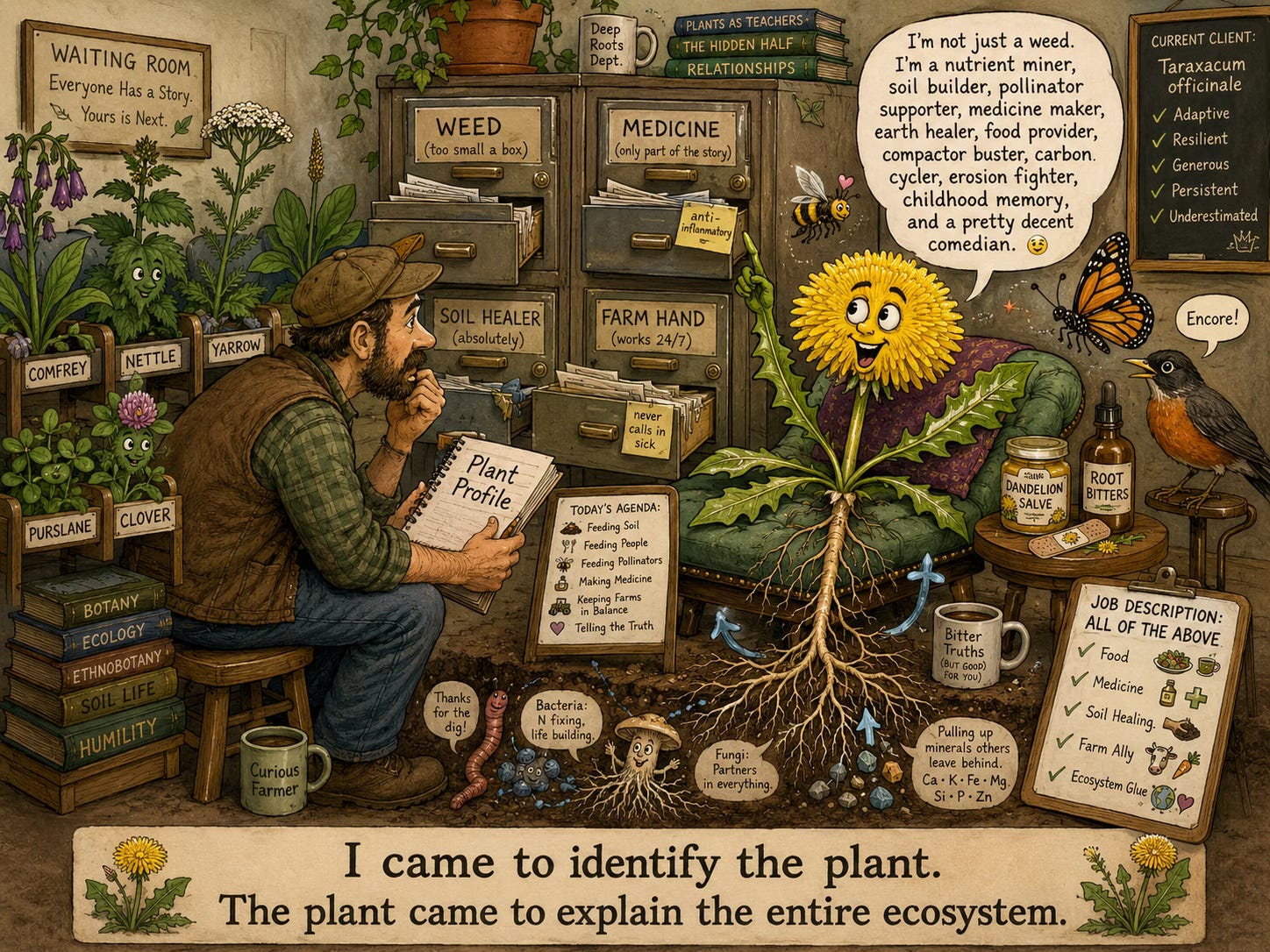
Each plant profile is like sitting beside a plant long enough to hear more than its name.
The plant profiles are not about identifying a plant or cataloging its uses. They follow the plant through its relationships, with soil, insects, microbes, animals, medicine, food, farming, and the people who’ve leaned on it for a few thousand years.
The structure is layered because the plant is.
It has a botanical identity, an ecological role, a relationship with the ground beneath it, a chemistry, a long history with us, a life among insects and animals, and a possible future in how we heal land.
I build them this way because no plant lives alone. A weed in a vineyard, a herb in a garden, a wild thing on the edge of a field, each one is responding to something. It might be reading compaction back to you, or disturbance, or a mineral the ground is short on. It might be feeding pollinators, holding soil, pulling nutrients up from deep, or offering medicine. The plant is always saying something. Most of us just never learned to listen.
So what I’m after isn’t more information. It’s a different way of seeing. Instead of “What’s this good for?” or “How do I kill it?”, I want us asking: Why is it here? What’s it doing? What does it tell me about the land, and how do I work with it instead of against it?
Who we’ve sat with so far
If you’re new here, the profiles have piled up into something like a field guide written from the plant’s side of the conversation. A few ways into them.
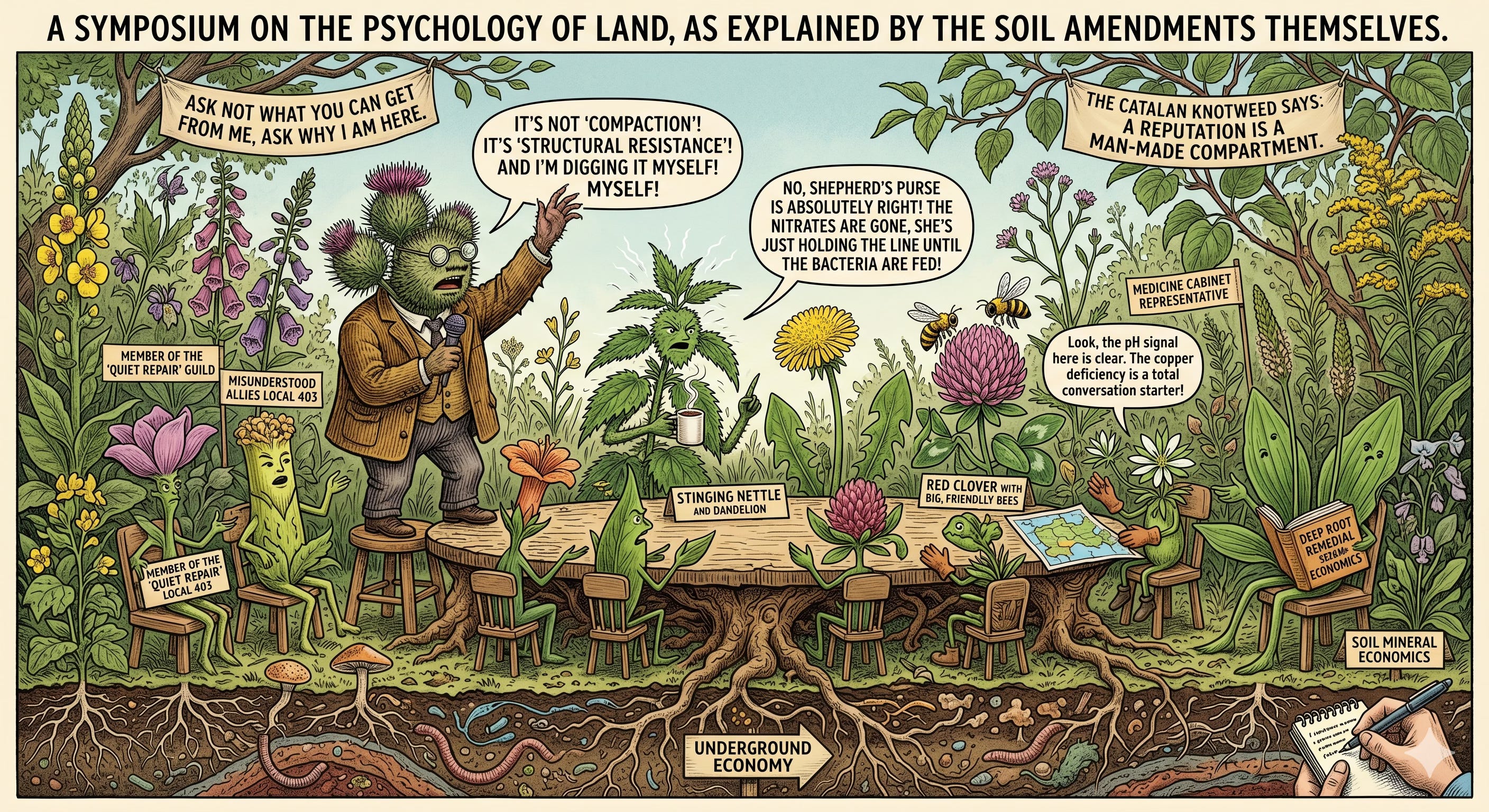
The soil healers. Comfrey, stinging nettle, yarrow, red clover, chickweed, purslane, horsetail, and plantain, the ones quietly doing repair work. Mining minerals, building biomass, feeding the underground economy, knitting bare ground back together while we weren’t paying attention.
The misunderstood ones. Dandelion, bindweed, knotweed, plantain, burdock, mallow, lambsquarters, goldenrod, and shepherd’s purse, the plants we’ve been taught to resent. Most of them turn out to be allies wearing the wrong reputation. They show up where the land is asking for exactly what they provide.
The medicine cabinet. Plantain, yarrow, nettle, horsetail, comfrey, mullein, garlic, and chickweed, plants that have stood in for the pharmacy across cultures and centuries, and largely still hold up when the science gets curious enough to check.
The farm hands. Sunflower, clover, goldenrod, purslane, and the workhorses of the amendment and soil-building guides, the species you put to work on purpose, the ones that earn their place in a rotation or a cover crop or a compost pile.
You’ll notice the same names keep reappearing. Plantain shows up in three of those lists; nettle and yarrow and comfrey nearly as often. That isn’t sloppy filing. It’s the whole point. A plant refuses to stay in one folder because it was never just one thing, it’s a soil signal and a medicine and a farm tool and a thread in a longer story, all at once. The categories are doors, not boxes.
Which is why none of these profiles end at the species. The titles tend to frame plants as witnesses, teachers, and hidden systems rather than isolated botanical facts, because once you’ve sat with one long enough, that’s how it starts to feel.
What I hope you take from them
Something useful, first. A reason to look twice before you reach for the hoe.
But mostly your attention, restored. Science matters. Old knowledge matters. What you notice in the field matters. So does plain usefulness. None of them stands on its own, and a profile is just my attempt to hold them together long enough to be worth something to a grower, a gardener, a herbalist, or anyone tending a piece of ground.
Because once you really see a plant, the land stops looking random. It starts to speak.
None of this runs on air. The research, the reading, the long hours spent learning to listen and then chasing down the soil science and the ethnobotany to see whether the old knowledge holds up, that’s real work, more than the land has ever paid me for. The essays will always be free. But paid subscribers are the soil this whole thing grows in. They’re the reason the next profile gets written.
Eight dollars a month, less than a forgettable bottle of wine, or an overpriced coffee, and you become part of why the work continues.
If the land has started speaking to you here, consider this your chance to answer.