

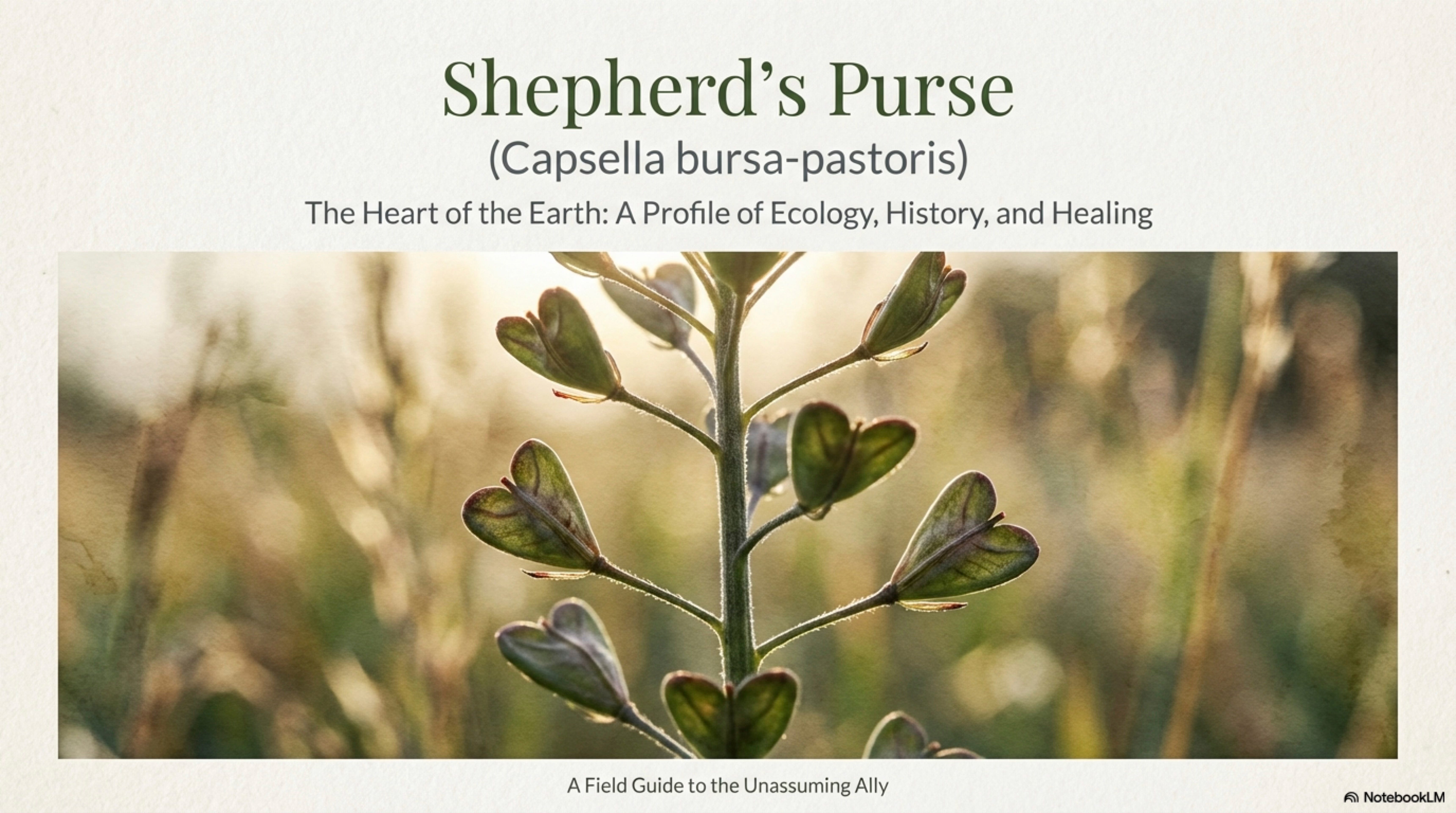
Shepherd’s Purse
Capsella bursa-pastoris
The Heart of the Earth: A Profile of Ecology, History, and Healing
This is a Living Plant Wisdom Profile, a format built to hold a plant whole. Not just its Latin name, not just its chemistry, not just its folklore, but all of it at once: the field encounter, the soil relationships, the ethnobotanical thread running through centuries, the biochemical architecture, the safety cautions, the farming applications, and the open questions at the edge of current science.
The subject is Shepherd’s Purse, (Capsella bursa-pastoris), one of the most ordinary weeds on Earth. It grows in sidewalk cracks and fallow fields, shows up in late winter when almost nothing else does, and has been quietly doing useful work for humans and ecosystems for as long as the two have overlapped. It is not glamorous. It is not rare. It is, in its own words, a first responder.
These profiles are about regenerative land stewardship, traditional ecological knowledge, and the science that bridges them. The voice is plainspoken and grounded. Evidence is labeled by confidence tier: Established, Probable, Plausible, Speculative, or Unknown. Nothing is dressed up to look more certain than it is.
What You Will Learn
By reading through this profile, you will come away with:
How to find and identify it — what the heart-shaped seed pods look like, how to distinguish it from similar plants, and why misidentification is rarely dangerous.
What it does underground — including a genuinely strange trick: its seeds, when wet, exude a sticky mucilage that traps nematodes, effectively practicing a rudimentary carnivory to fertilize itself on bare, poor ground.
How to read it as a land indicator — lush growth signals fertile, disturbed, nitrogen-rich soil; stunted reddening plants tell a different story. This plant is a living soil test if you know how to look.
Its full cultural biography — from Han dynasty Chinese materia medica and Japanese festival porridge, through medieval midwives and WWI field dressings, to Korean dumpling fillings and 21st-century clinical trials for postpartum hemorrhage.
Why it actually stops bleeding — the biochemistry behind its most storied use: vitamin K, uterotonic peptides, vessel-constricting amines, and flavonoids working in concert, not isolation.
When not to use it — pregnancy, anticoagulant medications, uncontrolled hypertension. A plant this effective has edges worth knowing.
How to work with it on land — as a volunteer cover crop, nitrogen scavenger, fermented plant juice input, bioindicator, and orbital character in orchard systems. It’s not a cash crop. It’s something more useful than that.
Where science is still catching up — genomic evolution research, metabolomic profiling, clinical trials in maternity care, and speculative frontiers including its seed’s electrical signaling and quantum biology angles.
Table of Contents
Capsella bursa-pastoris — Living Plant Wisdom Profile
Part I — The First Meeting
Opening Field Vignette
Part II — Getting to Know Them
Plant Identity & Names
2.1 Common & Indigenous Names
2.2 Look-alikes & Misidentification Hazards
2.3 Taxonomy & StatusEcological Intelligence & Soil Relations
3.1 Soil Communication Systems
3.2 Community Ecology
3.3 Ecosystem Functions
3.4 Indicator Species ValueWater Wisdom & Hydrology
4.1 Habitat Hydrology
4.2 On-Farm Water ApplicationsSensory Ecology
5.1 Phenological Precision
5.2 Activity Schedules
Part III — Stories & Lineage
History & Folklore
6.1 Timeline
6.2 Rituals, Proverbs & Crafts
6.3 Encoded AgronomyTraditional Ecological Knowledge (TEK) & Land Stewardship
7.1 Knowledge Holders & Context
7.2 Stewardship Practices
7.3 Ethical Protocols & Reciprocity
7.4 Permissions & Review
Part IV — Working Together
Biochemical & Nutritional Architecture → Evidence Crosswalk
Medicinal & Functional Uses (Traditional & Modern Evidence)
Safety & Contraindications
Regenerative Agriculture Applications
Research Frontiers & Citizen Science
12.1 Cutting-Edge Science
12.2 Quantum Biology HypothesesFuture Visioning & Wisdom Synthesis
Part V — Working Together
Biochemical & Nutritional Architecture → Evidence Crosswalk
14.1 Primary Metabolite Profiles
14.2 Secondary Metabolite Symphony
14.3 Nutritional & Medicinal CrosswalkSafety & Contraindications
15.1 Safety and Contraindications
15.2 Molecular MechanismsRegenerative Agriculture Applications
16.1 Korean Natural Farming (KNF) Applications
16.2 Biodynamic Applications
16.3 Regenerative Systems
16.4 Livestock Integration Protocols
16.5 Integrated Pest Management (IPM)
References / Bibliography
Bioregion Focus: Temperate North America (wild and garden settings)
Primary Focus: Wild Weed – Food & Medicine
Part I: The First Meeting
1) Opening Field Vignette:
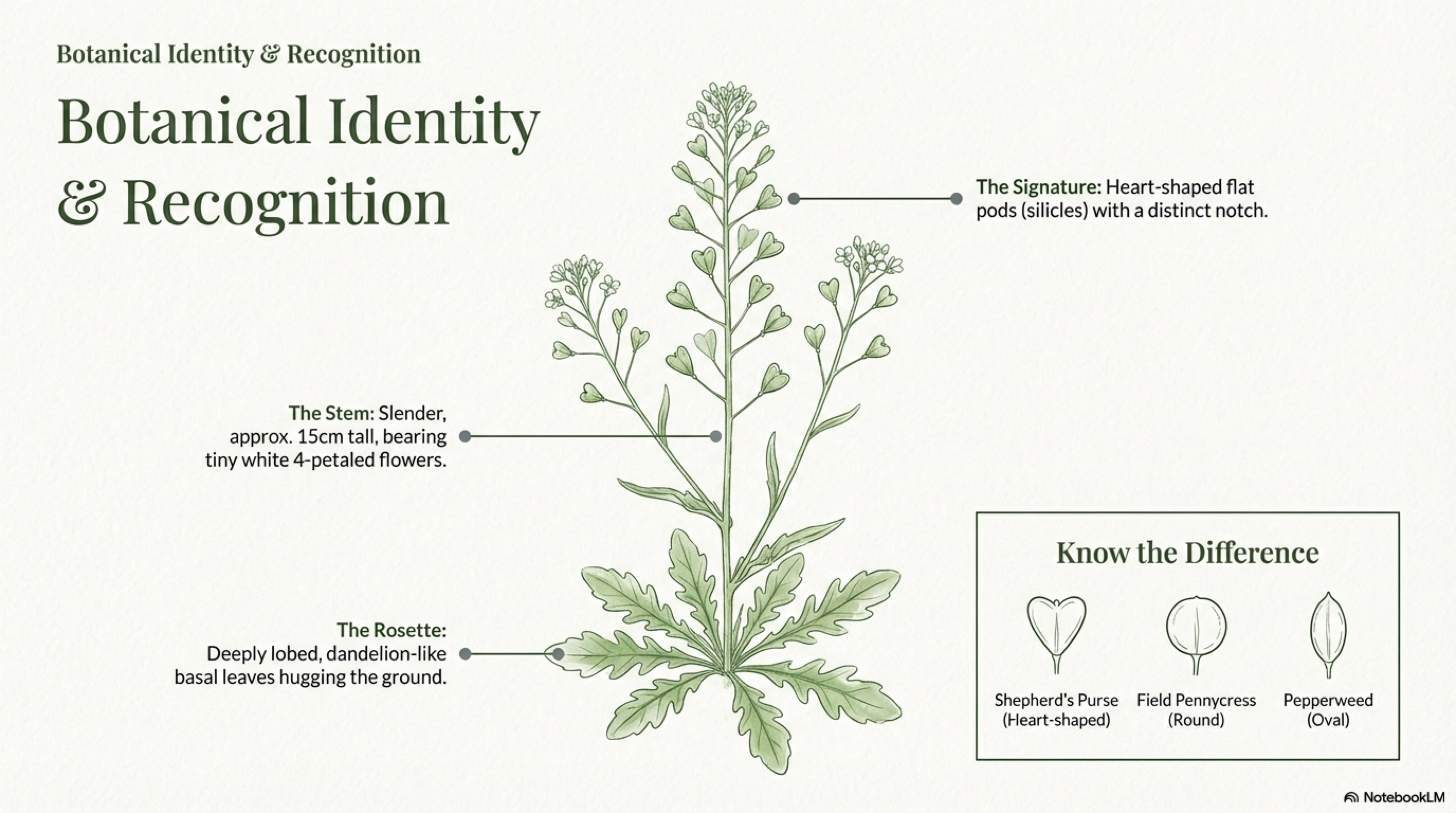
Late March in a temperate field on the Pacific Northwest coast, you crouch low to inspect a newcomer in the spring sun. The ground is damp from melting snow. There, amid last year’s stubble, is a small rosette of green, its lobed leaves hugging the soil. Slender stems rise about 15 cm, bearing tiny white four-petaled flowers. In the breeze, the stems sway, each dangling a constellation of heart-shaped pods – the “purses” that give Shepherd’s Purse its name. You pinch a leaf; it smells faintly peppery and green, like fresh cabbage with a bite. A few early honeybees and hoverflies flit from flower to flower, gathering the sparse nectar this humble mustard offers. The surrounding earth is bare in patches, still healing from winter’s scouring, but Shepherd’s Purse is already at work: its fibrous roots grip the soil, preventing erosion, while its leaves absorb the lengthening daylight. A gentle tug frees an entire plant – taproot and all. Mud clings to the thin, branching root, and you notice tiny orange-brown seeds spilling from a split pod. They’re sticky when wet, gluing bits of sand to your fingertips. You set the plant back and pat the soil. In this quiet moment, the weed reveals itself not as an intruder, but as a modest first responder of spring, blanketing disturbed ground with green hope. Having met them through sight, smell, and touch – the delicate white blooms, the heart-shaped seedpods, the peppery leaf – let’s learn this plant’s many names and identities across time and cultures.
Part II: Getting to Know Them
You’ve glimpsed how Shepherd’s Purse appears and behaves in the field. Now, let’s explore who they are – their many names, how to recognize them, and their role in ecology.
2) Plant Identity & Names
2.1 Common & Indigenous Names:
Shepherd’s Purse – the name evokes the triangular, pouch-like seedpods reminiscent of the little leather purses once carried by shepherds. This common English name dates back at least to the 15th century, appearing in medieval herbals. In older European texts it was also called Mother’s Heart or Mother’s Purse, alluding to the heart-shaped pods and perhaps its use in women’s health (folk herbalists noted its value for postpartum mothers – more on that later). Another English nickname, Caseweed, refers to those seed “cases.” Indigenous Names: Because Capsella bursa-pastoris is not native to the Americas, there is no known pre-colonial Indigenous name in North America (Unknown). After its introduction, some Native communities may have learned of its uses through exchange or observation, but documentation is scant. In contrast, across the Pacific, Shepherd’s Purse has long been familiar in East Asia: in Traditional Chinese Medicine it’s called “荠菜” (jì cài, literally “wild vegetable”), celebrated as both food and remedy. In Japan it’s Nazuna (薺), one of the symbolic Seven Herbs of Spring – on January 7th, a festival porridge includes Shepherd’s Purse to invite health for the year (Probable, culturally recorded). These names reflect the plant’s ubiquity and humble service: a wild weed that feeds and heals. Wherever it has traveled – and it now grows on every inhabited continent – people give it names linking to purses, hearts, or its nourishing nature. (No restricted Indigenous knowledge is presented; all traditional names are from public historical and ethnobotanical sources.)
Trade & Other Names: In botanical Latin it’s Capsella bursa-pastoris – literally “little box of the shepherd,” echoing the common name. Older classifications placed it in genus Thlaspi (pennycresses), so some 19th-century texts refer to Thlaspi bursa-pastoris. European folk names include “Pick-purse,” “Shepherd’s Bag,” and in French Bourse de pasteur (shepherd’s purse) – nearly identical across languages, a rare consistency in plant nomenclature. In Mandarin Chinese, aside from “jì cài,” it’s also lovingly dubbed “spring vegetable”, as it is one of the earliest edible greens. There are no known esoteric or alchemical code-names for Shepherd’s Purse; this plant has always been allied with common folk rather than occult practitioners. It wears its identity plainly.
2.2 Look-alikes & Misidentification Hazards:
In bloom and seed, Shepherd’s Purse is quite distinctive – no other common weed has those tiny heart-shaped seed pods held out on slender stalks. Nevertheless, a few relatives could confuse the keen forager or farmer:
Field Pennycress (Thlaspi arvense): Another mustard weed with flat circular pods. It differs by having round, coin-like silicles (hence penny-cress) rather than heart shapes. Pennycress leaves are smooth-edged and hairless, whereas Shepherd’s Purse rosette leaves are toothed or lobed and can be hairy. Also, pennycress pods sit directly against the stem, not on long stalks.
Pepperweeds (Lepidium spp., e.g. Virginia pepperweed): These have many small round seed pods and leafy flowering stems. Pepperweed stems carry leaves all the way up, while Shepherd’s Purse typically has bare, unbranched upper stems with only a few small leaves at the lower part. Pepperweed seed pods are more oval and lack the obvious notch at the pod tip that Shepherd’s Purse has.
Other Mustard Family Weeds: Capsella’s seedpods set it apart. Small winter annual mustards like Arabidopsis(the related mouse-ear cress) have similar rosettes and tiny white flowers but their seedpods are skinny elongated siliques, not triangular silicles. Young Shepherd’s Purse rosettes (before flowering) might superficially resemble other basal weeds like dandelion or plantain to an untrained eye, but those lack the lobed, pinnatifid leaf shape with occasional hairs that Shepherd’s Purse shows.
🚩 SAFETY FLAG: Fortunately, no dangerously toxic plant closely mimics Shepherd’s Purse in North America (Established). Its mustard-family kin are generally non-poisonous (many are even edible). Still, one should avoid harvesting from areas where pesticides might have been used, or where look-alike rosettes of unknown identity grow intermingled. One remote misidentification risk is with young poison hemlock or water hemlock rosettes – but those belong to the carrot family, have very different finely divided leaves and a distinct mousy odor when crushed (and they lack any kind of above-ground seedpod in rosette stage). Always wait to see the flower and seedpod if uncertain; with Shepherd’s Purse, the unique heart-shaped pouch confirms the ID unambiguously. (Confidence: Established that common mustard weeds are edible; Unknown for any extremely rare look-alike.)
2.3 Taxonomy & Status:
Latin Binomial: Capsella bursa-pastoris (L.) Medik. (1792). Capsella means “little box,” and bursa-pastoris is Latin for “shepherd’s purse” – a direct reference to the pod shape. Carl Linnaeus first described it as Thlaspi bursa-pastoris, but it was later reclassified to Capsella.
Family: Brassicaceae (Mustard family), the same family as cabbage, mustard, and canola. Like many mustards, it’s an annual or short-lived biennial herb.
Synonyms: Historical texts may refer to it by old names: Bursa pastoris (dropping the redundant genus), Nasturtium bursapastoris, or Thlaspi bursa-pastoris. All are the same species. It has at least two recognized subspecies globally (e.g. C. bursa-pastoris subsp. thracicus in Eastern Europe), but those distinctions are subtle and not important in most contexts.
Native vs. Introduced: Native Range: likely the Eastern Mediterranean and temperate Eurasia. From there it spread worldwide. Introduced Range: Virtually all temperate and subtropical regions. It followed European colonization and agriculture – by the 17th–18th centuries it was recorded in North America, and it’s now found across the entire U.S. and Canada (even Alaska). In temperate parts of South America, Africa, East Asia, and Australia/New Zealand, it is a common naturalized weed. Essentially, wherever Europeans farmed or wherever soil is disturbed in temperate climates, Shepherd’s Purse has made itself at home.
Weed/Invasive Status: Shepherd’s Purse is one of the most common cosmopolitan weeds. It thrives in gardens, roadsides, farm fields, and urban lots. Most regions consider it a minor agricultural weed – troublesome in seedbeds and winter crops – but not a noxious invasive that outcompetes native perennials severely. It doesn’t usually warrant legal regulation. Its prolific seeding and soil seed bank (seeds can persist decades) make it hard to eliminate once established (Established). For example, a single plant can release thousands of seeds and those seeds can survive ~20–35 years if buried and undisturbed. Yet because it’s small and shallow-rooted, it’s relatively easy to control by cultivation or mulch (Probable, based on agricultural reports). In natural ecosystems it tends to appear only on disturbed ground and usually yields to perennial native vegetation over time, so it’s not considered a major threat to intact wild plant communities (Established).
Conservation Status: Not of concern – quite the opposite. Globally, Capsella bursa-pastoris is secure and abundant (Established). It is a successful generalist species. Interestingly, its very success makes it a model for studying weed evolution. Genetic studies show that Shepherd’s Purse, a self-pollinating tetraploid, expanded worldwide relatively recently and formed distinct regional gene pools (e.g., Middle Eastern, European, East Asian) with North American populations aligning genetically with the Middle Eastern cluster. This reflects how humans transported it and how it adapted (Plausible). No known rare or endangered subtaxa exist, and it’s not under threat in any of its introduced lands.
You’ve learned this plant’s many names and how to identify it without mistake. Next, how does Shepherd’s Purse live and communicate in the soil and ecosystem? We step into its ecological intelligence – its relationships with soil, water, and neighbouring life.