

For years I watched purslane colonize ground that looked wrong for it, and flourish anyway. It was always the soils that needed covering.
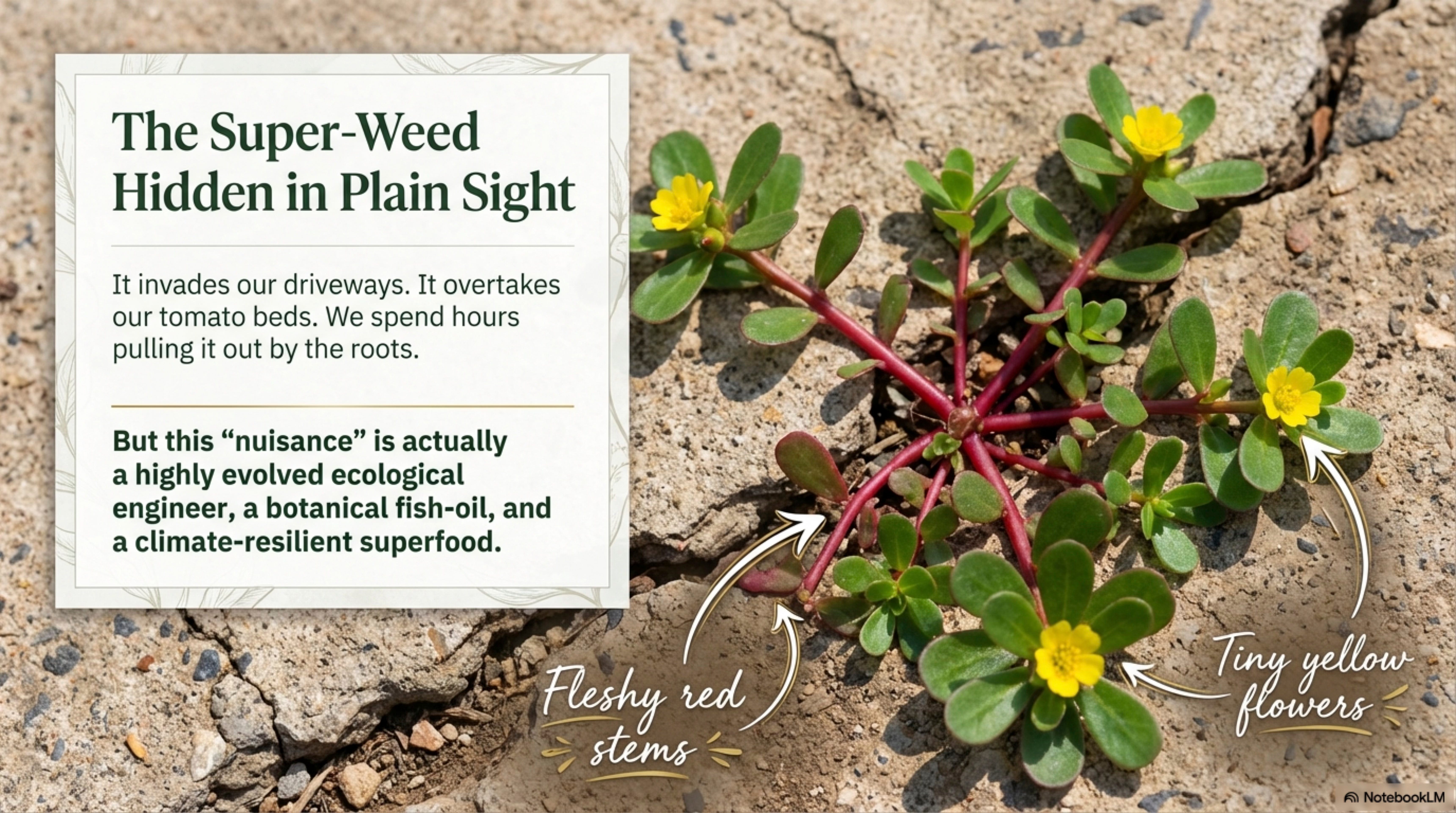
It’s the fleshy, red-stemmed mat that recolonizes the bed three days after you’ve weeded. The thing that roots from every severed node. A single plant drops 200,000 seeds in a season, and those seeds stay viable in the soil for forty years. Purslane doesn’t negotiate. It just waits.
But before you reach for the hoe, consider what you’ve been pulling up.
A plant that runs two photosynthetic pathways, C4 by default, CAM when it’s thirsty, a metabolic flexibility so rare that plant geneticists are studying it to help us breed drought-proof crops. A land plant carrying EPA, the omega-3 fatty acid we usually mine from cold-water fish. Betacyanins, glutathione, melatonin. A suite of novel alkaloids called oleraceins that researchers are now testing against everything from Alzheimer’s to liver damage. Traditional Chinese Medicine has used it for dysentery for two thousand years. Ayurveda calls it a blood purifier. Culpeper prescribed it for frenzy. Thoreau ate it daily at Walden and remarked on the quiet sufficiency of it.
It’s earned the nickname “global panacea.” That’s a big phrase for something most of us have been throwing on the compost.
What follows is long, and deliberately so. Purslane sits at the intersection of too many fields for a quick pass to do it justice, food, medicine, soil science, ethnobotany, climate adaptation, and a few things that don’t yet have a tidy name. I wrote this for three kinds of reader, and most of you will be some blend of all three.
For the homesteader: the nutrient profile with oxalate-mitigation strategies your grandmother probably knew without knowing, preservation methods that carry purslane from August abundance into February pickles, a breakdown of how it plays into poultry and livestock rations (chickens love it; watch nitrates with ruminants), and a seasonal calendar adapted for temperate, arid, tropical, and high-latitude bioregions. Also: why feeding purslane to laying hens likely bumps the omega-3 content of your eggs.
For the gardener: companion dynamics that matter — corn roots have been observed following purslane roots down through hardpan — plus its role as a living mulch, its work as a dynamic accumulator of potassium and magnesium, and its documented capacity to pull lead and cadmium out of contaminated soil. There’s a section on Korean Natural Farming inputs, including a purslane-dandelion FPJ recipe worth trying before your summer hits full stride.
For the plant geek: the full biochemical architecture, the CAM/C4 switching mechanism, the oleracein complex, and phenology tied to CAM-driven diurnal acid cycling. Morning-harvested purslane carries roughly ten times the malic acid of afternoon leaves, which means the hour you pick changes the flavour and the medicine. You’ll also find the ethnobotany: forty-plus documented ecotypes, a migration story that predates European contact in the Americas, and a cross-cultural map of names that tells you where this plant has been loved, and for how long.
Purslane has been teaching patient humans for a very long time. This profile is my attempt to pass along what it’s been saying.
Read it in pieces. Come back to it. Let the plant do the rest.
Foundation: Plant Identity & Geographic Wisdom
Botanical Profile: Scientific Classification: Purslane is a succulent annual herb in the purslane family Portulacaceae. Its scientific name Portulaca oleracea reflects its use as a vegetable (“oleracea” meaning pot-herb). It has a prostrate, spreading growth habit with smooth, reddish stems up to 20 inches long, bearing clusters of alternate, paddle-shaped leaves that are fleshy and smooth. Tiny yellow flowers with five petals open only in bright morning sun, giving way to small egg-shaped capsules (a “little door,” or portula, that opens circumferentially) containing numerous black seeds. Phenological Cycles: As a summer annual, purslane thrives in warm weather – seeds germinate when soil temperatures exceed ~25°C (77°F), usually in late spring, and plants grow rapidly through the hottest months. It can begin flowering and setting viable seed as early as 3–5 weeks after sprouting, continuing through late summer; a single plant may produce 100,000–200,000 seeds in one season. With the first hard frost in temperate zones, above-ground growth dies back, but the seeds persist in the soil seed bank (they remain viable for 20 to 40 years). Purslane’s seeds germinate opportunistically after disturbance and warm rains, creating successive flushes in a single growing season if conditions allow.
Bioregional Variations: This adaptable “cosmopolitan” plant expresses differently across climates. In temperate North America, it behaves as a warm-season annual (germinating in late spring, flourishing in summer, killed by frost). In Mediterranean and subtropical climates, it can germinate with winter or spring rains and persist into the dry season by virtue of its drought tolerance. In tropical regions, purslane grows year-round (often in the drier or less humid part of the year) or may appear during seasonal dry spells. It tends to remain smaller under extreme heat/drought (hugging the ground and conserving moisture), whereas in gardens with rich soil and ample moisture it becomes lush, with larger, more tender leaves. Local ecotypes show adaptive traits: over 40 eco-types are documented worldwide, exhibiting variations in size, leaf thickness, and tolerance to conditions. For example, in arid regions purslane often has a deeper taproot and more pronounced succulent tissues to endure drought, whereas in cooler climates it may grow more upright to catch the sun. These regional forms all retain the plant’s core resilience and fast seed-setting strategy.
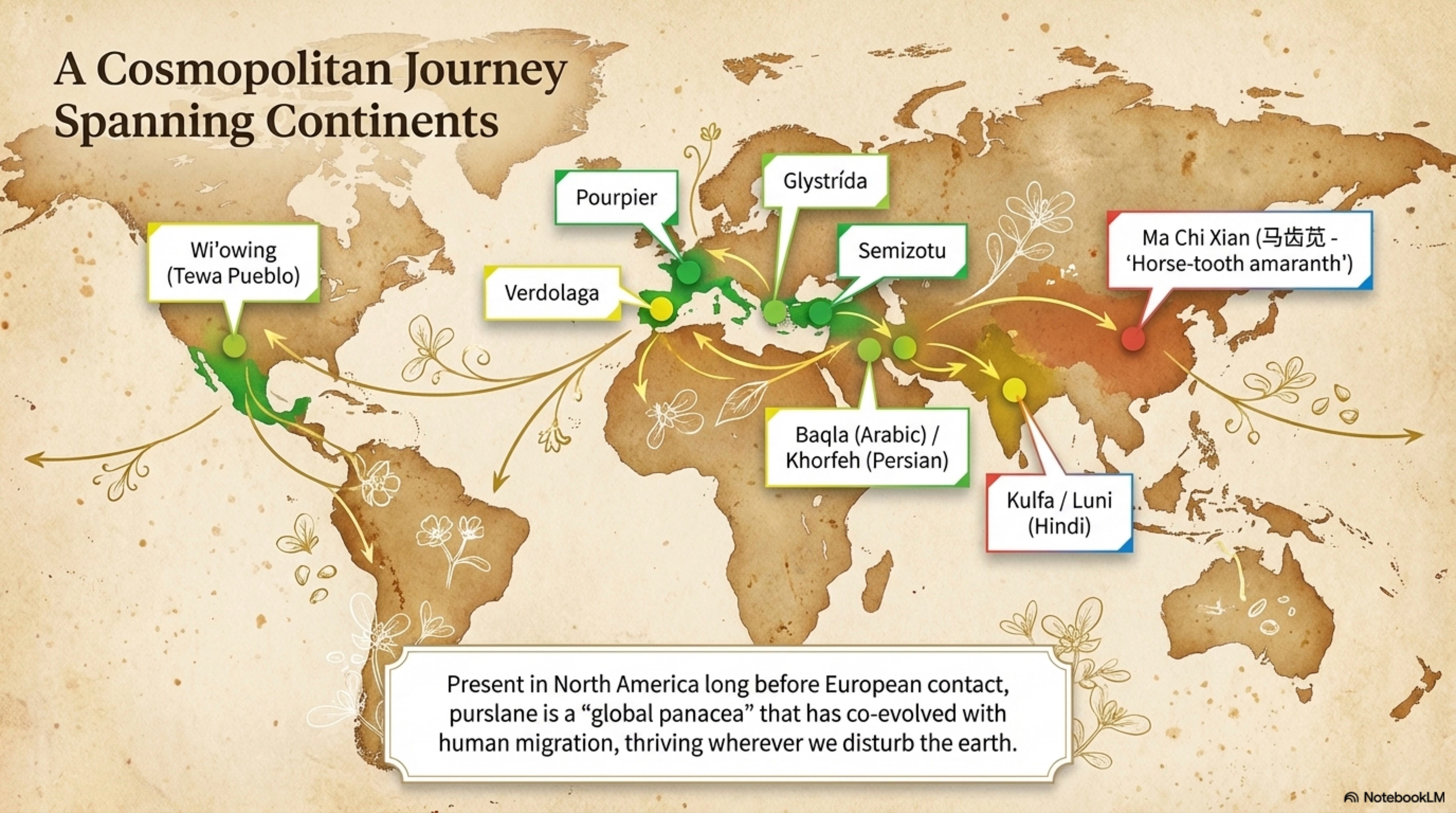
Native Range & Migration Story: The exact origin of Portulaca oleracea is obscured by antiquity. It is believed to have originated in the Old World, likely North Africa, the Mediterranean, or West Asia, where it has been used since ancient times. However, purslane’s distribution is truly global and ancient – archaeological evidence (seeds in sediment cores and pre-Columbian archaeological sites) shows purslane was present in North America long before European contact. This suggests it may have migrated naturally (e.g. via bird migration or early human trade routes) and established a cosmopolitan range. Early European explorers in the Americas found it already growing as a wild pot-herb. By the Middle Ages, purslane was a familiar cultivated and wild vegetable in Europe; historical records note that Theophrastus listed purslane among summer herbs to sow in ancient Greece (4th century BCE). It was also a common food in the Middle East, India, and Africa since antiquity. European colonists later intentionally and unintentionally spread purslane to new locales – it was noted in colonial American gardens for salads, and it readily escaped cultivation. Today purslane is found on every continent except Antarctica, a true citizen of disturbed soils across temperate, subtropical, and tropical regions. Its migration story is one of companionship with humans: as people moved and farmed, purslane followed, thriving in gardens, fields, and trade routes, earning nicknames like “global panacea” and “world weed.”
Endangered/Protected Status: Far from endangered, purslane is considered one of the most common and resilient weeds on Earth. It is not protected – in fact, it is often listed as a noxious or invasive weed in gardens and agriculture due to its prolific seeding and ability to root from stem fragments. However, its very ubiquity is part of its gift: it volunteers abundantly, offering free food and groundcover. No specific conservation concerns exist for P. oleracea (it thrives in human-disturbed habitats), though its presence signals the need for conservation of soil (as purslane often appears to cover bare, exposed ground). In some regions it’s valued as a traditional food, which has led to efforts to re-wild it into cultivation rather than eradicate it. Overall, purslane exemplifies a plant thriving at the intersection of human and natural ecosystems – needing no protection, yet deserving appreciation.
Key Parts Used: The aerial parts of purslane – primarily the succulent leaves and stems – are used as food and medicine. These are eaten fresh as salad greens, cooked as a potherb, or preserved by pickling or drying. Young shoot tips and tender leaves are preferred for culinary uses (crunchy and mildly tangy). Flowers are also edible (though small) and can be included in salads. The seeds are technically edible and extremely nutritious (high in protein and omega-3); traditionally they were used by Indigenous Australians to make seedcakes or flour, though their minute size makes them labor-intensive to collect in quantity. In herbal medicine, the fresh juice of the plant or a poultice of the crushed whole herb is applied externally, and teas or tinctures are made from the dried or fresh aerial parts. The root is small and fibrous (or a slender taproot) and not typically utilized, though its presence helps break up soil. Fresh vs. Dry: Purslane can be used fresh for highest nutritional content, while drying concentrates some constituents (but may reduce the content of volatile and juicy compounds). Both fresh and dried plant (known as Herba Portulacae in Traditional Chinese Medicine) are used medicinally.
Morphological Signatures: Purslane’s form hints at its qualities. The low, mat-forming growth and radiant leaf rosette pattern suggest a groundcover protector, shielding soil from erosion and sun. Its red creeping stems form a spiral geometry from a central taproot, radiating like spokes – a signature of spreading vitality and expansive resilience. The succulent, water-filled leaves (often arranged in a star or wheel-like cluster at stem joints) reflect the plant’s water wisdom – an ability to hold moisture and thrive in heat, hinting at its cooling, hydrating medicinal effects. The bright yellow, five-petaled flowers – opening only under the sun’s warmth – suggest a connection to sunlight and perhaps a solar signature of joy and life, albeit ephemeral (each bloom lasts only a few hours). Morphologically, purslane doesn’t have obvious “Doctrine of Signatures” cues for specific organs, but its crisp sour taste and slippery mucilage do point to cooling and soothing benefits internally (as if to quench internal “heat” and lubricate dryness). In the garden, its presence often indicates disturbed or compacted soil – the plant’s thick roots help break up hard ground, and its nutrient accumulation returns fertility to the surface, a signature of ecological healing.
Safety Tier: Purslane is generally regarded as a very safe edible and medicinal plant (Safety Tier A). It has been consumed as a vegetable for millennia on multiple continents. However, like many spinach-like greens, it contains significant oxalates (oxalic acid) which in large amounts can contribute to kidney stone formation or interfere with calcium uptake. Individuals with a history of oxalate kidney stones or rheumatism/gout should moderate intake of raw purslane. (Traditional wisdom often pairs purslane with yogurt or cooking methods to mitigate oxalates – modern tests show adding yogurt can reduce soluble oxalate by ~80% .) Purslane can also accumulate nitrates if grown in nitrogen-rich soils, similar to other leafy greens, so enormous quantities eaten raw could pose a risk for nitrate-sensitive individuals (this is rarely an issue in normal use). It is contraindicated in very cold, deficient constitutions in TCM (due to its cold nature) and in pregnancy in some traditions, because high amounts were thought to stimulate uterine clearance (some sources class it as a mild emmenagogue). Overall, for most healthy people purslane is a nutritious food herb with no significant toxicity. Ensure identification is correct – it should not be confused with toxic lookalikes like spurge (Euphorbia species, which have milky sap). As with any wild plant, avoid harvesting purslane from chemically contaminated areas (purslane is a known accumulator of heavy metals and pollutants from soil). Properly washed and prepared, purslane is a safe “common-uncommon” food.
Names as Portals of Understanding
Etymology (Scientific & Common Name): The genus name Portulaca comes from Latin porta (“gate”) and lacera (“to tear”), referring to the lid-like top of the seed capsule that peels open like a little gate. The species epithet oleracea means “of the kitchen garden” or “pot herb,” highlighting its long history as an edible plant. The English name “purslane” derives from Old French porcelaine, from Latin portulaca – showing the linguistic trail from Latin to Norman French to Middle English. It has been colloquially called “pursley” or “purslain” in older texts. Another common English nickname is “Little Hogweed,” comparing it to related wild greens (and perhaps because pigs were fond of eating it).
Common Names by Culture: Purslane’s global journey is reflected in a tapestry of names. In Mediterranean Europe, it’s known as pourpier (French), portulaca or porcellana (Italian), and verdolaga (Spanish). Greek cuisine calls it andrákla or glystrída, and in Turkey it’s semizotu. Across the Middle East and South Asia: Arabic speakers call it baqla or baqlah; in Persian (Farsi) it’s khorfeh; in Urdu/Hindi it’s often kulfa or luni. Traditional Sanskrit sources refer to the larger purslane as Ghotika or Lona, and Hindi has barri lunia for the bigger variety. In China, purslane is Ma Chi Xian (马齿苋, “horse-tooth amaranth,” referring to the shape of its leaves). Many Asian cultures also simply transliterate Portulaca. Indigenous peoples in the Americas had their own names: for example, the Tewa pueblo people called it “wi’owing” (according to some ethnobotanical notes), and it was simply known as a wild spinach variant to various tribes. In Mexico, verdolagas is widely used (Spanish origin), and the plant is a staple in traditional Mexican recipes. African vernacular names include variations like mpilirweshi (in parts of East Africa). These names often highlight the plant’s use as a vegetable or its spreading habit.
Each name reveals cultural perspective: e.g. “garden pursue” in some British dialects indicated it would voluntarily “pursue” the gardener by popping up in the garden. The Spanish verdolaga implies a verdant green; the Persian khorfeh is found in medieval medicinal texts of Unani. The sheer multitude of names in India (Hindi nonia, Marathi gholak, Tamil pasalai keerai, etc.) suggests purslane’s integration into food and medicine across many linguistic communities.
Sacred and Ritual Names: While purslane does not have widely known deity-specific names, it was considered a plant of protective power in European folk magic. An old English term “Mother of Night” alludes to its nocturnal malic acid cycle and perhaps its use under the pillow to ward off evil at night. In some folklore, it was simply called “Poor man’s spinach” – not sacred per se, but valued by the common folk. In traditional Ayurveda, it’s called Loni or Sanhti in Sanskrit texts and praised as “Mahacchoti” (great little vegetable) in some verses, indicating esteem. Purslane doesn’t feature as a sacred plant in major religious ceremonies, but it was employed in folk rituals: ancient Romans wore purslane amulets to expel evil, and European herbalists like Culpeper noted it “hath an excellence to expel the evil humors” and could be used to protect against “witchcraft.” Thus, we find purslane scattered around beds or hung in homes as an anti-magic herb, sometimes called “Herb of Seven Powers” in that context. These ritual uses and names portray purslane as a guardian plant – humble yet spiritually potent in its ability to “ground” and protect.
Trade Names and Historical Commerce: Purslane has usually been a local market herb rather than a large-scale traded commodity, so it lacks famous historical trade names like some spices. However, in medieval apothecary commerce it was listed as Portulaca herba or Herba portulacæ, and dried purslane might be sold as “Purcelane” in English herb shops. In the 16th–18th centuries, European gardeners distinguished “Green purslane” and “Golden purslane” (a yellow-green-leaved cultivar), the latter being a preferred salad variety – these could be considered trade variants, sold in seedsmen’s catalogs. There is also “Winter purslane” in old garden books, though that name refers to a different plant (Claytonia perfoliata, miner’s lettuce). In modern commerce, purslane occasionally appears as an ingredient in health supplements or cosmetics under names like “Portulaca extract” (promoted in anti-aging creams for its antioxidants). Generally, purslane’s commerce has been informal – shared in community gardens and farmers’ markets rather than global trade. Its presence as a beloved ingredient in cuisines (from the French bonne femme soup to Middle Eastern salads) has been the main driver of any trade, with seeds available from heirloom seed companies under names like “Garden Purslane” or local names (Verdolaga, etc.).