A warm late-summer breeze dances through a sea of golden plumes. Canadian Goldenrod (Solidago canadensis) stands tall along the fence line, its honey-gold flowers alive with the hum of bees. Kneeling down, a farmer notices how the plant’s spicy-sweet scent mingles with sun-warmed grass, an invitation to pause and observe. In one glance, goldenrod is a weed thriving in poor soil; in another, it’s a healer offering medicine and soil wisdom. A curious passerby might first see a tangle of yellow flowers, but look closer: dew drops gather on lance-shaped leaves at dawn, and by noon small pollinators are feasting on nectar. Goldenrod invites us to shift our lens, to see a teacher hiding in plain sight.
This deep dive maps goldenrod’s intelligence: its evolutionary strategy, chemical arsenal, ecological relationships, and the documented uses humans have extracted across continents and centuries. I’m pulling from peer-reviewed research, ethnobotanical records, traditional pharmacopeias, and field observations that span from Appalachian hollows to European meadows.
You’ll find:
Botanical architecture: How this plant is built and why it matters
Chemical weaponry: The compounds doing the actual work, backed by lab data
Ecological function: What goldenrod does for soil, pollinators, and succession
Cross-cultural applications: Where traditional knowledge converges (and where it diverges)
Practical deployment: How to grow it, harvest it, and put it to work on your land
This isn’t light reading. It’s also not academic gatekeeping. I’ve translated the Latin, unpacked the chemistry, and connected the dots between what scientists measure and what practitioners need to know. No fluff, no woo—just the mechanisms that matter.
Fair warning: Some of what you’ll read challenges conventional thinking about “invasive” species, monoculture, and what counts as medicinal. I follow the research where it leads, even when it’s inconvenient.
If you’re here to truly understand this plant, keep reading.
2) Plant Identity & Names
2.1 Taxonomy & Status: Solidago canadensis L., commonly known as Canada Goldenrod, is a perennial herb in the Asteraceae (daisy) family. It is one of about 100–120 Solidago species worldwide. Solidago comes from Latin solidare, “to strengthen or make whole,” reflecting its healing reputation. This species is native to North America (found in most of Canada and the U.S.) and has become naturalized/invasive in parts of Europe and Asia. It spreads aggressively by rhizomes and wind-dispersed seeds, often colonizing roadsides, fallow fields, and disturbed ground. Goldenrod is not considered threatened, quite the opposite, it’s often termed a weed on farms, yet in ecological gardening it’s valued as a native wildflower. In North America, it’s a prolific pioneer; in Europe, an officially invasive species. The plant usually grows 0.5–1.5 m (2–5 ft) tall, occasionally up to 2+ m (notably, horticultural breeding once produced 12 ft giants – see history). Status: In its home range it’s a common native wildflower; in introduced regions it’s frequently listed as an invasive exotic. It has no special conservation status in its native range.
Amid different labels – native wildflower, invasive weed, healing herb – Goldenrod thrives unapologetically.
2.2 Common & Indigenous Names: Goldenrod’s bright color and upright form have inspired names across cultures. In English it’s simply “Goldenrod” – referring to those rod-like golden flower clusters – and folk names like Woundwort, Aaron’s Rod, and Blue Mountain Tea are recorded. French settlers called it “Verge d’Or” (golden rod). Many Indigenous North American peoples name it after the sun or its healing use. For example, the Ojibwe (Chippewa) call it gizisomukiki, meaning “sun medicine”, noting its sunny blooms and medicinal potency. The Cherokee have names and uses in their language (specific terms vary by dialect; one documented Cherokee name translates to “flower of the ridge,” honoring its upland habitat – Traditional, community knowledge). In Chinese, where the plant was introduced, it’s known as “一枝黄花” (yī zhī huánghuā), literally “one-branch yellow flower,” and in Traditional Chinese Medicine (TCM) contexts it’s called huang hua (黄花) or yi zhi huang hua, used to “clear heat” – reflecting a modern adoption into Chinese herbal practice. Latin Solidago itself encodes the plant’s reputation: solidare (“to make whole”) plus -ago (“to make”) – essentially “to make whole (again),” alluding to wound-healing. Old European texts called related species “Solidage” or “Goldruthe”, and a Sanskrit descriptor isn’t found in classical Ayurvedic texts (the plant is not native to South Asia), though contemporary Ayurvedic practitioners might refer to it by transliteration of its English name. Trade & cryptic names: During the American Revolutionary era, goldenrod tea was nicknamed “Liberty Tea” after the colonists dumped British tea – drinking goldenrod was seen as an act of patriotism. Alchemically, it was sometimes symbolized as the plant of endurance (its gold color linking to the sun and longevity in hermetic thought – Traditional). Across Europe and America, any “golden” herb was associated with good fortune: one folk name, Treasure Finder, reflects the belief that a goldenrod sprig could bend toward buried gold.
2.3 Look-alikes & Misidentification Hazards: Goldenrod’s showy yellow plumes make it fairly distinctive in late summer, but it is often confused with ragweed – a dangerous mix-up in terms of allergies. Key differentiators:Goldenrod bears dense clusters of bright yellow flower heads at stem tips, and has alternating, lance-shaped leaves ~7–15 cm (3–6 in) long. In contrast, Common Ragweed (Ambrosia artemisiifolia) blooms at the same time but has inconspicuous greenish flower spikes and deeply lobed leaves that are opposite low on the stem. Goldenrod’s pollen is heavy/sticky and insect-carried; ragweed’s is light and wind-blown, causing hay fever. New foragers sometimes mistakenly blame goldenrod for allergies, when ragweed is the true culprit – a critical distinction for those harvesting. Other yellow-flowered wild asters like Groundsel (Senecio) or Tansy Ragwort might superficially resemble goldenrod, but their flower structure differs (daisy-like rays in ragwort vs. plume-like clusters in goldenrod). Safety Flag: Toxic look-alikes: “Rayless goldenrod” (Isocoma pluriflora, also called jimmyweed) is a different plant that lacks ray flowers and is highly toxic to livestock. It grows in the southwestern U.S. and can be mistaken for true goldenrod by name alone – farmers should note it’s unrelated despite the common name. When foraging goldenrod, also be mindful not to confuse it with St. John’s Wort (Hypericum) or Wild Parsnip, which have yellow blooms but very different leaves and can cause harm.
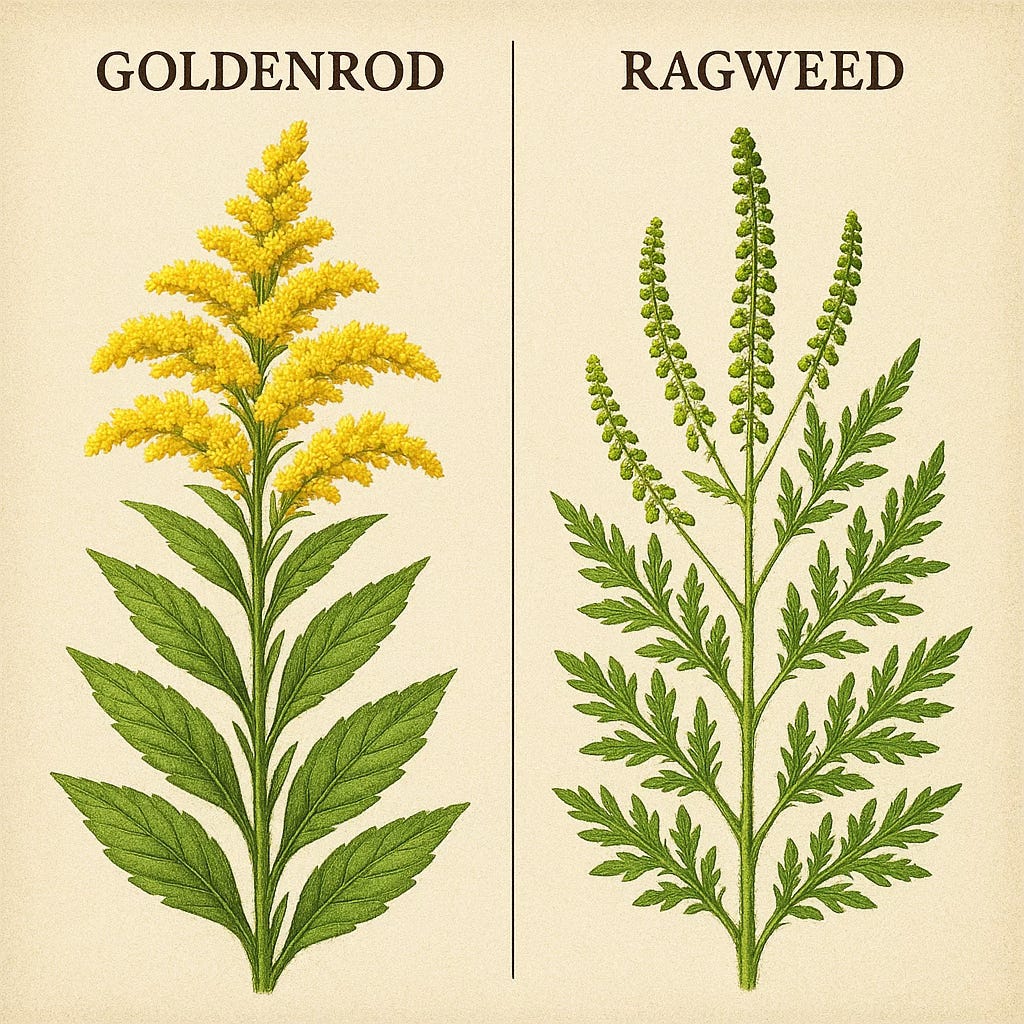
Figure: Goldenrod (left) vs Ragweed (right) – goldenrod’s golden flower plumes vs. ragweed’s green, pollen-shedding spikes. With keen observation – noting flower form, leaf shape, and bloom timing – one can safely distinguish goldenrod from its imposters and harvest with confidence.
3) History & Folklore
Goldenrod’s story weaves through ages of medicine, myth, and survival. Once quietly tending wounds in ancient villages, it later became a symbol of resilience in the New World. This section offers a concise historical arc, from antiquity to the present, highlighting how goldenrod moved from folklore to the laboratory.
3.1 Timeline:
Classical Antiquity: Goldenrod (Solidago virgaurea in Europe) wasn’t prominent in Greek or Roman medical texts – it hides in the background of antiquity. However, some historians surmise that it may have been the “wound-healing herb” referenced vaguely by Roman soldiers (Traditional, unconfirmed). The plant truly enters written record by the Medieval Period, where European herbalists noted Solidago for treating wounds and kidney ailments. Monastic infirmaries of the Middle Ages included “Woundwort” preparations. In the 9th–12th centuries, Islamic Golden Age physicians possibly encountered Solidago via trade (though it was not central in Unani medicine).
Colonial Era & Knowledge Suppression: In the Americas, indigenous peoples had long-valued goldenrod (see TEK) but early European colonists initially dismissed native herbal knowledge. That changed in the late 18th century: after the 1773 Boston Tea Party, American colonists famously turned to goldenrod tea, dubbing it “Liberty Tea”, to replace British tea. It became a patriotic brew and was even exported to China briefly. Yet, during colonial times, much Native wisdom about goldenrod was suppressed or went unacknowledged.
19th Century: Goldenrod appears in American “Eclectic” medical literature as a mild diuretic and wound wash. Folk healers used goldenrod poultices for sores and tinctures for kidney complaints (Traditional). In Europe, interest grew after samples of Canadian goldenrod were sent back – Queen Elizabeth I herself was presented with goldenrod herb; it was so prized initially that it sold at high price until they realized it grew wild locally.
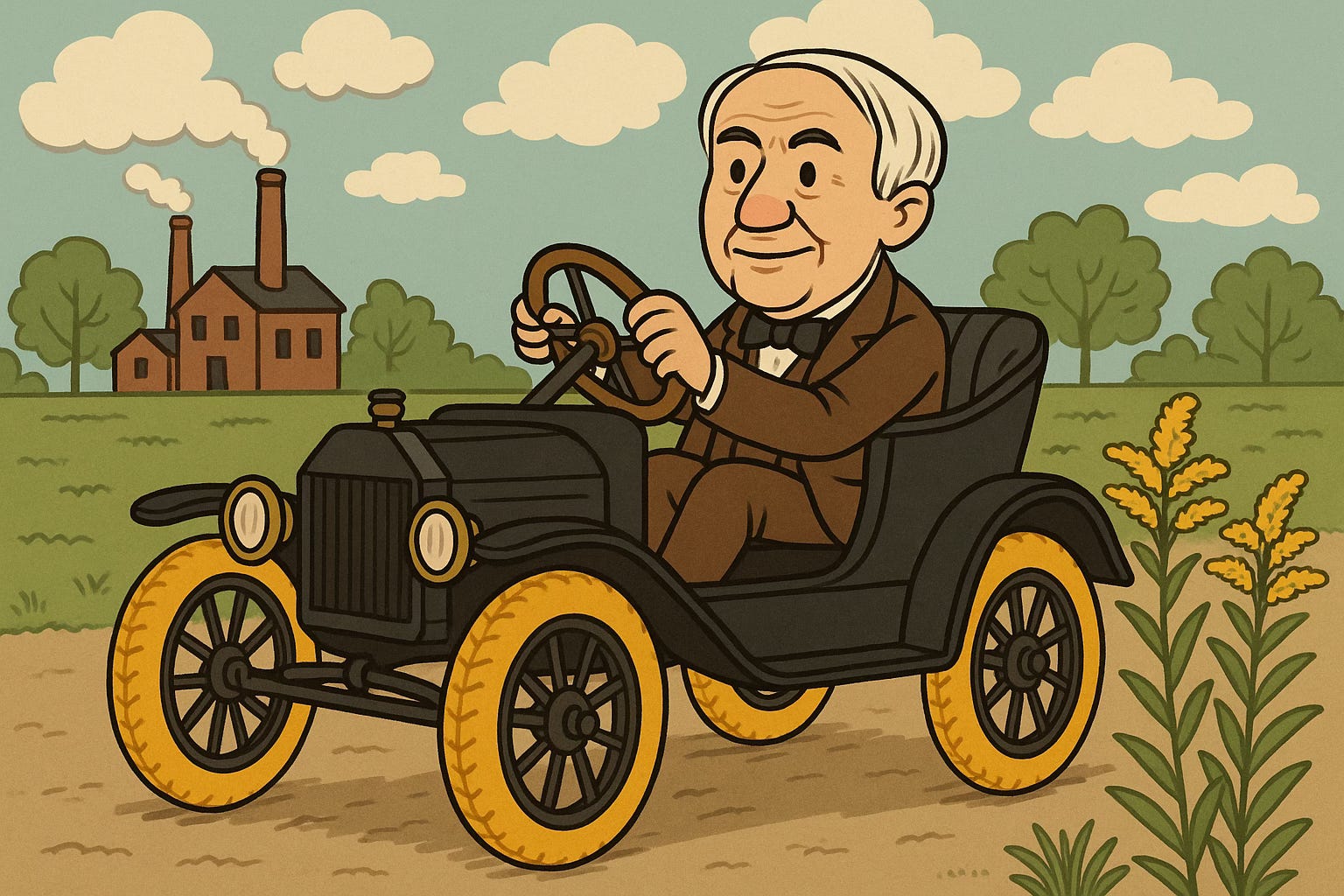
Early 20th Century Industrial Experiments: A unique chapter – Thomas Edison and partners (including Henry Ford) sought domestic rubber sources during World War I–II. By the 1920s Edison had 17,000 plants under study; goldenrod emerged the winner. Edison bred a 12-foot tall goldenrod yielding 12% latex in its tissues. In 1928, Ford gifted Edison a Model T with tires made from goldenrod rubber. Though natural goldenrod rubber was superseded by synthetics in WWII, this story shows goldenrod’s versatility beyond medicine.
Modern Renaissance (1960s–present): The herbal revival of the 1960s-70s saw Western herbalists “rediscover” goldenrod’s value for allergies and urinary health. It became a staple in modern Western herbalism for seasonal allergies and as a kidney “tonic.” In Europe, Commission E (Germany) officially approved goldenrod in 1987 for treating bladder and urinary inflammation (Confirmed). Today, goldenrod enjoys renewed fame as both a native pollinator plant and an herb for holistic health. Contemporary clinical trials explore its benefits (e.g., as part of formulas for UTIs), and land stewards recognize its ecological functions (soil restoration, pollinator support). The plant’s journey from ancient woundwort to modern phytochemical research subject exemplifies the bridging of traditional knowledge with science.
Through centuries of change, goldenrod endures – a golden thread stitching together past and present.
3.2 Rituals, Proverbs & Crafts: Throughout history, goldenrod gathered its share of legends and practical folk uses. In seasonal ceremonies, goldenrod often signals the transition to autumn. An old New England saying goes, “When goldenrod blooms, the first frost is 6 weeks away,” linking it to harvest preparations (Traditional proverb). Rituals: Some Native American tribes historically included goldenrod in harvest dances or medicine lodge decor, honoring its late-season bloom as a sign of nature’s generosity.
Folk Magic & Proverbs: In Appalachia, wearing a sprig of goldenrod was said to make one’s true love appear the next day (Traditional lore). A dense patch of goldenrod by one’s door meant good fortune was on its way. Children in some communities played a “treasure finding” game: carry goldenrod and it will bend toward buried gold or hidden springs (folklore that made nature walks magical).
Crafts: Goldenrod’s sunny pigment made it a valued dye plant. Early settlers learned from Indigenous people to steep the blossoms and make a yellow dye for homespun cloth. This dye tinted wool a warm mustard-gold (one of the “homespun” colors of colonial America). In the 1800s, rural artisans also used goldenrod flower heads in dry flower arrangements and beeswax polish (infusing wax with goldenrod oil for a fragrant furniture polish – a nearly lost craft). Goldenrod features in proverbs about resilience too: “Like goldenrod in August, may you stand tall through life’s storms” – a saying that likens a person’s endurance to this plant that survives drought and wind.
In song and story, goldenrod is cast as a harbinger of autumn, a magnet for good luck, and a giver of humble crafts – a plant woven into the cultural fabric of country life.
3.3 Encoded Agronomy: Folklore often encodes ecological wisdom. One charming example: goldenrod is sometimes called “Fireweed’s friend” in prairie lore – reflecting the observation that after prairie fires, goldenrod often flourishes alongside fireweed. The story motif: “Where fireweed paints the land purple, goldenrod soon gilds it with gold.” This hints at an agronomic hypothesis: goldenrod may be a post-fire pioneer that helps stabilize soil. A further example: In Cherokee story, goldenrod and aster sprang from the spirits of two sisters who escaped war by turning into flowers – one golden, one purple. Encoded in that tale is an ecological truth: purple New England asters and yellow goldenrods grow together and attract more pollinators combined than alone. Modern science confirmed this by showing the complementary colors increase insect visits. Thus, a legend of sister flowers “helping each other” encodes a real companion planting benefit. Agronomic lessons hidden in stories: goldenrod appearing after overgrazing or disturbance indicates soil seeking recovery (the “medicine” arrives where land is injured). We interpret that today as goldenrod being an early successional healer of eroded soils – a hypothesis being tested in regenerative agriculture (Hypothesis-level; see Section 10).
Folklore, far from fanciful, often held agronomic clues – goldenrod’s tales of fire, friendship, and healing mirror its real roles in the landscape.
3.4 Ethical Handling of Stories: Many goldenrod stories stem from Indigenous knowledge and local folklore. It’s vital to handle these with respect and permission. Before publishing a Cherokee legend or an Ojibwe name, one should seek community permission or use publicly shared sources (as we have here, citing published ethnobotanical records). The CARE Principles (Collective Benefit, Authority to Control, Responsibility, Ethics) guide us: ensure the community benefits from sharing the story, retains authority over how it’s told, and that we share responsibly. In this profile, traditional uses (e.g. Chippewa “sun medicine” or Cherokee bruise remedy) are attributed to their sources.
Story Sovereignty: Certain sacred stories about goldenrod (for example, if any ceremonial origin story not meant for outsiders) should not be retold without approval. We have included only those legends that are widely published or permitted. Going forward, any deeper cultural narratives (songs, sacred uses) would require reaching out to knowledge holders and possibly co-creating content. We have an obligation: by learning from goldenrod and its keepers, we incur a debt of gratitude – perhaps to plant extra goldenrod for pollinators, or to share the healing it offers freely with our community.
In honouring goldenrod’s stories, we also honour the peoples who carried this knowledge – with permission, gratitude, and a promise to give back.