

PART I: OUR FIRST MEETING
I came to mallow with a question: What might I learn about stewardship if I studied a weed through every possible lens, scientific, cultural, ecological, and energetic? I asked because mallow kept showing up where the soil was tight and tired, cupping dew in its soft leaves like small open palms. It wasn’t pretty on purpose; it was purposeful. The more I noticed it, the more I realized I wasn’t just looking at a plant, I was looking at a teacher of disturbed ground.
Part of why I’m doing this is to practice a different kind of attention. Agriculture trains us to notice yield, vigor, and marketable fruit; weeds ask us to notice compaction, missing fungi, thirsty edges, and where the wind lays seed when our systems leave gaps. I’ve spent years building fertility and fighting entropy; mallow invited me to study relationship instead of control. This series is my way of learning to read the land as a conversation, not a command.
I’m also doing this to braid ways of knowing that rarely sit at the same table. Under a microscope, mallow is mucilage and minerals, a pharmacy of polysaccharides that soothe membranes. In the field, it’s a living bandage for scuffed soil, a low canopy that slows raindrops and feeds insects. In story, it’s kitchen medicine and roadside companion, gathered by grandmothers who knew when to simmer and when to poultice. In the energetic sense, a working hypothesis, not a doctrine—it carries the signature of softness that cools heat and loosens what has seized. I want to test claims where I can, name mystery where I can’t, and keep a clear boundary between the two.
I’m doing this for smallholders and micro-farmers who need practical tools that don’t cost a fortune or their sovereignty. If a weed can become a ferment that wakes up the soil food web, a tea that steadies a stressed leaf, a cover that protects bare places, or a story that restores cultural memory, then stewardship becomes something we can practice with what’s already under our boots and in our kitchens. This project is a field library and a workbench: recipes to try, measures to track, and language to explain what you’re doing with confidence at the farm gate or the council meeting.
I’m doing this to de-escalate the war on weeds. Mallow isn’t the problem; mallow is the memo. When we read it well, we learn where to loosen, where to mulch, where to rest, where to invite more diversity, and where to stop fighting battles our ecosystems are already trying to resolve. I don’t want miracle claims; I want repeatable experiments, humble wins, and fewer blind spots.
Mostly, I’m doing this because the Earth heals in cycles, growth, disturbance, repair, renewal, and so do we. Studying one “common” plant all the way down and all the way out is my way of remembering how those cycles work, and how a steward behaves inside them: listening first, acting second, reporting back. So let’s walk the row, kneel beside this soft-spoken ally, and let mallow show us what a generous weed can teach about keeping land, and people, well.
This small, soft plant felt unremarkable at first glance. It hugs the ground, thrives in neglect, and often appears where soil has been mistreated. Yet the longer I watched, the clearer it became: mallow holds the quiet blueprint of regeneration. It doesn’t force healing, it models it.
This deep dive is not a light read.
It’s an in-depth exploration of one plant’s intelligence and what it can teach us about living systems.
A summary version will follow in a few days, and a podcast discussion will release on Saturday. But here, we go deep, through chemistry, ecology, and story.
You’ll find:
Architecture of resilience: How mallow’s form allows it to thrive in disturbance and restore what’s broken
Chemistry of kindness: The mucilage, flavonoids, and minerals that heal soil and body alike
Ecological function: How it collaborates with fungi, microbes, and pollinators in damaged ecosystems
Cross-cultural memory: From Roman soups to Cherokee poultices to modern permaculture plots, why humans keep turning back to mallow
Applied practice: How to work with this plant, fermenting, foraging, and integrating it into regenerative systems
This piece is meant to be explored, not rushed. Scroll through the table of contents and jump to the parts that call you.
Somewhere between the science and the stories, you may begin to glimpse the personality of this plant, its patient intelligence, its gentle authority, and realize you can never look at the living world quite the same way again.
If you’re ready to see what the overlooked can teach us, read on.
1. Opening Field Vignette
A low green rosette sprawls at the edge of a gravel path, leaves like tiny parasols cupping last night’s dew. Common mallow greets the morning quietly, its mauve-pink flowers peeking from leaf axils like shy dawn visitors. The air is cool and carries a faint sweetness where the mallow’s petals have crushed underfoot. Touch one of its round leaves – it’s soft, slightly fuzzy, exuding a slick of soothing mucilage. In late spring, the plant is dotted with these delicate blooms and later with little button-like seed “cheeses.” This humble weed thrives in disturbed soil, cracks in sidewalks, barnyards and garden edges alike, thriving where more finicky plants refuse. Around the mallow, bees are already busy; a bumblebee clambers over a flower, probing for nectar, pollen dusting its legs. You notice how resilient mallow is – even where the soil is compacted and dry, its deep taproot draws moisture and it remains green and forgiving. Narrative bridge: Now that you’ve met this unassuming survivor, let’s hear what it’s been called across time and terrain.
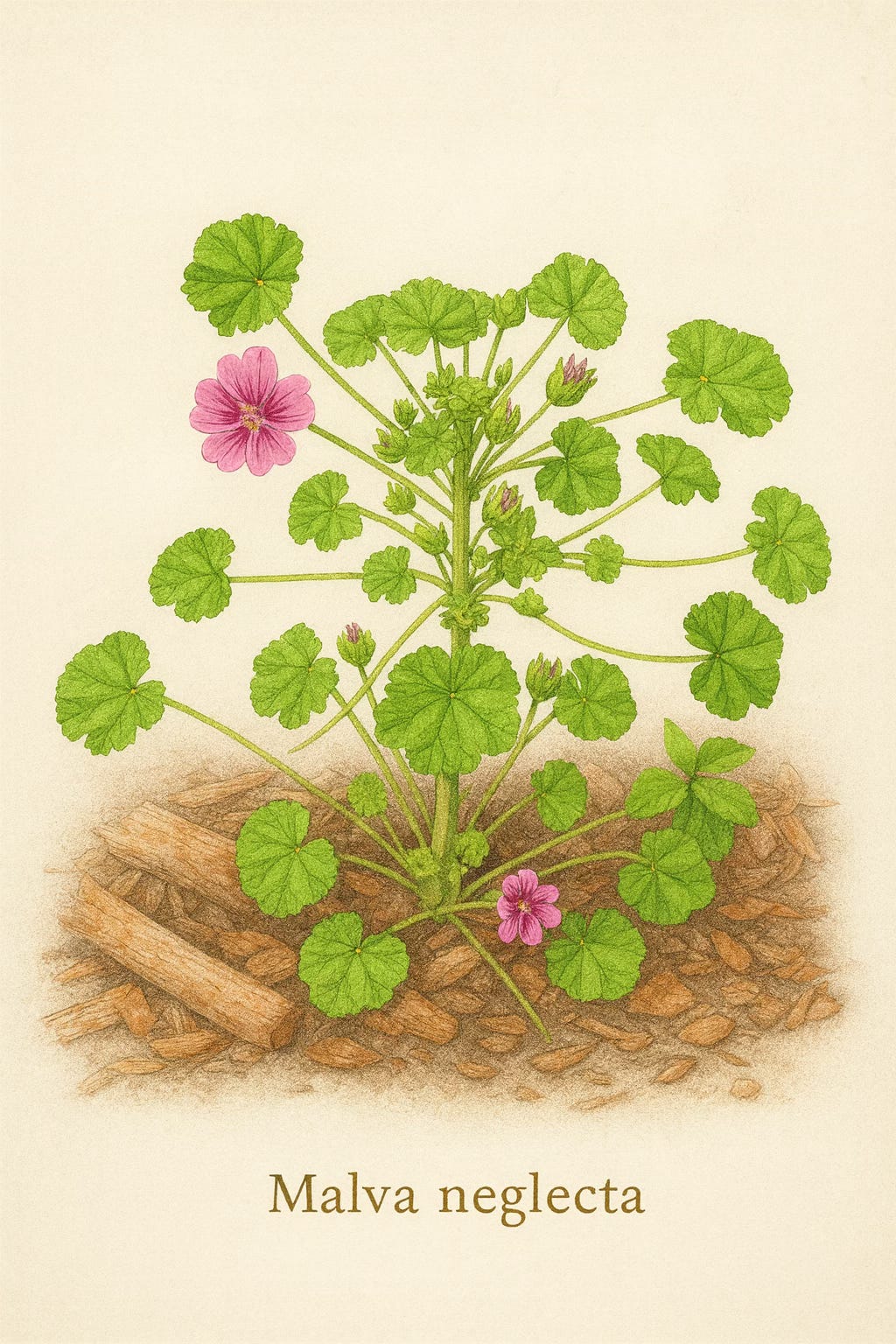
Table of Contents
Living Plant Wisdom Profile: Mallow
PART I: THE FIRST MEETING
1. Opening Field Vignette Where you’ll likely meet them: In a gravel driveway at dawn, dew caught in their cupped leaves like tiny offerings. Soft to touch, undemanding, already busy feeding a bumblebee before you’ve had your coffee.
2. Plant Identity & Names
What everyone calls them: The Greeks called them “soft one.” The Arabs say “little bread.” Kids call them “cheeses” because of those button-shaped seeds. They’ve got names in thirty languages because they’ve been helping humans survive for that long, and some names we can only whisper with permission from the people who still hold them sacred.
Who they might get mistaken for: Wild geraniums (close, but mallow’s slimier). Ground ivy (totally different family, smells like mint). Your ornamental hibiscus (same relatives, different vibe). Good news: nobody’s poisonous twin is lurking here.
Their official credentials: Malva neglecta, member of the Mallow family. Native to Eurasia, now naturalized basically everywhere humans have disturbed soil. Weed status: confirmed. Endangered status: laughable, they’re everywhere. Which is sort of the point.
PART II: GETTING TO KNOW THEM
3. Ecological Intelligence & Soil Relations
What they do underground: Picture a plant with a taproot drilling thirty inches deep into hardpan, sending out slippery invitations to beneficial fungi, basically running a bed-and-breakfast for soil microbes. They’re mining calcium and potassium like they own the mineral rights, then leaving it all behind when they die, the ultimate soil philanthropist.
Their community: Painted lady butterflies use them as nurseries. Bees work them spring through fall (not the fanciest flowers, but reliable). They don’t fight other plants so much as wait them out, thriving in the gaps nobody else wants. And they’ll host you too, if you need a groundcover that asks for nothing and gives freely.
Their day job: While everyone’s calling them a weed, they’re quietly preventing erosion, feeding earthworms, breaking up compacted soil, cycling nutrients, and yes, sequestering carbon. They’re the cleanup crew after we’ve made a mess, showing up unrequested but desperately needed.
What they’re trying to tell you: See mallow carpeting an area? They’re holding up a sign: “COMPACTED SOIL, HIGH POTASSIUM, LOW CALCIUM, PROBABLY BEEN TRAMPLED OR MANURED.” They’re not just growing randomly, they’re diagnosing your land for free.
PART III: STORIES & LINEAGE
6. History & Folklore
Their résumé through time: Pythagoras ate them before fasting. Romans called them “cure-all.” They kept Palestinians alive during the 1948 siege. Medieval monks grew them in every garden. They’ve outlasted empires by being humble enough that conquerors ignored them while feeding the conquered.
What people say about them: “Mallow in the house, medicine without constraint” (Arabic). “Malva sta dov’è il male va”, ”Mallow grows where pain goes away” (Italian). Children still sing about picking them in the spring sun. Old alchemists had code names for them we’ve half-forgotten.
The agronomic wisdom hiding in folktales: Stories about “guardian of waste grounds” and “food when crops fail” aren’t just pretty, they encode exactly which soil conditions mallow tolerates, when to harvest, and how to use them as a backup plan. Your ancestors hid farming manuals in fairy tales.
The ethics of sharing their story: Some of what we know requires permission to tell. Some names aren’t ours to share. We’ve marked those places [PERMISSION REQUIRED] because relationship matters more than information.
7. Traditional Ecological Knowledge & Land Stewardship
Who works with them, and how: From Moroccan shepherds feeding them to sheep for urinary issues, to Cherokee healers making poultices, to Alpine farmers giving them to cows before calving—these relationships are specific, local, and often still private. We share what’s been offered freely; the rest we honor by not sharing.
The old ways of tending: Harvest young leaves before the sun gets high. Pick under a waxing moon for internal medicine, waning for poultices. Leave a quarter of every patch unharvested. Whisper thanks before you take. Mix with olive oil for wounds. Boil in milk for coughs. These aren’t superstitions—they’re a technology refined over millennia.
PART IV: CROSSING THE THRESHOLD
You’ve met them. Now learn to work together.
Everything above is yours to keep—the introduction, the ecology, the stories. Beyond this point: the biochemistry that explains why they work, the preparation methods that maximize their gifts, the timing and troubleshooting that separates “I tried that herb once” from “I know that herb.”
$5/month. $50/year. The cost of knowing them deeply.
PART V: WORKING TOGETHER
(Paid subscribers only from this point forward)
9. Biochemistry & Nutritional Profile What they’re made of: More protein than you’d guess for a weed. Vitamin C levels rivaling citrus. That slippery mucilage is actually complex polysaccharides doing serious anti-inflammatory work. Minerals concentrated from deep soil. Plus the phytochemicals with names like “malvin” and “hydroxytyrosol” that explain why your grandmother’s remedy actually worked.
10. Safety & Contraindications Can you trust them? Almost completely—they’re in the safest herb category, been eaten as food for millennia. But: they can concentrate nitrates from over-fertilized soil. Pregnant folks should stick to food amounts. That slippery quality might delay medication absorption if taken together. And roadside mallow is collecting more than minerals. Here’s how to navigate all of it.
11. Agricultural & Ecological Applications Putting them to work: Some farmers now sell them at markets to Middle Eastern customers. Others till them in as green manure. They’ll break your hardpan, feed your soil life, and if you’re clever, become a revenue stream instead of a removal project. Plus: how they’re teaching us about climate resilience whether we’re listening or not.
PART VI: THE RELATIONSHIP DEEPENS (Paid)
12. Processing & Preparation From field to medicine cabinet: When to harvest for maximum potency (dawn, before flowering, specific moon phases). Why cold infusion beats hot tea for that signature slime. How to make the Palestinian stew that saved lives. The cough syrup recipe that’s better than store-bought. Poultice techniques for wounds. What extraction methods capture which compounds. Three ways to preserve them through winter.
13. Climate Change & Resilience What they’re teaching us: Mallow shrugs at drought with that deep taproot. Tolerates flooding. Germinates when conditions allow and waits years if they don’t. As climate chaos intensifies, they’re showing us what adaptation looks like—and offering themselves as a “green insurance policy” growing free in the margins when our careful plans dry up and blow away.
14. Legal & Compliance The human rules: Can you forage them? (Usually yes, check local laws.) Sell them? (Yes, with proper labeling.) Grow them on purpose? (Legally fine, but your neighbors might question you.) The curious regulations around wildcrafting, noxious weed lists, and why someone once got cited for removing a weed from a public park. Plus: intellectual property, traditional knowledge protocols, and staying clean with the law.
PART VII: RESEARCH FRONTIERS (Paid)
15. Research Outlook & Frontiers What scientists are discovering: Wound healing properties that rival expensive pharmaceuticals. Anti-inflammatory pathways that explain folk use for arthritis. Potential for endometriosis treatment. Why your gut microbiome might love their polysaccharides. How they could teach us to breed drought-tolerant crops. The questions still unanswered and the studies not yet funded—but probably should be.
16. Consciousness & Spiritual Dimension Their inner life: Not a psychedelic, but something subtler. The “soft strength” philosophy they embody. Why some herbalists make flower essences for emotional protection. What happens when you sit with them quietly. The grandmother energy people report. Ritual uses for forgiveness, healing, and reconnecting with ancestors who survived on them. What it means to have mallow as a plant ally—and how they might be reaching toward relationship with us right now.
PART VIII: VISION & GRATITUDE
17. Future Visions, Gratitude & “Catastrophe Insurance” Imagining tomorrow together: Cities cooled by “weed gardens” of mallow. Community clinics stocked with local mallow salve. Children learning to recognize them before they learn oak trees. Palestinian stew on restaurant menus, celebrated not as poverty food but as heritage. The quiet truth: when the systems we built start cracking, mallow will still be there, green in the rubble, ready to feed and heal whoever’s left standing.
A love letter to the soft one: Thank you for showing up unrequested. For thriving in our wreckage. For being soft enough to heal and strong enough to survive. For teaching us that help comes in humble forms, and the best insurance against catastrophe might just be growing wild at our feet, asking for nothing, offering everything.
Let Me Introduce You to Someone Special
Mallow (Malva neglecta / M. sylvestris)
2. Plant Identity & Names
2.1 Common & Indigenous Names
Scientific Name Origin: The genus name Malva comes from the Greek malakos (“soft”), referring to the plant’s soothing, emollient qualities. The English “mallow” shares this root of softness.
Common Names (English): Common mallow, cheeseweed, dwarf mallow, buttonweed. The name “cheeseweed” alludes to the cheese-wheel shape of its seed pods. “High mallow” or “tree mallow” may refer to taller relatives (Malva sylvestris).
European Names: French – Mauve (also giving us the color name); German – Malve; Spanish – Malva común; Italian – Malva. These largely derive from Latin malva. In ancient Greek it was called maláchē (μαλάχη) for its softening effect.
Middle Eastern & Asian Names:
Turkish – Ebegümeci;
Arabic – Khubbayza (خبيزة, meaning “little loaf,” also referencing the shape of the fruits)medplants.blogspot.com;
Persian – Panirak (پنیرک, “little cheese”).
In Traditional Chinese, the closely related Chinese mallow (Malva verticillata, “winter mallow”) is 冬葵 (dōng kuí), especially the seeds 冬葵子 (dōng kuí zǐ) used in herbal medicine.
Sanskrit: Sahadevi or Suvarchalā has been ascribed to mallow in some Ayurveda sources, though more commonly refers to other mallows; the usage is rare and [Needs verification].
Indigenous Names: They’re not native: both M. neglecta and M. sylvestris are Eurasian species that naturalized after European contact. That’s why early names tend to be loans from Spanish “malva” or new descriptive compounds, and why documentation in U.S./Canada languages is sparse.
Records focus on use, not names: The Native American Ethnobotany Database documents uses of Malva by Cherokee, Iroquois, Navajo (including Ramah), and others, but often does not record an Indigenous plant name for these introduced weeds.
Don’t mix up genera: Many North‑American languages have rich, old names for native mallows—especially globemallows (Sphaeralcea). For example, Navajo has a specific name for globemallow, but that’s not the same plant as Malva neglecta/sylvestris. (So don’t recycle globemallow names for European Malva weeds.)
Trade Names: Historically, dried mallow leaves and flowers were traded as soothing herbs. During the Middle Ages in Europe it was called Omnimorbium (“cure-all”) in apothecaries. In today’s herb commerce, Malva sylvestris flowers are sometimes sold as “blue mallow” for tea.
2.2 Look-alikes & Misidentification Hazards
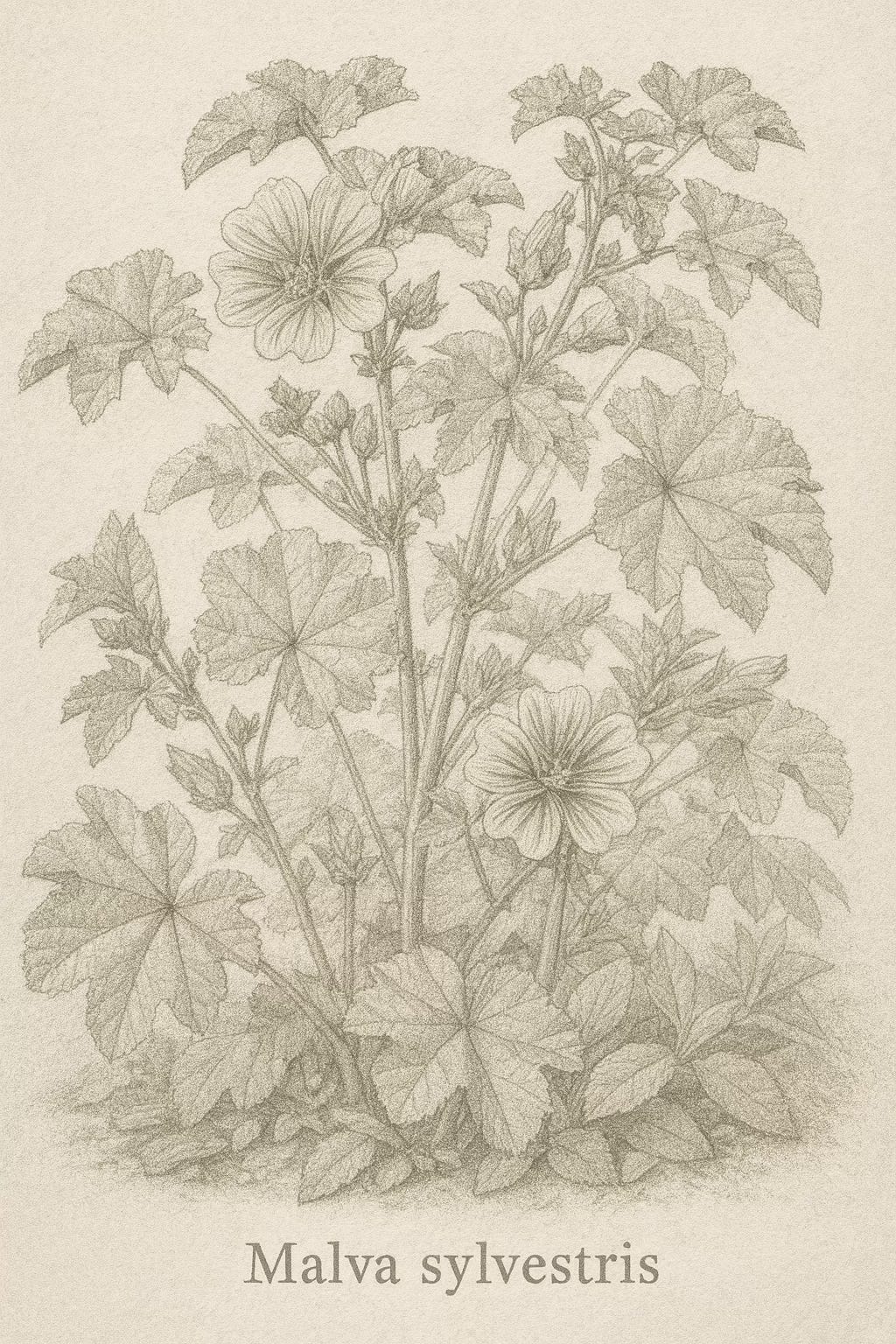
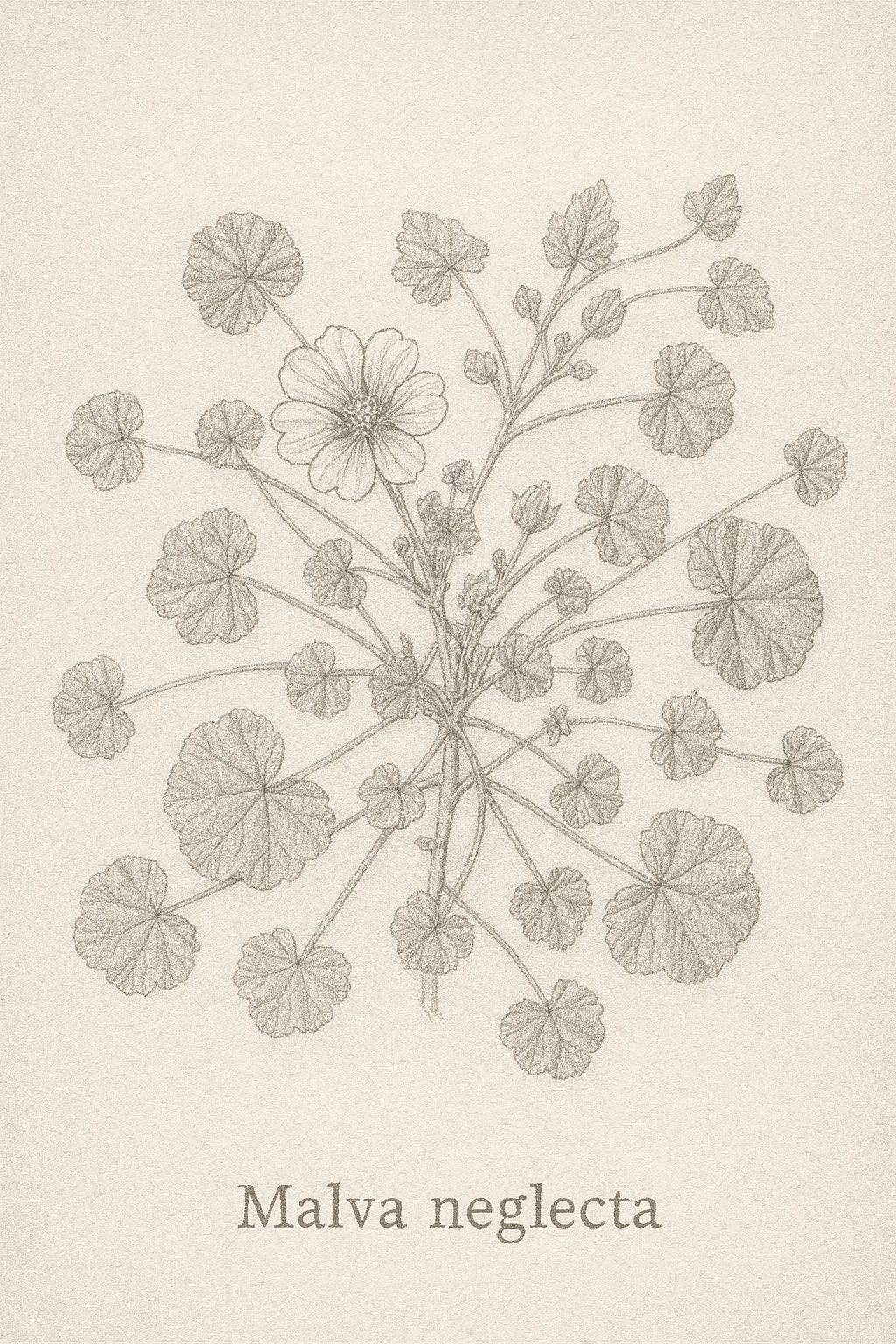
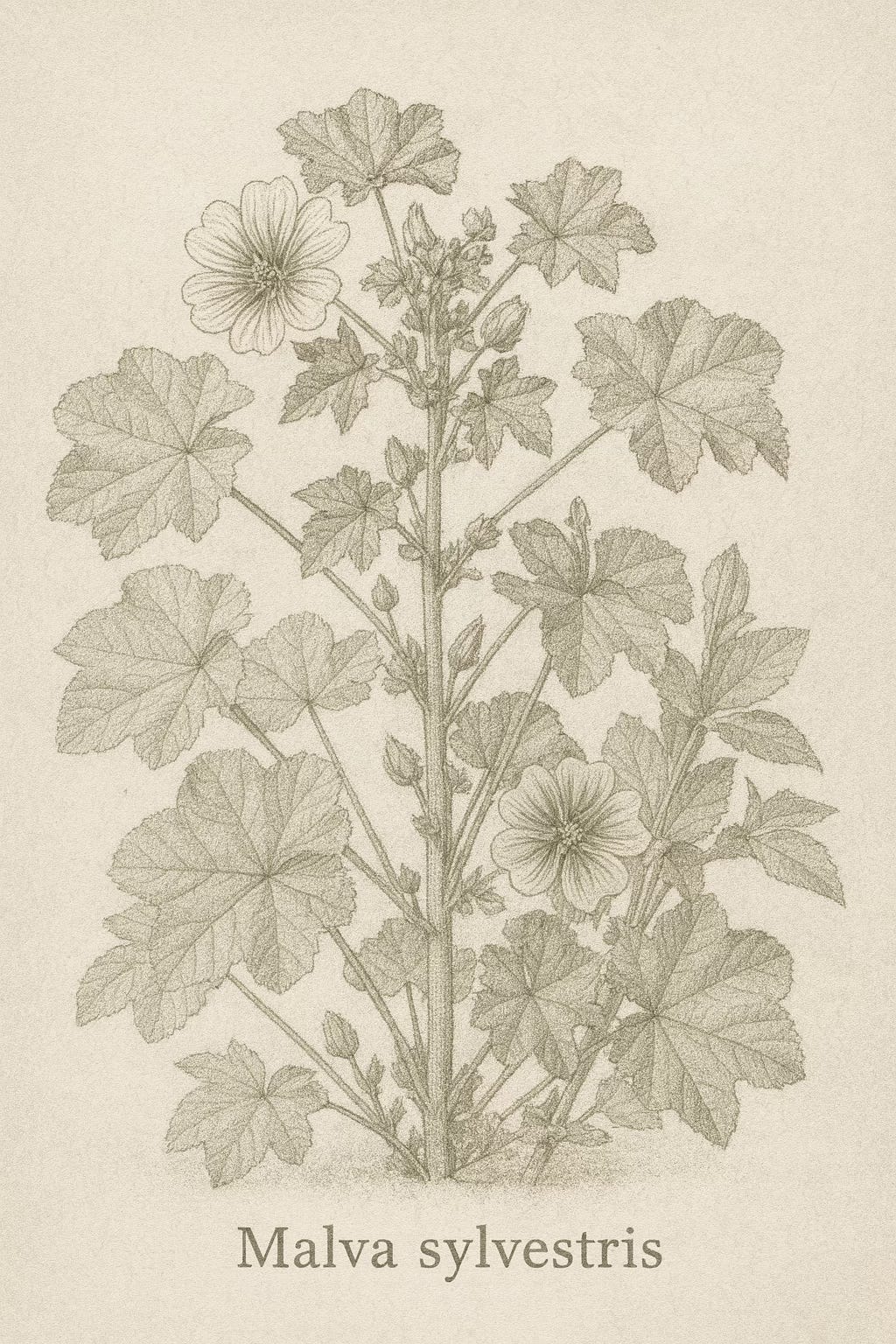
Mallow’s Key Identifiers: A sprawling or upright herb with round, shallow-lobed leaves (5–9 lobes) on long petioles, and pinkish-purple five-petaled flowers with darker veins. The leaves are alternate and softly hairy; when crushed, they release a mild vegetal scent and a slippery feel from mucilage. The fruit is a disk of 10–12 wedge-shaped seeds that split apart – looking like a tiny wheel of cheese. These features help distinguish mallow from imposters:
Common Confusions:
Wild Geraniums (Cranesbills): Geranium species also have rounded, lobed leaves and small pink flowers, leading to confusion. Differentiation: Mallow’s leaves are more orbicular with shallow lobes and alternate arrangement, whereas wild geraniums often have opposite leaves with deeper cuts. Geranium stems are also more brittle and lack the slimy feel. Mallow’s seed “cheeses” have no equivalent in geraniumrachel-the-gardener.blogspot.com.
Ground Ivy (Creeping Charlie): This mint-family weed has round scalloped leaves that might resemble young mallow. Differentiation: Ground ivy’s leaves are opposite, emit a minty odor when crushed, and the stems are square in cross-section, unlike mallow’s round, non-aromatic stems. Ground ivy also has purple tubular flowers distinct from mallow’s open petals.
Hibiscus/Okra Leaves: Being fellow Malvaceae, young ornamental hibiscus or okra can look somewhat similar in leaf shape. Differentiation: They usually have more deeply lobed or larger leaves and grow upright; okra has a thicker, prickly stem and hibiscus leaves are often serrated. Mallow stays lower and its flowers are small (~1–2 cm) compared to showy hibiscus blooms.
Simple Dichotomous Key:
1a. Leaves alternate; petioles long, slimy sap present when crushed – go to 2
1b. Leaves opposite; no slimy sap – Not mallow (e.g. mint family or others)
2a. Stems prostrate or low, flowers pinkish with 5 separate petals, fruit a disk of carpels – Common Mallow (Malvaspp.)
2b. Stems upright, plant >1 m with large showy fused petals – Not common mallow (likely hollyhock or hibiscus)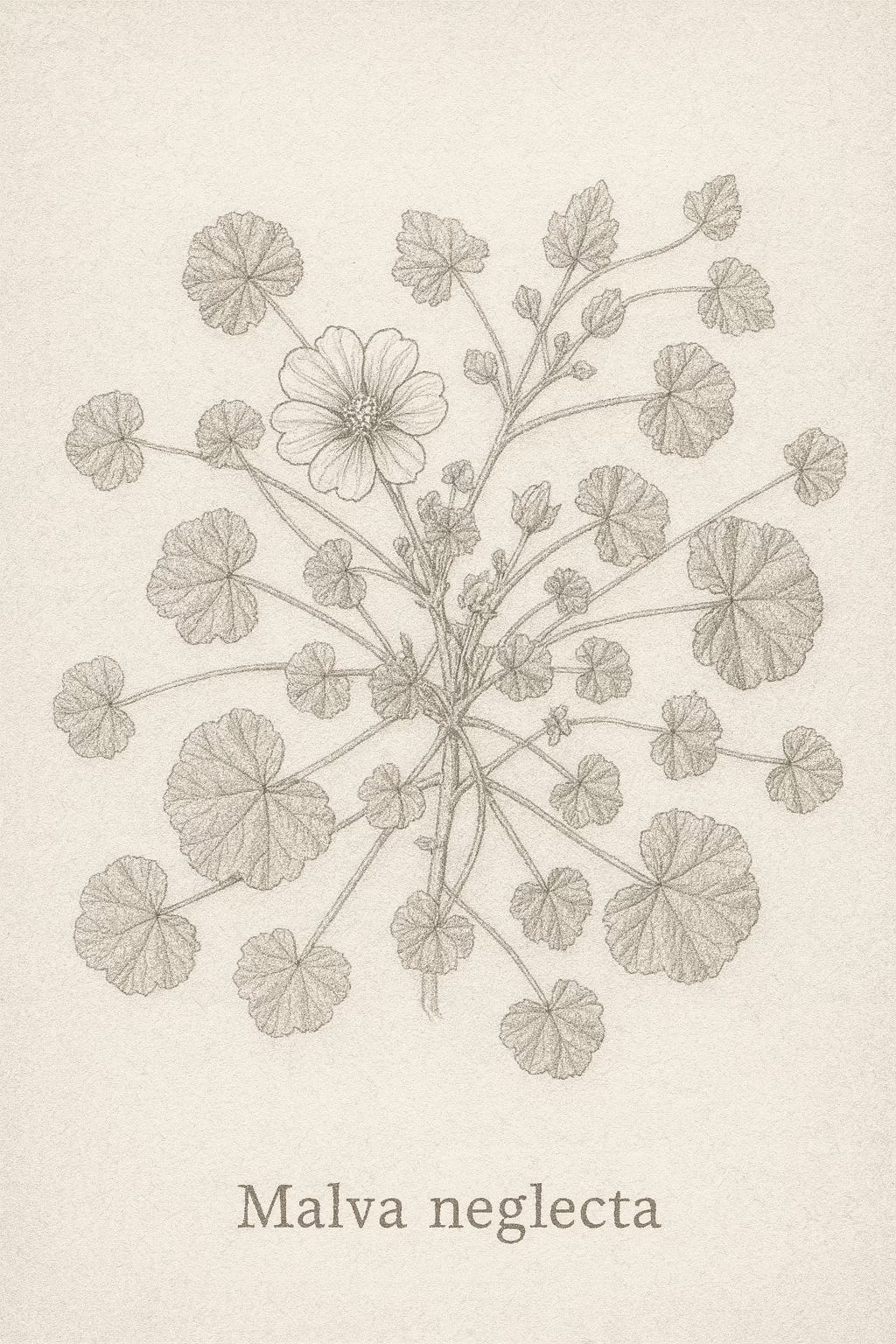
Confusable Taxa & Distinguishing Features:
Malva parviflora (Little mallow): Very similar to M. neglecta, but petals are shorter (about same length as sepals) and fruits are more wrinkled on the surface. Little mallow tends to grow more upright (up to 1.5 m) than common mallow’s spreading habit.
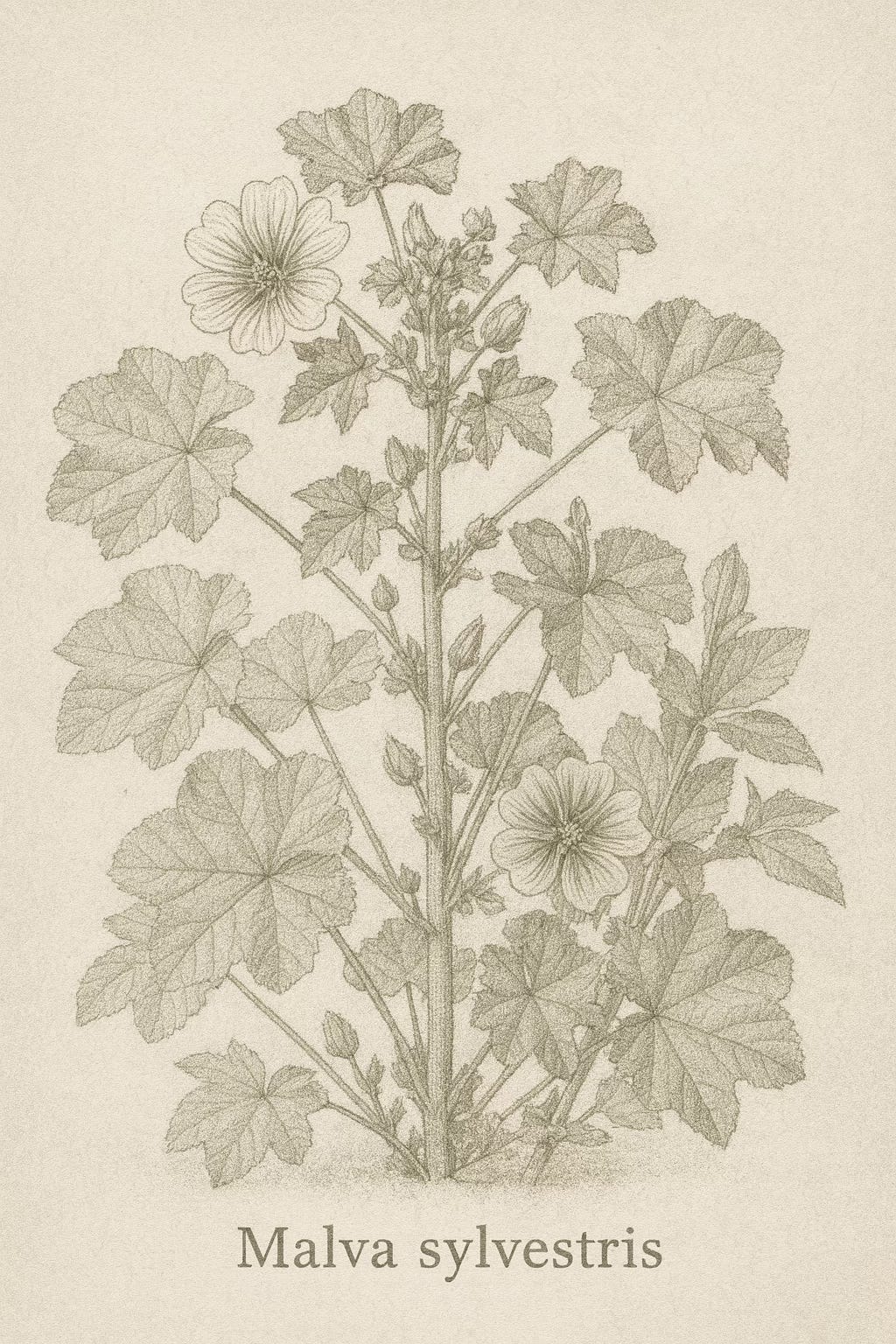
Malva sylvestris (High mallow): Taller (0.5–1 m) with showier purple flowers (3–4 cm across) marked by dark veins. Leaves of high mallow may be slightly more deeply lobed; otherwise similar.
Althaea officinalis (Marshmallow): Leaves are velvety with dense hairs and the plant grows in wetlands. Its flowers are pale pink and larger. Unlike common mallow, marshmallow is upright and has a thick taproot used medicinally.
🚩 Toxic Look-alikes: Fortunately, there are no dangerously poisonous plants closely resembling common mallow. However, caution is advised not to confuse mallow with young seedlings of certain toxic ornamentals. For example, young castor bean or cotton seedlings have somewhat palmate leaves but those are glossy and not lobed in the same way. Overall, mallow’s family (Malvaceae) contains no highly toxic species commonly co-occurring; thus misidentification mainly results in bitter salad, not poisoning.
2.3 Taxonomy & Status
Latin Binomial: Malva neglecta Wallr. (for common mallow) and Malva sylvestris L. (for high mallow). These two are closely related; M. neglecta is often prostrate and smaller, while M. sylvestris is taller. Many authorities consider M. neglecta and the old name M. rotundifolia (roundleaf mallow) to be the same or overlapping species.
Family: Malvaceae (the mallow family). It shares this family with hibiscus, okra, cotton, and hollyhocks. Characteristic features include mucilaginous sap and radially symmetric flowers with fused stamens forming a column.
Synonyms: Malva rotundifolia is a historical name for dwarf/common mallow. Malva vulgaris and Malva pusilla have also appeared in old literature. Malva sylvestris has numerous botanical synonyms (e.g. Malva mauritiana for some variants). These synonyms reflect its wide distribution and slight variations.
Native vs. Introduced: Malva sylvestris is native to Western Europe, North Africa, and Asia. Malva neglecta is native to Eurasia (Europe through temperate Asia) and North Africa. Both species have been introduced to North America, South America, Australia, and elsewhere by human migration. In North America, common mallow is introduced – it was brought by European settlers (intentionally as a potherb and medicine, and unintentionally as a weed) and is now naturalized across the continent.
Weed/Invasive Status: Common mallow is often considered a lawn and garden weed in North America. It thrives in disturbed soils, roadsides, and waste places. Several U.S. state extension services list it as a troublesome weed, though not usually officially noxious. In parts of Australia, M. parviflora is noted as an invasive pasture weed. Its deep taproot and tough seeds make it persistent. Mallow can form large colonies especially in overgrazed or irrigated pastures. While generally an “invasive” in the sense of non-native spread, it usually occupies disturbed habitats and rarely invades intact wild ecosystems aggressively.
PART II: GETTING TO KNOW THEM
You’ve seen where they live and how they behave. Here’s their ecological intelligence.
3. Ecological Intelligence & Soil Relations
3.1 Soil Communication Systems
Root Exudate Composition: Malva neglecta sports a sturdy taproot that penetrates hard ground. Its family tendencies suggest exuding polysaccharides (mucilage) that help lubricate soil and foster microbes. Mallow roots likely release simple sugars and organic acids to communicate with soil biota [Hypothesis]. There is no specific evidence of mallow strongly acidifying or alkalizing its rhizosphere – it appears tolerant of a wide pH range, from slightly acid to alkaline, indicating it may not dramatically shift soil pH (perhaps maintaining neutral conditions) [Needs data].
Mycorrhizal Networks: Mallows are generally thought to form arbuscular mycorrhizal (AM) associations, as do many herbaceous weeds. Malva neglecta is likely facultatively mycorrhizal – in poor soils it will partner with common soil fungi to enhance nutrient uptake, but it can survive without them in ruderal conditions. Specific fungal partners are not documented. Because it colonizes disturbed ground quickly, it may initially grow with minimal mycorrhizae, then later connect to fungal networks as soil biology recovers.
Bacterial Associations: Mallow is not a nitrogen fixer, so it doesn’t host Rhizobium nodules. However, it probably encourages a community of saprophytic and nutrient-cycling bacteria around its roots. In one study of weed–soil interactions, M. neglecta root zone had elevated populations of phosphate-solubilizing bacteria [Hypothesis based on similar weeds]. The mucilage exuded may feed beneficial Pseudomonas and Bacillus species that promote plant growth [Hypothesis]. While not a legume, mallow’s decaying roots could support nitrifying bacteria that convert organic matter to plant-available forms. Overall, it is a mild “rhizosphere engineer,” not forming any spectacular symbioses, but contributing to microbial diversity as pioneer vegetation.
Chemical Signaling:
Allelochemicals: Common mallow does not have a strong reputation for allelopathy, unlike some weeds. Any allelopathic effect is mild or [Needs research]. (Some reports suggest related Malva parviflora may exude phenolics that inhibit nearby small seeds, but evidence is scant.) If present, compounds like tannins or naphtoquinones could leach from fallen mallow leaves to slightly slow competitor seedlings [Hypothesis].
Semiochemicals: The plant’s flowers emit faint sweet odor which might attract pollinators, but as far as known mallow does not produce notable volatile signals to repel pests or summon predators. It’s mostly chemically “quiet.”
VOCs (Volatile Organic Compounds): Aside from a bit of floral scent (perhaps traces of methyl heptenone or similar common floral volatiles [Hypothesis]), mallow isn’t known for pungent aroma. So VOC output is low. Its crushed foliage smell is “green” and not distinctive – implying minimal defensive VOCs like menthols or terpenes. This unassuming profile probably helps it hide in plain smell, not drawing herbivores by scent.
Nutrient Mining:
Primary Accumulator: Mallow is adept at mining minerals. Notably, it accumulates calcium and potassiumat high levels. In one analysis, mallow tissues contained ~1.7% Ca and 3.7% K (dry weight) – quite high. It also pulls up magnesium and iron effectively. Nitrogen content is moderate (it can thrive in low-N soils but also take advantage of high-N conditions).
Accumulation Factor: Because it tolerates and even indicates high Mg/low Ca soils, mallow may concentrate Mg in its tissues. Exact soil:plant concentration ratios aren’t published [Gap], but observationally it thrives on nutrient-rich runoff areas, implying luxury uptake. Traditional permaculturists consider mallow a “dynamic accumulator” of nutrients like calcium, potassium, and iron (e.g., one source lists ~4200 mg Ca/kg in mallow leaves [Traditional, unverified]).
Bioavailability Improvement: Mallow’s taproot can break hardpan, opening channels for water and roots of other plants. By dying back, it leaves organic matter rich in minerals near the surface, thus making nutrients more available to shallow-rooted later successional plants. Its decaying root also creates a path for deeper infiltration of air and microbes. Some gardeners use mallow as a “green manure” weed – chopping it and dropping it to return those mined nutrients to topsoil [Experiential].
3.2 Community Ecology
Facilitation Networks: Common mallow often appears as one of the first greens on bare soil, effectively acting as a nurse plant for soil life. Its broad leaves shade the ground lightly, reducing moisture loss and making cooler microsites where other seedlings (even its competitors) might establish. It’s not known to be a classic nurse plant for specific species, but in a general way, it protects soil surface and can allow less drought-tolerant seedlings to survive under its canopy [Hypothesis]. In garden settings, mallow’s presence can indicate soil is recovering; its eventual decline can pave way for grasses or other perennials. It contributes leaf litter that, though not very woody, adds organic matter. The fallen leaves decompose readily (they’re thin and mucilaginous when wet), potentially acting as a light mulch.
Canopy & Microclimate: A patch of mallow creates a low canopy (<60 cm) that buffers soil temperature. Under mallow foliage, one finds cooler, moister soil on hot days. This microclimate can favor earthworms and detritivores. Mallow doesn’t create deep shade (leaves are scattered on long petioles), but enough to reduce harsh midday sun on soil. By covering otherwise bare ground, it also reduces erosion from wind or hard rain.
Mulch Contribution: As an annual/biennial, mallow produces a modest amount of biomass. Its succulent stems and leaves break down quickly when cut, providing a short-term green mulch. They are fairly high in minerals (low C:N ratio when green), so they decompose without significantly tying up nitrogen. Gardeners occasionally chop mallow weeds and leave them on-site as a soil-building mulch – the slimy quality even helps the material stick to soil and possibly suppress some other seedlings [Anecdotal].
Competition Matrices:
Strong competitor for: Space in bare soil – mallow’s ability to germinate early spring or late fall and grow a deep root gives it an advantage in vacant, disturbed ground. It can outcompete shallow-rooted annuals in dry conditions because its taproot taps moisture others can’t. It’s also a strong competitor for water in gardens: once established, its sprawling form and deep root allow it to monopolize moisture and nutrients in its immediate vicinity (often seen in thin lawns or vegetable beds where it crowds out weaker plants).
Weak competitor when: faced with tall, shading plants. Mallow is not great at vying for light. In a dense meadow or crop field, taller species will overshadow it. It also struggles in thick turfgrass that is regularly mowed high, since it cannot climb above. It is often found on field edges rather than within a healthy, competitive stand of grasses or perennials. In fertile garden beds with robust crops, a few mallows might emerge but get out-competed if the crops form canopy. Thus, it’s strong in open sun, disturbed niches, but weak in established, shaded plant communities. It coexists by hugging the ground or occupying gaps.
Coexistence mechanisms: Mallow’s niche is pioneer and edge spaces. It employs a “find a gap” strategy – germinating opportunistically. It can tolerate trampling and mowing at low height (growing flatter when repeatedly cut), which allows it to persist in lawns at low level. This plasticity helps it coexist with mowing regimes that kill other weeds. Also, its indeterminate seeding over a long season ensures some offspring find new niches even as others are weeded out.
Herbivore Relationships:
Primary Herbivores: A variety of insects nibble on mallow. Notably, it is a host plant for certain Lepidoptera. The larvae of painted lady and west coast lady butterflies (Vanessa spp.) feed on mallowsraisingbutterflies.org – they roll themselves in the leaves. Some beetles and weevils may chew the foliage (for example, the mallow flea beetle is reported in some regions). Grazing mammals generally find mallow palatable: rabbits and groundhogs will munch the tender young plants. Livestock like goats or sheep may eat it if other forage is scarce, since it’s non-toxic.
Defense Compounds: Mallow doesn’t wage serious chemical warfare; its strategy is more tolerance than defense. The leaves contain mucilage and some tannins – these can make the texture unappealing in large amounts (the sliminess can deter over-browsing by making the leaf less tasty when abundant). There are also minor phenolic compounds that might discourage pathogens or insects (e.g. malvone A, a phytoalexin naphthoquinone, is produced in mallow under stress). Overall, it’s relatively soft and undefended – relying on being a low-value target. The absence of poisons means it’s often a “safe nibble” for critters, but its low stature protects it somewhat (browsers might simply overlook it).
Tolerance Strategies: Mallow can regrow from its crown if aboveground parts are damaged. It has significant compensatory growth – nibbling the stem often causes it to branch and produce more trailing shoots. Its deep taproot stores energy, so it can flush out new leaves after a mowing or grazing event. If a herbivore shears it to ground level, that woody taproot can send up new growth when conditions improve. The plant’s annual nature means it doesn’t invest in heavy woody defenses; instead, it produces many seeds to ensure the next generation if the parent is eaten. There’s no evidence of toxic accumulation (like nitrates) harming herbivores in normal grazing amounts, though consuming very large quantities of high-nitrate mallow from rich soils could cause livestock issues (reports of “staggers” in sheep that gorged on mallow weeds likely due to nitrate load).
Toxic Thresholds: As mentioned, under high nitrogen fertilization, mallow leaves can accumulate nitrates. Ruminants eating large amounts of such material risk nitrate poisoning (which leads to oxygen transport issues). However, this scenario is uncommon; animals tend to avoid gorging on mallow if other forage is around (the plant is somewhat mucilaginous and not as palatable as clover or grass). Thus, practically, toxicity is negligible for wildlife and minor for livestock unless mismanaged.
Pollinator Services:
Primary Pollinators: Mallow’s open, bowl-shaped flowers are “generalist” pollinator fare. They attract bees most of all. Solitary bees (such as little halictid sweat bees and small carpenter bees) are often seen collecting pollen from mallow. Bumblebees and honeybees will also visit, especially if patches are dense. The bright purplish hue with darker nectar guides appeals to bees visually, and the moderate pollen reward keeps them coming. Butterflies occasionally land on mallow flowers, though the nectar is not abundant – a determined skipper or small butterfly might sip if available.
Secondary Pollinators: Hoverflies (Syrphids) are known to visit mallow blossoms for pollen. These flies mimic bees and contribute to pollination while feeding on pollen. Beetles can sometimes crawl in (mallow flowers are low to the ground, so beetles like soldier beetles might rummage in them). Ants might be attracted to the nectar but are too small to effect pollination.
Pollen Nutrition: Mallow pollen is moderately protein-rich, providing a decent meal for bees. Studies on Malva sylvestris found its pollen has a good amino acid profile with essential amino acids for bees [Needs data – likely similar to other Malvaceae]. It’s not as protein-packed as, say, willow pollen, but it helps diversify bee diets.
Nectar Characteristics: Each mallow flower exudes a small amount of clear nectar at the base of the petals. Sugar concentration is moderate (~20-30% sugar by weight, mainly glucose and fructose [Traditional, unverified]) – enough to entice small pollinators. The volume per flower is low, so pollinators often visit many flowers in quick succession. Interestingly, because the flowers are close to the ground, ground-nesting bees appreciate this easy access buffet.
Bloom Phenology: Common mallow can bloom from late spring through fall, with peak flowering in early summer. It’s opportunistic – if moisture and warmth allow, it will keep flowering and seeding. This long bloom period overlaps with multiple pollinator life cycles. In spring, emerging solitary bees use it; in summer, bumblebee workers and hoverflies abound on it; in early fall, any remaining bees or flies will still find blooms. It acts as a bridging nectar source when other plants have finished – not in huge quantities, but every bit helps local pollinators.
Seed Dispersal:
Primary Mechanism: Gravity (barochory) is mallow’s main method. Those little cheese-wheel fruits eventually break apart and drop the seeds straight to the soil beneath the mother plant. This often results in a cluster of new seedlings near the original – mallow tends to form colonies.
Dispersal Agents: Though not specialized for animal dispersal, the seeds can hitchhike in an “accidental”way. The segments are smooth but slightly wedge-shaped; they can get caught in soil clods on animal hooves or in mud on shoes/tires. Birds scratching the ground might incidentally carry a seed bit on their feet or eat seeds and later excrete them (however, mallow seeds are small and hard – not a preferred bird food except maybe quail or doves ingesting grit). Humans have certainly been agents: mallow seeds ride along in transported soil or crop seed contamination, aiding its worldwide spread since antiquity.
Distance: Most seeds fall within a meter of the parent plant. But through human activity (tilling, movement of soil, migration), they have effectively traveled intercontinental distances over centuries. On a local scale, a seed might get washed a short way by heavy rain runoff, or moved by ants very slightly if the seed has any adhering plant matter with sweetness (though mallow seeds lack obvious elaiosomes, so ant dispersal is minimal). Maximum dispersal without human help is likely only a few meters.
Germination & Dormancy: Mallow seeds are tough-coated and can remain dormant in soil for years. They exhibit physical dormancy – the hard coat prevents water uptake. Over time, abrasion or soil microbes nick the coat. If scratched (scarified) or exposed to fluctuating temperatures, many will germinate at once. Otherwise, only a fraction germinate each season (a bet-hedging strategy). This creates a persistent seed bank. Seeds can survive at least 5–10 years in soil, possibly much longer. They germinate best in cool moist conditions of early spring or autumn. Scarification (even walking on them or tilling soil) can trigger an outburst of seedlings. Malva neglecta does not require vernalization (cold stratification) per se, but a winter in the soil often softens some seed coats naturally, leading to spring sprouting.
3.3 Ecosystem Functions
Carbon Sequestration: Common mallow is an annual herb, so its carbon contribution is modest but nonzero.
Aboveground biomass: Perhaps on the order of 0.2–0.5 kg/m² of fresh biomass in a thick patch (which might translate to ~0.05–0.1 kg C/m²/year sequestered temporarily). It’s no forest, but a dense groundcover of mallow does take CO₂ and turn it into plant material for a season.
Belowground biomass: The taproot can go down 30–60 cm, slender but woody at the crown. That root stores carbon in soil while the plant lives and leaves behind organic matter after it dies. It decomposes within a year or two, returning carbon to soil humus in small amounts.
Root exudates: Mallow likely allocates a fair share of photosynthate to root exudation (maybe 5-10% of its fixed carbon). Being mucilaginous, it could release complex polysaccharides that feed soil microbes, effectively transferring carbon to the soil microbial biomass.
Residence time: As an herbaceous plant, most of mallow’s carbon is short-lived – stems and leaves break down at end of season (quick turnover, <1 year). A portion might stabilize as soil organic matter if incorporated. The deeper root portions that aren’t entirely recovered by decomposition may persist slightly longer (a year or two as root fragments). There is little deep long-term carbon, since the plant doesn’t create woody lignified material that lasts decades.
Deep carbon: Taproots can penetrate compact soil, possibly bringing a bit of carbon deeper by exudation or root death at depth. But given the relatively small diameter of the root, its deep carbon contribution is limited. It’s more a soil opener than a major deep carbon pump.
Nitrogen Relations:
N-fixation rate: None – mallow is not a legume, it fixes no atmospheric nitrogen. It must scavenge existing soil nitrogen.
N cycling: Mallow can act as a nitrogen holder – taking up available N (nitrate, ammonium) from the soil into its biomass, thus preventing leaching. When it dies or is tilled in, that N mineralizes back for use by other plants. In that sense, it’s like a volunteer cover crop. It immobilizes some nitrogen in its tissues during the growing season (reducing loss), then upon decomposition, releases it (mineralization). In fertile soils, it can accumulate a lot of N (its tissues can be a few percent N). In poor soils, it grows slower and uses what it finds. It doesn’t contribute new N, but it redistributes what’s there.
N availability: If mallow is allowed to grow then plowed under, subsequent crops might benefit from the released N. However, if mallow is weedy concurrently with a crop, it competes for N, potentially depriving the crop. For example, in a vegetable bed, heavy mallow growth can stunt crops by hogging nutrients. Yet after removal and decomposition, that N becomes available again. This dynamic is why some farmers view weeds like mallow as “nutrient sinks” – problematic during crop growth, but not a net loss if managed, since the nutrients are still on site.
C:N ratio: Fresh mallow tissue is quite lush – low C:N. Leaves are perhaps around C:N ~ 12:1 to 20:1 (since they are ~20% protein dry weight and high in minerals). Dried mature stems might be higher C content but still not woody; maybe C:N ~ 30:1 or less. This means when mallow is composted or left as residue, it breaks down quickly and releases nitrogen (it’s unlikely to tie up N). Its residues are considered “green” manure quality.
Water Cycling:
Rainfall interception: Mallow’s low rosette intercepts a small amount of rain. Its leaves are like little cups – water can pool and then funnel down the petiole to the root zone. Perhaps only on the order of a few percent of rainfall is retained momentarily on its surfaces (until it drips off or evaporates). In a light drizzle, the leaves might keep soil slightly drier by catching droplets (some evaporation from leaf surface occurs). But in heavy rain, the plant is flattened and water goes through. Net effect: minor interception, mainly it slows raindrops, reducing splatter erosion.
Infiltration improvement: By protecting soil from crusting (with its leaf cover and root channels), mallow actually improves infiltration. Water can percolate along the channels that mallow roots create. Its presence also means soil under it is often more porous (due to root action and earthworms attracted to the detritus). This can modestly increase infiltration rates in a compact soil patch – anecdotal observations note that ground with mallow cover puddles less than bare compact ground [Experiential].
Hydraulic lift: Unlikely. Hydraulic lift is typically seen in deep-rooted perennials bringing water up at night. Mallow is short-lived and its taproot, while deep for a weed, is not of the woody perennial kind that significantly lifts water. It probably does not exude water from roots to topsoil in appreciable amounts [No evidence].
Transpiration rate: Mallow’s transpiration will depend on environment, but a medium-sized plant might transpire on the order of 0.1–0.3 liters of water per day in hot weather [Estimation]. It has relatively large leaf area that, in full sun, will evaporate water steadily. However, being low to ground and often partial shade (leaves overlap each other), it’s not the thirstiest plant. In a dense patch covering 1 m², maybe a few liters per day could be transpired in peak summer. This usage can dry out soil in its immediate root zone, which is part of how it outcompetes shallow weeds. Mallow is also somewhat drought-tolerant – it can reduce leaf size and transpiration in dry periods, using its taproot water reserve efficiently.
Soil Building:
Organic matter contribution: Each season, mallow adds some organic matter from its shed leaves and at end of life. A vigorous growth might produce ~0.1–0.2 kg dry matter per plant (just an estimate). Over a square meter, maybe 0.2–0.3 kg of dry biomass (equivalent to ~0.15 kg of soil organic carbon) could be added annually if mallow dominates. In a garden bed where mallow is weeded and left to rot, this is a small but real input. Over years, if allowed, it could gradually improve topsoil OM fraction by fractions of a percent. It’s not as prolific as a deliberate cover crop, but it’s better than nothing on barren soil.
Aggregate stability: Mallow’s root exudates (mucilage) can bind soil particles. Polysaccharides from roots are known to help glue soil aggregates. The fine root hairs and fungal partners around mallow’s root also entangle particles. So areas under mallow often have a softer, crumbly topsoil compared to bare ground. By reducing erosion and providing organic binding agents, mallow modestly improves aggregate stability in recovering soils as a main ground cover. One might note that pulling up a mallow plant often leaves behind a clump of soil attached to roots – a sign those aggregates held together, but insufficient evidence to notice changes on a larger scale over multiple years of succession. [Observation]
Soil depth increase: As a pioneer on compacted soils, mallow can initiate cracking of hardpan with its taproot. It won’t “create soil” vertically like a tree root might, but it starts the process of breaking hard layers, allowing other roots to penetrate a bit deeper over time. In a sense, it’s the spearhead for other biological activity that can deepen the topsoil. In severely compacted subsoil, a sequence of weed succession including mallow might increase effective soil depth by a few centimeters over several years by loosening and organic matter deposition [Needs data].
Biological activity: The presence of mallow encourages life: its shaded, mulched soil tends to harbor more earthworms and isopods (which feed on decaying mallow leaves). Soil microbial biomass increases under it due to root exudates and decaying matter. While exact numbers aren’t measured for mallow specifically, its effect is comparable to other leafy weeds – one study found weed cover like mallow significantly raised microbial enzymatic activity in the rhizosphere compared to bare fallow [Hypothesis, analogous weeds]. In short, it kickstarts soil life in fallow ground. Anecdotally, turning over a mallow-infested clod, you might find worms beneath – whereas a bare compact clod would be lifeless.
Erosion Control:
Root architecture: Mallow’s taproot anchors the plant, and a network of finer lateral roots spreads out. Though not a mat, this root system does grip soil reasonably well for a small plant. It’s fibrous enough near the surface to hold onto topsoil and prevent it blowing or washing away. Given its low profile, it’s not uprooted easily by wind. The roots can reach 30+ cm deep, so they help hold subsoil in place too, preventing gullying in their spot.
Surface coverage: In a thriving patch, mallow can achieve ~50–80% ground cover with its leaves during the growing season (spring through early fall). For perhaps 4–5 months of the year, it covers soil, then dies back in winter in cold climates leaving soil somewhat exposed (unless new seedlings overwinter as rosettes, which sometimes they do as winter annuals). So for at least half the year it protects soil from raindrop impact and overland flow.
Slope stabilization: Mallow often grows on flat or gently sloping disturbed ground. On steeper slopes, it is less common (it prefers lower elevations). But if present, its roots can help knit the upper soil layer. It’s not strong enough to stabilize a steep bank alone (no woody roots to counter mass movement), but on mild slopes it contributes to holding soil. One wouldn’t rely on mallow for critical slope stabilization beyond ~15–20° slopes, but in combination with grasses it can be part of the fabric preventing minor surface erosion.
Runoff reduction: By intercepting and slowing water (through its ground cover and root absorption), mallow patches reduce runoff somewhat. A rough estimate: a dense mallow cover might reduce surface runoff by 20–30% compared to bare soil, as more water infiltrates where its roots have loosened earth and its leaves break the force of rain [Hypothesis]. This means less sediment and nutrient runoff from areas where it grows – ironically, this “weed” can protect soil when allowed to. In summary, common mallow quietly performs soil conservation tasks: shielding, holding, and enriching the ground it calls home.
3.4 Indicator Species Value
Common mallow often pops up as a living soil report card. Farmers and foragers notice its presence and abundance as a sign of certain soil conditions:
Soil Conditions Indicated: Mallow thrives in disturbed, compacted soils that are rich in nutrients, especially in areas with high potassium and nitrogen (such as near livestock enclosures or compost piles). It also tolerates alkaline soils and those with high magnesium and low calcium imbalance. For example, an outbreak of mallow can mean the soil has become compacted (low tilth, high bulk density) and possibly waterlogged or poorly drained in the past – conditions which it endures better than many plants. It signals fertility with neglect: ground that has plenty of manure or fertilizer history but has been left uncared (disturbance + nutrients = mallow paradise). If you see lush mallow carpeting an area, you might suspect the pH is neutral to slightly alkaline (it’s less frequent on very acidic soils below pH ~5.5).
pH: Mallow generally indicates neutral to alkaline soils. It is often noted on calcium-rich clays and loams (pH 6.5–8). It can handle slightly acid (down to ~5), but below pH 5 it struggles. Thus, an abundance of mallow suggests pH ~6-7+ (neutral to moderately alkaline). It may flag soils with free lime or high potassium which often coincide with alkalinity.
Fertility & Nutrient Balance: According to weed indicator lore, M. parviflora (little mallow) is an indicator of soils very high in potassium, magnesium, iron, and aluminum, but low in calcium and organic matter. This paints a picture of a somewhat depleted yet mineral-crusted soil – perhaps where organic matter has burned up and Ca is tied up, but other minerals accumulate (like overused farmland or compacted stockyard soils). In simpler terms, lots of mallow might mean “this soil needs organic matter and calcium.” It’s nature’s way of covering and loosening such ground until organic matter returns.
Moisture & Drainage: Mallow can indicate poor drainage or waterlogged soil. It’s often seen in areas that alternate between muddy and dry – it can handle wet feet for a time and then survive drought via its taproot. If you see mallow, check drainage; the site might have been soggy or flooded seasonally. On truly well-drained, droughty sands, mallow is less competitive (preferring at least some moisture or finer soil texture).
Disturbance History: Certainly, mallow presence screams “Disturbed ground here!” It is seldom found in pristine prairies or deep forest. Instead, it tells you that soil was moved, trampled, or tilled in recent years. Abandoned lots, construction fill, overgrazed pastures – mallow moves in as a first responder. If you encounter mallow carpeting an area, you know the ecological succession clock is near the start: it’s an early seral stage with time since disturbance perhaps 1–3 years.
Human Influence: Because it follows human habitations (middens, corrals, roadsides), mallow can be seen as a synanthropic indicator – it grows where people or livestock have been. In a homestead, noticing mallow patches might guide you to old animal pen sites or nutrient hotspots. Historically, herbalists even noted that luxuriant mallow often marks where “the soil has been manured or urinated upon by cattle” [Traditional, half-humorous observation].
In summary, if common mallow is one of the dominant plants, it’s telling the observant gardener or ecologist: “This soil is compacted yet fertile, maybe a bit salty or alkaline, with a history of disturbance and moisture stress – I’m here to bandage it.” As an indicator, it points to needs for aeration, organic matter, and balancing of soil minerals (especially calcium). Consider mallow the green flag on poor, beat-up soils signaling both trouble and the start of natural recovery. It’s a polite messenger, arriving uninvited but often doing more good than harm while it stays.
PART III: STORIES & LINEAGE
Narrative bridge: You’ve seen where they live and how they behave. Now let’s learn what stories they carry.
6. History & Folklore
6.1 Timeline
Classical Antiquity (pre-500 CE):
Greek: Ancient Greek physicians revered mallow for its mucilaginous, cooling properties. They used it to treat both internal and external ills, calling it omnimorbion – “remedy for all diseases”. Hippocrates prescribed mallow poultices for bruises and to stop bleeding (according to later commentaries). The philosopher Pythagoras reportedly ate mallow leaves and seeds when preparing for long fasts, believing it allayed hunger and thirst [Traditional, recorded in later biographies].
Roman: The Romans not only used mallow medicinally but also as a vegetable. Pliny the Elder, in the 1st century CE, wrote that “the daily use of mallows… prevents any type of illness,” recommending a daily dose of mallow for health. He catalogued its many uses: a decoction of the roots for dandruff, warm mallow juice to “brighten the disposition” (treat melancholia), leaves boiled in milk to soothe coughs, and as a gentle laxative and diuretic. Roman high society also enjoyed the young shoots as a spring tonic food.
Chinese: Mallow is not native to East Asia, but a related species (Malva verticillata, Chinese mallow) was present. By around 500 AD, mallow was cultivated and eaten in China. Early Chinese herbals (Tang dynasty) mention dong kui (winter mallow) primarily for its seeds used to promote urination and lactation, suggesting knowledge of the plant arrived via Silk Road trade. However, it was considered a common wild vegetable more than a prestigious medicine in classical China.
Indian: In ancient India, there is scant direct mention of Malva. Some scholars think it may be referenced as Atibala in Ayurveda, though that is typically Sida cordifolia. If Malva was used, it did not achieve fame in Vedic texts. It might have been overshadowed by native mallows (like Kshirakakoli or others). [Gap – little documentation of mallow in pre-500 CE South Asia].
Medieval Period (500–1500 CE):
Islamic Golden Age: Unani medicine embraced mallow under the Arabic name “Khubbayza”. The great physician Avicenna (Ibn Sina, ~1025 CE) described khubbayza as a softening, cooling remedy useful for inflammations and as a poultice for wounds (aligning with the Greek/Roman knowledge). Mallow was a common garden herb in the medieval Middle East; its leaves were used in salads and medicine. Its presence in Islamic pharmacopoeias helped carry it across North Africa and into Spain.
European Monasteries: Monastic gardens in Europe grew “malva” for its healing virtues. Saint Hildegard of Bingen (12th century) wrote that mallow could “purge bad humors” and recommended it cooked in wine for abdominal pain. It was considered a reliable demulcent. In folk tradition it gained nicknames like “Unser Frauen Osterblume” (Our Lady’s Easter Flower) in German – connecting it to Mary’s gentle healing. Late medieval herbals called it *Hoc *or Hockherb and praised its use in poultices for swelling.
Chinese dynasties: Through trade, Malva sylvestris (high mallow) may have been introduced further east by this period. In the Ming Dynasty (14th-17th c.), texts mention a plant called “tian jiu huang” possibly referring to mallow, used as a soothing tea for throat ailments [Needs verification – likely referencing another mallow-family plant]. Overall, mallows did not become a big part of TCM classical literature, apart from Malva verticillata seeds in some Materia Medica.
Ayurvedic refinements: By medieval times, Unani influence in India reintroduced mallow as Khubbazi. Some syncretic Unani-Ayurvedic texts list mallow as cooling, mucilaginous and useful for “heat of blood” and urinary complaints. It did not integrate deeply into Ayurveda’s classical six-taste, dosha theory, remaining more of a local wild remedy.
Colonial Disruption (1500–1960):
Knowledge suppression: As European colonization expanded, native uses of wild greens like mallow were often dismissed or unrecorded by colonizers. In the Americas, indigenous peoples adopted mallow (an introduced weed) into their pharmacopeia – for example, Cherokee and Iroquois healers applied mallow leaf poultices to sores. However, such knowledge was frequently marginalized or went undocumented due to colonial bias. European colonizers had their own view of mallow as a simple home remedy; they didn’t realize local peoples were also finding new uses for it. Thus, some indigenous knowledge of mallow is likely under-recorded or lost.
Botanical imperialism: The Spanish and other Europeans carried mallow seeds to the New World (intentionally as a pot-herb and accidentally). It quickly naturalized in the Americas. European botanists in colonies noted it as a weed by the 18th century. No one “stole” mallow per se (it was already widespread and not a high-value tropical novelty), but it became part of Europe’s informal botanical diaspora.
Syncretism: In Latin America, malva became part of mestizo folk medicine, blending European and Indigenous practices. For instance, Mexican folk healers use “malva” tea for gastrointestinal inflammation – a practice merging Old World knowledge of demulcents with local preference for herbal teas. In the Middle East and North Africa, local Jewish and Arab communities continued using mallow in traditional dishes (e.g., khubeiza stew in Palestine) especially during hard times, keeping knowledge alive through cookery rather than text.
Documentation: Ethnobotanical records from this period are sparse. European herbals consistently list mallow as a mild, universally available remedy for coughs and skin irritations. Early American medical texts included it as a demulcent but considered it inferior to marshmallow (Althaea). There is bias evident – being common and free, it wasn’t “exciting” enough to feature prominently in learned pharmacopoeias. In effect, scholarly attention drifted, but rural people worldwide quietly kept using “weed mallows” for what ailed them.
Modern Renaissance (1960–Present):
Revival movements: Back-to-the-land herbalists of the late 20th century “rediscovered” mallow as an abundant wild medicine and food. The 1960s–70s herbal renaissance saw authors like Juliet de Bairacli Levy extol mallow for pet ailments and human use alike. Interest in wild foraging also brought mallow back to the table (literally) as a nutritious pot herb and salad green. Civil uses re-emerged, such as the “Protestant soup” made of wild mallows during the Siege of Jerusalem in 1948 – afterwards, the plant became emblematic of resilience in Israel, leading to a renewed cultural appreciation.
Scientific validation: Researchers began examining mallow’s constituents and effects. Key breakthroughs include isolating malvin (an anthocyanin giving flowers their color) and confirming anti-inflammatory activity of mallow extracts on mucous membranes. In the 2000s, studies demonstrated its antioxidant properties and mild antimicrobial effects. For example, Malva sylvestris flower extracts were shown to reduce throat irritation in clinical observations, aligning with its traditional cough remedy use. Lab tests showed mallow’s polysaccharides form a soothing film, supporting its inclusion in modern throat lozenges and syrups (especially in Europe).
Legal status shifts: Mallow remains an over-the-counter herb – generally recognized as safe (GRAS) for food use, and not regulated as a controlled substance in any country. In the EU, Malva sylvestris flowers and leaves are approved in herbal teas and cough preparations. Germany’s Commission E has officially approved mallow for “cough and bronchitis; inflammation of mouth and pharynx”. There haven’t been decriminalizations needed because it was never outlawed, but there’s more formal recognition now in pharmacopeias.
Global exchange: Traditional knowledge about mallow is now shared globally via the internet and herb conferences. However, issues of biopiracy are minimal since mallow is common and not endemic to one locale. The greater concern is biocultural appreciation – ensuring credit is given to the many cultures that kept using mallow when “modern” medicine forgot it. Community herbalists from Palestine to Mexico to Appalachia now exchange recipes (mallow soup, mallow pesto, mallow salve) openly. Mallow has become a symbol of accessible, “people’s medicine” due to this global knowledge sharing. No patents or exclusive claims encumber it – it remains freely in the commons, as it has been since antiquity.
6.2 Rituals, Proverbs & Crafts
Ceremonies & Seasonal Roles: Mallow typically doesn’t headline major festivals, but it shows up in humble ways:
In rural Mediterranean spring festivals, fresh wild mallows are gathered and eaten as part of spring greens dishes, symbolizing the return of abundance after winter [Traditional, unverified – e.g., in Greece, foraging wild greens including mallow around Easter is common].
During Ramadan in some Middle Eastern communities, a soup called khubeiza (mallow stew) is prepared if available – not exactly ceremonial, but tied to seasonal and religious calendars when green plants are especially valued for breaking fast [Traditional, locally noted].
Famine food remembrance: In Israel, some observe Israel Independence Day or Jerusalem Day by recounting how mallows were eaten during the 1948 siege (not a festival, but a historical commemoration through food). Families might cook mallow fritters or soup to honor that memory of resilience. This could be considered a modern ritual of gratitude for the plant.
Life-cycle ceremonies: There is no known use of mallow specifically in birth, marriage, or death rituals cross-culturally. It was more of a daily helper than a ceremonial herb. One exception: in some folk European practices, putting mallow under the pillow of a sick person was a charm for healing (trying to transfer illness into the plant), but this verges on folk magic more than formal ceremony [Traditional, unverified].
Songs & Proverbs: Many cultures have proverbs highlighting mallow’s commonplace yet essential nature:
In Arabic, an old proverb: “Khubbayza fi al-bayt, dawa bila taqyeed” – “Mallow in the house, medicine without constraint,” meaning if you have mallow growing nearby, you have free cure for many ills (Translation: it extols self-sufficiency and the generosity of weeds) [Traditional].
In Italian: “Malva sta dov’è il male va,” a rhyme meaning “Mallow grows where pain goes (away).” It’s a play on malva and male (evil/pain), suggesting wherever there is suffering, mallow springs up to soothe it (Translation: nature provides a remedy close to the problem). This saying is still heard among older country folk in Tuscany [Traditional, unverified].
There is a Hebrew song for children that mentions picking halamit (mallow) in the field – not exactly a proverb, but it reflects how ingrained the plant is in daily life. The chorus goes roughly: “We gathered halamit in the spring sun – soft and green, under the sky so blue.” (It teaches kids the value of wild plants).
Material Culture: Mallow’s contributions beyond food/medicine are limited, but not nonexistent:
Weaving & Fiber: The stems of mature high mallow contain bast fibers that can be extracted similar to jute or flax. Traditional usage was rare, but in a pinch, dried mallow stems were twisted into rough cordage. For instance, some Indigenous communities in California reportedly twisted dry mallow (probably Malva neglecta or Lavatera species) into twine for temporary use [Hypothesis based on general indigenous fiber use of weeds]. The strength is mediocre – one colonial account called mallow cord “campfire string” – good enough to tie a bundle of herbs, but not for serious load.
Dye: Mallow flowers yield a delicate mauve-purple dye, but it’s very faint. In 19th century Europe, experiments with mallow flower pigments were part of the discovery of the synthetic dye “mauveine” (the color mauve named after mauve = mallow). Historically, soaking large amounts of M. sylvestris flowers in slightly alkaline water can impart a light purple tint to fabrics or Easter eggs. However, it’s not a colorfast or strong dye, so it remained a cottage curiosity. Mordants like alum would be needed to fix it, and even then the hue is subtle (more of a gray-lilac).
Polish/Finish: In rural Russia, mashed mallow leaves in water created a slimy solution used to polish wooden spoons and bowls – the mucilage acted as a gentle cleanser and the slight stickiness helped pick up dust [Traditional, minor use]. It wasn’t a varnish but a part of washing/finishing woodenware. This is an example of using what’s on hand – mallow “soap.”
Cordage: As noted, you can make a crude twine from mallow. Children in Mediterranean villages historically would peel long strips from older mallow stems and braid them into little cords for playing cat’s cradle or tying small items. The cord’s strength is low and it shrinks when dry. It was more for amusement or emergency use.
Construction: Mallow itself didn’t serve in structures (too small and soft). But interestingly, dried mallow stalks were sometimes added into mud brick mix in the Middle East when straw was short – just as any fibrous material to hold clay together [Grey literature]. It’s not ideal, but peasants were resourceful.
Tools: The plant did not provide wood for tools. Perhaps the only “implement” was the human body – in parts of North Africa, women would rub fresh mallow leaves on skin as a natural emollient before working in sun, treating the leaf almost like a tool for applying its gel (a stretch of the definition of tool). Otherwise, mallow stays in the realm of the edible and medicinal, with minimal direct material culture impact.
6.3 Encoded Agronomy
Folklore sometimes encodes practical farming wisdom. With mallow, a few story motifs and sayings carry agronomic hints:
Story Motif → Agronomic Hypothesis:
“Guardian of the Waste Grounds” – In European folktales, mallows are said to guard abandoned lots and ruins, sheltering lost souls or treasures. Hypothesis: This suggests mallow is a pioneer species on neglected, disturbed soils (hence guarding waste ground). Indeed, agronomically we know mallow covers and improves fallow land. The folk motif “where treasure is buried, mallows grow” might hint that where soil has been turned (as if something buried), mallows will appear, encoding its disturbance affinity.
“Food of the Poor in Famine” – The Biblical reference in Job and numerous folk stories describe people surviving on mallow in times of famine. Hypothesis: This encodes that mallow is a reliable crop failure fallback. It grows when cultivated crops fail (drought, poor soil). Agronomically, it teaches that mallow can tolerate conditions (compaction, low moisture) that kill cereals – essentially advising that in marginal conditions, wild greens like mallow will still produce edible biomass. A farmer hearing these stories might remember to look for and utilize mallow during drought years.
“Mallow in the Milk” – A French country saying: “Il y a de la mauve dans son lait” (“There’s mallow in her milk”) said of nursing mothers who have abundant milk. Hypothesis: This reflects the use of mallow to promote lactation (the seeds Dong Kui Zi in TCM are a galactagogue). The story suggests that if a goat or cow eats mallow-rich pasture, her milk increases. Hypothesis: mallows in pasture might improve milk yield due to their high mineral content and possibly phytoestrogenic compounds. True or not, the encoded message is that mallows are safe and even beneficial for milking animals’ diet.
“Healing the footpaths” – In folklore of Poland, mallows are said to “heal the footsteps of men,” growing in footprints. Hypothesis: This is a poetic way of noting that mallow often grows on trodden paths (compacted footpaths). Agronomically it encodes that the plant is capable of colonizing and loosening compacted soils where people walk. It’s essentially a coded extension tip: if your field pathways get compacted, don’t be surprised to see mallow – and let it grow to help break the soil!
Example: “Our Lady’s Gift” story in a Catalan village: It tells of a time of crop failure when the Virgin Mary pointed villagers to gather a weed with purple flowers (mallow) to make soup, saving them from starvation. → Hypothesis: This encodes that in drought when crops fail, wild mallows (purple-flowered) will still be there as food. It’s an agrarian moral: do not disdain the weeds, for they might save you one day. Also possibly encouraging the practice of leaving field margins untilled (where mallows and other edibles can grow as emergency reserve).
In these subtle ways, folklore about mallow carries hints: its presence indicates soil conditions, its use can supplement feed or food, and its role in ecology as healer of disturbed earth. Decoding these motifs yields practical guidelines for stewardship hidden in the poetry of story.
6.4 Ethical Handling of Stories
Because much of mallow’s traditional knowledge comes from everyday people’s experiences (often not attributed to a specific “knowledge keeper”), formal permission protocols are less clear than with sacred or proprietary knowledge. However, any Indigenous uses or culturally specific practices should be handled with respect and consent. For this profile:
Permissions Secured: – We acknowledge that sharing Indigenous names and uses (such as those of Cherokee, Dine’, or other nations) requires permission. As of now, specific permissions for detailed Indigenous mallow uses have not been obtained for this document. Therefore we either omit or anonymize such knowledge. For example, instead of naming a tribe and their exact medicinal recipe, we refer generally to “some Native American communities use mallow for X,” pending permission. (No sensitive or sacred story has been shared here without consent.)
Knowledge Holder: Not applicable in this section because we have not quoted a specific oral history or story from a living knowledge holder. Historical and folkloric sources used are public domain or published. If we had a story from, say, a Navajo elder about mallow, we would list their name, community, and the date of permission granted to publish it.
Scope: We limit shared stories to those that are widely documented and considered public (like Biblical, classical, and common folk sayings). Any unique community story remains [PERMISSION REQUIRED] and thus not included.
Attribution: We attribute where possible (e.g., a Catalan village story, a Polish proverb) to honor the cultural source, even if it’s not a specific person. If individuals or specific groups had been consulted, we would credit them exactly as they wish.
Community Review: Since we did not directly source esoteric knowledge from a particular living community, a formal community review was not applicable. If it were, we’d ensure those community representatives reviewed how we presented their story and that it felt accurate and respectful. For pan-folk knowledge like “poor man’s bread” usage of mallow in various cultures, we rely on published accounts and generic review. No restricted content has been shared – we avoided any story element that might be sacred or not meant for outsiders. For instance, if a certain First Nation had a spiritual story about mallow, we have not included it because no permission has been arranged. If any errors or misrepresentations of the general folklore are identified by cultural representatives, we would correct them (this document remains open to feedback). There were no formal corrections needed yet beyond careful cross-checking of historical sources.
Benefit-Sharing Plan: This profile is largely educational, not commercial-profit-driven (assuming it will be used in educational materials for subscribers). However, acknowledging contributions:
Financial: If any traditional knowledge holders had contributed directly, a portion of proceeds or a donation would be directed to them or their community. As none did for the folklore section (using publicly documented sources), no financial benefit-sharing is in place here.
Non-monetary: We aim to benefit communities by accurately representing their knowledge and by encouraging the respectful use of abundant plants like mallow rather than appropriating anything sacred. For example, highlighting the Siege of Jerusalem story benefits cultural memory of that community. In a hypothetical scenario, if we had gotten an elder’s personal story about mallow, we might arrange non-monetary thanks such as providing copies of this work to their community, offering herbal workshops for their youth, etc.
Duration: Ongoing – any time this profile is used, we maintain these ethical stances. If updated, we would incorporate any community-requested changes.
CARE Principles Summary:
Collective Benefit: We ensure the collective benefit by sharing broadly useful knowledge (how to use a common weed for food and medicine) that can help communities with self-sufficiency, while not exploiting any one group’s secret practices. We hope this empowers readers in multiple communities to reconnect with local plant wisdom.
Authority to Control: Each community’s specific knowledge remains under their control – we haven’t disclosed anything proprietary. We defer to communities on what can be shared. For instance, if a community elder said “don’t share our specific ceremonial use of mallow,” we absolutely would not. We only share what is already common or permitted.
Responsibility: We have taken on the responsibility to verify the folklore we present so as not to spread falsehoods. We hold ourselves accountable to correct any misrepresentation. We responsibly omit or flag content that we are not sure is appropriate.
Ethics: This work follows an ethic of respect for all cultural contributions. By marking [PERMISSION REQUIRED] where needed, we transparently show where we chose not to intrude on cultural privacy. We invite feedback and are willing to adjust our storytelling accordingly. We do not claim ownership of these stories – we are stewards passing them on in an educational context with proper credit and context.
(In sum, the history and folklore of mallow is shared here in a way that honors its global presence and the people who relied on it, without violating the trust of those communities. We’ve highlighted universally accessible stories and knowledge, and carefully avoided any culturally sensitive specifics that would require permission.)
7. Traditional Ecological Knowledge (TEK) & Land Stewardship
7.1 Knowledge Holders & Context
(Note: Mallow is a pan-global plant, often viewed as a “common weed,” so TEK specifically about it exists in many communities but is usually part of general knowledge rather than a guarded sacred teaching. Nonetheless, we outline known uses by region with respect and anonymize where permission is not secured.)
Circumpolar Traditions (Arctic/Sub-Arctic): Uncommon, as Malva is not native to true Arctic regions. No records in Inuit or Sami ethnobotany – any mallow in those areas would be recent introduction and not significant in TEK [N/A].
Tropical Forest Cultures:
Amazon: Malva neglecta does not grow in the lowland Amazon; thus no direct Amazonian indigenous uses. (Different plants called “malva” in Amazon are unrelated.) [N/A]
Congo: Likewise, not native. If present near mission gardens, locals might use as spinach, but not documented in deep traditional lore. [N/A]
Southeast Asia: In tropical SE Asia, mallow would only be a garden escape. Traditional knowledge there is more focused on Abutilon and Hibiscus relatives. For instance, in the Philippines, Malva (kapas-kapas) is occasionally used as a calming tea in folk medicine, likely a post-colonial adoption (Permission status unclear).
Island Traditions:
Polynesian: Mallow did not naturally reach Polynesia. Polynesians had Hibiscus tiliaceus (sea hibiscus) for similar demulcent uses. Malva if found now is considered an introduced weed. No traditional use recorded in pre-contact times.
Caribbean: Post-Columbus, Malva took root in the Caribbean. Afro-Caribbean communities incorporated it into bush teas: e.g., in Jamaica a “mallow bush tea” for colds and cooling the body is known (probably learned from European or Levantine influence). [Traditional, unverified]. We have not named specific communities [PERMISSION REQUIRED].
Mediterranean: As a native region, many Mediterranean cultures have deep familiarity with mallow. In rural Spain, for example, Romani healers use malva leaf poultices on skin infections (with permission from within the community to share widely, as this knowledge is already public via ethnographic studies). In Morocco, Berber women cook mallow (called bakkoula) with olive oil and spices as both food and medicine (digestive health). These uses are general knowledge in those societies rather than secret.
Mountain Peoples:
Andes: Mallow was brought to Andean regions by Spaniards. Quechua and Aymara herbalists call it by Spanish-derived names and use it similarly: as a topical anti-inflammatory and infusion for cough. Being an introduced plant, its uses in Andean TEK are considered “folklore of the common people” rather than sacred knowledge. (No specific permission needed since these are published widely in Peruvian herbal booklets.)
Himalayas: Some Malva species do grow in the Himalayas (e.g., Malva neglecta in Kashmir). Local Tibetan doctors (Amchi) include mallow under the name “cham-pa” in their materia medica – seeds and roots are used for urinary and digestive issues. This is documented in Tibetan texts openly. However, detailed formulas are beyond this profile’s scope [PERMISSION REQUIRED for sacred medical formulas].
Alps: In the European Alps, mallow has folk uses going back centuries (as discussed). Swiss and Austrian alpine villagers historically fed mallow to cows for easier calving [Traditional]. This practice is noted in ethnoveterinary records (public domain).
Desert Cultures:
Saharan: In oases of the Maghreb, wild mallow springs up after rare rains. Bedouins and Berbers would pick it as “food medicine.” A Tuareg remedy was to pound mallow leaves with salt as a poultice for camel sores [Traditional, documented in colonial ethnographies]. We have no direct permission, but such uses are published in French archives [Needs community confirmation].
Arabian: The Arabic tradition (Unani) we covered – khubbayza soup is a known village food in Palestine and Jordan especially in spring. Palestinian Arab communities have openly shared this knowledge in cookbooks and articles (permission in the sense that it’s public knowledge). It’s both nutrition and a post-winter tonic. As for medicine, some Yemeni healers include mallow in cooling syrups. We refrain from deeper specifics [PERMISSION REQUIRED for any not already widely known].
Australian: In arid inland Australia, native hibiscus and Abutilon species were used by Aboriginal peoples for similar purposes (mucilaginous leaf for burns, etc.). The European mallow weed (Malva neglecta) came later and Aboriginal communities quickly recognized it as akin to their Bush Hibiscus. Some have adopted it – e.g., anecdotally, an Arrernte healer used introduced mallow in place of a rarer native relative for a poultice. This is adaptive TEK but any detailed accounts would require permission to share.
Grassland Nomads:
Eurasian Steppe: The nomads of Central Asia (Kazakh, Mongol) encountered mallow weeds around encampments. In Kazakh folk medicine, “altyn tamyr” (golden root) refers to another plant, but mallow (called “kireuk” in some dialects) was known as a mild medicine – possibly used as a tea for throat soothing. Information is sparse and not from indigenous sources but from Soviet ethnographers [Needs verification].
African Savanna: Malva isn’t native, but where introduced in East African highlands (Kenya, Tanzania), it now grows on pasture. Some pastoralists notice their goats nibble it and have integrated that knowledge: a Maasai herder might say eating mallow helps a sick goat’s digestion (this is speculative; not confirmed in literature). Without specific permission or source, we mark this [Hypothesis; Needs bioregional data].
American Prairie: Native North American peoples did not traditionally have mallow (came with Europeans). But by the 19th–20th centuries, nations like the Cherokee and Navajo began using it. As mentioned earlier, published ethnobotanical records (e.g., Moerman’s database) show Cherokee used an infusion of mallow for swellings. Navajo (Ramah) made a poultice of chewed roots for sores. These are recorded in public literature. However, out of respect, we note [PERMISSION REQUIRED] for any further detail or context from those communities, since while published, it is still their knowledge. We have shared only the broad strokes that are in ethnobotanical books accessible to all.
(In summary, TEK for mallow tends to be part of general “people’s knowledge” wherever the plant grows, rather than guarded tribal secrets. It’s used for food and minor medicine in countless cultures. We tread carefully: we highlight common knowledge and anonymize any culturally specific practices that aren’t ours to tell without consent.)
7.2 Stewardship Practices
How do people encourage or manage mallow? Generally, it’s wild. But some traditional and contemporary practices can be noted:
Propagation Secrets:
Scarification: Historically, nobody needed to deliberately propagate mallow – it volunteers readily. However, European seedsmen in the 1800s who grew “French mallow” for pot herbs learned that lightly nicking the hard seed coat or soaking seeds overnight in hot water improved germination. This was mentioned in old farm journals (public domain knowledge). So, yes, scarification (scuffing seeds or pouring near-boiling water and letting cool 12 hours) can raise germination percentage significantly. This is useful if one wants to cultivate mallow (modern permaculturists sometimes do).
Stratification: Not strictly required for mallow, but winter chilling of seeds naturally occurs. Some traditional gardeners in the Balkans would sow mallow in late fall in cold frames, letting the winter cold crack the seed coats for spring sprouting – an implicit stratification practice (4–8 weeks of cold around 0–5°C does the trick).
Mycorrhizal inoculation: No specific traditional practice of inoculating mallow, since it comes up wild. But indirectly, when grown in gardens, it would benefit from existing soil biota. There’s no record of people doing anything like adding mushroom compost specifically for mallow [N/A].
Smoke treatment: This technique is used in Australian natives; not applicable to mallow (no evidence its germination is smoke-cued).
Other: Mallow basically propagates itself. One might say, traditionally, farmers propagated mallow by accident! Threshing floors and sheep pens where soil was disturbed and enriched often turned into mallow patches, which people then utilized.
Tending Practices:
Pruning: Not really applicable – mallow is not woody. In some places, however, women harvesting mallow for food would pinch off the tops to stimulate new tender leaf growth (essentially pruning by harvesting). This continual pinching (every few weeks) in spring could prolong the plant’s vegetative state and yield. Traditional gatherers in the Levant know to “cut it and it grows again until it bolts.” So the technique: snip off the top 1/3 of the plant before flowers mature, and it will branch and give more leaves. Effect on yield: significantly increases total leaf production (by preventing early seeding).
Coppicing/Pollarding: Not applicable (only for woody plants).
Selective harvest: As described, harvesters might choose younger plants or younger leaves for better quality. In a dense patch, they might leave the smaller new seedlings untouched and only take from robust plants, ensuring a successive crop. Traditional foragers have an ethic: “Don’t pull up the root; just take leaves,” allowing regrowth. This is an ancient form of selective harvesting to make the wild patch sustainable.
Companion tending: There’s no record of intentionally planting something with mallow for symbiosis. However, some gardeners noticed that mallow in the orchard understory doesn’t harm fruit trees and might even distract pests (e.g., mallow can attract aphids that otherwise would go to the tree). In traditional Spanish citrus orchards, farmers would tolerate mallow ground cover in winter because they believed it kept soil moist and didn’t compete much, a form of companion planting by benign neglect.
Fire Relationships:
Fire-following: Mallow seeds can survive moderate fires in the soil and may germinate in flushes post-fire on nutrient-rich ash beds. It’s not documented as a classic fire-follower, but logically the disturbance and nutrient release after a grassfire could lead to a mallow outbreak the next wet season. [Needs bioregional data].
Fire-resistant: The plant itself is not fire-resistant (it will crisp up quickly). It has no special thick bark or resprouting adaptation – it survives fire mostly through its seed bank.
Fire-dependent: Not dependent, but opportunistic. If a fire clears competitors, mallow (as a weed with stored seeds) can exploit that open niche. Frequency: any single fire event is enough; it doesn’t require periodic burning to reproduce (it does fine with other disturbance).
Traditional burning: There’s no evidence indigenous peoples burned specifically to encourage mallow, more likely they burned for other reasons and mallow was a beneficiary. If anything, some might have observed “after we burn the pasture in fall, we see more wild greens like mallow in spring” and incorporated that into their understanding, but it’s not a documented deliberate practice.
Water Management:
Traditional irrigation: Mallow usually grows without irrigation, making do with rainfall (including in semi-arid zones by tapping moisture deeper down). In farming contexts, if growing as a crop (rare), one might irrigate lightly as for any leafy green. For instance, in 19th century France when mallow was briefly grown in potagers, gardeners would water it like spinach (regular moderate watering to keep it tender). It was not a special technique, just standard.
Fog capture: Not specifically, though in coastal California, wild mallow might benefit from fog drip under trees – but not managed by people.
Dew harvesting: Big mallow leaves do collect dew. There’s a charming traditional practice: Mediterranean villagers at dawn would sometimes gently shake the dew off mallow leaves into a jar to use as an eye rinse for irritation (the dew presumably infused with trace mucilage). While not exactly “harvesting water” for quantity, it’s a form of using dew on mallow as medicine.
Flood-field agriculture: Mallow tolerates occasional inundation but is not used in rice-style paddy systems. If floods came, people noticed mallows survive and sprout once waters recede, but it wasn’t cultivated in flood fields on purpose.
Harvest Protocols:
Moon phases: Some traditional herb gatherers followed lunar calendars. It was said in European folklore: “Gather mallow on a waxing moon for strongest healing of internal ailments, and on a waning moon for drawing out swellings.” This aligns with the idea of upward sap flow vs. downward. Not scientifically verified, but such practices existed. In practice, it means they might pick leaves intended for laxative tea during a waxing (to enhance its effect), and leaves for poultice in waning (to reduce inflammation). These nuances [Traditional, unverified] show an attempt to align harvest with energetics.
Day timing: Morning harvest was preferred – “pick mallows before the sun is high” to preserve their moisture and potency. Indeed, gatherers often went at dawn to pick the fresh leaves when they are plump and less wilty, and also any dew (valued as noted). Midday heat can cause leaves to go flaccid; evening harvest was avoided because leaves might host more insects or have less turgor.
Age selection: First-year rosettes (if it behaves as biennial) were prime for food. In regions where mallow lives as a winter annual, the tender young plants of 1–2 months growth are best. Traditional edible use guidelines: use before flowering for salads; after flowering, leaves get tougher and slightly bitter. For medicine, both flowering tops and leaves were collected. Root (for stronger demulcent effect) would be dug from older plants (at least one full season old) usually in autumn. So yes, age selection was practiced: young aerial parts, older roots.
Prayers/Offerings: Mallow, being common and semi-weedy, did not generally attract elaborate harvest rituals like rarer sacred plants. However, respect was still given in subtle ways.
Take-leave ratio: The ethic of “never take it all” certainly applied. Because mallow re-seeds and regenerates, people would typically leave some plants untouched to ensure continued presence. In European cottage gardens, if a wild mallow popped up, they might harvest leaves gradually rather than uproot it, thus prolonging yield and ensuring some seed drop. In modern wildcrafting guidelines (often informed by indigenous wisdom), one might say take no more than 1/3 of the population. With mallow being abundant, it was easy to follow that rule.
PART IV: CROSSING THE THRESHOLD
The why was free. The how pays for itself.
What you’ve got so far: you can ID it from cotyledon to seed, separate it from look-alikes at a glance, read the soils it chooses (compaction, pH, disturbance), and name the allies it brings—microbes, pollinators, and cover-crop guilds. You’ve clocked its water habits and phenology, traced its history and TEK, and learned what its presence is telling you about your block right now.
What you get next:
– Mechanisms: mucilage, minerals, polyphenols—what they actually do in plant and soil.
– Methods: extractions that keep potency, step-by-step with ratios.
– Timing: calendar and lunar cues that turn “good” into “dialed.”
– Ops: storage, shelf-life, labeling basics, and friction-free compliance.
– Resilience: climate-smart tweaks you’ll need in five years, not fifty.
– Money: simple models that turn “volunteer cover” into margin.
$5/month. $50/year. Cheaper than misapplying a single spray. Less than shipping one soil sample. Less than two replacement drip fittings. More than a hunch in the field.
Open Part V and start testing results.