There’s a not-so-quiet rebellion happening along your roadsides and riverbanks right now.
While you’re inside reading this, a thicket of hollow canes is swaying in the damp air, reddish stems, heart-shaped leaves, and sprays of small white blossoms that hum with bees like a late-season emergency buffet. Last winter’s dried stalks crack underfoot. Nearby, new shoots are pushing up through old pavement as if concrete is just a suggestion. Under all of it, a rhizome network is doing what rhizome networks do best: planning.
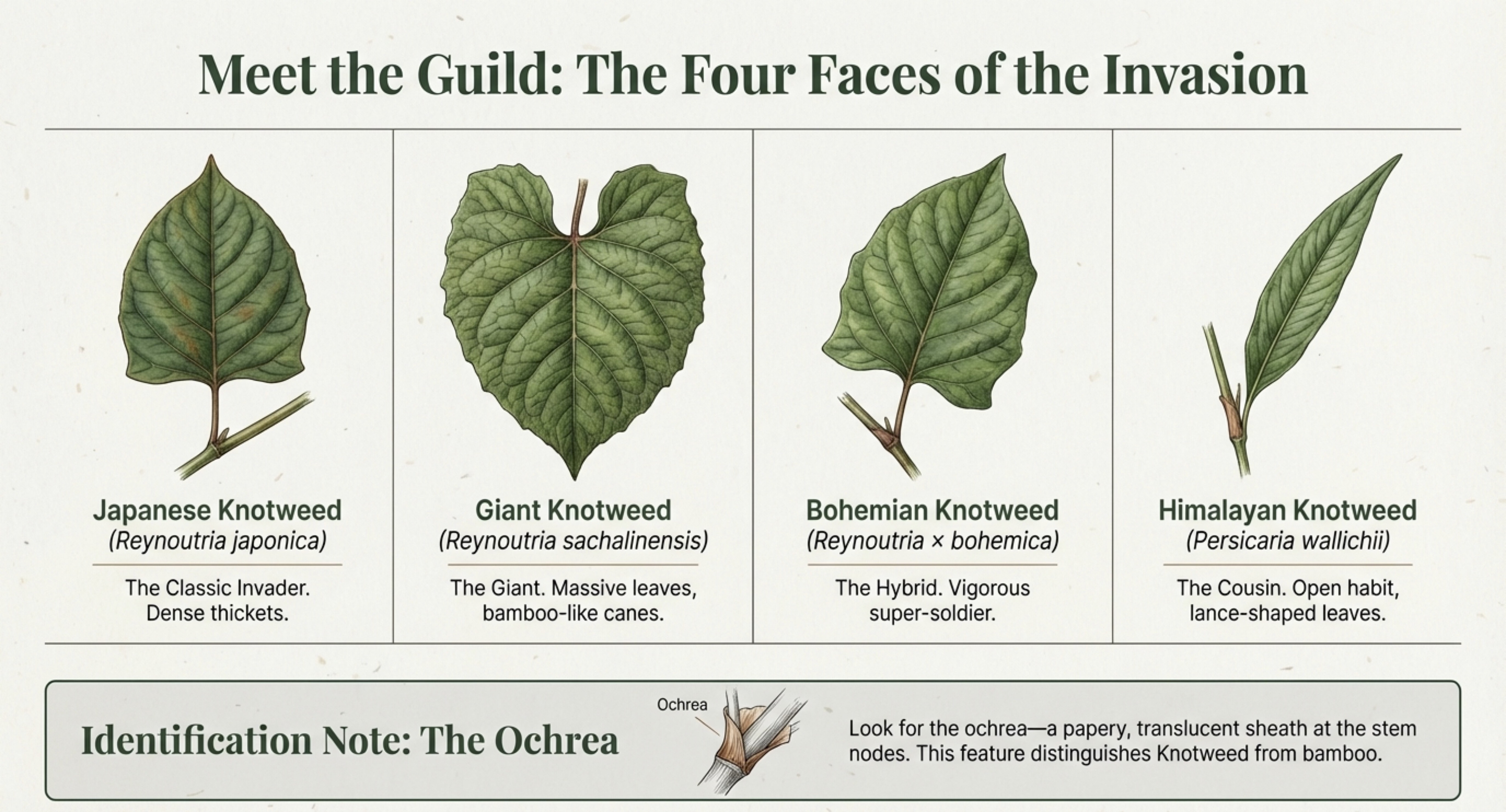
Knotweed. A whole guild of knotweeds, really; Japanese, giant, Bohemian, Himalayan, different faces, same stubborn strategy. In Japan it’s itadori (“pain puller”). In Chinese medicine it’s Hǔzhàng (“tiger’s cane”). Reverence and reproach baked right into the names.
What follows is an attempt to make it visible again, not as a cartoon villain, and not as a miracle herb, but as a living pattern you can read. Because knotweed forces a strange, useful kind of maturity: it asks us to hold two truths at once, its healing gifts and its disruptive power in ecosystems, without turning either one into propaganda.
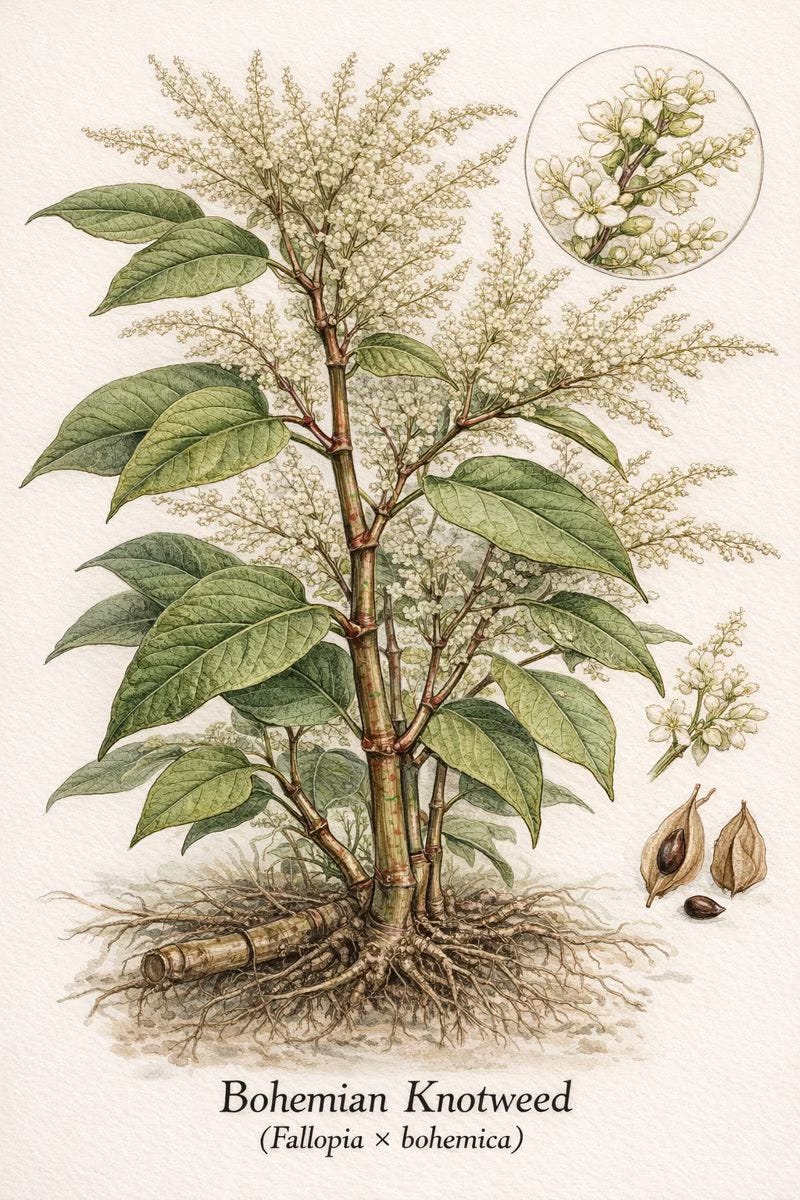
What You’ll Find in These Pages
This profile began the way most real learning begins: with a field encounter that wouldn’t let me stay simplistic. A plant that can act like a “living bandage” on damaged land, thriving in stressed, disturbed places, while also forming dense monocultures that crowd out almost everything else.
So I wrote this as a plant conversation with receipts: observation first, then ecology, then history, then practical application, so you can decide how to respond with intelligence instead of impulse.
Here’s the map:
Part I: The First Meeting opens in the habitat where most of us meet knotweed: disturbed edges, riverbanks, rubble. You’ll get the sensory portrait, the pattern summary, and the identity work, names across cultures, what “itadori” and “tiger’s cane” are pointing to, and the practical “don’t-make-it-worse” basics (including why even tiny fragments matter).
Part II: Ecological Intelligence goes underground. This is where knotweed stops being “a plant” and becomes a strategy: rhizomes, rapid regrowth, and chemical negotiations with the rest of the plant community. You’ll see how allelopathy (plant-made growth inhibitors) shows up in the literature and why compounds like resveratrol and emodin are part of both its medicine story and its territory story.
Part III: Stories & Lineage crosses the human threshold, how knotweed lived as valued food/medicine in East Asia, then got imported as an ornamental and turned into a global cautionary tale. You’ll walk through the timeline, from classical records like Shennong Bencao Jing, through 19th-century plant collecting (hello Philipp Franz von Siebold and Royal Botanic Gardens, Kew), and into the modern era where the narrative is slowly shifting from pure demonization to “okay… what else is going on here?”
Part IV: Traditional Ecological Knowledge stays respectful and practical: how communities in the plant’s native regions have historically foraged, prepared, and stewarded it; how preparation methods reduce acridness/oxalates; and how ethics (attribution, permission, not turning TEK into a Pinterest board) has to be part of the conversation.
Part V: Medical & Biochemical Intelligence is the “what’s actually in this thing?” section, nutrition, anti-nutrients, and a grounded walkthrough of its secondary metabolites (stilbenes, anthraquinones, flavonoids, etc.), plus a sober safety section. This includes the real-world cautions: oxalate load, herbicide contamination risk, pregnancy contraindications, and why “it’s natural” is not the same as “it’s consequence-free.”
Part VI: Regenerative Agriculture Applications is where the philosophy puts on work boots. You’ll see how frameworks like KNF/JADAM/BD can turn knotweed from “endless problem” into “directed resource”—FPJ/FPE, liquid fertilizers, botanical extracts, and management that harnesses its biomass and chemistry without accidentally helping it colonize your entire postal code.
Part VII: Processing, Preservation & Products closes the loop: harvest timing, drying, extraction, fermentation, and residue cycling. It covers when the roots are most potent, how to handle post-harvest curing, and how to process in ways that respect both chemistry and ecology.
A Note on Evidence
Throughout the profile you’ll see evidence-language like Established, Probable, Plausible, and Speculative. That’s not fence-sitting, it’s a commitment to reality. Some things are well supported (e.g., seasonal harvest practices, key phytochemicals, certain preparation methods). Other things are promising but still emerging. And some ideas, especially in the “energetics/biofield” zone, are clearly labeled as hypothesis so the reader can enjoy the frontier without confusing it for settled science.
Who This Is For
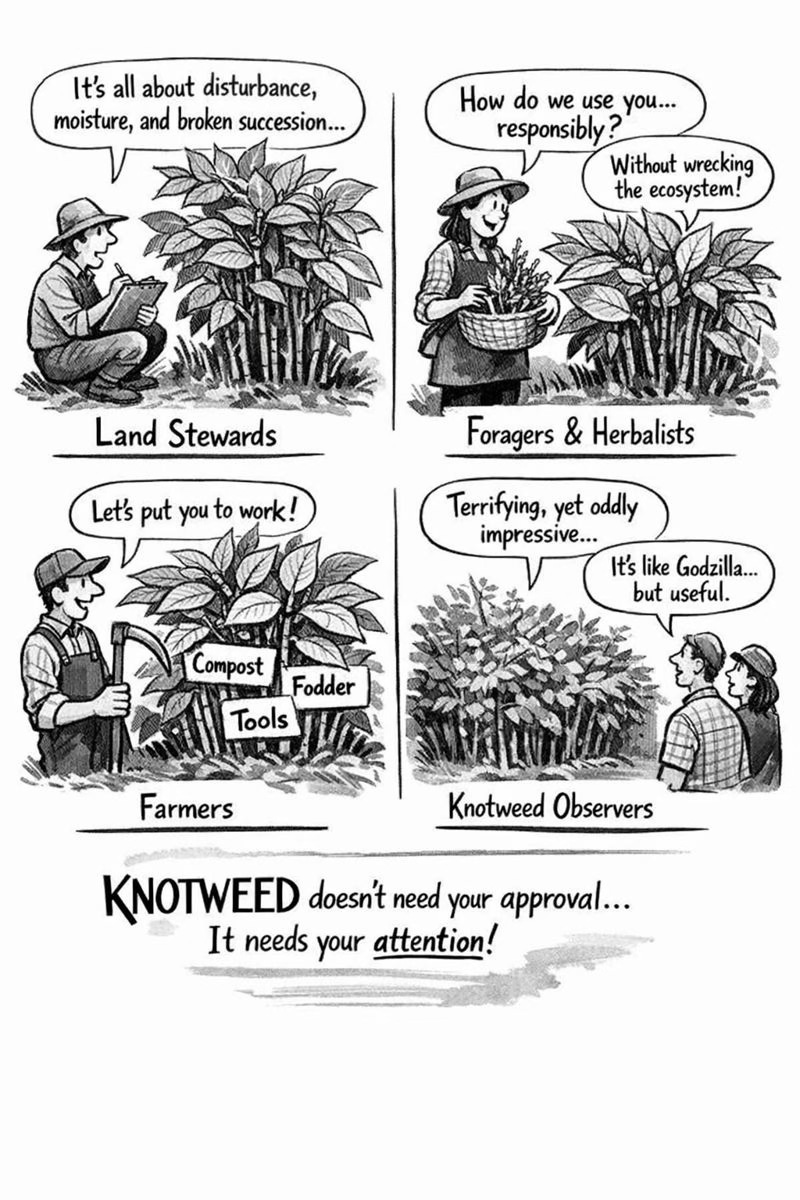
If you’re a land steward trying to understand what knotweed is saying about disturbance, moisture, and broken succession—this is for you.
If you’re a forager or herbalist who wants knotweed’s gifts without the ecological self-sabotage—this is for you.
If you’re a farmer who’d rather convert invasive biomass into fertility, feed, or tools than wage a forever-war—this is for you.
And if you’ve ever looked at a knotweed stand and thought, How is this plant both terrifying and kind of… impressive?—you’re in the right place.
Knotweed doesn’t ask for your approval. It asks for your attention.
PART I — THE FIRST MEETING
1. Opening Field Vignette
On a late summer morning by a misty riverbank, a knotweed thicket sways gently. Tall, hollow stems with a reddish hue reach 3 meters high, topped by sprays of delicate white blossoms buzzing with bees. The air carries a faint green scent as dew glistens on broad heart-shaped leaves. Last winter’s dried canes still litter the ground, cracking underfoot as new shoots burst through old pavement nearby – a testament to the plant’s relentless vitality. In spring, tender red-purple sprouts push through ash and rubble, growing inches per day. By autumn, the lush green canopy turns yellow and collapses, briefly exposing bare soil before snow – only for underground rhizomes to bide their time. Around this patch, few other plants survive; the knotweed stands alone, a pioneer in disturbed ground, colonizing where others cannot. An observer notes both its folklore as a traditional Asian medicinal herb and its ecology as an aggressive invader. Why this plant matters now: it compels us to reconcile its healing gifts with its disruptive power in ecosystems.
Pattern Summary:
1. How it behaves: Knotweed is a fast-growing, opportunistic colonizer that forms dense monocultures via tough, creeping rhizomes and vigorous regrowth (Established).
2. Relationships: It often operates in isolation, shading out neighbours and suppressing soil fungi, yet it supports generalist pollinators with abundant late-season nectar (Established).
3. Soil and place:Thriving on disturbed, nutrient-poor or polluted soils (Probable), its presence reveals an ecosystem in stress or transition, where knotweed acts as a living bandage on damaged land.
4. Timing: Rhythms of emergence and dieback govern it, explosive spring growth after frost, summer flowering as days shorten, and winter dormancy after first hard freeze (Established).
5. Doorway to understanding: Practically, knotweed is best understood by observing its pioneer role, it capitalizes on open niches and disturbance; to work with it (or control it), one must appreciate its underground strategy and seasonal timing (Probable).
2. Plant Identity & Names
2.1 Common & Indigenous Names: Globally, this guild has collected many names reflecting its character and cultural uses. Japanese knotweed – called itadori (イタドリ) in Japan, literally “pain puller” or “removes pain,” hinting at its traditional analgesic use. In Chinese medicine it’s Hǔzhàng (虎杖, “tiger’s cane”), evoking strength. Other English names include Mexican bamboo or American bamboo (for its bamboo-like stems), Donkey rhubarb (UK, for its large rhubarb-like leaves on giant knotweed), and Elephant ears (describing giant knotweed’s huge leaves). The hybrid is simply known as Bohemian knotweed, while Himalayan knotweed (Persicaria wallichii) may be called Kashmir knotweed, bell-shaped knotweed, or cultivated knotweed in different regions. Folk nicknames like “pea shooters” (children once used the hollow stems as blowguns) and a Japanese proverb “Even bugs that eat knotweed” (“itadori-mushi mo sukizuki”, meaning “there’s no accounting for taste”) reflect its notoriety and use in daily culture (Plausible). Across cultures, knotweed’s names carry a mix of reverence and reproach, from medicinal savior to tenacious weed.
2.2 Look-Alikes & Safety Flags: In the field, knotweeds are quite distinct, but a newcomer might confuse them with a few other plants. The bamboo-like canes invite comparison to bamboos, however, knotweed stems are not woody and have a characteristic papery sheath (ochrea) at nodes, plus broad leaves instead of narrow grass-like blades. Giant knotweed’s heart-shaped 30–40 cm leaves (with deep cordate bases) distinguish it from the smaller, more truncate-based 10–15 cm leaves of Japanese knotweed. Himalayan knotweed has much narrower, lance-shaped leaves and a more open habit, preventing confusion with the others’ dense thickets. Few truly toxic plant look-alikes exist – giant hogweed (Heracleum mantegazzianum), for example, shares invasive tendencies and height but has umbrella-like white flower clusters rather than knotweed’s fine panicles, and hogweed’s sap can cause burns (a hazard knotweed lacks). Safety flags: Young knotweed shoots are edible, but because the plant accumulates oxalic acid (like rhubarb), excessive consumption can aggravate kidney issues (Probable). Also, be mindful that invasive stands are often sprayed with herbicides – harvest only from clean sites. Always handle cut knotweed carefully: even small stem or rhizome fragments can regenerate new plants, so contain and dry or destroy waste to prevent unwitting spread (Established).
2.3 Taxonomy & Status: Knotweeds belong to the buckwheat family (Polygonaceae). Taxonomically, the Japanese-Giant-Bohemian trio are in genus Reynoutria (often still referenced as Fallopia or Polygonum in older literature). Japanese knotweed: Reynoutria japonica (Houtt.) Ronse Decraene – synonyms Fallopia japonica, Polygonum cuspidatum. Giant knotweed: Reynoutria sachalinensis (F. Schmidt) – synonym Polygonum sachalinense. Bohemian knotweed: Reynoutria × bohemica, a hybrid of the former two. Himalayan knotweed: Persicaria wallichii (also listed as Polygonum polystachyum or Koenigia polystachya), which is a close cousin but technically a different genus of knotweed. All four are perennial herbaceous plants with vigorous rhizomes. In their native ranges (East Asia for Japanese/Giant; high Himalaya for Himalayan knotweed), they are ordinary components of the flora. When introduced elsewhere, however, they have become notorious invasive weeds. Japanese, Giant, and Bohemian knotweeds are listed among the world’s 100 worst invasive species, naturalized across Europe, North America (confirmed in 40+ U.S. states and most Canadian provinces), and beyond. They are often classified as noxious weeds, with legal restrictions on planting or transport (Established). Ironically, in their homelands these plants were historically valued – Japanese knotweed was cultivated as a medicinal and vegetable, and Giant knotweed was once planted to stabilize riverbanks and for livestock feed. Today, their status in most introduced regions is “enemy at the gates,” yet a growing contingent of foragers and herbalists view them as under utilized resources in disguise (Plausible).