

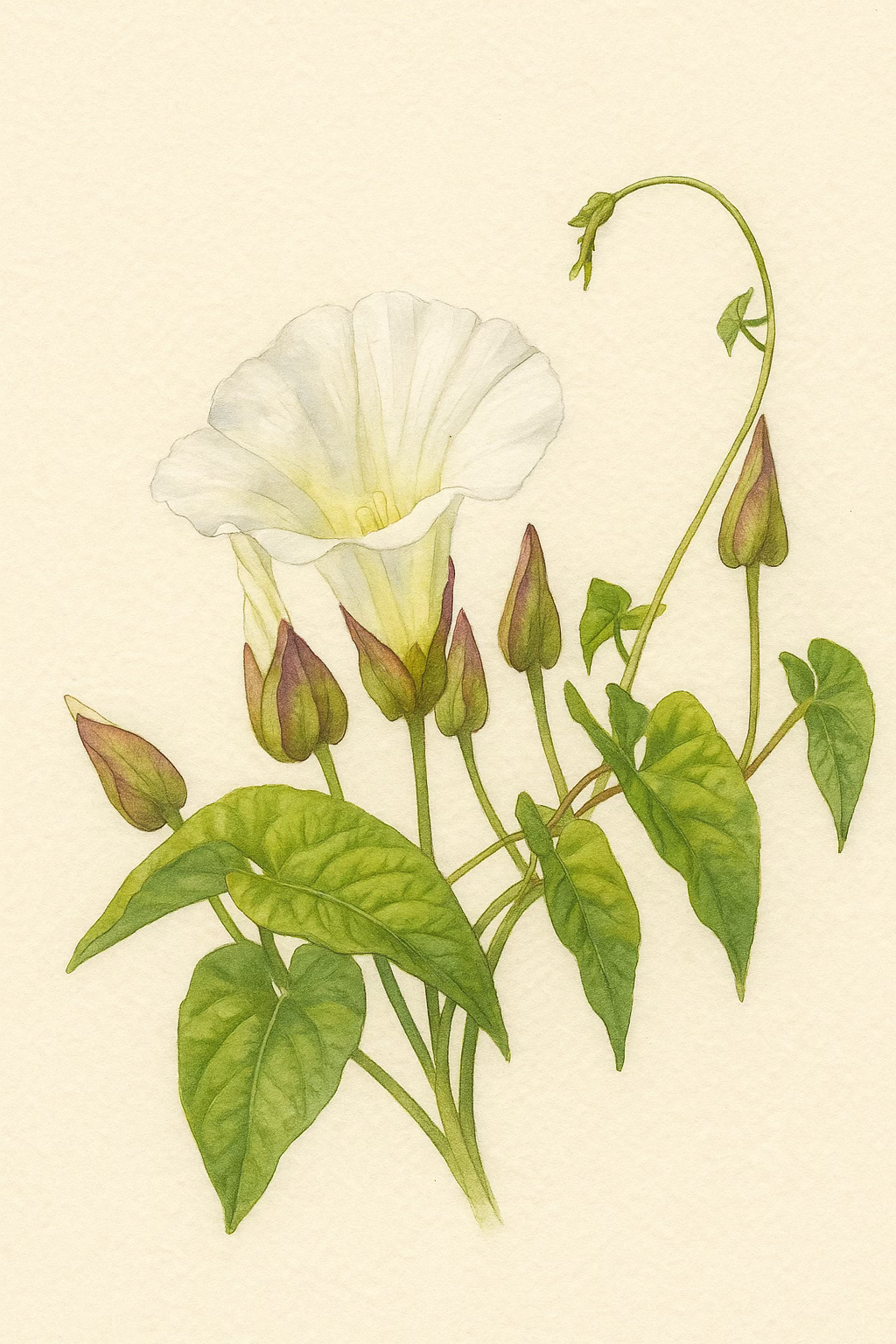
Last week, I asked you to stop fighting bindweed long enough to hear what it’s trying to say.
Based on the responses, relief, frustration, a few confessions about talking to plants while pulling them, I’d say that question landed. Some of you are ready to burn it all down. Others are cautiously curious. A few admitted you’ve been secretly impressed by bindweed’s sheer audacity for years.
Good. That’s exactly where we need to be.
Because here’s what we’re unpacking today: the full story. Not the surface-level “weed or not-a-weed” debate, but the why and the how and the what now.
We’re going six meters down, the depth of a single bindweed taproot, mining water and fertility while your tomatoes are crying at eighteen inches. We’re examining the allelopathic compounds it secretes to engineer the soil for its own success. We’re mapping its 100-day pollinator service, calculating its nitrogen contribution, and learning how to turn those “devil’s guts” into liquid gold for your soil.
This isn’t theory. This is fifteen years of vineyard management, Korean Natural Farming protocols, and enough hours in research databases to make my eyes cross, distilled into something you can actually use.
What’s inside:
Why bindweed thrives in fertile soil, not poor soil (and what that means for your management strategy)
The biochemistry that makes it both medicinal and allelopathic, alkaloids, glycosides, and compounds that have been used in traditional medicine for centuries
Exact fermented plant juice ratios and timing (because why waste free nitrogen?)
Living mulch combinations that actually outcompete bindweed without creating new problems
Grazing management protocols using sheep and goats (it’s as nutritious as alfalfa, let them do the work)
What Chinese medicine, European herbalism, and Great Plains farmers all understood about this plant that we’ve forgotten
This is the material that shifts you from warrior to steward. From exhaustion to strategy. From seeing bindweed as a failure of your land to recognizing it as diagnostic intelligence.
Next week, paid subscribers get the Quick Release & Stewarding Guide, the condensed, printable, take-it-to-the-field version. No fluff. Just protocols, timing, application rates, and decision advice for managing bindweed in different contexts. The stuff you’ll actually reference when you’re standing there with a tarp, a bag of mulch, and a choice to make.
A word about access and sustainability: These deep dives take 40-60 hours each. Research, synthesis, cross-referencing traditional wisdom with peer-reviewed science, translating biochemistry into plain language, creating A/B testing for your soil. I’m moving the subscription price from $5 to $15/month in January, a rate that better reflects the work and keeps this sustainable long-term. Current subscribers get grandfathered at $5/month forever.
I’m not interested in gatekeeping knowledge. But I am interested in doing this work well, and that requires support. If these profiles are changing how you see your land, how you make decisions, how you move from fighting to partnering with the systems already in place, then subscribe. Not because I’m selling you something, but because this exchange matters. Your investment keeps the research happening. My work helps your land heal.
Fair trade.
Now, let’s talk about bindweed like it deserves: with respect, curiosity, and a willingness to be wrong about what we thought we knew.
The roots go deeper than you think.
—Jay
Table of Contents
Part I — Introduction & Identity
1. Opening Field Vignette
2. Plant Identity & Names
2.1 Common & Indigenous Names
2.2 Look-alikes & Misidentification Hazards
2.3 Taxonomy & Status
Part II — Ecological Intelligence
3. Ecological Intelligence & Soil Relations
3.1 Soil Communication Systems
Underground Conversations: Root Exudates
The Fungal Partnership
Bacterial Neighbors
Chemical Whispers: Volatiles and Signaling
Mining the Deep: Nutrient Uptake and Bioavailability
Management Implications: Working with the Chemistry
3.2 Soil-Amendment Compatibility
Vermicast (Worm Castings)
Biochar
Compost Teas
Fermented Plant Extracts (FPJ/FPE)
The Fungal:Bacterial Balance Question
Amendment Strategy: The Big Picture
3.3 Community Ecology
3.4 Pollinator & Insectary Ecology
3.5 Ecosystem Functions
3.6 Indicator Species Value
Part III — Water Relations
4. Water Wisdom & Hydrology
4.1 Habitat Hydrology
4.2 On-Farm Water Applications
Part IV — Phenology & Observation
5. Sensory Ecology
5.1 Phenological Precision
5.2 Activity Schedules
Part V — Working Together (Practice & Safety)
9. Biochemical & Nutritional Architecture
The Foundation: Primary Metabolites
Carbohydrates: The Energy Vault
Proteins: The Nitrogen Story
Lipids, Nucleic Acids, and the Mundane
The Personality: Secondary Metabolites
Tropane Alkaloids
Calystegines
Phenolic Compounds
Flavonoids
Resin Glycosides
Terpenoids
Proteoglycans
What’s Missing: The Negatives
Nutritional Density & Anti-Nutrients
Minerals: The Deep Miners
Vitamins
Oxalates
Nitrates
Phytate and Other Minor Anti-Nutrients
Putting It All Together: The Chemical Portrait
10. Safety & Contraindications
General Safety Profile
Pregnancy & Lactation
Potential Toxicity & “Dose Makes the Poison”
Herb-Drug Interactions
Allergies and Irritation
Phototoxicity
Accumulation of Nitrates and Heavy Metals
Fermentation Safety (FPJ/FPE)
Dosing Guidelines
Safety Tier Assignment
Part VI — Regenerative Agriculture Applications
11. Regenerative Systems Integration
11.1 KNF (Korean Natural Farming)
Fermented Plant Juice (FPJ) from Bindweed
FPJ Application Schedule
Fermentation Ratios & Tips
Bindweed in IMO and Microbial Roles
11.2 Biodynamics & Companion Dynamics
Planetary & Elemental Associations
Planting & Weeding Cues
Companion Plant Synergies
Pest and Disease Roles
Overall Biodynamic Perspective
11.3 Regenerative Systems
When Bindweed Becomes Cover Crop
Turning Vines into Fertility: The Biomass Opportunity
The C:N Story: Why It Matters
Liquid Biological Inputs: Weed Tea and Beyond
Beyond Fertility: Other Uses for Biomass
The Regenerative Mindset
11.4 Livestock Integration
Why Bindweed Works as Forage
Animal-by-Animal Profiles (Cattle, Sheep, Goats, Pigs, Horses, Poultry)
The Nutrient Cycling Loop
Safety Protocols and Grazing Calendar
Making It Pay: Economics of Integrated Grazing
The Bigger Picture
11.5 Integrated Pest Management (IPM)
Bindweed as Trap Crop
Beneficial Insect Habitat
Push-Pull Strategies
The Disease Reservoir Problem
Biocontrol: The Mites That Fight Back
IPM Decision Framework
The Pragmatic Stance
11.6 Synergies & Antagonisms
Five Useful Synergies
Four Avoidable Antagonisms
Reading the Relationships
11.7 Economic & Livelihood Paths
Cost Savings: The First Economic Win
Revenue Generation: Where to Be Realistic
Case Study: One Farm’s Numbers
The Barter Economy
What’s NOT Economically Viable
The Real Economic Value: Resilience
Starting Your Economic Assessment
The Bottom Line
12. Harvest, Processing & Quality Control
When to Harvest: Reading the Plant
Harvest Technique: Clean Cuts, Clean Process
Processing: Matching Method to Purpose
Drying for Storage
Fermenting into FPJ (Detailed Protocol)
Aerobic Weed Tea
Anaerobic Fermented Extract
Making Hay
Quality Control: Ensuring Safety and Efficacy
Source Verification
Sensory Quality Assessment
Microscopy
pH Testing
Batch Records
Safety Protocols for Different End Uses
Troubleshooting Common Problems
Product Innovation: Pushing Boundaries
The Bigger Picture: Why Quality Matters
Part VII — Research & Governance
13. Legal, Regulatory & TK/IP
Wild Harvest & Noxious Weed Status (Pacific Northwest)
Traditional Knowledge (TK) and Intellectual Property (IP)
Wildcrafting Ethics
Sale and Label Rules (PNW specifics)
Summary (Governance)
14. Research Frontiers & Citizen Science
Current Scientific Research & Trials
Medicinal Research
Genomics & Molecular Biology
Microbiome Interactions
Biocontrol Trials
Phenotypic Plasticity & Climate Change
Heavy Metal Phytoremediation Trials
Allelopathy and Cover Crop Potential
Citizen Science Involvement in Research
Citizen Science Protocol Suggestions
Protocol 1: Bindweed Phenology Tracking
Protocol 2: FPJ Efficacy Trial
Protocol 3: Seed Dormancy and Germination Experiment
Protocol 4: Quantum Biology Experiments
14.2 Quantum Biology Hypotheses
Hypothesis 1: Spiral Growth and Water Coherence
Hypothesis 2: Biophoton Emission and Growth Coordination
Hypothesis 3: Obstacle Detection Before Contact
Hypothesis 4: Morphic Resonance and Plant “Memory”
Hypothesis 5: Circadian Photonic Rhythms and Flower Opening
Why Bother Testing the Weird Stuff?
Getting Started: Practical First Steps
The Invitation
1. Opening Field Vignette
A thin green vine coils through cracked summer soil, its arrowhead leaves dusted pale. Dawn light reveals white-pink trumpets of bindweed opening like tiny gramophones. Bees hum low among the blossoms, and a faint honey-sweet scent drifts where the vine sprawls under a rusting fence. The bindweed’s touch is tenacious, wrapping a brittle thistle stalk and even a forgotten garden spade. Nearby, a gardener tugs futilely at the trailing stems while a swallowtail butterfly flutters past, a small moment of ecology and folklore intertwined. Folklore whispers that bindweed’s stubborn roots bind earth and spirit, while botanists note its deep roots mining hidden moisture. Why this plant matters now:Bindweed’s resilience and soil-binding habit offer gardeners and farmers clues to soil health and drought-hardiness in a changing climate.
2. Plant Identity & Names
2.1 Common & Indigenous Names
Bindweed has accumulated names in many languages, reflecting its twining habit and the varied cultural perceptions it’s inspired. The very act of binding is ancient—the Proto-Indo-European root bʰendʰ- means “to bind; bond,” and that ancestral sense of tying and wrapping echoes through descendant languages. In Sanskrit, Ayurvedic texts called it bandhāvallī (बन्धवल्ली), literally “binding creeper-vine,” a name that captures both its physical habit and its persistence. Hindi speakers in North India know it as hiranpag (हिरनपग), “deer’s foot,” a reference to the leaf shape that also appears in Punjabi usage.
In China, the standard name is tián xuán huā (田旋花), “field revolving flower,” emphasizing its spiraling growth in agricultural land. Persian herbal traditions call it līlān-e sahrawī (لیلان صحرایی), “desert morning-glory,” noting both its habitat and its kinship with ornamental morning glories in Unani and folk medicine. Arabic-speaking regions of North Africa—particularly Morocco and Algeria—use the evocative ḥalīb al-ghazāl (حليب الغزال), “gazelle’s milk,” likely referencing the white sap or pale flowers.
The ancient Greeks called it klyménon (κλύμενον), “the circling one,” a name recorded by Dioscorides that describes its twining behavior with elegant precision. The Romans went darker: Pliny’s era knew it as volucrum majus, “a large worm that wraps in vines,” likening the plant to a coiling serpent. This sense of something both alive and entangling persists in modern English slang, Great Plains farmers coined “Devil’s Guts” for the tangled red roots and vines that choke their fields.
English has accumulated a rich folklore around bindweed. The standard name “Field Bindweed” is straightforward enough, but older terms carry more character. In Wiltshire, England, it was known as “Granny’s Nightcap” because the funnel-shaped flower resembles a grandmother’s sleeping cap. The historical term “Bear-bind” (or “Barley-bind”) comes from harvest practices: farmers used the strong stems to tie sheaves of barley, turning a weed into a tool. Meanwhile, European languages follow similar patterns—Spanish uses correhuela, “little runner”; French has liseron des champs, “bindweed of the fields”; and Afrikaans speakers in South Africa say akkerwinde, “field wind(er),” all emphasizing the plant’s mobile, wrapping nature.
In Aotearoa (New Zealand), the Māori distinguish introduced bindweed as pohuehue Pākehā, “foreign bindweed,” setting it apart from native pohuehue vines—a linguistic marker of invasion and displacement. These names, drawn from multilingual botanical sources and ethnobotanical records, reveal how bindweed’s presence has been noticed, named, and narrated across continents and centuries. Each name is a small story about how humans see this plant: as medicine, nuisance, tool, or omen.
2.2 Look-alikes & Misidentification Hazards
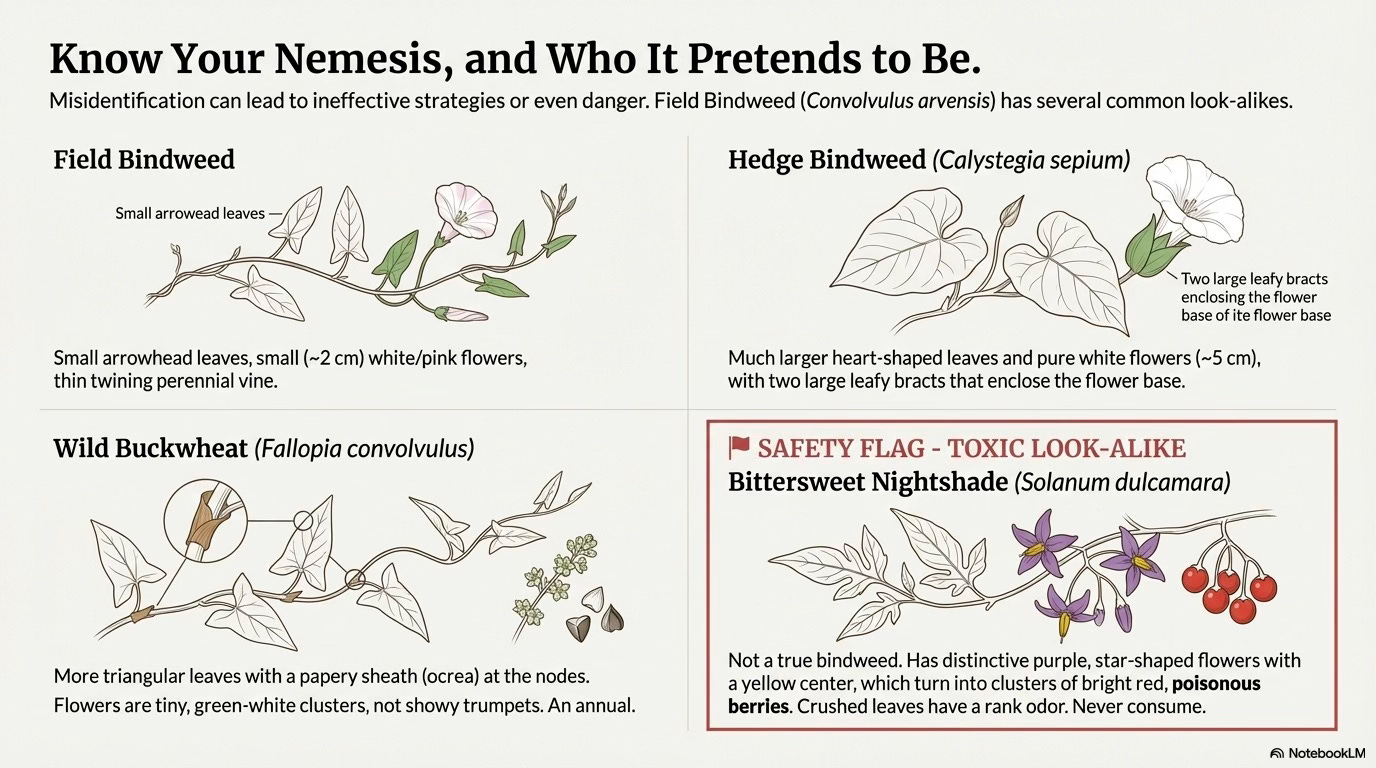
Several vines resemble bindweed and can lead to confusion. Field bindweed (Convolvulus arvensis) can be distinguished from its top look-alikes by habit, leaf shape, and flowers:
Hedge Bindweed (Calystegia sepium) – Habit: Larger, vigorous perennial vine often climbing taller vegetation. Stem: Twining, hairless, thicker than field bindweed. Leaves: Bigger (5–10 cm), heart-shaped with pointed lobes at the base. Nodes: Two large leafy bracts at each flower node that enclose the calyx (field bindweed’s bracts are much smaller). Aroma: None distinctive. Flowers: Trumpet-shaped white (sometimes pink), 4–7 cm across – about double the size of field bindweed’s. Best season to tell apart: Summer – hedge bindweed’s large white blooms and enveloping bracts versus field bindweed’s smaller open flowers and exposed calyx are obvious in mid-season.
Wild Buckwheat (Fallopia convolvulus, “Black bindweed”) – Habit: Annual twining vine in the buckwheat family, often low-growing through crops. Stem: Slender, wiry, may twine but less robust. Leaves: Opaque green, triangular to heart-shaped with pointed tip and slight lobes, generally broader than field bindweed’s and a papery ocrea (sheath) at nodes (bindweed lacks ocrea). Nodes: Swollen nodes with papery sheath (distinctive of buckwheat family). Aroma: None. Flowers/spores: Very small greenish-white flower clusters in leaf axils (not showy); seeds are dark three-sided “buckwheat” achenes. Best season to tell apart:Late summer – wild buckwheat produces inconspicuous flower clusters and black seeds, unlike bindweed’s obvious blossoms.
Common Morning Glory (Ipomoea purpurea and other Ipomoea spp.) – Habit: Annual twining climber (often deliberate ornamental escape). Stem: Twining, thicker and more pubescent than bindweed when young. Leaves:Large (6–15 cm) heart-shaped leaves without lobes (distinguishes from bindweed’s arrowhead leaves). Nodes: No bracts at flower; often a few fine hairs. Aroma: Some ornamental varieties have mild fragrance. Flowers: Showy funnel-shaped blooms in purple, blue, pink or multicolored, 5–8 cm across – much larger and more colorful than field bindweed’s white/pink 2 cm flowers. Best season to tell apart: Summer – morning glories bloom in vibrant colors at dawn and have thicker vines, whereas field bindweed’s flowers are smaller, pale, and the plant is perennial.
🚩 SAFETY FLAG – Toxic Look-alike: Bittersweet Nightshade (Solanum dulcamara) – a woody vine with purple star-shaped flowers and red berries often called “blue bindweed”. It is not a true bindweed but can twine through hedges. Distinguishing features: Leaves are oval with two small lobes at the base, and crushed foliage has a rank odor. Berries turn from green to bright red and are poisonous to humans and livestock. Never consume berries or foliage of bittersweet nightshade; its presence alongside bindweed can be misidentified – note the different flower shape and the presence of berries as a clear warning sign.
Placeholder for images: e.g. comparison photos of field bindweed vs hedge bindweed flowers, wild buckwheat vine with seeds, and toxic bittersweet nightshade with purple flowers and red berries.
Mini Dichotomous Key (4 steps) for Bindweed vs. Look-alikes:
Flowers present? – If no conspicuous flowers (tiny green clusters) → Wild Buckwheat (Fallopia). If showy funnel-shaped flowers present → go to 2.
Flower size & color: – If large (≥4 cm) pure white with large leafy bracts at base → Hedge Bindweed. If smaller (≤2.5 cm) white or pink with no large bracts → go to 3.
Leaf shape: – If large heart-shaped leaves, annual vine, flower often colorful (purple/blue) → Morning Glory(Ipomoea spp.). If small arrowhead leaves, perennial vine, flower white/pink → Field Bindweed (Convolvulus arvensis).
Fruit presence: – (Check for safety) If red berries present, purple starry flowers → 🚩 NOT bindweed – it’s poisonous bittersweet nightshade.
2.3 Taxonomy & Status
Latin Binomial: Convolvulus arvensis L. (1753) – “Convolvulus” from Latin convolvere (“to entwine”) and arvensis meaning “of the fields.”
Family: Convolvulaceae (Morning Glory Family).
Accepted Synonyms: Convolvulus ambigens House; Strophocaulos arvensis (L.) Small (the latter reflecting an attempted separate genus). Dozens of historical names exist due to its wide range.
Native Range: Native to Eurasia (Europe, Mediterranean, and Asia). Also indigenous to North Africa.
Pacific Northwest Status: Introduced and invasive – first recorded in the NW in the 19th century and now widespread in WA, OR, BC. Designated a noxious weed (Class C in Washington). It infests agricultural lands, gardens, and roadsides across the PNW.
Weed/Invasive Listings: Listed as noxious in >20 U.S. states and many countries. One of the world’s most troublesome weeds, often ranked in the global “top 10” worst weeds. In the PNW, management is required in many counties due to agricultural impacts.
Conservation Status: Not threatened – IUCN Red List: Not formally evaluated globally (would be “Least Concern” given its abundance). Instead, C. arvensis is of conservation concern as an invasive species in native ecosystems. Regionally, it is actively suppressed rather than protected.
Taxonomic Notes: No major taxonomic controversies; Convolvulus arvensis is clearly distinct from larger Calystegia (bindweeds) despite historical confusion. Some authorities once placed it in genus Strophocaulos, but this is not widely accepted. It has no subspecies in the PNW, though minor morphological variants occur across its broad range.
3. Ecological Intelligence & Soil Relations
3.1 Soil Communication Systems
Bindweed doesn’t just grow in soil, it talks to it. Not with words, obviously, but with chemistry: a constant exchange of signals, nutrients, and negotiations happening in the dark, moist world around its roots. Every plant does this to some degree, but bindweed is particularly good at it. Understanding these underground conversations tells us why bindweed dominates where it does, how it shapes the soil community around it, and what we might do to shift the balance back in our favor.
Think of the rhizosphere, that thin zone of soil directly influenced by roots, as a plant’s neighborhood. Bindweed is that neighbor who’s simultaneously helpful (bringing up nutrients from deep below) and obnoxious (secreting chemicals that make other plants struggle). Let’s walk through the conversations.
Underground Conversations: Root Exudates
When bindweed roots grow, they leak. This isn’t sloppiness—it’s strategy. Roots constantly exude organic compounds into the surrounding soil: sugars, amino acids, organic acids, and a whole suite of phenolic compounds. Think of these exudates as the plant’s chemical voice, broadcasting messages that shape who lives nearby and who doesn’t.
Bindweed’s exudate signature includes some particularly potent phenolics:
Umbelliferone (a coumarin)
Quercetin (a flavonoid)
Glycosides of gentisic acid, p-coumaric acid, vanillic acid, and ferulic acid
These aren’t random leaks—they’re targeted. Research shows that soil directly around bindweed roots contains twice the phenolic concentration of soil just a few inches away. This chemical halo does two main things:
First, it suppresses competitors. Some of these phenolics inhibit seed germination and early root growth in other plants. Lettuce seeds struggle to germinate in bindweed-heavy soil. Grass seedlings grow more slowly. This is allelopathy in action—chemical warfare at the root level. Bindweed essentially poisons the ground around itself just enough to give its own shoots an advantage.
Second, it shapes the microbial community. Phenolics aren’t universally toxic to microbes—they’re selective. Some soil bacteria thrive on them; others are inhibited. Studies show that bindweed patches have reduced activity in certain beneficial bacteria and fungi compared to adjacent soil. The plant is essentially curating its underground neighborhood, favoring microbes that tolerate (or even feed on) its particular chemical signature.
This matters for management because it means bindweed isn’t just competing for water and nutrients—it’s actively changing the soil chemistry to tilt the game in its favor. If you pull a bindweed vine but leave the roots, those roots keep exuding these compounds, maintaining bindweed’s chemical advantage even while you think you’ve cleared the area.
The practical angle: Materials like biochar can adsorb some of these phenolic compounds, effectively mopping them up and reducing their impact. High-carbon amendments (wood chips, straw) might also tie up phenolics temporarily as microbes work to break down both the carbon and the allelochemicals. This is one reason mulching heavily can help suppress bindweed—you’re not just blocking light, you’re also diluting its chemical weapons.