

Table of Contents
Introduction
1.1 About Comfrey
1.2 Benefits in Regenerative Agriculture
1.3 How to Use This Guide
Garden Amendments
2.1 Fresh-Cut Mulch
2.2 Comfrey Tea
2.3 Fermented Plant Juice (FPJ)
2.4 Dried Leaf Meal
2.5 Compost Accelerator
2.6 Allantoin Root Tonic
2.7 Vegetable Compatibility
2.8 Seasonal Garden Calendar
2.9 Safety & Tips
2.10 Testing Comfrey’s Effectiveness in the Garden
2.11 Wisdom for Better Gardens
Orchard Amendments
3.1 Fresh-Cut Ring Mulch
3.2 48-Hour Tea Drench
3.3 FPJ Foliar Program
3.4 Decoction
3.5 Compost Integration
3.6 Pest Management Hacks
3.7 Complementary Herb Guilds
3.8 Seasonal Orchard Plan
3.9 Practical Notes
3.10 Testing Comfrey’s Effectiveness in Orchards
3.11 Wisdom for Better Tree Fruits
Vineyard Amendments
4.1 Standard and Enhanced Programmes
4.2 Tea Soil Drench
4.3 FPJ Foliar Spray
4.4 Root Decoction
4.5 Compost + Inoculation
4.6 Biodiversity Strip Design
4.7 Effects on Wine Quality
4.8 Vineyard Calendar
4.9 Cautions & Monitoring
4.10 Testing Comfrey’s Effectiveness in Vineyards
4.11 Wisdom for Better Quality Fruit
Homestead Income Strategies
5.1 Living Fertility Products
5.2 Herbal Body Care Products
5.3 Plant Sales & Nursery Income
5.4 Agritourism & Education
5.5 Niche Products & Feed Add-ons
5.6 Stacked Seasonal Returns
5.7 Integration and Closing Reflections
Introduction
Comfrey (Symphytum officinale) has been earning its place in human hands for over two thousand years, on battlefields, in cottage gardens, in the soil beneath fruit trees, and in the fermentation crocks of farmers who understood that the most powerful inputs on a regenerative farm often grow for free at the fence line.
This guide is not a celebration of comfrey for its own sake. It is a working manual, built from ethnobotanical tradition, modern soil science, and hard-won field observation, for anyone who wants to use this plant intelligently across gardens, orchards, and vineyards. The applications here range from simple fresh-cut mulch to fermented plant juice, root decoctions, biodiversity strip design, and homestead income strategies. There is something in this document for the first-year gardener and the experienced viticulturist alike.
But before you plant a single root cutting, read Section 1.3. It may be the most important paragraph in this entire guide.
1. About Comfrey
1.1 Botanical Profile
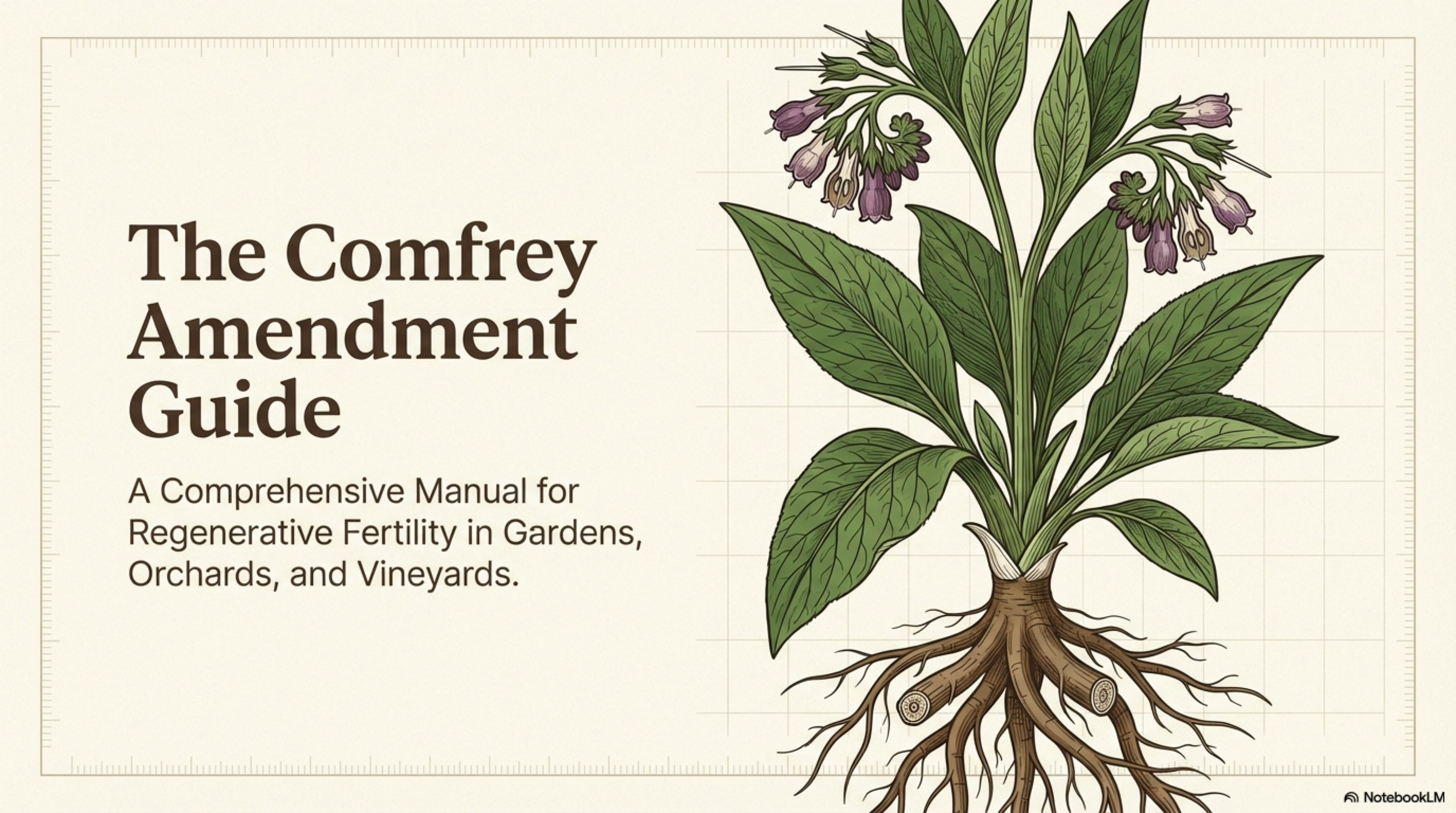
Symphytum officinale — common comfrey — is a robust, deep-rooted perennial in the Boraginaceae family, native to temperate Europe and Western Asia and now naturalized across much of the world. It grows in moist meadows, ditches, riverbanks, and garden borders, thriving in rich, loamy soils with reliable moisture, though established plants show surprising drought tolerance once their roots have found depth.
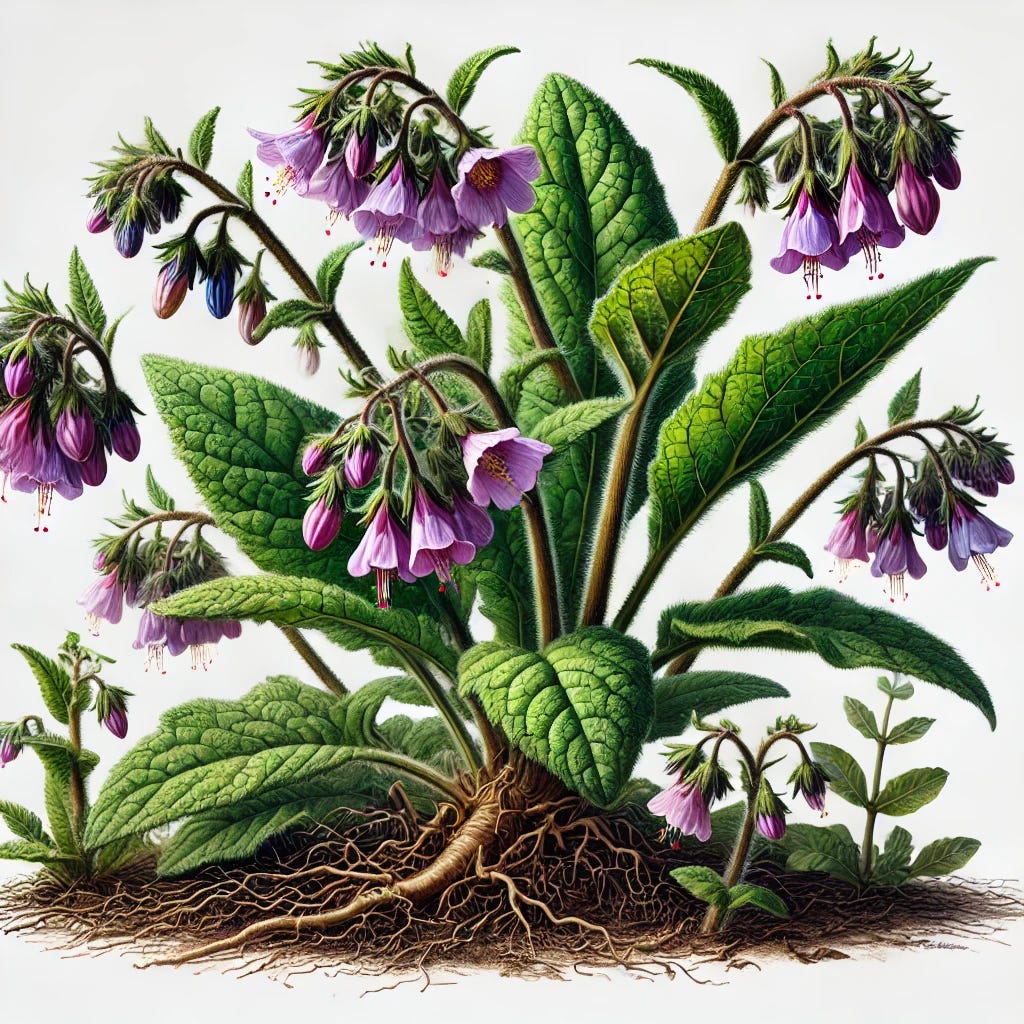
The plant is immediately recognizable: large, rough-hairy leaves that can reach 60 cm, hollow ribbed stems rising 30–120 cm, and drooping racemes of tubular flowers in cream, pink, or violet depending on the cultivar. The taproot is the defining feature, thick, fleshy, and capable of penetrating two meters or more into subsoil, driving through compacted clay and hardpan that stops most other plants cold.
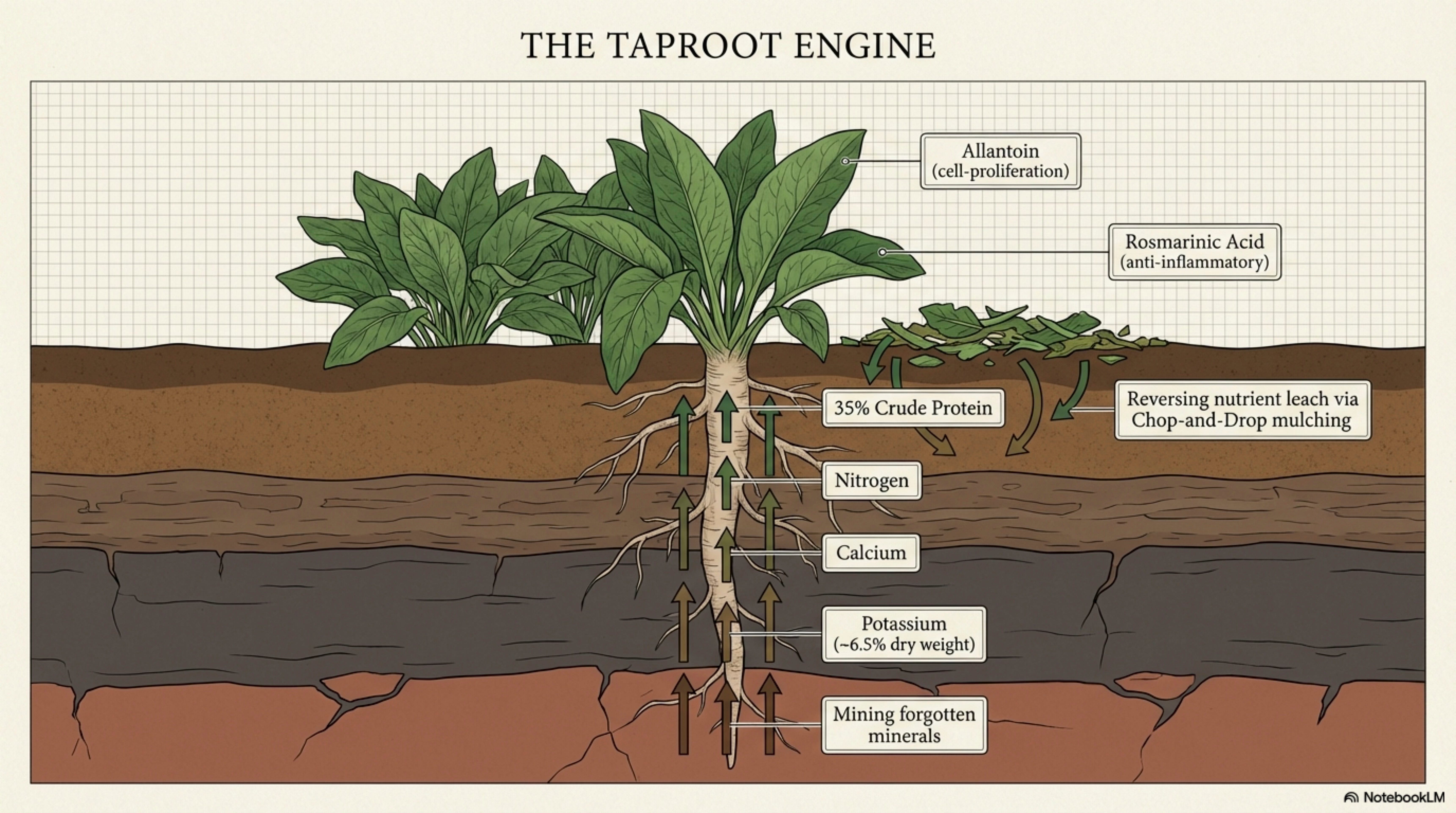
It is this root that makes comfrey extraordinary as an agricultural tool. Everything else, the medicinal compounds, the biomass, the wildlife value, flows from that relentless downward reach.
Key constituents include allantoin (a cell-proliferating compound central to its wound-healing reputation), rosmarinic acid (anti-inflammatory), abundant potassium (~6.5% dry weight), approximately 35% crude protein on a dry basis, and pyrrolizidine alkaloids (PAs), defensive compounds that make internal consumption dangerous and demand that all preparations in this guide be treated as external or soil-applied only.
1.2 Benefits in Regenerative Agriculture
Comfrey operates simultaneously across several ecological roles that most plants fill only one of.
As a soil builder, its taproot mines calcium, potassium, and other minerals from depths inaccessible to most crops, translocating them into leaves that can be cut and returned to the surface as free, self-renewing fertility. Each cutting essentially reverses the slow downward leach of nutrients that depletes topsoil over decades. The biomass contribution is substantial, established plants yield three to five cuts per season, and the leaf litter accelerates composting, supports earthworm populations, and feeds mycorrhizal networks.
As a plant health promoter, comfrey preparations, fermented plant juice, aerobic tea, root decoction, deliver bioavailable potassium, nitrogen, and secondary metabolites at key growth stages. The evidence base for topical allantoin as a tissue-repair compound is solid enough that German medical boards now approve comfrey root creams for sprains and arthritis. The same biology that closes wounds also stimulates cell division in plant tissue under stress.
As an ecosystem supporter, comfrey flowers attract bumblebees, hoverflies, and parasitic wasps across an extended bloom period. Dense plantings stabilize eroding banks, suppress aggressive weeds, and provide shelter for ground-nesting insects. In an orchard or vineyard guild, comfrey earns its space on multiple levels simultaneously.
⚠️ 1.3 The Most Important Thing in This Guide: Bocking 14 and the Sterile Cultivar Distinction
Read this before you order roots, before you accept a division from a neighbor, and before you put anything in the ground.
Not all comfrey is the same, and the difference matters enormously.
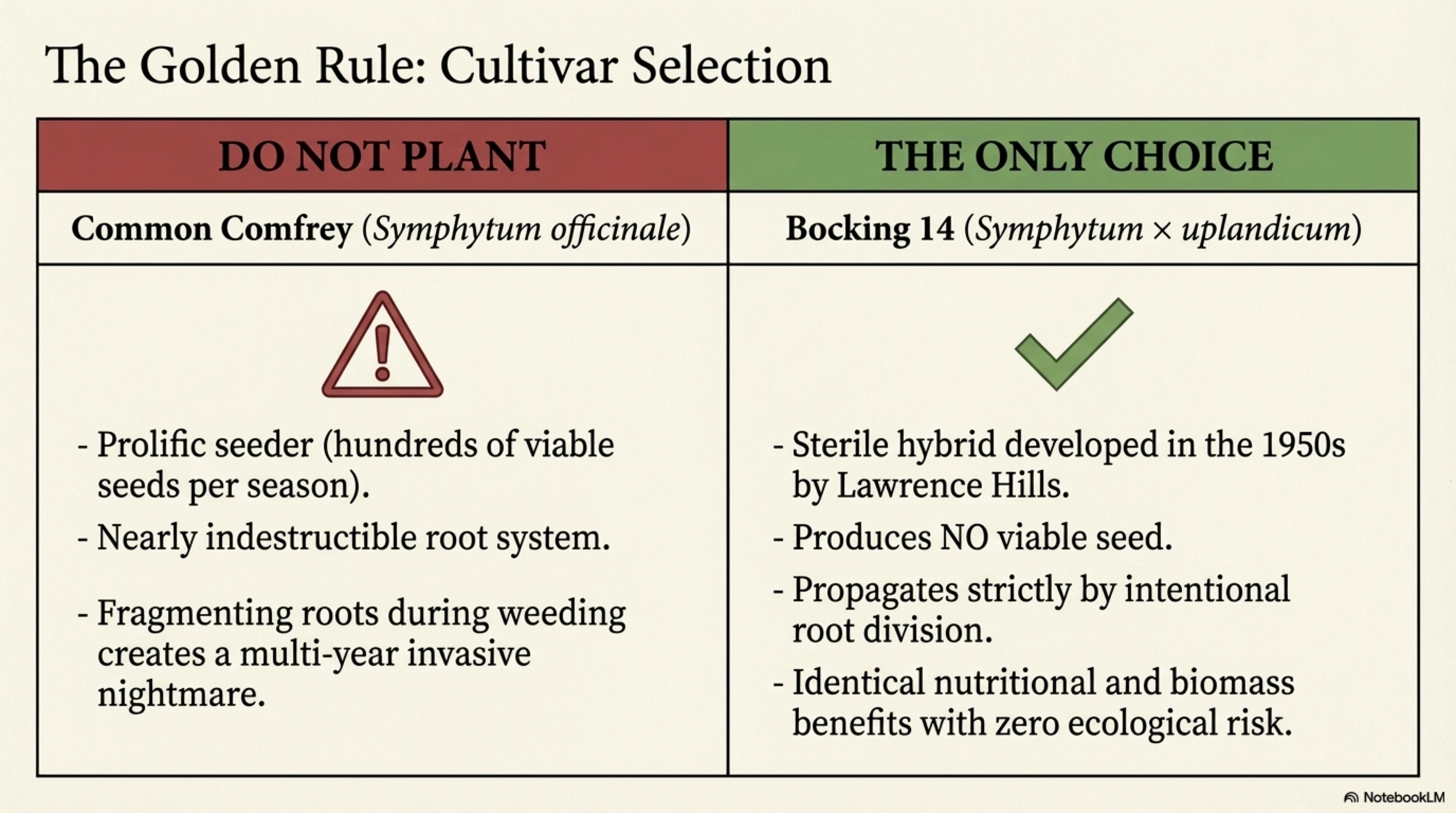
Common comfrey (Symphytum officinale) seeds prolifically. A single established plant can produce hundreds of viable seeds per season, and those seeds germinate readily in disturbed soil, exactly the kind of soil you’re cultivating in a garden or orchard. Worse, the taproot is nearly indestructible. Fragment it during weeding or cultivation and each piece regenerates into a new plant. Once common comfrey is established where you don’t want it, removal is not a seasonal project, it is a multi-year battle that most gardeners eventually lose. It will cross fence lines, colonize pathways, invade neighboring beds, and laugh quietly at your efforts to contain it.
This is not a theoretical risk. It is the most common comfrey regret reported by experienced growers, and it is entirely avoidable.
Bocking 14 is a sterile hybrid cultivar of Russian comfrey (Symphytum × uplandicum), developed in the 1950s by Lawrence Hills at the Henry Doubleday Research Association in Bocking, Essex. It produces no viable seed. It spreads only where you deliberately plant it, via root divisions. It offers the same deep taproot, the same extraordinary biomass and nutrient density, the same medicinal allantoin content, the same wildlife value, every agricultural and ecological benefit of common comfrey, without the capacity to escape into your ecosystem or your neighbours.
The recommendation in this guide is unambiguous: use Bocking 14. Only Bocking 14.
When sourcing plants, ask explicitly whether you are receiving Bocking 14 or another named sterile cultivar. Root divisions passed informally between gardeners are frequently common comfrey, even when the giver doesn’t know it. Treat any unlabeled comfrey as common comfrey until proven otherwise. Reputable nurseries and permaculture suppliers stock Bocking 14 specifically, it is worth paying for and worth waiting for.
If you already have common comfrey on your property and want to transition to Bocking 14, the practical approach is to remove as much of the existing root mass as possible over one to two seasons before establishing new sterile plants. This is significant work, but considerably less work than managing common comfrey that has spread beyond its intended boundaries.
Plant Bocking 14 with intention, in a dedicated patch, at orchard driplines, along vineyard margins, and it will reward you with decades of free fertility, staying exactly where you asked it to stay.
1.4 How to Use This Guide
This guide moves from the simplest applications, fresh-cut mulch requires nothing more than a pair of gloves and a sharp blade, through increasingly refined preparations toward a full integrated fertility system. You do not need to implement everything at once.
A sensible entry point for most growers is a fresh-cut mulch trial under one or two heavy-feeding crops alongside a simple fermented tea. Establish a small untreated control area nearby. Observe leaf color, fruit development, pest pressure, and soil texture across a full season before scaling up. Comfrey rewards patient, attentive growers who take notes.
The guide is organized by application context, garden, orchard, vineyard, followed by homestead income strategies for those looking to build revenue streams from an established planting. Each section includes seasonal timing, practical preparation methods, companion planting guidance, and farmer-science trial designs for those who want to generate their own evidence.
Throughout, a note on safety: all preparations in this guide are intended for soil application, foliar sprays on non-edible crops or crops not approaching harvest, and external veterinary and medicinal use only. Comfrey’s pyrrolizidine alkaloids make internal consumption dangerous. This is covered in detail in the safety notes accompanying each section.