

A new shape, starting here.
From now on, each plant comes through five doors, because no two of us meet a hillside the same way. Some notice the flower first. Some notice where it grows. Some want to know what it does; for soil, animals, medicine, food, story, or spirit. And some of us arrive suspicious, especially when the plant has already caused frustration or concern.
But every plant is more than the first lens we were handed.
The point isn’t to romanticize, or to pretend every relationship is easy. Some plants demand boundaries. Some ask better questions than they answer. Some show us exactly where our soil, our systems, or our assumptions have gone thin.
The free read carries you all the way through the field door: how to recognize the plant, read what it may be telling you, and understand why it’s happy where it grows well enough to walk outside and know what you’re looking at.
Paid readers get the deeper half below the break, the history, chemistry, medicine, folklore, the uses, and unexpected lives. The places where a roadside weed turns out to have been a king’s badge, a heart drug, a soil-repair crew, an animal ally, or a messenger from a landscape trying to heal itself.
Walk in through whichever door is yours. They all open onto the same plant.
Because the more honestly you understand a plant, the more capably you can steward it. If you’ve yet to meet this one, my hope is that by the end you’ll know it on sight, and know how to begin. And if it’s already in your life, gold on your hillside, arguing with your idea of order, maybe this is the read that turns it from a problem into a conversation.
Not every plant needs to be loved in the same way. But every one can be understood more deeply today than it was yesterday.
There’s a hillside somewhere near you that has gone completely gold in May, and depending on who you are, you’re reading a different story in it.
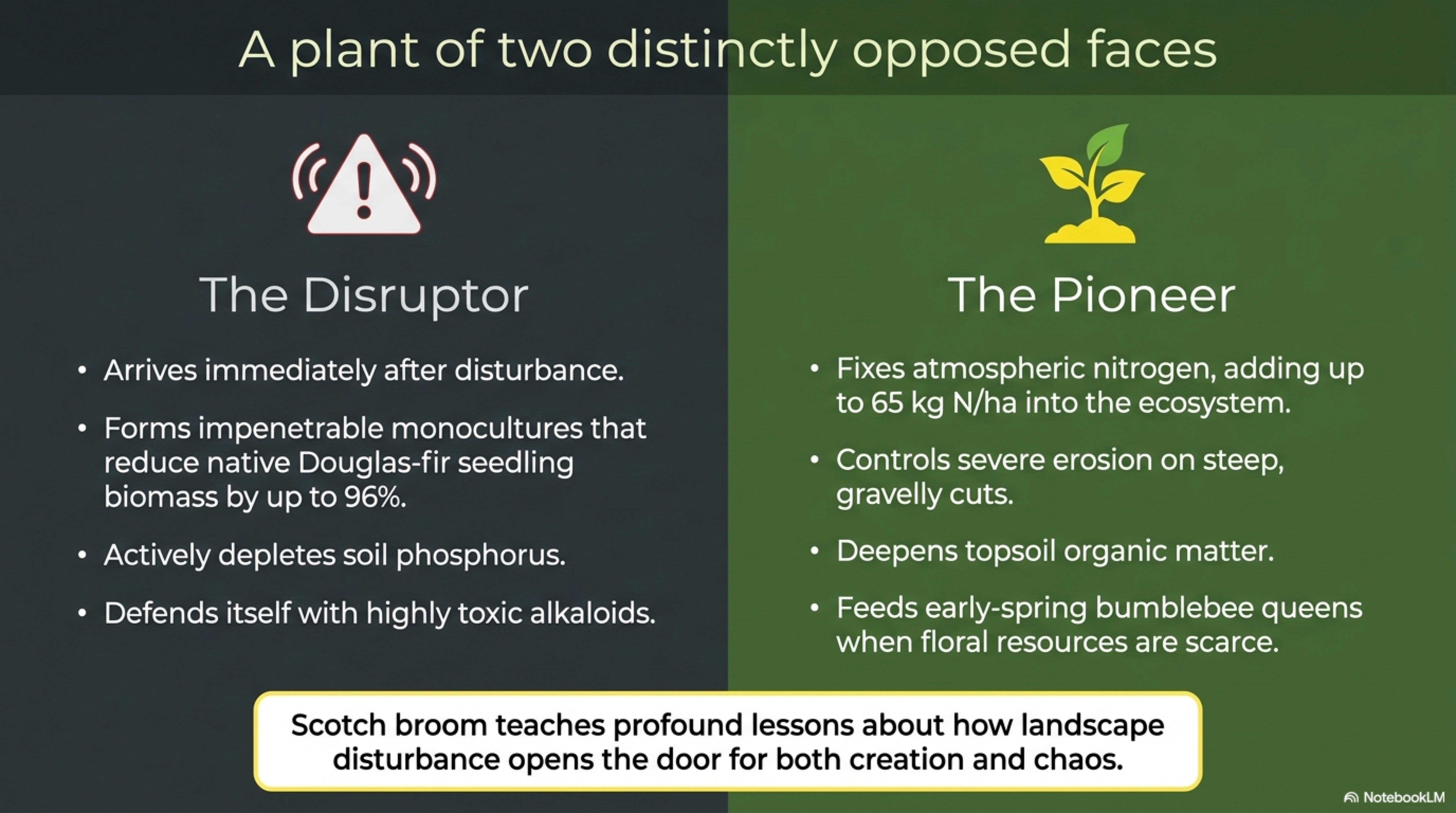
If you farm or replant trees, you’re looking at a wrecking crew, a shrub that can starve a Douglas-fir seedling of nearly all its growth in a dry summer, and that your cattle and horses can’t safely eat.
If you’re trying to build soil on dead ground, you’re looking at a legume that fixes its own nitrogen and greens up bare sand where almost nothing else will root.
If you make things, you’re looking at raw material, flowers that dye wool a glowing acid-yellow, twiggy stems that gave the plant its name when people bound them into besoms.
If you teach, you’re looking at the perfect classroom plant: brought to Vancouver Island around 1850 as an ornamental, escaped, and now the named villain of a thousand restoration days, with a flower that slaps visiting bees with pollen and pods that crack like knuckles on a hot afternoon.
And if you’re just curious, you’re looking at a diagnosis. Because broom doesn’t grow where the land is whole. It grows where something got opened.
All five of you are right. Start with knowing what you’re looking at.
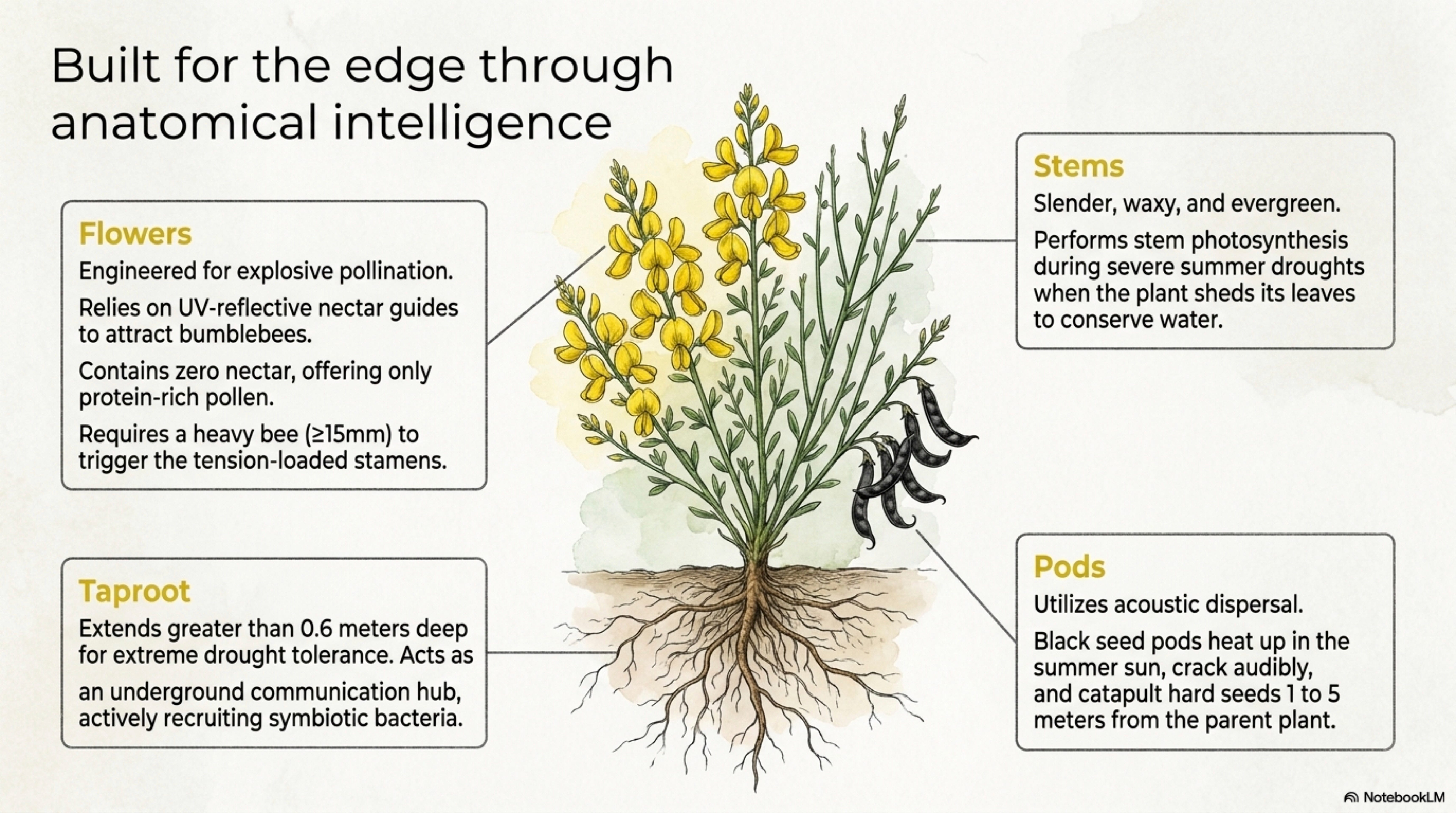
Scotch broom is a shrub of bright, angled green stems that stay green and do much of the plant’s photosynthesis even when the small leaves have dropped, which is most of the dry season. In spring it covers itself in yellow pea-flowers, each one a banner-and-keel structure that, oddly, holds no nectar at all; it pays its pollinators in pollen instead. By midsummer the flowers become flat pods that ripen black and burst open with an audible snap, flinging hard seeds a few meters into the dirt. The one lookalike worth carrying is its spiny cousin, gorse, same family, same yellow, same bad habits, but gorse is armored with real spines, while broom is smooth. Broom doesn’t stab; it poisons. Run a hand near it: if it bites back, that’s gorse.
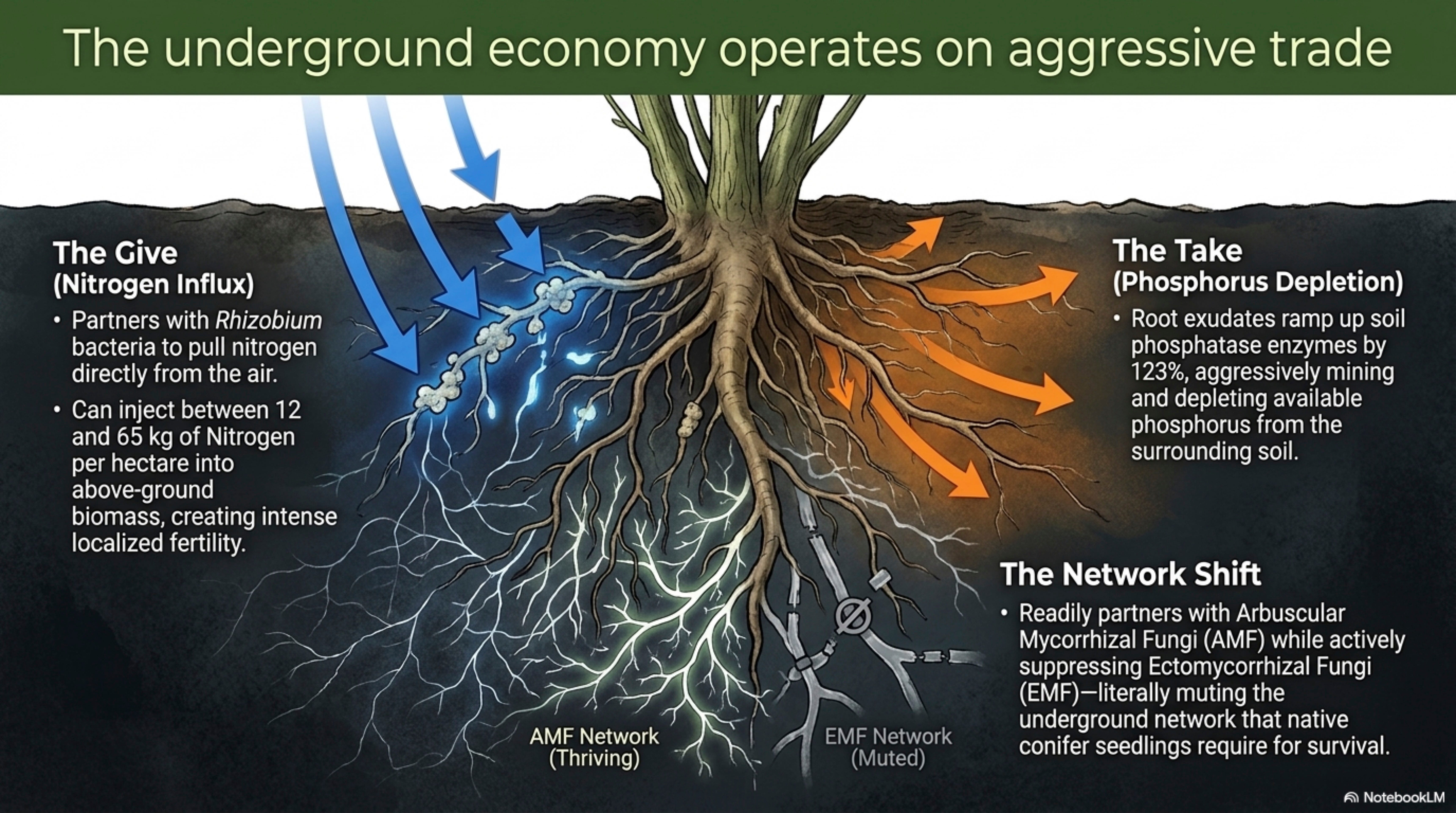
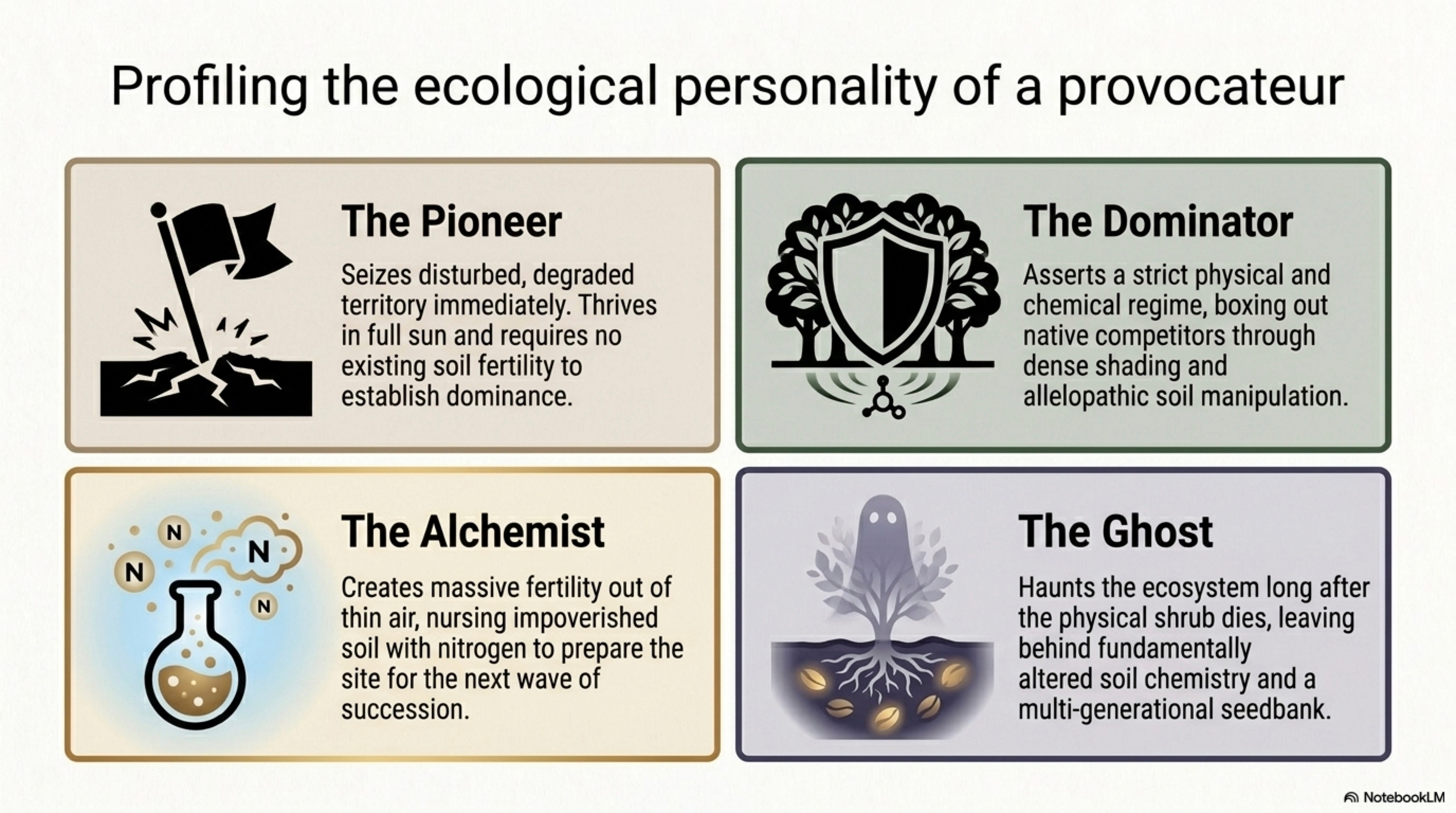
Broom is a soil-reader before it’s anything else. It colonizes disturbed, sunny, well-drained ground, roadsides, logged clearcuts, pastures, prairies, and it can’t get a foothold in closed forest, because it has no tolerance for shade. So where you find a thicket of it, the land is telling you three things at once: it was disturbed not long ago, the soil tends to be acidic and coarse and oddly out of balance, and whatever used to keep broom out, frequent low grass fires, steady browsing, has stopped. Here’s where it gets interesting, and where broom stops being a weed and starts being a teacher. As a legume, it pulls nitrogen from the air and banks it in the soil, genuinely enriching dead ground. But in the same gesture it draws phosphorus down, acidifies the dirt, and snubs the underground fungi that forest trees depend on. It builds fertility and breaks the balance simultaneously. The thicket isn’t telling you broom won. It’s telling you the system already tipped, and broom is the symptom wearing the brightest possible coat.
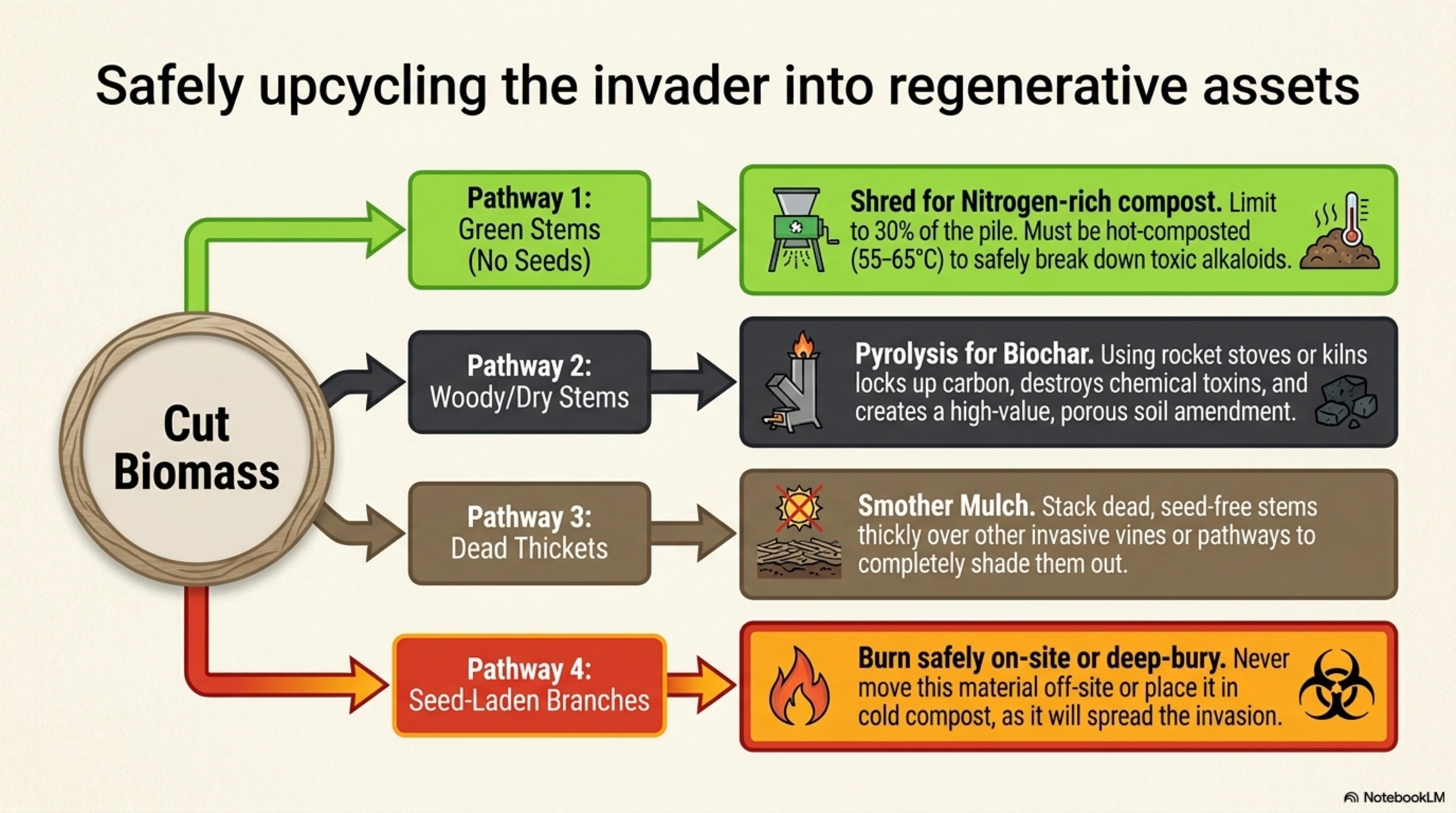
So the most honest use of broom isn’t to harvest it — it’s to read it, and then to close the loop on the plant you’re already removing. In most of the Pacific Northwest broom is a regulated invasive, which means the job is removal, not cultivation. Once it’s cut, don’t waste it: chipped and hot-composted (seed-free), it’s nitrogen-rich biomass; its twiggy branches make excellent biochar feedstock that locks up carbon and stabilizes some of its own toxins; dead stems stacked thick will smother the weeds underneath them. The flowers will give a strong yellow dye with an alum mordant if you’re inclined that way. What broom is not is food or fodder — it’s genuinely toxic, and we’ll get to exactly how on the other side of this. Keep it away from livestock entirely.
If you do one timed thing with broom, do this: cut it in bloom, before the pods set, and cut it below the ground line rather than yanking it. Pulling a big plant tears open the soil and hands the buried seedbank exactly the disturbance it’s been waiting for. The volunteer groups who do this for a living, the “Cut Broom in Bloom” crews, work the clean edges first and move inward, and they always re-green the cleared ground with natives, because bare dirt just grows the next broom. And know when to leave it. On a raw, actively eroding slope where broom is the only thing holding the soil, stage the removal instead of stripping it bare. There’s a real catch here the source is blunt about: pulling broom out abruptly can leave the soil lower in calcium, potassium, magnesium, and phosphorus than before, and let other weeds rush the gap. Broom had been holding and cycling those nutrients. Take it away with nothing ready to replace it, and you can make the wound worse before it heals.
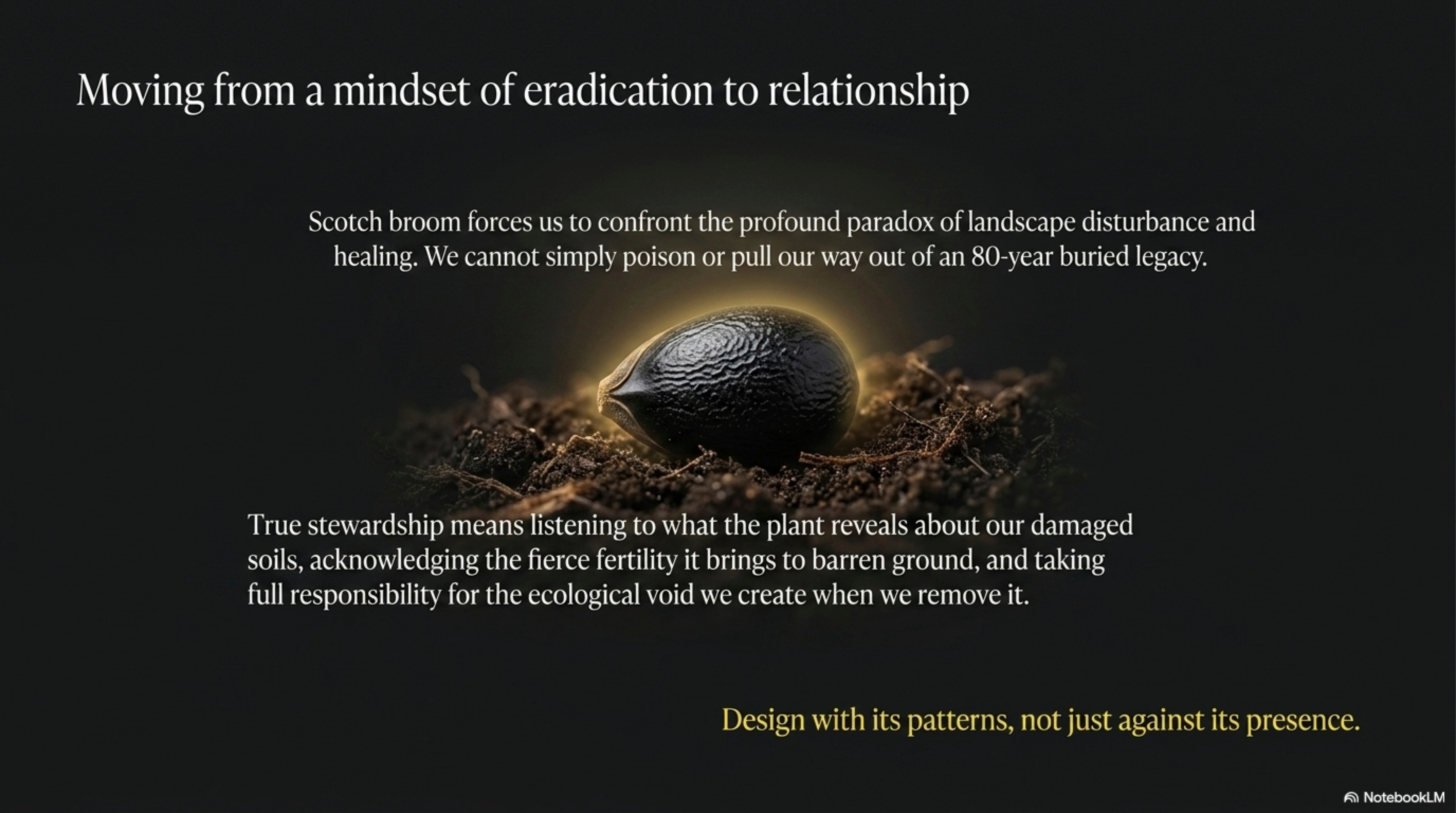
That’s the thing that won’t leave me alone. Broom heals bare ground and harms diverse ground using the very same trick. It can leave a site worse for the natives you want even as it “fixes” the bare patch you hated. And its seeds wait in the soil, 30 years, 60, by some accounts up to 80, so even after you win, you haven’t, quite. So which is it: is broom a bandage on a wound, or part of the wound? And there’s a stranger question underneath that one. For most of a thousand years this plant was a sign of home, hearth brooms, a king’s golden badge, the gold of May Day. Somewhere it flipped into a sign of carelessness. What changed, the plant, or us? And then there’s the part almost nobody knows: that this “useless weed” was once a heart drug, and a drug given to women in labor.
The answer’s on the other side of this paywall, the history, the chemistry, the surprising lives, and the full monograph that everything above was drawn from.
But here’s the truer reason to come through. This is the first of a growing library: every plant I publish, the full deep-dive monograph behind it, the complete video, and the reference you’ll keep coming back to when broom, or nettle, or comfrey, or whatever shows up gold on your own hillside, actually lands in your life and you need to know what to do with it. The free essays stay free, always. Paid subscribers get the atlas. And the collection gets bigger every month, which means a subscription today is worth more in a year than it is right now.
Eight dollars a month, less than a forgettable bottle of wine, and I’d know. That’s what keeps the research going: the reading, the cross-checking, the long hours spent learning to listen and then chasing down whether the old knowledge holds up. The land has never paid me for that work. The atlas is how it gets paid for now.
Left open today so you can see what paid subscribers get: the full half below, plus the complete six-minute video up top instead of the usual 30-second preview. Read on.
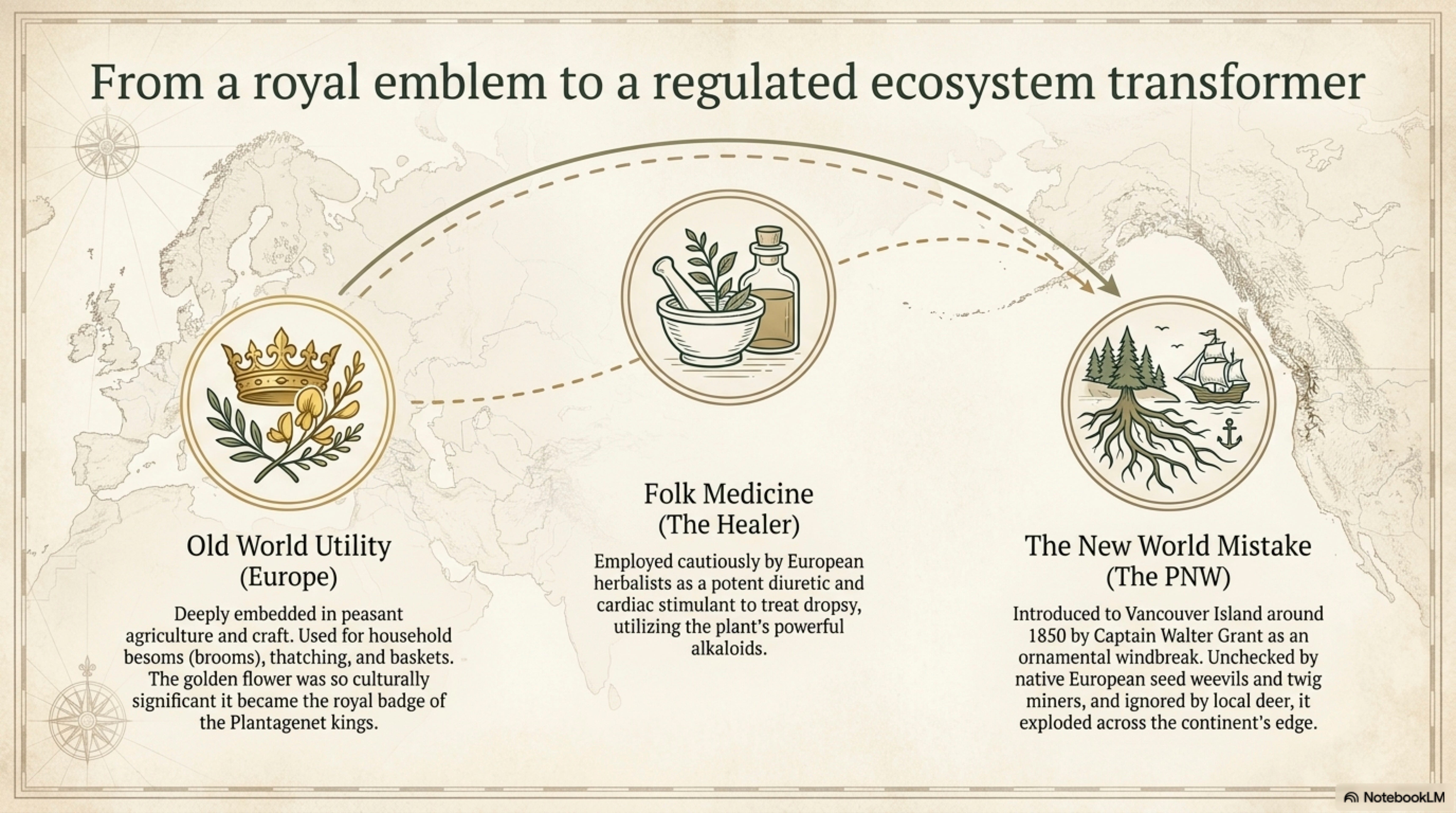
Start with the history, because broom has been keeping human company far longer than it’s been a villain. The name is the oldest clue: people bound its springy stems into sweeping brooms, and the tool took the plant’s name, not the other way around. The same stems went into thatch and rough fencing. In Portugal and Spain, farmers ran whole landscapes on broom’s nitrogen habit, they kept stands of it, giestais, on poor acid soils precisely to recharge the ground before grazing or cropping it again, a fertility bank made of brush. It dyed cloth a buttery yellow. And it climbed about as high as a wild shrub can: the Plantagenet kings of England took their name from it, planta genista, the broom plant, after Geoffrey of Anjou wore a sprig in his cap. Its gold bloomed around Beltane and became the gold of spring itself, and its besom tangled it up in witch-lore and purification rites, swept thresholds clean of bad luck. A sign of home, in nearly every direction you look.
Now the chemistry, and here I have to be careful, because broom is not a gentle herb wearing a scary reputation. It is genuinely, pharmacologically dangerous. The plant is built around quinolizidine alkaloids, sparteine, lupanine, cytisine and their kin, and these are not subtle compounds. Sparteine acts directly on the heart’s electrical conduction; for a stretch of the early twentieth century it was used as an antiarrhythmic and a cardiac stimulant, and it had a second career as an oxytocic, a drug to force uterine contractions in childbirth. It was abandoned on both fronts, not because it didn’t work but because the dose that helped sat too close to the dose that harmed. Cytisine acts on the same nicotinic receptors as nicotine. Taken carelessly, broom’s alkaloids bring on nausea, vomiting, plunging or spiking blood pressure, arrhythmia, weakness, convulsions, coma. This is why I’m printing no doses and no recipes: the historical medicine here is real, but it’s the kind that belongs to clinical history, not to a teacup. There is also a quieter, more promising side, the flowers and shoots are rich in polyphenols with strong antioxidant and antimicrobial action in the lab, but that work is still early, still mostly in vitro, and aimed at non-food uses like sanitizers and dyes, not at anything you’d swallow.
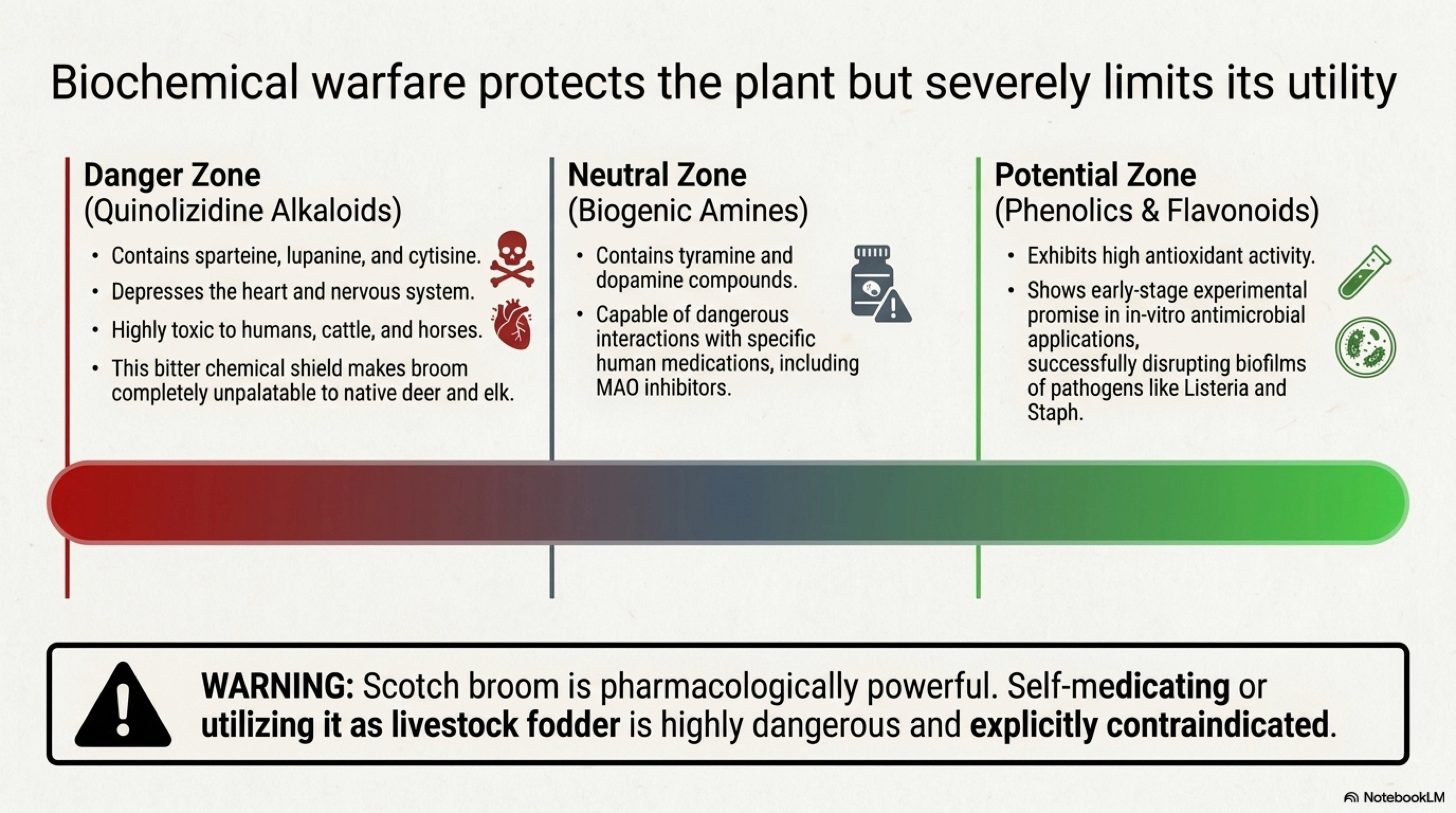
A few honest corrections while we’re here. Broom is sometimes folded in with the cheerful “useful invasives you can forage”, don’t. A handful of European foragers have pickled the flower buds like capers, but the safety margin is narrow and even the flowers carry alkaloids; the source treats edible use as high-risk and not recommended, and so do I. The dreamier claims you’ll find, broom’s xylem running on “structured water,” its stem network as a quantum signaling grid, are clearly labeled in the monograph as concept art, not agronomy, and that’s the right shelf for them. Even the optimistic “use broom as a nitrogen nurse crop” idea only works under active management, in its native range or under strict containment; left alone, the nurse becomes the tenant who won’t leave.
And the surprising lives, because broom is a more interesting character than its rap sheet. Part of why it runs wild here is simply that it left its enemies behind, in Europe, seed weevils, beetles, and a twig-mining moth keep it in check, and managers have since shipped some of those enemies over as biocontrol. Its flowers are spring-loaded: a bee heavy enough to land trips the keel, and the stamens spring up and dust it with pollen in a single slap, which is why broom needs bumblebees and large bees, not the small ones. Its seeds are patient past belief and fire-adapted, heat from a burn cracks their hard coats and triggers a mass germination, so a fire that kills the grown plants only midwifes the next generation. And in a final twist of perspective: in the 1940s broom was a hero on the Oregon coast, deliberately planted to pin down shifting sand dunes, growing three feet in a year, building soil out of bare grit. The same traits we now spend millions fighting were, eighty years ago, exactly what we wanted. The plant didn’t change. The story we tell about it did.
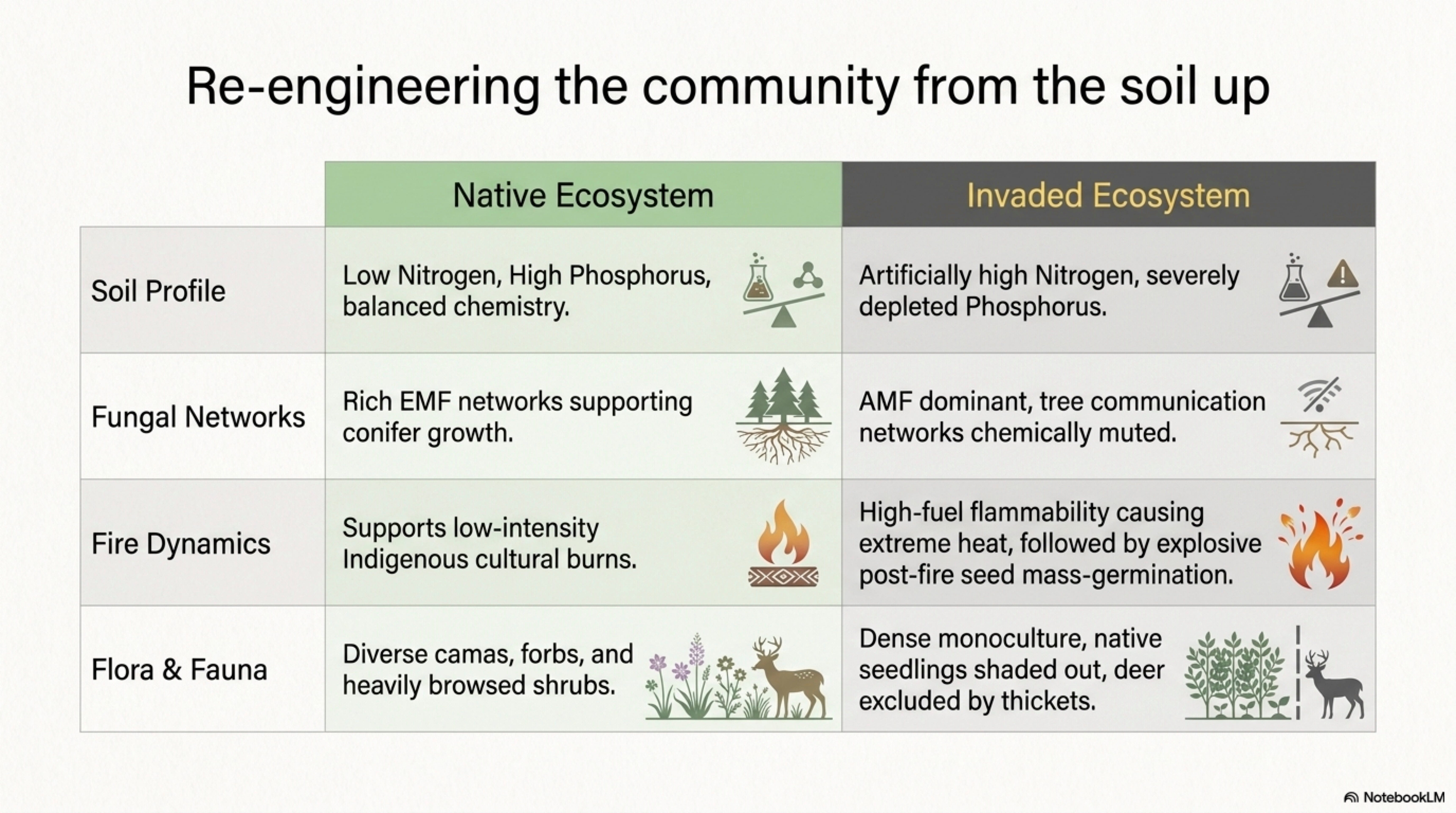
Stand in a broom thicket in May, chest-high, the whole stand roaring gold and loud with bees, pods already loading for their summer launch, and the reframe does itself. The gold on the wrecked hillside is both a bandage and a warning. Broom is what shows up after the collapse, after the logging or the fire or the overgrazing, and it does real work holding the bared ground together and feeding nitrogen back into it. But it won’t hand the land back on its own, and it can keep a place stalled in low diversity for decades while it does. The lesson it teaches is almost stern: disturbance without follow-up is an invitation, and the first plant to answer is rarely the one you wanted. To read broom rightly is to read the history of a place’s wounds, and to understand that healing damaged land and undoing the damage are not the same thing. The bright shrub is asking the same question from every one of its five doors: not how do I get rid of you, but what happened here, and what are you going to do next.
For the full Monograph click the image below.


