

The Land Has Been Writing to You. Would you like to learn the language?
There’s a garden bed I still think about. Mine, this time, which is the part that stings.
Productive for years, then it quit on me. Tomatoes growing lush and dark and refusing to fruit. Lettuce bolting two weeks after I set it out. Aphids stitched along the stems, ants running up and down the plants like they owned the place. So I did the sensible thing. Added compost. Added fertilizer. Added more.
Nothing changed. Or it got worse.
Here’s what the bed was actually telling me, if I’d been listening: stop feeding me, I’m already drowning. That dark soil wasn’t healthy, it was overfed and compacted, the biology long since crashed, the roots matted in the top three inches because there was nowhere else to go. The aphids weren’t an invasion. They were a readout. Stressed plants leak sugars, and a leaking plant is a dinner bell.
Every input made it sicker. The cure was the disease.
You can’t input your way out of a systemic problem. Sick soil isn’t saved by more product. It’s healed by a new environment.
What this is
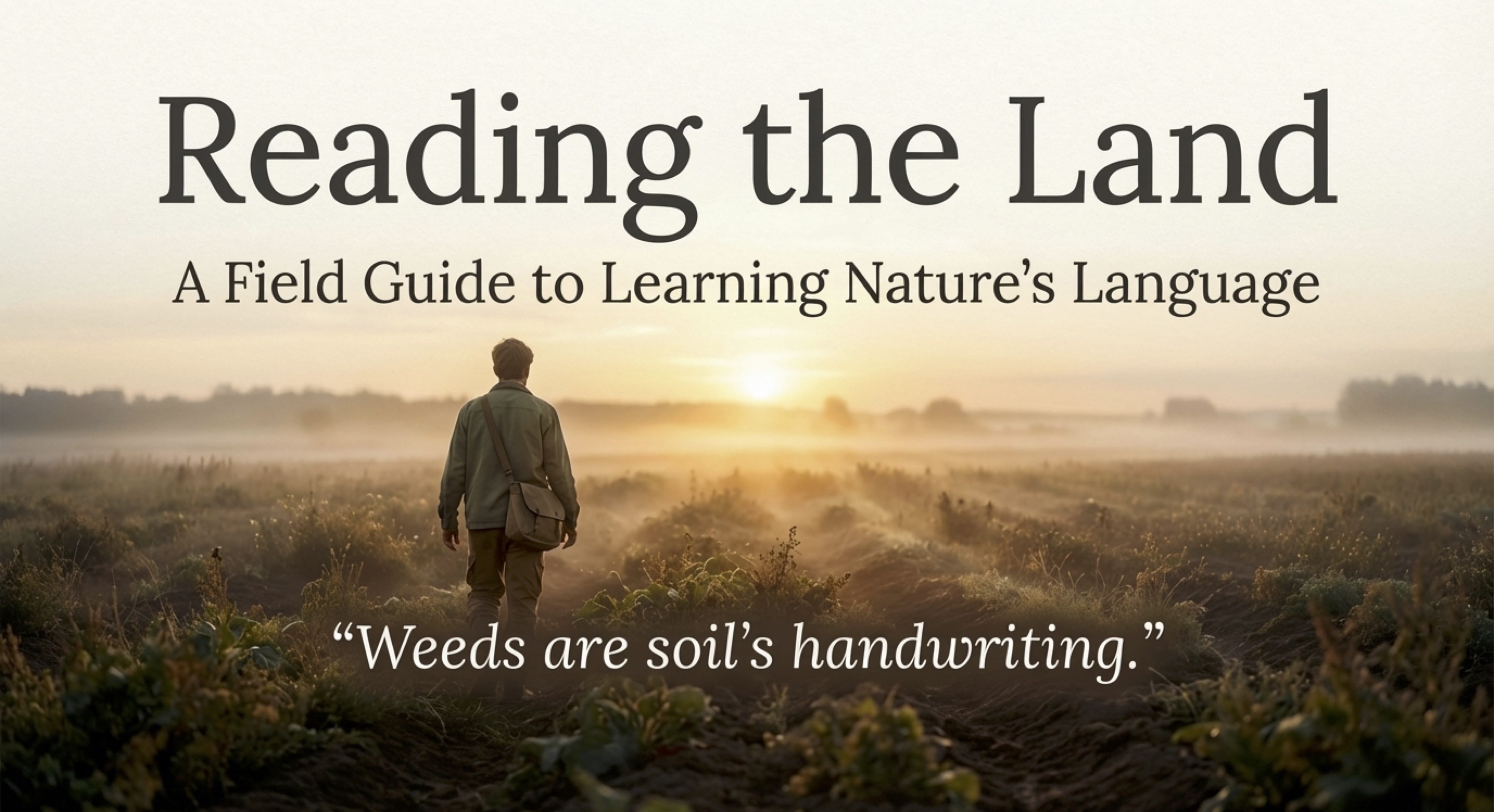
Reading the Land: A Regenerative Coaching Guide is not a spray schedule. It’s not forty product recommendations dressed up as wisdom. It’s a way of learning the language your land has been speaking the entire time you’ve been treating it like it was mute.
Four parts. One conversation.
The soil — a living city under your boots, with recycling crews, infrastructure, a fungal trade network, and billions of citizens you’ve never met. You’ll learn to read it with a spade, your nose, and a jar of water. No lab required.
The plants — the city’s signage. A dandelion isn’t a nuisance, it’s a sign that reads compaction zone, deep drilling in progress. Clover is a billboard for low nitrogen. Horsetail marks the swamp. Weeds are soil’s handwriting, and this teaches you the alphabet.
The insects — the system’s vital signs. They react in days, not years. Learn to take the land’s pulse in sixty seconds the way an old farmer does, before you’ve consciously decided anything.
The whole sentence — because the land doesn’t speak in single words.
The soil is the subject. The plants are the verb. The insects tell you whether the sentence makes sense.
When all three say the same thing, you can believe them. That’s not mysticism. It’s pattern recognition, built one season at a time, and the book hands you the framework so you don’t have to spend fifteen years in a vineyard figuring it out the hard way like I did.
Who it’s for
You, if you’ve ever suspected the dandelion punching through your hardpan was doing a job you didn’t know needed doing.
You, if you’re tired of the loop, yellow leaves, add nitrogen, aphids, spray, repeat, running it faster and faster until the soil quietly gives up and you’re standing there with an empty wallet and a dead bed wondering what you did wrong.
You, if you’re ready to stop fighting your land and start collaborating with it.
Here’s the math nobody on the input treadmill wants to do: you can keep buying your way out, bag after bag, season after season, forever, or you can learn to read the ground once. One of those compounds in your favour. The other compounds in someone else’s.
How to get it
Paid subscribers already have the whole thing on Substack, it’s part of what your subscription is for. Read it here. ($8/month or $75/year, and you get every deep-dive after it too.)
Want just the book, digitally? It’s $14 on Gumroad. Yours to keep.
Want the real thing? The paperback is $18 on Amazon. This is a book that’s meant to get dirt on it. To stay open on the potting bench, dog-eared and underlined, loaned to a neighbour with you need to read this scribbled inside the cover. Land-based work lives offline. The book wanted to live where the work lives.
A note of gratitude
This newsletter grew from a few readers to over 25,000 of you. The book exists because of your questions, your skepticism, your hunger to read the world for yourself. You shaped it more than you know.
Pick a spot. Spend some time there, noticing. You’ll find a world that’s been there the whole time, waiting for you to slow down enough to see it.
— Jay
P.S. If the book proves useful, an honest Amazon review helps it reach the people who need it. The algorithm doesn’t speak ecology, but it does listen to readers.


