

Scotch Broom (Cytisus scoparius) – Living Plant Wisdom Profile
Table of Contents
Opening Field Vignette — You’ll meet broom on a golden hillside and feel its paradox before you analyze it: beautiful, defiant, soil-enriching, and quietly strangling everything beneath it.
Plant Identity & Names — How to recognize Cytisus scoparius on sight (angled green stems, nectarless pea-flowers, exploding pods), where it came from, who its broom-cousins are, and how a Vancouver Island ornamental became a continental problem.
Soil Intelligence & Root Communication — The underground story: how broom fixes its own nitrogen, recruits rhizobia and AMF (but snubs the ectomycorrhizae trees need), mines phosphorus with enzymes, and may chemically silence competitors. The chapter where broom stops being a weed and starts being a soil engineer.
Community Ecology & System Behavior — Why broom wins: enemy release, monoculture-building, the 96% hit to Douglas-fir seedlings, the boom-bust life cycle, and the uncomfortable lesson that pulling broom can leave the soil worsebefore it gets better.
Water Wisdom & Hydrology — How broom drinks: deep taproots, leaf-dropping in drought, stem photosynthesis, and the double game of shading soil while draining it. You’ll learn why it owns summer-dry maritime climates and where frost and aridity finally stop it.
Phenology, Timing & Sensory Ecology — Broom’s calendar — bloom, pod-pop, seedbank — plus its sensory toolkit: UV nectar guides, the explosive bee-tripping mechanism, the audible crack of seedpods on a hot day, and a seedbank that waits up to 80 years.
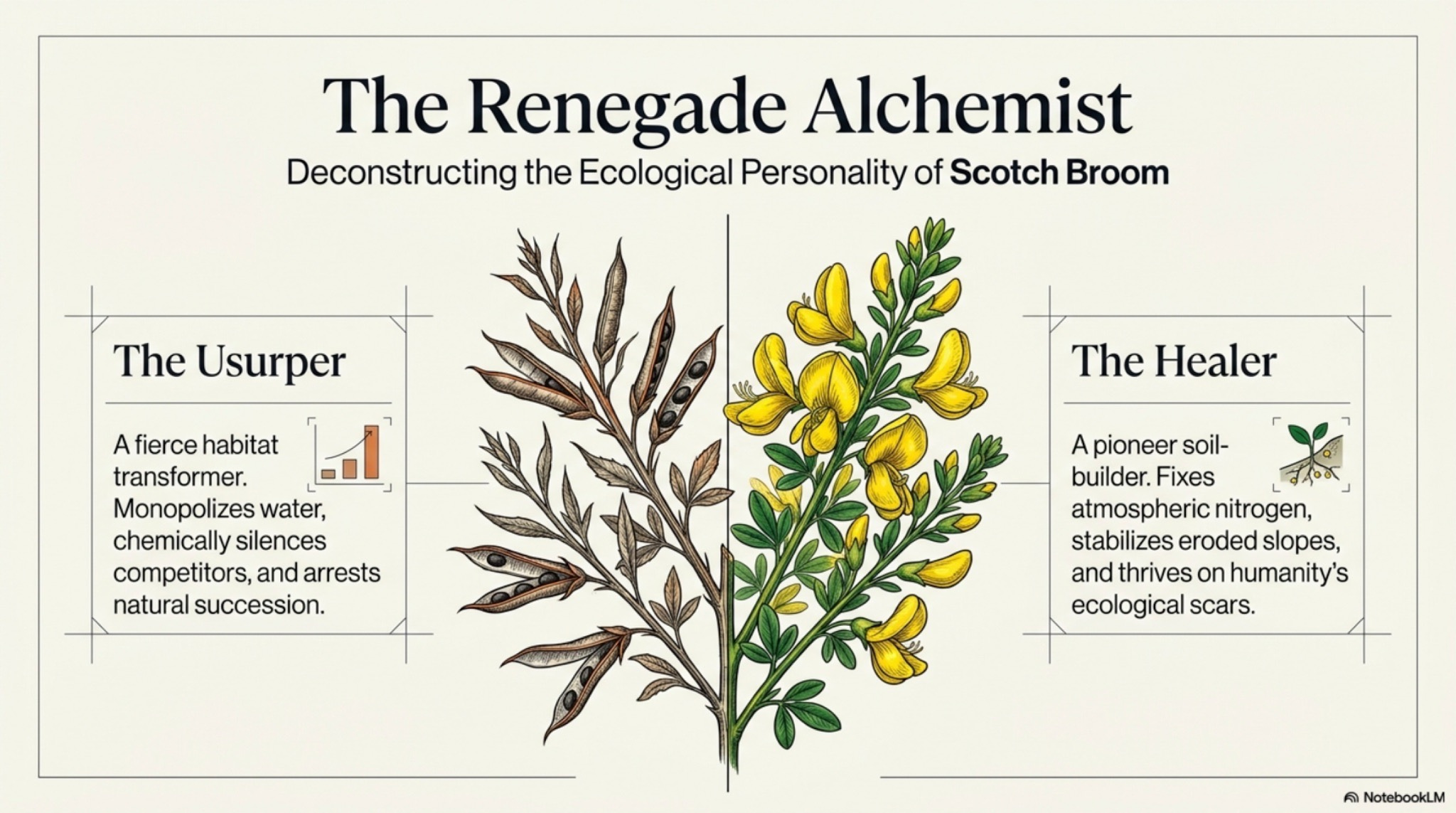
Ecological Personality Profile — Broom rendered as a character: the “Renegade Alchemist,” part healer, part usurper. A way to hold its contradictions in one frame without pretending it has a soul.
History, Folklore & Cultural Roles — The human story: brooms and thatch, sparteine and the village healer’s cabinet, Plantagenet heraldry, Celtic purification lore, and the flip from “sign of home” to “sign of ecological carelessness.”
TEK & Regional Stewardship — Honest about its limits (no pre-contact PNW knowledge of a post-contact plant), then European peasant fertility-banking, folk Ayurveda adoption, and Salish Sea Garry-oak restoration.
Biochemistry & “Nutrition” — The chemistry that makes broom both medicine and poison: quinolizidine alkaloids on the heart and nerves, the polyphenol antioxidant shield, why it’s nitrogen-rich biomass and emphatically not food, and a blunt safety-and-contraindications section.
KNF, BD & JADAM Integration — How to (cautiously) repurpose broom you’re already cutting: experimental ferments, biodynamic framing, compost and mulch roles, why it’s never fodder, and a ranked top-ten of genuinely useful regenerative applications under containment.
Harvest Optimization & Alchemy — What to cut, when, and why: phenological peaks for different tissues, the honest gap where chronobiology data should be, weather and moon-timing (separating physiology from ceremony), and safe drying and processing.
Residue Loop & Circular Use — Closing the loop: composting rules, biochar, structural reuse, and a year-by-year design pattern for turning an invasion into soil organic matter and stable carbon.
Product Development & Quality Control — The realistic product list — dyes, biochar, non-food antimicrobials, education — plus propagation facts (and why you shouldn’t), and how to read broom as a design diagnostic rather than a design element.
Emerging Science — Research frontiers: metabolomics and chemotypes, the Bradyrhizobium symbiosis, root and phyllosphere microbiomes, and the open questions about how broom recruits mutualists in novel soils.
Quantum Biology & Energetic Hypotheses — The clearly-labeled speculative wing: structured water in xylem, electrical signaling across the stem network, and the soil-fungus quantum interface — framed as concept art, not agronomy.
Citizen Science Protocols — Four experiments you can run without a lab: phenology logs, seedbank assays, allelopathy bioassays, and DIY soil-nutrient comparisons.
Plant Consciousness — A grounded middle road between “broom is a person” and “broom is an object” — what it senses, how cultures have read it, and what it can teach about edges and consequences.
Harvest, Tending & Seasonal Ceremonies — A ritual arc for removal-and-return through the seasons, treating succession itself as a living ceremony.
Dreamwork, Divination & Synchronicity — Pattern-reading, not fortune-telling: how to treat broom as a signal — of overgrazing, soil leaks, or succession proceeding — in the land and in your own choices.
Economic Roles & Income Potential — Where the money and value actually are: biochar and wildfire mitigation, natural dyes and craft, slope stabilization, community “broom bashes,” small-farm upcycling, and broom as speculative catastrophe insurance.
Vision & Synthesis — The throughline: broom as the paradox of disturbance and healing, a dormant invader that holds the line after collapse — threat, teacher, and conditional tool, all at once.
Opening Field Vignette
On a late spring afternoon in the Pacific Northwest, a once-green hillside blazes gold with the flowers of Scotch broom. The air carries a faint sweet note as bumblebees clamber among the bright pea-shaped blossoms, each landing triggering an explosive puff of pollen. Sunlight glints off the evergreen stems that weave a dense thicket over the dry, sandy soil. Beneath the canopy, all is quiet; only a few sparse grasses and withered wildflowers persist, crowded out by broom’s dominion. In the heat of summer, the black seed pods will curl and pop with audible cracks, flinging shiny seeds into the wind. This shrub exudes a paradoxical presence – at once beautiful and defiant – enriching the poor soil underfoot even as it overtakes the landscape (Plausible). One can almost sense a restless energy in this plant community: Scotch broom stands as a pioneer, thriving on disturbance and waiting for a spark, figuratively and literally, to shape the next succession of the land.
Plant Identity & Names
Scotch broom (Cytisus scoparius (L.) Link), also known simply as broom or common broom, is a perennial deciduous shrub of the legume family Fabaceae. It is native to Western and Central Europe, particularly in dry, sandy lowland areas of the British Isles and the Mediterranean coast. The shrub typically reaches 1.5–3 m (5–10 ft) in height, with many angled green stems that remain leafless or sparsely leaved through summer. Lower leaves are trifoliate (three leaflets) while upper leaves may be single and very small. In spring, Scotch broom produces an abundance of bright yellow pea-flowers (occasionally streaked with red) about 2 cm long. These flowers have the classic papilionaceous structure of peas – a banner, wings, and a keeled keel – but notably contain no nectar (Established) and rely on pollen rewards to attract pollinators (more below). The fruit is a flat pod that matures from green to black, ~5 cm (2 in) long, with hairy margins. Each pod holds 3–12 hard, glossy seeds.
Taxonomy & Relatives: Cytisus scoparius belongs to the Genisteae tribe of the pea subfamily, making it kin to other “broom” shrubs such as Spanish broom (Spartium junceum) and French broom (Genista monspessulana). These cousins share similar yellow flowers and invasive tendencies. Scotch broom itself has a few botanical varieties; for instance, a prostrate coastal form (C. scoparius subsp. maritimus) occurs on European sea cliffs. Numerous ornamental cultivars have been developed – e.g. ‘Moonlight’ (pale yellow), ‘Andreanus’ (yellow and red bicolor) – prized for their showy blooms. However, many regions now ban cultivation due to broom’s invasive potential (Established).
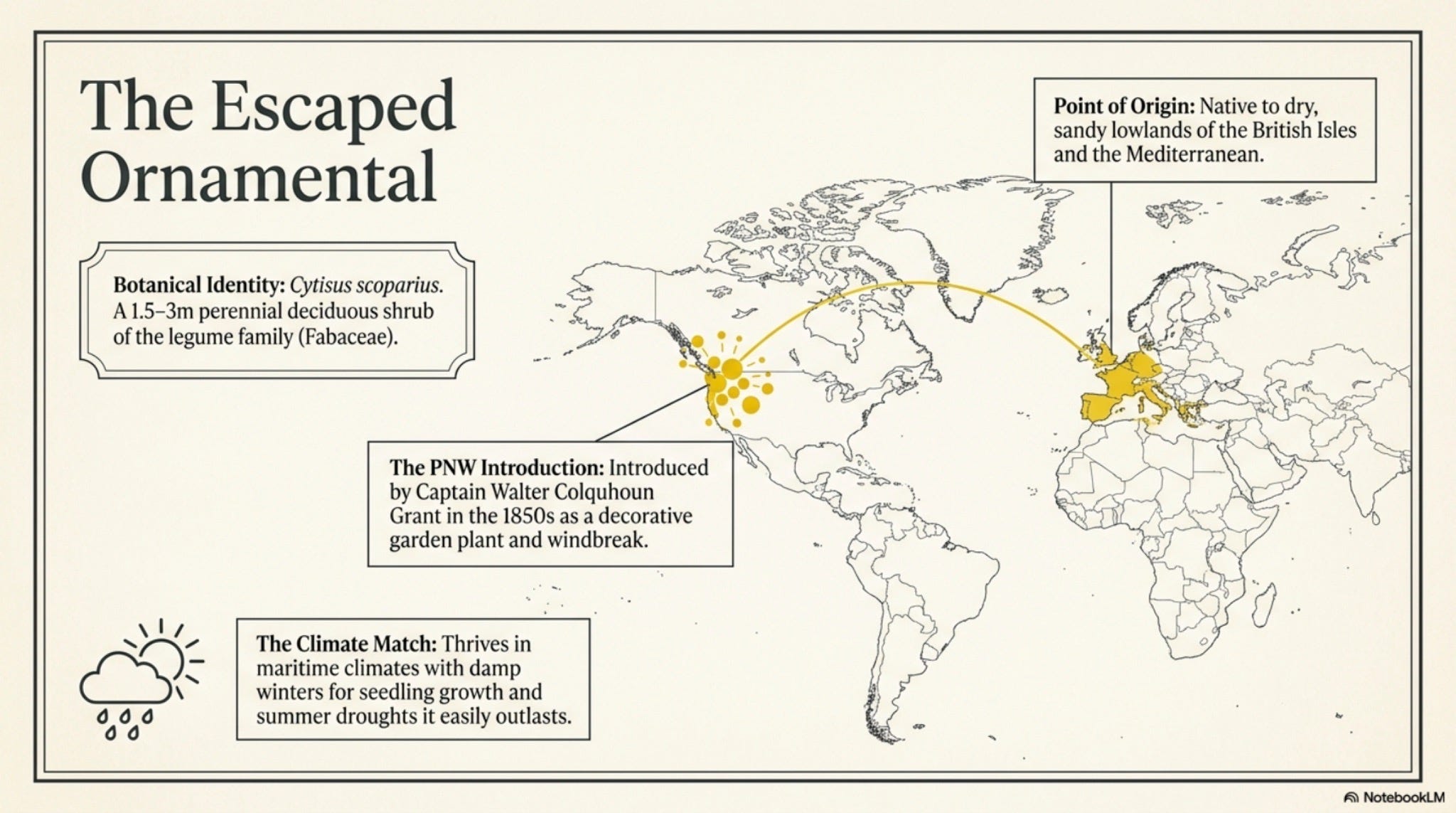
Global Distribution: In its native Eurasian range, Scotch broom inhabits sunny, well-drained soils and is often found on acidic sands or gravels. It has been widely introduced around the world and become a notorious invasive species in parts of North America, South America, Australia, New Zealand, and elsewhere. In western North America (Pacific Northwest), Scotch broom was first introduced in the mid-1800s – famously, Captain Walter Colquhoun Grant brought seeds to Vancouver Island around 1850, planting them as ornamentals and windbreaks (Established). Settlers were drawn to its hardiness and vibrant flowers, and it was also planted for erosion control on roadsides (Probable). Unfortunately, broom escaped cultivation and now infests millions of acres from California to British Columbia. It is classified as a noxious weed in many states and provinces. In the PNW today, Scotch broom is most common in lowland areas west of the Cascades, especially on disturbed ground – roadsides, logged clearings, pastures, and prairies. Notably, it does poorly in heavy shade, so it seldom penetrates closed forests. In climates with harsh winters or very low summer rainfall, broom’s spread is limited by frost kill and drought stress. Where conditions suit it, however, this shrub has shown remarkable vigor and tenacity.
Soil Intelligence & Root Communication
Scotch broom is a plant of poor soils that has developed special “intelligence” in the root zone to thrive where others cannot. Like most legumes, it engages in a symbiotic partnership with Rhizobium bacteria in its roots, forming nodules that fix atmospheric nitrogen into forms usable by plants. This nitrogen-fixing ability is well established [Established] – broom essentially “fertilizes” its own soil. In fact, farmers in its native Portugal historically took advantage of this trait by keeping broom on fallow or marginal fields to enrich the soil, improving pasture quality in subsequent years (Probable). By pulling nitrogen from the air and later shedding its leaf litter, Scotch broom can substantially raise soil nitrogen content and organic matter over time. Studies in the Pacific Northwest have found that broom-invaded sites often show higher total soil N and C compared to uninvaded areas, although results vary with site conditions (Probable). This nutrient alchemy is a key to broom’s success on sand and subsoil – it creates the fertility it needs, an act of ecological resourcefulness.
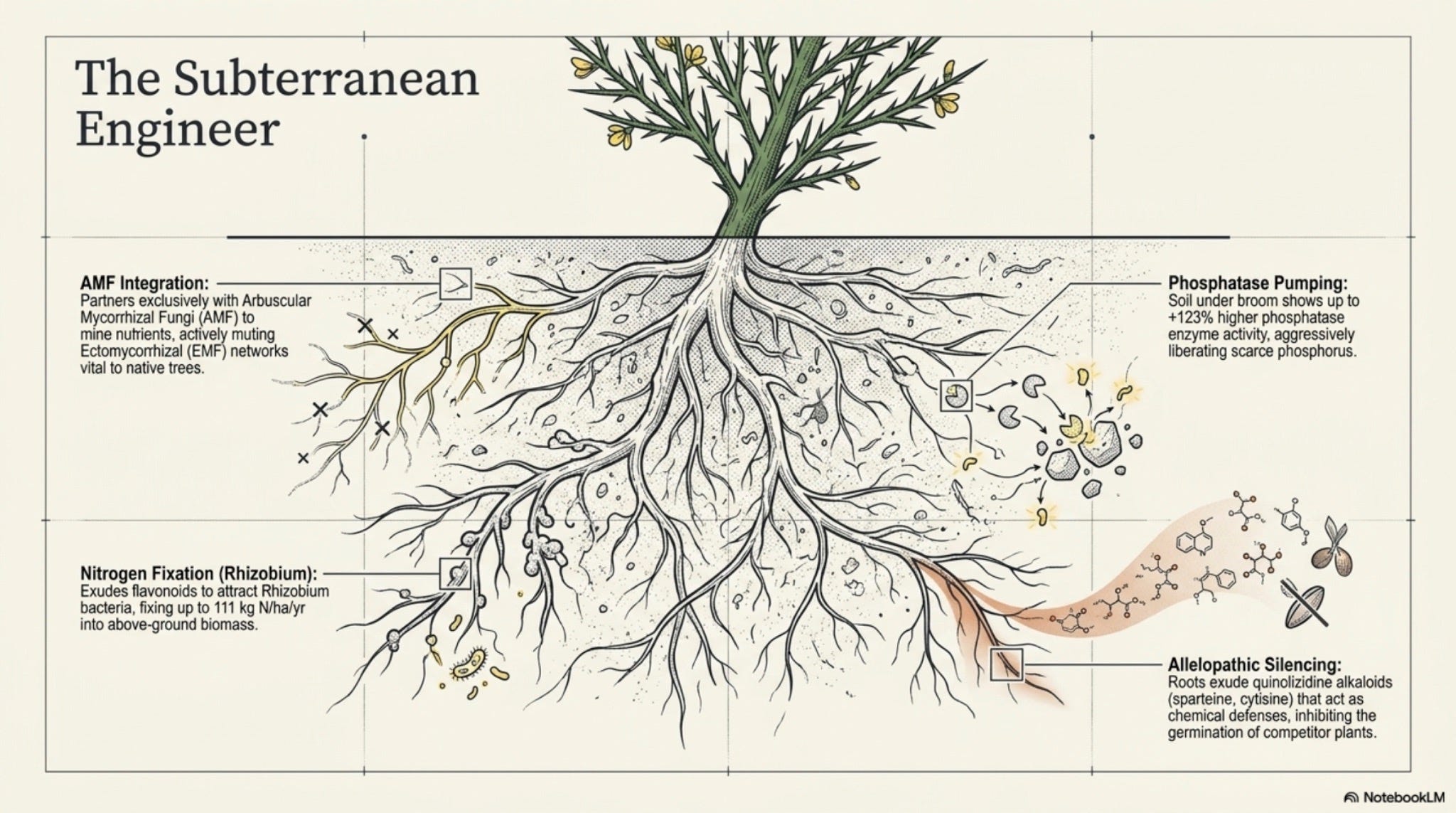
Beyond hosting bacteria, Scotch broom’s roots also associate with mycorrhizal fungi, specifically arbuscular mycorrhizae (AMF) (Established). Through AMF networks, broom likely gains improved access to phosphorus and other nutrients, while providing the fungi with sugars from photosynthesis. Notably, broom does not partner with ectomycorrhizal fungi (EMF). This is significant in forest ecosystems: in areas where broom replaces EMF-dependent trees, the soil fungal community shifts, potentially losing the EMF that tree seedlings rely on (Probable). In essence, broom’s rise may “mute” the underground conversation that normally occurs between EMF networks and trees (a disruptive legacy discussed later). However, broom readily taps into existing AMF networks shared with grasses and herbs, integrating itself into the soil food web (Plausible). Such root-level communication can extend to neighboring plants – common mycorrhizal networks can transmit nutrients and chemical signals between broom and co-occurring flora (though specific studies on broom’s signaling are under-researched, this is Plausible by analogy to other AMF-hosting plants).
Scotch broom also appears to “know” how to mine scarce nutrients in depleted soils. Researchers observed that soils under broom have significantly higher phosphatase enzyme activity, presumably due to broom or its microbes ramping up phosphorus acquisition. In one study, phosphatase activity was ~123% higher under broom than in adjacent bare soil. This suggests the broom-soil system responds to low phosphorus by producing enzymes to liberate P from organic matter (Probable). Indeed, a consistent finding is that broom-invaded soils often show decreased available phosphorus – broom and its microbial associates may be sucking up P or binding it in organic forms, even as nitrogen accumulates. One long-term survey concluded that “broom does not necessarily increase soil N availability but may deplete soil P”[Established]. This nutrient imbalance (high N, low P) can favor ruderal invaders and hinder native plants adapted to low N (as we’ll see in community effects).
Chemically, Scotch broom’s roots and litter release compounds that influence the soil biota. The plant is rich in quinolizidine alkaloids (such as cytisine, sparteine, lupanine) that serve as chemical defenses. There is evidence these alkaloids can function as allelochemicals: they may inhibit the germination or growth of other plants and soil microbes (Plausible). Laboratory studies show quinolizidine alkaloids have antimicrobial and phytotoxic effects. Field observations note that dense broom litter tends to suppress understory plant emergence (commonly seen under broom stands, though this could be due to physical shading as well). While it’s challenging to disentangle allelopathy from other factors, scientists consider it plausible that broom’s alkaloids contribute to its competitive edge by chemically “silencing” potential competitors in the rhizosphere (Plausible).
Intriguingly, these same root-secreted compounds play positive communication roles too. Legume roots exude specific flavonoids into soil that attract Rhizobium bacteria and initiate the nodulation symbiosis (Established). Scotch broom is no exception: when its seedlings sense the right rhizobia nearby, a molecular dialogue begins that results in root nodule formation – a beautiful example of cross-kingdom communication in the soil. This chemical signaling represents a form of plant intelligence, guiding microbes to partner for mutual benefit. In a broader sense, Scotch broom’s root system engineers its surroundings, fostering microbes that help it and altering soil chemistry to suit its needs.
From a systems perspective, broom’s soil interactions exemplify an ecosystem engineer that both gives and takes: it builds fertility (via N-fixation) even as it monopolizes resources like P and water (as discussed below). Other Fabaceae plants show similar duality – e.g. alfalfa and clover enrich soil for crops (harnessed in regenerative agriculture), whereas invasive gorse (Ulex europaeus) and kudzu aggressively reshape soil nutrient cycles for their own expansion. In the case of Scotch broom, its “soil intelligence” is quite advanced on the spectrum: it collaborates with microbes, biochemically modifies its environment, and thereby creates a self-reinforcing niche (Established). Some have even speculated about quantum processes in these root interactions – for instance, quantum-level sensitivity in how roots perceive nutrient gradients or water structure in soil (Speculative). While still fringe science, emerging research in quantum biology hints that water in plant tissues can form coherent structures and that plants might detect signals at very subtle levels. Applying this lens, one could poetically imagine Scotch broom’s roots as antennas tuning in to microscopic vibrations in the soil, enhancing its ability to find nutrients and symbiotic partners (Highly Speculative). What is firmly known is that Scotch broom has a masterful relationship with the soil: part chemist, part communicator, it sets the underground stage for its own success.
Community Ecology & System Behavior
In its interactions with other species and the broader ecosystem, Scotch broom often behaves as a dynamic disruptor and opportunist. This shrub is notorious for forming dense, monospecific stands that displace native vegetation. In invaded Pacific Northwest prairies and clear-cuts, one can observe near-total dominance by broom – a sea of yellow blooms in spring where diverse wildflowers or tree seedlings once grew. The ecological impact is significant: broom thickets reduce plant community richness and diversity (Established). For example, surveys in endangered Garry oak savannas found that in broom-invaded plots, many native herbs and grasses decline, and up to 60% of the species that increased were other non-native weeds taking advantage of broom’s soil changes. Native forbs and grasses struggle under the shade, altered nutrients, and possibly allelopathic effects of broom (Established). In some cases, broom may actually facilitate the invasion of other exotics – its nitrogen enrichment and litter create conditions that fast-growing non-natives exploit better than slower-growing natives (Probable). In short, Scotch broom acts as a transformer of habitats, often tipping ecosystems toward novel assemblages dominated by invasive species.
A prime example of broom’s system-level behavior is its effect on forest regeneration. Broom aggressively colonizes disturbed sites such as clear-cut logging areas, roadsides, and burned forests. It thrives in the full sun of a recent clear-cut, often outcompeting tree seedlings for light and water. Young Douglas-fir or pine seedlings planted in broom-infested clearings suffer high mortality and stunted growth. Research shows that during dry summers, broom competition can reduce the biomass of Douglas-fir juveniles by as much as 96% (Established). Broom’s fast-growing roots likely siphon soil moisture and nutrients, leaving little for the slower-growing tree saplings (plus overhead shade from broom further stresses the seedlings). As a result, broom invasions can delay or prevent forest succession, effectively arresting a site in shrubland state for years or decades. This has economic impacts: in the Pacific Northwest, Scotch broom invasion is estimated to cause tens of millions of dollars in lost timber productivity annually. Land managers thus view broom as a serious competitor to reforestation efforts.
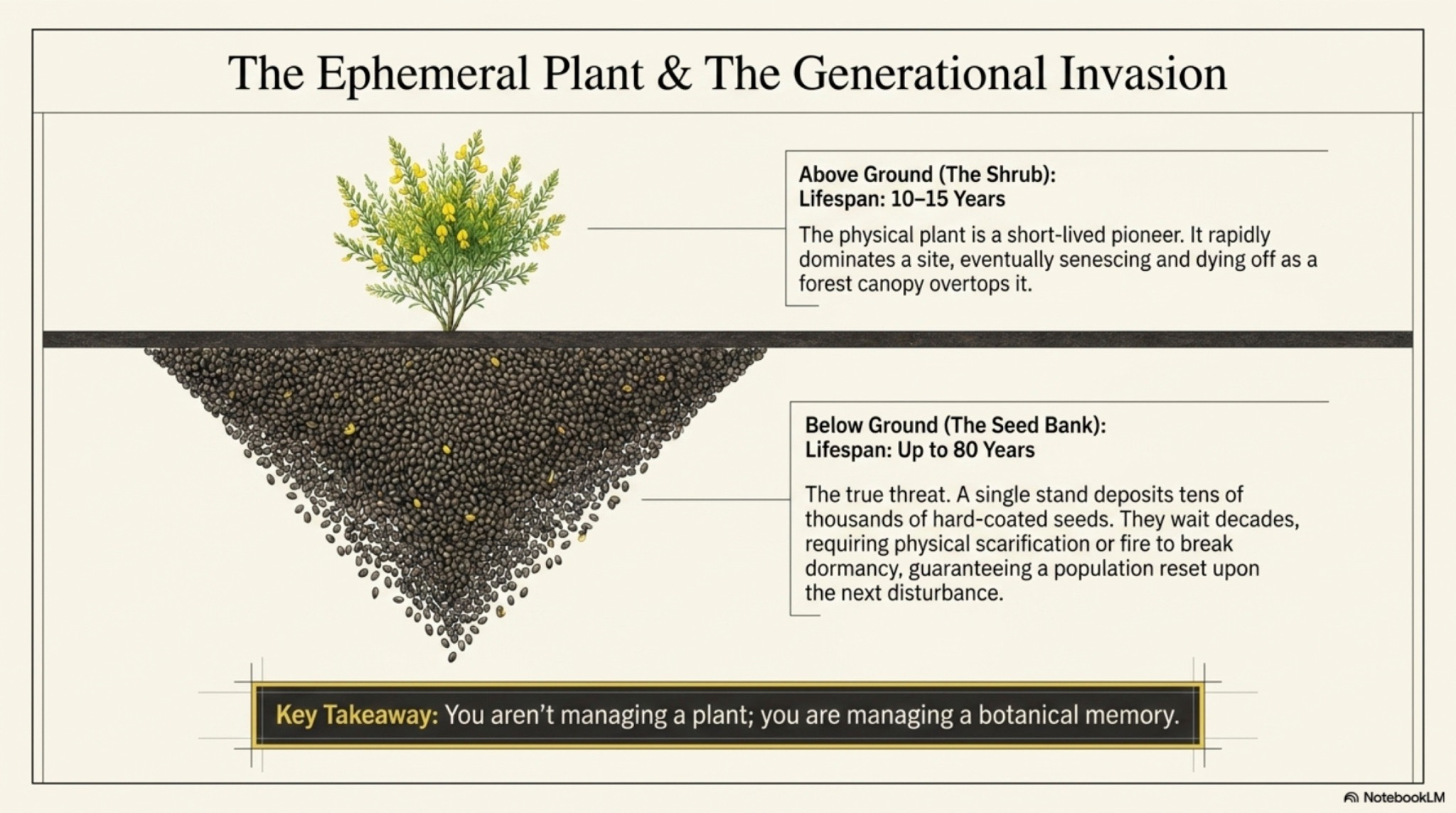
Interestingly, Scotch broom is relatively short-lived on the individual level – an average plant lives only about 10–15 years in the field (Established). It is not a long-term climax species. However, its population persists via a massive and long-lived seed bank (discussed under Phenology). This leads to a boom-bust dynamic: broom often explodes after disturbance, dominates the site for a decade or two, and then as taller vegetation (trees) slowly overtops it, broom plants senesce and die out. In a more intact successional trajectory, eventually a forest canopy can re-establish and shade out broom entirely. But the interim period can be prolonged and problematic. In some cases, even after broom dies, its legacy of altered soil and depleted native seedbank means secondary invaders (other weeds) take over instead of the original community. This phenomenon – an invasive species leaving behind soil legacies that hinder ecosystem recovery – is well documented for Scotch broom (Established). Land trials in Washington found that even 4+ years after broom removal, sites showed little recovery of native species and were instead colonized by other non-natives. In fact, paradoxically, removing broom abruptly can make certain soil imbalances worse in the short term: one study saw that broom removal led to significantly lower soil calcium, potassium, magnesium, and phosphorus, especially on poor sites. It appears that while broom was present, its litter and N-fixation had been holding or cycling these nutrients; once removed, nutrients leached or became unavailable, and opportunistic weeds rushed in. The lesson for managers is that broom-infested ecosystems may require gradual restoration or soil amendments to truly heal, rather than just broom eradication (Probable).
In terms of species interactions, Scotch broom largely “goes it alone” in new environments. It benefits from a lack of natural enemies – a classic case of enemy release. In its native range, broom foliage and seeds are fed on by certain insects (e.g. the broom twig miner moth, seed weevils, specialist aphids) and browsed to some extent by herbivores. But when introduced to North America, those specialist herbivores were absent. Broom’s bitter alkaloids deter most generalist grazing animals. It is mildly toxic to livestock, causing digestive and nerve problems if eaten in quantity, so cattle and sheep rarely touch it [Established]. Deer and elk also find broom unpalatable, nibbling only tender new shoots if at all. This means little herbivore pressure to keep broom in check (Probable). As a result, broom can form thickets unbothered by browsing that would normally prune back shrubs. In coastal California and PNW, one might see deer path networks weaving around broom patches rather than through them. The lack of predation gives broom a huge competitive advantage over palatable native shrubs that get heavily browsed. Recognizing this, biocontrol programs have introduced some of broom’s European enemies into invaded regions. For example, the Scotch broom seed weevil (Exapion fuscirostre) and the bruchid seed beetle (Bruchidius villosus) have been released to eat broom seeds, and the twig miner moth (Leucoptera spartifoliella) to attack its stems. These agents have established in many areas and help reduce seed production (Estimated seed destruction varies, maybe 20–50% in some locales – Probable). However, broom continues to thrive as enough seeds escape predation to maintain populations. Other introduced biocontrols include a sap-sucking psyllid and a gall mite, each targeting different parts of the plant. While helpful, none of these have eradicated broom; at best they slow its spread or reduce vigor (Probable). Thus, Scotch broom remains a formidable competitor, essentially unchecked by herbivores in much of its invasive range.
Broom’s pollination ecology also plays into its invasive success. The bright yellow flowers of Scotch broom are entomophilous, adapted to bee pollinators. In its non-native range, there was some initial concern that a lack of the exact native pollinator species might limit broom’s seed set. Indeed, one study in New Zealand and North America noted that adequate pollination (especially by large bumblebees) was initially a limiting factor in some broom populations (Probable). However, in most invaded areas, generalist bees (introduced honeybees and native bumblebees) have proven quite capable of pollinating broom. C. scoparius flowers have a specialized “explosive” pollination mechanism: the petals are kept under tension (the keel enclosing stamens and style) and “trip” open when a sufficiently heavy insect lands, releasing a burst of pollen onto the visitor. This usually requires a bee of moderate to large size – hence bumblebees are ideal, and honeybees can accomplish it too. (Smaller bees may struggle to trigger the mechanism or might “steal” pollen by biting flowers.) Notably, broom flowers produce no nectar and little fragrance, relying on their bright color and UV-reflective nectar guides on the petals to attract bees (Established). The reward for pollinators is pollen itself, which is protein-rich. Broom thus depends on bees actively collecting pollen for brood; fortunately, in spring when broom blooms, bumblebee queens and workers are eagerly foraging pollen for their young. Once tripped, a flower’s stamens may reset after a time, allowing multiple tripping events. This strategy promotes outcrossing (self-pollination yields few seeds in broom). In urban environments, interestingly, researchers have observed pollinators selecting for larger flower size in broom, indicating ongoing adaptation to local pollinator communities (Probable). Overall, Scotch broom’s relationship with pollinators has become sufficiently mutualistic in its new range that pollination is no bottleneck – plenty of viable seeds are produced each year (Established). This ensures that broom’s prolific reproductive capacity can be fully realized in invaded ecosystems.
Another aspect of broom’s community behavior is its interaction with fire and disturbance regimes. Scotch broom can act as a flashy fuel: its stems are woody and dry out seasonally, and dead broom (from past years) often accumulates within stands. Come summer drought, a broom thicket can become highly flammable, increasing wildfire risk. Land managers list broom as a fire hazard (Established). Ironically, broom is also somewhat fire-adapted: while mature plants may be killed by intense fire, their heat-scarified seeds then germinate en masse afterward. Low-intensity grass fires can actually increase broom seed germination by cracking seed coats. Thus, in a burn scenario, broom tends to come back vigorously from the seedbank, even if the adult stand was removed – unless post-fire management (like sowing native competitors or manual weeding) is done. This suggests broom could create a positive feedback with fire in certain ecosystems, similar to how gorse or chaparral shrubs do (Probable). However, on the flip side, broom thrives in regions where fire suppression has allowed woody shrubs to encroach into historically open prairies (e.g. Garry oak meadows). So changes in disturbance regimes either way can benefit broom. It is an archetypal disturbance opportunist, ready to exploit any gap or reset in the system.
To summarize, Scotch broom’s system behavior is that of an aggressive pioneer and ecosystem engineer. It colonizes disturbed niches, rapidly forms a self-serving alliance with soil microbes, and excludes many other species through a combination of shading, nutrient manipulation, and chemical defense. It then persists via seed bank through unfavorable periods, ready to regenerate when conditions reset (Established). In community ecology terms, broom is an “r-selected” strategist – it invests heavily in reproduction (tens of thousands of seeds, fast growth) and less in longevity or steady-state coexistence. Like other invasive legumes (e.g. black locust trees or kudzu vines), it can augment site fertility while simultaneously destabilizing existing communities. Over time, some balance may be restored (e.g. as forests overtop broom), but broom often leaves behind an altered ecosystem state. Only time or active restoration can shift the system back. Understanding Scotch broom’s role in the community thus requires a whole-systems view: it’s not just a weed, but a catalyst that reorders relationships among plants, animals, soil, water, and even disturbance processes. This perspective helps land stewards anticipate indirect effects like secondary invasions or nutrient legacies when managing broom (Probable). In essence, Scotch broom behaves less like a lone invader and more like a force of change, reshaping the community to fit its own fierce yet fleeting life cycle.
Water Wisdom & Hydrology
Scotch broom’s relationship with water is a story of efficiency and adaptation to seasonally dry climates. Native to Mediterranean-type regions, broom is inherently drought-tolerant (Established). It has a deep taproot (often >0.6 m) accompanied by a network of lateral roots that allow it to access soil moisture reserves. During the Pacific Northwest’s summer droughts, broom survives by tapping into deeper moisture and by reducing water loss. One key adaptation is that broom often drops many of its small leaves as the dry season progresses, relying on its green stems for photosynthesis. These slender, waxy stems have fewer stomata than leaves, so they lose less water per unit of carbon fixed (Plausible). By essentially performing “stem photosynthesis,” Scotch broom can continue to grow (slowly) through dry periods when many plants are completely dormant. This strategy of being drought deciduous in leaves while evergreen in stems is well-suited to climates with wet winters and dry summers (like the PNW and Mediterranean).
Despite tolerating drought, Scotch broom actually prefers moderate moisture and mild temperatures. It flourishes in regions with annual precipitation above about 500 mm (20 inches) and where summer drought, while present, is not extreme. In very arid areas or years of severe drought, broom may suffer high seedling mortality and dieback of older plants (Probable). Cold is another limitation: broom is sensitive to hard freezes, especially as a seedling. A harsh winter can kill back branches or whole plants, though mature broom often resprouts from the base if roots survive. Thus, broom’s ideal hydrologic niche is a maritime climate with damp winters (for growth and seedling establishment) and dry summers that it can withstand better than thirstier competitors. In the PNW, this corresponds to low-elevation coastal and Puget Sound zones, whereas the colder interior or very dry regions naturally check broom’s spread (Established).
In terms of water use, Scotch broom is a water opportunist. In wet seasons or years, it can grow prolifically, but in dry times it can throttle down its water needs. When water is available, broom’s fast growth means it will transpire copiously and potentially deplete soil moisture rapidly from the upper soil layers (Probable). Indeed, broom stands are noted to compete strongly for soil water, to the detriment of other plants. As mentioned earlier, studies in Douglas-fir plantations showed that during summer drought, broom presence cut available moisture enough to nearly halt tree seedling growth (up to 96% biomass reduction). This indicates broom has a substantial transpirational pull, likely extracting water that would otherwise support the shallow-rooted seedlings. By monopolizing water in the root zone, broom gains a competitive edge in arid late-summer conditions (Established).
Curiously, Scotch broom’s canopy effects on microclimate create a mix of hydrological outcomes. Broom’s dense foliage in spring can shade the soil, reducing evaporation and keeping the soil beneath somewhat cooler and moister into early summer (Plausible). However, that same foliage is also drawing water from the soil. Field experiments that removed broom found that without the broom canopy, sunlight and soil temperature increased (drying the surface more), yet soil moisture did not improve much. Specifically, broom removal raised light penetration (PAR) and warmed the topsoil, but had “limited effects on soil moisture” (Established). The implication is that any water saved by eliminating broom’s uptake might be lost through higher evaporation in the now-exposed soil, at least in the short term. So broom’s presence may create a slightly more buffered microenvironment (cooler, less evaporative), even as it actively extracts water for its own use. This nuanced behavior suggests broom stands might conserve soil moisture early in the dry season (by shading) but exhaust deeper moisture later on (by uptake) – a hypothesis that would be interesting to test in different soil types (Speculative).
Another hydrological role of broom is in erosion control and soil stability. Thanks to its root system, broom can bind loose sandy or gravelly substrates. In fact, one reason it was planted along roads and embankments was to prevent erosion (Historical). In the Pacific Northwest, it’s common to see broom lining gravelly highway cuts and riverbanks, where it likely does help hold the slopes. By shielding soil from direct rain impact and anchoring it with roots, broom reduces surface runoff and sediment loss (Probable). However, in doing so it also displaces native stabilizers like grasses or shrubby willow. The net effect can still be positive for slope stability – one could say broom performs a service on severely disturbed soils by rapidly revegetating barren ground (Probable). This aspect is recognized in some land reclamation contexts, albeit with the risk of subsequent invasion.
From a water quality perspective, broom’s impact is not well studied. Dense broom along riparian zones could intercept nutrients or sediment before they enter streams (Plausible). But if broom replaces a diverse riparian community, it might provide less bank reinforcement or shade to streams than native vegetation, potentially affecting aquatic habitats (Speculative). Broom generally doesn’t grow in marshy or very wet soils, so it’s not directly involved in wetland water processes.
One fascinating area of speculation is the idea of “water wisdom” at a finer scale – how Scotch broom might utilize or even influence the structural properties of water in its tissues. Some water science researchers (e.g. Dr. Gerald Pollack) have posited that plants can exploit a “fourth phase” of water (structured water) in xylem to aid in fluid transport and energy storage (Speculative). If such phenomena are real, Scotch broom’s xylem could be an arena where water molecules arrange in semi-crystalline order along hydrophilic vessel walls, helping push sap upward without full reliance on transpiration pull (Speculative). This might be especially handy during drought stress, allowing continued flow even as stomata close. While this is not yet mainstream science, it’s intriguing to imagine broom’s water transport benefiting from quantum-level coherence in water molecules – a subtle form of “wisdom” in how it handles hydration internally (Speculative). At the very least, broom shows prudence in water use: it drinks deeply when water is abundant and hunkers down when water is scarce.
In summary, Scotch broom’s hydrological profile is one of resilience and opportunism. It has the capacity to endure dry summers by deep rooting and shedding leaves (Established). It has enough thirst to hinder neighbors, yet can moderate the microclimate under its own canopy. It thrives in regions with mild wet winters and dry summers – aligning with climates where water arrives all at once then withdraws. In those conditions, broom acts as a green bridge across the drought, staying physiologically active when many plants go dormant. This gives it a temporal advantage (Probable). Cross-referencing other Fabaceae: like Mediterranean broom shrubs and gorse, it is adapted to shed or reduce leaves in drought; like mesquite (Prosopis) in deserts, it sends roots deep for water; and like many acacias, it maintains photosynthetic bark. These convergent strategies underscore a family-level trait of legumes in challenging environments – a blend of aggressive growth in the wet season and stoic conservation in the dry (Established). Scotch broom exemplifies this water wisdom as it colonizes the Pacific Northwest’s summer-dry ecosystems.
Phenology, Timing & Sensory Ecology
Phenology (Life Cycle Timing): Scotch broom follows a distinct annual rhythm in the Pacific Northwest. In late winter to early spring, as daylight lengthens and temperatures rise, broom breaks dormancy and initiates new growth. By April, flower buds appear, and peak bloom occurs in May and June. Hillsides can turn completely yellow during this period. Individual flowers last several days, and blooming may continue into early summer (through June) depending on elevation and latitude. Notably, broom’s flowering often coincides with Beltane (May Day) in Celtic tradition, which folklorists link to its bright golden display (Speculative). The plant likely evolved to flower in late spring when its bee pollinators are most active and before deep drought sets in.
Following pollination, seed pods develop quickly. By mid-summer (July) the fuzzy green pods turn dark and begin to dry. From July through August, they ripen and burst open in warm weather, often with a sharp audible crack. This explosive dehiscence flings the hard brown seeds distances of 1–5 meters from the parent plant. One can sometimes hear a popping sound coming from a broom thicket on a hot afternoon – a vivid soundscape element of broom’s sensory ecology. The black, split pods may remain on the branches for weeks after ejecting their seeds. By early fall, most seeds have been discharged to the soil seed bank.
Broom’s seed biology is central to its timing strategy. The seeds have a hard, impermeable coat that enforces dormancy. Studies show that about 40% of seeds will germinate soon (within the first wet season after dispersal), another ~25% germinate the second year, and the remainder can persist much longer. Many seeds require scarification (physical or thermal stress) to break dormancy. Natural scarification occurs via fire exposure, abrasion in gravel (for example, seeds moved in road fill or along riverbeds), or simply gradual weathering in soil. Because of this, Scotch broom builds up a large persistent seed bank in the soil. Reported seed longevity ranges from at least 5 years up to an astounding 30–60 (or even 80) years in some cases (Established). This means a single broom invasion can sow the seeds of future outbreaks for decades. For land managers, it explains why sites must be monitored and treated for many years after initial removal – buried seeds keep germinating whenever soil is disturbed or conditions favorable.
The germination of broom seeds usually happens in the fall or spring when moisture is abundant. In the PNW, many seeds sprout with the onset of autumn rains (especially those freshly scarified by a summer’s heat or a fire). Others germinate in spring as temperatures warm. Seedlings grow rapidly, and some can even flower in their second year if conditions are good. Typically, though, significant flowering and seed set begin by the third year, and plants reach full size (~3 m) in 5–10 years. After a lifespan of 10–20 years, older broom shrubs senesce and die, often leaving behind a bare understory (since few other plants grew beneath them) ready to be colonized by the next cohort of broom from the seed bank. Thus, the population is perpetuated in pulses.
Sensory Ecology: Scotch broom engages the senses of pollinators and other organisms in notable ways. Its visual signature is striking: the pea-flowers are a bright butter-yellow (sometimes with red splotches or fully bi-colored in cultivars) and present a strong contrast against the green stems. To insects, these flowers likely appear even more dramatic – under ultraviolet light they have distinct patterns (nectar guides) that our eyes can’t see. Many legumes have UV-reflective guide marks on their banner petals to direct bees to the pollen; broom is reported to have such guides (Probable). Interestingly, broom flowers have little to no scent discernible to humans, which is consistent with their strategy of attracting bees primarily through visual cues rather than fragrance (Established). Some observers detect a faint vanilla or honey-like smell on warm days, but this is subtle. The lack of nectar and strong odor implies bee visitors are enticed by color and the promise of pollen reward alone.
The mechanics of pollination are also part of broom’s sensory story. When a heavy bee alights on the flower’s wing petals and pushes down (in an effort to reach anthers), the tension in the keel is released and the stamens and style spring upward. This literally “slaps” the bee’s body with pollen, coating it liberally. To the bee, this is a sudden burst of stimulus – a physical jolt coupled with a dusting of food. Bumblebees have been observed learning to trip broom flowers efficiently, and they often buzz audibly as they work (perhaps “buzz-pollinating” to jar pollen loose). Honeybees can pollinate broom too, though sometimes smaller honeybees have trouble triggering the mechanism and may chew into the flower instead (nectar robbing behavior, even though nectar is absent, they might go for pollen). The sensory threshold for the tripping mechanism – requiring a bee about 15 mm or larger – means broom’s reproduction is closely tied to bumblebee presence (Established). This link was weaker when broom first arrived in some regions (bumblebee distributions vary), but nowadays both native bumblebees and introduced honeybees ensure pollination in the PNW.
After pollination and seed development, another sensory event occurs: the audible seed pod burst. As mentioned, on hot summer days, one can hear the crackle of pods. This is a relatively uncommon trait (most plants disperse seeds silently), making broom stands a unique soundscape element. The snapping pods may startle birds or insects nearby, though it’s not known if any animals cue in on the sound. There’s no evidence, for example, that the sound attracts seed predators or dispersers – it’s likely just a byproduct of the dehiscence mechanism. However, one could muse that this “popping” is broom’s way of announcing its prolific seeding to the world (Mythopoetic interpretation).
Once on the ground, broom seeds are mostly static unless moved by external forces. They lack wings or plumes, but they are somewhat ballistic from the initial ejection. Secondary dispersal occurs via gravity (rolling downhill), water transport (heavy rains or stream flows can carry seeds along slopes or creeks), and human activities. A common cause of spread is seeds mixed into gravel and soil that get transported by road maintenance or construction. Vehicles and machinery can pick up broom seeds in muddy treads and drop them far away (Probable). Also, though broom seeds don’t have a fleshy elaiosome like some legumes, ants have been noted to occasionally carry them to nests (perhaps mistaking the shiny seed for food or due to mild seed coat nutrients) – but this is minor. Birds generally don’t eat broom seeds due to toxicity, though quail or grouse might ingest a few grit-like seeds incidentally (Unknown effect). Thus, broom relies on its explosive propulsion and longevity more than animal vectors for seed dispersal.
Seasonal & Sensory Highlights:
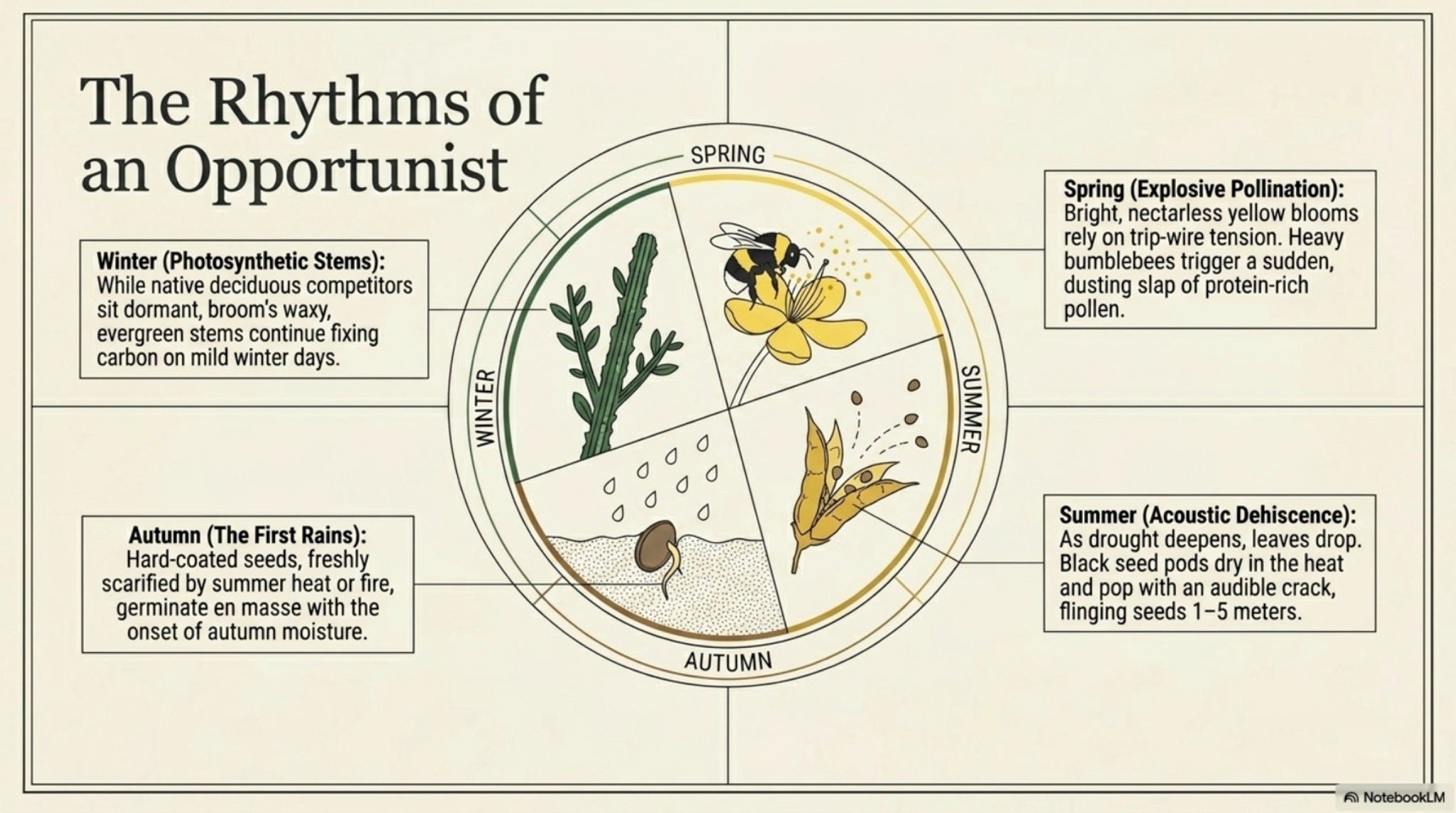
Spring (March–June): Rapid vegetative growth and profuse flowering. Landscape turns bright yellow (visual cue). Bees and other insects visit; pollen dusting mechanism in action (mechanical stimulus, bee visual targeting via flower color). Light sweet scent possible on warm days (olfactory minimal). Leaves present during early spring, aiding photosynthesis in wet season.
Summer (July–August): Plant transitions to seed production. Many leaves shed as drought deepens, stems do photosynthesis. Pods drying and popping (acoustic cue). Seeds scatter and enter soil. Broom stands appear scraggly and grey-green as flowers are gone and foliage sparse, but seed rain is in progress.
Autumn (Sept–Oct): Seeds germinate after first rains (if scarified). Some resprouting or new green growth may appear on older plants with renewed moisture. Otherwise, plants are semi-dormant but with evergreen stems ready for winter sun.
Winter (Nov–Feb): Broom remains in leafless (or minimal leaf) state, but green stems continue photosynthesis on mild days. This winter photosynthesis can be crucial for survival and early spring readiness. If temperatures drop below ~-10°C, twigs may freeze, but plants often recover. Stands of broom can be an odd sight in winter: drab olive-green bushes amid deciduous landscape, quietly gathering sunlight when available.
In terms of sensory ecology with animals, one notable interaction is with pollinators as covered. Another is with herbivores: broom’s bright green shoots might visually attract browsing animals in winter when other forage is scarce, but the taste (due to alkaloids) quickly deters them (as evidenced by rare grazing). So the taste/palatability is a sensory defense – bitter quinolizidine alkaloids make the experience unpleasant or even toxic (Established). A sheep or cow nibbling broom would get a mix of harsh bitterness and slight burning sensation, likely causing it to avoid the plant thereafter (learned aversion). Thus, broom’s chemical profile interacts with the gustatory sense of herbivores to protect the plant.
Finally, consider any magnetic or solar cues: Plants like Scotch broom may time their bud-burst and flowering with photoperiod (day length) – an internal sensing of light cycles. Broom likely senses increasing day length in spring to trigger flowering (Probable). The role of temperature (vernalization requirement or accumulated heat units) also factors in – a run of warm days in April can cause a sudden flush of bloom. Some speculation exists that plants might even sense the Earth’s magnetic field (via cryptochrome pigments) to align certain growth processes (Speculative). There’s no direct evidence for broom, but as cross-disciplinary thought, one could imagine seeds possibly responding to subtle geoelectric signals when cracking in fire (fringe idea).
In summary, Scotch broom’s phenology is tuned to seize the favorable season – grow and reproduce before the drought – and then endure through the unfavorable season via hardy architecture and seed dormancy. Its sensory ecology involves bright visuals for pollinators, a dramatic pollination mechanism, and an auditory seed dispersal quirk, all of which underscore broom’s somewhat flashy personality in the landscape. This plant is in many ways synchronized with the rhythms of disturbance: it flowers in the calm between winter storms and summer fires, and it releases its progeny in the heat that portends potential fire (perhaps ensuring seeds are in place to exploit post-fire conditions). Such timing and sensory strategies have enabled Scotch broom to spread successfully across regions where the climate and disturbance patterns mirror those of its ancestral home.
Ecological Personality Profile
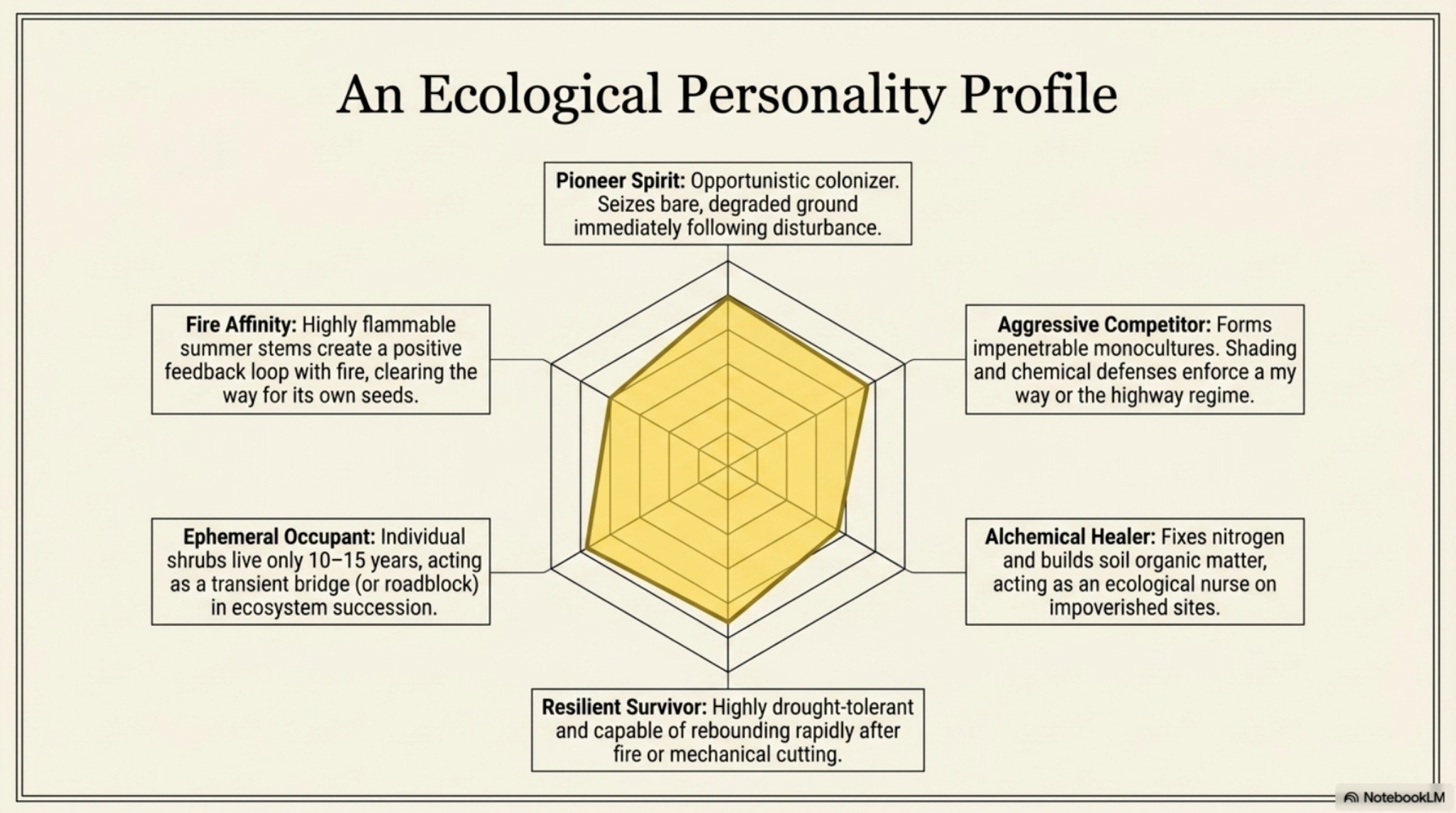
Scotch broom can be characterized as an ecological provocateur and pioneer, with a complex personality that blends healer and aggressor. If we were to paint a portrait of Cytisus scoparius as a being, it might be the “Renegade Alchemist” of the plant world – a scrappy opportunist that appears after disruption, concocts its own fertility, and defiantly holds space until more permanent residents arrive.
Key Personality Traits:
Pioneer Spirit (Opportunistic Colonizer): Scotch broom is among the first to colonize disturbed or degraded ground. It exhibits bold opportunism, germinating en masse on bare soil and growing rapidly to take advantage of full sun (Established). Like many pioneers, it doesn’t wait for invitation – it seizes territory. This trait is akin to an “adrenaline junkie” in human terms, thriving on the energy of disturbance. Ecologically, broom’s pioneer role is somewhat analogous to fireweed or thistle in that it loves freshly opened niches, but broom far outcompetes those due to its woody stature and N-fixing boost.
Aggressive Competitor (Dominance & Monoculture Formation): Once established, broom shows a domineering streak. It forms dense thickets that exclude competitors, through shading and altering soil chemistry. It’s not a cooperative community member; rather, it asserts dominance. This competitive nature is seen in its ability to create near monocultures, essentially pushing a “my way or the highway” regime on the ecosystem. This trait aligns with an “alpha” personality in ecological terms (Established).
Alchemical Healer (Nitrogen Fixer & Soil Builder): Paradoxically, even as broom invades and excludes, it also heals the soil in certain respects. By fixing nitrogen and adding organic matter, broom acts as a fertility builder on impoverished sites. One might call it an “ecological nurse” plant in the sense that it prepares the site for later successional species (though it might not intend to relinquish control easily). In its native habitats, broom’s N-rich leaf fall could help nurture oak seedlings or diverse understory once broom thins out – a beneficial role (Probable). In its invasive range, this alchemy often benefits other invaders more than natives, but the principle remains: broom improves the soil even as it exploits it. This dual nature lends Scotch broom a Janus-faced persona – one face turns toward regeneration, the other toward disruption.
Resilient Survivor (Stress Tolerance & Persistence): Scotch broom demonstrates remarkable resilience to environmental stresses. It tolerates drought, survives moderate frost, and quickly rebounds after cutting or fire (via its seed bank). This hardiness is part of its personality: broom is a tenacious survivor, often described as “difficult to kill.” Individuals might be short-lived, but the population endures like a hidden reserve of resilience (the long-lived seeds). In anthropomorphic terms, broom is stubborn and persistent, weathering hardships and bouncing back (Established). Its root symbioses also buffer it against nutrient stress, adding to its rugged independence.
Ephemeral & Transitional (Short Life, Legacy Effects): Unlike truly climax dominants (e.g. a long-lived oak), broom is ephemeral at a site – a transient occupant of early succession. It is often a bridge between disturbance and more stable vegetation. However, it doesn’t depart without leaving a mark; the soil legacy of high nitrogen, low phosphorus, and reduced mycorrhizal fungi lingers. Thus, broom’s personality includes being a “ghost” that haunts ecosystems long after its physical presence is gone (Probable). It’s a bit of a trickster in that sense: even when it dies off, it influences what comes next.
Fire Affinity (Flammable yet Regenerative): Broom has a somewhat pyrophytic inclination – it contributes to fire fuel and then regenerates strongly post-fire. This can be seen as recklessness or a strategy of creative destruction. It’s as if broom “knows” that burning down the current vegetation will only favor its own offspring waiting in the soil. Ecologically, that’s speculative, but we do observe that broom and related legumes (like gorse, acacia) often tie their life cycle to fire regimes (Plausible). This trait gives broom a wild, untamable aspect, aligning it with elemental forces.
Anti-Herbivore Chemical Arsenal (Defended & Unpalatable): Personality-wise, broom is fortified and unsociable when it comes to herbivores. Its bitter alkaloids are like a “keep out” sign to animals. This can be seen as a protective, perhaps antisocial trait – broom doesn’t form mutualisms with large animals (no rewarding nectar, no edible foliage); instead it relies on small, specific partners (bees, bacteria) and deters others. In a community context, it’s somewhat of a loner or even a toxic friend – engaging beneficial microbes while poisoning would-be browsers.
To draw a cross-family comparison, consider other Fabaceae with strong personalities: Kudzu is the relentless conqueror vine, Black locust the aggressive yet soil-enriching tree, Lupines are gentler pioneers stabilizing alpine meadows, and Clover the cooperative pasture builder. Scotch broom shares black locust’s tendency to dominate and enrich soil, but broom is a shrub with a shorter lifespan and more fire association. It’s less cooperative than clover or lupine (which often integrate into diverse communities). Instead, broom’s closest analogue might be gorse (Ulex europaeus) – another thorny invasive shrub in the pea family that overtakes land, fixes nitrogen, burns readily, and challenges restoration. Gorse, however, has spines and a different growth form, so one might say gorse is the spikier, more armored cousin, whereas broom is smoother but chemically armed.
If the Pacific Northwest ecosystem were viewed as a theater, Scotch broom might play the role of the rebellious youth in an ecological succession play: it rushes onto the stage after a disturbance, full of energy and bravado, elbowing aside the old order. It changes the set (soil conditions), steals the spotlight for an act or two with its flashy yellow costume, and then – as the larger, slower characters (trees) eventually mature – broom exits (or is forced off), leaving behind a changed scene. Critics (ecologists) might label its performance as both creative and destructive. This is why we give it a nuanced personality profile.
In terms of confidence levels for these characterizations: It is established that Scotch broom is a pioneer invader with aggressive competitive ability and nitrogen-fixing habit. It is probable that its presence facilitates some species (weeds) and hinders others (natives) through soil legacy. It is plausible that broom’s role in fire cycles and deeper system feedbacks (like mycorrhizal disruption) significantly shape successional trajectories, though research is ongoing. And it remains speculative to attribute intention or consciousness to its “behavior,” yet using metaphor helps convey the essence of this plant’s ecological role.
Summary: Scotch broom is a short-lived conqueror that arrives in a blaze of glory (golden blooms), radically alters its environment (fixing nitrogen, shading ground), defies enemies (toxins for herbivores, tough seeds for adversity), and then yields – but on its own terms (leaving seeds and changed soil). Its ecological personality is neither purely villain nor hero: it has elements of the restorer (soil improver) and the usurper (habitat transformer). This complexity is why managing Scotch broom invokes both respect for its resilience and concern for its impacts. In the grand web of life, broom teaches lessons about how disturbance can open the door for both creation and chaos – and how some species are equipped to dance in that doorway.
History, Folklore & Cultural Roles
Humans have a long and storied relationship with Scotch broom, one that spans utilitarian uses, cultural symbolism, and recent notoriety as an invasive pest. Here we explore how this plant has been perceived and used across time and cultures, blending scientific history with folklore.
Historical Uses in Europe: In its native range, Cytisus scoparius has been put to use by people for centuries. The very name “broom” comes from its traditional use in broom-making – the twiggy stems (especially when in leaf) were bound together to create effective sweeping brooms for household and farm use. The stiff yet flexible branches made ideal brushes for clearing floors of dirt, and this simple use was so common that the plant itself became synonymous with the tool. Broom was also valued as thatching material for roofs in rural areas; its tangled branches provided a layer to shed water when layered thickly (Probable traditional use). Farmers planted broom along fence rows as well, both to delineate property and because the woody stems could be woven or stacked as an impromptu fence.
Another major role was as fodder: despite its toxicity, small quantities of young broom shoots were sometimes used as emergency or supplementary feed for cattle and goats. In the Scottish Highlands and other parts of Britain, there are accounts of broom being cut and allowed to wilt (to reduce harsh compounds) then given to livestock in winter when other forage was scarce (Speculative based on historical anecdotes). Shepherds apparently noted that sheep nibbling on broom would have to be monitored, since too much could cause problems – yet in controlled doses, it “kept them alive” through lean times. This dual nature as both feed and poison likely made broom a plant treated with caution and respect by herders.
Broom’s medicinal properties were recognized in European herbal medicine. The plant contains pharmacologically active compounds, notably spartein and scoparin, which exert effects on the heart and kidneys. Traditional herbalists used broom blossoms and tops as a diuretic to treat dropsy (edema) and to stimulate urine flow. An old remedy for congestive heart failure (then termed dropsy) involved broom preparations to reduce fluid buildup. Broom was also employed to address arrhythmias and low blood pressure – essentially as a mild cardiac stimulant. In fact, sparteine from broom was isolated and at one time (early 20th century) used in medical practice to regulate heart rhythm and as an oxytocic (to induce uterine contractions in childbirth). However, due to its narrow therapeutic window and the development of safer drugs, sparteine fell out of use (Established historical). The plant’s alkaloids can be quite potent: high doses cause nausea, vomiting, and even dangerous blood pressure changes, so herbal use required expertise. Scotch broom tea was sometimes taken to relieve fluid retention and as a cathartic (laxative) – reflecting its stimulating effect on smooth muscles. There are also records of broom flower tinctures given for “intermittent fevers” and as part of folk cancer remedies (the latter unsubstantiated by modern science). A topical ointment of broom flowers in folk medicine was used to treat gout and rheumatism, applied to swollen joints. The efficacy of such treatments is questionable, but it shows broom’s place in the repertory of village healers.
In Portugal and Spain, where Scotch broom and its relatives grow abundantly, the plant has similar uses. Portuguese folk medicine uses broom (often Cytisus striatus, a close cousin) as an anti-inflammatory – infusions of flowers or young shoots are taken for respiratory issues, skin wounds, and even as a tonic for digestive health. Broom is noted to contain many phenolic compounds (flavonoids) with antioxidant activity, which may underlie some of its healing reputation. Interestingly, broom flowers have also been used as a yellow dye for textiles, similar to the better-known Dyer’s Greenweed (Genista tinctoria). Fabric dyed with broom blossoms yields a bright “buttery” yellow. This practice was common enough that broom earned the moniker “Dyer’s broom” in some locales (though that name more often refers to Genista). The yellow color was likened to gold, perhaps contributing to broom’s symbolic link to the sun and spring.
Folklore & Symbolism: Scotch broom holds a noteworthy place in European folklore, particularly Celtic and English traditions. In the Celtic Ogham tree calendar, broom is associated with the Ogham name “Ngetal”, often interpreted as signifying healing, purification, and new beginnings. A verse from the 14th-century Book of Ballymote calls broom “a physician’s strength” and “robe of physicians,” hinting at its connection to healing arts. Broom’s bright golden blooms arriving around the festival of Beltane (May 1st) made it a symbol of spring’s renewal and the sun’s power. One folklore motif has the hero Balor disguised as broom in an old Irish poem, representing a solar deity vanquishing winter’s darkness. Because broom blooms at the time livestock were traditionally let out to summer pastures, it also became a sign of the agricultural calendar – when broom is in flower, it’s time for certain chores and rituals (Probable cultural observation).
The act of sweeping with a broom naturally led to symbolic interpretations. A broom (the tool) was used in ceremonies to “sweep out the old” and welcome fresh energy. Consequently, the plant broom is linked to purification rites. Folklore from the British Isles holds that hanging a sprig of broom over a doorway wards off evil spirits and bad luck (Probable traditional belief). In some regions, people would throw broom twigs into the air to invoke winds or change the weather – a practice perhaps born from its association with wind-swept heaths and the fact that dried broom catching fire could produce sudden gusts. Broom was also sometimes carried or worn by brides in certain old European weddings as a token of plenty and new beginnings (Speculative, sources hint at broom or gorse in bridal garlands for fertility). However, contradictory superstition in England warned against bringing broom indoors when in bloom; a rhyme went “If you sweep the house with broom in May, You’ll sweep the head of the house away,” linking it to ill omen (likely due to its disruptive, witch-associated reputation).
The connection to witchcraft and witches’ brooms is worth noting. Historically, actual brooms used by alleged witches in Europe were often made of birch twigs for the brush, with broom plant or sometimes hazel handles. Yet the term “besom” often referred to a broom-made broom. Witches in lore were said to use broomsticks not only for flight but to sweep their ritual spaces clean of negative influences. Broom as a plant thus carried an aura of magic and otherworldliness. One folk belief suggests broom could protect against witchcraft – for example, planting broom around the house would keep witches away (because as the myth goes, witches would be compelled to count the leaves or flowers on each broom plant, thus distracted until sunrise) (Folkloric, speculative). Another says that burning broom exorcises poltergeists or mischievous spirits from a dwelling (Speculative). These beliefs highlight broom’s dual image: it was a tool for cleansing and also associated with witches’ lore.
Perhaps the most illustrious legacy of broom in European culture is its link to royalty and heraldry. The Plantagenet dynasty of England (12th–15th centuries) derived its name from planta genista, Latin for the broom plant. Legend has it that Geoffrey of Anjou (father of King Henry II) wore a sprig of broom in his cap as a badge of humility and adopted it as his emblem. This badge was passed to the Plantagenet kings, and the golden broom flower became a royal symbol of sorts – a curious elevation for a common shrub. Additionally, the “broomscod” (broom seed pod) was the personal emblem of Charles VI of France in the 14th century, showing up in art and costume. It’s speculated that broom’s abundant seed and hardy nature symbolized fertility and resilience to these nobles (Probable symbolic interpretation). Thus, an unassuming wild plant found its way into the annals of European heraldry and even into the moniker of one of history’s most famous royal houses.
Introduction to North America & Cultural Perception: Scotch broom was introduced to North America, as noted, in the 19th century. For early settlers in the Pacific Northwest, broom was initially an attractive exotic – it reminded some of the gorse and broom of home (Scotland, England) and was used to beautify homesteads and roads. Captain Grant’s infamous planting in Sooke (Vancouver Island) in the 1850s was likely admired for a time as the shrubs flourished with minimal care. Gold rush settlers in California also planted broom and gorse for ornament and hedge. However, by the early to mid-20th century, the tone shifted as broom spread uncontrolled. It began to be viewed as a noxious weed and a menace to farming and forestry. Local anecdotes from the mid-1900s describe farmers lamenting how broom “took the pasture,” and foresters battling thickets in cutblocks.
In recent decades, broom has even entered popular culture and art as a symbol of invasive species. In British Columbia, community “Broom Bashes” (volunteer removal events) have become common, and the plant is often used in educational outreach about invasive ecology. There’s a certain irony in how a plant that symbolized spring and healing in one context is now emblematic of ecosystem disruption in another. Yet, there is also a movement among some herbalists and foragers to “find value in invasives.” For instance, some Pacific Northwest herbalists cautiously use Scotch broom tincture for similar cardiac indications as in Old World herbalism (with full awareness of its toxicity – very much not a DIY remedy!). Natural dyers in North America have rediscovered broom for making yellow dyes from the flowers, turning a weed into an artistic resource. Environmental artists have even used cut broom stems in sculptures and community projects to illustrate the story of human-mediated plant migrations (Probable).
From a Traditional Ecological Knowledge (TEK) perspective, Native American peoples in the PNW did not historically use Scotch broom, as it wasn’t present before European contact. However, some nations today actively manage broom as part of habitat restoration. For example, the removal of broom is crucial in restoring Garry oak ecosystems – an endeavor led in part by Indigenous and community groups to bring back native prairie vegetation. In this sense, broom has influenced modern TEK or “Neo-TEK,” where contemporary Indigenous land stewards incorporate knowledge of invasive species management into their practice to heal the land (Probable, as documented in restoration case studies). While broom itself has no known Indigenous cultural significance (being foreign to the land pre-contact), it has become a catalyst for discussions about reciprocity and responsibility – understanding that what one generation introduced, current generations must manage, often guided by both science and traditional values of caring for the ecosystem.
Mythopoetic Perspective: Mythically, one could align Scotch broom with the element of fire (for its bright color and combustibility) and the qualities of transformation and boundary-breaking. It’s a plant of liminal spaces – roadsides, clearings, edges – which in folklore are often magical or troublesome zones. Some modern nature writers have mused that broom, with its golden glare, is like “the mischievous fairy of the forest margins,” appearing when order (forest) is disturbed, and only bowing out when order (forest) returns, but not without leaving a gold coin (fertile soil) behind as a parting gift (Mythopoetic, speculative).
Confidence wrap-up: Historically documented uses (brooms, thatch, medicine) are established or well-recorded. Folklore associations (purification, witchcraft, Plantagenet badge) are probable, supported by literature and ethnography. Some symbolic interpretations and mythic attributions are more speculative, serving to enrich our understanding of broom’s presence in cultural narratives rather than scientific fact.
In conclusion, Scotch broom’s journey from Old World tradition to New World invader is a fascinating study in how human values assigned to a plant can flip over time. Once a sign of home (hearth brooms, springtime blossom, heraldic pride), it is now often a sign of ecological carelessness (a reminder of unchecked introductions). Yet, broom still offers gifts: lessons in resilience, raw material for dyes or bioenergy, and an opportunity for communities to come together (in pulling it out!). Perhaps, in a full-circle way, we are rediscovering a balanced relationship with Scotch broom – neither demonizing it nor romanticizing it, but acknowledging its living plant wisdom: it is a vigorous pioneer that can teach us about healing damaged land if we listen, and a cautionary tale about unintended consequences if we ignore it. By bridging scientific understanding with cultural memory, we can better appreciate this plant’s role on our planet – as both a giver and a taker, a weed and a teacher.
Sources Cited:
Shaben & Myers (2010) – Plant Ecology, on broom’s soil and diversity effects.
Slesak et al. (2016, 2022) – Plant and Soil; Oecologia, on soil changes and recovery after broom removal.
MSU Extension (2021) – Scotch Broom Biology & Management, identification, life cycle, impacts.
WA Noxious Weed Board – Fact Sheet on Scotch Broom.
Caramelo et al. (2022) – Processes, review of Cytisus spp. uses and chemistry.
– Cytisus scoparius (accessed 2025), background on distribution, phytochemicals, historical notes.
Folklore sources – WalkwithTrees (2019) on Celtic broom lore; The Goddess Tree (n.d.) on broom magic.
Coastal Invasive Species Committee – regional history note (Captain Grant intro).
Various research on pollination and mycorrhiza (Parker 1997; Grove et al. 2017) summarized in text.
TRADITIONAL ECOLOGICAL KNOWLEDGE (TEK) & REGIONAL STEWARDSHIP
TEK & Regional Stewardship
Orientation & Limits
TEK scope:
Scotch broom is Old World native (Europe/North Africa) and a post-contact invasive in the Pacific Northwest. That means:There is no pre-contact Indigenous TEK about Scotch broom in the PNW (Established).
Modern Indigenous and local stewardship knowledge focuses on removing broom to restore culturally important ecosystems (e.g., Garry oak–camas prairies).
Ethical boundary:
Some detailed teachings about fire, camas, and oak meadows are held by Coast Salish and other Nations and are not mine to retell without permission. I’ll stay with public, documented material and mark places where deeper teachings likely exist but require direct relationship.
West Mediterranean & European Peasant TEK
Scotch broom and its close cousins (Cytisus multiflorus, C. striatus) sit right at the intersection of folk agronomy and household craft in Iberia, France, and the British Isles.
Soil & pasture TEK (Portugal & Spain)
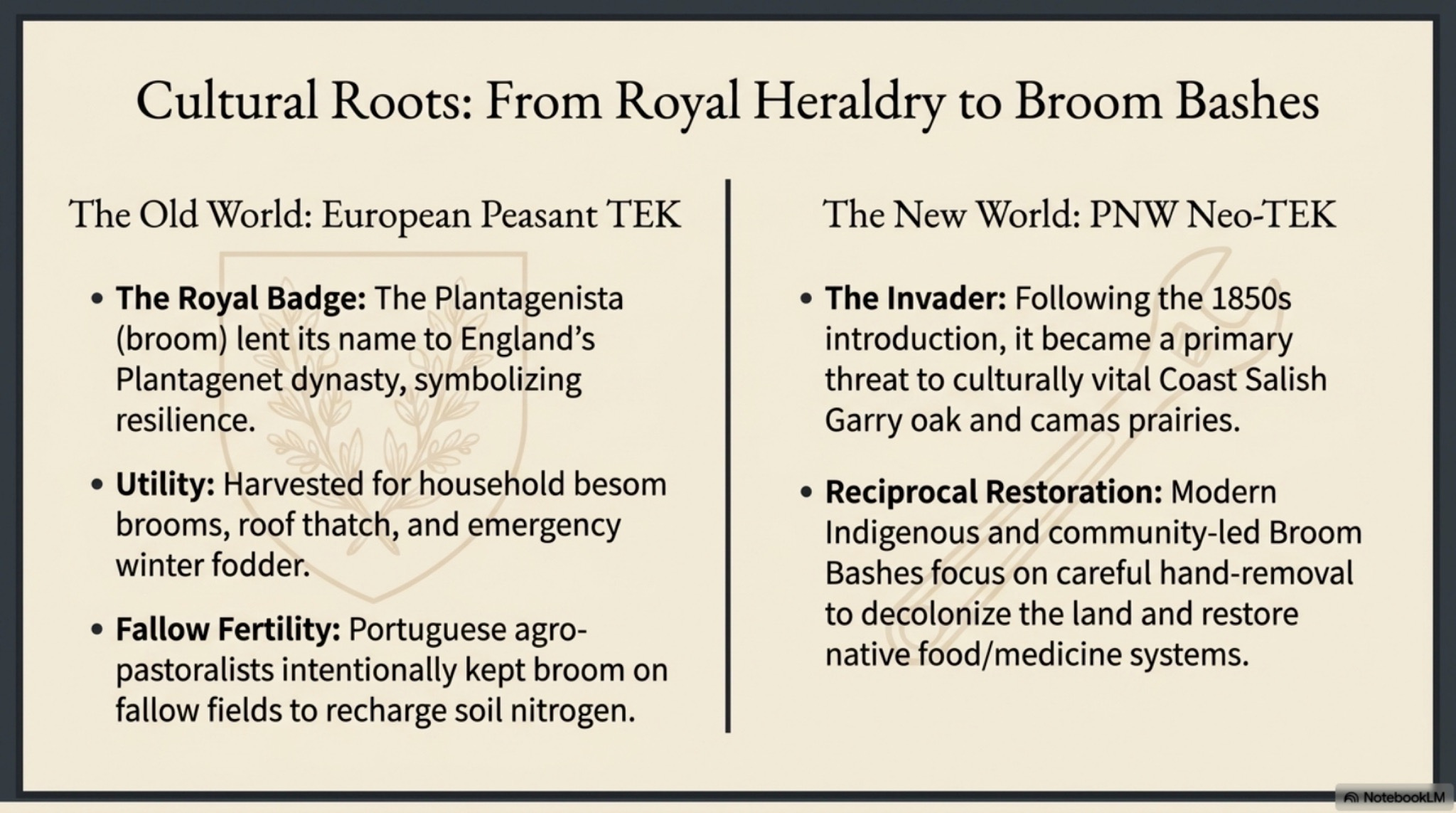
Traditional agro-pastoral systems in Portugal used Cytisus-dominated shrublands (“giestais”) as living fertility banks.
Farmers intentionally kept broom stands on poor, acidic soils and fallows to enrich them with nitrogen, then grazed or cropped nearby fields afterward.
Cited modern review: Cytisus shrubs can significantly support nitrogen sustainability of agricultural practices, especially by raising pasture quality when broom is kept near grazing lands (Established).
This is classic TEK pattern: tolerate a “brush” phase to recharge soil, then cycle back into grazing/cropping.
Structural & craft TEK (Britain & Europe)
Brooms, thatch, palisades:
Bundles of broom stems were standard for floor brooms, thatch layers, and fence/palisade material in rural Europe (Established).
Charcoal & kiln TEK (Italy):
Italian charcoal burners used broom branches on top of wood piles for slow, controlled burn in charcoal clamps and as hut roofing in seasonal forest camps (Probable; documented for C. scoparius in central Italy).
Fertility marker:
In several regions broom flowering was read as a calendar cue for certain agricultural actions (moving livestock, sowing specific crops). Direct scientific documentation is sparse but consistent across folklore sources (Plausible).
Folk medicine & household TEK (pan-European)
Flowers and green tops were used as:
Diuretic teas for dropsy (edema) and kidney issues.
A cardiac stimulant (via sparteine-containing preparations) for heart failure and arrhythmias.
This TEK has partly converged with pharmacology (sparteine indeed affects cardiac conduction and uterine muscle) but is now largely abandoned due to toxicity and safer drugs (Established).
TEK pattern (Europe):
Treat broom as:
A pioneer soil-builder on harsh sites.
A multi-use woody fiber (brooms, thatch, baskets, small tools).
A dangerous but powerful medicine requiring strict expertise and low doses.
Himalayan / Folk Ayurveda Context
Scotch broom is not a classical Ayurvedic plant, but folk Ayurveda in Himalayan regions has adopted it:
In Himachal Pradesh/Uttarakhand, C. scoparius is used in local village-level practice for:
Pitta-pacifying formulations, mild circulatory support, and diuretic effects.
Decoctions of dried stems with ginger and black pepper for mood and seasonal allergies (reported in 20th-century folk records; Probable).
Modern reviews note sedative, hypotensive, anti-diabetic, hepatoprotective actions in experimental models, aligning partially with folk uses (Probable).
Boundary note: these uses are not mainstream classical Ayurveda and are considered adjunct/experimental even in India (Probable).
Island & Coastal TEK / Neo‑TEK (PNW & Salish Sea)
Here’s where Scotch broom intersects with contemporary Indigenous-led restoration and local stewardship.
Garry oak–camas ecosystems around the Salish Sea (Vancouver Island, Gulf Islands, Puget Sound) are:
Culturally central for Coast Salish and related peoples (food, medicine, ceremony).
Historically maintained by frequent low-intensity cultural burning, which suppressed shrubs and conifers and favored camas and forbs.
Scotch broom is now recognized as a major threat to these meadows:
Chokes oak openings, crowds camas and other bulbs, and alters soil chemistry toward high N, lower P.
Contemporary, TEK-informed practices (publicly documented):
Annual broom pulls in Garry oak parks and sacred sites (e.g., Mount Sutil, Cowichan Garry Oak Preserve, Uplands Park) with:
Focus on hand removal and careful cutting rather than aggressive soil disturbance, to protect native seedbanks and minimize seed germination.
Long-term, patient engagement (decades) recognizing the seedbank time depth and the need for cultural as well as ecological restoration.
Indigenous and non-Indigenous partners explicitly frame broom removal as:
Part of “decolonizing the land” and restoring Indigenous food/medicine systems (e.g., camas).
Important placeholder:
Deeper teachings about how specific Nations relate to broom-invaded prairies, how camas/spring burns are conducted, and how cultural protocols shape restoration are held within those communities. Those stories belong in direct Nation-to-Nation or community collaborations, not in a generic written profile.
Desert, Tropical & Other Biomes
Scotch broom is not a major TEK species in desert or tropical Indigenous systems; it doesn’t like extreme aridity or true tropics (it prefers temperate, Mediterranean climates) (Established).
Where present in upland Mediterranean-type shrublands (e.g., North Africa), it appears in grazing and fire management systems, but accessible TEK documentation is sparse (Unknown/under-documented).
Regional Stewardship Protocols (PNW‑Specific, TEK‑Aligned)
From PNW stewardship guides (King County, , BC Garry Oak groups, WA Noxious Weed Board), a convergent wisdom emerges:
Prioritize uninvaded or lightly invaded areas first
Keep clean sites clean; then work inward from edges of heavy infestations (Established).
Timing:
Remove broom when soils are moist (fall–winter) to reduce disturbance and ease cutting/pulling.
Avoid heavy soil disturbance when seeds are ripe (late spring–summer) to prevent seed spread and germination (Established).
Technique:
For larger shrubs, cut below ground line (e.g., with a weed wrench or mattock) rather than pulling big plants, to avoid exposing buried seeds (Established).
Pull first-year seedlings only where disturbance can be tamped back down afterward.
Always re‑green the space intentionally:
Follow broom removal with native or non-invasive cover (e.g., native grasses, Oregon grape, red-flowering currant, Douglas-fir in the right context) to shade out new broom seedlings (Established).
Expect a long relationship:
Because of the long-lived seed bank (5–30+ years), plan for repeat visits and periodic sweeps for new seedlings (Established).
TEK–science synthesis:
Indigenous fire TEK (frequent, low-intensity burning of prairies) historically prevented shrubs like broom from establishing at all.
Today’s broom stewardship mimics that pattern with regular human disturbance (cutting, hand work, sometimes prescribed fire) plus reintroduction of traditional foods/forbs.
The deeper teaching: broom isn’t just a weed; it’s a signal that disturbance regimes and relationships have shifted.
MEDICAL & BIOCHEMICAL INTELLIGENCE
Biochemistry & “Nutrition” (Evidence‑Mapped)
Note: Scotch broom is toxic and not a food plant in any normal sense. “Nutrition” here is focused on phytochemistry, pharmacology, and soil nutrient dynamics, not dietary recommendation.
Major Chemical Classes (High-Level)
Primary metabolism (for growth & soil cycling)
Carbohydrates: structural polysaccharides (cellulose, hemicellulose), soluble sugars.
Proteins: high N content in leaves (~3.9% N) and green stems (~2% N), roughly double many non-legume shrubs (Established).
Lipids: typical membrane lipids; minor in biomass compared to fiber.
For soil: Broom can fix up to 111 kg N/ha/yr into above-ground biomass and return ~17 kg N/ha/yr via litter (Established).
Secondary metabolism (bioactive compounds)
Quinolizidine alkaloids (QAs):
Sparteine, isosparteine, lupanine, sarothamnine, 17‑oxo-sparteine, and cytisine (and related derivatives).
Phenolic/flavonoid compounds:
Flavone & flavonol glycosides: scoparin/scoparoside, rutin, quercetin, quercitrin, isorhamnetin, kaempferol; plus isoflavones like genistein and sarothamnoside.
Biogenic amines:
Tyramine, hydroxytyramine, dopamine-like compounds (esp. in young shoots and flowers).
Other groups:
Carotenoids (xanthophylls like chrysanthemaxanthin), various phenolic acids (gallic, protocatechuic, caffeic, chlorogenic), and volatile aromatics (cresols, phenylethanol).
Primary Metabolites & Soil/Nutrient Dynamics
High nitrogen density:
Leaves: ~3.9% N; stems: ~2% N (Established).
This makes broom biomass a N-rich input when decomposed or chipped, but with the caveat of alkaloids.
C:N and decomposition:
Broom litter has sufficient N that co-occurring species’ litter C:N often drops as broom density increases, but decomposition rates are more controlled by broom-induced soil changes (N availability, P depletion) than by litter quality itself (Established).
Physiology:
Under irrigation and P fertilization, broom can accumulate 7–23 g N per plant, scaling to ~12–65 kg N/ha in infested PNW sites, depending on density (Established).
Implication: as a biomass resource, broom is protein‑rich, N‑dense, woody material with modest soluble sugar content and a moderate C:N suitable for composting if alkaloid issues are accounted for (Probable).
Secondary Metabolites & Pharmacology
A. Quinolizidine Alkaloids (QAs) – core “teeth” of the plant
Main QAs in C. scoparius:
Sparteine / isosparteine – principal alkaloids in stems and tops.
Lupanine & hydroxy-lupanines – especially in seeds.
Cytisine – potent nicotinic receptor agonist; present in broom along with other Cytisus spp.
Pharmacological actions (mostly Established, but clinical value is now limited):
Cardiac conduction & rhythm:
Sparteine acts on cardiac muscle and electrical conduction; historically used as an antiarrhythmic / cardiotonic and diuretic, but with unpredictable and potentially dangerous effects ( Established for pharmacology; clinical use abandoned).
Uterine stimulation:
Sparteine and oxysparteine have oxytocic effects, increasing uterine contractions; used historically in obstetrics.
Neuropharmacology:
Lupanine and 17‑oxo-sparteine can activate nicotinic acetylcholine receptors and show neuroprotective activity against amyloid‑β toxicity in cell/animal models (Probable; early-stage).
Toxicity mechanism:
QAs depress the heart and nervous system; symptoms include nausea, vomiting, arrhythmias, weakness, convulsions, coma (Established).
B. Phenolics & Flavonoids – “antioxidant shield”
Extracts of aerial parts show strong in vitro antioxidant activity across multiple assays (DPPH, superoxide, hydroxyl radicals, lipid peroxidation), often comparable to classic antioxidants at similar doses (Established in vitro).
Total phenolic content is high (e.g., ~427 mg gallic acid equivalents/g extract in some assays).
Flavonoid profile: rutin, quercetin, kaempferol, isorhamnetin, scoparin, isoflavones (genistein, sarothamnoside).
In rats, hydroalcoholic extracts reduced oxidative stress markers and modestly improved behavioral stress parameters (anti-stress/anxiolytic effects; Probable but not clinically established).
C. Biogenic Amines & Other Compounds
Tyramine & hydroxytyramine – vasoactive amines; can influence blood pressure, interact with MAO inhibitors (Established).
Phenolic acids & volatiles – may contribute to antimicrobial, antioxidant, or allelopathic effects (Probable).
D. Antimicrobial & allelopathic activity
Rich polyphenolic extracts from broom show in vitro antimicrobial activity against foodborne pathogens (Listeria, Staph, Pseudomonas) and can disrupt biofilms (Probable for practical use; applications still experimental).
Aqueous/phenolic extracts also show phytotoxic effects on other plants, with complex interactions between polyphenols and other constituents driving allelopathy (Probable).
Edibility & Nutritional Value
Flowers & buds:
Some European foragers and agroforestry sources mention using flower buds as caper-like pickles and flowers sparingly as garnish.
However, because the plant is alkaloid-rich, safety margins are narrow, and even flowers contain QAs and biogenic amines (Probable).
Seeds & pods:
Seeds are definitely toxic (higher QA content) and not considered food (Established).
Nutritional composition for humans:
Robust nutrient tables (vitamins, minerals) for broom as food are essentially lacking (Unknown).
Given toxicity, there is no justification to treat broom as a staple or regular wild food.
Bottom line:
For humans, broom is medicinal/poisonous, not nutritional. Any “edible” uses (flowers, buds) should be considered high risk and are generally not recommended.
Livestock & Wildlife Nutrition / Toxicity
Broom is of little forage value.
Leaves, twigs, seeds all contain QAs; animals avoid it unless hungry. Livestock toxicity (Established):
Cattle & horses are most susceptible; large amounts (tens of pounds fresh) required to cause fatal poisoning, but sublethal doses can cause: vomiting, excitation, weakness, digestive issues, convulsions, coma.Wildlife:
Herbivores (deer, elk) generally avoid broom, giving it a competitive advantage over palatable native shrubs (Established).
Seasonal & Diurnal Trends (Hypothesized)
Direct data on intra-seasonal chemistry is limited, but extrapolating from legume and QA literature:
QAs often peak in young leaves and shoots and in reproductive organs (seeds) (Plausible).
Phenolic/flavonoid content often increases under stress (drought, UV, herbivory) and may be highest in sun-exposed tissues during flowering (Plausible; supported by antioxidant studies sampling aerial parts at flowering).
Diurnal rhythms in phenolic metabolism and ROS scavenging are known in other species; likely present in broom but unstudied (Speculative).
Soil N and P dynamics under broom show multi-year trends rather than daily cycles: N accumulation and P depletion over decades (Established).
So, broom’s “chemical weather” probably peaks in defense and antioxidant compounds in spring/early summer during active growth and flowering, and partially rebalances as tissues lignify and senesce.
Biofield–Microbiome Correlations (New, Mostly Hypothesis Space)
Scientific translation: How broom’s chemistry interfaces with microbial communities and subtle energy processes.
Rhizosphere exudates & microbial signaling
Root exudation of flavonoids (to attract Rhizobium), phenolics, and QAs shapes the community composition of bacteria and fungi around broom roots (Established for legumes in general; broom-specific data limited but consistent).
These exudates modulate electrical potentials and ion flows in microbial biofilms and mycorrhizal networks (Plausible, extrapolated from broader rhizosphere electrophysiology research).
Broom’s strong allelopathic profile suggests its rhizosphere “field” skews toward a defensive, exclusionary microbial consortium – AMF-biased, EMF-suppressed, bacteria/actinomycetes adapted to alkaloids (Plausible).
Polyphenols as “buffers” in soil–water interface
High polyphenol levels mean broom litter and root exudates can chelate metals, modulate redox potential, and influence the structure of soil water (Plausible).
This may create microzones of altered pH and redox that favor certain N-cycling microbes (e.g., suppressing nitrite oxidizers, enhancing ammonium retention) (Speculative but consistent with N legacy patterns).
Biofield / subtle energy framing
Some emerging work in plant electrophysiology and biophotons suggests plants emit low-level electromagnetic and light signals correlated with stress, growth, and communication (Speculative for broom specifically).
Given broom’s dense green stem network and year‑round photosynthetic surfaces, its “electrical presence”in a site may be unusually continuous compared with deciduous neighbors. One could say the plant maintains a persistent signaling grid even when leafless (Speculative).
Confidence summary for this subsection:
Microbiome shaping via exudates: Probable / Established (by analogy).
Specific EM / “biofield” aspects: Speculative – interesting to contemplate, not decision-grade.
Safety & Contraindications
Let’s be blunt: this plant is pharmacologically powerful and genuinely toxic. Self‑medicating with Scotch broom is not safe.
Humans
Do not use internally without qualified clinical supervision. Reasons:
QAs (sparteine, cytisine, lupanine, etc.) can cause serious cardiac arrhythmias, hypotension or hypertension swings, respiratory compromise, and CNS signs.
Biogenic amines (tyramine, etc.) can interact with MAO inhibitors and other meds, potentially causing hypertensive crises (Probable).
Absolute contraindications (Established/Probable):
Pregnancy & breastfeeding: oxytocic and potentially abortifacient; sparteine historically used to induce labor.
Cardiovascular disease: arrhythmias, heart failure, conduction disorders, uncontrolled hypertension or hypotension.
Renal impairment: broom is diuretic; fluid/electrolyte shifts plus alkaloid load are risky.
Liver disease: metabolism of alkaloids may be impaired (Plausible).
Use of cardiac medications or antiarrhythmics, or MAOIs/psychiatric meds (interaction risk with QAs and biogenic amines).
Topical use:
Antioxidant and anti-inflammatory effects of extracts on skin models are promising but still exploratory (e.g., Episkin tests show low irritation) (Probable).
Even topically, sensitization or systemic absorption is possible; avoid open wounds, pregnancy, infants.
Livestock / Pets
Avoid allowing horses, cattle, goats, dogs, cats, or other animals to browse broom or hay contaminated with broom:
Large intakes can cause vomiting, weakness, incoordination, convulsions, coma, and rarely death(Established).
Horses are particularly sensitive.
Environmental / regenerative context:
Using broom biomass in compost, mulches, or biochar is generally safer than medicinal use, but:
Compost fully before use on vegetables or fodder fields to allow microbial breakdown of alkaloids (Plausible; no direct data but standard for toxic plant composting).
Avoid using fresh broom extracts (FPJ/FPE) on edible parts close to harvest to minimize residue risk (Prudent, Speculative).
Pattern Summary (5 Sentences)
Scotch broom is chemically “loud”: it concentrates nitrogen, powerful alkaloids, and strong phenolic antioxidants, making it both a soil builder and a biological disruptor.
Its quinolizidine alkaloids (sparteine, lupanine, cytisine) strongly affect the heart, nervous system, and uterus, aligning with traditional cardiac/diuretic uses but imposing real toxicity risks even at moderate doses.
Its polyphenolic profile underpins robust antioxidant and antimicrobial activity in vitro, offering potential for topical and agricultural applications but still awaiting careful translational research.
Nutritionally, broom is valuable mainly as a nitrogen-rich biomass source for soil, not as human or animal food, due to its alkaloid and amine content.
The core pattern: Scotch broom’s medicine is too sharp for casual use but rich enough to inspire targeted, carefully controlled applications in pharmacology and regenerative systems, provided toxicity is respected and context‑specific risk is evaluated.
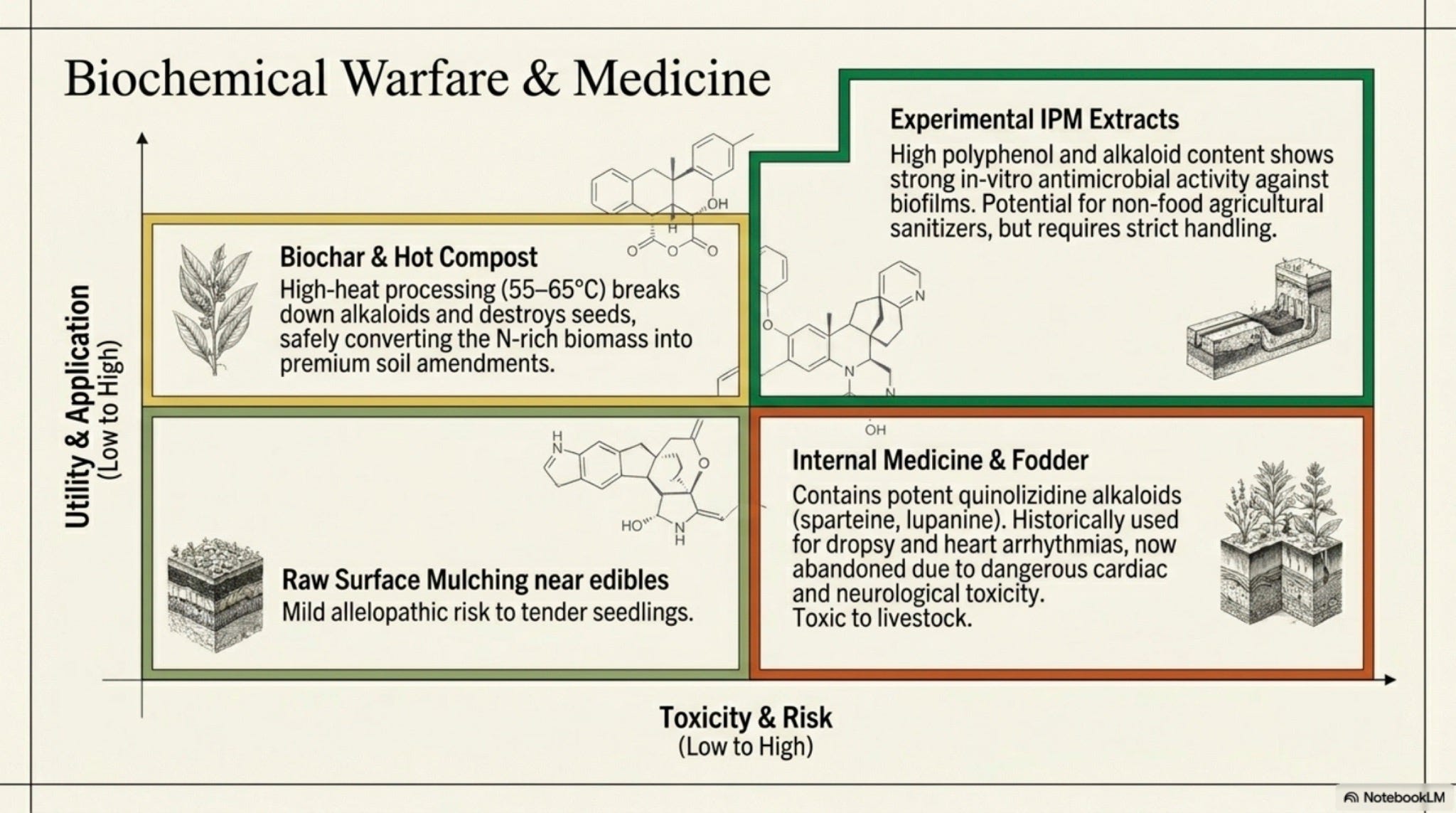
REGENERATIVE AGRICULTURE APPLICATIONS
(Important context for the PNW: in your bioregion, Scotch broom is a regulated invasive. Anything here about “use” should be read as how to harvest and repurpose existing invasions, not a recommendation to plant or spread it.)
KNF, BD & JADAM Integration
FPJ/FPE Guidance (Korean Natural Farming & JADAM‑type extracts)
Key idea: Scotch broom is best treated as a niche, cautious ingredient in plant-based ferments, mainly for IPM and soil biology experiments, not for broad-spectrum “tonic” FPJs.
Why caution?
Strong QAs + biogenic amines = potential phytotoxicity to sensitive crops and toxicity to humans/animals via residues or mishandling (Probable).
Relatively safer biomass choices:
If experimenting at all:
Favor older, mostly lignified green stems (post-flowering) over flowers/seeds to reduce QA load (Plausible). QAs often concentrate more in young tissues/seed.
Avoid using seeds, pods, or large quantities of flowers in ferments.
Possible roles:
Low-dose JADAM-style FPE for IPM
Concept: use broom’s antimicrobial/allelopathic phenolics + alkaloids in a dilute spray targeting fungal or bacterial pathogens (e.g., blending with other aromatic plants).
Evidence: in vitro, broom polyphenolic extracts inhibit multiple pathogens and biofilms; in soils, broom exudates and litter suppress some plants/microbes (Probable).
Practical rule-of-thumb:
Treat broom FPE as experimental; start at very low dilution on non-food crops (e.g., ornamentals, cover crops), observe 1–2 weeks, and only then consider broader application. (Prudent, Speculative).
FPJ analog for stressed soils, not for foliar feeding
Due to N content, broom could in theory contribute to microbial stimulation in soil-only applications. But its QAs may slow some beneficial fungi. (Plausible; unclear net effect).
Given the toxicity and invasive status, many practitioners simply skip broom and use safer, abundant plants (nettle, comfrey, grass tops) for FPJ/FPE. That’s a very reasonable choice.
Biodynamic Use & Planetary Associations (BD)
There’s no classical Steiner‑era BD lore on Scotch broom specifically, but we can infer:
Broom as a “fire–air” shrub:
Bright solar-yellow flowers at Beltane timing, extreme flammability, and seed-popping in hot sun suggest a strong Sun/Mars signature in old European astrological herb language (Speculative).
BD lens:
As a pioneer nitrogen fixer on poor slopes, broom resonates with BD “silica and Mars” forces: structuring, hardiness, and rapid colonization of bare sites (Speculative).
If used at all, broom could be thought of as a “disturbance imprint” plant: its ashes or highly diluted preparations might be experimented with in BD-style trials on degraded or post-fire sites, but this is uncharted territory.
Given its invasive character, most biodynamic practitioners in the PNW will treat Scotch broom as fuel for BD compost or ash preparations, not as a crop species.
Soil, Compost & Mulch Roles
Here’s where broom is genuinely useful once you’ve cut it.
A. Biomass and nitrogen
Above-ground broom biomass can contain 12–65 kg N/ha depending on density and site conditions (Established).
Litterfall returns around 17 kg N/ha/yr in some systems.
B. Composting guidelines
Shred/chip woody broom to speed decomposition and dilute alkaloids.
Mix broom biomass with high-carbon materials (straw, woody chips) and diverse greens to:
Moderate N release.
Encourage microbial communities that can degrade QAs and phenolics (Probable; many soil microbes can metabolize alkaloids).
Allow full hot composting (55–65°C) cycles if possible:
High temperatures + time will greatly reduce both seed viability and alkaloid content (Probable).
If seeds may be present, use windrow cores for hottest zones, or prioritize broom from pre-seed cuts.
C. Mulch
Use only dead, seed-free broom as surface mulch; ideal on paths, under hedges, or on invasive patches you’re trying to smother (Probable).
Avoid thick fresh mulch directly on tender vegetable seedlings to reduce allelopathic risk (Plausible).
Livestock Integration
Short version: you don’t integrate broom as feed; you integrate it as a structural and shelter element, or you keep it away.
Potential roles:
Living windbreak / shelter on European-type farms where broom is native and not invasive:
Acts as wind-hardy hedge, N-fixer, insect habitat; animals graze around it (not on it).
Exclusion fencing:
Dense broom thickets (or stacked cut broom) can function as barrier strips to keep animals out of regenerating areas (Plausible, widely practiced informally).
NOT a fodder shrub:
Given livestock toxicity and low palatability, broom is not suited as intentional forage (Established).
In the PNW, best practice is to remove broom from pastures and compost or burn it safely, then replace with non-toxic fodder shrubs/trees and grasses.
IPM Applications
This is one of the more intriguing regenerative uses, but still very experimental.
Mechanisms to leverage:
Antimicrobial polyphenols:
Broom extracts demonstrate in vitro activity against several Gram+ and Gram− pathogens and can disrupt biofilms (e.g., Listeria, Staph, Pseudomonas).
Alkaloid deterrence:
QAs deter herbivores and some insects; some specialist insects adapt, but generalists are discouraged (Established).
Potential IPM uses (Probable/Plausible, NOT yet standard practice):
Botanical bactericide / sanitizer for tools or greenhouse benches
Ethanol or vinegar-based broom extracts (from stems/leaves) could, in theory, be used as surface sanitizersfor non-food-contact equipment, leveraging antimicrobial polyphenols (Plausible).
Soil drench in non-food systems
Highly diluted extracts might suppress certain soilborne pathogens in ornamentals or fiber crops (Speculative – needs research).
Repellent strips
Piles or hedges of broom may act as “donor” plants for bio-control insects or as physical/chemical deterrents for some grazing pests (Plausible).
Given the toxicity and limited empirical field tests, broom-based IPM is best approached as research, not routine practice.
Synergies & Antagonisms
Synergies
With deep-rooted trees (in non-invasive native range):
As a temporary N-fixing nurse shrub, broom may help early growth of pines or oaks in very poor soils, especially in Mediterranean Europe (Probable, with some evidence of N transfer in pine plantations).
With pollinator-support plantings:
Broom can provide early-season pollen for bees when few other resources are available (Established).
Antagonisms
With native forbs/grassland communities in PNW:
Strongly antagonistic: broom reduces richness, shifts soil nutrients, and favors other invasives (Established).
With EMF-dependent trees during regeneration:
Broom suppresses EM-fungal dominated communities and competes strongly for water, reducing tree seedling survival (Established).
With fodder systems:
Toxicity and low palatability make broom an antagonist to pasture health and safe grazing (Established).
Meta-pattern:
Scotch broom synergizes with disturbance, bare mineral soil, and low-N systems, and antagonizes late-successional, EM-dominant, or high-biodiversity grassland systems.
Top 10 Most Valuable Regenerative Uses of Scotch Broom (under strict containment)
Again: in the PNW this means “what can we do with broom we are already removing,” not “let’s plant more.”
Nitrogen‑rich woody biomass for compost
Shredded broom (seed-free) contributes significant N and structure to compost, reducing reliance on imported N sources (Established for N content; composting behavior Probable).
Path and weed-smother mulches
Dead broom piled thickly over invasive vines or grasses can smother them while slowly releasing N (Probable; widely used in community broom bashes).
Slope stabilization & erosion control (existing stands only)
On actively eroding slopes already colonized by broom, staged removal plus replanting can harness its root-stabilizing function while transitioning to natives (Probable).
Biochar feedstock
Broom’s twiggy branches make excellent small-diameter feedstock for biochar, capturing carbon and locking up some alkaloids in a stable matrix (Plausible; biomass quality for energy well documented).
Pollinator buffer (temporary, where not invasive)
In its native range or highly controlled plantings, broom can serve as part of a pollinator corridor, providing spring pollen in hedgerows (Probable).
Teaching tool for invasion ecology & restoration
Broom is an ideal “classroom plant”: easy to identify, dramatic in impact, and rich in lessons on succession, soil legacies, and human introduction—great for farmer training and youth education (Established via countless restoration programs).
Experimental botanical antimicrobial for non-food uses
Carefully made extracts can be trialed as sanitizers or wood-treatment rinses for tools, posts, or structures where human contact with residues is minimal (Plausible, based on antimicrobial data).
Indicator species for disturbance & nutrient regimes
Presence and vigor of broom can serve as a bioindicator: high broom density flags high N/low P soils, past fire suppression, and repeated human disturbance (Probable).
Fuel for community bonfires / controlled burns (where legal & safe)
Collected broom is a convenient, dry fuel for planned burn piles or biochar kilns, converting a liability into heat and stable carbon (Probable; always follow local fire regulations).
Structural material for temporary fencing, brush weirs, and wildlife habitat piles
Cut broom bundled into dead hedges or brush piles can provide temporary barriers, windbreaks, and small wildlife habitat while it decomposes (Plausible).
PROCESSING, PRESERVATION & PRODUCTS
Harvest Optimization & Alchemy
(For the PNW: this is about how to harvest and repurpose broom you’re already removing, not encouragement to plant it.)
Phenological Peak Timing (What to harvest, when)
Because different tissues concentrate different compounds, the “best” harvest depends on your goal.
Aerial parts (flowers + young shoots)
Peak flavonoids & polyphenols:
Studies that prepared antioxidant extracts from aerial parts harvested at flowering consistently report high total phenolics and flavonoids (rutin, quercetin, kaempferol, scoparin, genistein, etc.) and strong antioxidant activity.
Confidence: Established (for “flowering = phenolic peak” pattern in broom and Cytisus spp.).
Rough working peak:
Just as full bloom hits (mid–late spring in PNW) and for ~2 weeks after: flowers fully open, leaves still present, shoots tender but starting to lignify.
Stems (for biomass, compost, biochar, craft)
Best harvested after seed drop (late summer–fall) to avoid moving viable seeds around, and when stems are still green/woody but not totally brittle.
By that time, much of the QA content has shifted toward seeds; stems still contain QAs and lignin but less of the “green intensity” (Plausible).
Seeds & pods
Pharmacologically interesting (rich in cytisine/lupanine) but also the most dangerous and invasive part of the plant.
For regenerative systems, the only good reason to “harvest” pods is to destroy them (burn, deep compost with seed-kill) rather than to process them as medicine.
Confidence: Established (toxic, long-lived seed bank).
Hour‑by‑Hour Compound Rhythms (What we know vs. what we’re inferring)
Direct chronobiology data on broom is basically non-existent (Unknown), so we lean on patterns from other legumes and flavonoid-rich shrubs:
Flavonoids & phenolic antioxidants often peak in midday to early afternoon when UV radiation is highest; plants use them as sunscreens and ROS quenchers (Plausible).
QAs are more tied to tissue age and organ type than diurnal swings; day–night variation is likely modest compared to developmental stage (Plausible).
If you were targeting antioxidant extracts (for non-ingested topical or experimental uses), a reasonable hypothesis would be:
Harvest flowering tops & leaves between late morning and mid-afternoon on a clear day, when the plant has been photosynthesizing for several hours (Speculative but consistent with phenolic rhythms in other species).
Given broom’s toxicity, I’d treat any internal use as off the table and these timing ideas as relevant only for non-edible applications (e.g., experimental antimicrobial extracts, dye intensity, etc.).
Moon & Weather Influences (Mythic vs. plausible physiology)
Weather:
Dry, sunny weather for several days before harvest:
Concentrates soluble compounds (less water), reduces mold risk in drying.
Post-rain harvest:
Tissue water content is higher; flavor and phenolic concentration may be slightly lower but easier to wilt/press (Plausible).
Moon cycles:
Traditional European broom lore sometimes ties cutting shrubs after full moon to better drying and less splitting (folk observation; Speculative).
From a physiological perspective, sap flow and turgor can show small lunar-linked oscillations in some species, but broom-specific evidence is Unknown.
If you like working with moon timing, a pattern that doesn’t contradict science would be:
Above-ground biomass (flowers, shoots): cut in waxing to full moon during dry weather.
Woody stems for structural use or biochar: cut in a waning phase when growth forces are returning to roots.
Confidence: Speculative (ceremonial alignment rather than physiological necessity).
Drying, Curing & Basic Processing
Because of the alkaloid load, we’re mostly interested in safe handling and stability, not in preserving broom for ingestion.
Drying flowers / aerial parts
Thin layers on screens, out of direct sun, with good airflow.
Because polyphenols can oxidize and discolor, moderate shade and 30–40°C equivalent air temps are ideal for preserving antioxidant content (Extrapolated from polyphenol drying studies; Probable).
Expect dried material to retain a faint bitter/herby odor, not a strong fragrance.
Drying stems for craft / biochar
Bundle and hang or stack off ground; ensure seed pods have already dehisced or remove them and dispose of seeds safely.
Avoid storing large green piles where spontaneous heating could be an issue.
Ferments (KNF/JADAM style)
If making experimental FPEs (fermented plant extracts) from broom:
Use heavily diluted, mixed-plant ferments, not single-species, and apply only in test strips on non-food crops first (Precautionary; Speculative).
Allow full fermentation until pH drops <4 to discourage pathogens (General JADAM/KNF microbiology pattern; Established for food safety, extrapolated here).
Residue Loop & Circular Use
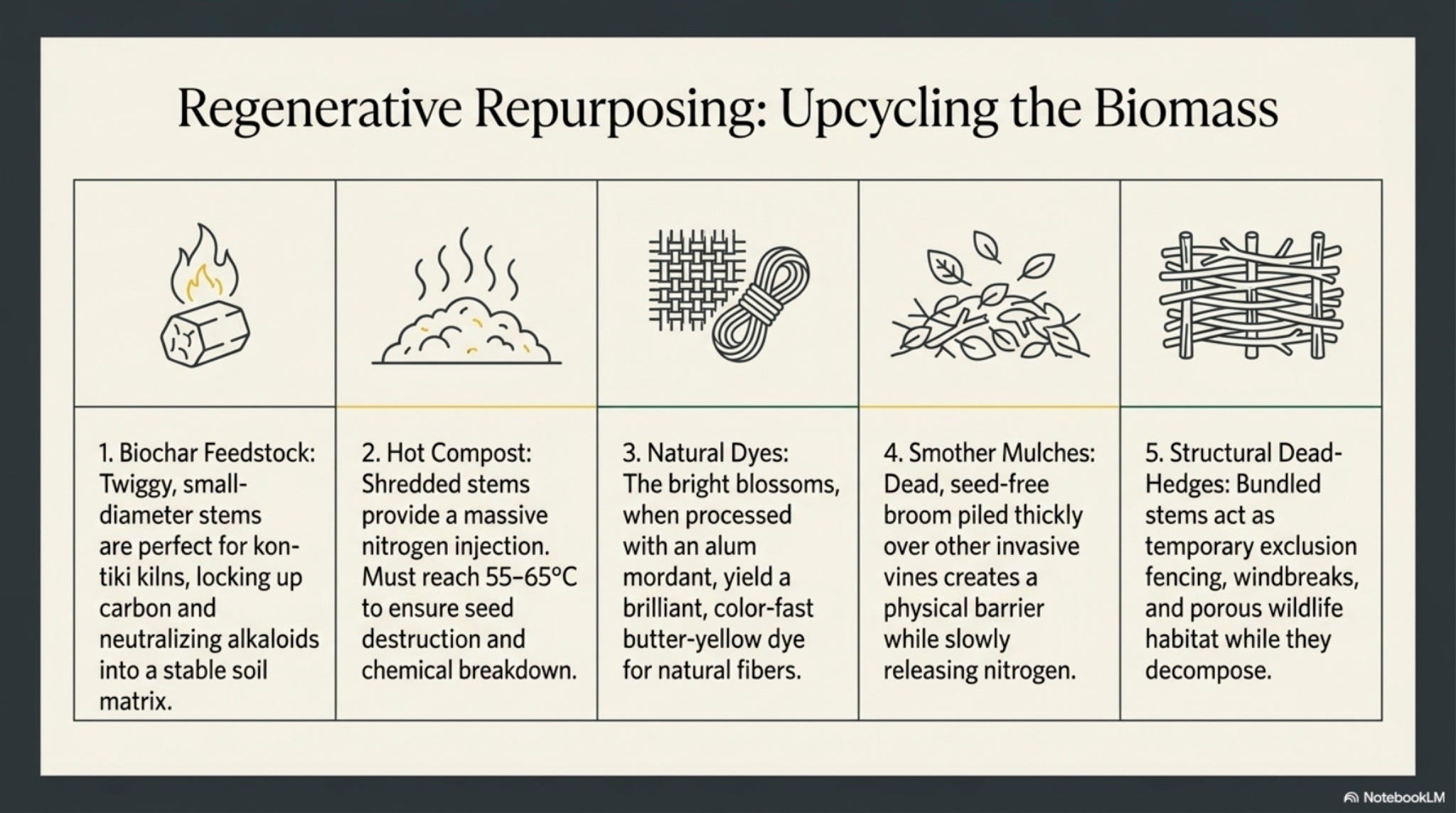
Broom is basically invasion + biomass. Residue design is where we can turn that into net system value.
Compost
C:N & N contribution:
Broom foliage/stems are relatively N-rich compared to many woody shrubs; field studies show it can incorporate 12–65 kg N/ha into biomass and return ~17 kg N/ha/yr via litter.
Confidence: Established.
Safe composting rules:
Chip/shred stems; remove or high-heat compost seed-bearing material.
Aim for a hot compost phase (55–65°C for several days); helps kill seeds and accelerates QA degradation (Probable).
Mix broom at ≤30% of total green material in the pile to avoid overly “spicy” compost (Plausible).
Use finished compost mainly:
On perennial systems (orchards, forest gardens, shelterbelts).
On areas where you’re trying to boost N and organic matter but aren’t planting high-value annual veg immediately.
Bedding & Structural Uses
Shredded broom (seed-free) can be:
Mixed into livestock bedding for absorbency and structure, then composted thoroughly before field use (Plausible; need to avoid animals eating it).
Used as mulch on paths, under hedges, or in dead hedges to create porous wildlife habitat and windbreaks.
Biochar & Energy
Broom’s twiggy, small-diameter wood is ideal for:
Rocket stove fuel, small gasifiers, or kon-tiki kilns to produce biochar.
Biochar from broom:
Locks up a portion of its carbon and immobilizes some alkaloids in a stable matrix (Probable).
Can be blended into compost or applied to degraded soils for CEC and water-holding benefits (Established for biochar generally).
Nice loop:
Cut broom → dry → char → charge with compost/urine/tea → return to broom-infested soil in transition → plant natives/trees into improved micro-sites.
Secondary Ferments & Extracts
Spent broom from antimicrobial experimental extracts could be:
Returned to compost after sufficient microbial decomposition.
Avoid using broom residues in any process that would reintroduce viable seeds (e.g., raw livestock bedding spread directly on fields).
Whole-System Reintegration
Design pattern for PNW:
Year 0–2:
Systematically cut broom in a mosaic, starting from high-value native patches; chip and compost or char.
Year 1–5:
Use broom-derived compost/biochar to boost native plantings (trees, shrubs, prairie forbs) in now-cleared patches.
Year 3–10:
Continue “seedling sweeps,” pulling new broom seedlings and using their small biomass directly in hot compost.
Beyond:
Broom biomass becomes a memory in the soil organic matter and biochar matrix, supporting a more diverse community.
Product Development & Quality Control
This includes propagation & breeding + landscape design as “products” in the broad sense, alongside any extracts or value-added goods.
Propagation & Breeding (Wild vs. Cultivar, PNW lens)
Propagation (where legal & appropriate):
Seed
Primary propagation method globally. Seeds have hard coats and require scarification (boiling water, sandpaper, or acid) to germinate well; stratification generally not required.
Germination best around 15–20°C; scarified seeds can germinate across a wide temp range.
Cuttings
Semi-ripe cuttings in late summer/early autumn or hardwood cuttings in winter root reasonably well in horticultural conditions.
In the PNW: do not propagate Scotch broom; it’s a listed invasive in many jurisdictions. Check regional weed laws before even moving seeds or plants.
Breeding & cultivars:
Ornamental breeding has produced:
Color variants of C. scoparius (‘Firefly’, ‘Luna’, etc.).
Inter-specific hybrids like Cytisus ‘Lena’ (C. scoparius × C. dallimorei) and Cytisus × praecox (‘Allgold’, ‘Warminster’, etc.), many with Awards of Garden Merit.
In Europe, breeders sometimes aim for:
Compact, non-seeding, or reduced-seed cultivars (Probable), although truly sterile forms are not universally guaranteed and documentation is sparse.
Breeding frontier (Plausible future focus):
Selection for partial sterility or poor seed viability, to decouple ornamental value from invasive risk.
For your land in the PNW, “breeding” work that helps would be:
Collaborating with scientists on sterile broom hybrids that could replace invasive lines in horticulture (research area, not DIY).
Landscape Design (Regenerative, PNW‑Specific)
Key design principle:
In the PNW, Scotch broom is not a design element; it is a design constraint and teacher. We design with its patterns, not for its presence.
A. Reading broom as a design diagnostic
Dense broom =
Past disturbance (logging, road building, overgrazing).
High N / low P soil, acidic, often coarse-textured.
Lack of frequent low-intensity fire and/or lack of browsing pressure.
B. Transition design: broom → diverse system
Prairie / oak‑savanna restoration
Sequence:
Remove broom (hand or mechanical, staged).
Immediately seed native grasses and forbs (e.g., Roemer’s fescue, camas, yarrow) plus shrub islands (Nootka rose, snowberry).
Use broom-derived compost/biochar only after full composting and in targeted microsites to boost native seedlings, not broadcast over entire meadow (to avoid over‑N boosting weeds).
Long term: maintain with mowing, hand work, and/or cultural burns to keep shrubs from re-establishing.
Forest regeneration (Douglas-fir, mixed conifer)
Avoid planting tree seedlings directly into intact broom thickets; broom severely reduces seedling growth via competition and mycorrhizal disruption. +2
Instead:
Clear broom in patches and strips, leaving some cover for microclimate.
Plant tree seedlings near forest edges or in broom-free corridors to maximize EMF colonization and survival.
Use woody broom residues as mulch or dead hedges between tree rows, not within the immediate root zone.
Agroecology / hedgerows (outside invasive range or fully contained)
In European contexts, broom can fit into multi-layer hedges with hawthorn, blackthorn, wild roses, etc., as a pioneer N-fixer and pollinator shrub (Probable).
In the PNW, substitute with non-invasive N-fixers (native lupines, ceanothus, goumi, Siberian pea shrub where appropriate).
Value‑Added Products & QC
Given safety and legal context, realistic “products” are more:
Educational services (weed walks, restoration workshops).
Biomass products (biochar, craft material, dyes), not herbal supplements.
Potential product lines (local/community scale):
Dyes
Broom flowers can yield yellow dyes similar to other Genisteae (Probable; documented for Cytisus and Genista spp.).
QC: color fastness tests, ensuring no off-odors from residual fermentation.
Biochar / soil amendments
QC: test char for pH, ash content, CEC, and absence of unpyrolized material.
Optionally do simple germination tests to ensure char-containing mixes don’t inhibit sensitive seeds (bioassay-style QC).
Antimicrobial extracts (non-food)
Polyphenolic extracts have measured MICs against several foodborne pathogens.
QC markers:
HPLC/TLC fingerprints for quercetin, kaempferol, caffeic/protocatechuic acid, etc.
Microbial challenge tests to confirm antimicrobial function and lack of contamination.
Regulatory reality:
Anything intended for internal human use would fall into a high‑regulation + high‑liability zone due to toxicity. Not worth it for most farmers or small herbal makers.
RESEARCH FRONTIERS
Emerging Science
Metabolomics & Chemotypes
Modern metabolomic work on Cytisus is focusing on:
Detailed profiles of phenolic compounds (caffeic, chlorogenic, protocatechuic, gallic acids; rutin, quercetin, kaempferol, apigenin, chrysin; genistein, sarothamnoside, etc.).
Quantitative antioxidant capacity across solvents and extraction conditions.
Emerging themes:
Solvent choice strongly shapes the phenolic profile and activity of broom extracts (Established).
There may be chemotypes across Cytisus species and populations with different QA and flavonoid ratios (Probable, but broom-specific chemotype mapping is incomplete).
Potential next steps (Speculative):
Using untargeted LC‑MS metabolomics to correlate specific chemotypes with:
Drought or nutrient stress.
Different soil microbiomes.
Distinct geographic provenances (e.g., Iberian vs. British vs. PNW naturalized lines).
Genomics & Symbiosis
Rhizobial partners:
Broom and other Genisteae legumes are predominantly nodulated by Bradyrhizobium lineages (e.g., Bradyrhizobium japonicum, B. cytisi), according to multilocus phylogenies.
Non-rhizobial nodulators like Brucella (Ochrobactrum) cytisi can also form nodules on broom (often less efficient).
Recent greenhouse work shows broom in invaded soils has higher nodule numbers and AMF colonization than in uninvaded soils, indicating positive plant-soil feedbacks that favor its own mutualists.
Plant genome:
A full reference genome for C. scoparius has not (yet) become mainstream-labeled, but Genisteae genomics is progressing in related genera (Lupinus, etc.). (Unknown for broom-specific genome).
Frontier questions:
How do broom’s nodulation genes shape host range and invasion?
Are there broom genotypes better at recruiting mutualists in novel soils?
Root, Leaf & Phyllosphere Microbiomes
Root symbioses:
Broom forms arbuscular mycorrhizae (AMF), not ectomycorrhizae, even in Douglas-fir forests.
In invaded soils, broom increases AMF colonization and nodule abundance, yet growth can be smaller in broom-conditioned soils—suggesting negative density dependence despite more mutualists (Established/Probable).
Rhizosphere:
Invaded soils show shifts in microbial composition and nutrient cycling (N up, P down), but broom-specific microbiome mapping is still early-stage.
Phyllosphere:
Little published for broom specifically (Unknown).
Given its evergreen stems and small leaves, broom likely hosts UV-resistant, cuticle-loving microbial communities similar to other shrub legumes (Plausible).
Quantum Biology & Energetic Hypotheses
Transport & coherence in water and sap
Hypothesis: Like other vascular plants, broom’s water transport might exploit subtle structured water phases (exclusion zone water) and quantum coherence phenomena to support xylem flow, especially during drought when transpiration pull is limited (Speculative).
Why broom is interesting:
Evergreen stems keep xylem active year‑round.
Drought-deciduous leaves + stem photosynthesis suggest the plant is optimized for low-pressure hydraulic systems.
Electromagnetic signaling & biofield
Plants generate electrical potentials, action potentials, and possibly ultraweak photon emission (biophotons) linked to stress and development (Established at a general plant level).
For broom:
Its dense, interwoven stem network might function as a 3D array of conductive tissues, broadcasting or integrating signals across the shrub (Plausible).
Disturbances (cutting, burning, herbivory) likely induce measurable electrical responses that propagate through the plant and into root-microbe networks (Plausible by analogy).
Soil–plant–fungus quantum interface
Hypothesis: At root tips and fungal arbuscules, quantum-level phenomena (e.g., tunneling in enzymes, coherence in energy transfer) could play a role in nutrient sensing and exchange (Speculative/Kinda Sci‑fi).
In broom-dominated soils, where AMF and Bradyrhizobium networks are intense, the “informational density” at this interface might be high. The plant’s chemical signals (flavonoids, strigolactones, alkaloids) could be thought of as classical carriers sitting atop a deeper quantum substrate.
Caveat:
These ideas are exciting but very much research frontier / concept art, not operational agronomy. They’re useful as imaginative frameworks, not as things to bet the farm on.
Citizen Science Protocols
Practical DIY experiments that don’t require a lab but can deepen understanding.
Phenology & Succession Logs
What:
Track broom at multiple sites: first leaf, first flower, full bloom, first pods, first popping pods, leaf drop, visible seedling flush.
How:
Keep a simple 52‑week log per site, with sketches or photos.
Record co-events: when do camas bloom, when do Douglas-fir buds break, when does soil crack, etc.
Why:
Over years, this reveals how broom timing shifts with climate variation, and how its phenology relates to both native species and management actions.
Seed Germination & Seedbank Assays
Goal: quantify how stubborn the seedbank is on your land.
Protocol:
Take soil cores from broom-infested and broom-free areas (top 10 cm).
Spread each in flats in a greenhouse or protected outdoor space, keep moist, and count broom seedlings over 3–6 months.
Optionally, heat-treat sub-samples (e.g., pour near-boiling water over soil or briefly bake at 80°C) and compare germination (mimicking fire scarification).
Outcome: direct, site-specific sense of seed density and responsiveness to disturbance and heat.
Simple Bioassays for Allelopathy
What: test whether broom extracts/litter affect germination of common species (e.g., lettuce, radish, native grass).
How:
Prepare three treatments:
Control: distilled or clean water.
Weak broom tea: a handful of leaves/stems soaked overnight in water.
Strong tea: same but simmered lightly then cooled.
Place seeds on filter paper with each solution, track germination % and root length.
Why:
Demonstrates in a simple way how broom’s chemicals might inhibit or slow other plants (Plausible, based on polyphenol/alkaloid effects).
Microbiome-Inspired Trials
Without sequencing, you can still explore functional soil change:
Compare N and P in soil using simple soil test kits or sending samples to a lab from:
Broom-dense stand.
Adjacent non-broom site.
Broom-cleared site 3+ years after removal.
Pair lab results with observed plant diversity and litter characteristics.
CONSCIOUSNESS, CEREMONY & MEANING
Plant Consciousness
We’re not saying broom is a little person with a passport; we are asking: how does this plant perceive and respond to its world, and how have humans read that?
Scientific “consciousness-lite”
Plants clearly show:
Sensing (light, gravity, water, chemicals, touch).
Integration (electrical and hormonal signaling).
Memory-like effects (priming, learned responses to repeated stress).
Broom specifically:
Adjusts its investment in nodules & AMF based on soil history.
Times germination and flowering with environmental cues (temperature, day length, moisture).
In a cautious scientific frame, we might say broom is highly responsive and adaptive, but we don’t have evidence it has subjective experience like humans.
Indigenous and folk worldviews
Celtic and European traditions treated broom as:
A plant of purification, healing, and boundary work (sweeping out the old, guarding thresholds).
Modern PNW Indigenous land stewards often frame invasive broom as:
A mark of colonial disturbance and an invitation to reassert right relationship through restoration (as documented around Garry oak).
Without appropriating, we can say: many cultures relate to plants as relational beings rather than objects, and broom is no exception.
A grounded middle road
You can experiment with relating to broom as a teacher of edges and consequences:
It responds dramatically to disturbance.
It gives fertility and takes diversity.
It shows up where systems are out of balance.
That doesn’t require believing broom has a human-like mind; it’s more about seeing patterned behavior and learning from it.
Harvest, Tending & Seasonal Ceremonies
(Framed as ideas; any practice on Indigenous land or with Indigenous ceremonies needs direct permission and guidance.)
Seasonal “ceremonies” of removal and return
For a PNW farm or project:
Late winter / early spring – Intention-setting & planning
Walk the land, map broom patches, note where it’s blocking oak, camas, or tree regen.
Name your goals out loud: which areas will you focus on, what natives you’ll invite back.
Spring bloom – Witnessing
Spend time in a broom thicket in peak bloom and really see it: bees, smell, color, density.
This can be a simple practice of acknowledging the plant’s power before cutting.
Post-seed drop (late summer–fall) – Cutting & transformation
Organize a crew day: cut broom, chip, char, or stack for compost.
Mark the effort with a simple closing (shared meal, gratitude to the land, maybe a spoken commitment to follow-up care).
Autumn / winter – Replanting & reweaving
Use compost/char derived from broom in tree and native plantings.
Mark each planting as a physical sign that broom’s niche is being transformed.
This becomes a living ceremony of succession: disturb → colonization → correction → reweaving.
Dreamwork, Divination & Synchronicity
We’ll keep this grounded and safe: no promises of visions, just pattern-sensitive storytelling.
Dreamwork
If you like working with dreams, you might:
Spend time observing or working with broom during the day.
Before sleep, write a specific question about land repair, boundaries, or disturbance.
Record any dreams with broom, yellow, fire, hedges, or clearings and treat them as metaphors from your own psyche, not external prophecies.
This is essentially a form of self-reflection anchored in your relationship with a very powerful edge-species.
Divination & pattern-reading
Instead of “fortune telling,” think:
What is broom telling me about this place or project right now?
Examples:
Broom suddenly invading a pasture → pattern: overgrazing, disturbance, or a gap in perennial cover → message: “Rebuild groundcover and rotations.”
Broom lining a roadside → pattern: soil movement, constant disturbance, nitrogen leaks → message: “This corridor is bleeding – how do we slow and infiltrate?”
Broom disappearing under maturing forest → pattern: succession proceeding → message: “You’ve done enough here; attention can shift.”
This is systems divination: reading ecological signs instead of cards.
Synchronicity
You might notice:
Broom showing up in your awareness precisely when you’re wrestling with questions of:
Boundaries (personal, community, or land).
How to respond to disturbance.
When to be “nice” vs. when to draw firm lines.
Treat those coincidences as invitations to look more closely at the patterns—in the land and in your own choices—rather than as supernatural commands.
Economic Roles & Income Potential
Scotch broom blooming across coastal sand dunes. In the early 1940s, Scotch broom was hailed as a hero for stabilizing Oregon’s shifting coastal dunes. Planted on barren sand, it grew three feet in a year and formed hedges 10–12 feet tall within five years. These dense thickets acted as windbreaks protecting infrastructure and wildlife, while broom’s nitrogen-fixing roots enriched the sterile sand for later plantings. This historical success illustrates broom’s regenerative potential and hints at its economic value – a cheap, fast-growing “green infrastructure” for erosion control. Today, however, broom is mostly seen as a costly invasive; in Washington State it’s estimated to cause ~$143 million in lost resource outputs and hundreds of job losses by impeding forestry and grazing. Turning this problem into a solution is now a focus of creative land managers.
Biochar & Wildfire Mitigation (High Confidence): One promising use of Scotch broom is converting its invasive biomass into biochar. Pyrolysis (burning in low oxygen) transforms cut broom into a carbon-rich soil amendment, sequestering carbon for millennia. This process not only produces a valuable soil enhancer but also reduces wildfire hazard – removing broom’s dense, oily thickets that are highly flammable. In the Pacific Northwest, pilot projects are already pyrolyzing broom slash to reduce smoke and greenhouse emissions compared to open burns. The result is a local product (biochar) that improves water retention and soil fertility, creating a potential income stream for rural communities and cost-saving for agencies by offsetting fire management expenses.
Natural Dyes & Craft Materials (High Confidence): Despite its menace to farms, broom offers raw materials for artisan products. Its bright yellow flowers yield a strong yellow dye, long known to traditional dyers. With a simple alum mordant, broom flowers produce a glowing acid-yellow on wool – a color valued in natural fiber arts. The bark and leaves can produce other hues (brown from bark, green from young shoots). Broom’s wiry branches have been used for generations to make baskets, brushes, and brooms (besoms). In fact, the very name “broom” comes from its historic use as bundled sweepers. Its stems have even served as thatching material and as substitutes for reeds in fencing and screens. While these uses are niche, they represent cottage industry opportunities – invasive broom harvested for natural craft supplies and sold to weavers, dyers, and heritage artisans. Such upcycling can supplement incomes in rural areas and save costs on imported materials.
Slope Stabilization & Land Reclamation (High Confidence): Scotch broom’s aggressive growth on disturbed land has been harnessed for land reclamation. Besides dunes, it was planted on steep road cuts and mining sites to prevent erosion – taking advantage of its deep roots and tolerance of poor soils. Root strength: Studies on a related species (Spanish broom) show it significantly increases slope stability, even on steep, drought-prone soils. By binding loose soil and adding organic matter, broom can buy time for landscapes recovering from wildfire or landslides. However, this benefit comes with caveats. Broom’s prolific growth can crowd out slower native colonizers, and it may chemically inhibit some plants. Researchers found broom stands acidify soil and lower phosphorus availability, while possibly releasing alkaloids that inhibit other seedlings. This means that as a regenerative tool, broom works best as a short-term nurse crop – to be later removed or shaded out once desirable vegetation takes hold. Land managers on small farms or public lands might capitalize on broom’s quick cover and nitrogen boost, but they must also plan for transitioning to longer-lived species before broom becomes a monoculture.
Community Partnerships & “Broom Bashes” (High Confidence): In regions overrun by broom, communities have turned removal into an educational and economic opportunity. Grassroots groups like Broombusters in British Columbia partner with local governments and volunteers to cut broom each spring (“Cut Broom in Bloom” campaigns). These volunteer-driven broom bashes serve dual roles: restoring ecosystems cost-effectively (volunteer labor saves public funds) and fostering environmental education and tourism. For example, on Cortes Island (BC), locals, First Nations, and park biologists united to remove Scotch broom from sensitive dunes in a series of community work parties. Interpretive signs and even social events (e.g. celebratory lunches or festivals) often accompany these efforts, turning invasive removal into a community-building exercise. Such partnerships can create seasonal jobs (for coordinators or processing crews) and even yield marketable byproducts – for instance, chipped broom from these events can be used as mulch or biochar feedstock instead of going to waste. In effect, broom becomes an impetus for ecosystem-based enterprises, linking public land management with local economic benefits.
Small-Farm Upcycling & Innovative Uses (Speculative): Forward-thinking small farmers see Scotch broom not just as a weed to eradicate, but as a free resource waiting to be utilized. Some permaculturists propose integrating broom into farm succession plans: leveraging its nitrogen-fixation to improve soil for future crops, then gradually shading it out with planted trees. Rather than bearing removal costs, farmers can chip broom in place for ground cover or carbon-rich mulch (taking care, of course, to prevent seed spread). There are anecdotes of farmers drying broom logs for firewood or feeding cut stems into rocket mass heaters (high-efficiency wood stoves) – essentially turning a pest into winter heating fuel. Goats and other browsing livestock have been used in some areas to graze young broom shoots; while the plant is somewhat toxic and unpalatable to most livestock, goats appear able to consume limited quantities, providing a natural control method and some fodder value. These uses remain experimental and localized, but they hint at a future where invasive biomass is routinely upcycled on-site – saving disposal costs and maybe generating a bit of extra farm income (e.g. selling broom biochar or dyed wool from broom-based dyes).
Catastrophe Insurance & Resilience (Speculative): As the climate and economy become less predictable, Scotch broom could act as a form of biological insurance in worst-case scenarios. In the wake of wildfires, broom’s heat-scarified seeds germinate en masse, rapidly carpeting scorched earth in green. This quick cover can stabilize ash-laden soils and reduce erosion on burned hillsides – a spontaneous ecosystem service when other resources are stretched thin. (Of course, it also sets the stage for future fire fuel, so it’s a mixed blessing.) After floods or landslides, broom’s ability to root in nutrient-poor, disturbed ground means it will often be one of the first plants to colonize silted floodplains or raw subsoil, again acting as a first responder holding the ground together. If global supply chains collapse or remote communities are cut off, locals might rediscover broom’s old-fashioned utilitarian uses: its fibrous bark can be processed into rough cloth or paper; its high-tannin bark and leaves can help in leather tanning and preserving hides; its woody stems, though thin, can be bundled as thatch or dried for fuel. In medieval Europe, broom was even used as emergency fodder for cattle and seeds were roasted as a coffee substitute – practices born of necessity that could inform future resilience. All these “lifeboat” uses of Scotch broom remain speculative today (modern communities have little need to rely on broom this way). Yet, simply knowing that this hardy shrub offers so many fallback options – from food seasoning to fiber to fuel – adds a layer of security. In a pinch, an invasive weed might turn out to be a community’s resource of last resort.
Vision & Synthesis
Scotch broom forces us to confront the paradox of disturbance and healing. This shrub thrives on disruption – wherever land is scoured bare or ecosystems falter, broom is ready to move in. It teaches that after every disturbance, nature will find a pioneer to begin the repair process, whether we approve of the chosen species or not. In the Pacific Northwest and beyond, broom has become the poster child for pioneer succession: it colonizes logged clear-cuts, burned forests, eroded slopes, and abandoned fields with relentless energy. In doing so, it repairs soil in its own way – enriching nitrogen and organic matter in barren ground – even as it simultaneously makes other chemical changes (like acidifying the soil) that complicate the recovery. The lesson broom offers is twofold: resilience is often messy, and the first stage of regeneration may not look like the end goal. Broom’s cheerful yellow blooms on a devastated landscape can be seen as nature’s bandage: a sign that life will return, but also a warning that the healing process may take a tumultuous path.
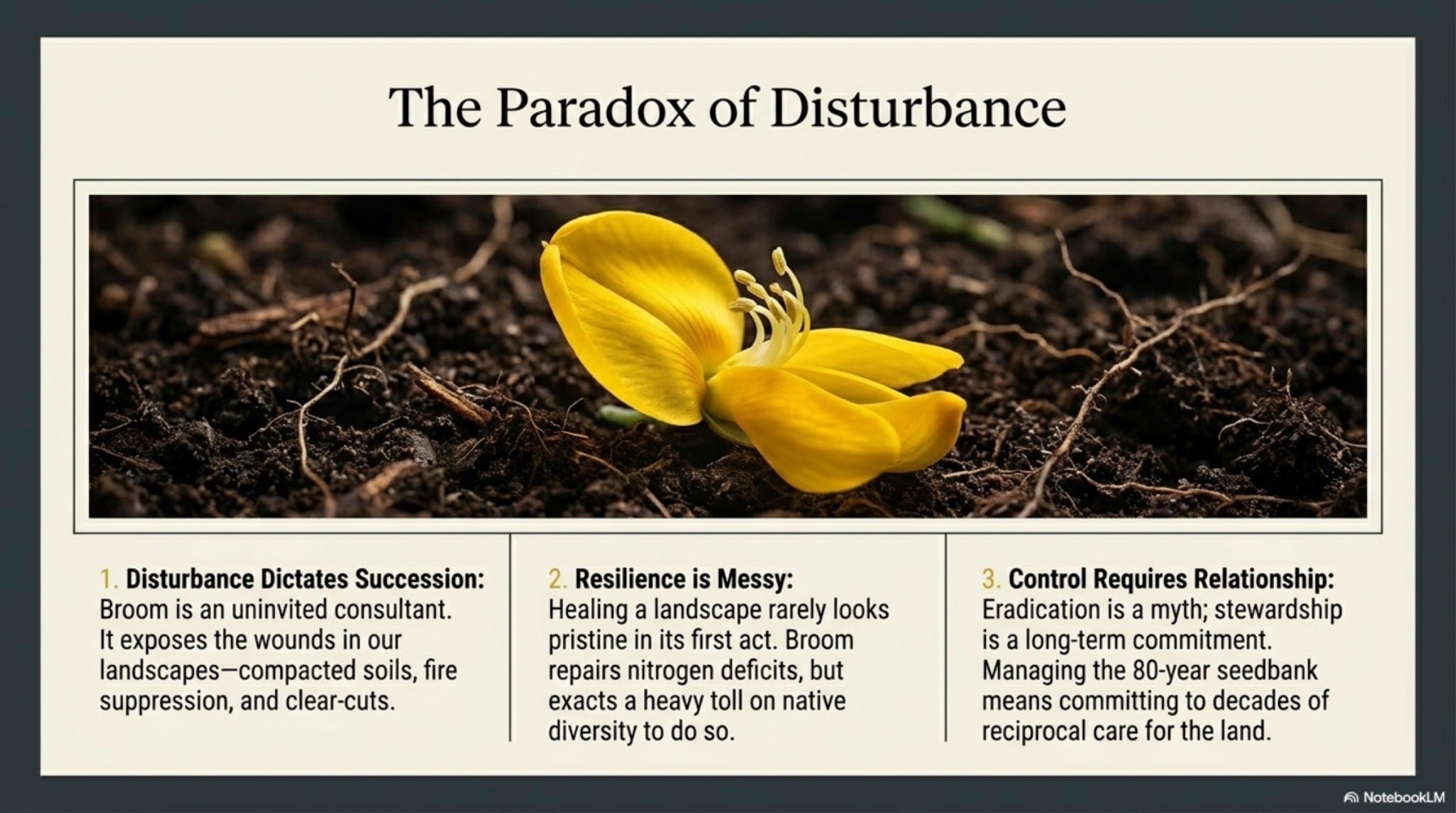
This plant’s story is one of astonishing resilience and opportunism. Scotch broom can lie in wait as dormant seeds for decades, banking its potential until the moment is right. A single mature bush can produce tens of thousands of seeds that remain viable 30, 60, even 80 years in the soil. When fire sweeps through or humans clear the land, that buried seed reserve springs to life, carpeting the area in green within a season. It’s a strategy of extreme persistence: by using fire and disturbance as triggers for germination, broom ensures it never misses an opening. Its seedlings grow quickly (often 1–2 meters in their first couple of years), outpacing many natives and forming dense thickets that can weather storms and drought. Broom is also chemically defended – packed with bitter alkaloids and tannins that repel most grazers – meaning few herbivores keep it in check. In essence, Scotch broom shows us what tenacity looks like in the plant world: an invasive survivor that bends harsh environments to its advantage. This high-confidence insight comes with a humbling realization for land stewards and climate resilience planners: when other systems fail, broom endures. It will be there after the wildfire, after the flood, holding the line (and sometimes holding back other recovery).
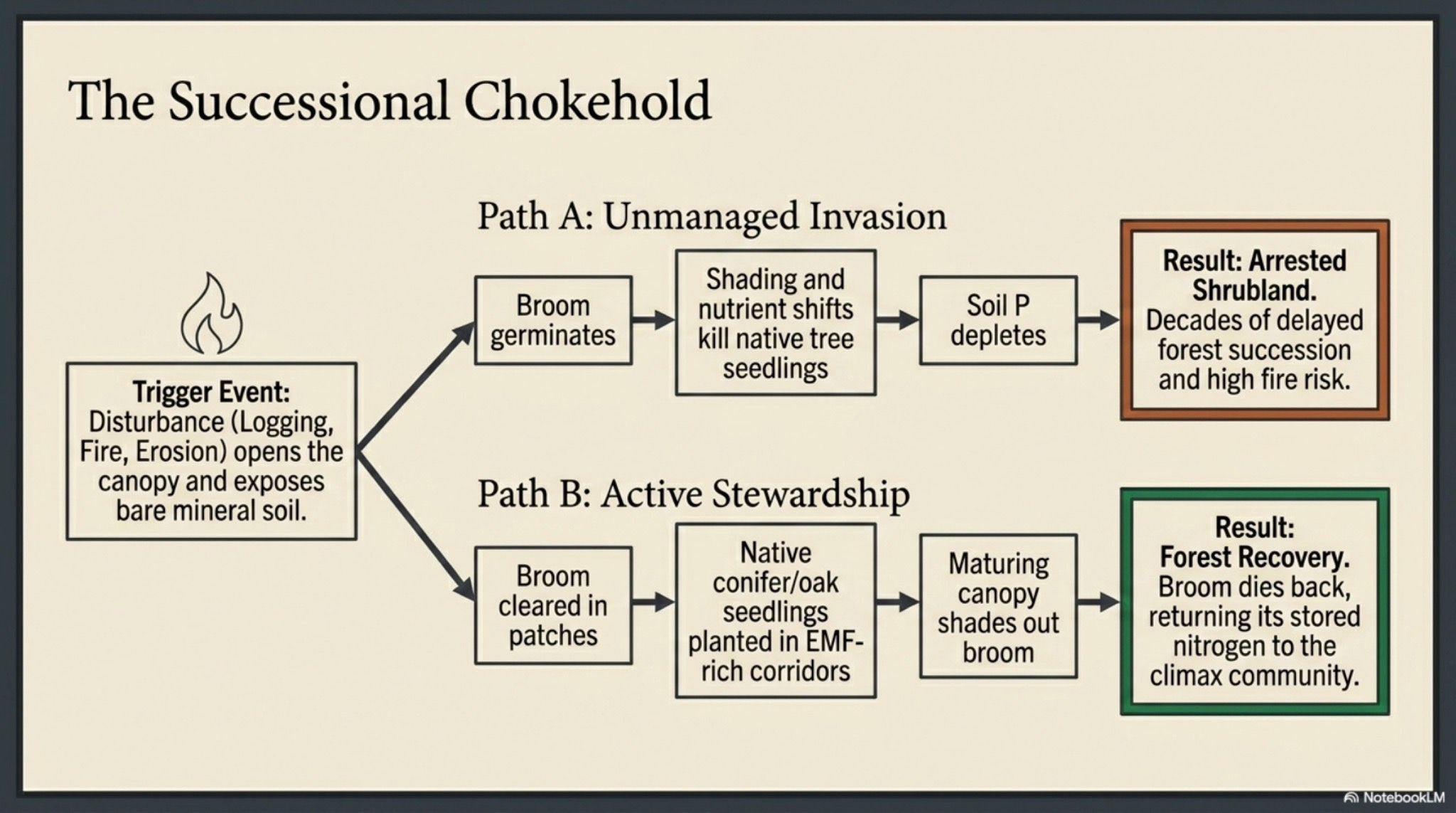
On a climate-shifting planet, Scotch broom is both a threat and a teacher – and possibly a tool. It undeniably poses a threat to biodiversity and fire safety: as temperatures warm and disturbances increase, broom’s range can expand into new territories, and its flammable thickets elevate wildfire risks near communities. Yet broom also teaches us crucial lessons about ecosystem dynamics. It exemplifies how invasive species exploit human-altered landscapes; in doing so, it highlights weaknesses in our land management. For instance, broom’s rampant spread after logging shows the cost of not planning for post-harvest restoration – a clear teaching that disturbance without follow-up invites invasion. Conversely, broom’s presence has spurred innovative thinking: land managers now experiment with using broom’s own traits (fast growth, nitrogen fixation) to aid restoration if harnessed correctly. In some experimental forests, practitioners allow broom to grow briefly as a nurse crop for tree seedlings, then thin it out once the trees establish – trying to glean a teaching from broom about pacing succession. The plant also pushes us toward more holistic, regenerative agriculture and forestry: instead of viewing any disturbance as purely negative, broom suggests that we design disturbances with intentional follow-up, perhaps even with biomass-utilizing solutions (like biochar) built in. In a way, Scotch broom is acting as an uninvited consultant, showing us where the ecological gaps are and challenging us to respond with creativity rather than just chemical control.
Can Scotch broom be a tool for ecological repair? The answer is a cautious yes, within limits. Its known traits – nitrogen-fixing ability, tolerance of degraded soils, rapid growth – mean it can kickstart soil building on severely damaged sites where native species fail to establish. In coastal dunes and subalpine barrens, for example, broom has been one of the first to transform sand into soil, paving the way (however roughly) for forests to eventually grow. Unlike even more pernicious invaders (like gorse), broom doesn’t entirely prevent succession: it drops its small leaves in winter and produces only sparse litter, allowing some light through and decaying relatively quickly. This suggests that given time, later successional trees can overtop and shade out broom naturally, as has been observed in some older stands. Indeed, broom plants seldom live more than 15 years; if a forest canopy closes during that time, the broom population will diminish. However, the limitations of broom as a “helper” are significant. Its tendency to form monocultures can stall biodiversity, creating a new problem even as it solves an erosion issue. Its modifications to soil chemistry (lowering pH and locking up nutrients like phosphorus) may benefit itself while handicapping native competitors, potentially requiring remediation later. And the legacy of its seed bank means that even after it dies off, any new disturbance decades down the line can trigger a reinvasion – a persistent legacy effect. Ecologists frame this in terms of adaptive cycles: broom dominates the rapid reorganization phase after a collapse (fire/clearing), but it can also prolong the phase of low diversity by blocking the next phase (true recovery to a diverse, stable system). To use broom as a tool, humans must intervene in the cycle – for example, by removing or mulching broom at the right time (as Broombusters do, cutting in bloom to prevent resprouting) so that more desired species can take over. In summary, Scotch broom has clear eco-engineering potential to stabilize and enrich degraded soils, but it must be managed deliberately to avoid it becoming a long-term obstacle to ecological resilience.
Signature Move: Dormant Invader – Scotch broom’s ecological superpower is its ability to lie in wait through decades of calm, then explode across disturbed ground with nitrogen-fueled ferocity, rapidly healing and hijacking damaged landscapes in equal measure.