

Yarrow: The Regenerative Powerhouse in Modern Agriculture
In the evolving landscape of regenerative agriculture, certain plants stand out not just for their individual properties, but for their capacity to fundamentally transform agricultural ecosystems. Yarrow (Achillea millefolium) is one such remarkable species that deserves a closer look from forward-thinking farmers and land stewards.
Beyond the Common Wildflower
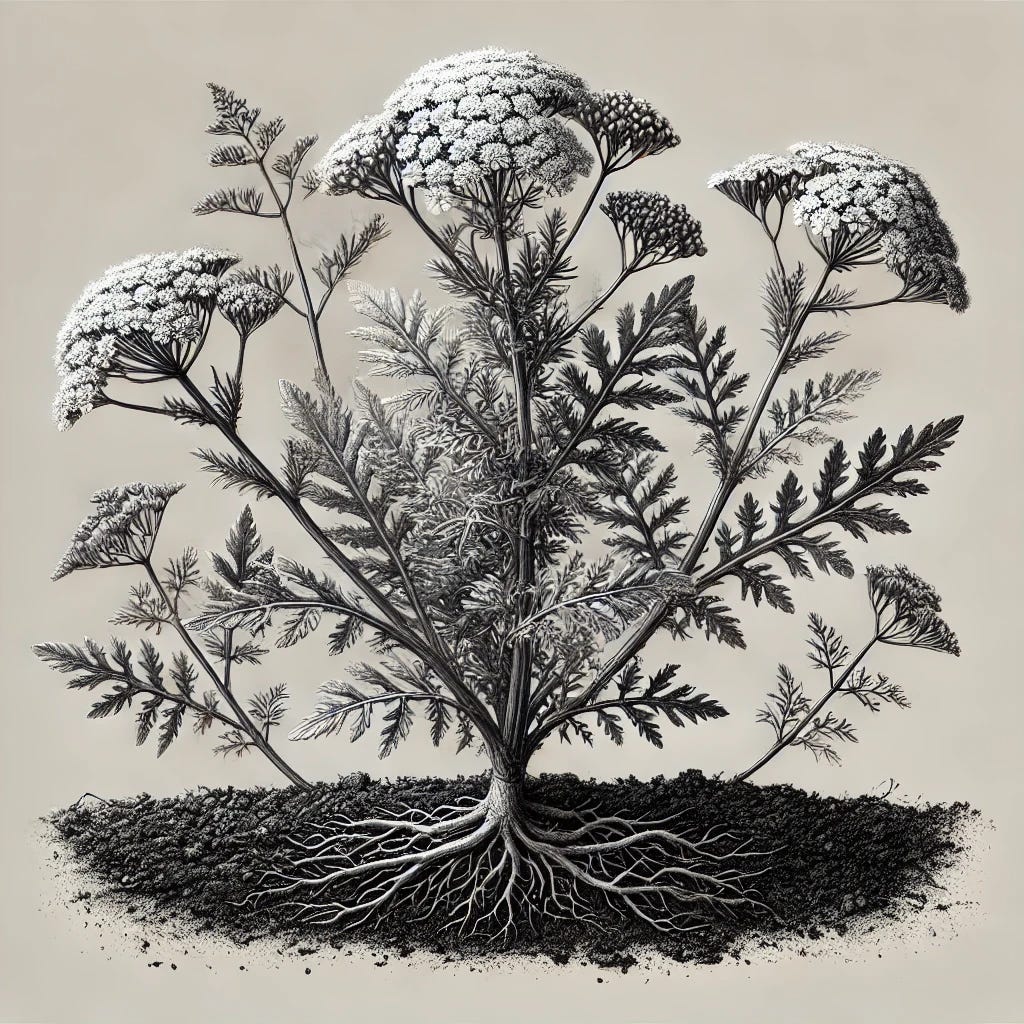
Many of us know yarrow as the feathery-leaved plant dotting field edges and roadsides, but this hardy perennial is far more than an opportunistic colonizer. As a member of the Asteraceae family, yarrow represents a sophisticated ecological intervention mechanism that can significantly enhance agricultural operations.
What makes yarrow particularly interesting for agricultural applications is its dual role as both an indicator and a modifier of soil conditions. When you spot yarrow volunteering in your fields, it's often signaling specific soil conditions - typically mineral deficiencies or imbalances. However, unlike many indicator species that simply highlight problems, yarrow actively works to address these issues through its unique biological processes.
The Underground Economy
Yarrow's most impressive work happens below the surface. Its extensive root system serves multiple functions in soil ecology:
Mineral accumulation and redistribution: Yarrow's deep roots access minerals from lower soil horizons, making them available to surrounding plants through natural cycling processes.
Soil structure improvement: The fibrous root system creates channels for water infiltration and air movement while contributing to organic matter buildup.
Microbiome enhancement: Yarrow roots form beneficial relationships with soil microorganisms, contributing to the development of healthy soil food webs.
Strategic Integration in Agricultural Systems
For farmers looking to incorporate yarrow into their operations, several strategic applications have shown particular promise:
Orchard Systems
Yarrow excels as an orchard understory component. Its presence can:
Support beneficial insect populations
Provide natural pest management through volatile organic compounds
Improve soil structure without competing significantly with tree roots
Add biodiversity to what might otherwise be bare soil
Field Borders and Hedgerows
As a border plant, yarrow offers multiple benefits:
Creates habitat for beneficial insects and pollinators
Serves as a buffer zone for water and nutrient management
Provides soil stabilization
Offers potential additional income through medicinal herb harvest
Pasture Systems
In grazing operations, yarrow contributes to:
Increased forage diversity
Enhanced mineral content of livestock diets
Natural parasite management
Improved soil health through root interactions
Climate Resilience and Adaptation
In an era of climate uncertainty, yarrow's adaptability becomes increasingly valuable. The plant demonstrates remarkable resilience to various environmental stresses:
Drought tolerance through deep root systems
Temperature adaptability across diverse climatic zones
Minimal input requirements
Rapid regeneration after disturbance
This adaptability makes yarrow an excellent choice for farmers looking to build resilience into their agricultural systems.
Practical Implementation
For farmers interested in establishing yarrow, several approaches have proven successful:
Direct seeding: Broadcast seeding in early spring or fall, with minimal soil coverage needed
Transplanting: Especially effective for establishing strategic patches or borders
Natural spread management: Once established, yarrow will self-propagate effectively, requiring only basic management to maintain desired distribution
Management Considerations
While yarrow's vigorous growth can be advantageous, it requires thoughtful management:
Monitor spread in cultivated areas
Consider mowing or grazing to maintain desired height and prevent excessive seed production
Rotate harvest areas if collecting for medicinal purposes
Observe interactions with other crops and adjust placement accordingly
Economic Opportunities
Beyond its ecological benefits, yarrow offers potential economic returns through:
Medicinal herb markets (flowers and leaves)
Value-added products (tinctures, dried herbs)
Ecosystem service payments (pollinator habitat programs)
Reduced input costs through natural pest management and soil improvement
Measuring Success
When incorporating yarrow into agricultural systems, several indicators can help measure its impact:
Increased beneficial insect populations
Improved soil structure and organic matter content
Enhanced water infiltration rates
Reduced pest pressure in adjacent crops
Increased biodiversity metrics
Bridging Disciplines: Lesser-Known Aspects of Yarrow
The deeper we look into yarrow's role in agricultural ecosystems, the more fascinating layers we uncover. Here are some lesser-known aspects that highlight yarrow's sophisticated ecological functions:
Ecological Communication Node: Yarrow functions as what ecologists call a "sentinel species" - essentially acting as a living communication hub within plant communities. Through its connection to mycorrhizal networks (sometimes called the "plant internet"), yarrow can signal to surrounding plants about incoming environmental stressors before they become visually apparent. This early warning system was historically recognized by indigenous agriculturalists but has been largely overlooked in modern farming.
Thermal Regulation Properties: According to traditional herbal texts, yarrow demonstrates remarkable capacity for microclimate modification. Its feathery foliage creates specific air flow patterns that can help moderate temperature extremes in its immediate vicinity - a property that can be particularly valuable in protecting more sensitive companion plants.
Electromagnetic Field Interactions: Drawing from both traditional knowledge and modern biophysics, yarrow appears to influence local electromagnetic fields in soil systems. This property may help explain its historical use in dowsing and its observed effects on soil mineralization processes.
Chemical Complexity: Unlike many plants that produce a handful of signature compounds, yarrow synthesizes over 200 distinct biologically active compounds. This chemical complexity enables it to respond dynamically to different environmental stressors and community needs, essentially functioning as a living pharmacy for the ecosystem.
Memory Retention: Studies in plant intelligence suggest that yarrow populations can "remember" and adapt to previous environmental stressors, passing this information to subsequent generations through epigenetic mechanisms. This makes established yarrow populations particularly valuable in areas with recurring environmental challenges.
These interdisciplinary insights suggest that yarrow's role in agricultural systems may be far more sophisticated than previously recognized, opening new avenues for research and practical applications in regenerative agriculture.
Looking Forward
The future of yarrow in agricultural systems looks particularly bright as several trends converge. First, the growing demand for natural pest management solutions aligns perfectly with yarrow's demonstrated ability to support beneficial insect populations and disrupt pest cycles. As regulations around synthetic pesticides tighten, yarrow's role in integrated pest management will likely expand.
Climate change adaptation strategies increasingly emphasize drought-resistant species, positioning yarrow as a valuable ally in resilient landscaping. Its deep root system and ability to thrive in challenging conditions make it particularly relevant for areas facing increased water stress. We're already seeing innovative applications in orchard understory systems, where yarrow's presence helps maintain soil moisture and supports tree health.
The medicinal herb market presents another frontier for yarrow cultivation. With the global herbal medicine market growing at over 11% annually, yarrow's well-documented medicinal properties make it an attractive crop for diversified operations. Forward-thinking farmers are already developing value-added products from yarrow, from tinctures to dried herb preparations.
Soil remediation projects represent perhaps the most exciting frontier for yarrow application. Its ability to accumulate certain minerals and improve soil structure makes it valuable for rehabilitating degraded lands. Research is currently exploring yarrow's potential in phytoremediation projects and its role in restoring mining-impacted soils.
For farmers considering yarrow integration, the path forward might include:
Establishing dedicated yarrow plots for beneficial insect habitat
Incorporating yarrow into orchard floor management systems
Developing relationships with herbal product manufacturers
Participating in soil restoration projects
Monitoring and documenting yarrow's impacts on pest populations and soil health
The key to yarrow's future lies not just in its individual properties, but in its ability to create synergistic benefits across farming operations. As we continue to understand its role as an ecological communicator and soil health enhancer, new applications will likely emerge. The plant's demonstrated ability to strengthen agricultural ecosystems while providing multiple revenue streams positions it as a valuable ally in the evolution of regenerative agriculture.

I 💗 yarrow. Thank you for this amazing article!