

Working with Fireweed
A practical guide to the plant, its uses and the science behind them
An invitation
Begin with one stem in flower. Follow its leaves upward, then look below the open flowers for the slender capsules. The plant holds more than one part of its season at once. Return a little later and look for what has changed.
This guide grows from that kind of attention. It follows common tall fireweed through the year, through disturbed ground and among the lives that visit or eat it. Named public accounts bring people’s relationships with the plant into view. For gardeners and growers, the chapters follow the choices of keeping, containing or harvesting a patch, and examine the evidence behind promising uses.
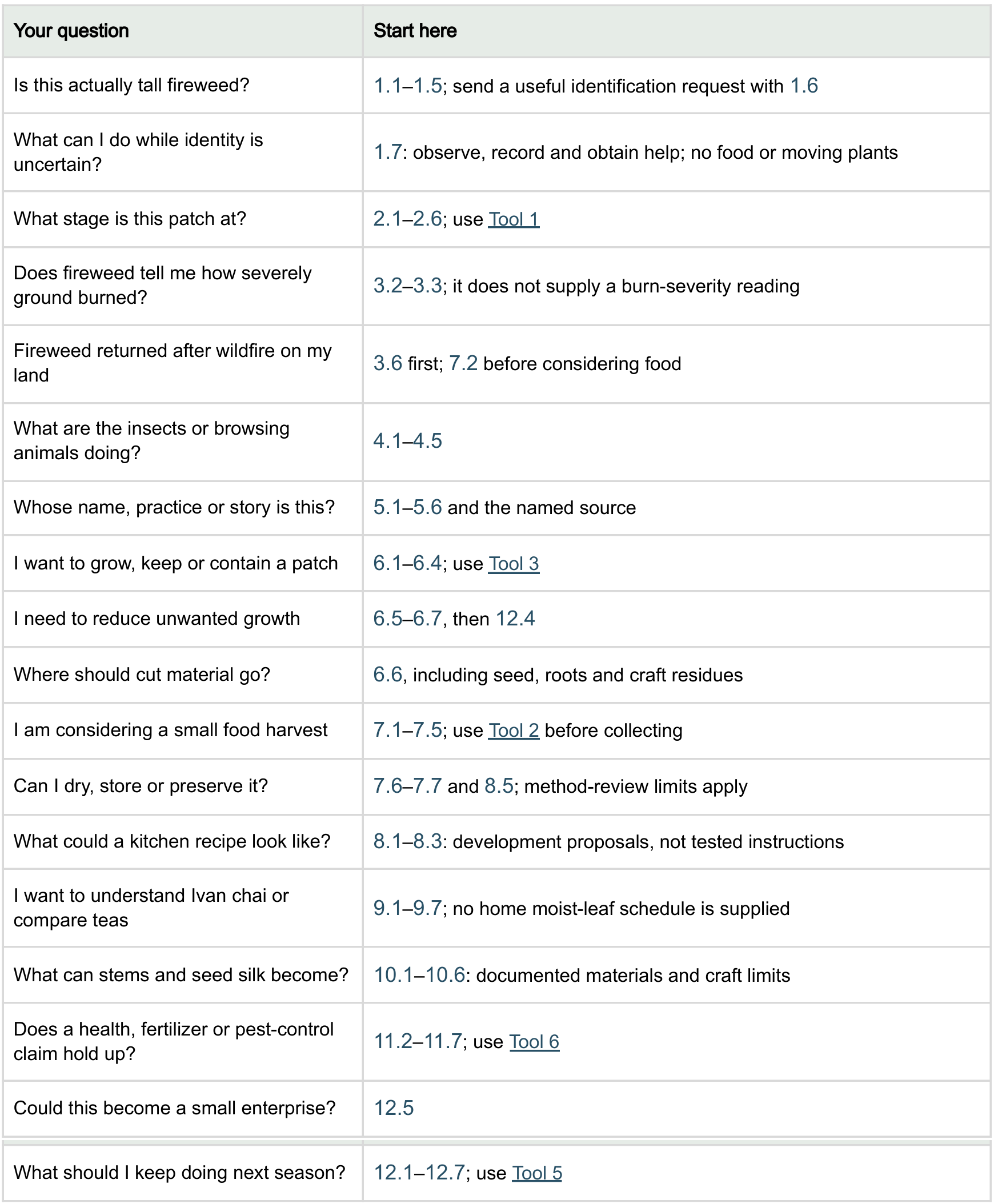
Read from the beginning, or use the task finder to start with a question. A leaf can lead toward identification, a cup toward chemistry, and a cut stem toward the life that continues underground. Each route begins with something you can look at more closely.
The geographical centre is temperate North America, especially British Columbia, the Pacific Northwest and the Okanagan. Northern and European accounts retain their own locations. The focal species is Chamaenerion angustifolium, following VASCAN and Flora of North America. Chamerion angustifolium and Epilobium angustifolium appear where sources use those names. River beauty and other plants called fireweed remain distinct.
A visit can be worthwhile without taking anything home. Looking closely, leaving flowers or deciding against a preparation can each be a useful result. Choose what fits the plant, the place and your purpose.
The reading journey
Part One: Meet the living plant. Chapters 1–4 build an eye for identity, season, disturbed ground and the lives among the flowers.
Part Two: Live with the patch. Chapters 5–6 keep people, provenance and purpose beside practical management choices.
Part Three: Work with a harvest. Chapters 7–10 follow material from its source toward food, tea and craft uses, distinguishing documented practices from methods still awaiting review and testing.
Part Four: Test claims and return to the patch. Chapters 11–12 examine evidence and leave one clear question or worthwhile practice for the next visit.
How to use this book
The twelve chapters are followed by reusable tools and a glossary. Each chapter’s source notes identify the support for key claims and explain its limits. The separate Evidence Companion, dated 6 October 2026, preserves the earlier claim register, open questions and consolidated source index. For this edition’s revised text and source checks, use the notes with each chapter.
Independent botanical, ecological, cultural-permission, food-safety, clinical, craft and reader reviews remain outstanding. Seasonal identification images and tested-process photographs are not included. No site, specimen, product or household method is certified by this book.
The urgent-help page that follows provides current public contact information. It does not replace case-specific advice. Identity, collection permission, suitable site history and preparation are separate checks; passing one does not supply the others.
Read dates, measurements and study results with their setting and endpoint. Suggested observations and comparisons are learning tools, not reports of work already completed. Citation does not imply that a person or organization has reviewed or endorsed this book.
Task finder
Start with the question closest to yours. Before collecting for food, follow the identity and source checks in Chapters 1 and 7.
Contents
1 The plant behind the name
2 A year above and below ground
3 What happens when ground opens
4 The lives among the flowers
5 People, places and remembered uses
6 Grow, keep, contain or remove
7 Harvest, handle, dry and store
8 Fireweed in the kitchen
9 From leaf to cup
10 Stems, silk and useful making
11 Chemistry, health and the limits of a cup
12 Return, observe and decide what to keep doing
Six tools for a return visit
Words used in the guide
Find it by plant part or task
CHAPTER 1
The plant behind the name
A patch of fireweed in flower draws the eye across a clearing. Pink gathers above the green, distinct even from the far side of a road or garden. Walk closer and the colour separates into stems. Closer still, it becomes a flower on a short stalk, a narrow leaf, a green capsule lengthening where a flower has faded.
Choose one stem. Let your eye travel down it before following it back toward the flowers. Among overlapping leaves, the path may disappear for a moment. A small change of position brings the stem into view again. Already, the patch is less uniform than it looked.
Now look through an attached leaf where the light allows. Fine veins leave the midrib, curve outward and join a line just inside the edge. The pattern is delicate enough to miss from a pace away. You can move past this plant for years and never notice it. Once you have seen it, you have something particular to look for on your next walk.
This chapter begins with that kind of attention. It follows common tall fireweed through its visible parts, its changing seasons and its names, then brings it beside plants with which it might be confused. The aim is to recognise more of what is actually growing before you. A familiar wash of colour becomes a plant you can begin to know.
1.1 Follow one plant from the ground up
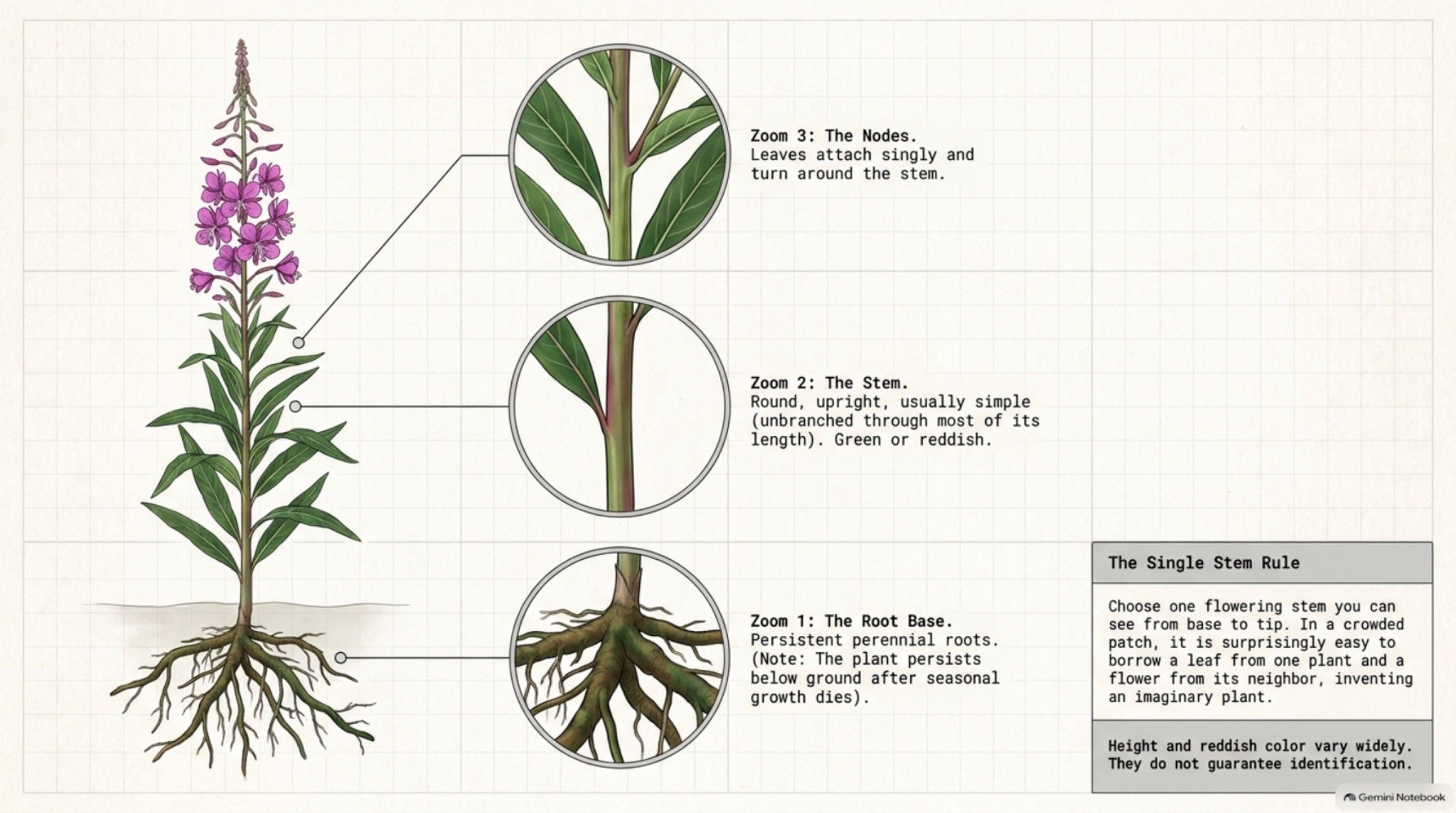
Start where the stem meets the ground. In a crowded patch, a leaf from one plant can cross the flowers of another. Following the same stem keeps those pieces together. It also slows the eye enough to reveal details that a quick recognition passes over.
Common tall fireweed is a perennial. The stems you see belong to a plant that can persist below ground after the season’s growth has died. A stem is round and usually simple through much of its length, although it may branch near the top. Green and reddish stems both occur; height varies with the plant and its growing conditions. Leave room for that variation as you look.
The places where leaves meet a stem are called nodes. On a typical tall fireweed stem, leaves attach singly and turn around it. Follow several attachments, low down as well as higher up. Leaves can be crowded or differently arranged near the base, and a leaf pointing toward you may hide the one behind it. Moving around the stem often makes the pattern clearer than looking from above.
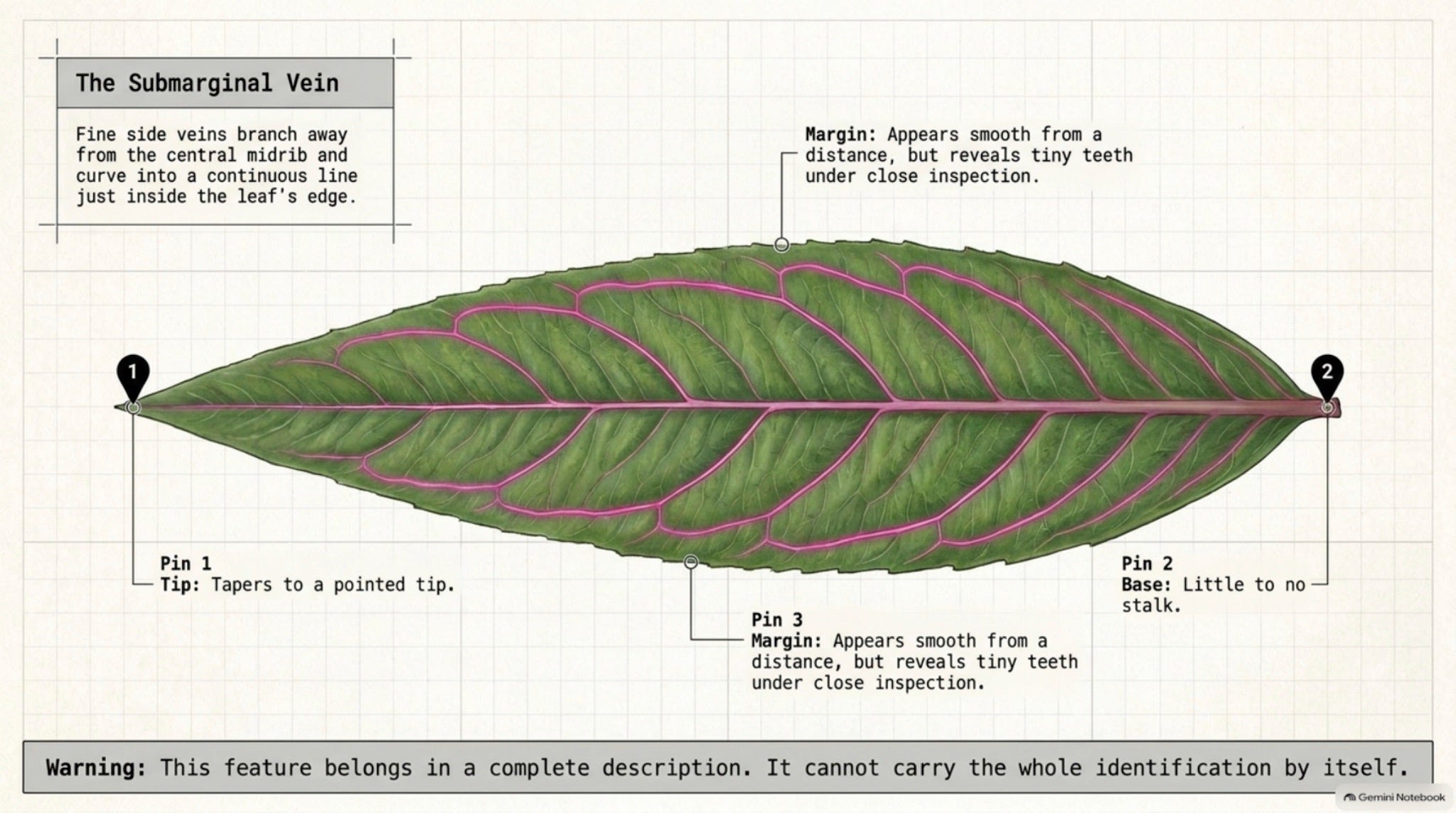
A mature leaf is narrow and pointed, with little or no leaf stalk. What looks like a smooth edge may show small teeth on closer inspection. Then there is the vein just inside that edge. Many side veins run out from the midrib and join it, making a fine border within the leaf itself. Botanists call it the submarginal vein. The word describes a position you can see.
Try following one side vein all the way out. The movement is small, from the centre of the leaf toward its margin, but it changes the leaf from a green outline into a structure. Shape, attachment and venation now belong to the same observation. Together they are more useful than any one feature remembered alone.
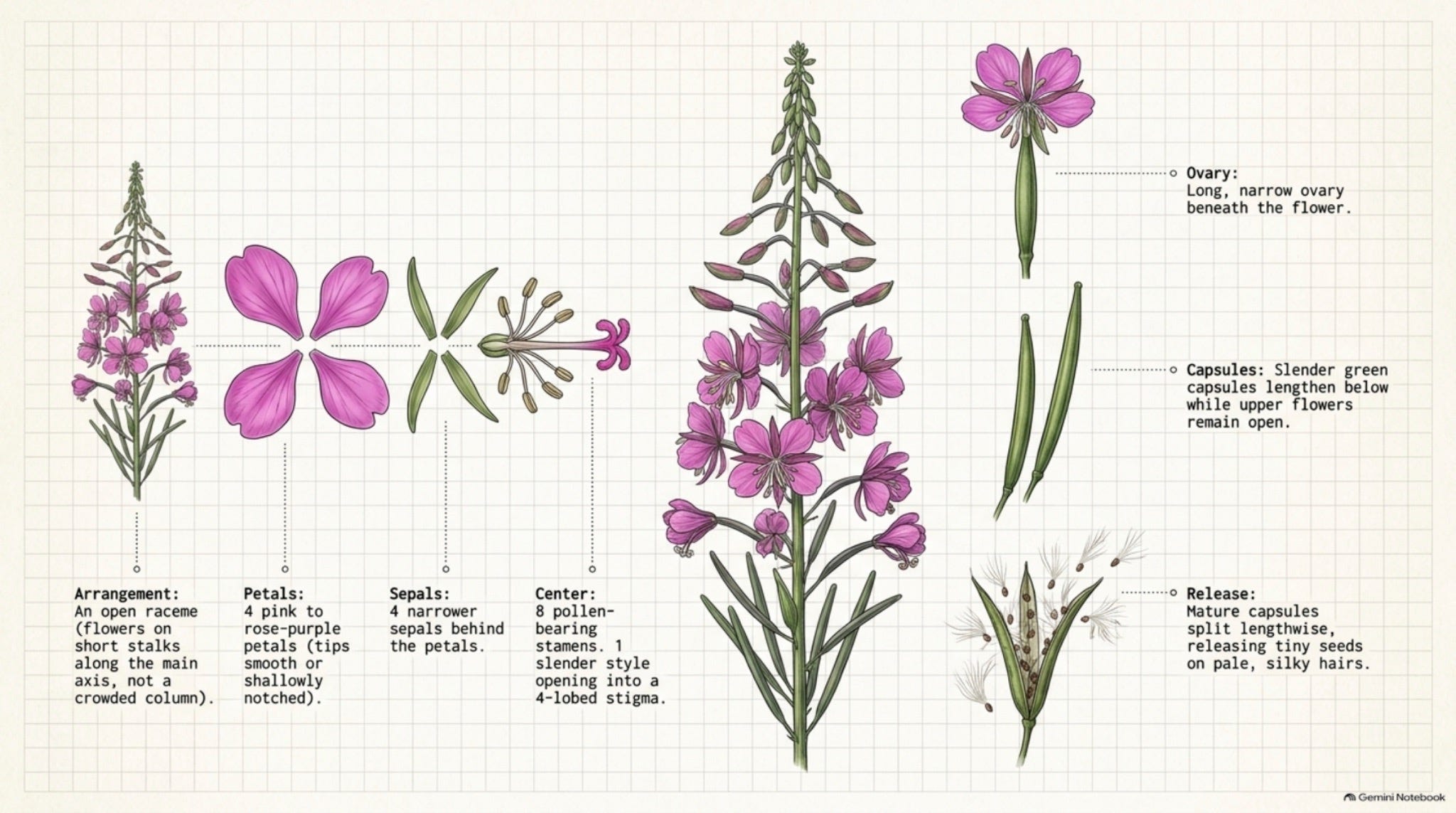
At the top of the stem, flowers stand on short stalks along an elongated central axis. This arrangement is a raceme. Look from the side and you can see the spaces between the individual flower stalks, a useful distinction from a dense column of blossoms.
An open flower usually has four pink to rose-purple petals. Behind them are four narrower sepals, the parts that enclosed the bud. Petal tips may be smooth or shallowly notched; some plants bear much paler flowers, occasionally white. Eight pollen-bearing stamens surround the centre. A slender style carries the stigma, the pollen-receiving surface, which can open into four spreading lobes as the flower matures.
Look at several flowers on the same stem. Their centres may be at different stages. The detail that is folded or inconspicuous in one can be easier to see in another. Chapter 2 follows those changes through the life of a flower.
A side view reveals a long, narrow ovary beneath the petals. This is the part that develops into the seed capsule. Lower on the stem, slender capsules may already be lengthening while flowers remain open above them. Later, the capsules split along their length and release tiny seeds bearing pale, silky hairs that help carry them on the air.
The plant now offers several connected features: stem, leaf attachments, venation, flower cluster, flower parts and capsules. Let them confirm one another. If a detail does not fit, give it a second look. That small interruption is often where learning begins.
1.2 Meet it before and after flowering
Flowering gives a beginner the fullest view. Buds, open flowers and developing capsules can occupy one stem, with each stage showing something the others conceal. A flowering patch is a good place to begin a year’s acquaintance.
Take a few photographs that you can find again: the whole plant, several leaf attachments and something recognisable in its surroundings. Note where you stood. On a later visit, matching that view will help you see what has changed rather than relying on a general memory of the patch.
Spring offers a smaller vocabulary. Leaves are unfolding, stems are short and the flowers have yet to appear. Even the phrase “young fireweed” can describe two different beginnings. A shoot rising from an established perennial draws on a plant already living below ground. A seedling begins from seed, and its first leaves can be broader and rounder than the narrow leaves of a flowering stem. Neither has to look like a miniature summer plant.
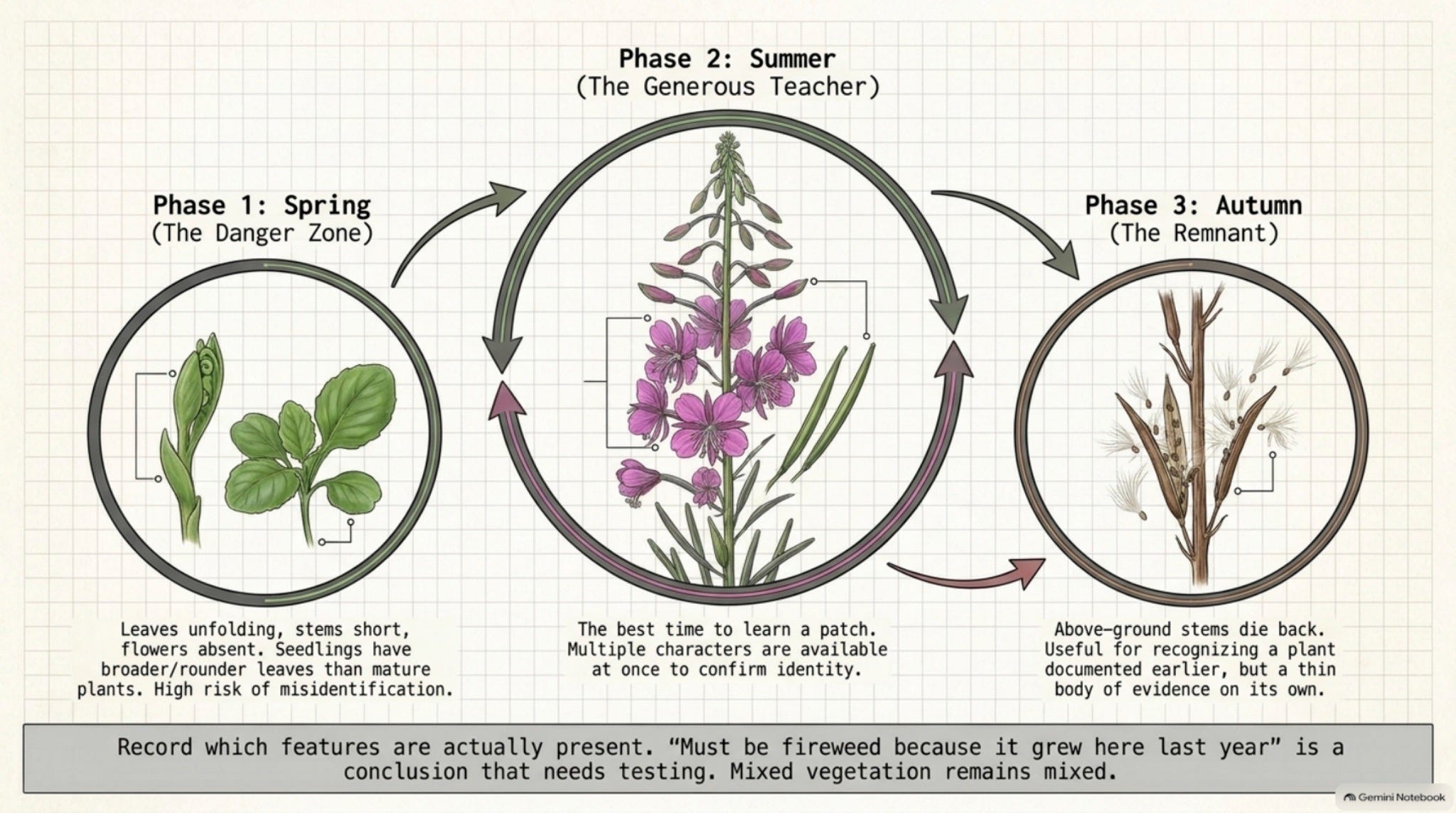
Return to a patch you learned in bloom and look at the growth around the old stems. Some shoots may be fireweed; others may belong to neighbouring species. Follow each one on its own terms. Last year’s photographs give you a history to work with, while this year’s plant supplies the evidence in front of you.
By late summer, the capsules may catch your attention as readily as the flowers. Watch one that has begun to open. The closed green capsule becomes narrow separated strips, with seed hairs emerging between them. Loose silk may lodge on another leaf or stem, so the connection to an opening capsule is worth finding. It lets you see release taking place rather than simply finding its traces.
In autumn, leaves colour, dry and fall. The upright stems die back, while the perennial plant can remain alive below the surface. Some seed release may continue after frost has killed the shoots. The open capsules and dry stalks of a documented plant can carry your recognition into the colder months, although they offer fewer features than the flowering stem.
Keep the stage beside the date in your notes. A cool coastal opening, an exposed interior slope and a mountain patch need not keep the same calendar. “First open flowers seen today” tells you more than “late for July.” Over time, those ordinary entries become a record of one place, attentive to the season it actually had.
1.3 Keep the names connected
Fireweed carries a place in its English name. It calls to mind the plant’s familiar appearance on burned ground. Rosebay willowherb, widely used in Britain, draws attention toward its flowers and narrow leaves. The name bombweed recalls its growth among Second World War bombsites. Ivan-chai leads toward leaves gathered and made into a Russian tea.
These names hold different kinds of attention. One remembers a landscape; another follows a plant into a household. A name can be a beginning to a story, provided we keep track of whose story it is.
The Champagne and Aishihik First Nations’ Dàkwänjè Dictionary records Nàkhela in Southern Tutchone. A Yukon First Nations curriculum connects the name explicitly with tall fireweed. Keeping the word beside its language, community and published source allows the reader to follow it back. Chapter 5 returns to particular people and accounts, with the same care for attribution. The name is shared here without assigning it an invented translation or claiming community endorsement.
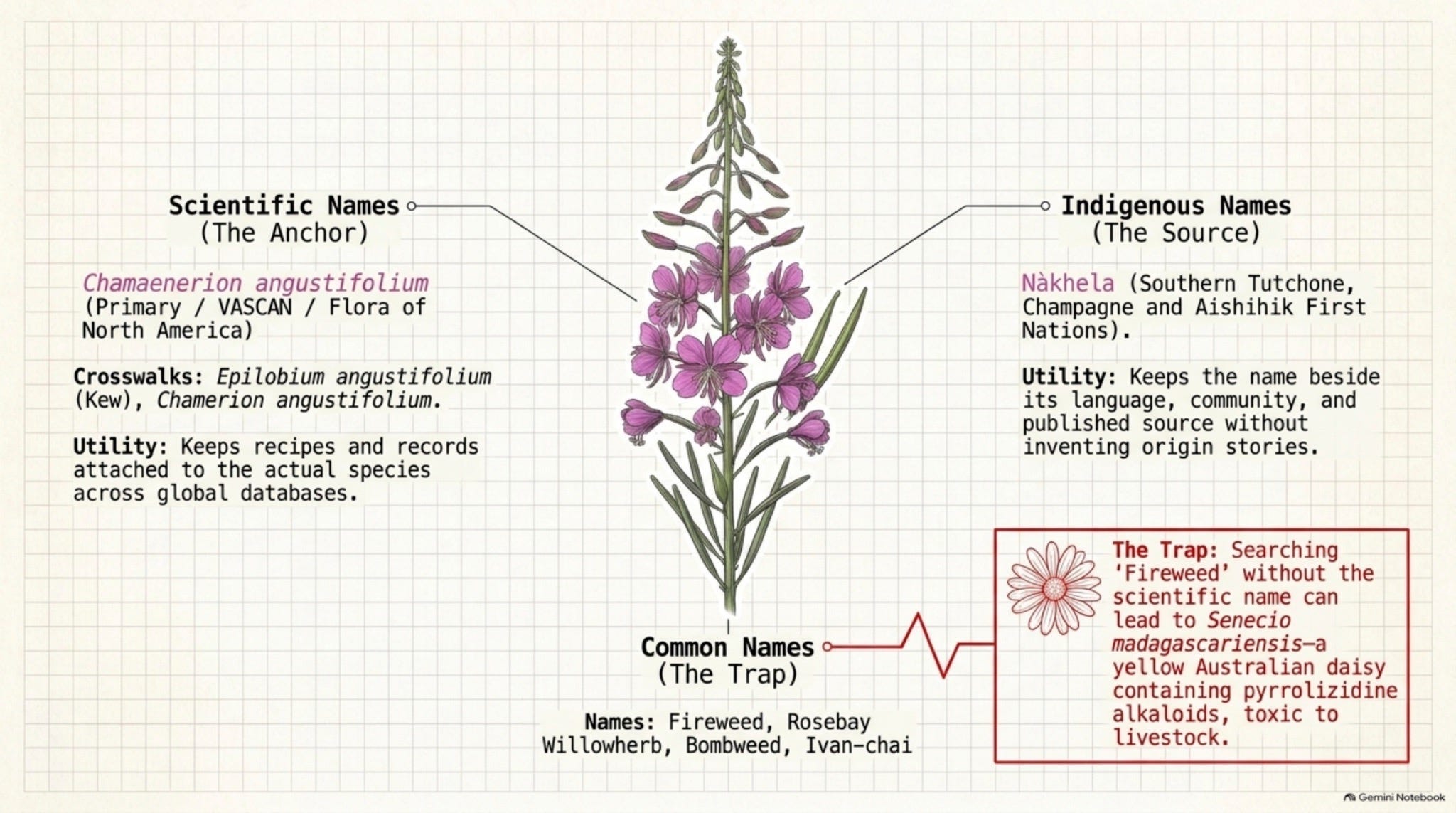
Scientific names make another set of connections. This book uses Chamaenerion angustifolium, following the Canadian VASCAN database and Flora of North America. Kew’s Plants of the World Online accepts Epilobium angustifolium. Chamerion angustifolium is also common in guides and research papers. For tall fireweed, these names link different botanical treatments of the same focal species.
Keep all three in mind when searching. An older study may sit under a name that differs from the one on a recent plant label. Its original name remains part of its record. Subspecies, other willowherbs and uncertain commercial ingredients still need their own checks, but knowing these connections saves useful work from being lost between names.
In a notebook, write the scientific name beside “fireweed,” then add the place, date and source of the identification. There is no need to turn every walk into a formal survey. A few precise words simply give a future reader, including your future self, a way back to the plant you meant.
1.4 Look beside it
Comparison gives familiar features sharper edges. A pink flower seems more particular after you have looked at another pink flower on a differently arranged stem. The plants below offer useful comparisons for Canada and the Pacific Northwest; a regional flora can extend the set for your area.
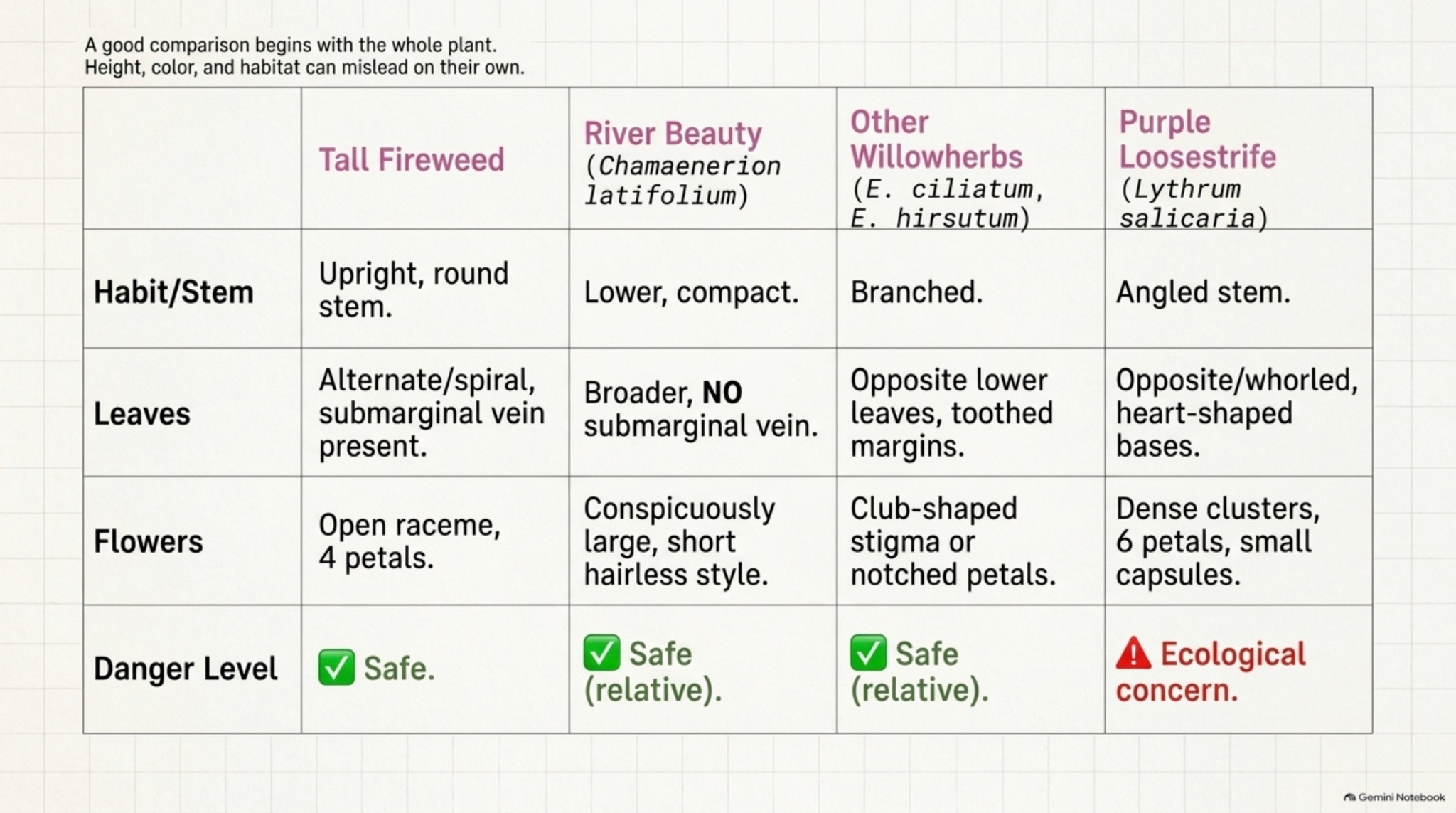
River beauty or dwarf fireweed, Chamaenerion latifolium, is a close relative. It often forms a lower, more compact plant, with proportionally broader leaves and conspicuously large pink-purple flowers. Moist gravel and sand beside rivers and streams are familiar settings, especially in northern or mountain country. Tall fireweed also grows beside water, so look beyond the riverbank itself.
River beauty’s leaves have fewer, less conspicuous side veins and lack the tall species’ submarginal vein. Its flower has a hairless style shorter than the stamens; tall fireweed has a longer style with hairs toward its base. A clear regional reference or a botanist can help you learn those finer structures. Both species produce long capsules and hair-tufted seeds. Their recorded uses nevertheless belong with the species named in the source.
Other willowherbs share parts of the same family pattern. Four pinkish petals, long capsules and silky seeds occur beyond tall fireweed. Ciliate willowherb, Epilobium ciliatum, commonly branches above and has opposite lower leaves, finely toothed margins and relatively small, notched flowers. Its stigma is usually club-shaped. Look for hairs, including glandular hairs near the flowering portion, and follow the leaves upward, where their arrangement can become alternate.
Hairy willowherb, Epilobium hirsutum, can be tall and robust, with fairly large pink-purple flowers and a four-lobed stigma. Conspicuous long hairs, substantial branching and distinctly notched petals help separate it from tall fireweed. Its toothed leaves are often stalkless or clasping, opposite below and alternate higher in the flowering region. It is introduced in North America and associated with moist or wet ground. A local key will help with the finer distinctions among willowherbs.
Purple loosestrife, Lythrum salicaria, may first attract the eye in much the same way as a patch of fireweed: upright stems carrying a mass of purple. Walk closer and the flower arrangement changes. Dense clusters sit around the upper stem, and flowers often show six petals. The stem is angled. Leaves commonly grow opposite one another or in threes lower down, with rounded or heart-shaped bases; upper leaves may be alternate. Its small capsules contrast with fireweed’s long, slender ones. Petal number varies, so keep it with the other characters you have observed.
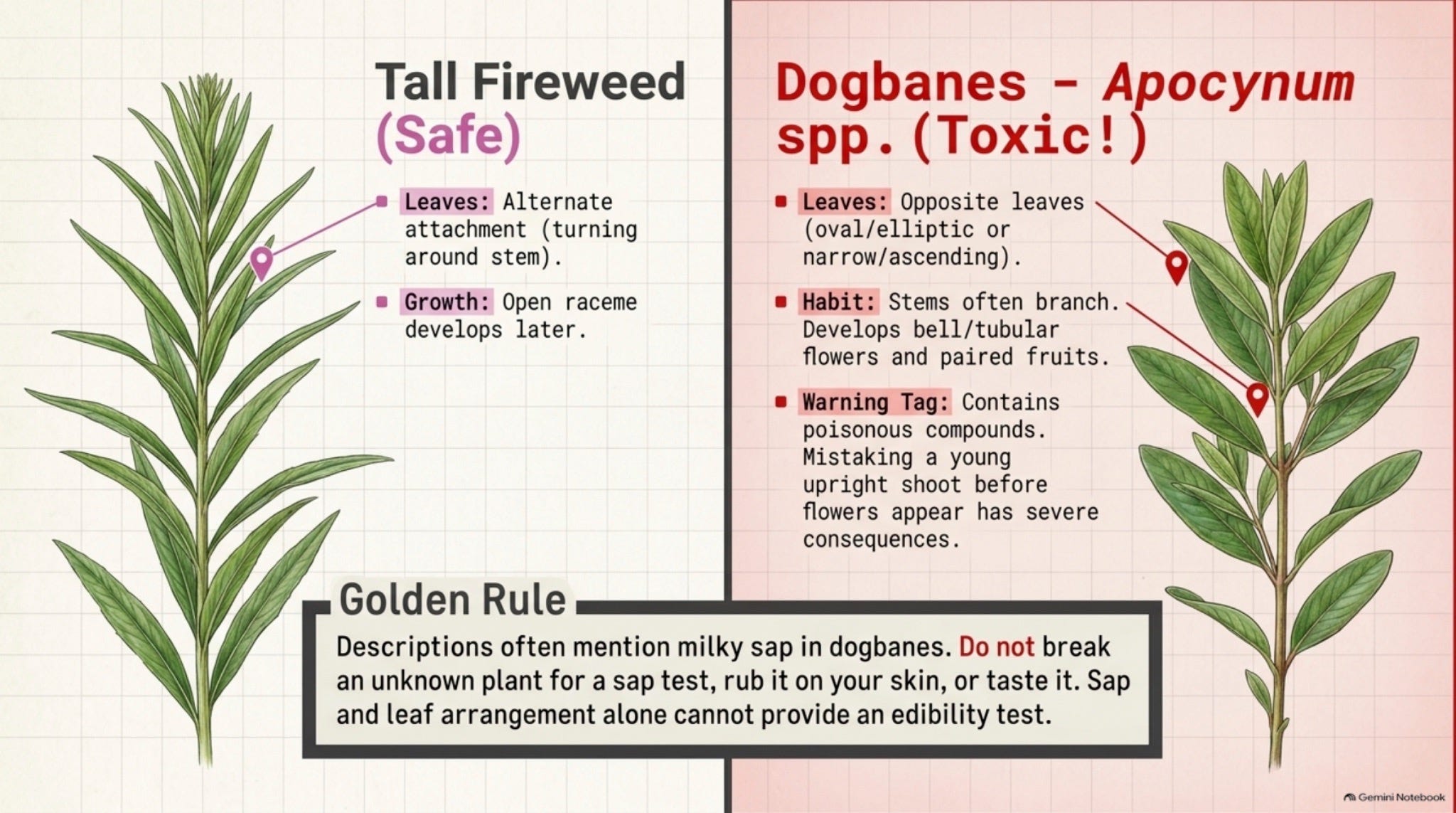
Dogbanes deserve a place in the early-season comparison because they are poisonous and their young shoots may lack the flowers that make the difference easier to see. Spreading dogbane, Apocynum androsaemifolium, has opposite, generally oval to elliptic leaves on short stalks, branching stems and small white-to-pink bell-shaped flowers. Hemp dogbane, Apocynum cannabinum, can have narrower, more ascending leaves and small white or greenish tubular flowers. Long, narrow fruits commonly develop in pairs. A young stem may still be unbranched.
Observe an unfamiliar shoot in place. Leaf arrangement and later flowers or fruit are useful features to document; breaking it for a sap test or tasting it is not a suitable way to settle its identity. When the available details leave doubt, a regional botanist can help you decide what to look for next.
Each comparison sends you back to tall fireweed with a more exact question. Where does this leaf attach? How are these flowers grouped? What shape does the fruit take? These are questions a living plant can help you answer, one visible part at a time.
1.5 Check which fireweed a source means
A search for “fireweed” can also lead to a yellow daisy in an Australian pasture. Senecio madagascariensis is unrelated to the tall pink-flowered plant in this book, but it shares the English name. Australian agricultural guidance describes its livestock toxicity, including poisoning through contaminated fodder.
This explains some apparently contradictory search results. The photograph, warning and advice may concern a different plant on another continent. Before carrying a claim into your own notes, check the scientific name and the region, then follow it to its source.
The same habit serves a useful practice or a reassuring claim about food. Knowing that one warning concerns Senecio tells us which plant that warning belongs to. Questions about using tall fireweed still depend on its identity, the part gathered, the site and the preparation. Later chapters take up those decisions where they become practical.
Common names keep plants present in everyday speech. Scientific names help us follow a claim accurately. A good record has room for both.
1.6 Make a record someone else can read
One beautiful flower photograph may preserve the colour perfectly and leave the identity unresolved. A useful set shows how the parts belong together. You can make it with the plant standing where it grows, wherever access is permitted and the footing allows.
Begin with the setting. Note the date, region, habitat and approximate height, and take a view of the surrounding patch. Add a whole-plant photograph that connects the stem to its visible base. There is no need to expose the roots. If a precise location would put a sensitive site at risk, keep that detail private.
Move closer for the leaf attachments, showing several nodes low down and higher up. Choose a leaf whose outline, margin and veins are visible. A ruler held beside it without damaging the plant gives the image a scale. Where the underside is already accessible, include that view too.
Photograph flowers and fruit from the front and side. Several flower centres may show stages that one photograph would miss. Include intact or opened capsules when present, and close views of hairs or branching if these are relevant to the comparison.
Finish with a sentence about what you could not see. “No flowers yet,” “base hidden by grass” or “vein pattern unclear” helps another person understand the limits of the set. It also gives you a short list for the next visit.
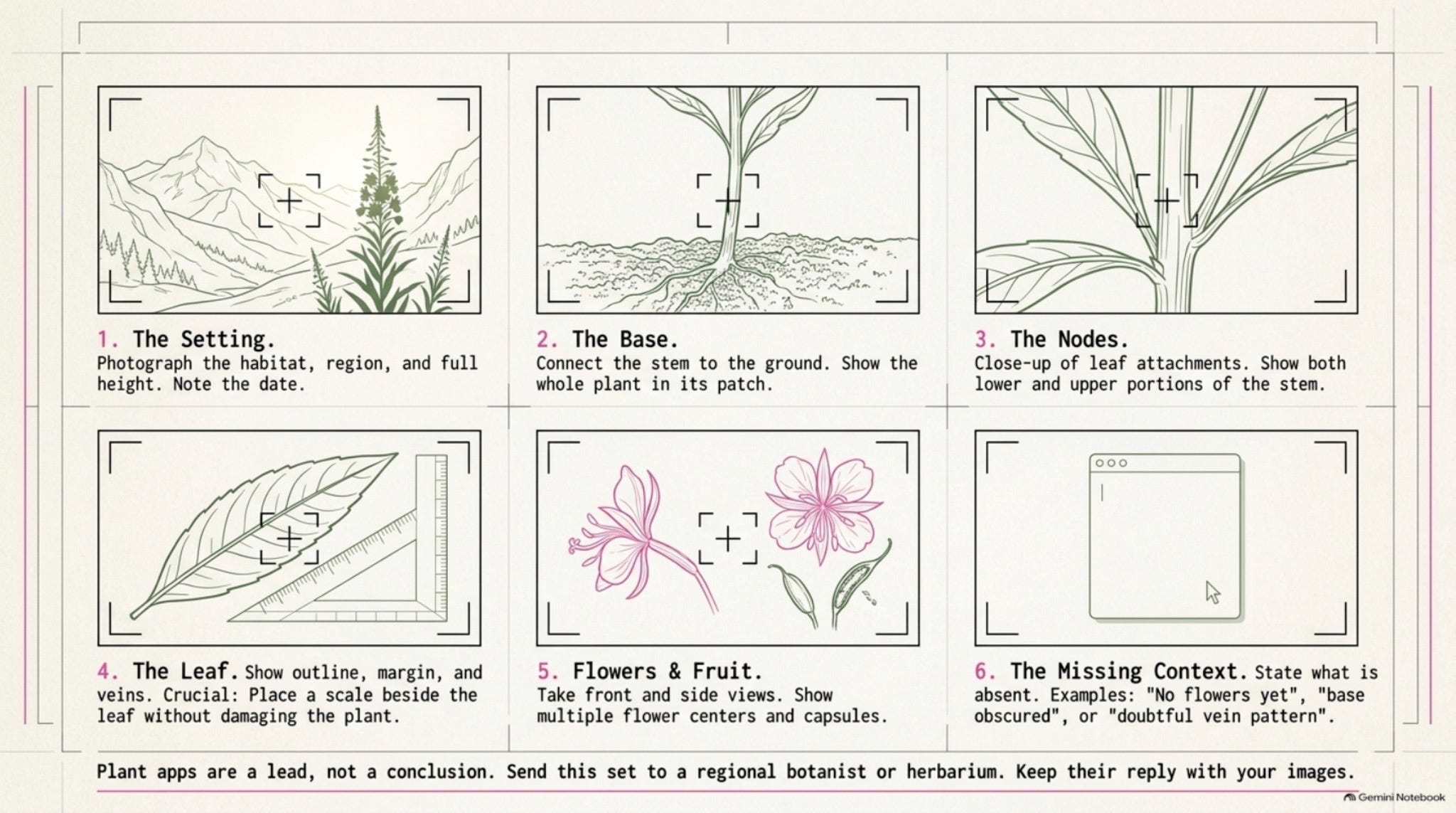
Send the photographs to someone familiar with the plants of your region, such as a botanist, herbarium contact or an appropriate extension service. Ask which features support the name and whether another view is needed. If a specimen would help, follow their advice about permission and collection.
An identification app can supply a lead. The useful next step is to compare its suggestion with the features you have recorded. Keep any expert reply with the photographs and date, including a tentative identification if that is all the evidence supports. “Possible tall fireweed; flowers needed” leaves a clear question for your return.
1.7 Return with one thing to look for
You do not have to learn every feature in a single visit. Choose one that you can recognise again: the vein running inside a leaf’s edge, the short stalk beneath a flower, the first opening along a capsule. Draw it or photograph it. Then leave enough time on your next walk to find it again.
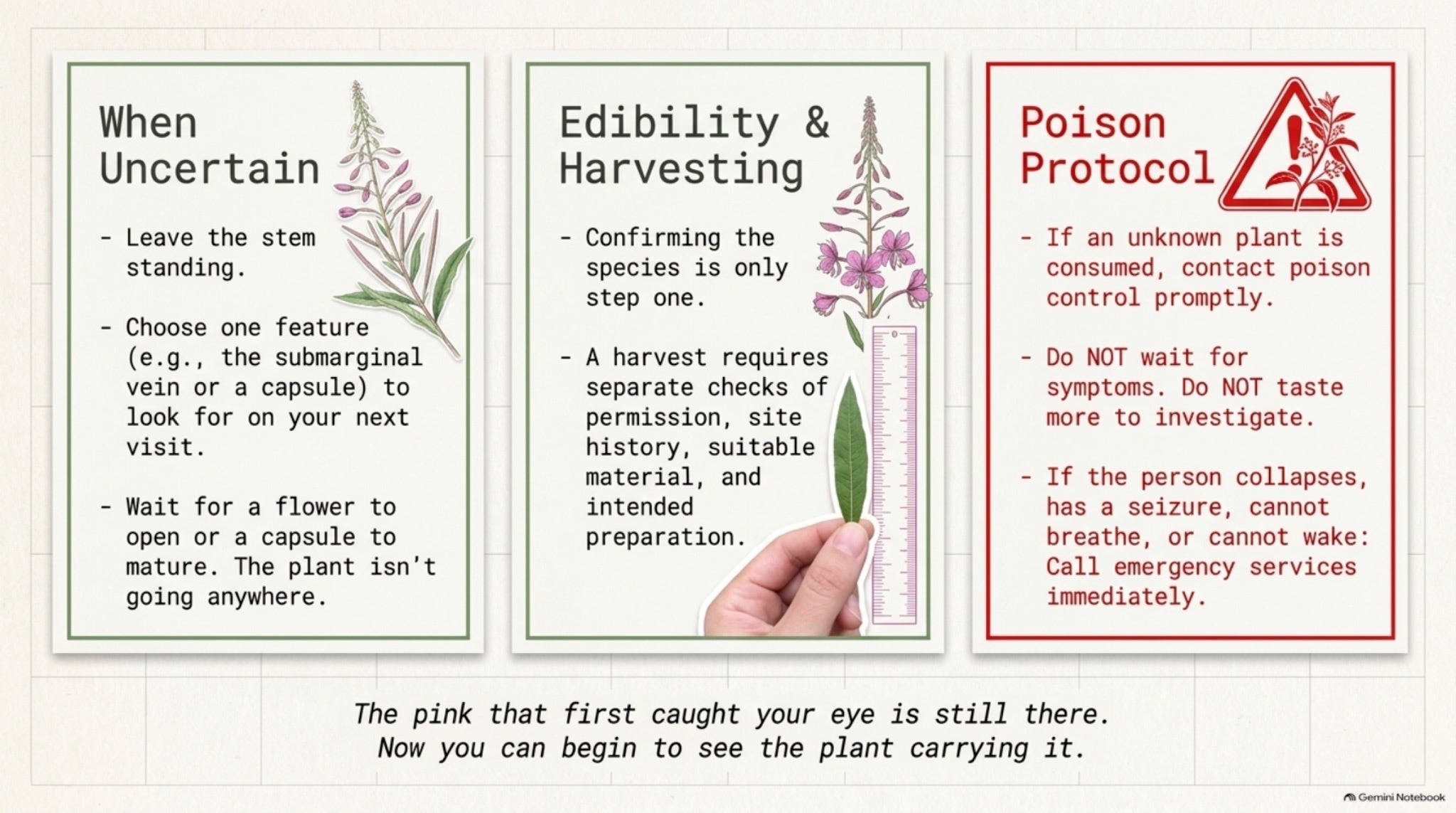
While the identity remains uncertain, leave it ungathered and do not eat it or offer it as food. A harvest also calls for permission, a check of site history, suitable material and an appropriate preparation. Chapter 7 follows those checks; Chapter 6 takes up growing and management. This chapter and its schematic illustration support observation, rather than serving as a complete food-identification key.
A practical note belongs here: if someone eats an unidentified plant, seek poison-service advice promptly, without waiting for symptoms or a finished identification. If the person collapses, has a seizure, has trouble breathing or cannot be awakened, call local emergency services immediately.
For an ordinary first visit, there may be nothing to take home except a photograph and a better question. Leave the stem standing. Look once more from the leaf to its attachment, then upward to the flowers.
The patch will gather back into colour as you walk away. But the next time you see that pink across a clearing, you may remember the fine vein inside the leaf, or the green capsule below the flower. Distance has not made the plant less particular. You have learned where to begin looking.
Sources and further looking
These references support the descriptions and naming in Chapter 1. The photographic sequence is a practical observation method proposed by this guide. Regional botanical review of the chapter and illustration remains outstanding. For identification in a particular place, use a regional flora and advice from a botanist familiar with that flora.
The flowering plant and its parts
Flora of North America and Burke Herbarium · USDA NRCS Fireweed Plant Guide
The flora supplies the detailed description; Burke provides regional context and photographs. Rich Fleenor’s 2016 NRCS guide is an additional plant reference. Several leaf attachments should be examined because arrangement near the base can vary. No single vein pattern establishes an identification.
Seasonal appearances
US Forest Service Fire Effects Information System · IRIIS phytoprotection
The Forest Service synthesis supports perennial persistence, locally varying seasonal timing and seed release after frost. The Québec diagnostic resource documents seedling and vegetative appearances. Its photographs are useful references, not reproduced here.
Scientific names
VASCAN species record 17491 · Kew Plants of the World Online
VASCAN accepts Chamaenerion angustifolium following Flora of North America. Kew accepts Epilobium angustifolium and connects the Chamaenerion and Chamerion combinations as synonyms. Names rechecked 8 October 2026.
Names in place and use
Royal Horticultural Society · Prakofjewa and colleagues 2020
The RHS records rosebay willowherb and the wartime bombsite association of bombweed. The historical and interview study, “Re-written narrative: transformation of the image of Ivan-chaj in Eastern Europe,” supports the tea-name context without establishing the origin legends often repeated about it.
Southern Tutchone Nàkhela
Champagne and Aishihik First Nations Dàkwänjè Dictionary · Plants and Connection to Place
The dictionary records the name on printed page 26. The Yukon First Nations Curriculum Working Group’s November 2017 publication connects it explicitly with tall fireweed. This source-specific lexical attribution does not imply consultation, endorsement or permission to adapt associated teachings.
River beauty and other willowherbs
Flora of North America genus key · River beauty · Ciliate willowherb · Hairy willowherb
These flora accounts support the comparisons of venation, style, hairs, leaf arrangement and flowers. The selected comparisons are not a complete regional key, and no edible-use claim is transferred between species.
Purple loosestrife and dogbanes
Flora of North America on Lythrum salicaria · Washington State Noxious Weed Control Board · South Dakota State University on spreading dogbane · Burke Herbarium on hemp dogbane · North Carolina State Extension on dogbane
The accounts support the combined characters and the reason for including poisonous dogbanes. This chapter does not estimate how often a particular plant is mistaken for fireweed.
An unrelated plant called fireweed
New South Wales Flora Online · NSW WeedWise
The flora identifies Senecio madagascariensis; WeedWise describes its livestock toxicity, including contaminated fodder. It is one consequential common-name overlap.
Advice after an unidentified plant is eaten
Poison Control on getting help · Poison Control on immediate assistance
These sources support prompt poison-service advice and the emergency signs stated in section 1.7. Use the poison service and emergency number for your location. Guidance rechecked 8 October 2026.
CHAPTER 2
A year above and below ground
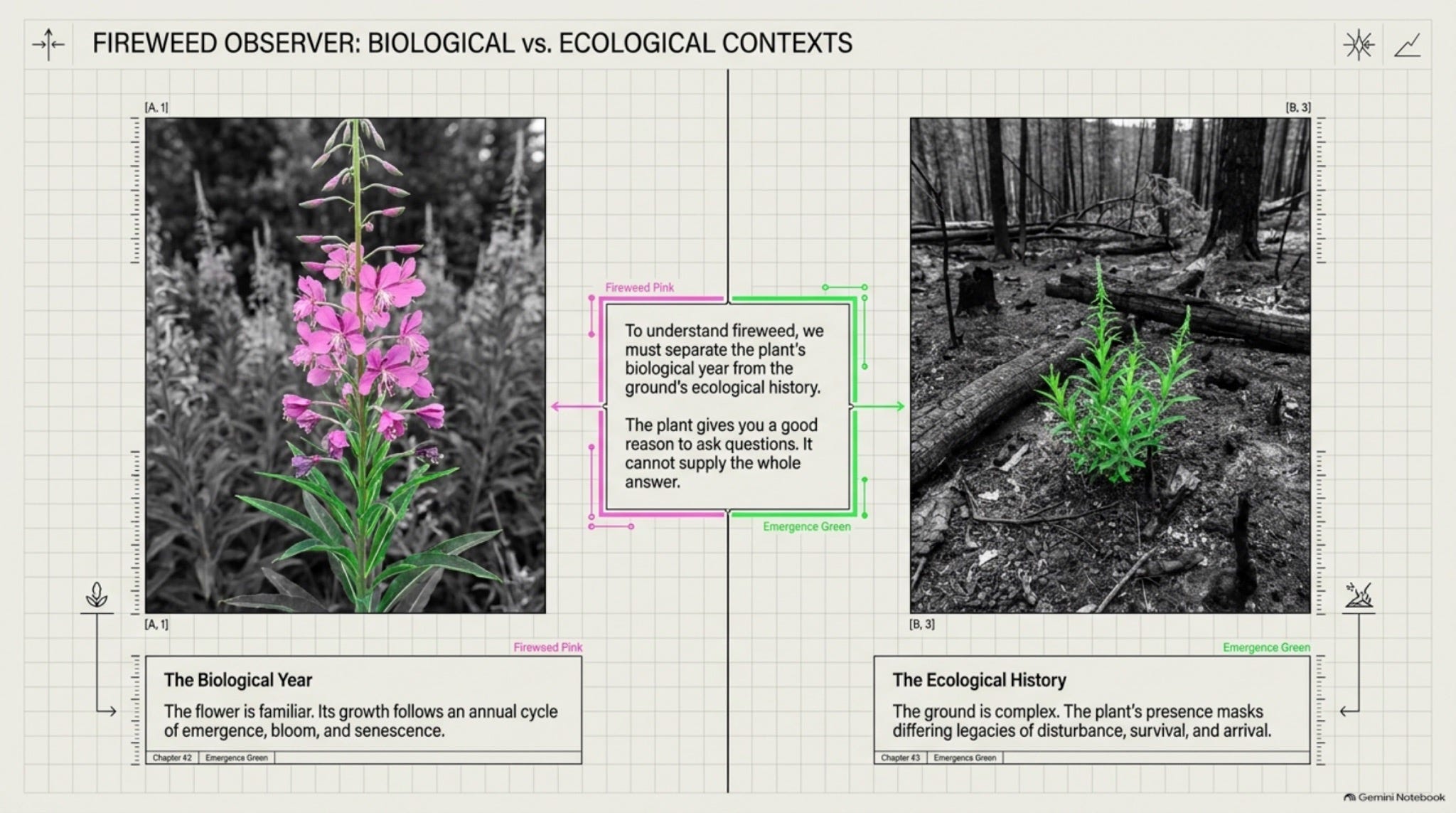
The first flowers have gone from the lower part of a fireweed stem. In their place, slender green capsules lengthen. Higher up, petals are open; above them, buds remain tightly gathered. Your eye can travel through several stages without leaving the stem.
Return to the same plant and the arrangement will have shifted. A flower you remember may have lost its petals. A closed capsule may have opened. Eventually, even the green leaves will be gone. Following one stem through these changes gives time a shape you can recognise.
Below the soil, another part of the year continues out of sight. Fireweed is a perennial, and the living system beneath a stem can survive the death of its summer growth. A new shoot may draw on that established life or begin as a seedling with a much shorter history. Several stems may belong to one clone.
This chapter follows both the visible season and the life that supports it. We begin close to the ground, move upward through the flowers and seed, then return with the year to the soil surface. Along the way, a familiar patch becomes a place where you can notice change with more precision.
2.1 Watch the first shoots
In spring, the place you remember for its flowers may ask you to lower your gaze. Dry stalks stand above small green growth, and fallen leaves can conceal a whole young plant. Begin, if possible, where you documented fireweed in bloom. Last year’s photographs give you a place to return to and a mature plant to compare with.
Look between the old stems, leaving the soil undisturbed. New leaves may be folded close together. As the shoot lengthens, their separate attachments become easier to follow. Photograph the same small area again as they unfold, keeping a fixed landmark in view. A stone or fence post can help you find the cluster you meant when several nearby shoots look much alike.
Two different beginnings may be present. A shoot rising from an established perennial starts with roots, stored resources and living buds already in place. A seedling begins with the resources held in its seed and must develop its own root and shoot. Both are new above ground, but one may belong to a plant that has lived through several seasons.
The seedling can also look unfamiliar. Québec’s IRIIS diagnostic account describes oval seed leaves, called cotyledons, followed by oval early leaves in a low rosette. The long, narrow leaves of the flowering plant come later. Looking only for a miniature summer stem can mean overlooking the seedling at your feet.
Follow these stages in a plant whose identity you can confirm. Neighbouring shoots may belong to other species, and last year’s fireweed does not identify everything growing around it. Chapter 1 provides the fuller identification route; uncertain plants can stay in place while you learn more.
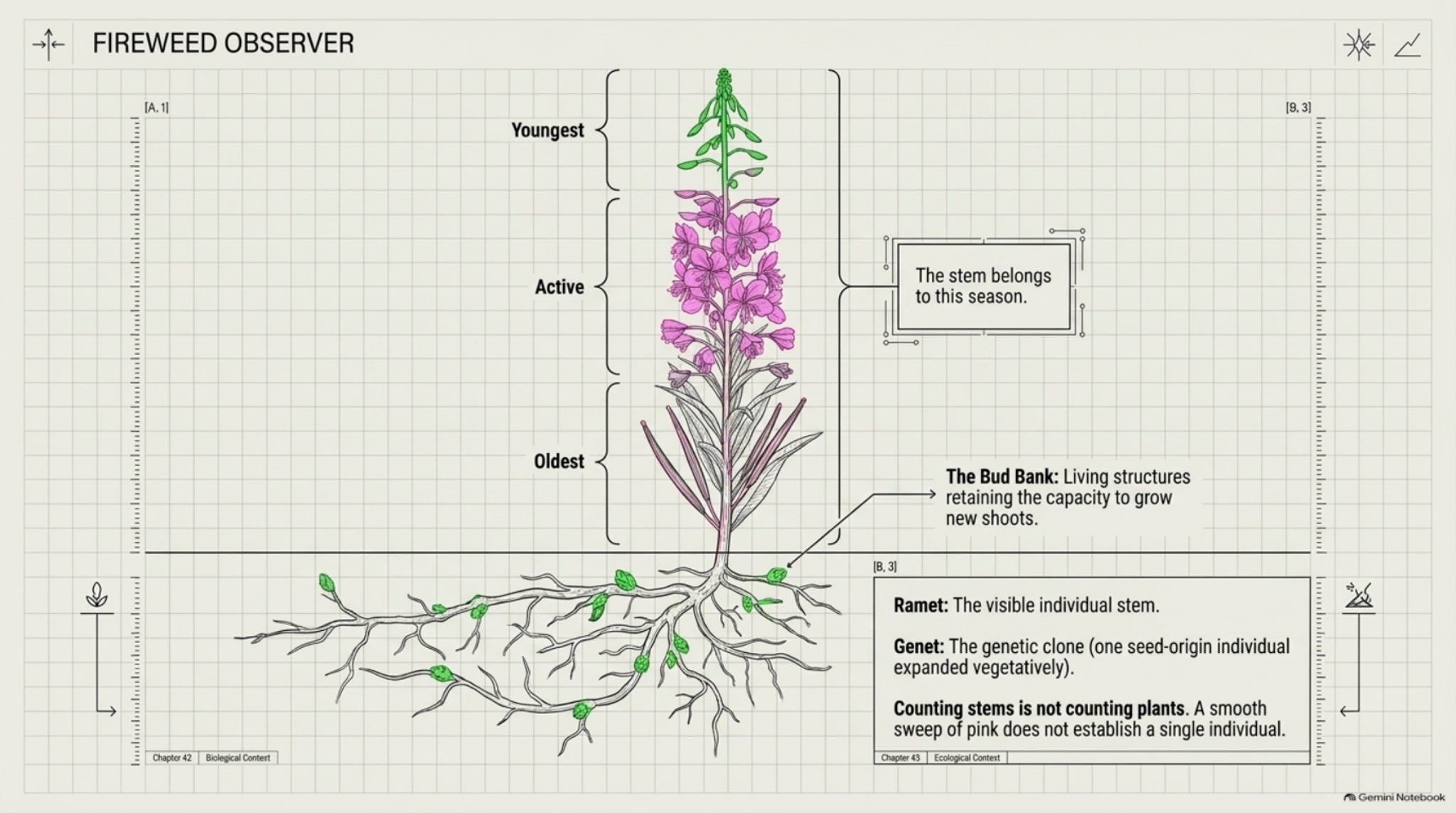
Size alone will not tell you whether a shoot came from seed or an older underground system. Nor does its position beside a dead stalk prove a connection. A garden plant followed from sowing has a history your records can supply. Elsewhere, “new shoot, origin uncertain” may be the most accurate description.
Some young fireweed plants have already passed a winter before you notice them in spring. Seeds can germinate late in the growing season, and the seedlings may overwinter as rosettes. Autumn photographs of the ground can reveal a small plant that was there while the last capsules were opening above it.
The timing belongs to the place. A coastal opening, an interior valley and a mountain patch need not emerge together. Once shoots appear, return often enough to see the leaves unfolding. Let the plant’s development guide the interval rather than choosing a date simply because the calendar says April.
For each visit, record where you looked, what you could see and the date. Note snow or litter covering the ground. “No shoots seen” is a different observation when the surface is hidden. You may learn the plant’s identity before you learn its origin, and a useful record can hold both a name and an unanswered question.
2.2 Find the life that stays underground
Follow a stem down to where it enters the soil. This is where your view stops, though the plant continues. Beneath the surface, roots extend into the surrounding ground, and living buds on underground organs can give rise to shoots. Some will emerge away from the stem you first noticed.
Botanical studies help us understand what we can leave undisturbed. Researchers have documented buds on fireweed roots at different sizes and stages of development. Together, the living buds held below ground form what is often called a bud bank. Some may grow into shoots; others may remain inactive. The stems of one summer show only part of the plant’s capacity to grow again.
The names of the underground parts matter here. A rhizome is a stem growing underground. A root remains a root even when it bears a bud that produces a shoot. Flora of North America reports rhizomes in fireweed, while experimental work also documents root-borne buds and shoots. Where the particular organ has not been examined, “spreading underground system” is a useful, accurate phrase.
Through this vegetative growth, one plant that began from seed can produce many shoots. This is clonal growth. Researchers call the genetic individual and its vegetative descendants a genet; a potentially independent unit within the clone is a ramet. The distinction helps them separate a count of visible units from a count of genetic individuals.
On an ordinary walk, “stem,” “clone” and “patch” will usually be enough. A stem is the structure you can follow upward from the ground. A clone shares a vegetative origin. A patch is the area you have chosen to describe, perhaps beside a fence or across a clearing. It may contain several clones and seedlings, with other species among them.
These distinctions change what a count means. Ten flowering stems are ten flowering stems, however many genetic individuals they represent. An outline drawn around a patch records its area. Differences in flower colour or timing may be worth noting, but they cannot by themselves reveal clone boundaries. A broad sweep of pink can hold histories that the surface does not disclose.
The underground plant also stores resources. In a boreal study published in 1997, Simon Landhäusser and Victor Lieffers measured seasonal carbohydrate storage in fireweed alongside several shrubs. Fireweed accumulated reserves during the growing season. While our attention follows the flowers, persistent tissues are part of the plant’s preparation for further growth.
This becomes easier to appreciate after a stem is cut. Living buds and stored resources may remain below it, allowing new growth to appear. Chapter 6 follows that distinction into management. Remember that possibility when a shoot rises beyond the edge of a familiar patch. The visible boundary may not mark the underground one.
2.3 Follow a flower through its phases
Choose an open flower and bring your eye level with its centre. Eight stamens carry pollen in anthers at their tips. Nearby, a slender style bears the pollen-receiving stigma. These structures change position and function as the flower ages, so a detail that seems tucked away on one visit may be prominent on the next.
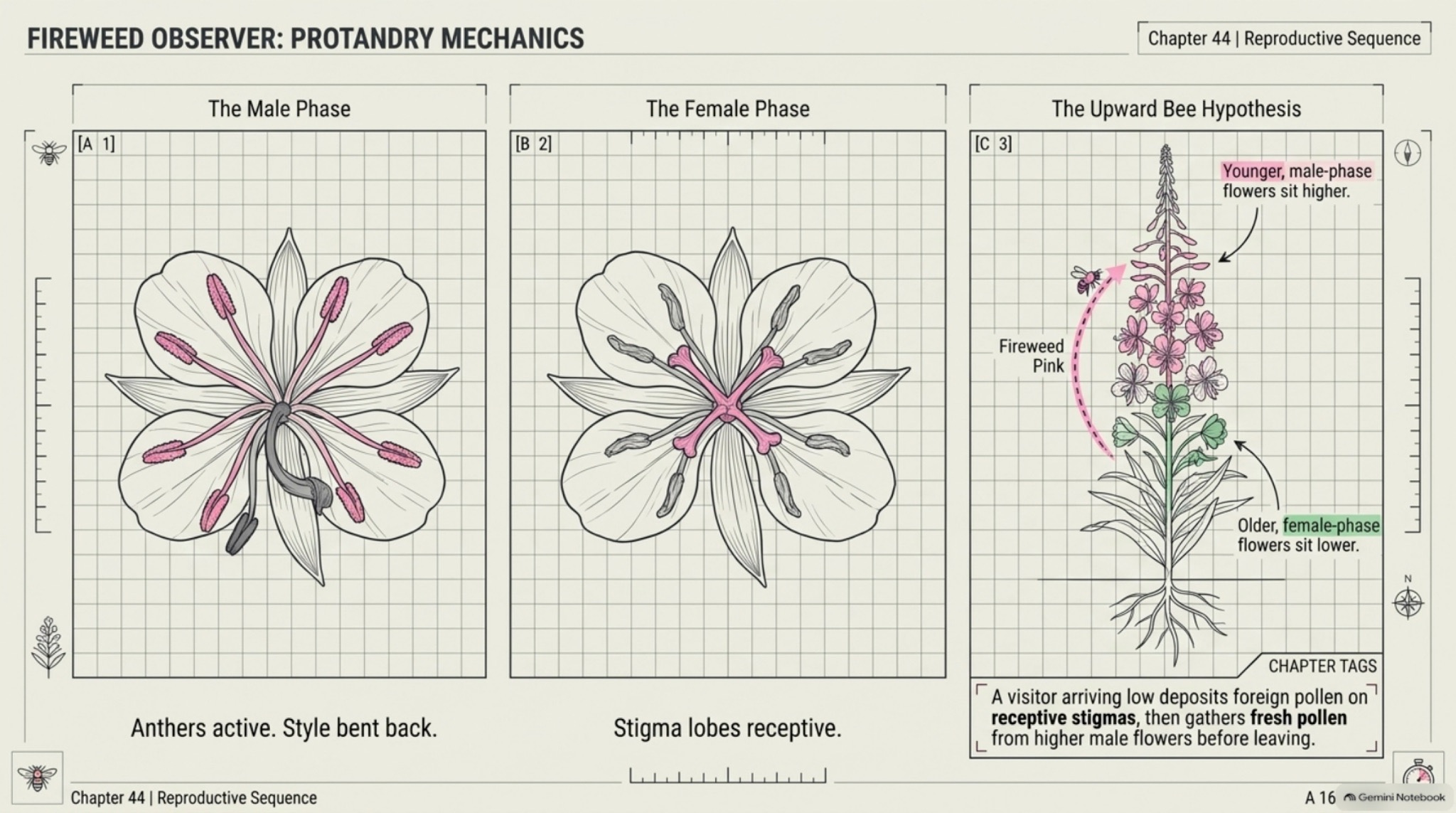
Early in the flower’s life, the anthers release pollen while the stigma’s lobes remain closed and the style bends away. Later, the style moves forward and the four lobes spread, opening the pollen-receiving surface. This male-first sequence is called protandry. One flower passes through both phases.
A front view records the centre; a side view shows the style’s position relative to the stamens. Take both, then return to the same flower if you can recognise it. A small sketch can make the change easier to remember: anthers prominent and style bent back, then stigma lobes spreading forward. Leave the parts where they are and move your viewpoint to see them.
The sequence within a flower works alongside the sequence along the stem. Lower flowers generally open first. Older, pollen-receiving flowers therefore tend to sit beneath younger, pollen-bearing ones. A bee arriving low and moving upward can touch a receptive stigma before collecting pollen higher on the stem. Pollen carried from another plant may be delivered before the visitor takes more away.
Watch an actual visit. Where does the bee land? Does it climb steadily, skip a flower or leave after one stop? Different visitors may take different routes. A few minutes spent following one can reveal movement that disappears into the general impression of a busy patch. Record the route you see; what happens to each grain of pollen will usually remain beyond your view.
Experiments let researchers ask the next question. In a 2003 study, Matthew Routley and Brian Husband manipulated floral displays in enclosed groups of fireweed. Their experimental protandrous plants had greater success siring offspring on other plants than those whose male and female functions overlapped. The result supports a reproductive advantage under those experimental conditions.
Fireweed can also fertilise itself. Viable pollen may remain when the stigma becomes receptive. A visitor can move pollen between flowers on the same plant, or between stems belonging to the same clone. Those separate stalks may appear to be different plants while sharing a genetic origin. The underground life reaches into the story of the flower.
The pollen’s origin can affect what follows. Brian Husband and Douglas Schemske studied one diploid fireweed population and found poorer performance of self-fertilised offspring at several stages, with a strong effect during seed maturation. Their 1995 study helps explain why a self-compatible plant may still benefit from crossing with another individual.
As the petals fade, follow the long ovary beneath them. The developing seeds remain enclosed as it matures into a capsule. A flower visit, pollen receipt, fertilisation, seed development and a surviving seedling are successive events, each with its own conditions. Watching the capsule lengthen keeps you with the process after the most conspicuous part has gone.
2.4 Let the capsule open
A closed capsule can disappear among the narrow leaves until a pale line draws your attention. Its lengthwise seams are opening. The fruit wall separates into slender strips, exposing seeds and their silky hairs. What had looked smooth and self-contained becomes loose enough to move with the air.
Look for a seed still held in the opening fruit. Most of what catches the light is hair. Flora of North America gives the seed body as 0.9 to 1.3 millimetres long and its tuft as 10 to 17 millimetres. The tuft can be more than ten times the length of the body it carries. Once you find that small body, the mass of silk begins to resolve into individual seeds.
The tuft is called a coma. It helps keep the seed airborne by slowing its fall. A gust may lift seeds clear of the capsule; a lull may leave them caught against a leaf or neighbouring stalk. Stand to one side for a few minutes. Feel the air move, then watch what the loosened hairs do. The first movement may be a tremble before anything leaves the stem.
Follow one seed as far as you can. Perhaps it catches close by; perhaps you lose it against the sky or the vegetation beyond. The point where it disappears from view is the limit of your observation, not necessarily the end of its journey. Seed can leave the boundary of a garden or patch, even when you cannot follow it to its landing place.
Long-distance dispersal is possible, but different kinds of evidence tell different stories. A seed caught high in the air, a calculated journey and a seed traced to an established plant are not interchangeable records. For a patch calendar, noting that release occurred and describing the air during your visit may be enough.
Landing begins another set of conditions. The seed needs a suitable seedbed and enough moisture to germinate, and its young root and shoot must survive. Silk caught on a dry stalk marks an arrival. Even bare-looking ground may be too dry, shaded or unstable for a seedling to persist. Chapter 3 follows those conditions into places opened by disturbance.
Fireweed seed can germinate without fire. Nor is it generally a long-lived reserve in the soil awaiting the next burn. In Anders Granström’s 1987 experiment, seeds were placed in the forest-floor organic layer of a northern Swedish coniferous forest, then recovered and tested over time. The fireweed seed reserve was exhausted within the first year, partly through germination. That finding describes the experiment’s conditions; carefully stored nursery seed has a different history.
A patch returning year after year may therefore owe much to living underground organs and newly arriving seed. Its reappearance alone cannot tell you how it began. Leave capsules attached and return as they open. “In seed” soon becomes several recognisable stages: closed green fruit, opening seams, exposed silk and, finally, empty strips.
2.5 Follow autumn into winter
The patch begins to show more of its framework as leaves change colour and fall. Yellow, red and brown may replace the green. Through the thinning foliage, capsules that were easy to miss become conspicuous. Some stems may still carry flowers while others are already drying.
This aging and decline of living tissues is senescence. Its pace can differ within a patch. The Forest Service’s fireweed review notes that limited water can bring on foliage colour in late summer and autumn, so a dry edge may look farther through its year than a moister hollow. Record what differs, leaving the cause open when colour is all you have observed.
Eventually, the season’s aerial stems die. Their dry structure may remain standing while the perennial persists beneath the soil. Seeds can continue to leave capsules after frost has killed the shoots. On one stem, growth may have ended while dispersal carries on.
Return to a stem you photographed in flower. Find the places where those flowers were. Which capsules have opened, and which still hold silk? Are the empty strips straight or curled? Has the stalk stayed upright, bent or fallen? On a breezy day, dry leaves or stems may brush against one another. The plant you first knew through colour now asks you to attend to form and movement.
Standing dead vegetation can also offer structure for other life. Studies of perennial garden plants show that some insects use hollow stems or excavate soft pith for nests. Whether a particular stem is useful depends on the plant, the insect and access to a suitable opening. This gives us a reason to look at retained fireweed stems without assuming they are occupied. A hole alone cannot identify its maker.
Where a few stems can remain without conflicting with the site’s safety or management, keep them in your observation patch. A visitor resting on a stalk or entering an opening is something you can document while leaving it undisturbed. Any pruning advice should fit the plants, insects and conditions of your region. Chapter 4 takes up fireweed’s relationships with other life in more detail.
Winter may interrupt the record. Snow can hide the stems and soil; storms can flatten what you photographed. The missing stalk tells you little about the life below it. Leave room for these gaps. When you return in spring, the first green growth will answer some questions and begin others.
2.6 Make a calendar for this patch
A seasonal observation gains meaning through the place and people who know it. In “When the Wild Roses Bloom,” Nancy Turner and Andrea Reid attribute to Bernadette Antoine, Nlaka’pamux, an account connecting full fireweed bloom with the time to hunt mule deer, after the fawns had been born. Their 2022 table credits her through Turner and colleagues’ 1990 publication. The Nlaka’pamux context is the southern Interior of British Columbia and adjoining territory.
Antoine’s account connects the plant’s development with an animal’s life and a human activity. Turner and Reid stress that published knowledge remains connected to its holders and communities. Keeping her name and community beside the account preserves that connection and its local context. Chapter 5 returns to these questions of knowledge and care.
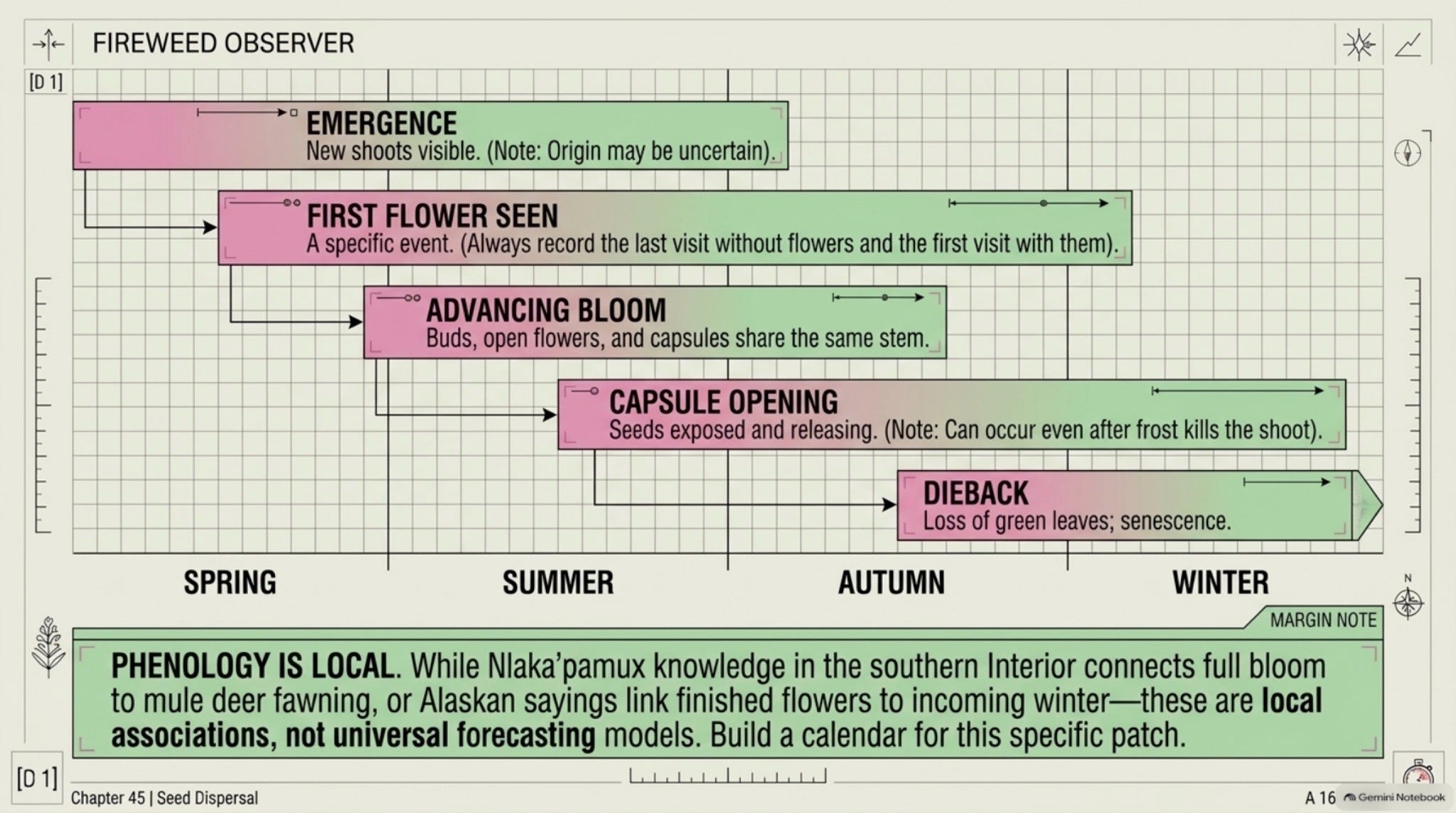
A saying recorded by the National Park Service at Dyea, Alaska, offers a different seasonal question: winter is six weeks away once the top of the fireweed has finished flowering. The caption records the saying without testing its accuracy. If you want to compare it with your own patch, begin by deciding which events you will record.
Will “finished flowering” mean one chosen stem, most of the patch or its last open flower? Will winter mean the first frost or lasting snow? These events need not happen together. Choose the endpoints before comparing dates, and keep the same meanings as you return.
This attention to the timing of recurring events in living things is called phenology. A patch calendar makes it practical. Choose a place you can revisit with permission and sound footing, and use fixed landmarks to recover the same view. Describe the boundary so you know when it changes.
Five stages can give the record a simple structure. They may overlap on a single stem and across the patch.
Emergence. New shoots are visible above the surface. Record confirmed seedlings separately and leave other shoots’ origins open where needed.
First flower seen. At least one open fireweed flower is visible within the boundary. Photograph its stem and note how much of the patch you checked.
Advancing bloom. Compare the positions of buds, open flowers and developing capsules on recognisable stems. Note how the stages vary across the patch.
Capsule opening. A capsule has split and exposed its seeds. Record separately whether you saw any seeds leave it.
Dieback. Describe the loss of green leaves and living aerial growth in the observed area. One browned stem need not mark the end of the patch’s season.
For each visit, keep the date, patch name and a photograph from the same viewpoint. Add a close view when something changes. Weather and site notes can be simple: rain during the visit, visible snow, a cut you witnessed or a temperature from a named instrument or station. Record elevation and slope direction when reliably known. Keep impressions of dryness separate from measured rainfall.
“First seen” is worth writing in full. If flowers opened between visits, your photographs place the event within an interval. Keep the last view without flowers beside the first one with them. You have a firm date for what you saw, even when the precise day of opening remains unknown. The same care applies to emergence and capsule opening.
At the end of a season, lay the dated photographs in order. The changes between them may be as revealing as any single image. Notice where stages overlap, where a visit was missed and where you moved your viewpoint. If you tested the winter saying, record the interval between your chosen events. Several years may show whether the association is useful here; a neighbouring valley will still need its own record.
You can begin at any point. An opening autumn capsule is enough, or a spring rosette whose development you can follow. Start with what is here.
On your next visit, find the same place. Follow a stem from the soil upward. What was closed may have opened; what was green may have dried. Beneath those visible changes, living tissues can carry the plant into another season. You have a clearer sense of what happened here, and a reason to return.
Sources and further looking
These references support the seasonal descriptions and research in Chapter 2. The observation prompts offer a way to return to one patch and keep a clear record of what changes. Seasonal dates and experimental results remain attached to the places and conditions in which they were recorded.
Young plants and seasonal development
IRIIS phytoprotection · US Forest Service Fire Effects Information System
The Québec diagnostic account describes cotyledons, early leaves and rosettes. Diane S. Pavek’s 1992 Forest Service synthesis includes overwintering rosettes, water-related foliage colour and seed release after frost-killed shoots. Its seasonal records come from different regions and habitats; they do not supply a single monthly calendar.
Underground organs and the bud bank
Flora of North America · Klimešová and colleagues 2009 · Raven 1962
The flora describes rhizomes. “Establishment growth and bud-bank formation in Epilobium angustifolium,” Botany 87, 195–201, documents root buds. Raven’s “The genus Epilobium in Turkey,” page 183, distinguishes rhizome-like roots from stems. The chapter retains that anatomical distinction rather than assigning every spreading organ the same name.
Clonal growth and stored reserves
Van Drunen and Husband 2018 · Landhäusser and Lieffers 1997 · Repository abstract
The clonal-reproduction study describes root-bud production and the relationship between ramets and genets. “Seasonal Changes in Carbohydrate Storage and Regrowth in Rhizomes and Stems of Four Boreal Forest Shrubs” also included fireweed. The repository abstract supports the limited statement that fireweed accumulated reserves during the growing season.
The changing flower
USDA NRCS Fireweed Plant Guide · Routley and Husband 2003 · Full text
Rich Fleenor’s 2016 guide describes the floral sequence and self-compatibility. “The effect of protandry on siring success in Chamerion angustifolium,” Evolution 57, 240–248, supports enhanced outcross siring in experimental protandrous displays. It does not establish universal prevention of selfing.
Visitors and offspring
Galen and Plowright 1985 · Husband and Schemske 1995
“Contrasting movement patterns of nectar-collecting and pollen-collecting bumble bees,” Ecological Entomology 10, 9–17, reports upward movement but different arrival positions in Bombus terricola. “Magnitude and timing of inbreeding depression in a diploid population of Epilobium angustifolium,” Heredity 75, 206–215, reports poorer performance among selfed offspring in greenhouse comparisons. These results do not provide a fixed selfing rate for other populations.
Seeds and establishment
Flora of North America gives the seed-body and coma dimensions; the NRCS guide supports wind dispersal and germination conditions. “Seed Viability of Fourteen Species During Five Years of Storage in a Forest Soil,” Journal of Ecology 75, 321–331, reports first-year depletion of the fireweed seed reserve in a northern Swedish forest-floor experiment. Stored nursery seed and seed in other soils face different conditions.
Retained stems
NC State Extension on perennial stems and bee nesting
Elsa Youngsteadt and colleagues describe nesting in selected perennial garden plants. This supports a general reason to examine retained stems, not a fireweed-specific claim of occupancy or a pruning calendar for British Columbia.
Bernadette Antoine’s attributed knowledge
Turner and Reid 2022 · First Nations Health Authority regional profile
“When the Wild Roses Bloom,” GeoHealth 6, e2022GH000612, Table 1 on printed page 7, attributes the fireweed and mule-deer association to Bernadette Antoine, Nlaka’pamux, through Turner and colleagues’ 1990 publication. The earlier book was not independently inspected for this chapter. The regional profile supplies broad geographic context. This brief attribution conveys neither community endorsement nor permission to adapt associated knowledge; permissions for the intended publication still require review.
The winter saying and the patch calendar
National Park Service fireweed caption from Dyea
The caption records the six-week saying without validation data. The five observation stages and photographic method are proposed by this guide. They offer a way to follow one patch; they have not been tested as a weather forecast.
CHAPTER 3
What happens when ground opens
In a dense fireweed patch, flowers can fill your view. Stems lean together, and the ground disappears beneath their leaves. Move your attention to the boundary and another story begins. Here the flowers stop. Beyond them may be the shade of trees, a strip of exposed soil or the straight edge of a road.
Fireweed can grow among blackened trunks. It can also flower along a road cut where no fire has passed. The same familiar plant draws us toward places with different histories. What opened the ground matters, as does what survived there and what found its way in afterward.
This chapter follows those histories outward from the plant. We will look at arrival and regrowth, at the changes fire leaves behind, and at the shifting relationships among soil, water and neighbouring plants. The aim is to see more of the place before deciding what its fireweed means.
If you are returning to your own land after wildfire, begin with the access and site guidance in section 3.6. A flowering patch can be welcome long before the practical questions about the property are settled.
3.1 Follow two routes into a patch
A tuft of seed silk catches on a rough surface. The hairs are easy to see when they hold the light; the small seed body beside them takes more attention. Chapter 2 followed this seed out of its capsule. Here, where it has landed, the more uncertain part of its journey begins.
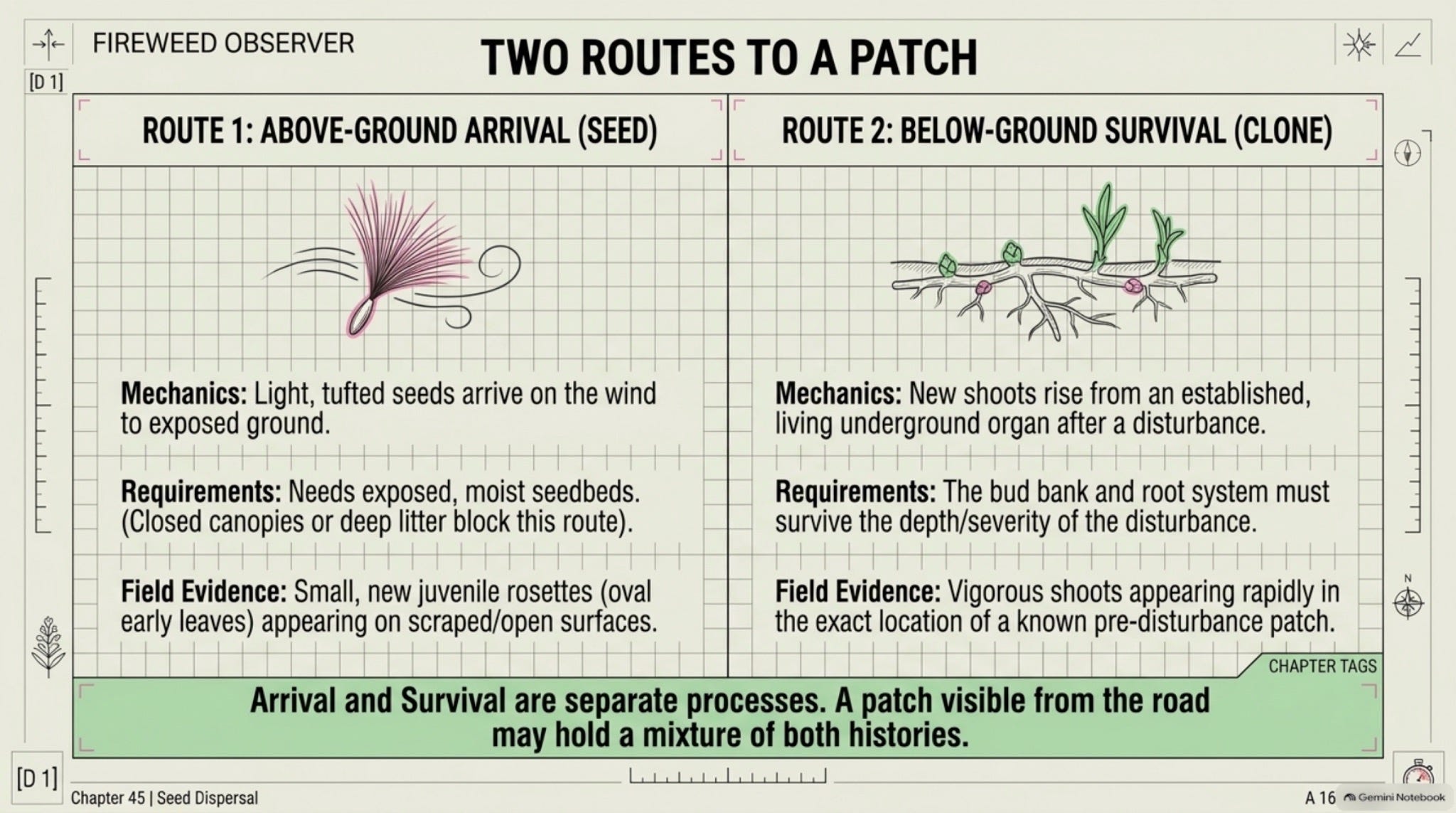
Wind can carry fireweed seed into an opening, but arrival is only one event. The seed must reach a suitable surface, germinate and survive as a seedling. Moist, exposed seedbeds can offer opportunities that deep litter or a close cover of other plants does not. Even in full light, a surface that dries too quickly may offer little chance to establish.
Look at the small differences within an apparently bare patch. Litter remains in one place; nearby, mineral soil is exposed. A stone casts a short shadow. These details help you ask where seedlings might persist. To learn which places actually supported them, you need to return.
Another beginning lies out of sight. Fireweed can produce new shoots from living underground organs. After disturbance, a fresh stem may rise from a plant that was already there, drawing on roots, buds and stored resources. The green growth is new above ground, while the life supporting it has a longer history.
Both routes can occur together. A surviving plant may spread beside seedlings whose seeds arrived from elsewhere. In time, those seedlings can develop spreading systems of their own. The flowering stand seen from a road may contain several generations and origins, even where its surface looks continuous.
An earlier photograph can help. If fireweed grew here before clearing, and new shoots appear in the same area afterward, vegetative recovery is a possibility worth recording. Small plants on newly exposed soil may suggest recruitment from seed. Neither observation, by itself, identifies every plant’s origin. Leave the underground connections intact and use the record you can make above them.
A useful note might read, “Fireweed photographed here before clearing; fresh shoots now visible in the same area; seedlings not confirmed.” If your first visit finds a mature stand, begin there. Its earlier history can remain open without making the present observation less valuable.
Fireweed seed is generally nondormant, and natural soil seed banks are often short-lived. Carefully stored nursery seed has a different history from seed exposed to conditions in the soil. The returning patch may owe much to recent seed arrival, persistent underground growth, or both.
Keeping arrival and survival separate changes the questions you ask. Seed may reach a place readily and seldom establish. An underground plant may persist where few seedlings can gain a foothold. The flowers alone cannot tell you which route brought them here.
3.2 Understand what fire changes
In a burned opening, the sky may occupy space once filled by branches and leaves. More light reaches the ground. From a safe viewpoint, you may see fallen needles in one area, exposed mineral soil in another, and charred material between them. The surface can change within a few steps.
Fire changes several parts of a place at once. It injures or removes vegetation, alters shade and competition, and heats the soil and the material lying over it. Nutrients held in plants and litter may be redistributed or lost. Later rain meets a different surface, with a changed community of roots beneath it.
These changes help explain why fireweed can become conspicuous afterward. A stem may be killed while living organs below it survive and produce new growth. Where those organs have died, or fireweed was absent, incoming seed may establish. The outcome depends on how the site burned and on the conditions that follow.
The new flowers can make it easy to overlook the loss that preceded them. Some plants survived; others did not. Fireweed’s growth shows one part of the response. It does not tell us that every part of the place benefited, or that the earlier community is returning.
Direct exposure to fire is also different from an opportunity left in its wake. Fireweed seed can germinate without burning. Nursery propagation and its growth on unburned disturbed ground make that plain. For a garden planting, there is no need to heat seed, add ash or burn a bed because of the plant’s name. Chapter 6 takes up propagation.
Research in northern Sweden gives a closer view of what happens below the surface. Schimmel and Granström varied the depth of burning in organic surface layers at two forest sites and followed the vegetation. Survival depended partly on the depth of living structures relative to the depth burned. Plants growing back from surviving parts and plants arriving from seed responded differently.
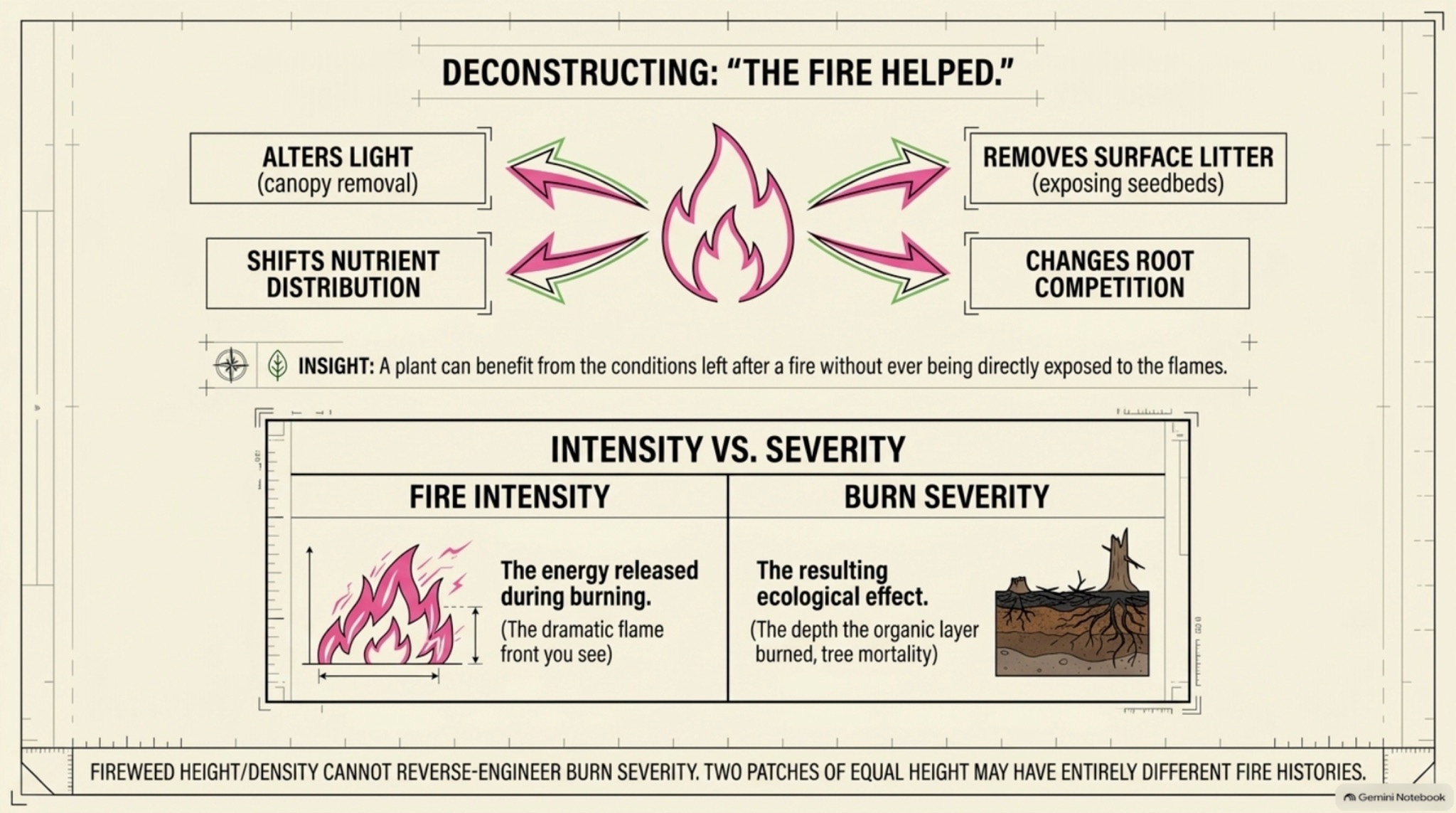
That relationship is more informative than the sight of a fierce flame front. Fire intensity concerns the energy released during burning. Burn severity concerns the effects left behind, with the thing being assessed specified, such as vegetation or soil. Deep or sustained heating of the ground and dramatic flames are not interchangeable measurements.
A useful inquiry follows the affected part of the site. How much of the organic surface layer remains? Which plants survived? What do existing assessments say about the soil or trees? Some answers require trained inspection. From the ground you can safely visit, you can begin with the visible pattern and keep it connected to the conditions under which it formed.
3.3 Read a disturbance honestly
The edge of a road cut may be sharp enough to trace with your eye. An old clearing can be less obvious, its boundary softened by shrubs. Both can hold fireweed. Before reading the plants, establish what happened to the place.
“Cleared” can cover very different work. Trees may have been removed while much of the surface remained. Soil may have been scraped away or brought in from elsewhere. A flood deposit, a harvest, repeated mowing and a wildfire leave different materials and survivors. Even when they all increase light, they do not create the same starting conditions.
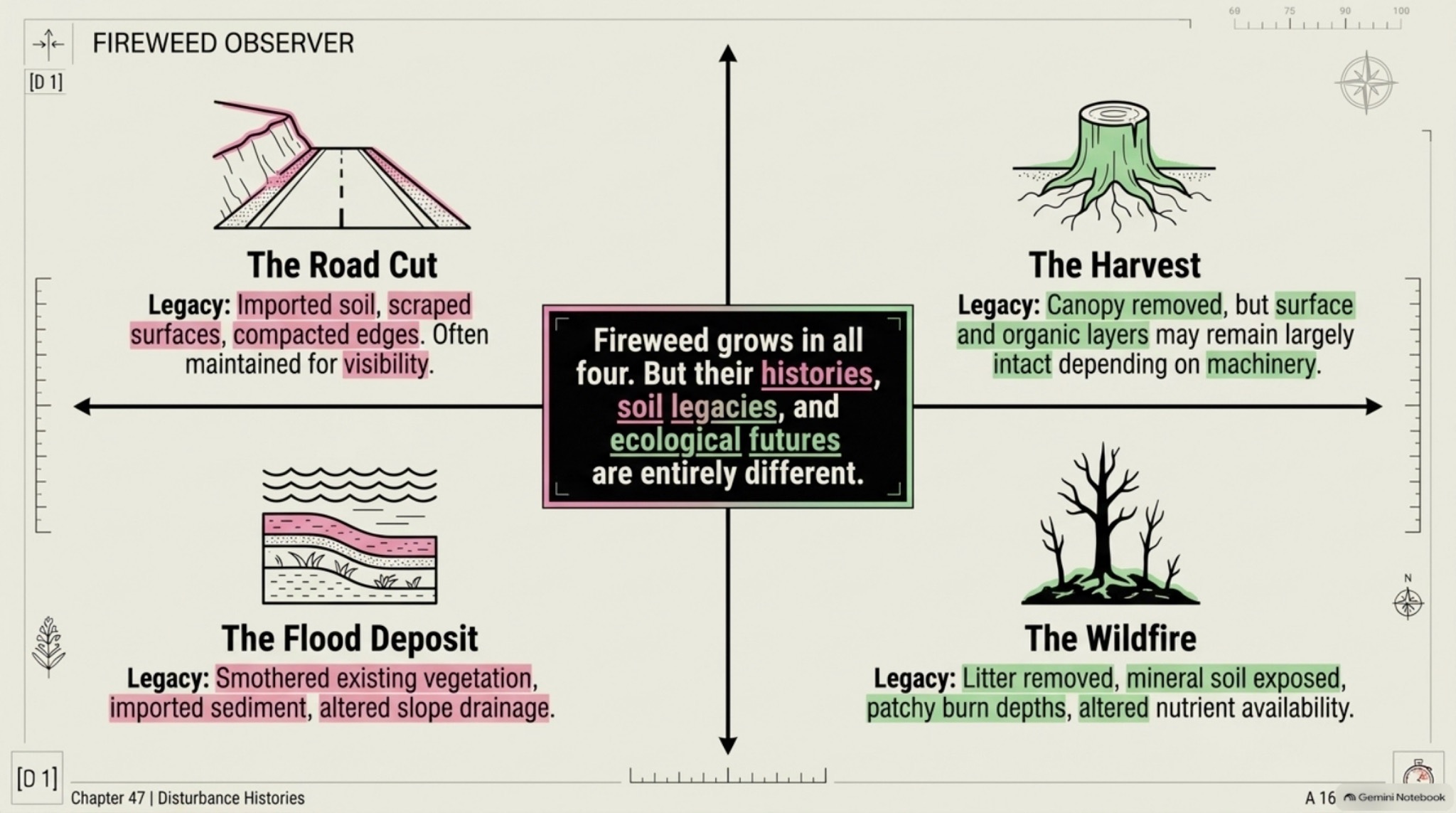
Keep the known history beside your own observations. “Road rebuilt in 2024” belongs in the record when a dated account supports it. “Exposed soil beside road” is enough when that is what you can see. A precise description gives you something dependable to build on later.
Fireweed’s height and density cannot, by themselves, tell you how severely ground burned. Seed supply, surviving underground plants, moisture, shade, neighbouring vegetation and later management all influence the stand. Similar-looking patches can have different histories, and different parts of one burn can grow quite differently.
Follow the boundary instead of stopping at the flowers. Does fireweed thin beneath a shrub? Does it end at a track or continue across it? Is a bare strip also steeper, drier-looking or made of different material? Each is a place to look more closely. The pattern may suggest an explanation before it supplies enough evidence to choose one.
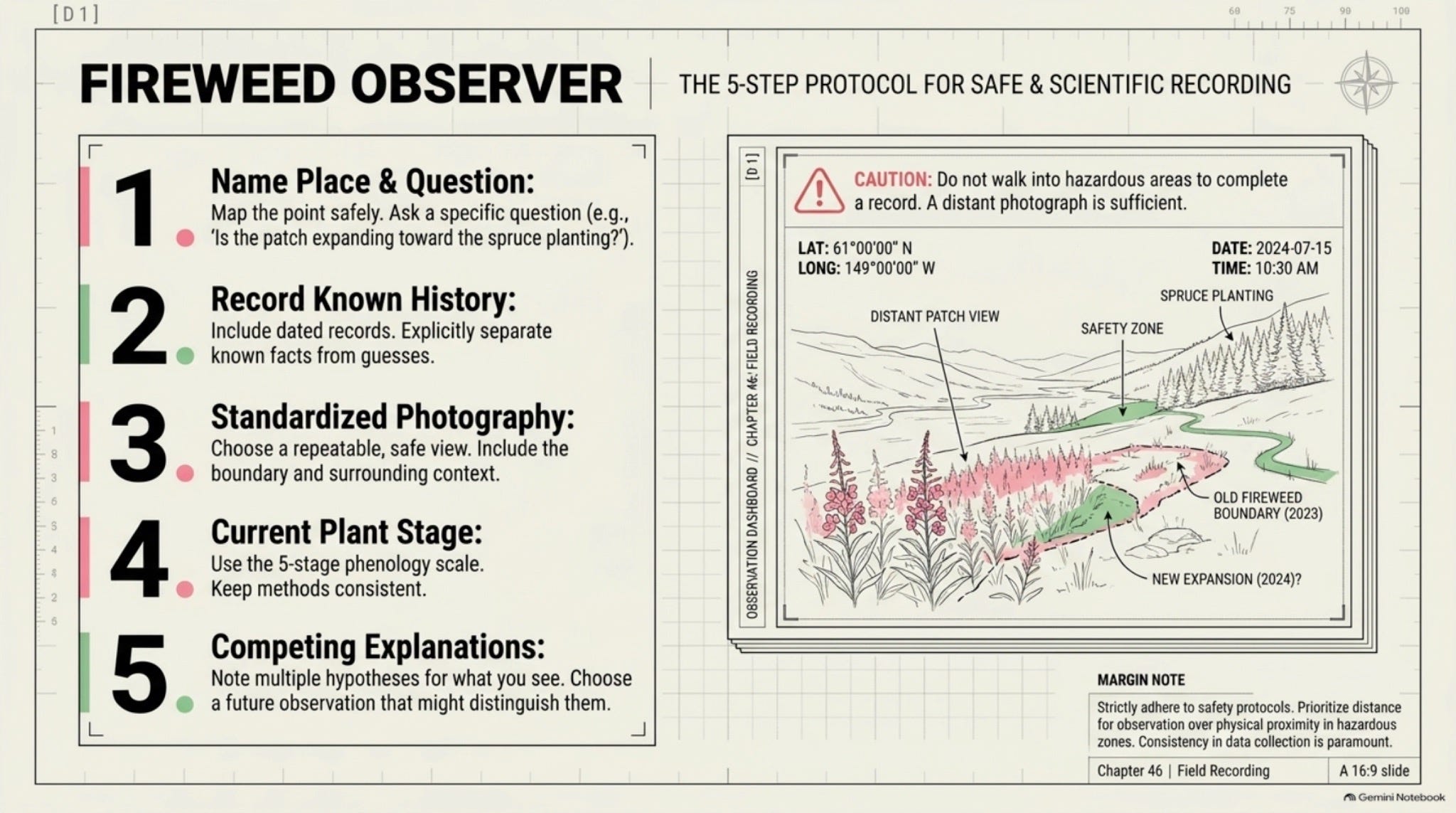
A short record can keep those possibilities useful. On a safe, permitted site, begin with five things:
1. The place and the question. Mark your viewpoint on a map and name what you want to understand, such as whether the patch is expanding toward a young tree planting.
2. The known history. Record dated disturbances or management work and where that information came from. Label uncertain accounts as uncertain.
3. A repeatable photograph. Include the patch boundary and enough of the surrounding vegetation and ground to show its position.
4. The plant’s present stage. Note fresh shoots, flowering, fruiting or dieback. Compare height or cover at a similar stage and with the same method.
5. A next observation. List the explanations that seem plausible and choose something you could check on a later visit.
The record can be small. A distant photograph is sufficient when access is limited. A formal burn classification, a restoration decision or an insurance assessment needs the relevant authority or an appropriately qualified professional.
Over time, details can change your first reading. A flowering strip may follow an old skid trail. Short stems may show signs of browsing. A boundary you took for a soil change may follow afternoon shade. Keeping the date and surroundings in the photograph gives a later discovery somewhere to belong.
3.4 Follow succession without a countdown
Return over several seasons and the opening may change without being cleared again. A shrub reaches farther. A young tree rises above the herbs. Its shadow crosses ground that used to receive more sun. Fireweed may continue along the bright edge while becoming sparse beneath the growing crown.
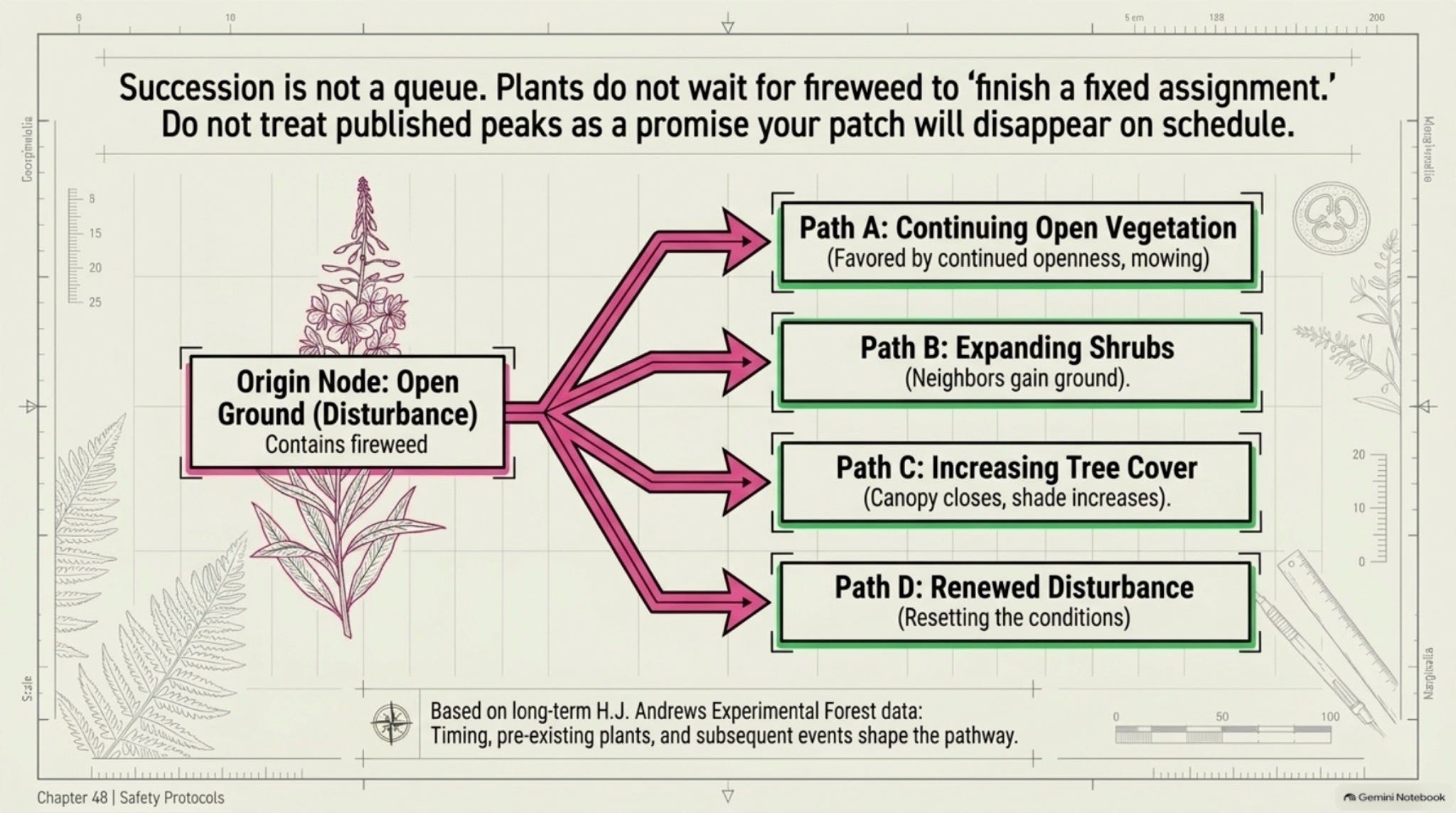
Ecologists call changes in a community’s composition over time succession. The word describes a process you can follow, but it does not supply a fixed timetable. Seedlings, established herbs and shrubs may be present together from the beginning. Their growth changes the conditions around them while weather, browsing and further disturbance continue to act.
Long-term studies at the H. J. Andrews Experimental Forest in Oregon followed vegetation after logging and slash burning in neighbouring watersheds. The timing of harvest, the plants established before burning and the later development of shrubs helped shape different pathways. Fireweed could already be present when a later disturbance occurred. The order of events mattered.
On a smallholding, a road edge kept open for visibility has a different future from an opening allowed to grow beneath trees. Repeated cutting, browsing or fresh soil disturbance can change which plants persist. A peak in fireweed cover recorded in one study cannot promise when a patch elsewhere will decline.
Look for the changes now under way. Compare the shadow cast by a young tree with an older photograph taken at a similar time of day and season. Watch the spaces between stems as other plants occupy them. Keep flower abundance separate from the area occupied by fireweed: a patch may be more conspicuous in one year without having expanded.
The seasonal record from Chapter 2 helps here. A visit near peak bloom and one made after petals have fallen can give very different impressions of the same stand. Long-term change becomes easier to see when the points of comparison are clear.
If you sketch the possible future, let it branch. An opening might remain open, develop more shrub cover, become increasingly shaded by trees or be disturbed again. Put the observations from this place beside the possibilities they support. You can revise the sketch as the place changes.
You need not settle its distant future to make a useful choice today. Protecting a young tree, retaining a flowering edge or watching for another season are all decisions with purposes you can name and results you can revisit. The next return may tell you more than a confident prediction.
3.5 Look at water and soil
On a slope, fireweed near the bottom may look taller and greener than the plants above it. The difference draws the eye downhill. Before assigning a cause, look at what else changes along the way.
Runoff may reach the lower patch. Soil may be deeper there, or a neighbouring tree may shade it during the hottest part of the day. The plants may have established earlier. Beside a track, material brought in during construction may complicate the comparison. Several of these conditions can act together.
Regional ecological accounts record fireweed across a broad range of substrates and nutrient conditions. Its presence can help you notice a place worth investigating, but it cannot supply a pH reading, locate a spring or diagnose a mineral deficiency. The question determines what evidence you need next.
Pinno and colleagues explored some of these relationships in a greenhouse study using Alberta reclamation soils. They tested germination and early establishment on contrasting soils, then examined growth and nutrient uptake under different fertilizer treatments. Establishment differed among soils; later growth and nutrient uptake depended on both soil type and fertilizer treatment. A high supply of one nutrient did not, on its own, ensure strong uptake.
The experiment made those relationships easier to examine by keeping plants watered and excluding competing vegetation. A dry Okanagan slope includes conditions the experiment left out. Its results help explain nutrient uptake; they do not provide a fertilizer recipe for that slope.
For an ordinary garden patch, begin with observations that fit your question. Keep watering and rainfall records beside the plant’s stage. Note whether the surface is exposed, shaded or covered by litter. If you use a moisture instrument, follow its method consistently and record the depth and position of each reading. Several carefully located observations are more useful than one number made to stand for the whole root zone.
Return after a dry interval and compare the same stems. Leaves may droop or change colour; new growth may be smaller. Record those changes before naming their cause. Water stress, root injury, disease and other conditions can produce overlapping signs. If a valued crop or tree is affected, a regional horticulturist or agricultural adviser can make better use of dated photographs and site history than of a diagnosis inferred from fireweed alone.
For a nutrient or pH question, ask a suitable laboratory which sample and analysis are needed. Say explicitly if the concern is contamination. A routine fertility panel answers a different set of questions from a contaminant investigation, and suspected contamination calls for professional sampling advice before material is collected.
The greener patch is still greener, but now you have begun to notice the slope, the shade and the route water might take. A test, when one is needed, can answer a question made clearer by looking.
3.6 After a wildfire on your own land
Pink flowers among burned stems can give the eye somewhere living to rest. For someone returning home, that colour may arrive beside grief, relief or the long work of deciding what comes next. It is possible to welcome the flowers while the place remains difficult to recognise.
Begin with the local instructions for return, access routes and closures. Once an evacuation order is lifted, individual parts of a property can still need assessment. Fire may weaken tree roots, trunks and branches, including trees that look relatively undamaged. The Central Okanagan returning-home guide recommends a qualified arborist or danger-tree assessor familiar with fire effects. Keep clear of areas of concern until they have been assessed.
Slopes and drainage need their own attention. Post-wildfire runoff can carry soil, stones and woody debris downslope and downstream. Ask the local government or emergency-management office about assessments and warnings for the property, and follow current rainfall, flood and debris-flow advice. New rills, damaged drainage or an uncertain crossing are reasons to obtain guidance before attempting repairs or diversions.
What burned matters to any later harvest. Buildings, vehicles, batteries, fuel containers and stored chemicals can leave contaminants in ash, debris and soil, sometimes beyond the original footprint. BC’s wildfire-contaminant guidance recommends qualified contaminated-sites advice for investigating and managing affected property.
Leave fireweed near burned structures, vehicles, outbuildings or their ash and debris out of food and tea while that question remains unresolved. In the Okanagan, Interior Health’s environmental-health service and wildfire guidance provide a starting point, alongside a qualified contaminated-sites professional. Describe what burned, where the patch is and how you hope to use it.
A plant’s appearance cannot establish food safety. Washing does not establish that contaminants have been removed from its tissues, and one clean soil result may not represent a variable property. Assessment needs to fit both the possible exposure and the intended use. There is no single waiting period that makes every burned site suitable for harvest.
University of California guidance for fire-affected gardens likewise considers ash, soot, suppression residues and nearby burned structures. It advises discarding affected produce rather than composting it. Until local advice resolves the question, keep suspect fireweed out of the kitchen, animal feed and ordinary compost, and avoid spreading ash or moving suspect material around the property.
Once access and physical hazards have been addressed, observation can begin without taking anything. Choose a safe viewpoint and return to the same view. Keep records of tree assessments, drainage concerns and former structures alongside, but clearly separate from, the plant photographs. Any later food harvest still needs the identification and handling care described in Chapter 7, especially section 7.2.
There may be days when a photograph is enough. It records that flowers grew here this year. You can let that matter without asking the picture to settle the future of the property.
3.7 See contribution and competition together
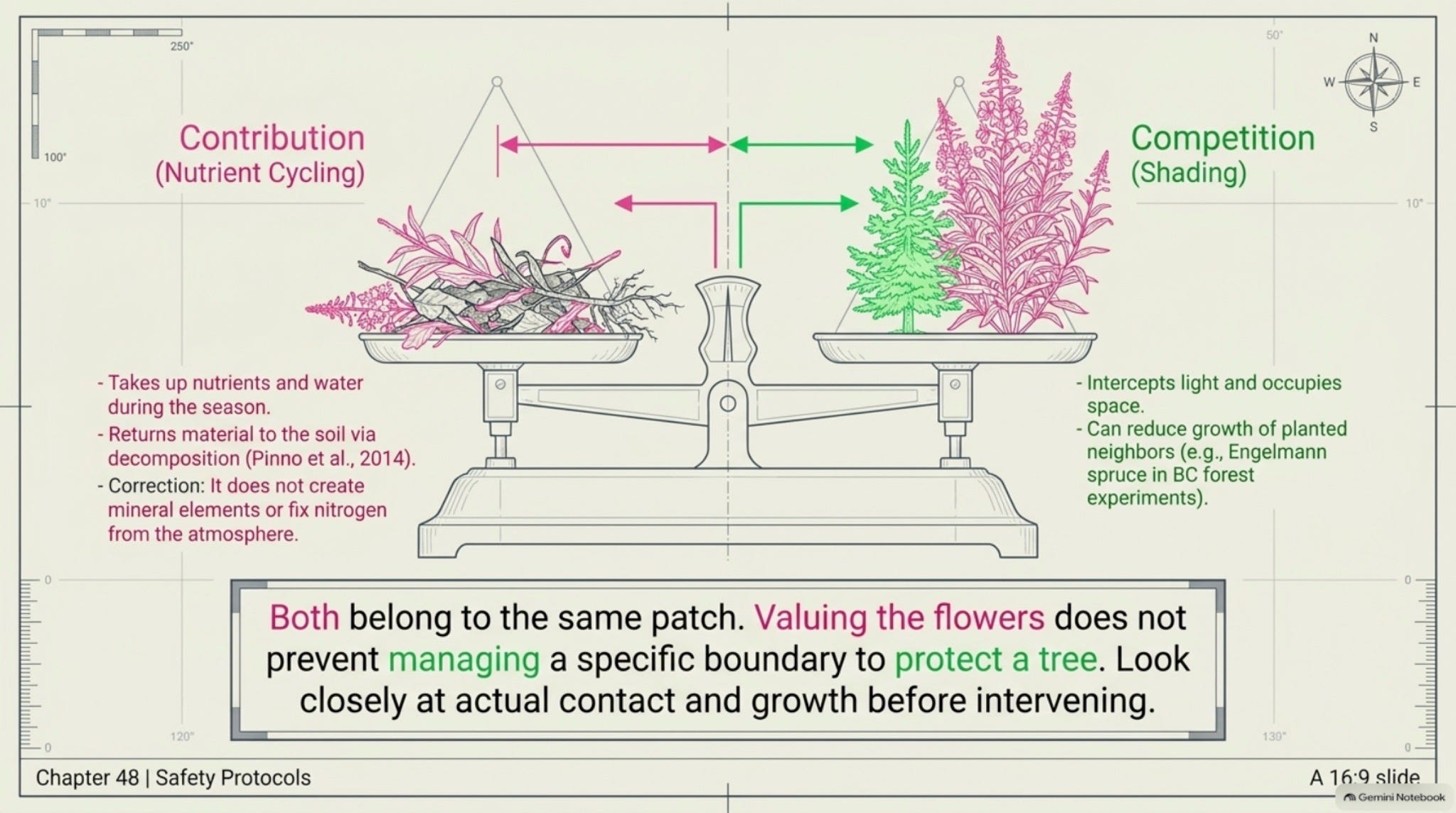
Stand beside a fireweed stem and follow the space it occupies. Leaves intercept light. Roots take up water and nutrients. Through the growing season, the plant makes tissue that may later be eaten, shed or left standing after it dies back. Its flowers and foliage bring it into relationships with other life, which Chapter 4 follows more closely.
Those same activities can affect a neighbour. A broad leaf that captures light for fireweed may shade a young tree. Water drawn from a shared rooting area may leave less available to a neighbour. What the growth contributes, and what it makes harder for another plant, belong to the same place.
The reclamation-soil experiment in section 3.5 measured nutrients accumulating in fireweed tissue. As dead tissue decomposes, nutrients can become available again within the community. Uptake and return are parts of nutrient cycling. They do not create mineral elements, and vigorous fireweed does not establish that atmospheric nitrogen has been fixed.
Larger claims need measurements of their own. More standing plant material is not, by itself, evidence of lasting soil-carbon storage. Cover over a surface does not give a measured erosion rate. Growth on damaged ground cannot demonstrate that contaminants have been removed. For each claim, ask what was measured, over what period and against which comparison.
Competition has also been studied. In a moist interior British Columbia forest experiment, repeated cutting of a mixed shrub-and-herb community increased the root-collar diameter of planted Engelmann spruce after five years. This measurement, taken near the base of the tree, gave researchers one way to compare growth. Fireweed was one member of that community. The study gives a reason to consider the growth of a desired neighbour, while leaving fireweed’s individual contribution to the competition unresolved.
On your own land, bring the question down to the relationship you can see. Is fireweed leaning across a newly planted tree? How long does the tree remain shaded? Does the tree’s growth change from one season to the next? Leaves touching in a photograph show contact. A record of growth, damage and any treatment helps you decide whether that contact has become a problem.
You can value the flowering patch and attend to a boundary where a planting needs room. You may also find that an expected problem has not appeared. Chapter 6 develops these choices around specific aims. A close view allows a proportionate response, including the choice to leave the patch as it is.
3.8 Consider a changing climate
Fireweed’s wide distribution can make it look ready for almost any future. Yet a species can be widespread while its populations differ in ways that matter. Conditions that favour one population may be less suitable for another. The familiar flower does not erase those differences.
Some researchers examine variation in chromosome sets. Diploid plants have two sets, tetraploids four and hexaploids six. A chromosome form within the group being studied is called a cytotype. These categories help describe variation and frame experiments; they do not rank a plant’s resilience.
In a Rocky Mountain reciprocal-transplant study, Sara Martin and Brian Husband compared diploid and tetraploid fireweed. Diploid populations occurred higher on the studied elevation gradient and tetraploids lower, with mixed populations between. Juvenile plants survived best in their native elevation type. The researchers did not find the same evidence for adaptation to each individual plot within an elevation zone.
Water-stress experiments follow a different part of the question. Maherali and colleagues compared established chromosome forms with newly produced tetraploids. After watering ceased, established tetraploids took longer to reach wilting, while several physiological responses did not differ. Comparing newly produced and established forms helped distinguish the immediate effects of genome duplication from the later history of a lineage.
Guo and colleagues studied plants grown from seed collected in one diploid and one hexaploid population on Baima Snow Mountain in Yunnan. Under controlled watering treatments, diploids maintained some aspects of function better during severe stress. Because only two source populations were involved, population history and chromosome category could not be fully separated.
A further glasshouse experiment compared competition between diploid and tetraploid fireweed. Over ten weeks, water limitation reduced biomass and strengthened competition, but neither cytotype became the superior competitor under the tested conditions. Time to wilting, physiological function and success against a neighbour are different outcomes. A result in one does not settle the others.
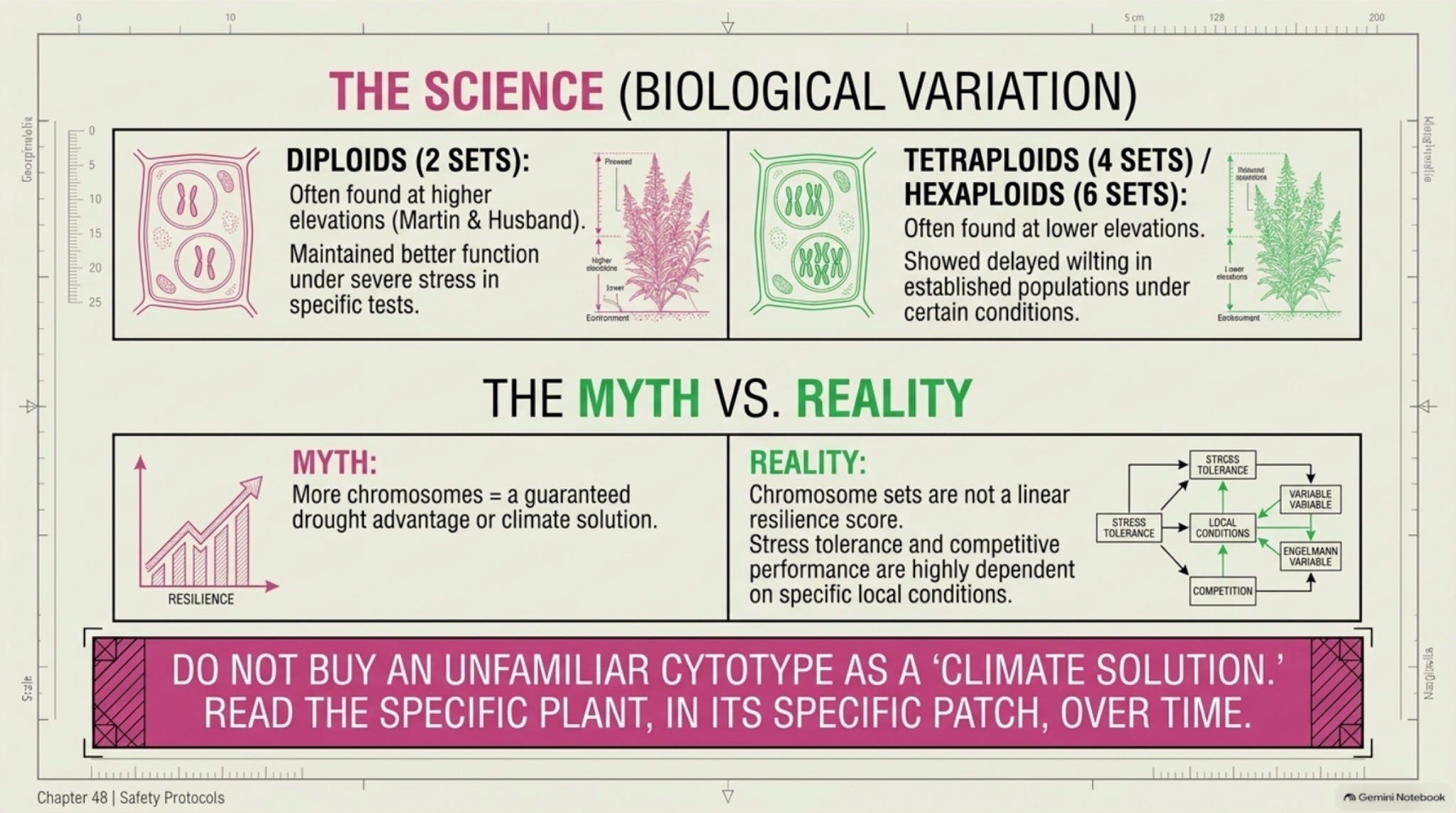
For planting, keep the plant’s origin, the proposed site and your purpose together. A chromosome label is insufficient grounds for choosing unfamiliar stock as a climate solution. Regional nursery and restoration advice can help with suitable material and the risks of moving plants beyond their established setting. Section 6.3 takes up those decisions.
For observation, the next useful question may be smaller. Did flowering begin earlier at this patch? Did fewer stems flower after the dry interval? Has the boundary shifted? Keep the dates, the method and the weather context. Weather shapes one season; climate concerns the longer pattern. Several kinds of change can occur together, and a single year seldom tells you why.
Return now to the edge of the patch. Follow it from flowers into shade, or from green leaves to the exposed ground beside them. There may be arrivals here, and survivors, and plants whose earlier lives you cannot yet recover. The opening has a history that reaches beyond the fireweed.
You can begin to read it without forcing that history into one explanation. The flowers still catch your eye. Around them, more of the place has become visible.
Sources and further looking
These references support the ecological descriptions and practical guidance in Chapter 3. Research findings remain attached to the places, methods and conditions in which they were recorded. Advice for a burned property must also fit its current condition and the intended use.
Arrival and growth after disturbance
US Forest Service Fire Effects Information System · USDA NRCS Fireweed Plant Guide
Diane S. Pavek’s 1992 Forest Service review supports wind-borne recruitment, vegetative recovery and generally short-lived natural seed banks. Rich Fleenor’s 2016 plant guide describes propagation without fire. These accounts support sections 3.1 and 3.2 without establishing a universal seed-bank lifetime or a burn treatment for growing fireweed.
Fire effects above and below ground
“Fire severity and vegetation response in the boreal Swedish forest” reports experimental burning at two northern Swedish forest sites. The original abstract supports the relationship between burn depth, the depth of regenerative structures, survival and colonization. It does not provide a diagnostic scale for reading burn severity from fireweed height or density in British Columbia.
Different routes through succession
USFS synthesis of the H J Andrews studies
Kris Zouhar’s 2013 synthesis follows original work by Dyrness, Halpern and colleagues on Oregon watersheds after logging and slash burning. Their differing disturbance histories and vegetation pathways inform section 3.4. These managed watersheds are not direct replicas of a wildfire on private Okanagan land.
Regional soils and habitat
Autecological Characteristics of Selected Species That Compete with Conifers in British Columbia: A Literature Review, Land Management Report 33, includes the fireweed account from page 65. It documents broad substrate and nutrient settings. Section 3.5 draws on the ecological account rather than the report’s historical treatment prescriptions.
Establishment and nutrient uptake
Pinno and colleagues 2014 · Natural Resources Canada record
“Nutrient uptake and growth of fireweed (Chamerion angustifolium) on reclamation soils,” published online in 2013, reports separate germination and growth experiments. Soil type affected early establishment; fertilizer treatments were used in the later growth experiment. Water limitation and competing vegetation were excluded. Tissue nutrient uptake was measured, while field leaching reduction, lasting soil-carbon gains and contaminant removal were not established.
Returning home and physical hazards
PreparedBC after a wildfire · Central Okanagan Returning Home Information Guide · BC postwildfire flooding and landslide guidance
PreparedBC directs residents to official return instructions. The Central Okanagan guide, dated 1 September 2023, discusses danger trees on page 19 and recommends qualified assessment. The BC hazard guidance explains runoff and downstream risks. Current local access notices, warnings and service information take precedence over older guides and this chapter.
Contaminants and a proposed harvest
BC wildfire contaminant guidance · Interior Health wildfire guidance · UC ANR Home Garden and Fruit Tree Safety
BC guidance supports qualified contaminated-sites investigation. UC ANR’s 2025 garden guidance considers heavy ash or soot, heat, burned structures and suppression residues, and advises discarding affected produce rather than composting it. Section 3.6’s exclusion of suspect fireweed from food, tea, animal feed and ordinary compost is a precaution while local advice is sought. It supplies neither a universal contamination radius nor a finding that every burned plant is contaminated. No actual site or harvest is cleared by the text.
Competition with a planted tree
“Effectiveness of repeated manual cutting and glyphosate for release of Engelmann spruce from mixed-shrub herb vegetation” reports a moist interior BC forest experiment. Repeated cutting increased spruce root-collar diameter after five years. The treatment acted on a mixed community, so the result does not isolate fireweed or prescribe a treatment for gardens, dry slopes or pasture edges.
Elevation and chromosome variation
“Adaptation of diploid and tetraploid Chamerion angustifolium to elevation but not local environment” supports the elevation pattern and juvenile survival comparison in section 3.8. The original abstract distinguishes adaptation to elevation type from adaptation to individual plots within an elevation. The juvenile-plant result does not establish that every population has a unique home-plot advantage.
Different questions about water stress
Maherali Walden and Husband 2009 · Guo and colleagues 2016 · Thompson and colleagues 2015
“Genome duplication and the evolution of physiological responses to water stress” separates established tetraploids from newly produced ones. Guo’s “Divergence in Eco-Physiological Responses to Drought Mirrors the Distinct Distribution of Chamerion angustifolium Cytotypes in the Himalaya–Hengduan Mountains Region” compares two source populations under controlled watering. Thompson’s “No influence of water limitation on the outcome of competition between diploid and tetraploid Chamerion angustifolium” measures ten weeks of growth and competition. Their distinct outcomes do not establish a chromosome-based resilience ranking.
The observation practices
The repeated photographs, field notes and branching sketch are practices proposed by this guide. They help keep observations connected to a place and date. They are not validated methods for classifying a burn, diagnosing soil conditions or designing restoration.
CHAPTER 4
The lives among the flowers
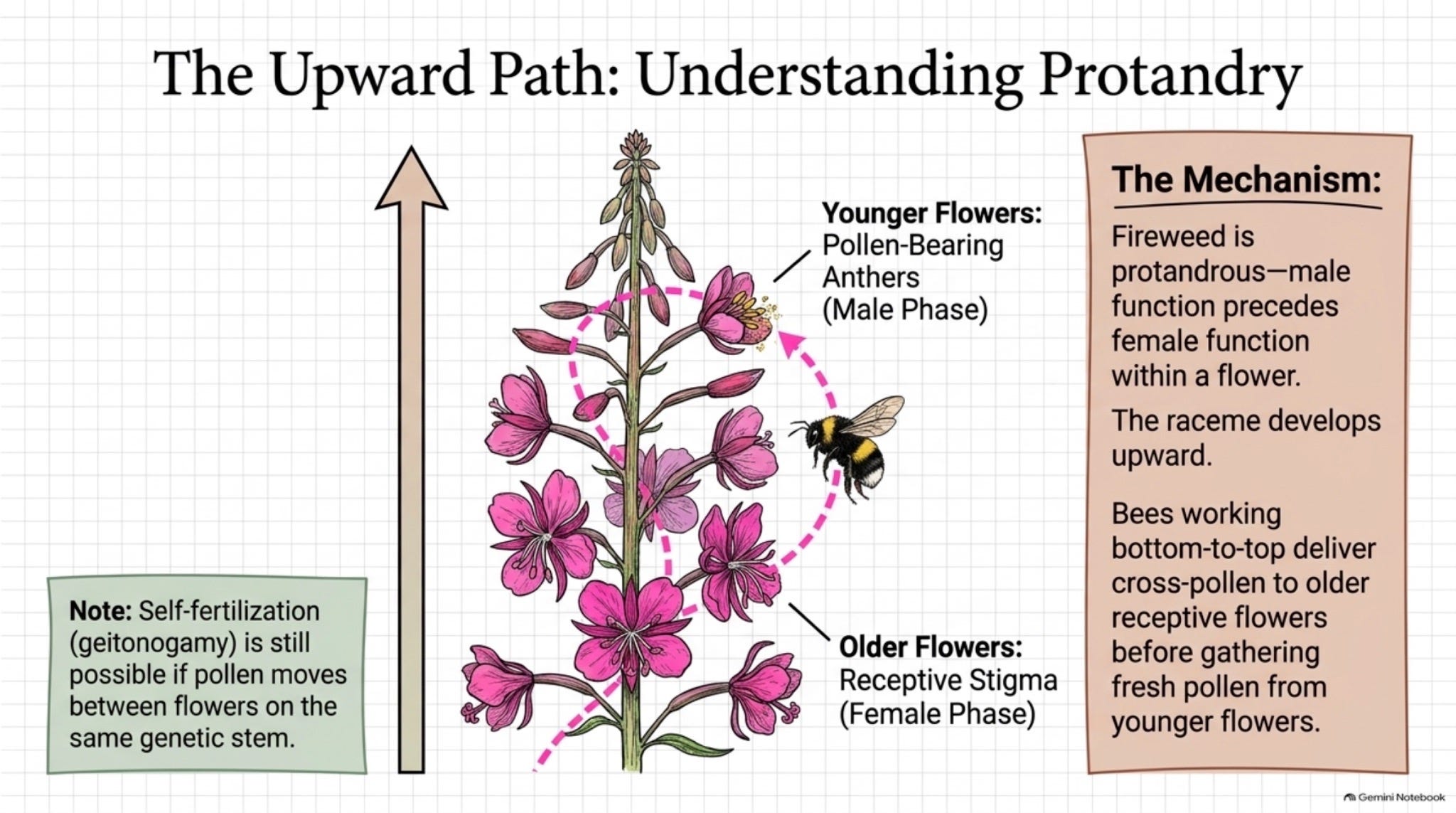
Stand beside a flowering patch and let the first arrivals go. Your eye may follow one insect, lose it behind a stem and catch another farther away. Stay a little longer. The movement begins to separate into things you can follow: a landing, a turn toward the flower centre, a brief pause before departure.
Choose one stem within comfortable view. Watch the space around its flowers as well as the flowers themselves. A visitor may approach and pass by. Another may settle, reach inward and move to the flower above. Listen for the hum as it comes closer or recedes. What first seemed like a patch “full of bees” acquires a sequence, with intervals when nothing arrives.
Now let your attention move down the stem. A leaf has lost part of its edge. Farther along the patch, a shoot ends abruptly where its growing tip used to be. Flowers, leaves and stems enter other lives in different ways. This chapter follows those relationships, from pollen carried between flowers to foliage eaten by larvae and larger animals. Seeing the patch already in use can change how much we gather, where we cut and what we are willing to leave.
4.1 Watch a visit closely
Begin with a position you can hold comfortably, where access is permitted and the footing is sound. Let the stem remain where it grows and give its visitors room. If a nest or another hazard makes the close view unsuitable, step back or choose another place. There is plenty to see without putting a hand among the flowers.
Follow the arrival first. Does the insect grip a petal, settle across the centre or land on a leaf? Watch the next movement. Reaching inward may indicate nectar feeding; working around the pollen-bearing anthers may indicate pollen collection. Sometimes another petal or the insect’s own body hides the action. Describe what remains visible rather than supplying the missing part.
Then look for contact with the flower. Anthers carry pollen. The receptive stigma receives it. A visitor touching these structures has an opportunity to transfer pollen, but a landing alone tells you little about what was delivered. Even visible contact with a stigma may leave the pollen itself beyond your view.
Pollination is the transfer of pollen to a stigma. Fertilisation and the development of viable seed follow only when further conditions are met. Researchers distinguish these steps through pollen counts, controlled access to flowers and measurements of reproduction. In your notebook, “visited” and “appeared to touch the stigma” can remain exactly those observations. A careful description is worthwhile before you know the reproductive outcome.
Try a five-minute watch. It is long enough to practise staying with a small view, and short enough to repeat. It is not a complete survey. Choose a few stems you can recognise again and record:
1. The conditions. Date, start time, sun or cloud, wind, and recent rain or watering if known.
2. The flowers. Roughly how many are open in your chosen view, and where they sit along the stems.
3. The visitors. A reliable name where you have one, otherwise a description or photograph that may help later.
4. The movement. Landing place, route between flowers, visible contact with flower parts and departure.
5. The gaps. Anything hidden or missed, including an insect that may have left the view and returned.
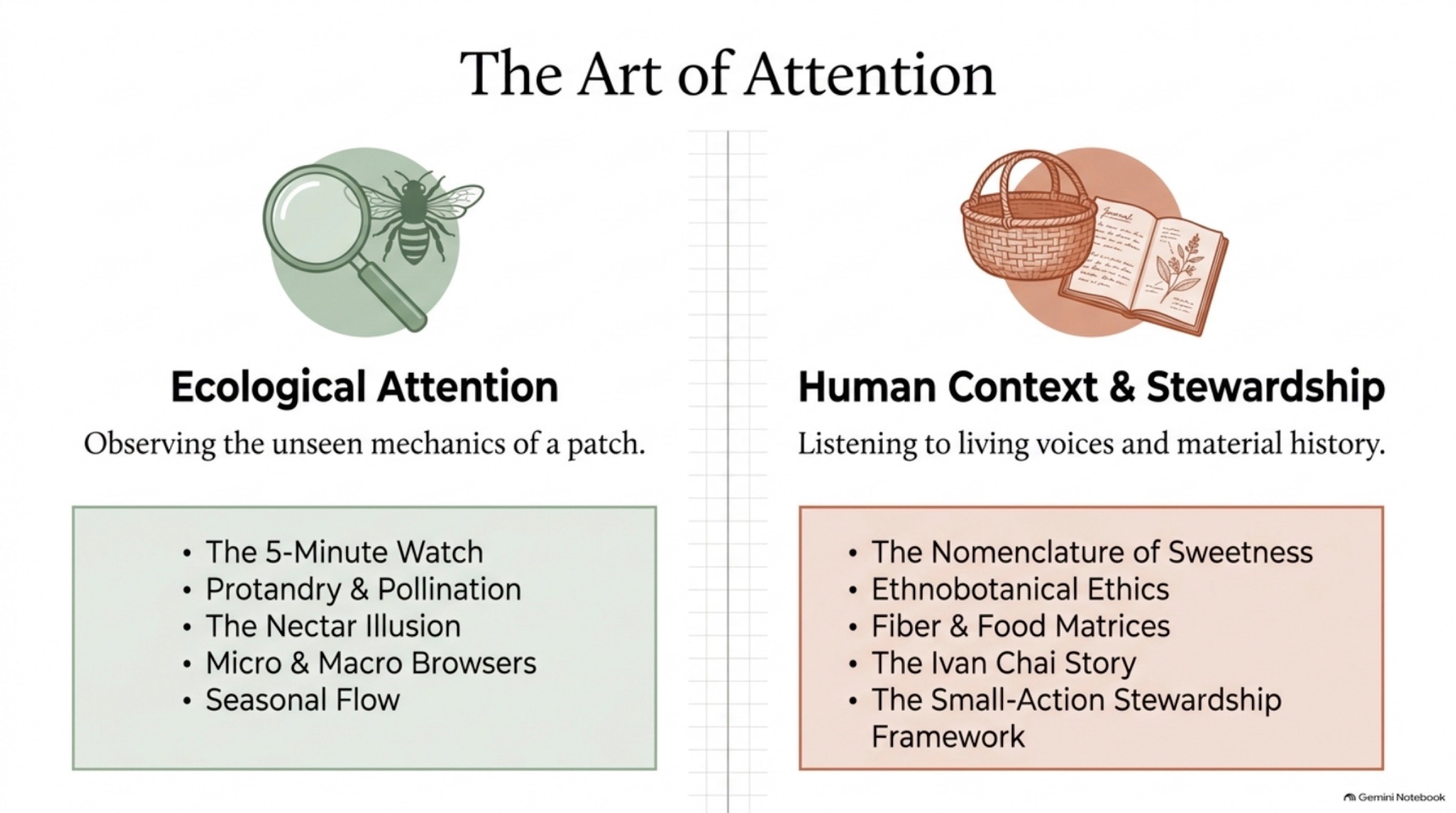
Keep the tally as a count of visits. The same individual may return several times. A watch with no arrivals is useful too, provided it keeps its date, conditions and duration. It tells you that you saw no visits in those five minutes; another hour or another day may look different.
A photograph can preserve details your eye could not hold. Where possible, include more than one angle and keep the plant and visitor together in the record. Let the picture follow the encounter. Chasing an insect from stem to stem often costs you the route you were trying to understand.
At the end, write one ordinary sentence about what happened. Perhaps a visitor began low and left after two flowers, or returned repeatedly to one part of the display. The sentence gives your next watch a starting point.
4.2 Follow the route through the flowers
A visitor meets flowers of different ages on the same stem. Look at their centres before the next arrival. In a younger flower, the pollen-bearing anthers may be prominent while the stigma’s lobes remain closed. In an older one, the style has straightened toward the flower’s centre and the four stigma lobes spread. Chapter 2 followed that change through time. Here it becomes part of a route through space.
Fireweed is protandrous: male function generally precedes female function within a flower. Lower flowers usually open before those above them, so older, receptive flowers tend to lie beneath younger, pollen-presenting ones. The order in which an insect reaches them can matter.
Picture a bee arriving low on the flowering portion with pollen already on its body. Contact with a receptive stigma can deliver some of that pollen before the bee moves upward and collects more from younger flowers. If the incoming pollen came from another genetic individual, this route can contribute to crossing between plants. The arrangement offers that opportunity; the visitor supplies the actual path.
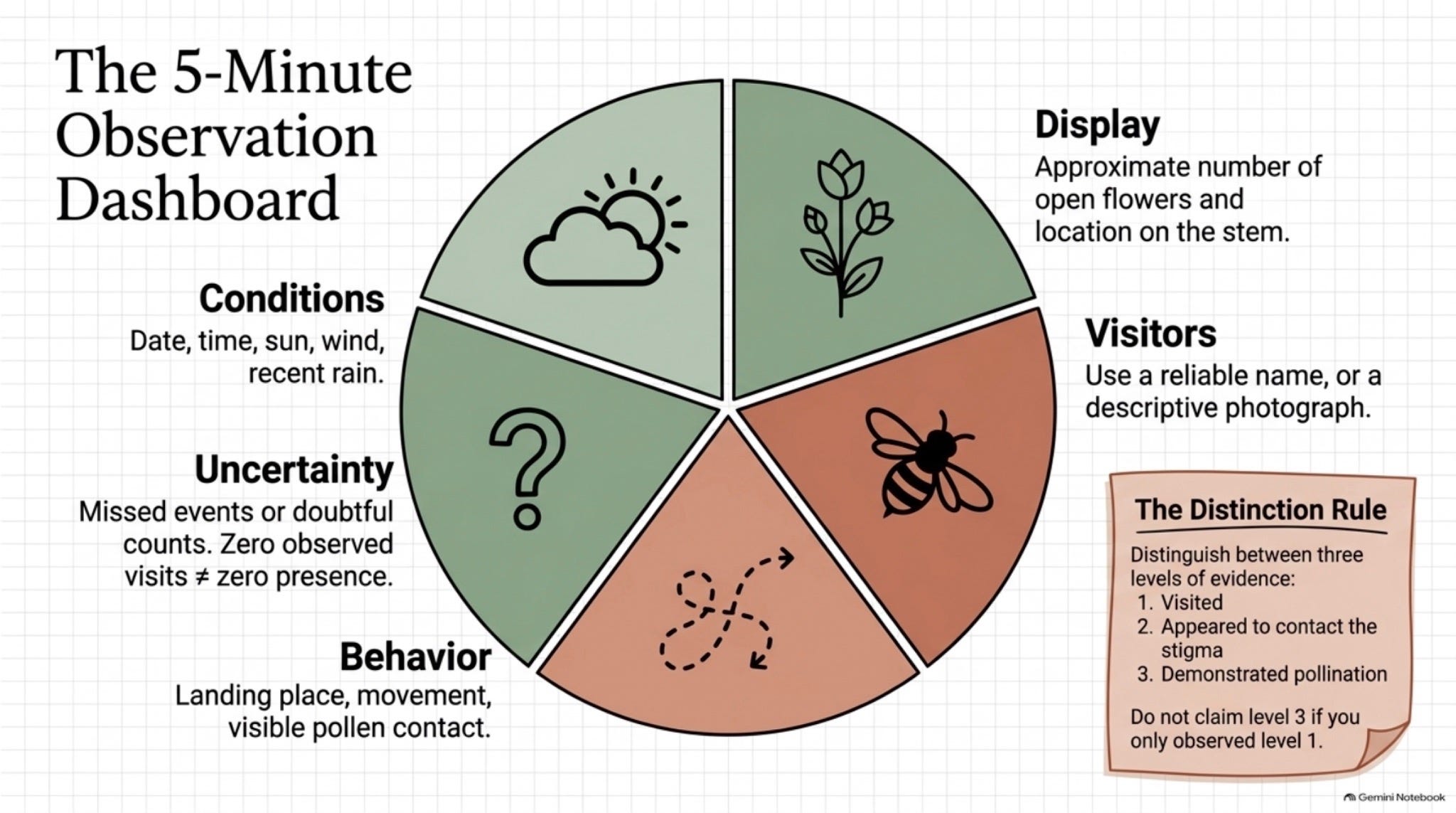
Candace Galen and R. C. Plowright found an instructive variation in their study of Bombus terricola. Nectar-collecting workers usually began low on the flower display, while pollen collectors tended to arrive around its middle. Both tended to move upward. What the bees were collecting helped shape their route. A pollen collector arriving partway up may pass over flowers a nectar collector encounters first.
The space between stems adds another complication. Fireweed can fertilise itself, and separate stems may belong to the same clone. An insect carrying pollen from one of those stems to another can still be moving it within one genetic individual. Pollination between different flowers on the same genetic individual is called geitonogamy. A short flight across open air need not be a crossing between different genetic individuals.
Matthew Routley and Brian Husband tested parts of this system by manipulating flower displays in experimental arrays. Plants with the male-first sequence had greater success siring offspring on other plants under the tested conditions, while seed set was similar between the treatments. Protandry favoured outcross siring without eliminating selfing.
Back at the patch, draw a stem as a simple line and mark one visitor’s first landing. Add the next few flowers and the point where it leaves. Include flower phases where you can see them. An arrow can stop at the edge of your view; a question mark can hold the place of an obscured flower.
Follow a second visitor. It may skip a flower, reverse direction or leave before reaching the top. Those small differences are worth keeping. They show how the orderly development of the flowers meets the less predictable movement of an animal.
4.3 Follow nectar through the weather
After a dry week, a patch may still look generously in flower. Petals catch the light, buds remain above them, and the display seems little changed from the path. What a visitor finds inside each flower is harder to see.
Nectar volume and sugar concentration describe different things. Volume is the amount of liquid; concentration is the proportion of dissolved sugar. A smaller amount at a similar concentration contains less sugar in total. The visible size of the flowering display tells you neither measurement.
Amy Carroll, Stephen Pallardy and Candace Galen examined water stress in thirty seed-grown fireweed plants in a Missouri greenhouse. The seed lot came from Colorado. Half the paired plants underwent twelve days of soil drying while the others continued to receive water. The researchers measured nectar in female-phase flowers, along with flower size and plant water status.
Water-stressed plants produced less nectar per flower and smaller flowers. Nectar sugar concentration did not differ significantly between the treatments. The result gives substance to something a distant view can miss: a plant can remain in flower while the amount of food it offers changes.
The experiment did not measure wild-bee visits, colony performance or honey production. Its results provide no watering prescription. The amount and timing of water a garden needs still depend on the plant and the place.
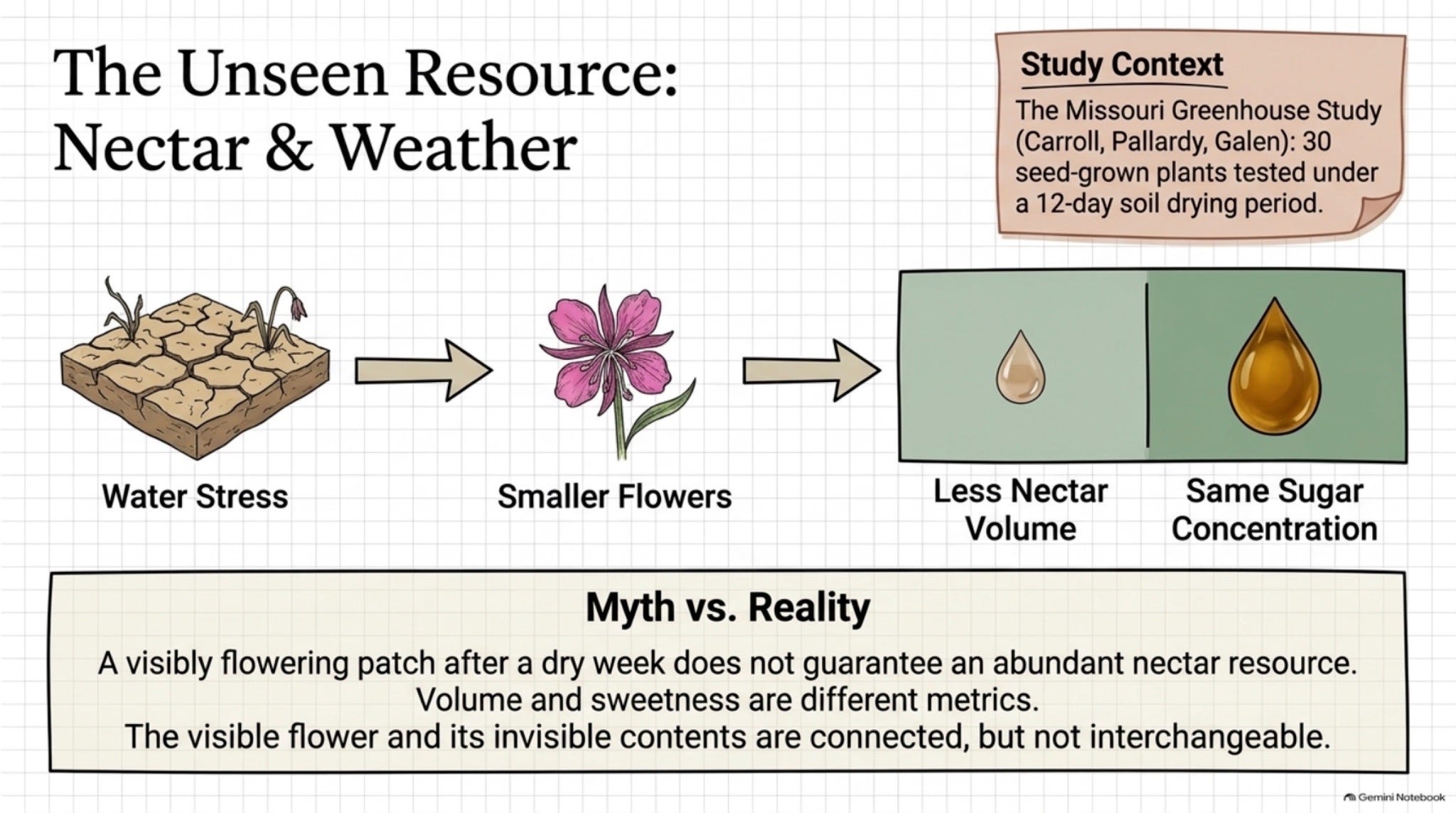
Return to your chosen stems at a similar time on several days. Keep weather beside the visitor record, along with the amount of open bloom. Notice wind moving the stems, rain during the watch or a change from sun to cloud. If one afternoon is quiet, compare the conditions before choosing an explanation. Flower age, recent visits and conditions for flight can complicate what you see.
Leave the nectar in place. Squeezing flowers or probing them with improvised tools disturbs the resource without resolving those differences. Measuring nectar reliably is a separate task; a repeated flower watch can be useful on its own.
In a garden, watering belongs with the needs of the whole planting and current local restrictions. A hot, exposed bed may ask more of fireweed than a cooler, moister opening. If the patch repeatedly needs water the site cannot reasonably supply, regional planting advice may lead you toward a better fit. Keeping every chosen plant in the same condition through every dry spell is not always the most useful aim.
For now, “many open flowers after a dry week” is a precise record. Add what you saw the visitors do.
4.4 Meet the small eaters
The missing edge of a leaf can hold your attention as firmly as a flower. Follow the irregular line into the intact blade. Look beneath it where the underside is already visible. There may be an animal nearby, or only the trace of an earlier meal.
Before naming a pest, watch what is happening. A caterpillar resting on fireweed may have fed elsewhere. If you can see its mouthparts working at the edge and fresh leaf disappearing, you have a stronger connection between animal and food. A photograph beside old damage records an association; direct feeding records an action.
Regional accounts give you particular lives to look for. In their British Columbia moth guide, Geoffrey Scudder and Robert Cannings record Mompha idaei larvae boring in the roots of Epilobium angustifolium. The same guide describes foliage feeding by larvae of Alypia langtoni and Alypia ridingsii on fireweed under the broader plant name Epilobium. Those latter records do not identify the host as precisely as the Mompha account does.
A US Forest Service guide to Pacific Northwest butterflies and moths lists fireweed among the larval foods of the bedstraw sphinx, Hyles gallii. A food plant for a caterpillar describes one stage of the insect’s life. An adult taking nectar describes another. Seeing an adult among the flowers does not tell you where it grew as a larva.
These records widen the possible view of the patch. Some relationships occur on the leaf surface; others remain below ground. They also belong to regions and named species. A garden need not contain every animal in a guide, and a five-minute flower watch will reveal little about a root-boring larva. Leave the underground plant intact rather than digging for an insect simply because a host record exists.
For help with identification, photograph the whole animal, its position and the relevant damage without handling it. Keep the date and region beside the images. An entomologist or regional identification service can judge whether the visible details support a name and whether the feeding association is known. Retain a tentative name as tentative.
Then consider what the feeding means for your purpose. A vigorous patch with a few chewed leaves may need no intervention. Widespread damage, repeated plant failure or a production crop calls for more specific advice before treatment. Treating an unidentified insect can remove life you hoped the planting would support.
Leave one affected leaf where you can find it again. On the next visit, compare its edge, the leaves around it and the growth of the stem. Damage has become something you can follow, rather than an immediate instruction to act.
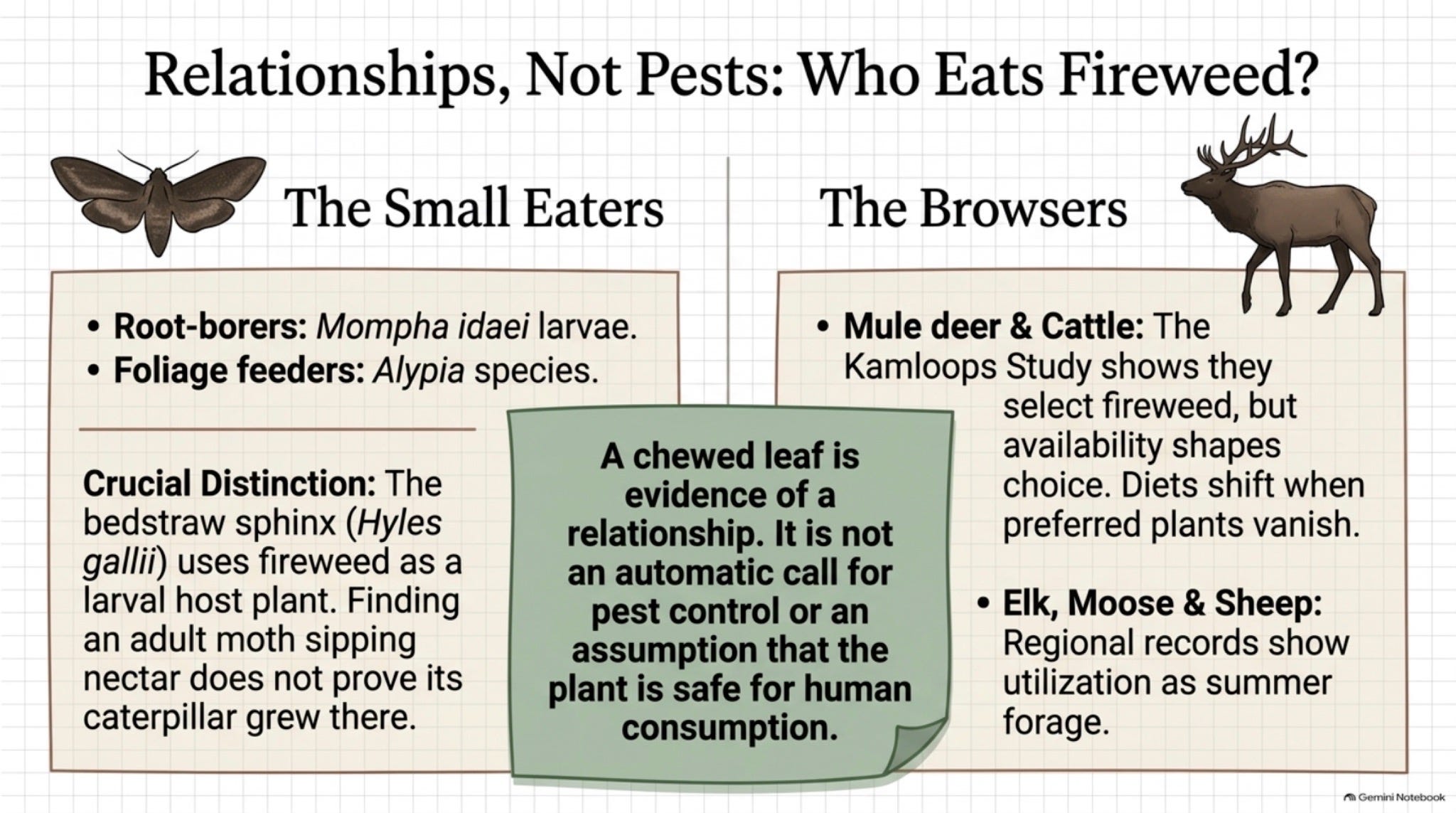
4.5 Meet the browsers
A larger mouth can change a stem in a moment. Leaves remain below, but the growing tip is gone. Beside it, another stem stands at full height. Look across several plants and the uneven outline becomes easier to see.
Fireweed is eaten by larger herbivores, though their use of it changes with season, place and available food. A missing tip can lead you toward that question without identifying the animal that removed it. Keep what you saw happen separate from the damage you found afterward.
One study near Kamloops followed mule deer and cattle on summer range in logged Douglas-fir and pinegrass openings. Much of Walter Willms and colleagues’ work used a small number of animals in fenced fields. Both deer and cattle selected fireweed when it was available. As preferred plants became scarce, cattle shifted more toward grasses and deer toward shrubs. The menu around the fireweed helped shape what happened to it.
The US Forest Service’s wider fireweed review gathers other regional records. Rocky Mountain elk use it as summer forage. Black-tailed deer eat it in British Columbia and Alaska, and moose feed on it in several northern and western regions. One Alaska account found strong moose use of preflowering fireweed in July and little use after flowering. The review also includes favourable sheep-forage ratings from parts of the western United States.
Each account gains meaning from those particulars. Summer forage in one forest opening tells a different story from winter food or a managed livestock ration. An animal eating fireweed shows that it chose or encountered the plant under those conditions. It does not reveal an intention to treat illness, establish human food safety or demonstrate a balanced diet for another animal.
If you manage a pasture edge, begin with the animals that actually have access and the other forage they can reach. Keep the site’s history beside that inventory, including recent burning, treatments or possible contamination. Note what is happening to the other plants and to the soil. Before deliberately using fireweed as feed or making grazing a control method, take those details to a livestock nutritionist, veterinarian or regional range adviser. Cut wild material from an uncertain source is unsuitable for an improvised feeding trial.
For observation, photograph a few recognisable stems and return to them after a stated interval. Record whether you witnessed feeding, found fresh damage or saw only an old break. Note changes in access and in the surrounding forage. Watch wildlife at a distance, without baiting or drawing it toward houses, roads or gardens.
A cropped stem raises practical questions too. Does the desired planting keep losing its new growth? Does fireweed remain abundant despite browsing? The answers can help you decide whether protection or another management approach deserves attention. They will not supply a stocking rate or prove that grazing can contain the patch.
Sections 3.5 and 6.1 connect those observations to the site and your management aim. On the next visit, look for new growth below the cropped tip.
4.6 Look beyond the brightest week
During peak bloom, fireweed can occupy so much of the view that the flowering season seems to belong to it. Return before its first flowers or after the last petals fall. Other plants, and the spaces between their flowering times, become easier to notice.
Look outward from the patch. Which trees, shrubs and herbs flower earlier? What overlaps with fireweed, and what follows it? British Columbia’s Food for Bees programme and broader pollinator-habitat guidance encourage a sequence of suitable floral resources, considered alongside climate, soil and water needs.
Add neighbouring plants to the seasonal strip from Chapter 2. Give each a row for the first flowers you observed, the main flowering period and the last flowers you saw. Keep gaps in your visits visible. Three weeks away cannot become three weeks of confirmed bloom simply because a line looks better when it is continuous.
Begin with what already grows there. A small flower below the pink display may be receiving visitors while fireweed holds your eye. Walk the same safe route and give a few neighbouring plants a short watch of their own. You may discover that part of the apparent gap was a gap in your attention. You may also find a time when little is flowering in the area you manage.
The scale of a useful change depends on the place. A garden bed, orchard margin and restoration site have different needs. Water, plant spread, machinery access, neighbours and the existing community all affect the choice. A regional nursery or restoration practitioner can help select a plant for a gap you have actually recorded. Section 6.3 follows sourcing and introduction; a bag labelled “pollinator mix” still needs to suit the site.
Flowers supply only part of habitat. The animals visiting them also need places to pass through other stages of life, with requirements that vary among species. Bare soil, vegetation and standing stems deserve attention alongside bloom. A hollow-looking fireweed stalk is worth observing without assuming that it contains a nest or meets every visitor’s nesting needs.
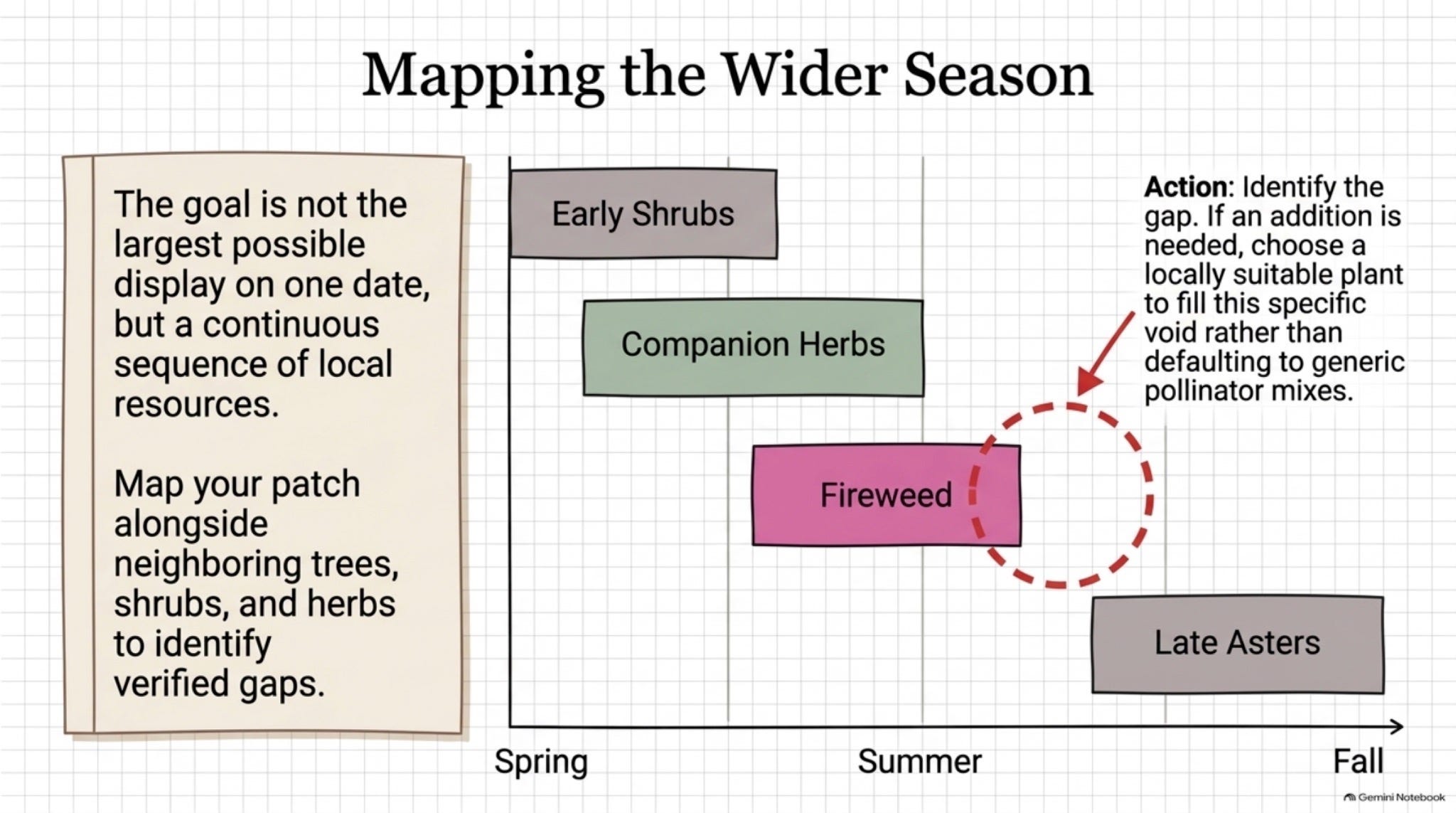
An existing mixed edge may be a good place to begin. Keep a boundary that permits necessary work, then learn what flowers within it and when. If an addition is warranted, check later whether it establishes and flowers under your conditions. The result may favour more fireweed, another suitable plant or simply keeping a neighbour that was easy to overlook.
As the rows in the seasonal record fill, the fireweed patch takes its place among them. Its brightest week remains important. Before and after it, the rest of the year is easier to see.
4.7 Distinguish honey from flower syrup
At a kitchen table or market stall, “fireweed honey” can name two quite different journeys from flower to jar. In one, honey bees gather nectar and make honey. In the other, a person combines flowers, sugar and water to make a flavoured syrup.
Fireweed-blossom honey refers to bee-produced honey associated with that floral source. Canada’s compositional standard defines honey through production by honey bees from nectar or specified plant-associated secretions. Flowers steeped with water and added sugar make fireweed-flower syrup. A familiar recipe title can obscure that difference, so keep the ingredients and process beside the name.
When buying a jar, ask whether it contains blossom honey, honey with another ingredient added or flower-flavoured sugar syrup. Read the product name and any ingredient list, and ask the producer when needed. Chapter 8.6 returns to naming at the kitchen bench.
The flower watch cannot authenticate a jar. A bee on fireweed establishes a visit, while the floral composition of a honey harvest needs other evidence. Nor does a fine stand promise a particular yield. The nectar study in section 4.3 shows one way the resource can change while flowers remain visible.
Keep flavour separate from medicinal claims. Enjoying a taste does not establish a treatment effect or show that honey and syrup contain the same plant constituents in comparable amounts. A product intended for sale also needs the current, product-specific review described in section 12.5.
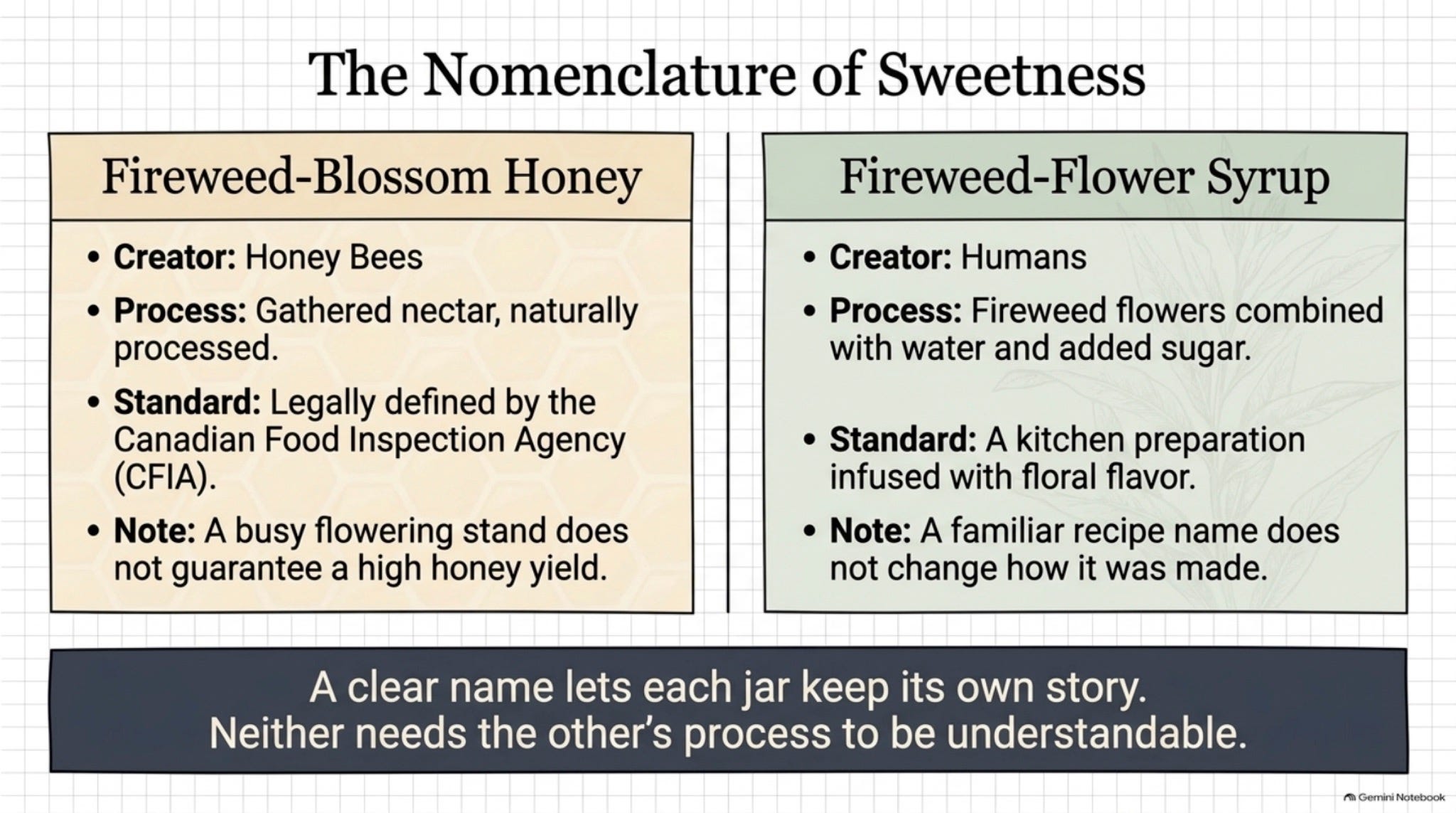
4.8 Let observation change a small action
You may have come to the patch intending to cut it. Then, while standing beside it, you notice that its flowers are most of the bloom within the area you can see. The intended work now includes a detail you had passed over.
If the cut is optional, retaining part of the flowering edge or changing the timing may be enough. Where growth blocks an essential route or conflicts with a safety requirement, that purpose still needs to be met. Observation helps make the choice more precise; it does not remove the other demands on the place.
Cutting a flowering stem removes its flowers. That immediate effect is visible and certain. The effect on a local bee population would require a much larger investigation. You can avoid an unnecessary, all-at-once loss of bloom without claiming to have measured a population benefit.
Choose one manageable decision and keep the reason beside it:
1. Name the work. A path needs clearance, a young planting needs room, spread has crossed a boundary or the cut is routine tidying.
2. Look at what is present. Note open flowers, developing capsules, visible larvae, nearby bloom and any access or site hazards.
3. Make the smallest useful change. Retain an acceptable edge, narrow the area to be cut, postpone optional work or leave the patch alone.
4. Keep containment in view. A delay may allow seed to mature, and retained flowers do not prevent underground spread. Use Chapter 6 when that is the concern.
5. Return to the result. Check the remaining bloom, regrowth and boundary, and whether the original problem was resolved.
Work only where access and permission are clear, and leave active nests undisturbed. Pause for advice if an uncertain plant or animal, or protected-site requirements, leaves the proposed work in doubt. After wildfire, use the physical-hazard and contamination guidance in section 3.6 before entering or moving material, even for a small job.

A garden or smallholding holds several purposes at once. A clear path can run beside a flowering strip. A young tree may need space while a vigorous fireweed patch can tolerate a few chewed leaves. Sometimes a decision to wait saves work because the expected harm never appears.
Write the outcome in ordinary words. “Kept the outer strip in flower; path stayed clear” is useful if that is what happened. So is “delay allowed unwanted seed release; change timing next season.” Include the cost of a choice as readily as its benefit. That is how the next season’s work becomes better informed.
Before leaving, return to the stem you watched at the beginning. Its flowers may be empty for a moment. Look again for the missing leaf edge and the shortened shoot nearby.
If another visitor arrives, watch its first landing. Follow it to the next flower, and see where it goes.
Sources and further looking
These references support the relationships and practical guidance in Chapter 4. Sources were rechecked on 10 October 2026. Research findings remain attached to the animals, plants, places and methods studied; the observation practices offer a way to look more closely at a patch of your own.
The changing flower
Routley and Husband 2003 · Full text
“The effect of protandry on siring success in Chamerion angustifolium (Onagraceae) with different inflorescence sizes” reports manipulated flowering arrays and reproductive measurements. The full paper supports enhanced outcross siring in protandrous displays, with similar seed set between treatments. Self-compatibility and pollen movement within a genetic individual remain relevant. These results inform sections 4.1 and 4.2 without establishing the outcome of any single observed visit.
Routes through the flower display
“Contrasting movement patterns of nectar-collecting and pollen-collecting bumble bees (Bombus terricola) on fireweed inflorescences” reports differing arrival heights and an upward tendency in both groups. The publisher’s indexed abstract was checked; the full text was not available for this review. The finding remains attached to the studied species and foraging behaviours.
Water stress and nectar
Carroll Pallardy and Galen 2001
“Drought stress, plant water status, and floral trait expression in fireweed, Epilobium angustifolium” used thirty plants grown from a Colorado seed lot in a Missouri greenhouse. The full paper confirms paired treatments, twelve days of drying and measurements in female-phase flowers. Nectar volume and flower size declined; sugar concentration did not differ significantly. Wild-bee activity, colony performance and honey yield were not measured.
British Columbia moth hosts
“The Lepidoptera Families and Associated Orders of British Columbia” records Mompha idaei root-boring in Epilobium angustifolium on printed page 51. The Alypia langtoni and Alypia ridingsii foliage-feeding accounts on printed page 84 name the host only as Epilobium. Section 4.4 preserves that difference in host identification.
A regional sphinx moth account
“Butterflies and Moths of Pacific Northwest Forests and Woodlands” lists fireweed among caterpillar foods for Hyles gallii on printed page 216, under the common name Galium Sphinx. The chapter uses the alternative name bedstraw sphinx. Official indexed text was checked; the complete PDF could not be opened in this review. The food plant is given by common name, and no conservation status or disturbance recommendation is carried forward.
Summer browse near Kamloops
Willms McLean Tucker and Ritcey 1980 · Author posted full text
“Deer and cattle diets on summer range in British Columbia” supports the local example in section 4.5. The author-posted paper reports work in logged Douglas-fir and pinegrass openings, much of it with a small number of animals in fenced fields. Both species selected fireweed, with different later shifts as preferred forage became scarce. This is a diet-choice study, not a ration or stocking-rate prescription.
Wider browse records
US Forest Service Fire Effects Information System
Diane S. Pavek’s 1992 review supplies the regional elk, black-tailed deer, moose and sheep summaries. The Alaska preflowering observation concerns moose. The review combines older studies with different seasons and methods; those underlying browse studies were not all independently re-examined. Animal feeding is not used here as evidence of self-medication or human edibility.
Flowers and habitat across the season
BC Food for Bees · NRCS New Jersey pollinator guidance · New England Pollinator Partnership
The BC programme supports forage suited to local climate, soil and water. NRCS guidance describes seasonal floral resources, nesting and overwintering habitat, and the consequences of mowing. General principles inform sections 4.6 and 4.8; regional plant lists, species percentages and management dates are not transferred to British Columbia. The small-action method proposes no universal cutting date or harvest fraction.
Names on honey jars
CFIA Canadian Food Compositional Standards · CFIA honey labelling guidance
Volume 15, section 15.1.16 defines honey through honey-bee production from nectar or specified plant-associated secretions. The labelling guidance addresses floral-source names and honey combined with other ingredients; single-ingredient honey is exempt from an ingredient list. These sources support the honey and syrup distinction. A commercial product still needs its own current review.
The observation practices
The five-minute watch, visitor-route sketch, bloom record and small-action review are learning practices proposed by this guide. They have not been validated as pollination assays or population surveys. No field trial, identification of an animal in the reader’s patch or local population benefit is claimed.
CHAPTER 5
People, places and remembered uses
Beside fireweed in the Regional District of Central Okanagan’s online language key sits another name, sɬqmiɬp. An audio link offers its sound in nsyilxcən. The accompanying guide credits Krystal Withakay (spaxwawlm), a Syilx artist and Knowledge Keeper, who worked with Parks Services on the English and nsyilxcən guide to common plants and animals.
Follow the link and listen. The familiar plant now has a name to encounter through the people who have chosen to share it.
The RDCO presents the guide on its Syilx / Okanagan partnerships page, alongside its work with Westbank First Nation. Those details give the entry a place. Keep them beside the word as you would keep a location beside a field observation. They help you find your way back to the account and understand what it offers.
Earlier chapters followed the plant through a season and watched the lives among its flowers. This chapter follows people through public records of food, making, stewardship and tea. The same species appears in many places, but the accounts begin with different people and circumstances. A spring food, a fibre blend and a drink each deserve their own history.
5.1 Listen to a living local voice
On the RDCO page, find the fireweed entry under trees, shrubs and wildflowers. Let the recording supply the pronunciation. A guessed version written in English would put a less reliable voice between the learner and the source.
The spelling belongs with the language and publication that supplied it. Its characters need the same care you would give a botanical name, although the naming systems carry different histories and responsibilities. The entry shares a name. A food or medicinal practice would need its own account; there is no reason to borrow one from another place to make this short entry seem more complete.
Read the page around the word. Notice who is credited, how the guide was made and what learning resources the publisher offers. If you keep a field notebook, record the publication and link as well as the name. A note made this way remains useful when memory has lost the route by which you first encountered it.
Public resources make that kind of learning possible. They also allow readers to pass on a link with its credits intact. Reproducing a recording, portrait or teaching in a course or book is a further use, with its own questions of permission. Acknowledgment matters, and so does asking what the person or organization has agreed to share in that setting.
The International Society of Ethnobiology’s Code of Ethics gives those questions a wider framework. It treats consent, reciprocity, acknowledgment and responsibilities to knowledge holders as continuing parts of the work. They remain relevant when the first encounter takes place through a website or library rather than across a table.
On the next walk, look again at the narrow leaves and the flowers opening above them. Nothing in their shape has changed because you have learned of another name. Your acquaintance with the plant has changed a little. There is now a source to return to, and a person’s contribution to acknowledge.
5.2 Follow specific northern food traditions
The Gwich’in Social & Cultural Institute’s entry “Fireweed - tall” identifies its subject as Epilobium angustifolium, the tall species called Chamaenerion angustifolium in this guide. It describes shoots eaten in spring and pink flowers added to other foods. The entry credits Alestine Andre and Alan Fehr’s Gwich’in Ethnobotany, second edition, published in 2002. An additional medicinal passage cites Andre’s 2006 thesis. Keeping the credits separate preserves the route to each record.
The database’s introduction makes clear that it is not a guide to self-medication. Its food account can be read and appreciated without turning the nearby treatment descriptions into instructions. Before preparing food, the practical questions of identification, gathering and handling still lead to Chapters 7 and 8.
In Kodiak, Alaska, the Alutiiq Museum and Archaeological Repository publishes another account. Its plant gallery pairs Cillqaq with Epilobium angustifolium. Leaves and shoots appear as vegetables, and dried leaves as a substitute for black tea. The museum also records former uses of the stems in sod-house roofs and as steam-bath switches. A short entry holds several relationships with the plant, each attached to Kodiak and to the museum that shares it.
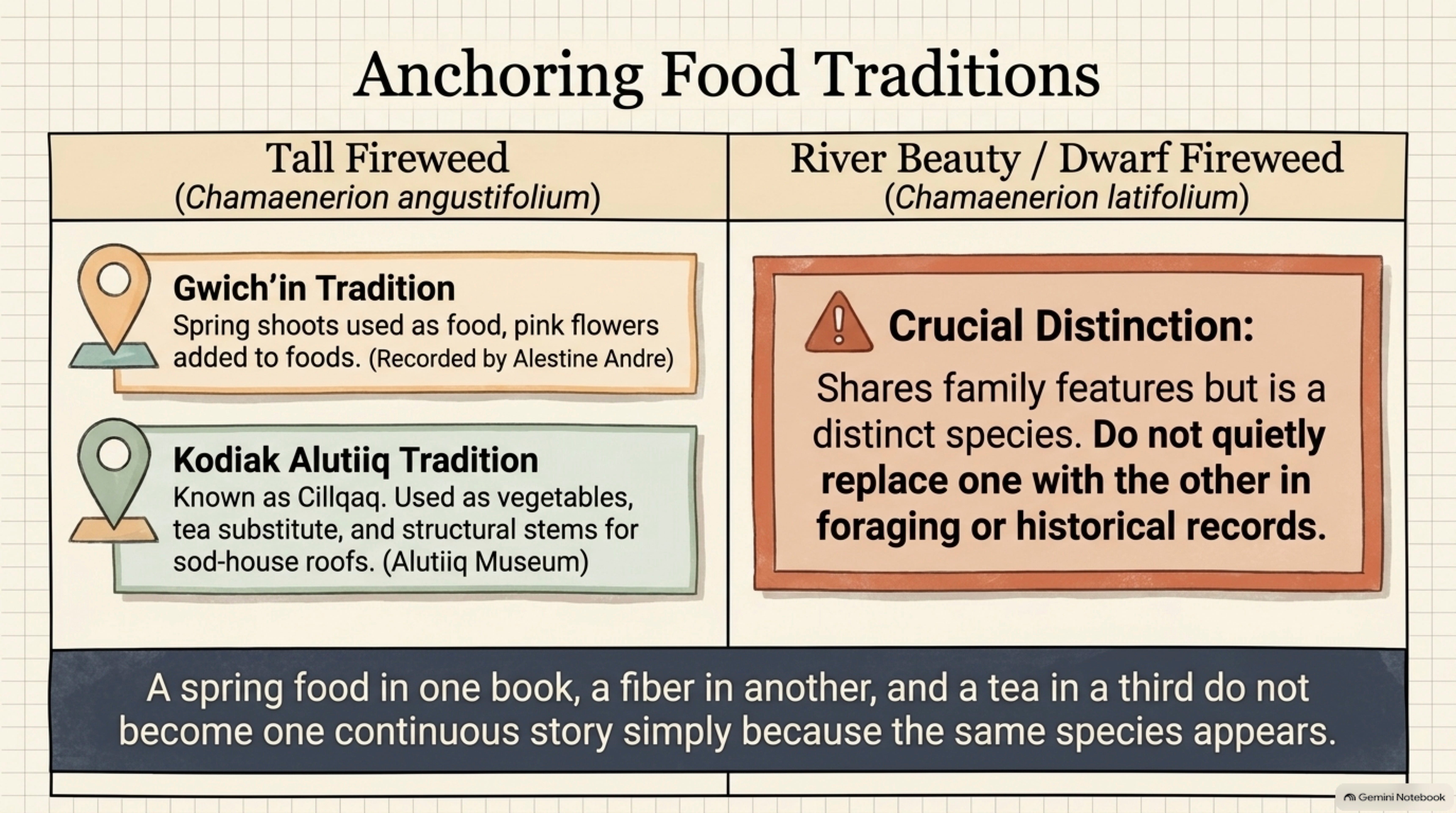
Read these accounts beside one another and their differences remain visible. Even “spring greens” leaves practical details unstated. Which shoots were chosen? How far had they grown? How were they prepared? A cultural record may establish that a food was used while leaving those questions outside its purpose. The missing detail is a reason to consult the relevant source further, rather than complete its account with directions from an unrelated book.
The species name deserves the same attention. Tall fireweed and river beauty, or dwarf fireweed, Chamaenerion latifolium, share some common names and family features. They remain distinct plants. The Gwich’in tall-fireweed page mentions both in one specifically attributed medicinal passage; that passage does not assign every food use on the page to both species. The Kodiak entry’s scientific name likewise keeps its account attached to tall fireweed.
Give each record a few lines in your notebook: the community or author, place, publication date, plant name and part used. Then note what kind of evidence you have read. A public museum entry, a recorded recollection and a tested preparation answer different questions. Leave space for anything the source does not say.
The result is more informative than a list headed “uses.” A shoot described only as a vegetable has lost the people and setting around it. Follow the credit back, and those relationships become visible again. Learning about them does not settle access to a gathering place or permission to reproduce a teaching, but it does make the reading less anonymous.
5.3 Meet contemporary stewardship
K’áad Jáad Clara Mooney’s “Fireweed Jelly with Haida Botanicals,” published by Sustainable Southeast Partnership on 8 August 2025, follows her aunt Jennifer Mooney. Jennifer grew up in Hydaburg on Prince of Wales Island, Alaska. The account connects what she learned from her grandmother with the foods she makes and shares through Haida Botanicals.
Clara describes foods sent to relatives living away or unable to gather for themselves. Jennifer explains the care she takes to leave enough in a gathering place for a return visit and for whoever comes after her. The enterprise appears within those family and land relationships. Clara is credited for both the story and its illustration.
Jennifer describes her own work, and Clara tells the account as her niece. The original article gives room to their voices; its recipe and artwork remain there with their credits.
For a gardener reading at home, Jennifer’s account raises a practical question: who will encounter this patch after today? You may be deciding how much flowering growth to leave beside a path, or whether a harvest can wait. Another gardener may arrive later. Insects may still be visiting. You may return when the weather, the plant and the time available for work have changed.
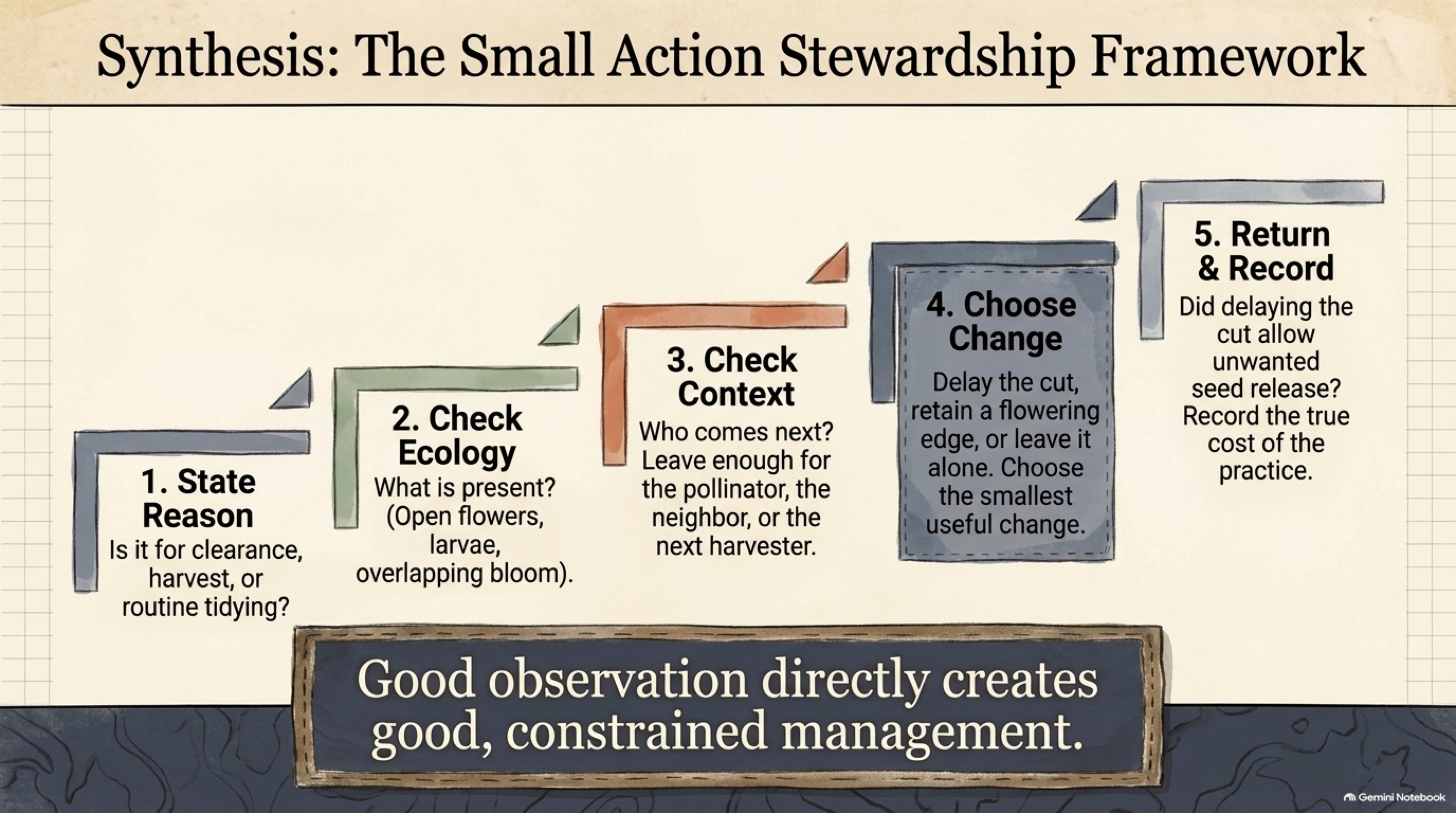
Applying that question to your own patch requires attention to your own circumstances. It does not make a garden decision an enactment of someone else’s cultural practice. What it can do is extend your view beyond the material you want to take now.
The view changes again when a reader considers a small enterprise. A jar has work behind it: collecting, processing, cleaning, keeping records and getting the product to someone else. Who does that work? What must the price cover? What is involved in maintaining access and leaving a gathering place in good condition? Chapter 12 returns to the obligations of selling. Here, the published account is a reason to notice labour and relationships that a finished product can hide.
Sharing food can also mean something beyond a sale. Clara’s description of food travelling to relatives keeps the connection to family visible. The meaning of any particular gift belongs first to the people giving and receiving it. A reader can recognise that connection without supplying feelings the account has not reported.
Makers can learn from family, develop products and make new choices without being confined to an imagined, unchanging past. Selling a food does not erase the relationships around it. Following what a named maker actually says allows both continuity and change to remain in view.
Return from the article to one decision of your own. Perhaps the gathering place needs more time between visits, or the true cost of a product needs another look. Let the next action be as particular as the account that prompted it.
5.4 Follow plant fibres through a real account
A split capsule holds a loose brush of shining hairs. In still air, they may remain gathered along its opening; a little movement loosens the outline. Below it, the stem still holds leaves and flowers upright. The word fibre can conceal how different these materials are. Seed down and stem fibre come from different parts of the plant, and a record about one cannot establish the properties of the other.
In its Traditional Food Fact Sheets, the First Nations Health Authority identifies outer fireweed stems among materials used for twine. This broad British Columbia educational resource supports the material distinction. A particular Nation, maker or technique would need a more specific source.
For seed down, the Skelkelosen fireweed profile hosted by the City of Surrey, with Wild Bird Trust provenance, describes Coast Salish weaving that combines fireweed’s soft seed hairs with other fibres. The blending matters. This brief account does not describe down on its own as a ready-made yarn or provide a tested method for a beginner.
Grant Keddie’s museum research “Prehistoric Dogs of B.C. Wolves in Sheeps’ Clothing?” gives a narrower documentary trail. In the Royal BC Museum-hosted version, Keddie credits Nancy Turner and Randy Bouchard with records of fireweed down mixed with dog hair among the Saanich, and with dog and goat wool among the Squamish and many Puget Sound groups. The plant is identified as Epilobium angustifolium. These are attributed historical records; the community names here follow the source.
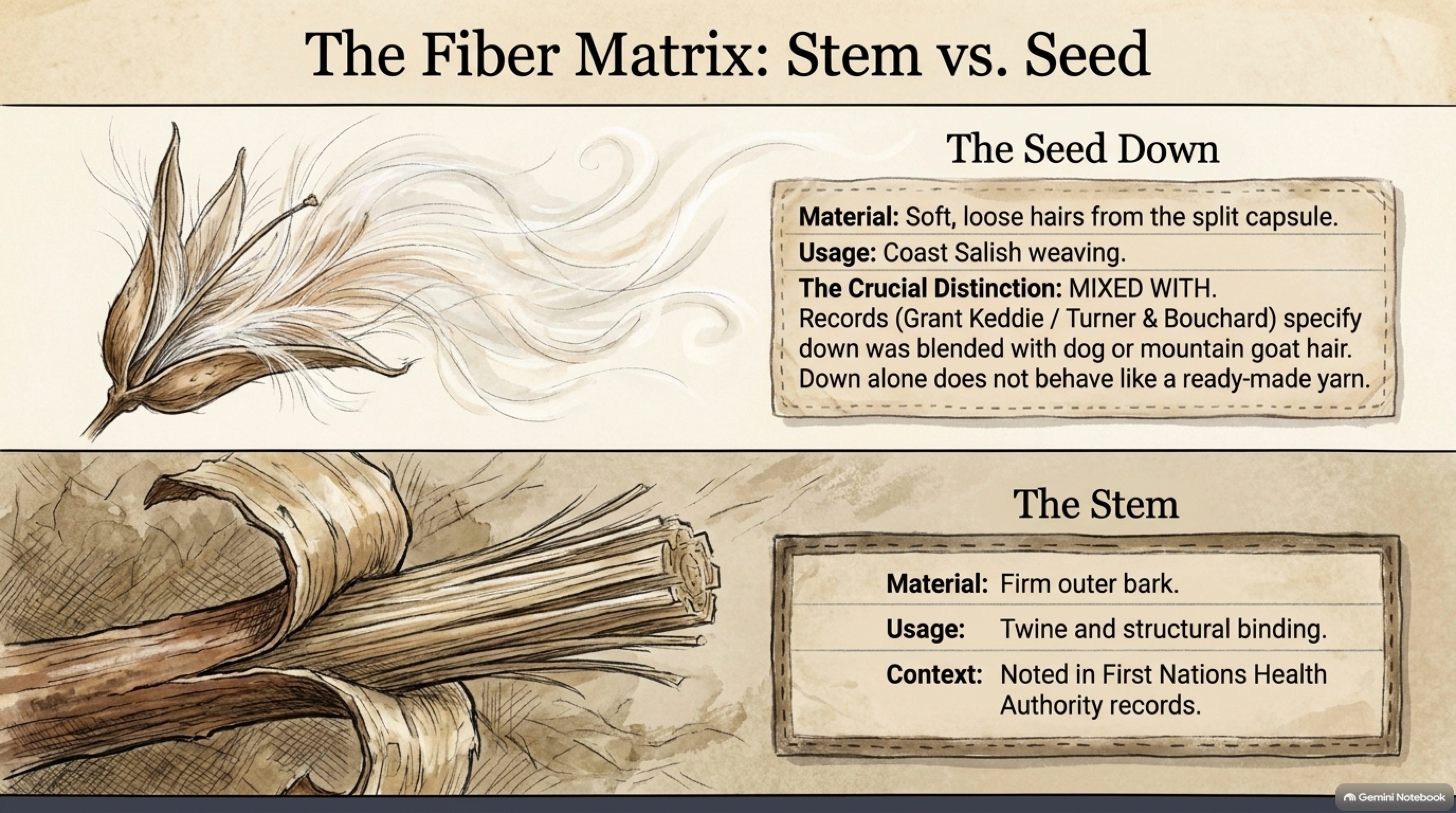
Keep the small words “mixed with.” They carry part of the material history. A textile made from several fibres cannot tell us how one would perform alone. Preparation, the proportions of the blend and the maker’s skill all affect what can be made. Calling such an object simply a fireweed blanket may obscure the work and the other materials that hold it together.
Different records reveal different parts of that work. A written account may describe a blend without identifying a surviving object. An object label may name a maker and place while leaving some of the fibres uncertain. A photograph can show weave and colour, yet leave the botanical identity of a pale strand unresolved. Used together, these records can strengthen an account. One should not silently take the place of another.
If a museum object draws your attention, begin with its own record. Which object is being described? Is the maker known? How were its materials identified? A photograph placed beside a discussion of fireweed does not, by that placement alone, become an example of fireweed workmanship. The institution’s guidance on access and reproduction matters too, including any responsibilities attached to the object’s display.
These questions can make practical curiosity more exact. A reader arriving at Chapter 10 might ask which part of a stem yields a strand, how drying changes it, or what a blend contributes. A small, carefully recorded trial, made after the chapter’s craft checks, can investigate the behaviour of the material in hand. It cannot by itself reconstruct a historical practice or stand in for learning from an experienced maker.
Look once more at the down along the open capsule. Its lightness is immediately visible. The judgement needed to choose it, prepare it and work it with another fibre is less easily seen. The documentary trail helps keep that skilled work in the picture.
5.5 Trace the changing Ivan chai story
A name on a packet can promise a flavour and a history in the space of a few words. Ivan chai offers a useful reason to pause over both. Ivan-chaj, Ivan-chai and koporskij chaj appear in the literature around Russian fireweed tea. The plant in this account remains tall fireweed, including where a source names it Epilobium angustifolium.
Begin with what goes into the cup. Simply dried leaves and leaves that have been worked and held through a processing stage are different preparations. Calling both preparations “fireweed tea” hides that distinction. Chapter 9 follows the methods more closely, including the limits of the everyday word fermentation: it does not identify one microbiological process or establish a safe household procedure.
Julia Prakofjewa and colleagues’ 2020 study, “Re-written narrative: transformation of the image of Ivan-chaj in Eastern Europe,” examines contemporary practice alongside the stories told about it. Interviewees describe methods learned from others, gifts, purchases and variations in preparation. The historical discussion traces a changing reputation, from tea substitute and imitation to a drink promoted as national heritage. Media and commercial storytelling form part of that change.
The interview histories do not begin at one moment. In interviews conducted in 2018, one participant in Karelia recalled learning the processed tea in 1989. Others who volunteered a starting date described beginning one to four years before the interviews. Those recollections help explain the spread of a practice among the people interviewed, without establishing when anyone first made the drink. The study gives readers grounds to question sweeping claims of antiquity while taking the work of present-day makers seriously.
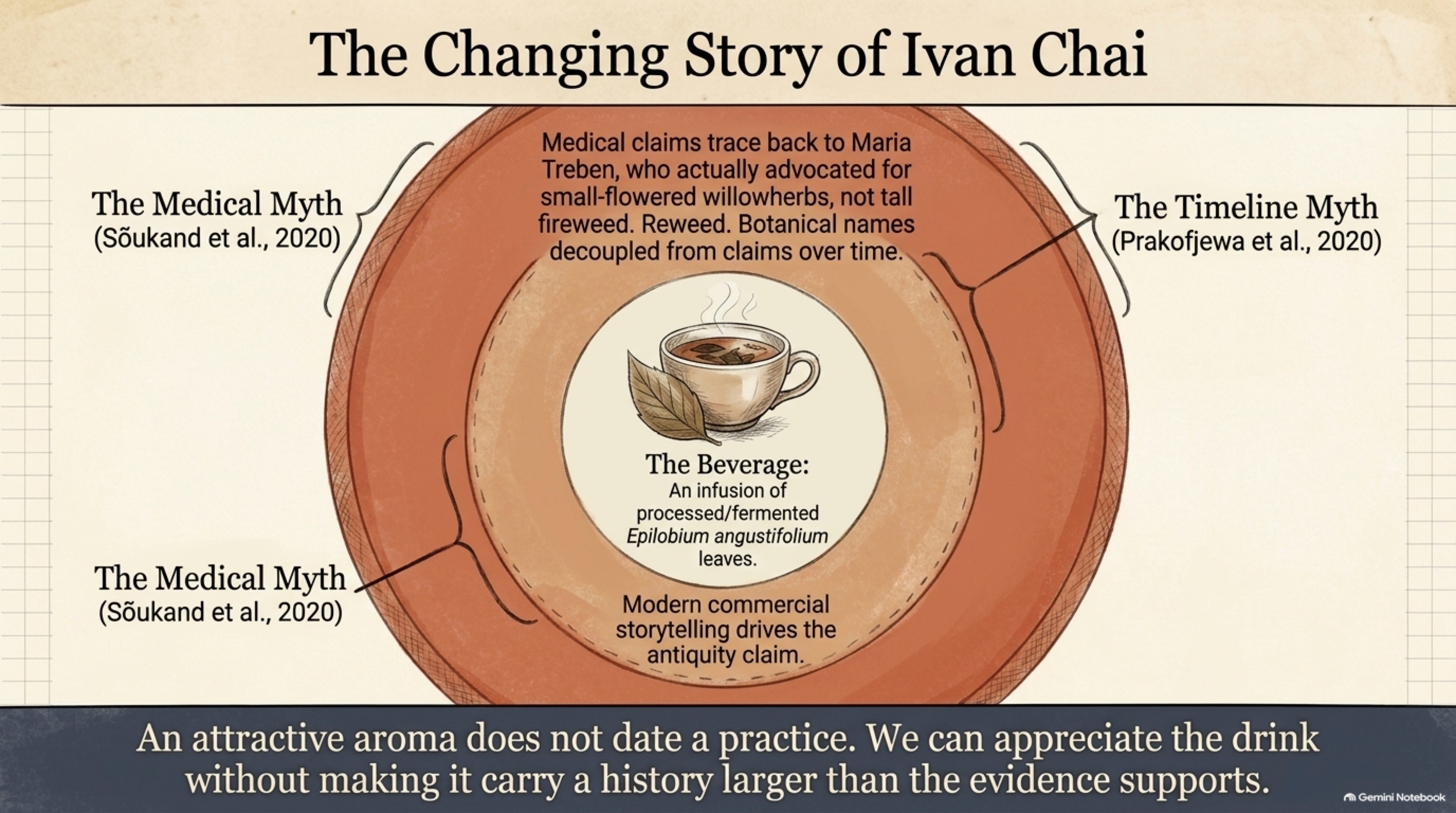
A second investigation follows medicinal claims. Renata Sõukand and colleagues’ “Inventing a herbal tradition,” also published in 2020, draws on 599 interviews in seven countries and historical source analysis. It examines the recent popularity of medicinal fireweed use and how claims changed as they travelled through print and other sources.
One consequential change concerns the plant itself. Maria Treben’s advocacy centred on small-flowered willowherbs rather than tall fireweed. As later accounts repeated the claims, botanical names and quotations did not always remain securely connected. A reference to willowherb could appear to support a claim about a different species. The familiar name made the movement easy to miss.
That paper investigates the history of knowledge and attribution. Its assessment of clinical evidence belongs to its publication date. Present-day health questions need the separate appraisal in Chapter 11 and appropriate professional advice. Neither historical study validates a processing method or a treatment.
The two papers make an origin story easier to read closely. Start with the earliest document a writer actually cites. Does it identify the species? Does it describe leaves dried for an infusion, or leaves worked through additional stages? What was the product offered as: an everyday drink, a medicine, or an imitation sold under the name of another tea? A later writer may cite the document directly, or may repeat someone else’s account of it. Follow that difference as far as the sources allow.
Each question separates claims that often arrive together on a label. Evidence for an old beverage is not necessarily evidence for today’s processing method. A dated recipe does not establish a health benefit. Even a well-supported history of one preparation cannot verify the contents of a packet made by another producer.
There is still room to enjoy a drink learned recently. A household can acquire a meaningful habit within a generation. A maker can work skilfully and care about a product while repeating an origin story that needs correction. The quality of the making and the accuracy of the history can be considered separately.
The same care applies to accounts of adulteration. Selling one substance under another name is a particular commercial act. Openly offering fireweed leaves as fireweed tea gives the drinker a different choice. A historical record of substitution should neither disappear from the story nor determine the meaning of every later cup.
For your own notes, keep the preparation beside its source, then give the historical and health claims separate space. That simple arrangement makes it easier to see which question a reference answers. If it tells you when one person learned a method, retain that useful detail without asking it to date the whole tradition.
The resulting history has movement in it. Leaves pass through households and markets; methods are taught, altered and written down; familiar names acquire new claims. A cup of tea can belong to that changing history without carrying a promise of great age or proven medicine.
5.6 Make room for meaning
Rosebay willowherb brings another setting into view: broken masonry and the open ground of bombsites. In Britain, its association with Second World War ruins survives in the name bombweed, recorded by the Royal Horticultural Society. A plant often met in clearings and burns also became familiar in damaged streets.
In Yukon, fireweed entered public life in another way. It became the territorial floral emblem in 1957. The Government of Yukon records the designation, and the ordinance names Epilobium angustifolium directly. A living species was chosen to represent a place.
One association persists in a common name; the other has a legislative date. Neither tells us what every person felt when the flowers appeared. Public meanings and private encounters can exist beside one another without becoming identical.
Resilience comes readily to mind when a green shoot rises through disturbed ground. Yet the plant’s return cannot repair a damaged home or account for those who did not return. Writing about recovery needs room for those absences. A flower can be welcome without turning loss into a lesson.
For a personal reflection, begin with an encounter you actually remember. Where were you standing? What was close enough to see? Perhaps the flowers marked a bend in a path, or the stems caught your attention against a fence. Include only what belongs to the memory. Details learned later can enter as later knowledge.
If the plant seemed hopeful, let that feeling remain yours. Another person may have experienced the same place differently. Your account becomes more convincing when it stays close to what you saw and understood, without assigning its meaning to everyone nearby.
An ordinary memory is enough. You may have noticed fireweed for years before learning its name, or begun seeing it only after following the leaf veins in Chapter 1. Repeated attention can give a plant a place in a life. There need be no dramatic event, family legend or moment of revelation.
When someone else belongs in the memory, keep their contribution distinct from yours. Ask before recording or publishing what they shared privately. If a public account prompted the reflection, name it and describe your own response. Acknowledging its influence does not imply that its author endorses what you have written.
End, if you like, with something to look for next season. It might be the first shoot beside the path, the lower capsules beginning to open, or stems still standing after the down has gone. A specific question gives you a reason to return without deciding in advance what the next encounter must mean.
The accounts in this chapter remain in their own places: a language guide in the Okanagan, northern food records, Jennifer and Clara Mooney’s account, records of textile making and the changing story of Ivan chai. Following their sources has brought people into view as well as uses.
Now return to the patch within your own reach. Notice where its outer stems stand in relation to the path or the neighbouring plants. The next chapter begins with that space, and a practical choice about how much of it fireweed can occupy.
Sources and further looking
These notes identify the public accounts behind Chapter 5. Sources were rechecked on 10 October 2026. Names, places and claims remain attached to the publications that supply them. This source review does not imply endorsement or approval by the people, communities or organizations named.
A name in the Okanagan
RDCO Syilx and Okanagan partnerships
The dual-language guide and audio key credit Krystal Withakay (spaxwawlm) and give sɬqmiɬp for fireweed. The page describes the guide alongside the Westbank First Nation partnership. It supports the name and guide credit; it does not identify the recording’s speaker or establish a fireweed food or medicinal practice. No pronunciation has been independently assessed here.
Reading and reuse
International Society of Ethnobiology Code of Ethics
The 2006 Code, with 2008 additions, addresses consent, responsibilities, reciprocity and acknowledgment, including publications and recordings. It informs section 5.1 as an ethical framework. Community-specific protocols and permissions for a new use still require their own attention.
Gwich’in food records
Fireweed tall · Plant database introduction
The Gwich’in Social & Cultural Institute entry credits Alestine Andre and Alan Fehr’s Gwich’in Ethnobotany, second edition, 2002, for the food account. A separate medicinal passage concerning tall and dwarf fireweed cites Andre’s 2006 thesis. Section 5.2 preserves those distinctions and the database’s restriction against self-medication. No Gwich’in plant name is supplied here.
Fireweed in Kodiak
Alutiiq Museum Fireweed and Cillqaq
The museum’s plant entry identifies Epilobium angustifolium and records vegetables, dried-leaf tea, roof thatching and steam-bath switches. These cultural-use records are not presented as a food-safety or clinical assessment.
A contemporary family enterprise
K’áad Jáad Clara Mooney’s “Fireweed Jelly with Haida Botanicals,” Sustainable Southeast Partnership, 8 August 2025, first appeared in the Juneau Empire. Clara is credited for story and illustration. The article supports the account of Jennifer Mooney, family learning, sharing food and gathering with later visitors in mind. The enterprise questions in section 5.3 are reader prompts, not an assessment of the business.
Stem fibre and seed down
FNHA Traditional Food Fact Sheets · Skelkelosen fireweed profile
The First Nations Health Authority’s plants section, PDF page 28, records outer-stem twine. The Surrey-hosted profile carries Wild Bird Trust provenance and describes seed-down blending in Coast Salish weaving. Both are broad educational sources; neither supplies the craft protocol or named maker absent from its account.
Attributed historical fibre blends
“Prehistoric Dogs of B.C. Wolves in Sheeps’ Clothing?” originally appeared in The Midden 25(1), pages 3 to 5. The Royal BC Museum-hosted version, PDF page 6, attributes the named fireweed-down records to Nancy Turner and Randy Bouchard. Those underlying records were not all independently re-examined. No particular surviving blanket is identified here as containing fireweed.
The changing tea narrative
Prakofjewa and colleagues 2020 · University repository full text
“Re-written narrative: transformation of the image of Ivan-chaj in Eastern Europe,” Heliyon 6, e04632, examines beverage practice and historical storytelling. The full paper was checked through the university repository. Section 3.1.1.1 places the 1989 recollection within the 2018 interview material; it establishes no universal origin date or validated household process.
The circulation of medicinal claims
Sõukand and colleagues 2020 · PMC full text
“Inventing a herbal tradition: The complex roots of the current popularity of Epilobium angustifolium in Eastern Europe,” Journal of Ethnopharmacology 247, 112254, combines 599 interviews across seven countries with historical analysis. The full paper supports the distinction concerning Treben’s promoted willowherbs. Its medical-evidence discussion belongs to its publication period, not a current clinical appraisal.
Public names and emblems
RHS Willowherbs · Yukon symbols and emblems · Yukon ordinances 1957
The RHS bombweed passage was verified in the page’s indexed text; direct extraction omitted that section. Yukon’s designation is supported by the government page and the 1957 second-session ordinance, chapter 4, printed page 121. The reflection exercise in section 5.6 is proposed by this guide, not a reported personal memory or an attributed Indigenous teaching.
CHAPTER 6
Grow, keep, contain or remove
A flowering stem leans over the path. Farther into the bed, another rises through the branches of a young shrub. The pink flowers belong to the same species, but the two stems may ask for different decisions. Look at what is growing beside them before reaching for a tool.
There may be room to keep the flowers by the path. The shrub may need more light, or space in which to water and inspect it. Fireweed can be welcome in one part of a garden and troublesome in another. A useful decision begins with this place, the plants around it and the time you can give it.
Walk the whole edge. Look between the stems and beyond them, wherever a new shoot would be difficult to reach. Then look up the flowering spikes. Slender capsules may already be developing below the open flowers. What happens underground and what leaves on the wind both belong in the plan.
This chapter follows that plan from a first planting to the next season’s return. Choose an outcome, use a proportionate method and leave yourself a way to judge the result. The small garden comparisons suggested here are ways to learn about your site, with regional advice where needed. They do not promise a particular treatment will work everywhere.
6.1 Choose a purpose and a boundary
Begin with a sentence about the place you want to make. “Keep a flowering patch beside the shed while leaving the path clear” gives you something to work toward. So does “give these young shrubs more light without stripping the bed.” Either sentence makes the other plants, and your use of the space, part of the decision.
The scale matters. A few stems among perennials can be watched individually. A pasture edge brings animals, forage and fencing into the picture. A nursery bed may need close attention around small stock. Restoration work begins with an agreed plant community and a plan for its development; a commercial forest may be assessed partly by the growth of planted trees. Carrying a successful method from one setting into another requires more than recognising the same plant.
In a garden, sketch the patch and the places you want to protect. Include paths, drains, neighbouring property and other planting. Mark an edge you can find again, perhaps beside a fixed feature or in a photograph taken from the same position. It is a working boundary, not a map of everything underground.
Decide what change would call for action. One shoot in the path may be enough. In a mixed border, the threshold might be fireweed overtopping a particular plant or preventing you from reaching its base. A restoration project may instead measure the cover of desired species or the survival of planted stock. Set that threshold before choosing a treatment, so the tool does not begin to define the task.
Where the patch already fits, leave it and observe. Check the places where spread would be costly, but there is no need to disturb compatible growth simply because it can spread. Nor should a decision to leave it depend on an expected date of natural disappearance. Open conditions may continue to favour fireweed.
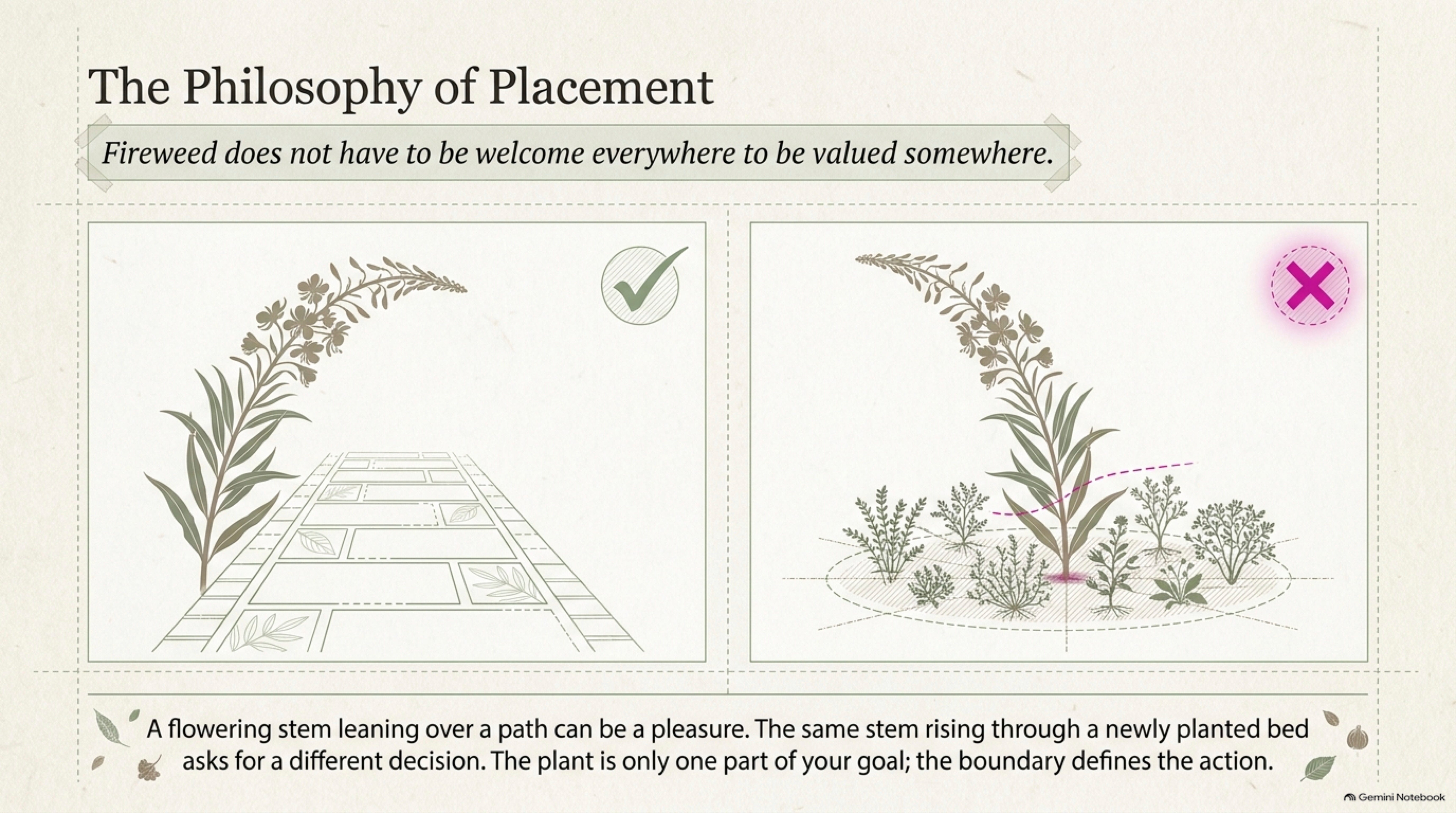
Put time into the plan as plainly as space. If you can visit only in spring, a planting that needs attention when capsules mature may be a poor fit. If regular edge work would turn pleasure into a burden, begin with a smaller area or choose another suitable species. The drawing is easier to change than an established underground network.
A first plan can fit on one page: the purpose, the boundary, the plants to protect, the change that would prompt action and the next check. Add who will do the work. A patch is much easier to keep within an agreed space when someone has time to return to it.
6.2 Check identity, source and authority
Confirm the plant before moving or removing it. Chapter 1 follows several characters on the same plant, keeping tall fireweed separate from river beauty, other willowherbs and unrelated plants that share the common name. Retain the scientific name on a seed or nursery label. This guide concerns Chamaenerion angustifolium; suppliers may also name it Chamerion angustifolium or Epilobium angustifolium.
Ask where the material came from. Nursery-grown stock of known provenance offers a more traceable beginning than an unplanned collection from a wild stand. Ask about its source region, growing conditions and intended use. For restoration, follow the project’s requirements for provenance and genetic diversity. “Native to Canada” leaves too much geography unresolved to tell you what belongs at a particular site.
Keep the supplier or permitted collection source and the date with your planting notes. A nursery lot, a division of one garden clone and seedlings from a local collection are different starting points. If germination or later growth disappoints, those details help a grower investigate the result.
Inspect purchased or shared plants for weeds, damaged growth and signs of pests or disease. Keep suspect stock out of the planting while you seek advice. Soil and root balls can carry other organisms; casually washing or trimming them does not necessarily resolve a plant-health concern.
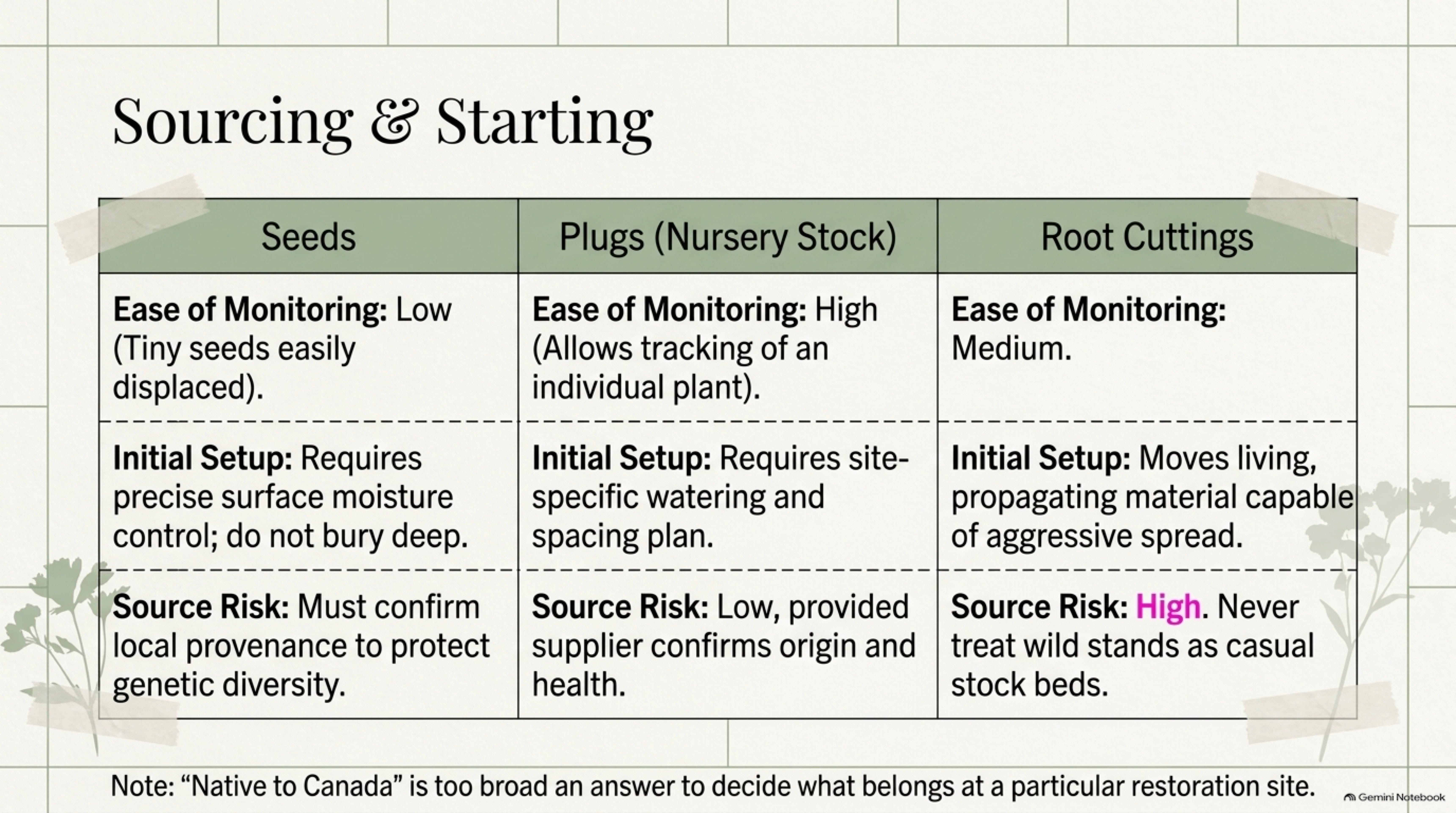
Permission needs its own check. Access to a patch does not establish permission to collect seed, dig roots, cut stems or introduce plants. Ask about the action you intend. Gathering a little seed and bringing machinery onto the ground are very different requests.
For a British Columbia site, begin with the owner or managing authority. Regional parks have their own regulations and contact routes; provincial parks are managed through BC Parks and the information for the named park. Roadsides, rights-of-way and other public land may have different managers. On Indigenous lands, and where Indigenous rights or community protocols are involved, identify the appropriate Nation and authority. The relevant permission belongs to the place and the work.
Ask about conservation concerns too. A widespread plant may form a small or sensitive local population. Wet ground, streambanks, steep slopes and cultural sites can make digging or repeated foot traffic inappropriate. Even a locally native species may be an unsuitable addition to a protected plant community.
Clarify responsibilities with neighbours before work crosses a property boundary. If food harvest is part of the purpose, carry the site history and sourcing questions into Chapter 7. Garden cultivation does not erase a plant’s exposure history. Where identity, authority or site sensitivity remains unresolved, observation can continue while the practical work waits for a clear answer.
6.3 Start a modest planting
Fireweed’s fine seed asks for attention near the soil surface. The USDA Natural Resources Conservation Service’s 2016 Plant Guide for Fireweed, prepared in Spokane, describes establishment favoured by light, moisture and shallow placement. In a study it cites, seed placed at the surface established more successfully than buried seed. The guide also records propagation from suitable root cuttings. A gardener does not need to burn ground to begin a nursery plant.
Start with a small amount of identified, appropriately sourced material. A regional native-plant grower can help you choose between plugs and seed. A plug is easier to follow as an individual planting. Seed lets you observe germination, but its tiny size makes the surface conditions especially important.
With seed, obtain instructions for that lot. Ask whether it needs pretreatment, when to sow in your climate and how to keep the surface moist without burying it. Regional guidance matters more than a borrowed calendar: a coastal nursery, an interior valley and a high-elevation garden have different seasons.
Use a labelled nursery container or a clearly marked, small sowing area. Record the source, date and method. Keep the surface visible enough to notice drying, displaced seed and unwanted seedlings. Scattering a packet through several unmarked beds makes it difficult to learn which plants came from the sowing or why some established and others did not.
Where surface sowing is advised, resist treating the seed like a bean that can be pushed into a deep hole. Moisture needs to reach its shallow position without leaving the medium persistently waterlogged. Ask the grower to help specify the medium and watering method for your setup. Large-scale seeding instructions may assume equipment and conditions a home gardener does not have.
For plugs, settle the planting season and aftercare before taking them home. Look at summer exposure, drainage, competing vegetation and the water you can provide. A cool opening that stays moderately moist presents a different task from a hot, exposed Okanagan bed. Fireweed growing somewhere in the region tells you little about the suitability of that particular garden position.
Allow room for the supplied stock and for yourself to work around it. The distance between young plants determines their starting arrangement, but it cannot hold an established patch within bounds. Plan access with later growth in mind.
Root propagation moves living material capable of producing further growth. Use an authorised source and nursery guidance if you choose that route. Leave wild stands intact unless collection has been specifically permitted, and keep leftover root pieces out of ordinary mulch and casual compost heaps. Section 6.6 follows these materials to an appropriate destination.
During the first season, record survival, growth, flowering, watering and the time spent maintaining the edge. Take photographs from the same position. If you have several comparable plants, follow each one, including those that struggle. The less successful plants may tell you more about the site than the best-looking specimen.
Let expansion wait until you know what the planting asks of you. A first season may reveal that the position is too dry, the edge too awkward to reach or the small patch quite sufficient. Each is a useful result.
6.4 Make spread easy to notice
Fireweed spreads in two ways that matter here. Seeds can reach new ground, while established plants extend through a spreading underground system that includes bud-bearing roots. Preventing seed release leaves underground spread to be checked; removing a visible shoot leaves both questions open.
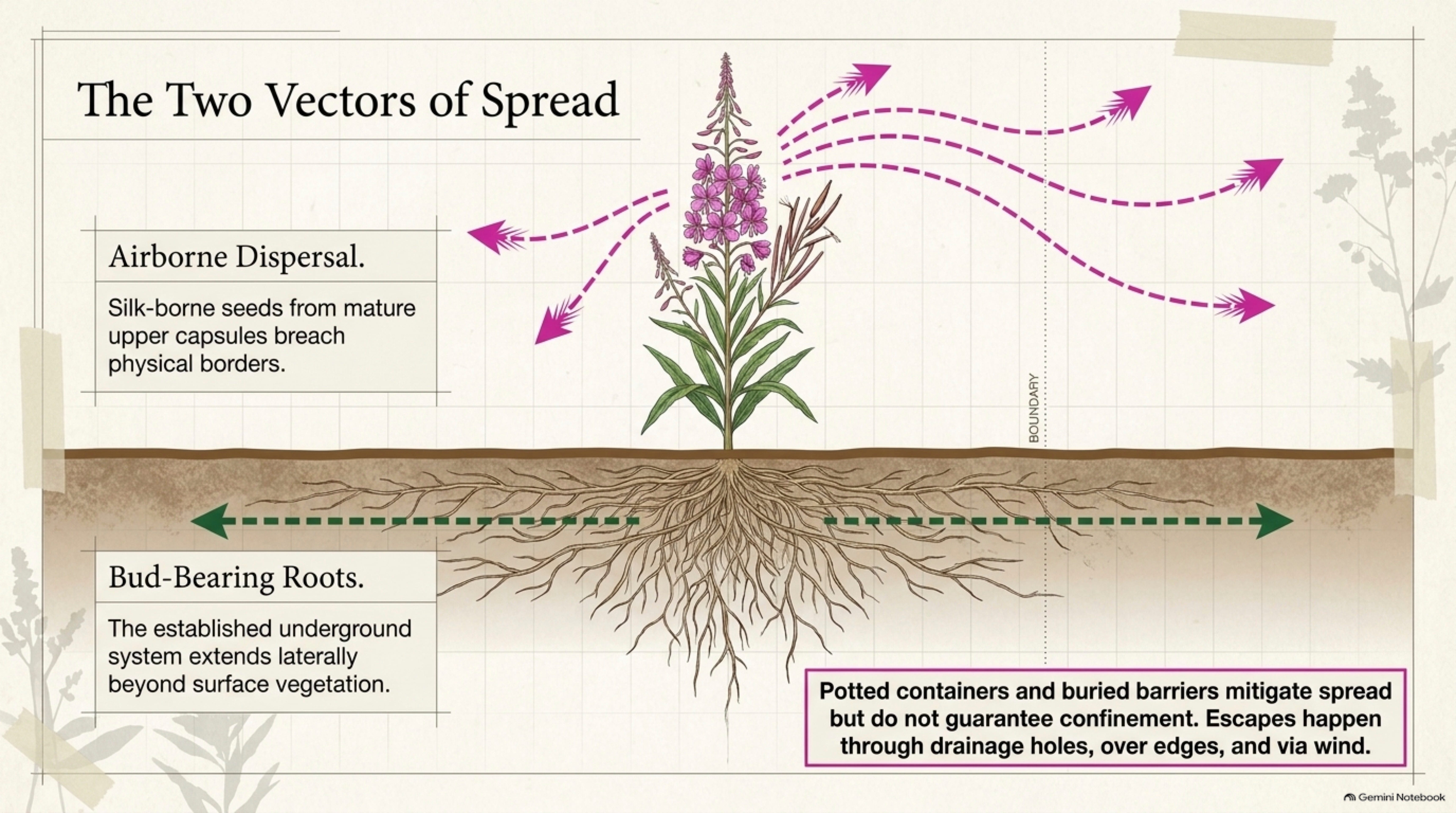
Give an open patch a visible edge. Where it suits the habitat, a mown or otherwise maintained strip can make emerging shoots easier to spot. Check the far side as well. The short vegetation shows you where to look, but does not demonstrate that roots have stopped beneath it.
A managed border also needs a place to stand. Leave enough access to distinguish fireweed from the plants you want to keep and to reach them without repeated trampling. Walk the route you expect to use in spring and again when the stems are tall. A boundary that disappears behind valuable planting will be harder to maintain carefully.
A container can help with observation and some of the edge work. Check its openings and any contact with nearby soil for escaping growth, and watch the surrounding ground for seedlings. It also needs adequate drainage, water, root space and winter care. Choose a container with regional nursery advice and put it where inspection will remain practical.
A buried barrier needs similar attention. Installation disturbs soil; joins and edges need checking. A barrier cannot be assumed escape-proof. Before undertaking substantial construction, consider whether a smaller patch, an accessible managed edge or another species would meet the purpose with less work.
Seed management begins while there are still flowers to enjoy. On the same stem, older capsules may be ripening below fresh blooms. Inspect those lower capsules rather than waiting for a cloud of silk. If preventing dispersal is part of the plan, select and remove the necessary stems before capsules open, with a destination already prepared for the cut material.
Removing a whole stem also removes the flowers still on it. Keeping floral resources while intercepting seed takes timely, selective attention. One mowing date will not suit every place or season. If those visits are unlikely to happen, allow for seed spread when deciding whether and where to plant.
Mark new stems beyond the chosen edge and seedlings in surrounding bare ground. Repeat photographs can show a changing footprint without telling you which shoots share an underground connection. There is seldom a need to dig solely to answer that question where disturbance would do harm.
Check during spring emergence, after management and as capsules develop. Adjust the interval when growth is rapid or a missed visit changes the situation. Keep returning to the practical question: does the patch still fit the space and the time available to care for it?
6.5 Work with the least disturbance
Look first at the part of the patch causing difficulty. A few selected stems may be all that stand between a young shrub and better light, or between you and a tap. Work at the scale of that problem. Where the rest of the patch fits, it can remain.
For a small garden, assess nonchemical methods first. The Royal Horticultural Society’s willowherb guidance includes removing young plants, carefully lifting established growth, preventing seed dispersal and filling gaps. Its advice comes from British gardens and covers several species. Use it to consider options, then judge them against your soil, the surrounding plants and tall fireweed’s capacity to regrow.
Selective cutting leaves much of the soil and neighbouring vegetation in place. The immediate effect is plain: the cut stem no longer stands over the plant you want to protect. Below ground, however, the plant may still be capable of new growth. Repeated cutting removes photosynthetic leaf area and can make regrowth draw on stored resources. Timing and conditions affect the response, so a cleared-looking bed on the day of cutting says little about lasting control.
Before cutting, follow the desired plant’s stems to the ground. Keep the working area small enough to see the tool’s path. Use suitable tools and protective equipment, and stop where concealed hazards, active wildlife use or uncertain plant identity make the work unsafe or indiscriminate. Machine work around small plants requires appropriate skill and a separate assessment of the risks.
Photograph the area and record what you removed. On the next visit, examine the protected plant as carefully as the fireweed. Has its light improved? Has other vegetation bent across it? Was its stem damaged? The plant’s response tells you whether the work achieved its purpose.
Continue cutting only while the return work is feasible and the effects are acceptable. Watch the regrowth before choosing the next action. If repeated visits bring heavy trampling, remove flowers important to the planting or produce little useful release, change the plan. Persistence is valuable when the method fits the place.
Careful lifting may suit a small, accessible garden patch. Dig only where authorised and where the soil and neighbouring roots can tolerate it. Collect living underground pieces for the waste route described in section 6.6, then watch for regrowth. Bud-bearing fragments left behind can produce new shoots. Repeatedly chopping through the whole bed risks scattering those pieces and disturbing more ground than necessary.
On a bank, beside established roots or in fragile soil, managing shoots may cause less damage than excavation. Where removal does expose soil, plan suitable cover before leaving it vulnerable to wind or running water. The condition of the ground after the work belongs in the result.
Shade and competitive planting change the habitat in which fireweed grows. Its preference for open light makes these worth considering, but added shade can also displace other open-habitat plants you wanted. Choose replacement vegetation for the site and its purpose. Mulch may help limit seedling establishment in gaps; an established underground system presents a different problem. Neither a particular mulch depth nor one competitor is a universal cure.
Browsing animals need a land-management plan of their own, including feed, welfare, fencing, soil condition and the plants they will actually select. Seeing an animal eat fireweed provides no stocking rate or assurance of control.
If a small comparison would help, choose two reasonably similar areas where observation is safe. Record both before treating one. Leave the other untreated only if it can remain without breaching the boundary or damaging plants. Follow regrowth, desired vegetation, bare soil, flowers, weather and time spent. The comparison can sharpen your judgement about this site, although it is not a replicated trial. Stop if the work begins to damage what you meant to protect.
6.6 Find a use or destination for the material
Decide where material will go before making the pile. Cut stems and leaves, stems carrying capsules, and living underground pieces need different handling. Sorting them as you work is easier than disentangling a heap afterward.
Clean stems and leaves without capsules or living roots may be left to decompose in the managed patch, used as suitable surface organic material or added to a properly managed compost system. Place them where they will not smother small plants, obstruct drainage or wash onto neighbouring ground. Near buildings, follow local fire-safety guidance about dry vegetation.
The history of the material matters. Keep vegetation from unknown treated sites, contaminated ground or plant-health problems out of food-garden compost until a suitable adviser or waste service has resolved how it should be handled. Decomposition does not reliably remove every concern carried into a pile.
Stems with developing or ripe capsules need to be handled as potentially seed-bearing, even before silk is visible. Prevent scattering while carrying and transporting them. Check whether the local green-waste service accepts this material and can process it appropriately; if it cannot, ask for the approved alternative. A cool home compost heap is not a reliable way to destroy seed.
Keep living roots and other underground pieces separate too. Their use in propagation is reason enough to avoid assuming that a fragment is dead. Do not spread them as mulch, move soil containing them into another growing area or add them to an uncertain composting process. Contain them while arranging the appropriate local destination, then inspect the holding area for new growth.
Keep all garden waste out of watercourses and natural areas, and off neighbouring land. A pile moved over a fence or down a bank remains part of the work you have done. Its destination deserves the same care as the bed it came from.
Washington State University’s Backyard Composting explains the difference between slow decomposition and a managed hot process. A warm centre does not prove that every seed, root piece or pathogen elsewhere in a heap received adequate treatment. When the process is uncertain, excluding seedheads and living spreading parts is the simpler home-garden choice.
Returning suitable biomass can recycle nutrients. During growth, a plant takes up mineral nutrients and incorporates them into its tissues. Decomposing organisms later release and redistribute some of that material. Carrying the stems elsewhere carries part of it away. The benefit needs no claim that fireweed creates mineral fertility from nothing.
Bradley Pinno and colleagues studied fireweed, named Chamerion angustifolium, in greenhouse reclamation soils. Growth and nutrient uptake varied with the soil and fertiliser treatment. The results demonstrate uptake under those conditions and suggest a possible contribution to nutrient cycling during reclamation. They did not directly test decomposition, nutrient return to other plants or the performance of fireweed compost and garden fertilisers.
A bucket of soaked or fermented fireweed raises further questions. What does the liquid contain, at what concentration, and what organisms have multiplied? Has it been tested on the proposed crop or pest against a suitable comparison? Bubbling and a strong smell answer none of those questions reliably. Without such evidence, there is no sound basis here for recommending a fireweed brew as a fertiliser or pesticide.
Protect water and food crops when handling amendments. Manage composting areas so nutrient-rich liquid cannot enter drains, wells or surface water. Manure and unvalidated brews bring additional questions about pathogens and food contact. Keep uncertain liquids off edible leaves, fruit and food-growing soil rather than using a food crop to test their safety. Ordinary compost practice, soil testing where needed and regional nutrient advice offer a firmer starting point. Section 11.7 returns to the evidence a claim of special benefit would require.
Commercial products also need the appropriate checks. In Canada, the Canadian Food Inspection Agency provides the route for fertiliser and supplement requirements; Health Canada regulates pest-control products. The product and its intended claims determine the questions to resolve before marketing it.
Craft residues come back to the same sorting point. Plain, untreated plant material can be assessed like other biomass. Dyes, mordants, adhesives and finishes may change the disposal route. Follow guidance for those added substances, even when the project began with a plant.
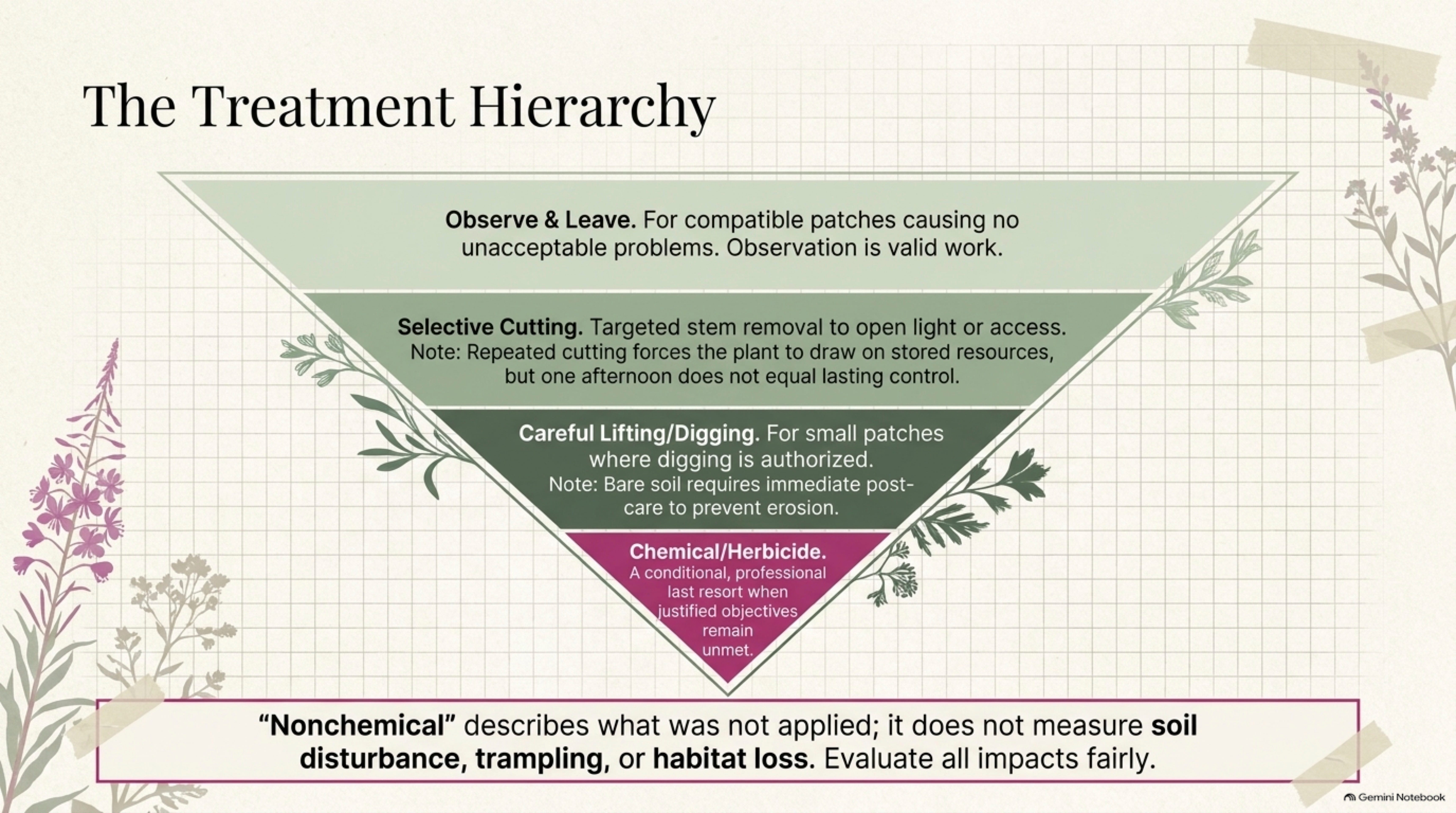
6.7 Compare larger treatments over time
A forest manager may face a scale of work beyond garden hand tools. The comparison still begins with an outcome. How much release do planted trees need, and for how long? What vegetation, soil cover and floral resources should remain? The area that looks most thoroughly cleared on treatment day may not deliver the best result over the following years.
A British Columbia experiment begun in 1992 compared single and repeated manual cutting, a glyphosate treatment and an untreated control in a mixed shrub and herb community. P. G. Comeau, B. S. Biring and G. J. Harper reported five-year results in 2000. Repeated cutting and glyphosate increased the planted Engelmann spruce seedlings’ root-collar diameter, their stem thickness near the base, compared with untreated plots. Survival did not differ significantly among treatments. Repeated summer cutting also increased height. By year five, total vegetation cover no longer differed significantly, although vegetation remained shorter in several treatments.
Later measurements changed the picture. Comeau and Harper’s 2009 report on the same experiment found that differences in average spruce height and diameter were no longer statistically significant by year 15. Survival was higher in all vegetation-control treatments than in untreated plots, with repeated cutting providing benefits comparable to glyphosate. Differences in total vegetation cover were not significant.
An early growth benefit and a later survival benefit are different outcomes. At the five-year measurement, vegetation had returned while trees retained a growth advantage; the longer view showed that the advantage in average size did not remain statistically clear. These results belong to a mixed community in an Interior Cedar–Hemlock setting. They cannot supply a direct prescription for pure fireweed, a dry valley garden or every forest type.
Count labour across the whole sequence. The official project record identifies repeated visits as a substantial cost of the manual treatments. Its historical figures help explain the workload, but current comparisons need present crew costs, terrain, access, equipment and the likelihood of further treatment. Include assessment and follow-up for every option.
David Hart and Philip Comeau’s review of manual brushing describes regrowth and possible damage to crop trees. Tools, sudden exposure and cut material can all affect the trees being released. Physical methods deserve careful accounting of trampling, injury, soil disturbance and habitat loss, as well as their benefits. Choosing a nonchemical method does not remove the need to examine those effects.
Chemical treatment needs equally close scrutiny beyond the number of dead stems. Lisa Wood and colleagues’ 2025 study examined fireweed exposed to glyphosate-based herbicides in growth chambers and operational BC forests. In the controlled experiment, treated plants were shorter and had reduced photosynthetic efficiency, assessed through chlorophyll fluorescence. Field samples had lower pollen viability one year after treatment; the two-year comparison did not differ significantly from controls. Residues were detected in floral tissues at both intervals. These are findings about plant function and exposure. The study did not measure bee-colony loss or establish a safe food-harvest interval.
Put the options through comparable questions. What happens to the target and the plants intended to remain? How much bare soil is exposed, and is it eroding? Which flowers are lost, when, and what other flowers remain? What regrows? Which exposure pathways involve workers, neighbours, animals or water? How much labour and equipment will the full course of work require?
A missing measurement should remain a gap in the comparison. A study designed around spruce growth cannot establish a complete pollinator outcome. Floral chemistry alone cannot supply the economics of vegetation management. Read the studies together while keeping their different sites, methods and measured outcomes visible.
Where a justified objective remains unmet, any proposed herbicide use needs current product and site advice from a qualified professional, the necessary permissions and the current Canadian registration and label. Check provincial and municipal requirements as well. A rate in an old experiment is not a present-day application instruction.
In a garden, the eventual choice may be modest: keep a useful patch, attend to one edge and return when new shoots appear. Larger land may call for professional assessment and a written management plan. In either setting, look at the desired plants, the ground beneath them and the work still ahead.
Return to the stem beside the path. Perhaps it can flower where it stands. Perhaps the shrub farther in now has the light it needed. A good result can be as particular as that: space for the plants you chose, soil left in sound condition and an edge you can find again next season.
Sources and further looking
Sources reviewed 11 October 2026. These notes distinguish horticultural guidance, proposed garden observations and research findings. Site-specific advice and permissions remain part of the work.
Plant behaviour and propagation
NRCS Fireweed plant guide · US Forest Service FEIS review
For sections 6.1 to 6.5. Rich Fleenor’s USDA NRCS guide, published in 2016 under Chamerion angustifolium, supports shallow seed establishment, propagation from bud-bearing roots and attention to lower capsules while upper flowers remain. The FEIS review provides ecological context. These sources inform the proposed garden observations; their regional nursery methods and historical chemical advice are not universal instructions.
Permission and local conditions
RDCO park use and regulations · BC Parks Visit responsibly
For section 6.2. These official routes help identify the responsible authority. Check the named site and proposed action, including collection, digging or planting. General access information does not provide project-specific permission or resolve Indigenous rights and community protocols.
Garden management and spreading parts
For sections 6.4 to 6.6. Royal Horticultural Society guidance covers young-plant removal, lifting, seed prevention, mulch, competitive planting and disposal of roots, rhizomes and seedheads. It includes several willowherbs in British gardens. Fixed treatment depths and durations have not been transferred into a BC prescription.
Compost and water
WSU Backyard Composting · WSU guide PDF · OSU Agricultural composting and water quality
For section 6.6. Craig Cogger, Dan M. Sullivan and Andy Bary’s WSU guide explains slow and hot composting and material selection. The WSU PDF provides an alternative to the catalogue page. OSU’s agricultural publication supports the runoff and leachate principles. Its operational designs and Oregon permitting rules are not BC home-garden instructions.
Nutrient uptake in reclamation soils
Pinno and colleagues 2014 · Author supplied full article
For section 6.6. Bradley D. Pinno, Simon M. Landhäusser, Pak S. Chow, Sylvie A. Quideau and M. Derek MacKenzie, “Nutrient uptake and growth of fireweed (Chamerion angustifolium) on reclamation soils,” Canadian Journal of Forest Research 44:1–7, 2014; published online in 2013. The author-supplied article supports the greenhouse findings. Nutrient cycling is an inference; decomposition, fireweed brews and comparative compost performance were not tested.
Five year tree release results
Comeau and colleagues 2000 · BC project record EP 1135.01
For section 6.7. P. G. Comeau, B. S. Biring and G. J. Harper, “Effectiveness of repeated manual cutting and glyphosate for release of Engelmann spruce from mixed-shrub herb vegetation,” Western Journal of Applied Forestry 15:154–162, 2000. The published abstract and official project record support the five-year summary and historical labour comparison. The publisher’s full article was not accessible during this review.
The same experiment at year fifteen
Comeau and Harper 2009 · Author supplied full article
For section 6.7. P. G. Comeau and G. J. Harper, “Effects of vegetation control treatments for release of Engelmann spruce from a mixed-shrub community in southern British Columbia – Year 15 results,” The Forestry Chronicle 85(4):583–592, 2009. Results and conclusions were checked in the author-supplied full article. The later survival and growth findings qualify the earlier account; similar vegetation cover does not establish an absence of other ecological effects.
Limits of manual treatment
For sections 6.5 and 6.7. D. Hart and P. G. Comeau, Manual brushing for forest vegetation management in British Columbia, Land Management Report 77. This historical review supports attention to regrowth, repeated work and crop-tree damage. Some observations came from personal communications. It supplies context rather than a current universal treatment schedule.
Fireweed after sublethal glyphosate exposure
Wood and colleagues 2025 · Open access full article
For section 6.7. L. J. Wood, A. R. Golt, L. Berg-Khoo and B. Hampton, “Reduced function in Chamaenerion angustifolium after sublethal glyphosate exposure,” Scientific Reports 15:31155. Growth-chamber results are distinct from observational field comparisons with untreated areas. The nonsignificant two-year pollen comparison does not establish complete recovery. Bee-colony loss and a food-harvest interval were not measured.
Present day product and pesticide checks
CFIA fertilisers · Health Canada pesticide compliance · Pesticide Product Information Database · BC pesticides and pest management
For sections 6.6 and 6.7. These official resources identify the authorities and current registration, label and regulatory checks. No product exemption, marketing authorisation or application instruction is inferred. Resolve the product, claim, site and applicable local conditions before manufacture, sale or use.
CHAPTER 7
Harvest, handle, dry and store
A basket changes the way we look at a patch. A moment ago, the eye followed a stem from its narrow leaves to the flowers opening above. Now the same stem seems to offer something to carry home. Before the first cut, look once more at the whole plant.
What is the harvest for? Is there a clean place for it in the kitchen, room on the drying trays, time to finish the work today? These are questions to ask beside the plant, while leaving it there is still easy.
The details we notice outdoors remain useful after gathering. A folded leaf, a firm lower stem, a drop of water held where leaves touch: each can affect how the material sorts, handles or dries. This chapter follows a small harvest from that first decision to the labelled container. Begin with the amount you can use well. The rest can go on growing.
7.1 Choose what the harvest is for
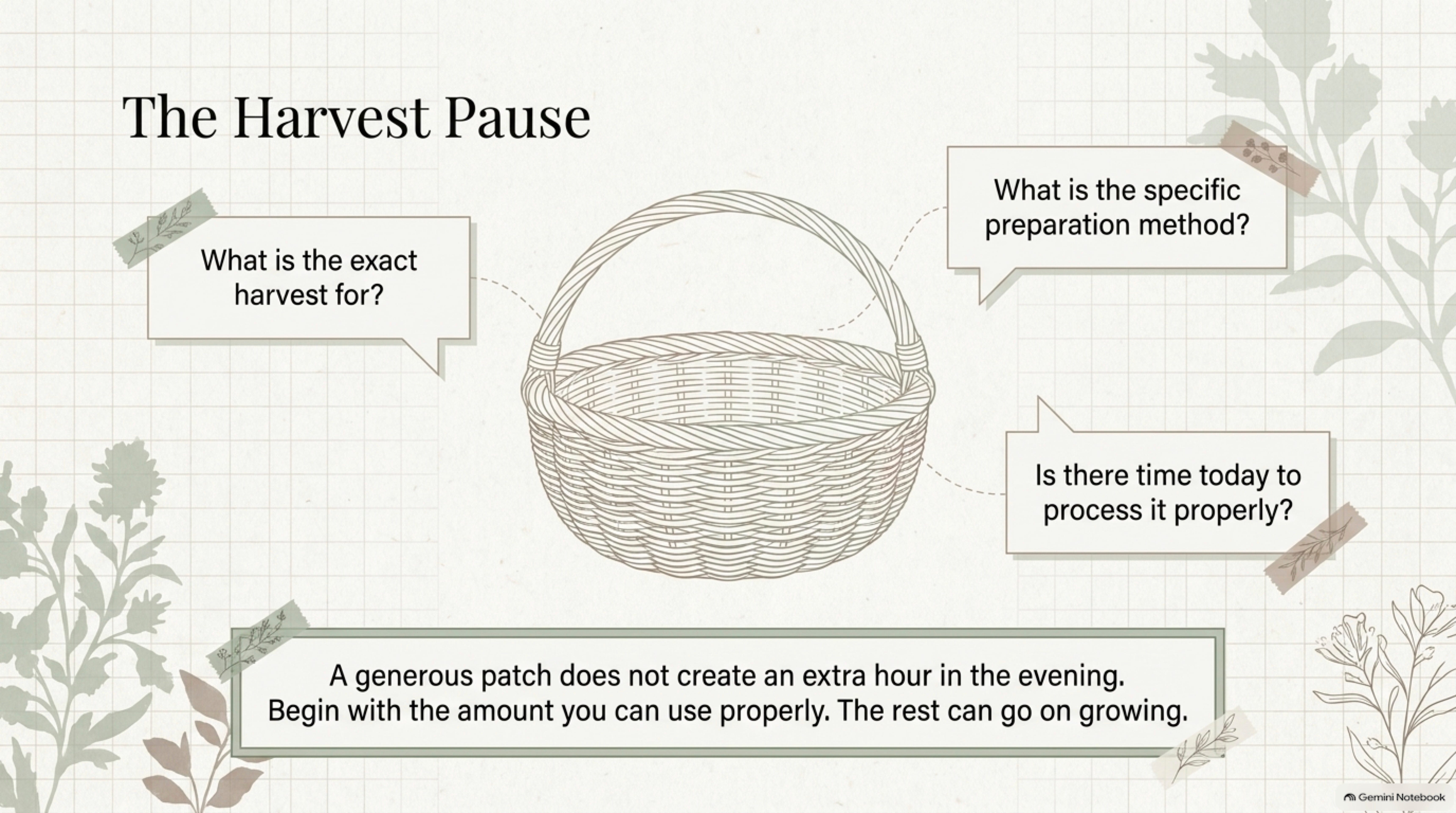
Name the use before choosing the part. Young shoots belong to a fresh-food preparation. Leaves might be intended for a dish or a particular tea method. Flowers call for their own handling, while mature stems and seed silk lead toward the craft chapter. Keeping those purposes separate at the start saves a difficult sorting job later.
“Leaves for tea” still leaves an important question open. A plain dried leaf, a bruised leaf held moist during processing and a concentrated extract are different preparations. Chapter 9 follows those distinctions. A paper measuring compounds after a laboratory treatment can help explain change without giving the household a method to follow.
Prepare the destination before collecting. Fresh food needs clean transport, prompt chilling and a suitable preparation. A drying project needs an appropriate method, enough tray space to spread the material freely and containers ready for the finished lot. Craft material needs its own work area. Leaves set aside for a dye experiment stay with the craft supplies, even when some remain unused.
For a first harvest, a meal is often a better measure than a basket. Work back from the preparation: how much does it require, how much can you handle at once, and what will happen to any leftovers? Allow for a little material to be rejected during sorting without gathering a large surplus in anticipation of waste.
If the method is still undecided, use the visit to learn the plant’s stage. Photograph the stems you were considering and note which leaves have unfolded. The next visit will begin with something more useful than a bag of wilting material and an evening spent looking for a recipe.
Roots are outside this chapter’s food-harvest route. Digging disturbs the patch and its neighbours, and can move living fragments to new ground. A historical record of root use also needs its preparation and context before it can inform modern instructions. Keep the plant part attached to the method that supports it.
A plan can be as short as “a small lot of young shoots from the identified garden patch, for a cooked preparation today.” The sentence gives the harvest a size, a source and a destination. It also makes a missing decision easier to hear.
7.2 Recheck the plant and the place
Examine each stem before it enters the food container. A familiar patch has neighbours, and a hand moving through dense growth can gather more than the eye selected. Keep uncertain material out from the beginning, while the whole plant is still available to examine.
Use Chapter 1’s identification route for common tall fireweed, Chamaenerion angustifolium, also named Chamerion angustifolium or Epilobium angustifolium. Last summer’s flowers do not identify every shoot appearing in the same place this spring. Confirm the actual material at its present stage, with appropriate regional help where needed. Tasting is never an identification test.
Check that collection is permitted at the particular site. Access to a path may allow walking without allowing harvest. Private land, parks, Indigenous lands, conservation areas and working forests have different authorities and conditions. Ask the landholder or responsible authority about the collection you intend; an absent sign leaves the question unanswered.
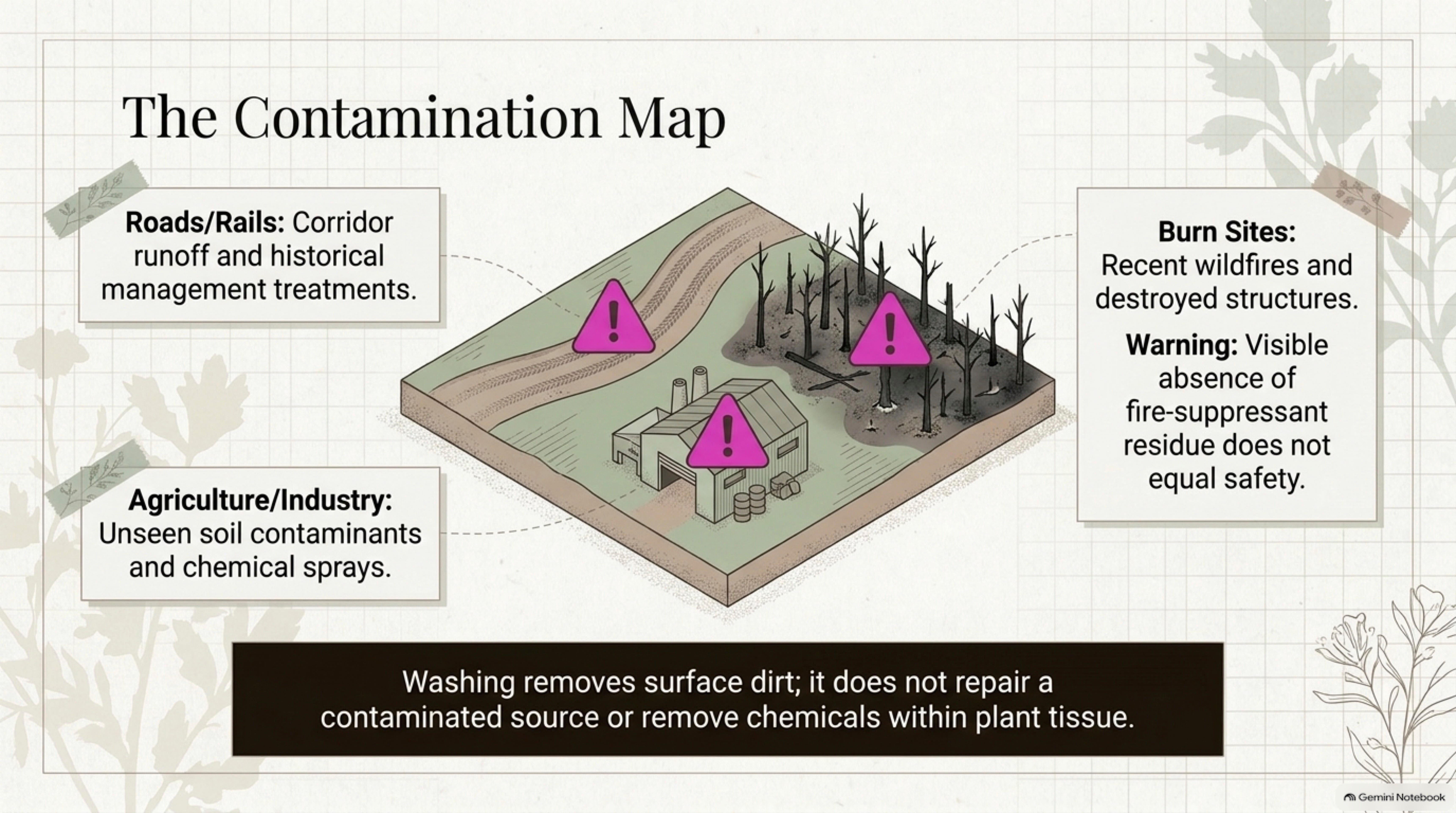
Then look beyond the stems. Roads, railway lines, industrial ground, waste sites, runoff and recent spraying can all matter. A quiet verge may have a treatment history that is invisible by the time fireweed flowers. Ask the manager about that history where necessary. There is no single roadside distance or waiting period after spraying that clears every place for food gathering. Choose another source when the relevant history cannot be established.
Check for animal fouling and signs that dirty floodwater or poorly managed manure has reached the plants. Leave visibly contaminated material. Microorganisms can arrive from the growing environment and from later handling, including at an unsprayed site.
After wildfire, follow closures and local re-entry advice before considering a harvest. Unstable ground and hazardous standing trees can make a green patch unsafe to approach. Chapter 3.6 gives the landowner route.
Fireweed near burned buildings, vehicles or stored materials needs a separate contamination assessment. Leave it out of the food basket while that is unresolved. Ask the local health authority or environmental-health service about the exact site. Green growth and a general soil-fertility test cannot establish that the ash, soil or plant tissue is suitable for food use; washing does not remove every substance a plant may have taken up.
Interior Health also cautions that above-ground produce present during a fire may be unsuitable, especially where retardants were used, and advises discarding produce with visible fire-suppressant residue. Follow the site-specific advice even when no residue is visible. Appearance alone cannot settle the question.
Before the first cut, bring the decisions together:
Plant: confirm the species and the actual material being gathered.
Place: establish permission and a history suitable for food collection.
Part: choose the part and stage the preparation requires.
Handling: arrange clean transport and prompt, appropriate storage.
Method: know how the harvest and any leftovers will be used.
If one answer is missing, leave this harvest for another day. The visit can still give you a photograph, a useful observation or the name of someone to ask.
7.3 Match the stage to the task
A calendar date is a reminder to look. The plant shows what has happened since the last visit.
The University of Alaska Fairbanks fireweed guide describes early shoots and young leaves as culinary material, with older leaves becoming tougher and stronger in flavour. Watch the development of the shoot and the unfolding of its leaves. A short stem is not necessarily at the right stage, and a harvest week borrowed from another region may arrive too early or too late for your patch.
With identity settled, inspect the condition and development of the material required by the preparation. Notice how much stem lies below the new leaves and how the lower growth differs from the tip. Those details make a more useful record than height alone. Keep a photograph of the whole plant as well as the part you intend to gather, with something in the image to show scale.
For leaves destined for tea, first decide what the method needs. Ease of handling, flavour and the concentration of a particular compound are different aims. A claim about the “best harvest time” needs to say which of them was measured.
Two chemistry studies show why a single optimum is hard to defend. Maruška and colleagues compared developmental stages and found the highest total concentration of the flavonoids they measured at mass flowering. Ivanauskas and colleagues examined Ukrainian material during early, mass and late flowering and found different patterns among compounds and plant parts. Their study did not include a pre-flowering harvest. Neither finding establishes that all useful chemistry peaks before flowers open.
A measured concentration in an extracted sample also leaves several steps between the plant and the cup. Researchers may use different solvents, separate plant parts or report values on a fresh- or dry-weight basis. Preparation changes what reaches the drink. Chapter 11 follows the evidence in more detail; here the useful habit is to choose a harvest stage for a stated purpose, rather than chase an unsourced promise of maximum potency.
Flowers and mature craft stems have their own useful windows. Select sound material suited to the intended work, leaving dirty, decaying or doubtful material out. Record the stage clearly enough that you can recognise it next season.
When the desired stage has passed, let the plan change. A patch too mature for young shoots may now let you follow flowers opening up the stem or capsules developing below them. Watching that sequence improves the next harvest without forcing older material into a dish meant for tender growth.
7.4 Take a modest amount and return
Walk the accessible edge before cutting. Notice flowering stems, new shoots and the spaces between them. Look for drought stress, trampling, browsing and earlier cuts. Other people and animals may already be using a patch that appears abundant from a distance.
Begin with a small amount you can handle well and an area you can revisit. Leave other areas undisturbed. Keep flowering and seed production in mind, and avoid stripping a stem simply because each leaf seems a small thing to take. Place feet and containers where they will not flatten neighbouring growth. Use clean tools that make the intended cut without pulling at the plant.
A modest harvest is easier to sort and follow. Its size alone does not prove that it has no ecological effect. Nor does a universal fraction solve that question: “one stem in ten” says little without a defined patch, plant stage and recovery context. Several visible stems may share an underground system. Counting them cannot by itself measure the effect of removing them.
Take a photograph before gathering, from a position you can find again. On the return visit, look at the ground as well as the cut plants. Is the route trampled? Has regrowth appeared? Are flowers or seedlings present? Has someone else harvested the same area? Rain, drought and the advance of the season all affect what you see.
These observations can reveal a reason to reduce collection, use a cultivated source or stop. They cannot establish a sustainable harvest rate from one return visit. Repeated or commercial gathering needs a plan suited to its scale; Chapter 12.5 keeps those larger decisions together.
The record can remain simple. Two photographs and a few clear words may be enough to notice that the patch or your use of it has changed. The important part is returning to look.
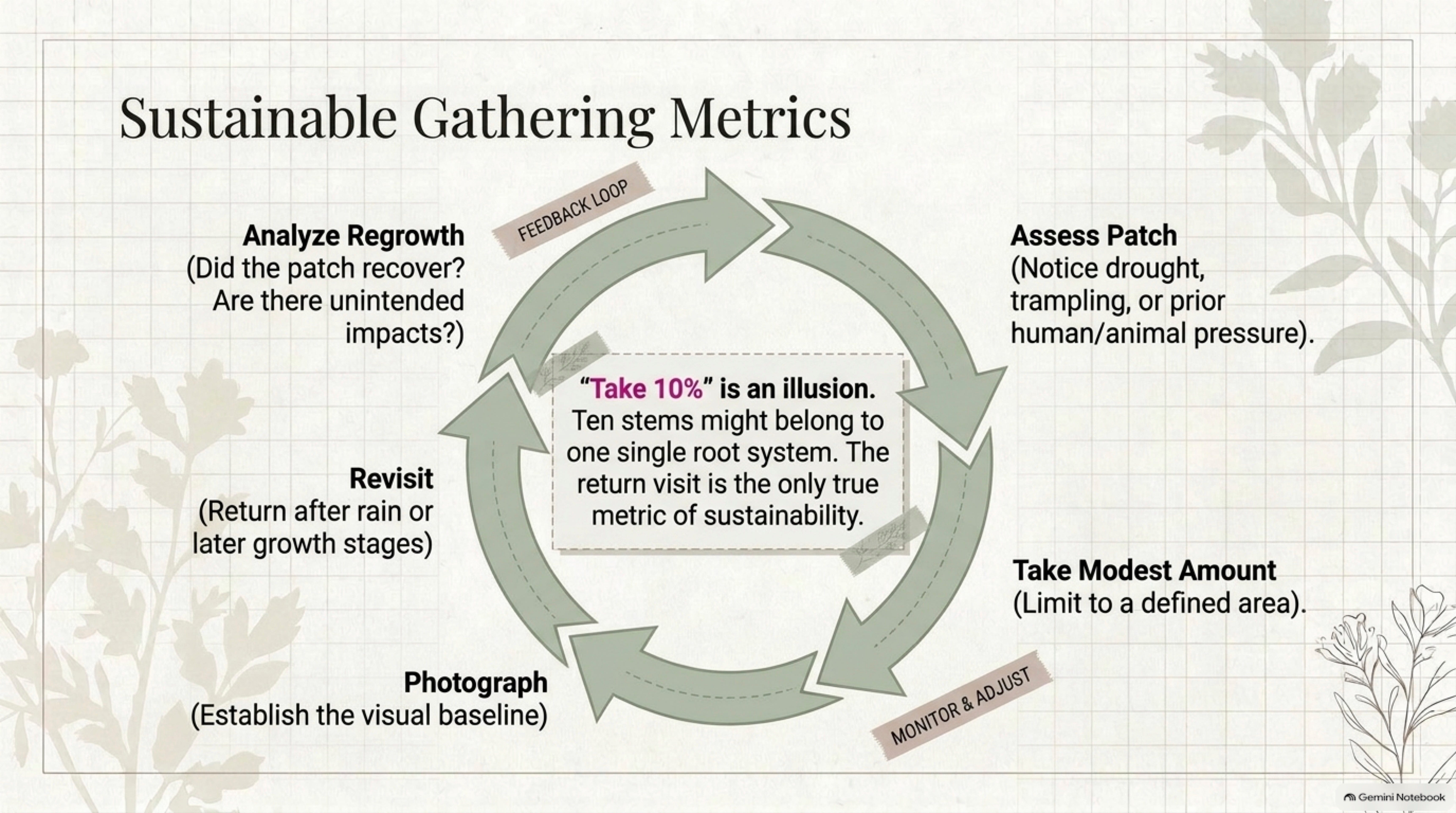
7.5 Keep the harvest clean and traceable
Choose a clean, food-suitable container with room to avoid crushing the harvest. Keep it separate from soil-covered roots, tools, craft supplies and animals. Protect the material from heat during transport and arrange to chill perishables promptly. Shade helps preserve quality on the journey, but a shaded car or basket does not provide refrigeration.
Keep collections from different places separate. If a site problem comes to light later, you should be able to identify the affected lot. A plain label can carry the plant and part, source, collection date and intended use. Add the method and processing date as the work proceeds. Retain a sensitive collection location privately rather than publishing it with a photograph.
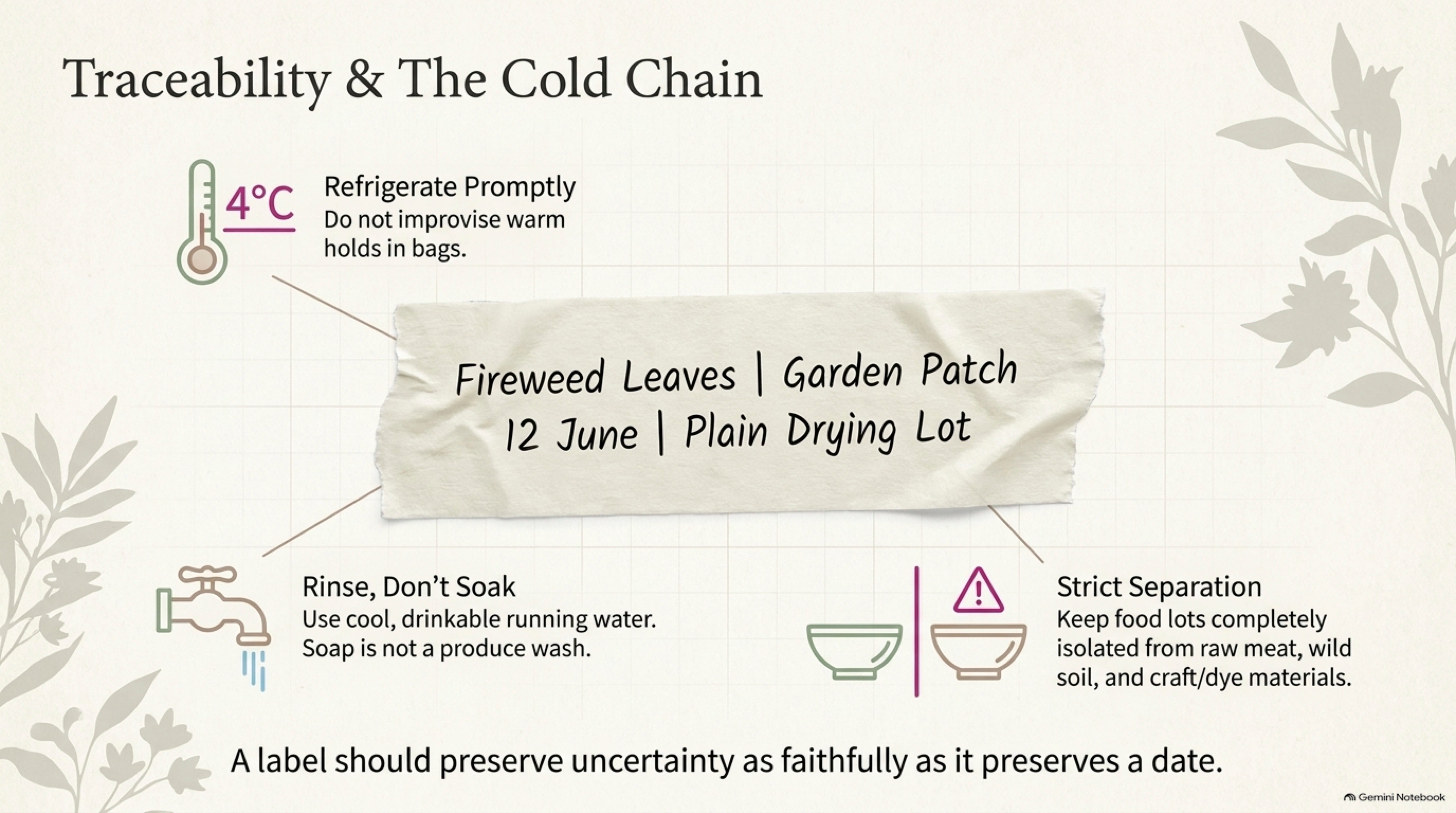
At home, wash your hands and sort the material on a clean surface. Discard unidentified, decaying, mouldy or visibly contaminated material. Keep food and its utensils apart from raw meat and from craft work. A bowl used with dyes or mordants stays out of food preparation, even when the dye began with an edible plant.
For produce washing, follow Health Canada’s advice to use cool, running, drinkable water. Rinse the food gently, then drain with clean equipment. Avoid soaking it in a dirty sink. Soap, detergent and household disinfectants do not belong on produce. Washing removes surface dirt and reduces some microbial contamination; it cannot correct an uncertain identity or unsuitable source.
Refrigerate fresh perishable material in a clean refrigerator at 4°C or colder, using a refrigerator thermometer to check it. Keep raw-food drips away from the harvest. Label the lot and use it promptly for the planned preparation. There is no established fireweed-specific storage period in this guide to turn into a number of days on the container.
If the evening’s plan changes, keep the material under appropriate refrigeration while you decide whether it can still be used by the chosen method. A warm hold in a bag or closed jar is not an alternative to refrigeration.
Make the note easy to understand later. “Fireweed leaves, garden patch, 12 June, plain drying lot” preserves more than “tea.” Record uncertainty just as plainly, for example, “Identity uncertain. Do not use as food.” Remove an old label before reusing its container.
7.6 Understand what drying must achieve
A fresh leaf bends as it loses water. Its blade may curl and its tip droop while substantial moisture remains inside. This is wilting, an early change that is easy to see. Material intended for dry storage must lose much more water.
Spread leaves apart and the surfaces meet moving air. Pile them together and damp contact points remain hidden in the layer. As water leaves the plant, that moisture must also leave the drying space. Leaf thickness, the amount loaded, humidity and airflow all affect the pace. Two trays started at the same time may finish differently.
The UAF fireweed leaflet describes a single layer of leaves or blossoms and roughly two days of air drying. Its timing is approximate. A damp room, crowded load or different preparation can give a different result, so forty-eight hours cannot serve as a universal finish line.
General herb guidance from the National Center for Home Food Preservation calls for leaves dry enough to crumble and stems that break when bent. That provides a useful physical distinction from wilting. The centre also warns that tender, high-moisture herbs can mould unless dried quickly. Air drying requires suitable dry conditions and moving air; when those conditions are lacking, merely waiting longer may spoil the material.
For a drying project, settle the method and equipment first. A dehydrator offers controlled airflow and temperature, but the appliance instructions must fit the material and loading. A temperature borrowed from another herb or a timed treatment in a chemistry paper does not establish a fireweed process.
The general sequence is worth understanding even before a particular method is chosen:
Begin with identified, sound material from a suitable source, cleaned as the method directs. Remove surface water with clean equipment before loading.
Arrange the material in the thin, even layer the method specifies. Leave room for air to pass and check for leaves folded or pressed together.
Use the specified conditions and examine material from different parts of the load. A dry edge does not tell you what remains at the centre.
Check the required endpoint before packing. A leaf that is merely soft or wilted has not reached the general herb endpoint of crispness. Where stems are included, assess them too.
Cool the finished material before putting it into clean, dry containers. Pack promptly once cool so it is not left exposed to humid air.
These are general herb-handling principles. The combination of equipment, loading, temperature, endpoint and packaging for this book’s fireweed methods still needs preparation-specific food-safety review. No complete home-drying schedule or tested fireweed shelf life is established here. Resolve those details before undertaking a batch for food storage
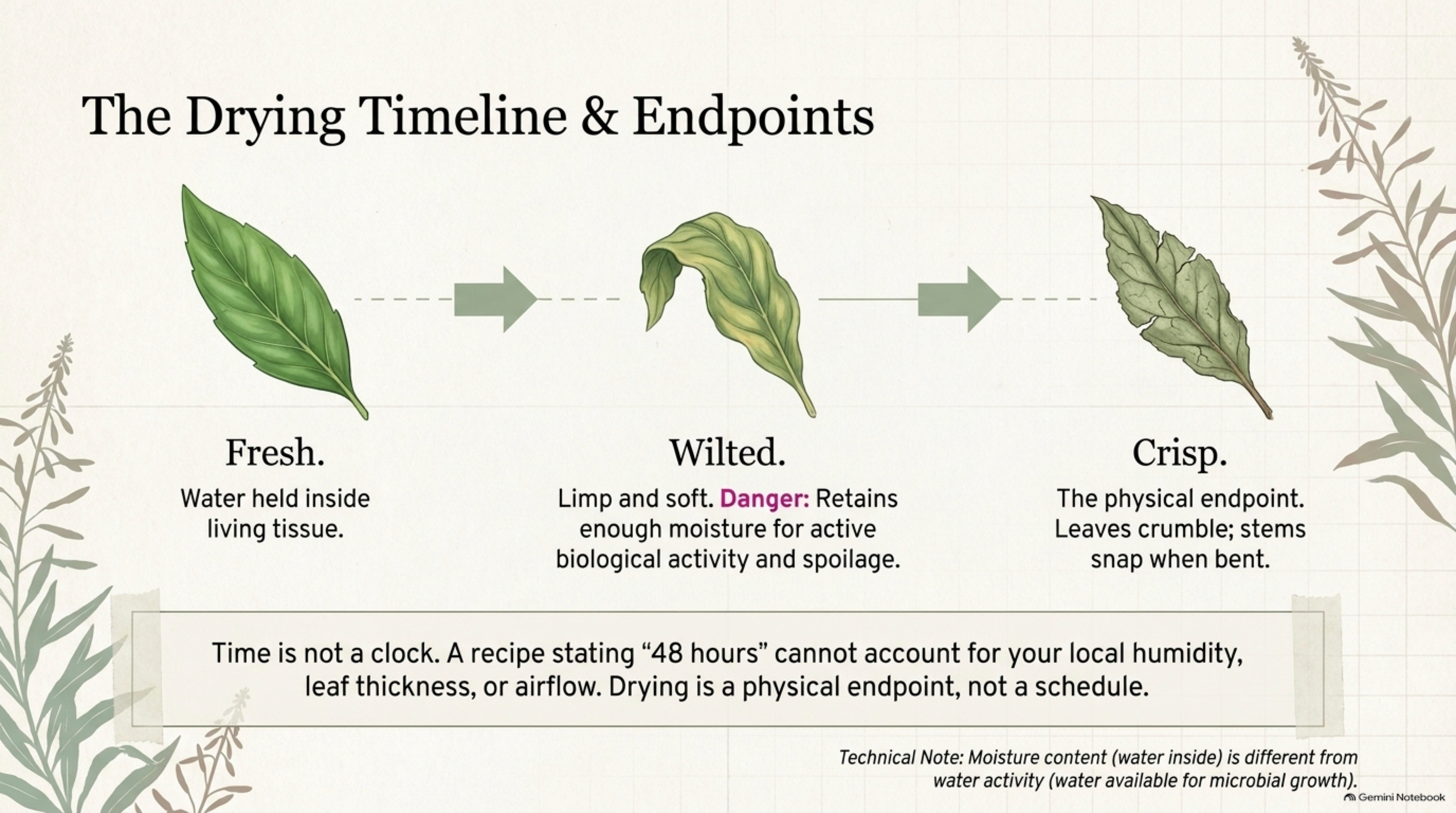
.
There is also a limit to what the fingers can tell. Moisture content measures how much water is present. Water activity describes how available that water is for microbial growth and other changes. Food laboratories measure it with controlled instruments. A light jar or a leaf that feels dry does not supply the same measurement.
Drying can inhibit microbial growth without destroying organisms already present. Clean sourcing and handling therefore remain important throughout the work. Rewetting a dried leaf changes its storage conditions again; adding boiling water is not a dependable way to rescue a spoiled or improperly processed lot.
A useful method tells you what material enters the process, how it is arranged, what is controlled and how completion is judged. It also tells you what to do when the process fails. Those details give the waiting a purpose: you are watching a change reach a defined endpoint.
7.7 Pack and inspect the finished lot
Once drying is complete, storage must keep moisture from returning and protect the contents from contamination. General dried-food guidance recommends cooling before packing, using clean, dry, moisture-resistant containers with tight-fitting lids and keeping them in a cool, dry, dark place. Warm material can release moisture inside a closed container.
Use smaller packages when practical. Opening a little at a time leaves the rest of the harvest undisturbed. Keep the source, dates and method with the actual lot, and avoid topping an older supply with a new one. Separate containers make their histories easier to follow
.
Inspect stored material for condensation, damp clumps, new softness, mould, insects and damaged packaging. A musty smell also calls for a pause. If a lost label leaves you unable to identify the contents or recover their history, leave them out of food use. Visible and sensory checks can reveal a problem without proving that everything else is safe. Never taste a suspect lot to settle the question.
For household use, discard questionable material rather than trying to salvage it for a drink. Do not blend it with a sound lot, scrape mould from dried leaves or assume another drying cycle will repair spoilage. Keep rejected material away from children and animals, and choose disposal appropriate to any suspected contaminant. Chapter 6.6 explains why an unsuitable food source may also be unsuitable for garden compost.
With a commercial dried product, check the identified ingredients, intact packaging and producer’s storage and use-by instructions. Keep its label and lot information. Chapter 11.7 follows the questions a product claim should be able to answer.
Fresh prepared food needs the handling and leftover instructions that accompany its method. Refrigeration, dry storage and canning do different work. Closing a screw lid does not make food shelf-stable.
At the end, the label should still lead back to the plant: what was gathered, where it came from and how it was prepared. The container may hold less than you first imagined beside the patch. Enough for the intended use, with the rest left growing, is a harvest worth bringing home.
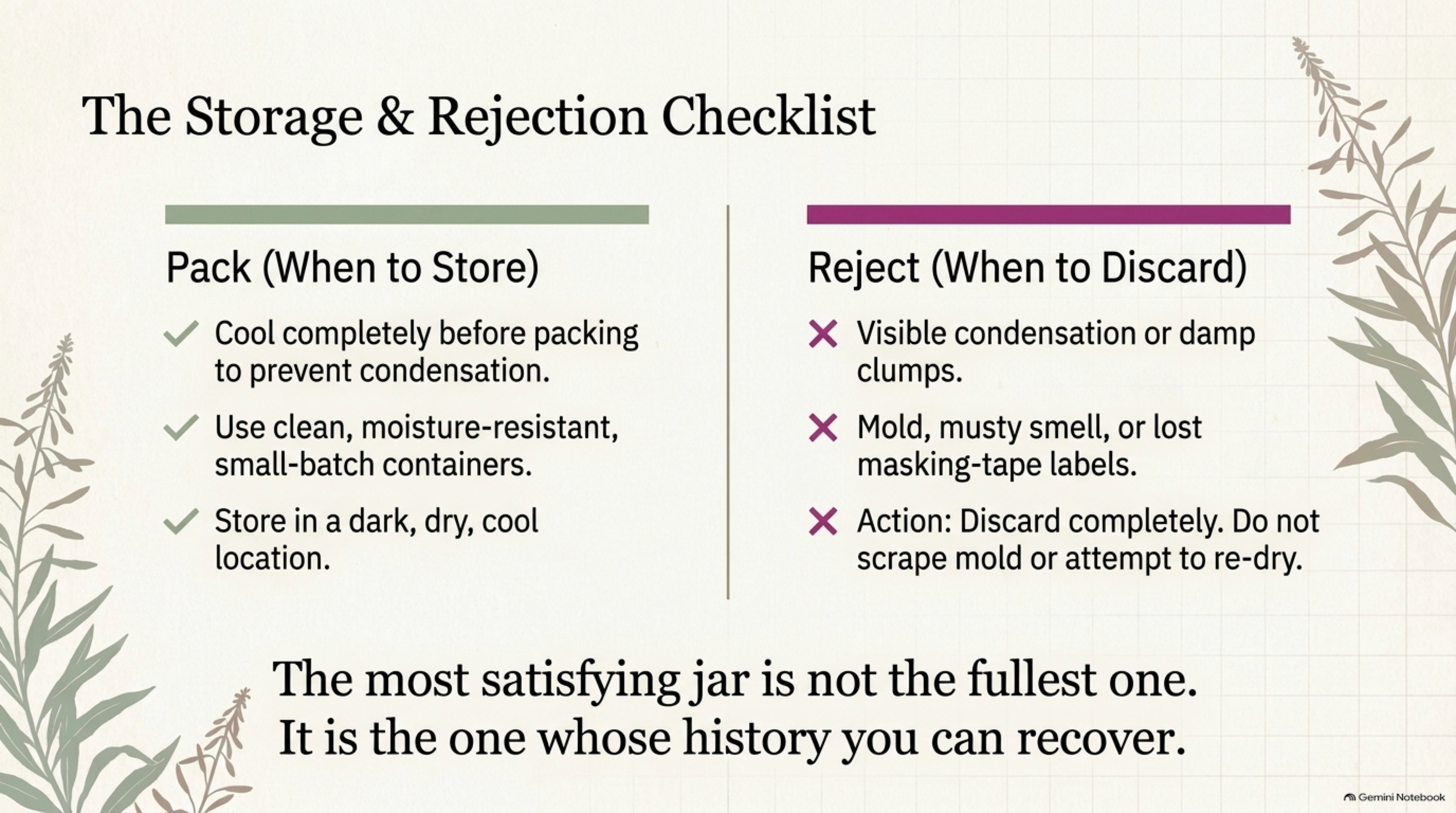
Sources and further looking
Sources reviewed 11 October 2026. These notes distinguish published culinary use, general food-handling guidance and preparation-specific evidence. The practical observations remain tied to their sources and limits.
Culinary parts and stages
For sections 7.1, 7.3 and 7.6. University of Alaska Fairbanks Cooperative Extension, Fireweed, revised October 2023. The full leaflet supports the limited description of shoots, young leaves and blossoms as culinary material, and the change in leaf eating quality with age. Its single-layer air-drying time is approximate. It supplies neither a measured shelf life for every home-dried fireweed preparation nor a universal endpoint based on elapsed time. Washing advice in this chapter follows the public-health sources below.
Clean handling and refrigeration
Health Canada leafy green vegetables · Health Canada safe food handling · FDA selecting and serving produce
For sections 7.2 and 7.5. These official pages support environmental and handling contamination, clean hands and equipment, cool running drinking-quality water, separation from raw-food drips and refrigeration at 4°C or colder. They are general produce controls. Their storage-duration advice for other produce has not been recast as a fireweed shelf-life study. Washing reduces contamination without eliminating every hazard.
Harvest after wildfire
Interior Health returning home after evacuation · Interior Health wildfire resources · BC guidance on wildfire contaminants
For section 7.2. Interior Health supports the re-entry, exposed-produce and fire-suppressant cautions. BC Guidance for Owners of Property Impacted by Wildfire Contaminants describes contamination from burned structures, vehicles and chemicals, including contamination remaining in soil after debris removal. These sources support seeking site-specific assessment. They do not provide a universal harvest distance, waiting period or appearance-based clearance for new growth.
Developmental stage and chemistry
Maruška and colleagues 2014 abstract · Ivanauskas and colleagues full article
For section 7.3. Maruška and colleagues, “Flavonoids of willow herb (Chamerion angustifolium (L.) Holub) and their radical scavenging activity during vegetation,” Advances in Medical Sciences 59:136–141, 2014, DOI 10.1016/j.advms.2013.10.002. The primary abstract was consulted; the full article and tables were not obtained. Ivanauskas and colleagues, “Phenological Variations in the Content of Polyphenols and Triterpenoids in Epilobium angustifolium Herb Originating from Ukraine,” Plants 13:120, 2024 issue, published online 31 December 2023, DOI 10.3390/plants13010120. Its full methods and tables compare early, mass and late flowering. Neither source establishes a universal culinary, beverage or therapeutic harvest optimum.
General herb drying and dry storage
NCHFP herbs · NCHFP packaging and storing dried foods
For sections 7.6 and 7.7. The National Center for Home Food Preservation supplies the general crumble-and-break physical endpoint, attention to dry moving air, cooling before packing, moisture-resistant packaging and cool, dry, dark storage. Its herb temperatures, times and general dried-food shelf-life ranges have not been assigned to fireweed. The numbered sequence in section 7.6 organises these principles; it is not a complete, validated fireweed process. NCHFP permits redrying moisture-affected food only when it has not spoiled. This chapter takes the conservative household approach of discarding questionable lots.
Water activity and microbial survival
FDA water activity in foods · Beuchat and colleagues 2013 review
For section 7.6. The FDA inspection guide explains water activity and its measurement; its 1984 regulatory discussion is not used as a household acceptance threshold. Beuchat and colleagues, “Low-Water Activity Foods: Increased Concern as Vehicles of Foodborne Pathogens,” Journal of Food Protection 76:150–172, 2013, DOI 10.4315/0362-028X.JFP-12-211, supports the distinction between inhibiting growth and eliminating organisms. The primary abstract and substantial indexed publisher text were consulted; the complete article was not independently retrieved. This review does not test a fireweed drying or storage method.
Observation and the limits of the method
For sections 7.1 to 7.7. Identification remains with Chapter 1’s regional flora sources. The harvest check, modest-lot planning, labels, photographs and return visits are proposed practical aids. No sustainable harvest fraction, recovery interval or microbial sampling result is claimed. Food-method, botanical and relevant site-contamination review remain necessary for the book’s preparation-specific instructions. General handling guidance cannot establish a fireweed drying schedule, shelf life or safe source on its own.
CHAPTER 8
Fireweed in the kitchen
A young shoot may yield readily beneath the knife near its tip, then resist closer to the base. A few petals spread across a white plate draw the eye to colour instead. Before heat or seasoning, the plant has already given the cook something to notice.
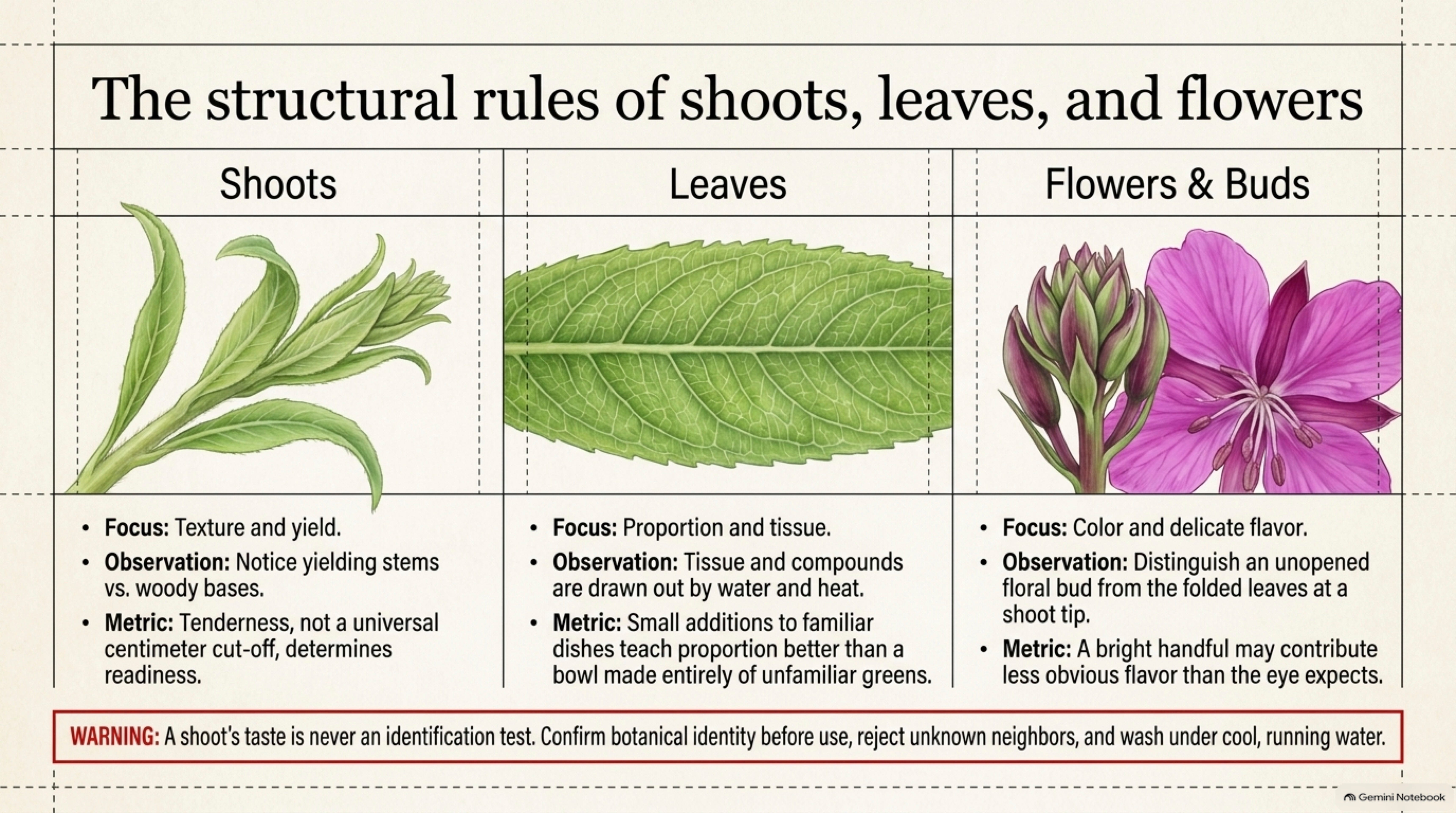
A shoot needs a preparation that reveals its texture. A small addition of leaf asks how much green flavour a dish can carry. With flowers, colour and flavour need separate attention. This chapter follows three proposed preparations, then looks at gels, preserving and the names we give sweet products.
Begin with a modest amount and a clear purpose. There is enough interest in the ingredient itself without asking it to promise exceptional nutrition or medicine.
8.1 Start with a simple cooked shoot
A small pan of shoots leaves little room for a woody stem to hide. That makes a lightly seasoned preparation a useful beginning. The cook can follow the ingredient from the trimming board to the plate and see which part of the stem remains pleasant to eat.
The University of Alaska Fairbanks fireweed guide documents the culinary use of young shoots. For this book’s recipe, the precise stage still needs to be defined and recorded. Photograph the whole shoot, note which leaves have unfolded and keep track of the lower portion removed. Height alone cannot tell the next cook how tender the material will be, and it cannot establish identity.
Before heating the pan, sort the lot again. Confirm that every stem is the intended plant and part, from a source suitable for food. Leave out unidentified, decaying or visibly contaminated material and anything from a site with unresolved spraying or contamination. Wash sound shoots under cool, running, drinkable water with clean hands and equipment. Soap and household disinfectants do not belong on produce. Tasting cannot settle an identification question.
Shoots with lemon and butter
Ingredients.
100 g young fireweed shoots, weighed after washing, trimming and draining;
10 g butter or 10 mL olive oil;
30 mL drinking water;
5 mL lemon juice; a small pinch of salt, if wanted.
Butter contains milk. Olive oil is the proposed dairy-free alternative for this fresh dish. Record which fat is used so the next trial can repeat it.
Equipment. Kitchen scale, small lidded frying pan, tongs, clean knife and board, and a serving plate.
Trim away the firmer lower tissue. Record the amount discarded and weigh the prepared shoots. Put the measured water and shoots in the pan, cover and heat until the water is steaming. Begin recording the cooking interval at this point; note the heating-up time separately.
Continue cooking, turning with clean tongs to distribute the heat. Begin assessing texture after a few minutes, within the agreed trial plan. Watch the liquid as well as the stems; record any additional water needed to prevent the pan from drying out. Establish the cooking interval for the recorded stage rather than assigning a time in advance.
Near the end, add the butter or oil. Uncover and let excess water evaporate without scorching the shoots. Finish with the measured lemon juice and optional salt. Assess and serve hot only as the approved trial plan allows.
The intended result is a shoot that cuts and chews comfortably while keeping its shape. Tenderness does not measure microbial safety. If the lower stem remains stringy, reconsider stage and trimming in the next trial; longer cooking may not give an older stem the texture wanted here.
Keep the tasting note close to the food. “Tender tip, fibres in the lower stem” tells the next cook where to work. Record any bitterness, astringency or other flavour only if it is actually observed. A comparison with asparagus may be useful after tasting, but it should not become the recipe’s promise before the first trial.
The useful record is short: plant stage, prepared weight, water used, pan time, cooked yield and the quality of the result. If identity, source or handling becomes doubtful at any point, stop the trial rather than tasting for reassurance.
8.2 Work with each plant part
A bowl labelled simply “fireweed” leaves too much unsaid. A young leaf, an unopened flower bud and an open blossom offer different tissues to the cook. Keep them separate while learning what each contributes.
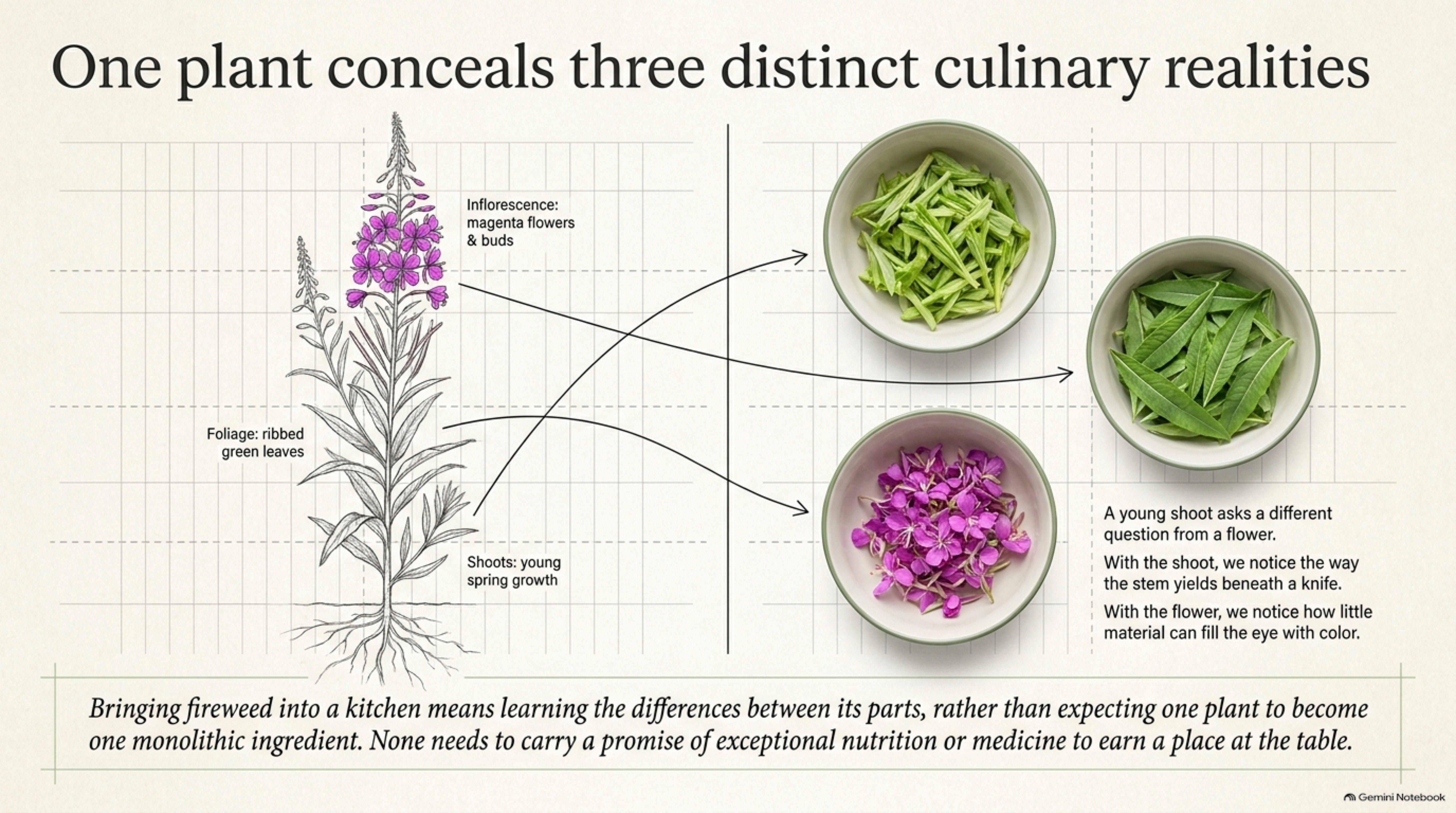
In a leaf dish, the blade and midrib remain part of the mouthful. Fine chopping makes smaller pieces, but a tough midrib can still be noticeable. A modest addition to a familiar dish makes that easier to assess than a bowl composed entirely of the new ingredient. Record the leaf’s stage as carefully as its weight.
An unopened flower bud belongs to the flowering portion of the stem. It must be distinguished from the folded leaves at a shoot tip. Follow its attachment on an identified plant before gathering; that detail is harder to recover from a mixed harvest. A recipe should describe its chosen part clearly enough for another cook to select the same material.
Flowers can make a strong visual impression before their contribution to flavour is known. Sugar, lemon or a rich accompaniment may dominate the finished preparation. Taste and appearance therefore need their own notes. A vivid colour does not oblige the cook to find a vivid flavour.
Keep the flower material consistent between trials. Petals, sepals, unopened buds and pieces of stem introduce different tissues. If the ingredient is petals, use and record petals. A later version made with whole blossoms needs its own description and testing; the names should follow what actually enters the pan.
Heat, acidity and time can also alter plant pigments. Record the colour at the stage when the food will be served, under comparable light. The cooled sauce need not match the flower on the counter.
No verified nutrient analysis of these dishes is supplied here. Values from dried herb, laboratory extracts or animal forage cannot simply be assigned to a plate. The culinary question is whether this part of the plant, prepared this way, earns its place in the dish.
8.3 Build a small recipe set
Let each preparation do a distinct job. After the plain cooked shoot, a potato soup gives a small amount of leaf a soft, familiar setting. A light flower sauce lets the cook assess what the petals contribute without also trying to establish a gel.
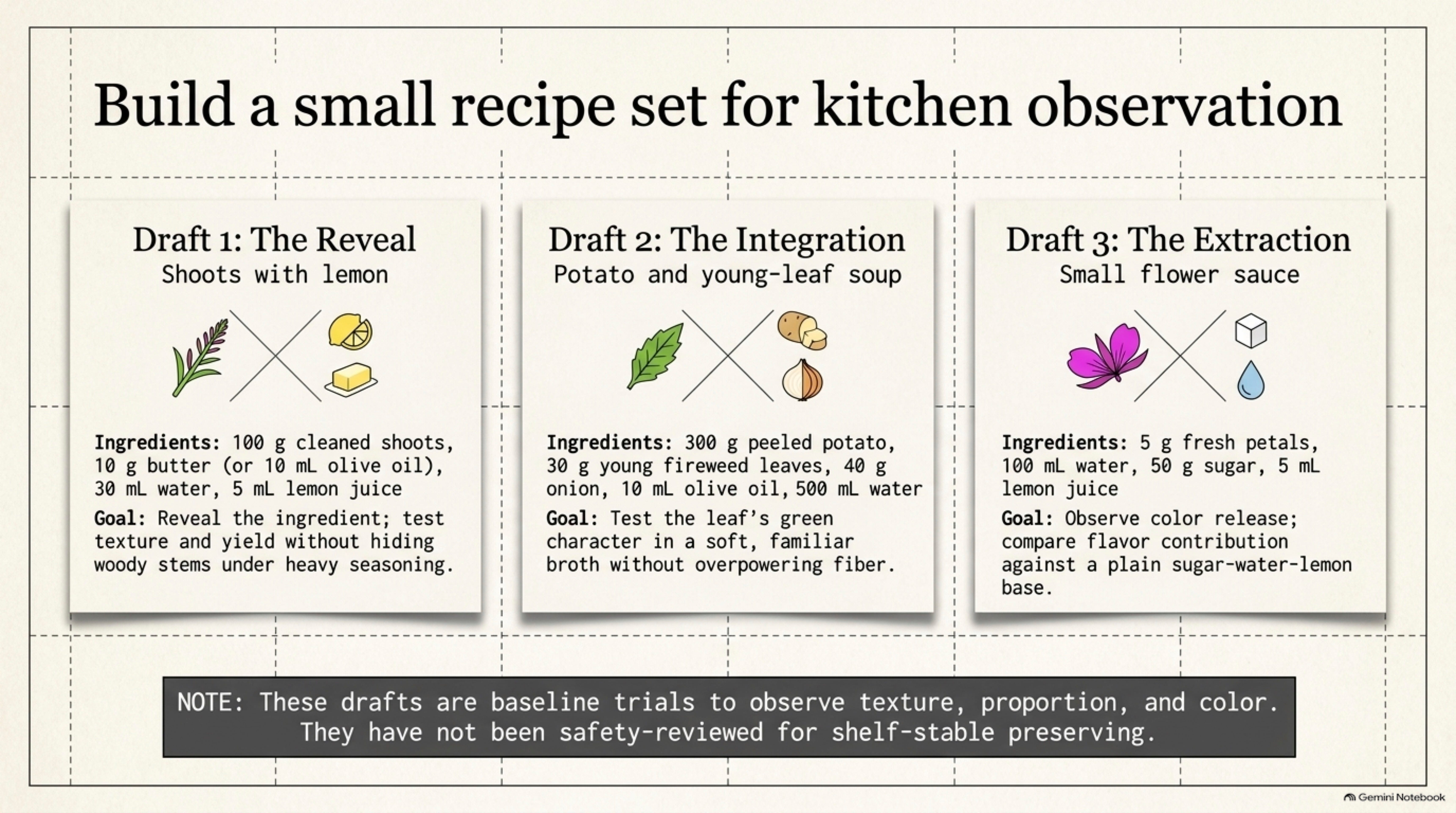
These proposals share the shoots’ untested status. Established spinach-soup or lemon-sauce recipes offer conventional alternatives while the fireweed versions await review and testing.
Potato and young leaf soup
Ingredients.
300 g peeled potato, cut into small, even pieces;
30 g young fireweed leaves, weighed after washing, draining and removing large stalk portions;
40 g chopped onion;
10 mL olive oil;
500 mL drinking water or commercially prepared vegetable stock; salt as needed, allowing for any already in the stock.
Check purchased stock for allergens and dietary requirements. Record the product used, or note that the trial used water; the choice will affect the flavour comparison.
Equipment. Saucepan, knife and board, scale, measuring jug, spoon and potato masher.
Soften the onion gently in the oil without deep browning. Add the potato and measured liquid, bring to a boil, then simmer until the potato is fully tender.
Chop the prepared leaves and add them to the pan. Return to a simmer, stirring so the leaves are distributed through the soup. Continue according to the agreed trial plan; the interval needed for the selected leaf stage must be established and recorded before the recipe can be completed.
Mash some of the potato in the pan to give the broth body. Bring the soup back to a thorough simmer, stirring. Assess its consistency and final volume, recording any adjustment agreed for the trial and any salt added. Serve only when the trial’s preparation and tasting conditions have been met.
The question is whether this amount and stage of leaf adds a distinct, pleasant green character without fibrous pieces or an overwhelming flavour. Note where any coarse texture occurs. A tough midrib calls for a different adjustment from a soup that is simply too thick.
Change one useful variable at a time. If the next trial alters both leaf maturity and quantity, it will be harder to know which change improved the dish. Name any alternative ingredient openly, and keep its results separate from the fireweed trials.
Flower sauce for immediate serving
Ingredients.
5 g fresh fireweed petals, cleaned and drained, from confirmed food-suitable material
100 mL drinking water
50 g granulated sugar
5 mL lemon juice
Pinch of salt
The proposed use is a little sauce spooned over a familiar cooked dessert or plain yogurt. Any accompaniment brings its own ingredients and allergens.
Equipment. Small saucepan, fine food-use strainer, heatproof jug and spoon, with a scale and measures suited to these small quantities.
Bring the water to a boil, add the prepared petals and maintain a gentle simmer. Record the extraction interval and the appearance of the liquid. The interval must be established for this preparation; a leaf-tea method cannot supply it.
Strain into the heatproof jug. Use the same agreed degree of pressing in each trial so the extraction is comparable. Return the liquid to the pan, add the sugar and stir over heat until dissolved. Add the measured lemon juice.
Record the final yield. Let the sauce cool only as needed for immediate service, within the handling limits below and the approved trial plan. Prepare only what the trial needs and discard the remainder; no storage method is established for this sauce.
Sugar and lemon are proposed flavour ingredients here. Their presence does not establish a preservation system. Do not bottle this formula for cupboard storage, use it as a canning syrup or assign it a shelf life because a lid seals.
For an informative comparison, prepare the same sugar-water-lemon base without petals and compare measured spoonfuls at a similar serving temperature, when tasting has been approved. Does the flower contribute aroma, flavour or an appearance worth keeping? Describe the difference plainly. If the base is preferred, or the petals add little beyond colour, that is useful information for the next version.
Handling and recording the trials
Use clean equipment, suitable ingredients and small batches intended for prompt serving. Keep the preparation, tasting and storage decisions in the agreed trial plan. Refrigeration cannot correct an unsuitable source or a poorly controlled process. Discard doubtful food without tasting it.
For ordinary leftovers, Health Canada advises refrigeration within two hours, cooling in shallow containers and a refrigerator at 4°C or colder. Its guidance is to use refrigerated leftovers within two to three days and reheat appropriate leftovers to 74°C, checked with a food thermometer. Reheated soup should reach a full rolling boil while being stirred. These are general controls, not a validated shelf life for any of the proposed fireweed dishes. The flower sauce is for immediate service only, with any remainder discarded.
Record weights after trimming and draining, the plant stage, equipment, actual cooking intervals and yield. Describe the intended texture and how closely the result approached it. Kitchen testing can establish whether a dish is repeatable and worth eating. Food-safety review must separately address the source, process and handling. An enjoyable tasting cannot answer those questions.
8.4 Read colour and set
Tip a spoonful of cooled sauce and watch it run. A pectin jelly behaves differently because pectin forms a network that holds water within it. That structure gives the food its set; colour tells us something else.
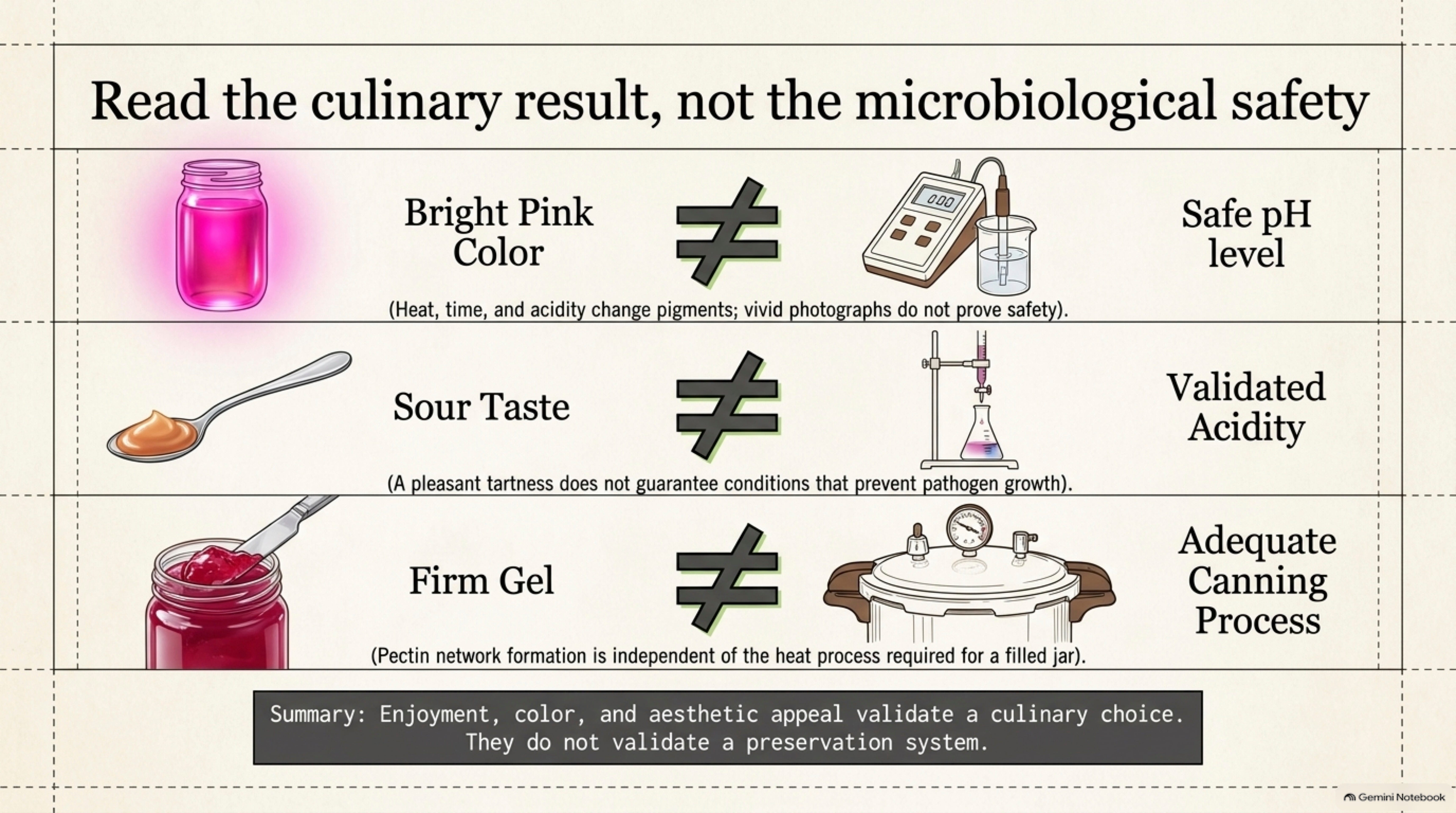
In a conventional jelly, pectin, sugar and acid must be in the right balance. Liquid pectin, standard powdered pectin and reduced-sugar products require their own formulations. Follow the tested recipe and its specified pectin; the products are not interchangeable.
Sugar supplies sweetness and helps a conventional pectin gel form. Acid establishes suitable conditions for that gel as well as changing flavour. Some low- or no-sugar pectins set through calcium linking. Follow their particular formulas and processes, including acidity requirements; reducing sugar in a standard recipe does not create a low-sugar system.
Acid can also change pigment appearance. A colour change in the pan may be striking, but it does not measure the finished food’s acidity. A sour taste gives no validated pH result, and a firm set does not demonstrate that a canning process was adequate. Keep the tasting note, gel assessment and preservation controls separate.
Colour records need only be consistent. Photograph the cooled preparation against the same plain white background under similar light. Note the plant part, its mass, the liquid volume and the extraction conditions. Avoid changing several ingredients to chase a brighter pink, particularly in a preservation formula whose proportions need to remain fixed.
If jelly is the goal, begin with an authoritative tested formula and its complete process. The clarification needed for this book’s fireweed method is described next. Choosing the better-looking jar cannot resolve it.
8.5 Preserve with an appropriate process
A dish for today’s table and a jar intended for the cupboard ask different questions of the cook. For storage, the answer must include the ingredients, container, heat treatment and storage conditions. A recipe’s flavour balance is only part of that work.
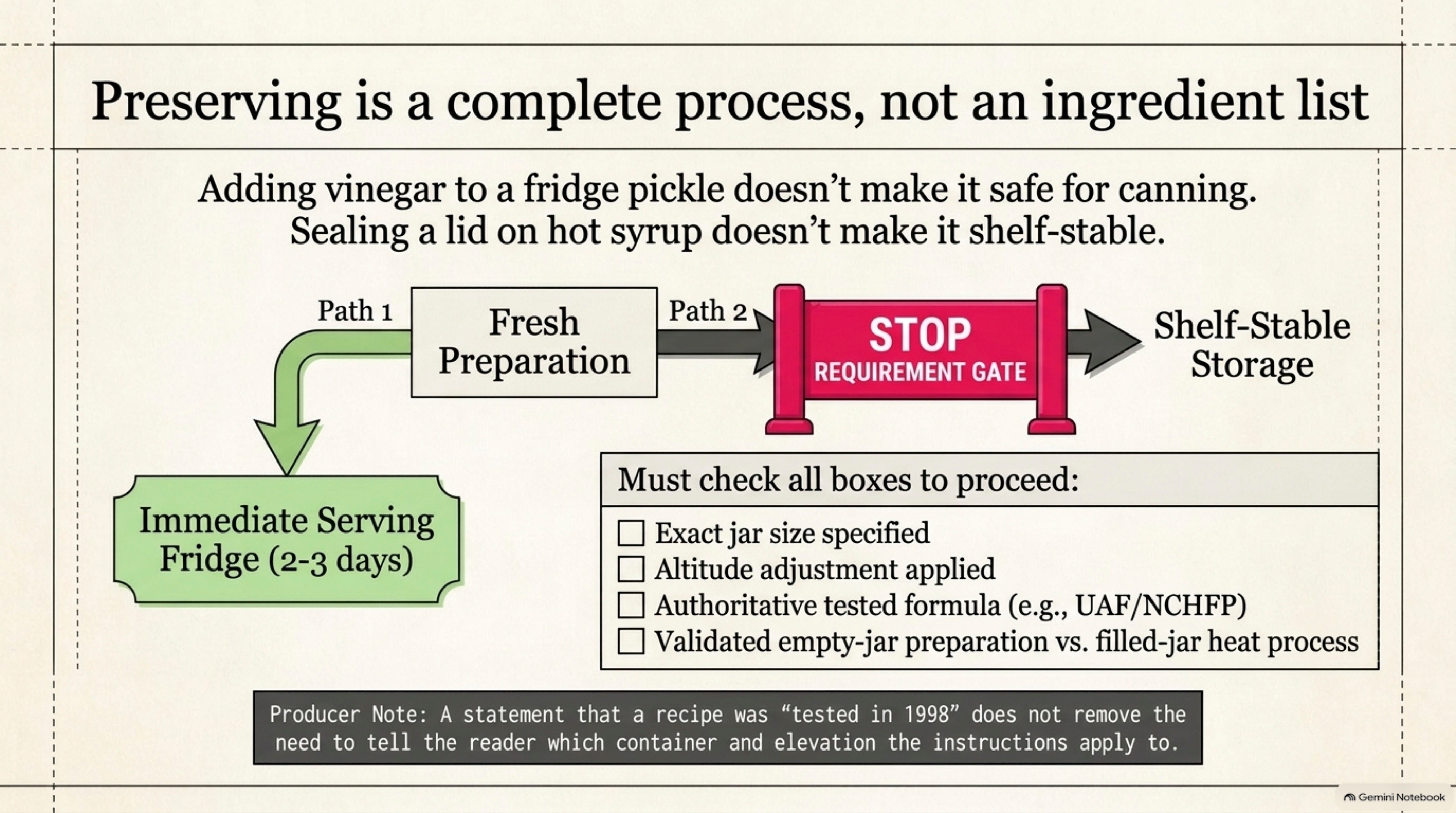
UAF publishes a fireweed jelly formula. In a May 2024 Ask Extension response, an Extension specialist stated that the recipe had been tested in 1998 and was still considered safe for home use.
Before reproducing a method here, some practical details need clarification. The fireweed publication’s empty-jar instructions differ from both NCHFP guidance and UAF’s newer general Jams and Jellies guide. Its jelly directions also leave jar size, headspace and altitude adjustments unspecified. Empty-jar preparation and filled-jar processing are separate steps, and neither can supply the other’s missing details.
Take the exact UAF formula, intended jar size and elevation, together with the differing instructions, to a qualified home-preservation adviser for one coherent process. That consultation remains outstanding for this book, so shelf-stable fireweed jelly instructions are withheld. The annotated sources preserve the discrepancy for review; they should not be combined into a canning schedule.
Refrigerator pickles require their own appropriate formulas. Cold storage does not validate an arbitrary vinegar mixture, and a refrigerator recipe cannot be converted to cupboard storage by borrowing a water-bath time from another food. Use an authoritative formula for the intended ingredient, product and storage class. No fireweed pickle or canning method is developed here.
Freezing and drying also need preparation and packaging suited to the material. A new flower sauce cannot inherit a commercial syrup’s storage life. Closing a bag of leaves does not establish that drying is complete; Chapter 7 follows that work in more detail.
Fresh use leaves room for a satisfying seasonal dish while preservation questions are answered. Filling the winter cupboard can wait for a complete method.
8.6 Name sweet products accurately
Bee-made honey begins with the material bees collect and transform. A flower-and-sugar preparation begins with measured ingredients in a saucepan. Give each food a name that tells the eater what it is.
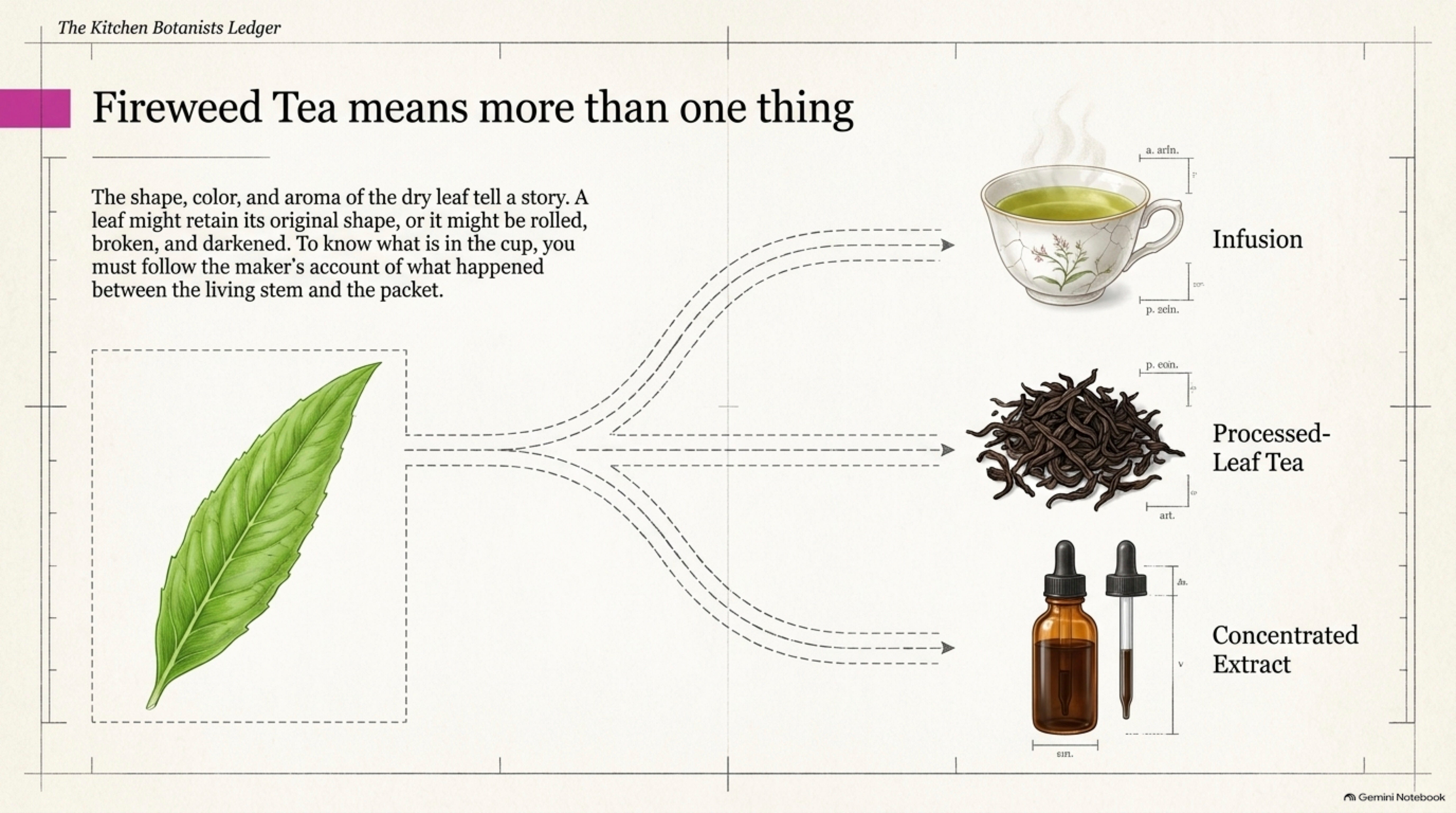
For a kitchen preparation, use fireweed-flower sauce or syrup according to the actual result. If an older recipe calls a sugar-based flower preparation “honey,” retain that wording when discussing the source and explain its ingredients. It need not become the name of a newly written recipe.
With actual honey, “fireweed” is also a claim about floral origin. A hive beside a flowering patch does not establish the source of every nectar load. The beekeeper’s knowledge and appropriate product evidence matter; Chapter 4 separates flower resources from a guaranteed honey harvest.
Honey is a standardised food in Canada. CFIA guidance also distinguishes honey from products with added ingredients that change their identity. A commercial label needs current review for the product and market concerned. At the table, make clear whether the food is bee-made honey, a honey mixture or a sweet flower preparation.
Keep the rest of the ingredients visible too. Butter, stock, lemon and an accompanying dessert can change what a guest needs to know. A correct plant name is the beginning of an ingredient description.
8.7 Troubleshoot the intended result
Start with what happened in the dish. A fibrous shoot, a strong leaf flavour and a thin sauce call for different adjustments. Quality observations can guide a later reviewed trial, but they do not establish food safety.
A shoot is fibrous. Record whether the problem lies in the lower stem, a midrib or the whole shoot. Reconsider stage and trimming before extending the cooking time indefinitely. A more precise ingredient specification may do more than extra time in the pan.
The leaf dominates the soup. Check the recorded part, maturity and quantity. For a fresh dish under development, a smaller amount or a different balance of ingredients may be worth testing. Keep the reason culinary unless evidence identifies a particular safety concern; a stronger flavour does not, by itself, identify a toxin.
The colour is weaker than expected. Check the condition and measured amount of flower material, water volume, extraction time, heat and viewing conditions. Keep a photograph that shows the actual result.
A jelly has not set. Follow the troubleshooting guidance for its tested formula and pectin system. Do not improvise changes to acid, sugar or processing for cupboard storage. Calling a failed jelly “sauce” leaves any unresolved processing problem in place.
A container shows mould, gas, leakage or an unexplained change. Stop using the food. Do not taste it, skim off mould, give it to an animal or assume reheating will repair it. For suspect canned food, follow authoritative disposal advice appropriate to the problem.
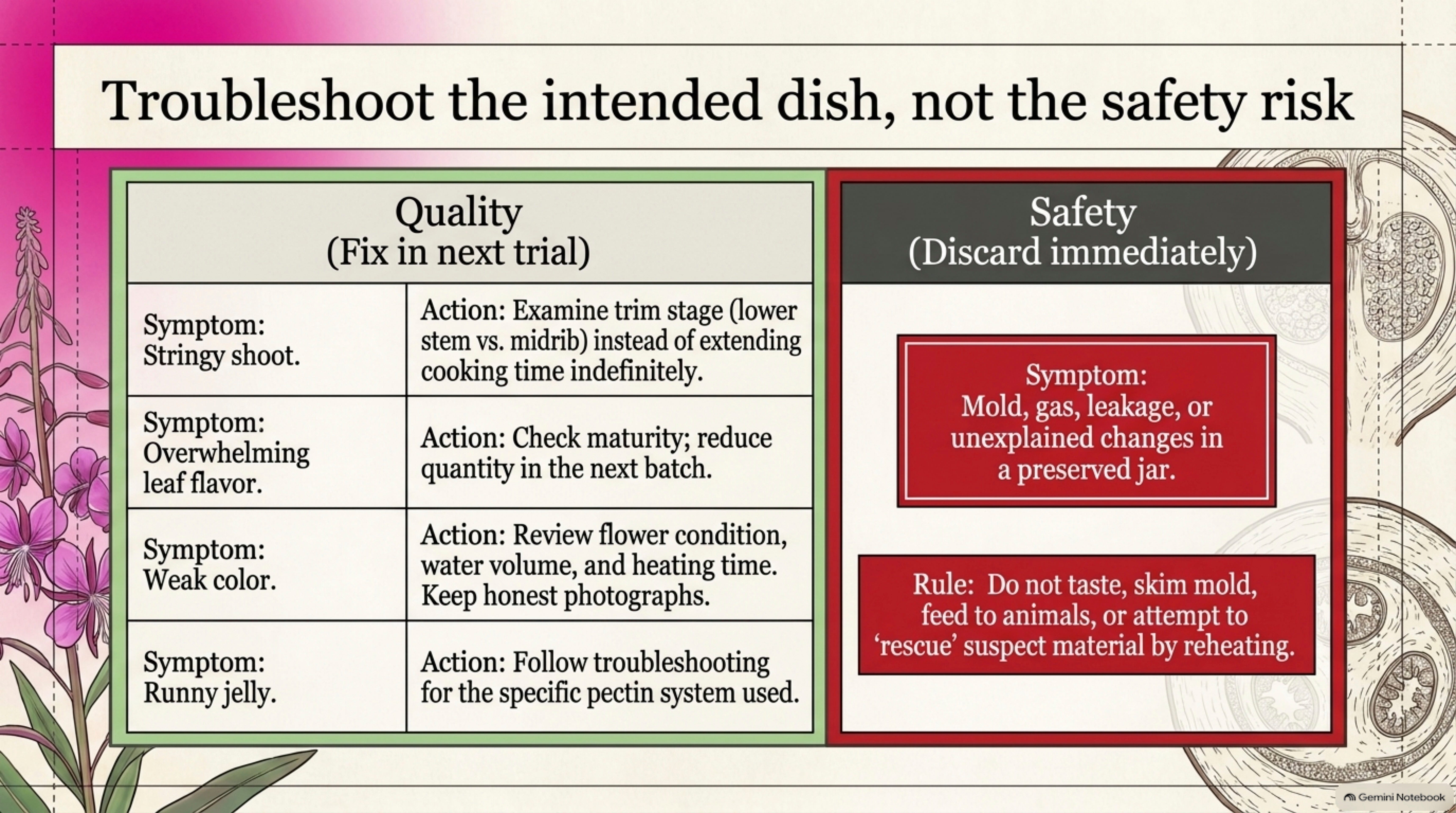
Finally, leave room for preference. A trial may lead to a dish worth repeating, a small adjustment, or the decision to leave more flowers on the plant. Each result is useful when it is recorded plainly. Keep the preparations that make good use of the ingredient and give another cook enough detail to find the same pleasure.
Sources and further looking
Sources reviewed 11 October 2026. Published culinary use and general handling guidance inform this chapter. They do not validate the three original development formulas. Their botanical specifications, methods, cooking intervals, yields and storage decisions remain subject to preparation-specific review and kitchen testing. No completed food trial is implied.
Culinary use and the development proposals
For sections 8.1 to 8.3 and 8.5. University of Alaska Fairbanks Cooperative Extension, Fireweed, FNH-00106. The publication documents culinary use of shoots, young leaves and blossoms and provides the jelly formula discussed in 8.5. The three proposed dishes here are original development drafts, not UAF recipes or adaptations of its canning process. The source does not validate these quantities, cooking intervals or sensory outcomes. Chapter 7 supplies the fuller sourcing and handling discussion.
Clean handling and leftovers
Health Canada food safety tips for leftovers · Health Canada safe food storage · FDA selecting and serving produce safely
For sections 8.1 and 8.3. Official guidance supports washing produce under running water without soap or detergent, clean equipment and separation from raw-food contamination. Health Canada gives the general two-hour refrigeration limit, shallow-container cooling, refrigeration at 4°C or colder, use within two to three days and reheating to 74°C measured with a food thermometer. It also directs that reheated soups reach a stirred rolling boil. These controls do not establish a tested storage life for a fireweed preparation. The sauce proposal is limited to immediate service, with the remainder discarded.
Pectin and plant pigments
NCHFP jellied product ingredients · NCHFP general canning guidance for jams and jellies · Illinois Extension cooking vegetables
For sections 8.2 and 8.4. The National Center for Home Food Preservation explains the roles of pectin, acid and sugar, calcium-dependent low-methoxyl pectin, and the need to follow the chosen formulation and pectin system. Illinois Extension’s The Whys and Hows of Cooking Vegetables supports the general observation that heat, acidity and cooking time can alter plant-pigment colour. No fireweed-specific pigment identity, colour outcome or colour-to-pH calibration is inferred. Colour comparison is proposed as a quality observation, with no acidity or preservation result inferred from appearance.
Clarifying the published jelly process
Ask Extension Fireweed Jelly safety · NCHFP sterilization of empty jars · UAF Jams and Jellies
For section 8.5, read with the UAF publication above. The Ask Extension reply of 22 May 2024 reports that UAF’s formula was tested in 1998 and remained considered safe for home use. The underlying testing report was not obtained. The fireweed publication specifies five minutes for boiling empty jars and a five-minute process for filled jelly jars, without identifying jelly jar size, headspace or altitude adjustments. NCHFP specifies ten minutes below 1,000 feet for empty jars requiring presterilisation, with additional time at elevation. UAF’s general Jams and Jellies guide, revised May 2025, also specifies ten-minute empty-jar sterilisation. These figures document a discrepancy, not a usable combined process. The chapter preserves the attributed testing statement while withholding its own shelf-stable instructions pending a coherent, preparation-specific process. No adviser consultation is claimed.
Names for honey and sweet preparations
CFIA labelling requirements for honey
For section 8.6. Canadian Food Inspection Agency guidance supports the standardised identity of honey and distinctions for products with added ingredients. The chapter gives a naming principle, not a complete commercial labelling review. Botanical-origin claims require appropriate support; a hive’s location alone does not establish them. Chapter 12.5 follows the business questions.
Spoiled preserves and the limits of troubleshooting
NCHFP general jam and jelly questions · NCHFP handling spoiled canned food
For section 8.7. NCHFP explains why mould should not simply be removed from jams or jellies and provides separate guidance for handling and disposing of suspect canned foods. The troubleshooting observations in this chapter are proposed quality questions, not findings from completed trials or clearance to eat or reprocess a failed batch. Food-safety and preservation decisions need evidence appropriate to the exact preparation.
CHAPTER 9
From leaf to cup
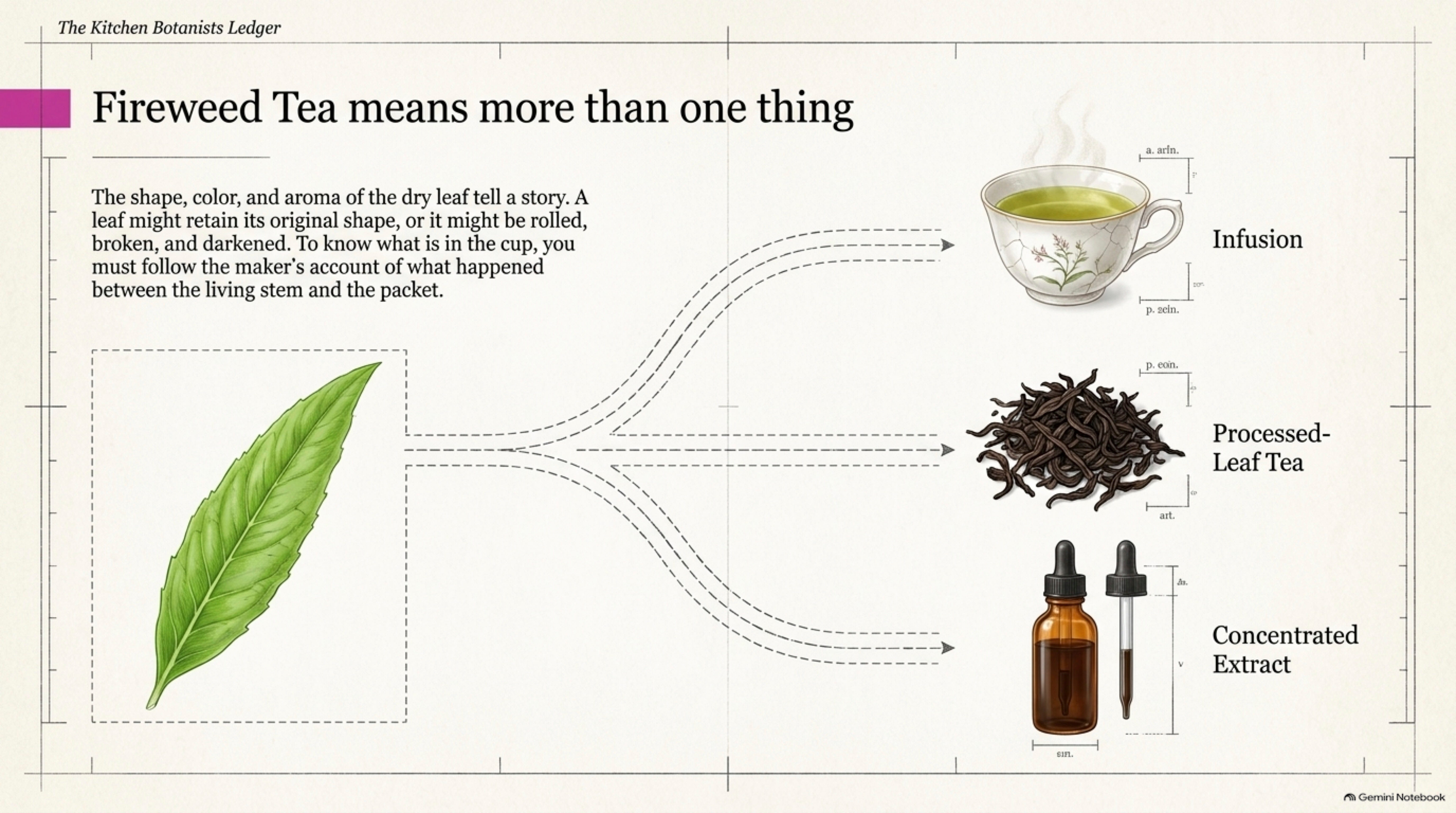
Imagine two cups on a light-coloured table. One holds an infusion of plain dried fireweed leaves. The other holds an Ivan chai made from leaves processed before drying. The same species has arrived by two different routes. Colour, aroma and the feel left in the mouth may tell part of that story.
Beside the cups, the dry leaves offer other clues. A blade may retain its outline and the trace of a vein; another product may be rolled, broken or formed into granules. Shape records something of the handling, but it cannot tell us everything that happened between the living stem and the packet.
This chapter follows the leaf through wilting, bruising and drying, then asks what brewing brings into the water. It draws on named makers and processing experiments while keeping their different kinds of knowledge clear. The tasting at the end uses finished food products with known identities and preparation instructions. A household fireweed-processing method still needs preparation-specific food-safety review.
9.1 Name the preparation first
“Fireweed tea” can mean the dry ingredient, the drink in the cup or, less helpfully, a concentrated plant product. Establish which one is being discussed before comparing flavour or research findings.
An infusion is made by steeping plant material in water. It may begin with fresh leaves or with plain dried leaves, meaning leaves dried without an intentional moist processing stage. Drying itself changes the leaf. The word “plain” identifies a simpler preparation, rather than a chemically untouched ingredient.
A processed-leaf tea has a further history. Its leaves may have been wilted, rolled, cut or otherwise damaged, then held under particular conditions before drying. Ivan chai is commonly associated with this route, although the name does not specify a single process. Brewing comes afterward: processing changes the ingredient, and steeping transfers some of its constituents into the water.
In chemistry, an infusion is a water extract. On a supplement label or in a study, “extract” may instead mean material produced with a specified solvent, concentrated, dried or standardised to a measured constituent. A capsule cannot be translated into cups from the species name alone. Its composition, concentration and preparation must be established before a comparison is meaningful. Chapter 11 examines that evidence more closely.
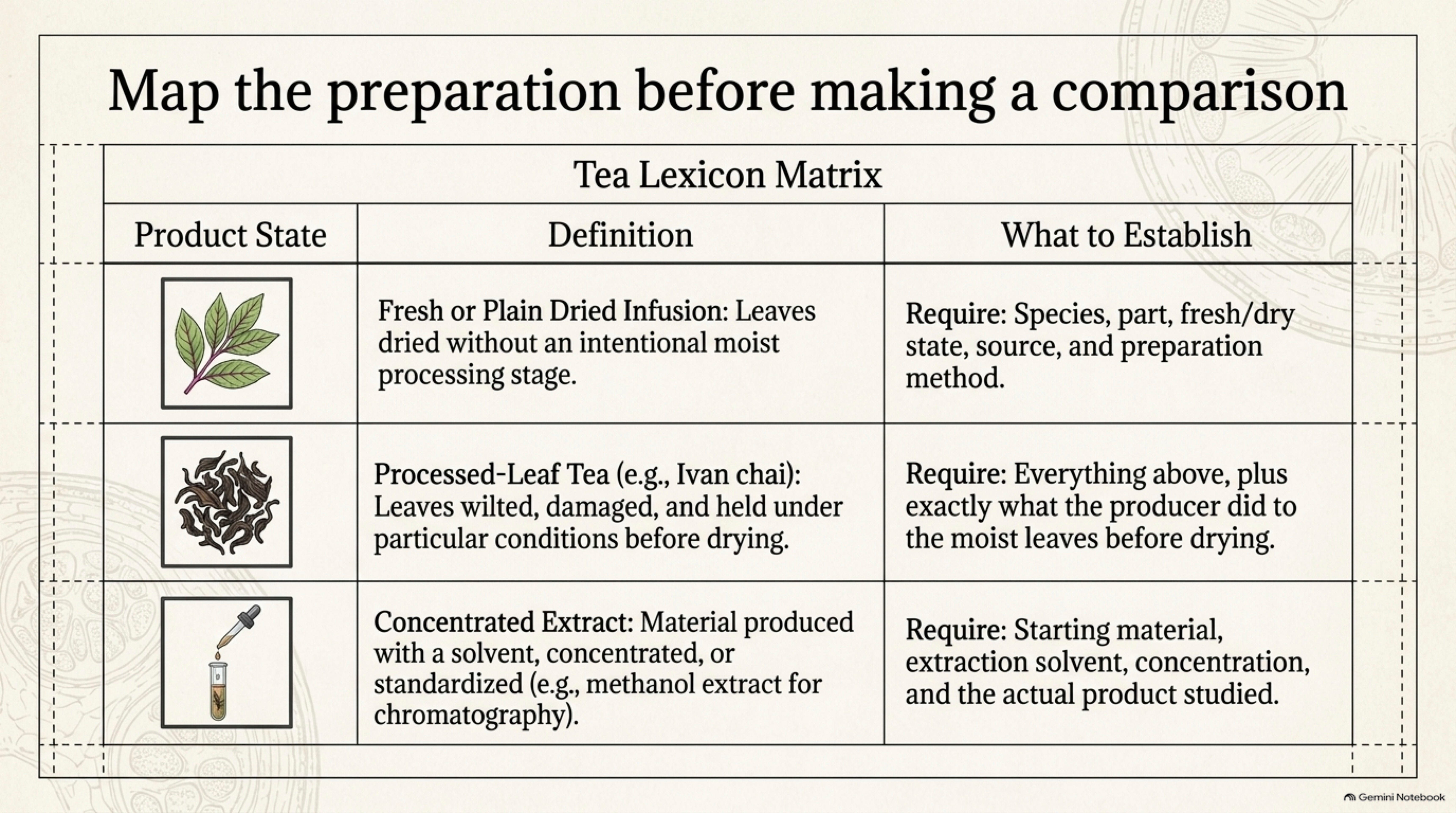
Keep the botanical name with the preparation. The plant here is common tall fireweed, Chamaenerion angustifolium. The studies below also call it Chamerion angustifolium or Epilobium angustifolium, names connected in Chapter 1’s crosswalk. That connection does not make every willowherb product equivalent. A common name may conceal a different species or a mixture.
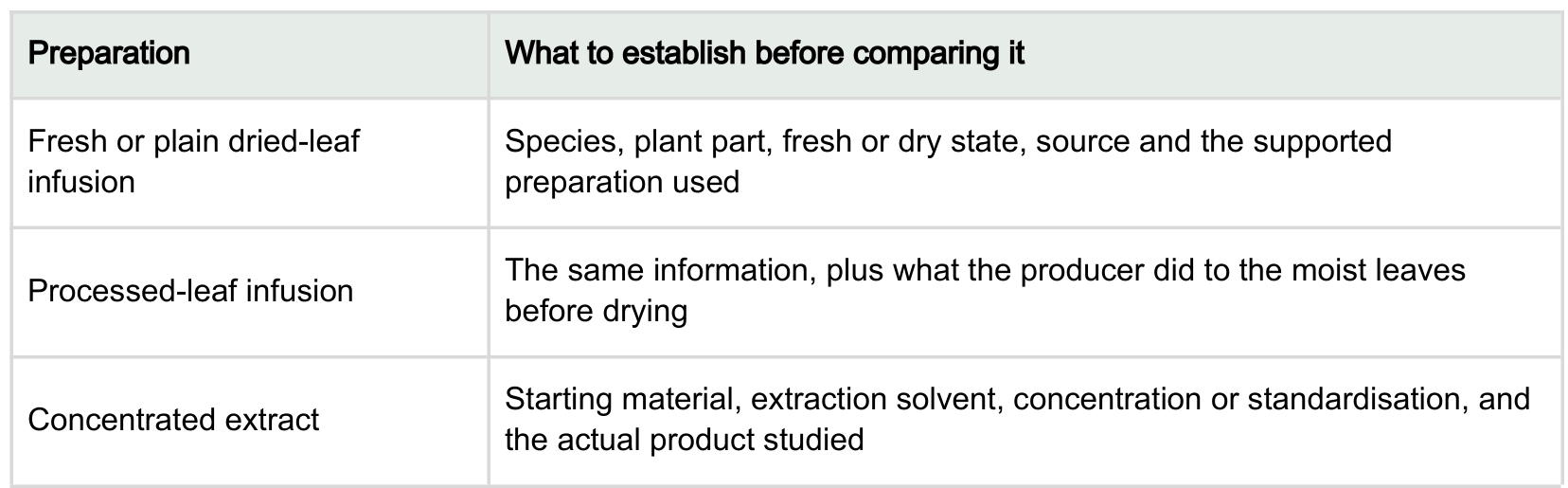
These distinctions keep the account of the leaf intact. The next useful question is what each stage of handling changes.
9.2 Understand wilting and bruising
A fresh leaf holds its shape partly because water presses outward within its cells. As water is lost, that support diminishes and the blade becomes limp. This is wilting. A flexible leaf may still contain ample moisture; softness does not establish readiness for dry storage.
Bruising changes the tissue in another way. Rolling, pressure or cutting disrupts structures that kept substances apart. Plant enzymes can meet compounds they act upon, and oxygen can take part in reactions. The change may begin beneath the hand, then continue after the leaf has been put down.
An enzyme is a biological catalyst: it speeds particular chemical reactions. Enzyme-driven oxidation helps explain the darkening of damaged plant tissue. Research on the tea plant, Camellia sinensis, offers a well-studied example involving the enzyme polyphenol oxidase. It helps explain the mechanism without assigning the tea plant’s exact pigments or processing requirements to fireweed.
Several changes can contribute to a fireweed leaf’s darkening. Existing compounds may be altered, green pigments lost and new coloured material formed. A darker leaf can therefore contain less of one particular compound than it contained before processing. Colour alone cannot measure that change.
Keep the visible observations separate. Limpness tells us something about water and structure. A torn or rolled blade shows tissue damage. Browning records a change in appearance. None identifies the microorganisms present or measures the amount of a constituent remaining in the leaf.
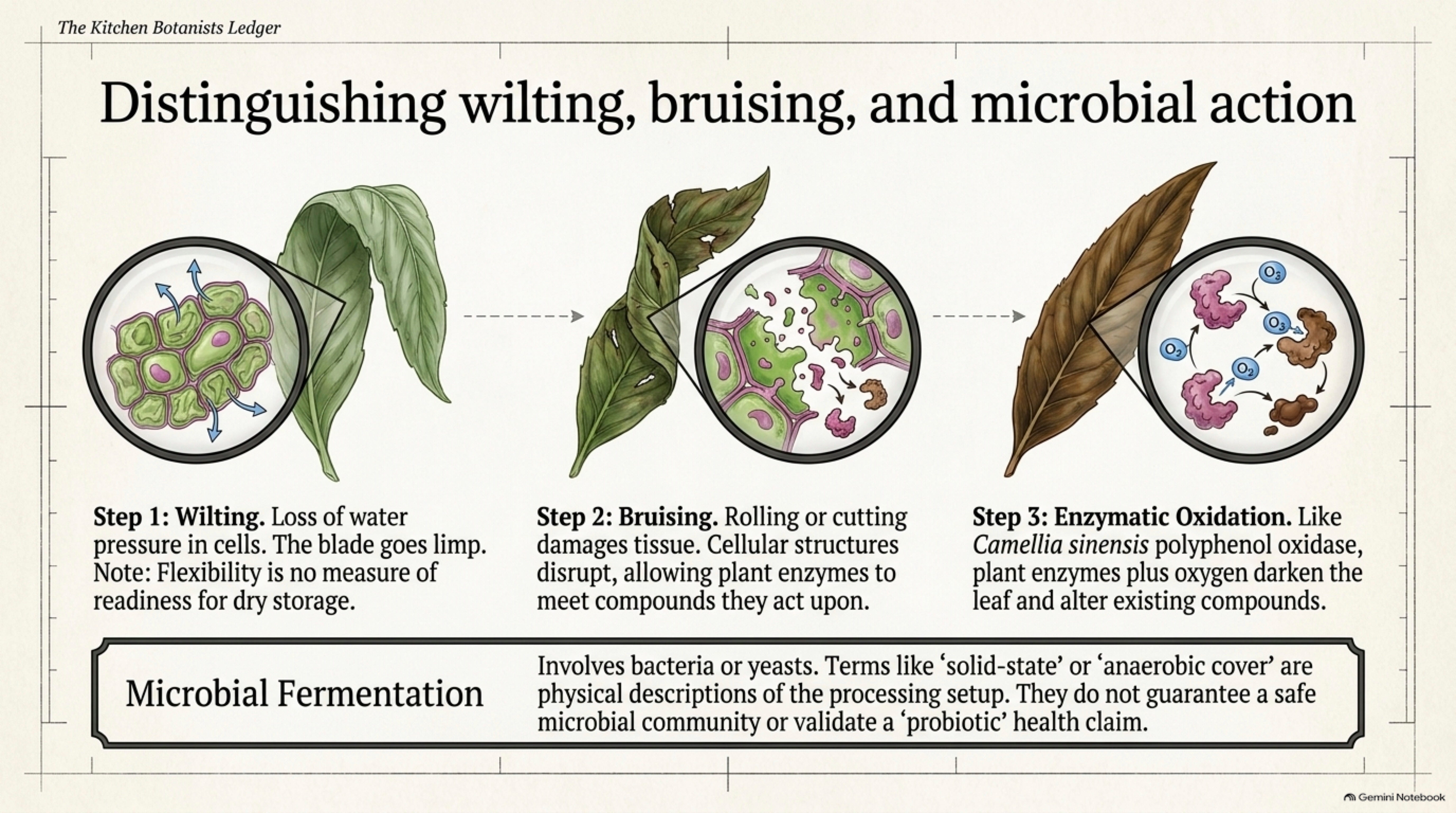
Temperature, moisture, oxygen supply and the extent of damage all affect the conditions in which reactions occur. A thin exposed layer and a compressed mass in a closed container have different surroundings, even after the same interval. Drying removes water and may also expose the leaf to heat, adding further changes to those already under way.
A maker’s account is more useful when it distinguishes wilting, bruising and darkening. “Fermented” needs a closer look.
9.3 Be precise about fermentation
In black-tea manufacture, “fermentation” commonly refers to enzyme-driven oxidation in damaged leaves. In many fermented foods, microorganisms cause the changes. Both meanings occur in fireweed discussions, sometimes within one paper.
Here, microbial fermentation means that microorganisms and their activity contribute to the food’s changes. Bacteria, yeasts and other fungi have different roles and requirements. The term alone tells us neither which organisms are involved nor whether they were deliberately introduced.
“Solid-state” or “solid-phase” describes processing in moist solid material rather than a freely flowing liquid culture. It does not mean that the leaf is dry. Fireweed researchers have used these terms for crushed-leaf treatments while measuring changes in chemistry; the terminology itself does not establish a safe microbial community.
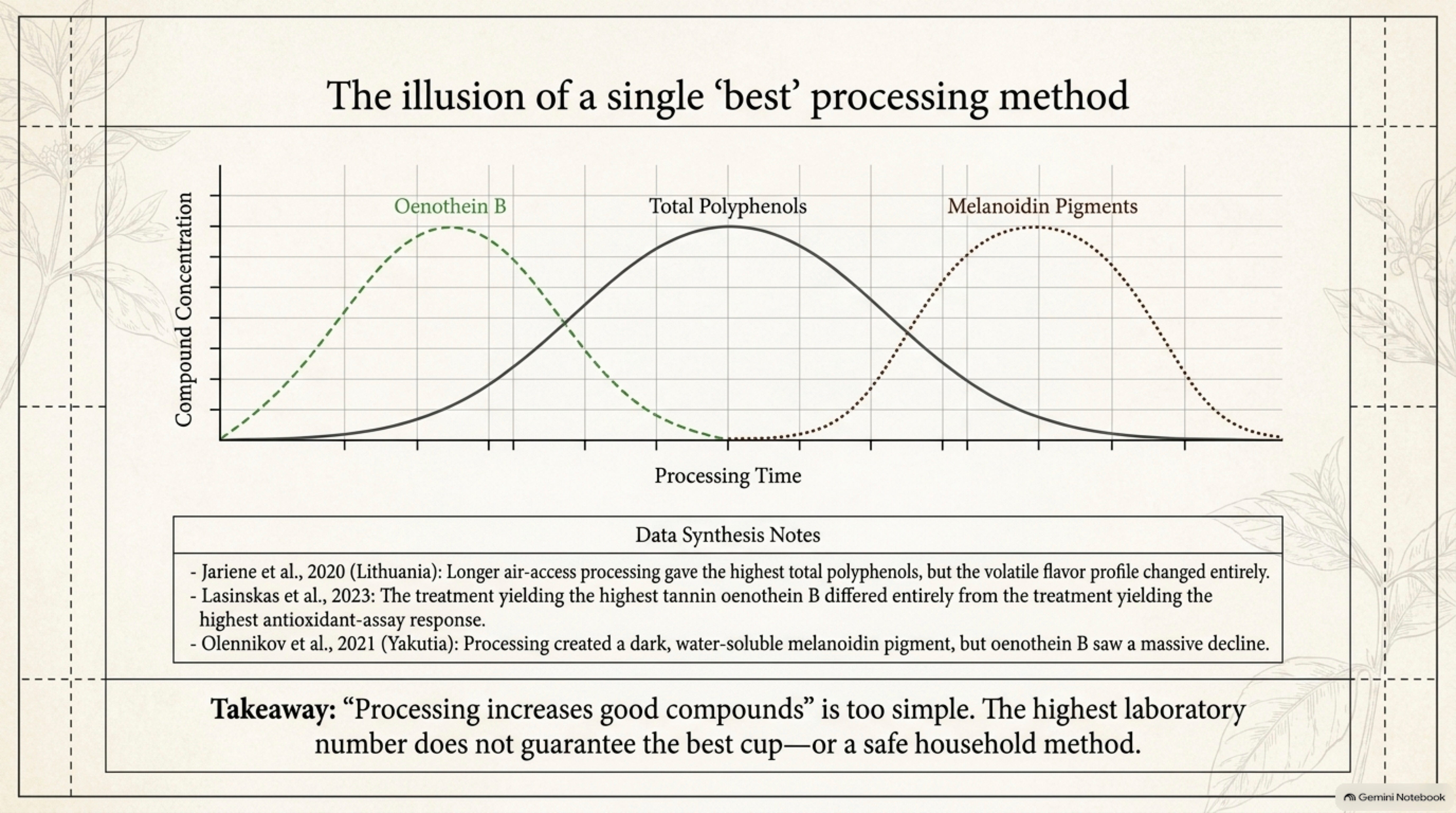
Aerobic and anaerobic concern oxygen. Some studies distinguished material beneath an air-permeable cover from material under a closed lid. Those are descriptions of the experimental setup. A lid alone does not measure oxygen throughout a mass of leaves, and closing a jar is not a preservation method.
Read a processing claim with three questions in mind. What changed in the plant? What organisms were identified or introduced? What evidence supports the finished food’s safety? A chemistry study may answer the first well while leaving the others open.
The same precision matters with “probiotic.” Fermentation does not automatically make a food probiotic. That claim requires evidence about identified live microorganisms, an adequate amount in the consumed product and a demonstrated health benefit. The leaf-processing chemistry studies discussed here do not supply it.
Smell and appearance can help us notice change or reject spoiled material. A fragrant, darkened batch still cannot establish a safe holding period, adequate drying or reliable storage. For that reason, this chapter does not turn the research treatments into improvised moist-leaf holds at home.
9.4 Learn from living practice
The Alutiiq Museum in Kodiak records fireweed under the name Cillqaq and identifies dried leaves as a substitute for black tea. Its website also hosts Gayla Pedersen’s Fireweed Chai handout, produced with support from the U.S. Fish and Wildlife Service’s Kodiak National Wildlife Refuge.
Pedersen attends to flexibility and to the effect of rolling a leaf. Her handout credits Joybilee Farm as the source from which its instructions were adapted. The credits locate a contemporary teaching practice and acknowledge how it was shared. They do not date every step or demonstrate microbiological validation. The procedure is not reproduced here.
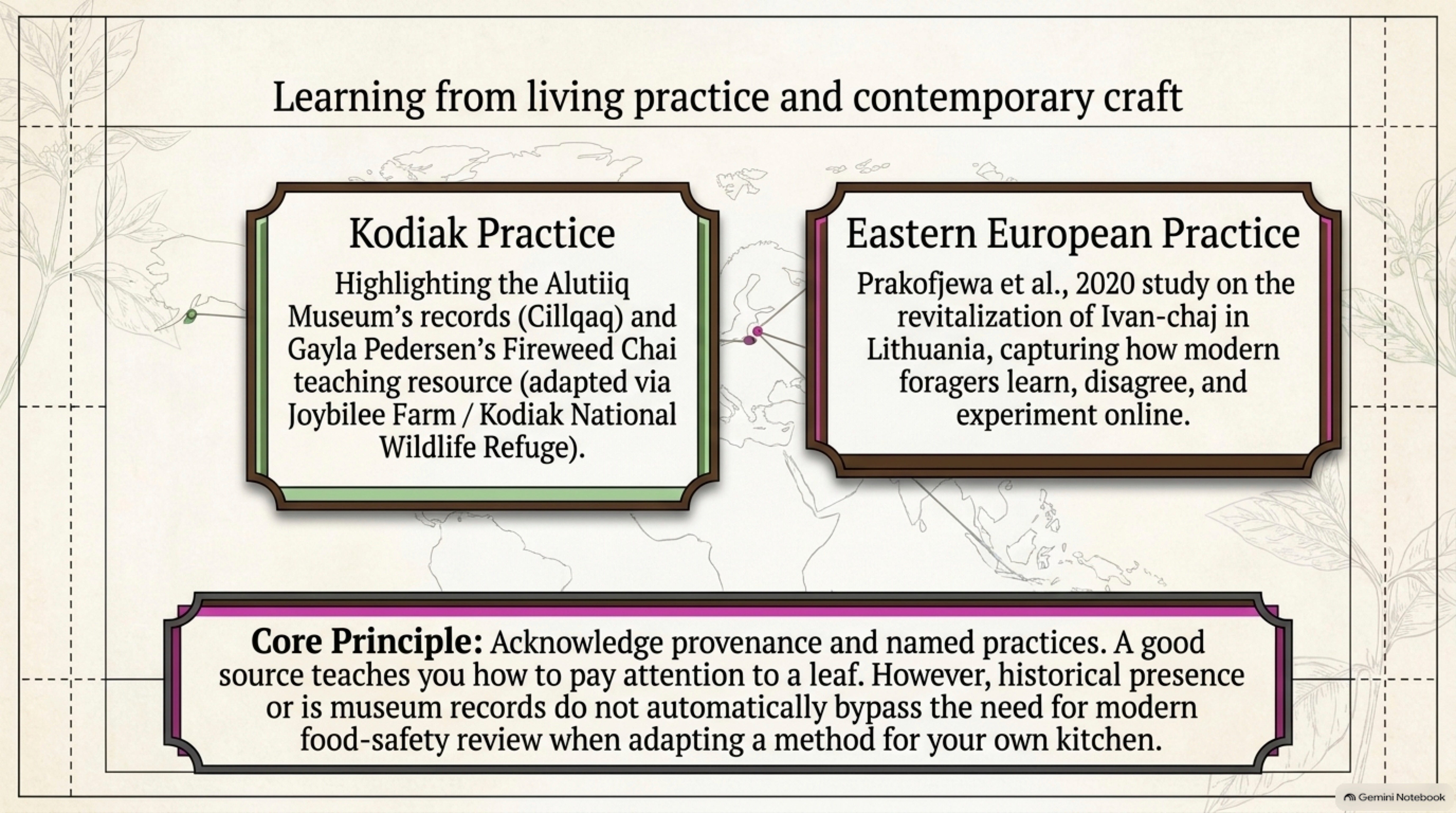
In Eastern Europe, Julia Prakofjewa and colleagues’ 2020 study, Re-written narrative, followed practices and public stories around Ivan-chaj. A couple interviewed in Lithuania had learned about the plant online but disagreed about longer processing: the husband favoured its effect on taste, while his wife thought it diminished aroma. Another participant varied processing and drying while consulting books and the internet.
Such accounts make the work recognisable. People learn from one another, try a method and disagree about the cup. The researchers also traced expansive heritage stories circulating online, giving reason to check an origin claim before repeating it. Their findings do not erase earlier uses or the present-day meaning of making and sharing tea. Chapter 5 considers that history in greater depth.
When following a method, retain the maker’s name, publication, place and date where available. Separate what a person reports doing from a later writer’s interpretation. At a workshop, ask which preparation is being taught and what food-safety support accompanies it.
A source can teach us how someone pays attention. A leaf’s changing feel is worth noticing even when the complete procedure requires further review before adaptation. Follow the source’s credits and seek any permission needed to reuse its material. No endorsement of this guide by the people or institutions cited is implied.
9.5 Read the processing experiments
Begin each study with its material, then follow what the researchers measured. “Best” has little meaning until the endpoint is clear. The highest amount of a compound, the strongest response in an antioxidant assay and the cup a drinker prefers may be different results.
Jariene and colleagues in 2020. The team used Lithuanian leaves collected at mass flowering and identified as Chamerion angustifolium. Cut, compressed material received air-access or closed-container treatments. Dried-leaf analyses measured polyphenols and antioxidant activity; separate electronic-nose sampling examined volatile compounds, which can pass into the air. Their longer air-access treatment gave the highest total-polyphenol result, while processing also changed the volatile profile. These instruments describe aspects of the material; they do not establish a drinker’s preference or validate a household preservation process.
Lasinskas and colleagues in 2023. This connected research group compared crushed Chamerion angustifolium leaves collected in Lithuania at full flowering beneath air-permeable and closed covers in a controlled chamber. Analyses used dried, ground leaves, including methanol extraction for chromatography, a technique that separates compounds for measurement. The treatment yielding the highest reported numerical amounts of oenothein B, a tannin, and total polyphenols differed from the treatment yielding the highest antioxidant-assay response. The numerical maxima did not identify a single best treatment across all endpoints, and some leading results were not significantly different. Neither result measured an ordinary cup or pathogen control.
Olennikov, Kirillina and Chirikova in 2021. A separate Russian team used authenticated Yakutian Epilobium angustifolium leaves and a different chamber-based process. Oenothein B declined substantially after processing. The researchers examined an isolated dark, water-soluble melanoidin pigment and leaf decoctions made by boiling in water, including under simulated digestion. In their assays, the overall antioxidant capacity of dried-leaf material did not differ significantly after processing, although individual compounds changed markedly. This was a different experiment, rather than an identical replication of the Lithuanian treatments, and simulated digestion did not measure a health outcome in people.
Efimenko and colleagues in 2021. Here, microorganisms were deliberately introduced. The researchers autoclaved previously processed commercial fireweed and apple-leaf teas, then inoculated them with the identified fungal strain Eurotium cristatum INA 01267. They examined chemical changes and tested the strain’s culture broth for selected mycotoxins and antimicrobial activity. Reported toxin non-detections belonged to that testing system and its analytical limits. They cannot identify an unexpected mould in a household jar or establish that it is suitable to consume. This was controlled fungal postfermentation research.
Together, these experiments show why “processing increases the good compounds” is too broad. Which compounds increased, in what material and under which treatment? A concentration per gram of dried leaf has not yet told us what enters the brewing water, how much is absorbed or what happens in the person drinking it.
An antioxidant assay measures a defined chemical response in a laboratory test system. Different assays can give different answers. A larger value does not measure food safety or demonstrate a benefit in the body. It may nevertheless help researchers understand how a treatment changed the leaf.
A 2026 primary abstract extends the research to a SCOBY-fermented beverage containing processed fireweed and Ginkgo biloba leaves. SCOBY refers to a community of bacteria and yeasts used in fermentation. The reported chemistry and sensory work concern that mixed preparation. An abstract alone cannot supply a standalone fireweed method or household instructions.
For the tea drinker, the studies offer a useful freedom from chasing the largest laboratory number. A dark product may have a changed chemical profile, and longer processing may favour one measurement while reducing another. Preference can remain a question about the finished cup.
9.6 Decide what method can be taught
A teachable household method needs support from beginning to end. Starting material, equipment, handling, processing conditions, drying, packaging and storage must belong to one coherent procedure. A favourable chemical result cannot supply the missing steps.
This guide has not yet established a complete method for processing fireweed leaves at home. Food-safety review and repeatable home testing remain open, so no timed warm hold or closed-jar schedule is given here. Plain home-dried leaves also depend on the unresolved drying and storage work in Chapter 7.
A food microbiologist or food-safety specialist should review the proposed preparation before a household trial is designed. That review must determine the controls and evidence needed for microbial hazards, drying endpoints and storage. Kitchen testing then has a separate role: showing whether the instructions are clear, equipment behaves as expected and batches are usable. Taste notes and photographs help with those questions, but cannot establish microbiological safety.
For the tasting below, choose a finished product sold for food use. Look for botanical identity, plant part and a complete ingredient list. Establish whether the leaves are plain dried or further processed. A producer should be able to identify the batch, explain its sourcing and provide clear brewing and storage instructions. Ask about missing information before buying, or choose another source
.
A label starts that inquiry; it is not independent proof of every claim it carries. Chapter 11.7 examines commercial identity and quality assurance. Avoid ambiguous loose material, research-only products and extracts presented as ordinary leaf tea. If avoiding caffeine or another ingredient, check the whole blend rather than relying on “fireweed” on the front of the packet.
9.7 Taste and store a finished product
Choose a plain dried-leaf product and a processed-leaf product intended for drinking, both with satisfactory sourcing information and clear instructions. Single-ingredient products make the comparison easier to interpret. If only one is available, begin with one cup.
The purpose is to notice flavour, rather than test tolerance or seek a health effect. If suitability is uncertain because of pregnancy, breastfeeding, a health condition, medicines or use by a child, obtain preparation-specific advice from a qualified clinician or pharmacist first. Leave concentrated extracts out of the comparison. UAF’s fireweed guidance notes that the drink can have a mildly laxative effect for some people.
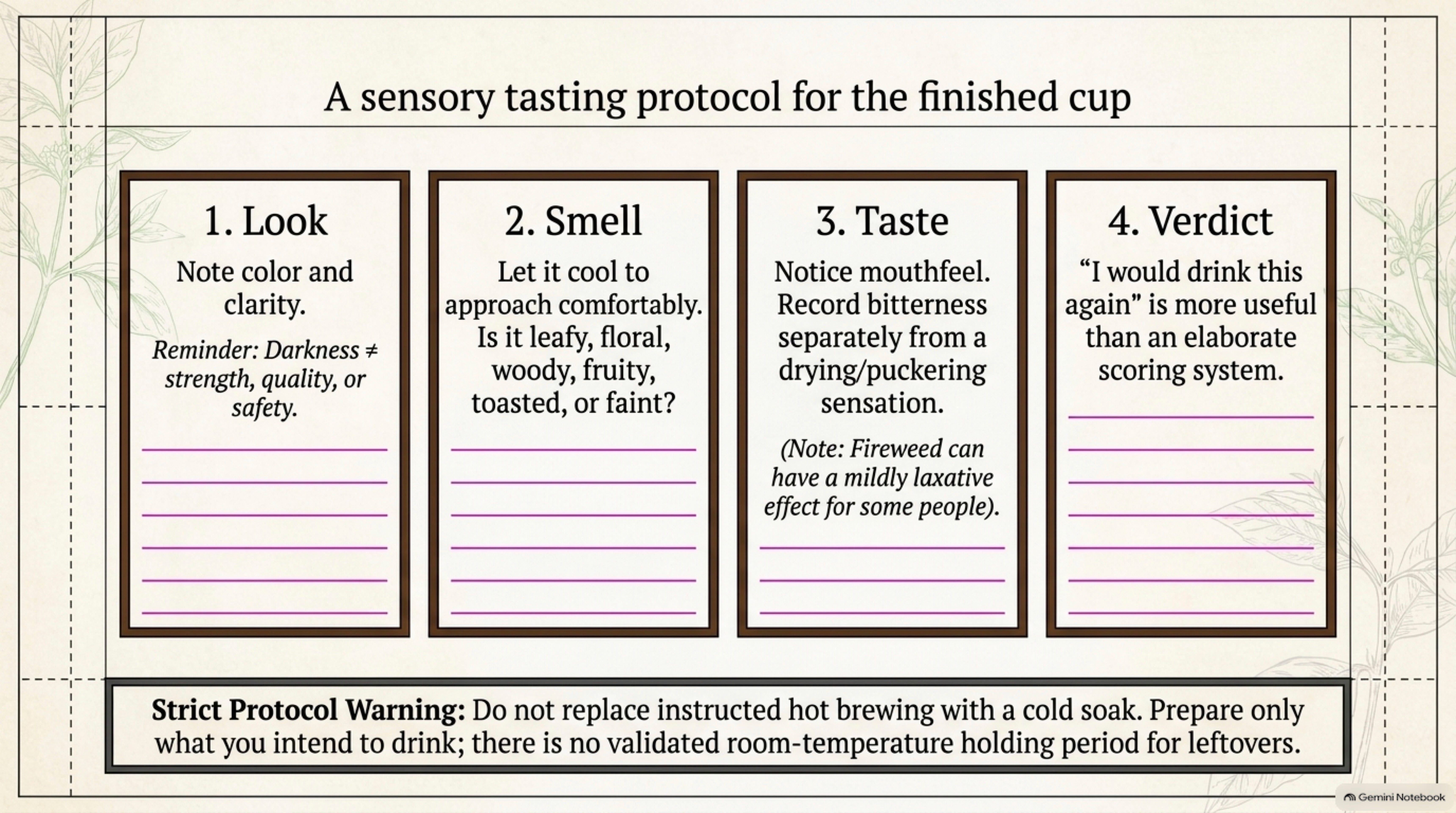
Keep the packets beside the cups. Check their condition and follow each producer’s brewing directions, including quantity, water temperature and steeping time. Use clean equipment and drinkable water. An instructed hot preparation should not become a cold soak merely to make the samples match.
If the directions differ, record the difference. This is a comparison of products prepared as their makers intend. Harvest, source and brewing conditions may all contribute to what you notice, so the tasting cannot isolate the effect of processing alone.
Look before adding anything. Similar light-coloured cups make comparison easier. Note colour and clarity without using darkness as a measure of strength, quality or safety.
Notice the aroma. Let the drink cool enough to approach comfortably. Try familiar words such as leafy, floral, woody, fruity, toasted or faint. Leave the description blank if nothing useful comes to mind.
Taste at a comfortable temperature. Notice the first impression, then the feel left in the mouth. Record bitterness separately from a drying or puckering sensation. You do not need to identify a compound to describe what you feel.
Write a preference plainly. “I would drink this again” is useful. Note whether the drink changes as it cools during the tasting.
These words are prompts, not promised fireweed flavours. If tasting with someone else, write separately before comparing notes so an early description does not settle everyone’s experience. Identify anything offered to another person clearly, with its ingredients available.
Keep the remaining dry product in its original packaging, or retain the full label and lot details with a suitable container. Follow the producer’s storage directions and date information. Protect the leaves from moisture and contamination, use dry utensils and close the package promptly. General dried-food guidance favours cool, dry, dark storage; it does not assign every fireweed product the same shelf life.
Stop using a product if you find condensation, unexpected dampness, visible mould, insects or a musty smell. Do not taste suspect leaves, mix them into a sound lot or try to rescue them by stronger brewing. Follow the producer’s advice on returns or disposal. Material with lost identity or an unknown processing history remains unsuitable for this comparison even if it looks sound.
Prepare only what you intend to drink. Follow any product-specific directions for prepared tea; no refrigerated or room-temperature holding period for leftovers is established here.
Return to the two cups. Perhaps the plain leaf is the one you would choose again. Perhaps an aroma in the processed product holds your attention as it cools. Write the product name beside that observation. Next time, you will have something particular to return to.
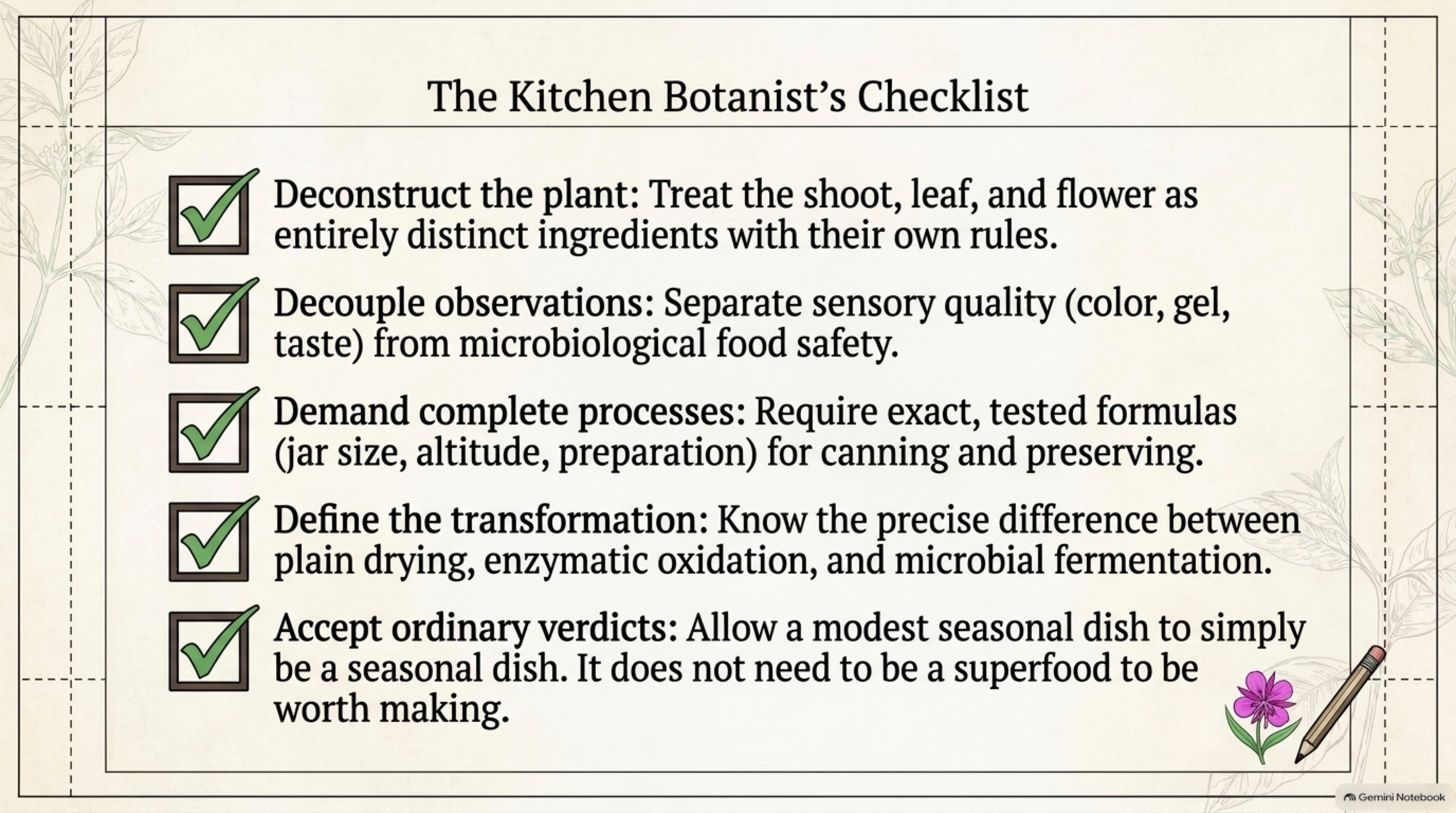
Sources and further looking
Sources checked 11 October 2026. The sources explain preparations and research findings; their procedures are not adopted as household recipes. Preparation-specific food-safety review and home processing trials remain outstanding.
Preparation and oxidation
Huang and colleagues 2021 · NIH probiotics fact sheet
Huang and colleagues, The R2R3 Transcription Factor CsMYB59 Regulates Polyphenol Oxidase Gene CsPPO1 in Tea Plants, supplies the Camellia sinensis comparison for 9.2. It is not a fireweed-specific enzyme study. The fireweed papers below establish their own materials and analytical preparations. NIH Office of Dietary Supplements explains the evidence required for probiotic claims in 9.3.
Kodiak practice and provenance
Alutiiq Museum fireweed profile · Gayla Pedersen Fireweed Chai
The museum profile and Pedersen’s handout support the named accounts in 9.4. The handout acknowledges Kodiak National Wildlife Refuge support and adaptation from Joybilee Farm. Its images, instructions and timings are not reproduced; no ancient lineage, microbiological validation or endorsement is inferred.
Eastern European accounts
Prakofjewa and colleagues 2020
Re-written narrative: transformation of the image of Ivan-chaj in Eastern Europe provides the field examples and analysis of circulating stories in 9.4. The primary full-text account was checked through its indexed PMC record. Interview quotations and processing durations are not reproduced.
Lithuanian processing experiments
Jariene and colleagues 2020 · Lasinskas and colleagues 2023
Polyphenols, Antioxidant Activity and Volatile Compounds in Fermented Leaves and The Impact of Solid-Phase Fermentation on Flavonoids, Phenolic Acids, Tannins and Antioxidant Activity support their distinct summaries in 9.5. Their primary PDFs were checked, and the shared research connection is retained. The highest numerical values are not presented as uniquely superior where leading treatments were not significantly different. Measurements of treated leaf material do not establish the composition of a household infusion or validate a food process.
Other processing research
Olennikov and colleagues 2021 · Efimenko and colleagues 2021
Water-Soluble Melanoidin Pigment as a New Antioxidant Component of Fermented Willowherb Leaves and Eurotium Cristatum Postfermentation of Fireweed and Apple Tree Leaf Herbal Teas support the remaining 2021 summaries. Relevant methods and results were checked through indexed primary full text; direct full-page retrieval was intermittent. Simulated digestion is distinguished from human outcomes, and strain-specific culture-broth testing from finished-food safety validation.
Mixed beverage research
Phytochemical Composition, Antioxidant Capacity, and Quality Attributes in Novel Plant-Based Fermented Beverages with SCOBY was available as a primary abstract. Only its mixed fireweed and Ginkgo biloba preparation and broad endpoints are described. Full-method appraisal remains outstanding.
Product choice and storage
UAF Fireweed FNH 00106 · NCHFP storing dried foods
UAF supports the limited digestive-tolerance note. NCHFP supports general moisture protection and storage principles; its general storage ranges are not assigned to fireweed. The product questions and tasting record are proposed reader tools, not a completed trial or certification of a brand. Individual suitability follows Chapter 11’s preparation-specific discussion.
CHAPTER 10
Stems, silk and useful making
A split fireweed capsule holds a pale brush of hairs. In still air, the tufts gather along its open seams; a breeze loosens them, and tiny seeds lift away. Below, the stalk that carried the leaves and flowers remains. One plant offers the eye two very different materials: a firm length of stem and a mass of hairs light enough to drift.
Their forms tell us something about their work in the living plant. The stem supports growth and contains tissues that move water and food. The seed hairs help dispersal. Making begins by recognising those differences, then asking what survives the journey from plant tissue to an object in the hand.
This chapter follows stem fibre and seed down through published accounts of cordage, stuffing and blended textiles. It also sets out small questions a maker could investigate. No process has yet been tested from raw fireweed to finished object for this guide, so the proposed projects remain starting points for trials planned with an experienced maker. Learning to describe a strand accurately is useful work in itself.
10.1 Separate stem fibre from seed down
The long, narrow capsule is a fruit. Each seed inside it carries a tuft of fine hairs called a coma. As the capsule opens, those hairs spread into the silky mass that catches the light. The tuft gives a very small seed more surface to meet the air. Here, silk describes an appearance; it is not the protein thread made by a silkworm.
Stem fibre has a different origin. In a 2021 anatomical study, Seher Güven and colleagues examined stems, leaves and fruits of willowherbs and fireweeds collected in Turkey. Their sections of Chamaenerion angustifolium show supporting tissues, including groups of thick-walled fibres associated with the phloem, the food-conducting tissue. The cross-section reveals structure that a whole stalk conceals. It helps explain the presence of fibrous material without telling us how a handmade cord will perform.
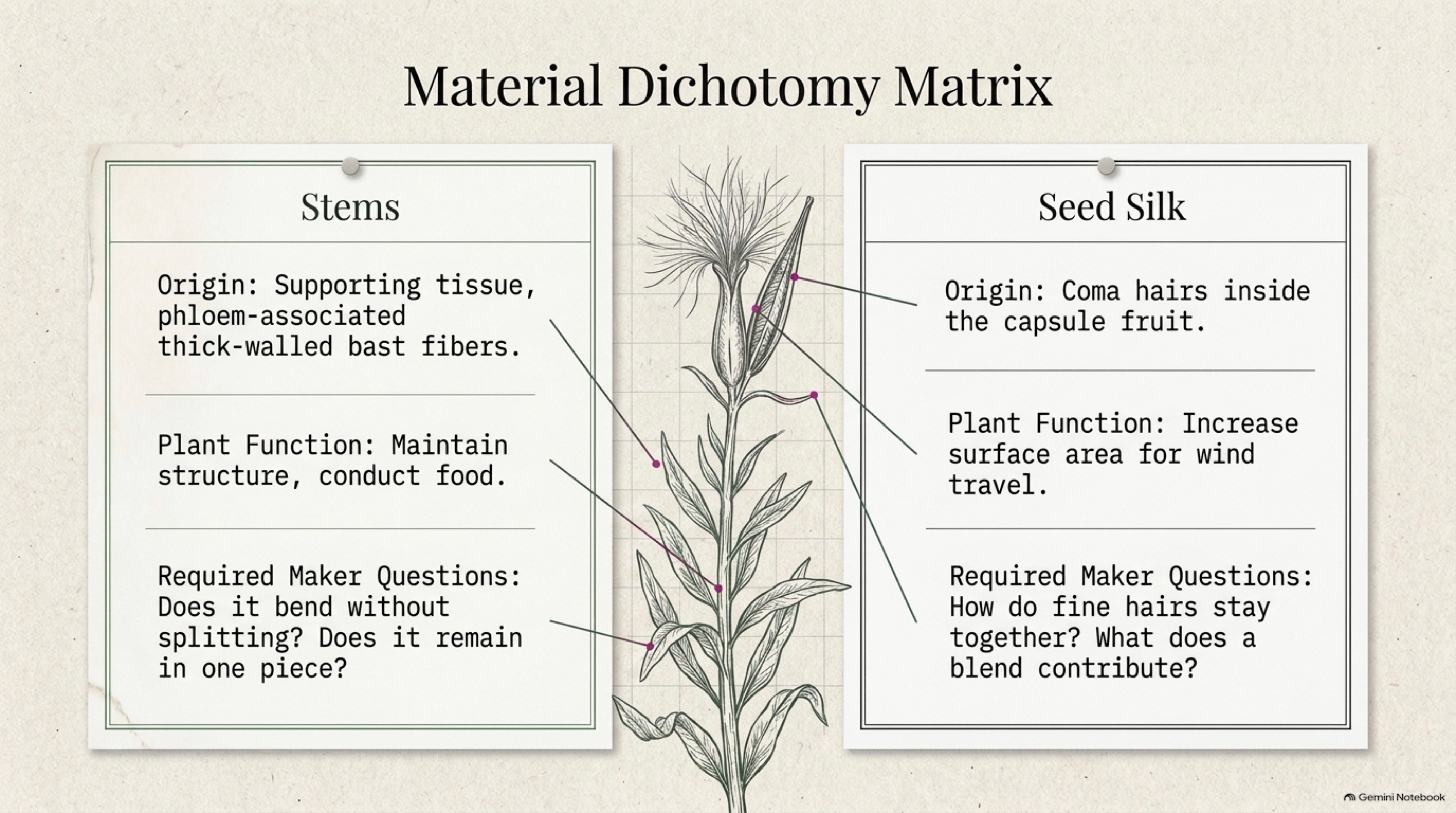
Textile accounts often call fibres obtained from the relevant tissues of stems or inner bark bast fibres. The term describes a source within the plant, rather than a preparation shared by every species. Flax, nettle and fireweed differ in structure. A yield, working method or breaking strength measured for one cannot be carried over to another simply because both appear in a list of fibre plants.
Even the word strand needs care. A strand visible between a maker’s fingers may be a bundle of cells still joined together, with other tissue clinging to it. Its length is not necessarily that of one microscopic fibre. A photograph of a long strip can document a particular preparation; it cannot, by itself, establish a textile specification.
This distinction becomes practical as soon as a sample is handled. A strand might bend, split, catch against its neighbours or slip free of them. A clean-looking surface and an uninterrupted length are separate observations. Seed down asks another question: how do its fine hairs hold together, and what changes when another fibre is added? A soft handful may be pleasant to touch while lacking the coherence needed for the imagined object.
Keep the part name with every observation. “Fireweed stem fibre” and “fireweed seed down” tell the next reader where to begin. If a sample contains both, or includes wool or another plant, say so. The mixture is part of the material’s identity.
10.2 Follow the documented objects
Chapter 5 introduced fireweed in material life. Looking closely at the objects brings those accounts into sharper focus. A cord must hold together along its length. Stuffing occupies space inside a covering. A woven textile brings prepared strands and the maker’s skill into a larger structure. These uses ask different things of the plant.
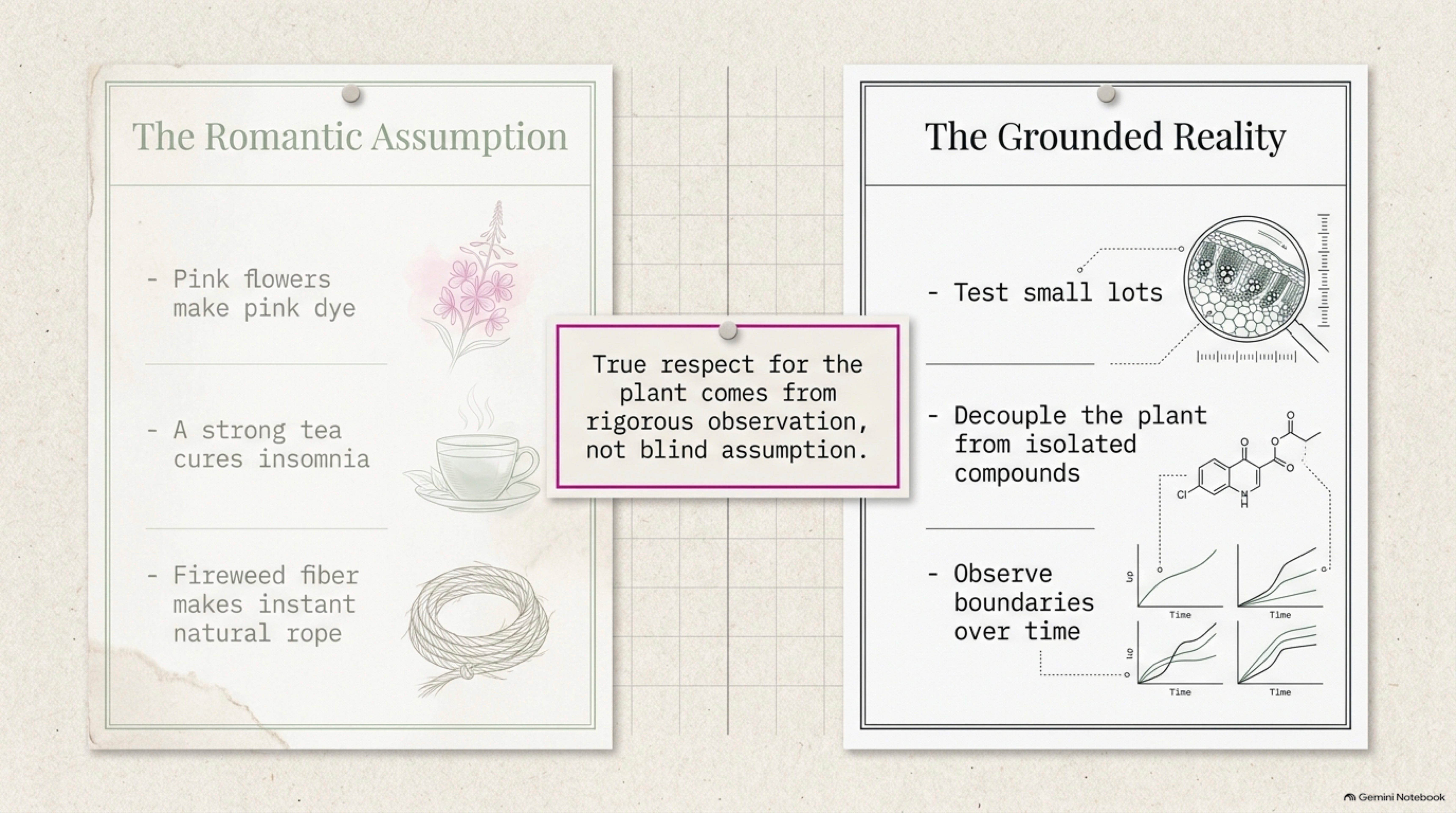
The First Nations Health Authority’s Traditional Food Fact Sheets names outer fireweed stems among materials used for twine. This is a broad British Columbia educational resource. Its brief entry establishes a stem-material record without identifying a particular Nation, maker or preparation, so the attribution belongs at that scale.
A more particular voice is Ashley Russell’s in the July 2017 issue of The Voice of CLUSI, the newspaper of the Confederated Tribes of Coos, Lower Umpqua and Siuslaw Indians. Identified there as Water Protection Specialist, Russell describes fine cordage made from the inner bark of fireweed stems for skirts and capes. She separately records seed fluff used to stuff pillows. Her account, published under Chamerion angustifolium, also conveys the labour involved in working the stems. The finished uses can be acknowledged without turning the brief processing account into a beginner lesson.
The distinction between cordage and stuffing matters. A covering can contain loose material that would not hold together as a strand. Equally, a cordage account says little about the behaviour of a filling. Russell’s pillow reference records a use; it does not establish a modern washing method, durability standard or suitability for infant bedding.
Blended textiles have a further documentary trail. In a 1993 article hosted by the Royal BC Museum, Grant Keddie credits Nancy Turner and Randy Bouchard with records of fireweed seed down combined with dog hair among the Saanich, and with dog and goat wool among the Squamish and many Puget Sound groups. His source names the plant Epilobium angustifolium. These community names are retained as the historical account gives them.
The Skelkelosen fireweed profile, publicly hosted by Surrey and carrying Wild Bird Trust provenance, separately describes seed hairs used in Coast Salish weaving alongside other materials. Together, these accounts make the mixtures important to the story. Neither supplies a recipe for the proportions or establishes the properties of a particular surviving textile.
Calling a blend simply a fireweed blanket can obscure the other fibres and the work needed to combine them. Name the whole mixture when it is known. A record of blending also leaves open the separate question of whether down could be worked alone. Evidence of one preparation cannot settle every possible preparation.
These publications are accounts of use, rather than a catalogue in which every claim is tied to an examined object. A written record, a museum label and a laboratory identification each offer different evidence. A photograph may reveal a weave while leaving the identity of a pale strand unresolved. Follow the original credits and the guidance of the relevant knowledge holders or institutions before adapting techniques or reproducing cultural material. Attentive reading can deepen appreciation of the work without requiring a reconstruction of it.
10.3 Choose a small first project
A useful first project would answer a question with little consequence if the result fell apart. Once an experienced maker has established an appropriate process, a fibre sample, short decorative cord or paper sample could offer that kind of beginning. The scale should leave room to examine the material closely, including the parts of an attempt that did not work.
A fibre sample asks what usable material a defined preparation leaves behind. Long strips carrying fragments of stem are different from clean, flexible strands. An attractive handful may contain only a little material that can be handled consistently. Keeping the preparation record beside the sample allows those differences to be seen again later.
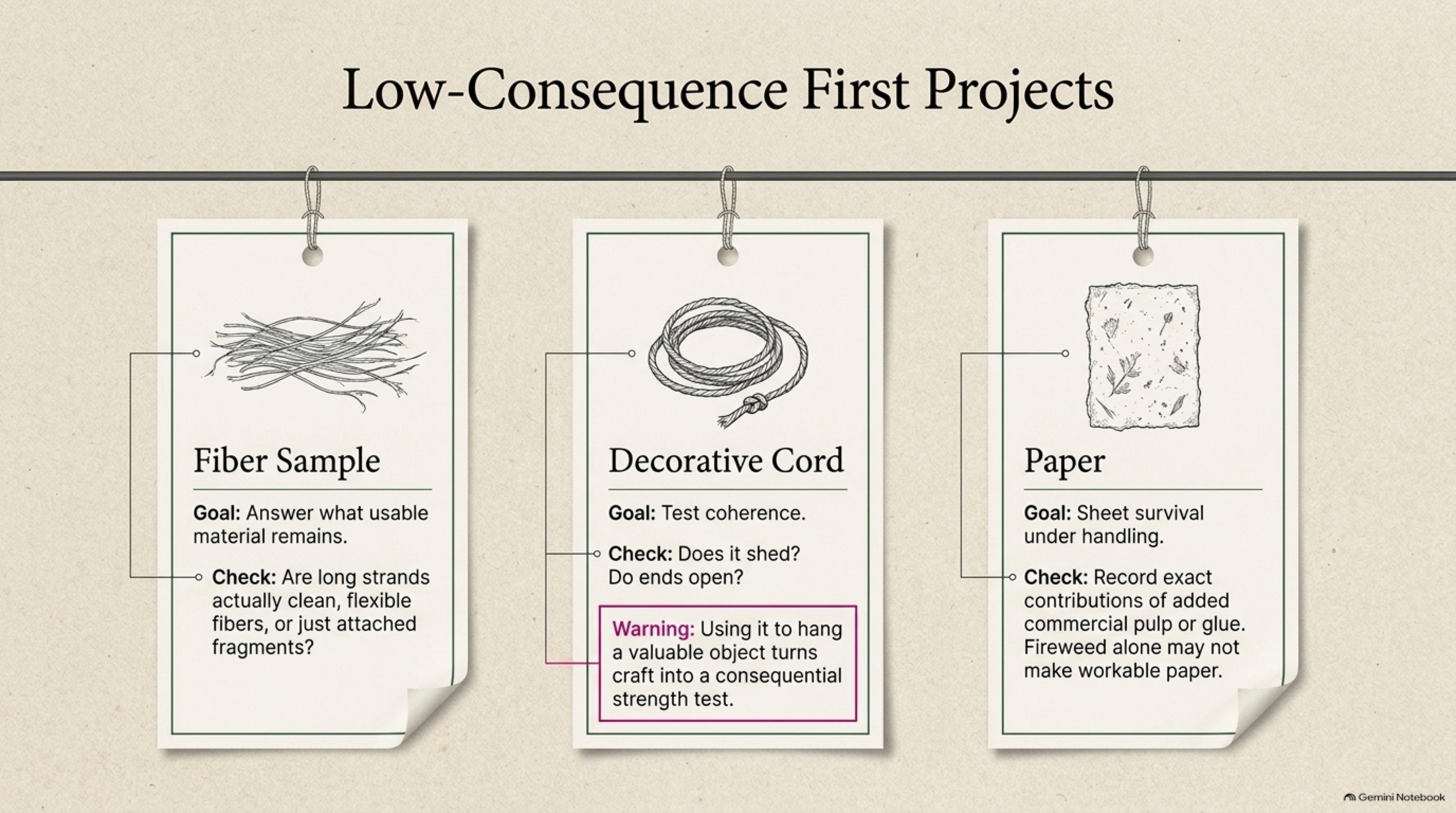
A decorative cord adds the question of coherence. Does the piece shed during handling? Do its ends open? If it separates, do the strands break or slide past one another? These observations would be useful even if the cord never became an ornament. Keep the intended use decorative: fastening equipment, suspending a valued object or restraining an animal would demand evidence of strength that such a trial cannot provide.
A paper sample asks whether prepared material can form a sheet that survives its intended handling. Added commercial pulp might contribute much of the sheet’s structure. Thread, glue or a backing would also change what the sample demonstrates. A sheet containing a little fireweed could be worth making for its appearance, with every component named, while leaving the question of paper made solely from fireweed unanswered.
An uneven cord or a sheet that breaks on lifting need not be disguised as a success. It may reveal where a preparation fails or why a larger attempt would be wasteful. Save a small, accurately labelled sample if it is sound enough to keep. Colour, surface and behaviour can be more informative than the ambition of the finished object.
The decision starts at the collecting place. Identification, lawful access and site history still matter for craft; material from a contaminated or uncertain site does not become suitable merely because it will not be eaten. Taking seed down also affects seed movement differently from taking a stem without capsules. Use Chapter 6 for the management decision and 7.2 for access and site questions before collecting.
A photograph or drawing of the intact plant is a useful first record and needs no harvest. Show the capsule in relation to the stalk. Once the material is separated and bagged, that connection is easy to lose.
10.4 Prepare and compare a small lot
Between the standing plant and the finished object lie selection, separation, cleaning and drying. Brief lists of uses rarely show enough of this work. A reliable method would explain the sequence and the signs that each stage had reached its intended result. Those details remain to be established for fireweed projects in this guide.
An experienced maker’s trial would begin with the actual stems or down available. Plant stage, condition and exposure to weather belong beside the collecting date. Stems from one place may differ, and the same calendar date in another year may bring material at another stage. Record the starting point closely enough that a later attempt can be compared with it.
Separation is a balance between retaining usable length and removing unwanted tissue. The longest strip may still carry fragments; a cleaner sample may be shorter. Which result is preferable depends on the object. “More thoroughly processed” is an incomplete judgement until the sample shows what was gained and what was lost.
Keep the comparison narrow. If the question concerns stem stage, changing the added fibre and the finishing at the same time makes the answer difficult to interpret. For a blend, record every component and its amount. Choose one difference worth examining, then keep the remaining preparation as consistent as the established process allows.
Mass needs a stated basis too. Fresh plant material includes water, while a dried sample has lost much of it. Comparing their masses without naming those conditions can produce a misleading fibre yield. Any eventual yield calculation would need a defined starting material, a consistent moisture basis and a clear account of which separated fraction was kept. Time and effort belong in the record alongside quantity. This chapter supplies no yield estimate, and figures for nettle cannot fill that gap.
Observation should continue after making. A sample that holds together on the workbench may later curl, shed or come apart. Record what changes and where failure occurs. A broken strand, a slipped bundle and a loose attachment suggest different problems. Ordinary handling observations help refine a craft trial, but cannot establish a safe working load.
A compact trial record would keep the following information with the sample:
Identity and origin, including plant part, collecting date, stage and condition
The maker’s established preparation, any changes to it, and all added materials
Amounts, with the fresh or dry condition stated and the basis for any comparison
Immediate results, including usable material, losses and time spent
Later changes, the way any failure occurred, and the next question worth testing
The process also needs an appropriate workspace. Fibre handling can release dust, so an experienced maker should assess exposure and controls before processing begins. There is no validated drying endpoint or storage life here. Stop working with mouldy or deteriorating material rather than brushing it out indoors and carrying on. These limits belong to the preparation plan, alongside the tools and the intended object.
The record should make it easier to keep an approach, change one part or stop. Chapter 12 returns to small comparisons whose answers remain useful even when the result is disappointing.
10.5 Explore colour if worthwhile
Pink flowers do not promise pink cloth. Colour in a living petal and colour retained by a finished textile arise in different settings. The receiving fibre, the substances extracted from the plant and any added chemicals all influence the result. A fresh swatch also says little about what light, washing or rubbing will do to it.
Dyeing remains an optional research question in this guide. No fireweed dye trial has been completed for this guide, so no recipe, expected colour or degree of fastness is established here. The first question is whether a particular result merits the material, work and waste involved. A faint or changing colour may interest an artist who describes it accurately. A claim of durable colour on a product would require evidence beyond an attractive first sample.
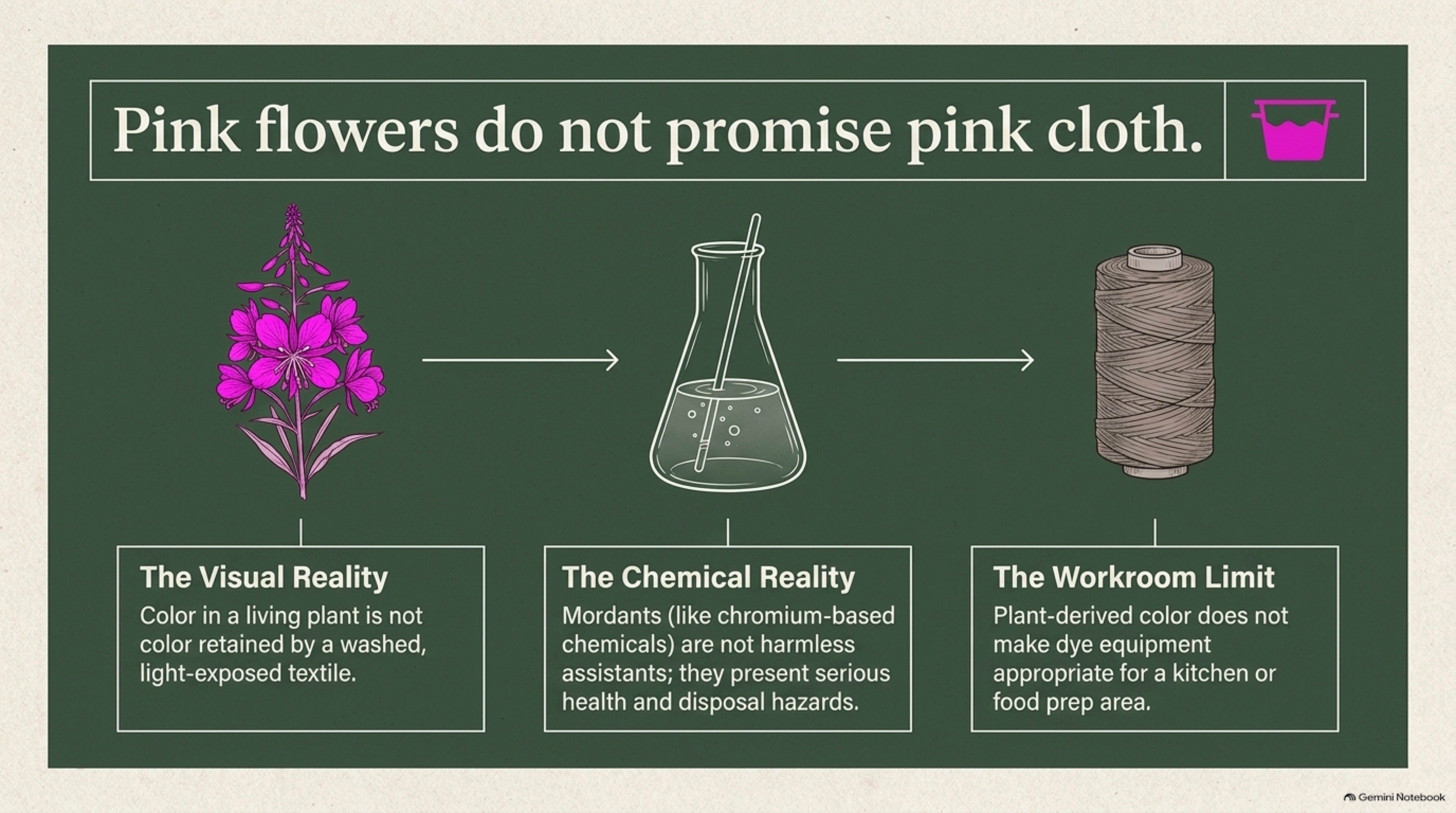
A mordant helps some dyes associate with a fibre and may alter the colour. The term names a function, not a single ingredient with a single hazard. Before using any product, an experienced dyer would need its exact identity, label and safety data sheet. Dichromate mordants, for example, can pose serious health hazards. This chapter recommends no mordant or chemical quantity.
Heat and exposure controls must match the actual process. Hot vessels and liquid can burn or splash; powders may become airborne, and some processes release vapours. Appropriate handling arrangements, eye protection, suitable gloves and ventilation belong in a reviewed method. An open window or generic mask cannot be assumed to meet those needs.
Keep dye vessels and utensils dedicated to dye work, separate from food preparation. Store chemicals in identified containers away from food, children and animals. Resolve disposal before heating a bath. The spent liquid and the plant residue may both contain added chemicals, so neither automatically belongs in compost or back on the collecting patch. Follow product directions and the local waste authority’s advice for the exact substances. Do not pour unidentified or hazardous residues onto soil, into drains or into a watercourse, or mix waste chemicals to try to neutralise them.
Those requirements may make dyeing a poor first project. The unaltered colour of a prepared strand is also worth recording. A maker can learn a great deal about a material before adding another process.
10.6 Give materials sensible limits
An accurate description keeps an object close to what has actually been learned about it. “Decorative sample containing fireweed stem fibre” identifies material and purpose without implying a rated strength. Name added pulp, wool, thread, adhesive or backing wherever it contributes to the result. The same care belongs on a label, in a photograph caption and in a trial notebook.
Keep exploratory craft pieces out of uses where failure or contamination could harm someone. This guide does not support fireweed material for medical dressings, infant bedding, filters, food-contact items or load-bearing work. Appearance establishes neither sterility nor safe filtration, and a cord’s working capacity requires testing. A sample that sheds also needs assessment before wear or prolonged contact. Historical use informs the enquiry; assess a present-day product for its own construction and purpose.
The last material decision concerns leftovers. Section 6.6 gives the garden-material route. Clean, untreated remains without seeds or living regenerative fragments may suit ordinary composting. Seed-bearing fluff and living roots or rhizomes need a separate containment and disposal decision so that a craft session does not become an accidental planting. A home compost pile cannot be assumed to destroy them.
Chemically treated residues stay outside that clean-biomass route. Their destination depends on what was added and the applicable local waste guidance, as 10.5 explains. Keep that information with the lot until its leftovers have been dealt with.
A process may demand more time, equipment or plant material than its result justifies. A small trial is valuable if it makes that clear. Leaving the next stems standing is a reasonable decision.
The useful object may be no more than a short, uneven cord, its ends still showing how the strands meet. Kept with an accurate account of the material, it can help another maker decide what to try next. It can also deepen appreciation of the skill in a finished textile. Chapter 11 carries that attention to identity and preparation into the evidence for fireweed’s effects on health.
Sources and further looking
Sources checked 11 October 2026. Botanical descriptions, published material accounts and general workshop guidance support different parts of this chapter. The proposed craft comparisons have no tested process, yield, working load, drying endpoint, storage period or colourfastness result.
Seed hairs and stem structure
USDA NRCS Fireweed Plant Guide · Güven and colleagues 2021 · Smithsonian bast fibre account
Rich Fleenor’s 2016 plant guide supports the capsule, hairs and wind-dispersal account under Chamerion angustifolium. Güven and colleagues’ Anatomical properties of Epilobium and Chamaenerion from a taxonomical perspective in Turkey, Protoplasma 258, supports the stem anatomy in 10.1. Nora Frankel’s Untangling Indian hemp explains bast-fibre terminology and identification in other plants. None supplies fireweed cord strength or a craft-performance specification.
Stem cordage and stuffing
FNHA Traditional Food Fact Sheets · The Voice of CLUSI July 2017
The FNHA plants section, PDF page 28, records outer-stem twine at a broad British Columbia scale. Ashley Russell’s This Month...be on the Lookout for Fireweed, page 6 of The Voice of CLUSI, separately records stem cordage and seed-fluff stuffing. Her food, medical and processing passages are not adopted as instructions or safety evidence.
Blends and cultural attribution
Keddie 1993 museum hosted article · Skelkelosen fireweed profile · International Society of Ethnobiology Code of Ethics
Grant Keddie’s Prehistoric Dogs of B.C. Wolves in Sheeps’ Clothing?, The Midden 25(1), credits Turner and Bouchard in the fireweed passage on PDF page 6. The Surrey-hosted profile supplies a separate weaving account with Wild Bird Trust provenance. These accounts support the named blends in 10.2, without identifying fibres in a particular pictured object. The ISE Code of Ethics supports attention to attribution, consent and knowledge holders; citation does not replace appropriate permission.
Workshop exposure and dye equipment
MassArt safety manual · UNSW Textiles Dye Lab · Open University natural dyes · Maiwa natural dye guide
MassArt’s fibres and chemical guidance supports assessing dust, dyes, mordants and exposure controls. UNSW describes training for heated dye equipment and protective measures. The Open University explains mordants and colour changes using another plant system; its recipe is not adapted here. Maiwa’s specialist guidance supports dedicated non-food equipment and separate chemical storage. These are general studio sources rather than fireweed-specific process reviews.
Residues and trial limits
The EPA guidance supports reading labels, keeping hazardous wastes separate and obtaining local disposal advice. It does not authorise a British Columbia disposal route. Exact local acceptance must be checked before work. The sample comparisons and recording questions in 10.3 and 10.4 are proposed enquiries; Chapters 1, 6 and 7 supply the connected identification, management and collecting context.
CHAPTER 11
Chemistry, health and the limits of a cup
A packet of fireweed leaves and a bottle of extract capsules can carry the same plant name. Set them beside the kettle and read the smaller print. The leaves will meet hot water. A capsule may hold a concentrated preparation, made with a particular solvent and measured against a chemical marker. The name connects them; their preparation begins to explain the differences.
Those differences matter when a health claim enters the conversation. Fireweed has chemistry worth studying, a history of medicinal use and a small, developing body of human research. This chapter follows that evidence from plant to preparation to measured outcome. The aim is to understand what a finding tells us and how closely it fits the product in hand.
Keep one claim in mind as you read: easier urination, better sleep, healthier skin or perhaps an effective garden feed. Ask what would have to be measured to establish it. You will have more useful questions for a clinician, pharmacist or supplier, and a clearer sense of what you can honestly say about your own cup.
11.1 Meet the compounds through the plant
The drying or puckering feel left by a suitable, correctly identified tea is astringency. It differs from bitterness, though both can occur together. Research connects this mouthfeel partly with interactions between tannins and salivary proteins and with changes in lubrication. Taste offers an introduction to chemistry. It cannot measure a particular compound, establish safety or predict what the drink will do elsewhere in the body.
Tannins belong to the broad group of compounds called polyphenols. Fireweed researchers also measure flavonoids and phenolic acids within that larger family. Quercetin, hyperoside, gallic acid and ellagic acid are among the names that recur. Each identifies a substance with particular chemical properties; the names are not interchangeable entries on a list of health benefits.
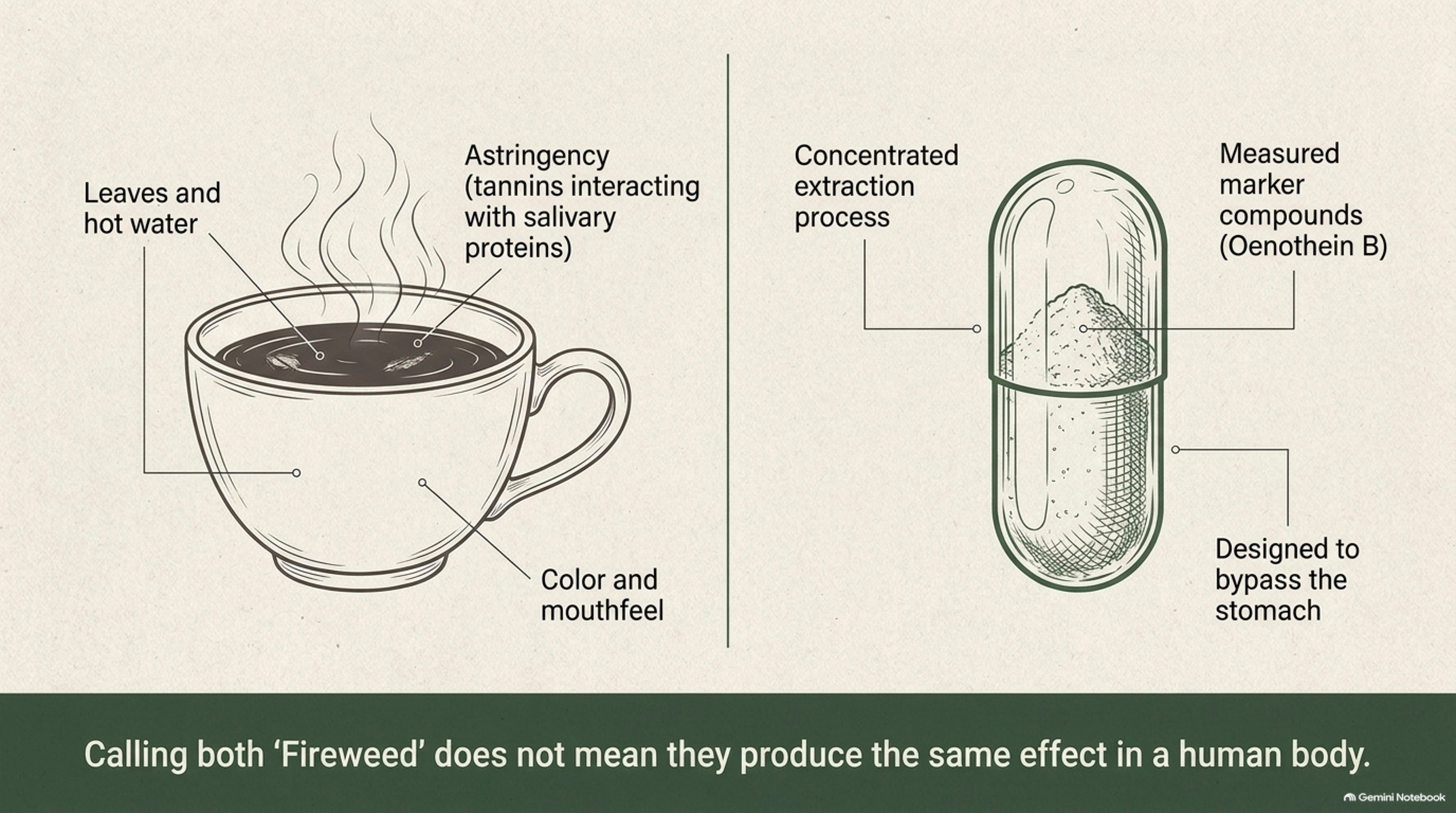
One tannin appears especially often: oenothein B, an ellagitannin. Researchers investigate its activity and use it as a marker when comparing preparations. A measured marker helps describe a product. Its presence alone does not explain every effect, and a larger amount need not make a better drink.
A flower, a mature leaf and a whole flowering top begin as different samples. Stage matters too. Ivanauskas and colleagues, in a 2024 paper using the name Epilobium angustifolium, compared leaves and flowers during early, mass and late flowering. Many measured leaf polyphenols were highest late in flowering; triterpenoids, another group of plant compounds, followed different patterns. The study began during flowering, so it leaves the earlier part of the season unanswered.
Processing changes the material again. In Lasinskas and colleagues’ 2023 leaf experiment, the highest numerical oenothein B result came from a different treatment than the strongest antioxidant-assay response. Olennikov and colleagues’ 2021 experiment used another process, found a large loss of oenothein B and investigated a dark, water-soluble pigment with antioxidant activity in laboratory tests. Their different materials, methods and measurements help explain why the findings differ.
Colour, aroma and mouthfeel need observations of their own. Choosing tender food, finding the highest amount of a compound and choosing a favourite tea are different tasks. Chapter 9 follows the leaf processing more closely. Here, keep the measurement attached to the question it can answer.
11.2 Ask what was actually measured
Before reading a conclusion, find the experimental material. Was it authenticated Chamaenerion angustifolium, perhaps reported as Chamerion angustifolium or Epilobium angustifolium? Was another willowherb used, or a mixture? Then find the plant part and preparation. An isolated compound, a whole extract and an infusion allow researchers to ask different questions.
Next, read the units. Milligrams per gram of dry leaf describe the dried starting material. Milligrams per gram of extract describe a product from which much of that material may have been removed. Milligrams per litre of infusion describe liquid. Fresh-weight values include the plant’s water. A large number means little until its denominator is clear.
Even “total polyphenols” needs a method attached. An assay may report a chemical response in equivalents of a reference substance, such as gallic acid. It has not necessarily weighed every polyphenol in the sample. Chromatography separates compounds so selected substances can be measured by another route. Results from these methods should retain their own meanings.
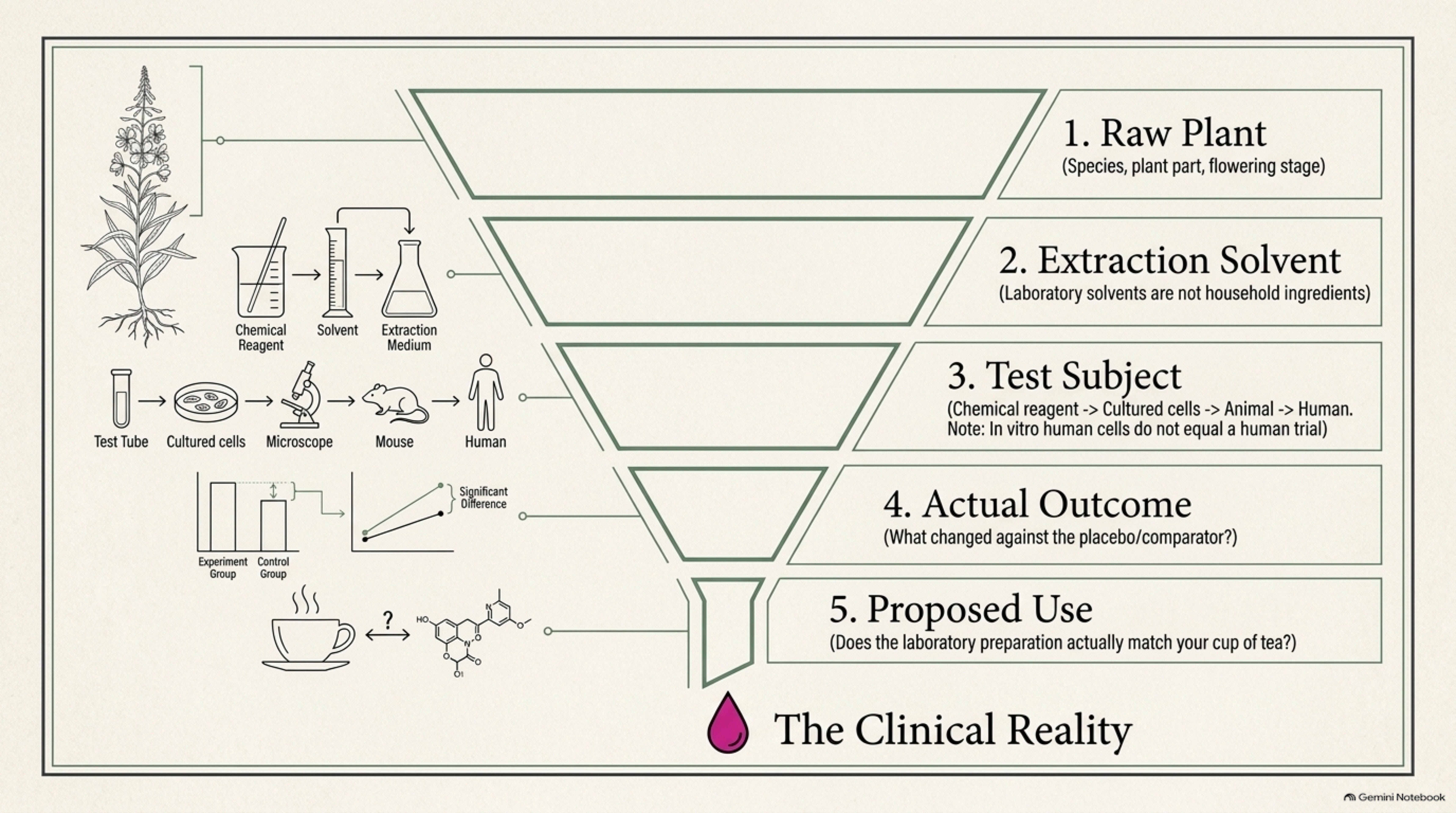
Follow the material through five questions:
What was present in the plant? Identify the species, part, stage and whether the result refers to fresh or dry material.
What entered the preparation? Find the solvent, processing and concentration. Laboratory solvents are not suggestions for household ingredients.
What was exposed to it? A chemical reagent, an enzyme, cultured cells, an animal and a person make different experiments.
What changed against the comparison? Look for the comparator and the actual outcome, including results that did not change.
How does that result fit the proposed use? Compare the preparation, exposure, participants and purpose.
An antioxidant assay measures how a sample reacts in a particular chemical test system. It can help compare preparations under those conditions. Prevented illness, longer life and improved health require other measurements, however impressive the assay result.
In vitro means that an experiment took place outside a living organism. Cultured human cells can help researchers investigate mechanisms and concentrations. The word “human” does not turn the work into a trial in people. Whether a person can achieve the same exposure, and whether it would help them, remain further questions.
Simulated digestion brings the preparation through another controlled system. Kowalik and colleagues studied a fireweed infusion after laboratory digestion, then examined effects on cultured colon-cancer cells and selected bacteria. They did not treat people with cancer or measure a person’s whole gut community. The experiment began with an infusion, but its final measurements were still far from a health outcome in someone drinking tea.
Animal studies include the workings of a living body. The species, preparation and way a condition was induced still shape the result. A human trial must then establish its own findings: how much changed, how uncertain the estimate was, how long the change lasted and which people were left out.
Early research has a useful place in this sequence. It can suggest why a trial is worth doing and what it should measure. Following the sequence also makes it easier to spot where a label has moved beyond the evidence.
11.3 Read the human studies
Human research deserves closer reading than a sales sentence can offer. Keep the intervention, participants and outcome together, including when a finding is encouraging.
Esposito and colleagues in 2021. At one Italian centre, 128 men with benign prostatic hyperplasia, or BPH, were randomly assigned to a standardised Epilobium angustifolium extract in gastric-resistant capsules or placebo for six months. The double-blind study allocated 70 men to extract and 58 to placebo.
The extract group’s average International Prostate Symptom Score fell from 13.4 to 11.5; placebo changed from 13.0 to 13.6. Reports of urination on the night before study visits also favoured extract. These were secondary outcomes. The primary outcomes were prostate volume and urine remaining after voiding. The distribution of residual urine changed, although the extract group’s mean volume changed little; prostate volume showed no significant treatment effect. No treatment-related adverse effects were reported.
The result belongs to that product and study population. One centre, limited follow-up, medication exclusions and industry involvement restrict what can be concluded. It supports further investigation of the preparation, without demonstrating prostate shrinkage or compatibility with excluded medicines. Ordinary tea was not tested.
A symptom-score change is worth reporting. Its importance to a particular patient depends on how much relief it represents, available alternatives and possible risks. Statistical significance alone cannot settle that clinical question.
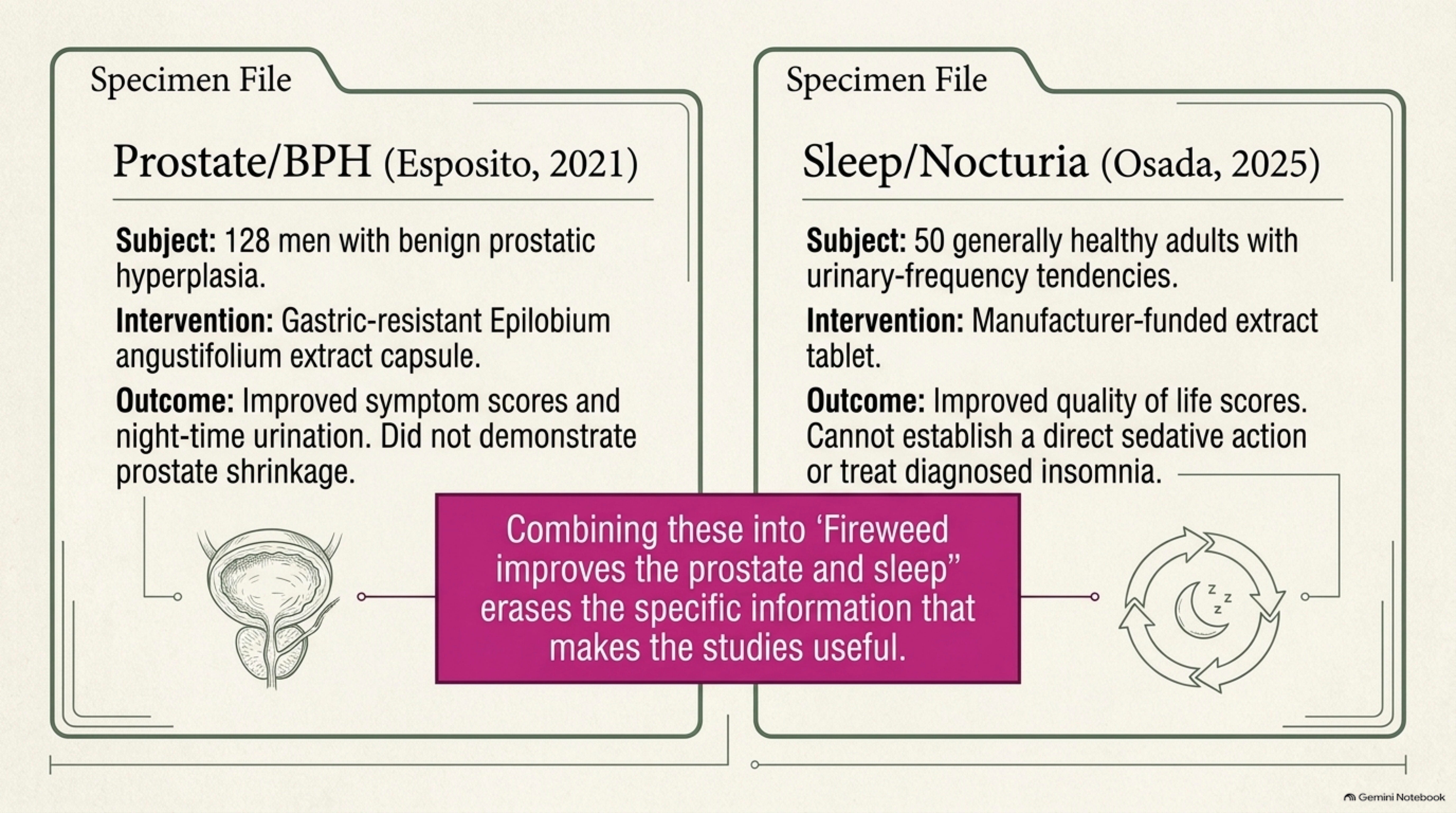
Osada and colleagues in 2025. A Japanese placebo-controlled, double-blind trial randomised 50 generally healthy adults with urinary-frequency tendencies and sleep complaints. Forty-seven entered the per-protocol analysis after eight weeks of extract-tablet use. The N-QOL questionnaire, which concerns quality of life related to night-time urination, favoured extract in its total score and Sleep/Energy domain. Bother/Concern and overall health perception did not show significant between-group improvement.
The manufacturer funded the small, short study, and most authors were company-affiliated. Night-time voiding frequency and awakening duration were not measured in this cohort. The positive result concerns reported quality of life in selected adults; it does not establish a direct sedative action or treatment of diagnosed insomnia.
The public registration, UMIN000053746, adds a qualification. Its primary-outcome field says only “Indexes on sleeping”; it does not name N-QOL, and the secondary-outcome field is blank. This broad entry limits comparison between the published outcomes and the registered plan. A detailed protocol and analysis plan would help. The wording alone does not prove that an outcome was changed after the results were known.
Matsuoka and colleagues in 2023. An earlier Japanese randomised, double-blind, placebo-controlled extract-food study appears in Pharmacometrics, volume 104, pages 55 to 60. Its bibliographic record and a manufacturer-hosted abstract were available for this chapter, but the full primary paper was not. The abstract describes sleep-related measurements in adults with urinary-frequency tendencies. Detailed results remain unappraised here; a later paper’s summary cannot replace the earlier methods, full results and exclusions.
These studies ask different questions. Men with diagnosed BPH and generally healthy adults with sleep complaints are different populations. A urinary symptom scale, a quality-of-life questionnaire and a measure of waking during the night are different outcomes. A broad promise about “prostate health and sleep” loses those distinctions.
Independent replication would help establish how dependable and transferable the positive findings are. Industry involvement does not automatically invalidate an experiment. Transparent methods, accessible data and work from independent groups make it easier to assess. Read the design and disclosures alongside both positive and nonsignificant findings.
11.4 Understand the regulatory record
The European Medicines Agency has a monograph on Epilobii herba. Adopted in November 2015 and published in January 2016, it covers the comminuted, or cut-up, above-ground herb of Epilobium angustifolium and/or Epilobium parviflorum prepared as herbal tea. Its indication concerns relief of lower urinary symptoms associated with BPH after a doctor has excluded serious conditions.
The basis is traditional use. This regulatory route recognises long-standing medicinal use and plausible effectiveness where clinical-trial evidence is insufficient. The required history is at least thirty years of medicinal use, including fifteen within the European Union. That recognition has a defined scope. It does not establish that every branded tea has been clinically tested or that a kitchen preparation matches a registered medicine.
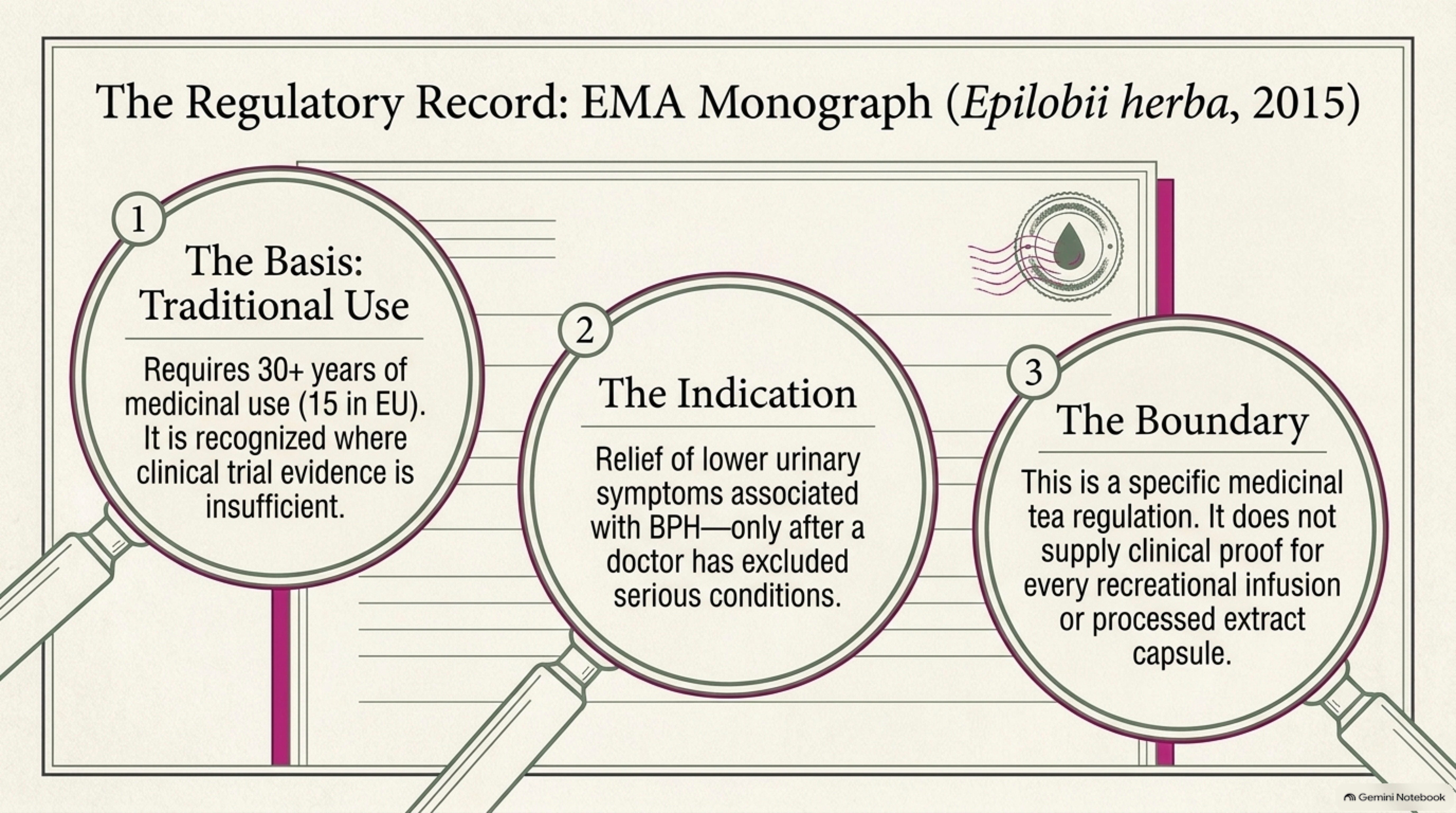
The monograph expressly includes medicinal tea. Describing it as a record about capsules alone would therefore be wrong. Equally, a recreational infusion, processed Ivan chai product or blend needs its own preparation considered before the monograph can be applied to it.
In its 2022 periodic review, the EMA considered Esposito’s trial and retained traditional-use status. The assessor found the extract insufficiently described and the more-than-ten-year EU medicinal-use history required for well-established use unproven. That requirement is separate from the traditional-use history above. The review also noted the studied product’s non-medicinal status. This regulatory judgment did not erase the trial’s observations, and it preceded the later Japanese papers discussed here.
No therapeutic tea dose is supplied in this guide. If you are considering a medicinal product, take its actual label and leaflet to a clinician or pharmacist. Ask how its identity, preparation and intended use fit your situation and the regulatory document being cited.
A seller’s mention of an agency is a starting point for checking. Find the document, its date and its scope. Establish whether the claim concerns a traditional-use category, a particular licensed product or a controlled trial.
11.5 Keep symptom claims proportionate
Urinary symptoms. The evidence above gives a reason for an informed conversation. Difficulty urinating, waking to urinate and discomfort can have several causes. Persistent or worsening symptoms deserve assessment rather than an increasingly strong brew.
Seek immediate medical care if you cannot urinate, see blood in your urine, have severe lower-abdominal or urinary-tract pain, or have painful, frequent or urgent urination with fever and chills. These warning signs follow US National Institute of Diabetes and Digestive and Kidney Diseases guidance. Do not wait to see whether fireweed helps; a symptom associated with BPH in one person may have another cause in someone else.
Skin. Route and preparation are particularly important here. Nowak and colleagues’ 2022 hydrogel research included laboratory tests and the passage of selected compounds through pig skin. Its formulated products were not homemade leaf washes, and it was not a clinical test of treatment for eczema, infection or wounds.
Human research now includes a small oral-extract study. Ariga and colleagues reported in 2026 that ten adults had higher measurements of skin moisture and elasticity after four weeks of use, alongside changes in some self-ratings. The study was open-label, had no comparison group and involved company-affiliated authors. Time, expectations and other influences could therefore account for some or all of the change. A separate laboratory glycation assay did not establish the cause of the human observations. Neither experiment tested ordinary tea or a poultice.d
Digestion. Astringency, traditional use and laboratory activity can suggest questions about digestive effects. They do not establish that an infusion treats diarrhoea, ulcers or a disturbed gut community. The targeted search for this chapter did not locate a controlled human trial of ordinary fireweed tea for those purposes. That is a limited search finding, rather than a claim that the subject has never been investigated. University of Alaska Fairbanks Extension also notes that fireweed tea can be mildly laxative. A familiar food can still disagree with someone.
Sleep. A person can honestly describe enjoying a warm drink in an evening routine. “Sedative” makes a pharmacological claim. The extract studies on nocturia and sleep-related quality of life do not establish that ordinary tea directly induces sleep or treats insomnia. If sleep trouble persists, discuss the pattern with a qualified health professional, including whether the need to urinate wakes you or is noticed after you are already awake.
Cancer claims need particular care. Findings in cancer-cell cultures concern mechanisms and possible avenues for research. They do not justify using fireweed to treat cancer or delaying established care. Discuss supplements with the treating team and bring the product details.
11.6 Put safety beside the choice
Begin with the practical checks that precede any harvest: identity, plant part, collection site and handling. A study of a characterised extract cannot certify an unidentified bag or material from an unknown roadside. An antioxidant value cannot establish a food process’s safety either. Chapters 7 to 9 describe the preparation-specific limits.
The EMA monograph lists hypersensitivity to the herb as a contraindication. Avoid a product if you are allergic to it, and stop use if it causes a suspected adverse reaction. Seek appropriate advice; trouble breathing or swelling affecting the mouth or throat needs emergency help. If an unknown plant has been consumed, contact a poison service promptly instead of waiting for symptoms or trying to finish the identification yourself.
“No adverse effects were reported” describes what was observed and attributed during a particular study. Uncommon or longer-term effects, and effects in people excluded from the trial, may remain undetected. Keep the reassuring observation within those limits.
The EMA monograph records no reported interactions. Older laboratory work by Ducrey and colleagues found that isolated oenotheins from Epilobium species inhibited enzymes involved in hormone metabolism. This gives researchers a mechanism to investigate. It does not document an interaction between a cup of tea and a named medicine, or justify a list of supposedly proven combinations to avoid.
If you take regular medicines or are considering a concentrated extract, ask a pharmacist or clinician to review the exact product. Bring the full ingredients and explain why you want to use it. Do not stop or replace prescribed treatment to reproduce a study’s medication exclusions.
The evidence reviewed here does not establish preparation-specific safety for therapeutic use during pregnancy or breastfeeding, or in children. The EMA’s statement that pregnancy and lactation are not relevant to its prostate indication is not a safety finding for a pregnant tea drinker. The adult indication supplies no children’s dose. Obtain individual advice before use in these circumstances rather than dividing an adult quantity or relying on food tradition alone.
Keep a short record for that conversation: the product or identified plant, part used, preparation, amount and frequency already used, other ingredients, medicines and any symptoms noticed. These details help a professional assess an actual exposure.
11.7 Read product and garden claims
Begin with what the label lets you establish. Look for a botanical name, plant part, preparation, full ingredients, batch information and a responsible supplier. If an extract is standardised, ask which substance is measured and on what basis. When a product cites a trial, compare it with the intervention the researchers used. A shared marker is only one point of comparison.
Quality documents should answer specific questions. Botanical authentication addresses identity. A chemical profile describes composition. Contaminant and microbiological testing assess specified hazards using stated methods and limits. “Laboratory tested” becomes useful when the supplier explains what was tested, when and in which batch. A certificate has that scope; it does not establish a health benefit.
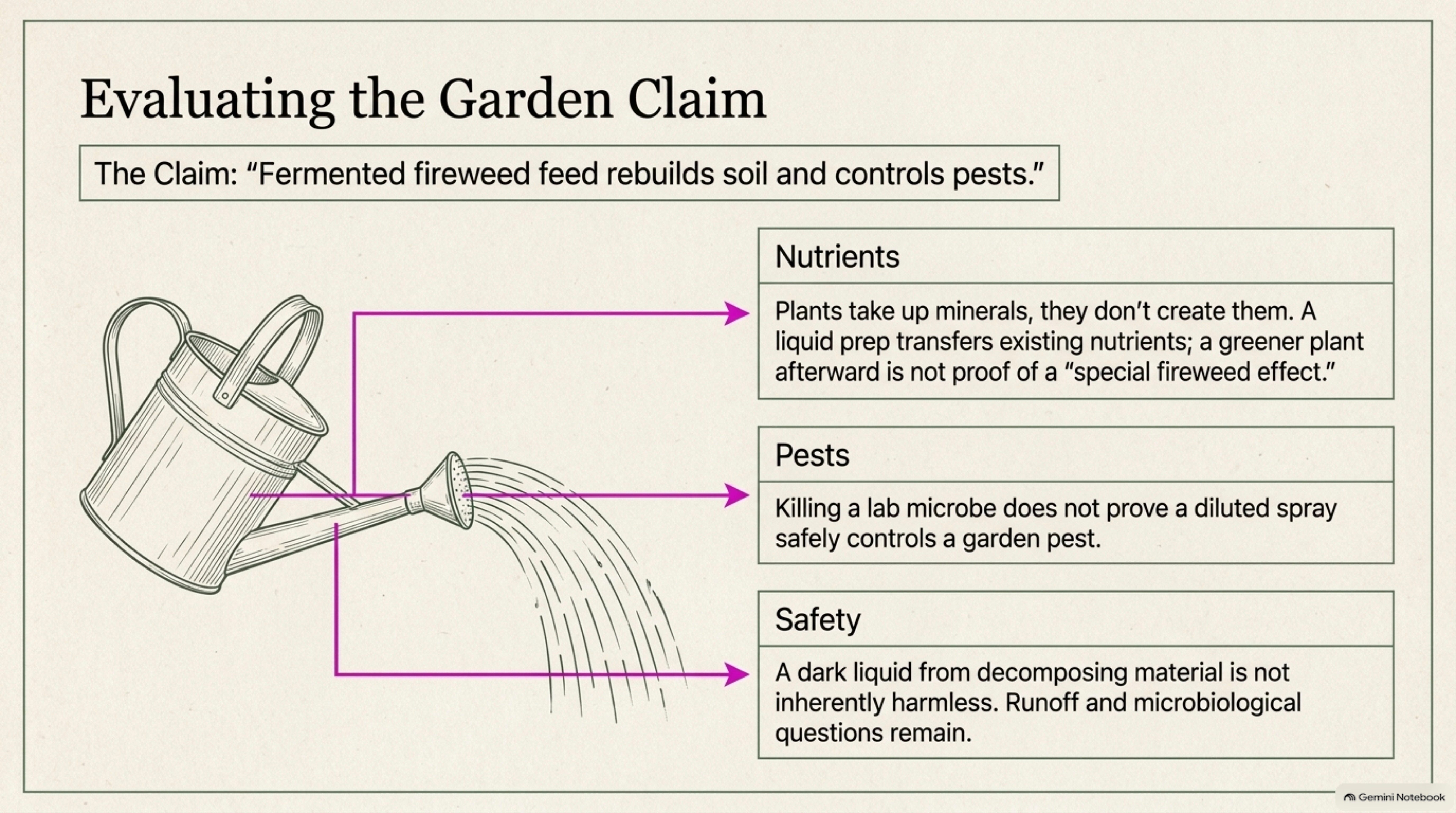
Two 2026 studies make the distinction tangible. Chudinov and colleagues used several analytical methods on seven retail herbal beverages from Russia and confirmed undeclared Lythrum in two. The sample included mixtures and products labelled as single-ingredient fireweed. It shows a problem in those products and the value of checking identity by more than one method. It does not estimate substitution across the market or demonstrate harm to consumers.
Mykhailenko and colleagues measured laboratory extracts of sixteen commercial Epilobium tea samples. Constituents varied substantially, including among products bearing the same species name. The analyses used methanol extraction of dry tea material, not brewed drinks. The small sample and reliance on labels for species information limit interpretation. This was a study of composition, rather than a ranking by clinical benefit. Identity and chemical consistency need separate checks.
Consider this invented teaching label: “Fireweed leaf tea. Rich in oenothein B. Clinically proven for restful nights and prostate health.”
The first sentence needs identity and ingredient evidence. “Rich” needs a measurement and a meaningful reference point. The final sentence needs a clinical study of this leaf tea, with participants and outcomes that support both promises. An extract-capsule study cannot establish that connection through a shared compound alone. Ask for the exact paper and the evidence linking its intervention to the tea. Where the link is missing, the health claim remains unestablished. You can still judge the drink on its flavour.
Now take the same questions into the garden. Imagine another teaching claim: “Fermented fireweed feed rebuilds soil, replaces fertiliser and controls pests.” Each promised outcome needs its own test.
A growing plant takes up mineral nutrients. Returning suitable biomass through composting can recycle some of them; it does not create new mineral elements. Moving biomass between sites transfers nutrients, and a liquid preparation may retain only part of that supply. Assessing a feed requires its composition, application rate, the soil’s existing nutrient supply and the crop’s response. Greener growth after watering leaves several possible explanations.
Pinno and colleagues measured fireweed growth and nutrient uptake on reclamation soils under different fertiliser treatments. Their greenhouse study helps explain the living plant’s response to soil. It did not test a fireweed brew as fertiliser for another crop. Reversing that experiment in a summary would manufacture support for a product the researchers never evaluated.
A useful crop trial would compare a defined preparation with water and an appropriate nutrient-matched treatment. Replication and comparable growing conditions would help distinguish any special effect from nutrients, extra water and ordinary variation. Pest-control research would also need to identify the target pest, measure control, observe crop damage and assess effects on other organisms. Activity against a laboratory microbe cannot answer all those questions for a garden spray.
The targeted public-source search for this chapter, refreshed on 11 October 2026, did not locate a directly applicable controlled trial validating a household tall-fireweed brew as fertiliser or pest control. The claimed special benefit remains unknown. This was not a complete search of every language or unpublished experiment, and it does not show that every possible preparation has failed.
An improvised brew also raises handling and microbiological questions, particularly where it contacts food crops. Runoff matters. Oregon State University Extension’s guidance on compost leachate warns against assuming that dark liquid from decomposing material is harmless, without establishing the exact risk of a fireweed preparation. Use established local composting guidance for suitable clean biomass and seek soil or crop advice for a defined problem. No liquid-amendment recipe is supplied here.
Return to the packet beside the kettle. Its identity, ingredients and preparation can be checked. The cup’s aroma and the feel it leaves in your mouth can be described. A health claim asks for a different kind of evidence. Keeping those observations clear leaves room to enjoy the drink and to learn more about the plant, on the next visit to the patch as well as in the next paper
.
Sources and further looking
Sources checked 11 October 2026. Study quantities and medicinal instructions in linked papers are research or regulatory details, not therapeutic recommendations from this guide. This chapter offers editorial and evidence appraisal, not individual clinical advice.
Astringency and plant chemistry
López-Solís and colleagues 2020 · Ivanauskas and colleagues 2024
Diverse interaction of commercial enological tannins with the protein fraction of saliva supports the general mouthfeel explanation in 11.1, rather than a fireweed-specific measurement by taste. Phenological Variations in the Content of Polyphenols and Triterpenoids compared parts during flowering; it did not sample the pre-flowering period or establish a universal harvest optimum.
Processing and laboratory digestion
Lasinskas and colleagues 2023 · Olennikov and colleagues 2021 · Kowalik and colleagues 2022
The two processing studies in 11.1 used different regimes and chemical endpoints. Their numerical maxima and pigment findings do not validate household fermentation or demonstrate clinical benefit. Biological Activity of an Epilobium angustifolium Infusion after In Vitro Digestion supports the example in 11.2: simulated digestion, cell cultures and selected bacteria, rather than cancer treatment or a whole human microbiome.
Prostate symptoms and extract capsules
The six-month BPH trial supports the product-specific account in 11.3. Read Tables 4 to 6 with its methods, exclusions and disclosures. Symptom outcomes are distinct from prostate volume, and the study did not test ordinary tea.
Nocturia and sleep related outcomes
Osada and colleagues 2025 · UMIN000053746 registration · Matsuoka and colleagues 2023 record · Manufacturer hosted abstract
The 2025 paper and registration support the questionnaire and reporting qualifications in 11.3. The registration’s broad primary-outcome wording does not establish an outcome switch. The 2023 full paper was unavailable for appraisal; its record and commercially hosted abstract leave detailed methodological questions open.
The regulatory record
EMA monograph · EMA public explanation · EMA 2022 review
These documents have distinct roles in 11.4 and 11.6. The monograph concerns a medicinal tea preparation and traditional-use recognition. The later assessment considered the extract trial but did not change that basis. Neither establishes equivalence for every fireweed product.
Skin and digestive tolerance
Nowak and colleagues 2022 · Ariga and colleagues 2026 · UAF Fireweed FNH 00106
The hydrogel experiments used laboratory systems, including pig skin. The oral-extract skin study was small and uncontrolled, alongside a separate laboratory assay. Neither supports a household skin-treatment recipe. UAF’s culinary guidance, revised in 2023, supplies the mild-laxative caution without quantifying its frequency or establishing therapeutic safety.
Medicines and urgent symptoms
Ducrey and colleagues 1997 · NIDDK BPH guidance · NIDDK prostatitis guidance · NHS anaphylaxis · Poison Control guidance
Ducrey’s primary abstract reports enzyme inhibition by isolated ellagitannins from Epilobium species, not a documented clinical drug interaction. NIDDK supports the urinary referral signs in 11.5; NHS and Poison Control support prompt escalation in 11.6. Use the emergency or poison service appropriate to your location.
Commercial identity and chemical variation
Chudinov and colleagues 2026 · Mykhailenko and colleagues 2026
The seven-product identity investigation and sixteen-product composition study support the distinct examples in 11.7. They are small analytical studies, not market-wide risk estimates or comparisons of clinical benefit.
Nutrients and garden liquids
Pinno and colleagues 2014 · OSU Agricultural Composting and Water Quality
Pinno’s greenhouse study examined growing fireweed on reclamation soils. OSU addresses composting, leachate and water protection. The proposed comparisons in 11.7 explain what a garden-product claim would need to demonstrate; they are not a validated application method. The targeted search finding is limited to the accessible sources checked.
CHAPTER 12
Return, observe and decide
what to keep doing
Bring the earlier photograph when you return. Find the fence corner, the rock or the bend in the path that marked your first view. Stand there again. Before deciding whether the patch looks better, look for what has changed.
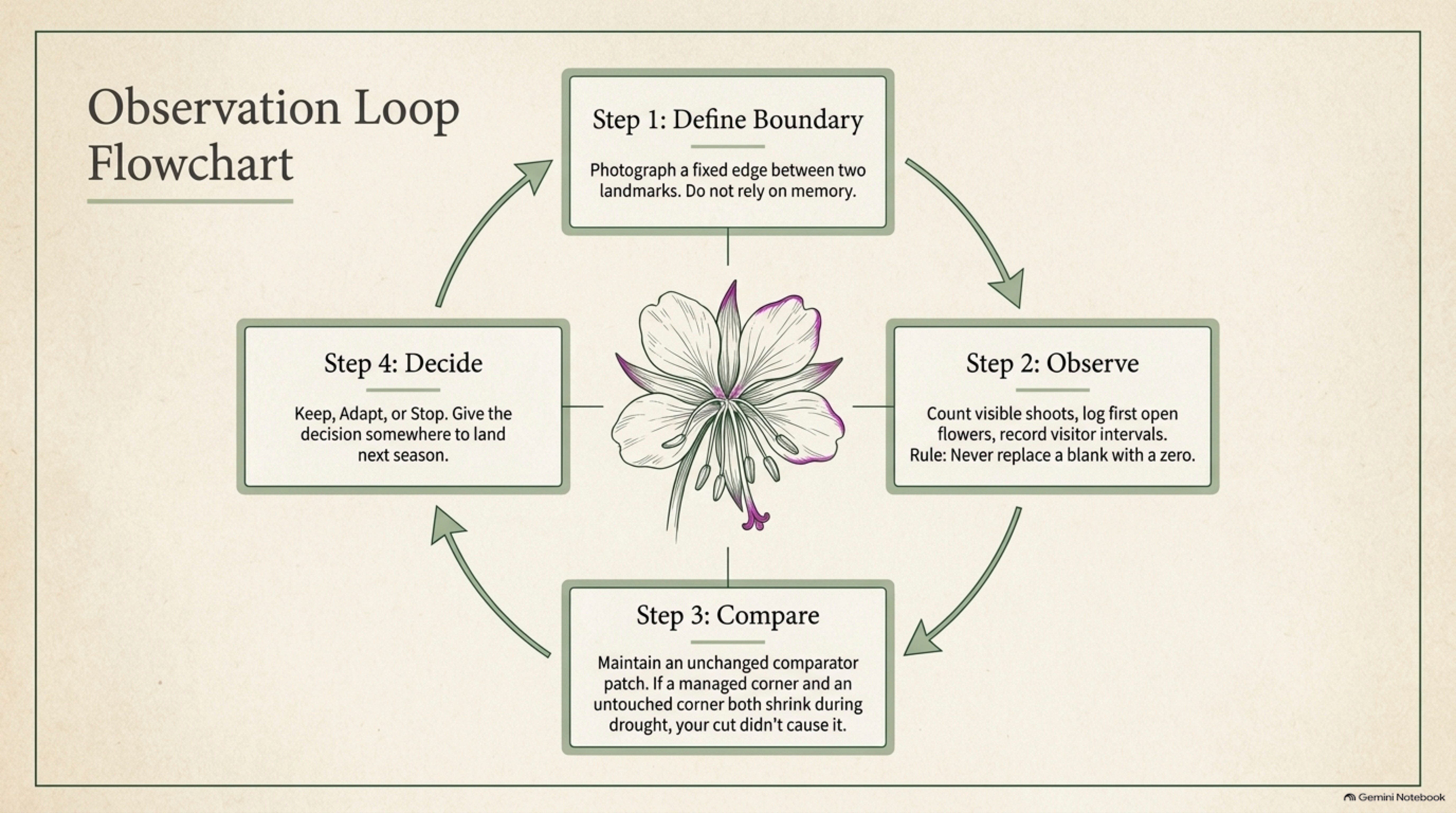
Flowers may have given way to long, narrow capsules. A small neighbouring plant may be easier to see. New shoots may stand beyond the edge you meant to keep. The photograph holds the earlier arrangement still, while the plants before you have gone on growing.
Some changes will be in your own attention. You may now follow a leaf to its attachment instead of seeing only a mass of green. You may look behind the tall stems for the shrub you hoped to release, or notice where repeated footsteps have thinned the ground cover.
This chapter brings those observations into a decision. Did the work serve its purpose? What did it ask of the place and of you? Choose one question whose answer could change the next visit. It may lead to a smaller task, a different approach or another season of leaving the flowers alone.
12.1 Keep one observation worth revisiting
Begin with something you want to know. Is the patch extending into the path? When do you first see an open flower within this boundary? Does the shrub released in Chapter 6 remain accessible? Choose a main question. Other details can enter the notes without becoming new obligations.
Define the area. A whole slope is difficult to inspect consistently; an edge between two landmarks is easier. Record the species, the boundary and where you stand. Keep the exact location private when the site is sensitive. Check permission and safe footing on each visit, remembering that access to observe may not include placing markers, collecting or treating plants.
Then decide what you will record. To follow spread, count visible fireweed shoots beyond a fixed boundary and photograph their positions. Call them shoots, since you may not know which are connected below ground. To follow flowering, record whether at least one open flower is visible in the chosen area. If several days passed between visits, write “first flower seen.” The flower may have opened while you were away.
Give the photograph a few words. Use roughly the same position, direction and framing, and note anything that changes the view. Long shadows, flattened stems or new foreground growth can exaggerate a difference. Preserve the original files; a crop may remove the boundary you meant to follow.
For flower visitors, choose a fixed watching interval and area. Record the weather, time and flowers available. Count visits unless you can reliably distinguish individuals: one returning bee can otherwise become several bees in the notebook. Write “no visits seen during this watch” when that is what happened. A quiet interval tells you little about the hours you did not watch.
Fit the return schedule to the question and the time you have. A check just after cutting shows the immediate result; one during regrowth shows how long it lasted. To follow a seasonal stage, return while it is changing. Mark a missed visit as missed. Zero means you looked and found none, not that the page was left empty.
The record below can accompany a photograph, Chapter 6’s management notes or Chapter 7’s batch record. Use only the fields that help answer your question. A few entries you can understand next spring are worth more than measurements whose meaning has been lost.
One patch observation record
Use this for one question about an identified patch you have permission to observe. This record does not establish suitability for harvest. Continue on another sheet when needed.
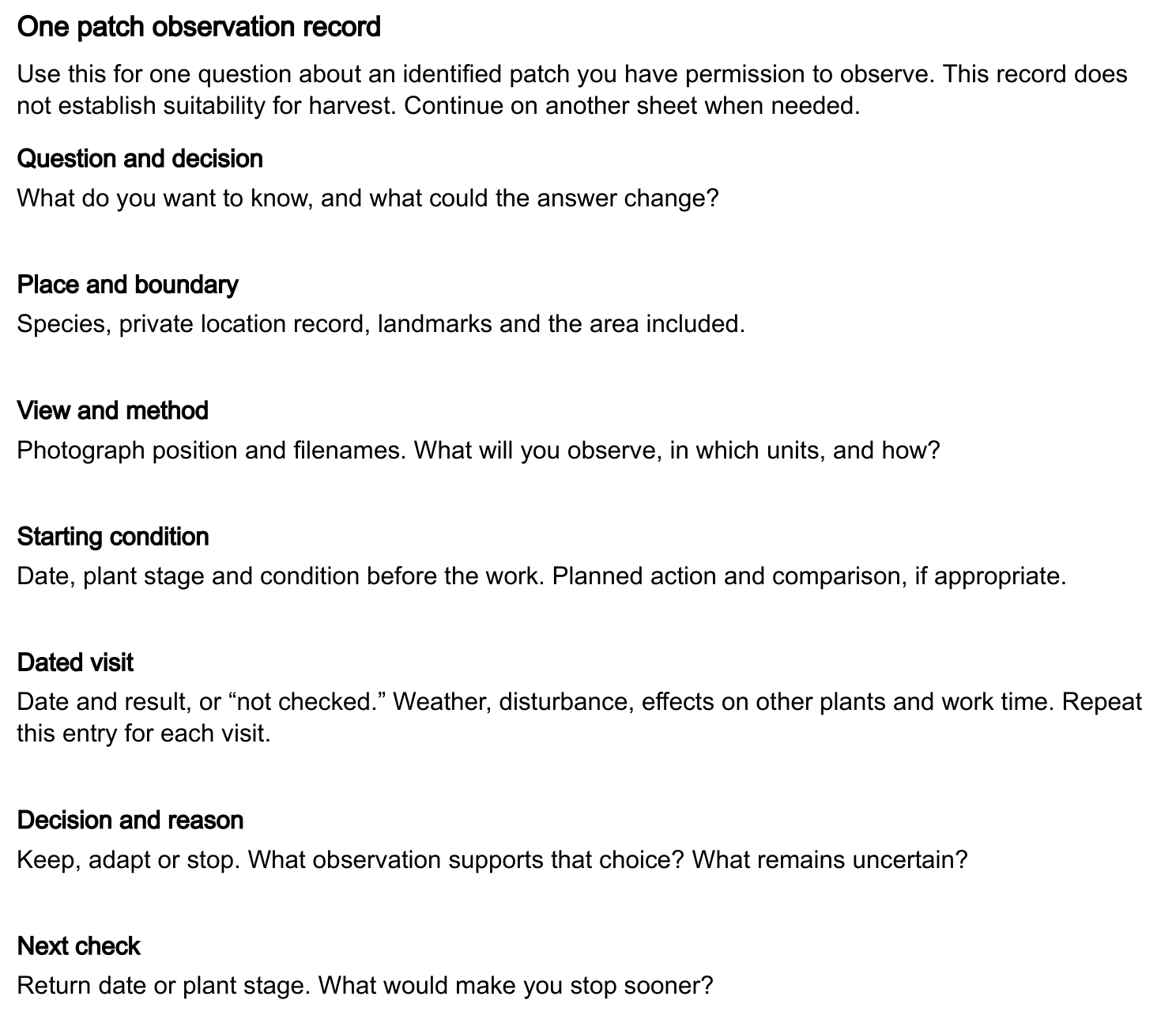
12.2 Make a useful comparison
A second view helps you ask what caused a change. If both a cut corner and an uncut corner make little new growth during drought, cutting cannot explain the whole result. Without the comparison, the weather can disappear from the account.
Join an action to an observable purpose. “Will selective cutting keep this access clear between the visits I can manage?” gives you something to check. “Does cutting improve fireweed?” leaves both the place and the meaning of improvement unclear.
Where Chapter 6’s access and site checks allow it, choose two small areas with reasonably similar starting conditions. Photograph and describe both before beginning. Apply the planned action to one and leave the other unchanged only while that remains acceptable. A comparison must not put a path, a valued plant or neighbouring property at risk. If either area could reasonably receive either treatment, drawing lots can reduce the temptation to favour the more promising area.
Keep other care as similar as you can. Record watering, shade and accidental disturbance. Observe both areas on the same visits with the same measure, including the plants you meant to protect. Repeated observations make the history clearer, but two areas remain a small comparison. Nearby fireweed shoots may also share an underground system. Counting many stems does not necessarily give you many independent test plants.
An imagined garden comparison. Suppose the purpose is to keep a garden access usable until each planned return. One edge is selectively cut; a similar nearby edge is left unchanged while it remains safe. The gardener records starting photographs, obstruction, regrowth, other plants, soil disturbance and work time. This is a teaching example, with no measured field results behind it.
Suppose cutting clears the access immediately, but regrowth repeatedly obstructs it before the gardener can return. The unchanged edge stays crowded. Cutting has provided temporary access under those conditions, at a frequency of work the gardener cannot sustain. The first tidy photograph would tell only part of that story.
The next decision might be to reduce the area being maintained, reconsider the boundary or seek another proportionate management option. The comparison has not established permanent control, the best cutting interval or the response of another site. It has helped this gardener see a mismatch between the plan and the time available.
Write the conclusion before choosing the photographs you will share. Include the unwelcome result and the missing visits. If different starting conditions, weather or an accidental second treatment leave the comparison unclear, say so. You may still have enough information for a modest garden decision. A recommendation for other people’s sites needs stronger evidence.
12.3 Know which questions need specialist work
Ordinary observation can answer useful household questions. You can time the work at a patch edge, compare the feel of two low-consequence objects from Chapter 10, or record which stems were stringy in a food trial using an appropriately reviewed method. You can also discover that a planting needs more attention than you have to give it.
Other questions need different evidence. Pleasant flavour cannot establish microbial safety. A leaf that breaks easily cannot establish a validated drying endpoint or storage life. Dark colour cannot measure oenothein B. Feeling better after a cup cannot separate a treatment effect from the other influences on a person’s health and day.
Choose help according to the missing answer. A qualified food-safety specialist can assess the exact drying, moist-leaf or preservation process, its equipment, hazards and validation needs. Laboratory work may be part of that assessment. One satisfactory sample cannot establish the reliability of future batches. Do not taste or serve a suspect batch to test its safety.
An analytical laboratory needs an identified sample, an appropriate method and a defined chemical question. For suspected contamination, ask an environmental-health or contamination specialist what to sample and which substances to investigate. A soil-fertility panel or vigorous plant growth cannot clear a burned or industrial site for food. For symptoms or proposed medicinal use, take the preparation details to a qualified clinician or pharmacist; Chapter 11 explains why the evidence must match the claim.
The guide’s unfinished development work remains unfinished here. Chapter 8’s recipes still need kitchen testing and the relevant safety reviews. Chapters 7 and 9 do not supply a validated household drying or processed-leaf method. Continue observation, source checking and planning while food trials that depend on those methods wait for suitable review.
Bring the specialist your question, the material’s identity and source, the process record and what you have observed. Ask what a proposed test could establish, what it would leave unresolved and whether its answer could change the decision. A good record makes the conversation more useful.
12.4 Decide whether to keep, adapt or stop
Return to the purpose written before the work. Fewer visible fireweed stems may be useful, but the aim may have been to release a shrub, keep access open or retain flowers in a manageable space. Look first at that outcome.
Then look beyond it. Has repeated walking worn a bare track? Did digging disturb another plant’s roots? Is regrowth appearing farther along the edge? Are you removing more flowers than the planting’s purpose allows? Include the time spent sorting material, cleaning tools and returning to the site
.
Keep a practice. Continue when the observed result serves the purpose, its effects are acceptable and you can sustain the work. Record the scale that worked. A manageable small patch gives you no obligation to enlarge it. Set another check, since conditions will continue to change.
Adapt the plan. When the purpose remains worthwhile, consider a smaller area, better access or a return schedule you can maintain. Change one important feature at a time where possible, so you can interpret the next result. Obtain any necessary specialist advice before altering a method, especially a food process.
Stop the work. Stop if identity or access becomes uncertain, the site is being harmed, the result is poor or the demands exceed what you can sustain. An emerging safety concern calls for action immediately, rather than at the planned review. End a comparison early when necessary and record why.
Stopping still leaves care to take. Remove temporary equipment where authorized, send cut material to an appropriate destination and address avoidable erosion or spread from disturbed ground. Chapter 6 follows management material beyond the patch. If continuing care is needed, establish who will provide it or seek help changing the plan.
Keep the unsuccessful record. Next spring, an empty page can make the same attractive idea seem new again. A dated sentence about why you stopped gives you something useful to begin from.
12.5 Assess a small enterprise
A pleasing cup or a well-grown nursery tray can prompt a practical question: would someone pay for this? Begin with one clearly described product and a real prospective buyer. A packet of leaf tea, a live plant, a prepared food and a decorative object involve different customers, work and obligations. Cost them separately.
Count the work that seldom appears in the photograph. Finding an authorized source, travelling, sorting, rejecting material, cleaning, packing, answering enquiries and handling unsold stock all take time. Use measured pilot records where that work is appropriate and authorized; label estimates as estimates. Seasonal abundance does not guarantee a dependable supply. Permission for household collection may not cover commercial quantities.
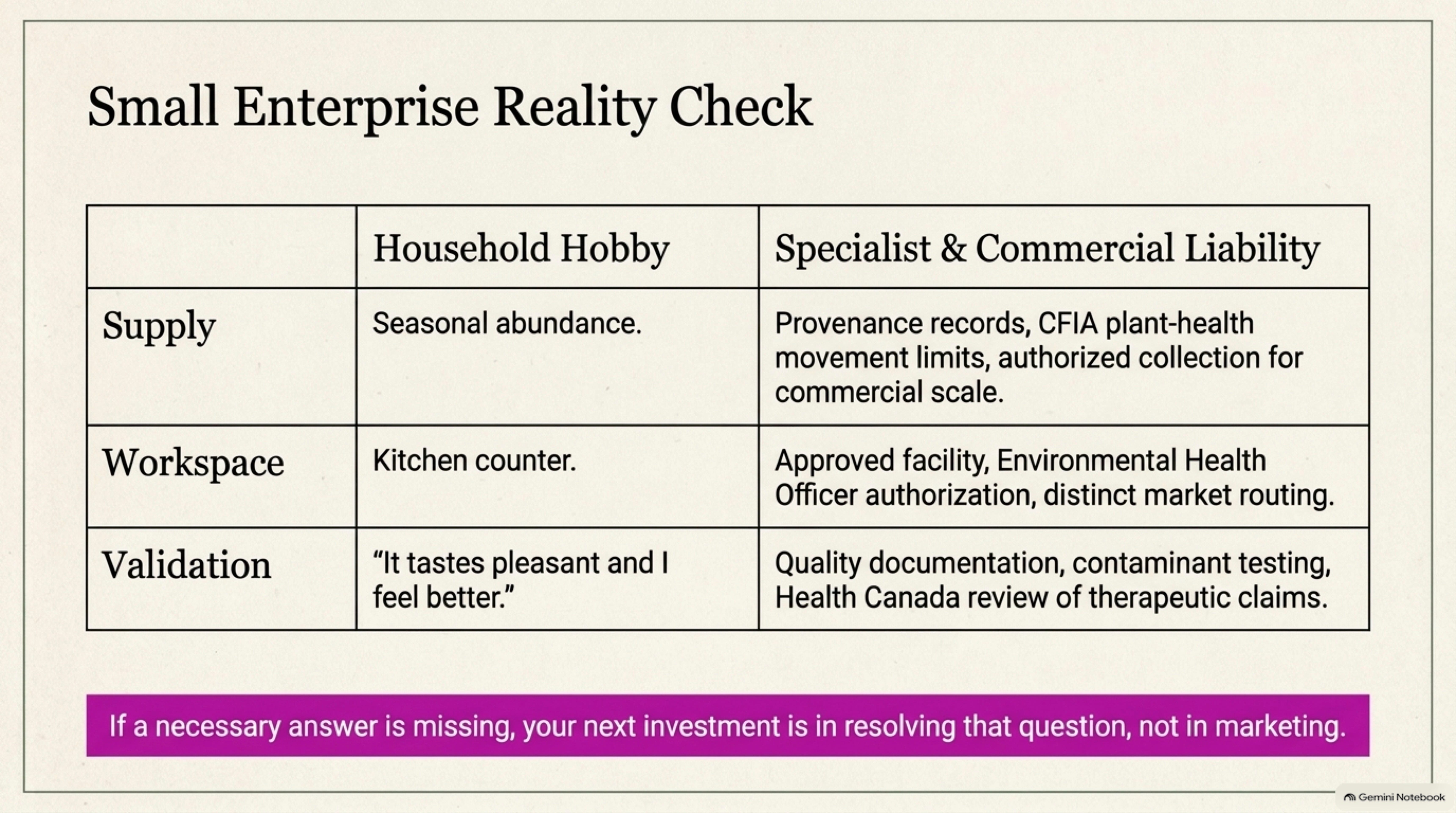
Establish where and how the product would be sold before investing. In Interior Health’s region, pre-packaged sales at an organized temporary market, food served for immediate consumption, and online or retail production follow different routes. Environmental Health Officer authorization is typically unnecessary for lower-risk pre-packaged market foods; higher-risk foods require health approval. The exact formulation and process must be checked before assigning a fireweed product to either category.
Online sales generally require preparation in an approved kitchen, with exceptions to be confirmed. A temporary-market confirmation does not cover online or retail sales. Ask the relevant officer and market manager about the proposed product, premises, sales route and sampling. The linked Interior Health guidance provides a starting point; elsewhere, begin with the responsible local authority.
Federal questions are separate. The Canadian Food Inspection Agency bases food-licensing requirements on the activities undertaken. Establish the production, packaging and trade route. Other requirements, including labelling, traceability and preventive controls, may apply even when a licence is unnecessary.
Check claims before writing labels or advertisements. Health Canada’s food and natural health product guidance considers composition, representation, format, public perception and history of use. The word “tea” does not settle every classification question. A health claim needs supporting evidence and must meet applicable regulatory requirements; some claims require pre-market authorization. Removing a claim does not by itself resolve every obligation.
For nursery stock, retain species and provenance records. Check plant-health and movement requirements for the material, soil, origin and destination before shipping. For any enterprise, obtain current advice on local business requirements, taxes and suitable insurance. Use actual costs and coverage in the plan.
The worksheet helps identify what still needs an answer. Complete required process validation and applicable approvals before sales; the guide’s development methods supply neither. The official guidance was rechecked on 11 October 2026 and must be checked again for the particular proposal. If an essential answer is missing, resolve it before committing further money.
One product enterprise record
Use one record for each product and sales route. Add the date and preparer’s name. Keep measured figures, quotations and estimates distinct, and attach the supporting records. This is an assessment tool, not clearance to sell.

12.6 Share an observation with care
A useful account lets another person understand what you saw and how you saw it. Include the species, broad region, stage, method and interval. Distinguish your own work from another person’s account or a published source, and preserve uncertainty in the identification or result.
Keep the conclusion within the record. “The path stayed clear between my visits after this treatment” describes an outcome. “This controls fireweed” leaves the conditions unsaid. When photographs show only an immediate result, make that clear. If a later observation changes your mind, add a dated correction so the earlier conclusion can be understood in its time.
Protect the place as well as the record. Precise locations can expose small patches, private property or culturally important sites to unwanted visits and collection. Check photograph metadata, maps and background landmarks before posting. Retain the detailed location privately and share a broader one when appropriate. Ask the landholder or relevant community about disclosure when their interests are involved.
Credit people in the way they have agreed to be credited. Permission to hear a story, attend a workshop or receive advice may not include publishing it, teaching it or using it to sell a product. Chapter 5’s care with community-held knowledge applies to a short caption as much as to a book. Public availability alone does not grant unrestricted reuse of someone’s knowledge, images or words.
Before sharing a contribution, establish who can authorize that use and the limits on adaptation and attribution. Keep the permissions with the material. Do not imply that a named person or community endorses your interpretation. If the scope is unclear, leave the contribution out until it is resolved.
A small, accurate account gives the next observer something to check. Its value lies partly in making clear where your observation ends.
12.7 Leave a clear path to the next season
Before putting the notebook away, write one sentence for the next visit. Make it something you can do: check the far side of the path when shoots emerge; photograph the boundary before cutting; return while the lower capsules are still closed. Note where the earlier photographs and records can be found.
Use a date as a reminder and the plant’s stage as a reason to look. Weather or a seasonal closure may change the plan. Let a missed visit remain a gap. There is no need to force a harvest or a comparison because a page expected one.
Your decision may be quite small. Keep the flowering patch and set aside the idea of harvesting it. Grow a limited source rather than returning repeatedly to a wild one. Continue a promising preparation only after the method has received the review it needs. The record may also show that your time belongs elsewhere. A clear decision can leave less work for the next season.
Take the wider photograph before you go. Include the plants you were not studying and the ground beyond the chosen edge. Next year, a neighbouring shrub’s growth or a new patch of shade may help explain a change the close view missed.
Then lower the camera. Find one attached leaf and follow it back to the stem. If flowers remain, look below them for the narrow capsules. If the stalk is already dry, notice what is still attached and what has gone. Begin with the plant as it is on this visit.
The first pink seen across a clearing drew you closer. Returning has given that colour a place, a season and a history you can check. There will still be details you cannot name and questions another visit may change. Leave those in the notebook too.
Nothing needs to go into a basket. You can leave the stem standing, with a clearer sense of what to look for when you return.
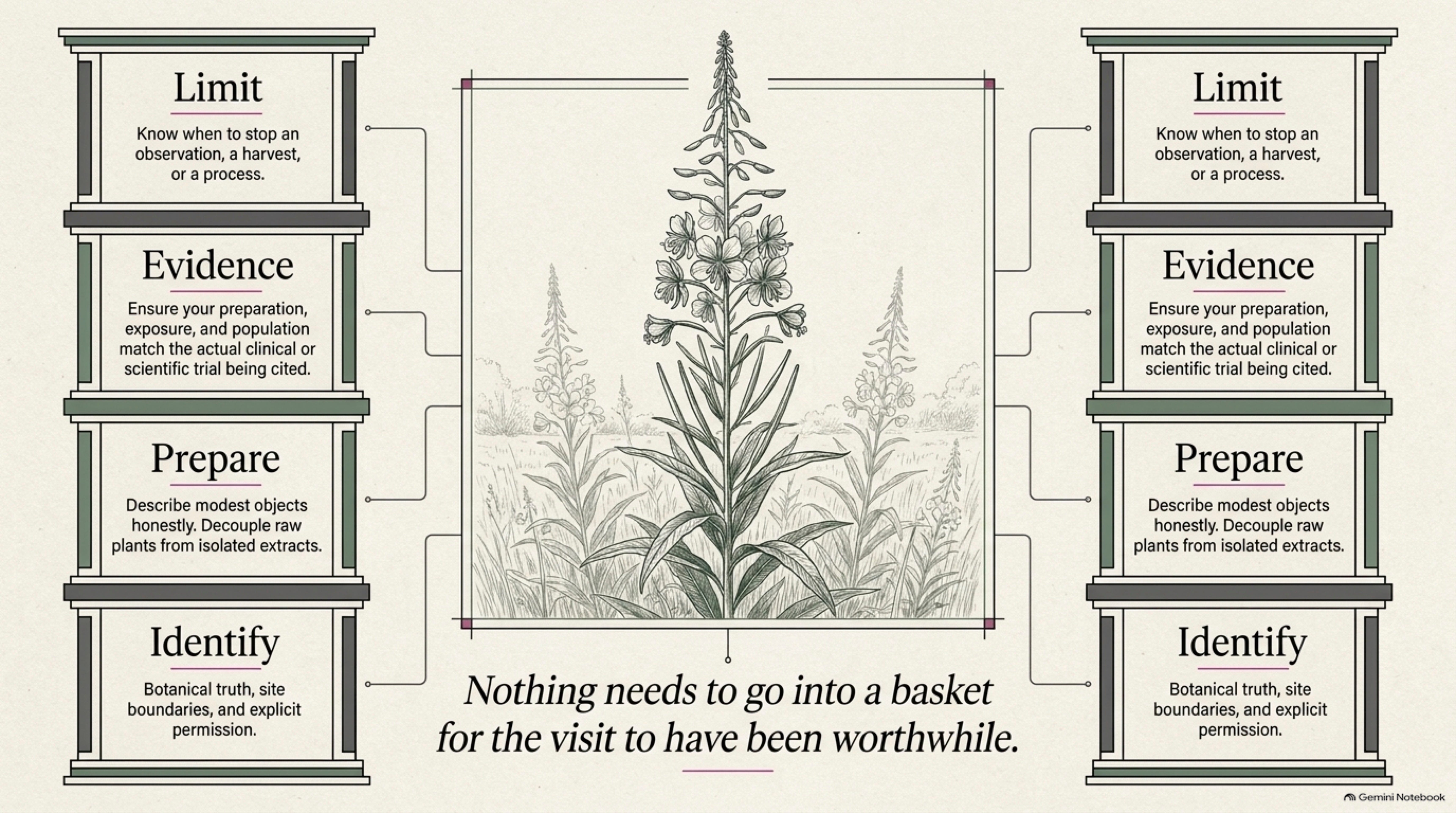
Sources and further looking
Official guidance rechecked 11 October 2026. The records and imagined comparison are learning aids proposed by this guide, not tested fireweed-management protocols or measured field results. The chapter retains the guide’s outstanding specialist, process-validation and reader reviews.
Observation and household decisions
Sections 12.1 to 12.4 draw together the seasonal-stage and visitor observations in Chapters 2 and 4, the management prerequisites in Chapter 6, the preparation-specific limits in Chapters 7 to 9, Chapter 10’s small material comparisons and Chapter 11’s distinctions among chemistry, laboratory findings and clinical outcomes. No new treatment schedule or food-processing method is supplied here.
Regional food sales
Supports the distinctions among temporary-market foods, immediate food service, online sales and other premises. Consult the current route for the exact product and process. No risk category or approval for a particular fireweed product is established by this chapter.
Federal food obligations
CFIA Food business activities that require a licence
Licensing depends on activities. The guidance also identifies requirements that may apply when a licence is unnecessary, including preventive controls, traceability and labelling.
Food and natural health product classification
Health Canada Classification of products at the food and natural health product interface
Classification considers the actual product and its representation, alongside format, composition and history of use. The chapter provides no individual classification or approval of a health claim.
Nursery shipments
Routes to domestic movement, import, export and soil requirements. Check the particular material, origin and destination before arranging shipment.
Taxes and records
Canada Revenue Agency Checklist for small businesses
Routes to registration, reporting and recordkeeping guidance. Business and insurance questions also require advice appropriate to the proposed enterprise.
Contributions and permissions
Section 12.6 returns to Chapter 5’s attributed sources and their stated scope. A public record, permission for a new use and endorsement remain separate matters.
Urgent help for a possible poisoning
If someone has consumed an unknown plant or may have been poisoned, contact a poison centre promptly, even if they feel well. Do not wait for symptoms or for identification to be completed.
Call 911 immediately in Canada or the United States if the person collapses, has a seizure, has trouble breathing or cannot be awakened. Follow the emergency dispatcher’s instructions.
Canada, except Quebec and Nunavut: 1-844-764-7669, also written 1-844-POISON-X
Quebec: Centre antipoison du Québec, 1-800-463-5060
Nunavut: contact your local health centre
United States: Poison Control, 1-800-222-1222
Elsewhere: use the local poison service and emergency number for the country where the person is located
Do not induce vomiting or taste more of the material to investigate. Follow the poison specialist’s instructions. Be ready to explain what happened, when, the person’s age and symptoms if any, and the possible material involved. Keep any existing label or photograph available, but do not delay calling in order to collect it.
Contacts and emergency instructions checked 11 October 2026. Canadian poison centres · Poison Control urgent help. Recheck contact information for any later edition.
Six tools for a return visit
Use these six tools to keep observations, decisions and batch details in a form you can return to. The blank fields are for your own records. Identification, permission, reviewed food methods and any necessary professional assessment still need their own checks.
Tool 1 A seasonal strip for one patch
Use with 2.6. Choose a safe place you have permission to visit again. Name the observed area and mark its boundary in your record. Photograph from a repeatable viewpoint without disturbing plants or wildlife.
Patch and viewpoint: ____________________
Year and observer: ____________________
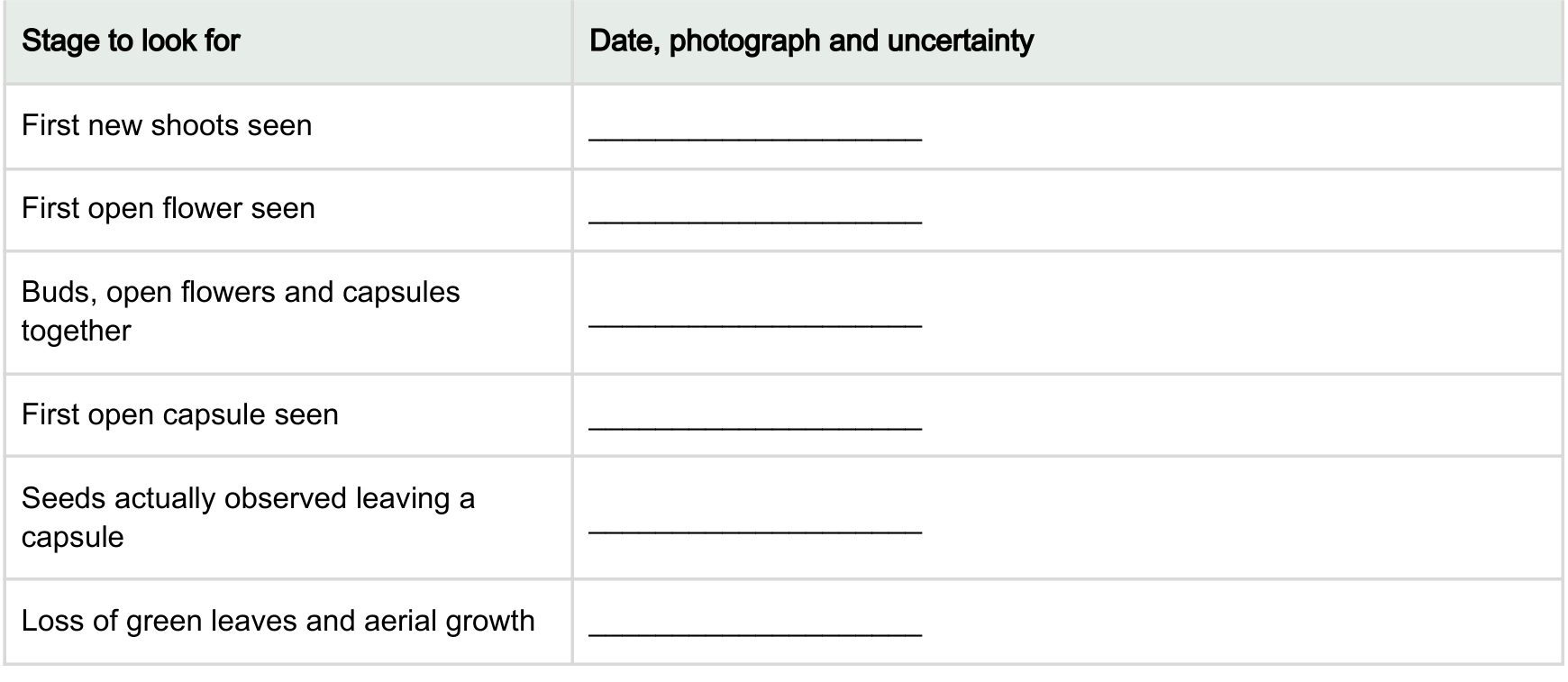
Keep the last visit when you did not see a stage beside the first when you did. “First seen” need not mean the event began that day. Note hidden ground, missed visits or a changed viewpoint. Several stages can share a stem or patch; they need not fit into separate boxes.
One question for the next visit: ____________________
Stop if access is unsafe or not permitted. Leave uncertain plant identity or shoot origin as an open question rather than filling the gap by assumption.
Tool 2 Source and identity before a harvest
Use with 1.6–1.7 and 7.1–7.5. Resolve each question before collecting for food. This checklist does not certify identification or safety.
1. Plant: Have the actual stems, at this stage, been reliably identified as common tall fireweed? Keep doubtful or mixed material out.
2. Place: Is collection permitted, and is the site’s history suitable for the intended use? Resolve questions about treatment, animals, roads, water and contamination.
3. Part and purpose: Is the material the part and stage required by a supported preparation, in an amount you can handle today?
4. Handling: Are clean transport, separation and prompt appropriate storage ready?
5. Method: Is there a complete, reviewed procedure for this preparation, including its endpoint and storage? Chapter 8’s untested proposals do not meet this requirement.
If any answer remains unresolved, do not collect for food. Photograph the plant and seek appropriate help, choose a known suitable source, or leave it standing.
After wildfire: follow access, tree and ground-hazard advice first. Do not harvest near burned structures, vehicles or their debris and ash while contamination is unresolved. A healthy plant, washing or an ordinary fertility test cannot clear the site.
Keep a private record of the plant and part, source and date. If someone confirmed an uncertain identification, note who they were and any limits they placed on the answer. Do not publish a sensitive location.
If an unknown plant has already been eaten: use the urgent-help page promptly. Do not wait for symptoms or taste more.
Tool 3 Keep, contain or reduce
Use with Chapter 6 and 12.4. Begin with your purpose for the place before choosing an action.
Purpose: ____________________
Visible boundary and plants to protect: ____________________
Keep: The patch serves its purpose and no unacceptable problem is present. Note what would prompt a later change.
Contain: The patch is wanted within a defined area. Watch for underground spread and seed dispersal, and leave access for return work.
Reduce or remove: Name the conflict. Consider the smallest useful nonchemical action and its effects on soil, neighbours, flowers and labour.
Proposed action and reason: ____________________
Return when: ____________________
What would count as improvement: ____________________
On returning, examine the desired plants and the ground as well as fireweed regrowth. Record time spent and unintended damage. A clear-looking bed on the day of cutting says little about lasting control.
Stop or seek advice if identity, authority or hazards remain unresolved; the work damages the site; or the scale or equipment exceeds what you can manage safely. A rate used in a past herbicide study is not a present application instruction.
Before cutting, decide where clean biomass, capsule-bearing stems and living underground pieces will go. Material from a potentially contaminated site and chemically treated craft residues need their own disposal assessment; do not assume they belong in garden compost.
Tool 4 One useful batch record
Use with 7.5–7.7 and a separately supported method. This record documents what you do; it does not validate the method. Before a food-process trial, obtain the appropriate review and an agreed trial plan.
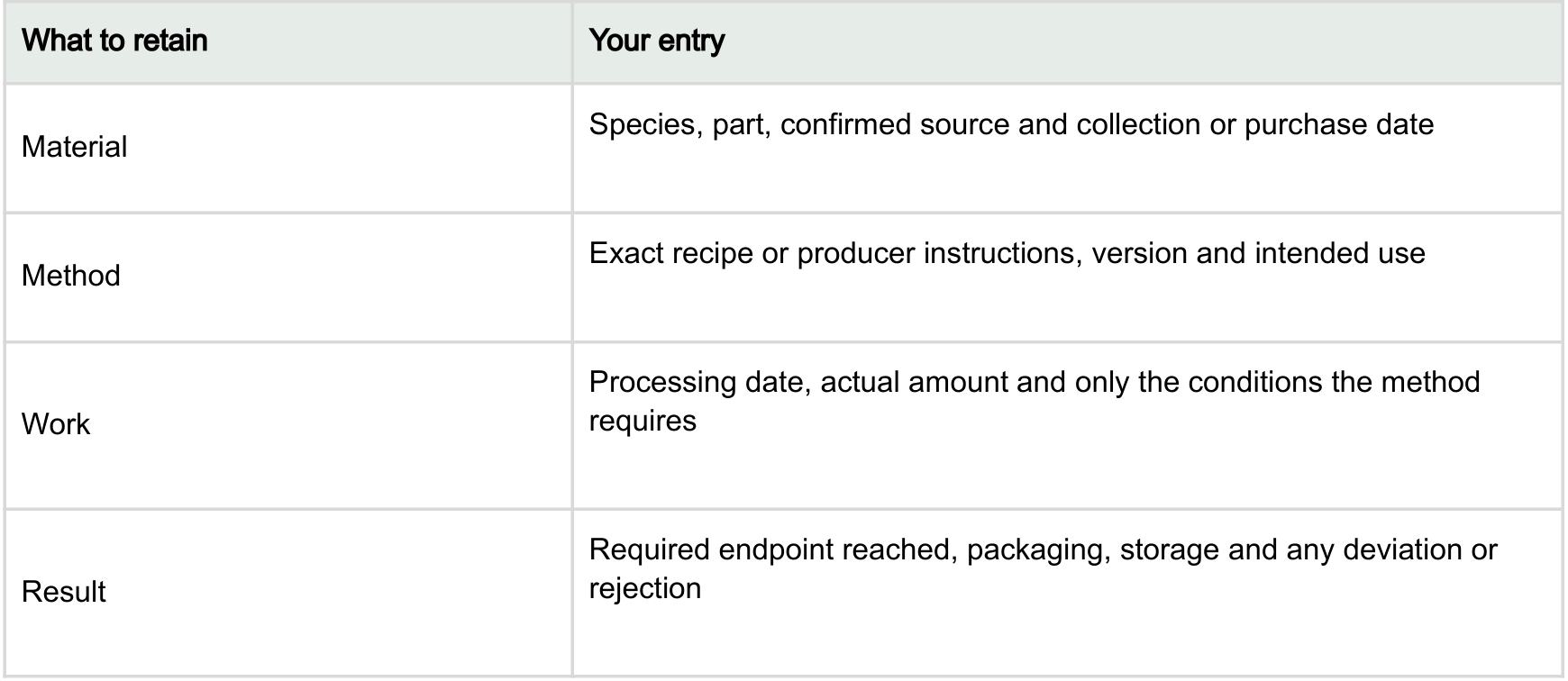
Keep the lot separate and its label attached. Put the actual weighed result in the result field. Identify any estimate or target as such.
Example label structure: “Tall fireweed leaves / source and date / method and processing date / storage instructions.” This illustrates the fields only; it is not a completed batch record.
Stop if identity or method is lost, required conditions were missed, contamination is suspected, or unexpected dampness, mould, insects or damaged packaging appears. Do not taste suspect material, blend it into a sound lot or assume redrying makes it safe.
Keep food and craft records separate. A chemical, dye or adhesive added to craft material changes its handling and disposal route.
Tool 5 One question you can actually revisit
Use with 12.1–12.4. Choose a question you can observe at household scale, such as patch spread, time spent or a desired plant’s response. Clinical efficacy, microbial safety and contaminant clearance require suitable professional work.
Question: ____________________
What you will compare: ____________________
What you will observe, in the same way each time: ____________________
When you will return, and when you will stop: ____________________
Photograph or short result: ____________________
If leaving a comparison area untreated could allow harmful spread or conflict with an important purpose, change or stop the exercise. Record the limitation or choose another question.
Example comparison: selectively cut a small patch edge and leave a similar edge alone, where both choices are acceptable. Record their starting conditions, the actual intervention, regrowth, flowers, desired plants, bare ground and time spent. Note differences in shade, weather or browsing that could affect the result. This is a proposed comparison, with no field results claimed. Its findings could guide a local decision; one comparison would not establish a universally best treatment.
After returning, decide whether to keep, adapt or stop the practice, or seek help. Write why. An unwelcome result may be the most useful part of the record.
Tool 6 Read a product claim
Use with 11.2 and 11.7. Copy the claim exactly before deciding whether its evidence fits.
Claim and product: ____________________
1. Identity: Which species, part, ingredients and batch are involved?
2. Preparation: Fresh plant, dried leaf, processed tea, concentrated extract, compost or liquid amendment?
3. Comparison: Against what was it tested: placebo, water, usual treatment, a nutrient-matched preparation or nothing?
4. Outcome: What was actually measured: a molecule, assay response, symptom score, crop growth, pest damage or a personal preference?
5. Match: Does that experiment support this product, this use and the words on the label?
Evidence link and limitation: ____________________
Present conclusion: supported within the stated scope; plausible but not demonstrated; evidence inadequate; or a specific claim contradicted by adequate evidence. Record the scope of your search. “Not found” does not mean “never studied.”
Keep identity, quality testing and efficacy separate. A marker molecule is not a clinical outcome. A plant taking up nutrients is not a trial of a plant brew feeding another crop. A culture-broth assay is not validation of a finished household tea.
Next action: request the exact study or batch documentation, consult the appropriate professional, choose a simpler supported alternative, or decline the claim. The plant can remain worth your attention even when the claim falls short.
Words used in the guide
Anther. The pollen-bearing part of a stamen.
Astringency. A drying or puckering mouthfeel. It differs from bitterness and cannot establish safety or a compound’s concentration.
Bud bank. Living buds available for possible new growth, including buds below ground. Not every bud becomes a shoot.
Clone. A plant and vegetative descendants sharing an origin. A visible patch can contain more than one clone.
Coma. The tuft of hairs attached to a seed, helping it travel in moving air.
Comparator. The thing against which an observation or treatment is compared.
Cotyledon. A seed leaf. A seedling’s early leaves can differ from the mature plant’s leaves.
Cytotype. A chromosome form, such as a diploid or tetraploid, within the group being studied.
Endpoint. The particular result a study or method sets out to measure or reach.
Genet. The genetic individual and its vegetatively produced descendants, distinguished from the visible units being counted.
Geitonogamy. Pollen transfer between flowers on the same genetic individual.
Infusion. A preparation made by steeping material in water. It need not have the same composition or strength as a concentrated extract.
In vitro. Outside a living organism, for example in a chemical system or cell culture.
Node. A place where a leaf or other structure attaches to a stem.
Oenothein B. An ellagitannin studied in fireweed and used as a chemical marker; its presence alone does not establish a health benefit.
Phenology. The timing of recurring events in living things.
Protandry. Male function preceding female function within a flower.
Provenance. Where material or knowledge came from, including the relevant source, place and history.
Raceme. An elongated flower cluster with individual flowers on short stalks along the main axis.
Ramet. A potentially independent vegetative unit belonging to a clone.
Rhizome. An underground stem. A root that bears buds is still a root; the terms should not be used interchangeably.
Senescence. The aging and decline of living tissue.
Stigma. The pollen-receiving structure at the end of a flower’s style.
Style. The structure supporting the stigma above the ovary.
Submarginal vein. A vein running near and inside a leaf’s margin.
Succession. Change in the composition of a community through time, without implying a fixed timetable.
Water activity. A measure of water’s availability in a food for processes including microbial growth; it is different from total moisture content.
These short definitions are reading aids. The relevant chapter provides the fuller explanation and source context.
Find it by plant part or task
Numbers refer to chapter sections. Select a linked number to go to that passage.
Shoots and seedlings: 1.2, 2.1, 6.3, 7.3, 8.1
Leaves and veins: 1.1–1.4; harvest and handling 7.3–7.7; kitchen development 8.2–8.3; tea 9.1–9.7
Flowers and visitors: 1.1, 2.3, 4.1–4.3; flowering continuity 4.6 and 4.8; honey 4.7; flower foods 8.2–8.6
Capsules, seed and silk: 2.4; dispersal and establishment 3.1–3.2; containing seed 6.4 and 6.6; material accounts 10.1–10.2
Roots and persistent organs: 2.2; recovery 3.1–3.2; management 6.3–6.6
Stems and fibres: 5.4; material distinctions and limits Chapter 10; residues 6.6
Burned ground: 3.2–3.6; food-source stop route 7.2
Cultural names and accounts: 1.3, 2.6 and Chapter 5; tea practice 9.4; material provenance 10.2
Planting and management: Chapter 6; return to the outcome 12.4
Food and storage: Chapter 7; untested recipe-development proposals Chapter 8; urgent help in the front matter
Health and extracts: 11.1–11.6; commercial quality and claims 11.7
Compost, brews and fertilizer claims: 6.6 and 11.7
A small enterprise: 12.5
Observation and fair comparison: 2.6, 4.1, 12.1–12.4 and Tools 1 and 5