

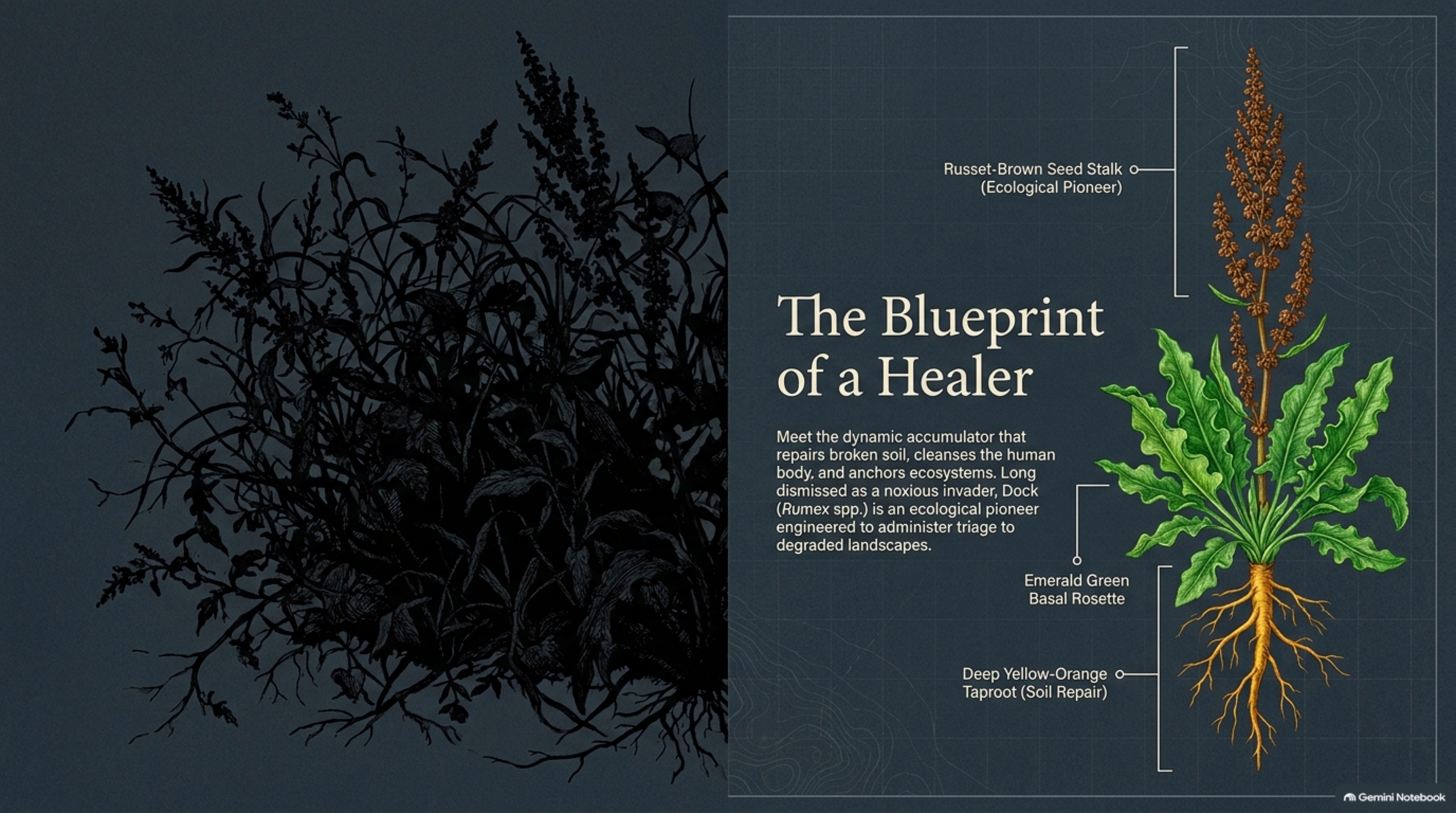
Dock arrives where the land has been compacted, drowned or overfed, and it leaves behind seeds that can outwait you by half a century
Late August, the wet corner of a field, and dock introduces itself twice. First by sound: four-foot stalks gone the color of old brick, hung with papery clusters that rattle when the wind works through them, each husk holding one small three-sided seed built to ride wind or water somewhere else. Then by the ground under your boot, which gives with a squelch. Bruise a leaf and you get a faint bitter-green smell and very little else, this is not an aromatic plant, it’s a structural one. The rosettes crowd the bare dirt where the pasture gives out. Stinging nettles are working the same rich damp a few feet away. And the whole assembly is standing precisely where an old livestock wallow or a flooded corner ruined the ground.
That siting is the plant’s entire argument. Dock is not growing there in spite of the damage. It is growing there because of it, and it is already, slowly, doing something about it.
Which is why the same weed turns up in five completely different conversations depending on who’s standing over it.
If you farm, you’re looking at a plant your stock will walk around. Cattle and horses graze the grass and leave the docks standing, the leaves are bitter and loaded with oxalates, and that refusal is exactly why a tired pasture goes docky while the good forage thins out. There’s one documented circumstance where the refusal breaks down and the plant turns genuinely dangerous to the animal, and the intake it takes is on record. There’s also the matter of what actually spreads it across your fields, which is not the wind and is not your neighbor.
If you garden, you’re looking at the cheapest subsoiler ever made. Dock drives a taproot several feet down through hardpan that stops a spade, mining the layer your vegetables can’t reach; dig one out and the soil that comes with it is often darker and more crumbly than the ground a foot away, threaded with worm castings. Which sets up the contradiction at the middle of this plant: dock is the standard indicator of compaction, and dock is also, quietly, one of the things fixing it.
If you forage, you’re looking at food with a long and unglamorous résumé, tart young leaves that want cooking, and seed in such quantity that people have ground it into a dark gluten-free flour when the grain ran out. The oldest evidence of anyone eating this seed is not in a cookbook. It’s in a stomach, in a Danish bog, from the fourth century BCE. The famous part of this plant, though, is the root, and the root comes with rules, so it lives on the other side of the wall today.
If you teach, you’re looking at a plant whose names are a set of instructions. Docce, Old English, roughly “dark weed.” Yellow dock, for the startling yellow-orange the root shows when you cut it. Sour dock, for the oxalic tang. Butter dock, because those broad leaves were wrapped around butter to keep it cool on the way to market. And “nettle in, dock out”, the rhyme children have recited while rubbing a dock leaf on a nettle sting since at least Chaucer’s day, around 1386. Modern analysis finds nothing in a dock leaf that acts against nettle venom. No antihistamine, no antidote, nothing. So why has that charm survived six hundred years of people testing it on their own arms?
And if you’re just curious, you’re looking at the ground telling on itself. Dock is a soil report you can read from the truck: wet feet, hard earth, and more fertility than you’d guess. But which dock, and how lush, changes the reading completely, and the report has a line in it that most people who repeat “dock means compaction” have never actually heard.
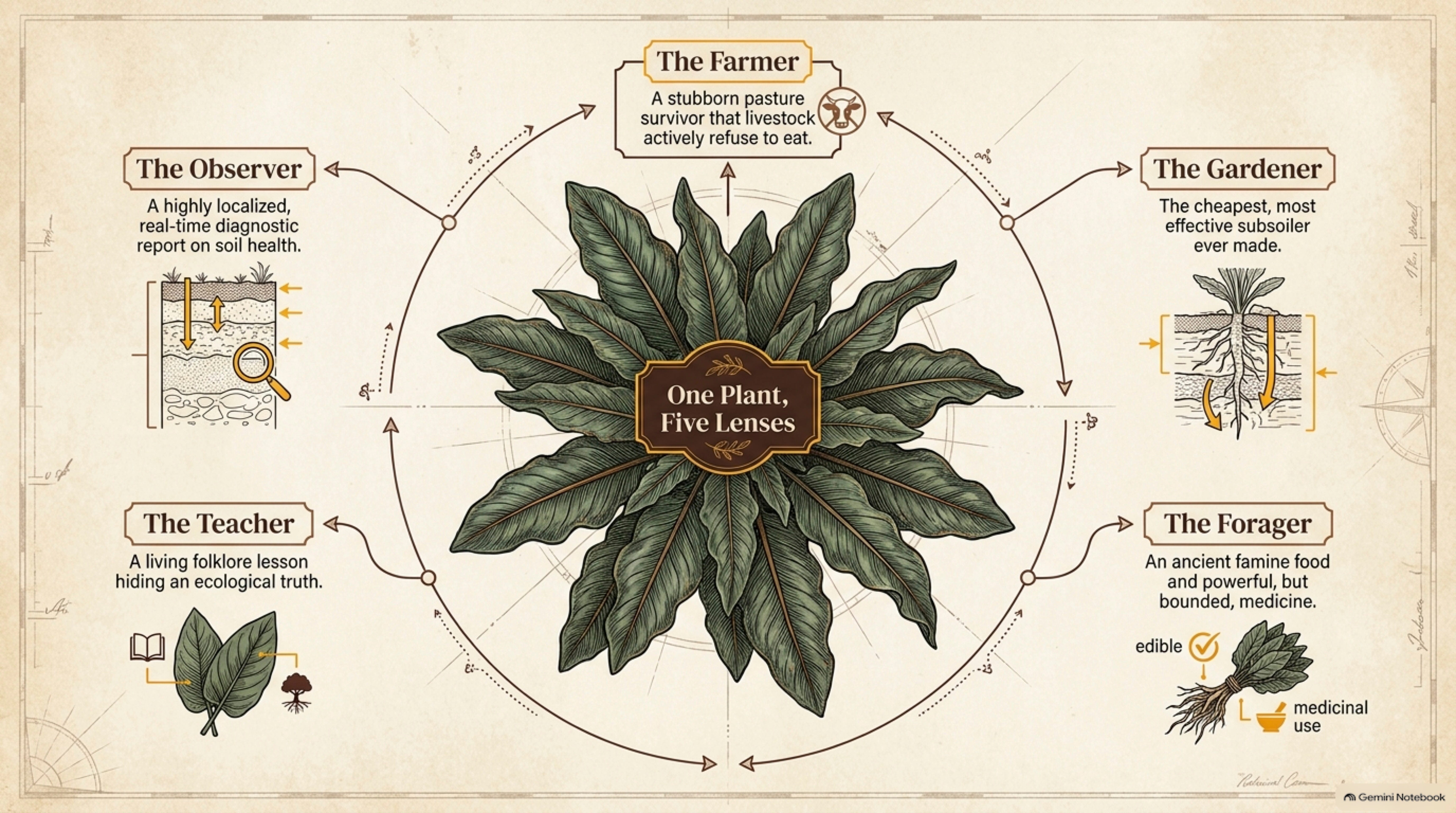
Five readings, one plant, and they run through two gestures. A root that goes down where nothing else will and brings back what it finds there. And a seed that waits longer than you will.
Start with meeting it, because dock is one of the easier plants to be sure about.
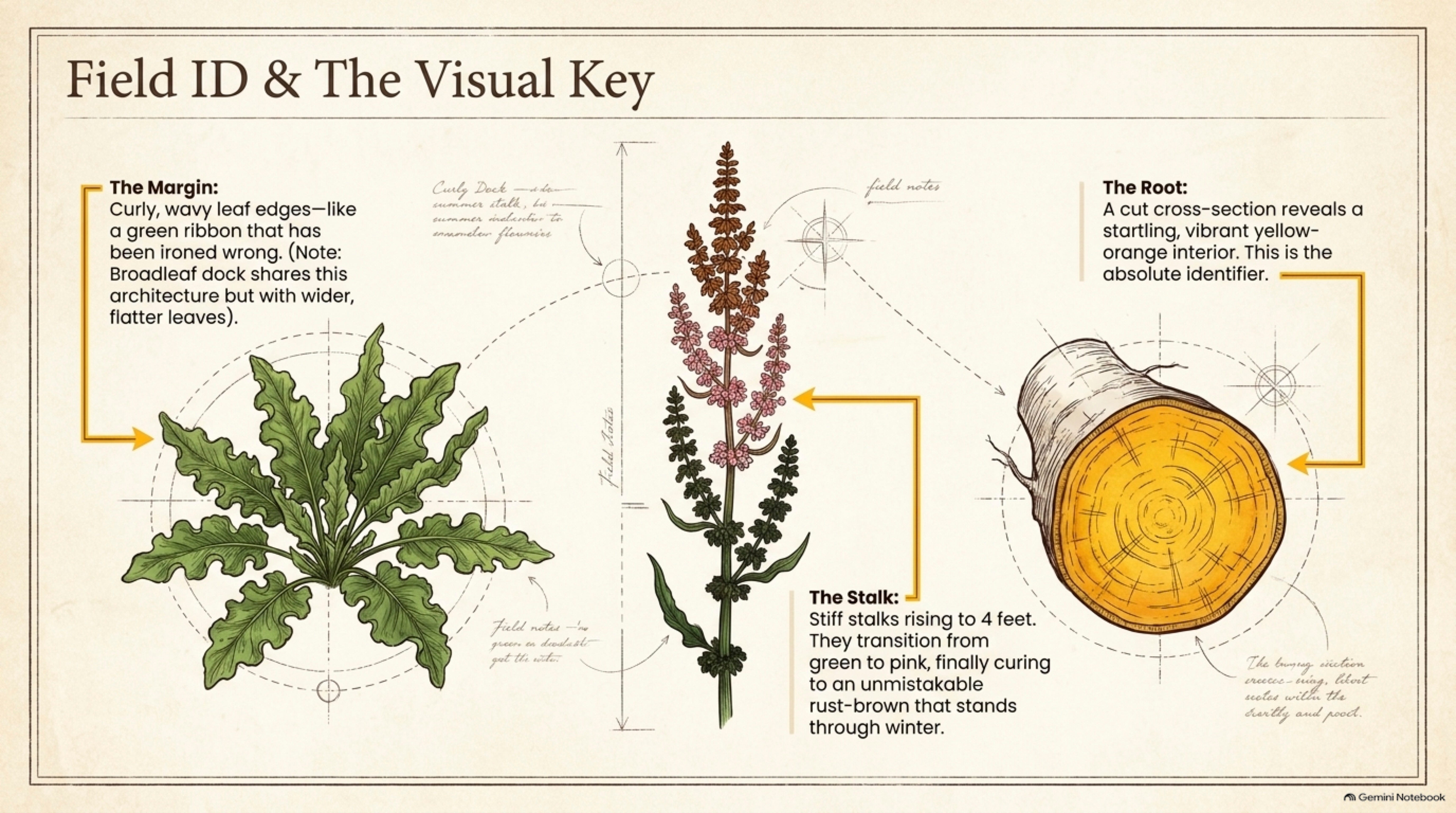
Look for a rosette of long, lance-shaped leaves lying close to the ground, and check the edges: curly dock’s are narrow with a wavy, crimped margin, like a ribbon that’s been ironed wrong. Broadleaf dock, the other one you’ll meet constantly, has the same architecture with wider, flatter leaves. By early summer both send up a stiff stalk to four feet or so, carrying dense whorls of small green flowers that ripen through pink to that unmistakable rust-brown, and the dead stalks stand through winter, which makes docks the easiest plant in the world to map in February. Cut the root and it runs yellow-orange inside. That’s the whole key.
The lookalike news is unusually good. Foragers report no poisonous lookalikes for docks in North America. The confusion that does happen is at the rosette stage, before the stalk goes up, when a young broadleaf dock can read as burdock or, the one that matters, as young foxglove, which is properly toxic. Dock leaves are smooth-surfaced with veins that curve toward the tip; foxglove is notably fuzzy. Learn that one distinction and the plant stops being a risk. (In the Southwest there’s a further wrinkle: wild rhubarb, Rumex hymenosepalus, is a native dock with a similar look and edible root, and the monograph’s caution there is about pressure on a protected native rather than about poisoning.)
The real cautions with dock are not about mistaken identity. The leaves are high in oxalates, the sour is the tell, so the traditional handling is to cook or blanch them and to introduce them to your diet gradually rather than in a first enthusiastic bowlful. The measured oxalate levels in curly dock tissue are modest enough that ordinary foraging shouldn’t spike anyone’s intake, so this is a “cook it and don’t overdo it” rule, not an alarm. The second caution is about place rather than plant: dock will accumulate nitrates out of polluted soil, so the ditch beside the industrial yard and the strip along the busy road are the wrong dock, however healthy they look. As with a lot of accumulator plants, the danger isn’t in the species. It’s in the dirt you took it from.
Cut your docks before they seed, and put them straight back on the ground. The big leaves make a genuinely good mulch, they hold moisture, they suppress the next round of weeds, and being soft and non-woody they break down within a season instead of sitting there like straw. The same quality makes dock an excellent “green” in a compost heap: low carbon-to-nitrogen, quick to heat, and carrying the minerals the taproot spent all summer hauling up from a depth your crops will never see. You are, in the most literal sense, harvesting the subsoil without digging it. The one hard rule is the seed: never put mature dock seed heads in a pile you aren’t certain gets hot, because those seeds are built to survive things, and an unfinished compost heap is how a dock problem becomes a dock decade. Cut before brown, or cut the heads off separately and deal with them apart from the leaf.
That’s the surface. Underneath it, three things about this plant refuse to sit still.
The first is the refusal in the pasture. Every large grazer on the place walks around dock, and that’s usually described as a nuisance. It’s also a protection, and there’s one specific way it fails, with a number attached to it, and a species of livestock that’s more vulnerable than the rest. The animals are avoiding something real.
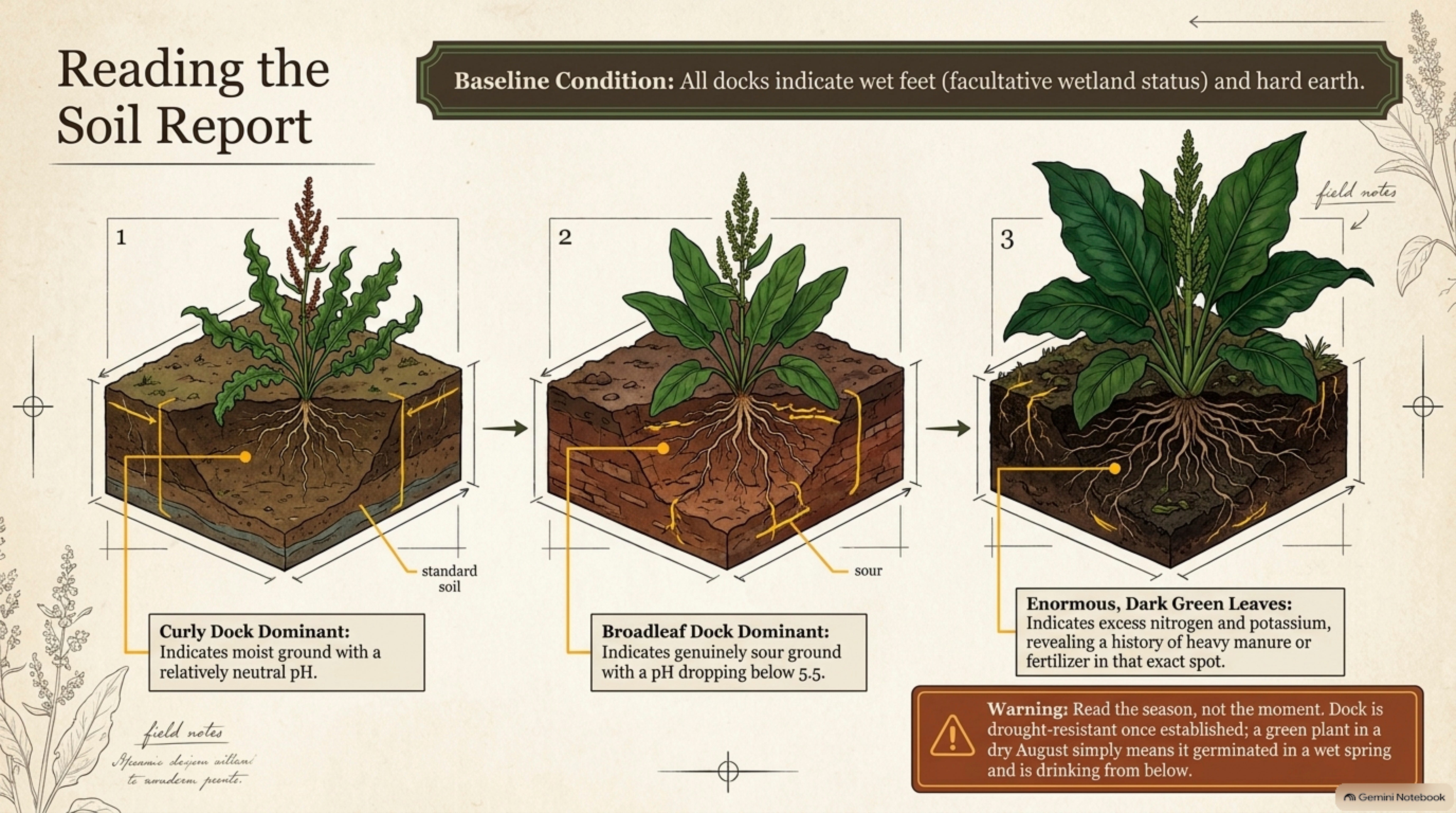
The second is the soil report. That stand in the low corner is reading its own ground out loud, the drainage, the compaction, the history of manure, the pH, and different docks read different sentences. But the same organ that lets dock take the reading is the organ that lets it change what’s being read, and once you see that join, the standard “weeds indicate problems” line stops being quite adequate. A plant that both diagnoses compaction and relieves it isn’t an indicator. It’s a treatment that also happens to be legible.
The third is the charm, and it’s the one I can’t leave alone. “Nettle in, dock out” has been in continuous use in the English-speaking countryside since the fourteenth century. The chemistry says there is nothing there. And yet nettle and dock genuinely do grow side by side, everywhere, reliably enough that the folklore treats it as providence, which it isn’t. There’s a plain ecological reason those two plants are always within arm’s reach of each other, and once you know it, the rhyme turns out to be encoding something true. Just not the thing it says.
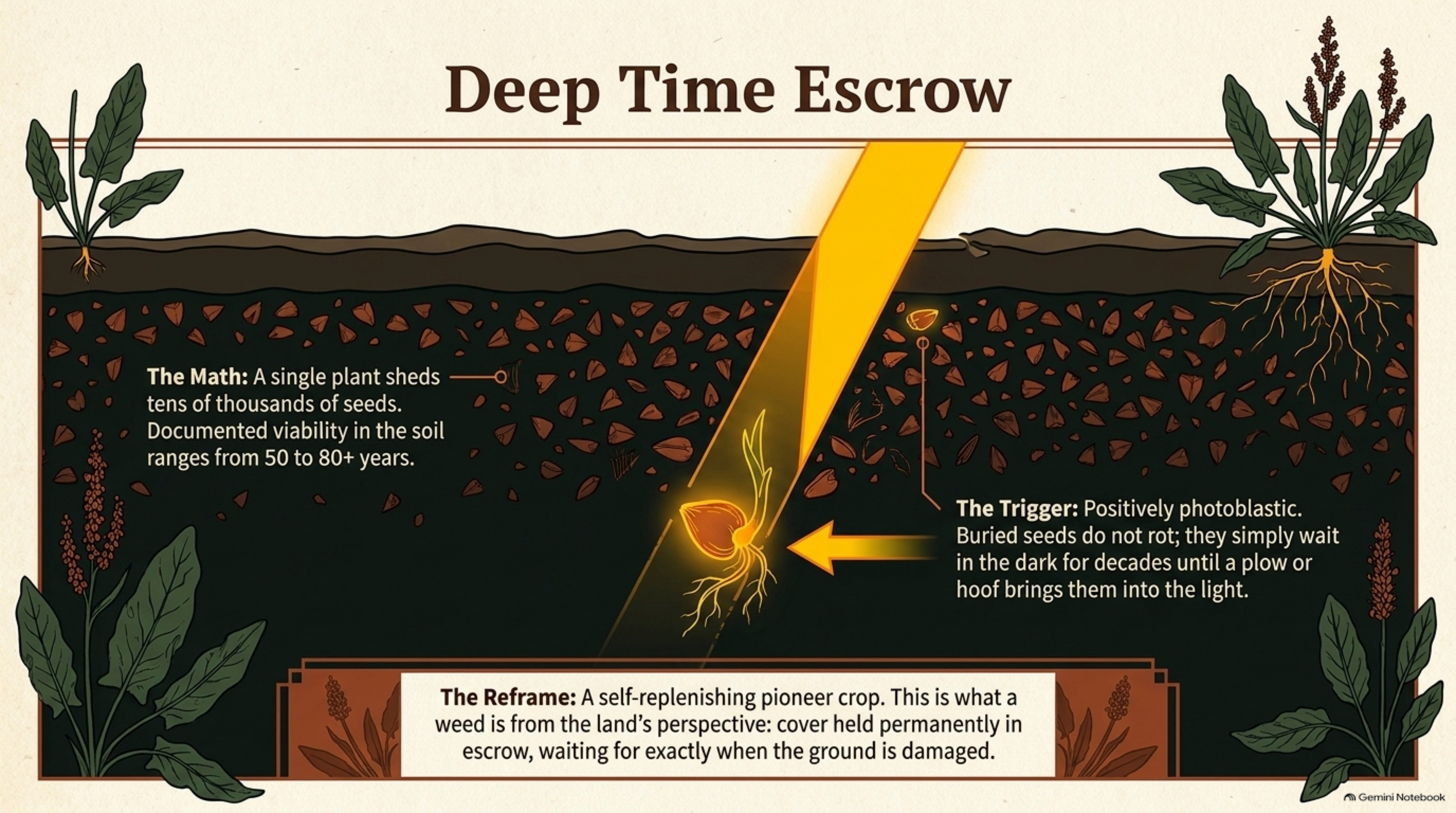
And then there’s the fourth thing, which is the one that changed how I look at a field. Dock seed viability in soil is documented at around fifty years, with reports past eighty. The seeds are triggered by light: buried, they simply wait in the dark, indefinitely, until a plow or an erosion scar or a badly-timed dig brings them up to where they can see. A single plant sheds tens of thousands of them. Which means the docks that came up in your fresh bed this spring were quite possibly sown by somebody else’s mistake, on ground that had a different name on the deed, before anyone now living had touched it.
That’s the other side.