

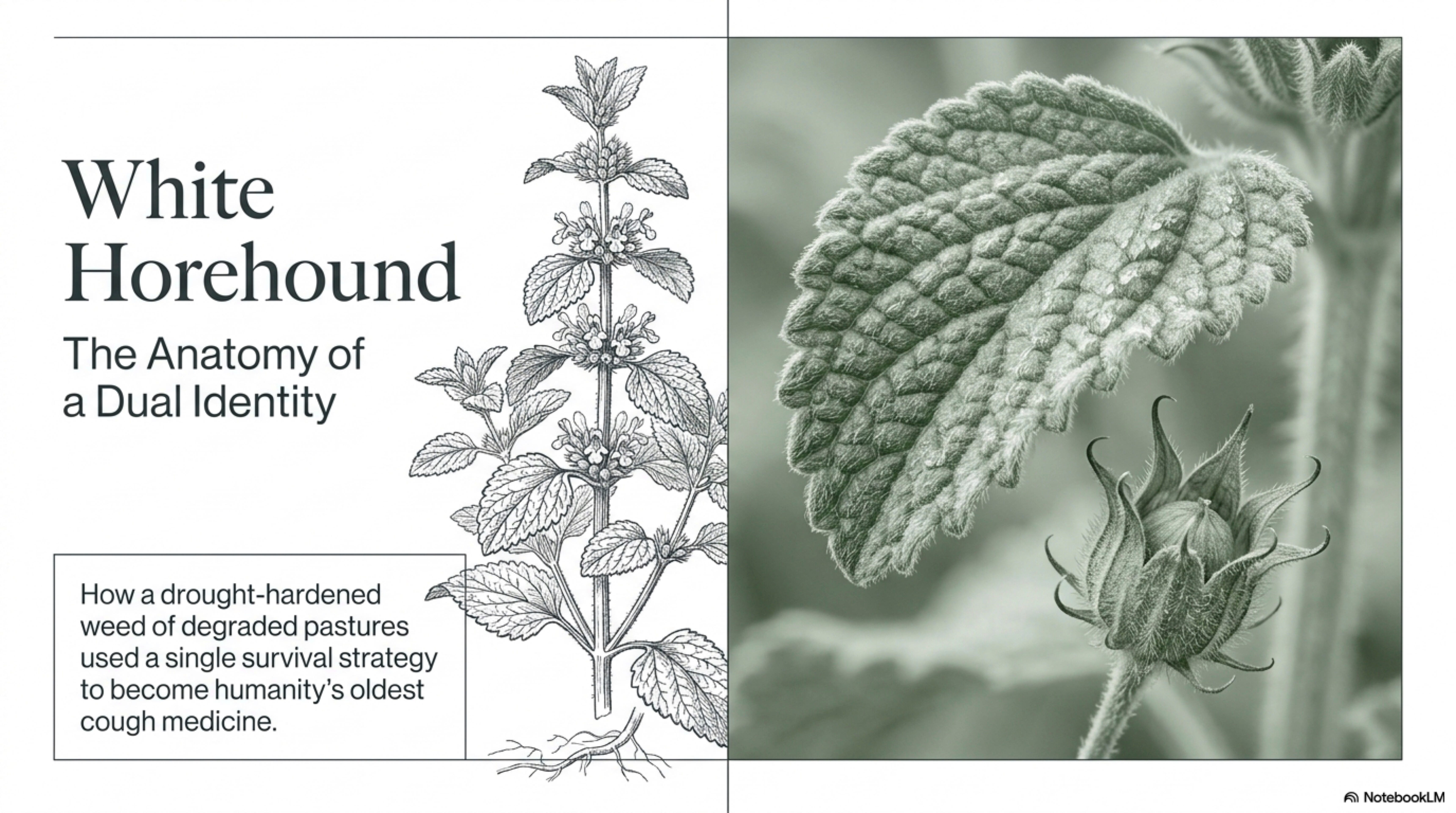
Horehound only thrives where the land’s been hurt, and the same bitterness that turns the grazer away is the medicine we’ve reached for since before we could write
Run a hand across a hillside stand of horehound at the end of a dry summer and it answers grey, leaves like felted wool, cool and dry, giving up a musky, resinous bitterness that clings to your fingers longer than it has any right to. Come back a few weeks later, brush the same plant, and it introduces itself a second way: a ring of tiny hooked burrs takes your sleeve and rides off with you. Two lessons, one plant. And in the paddock all around it, the sheep have grazed the grass down to the dirt and left the horehound standing untouched, a grey island in a field eaten bare.
Pull on that plant the way the season does, and depending on who you are, something different comes loose.
If you farm hard or overgrazed country, you’re looking at the plant your stock refuse, and that refusal isn’t stubbornness, it’s a diagnosis you can read from the gate.
If you garden in its Mediterranean homeland, you’re looking at a drought-proof, months-long bee plant that thrives on poor, chalky ground where little else will bother, and yet a hemisphere away the very same species is a declared weed with control laws written against it.
If you forage or have a sweet tooth, you’re looking at the bitter behind horehound candy, that dark, glassy, root-beer-and-menthol lozenge in the jar at the old sweet shop, a nostalgia sweet that is really a fossil of something far older.
If you teach, you’re looking at one of the oldest medicines on the human shelf: a cough remedy that runs in an unbroken line from Dioscorides through Culpeper to the modern cough drop, though the one thing science ever actually pinned down about it wasn’t the cough at all.
And if you’re just curious, you’re looking at a witness: grey felt spreading over dry, disturbed, hard-grazed ground is the land confessing what was done to it.
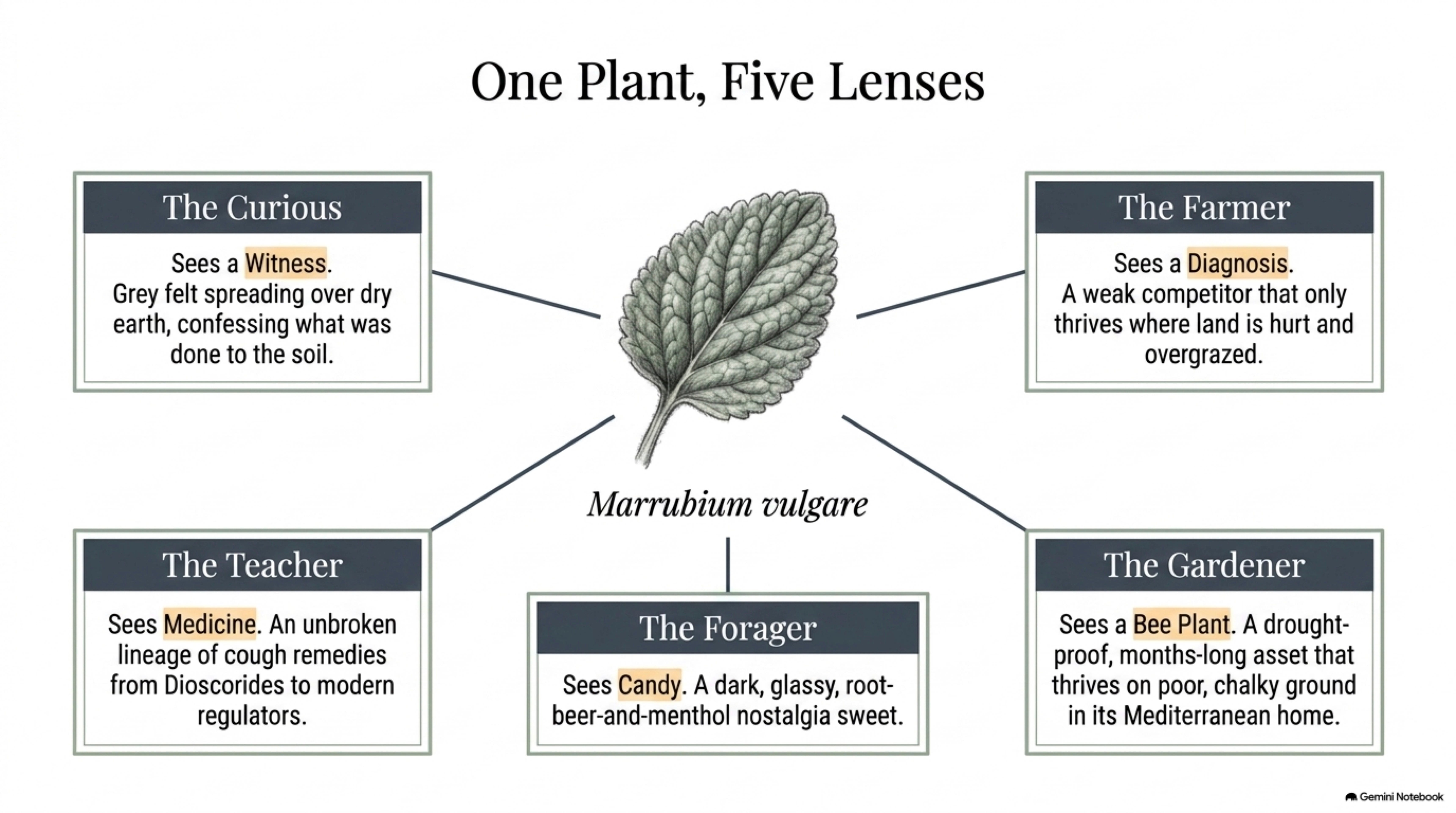
All five are true. And the splinter worth following is this: everything horehound is, medicine, weed, candy, witness, routes through a single bitterness, and that bitterness is doing at least two opposite jobs at once.
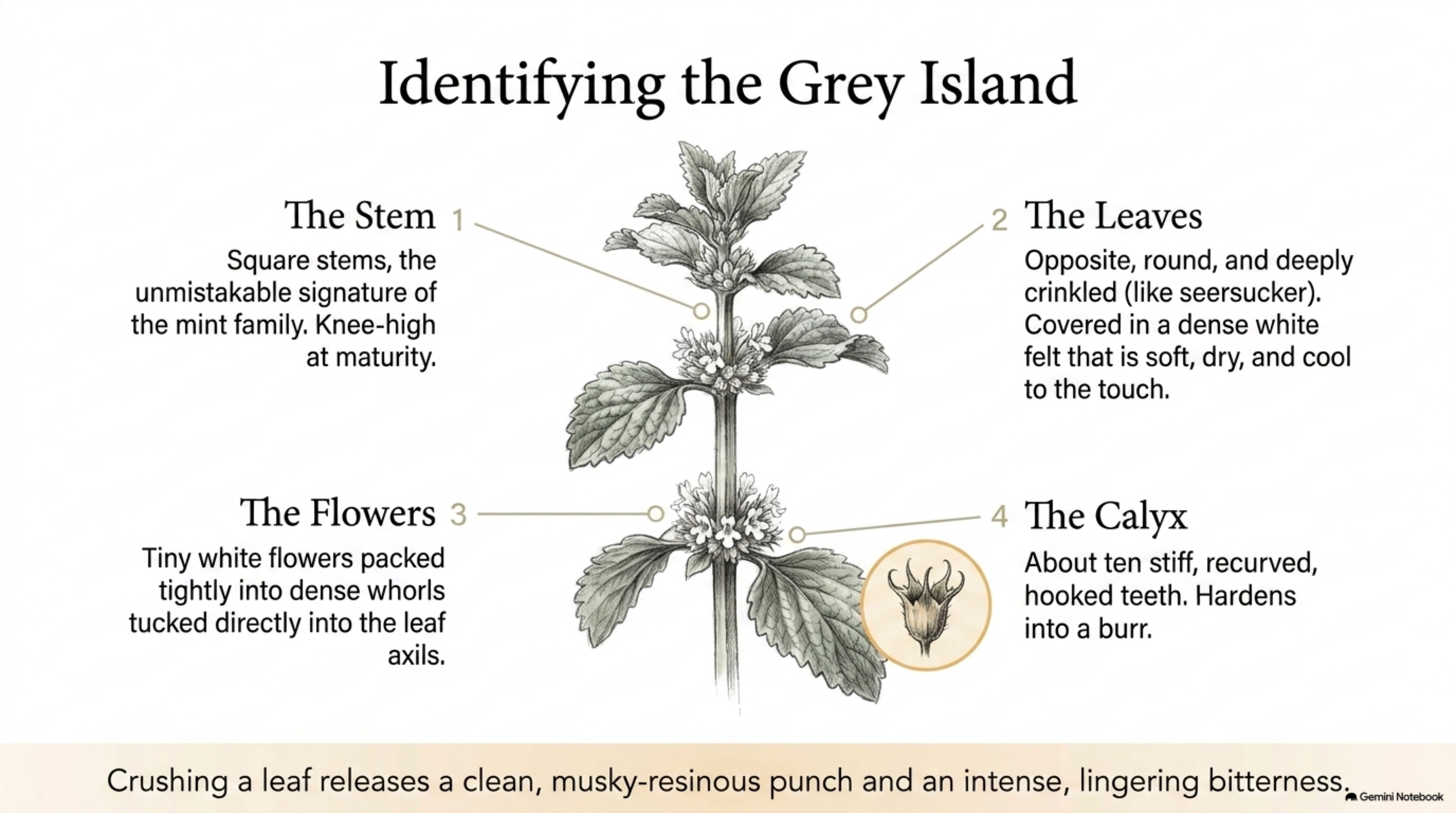
Start with knowing it, because it’s one of the easier plants to learn and one of the easier to confuse if you go by name alone. Horehound is a bushy, grey, several-stemmed perennial, knee-high at most, built from square stems, the mint-family signature, and opposite leaves that are round, deeply crinkled like seersucker, and covered in a white felt that’s soft, dry, and cool to the touch. The small white flowers pack into dense whorls tucked in the leaf axils, easy to walk past. What you won’t miss is the calyx: about ten stiff, recurved, hooked teeth that harden at maturity into the burr that rides away on wool and cuffs. Crush a leaf and you get a clean, musky-resinous punch and a bitterness that settles onto the tongue and won’t leave. That lasting bitterness is the whole story in one taste, hold that thought.
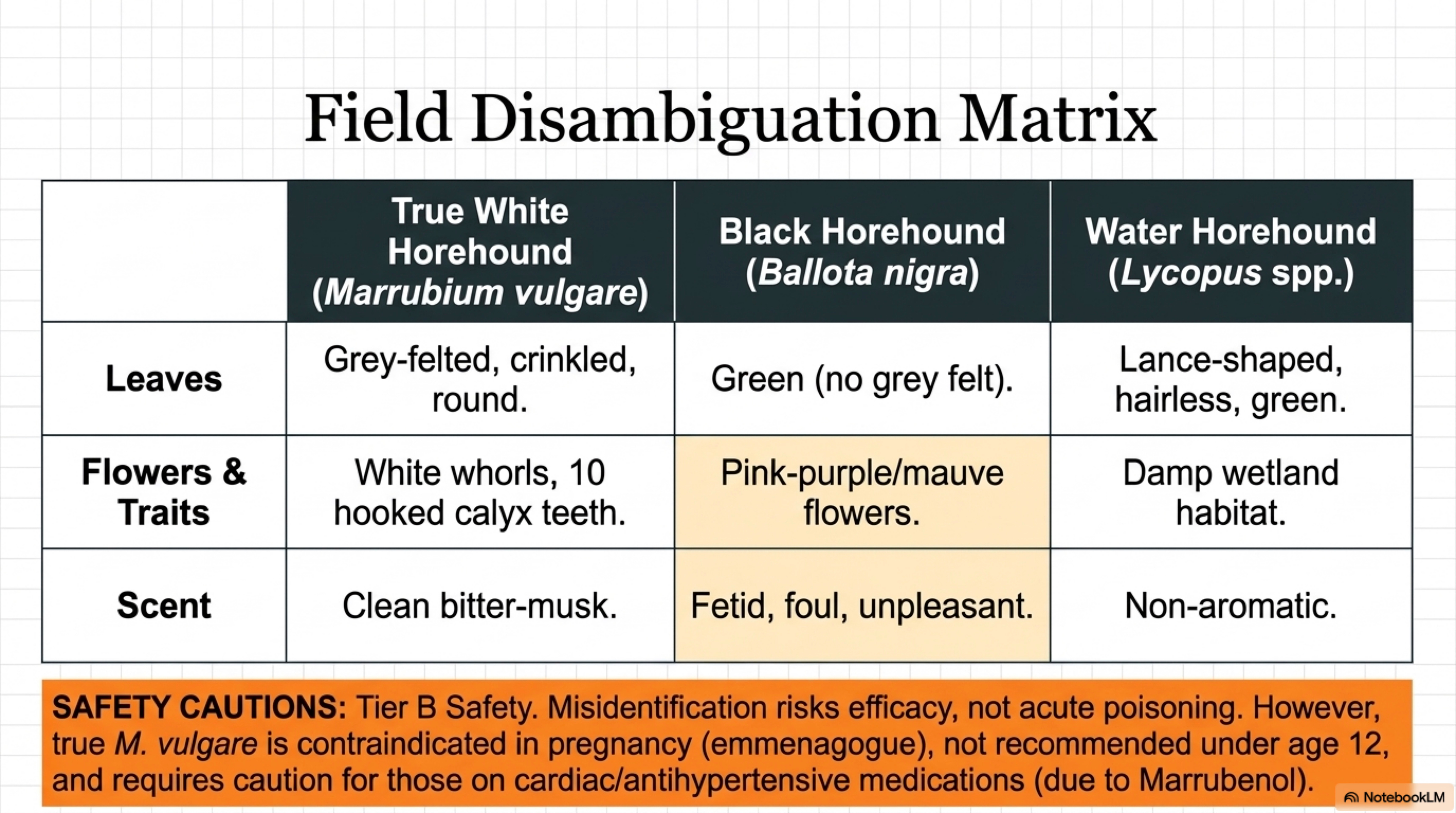
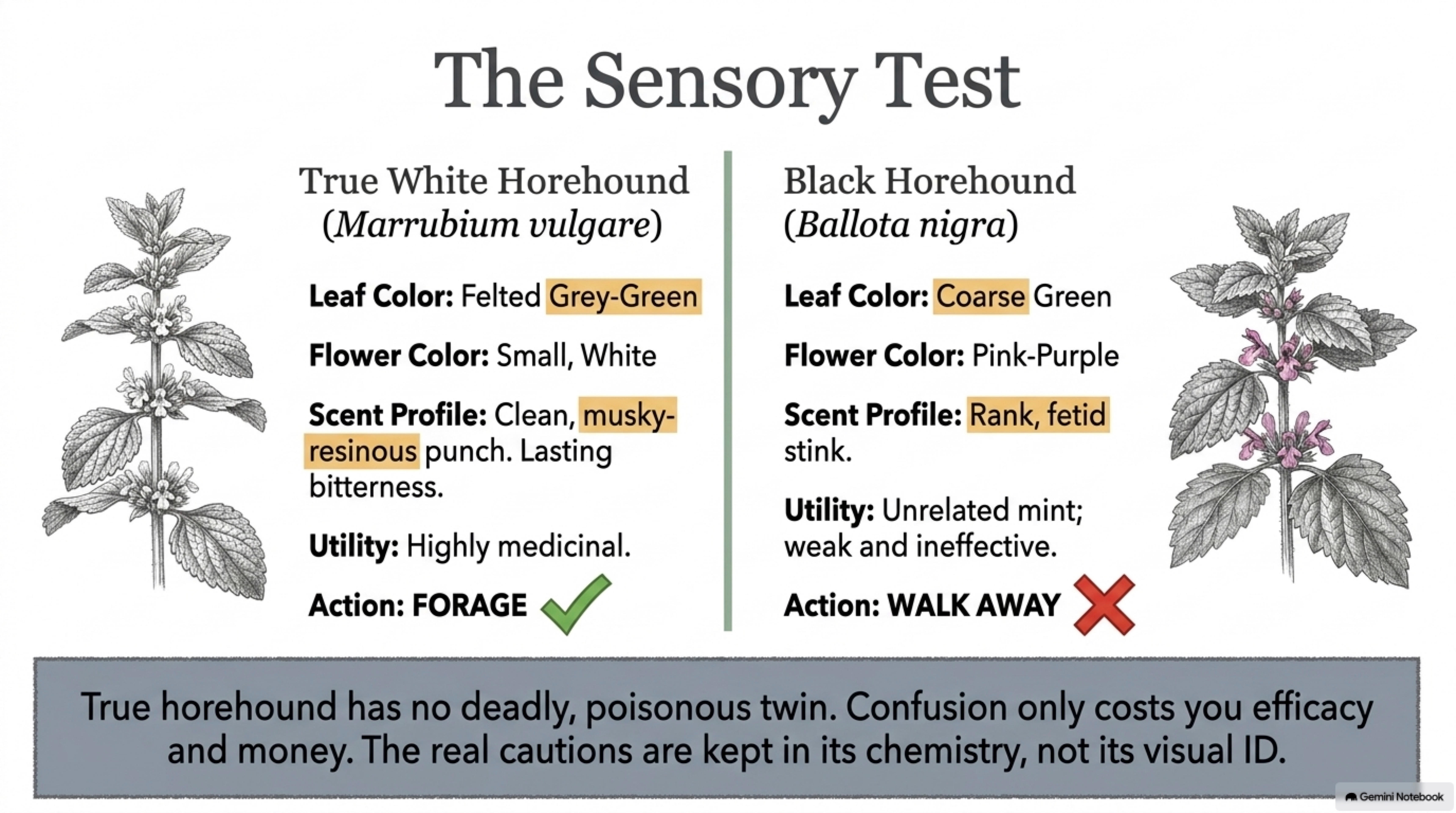
The one lookalike worth carrying is a matter of the nose. “Horehound” is a name shared with black horehound, Ballota nigra, a coarser, unrelated mint with green rather than grey leaves, pink-purple rather than white flowers, and a rank, fetid stink when you crush it, the exact opposite of white horehound’s clean bitter-musk. It’s a different and much weaker herb, and the surest way to separate them is the oldest instrument you own: crush a leaf and breathe. Aromatic and bitter, you’re right; foul, walk away. The reassuring part is that horehound has no poisonous twin, its confusions cost you efficacy and money, not your life. Which tells you exactly where this plant keeps its real cautions: not in the eye, but in the chemistry. Hold that thought too.
Before horehound is medicine or candy, it’s a soil-reader, and this is the safest, most useful thing it will ever do for you. Find it dominating a patch and the ground is telling you several things at once: it’s dry and sharply drained, often chalky or sandy, lean rather than rich, sunny and open, and, most tellingly, it’s been disturbed or grazed hard. Horehound is a weak competitor that wins by occupying ground others have vacated; it doesn’t shove healthy pasture aside, it moves into the gaps where the sweeter plants have already been eaten off or broken. Its bitterness makes the stock refuse it, so it simply outlasts everything they prefer. Where it spreads, then, it isn’t the cause of the damage, it’s the record of it. The grasses lost their grip before horehound ever arrived.
So the honest first use of horehound is to read it, and then tend what the ground actually needs, which is usually not to pull the one plant willing to tell you the truth, but to ease the grazing that made room for it. Where horehound is welcome, its Mediterranean home, a poor dry margin, a hedgerow, it’s a real bee asset, drought-hardy and flowering for months, asking for nothing. Where it isn’t, the pastures of Australia and much of the temperate New World, where it’s naturalized and, in South Australia, formally declared, the safest action is the reverse: don’t plant it, don’t spread its burrs, manage it. For the kitchen, the bitter tops steep into a strongly bitter tea and boil down, with honey or sugar, into the old horehound candy, a flavor, claim-free, and about as far as the safe use goes. Because horehound’s real medicine is dose-sensitive, travels with cautions, and belongs on the other side of this.
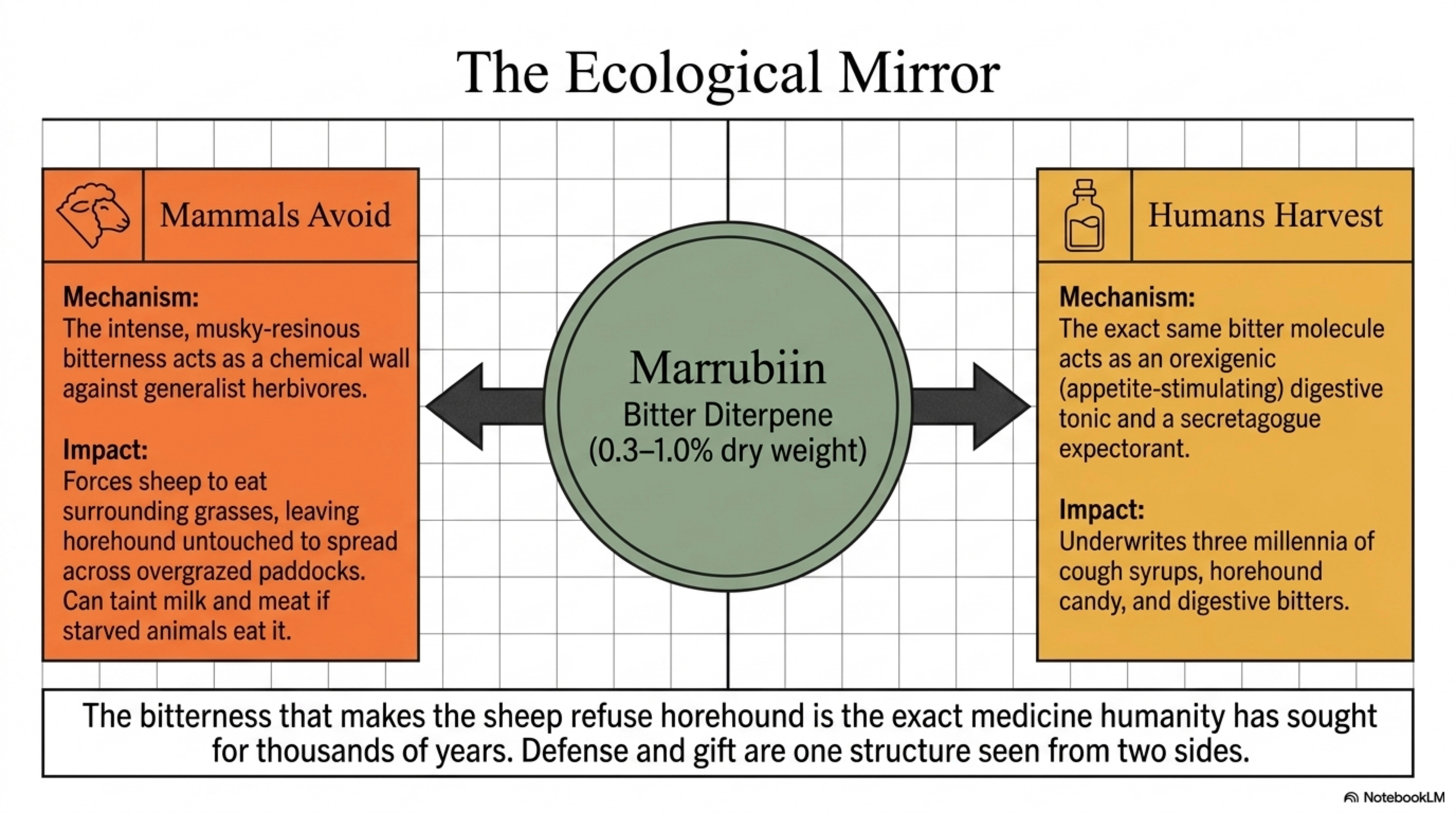
Two things about horehound refuse to add up from the field’s edge. The first: the same bitterness that makes the sheep turn away is the exact thing three thousand years of physicians reached for, the defense and the medicine aren’t two facts about the plant but one molecule read from two sides, and stranger still, that bitterness is riding to the next bare paddock on the very wool of the sheep that refused it. So which is it, a weapon, or a gift? The second is worse, or better: for a plant prescribed for the labouring chest since before writing, the one mechanism modern pharmacology actually nailed down had nothing to do with the lungs. It was the heart. Horehound has apparently been practising cardiology, quietly, in a candy jar, and almost nobody selling the lozenge ever knew it. There’s more the monograph is blunt about: why a modest Mediterranean herb turned into an outlaw weed the moment we carried it overseas, and why the oldest cough remedy in the book has never once had its cough properly tested.
That’s the other side.