

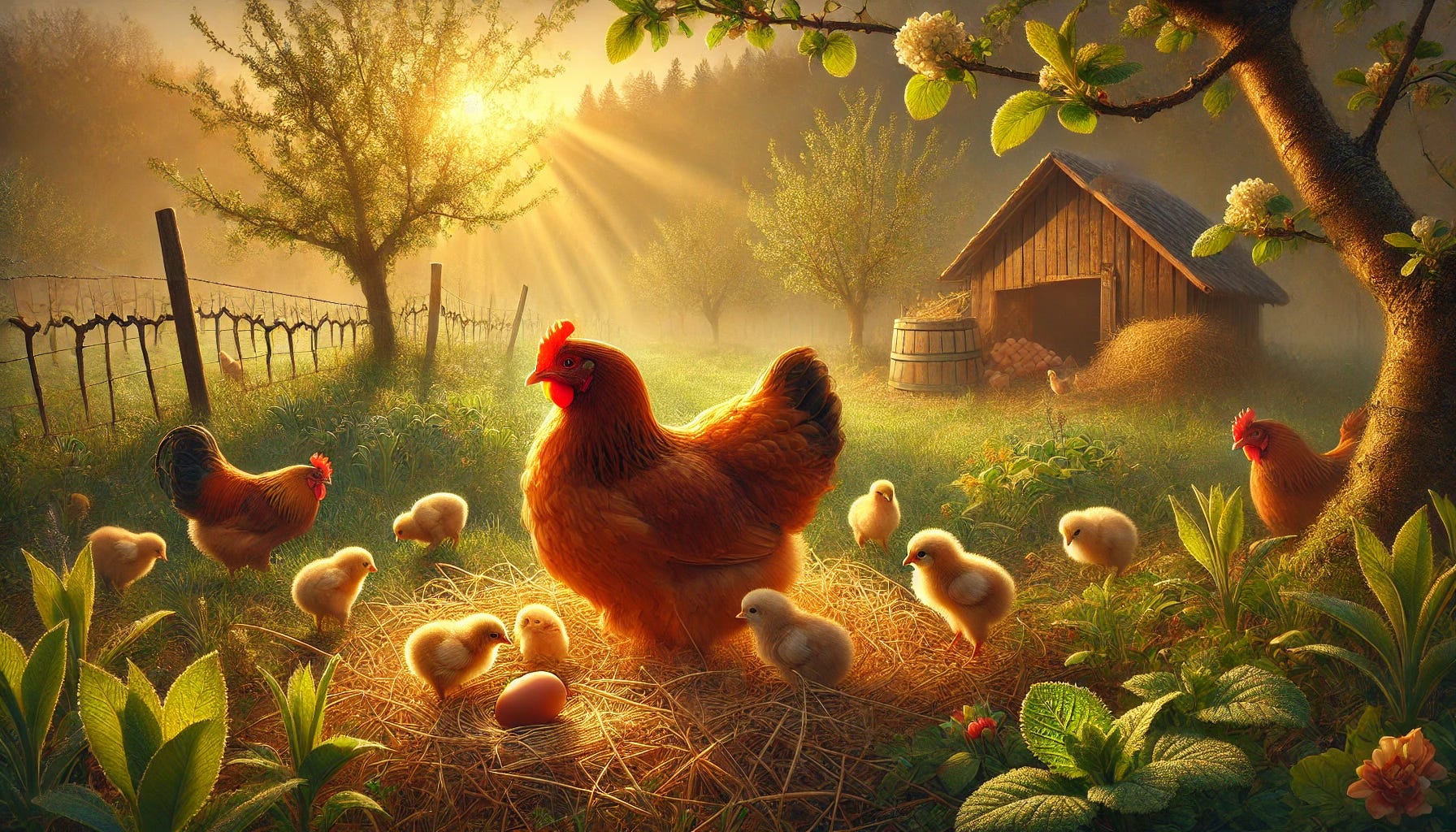
There's a particular moment each spring when everything shifts. You feel it in the air first—that subtle warming, the scent of soil awakening after winter's rest. The light stretches longer, casting golden paths across land that's beginning to remember its verdant purpose. And if you're fortunate enough to keep chickens on pasture, you witness one of nature's most reliable harbingers of seasonal change: the return of the truly magnificent egg.
The Spring Transformation
Yesterday I stood quietly, rake in my hands while working on the garden, watching our flock methodically working their way across the vineyard. There's an intentionality to their movements that never fails to captivate me. A chicken doesn't simply walk—she studies, calculates, and harvests with remarkable precision. A slight head tilt indicates she's seen a micro movement or heard something beneath the soil's surface. A quick scratch, then another, and suddenly she's extracting a wriggling grub that could have eventually become a vineyard pest.
What strikes me most in these early spring days is the sheer diversity of their diet. They move from tender new grass shoots to dandelion greens, pause to investigate a cluster of clover or a yarrow shoot, then dart toward the movement of insects awakened by warming soil. They sample herbs that we humans have long forgotten are edible, pecking at plants that contain precisely the nutrients they need in this season of renewal and laying.
And then, almost on cue with Mother Nature's grand symphony, the eggs begin changing. It happens so predictably that you could set your calendar by it, yet it still feels like a small miracle each spring.
The Magnificent Spring Egg
The winter egg is a practical thing—sturdy, reliable, limited, nourishing. But the spring egg? The spring egg is poetry.
Pull one from the nesting box, still warm from its creation, and you'll immediately notice the difference. Crack it open, and the transformation is undeniable. The colour shifts from the paler yellow of winter to something approaching orange, sometimes even nearing a rusty terracotta that speaks directly of the diverse nutrients the hens are consuming.
But it's not just visual. The texture changes too—the yolk develops a richness that coats the tongue differently, an almost buttery quality that elevates even the simplest preparation. The flavour deepens, develops complexity, tells the story of spring's awakening across your palate and treats you to a decadence.
This isn't enhancement; it's paying attention to the seasons —the egg showing us what it was always meant to be when the chicken who created it has access to the diet nature intended.
The Profound Intuition of Chickens
What fascinates me most, even after years of chicken-keeping, is their profound intuition. We've domesticated these birds for thousands of years, crossing and breeding for specific traits, yet somehow they've retained an ancient wisdom that puts our human nutritional science to shame.
Place a newly hatched chick in the world, and within days—sometimes hours—she knows exactly how to survive. By the end of her first week, she has learned to dust bathe, keeping her skin and feathers healthy with a diversity of microbes, without any instruction. She knows to dash for cover when a shadow passes overhead, recognizing the silhouette of predators her eyes have never seen before. She can distinguish between nourishing food and things that might harm her.
For too many reasons to list, most farms need to raise day old chicks by hand unless you have your own incubator and the skill to place eggs ready to hatch under a brooding hen after dark.
If you ever want the an in-depth education on how to raise chicks, just watch what happens when chicks are raised by a mother hen rather than under the artificial warmth of our heat lamps. Watch this natural parenting, and you'll witness countless subtle lessons human eyes can barely detect—the specific cluck that signals "food here" versus the urgent, lower sound that means "danger, freeze now." The demonstration of how to scratch effectively, how to recognize what is edible, when to rest in the shade.
In our well-intentioned brooder setups, we can provide warmth, food, and safety, but we cannot replicate the nuanced education that happens between hen and chick—a curriculum refined over thousands of generations. Watching chicks raised naturally changed my rearing setup to always include dirt and plants from the surrounding lands they will be on. Giving them access to plant materials, the diversity of microbes in the soil, and a playground to investigate.
The Wisdom of Natural Rhythms
What many modern chicken keepers don't fully appreciate is that egg-laying was never meant to be a year-round phenomenon. The industrial poultry system, with its artificial lighting and highly controlled environments, has created the illusion that continuous production is natural. It's not.
Watch a flock living in harmony with seasonal cycles, and you'll witness a beautiful choreography that has evolved over thousands of years. Chickens, like the wild junglefowl they descended from, are naturally attuned to the length of days, the availability of food, and the demands of their bodies.
Spring brings not just changes in egg quality but a surge in production as lengthening days trigger hormonal shifts that stimulate laying. These spring eggs—with their deep orange yolks rich in carotenoids from fresh greens—represent the beginning of the natural abundance cycle. They contain higher levels of vitamins A, D, E, and K, as well as omega-3 fatty acids from the diverse spring forage.
As we move into summer, the laying continues strong, though the character of the eggs shifts subtly. Midsummer eggs often have slightly paler yolks as chickens adapt to hotter days, seeking shade more frequently and consuming different vegetation. The protein content often increases as insect populations peak, offering hens a feast of grasshoppers, beetles, and fly larvae.
When summer temperatures soar, you'll notice their behavior shifting dramatically—they become less active during midday heat, seeking shade and digging shallow depressions in cool dirt to press their bodies against the earth. Their combs and wattles, those seemingly decorative red appendages, actually serve as thermal regulation systems, dissipating heat from their bodies. During these periods of heat stress, egg production often declines noticeably. This isn't a failure but a brilliant survival adaptation—the hen's body wisely redirects energy from reproduction to cooling and basic maintenance. Commercial operations fight this natural response with climate control and selective breeding, but on a natural farm, we recognize this temporary decline as the hens' innate wisdom prioritizing survival over productivity. The eggs that are produced during heat waves often have thinner shells and slightly different interior quality as the hen's calcium metabolism and protein synthesis adjust to the stress. By respecting these adaptations rather than fighting them, we honor the chicken's remarkable evolutionary intelligence—a living thermometer and barometer responding to environmental conditions in ways our modern technology still can't fully replicate.
Then comes autumn, when many heritage breeds naturally begin to slow their laying. This isn't a failure or deficiency—it's wisdom encoded in their bodies. Fall is molting season, when hens shed old feathers and grow new ones, a process that requires tremendous protein and energy. Some of my hens stop laying entirely during this period, redirecting their bodies' resources toward creating new feather coverage for winter.
The molt itself is fascinating—some birds complete it in just a few weeks, while others take months, dropping feathers in patterns as unique as fingerprints. I've noticed that the hens who take their time with molting, who honour this period of rest, often return to laying with renewed vigor when their bodies are truly ready.
Winter brings the deepest rest in the natural cycle. With shorter days and less available forage, egg production naturally decreases or stops altogether. Industrial operations fight this with artificial lighting and heat, forcing hens to lay against their bodies' wisdom. But there's profound intelligence in this pause—it allows hens to conserve energy during the leanest season, to rebuild their internal resources, and to extend their productive lives.
The winter eggs that do appear are different still—often with thicker shells (as calcium is less readily used for frequent laying) and paler yolks that reflect the reduced access to fresh greens. They're still nutritious, but they tell the story of dormancy and conservation rather than abundance.
I've learned to work with these natural rhythms rather than against them. We preserve spring and summer abundance through simple methods—pickling eggs, freezing whites and yolks separately for baking, and incorporating more eggs into our diet when they're plentiful. During the natural lulls, we adapt our cooking and eating accordingly.
This approach requires a shift in mindset from the industrial expectation of constant uniform production to an appreciation of seasonal abundance and scarcity. Modern agriculture has disconnected us from these natural cycles, creating the expectation that all foods should be available year-round in identical form.
But there's wisdom and delight in experiencing these variations—in tasting how an egg changes through the seasons, in adapting recipes to work with the rich spring bounty or the precious winter offering. This connection to natural rhythms grounds us in the reality of living systems that industrial agriculture often obscures.
The chickens have taught me that productivity isn't about constant output—it's about appropriate response to the season's offerings and limitations. There is profound wisdom in rest, in the fallow period that enables future abundance. This is a lesson our modern world desperately needs to remember.
Nature's Nutritionists
Perhaps most humbling is watching chickens manage their own nutrition when given the freedom to do so. Place a "buffet" of diverse foods before a chicken, and they won't simply gorge on favourites until sick (as many humans might). Instead, she'll sample thoughtfully, taking exactly what her body needs in that moment.
A chicken deficient in calcium will seek out crushed eggshells, limestone or calcium rich plants. One needing more protein will hunt insects with greater determination. They'll consume certain plants when fighting internal parasites, others when needing to boost immunity. No nutritional apps, no calorie counting, no supplement routine—just an innate understanding of what the body requires.
The wisdom here is profound: when we provide chickens with the diverse landscape they evolved to inhabit, they know exactly how to nourish themselves. The challenge isn't teaching chickens how to eat—it's creating environments that offer them the full spectrum of what they instinctively seek.
The Reciprocal Relationship
What makes this relationship particularly beautiful is its reciprocity. While the chickens nourish themselves, they simultaneously improve the land:
Their constant foraging provides early spring grass control, preventing any one species from dominating the landscape
Their appetite for insects, larvae, and eggs creates natural pest management
Their droppings offer calibrated fertilizer, already inoculated with beneficial microorganisms
Their scratching aerates the soil, working organic matter into the ground
Their movement across the land mimics the action of a gentle rake or cultivator, providing just enough disturbance to keep the soil dynamic without damaging it
When managed thoughtfully—with appropriate flock sizes for the land available and rotational patterns that prevent overuse—chickens become one of the most effective tools for land regeneration available to us. They're not just livestock; they're landscape partners, contributing to ecological health while simultaneously deriving their own nourishment from the system.
From Pasture to Plate
This relationship culminates beautifully on the plate. As the land awakens in spring and the chickens consume its bounty, their eggs become the perfect medium for celebrating seasonal eating.
One of my favourite spring rituals is preparing a farm carbonara that honours this abundance. The dish itself is deceptively simple—just a few ingredients brought together with care. But when those ingredients include eggs with yolks the colour of marigolds, guanciale from a pig raised on pasture and food waste, the finest local hard cheese you can find, and fresh egg pasta, the result transcends ordinary cooking.
I render the guanciale slowly, until the fat becomes translucent and the meat crisps to perfection. Liberal amounts of freshly cracked black pepper provide necessary heat. The eggs and cheese combine to create a sauce that needs no cream only a splash of pasta water. Alongside, a small salad of bitter greens foraged from the same land that nourishes the chickens offers the perfect counterpoint.
This isn't luxury in the conventional sense. There's no truffle oil, no expensive imported ingredients flown halfway around the world. Instead, it's the true luxury of connection—to the land, to the season, to the remarkable creatures who transform simple forage into extraordinary nourishment. How some of the worlds most comforting foods originated from simple foods from pieces found around the land.
The Deeper Wisdom
Perhaps what chickens offer us, beyond eggs and pest management and soil improvement, is a model for how to live attentively in relationship with the land. They don't overthink their place in the ecosystem; they simply inhabit it fully, responding to the season's gifts with innate intelligence.
They remind us that some knowledge resides not in books or studies but in bodies that have evolved in conversation with specific landscapes over countless generations. They demonstrate that the healthiest systems aren't micromanaged but rather created through diversity and appropriate relationships.
As spring unfolds and I watch our flock move purposefully across awakening land, I'm reminded that wisdom sometimes wears feathers, and that some of our best teachers stand less than a foot tall, offering their knowledge freely with every scratch, peck, and perfect egg.
The humble chicken—domesticated, bred for specific traits, adapted to life alongside humans—still carries within her the intelligence of wild ancestors and the accumulated knowledge of every generation that came before. All we need to do is create the conditions where that wisdom can express itself, then step back and observe with gratitude and wonder as ancient knowledge unfolds before us, one golden-yolked egg at a time.
Do you have wisdom to share from your feathered friends?
I've raised two groups of hens by hand. I am looking forward to supplying one of my broody hens with fertilized eggs so I can watch her raise her own babies. Thank you for this article. I love chickens, and this has made me love them more.
I found them an astonishing intelligent animal! Just love them. I