

Run your thumb up three weeds this month and you’ll get three different answers.
The Canada thistle bites. No bluff, no apology, spine-edged leaves that mean exactly what they say, on a plant that runs underground in a clonal army and never asks permission. The sow thistle looks armed and mostly isn’t: soft spines you can stroke flat with a fingertip, a thistle wearing the costume. And the wild lettuce hands you a decoy, a tidy row of little saw-teeth down the underside of the midrib, sharp enough to notice, while it keeps the real weapon somewhere your thumb can’t reach: the bitter white milk in the stem, thin in spring, thickening at bolting into the resin the old pharmacies once scraped into jars.
Three plants. Three grades of the same gesture. That was this chapter.
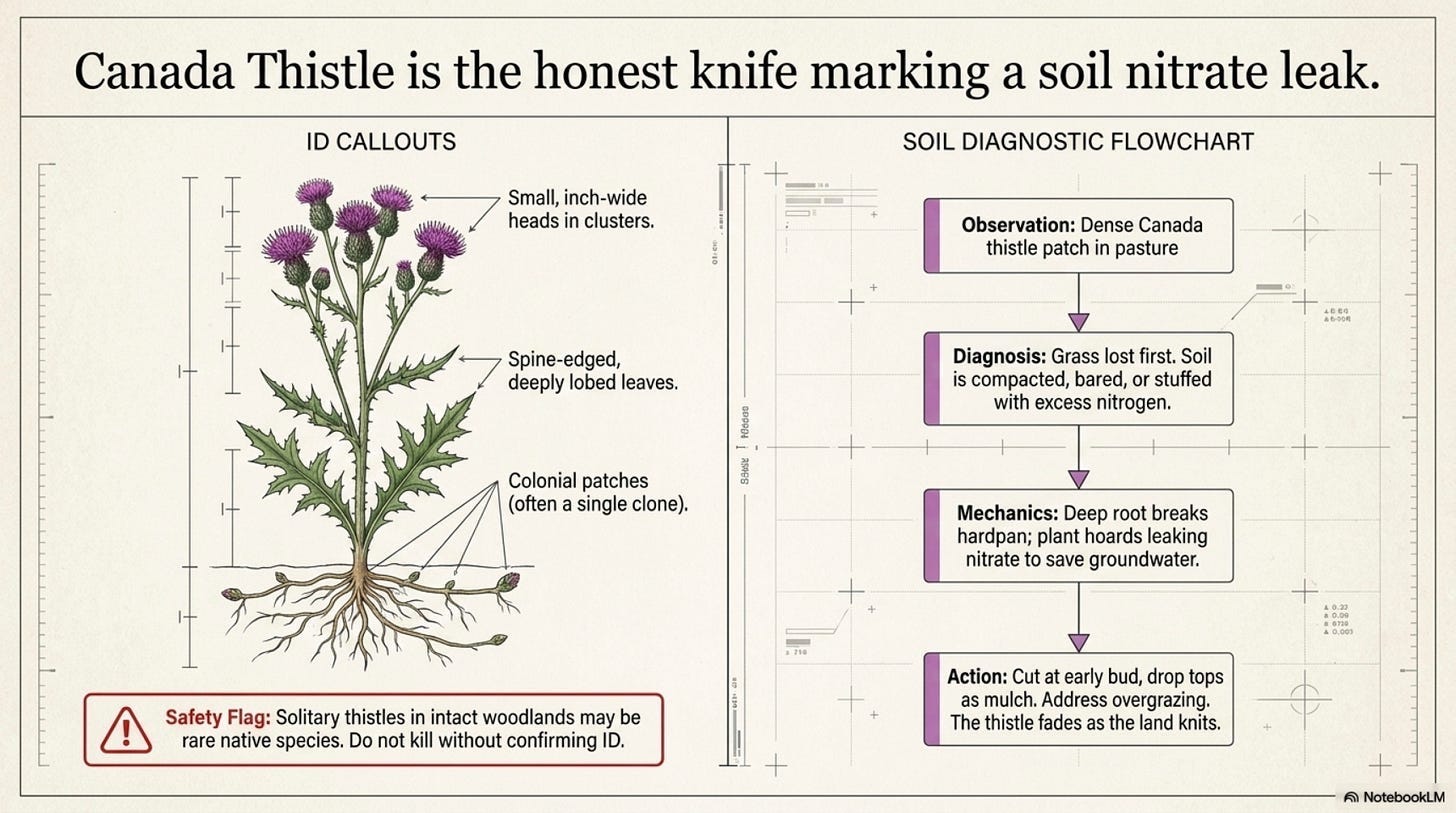
We opened with Canada thistle because it’s the one that means it. Cursed in a Vermont statute in 1795, an accident off a ship, and yet the plant that shows up only where the land already got hurt, the plow, the flood, the overgrazed pasture. Armed to the leaf-edge, and underneath the spines, a root driving several feet down to break your hardpan and hand the deep minerals back up. The armor was never the point. It was the fence around the repair work.
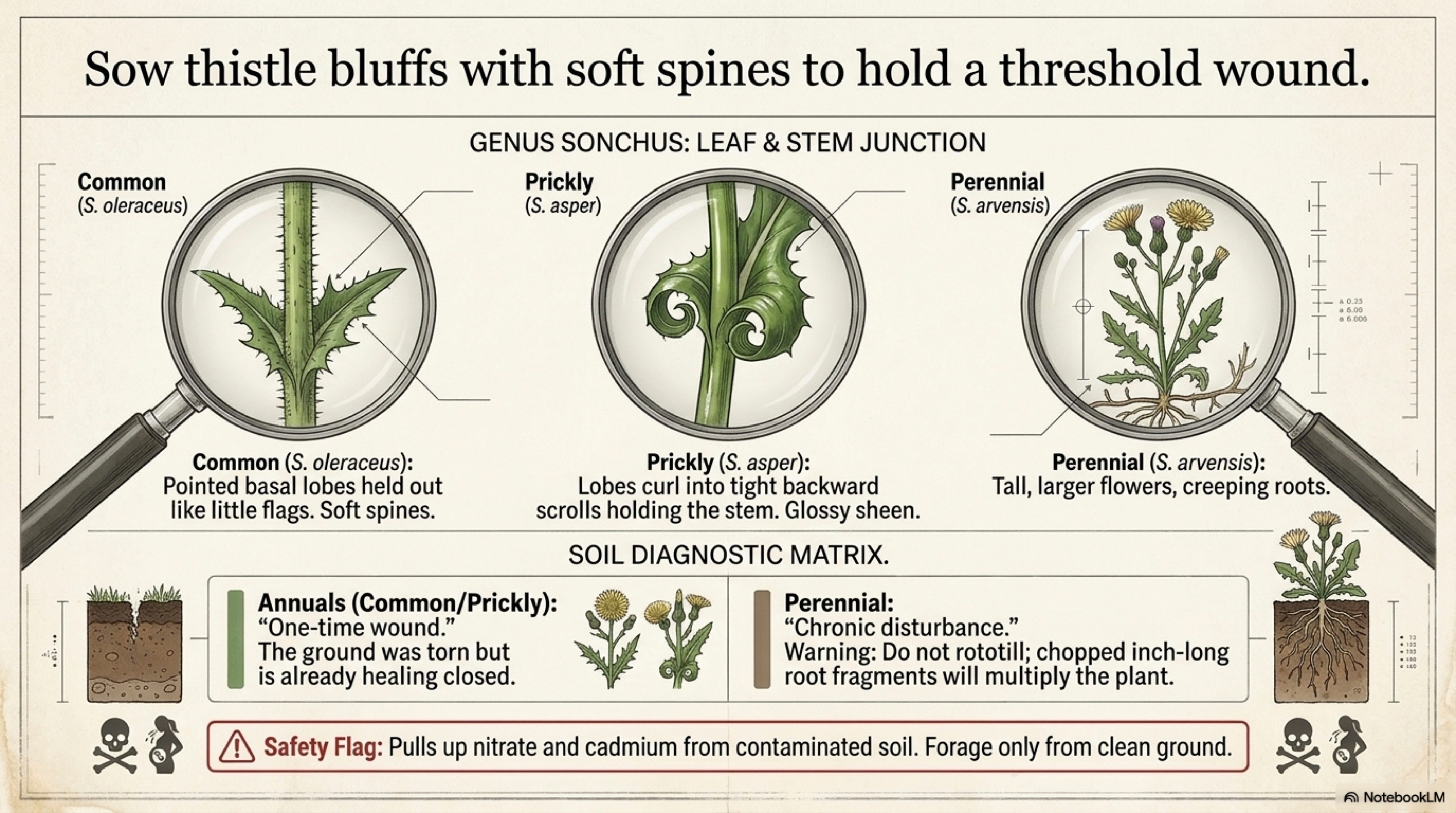
Then the sow thistle, to prove not every thistle bites back, and that the fiercest-looking of a family is sometimes the gentlest. Soft-spined, mild, one of the oldest pot-herbs on earth, bleeding the same white milk that nine separate cultures swore made mothers’ milk. You can eat it before it flowers. The costume is mostly for show.
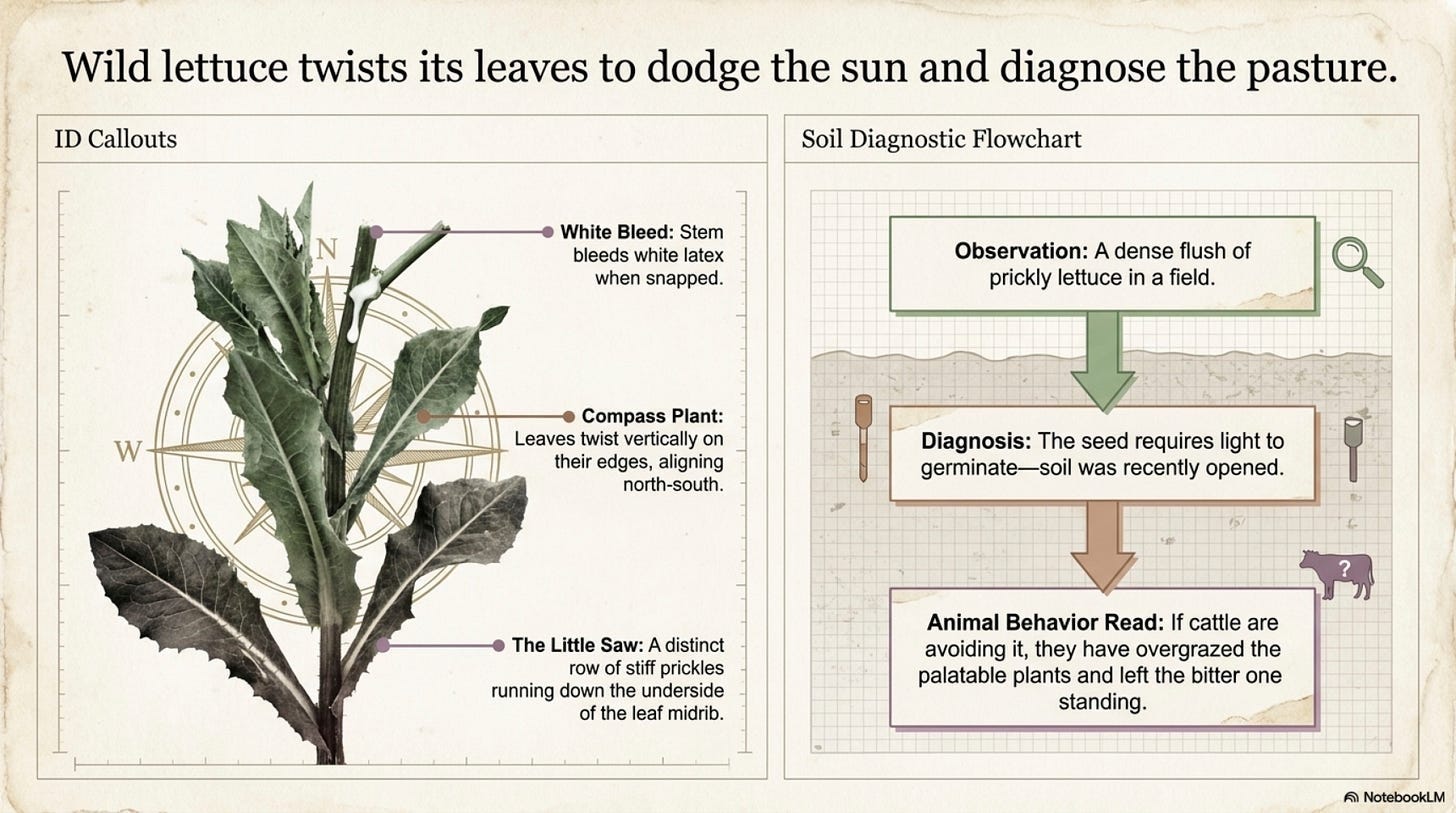
And then the wild lettuce, which quietly moved the weapon inward. Its visible arms, those saw-tooth prickles, are almost a distraction. The thing that matters is invisible: a bitter chemistry that sits low in the young rosette and climbs hard exactly when the plant bolts, throws up its flowering tower, and stands most exposed. It arms itself at the moment of its greatest vulnerability. Watch a herd read it, cattle nip the sweet spring rosettes and refuse the same plant by July, and you’re watching the tide come in.
So follow the line across the three and you see the armor migrate. Steel at the leaf-edge on the thistle. A soft bluff on the sow thistle. Invisible, in the sap, on the lettuce, a knife you can only taste. The warning moves from the thumb to the tongue.
Here’s the question the chapter was really asking. Why do the plants that colonize our broken ground come armed at all? Because bare ground is the most dangerous place on earth to be a plant. You’re the only green thing back. Every hungry mouth for a mile finds you first, and finds you alone. A pioneer of damage that can’t defend itself gets eaten before it can do a single day’s repair. The spine, the bluff, the bitter milk, that’s the cost of going first. Armor isn’t hostility here. It’s the price of showing up to a wound before anything else will.
And this is the part I keep turning over. On all three, the weapon is the gift, held behind a little discipline. The thistle spine guards a spring stem that tastes faintly of artichoke. The bitterness you cook out of the sow thistle is the same bitterness you’d reach for if you were sick in the old way. The latex that drives the cow off the lettuce is the resin the apothecary walked into the field to harvest. Arm and offering, the same organ, you just have to know the hour.
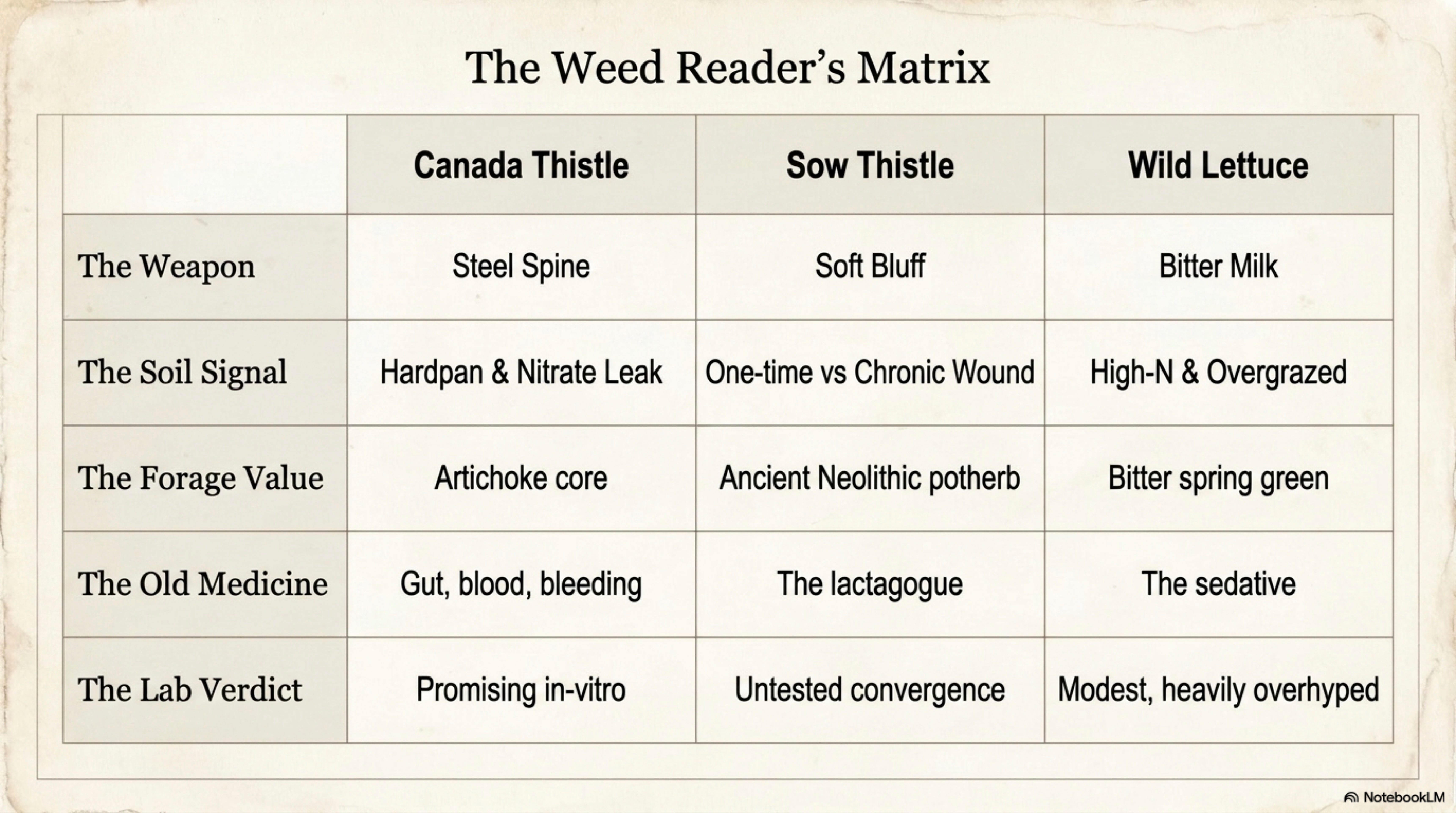
Which is the honest place to leave it, because each of these plants also handed us a claim, and the claims didn’t all cash out the same. The thistle: healers on three continents reached for the gut, the blood, the bleeding, and the chemistry says promising, not proven. The sow thistle: twenty-three centuries of mothers said the white sap makes milk, and the lab’s verdict is the maddening probably, but nobody has run the test. The wild lettuce: “opium lettuce” is a real name off a real drug, and the mu-opioid claim underneath it rests on a receptor test nobody has actually run. Three armed plants, three loud old claims, and a range of answers from maybe to we don’t know yet, which is exactly what it looks like to read the land honestly instead of flattering it.
And then there are the details that fit no argument at all and stay with you anyway. That goldfinches time their whole nesting season to thistle down, and line their nests with its silk, a bird scheduling its children around a weed’s calendar. That the Potawatomi learned to work sow thistle’s sticky latex into a call that mimics a distressed fawn, and drew deer within bow range with a plant that reached this continent only after they did. That wild lettuce turns its leaves on edge to point north–south, a living compass standing in the ditch, and carries in that same bitter milk a thread of real rubber, the kind a country might one day farm instead of import. None of it proves a thing. All of it is worth stopping for. That, more than any claim, is what I hope stuck: not the answers, but how much there is to notice once you slow down enough to look.
Thank you, by the way. You read two thousand words about a plant most people spray. That’s not nothing, and I don’t take it as given. The numbers are the only honest applause there is, and they’ve been kind this month.
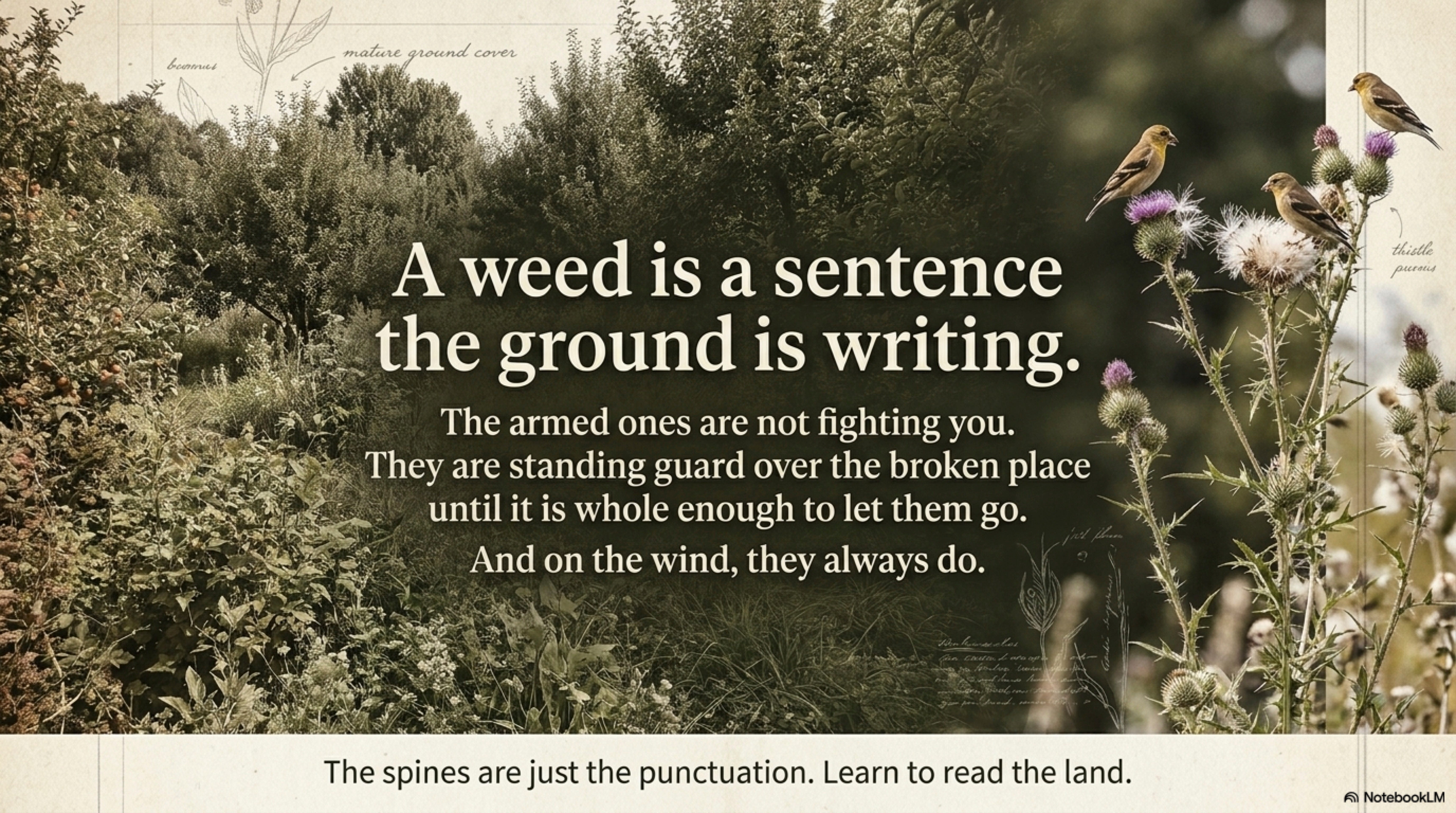
If the thistle and the lettuce taught you anything this month, it’s that a weed is a sentence the ground is writing, and the spines are just the punctuation. Learning to read those sentences is the whole quiet skill, reading a hillside the way you’d read weather.
The armed ones aren’t fighting you. They’re a fence around the broken place, standing until it’s whole enough to let them go, which, every time, they eventually do. On the wind.
Next Wednesday the armor stops pretending to be subtle.
Himalayan blackberry is up next. Arms you can see from the road, fruit worth the scratches sitting right inside the cage. The plant that quit bluffing.
It opens a run on the berries, and it’s the only one of the four that came here on a boat. After it: Oregon grape, holly-leaved, sour enough to stop you mid-bite, hiding inner bark the color of a school bus under your thumbnail. Then salal, which most of the world meets only as the green filler behind supermarket roses, and which is, in Britain, a noxious weed with a control budget. Then saskatoon, which isn’t a berry at all. Halve one and you’ll find a core, five little chambers, seeds in a ring, the whole architecture of an apple shrunk to the size of a pea. It’s a pome, same as a pear, same as a quince. A rose that decided to make dinner instead of a bouquet, and made it in miniature.
We’ll be honest about which is which, and about how little that distinction means to a bear.
The work behind this post lives in three books.
The Holistic Vineyard — a systems-based guide to regenerative viticulture and living soils: four pillars, one seasonal cycle, and decision matrices for the moments when knowing what not to do matters most.
Reading the Land — a regenerative coaching guide for learning to see what your ground is already telling you.
Healing Soil — a guide to biological restoration, for ground that’s gone quiet.
Reading the Land is included with a paid subscription here.
If one of them has been useful to you, an honest review does more than any ad I could afford. Reviews are the closest thing I’ve got to a working compass.

Thank you for sharing this information about these plants. A long time ago I set out to learn different healing qualities of weeds that I pulled in large amounts. Some I use, some the pollinators have shown me who visits them, and others made into a stuffed cheese filled flower "Bindweed" also known to eepel nemodes. Although in invasive in the garden the are many benefits to the the plant. Thank you again.