

Common Vetch - (Vicia sativa)
There’s a scrambling, purple-flowered tangle threading through the grass at the worked edges of your land right now, the field margin, the fallow corner, the ground that was turned over last year, and depending on who you are, you’re looking at a different thing.
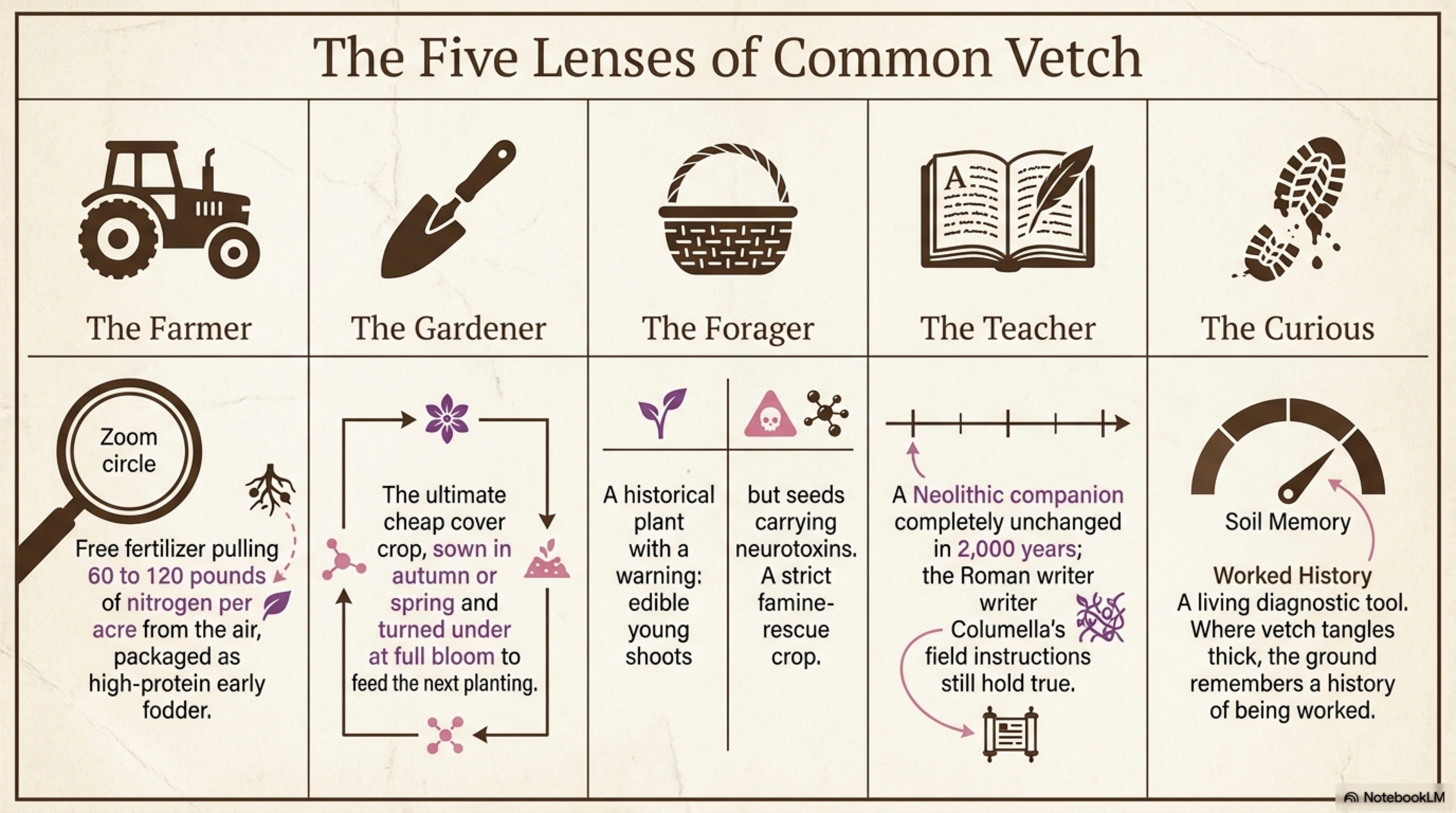
If you farm, you’re looking at free fertilizer: vetch pulls nitrogen out of the air, 60 to 120 pounds an acre, and packages it as high-protein fodder your sheep and cattle pull down ahead of the grass.
If you garden, it’s the cheapest cover crop in the catalog, sown in autumn or spring and turned under at bloom to feed whatever you plant next.
If you forage, it’s a plant with a warning folded in: the young shoots are edible, but the seeds carry a neurotoxin, and people only ever ate them when the harvest failed.
If you teach, it’s a ten-thousand-year companion the Chinese named famine-rescue wild pea and the Romans wrote field manuals for, Columella’s instruction to plow it under while green has needed no correcting in two thousand years.
And if you’re just curious, it’s a diagnosis: where vetch tangles thick, the ground has been worked.
All five are right. Start with knowing what you’re holding, because the danger in this plant isn’t where you’d think to look for it.
The plant climbs, and the Latin name remembers it: Vicia probably comes from vincire, “to bind,” for the branched tendrils at the leaf tips that coil around any standing neighbor within hours of touching it. The leaves are pinnately compound, a row of small leaflets, but the leaf doesn’t end in a leaflet; it ends in that grasping tendril. The flowers are the giveaway: small purple-to-violet pea-flowers, usually darker-veined, sitting one to four right in the leaf axils, not gathered into the showy one-sided sprays the tufted and hairy vetches throw up. And with a hand lens, check the little stipules where the leaf clasps the stem: common vetch wears a pair of dark glandular dots there, extrafloral nectaries, like punctuation. That’s your clean field mark.
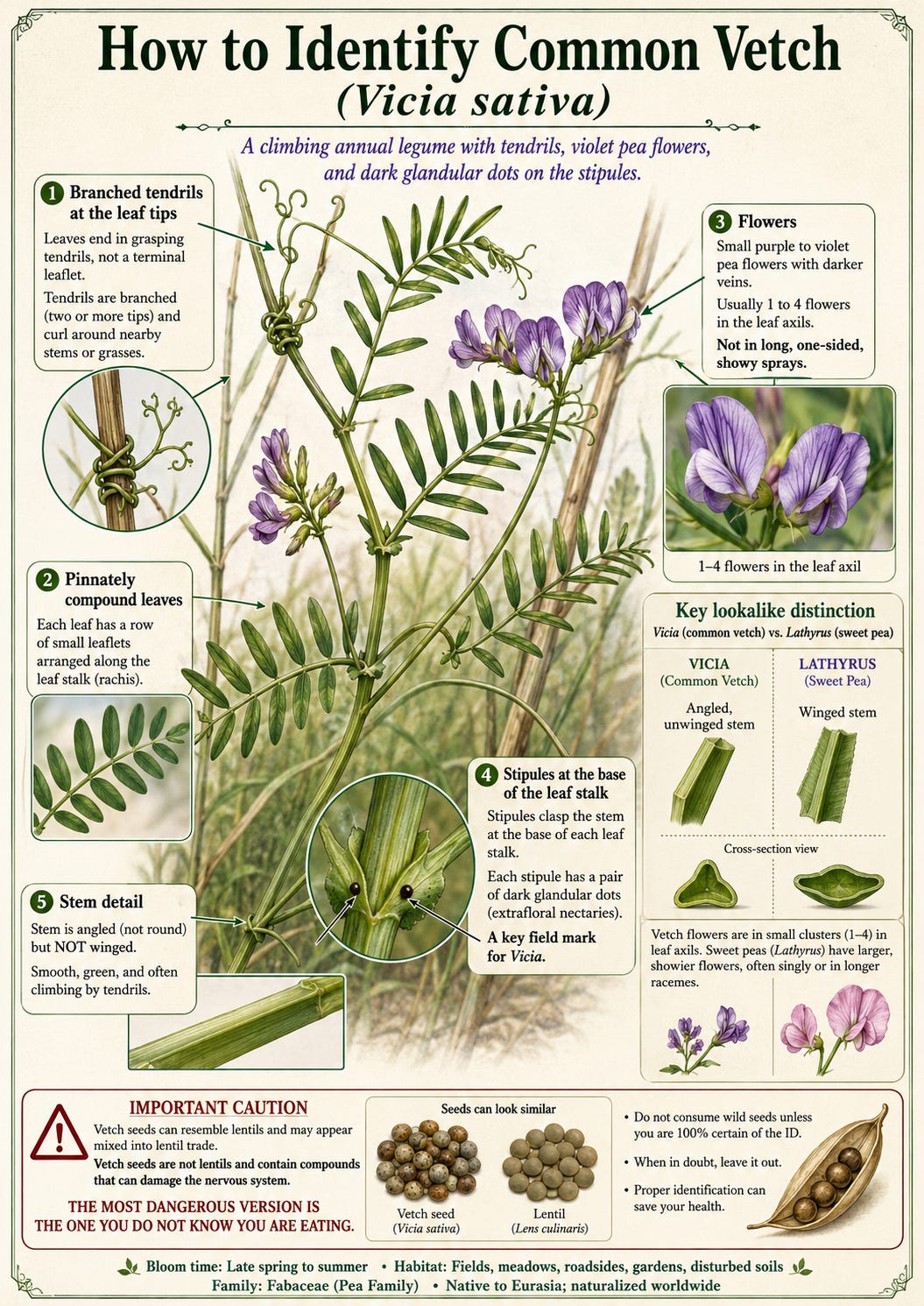
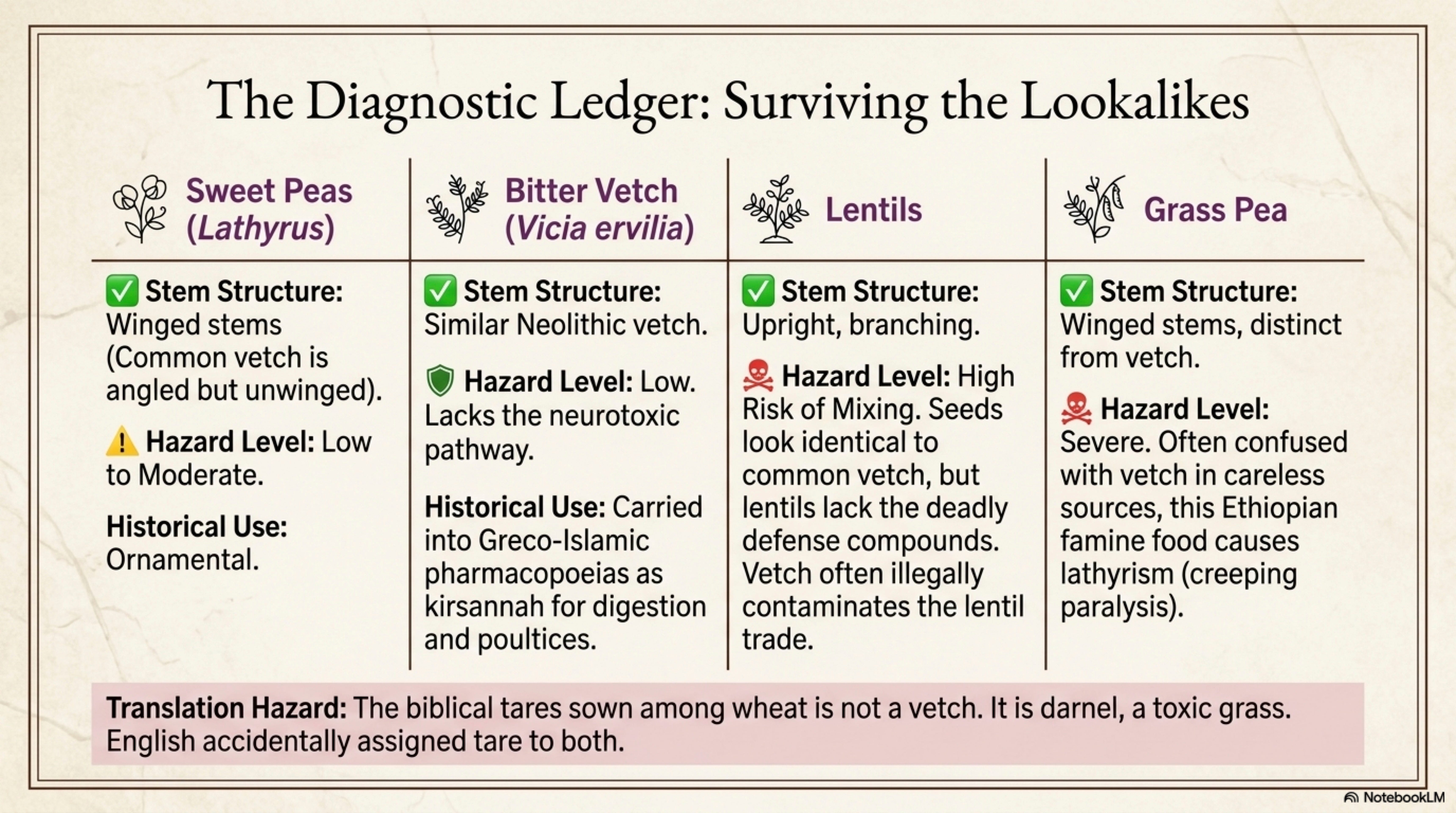
The lookalikes inside the genus are mostly low-stakes, vetches share their chemistry and uses, so mistaking one for another rarely costs you; the genus to keep it apart from is Lathyrus, the sweet peas, which carry winged stems where vetch keeps its angled-but-unwinged. But the danger that actually bites isn’t on the hillside at all. Vetch seeds look enough like lentils that they turn up, illegally, mixed into the lentil trade, and unlike a lentil, a vetch seed is loaded with compounds that damage the nervous system. The most dangerous version of this plant is the one you don’t know you’re eating.
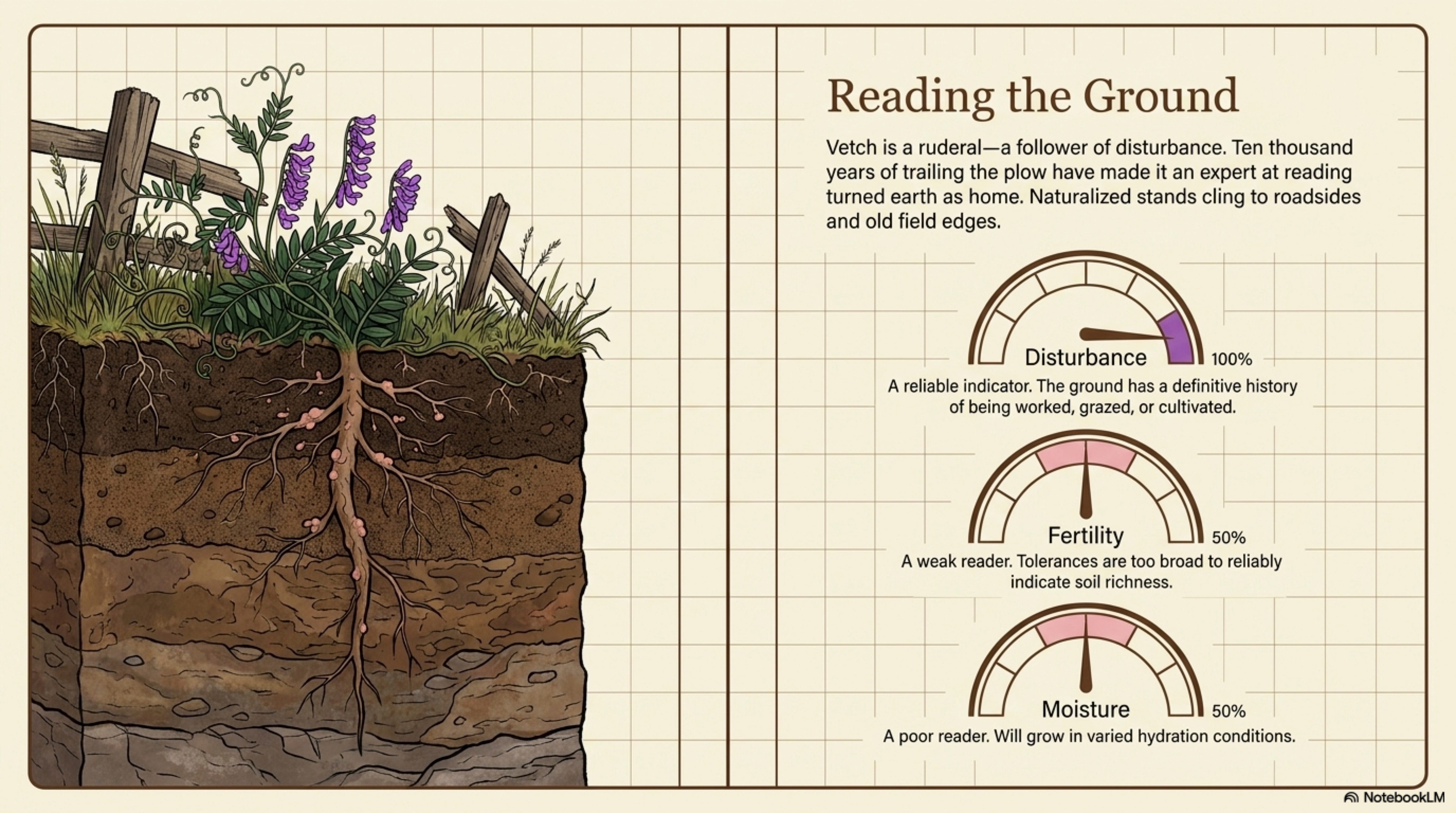
Now read the ground it’s standing on. Vetch is a ruderal, a follower of disturbance, and ten thousand years of trailing the plow have made it very good at one thing: reading turned earth as home. Its presence is a soil-read. It tells you the ground has a history of being worked, grazed, or cultivated; naturalized stands cling to roadsides and the edges of old fields. It’s a weak reader of fertility and a poor one of moisture, its tolerances are too broad to pin those down, but disturbance it marks reliably. And here is the part worth stopping on, because it’s the whole lesson of the plant: the work that matters is happening where you can’t see it. Three feet down, on the lateral roots, sit small nodules, pink inside when they’re working, colored by the same iron-and-oxygen chemistry that reddens your blood, and inside them a bacterium, Rhizobium leguminosarum, is pulling nitrogen straight out of the air and handing it to the plant in trade for sugar. The purple flowers are the advertisement. The real transaction is underground, invisible, and it’s why this scruffy weed has been worth sowing since the Neolithic. Vetch doesn’t just grow on worked ground; it quietly pays the soil back for the working.
So the safe, useful thing to do with vetch asks for no health claims at all, because, unusually, there are none to make. Its entire value is agronomic, so leave it, or sow it, where you want the soil fed. As a cover crop it fixes nitrogen, smothers weeds, and holds thin ground against erosion; turned under at full bloom, its low-carbon residue rots fast and feeds the next crop almost immediately. It pairs best with oats, the oat gives the vetch something to climb, the vetch gives the oat nitrogen, and it self-seeds happily into an orchard or vineyard understory, where its nectaries also bankroll a crew of beneficial wasps and hoverflies. None of this asks you to trust a word about a tincture, because nobody ever made one.
If you do one timed thing, get ahead of the seeds. The toxins concentrate as the pods fill, so graze or cut the stand while it’s still leafy, before seed set, the animals already know this and refuse the hardening pods on their own, a signal worth trusting. For green manure, turn it in at full bloom, when biomass and nitrogen both peak. And if you’re saving seed, beat the shatter: on a hot dry afternoon you can actually hear a ripe stand crackling as the pods twist open and fling their seed a yard in every direction. That sound means you’re already a day late. Otherwise, simply let it be, hold the slope, feed the wasps, read the soil, put nitrogen back.
Here’s what I can’t walk past, though. Ten thousand years, longer than wheat has been bread, and this plant appears in no herbal, no pharmacopoeia, no medicine cabinet anywhere. Not the Greek physicians, not Chinese medicine, not Ayurveda, not the village wise-women of Europe. The animals eat the leaves and spit out the seeds. And every culture that ever met it, on every continent, with no contact between them, independently filed it under the same heading: not food, not medicine, fodder and soil. A verdict that unanimous is a strange thing.
So which is it, is that silence a gap in the record, a plant nobody got around to studying? Or is it a verdict the plant earned, written in its own chemistry? And of all the legumes in all those fields, why was this the one the whole world agreed to feed to the animals and plow under green?
That’s the question on the other side.