

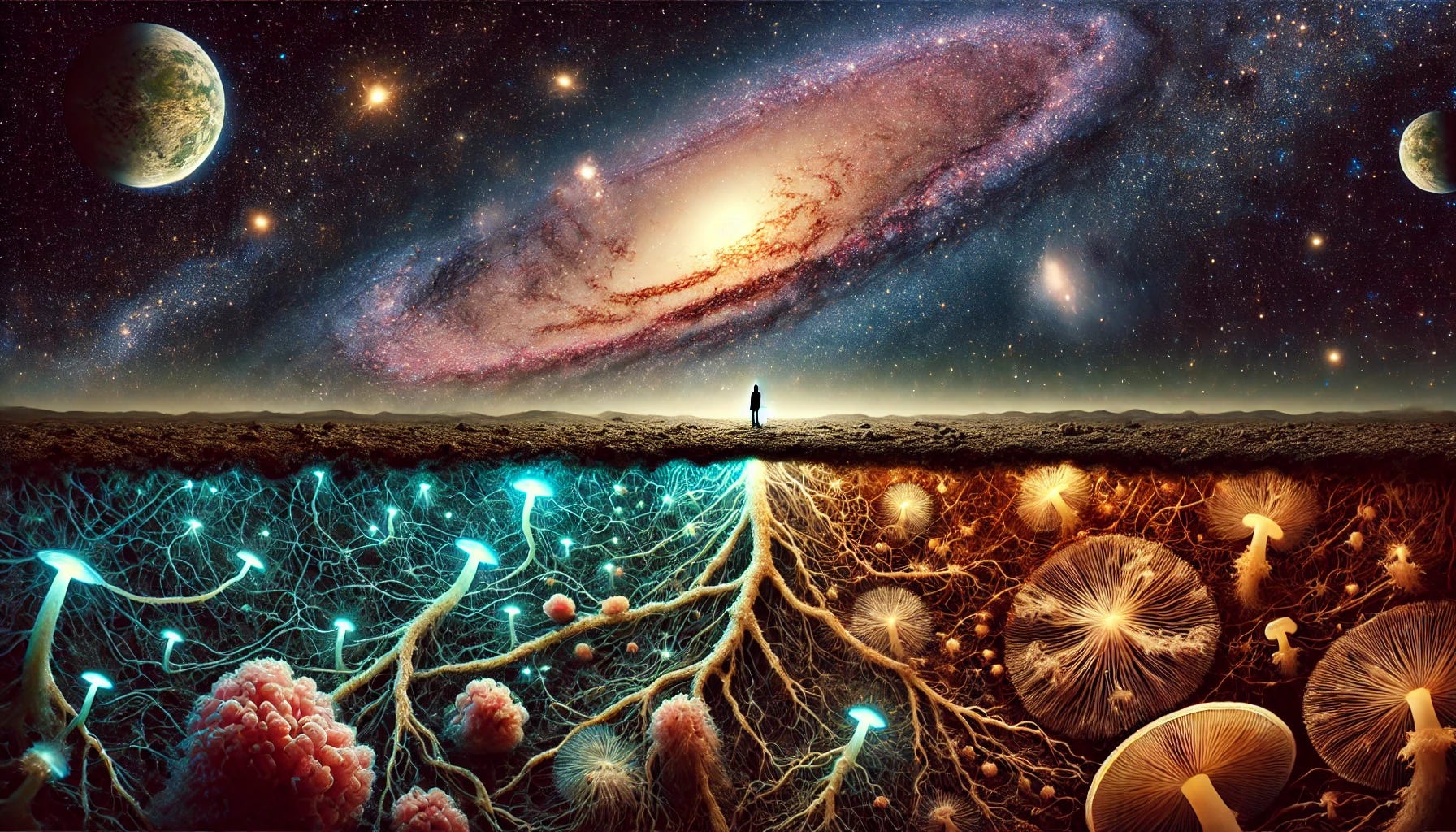
Lately, I’ve been circling around a thought I can’t shake: What if everything we think we understand—about life, nature, our place in it all—is just a fraction of the picture? What if the forces shaping us, shaping the planet beneath our feet, are working at scales we barely perceive? The more I dig into soil, the more I see the parallels stretching outward, far beyond Earth.
What if the vastness of space and the teeming world beneath our feet are two sides of the same coin?
The observable universe stretches across 93 billion light-years, filled with some 100 billion galaxies, each cradling billions of stars. Now scoop up a handful of soil—living, breathing earth—and you’re holding 10 billion microbial lives in a single gram. Bacteria, fungi, archaea, all locked in a constant dance of survival and cooperation.
Both realms are immense, overwhelming, and mostly invisible to us. Both remind us how little we actually know.
I’ve been chewing on a theory: everything on Earth is shaped by forces we can’t fully measure, let alone understand. Cosmic radiation trickles through our atmosphere, silent and unseen. Microbes in the soil whisper chemical messages, rewriting the script of life at scales too small for us to track. The more I sit with it, the more it feels like the universe and the soil aren’t just vast in opposite directions—they’re mirrors, each reflecting our ignorance back at us.
Space runs on gravity and chemistry, a vacuum punctuated by rare brilliance. Soil runs on biochemistry and ecology, a dense, messy, breathing microcosm. Both stretch beyond our ability to control, yet here we are, always trying.
And here’s where we get reckless. We don’t just exist on Earth—we rewrite it, we alter it. We clear forests, pump carbon into the sky, pave over the microbial cities in our dirt. And everything shifts in response. Species vanish, ecosystems recalibrate, weather rewires itself. It’s a chain reaction we barely notice, let alone predict. Instead of learning how to move with the complexity, we try to dominate it. We flatten the wild into something simple, convenient, controlled. Monocrops. Concrete. Short-term thinking. Maybe we’re scared of the chaos. Maybe we just don’t have the patience to live alongside it.
But here’s the thing: the vastness of space and soil isn’t just a neat parallel—it’s a warning. We’re tinkering with a system we don’t even begin to understand. Dark matter holds the universe together, unseen. Microbes run the soil, unnoticed. Both whisper the same truth: we are not the only players here, and we are nowhere near as smart as we think.
So what if, instead of bulldozing the complexity, we leaned into it? What if we stopped trying to tame Earth and started listening to its wildness?
Maybe the lesson isn’t to conquer, but to collaborate. Maybe the real intelligence isn’t in control, but in connection.
The universe doesn’t need us to understand it. But it leaves clues—written in the stars, in the dirt, in every breath of life that persists despite us. If we’re paying attention, we might just realize: we’re part of something far bigger, far wilder, and far more alive than we ever imagined.
Just some thoughts :)
Profound thoughts, and I’d argue, very close to the reality we too share.
We are less familiar with earth than … mars or the moon