

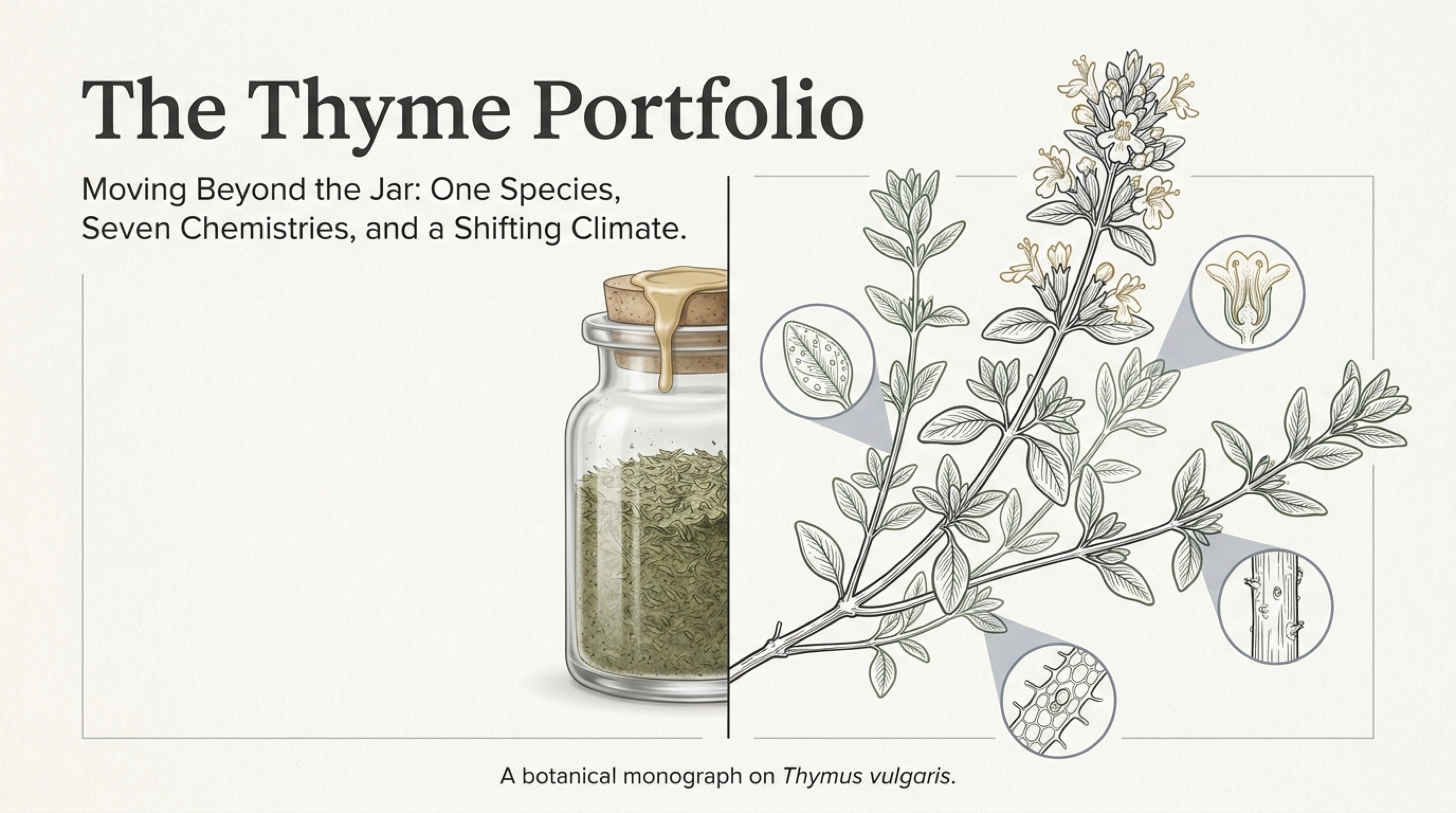
I don’t normally research herbs. Most weeks this page belongs to the plants nobody planted on purpose.
But I thought it might be fun to dive deep into the world of herbs for a bit, and thyme looked like an easy place to start. Everyone knows thyme. It turns out there is a good deal more in the jar than I expected.
Start with your hands.
Rub a thyme leaf between your thumb and finger. The leaf is no bigger than a fingernail clipping, and what comes off it is not subtle. It is hot, medicinal and a little bitter.
Here is the part most of us never check. What it smells of depends on which plant you are holding. One thyme smells of mouthwash. Its neighbour smells of lavender. The one beside that smells of pine. They are all the same species, Thymus vulgaris, and the difference is inherited.
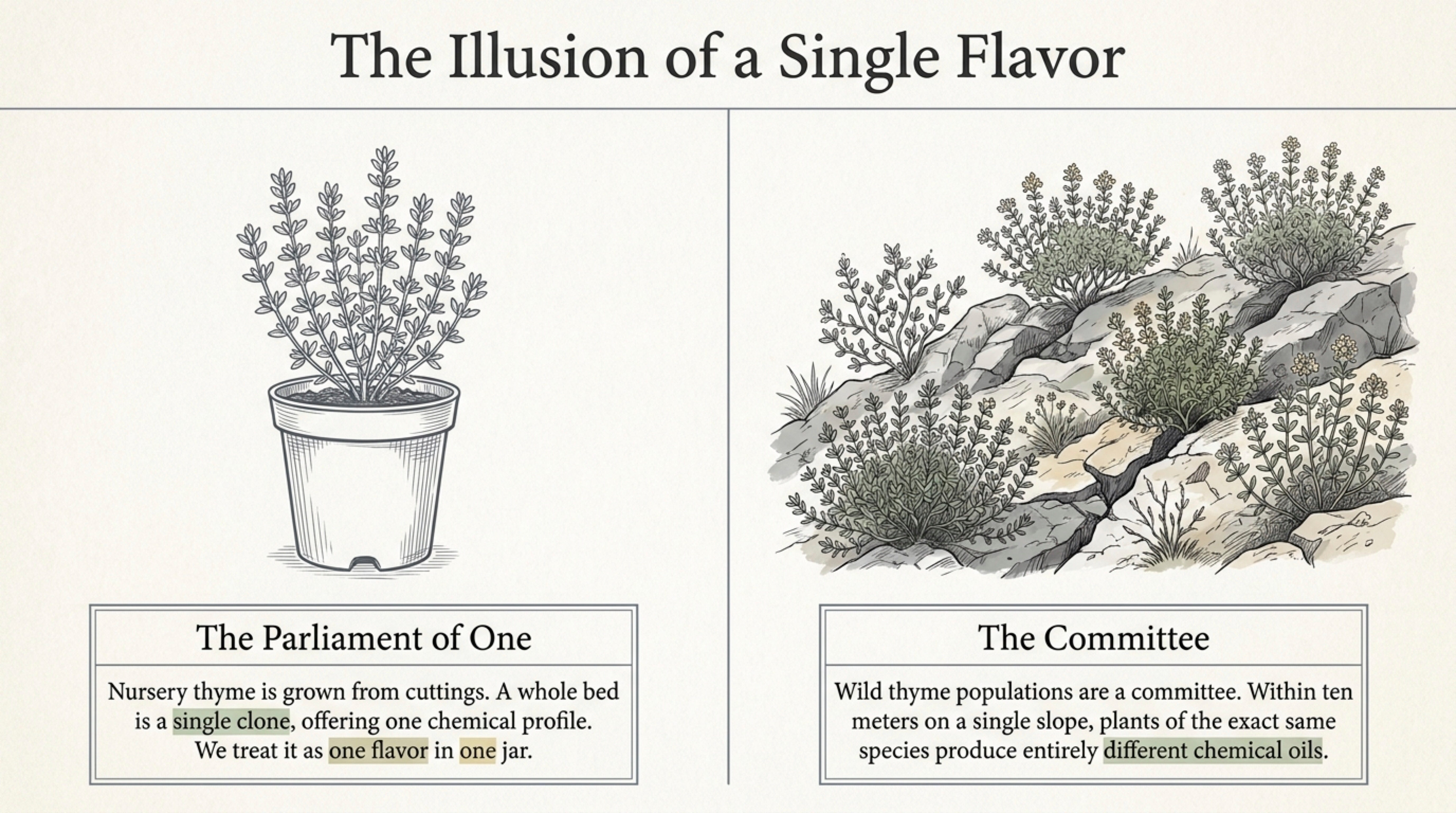
We treat thyme as one flavour in one jar. On its home hillsides it is closer to a committee.
Thyme keeps seven chemistries inside one species
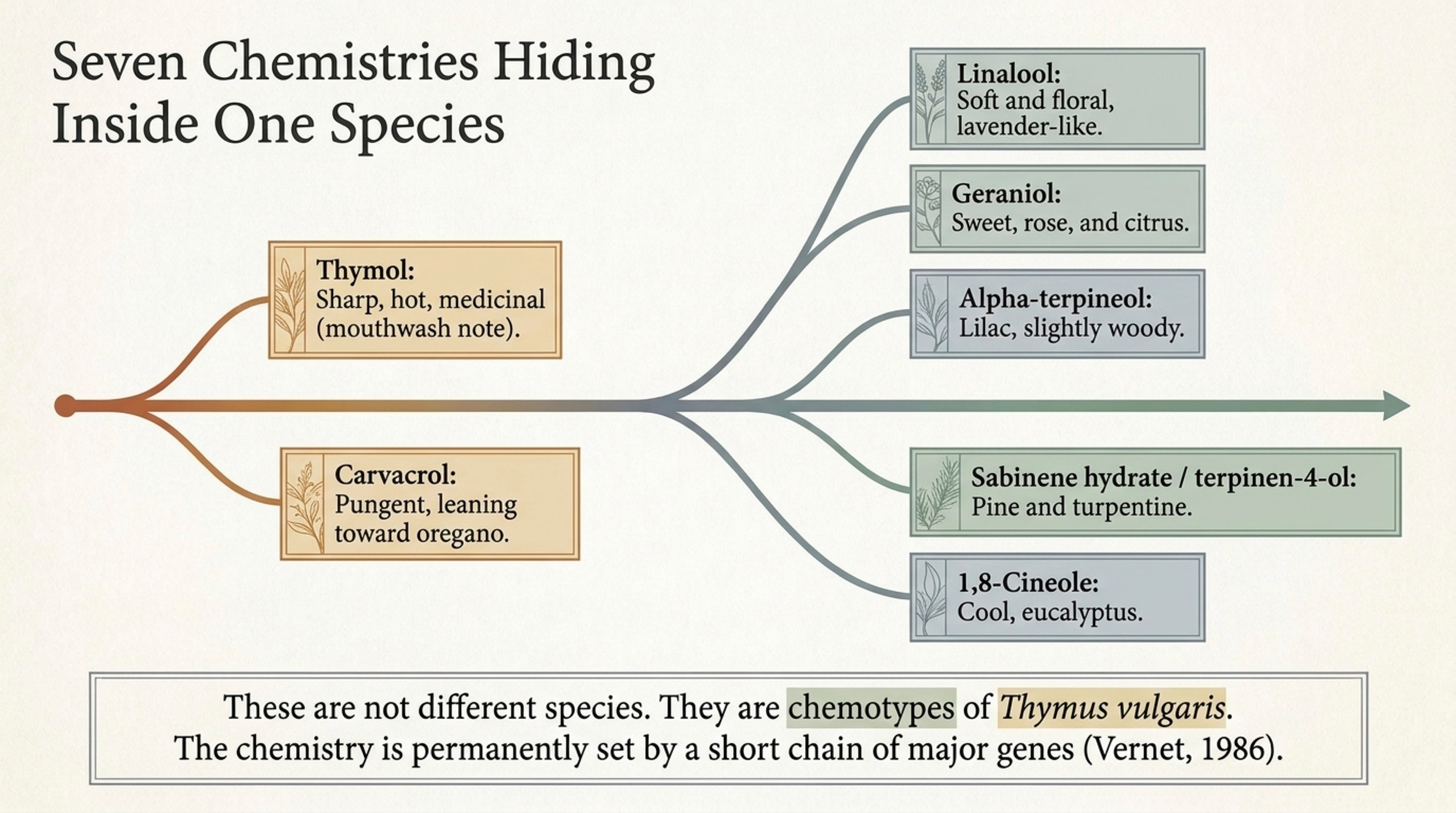
In 1973 two French researchers, Granger and Passet, described six “chemical races” in the wild thyme of southern France. In 2009 Keefover-Ring, Thompson and Linhart added a seventh. Botanists call them chemotypes: same species, same leaf, a different essential oil.
Thymol. Sharp, hot, medicinal. The mouthwash note.
Carvacrol. Close to thymol, a little more pungent, leaning toward oregano.
Linalool. Soft and floral, toward lavender.
Geraniol. Sweet, rose and citrus.
Alpha-terpineol. Lilac, slightly woody.
Sabinene hydrate and terpinen-4-ol. Pine and turpentine.
1,8-Cineole. Cool, like eucalyptus.
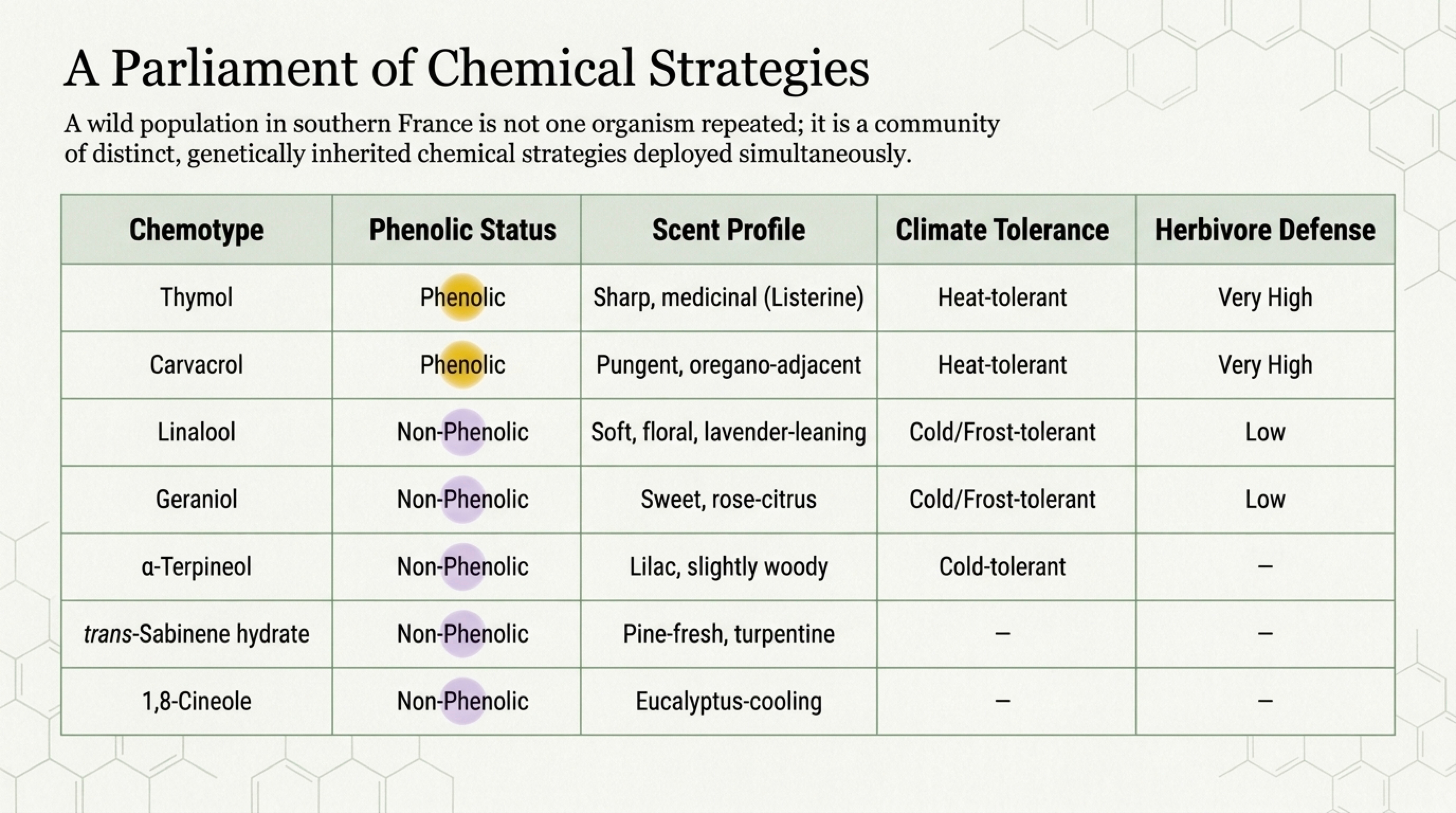
The first two are the phenolic types, the strong ones. The other five are non-phenolic and gentler. A plant does not switch between them. Vernet and colleagues showed in 1986 that the chemistry is set by a short chain of major genes. On one slope, several types can grow within ten metres of each other.
Each chemistry is a bet, and each bet has a cost
The strong chemistries leak. Thymol and carvacrol move into the soil from leaves, roots and rotting litter. In 1995 Tarayre and colleagues found that thyme’s own oils hold back the germination and early growth of competing herbs, and of thyme’s own seedlings. The phenolic types did it hardest. The plant clears a space around itself, its children included.
The same year, Linhart and Thompson fed thyme to the garden snail. The snails avoided the phenolic plants and ate the gentle ones.
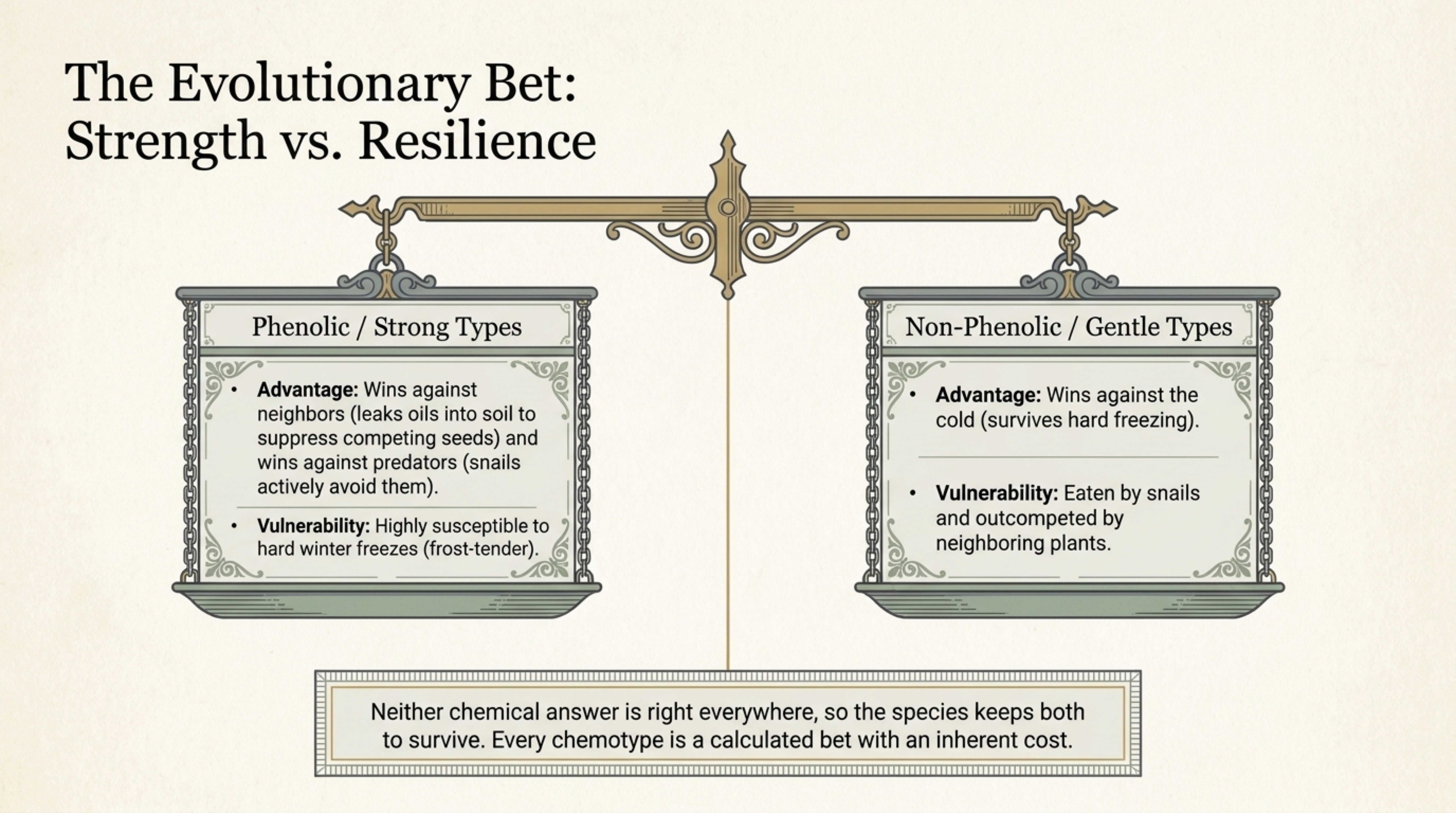
So strong chemistry should win everywhere. It does not, because of frost. Amiot and colleagues showed in 2005 that the phenolic types are the frost-tender ones. The gentle types take a hard freeze better.
Strong against neighbours and snails, weak against cold. Gentle the other way round. Neither answer is right everywhere, so the species keeps both.
The mix shifted within forty years, and someone was counting
Around Saint Martin-de-Londres in southern France, the two groups had sorted themselves by ground. The gentle types held the cold valley basins, where extreme winter freezes were common. The phenolic types held the warmer, drier slopes above about 250 metres.
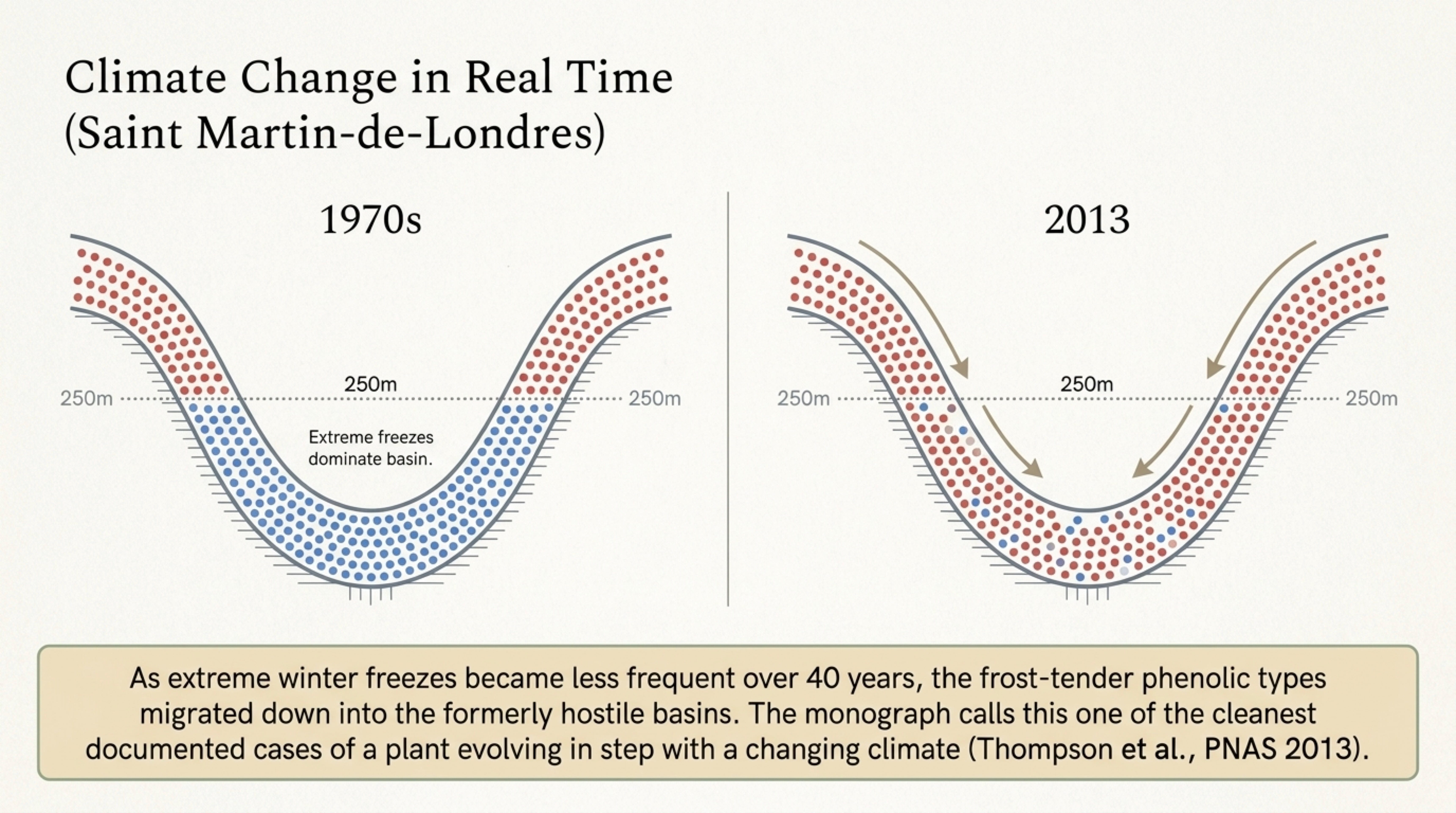
That map was drawn in the early 1970s. Four decades later Thompson and colleagues drew it again and published the comparison in PNAS in 2013. Extreme freezes had become less frequent, and the phenolic types had moved down into the basins that used to exclude them.
The monograph calls this one of the cleanest documented cases of a plant evolving in step with a changing climate. It also flags the limit: this is one landscape over forty years. Nobody has yet repeated it in Spain, North Africa or anywhere else thyme grows.
Much of the hillside is female
Wild thyme comes in two sexes, and they are not the two you would expect. Some plants are hermaphrodites, with pollen and seed. The rest are female only, with smaller flowers and no pollen. Across southern French populations, females make up anywhere from 30 to 95 percent of the plants (Couvet 1990; Manicacci 1996; Tarayre and Thompson 1997).
The females skip the cost of making pollen and set proportionally more seed. Bees still visit them for nectar.
You will not see any of this in a garden. Nursery thyme is grown from cuttings, so a whole bed is one plant repeated. The pot on your windowsill is one member of a parliament.
The thyme of the Greeks was a different plant
The thyme of Theophrastus, of Mount Hymettus and its famous honey, was not this one. It was Thymbra capitata, a plant of the eastern Mediterranean that now sits in a different genus (Baumann 1993). Common thyme is a western plant, native to Spain, Portugal, southern France, western and central Italy, and northern Morocco and Algeria. It became the cooking thyme of Europe later, through Roman estates and medieval gardens.
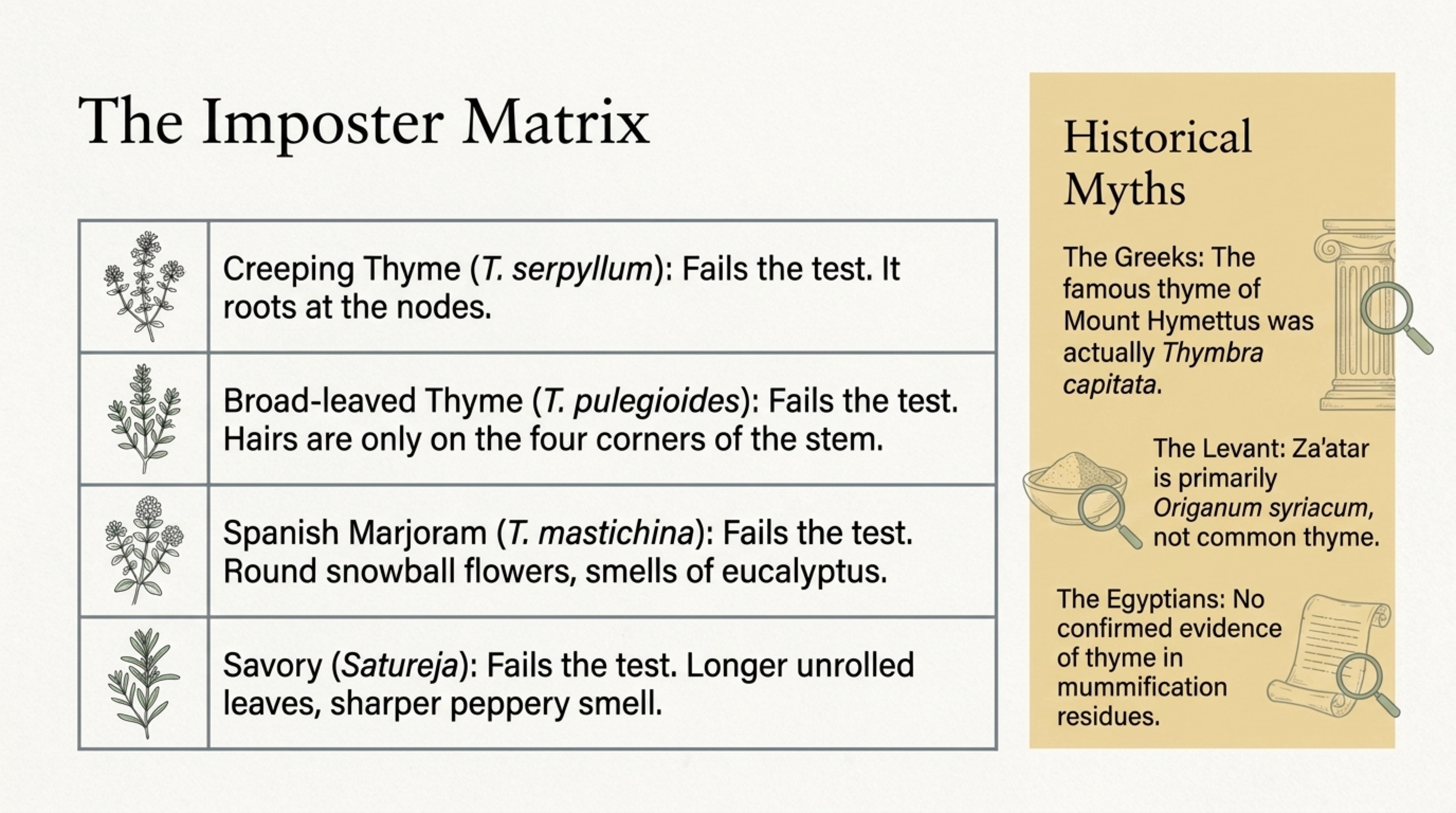
Two more stories fail the same check.
Za’atar is not thyme. The Levantine herb is mainly Origanum syriacum, as Fleisher and Fleisher (1988) and Dafni (2008) record. Common thyme arrived there by cultivation.
The Egyptians probably did not embalm with it. The claim has been repeated for two centuries. Lucas and Harris (1962) are silent on thyme in mummification residues, and Manniche (1989) lists it only tentatively, from Greco-Roman era recipes.
How to tell common thyme from its kin
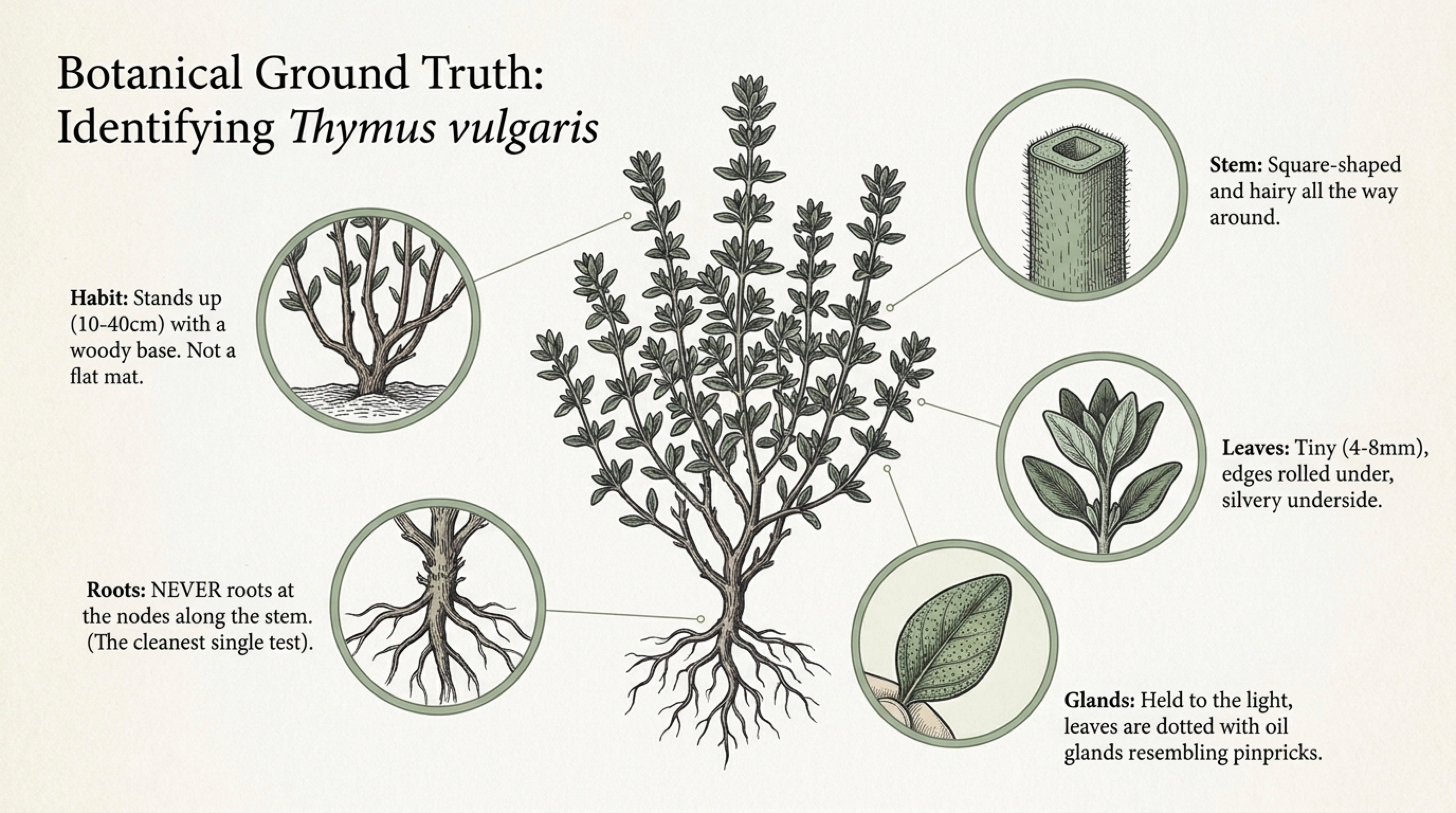
It stands up. A small woody-based shrub, 10 to 40 cm tall, not a creeping mat.
It does not root along its stems. Creeping thyme (Thymus serpyllum) roots at the nodes. Common thyme never does. This is the cleanest single test.
The stem is square and hairy all the way round. Broad-leaved thyme (T. pulegioides) carries its hairs only on the four corners.
The leaves are tiny and rolled. They are 4 to 8 mm long and narrow, with the edges curled under and a silvery underside. Held to the light, they are dotted with oil glands like pinpricks.
The crushed leaf smells strongly of thyme. Of one of the seven, at any rate.
Thyme has no deadly double. The monograph rates the genus among the safer aromatic plants a forager can meet, and its close kin are non-toxic in cooking amounts. The mistakes here are about getting the wrong chemistry.
Spanish marjoram (Thymus mastichina) has a round, white-bracted flower head like a small snowball. It smells of eucalyptus, not thyme.
Savory (Satureja) has the same habit and habitat. Its leaves are longer and less rolled, and the smell is sharper and more peppery.
One thing to do this week: the rub test
Take down your jar. Rub a pinch between your fingers and smell it. Good dried thyme is hot, bright and clean, and it still looks green. Spent thyme smells of stale hay, has gone grey-brown, and leaves dust at the bottom of the jar.
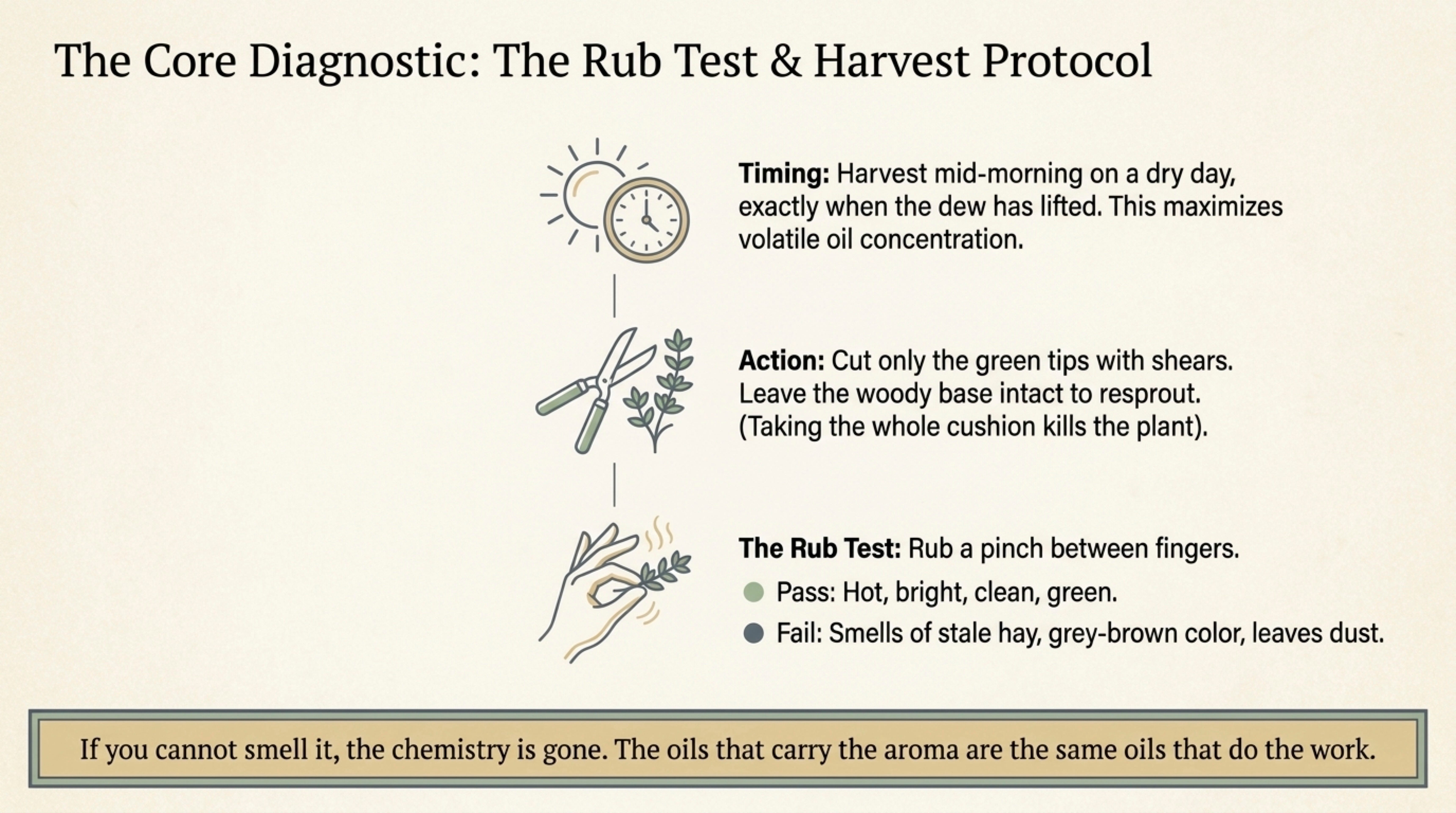
The monograph’s rule is short. If you cannot smell it, the chemistry is gone. The oils that carry the aroma are the same oils that do the work.
Run the same test on a living plant, mid-morning on a dry day, once the dew has lifted. That is when the smell is strongest. When you cut, use shears, take the green tips, and leave the woody base. The base resprouts. Take the whole cushion and you have killed the plant.
The caution that travels with it. The herb is wide and the oil is narrow. Leaf and flower in cooking and in tea are among the safest of all kitchen aromatics. The essential oil is another matter. Undiluted, it irritates skin and mucous membranes. Swallowed in excess, it harms the gut and the liver. Keep the bottle off your skin undiluted and out of your mouth unless a qualified practitioner is guiding you. In pregnancy, thyme in food is fine. The European Medicines Agency advises against medicinal amounts until there is more data.
From here the questions change
That is the plant: seven chemistries, two sexes, and a population that reshuffles itself when the winters change. Everything so far is about what thyme is.
The rest is about what you do with it. That is where the answers stop being facts and start being judgment calls, and where a wrong call costs money, a crop or a hive.
Below the line, five bigger questions, each answered by name:
For the grower. Seed or cuttings, and why does garden thyme keep dying on you?
For the herbalist. What does thyme really do for a cough, and where does the evidence stop?
For the beekeeper. How far can thymol be trusted against varroa?
For the stock keeper. Is a goat eating thyme treating its own worms?
For anyone buying or selling. Where is the money, and what is in a bottle labelled thyme oil?
The full monograph, with every source, is here: Thyme monograph