

I usually post about plants the way a field guide does: the plant first, wherever it grows, no postal code attached. This post breaks that habit on purpose. Siberian elm is currently being scouted and removed on private properties in my area, and I thought it would be a fitting “weed” to feature next.
Most of what we know about Siberian elm was learned somewhere else. The studies below come from China, Colorado, New Mexico, Spain and Kansas, and none was done in the Okanagan. Some of those findings may carry over. I found no Okanagan studies testing how well they apply here.
What those studies can’t tell you is what you need once you’re standing there with the saw: which bylaw covers your parcel, when the birds start nesting, who to call about the creek, and what the regional district is already pulling out of the parks. Around here, the people who manage invasive trees for a living have mostly decided the elm should go. For a landowner, the question is whether to act, and how. That answer depends on your ground, local rules and the local calendar.
The plant monograph tells the broader story of the tree, without focusing on any one region. This post is its companion: one valley, one decision, and a plain account of where the record runs out.
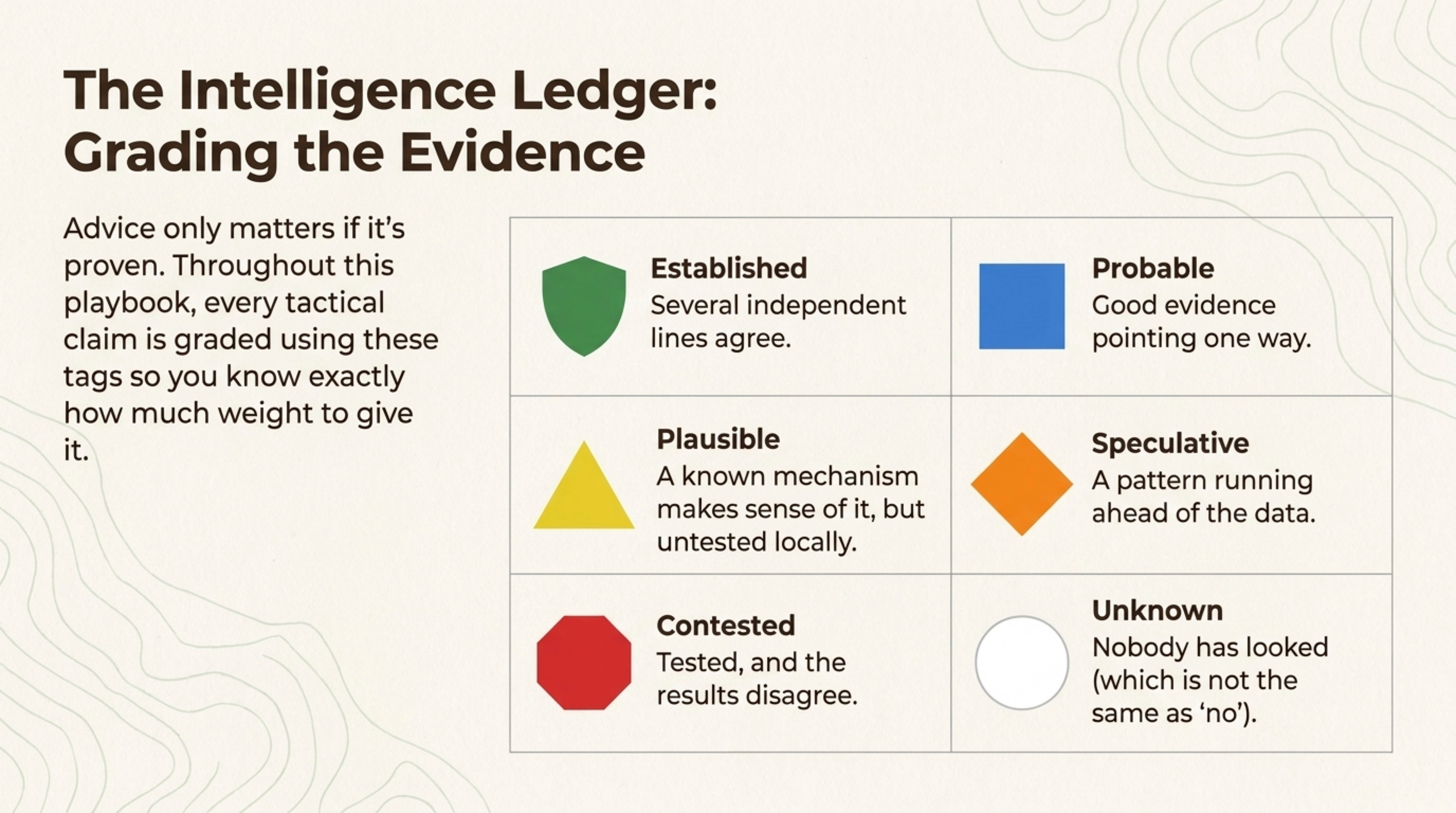
How to read the tags. A tag at the end of a paragraph has two words: how much to believe the claim, then where it comes from.
Established: several independent lines agree. Probable: good evidence pointing one way. Plausible: a known mechanism makes sense of it, but nobody has tested it directly. Speculative: a pattern running ahead of the data. Unknown: I found no evidence that answers the question., which is not the same as “no”. Contested: tested, and the results disagree.
Peer-reviewed is a published study; R4 means observational or pot work, and R1 would be blinded and replicated across sites. Institutional is an agency, flora or extension service. Regulatory-primary is the text of a law, read directly. Theoretical follows from mechanism but wasn’t measured. Absent means I found nothing, and always pairs with Unknown. ⚠ means I read an excerpt or summary, not the full source.
The elm by the fence, with the leaves down
The leaves are down, and for a few months you can see the whole tree: the crown, the dead wood, the fence line it has been leaning into. It’s the easiest time of year to tell an elm you’re keeping from an elm that’s keeping you.
If a Siberian elm stands on your place, you’ve already met the label: tough, fast-growing and drought-tolerant. That reputation is deserved. The label is true, and it’s also the problem. A tree that shrugs off cold, drought and poor soil will shrug off your neglect too.
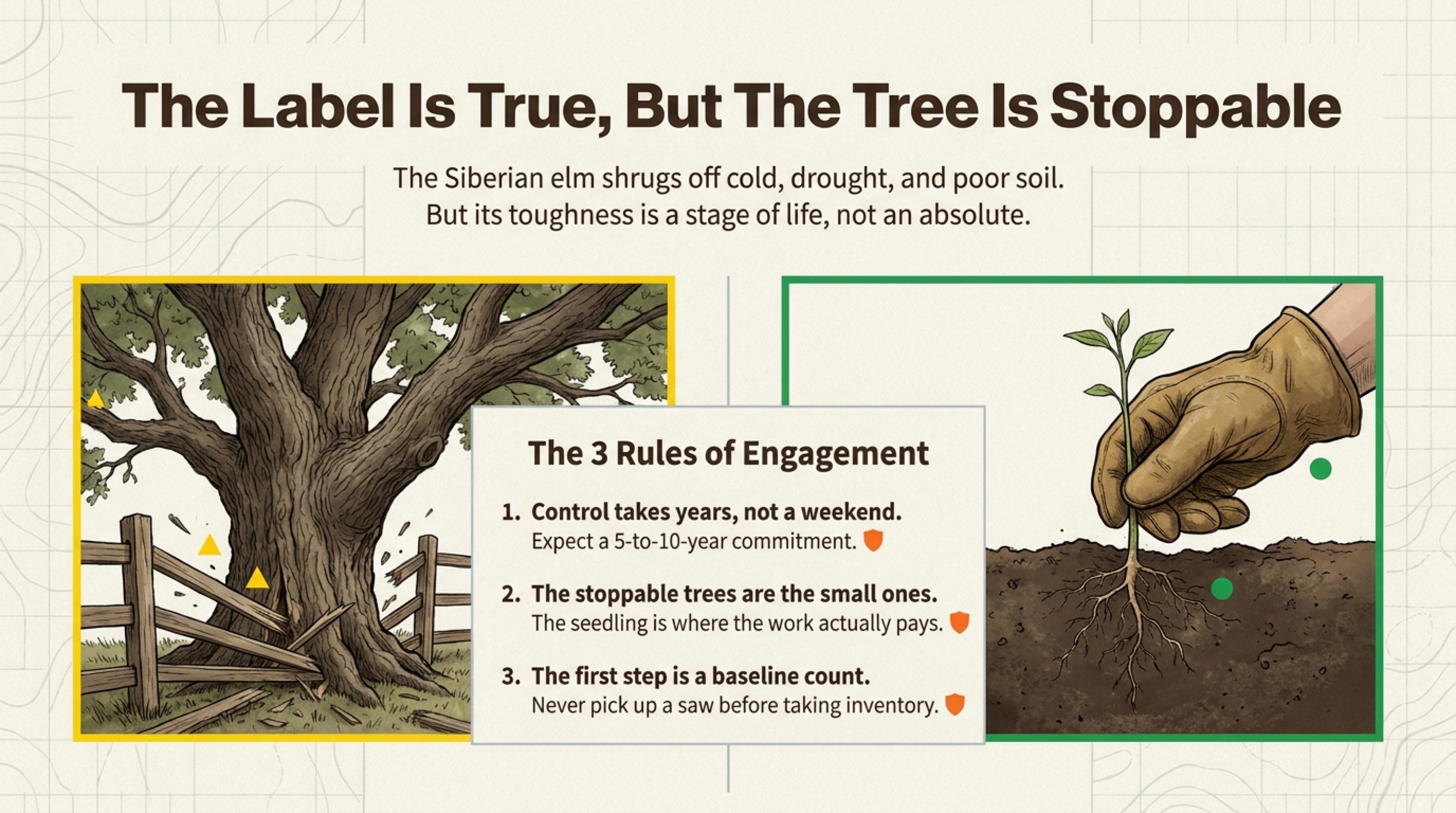
Three ideas hold it together:
Control takes years, not a weekend. The US Forest Service field guide says five to ten.
The trees you can actually stop are mostly the small ones.
The best first step takes about as long as a coffee: a count.
Where the research runs out, I’ll say so.
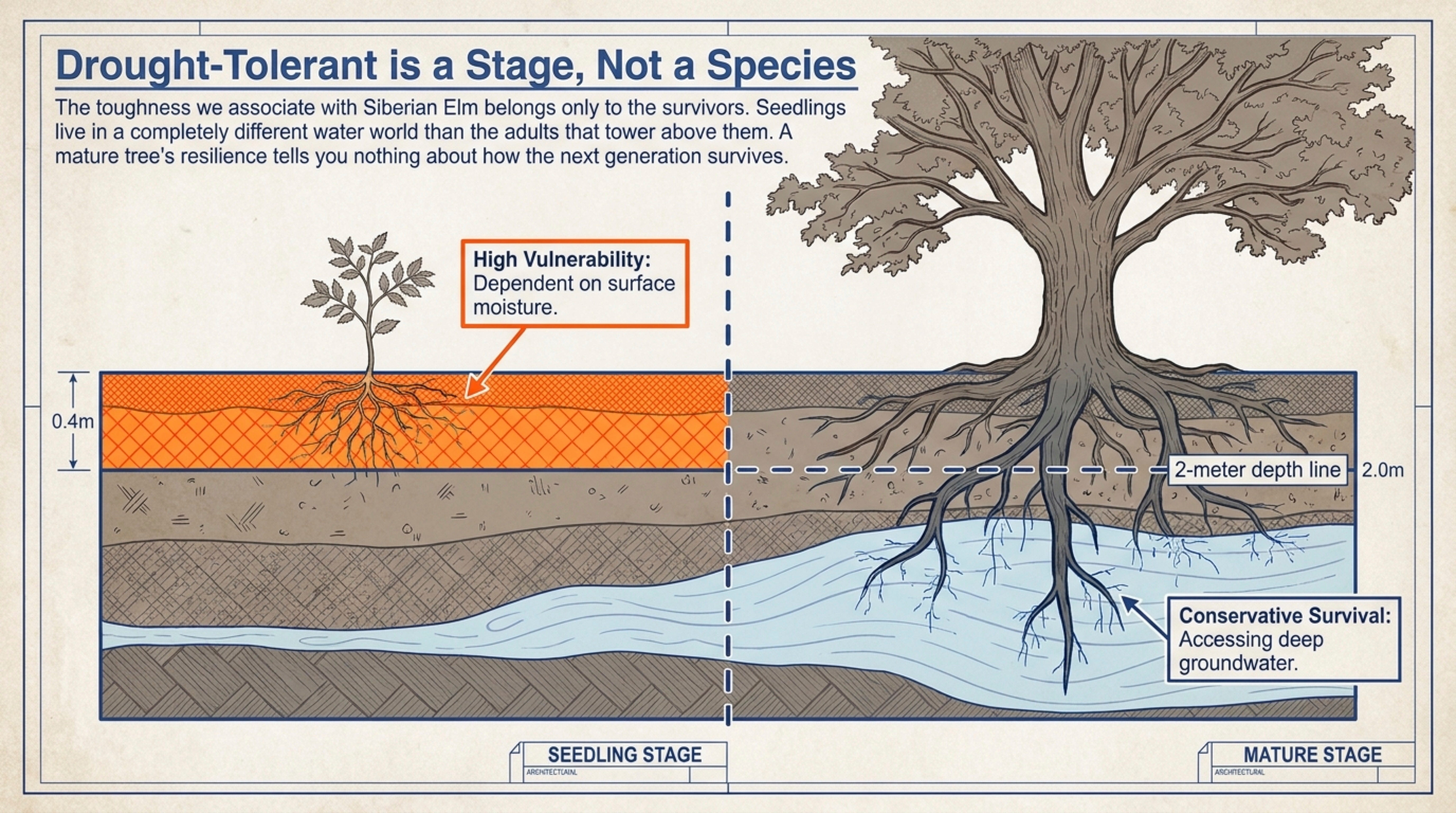
“Tough” is a stage, and the stage is your opening
On the southern edge of the Hunshandake Sandy Land in northern China, Su and colleagues used hydrogen isotopes to trace where Siberian elms of four ages were getting their water. Current-year seedlings relied on the top 40 centimetres of soil. Saplings and juveniles used deeper soil water. Mature trees mostly used groundwater, through taproots running past two metres. The seedlings had lower predawn leaf water potential than the older trees, which points to more water stress. That’s one site and an observational design. [Plausible · Peer-reviewed R4 ⚠]
A tree is most exposed when it is smallest, and that is also when it is cheapest to deal with. Agency guides sort the work by stem size. Newly emerged seedlings and saplings under about 1 cm across come out by hand or hoe. Stems up to about 6 cm can be grubbed with a shovel or weed wrench. Past roughly 7.5 cm the guides switch to girdling, cutting with a treated stump, or an excavator, and they warn that cut trees resprout. The guides borrow from one another, so read this as one line of evidence in many voices. [Plausible · Institutional]
The seedlings are quick. A germination comparison of seed from China and from the US Southwest found the American seed sprouted significantly faster, though not in higher percentages. The authors suggest fast germination may be one reason it succeeds as an invader. That’s lab dishes and a handful of seed lots, none from British Columbia. [Plausible · Peer-reviewed R4]
The seed also doesn’t wait around. The same paper describes seed that loses viability quickly after ripening unless conditions suit, and it found almost no seed that was viable but still dormant, which points to a thin seed bank. It also cites cold-storage work in which seed stayed viable for two years, so the rate depends on conditions. One extension column claims seeds can stay dormant for several years. The sources disagree, and the monitoring advice (three years) covers both. [Plausible · Peer-reviewed R4]
A patch you keep clear of seedlings for a few years should run down its own local supply, as long as no new seed blows in.
So “hard to get rid of” and “easy to stop” are both true. They describe different sizes of the same tree.
Know it by the twig before you cut
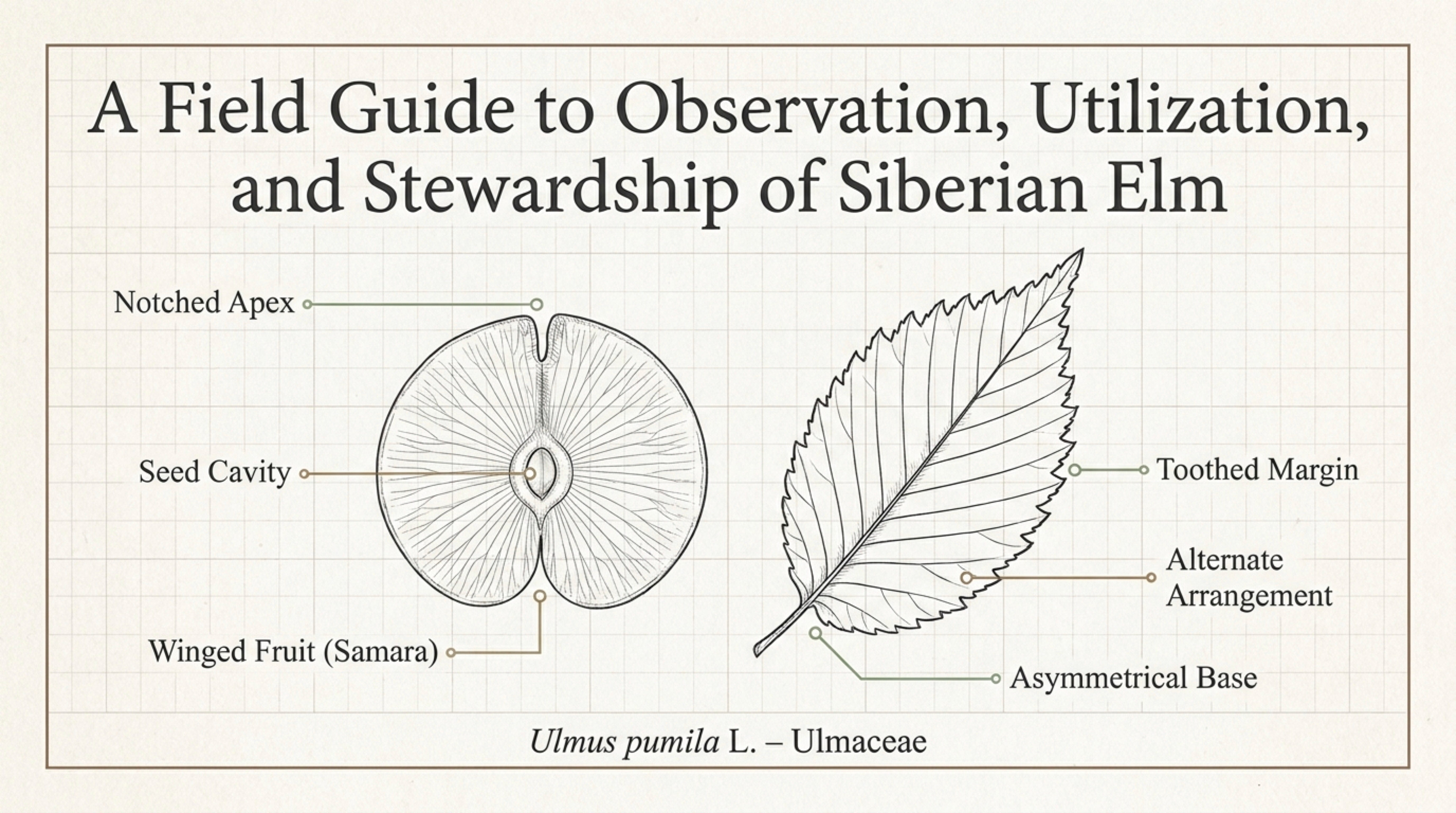
Pull and cut only what you’re sure of. Siberian elm leaves are simple and alternate: elliptical to lance-shaped, toothed, pointed at the tip, with a base that is usually close to even. “Usually” is doing real work. Flora of China gives blade lengths of 2 to 8 cm and allows slightly uneven bases and the odd double tooth, so one odd leaf doesn’t rule it out and one tidy leaf doesn’t prove it.
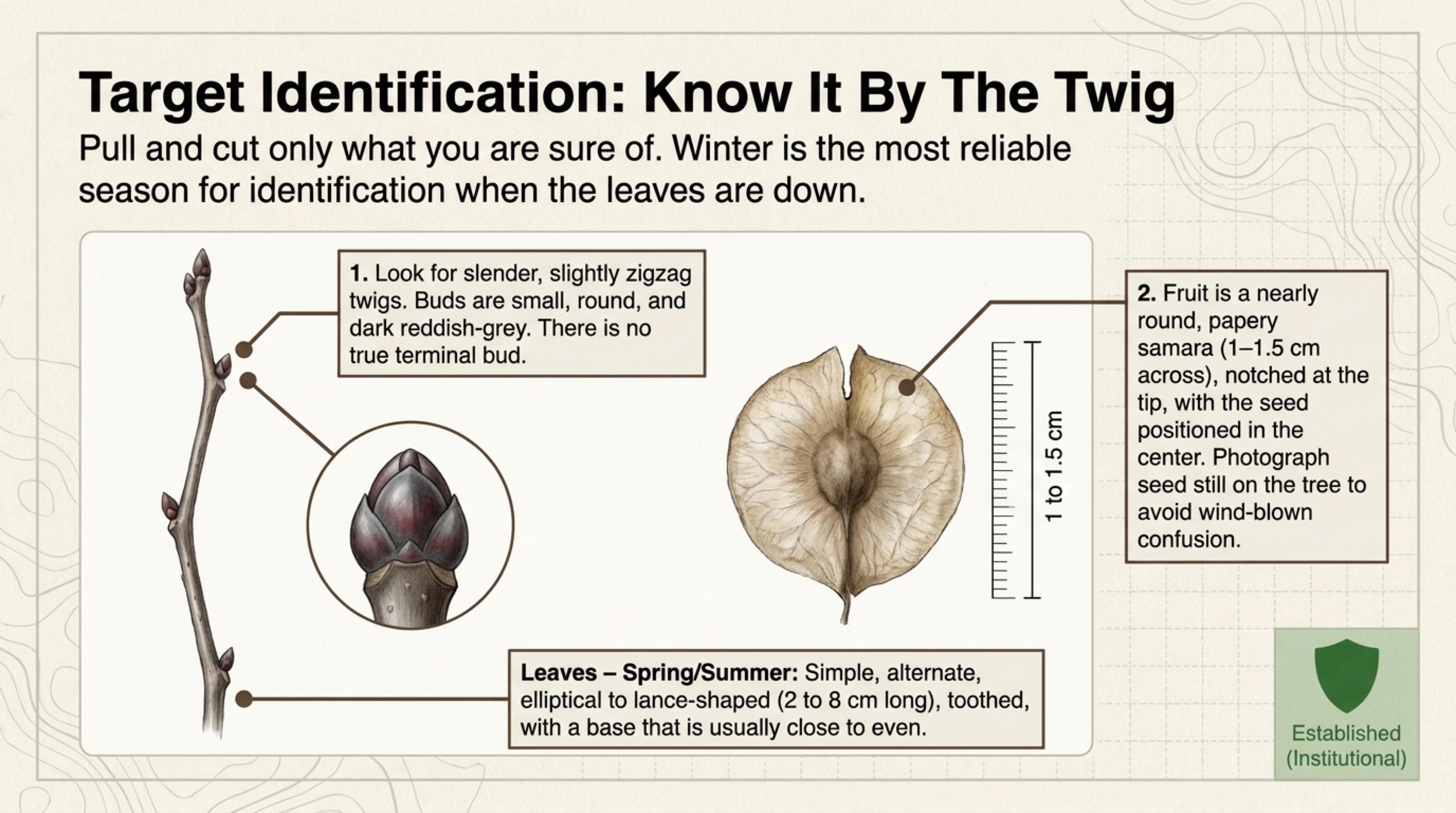
Winter, which is now, is the best identification season. Look for slender, slightly zigzag twigs, small round dark reddish-grey buds, and no true terminal bud. In spring the flowers come before the leaves. The fruit is a nearly round, papery samara about half an inch (1 to 1.5 cm) across, notched at the tip, with the seed near the centre. Photograph fruit that’s still on the tree, with a ruler in frame, because samaras on the ground may have blown in from elsewhere. [Established · Institutional]
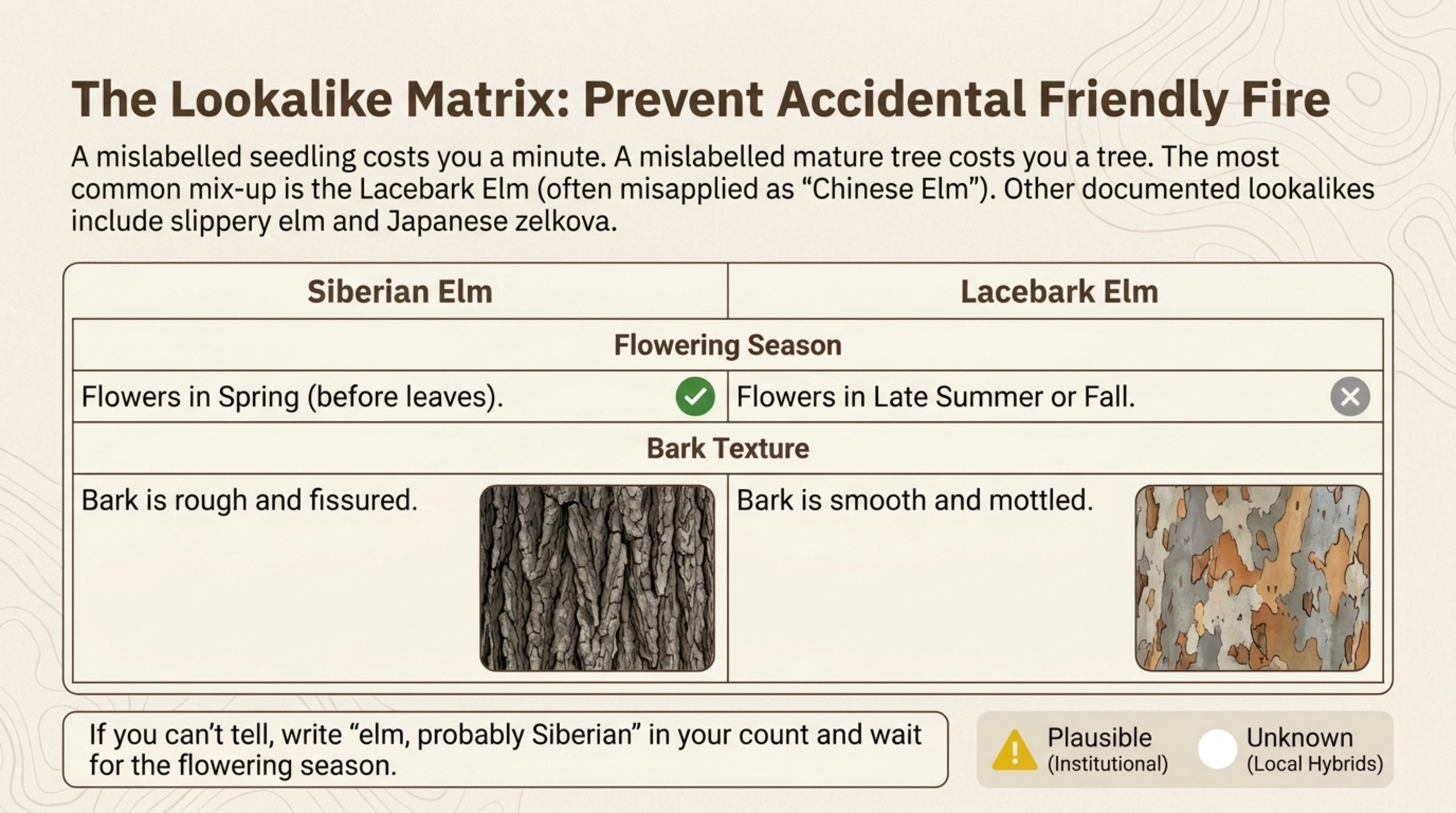
The usual mix-up is lacebark elm, which gets called “Chinese elm”, the same name often misapplied to Siberian elm. Lacebark flowers in late summer or fall and has smooth, mottled bark. Virginia Tech also lists slippery elm and Japanese zelkova as lookalikes. Genetic work cited in the germination paper found many Siberian elm populations in the eastern and central US include hybrids with slippery elm. Whether hybrids occur in the Okanagan is unknown. [Lacebark details: Plausible · Institutional ⚠. Hybrids here: Unknown · Absent.]
A mislabelled seedling costs you a minute. A mislabelled tree costs you a tree. If you can’t tell, write “elm, probably Siberian” and keep counting.
Click Here to read the entire Siberian Elm Monograph
What it does where it spreads, and what nobody has measured here
The case for acting is stronger as a pile of consistent local observations than as a set of local measurements. Here’s the pile, with verdicts.
Where it takes hold. Open, sunny, disturbed ground: roadsides, ditches, bare patches, riparian terraces. The Forest Service guide says it needs a lot of light, seldom invades mature forest and doesn’t tolerate flooding. [Plausible · Institutional]
How much of it there is here. OASISS told Summerland council it counts 22 hectares of invasive trees in the district, seen from roadsides, trails and municipal land only, and that Siberian elm is on 14 of them. Private land isn’t counted, and it’s one town. A 2009 regional district column called elm very prolific along channelized stretches of the Okanagan River, north of Oliver and between Oliver and Osoyoos. [Plausible · Institutional]
What it crowds out. Agency sheets say dense elm reduces shade-intolerant plants, including forage, and lowers diversity. An older Wisconsin DNR assessment found no studies on its effects on ecosystem processes. In planted stands in Inner Mongolia’s Siziwang Banner, grass diversity fell as elm density rose, and was higher near the stands than far from them. I found no measurement of displaced native plants in the Okanagan. [General claim: Plausible · Institutional ⚠. Siziwang survey: Plausible · Peer-reviewed R4 ⚠. Okanagan measurement: Unknown · Absent.]
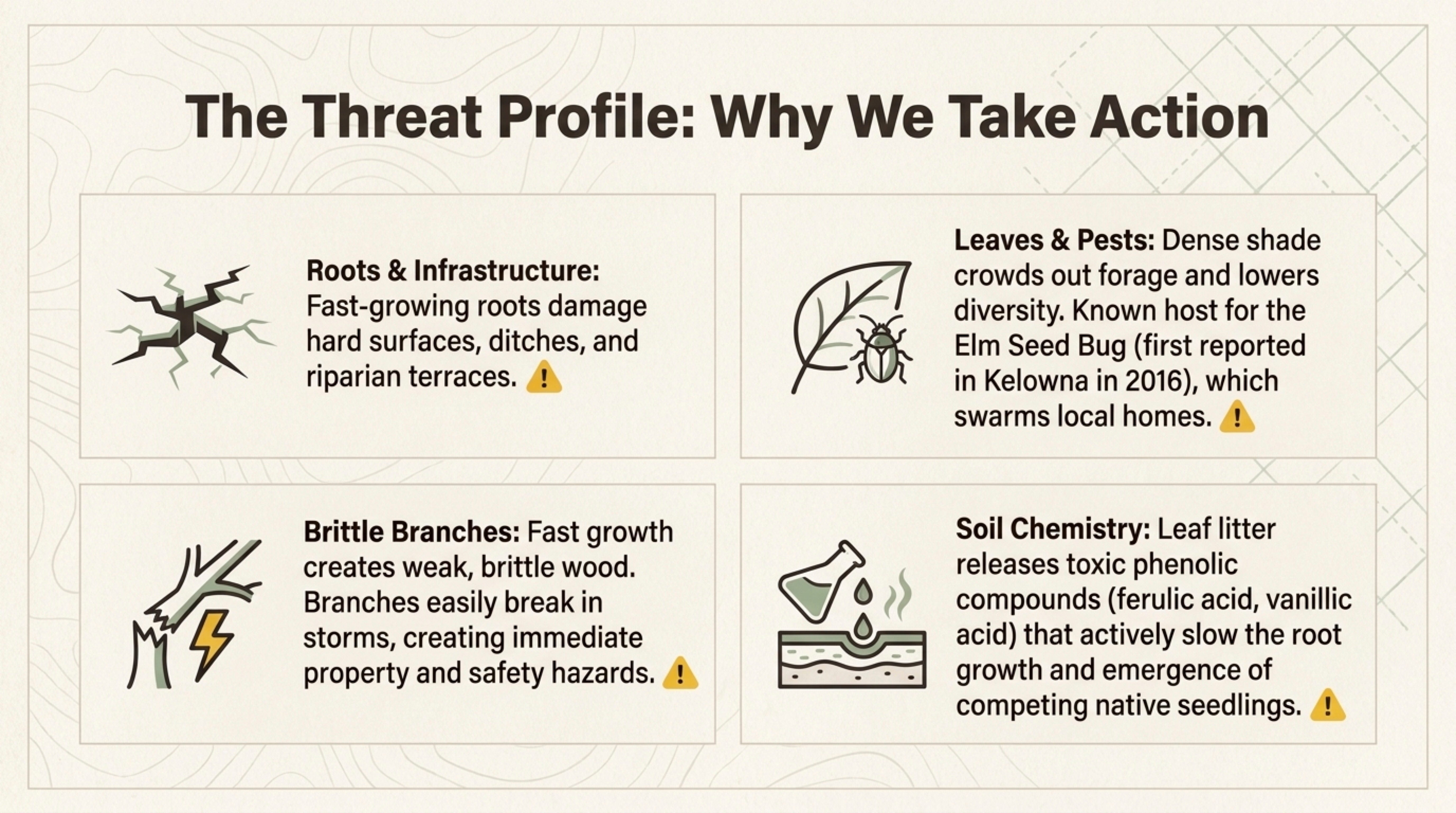
Chemistry. In a Spanish riverbank study, extracts of elm leaf litter slowed the root growth of orchardgrass and white clover seedlings. Litter mixed into pots cut the growth of white clover and the root biomass of orchardgrass, and slowed emergence of fat-hen. Phenolic compounds, including ferulic acid, vanillic acid and quercetin, turned up in the litter. A Central Okanagan staff report went further and described these invasive trees as releasing toxic chemicals to deter other plants, which says more than a pot trial can. [Plausible · Peer-reviewed R4]
Soil. Press coverage says it contributes to soil degradation. I found no study behind that line. One study of plantations in the Hunshandake Sandy Land found elm plantations held more than four times the soil organic matter of bare sand, and 74 per cent more soil water. That says nothing about an orchard floor. [Degradation: Unknown · Absent. Plantation versus bare sand: Plausible · Peer-reviewed R4 ⚠]
Roots, limbs and beetles. The regional district cites brittle branches that break in storms and susceptibility to elm leaf beetles, and says its roots damage hard surfaces. [Plausible · Institutional ⚠]
The elm seed bug. First reported in Kelowna in 2016, it feeds on elm seeds and leaves, barely harms the tree, and arrives in houses in large numbers. OASISS says getting rid of the tree often means fewer bugs. Nobody has tested that. [Plausible · Institutional ⚠]
The tree gives something back. It makes shade fast. Along New Mexico’s Middle Rio Grande, black-chinned hummingbirds were the only birds recorded nesting in Siberian elm, and native cottonwoods supported more nesting species than any other tree. I found no Okanagan nesting data. That’s not an argument against acting. It’s an argument for having a replacement ready and for checking for nests before any cut. [Plausible · Peer-reviewed R4]
A longer relationship with the tree
Siberian elm also has a cultural history worth carrying into this conversation. A 2021 ethnobotanical study revisiting early twentieth-century Mongolian expedition records describes a well named for four old Siberian elms growing around it. The same study identifies Ulmus pumila among the trees whose branches were used to build ovoo, ceremonial structures sometimes assembled from wood rather than stones. The tree helped name a place and supplied material for ritual practice. [Probable · Peer-reviewed]
Local names carried knowledge too. Research with Mongol herders in Arhorchin recorded hailson mod for Siberian elm and delt for large-fruited elm, Ulmus macrocarpa. Calling both simply “elm” loses a distinction those communities maintained. [Probable · Peer-reviewed]
Those histories deserve a place beside the management record. They don’t settle what belongs on an Okanagan creek bank, but they widen our understanding of the tree we’re making decisions about. Before an old planted elm goes, its local history may be worth recording too: who planted it, what they wanted from it, and what people remember happening beneath it.
Count first, then work smallest and nearest
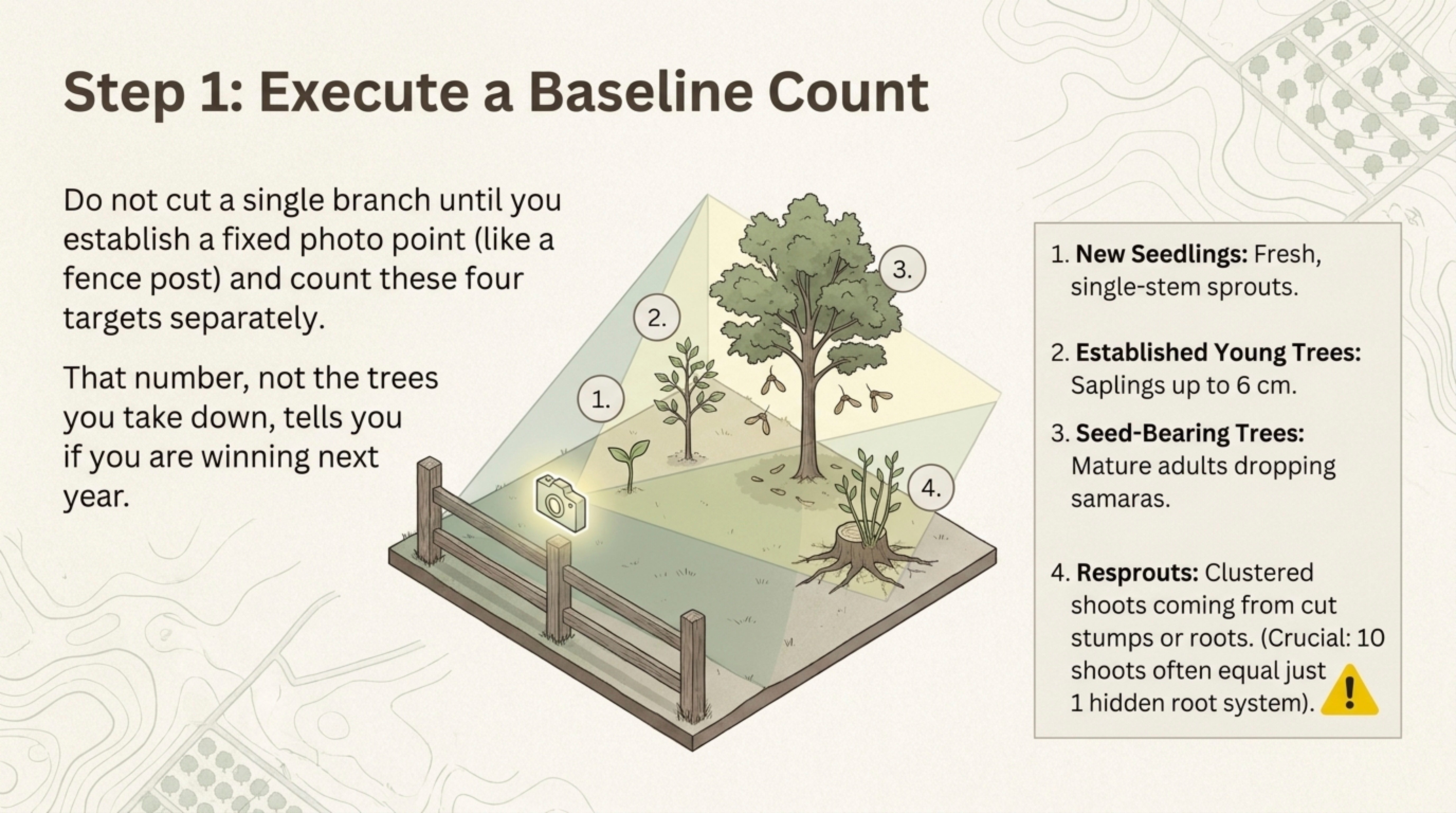
Count before you cut. Pick one elm and a patch of ground beside it that you can find again. Photograph it from a fixed spot; a fence post works. Then count four things separately:
new seedlings
established young trees
trees old enough to make seed
shoots coming back from cut stumps or roots
Keep the last one separate, because cut elm resprouts, so ten shoots can be one root system. Count again after your first season of work. That number, not the number of trees you took down, tells you whether it’s working. [Plausible · Institutional]
Then work in this order.
Seedlings and saplings on the ground you most want clear: orchard and vineyard rows, irrigation lines, fence lines, pasture margins, the creek bank. The Forest Service guide gives small infestations on otherwise healthy sites high priority.
Elms on disturbed margins: roadsides, ditches, bare or recently cleared ground. The guides say seedling thickets form there.
Seed-bearing trees nearest the ground you’re protecting, cut in the winter window described under Methods.
Along a creek or ditch, work from upstream to downstream.
Dense thickets you can’t keep up with come last. The Forest Service says treating an area once without follow-up is ordinarily useless, so schedule these for when you have the hours to return. Shaded mature woodland ranks lowest, since the guide says elm seldom establishes there. [Plausible · Institutional]
Is the parent tree the move? Two sources lean different ways. A Plant Conservation Alliance sheet calls reducing seed sources essential for long-term management. A study of Colorado’s South Platte River found that nearby upland seed trees explained little of how many elm stems stood along the river; its authors point to human influence and suggest focusing control where that influence is greatest. The two don’t strictly conflict: one is a general principle, the other an observation on one river. What nobody has measured is how much seedling arrival drops on your ground when one seed tree goes. That’s why this step comes third and not first. [Colorado finding: Plausible · Peer-reviewed R4 ⚠. Effect of removing one seed tree: Unknown · Absent.]
Is there ground left to defend? The Colorado authors cite earlier work suggesting the spread there was incomplete and limited by how far seed travels, which would mean unfilled ground is still worth protecting. I found no mapping of suitable but unoccupied habitat in the Okanagan. [Unknown · Absent]
When the parent tree has to go
Take out the seed tree when it’s feeding ground you’re protecting and you can afford to come back to the stump. Keep it only if you accept what keeping it commits you to.
Cut it when it stands beside rows, irrigation lines, pasture or a creek bank you’re trying to keep clear, seedlings keep arriving, and you can revisit the stump through the growing season for at least three years. The commonest advice for sites with few seed sources is to cut the large trees and trim the resprouts as needed. [Plausible · Institutional ⚠]
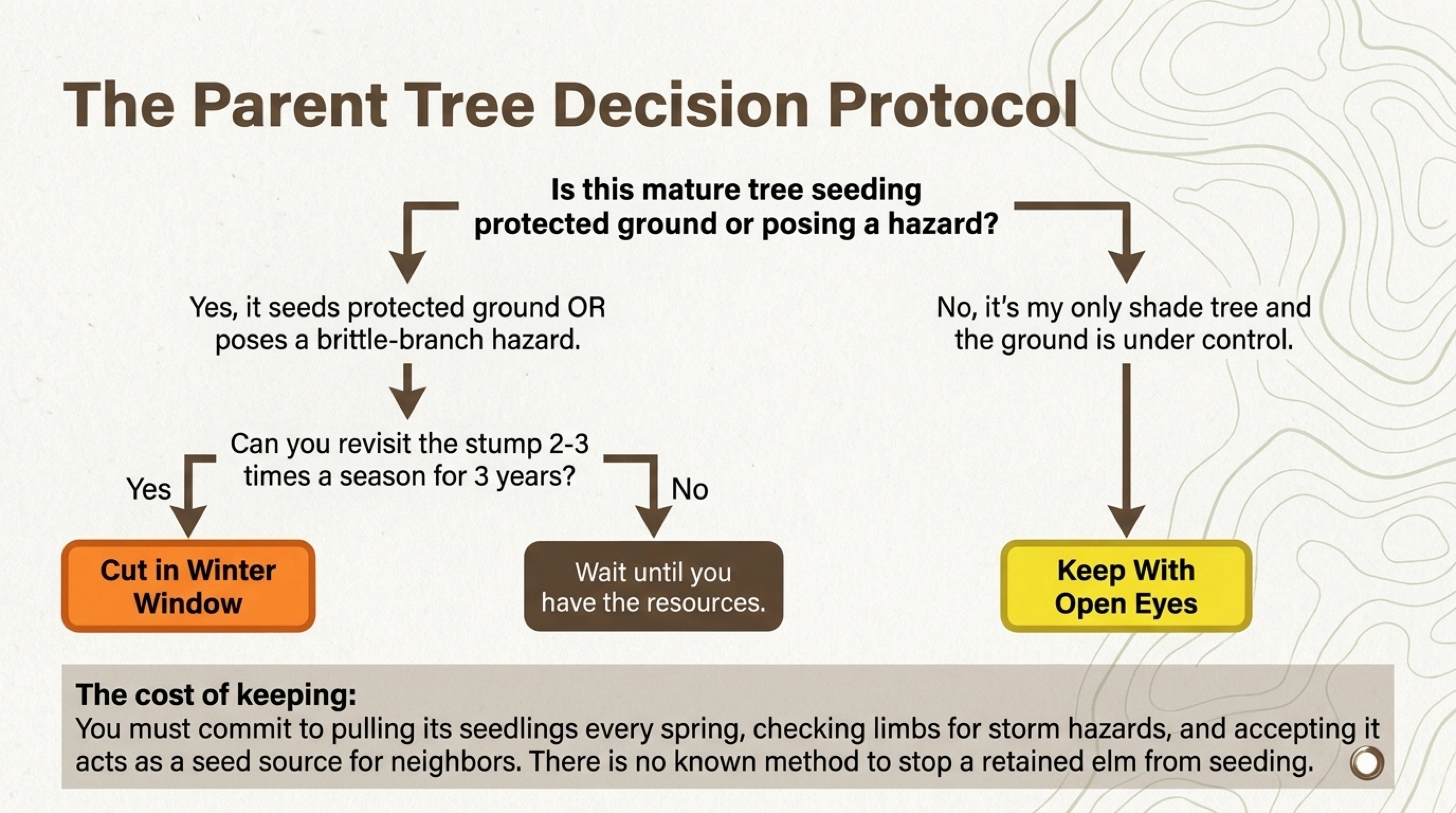
Cut it sooner when it’s also a hazard: a limb over a gate, a roof or a stock area. The regional district lists brittle branches that break in storms among its reasons for removing the tree, and a tree-risk assessment by a qualified arborist will tell you whether yours is one. If you’d cut it anyway, do it in the winter window.
Keep it, with open eyes, when it’s the one shade tree on the place and the ground around it is already under control. Keeping it means pulling its seedlings every spring, checking its limbs, and accepting that it’s a seed source for the neighbours. I found no method for stopping a retained elm from setting seed. [Unknown · Absent]
What you give up is fast shade, some nesting, and possibly roots that hold ground. On a bank or ditch, ask what the roots are holding before you pull them. That one is my inference; nobody has measured it for elm. [Speculative · Theoretical]
What won’t change is seed arriving from a neighbour’s land, the ditch or the river. If the nearest seed trees are on ground you don’t control, your job is the count and the pull, every spring, plus a conversation with the neighbours.
Four questions before the first cut
Is this tree seeding the ground I’m protecting?
Can I revisit this stump two or three times a season for three years?
What goes in afterward?
Have I checked for nests, and for the rules on this ground?