

Inside the Knotweed Ecological Guild: A Summary of the Living Plant Wisdom Profile
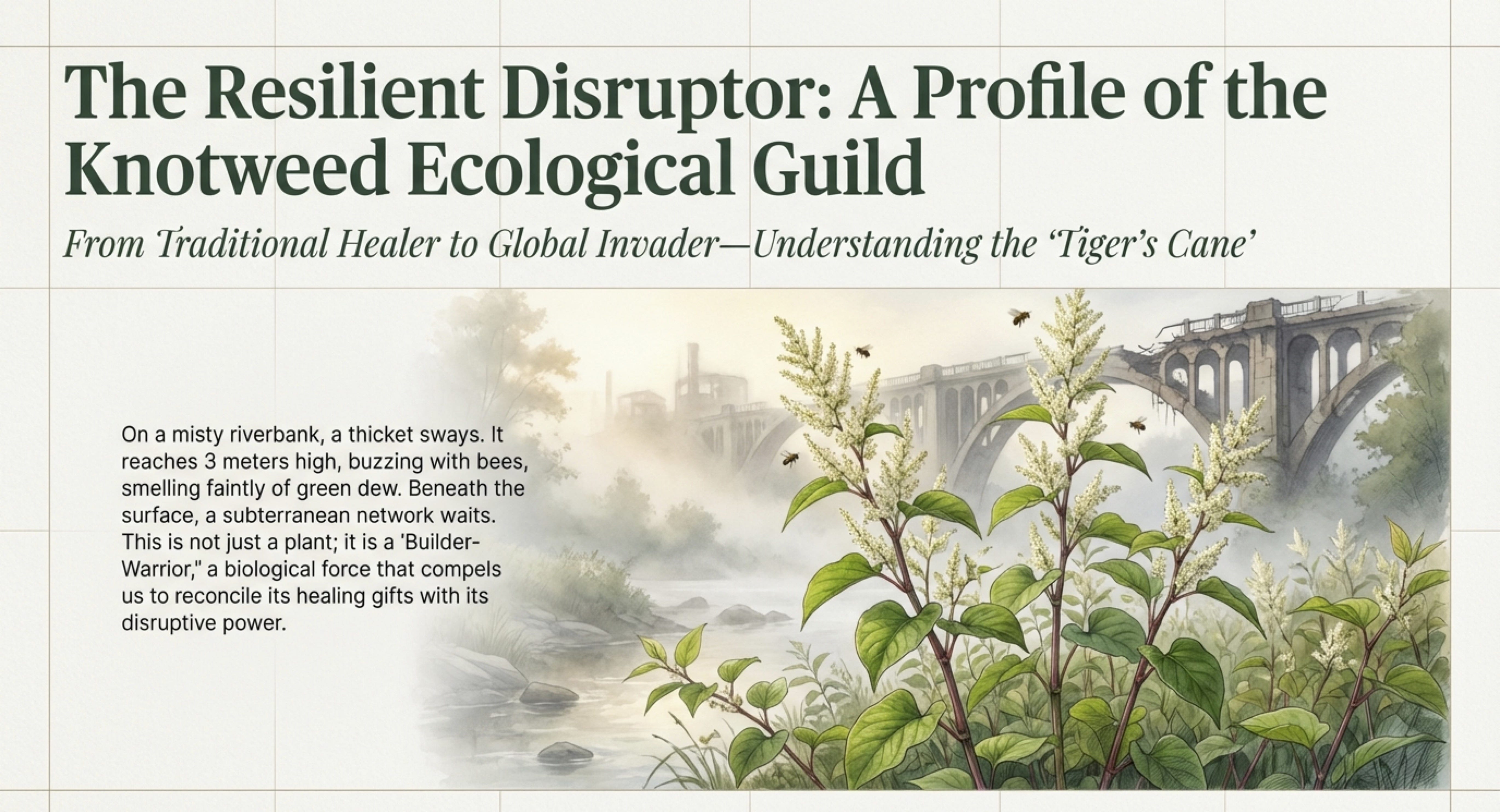
There’s a plant growing along your riverbank right now that the UK spends billions trying to kill. The same plant Japan has celebrated with festivals for centuries. The same plant that supplies most of the world’s resveratrol supplements.
The same plant whose name, in Japanese, means “removes pain.”
Itadori. The one who takes away the ache.
For two thousand years, families in mountain villages boiled this root when children had fevers, when grandparents couldn’t walk, when the swelling wouldn’t quit. They didn’t know about NF-κB inflammatory pathways. They knew the bitter tea worked.
Now we spray it with glyphosate and call it invasive.
What if the monster is the cure?
What This Is
Last week I published the full Living Plant Wisdom Profile for the Knotweed Ecological Guild, a deep dive into Japanese, Giant, Bohemian, and Himalayan knotweeds. It’s comprehensive.
This is the distilled version. The field guide. What you need when you’re standing in front of a knotweed patch wondering what it’s trying to tell you.
I have chosen 13 different lenses to see this plant through. Each lens asks the same question: What are this plant’s relationships? With soil, water, insects, livestock, humans, time, disturbance. And underneath that: What did the elders know that the labs are just now proving?
The Folklore-to-Science Bridges
Before we dive in, here’s what we’re working with, the moments where grandmothers and researchers arrive at the same truth from opposite directions:
What Grandmothers Knew = What Science Proved
Harvest roots in autumn when “essence” returns underground = Resveratrol concentration peaks in October roots
Bitter-cold herbs clear “heat” = Anti-inflammatory action via cytokine modulation
Boil shoots with ash to remove acridness = Alkaline processing reduces oxalic acid content
Let water buffalo graze it while on long treks to reduce joint stiffness = Anti-inflammatory compounds in browse; potential antiparasitic effects
The plant appears where it’s needed = Knotweed’s northeastern expansion coincided with Lyme epidemic; resveratrol shows anti-Borrelia activity
That last one still gives me chills. Coincidence? Maybe. But the compound in knotweed that shows promise against Lyme disease is the same compound that makes it nearly impossible to kill. Its resilience and its medicine are the same chemistry.
1. SOIL RELATIONSHIP
On the volcanic slopes of Mount Fuji, where nothing should grow, Japanese knotweed drills through fresh cinder and begins the patient work of making soil where there was only ash. The plant that breaks concrete doesn’t do it through brute force, it finds the crack, then applies pressure for years. This is soil intelligence with a timeline.
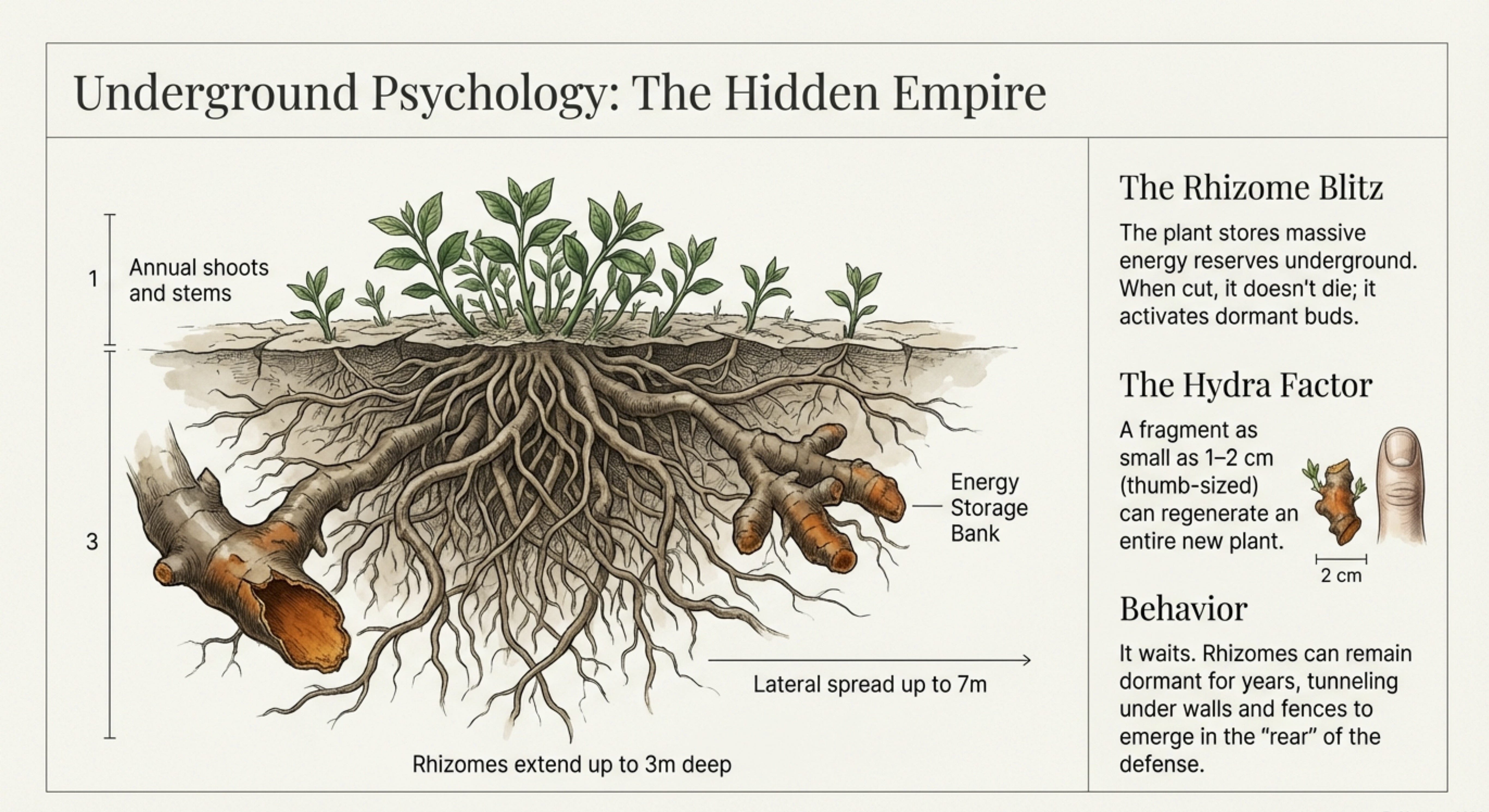
The Mining Operation: Knotweed functions as a dynamic accumulator on an industrial scale. Young shoots concentrate potassium, phosphorus, zinc, manganese, and vitamin C pulled from depths other plants can’t reach, rhizomes extend 2-3 meters down while spreading 15-20 meters laterally. But here’s the catch: by season’s end, knotweed withdraws 70-80% of leaf nitrogen back into its rhizomes before leaf-drop. What it returns to surface soil is comparatively nutrient-poor litter. High carbon, low nitrogen, slow to decompose. The plant that looks generous is actually hoarding.
The Chemical Warfare: Root exudates include flavonoids (catechin, epicatechin), stilbenes (resveratrol and piceid), and anthraquinones (emodin). These compounds leach into soil as roots exude and leaves decay, creating allelopathic suppression—nearby seeds fail to sprout, competitor seedlings stall. Lab trials confirmed knotweed extracts suppress germination of native elm seeds, but interestingly, do not suppress an elm from East Asia that co-evolved with knotweed. Chemicals new to an ecosystem give invaders an edge. The “novel weapons hypothesis” in action.
The Diagnostic: When knotweed shows up, it’s shouting something. Disturbance. Bare soil. History of human activity, construction fill, mine tailings, disturbed riparian zones. Its luxuriant growth can reveal hidden water; it thrives where groundwater or seepage is near. And here’s a paradox worth sitting with: in native Japan, itadori stabilizes volcanic slopes and prevents landslides. In invaded riparian zones, its shallow anchoring roots and winter dieback increase erosion compared to deep-rooted natives. Same plant, opposite effects. Context is everything.
Field Rules: If knotweed dominates a riverbank, anticipate ~3 cm more soil erosion per year than vegetated banks. If knotweed is present, test soil for heavy metals—it tolerates and even accumulates lead, zinc, and cadmium, performing partial phytoremediation. And remember: a rhizome fragment as small as 7 grams can regenerate into a complete plant. These fragments remain viable after 3 years dormant in seawater.
That’s one lens. There are twelve more.
What follows is the condensed version of each, the key insight, the surprising data, the paradox that shifts how you see this plant. The full profile goes deeper into preparation methods, safety considerations, and the gaps where we still don’t know. But this will give you enough to start thinking differently.