

There’s a shrub standing at the edge of your land, coulee bottom, fence-line, the burned-over slope, the margin of the old corral, and depending on who you are, you’re looking at a different thing.
If you farm, you’re looking at a workhorse: a century-proven Prairie shelterbelt shrub that traps snow and shelters the edges, or a fruit crop that runs four to eight thousand pounds an acre.
If you garden, you’re looking at the earliest white bloom of the entire northern shrub layer, flowers thrown open before the late frost has even decided whether to be a frost, which makes them the lifeline the queen bumblebee needs the week she wakes.
If you forage, you’re looking at a small purple-black pome with a faint almond finish, sweeter and softer than a blueberry, the fruit that became pemmican.
If you teach, you’re looking at a word: Saskatoon is Cree, misâskwatômina, and the berry named a river crossing, which named a city, which named the country around it. Berry-named city, city-named province. The lineage runs one direction.
And if you’re just curious, you’re looking at a diagnosis, because Saskatoon doesn’t grow where the ground is calm. It grows where something opened, a fire, a grazing release, a cut, a flood scar, thirty to fifty years back.
All five of you are right. And all five doors open onto the same room. This is the plant of openings.
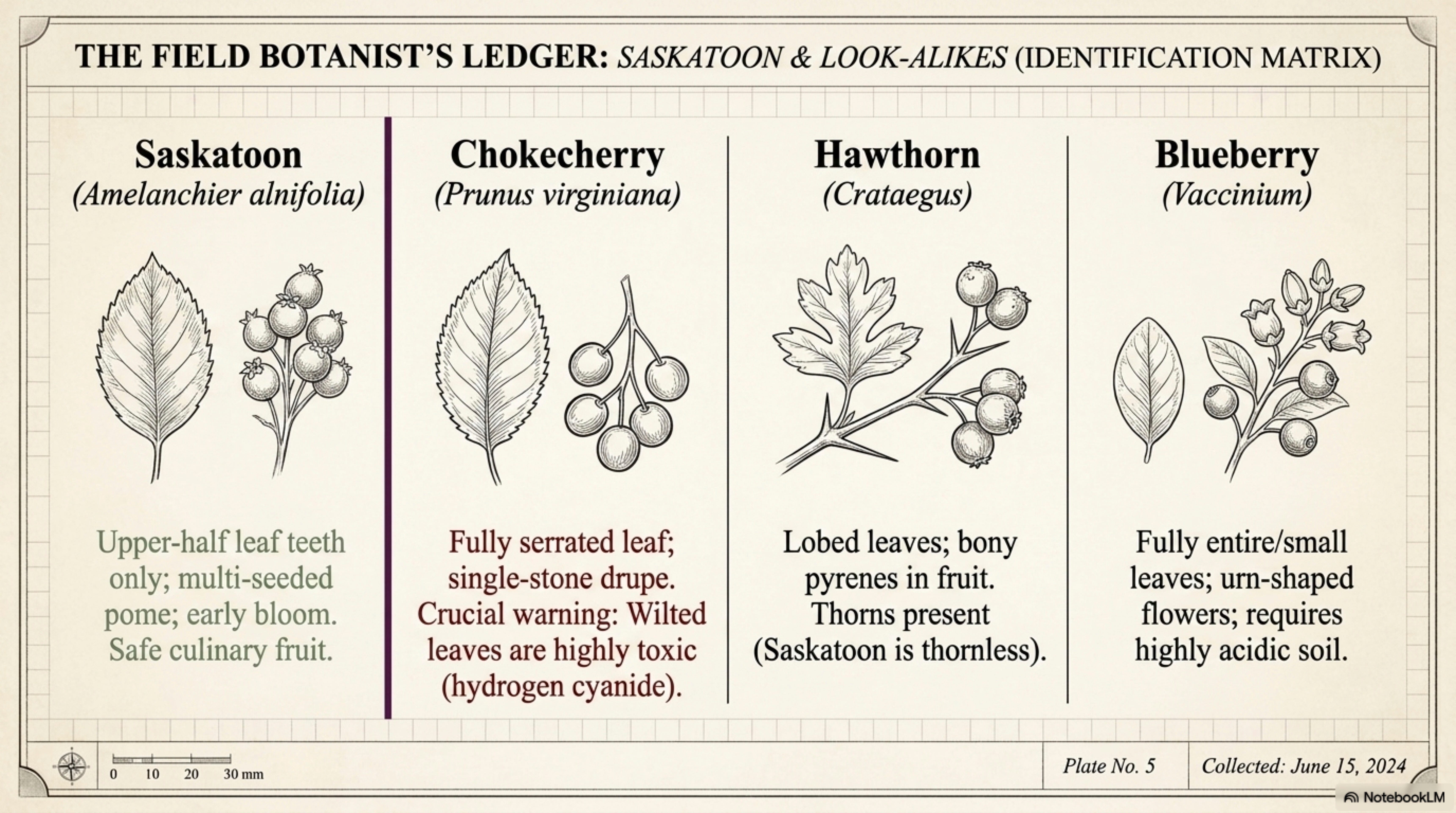
Start with knowing what you’re looking at. Learn it once and you keep it: alternate leaves, toothed only across the upper half of the blade and smooth toward the base, that single trait sorts it from most look-alikes. White, five-petaled flowers in short clusters, the earliest mass bloom on the slope. Smooth gray bark on slender, straight twigs. And the clincher at fruit: a purple-black pome with several small seeds inside, not a single hard stone. The shrub it shares a coulee with is chokecherry, and the difference is in the pit, chokecherry’s fruit is a drupe with one stone, its leaves are toothed all the way down, and its flowers hang in a long bottlebrush. Mistaking the two at fruit won’t hurt you; both are edible. It matters for your stock: the wilted or frost-struck leaves of both turn cyanogenic, chokecherry more dangerously so. The bitter-almond smell in a crushed leaf is the chemistry telling you what it is.
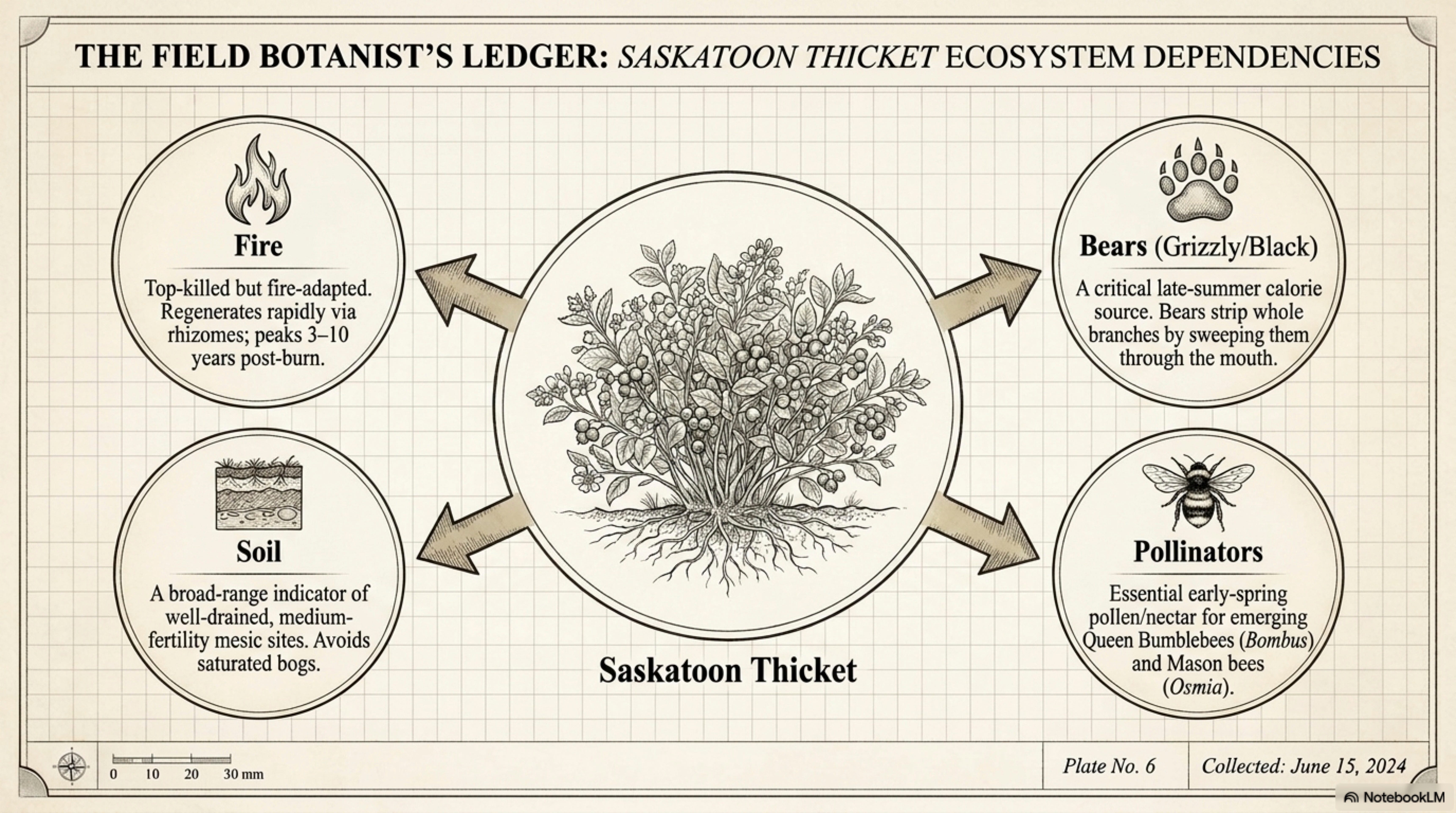
Before it’s food, though, Saskatoon is a reader of disturbed ground. It wants well-drained, middling-fertility mineral soil, not the rich wet bottom where willow and dogwood crowd it out, not the saline patch, not the deep peat. Where it abounds, the land was opened: a burn in the last few decades, a release from grazing, a roadcut, a scour. It’s a middle-of-the-story plant, peaking three to fifteen years after the ground breaks open and then thinning as the conifer canopy closes over it. So a coulee thick with Saskatoon isn’t telling you the shrub won. It’s telling you the ground was opened and hasn’t yet closed. Where it abounds, something disturbed the land. Where it thins, the shade is winning. Where it vanishes under spruce, the next fire is overdue. And notice what the plant keeps repeating in every register: it is first. First to flower, first soft fruit of the summer, first green shoot back from the rhizome the season after a fire burns it to the ground. Earliness in time, earliness in succession, it opens the year and it opens the ground, and it feeds whoever shows up first to either.
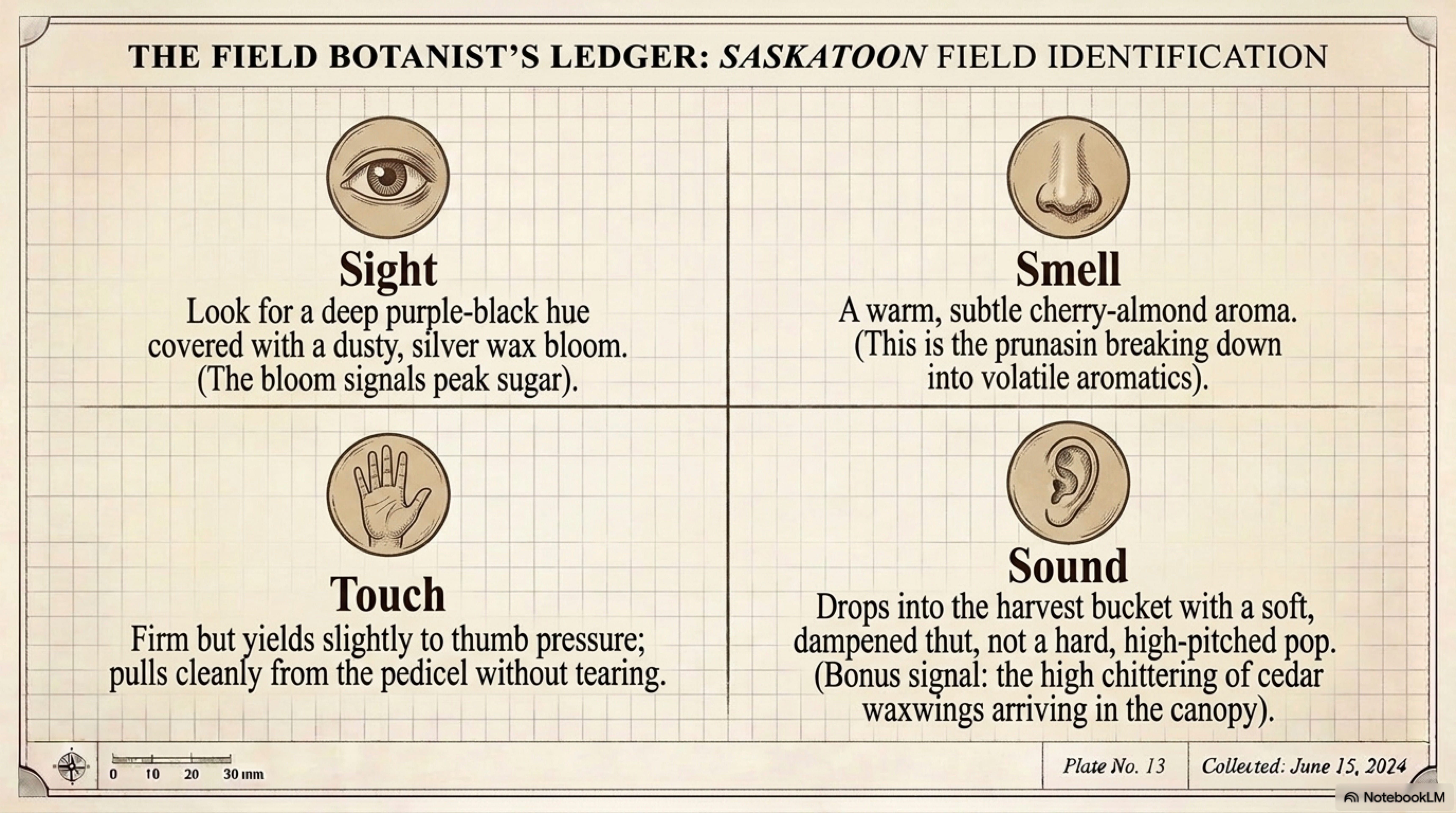
The safe first use is the one that asks you to trust no health claim at all: read it, then eat it. Read the bush as a gauge of your land’s disturbance history. Then, when the fruit comes, let the plant tell you it’s ready, the chemistry does the talking. Ripe Saskatoon wears a dusty silver bloom over a blue-black skin, and that wax is the go-signal; without it, the sugar is still climbing. The nose confirms, a warm, low almond note rising off a sun-warmed cluster. The tongue confirms last: sweet, then round, then a faint bitter-almond finish that arrives after the swallow. A drying pucker means under-ripe; a thick sherry-and-almond reek means it’s already fermenting on the branch. Eat it out of hand, or do what the Prairie kitchen has always done and marry it to fat and acid, it lacks the tartness of a blueberry, so it leans on rhubarb or a squeeze of lemon to find its edge.
Timing is the whole game, and the plant tells you that too. When the cedar waxwings arrive, a silver, chittering flock moving through the canopy, you have roughly thirty-six hours before they take the crop, because they’re reading the same wax-bloom signal you are. Pick when about four berries in five have gone bloom-dark; wait for the last holdout and you’ll split the harvest with the birds. And know when to leave it. Leave the high, hard-to-reach patches for the bear, who needs the energy of that fruit in late August more than you need the last gallon. Leave the bush that’s pinning a raw bank against erosion to finish its work. And keep stock off the foliage when it’s wilted or frost-hit, the one window when this gentle plant turns briefly poisonous. Take some, leave more. It is the oldest harvest ethic on this ground, and it is still the right one.
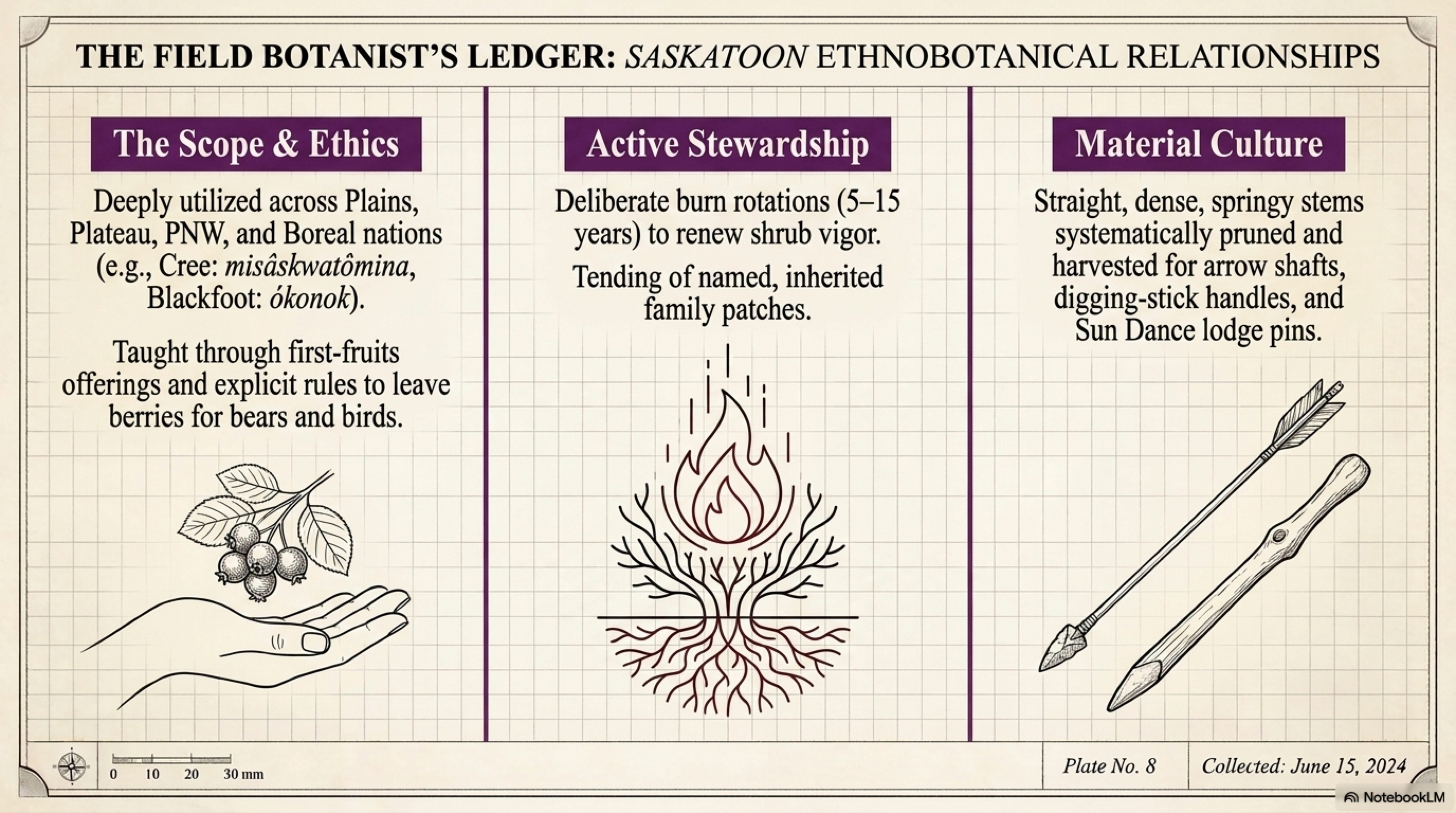
Here’s what I can’t walk past. This plant entered the European written record as a curiosity and never entered the European herbal canon at all, no Dioscorides, no Culpeper, no entry in the old dispensatories. The same silence runs through the Chinese and Ayurvedic records. A North American shrub, unknown to the Old World’s great medicine systems. And yet across this continent, nation after nation, separated by language, by mountain ranges, by a thousand miles, reached for the same bush, and, more startling, for the same handful of uses. Twelve and more nations built it into pemmican. Four unrelated nations, Blackfoot, Plains Cree, Woods Cree, Nlaka’pamux, independently used a decoction of its bark in the same narrow moment: after birth, to stop the bleeding. Three landed on it as an eye wash. Five as a gut medicine. None of them were comparing notes.
That is either a very long coincidence or a signal. And on the strongest of those convergences, the postpartum one, four nations, one purpose, modern chemistry has, as of now, simply never run the test. So: did all those people see something real in this bush? Does the chemistry agree where it has been asked, and what about the place no one has thought to ask?
That’s on the other side.