

Walk a tired field in early summer and you can meet all three without trying. Magenta clover heads humming with bumblebees. A roadside cut blazing gold with broom. And threaded through the grass, almost invisible, a tangle of purple-veined vetch gripping whatever stands near it.
Three plants. The last three Wednesdays of this newsletter. Most of you met them as strangers to one another.
They weren’t strangers. They had more in common than you realized.
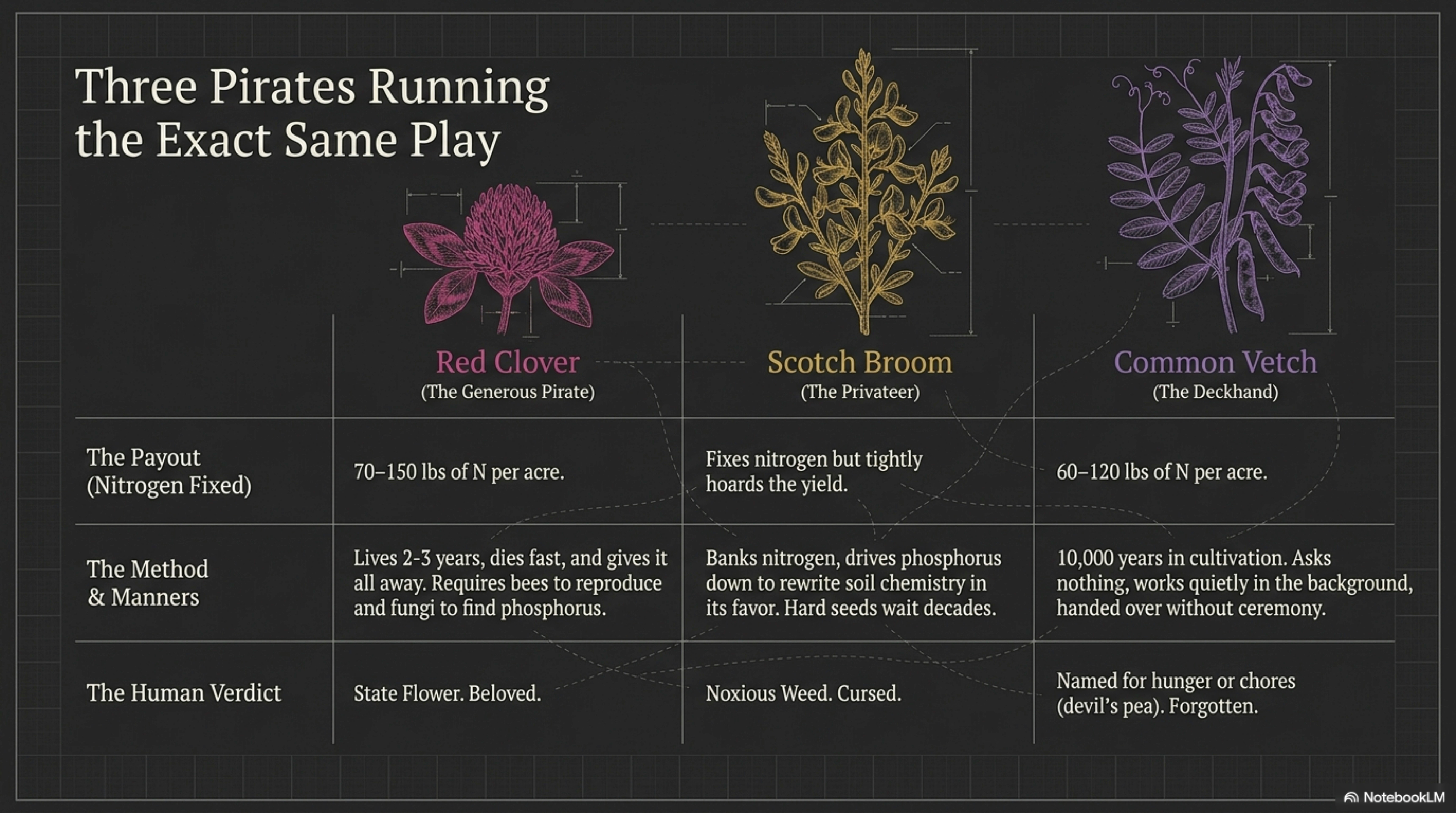
Here’s the secret the last three deep dives were keeping: clover, broom, and vetch all run the same heist. Nitrogen makes up about seventy-eight percent of the air around you, and not a single plant can use it. It comes locked in a triple bond, the molecular equivalent of a safe nobody has the combination to. So these three don’t crack it themselves. They hire muscle. Each one strikes a deal with a bacterium, houses it in nodules along its roots, feeds it sugar, and lets it do the breaking. Air goes in. Fertility comes out. In the dark, through an accomplice, for free.
That’s the trick. All three pull it. And then the story splits.
Clover, the one we crowned
Red clover fixes seventy to a hundred and fifty pounds of nitrogen an acre and gives almost all of it away. It lives two or three years and dies, a sprinter wearing a marathoner’s bib. It can’t even make its own seed without a long-tongued bumblebee to carry pollen between flowers too proud to fertilize themselves. It does nothing alone. It needs a bacterium to feed, a fungus to find phosphorus, a bee to reproduce, and increasingly a human hand to sow it where the ground is worn out.
For all that dependence, we made it a state flower.
Clover is the generous pirate, the one who hands you the whole chest, tips the harbormaster, and sails off before you can thank her.
Broom, the one we curse
Scotch broom runs the identical operation and keeps every coin. It fixes nitrogen and banks it into a feedback loop tilted in its own favor. It drives phosphorus down even as it drives nitrogen up, quietly rewriting the soil’s chemistry so the natives that follow find the table already set against them. Its seeds wear a coat hard enough to wait decades in the dark, through your tenure on the land and possibly your children’s, until heat or a blade tells them the harbor’s open again.
We call it noxious, and we are not wrong.
Broom is the privateer, the one who keeps the hoard, burns the map, and salts the harbor on the way out.
Vetch, the one we never saw
And then there’s the common vetch. Ten thousand years in cultivation, older than the alphabet, older than most of the gods, and in all that time it never made it into a single herbal, a single pharmacopoeia, a single song. Every language that named it named it for hunger or chores: fodder, crow’s pea, devil’s pea. The Chinese is the most honest, 救荒野豌豆, the “famine-rescue wild pea.” A plant remembered only for the year the wheat failed.
It fixes nitrogen as freely as clover. Sixty to a hundred and twenty pounds an acre, asked of no one, handed over without ceremony. And it earned nothing for it. Not love, not fear, and not even a reputation.
Vetch is the deckhand who did the actual work while the captains got the ballads.
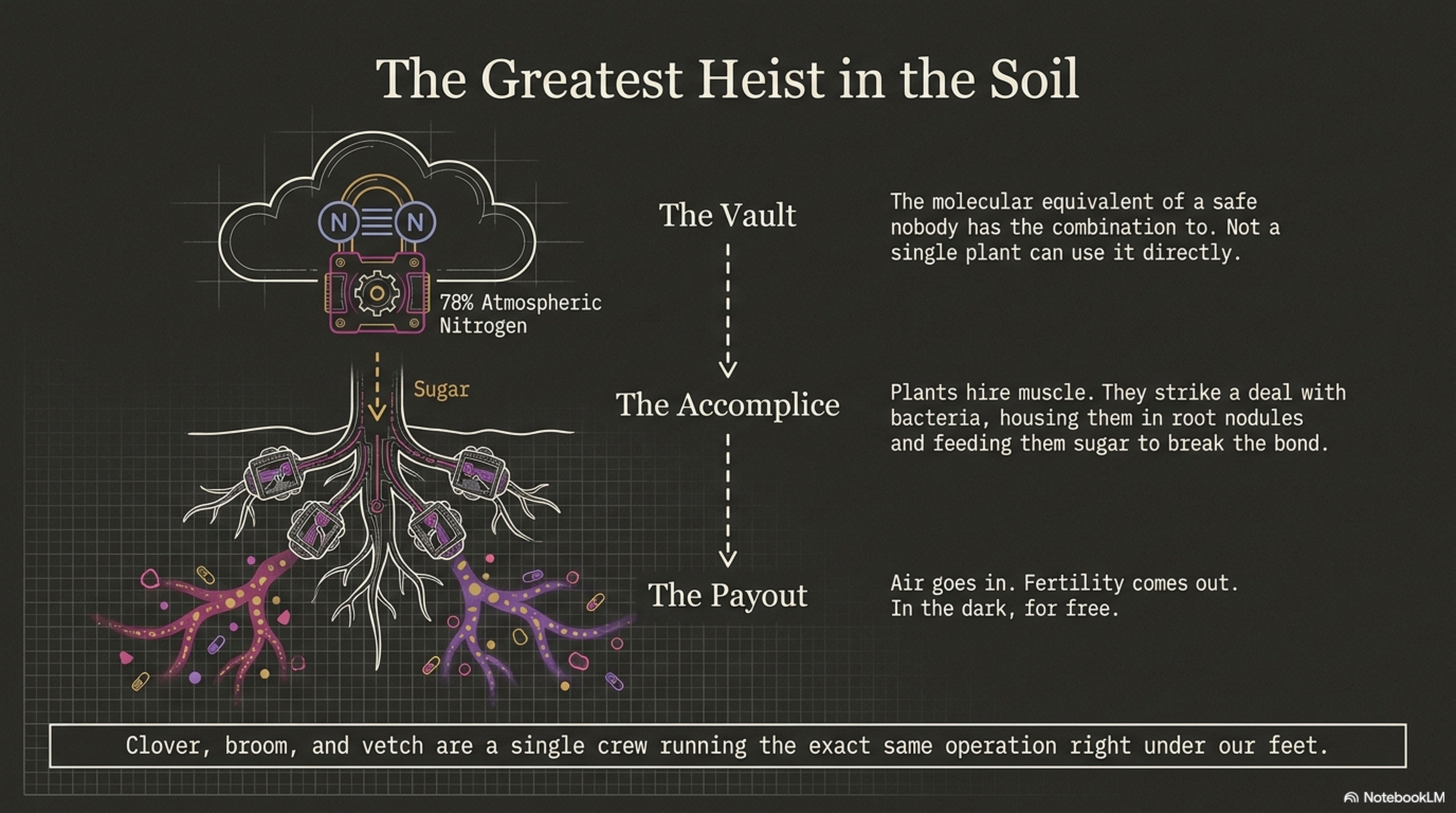
Same heist, three verdicts
The chemistry is identical. Air into fertility, through a bacterium, underground, given away. What’s different isn’t the gift, it’s the manners. Clover gives with charm, so we love it. Broom takes with swagger, so we hate it. Vetch gives without either, so we forgot it entirely.
Which means the names we’ve pinned on these plants, beloved, noxious, nothing, were never really about the plants. They’re about us. The land doesn’t sort its nitrogen workers into heroes and villains. We do that, standing at the edge of the field, deciding which gift counts based on how the giver carried itself.
That’s the whole crew. And it’s why I write these the way I do: not to tell you which weed to pull, but to show you that the weed has been reading you back the entire time.
What the next posts are hiding
There’s already a new crew assembling in the drafts folder. Different trick, same kind of secret hiding in plain sight across the posts.
I’m not going to tell you what links them.
But it’s there. The reader who calls it first gets the satisfaction of having read the land faster than the writer did.
Where the real story lives
Each of these three plants got a full Living Plant Wisdom monograph, twenty-one sections, tens of thousands of words, every claim labeled for how well it’s actually known. These aren’t blog posts dressed up. They’re the only documents I know of that pull botany, soil science, ethnobotany, phytochemistry, livestock science, folk medicine, and the honest gaps into one place, instead of leaving you to stitch eight disconnected silos together yourself. That stitching is the whole point. It’s the work nobody else is doing.
Free readers get the intros, the videos, the summary reveals like this one, and the first sections of the weekly summary, enough to know the plant by sight and by story.
Paid readers get the rest: the full monograph on every plant, the entire library as it grows (, and the chemistry-and-management detail you’d actually take into a field. Everything underneath it, the part that earns its keep, is yours when you upgrade.
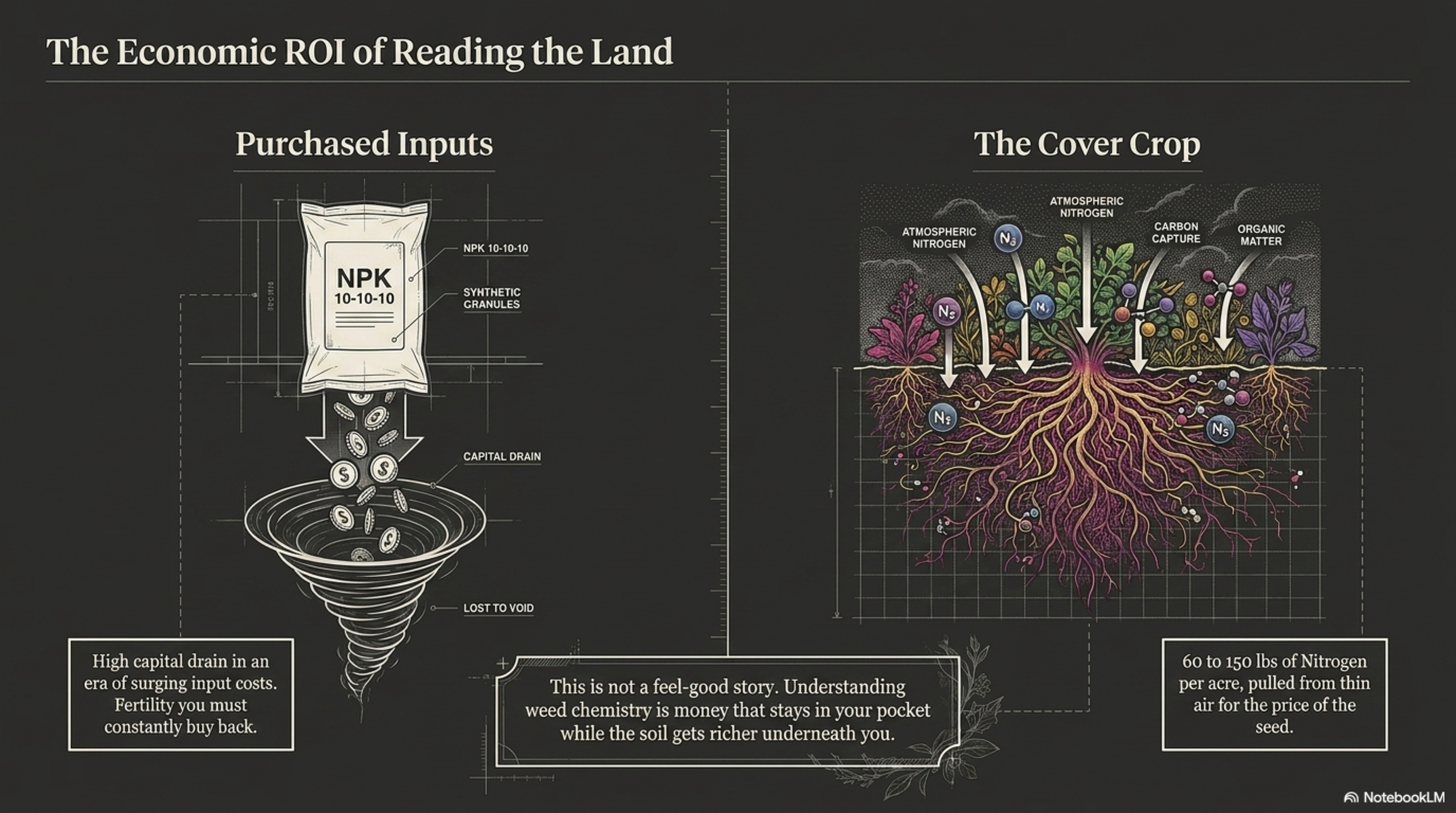
And if you farm, here’s the argument that needs no philosophy: a cover crop that hands your next crop sixty to a hundred and fifty pounds of nitrogen, pulled out of thin air for the price of the seed, is fertility you didn’t buy by the bag. With input costs where they are, that’s not a feel-good story. That’s money that stays in your pocket while the soil gets richer underneath you.
Everyone else hands you a piece of the plant. These profiles hand you the whole living thing.
Off the screen
If you want this thinking in something you can hold:
Healing Soil Naturally, the nitrogen-and-fertility story in book form, for restoring ground that’s been farmed flat.
Reading the Land, the coaching guide to hearing what the weeds are already telling you, before you reach for the sprayer.
Holistic Viticulture, and if your ground grows grapes, two of these three pirates (clover and vetch) are exactly the cover crops a living vineyard floor runs on. This one’s for the people farming the slope, not just the soil.
All three are available on Substack, Gumroad, and Amazon.
The land’s been getting quietly robbed and reseeded under our feet the whole time, the most useful element in the sky, stolen out of the air and buried in the roots where we’d never think to look.
The only real question is whether you can read the manifest.
Or whether you’re just standing on the gold, wondering why the soil keeps getting richer wherever the weeds are winning.
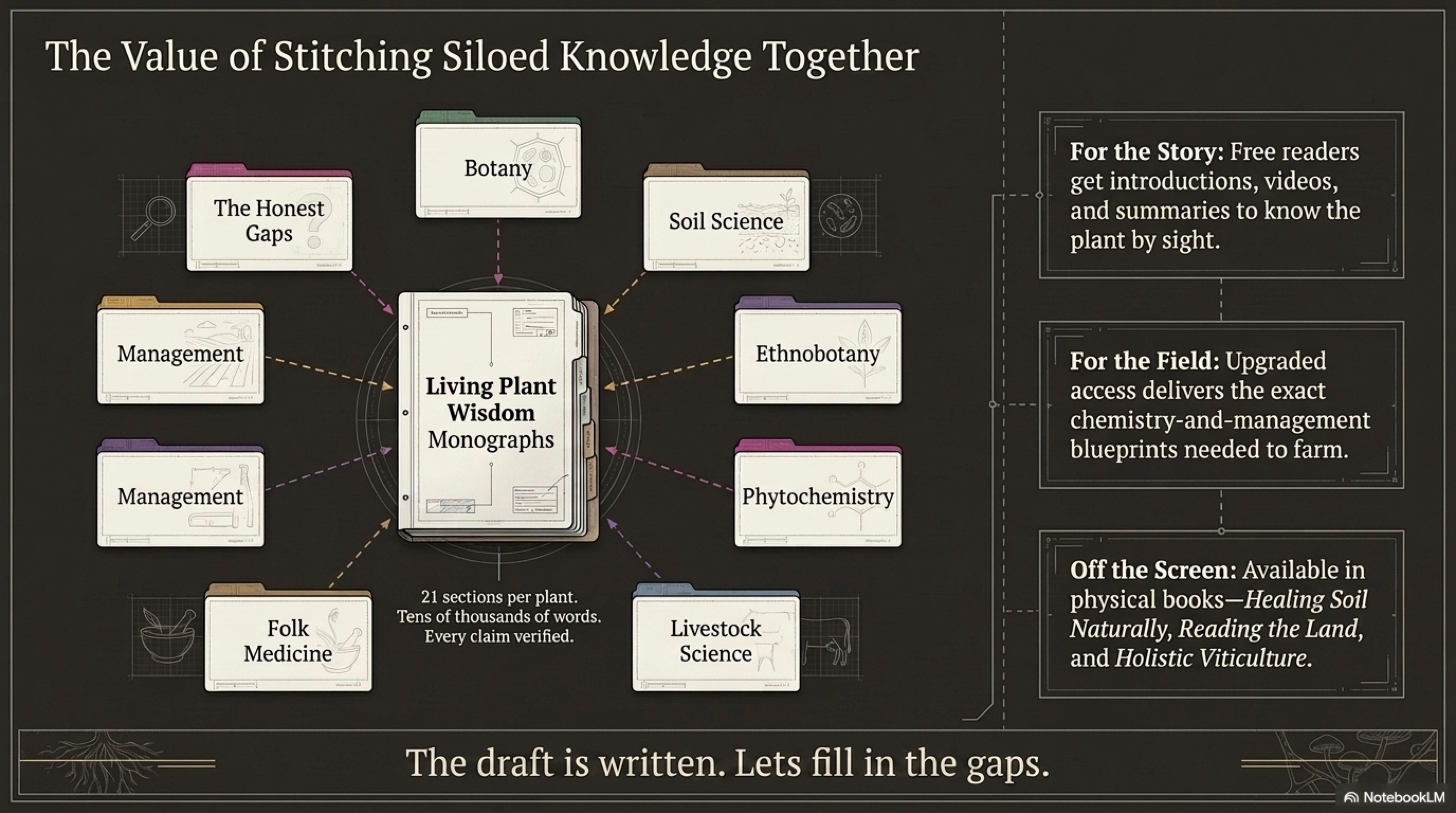
If you've read the free sections and felt like there was a larger picture waiting to be connected, there is. This is it. Not another stack of articles to fall behind on, but the bridge: every plant told whole, in one place, so the next time one shows up in your life, you'll know what it's actually saying.
There are many nitrogen-fixing plants, some used for cover crops, some used for food, some are trees. Why talking only about clover and vetch?
And vetch is not considered as nothing or forgettable. Actually it fixes between 100 to 250 kg/ha (quite a bit more than the estimate you gave in your post), and is very often recommended in seed catalogs by itself or as part of a cover crop mix, commonly with winter rye, to be sown in the fall and plowed over or tilled-in in the spring.