

Hello Friends: For generations, agriculture has been shaped by a mindset of management—controlling variables, optimizing inputs, and intervening in nature's processes to force productivity. Even in regenerative and organic movements, much of our focus has been on fixing what's broken by adding amendments, microbial ferments, and carefully designed systems.
But what if nature doesn't need to be managed? What if we are overcomplicating what is actually simple? The more we observe thriving natural ecosystems—forests, prairies, and coral reefs—the clearer it becomes:
Nature Doesn't Manage Complexity—It Embodies Balance Effortlessly
Every successful natural system operates without human intervention, not because of constant adjustments, but because it follows an underlying rhythm so seamless that we struggle to see it. If we want to farm with nature rather than on top of it, we need to shift from a management mindset to a synchronization mindset.
This mirrors the wisdom at the heart of traditional healing systems worldwide. In Traditional Chinese Medicine, practitioners honor the principle of "Wu Wei"—non-action or effortless action—recognizing that the most profound healing comes not from forceful intervention but from removing blockages to allow natural energy flow. Similarly, Ayurveda teaches "Swasthavritta"—living in rhythm with nature's cycles rather than imposing our will upon them.
The farmer, like the traditional healer, becomes not a manager of land but a facilitator of ecological health—reading the subtle signals of imbalance and making minimal, strategic interventions that restore harmony.
Farming Should Be About Nurturing, Not Killing
One of the most ingrained aspects of conventional farming is the use of "-cides"—pesticides, herbicides, fungicides. The very language of modern agriculture centers on elimination and control, fostering a war-like mentality against nature rather than a nurturing relationship with it.
When we wake up in the morning, do we want our first thought to be about death and eradication? Or should farming be about life, resilience, and nurturing the land so that every part of the ecosystem thrives together? The energy behind a system built on eliminating life is fundamentally different from one built on cultivating balance.
This mirrors how traditional healers approach illness—not as an enemy to be destroyed but as a signal to be understood. When an Ayurvedic doctor encounters disease, they don't simply suppress symptoms; they ask: "What relationship has fallen out of balance? What natural process is being blocked?" Similarly, when a TCM practitioner uses acupuncture, they're not "fixing" the body but removing blockages so qi can flow naturally.
The goal shouldn't be to eradicate something to make room for something else. It should be about supporting the relationships that naturally regulate an ecosystem, making the idea of "killing" unnecessary. Farming should be about fostering life, not waging war against it.
The Economic Reality of Farming & The Medicine of Diversity
For many farmers, the idea of stepping back and allowing nature to self-regulate sounds idealistic. The truth is, farming is not just about ecological balance—it's about financial survival. Most farmers can't afford to risk their livelihoods on a transition that might take years to bear fruit. The modern agricultural system is structured around short-term economic viability, often at the cost of long-term soil health and sustainability.
Traditional healing systems have always acknowledged these practical constraints while maintaining their philosophical integrity. Just as a skilled healer balances immediate symptom relief with deeper healing protocols, a resilient farm system must balance short-term stability with long-term abundance.
The Economic Trap
Debt and High Input Costs – Farmers rely on expensive fertilizers, pesticides, and machinery to maintain productivity, making them dependent on input-driven models.
Market Pressure for Immediate Yields – Regenerative approaches take time, but commodity markets demand fast, predictable results.
Land Ownership Costs – Many farmers lease land or carry mortgages that require continuous income, limiting their ability to experiment with low-input approaches.
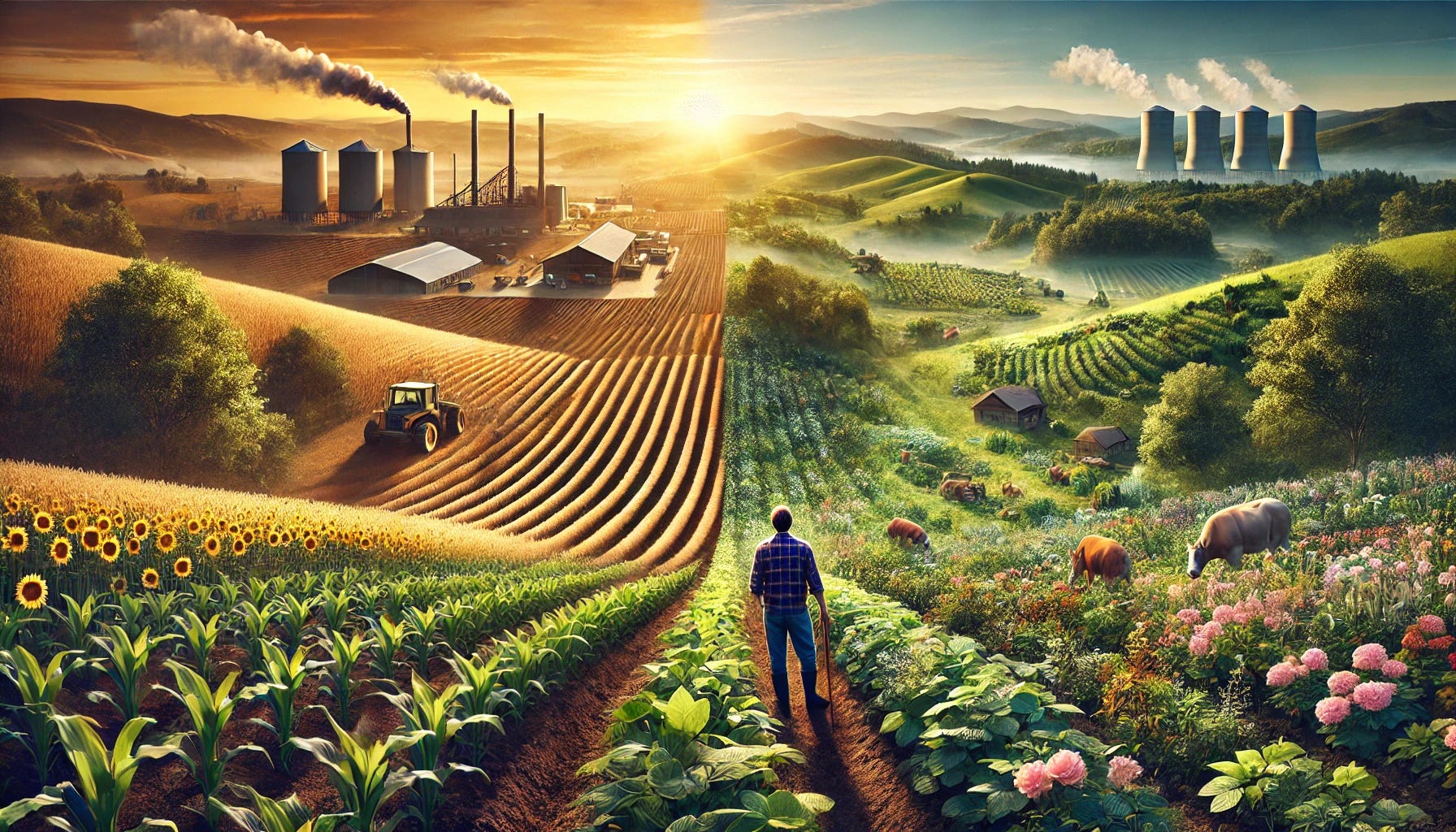
Moving Beyond Monoculture: Balancing Labor with Diversity
The industrial model is based on monoculture efficiency, but monocultures require constant intervention. Shifting to a diverse, multi-layered system can reduce input costs, improve ecosystem resilience, and create multiple revenue streams from the same land. The key is learning to balance labor with diversity, making sure that increasing crop variety doesn't become a burden, but an advantage.
Traditional medical systems teach us that health emerges from diversity and relationship. The Unani medicine concept of "mizaj" (temperament) recognizes that balance comes not from uniformity but from the right relationship between diverse elements. Similarly, a farm's health emerges from the relationships between diverse plants, animals, and microorganisms.
Diversifying Crops for Staggered Harvests → Instead of relying on a single cash crop, integrating companion crops, perennial plantings, or value-added herbs can generate income throughout the year while reducing pest and disease pressure.
Integrating Livestock into Crop Systems → Animals can provide fertility, weed control, and diversified revenue while reducing labor in tillage and nutrient cycling.
Agroforestry & Perennials → Planting nut trees, fruiting hedgerows, or medicinal plants can create long-term revenue without annual planting and labor.
On-Farm Experiences & Direct Sales → Creating CSA models, agritourism, or educational workshops can add resilience to farm revenue without relying solely on crop sales.
Diversification is not about doing more work, but about finding smarter ways to use the land's natural productivity rather than fighting against it—creating a system that, like a healthy body, largely maintains itself.
How Do We Shift from Managing to Effortless Balance?
1. Shift the Mindset: Observe More, Manage Less
The first step is not in the field—it's in how we think about farming.
In Ayurvedic medicine, diagnosis begins with deep observation—watching, listening, feeling—before any intervention. The skilled practitioner reads subtle cues that reveal underlying patterns of imbalance. Similarly, the attentive farmer must develop this observational intelligence:
Instead of focusing on what to apply, shift to what to observe.
Spend more time watching patterns unfold—where does moisture collect? Where do insects gather? What parts of the field naturally thrive without intervention?
Instead of reacting to problems, ask better questions about what is being disrupted in nature's rhythm.
Recognize that nature doesn't force balance—it creates the conditions for balance to emerge.
Farmers must trust observation over control, learning how to interpret what the land is already telling them. This is the "pulse diagnosis" of regenerative agriculture—reading the subtle signals of the land's health before taking action.
2. Identify What's Disrupting Natural Synchrony & Remove It
Instead of adding solutions, ask:
What is blocking the land's own ability to regulate itself?
Are we forcing systems into a structure they don't want?
Is the land asking for stillness instead of intervention?
In Traditional Chinese Medicine, health is restored not primarily by adding something but by removing blockages to the natural flow of qi. The land has its own qi—its own vital energy that naturally flows toward balance when obstructions are removed.
💡 Example: If powdery mildew keeps returning, instead of reacting to the outbreak, ask:
What conditions are making mildew thrive?
Where has fungal-bacterial balance been lost?
Is mildew appearing as a symptom of another disruption rather than a problem to be solved?
When we stop treating symptoms and start removing obstacles to natural regulation, balance emerges on its own. This is the principle of "removing the thorn" that many traditional healing systems emphasize—address the underlying cause, and the body (or land) heals itself.
3. Move from Inputs to Relationships
A farmer manages inputs—but nature thrives in relationships.
This mirrors how traditional healing systems view health not as the manipulation of biochemistry but as the harmony of relationships—between organs, elements, energies, and environments. The healer's art lies in restoring these relationships, not in forcing change through intervention.
Instead of asking: What do I need to apply to fix X? Ask: What relationships need to be restored so that X disappears on its own?
💡 Example: If pests keep attacking a crop, instead of focusing on organic sprays, ask:
What predator-prey relationships have been lost?
Is poor soil health causing plants to send distress signals that attract pests?
Is the landscape disconnected from natural corridors that bring in balancing species?
Restoring missing relationships creates effortless balance. Just as an Ayurvedic doctor might focus on restoring the relationship between digestive fire and body tissues rather than merely addressing symptoms, the farmer restores the relationship between soil, plants, and the broader ecosystem.
The Less You Do, The More Nature Can Do
Agriculture seeks answers: Which fertilizer? Which microbes? Which process? But nature doesn't work with answers—it works with presence, flow, and adaptation.
The most advanced farming system is the one where humans intervene the least. The highest intelligence isn't in what you apply—it's in what you allow.
Instead of constantly adding more, start removing what prevents balance. This is the essence of Wu Wei in farming—the paradoxical action of non-action that allows natural intelligence to emerge.
Where in your farm, garden, or philosophy can you step back and observe before intervening? What would happen if you trusted the land to self-correct more than you trust any farming method?
This is the next evolution—not just regenerative farming but resonant farming. Not just working with nature but being so attuned to it that nature does the work without interference. It's the difference between the novice healer who relies on formulas and the master healer who works with the body's inherent intelligence.
The key is not to abandon economic realities but to start where intervention can be reduced without risk—small, steady shifts that prove nature's ability to restore balance while also protecting a farm's financial foundation.
A New Language for Farming
Perhaps the most important shift is linguistic. Traditional healing systems have rich vocabularies for describing health that go beyond the absence of disease. Similarly, we need a farming language that transcends "pest management" and "yield optimization."
Instead of:
Pest control → Ecological balance
Soil amendments → Soil relationship
Yield maximization → System vitality
Resource efficiency → Cyclical abundance
This new language shapes how we think about and practice agriculture. When we speak of "inviting pollinators" rather than "controlling pests," we shift from a mindset of warfare to one of relationship. When we talk about "reading the land" rather than "managing the farm," we acknowledge the land's own intelligence and wisdom.
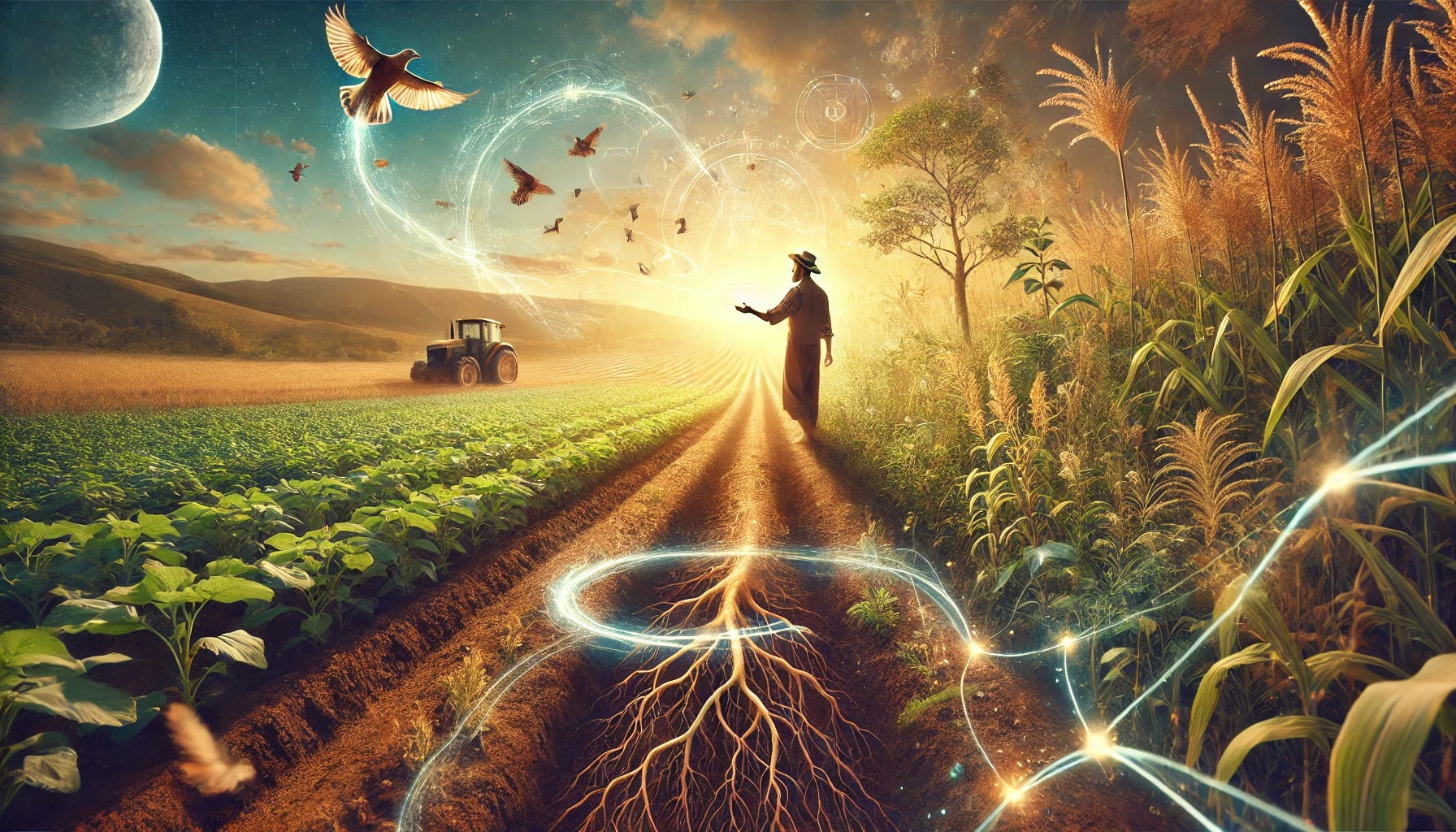
The Farmer's Journey: From Technician to Healer
This reframing transforms the farmer's identity—from technician applying techniques to healer in relationship with a living system. Like the traditional doctor who views illness not as failure but as information, the farmer sees challenges not as problems to solve but as messages to interpret.
The most regenerative tool at our disposal isn't a technique or amendment but a way of seeing—one that recognizes the farm as a living entity with its own balance, rhythm, and wisdom. Our role shifts from manager to participant, from controller to collaborator.
In this view, farming becomes not just a profession but a practice of relationship—one where we learn as much as we teach, receive as much as we give, and find that the land's abundance emerges not from our control but from our attunement.
The journey from conventional to regenerative to resonant farming isn't just about changing what we do—it's about transforming who we are in relationship to the land. It's about recovering the ancient wisdom that traditional healers have always known: that the deepest healing comes not from imposing our will but from aligning with the intelligence that already exists in nature.
The question, then, is not just what amendments to apply or what techniques to use, but who we become as we step into this deeper relationship with the living land. What might farming look like if we approached it not as managers but as attentive partners in an ancient dance of life?
Some thoughts for the week :)
This is ‘Spiritual Farming’. It sounds amazing but not being a farmer I’m wondering how practical it is.
Thank you. This is the way.