

What the White Blood Knows
A weed that bleeds milk, and the oldest claim no one ever checked
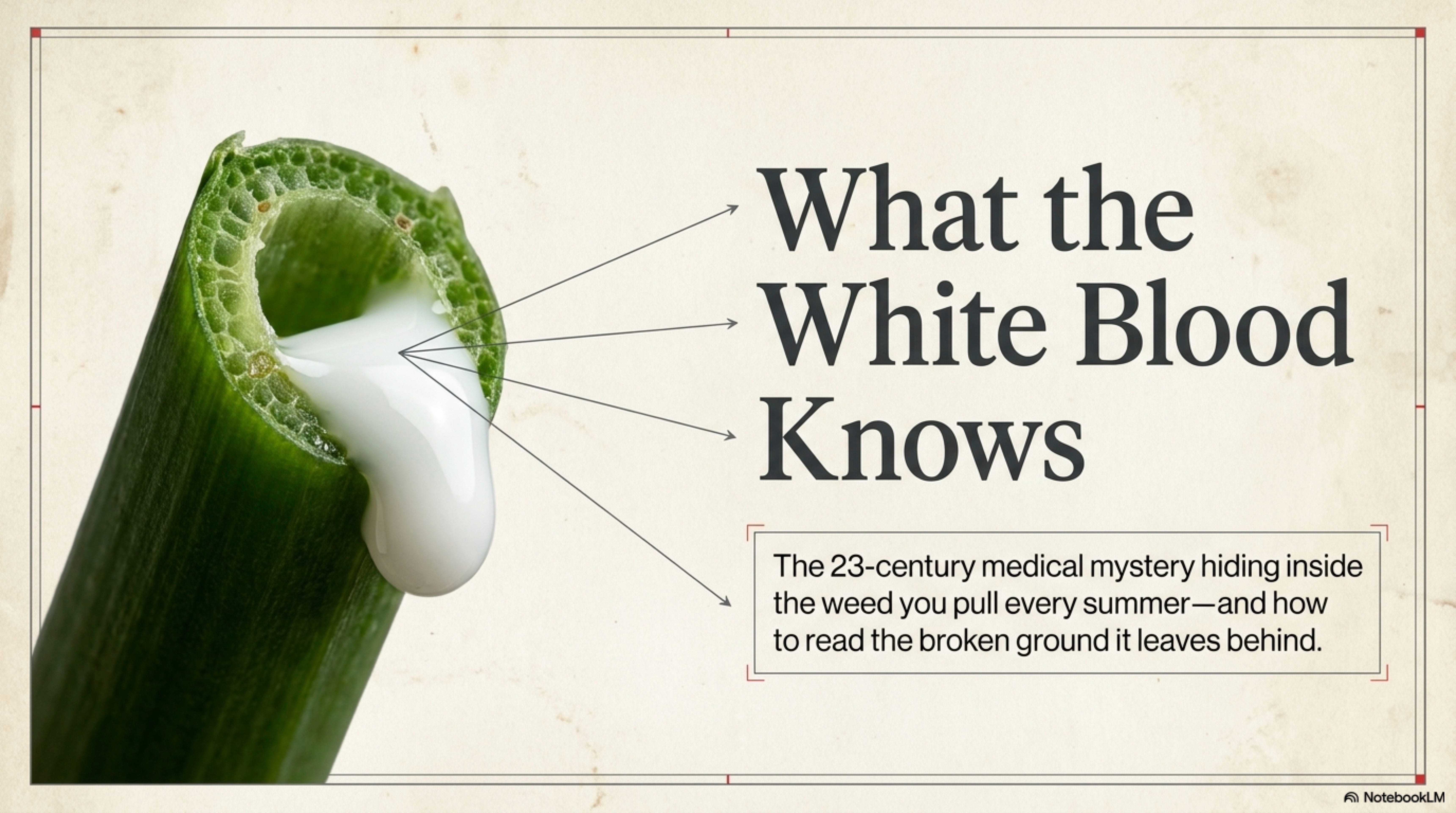
Snap a sow thistle stem in late June and it weeps. Not sap exactly, something whiter, thicker, that beads on the wound and runs. You’ve done this without meaning to a hundred times, breaking one off at the edge of a bed or a fence line, and wiped the white smear on your jeans without a thought. That white smear is the whole plant. It’s the bitterness, the medicine, the name, the twenty-three centuries of people who reached for this thing on purpose. Hold onto it, it’s the thread that ties every other thing about sow thistle together, and it ends somewhere stranger than you’d guess.
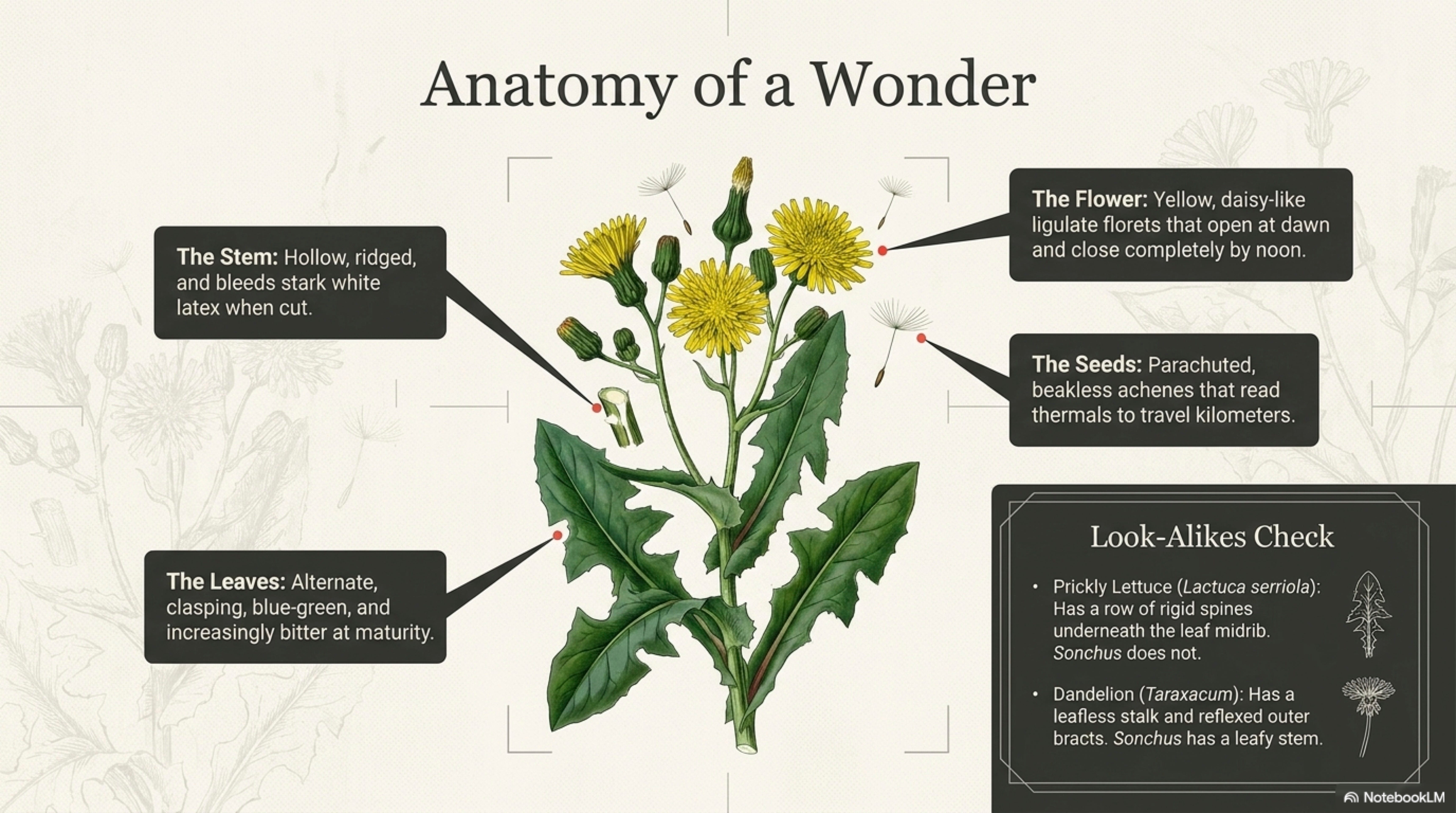
First, what it is. There are three of them, really, a tall one, a smooth one, a spiky one, and they blur, so we’ll come back to telling them apart. But all three are the same idea: a yellow dandelion-ish flower that shuts by noon, a hollow stem, parachute seed, and that white blood when you cut it. The one most likely standing in your garden right now is common sow thistle, Sonchus oleraceus, soft-spined and mild. Start there.
If you farm it, you’re looking at forage you’ve been mowing as a weed. Young perennial sow thistle runs twenty to twenty-five percent crude protein, it meets or beats alfalfa, and cattle, sheep, and especially rabbits go for it before almost anything else green. Geese were once fattened on it on purpose. The catch is timing: palatable and tender while young, bitter and stringy the moment it bolts. Graze it right and it stays sweet. Graze it wrong and it gets away from you.
If you garden it, you’re looking at a patch that hosts its own pest control. By midsummer the undersides of the upper leaves crawl with aphids, and that’s the feature, not the bug. The aphid colony draws hoverflies and lacewings, whose larvae spill onto your vegetables and eat the aphids there. A sow thistle stand at the margin is a beneficial-insect reservoir running on its own dime. The thing you’d reflexively yank is staffing your garden.
If you forage it, you’re looking at one of the oldest pot-herbs on earth. People have eaten this continuously since the Neolithic, Greek horta, Māori pūhā, Chinese kǔ cài, Cretan hillsides, Louisiana bayous. Young leaves blanched and dressed in oil and lemon, mild and mineral, with a clean cucumber note. And oddly for a leafy green, it carries real omega-3, part of why the Mediterranean peasant diet scored so well long before anyone counted.
If you teach with it, you’re looking at a contradiction with a name on both sides of the ledger. This is a Class 2 noxious weed in Canada, the subject of a glyphosate-resistance crisis tearing through Australian grain country, and simultaneously one of the most widely eaten wild plants in human history, a thing Theseus supposedly ate at a poor woman’s hut before going to fight a bull. Cursed by statute, blessed at the table, both true at once.
And if you’re just curious, you’re looking at a diagnosis. Sow thistle doesn’t colonize healthy sod. It shows up where the ground has been torn open, and one of its three faces stays by root while the other two pass through by seed, which means a patch is telling you something specific about what was done to that soil, and what it’s about to do next. What it’s saying is worth the whole walk. But that reading’s on the other side.
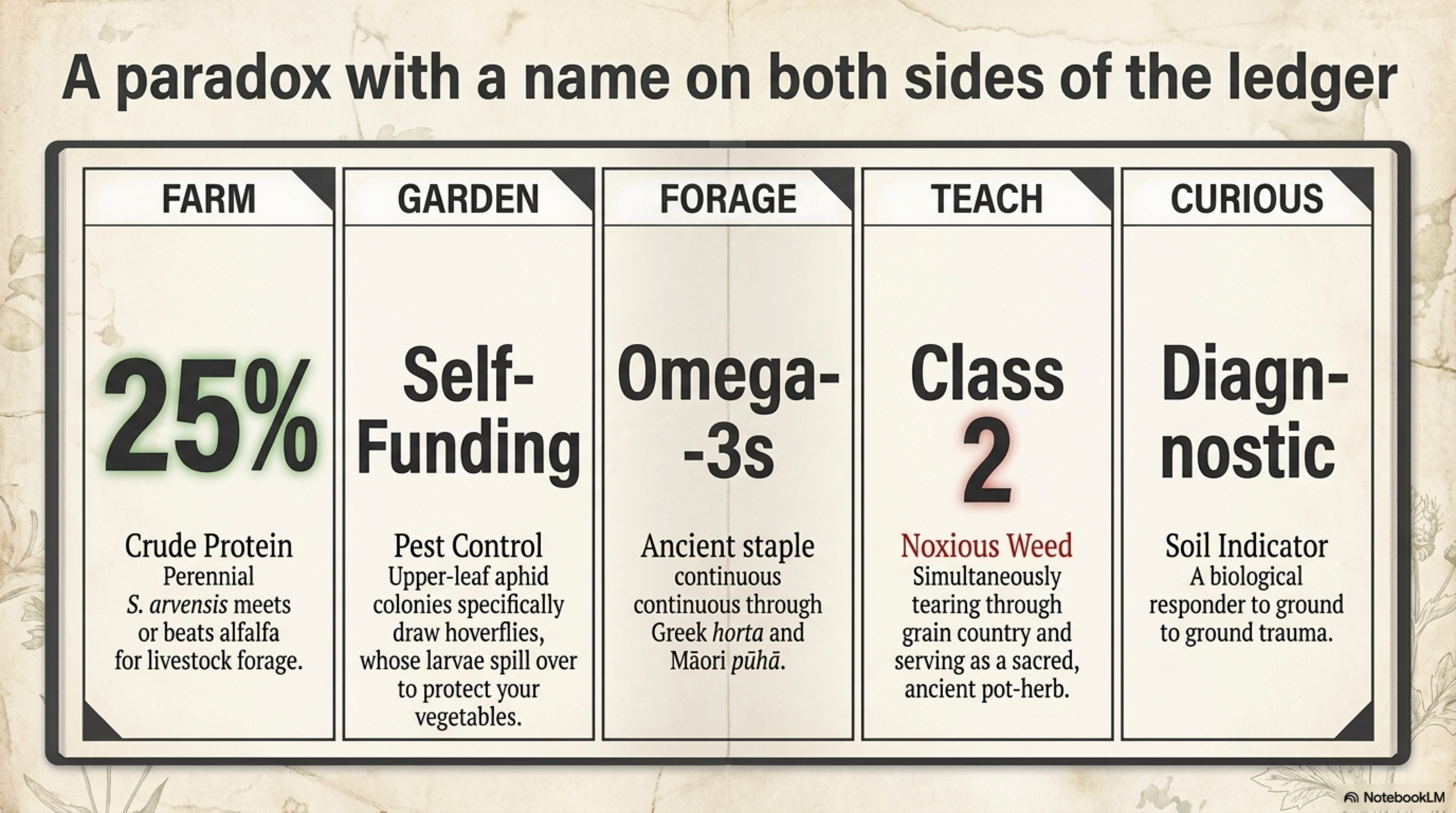
All five are true at once, and all five run back to the same white blood. So learn the body, because that’s where the safety lives.
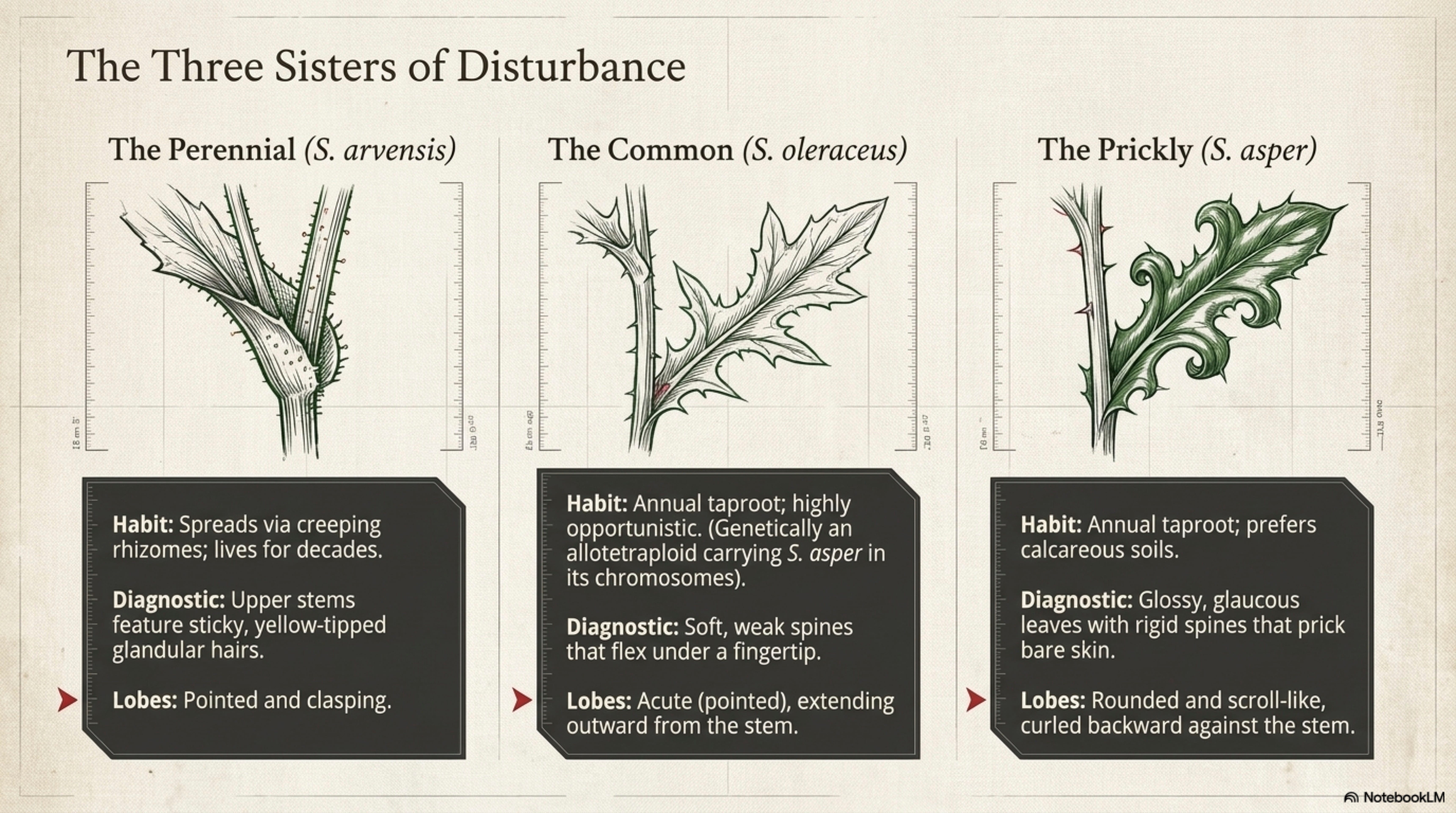
The three sow thistles share one architecture, hollow stem, milky latex, clasping ear-like lobes where the leaf grips the stem, small yellow heads that open at dawn and close by midday, then a powderpuff of windborne seed. Tell them apart by the joint where leaf meets stem. Common sow thistle’s basal lobes are pointed, held out from the stem like little flags, and its spines are soft enough to run a finger along. Prickly sow thistle (S. asper) curls those lobes into tight backward scrolls clasping the stem, wears a glossy plastic sheen, and actually pricks. Perennial sow thistle (S. arvensis) is the tall one, bigger flowers, sticky glandular hairs up top, and roots that creep. Don’t memorize a key. Just check the lobe and the prickle, and you’ve placed it.
One honest lookalike note, and it cuts the reassuring way. There is no deadly twin here, sow thistle is one of the safer wild greens going, with no lethal mimics, no cyanide, none of the liver-wrecking alkaloids some weeds hide. The plant it’s most often confused with is prickly lettuce (Lactuca), which also bleeds white and flowers yellow; tell it by the row of spines running down the underside of the leaf midrib and the little beak on its seed, neither of which sow thistle has. The real cautions aren’t about poison, they’re about where it grew: this plant pulls up nitrate from over-fertilized ground and, in S. oleraceus, hoards cadmium from contaminated soil. A green this good at scavenging is only ever as clean as the dirt under it. Skip the roadside, the sprayed verge, the old industrial lot. Take it from clean ground.
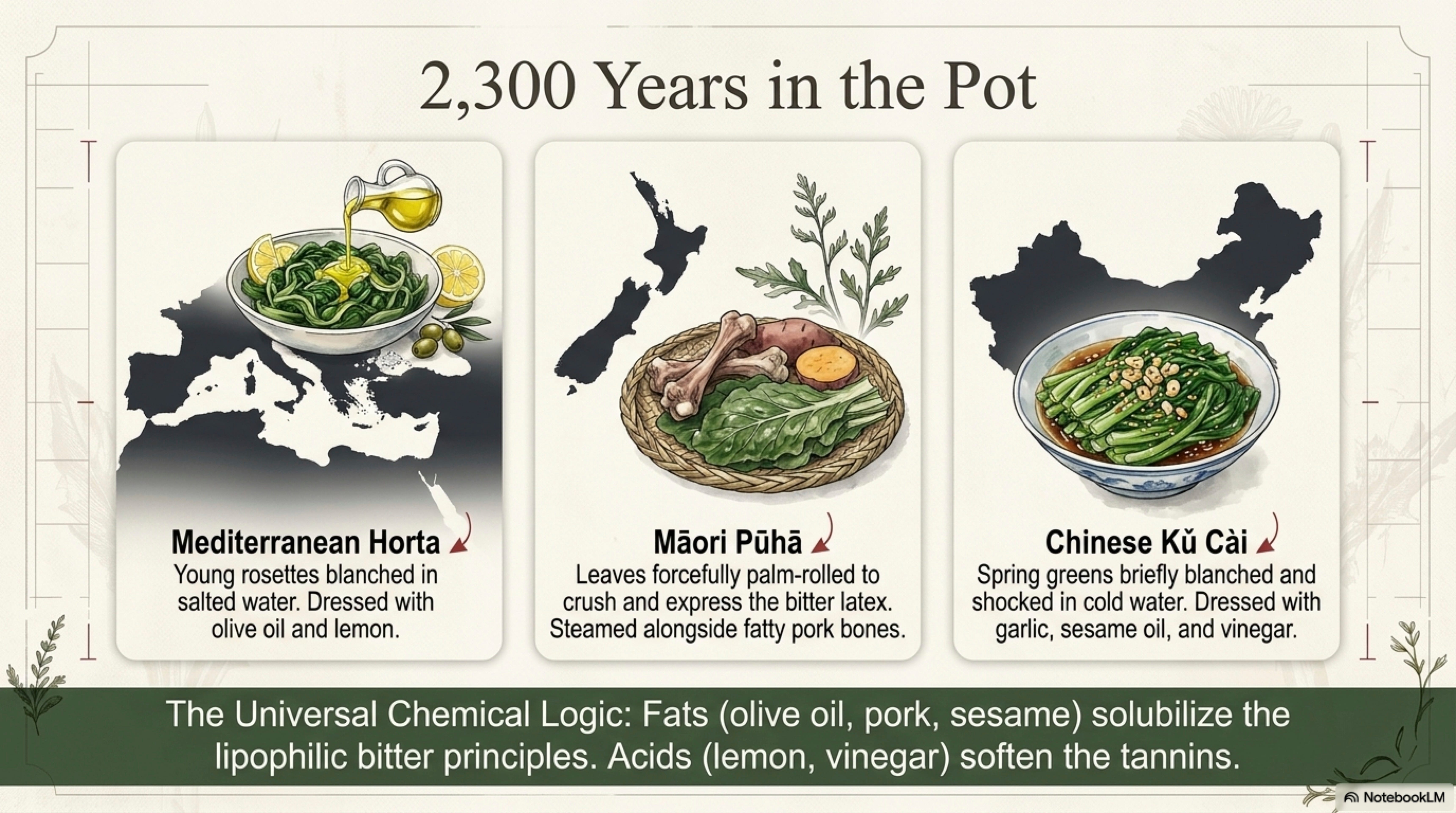
Now the one safe thing to do with it, claim-free. Eat the young ones. Before any flower bud shows, while the rosette leaves are still crisp and the stem snaps clean, cut them, blanch them ninety seconds in salted water, squeeze them dry, and treat them like spinach with a backbone, oil, lemon, garlic, a fistful into soup or a savory pie. The Māori roll the leaves hard between their palms first to crush the bitter latex out before cooking with pork; the Greeks just boil and dress. If you keep rabbits or poultry, skip your own kitchen step and hand them the cuttings, they’ll thank you. That’s the whole safe use, and it over-delivers: a free green, in season, that most people pay a weed-whacker to destroy.
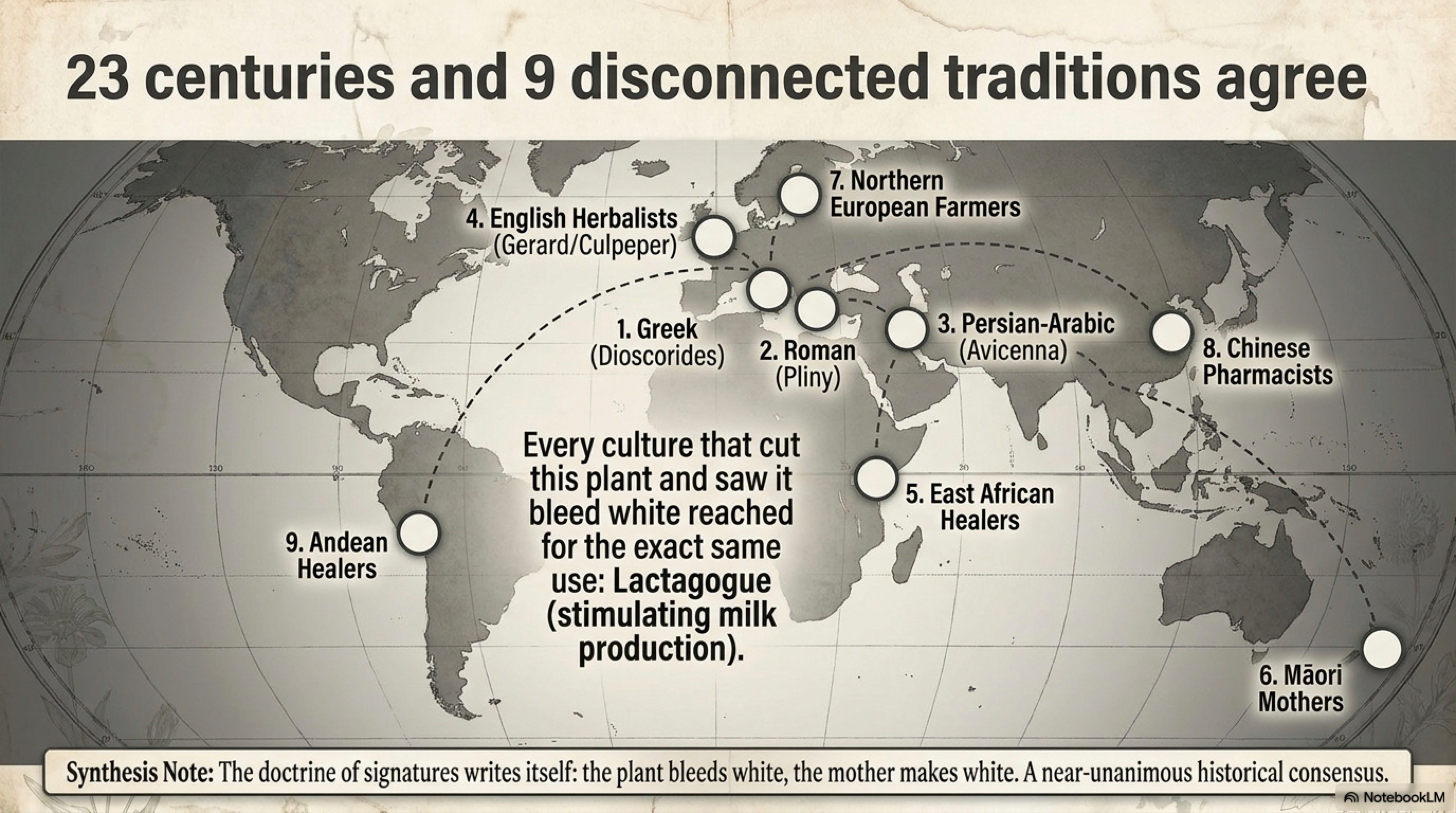
This was the biggest discover, and it’s the reason there’s an other side to this at all. Go back to the white blood. Across twenty-three centuries and nine separate cultures that never compared notes, people who cut this plant and saw it bleed white reached, every one of them, for the same use: milk. Dioscorides prescribed it to nursing mothers in the first century. So did Pliny, and Avicenna a thousand years later, and Gerard and Culpeper in England, and Maud Grieve in 1931, and Kenyan herbalists, and Māori mothers after birth, and northern European farmers fed it to farrowing sows for exactly the same reason, which is how it got the name you call it by. Sow thistle. The white sap that rhymes with milk, in every language at once, said to make milk.
Nine traditions. The strongest single thread in the plant’s entire record. The white blood says milk, and somewhere in the gap between that ancient, near-unanimous claim and what a modern lab can actually confirm sits the most honest, most uncomfortable sentence I know how to write about this plant.
So is it true? Did nine civilizations catch something real running in that white sap, or did they all just see white and think milk, a pretty coincidence of color that everybody copied from everybody else? There’s an answer to that. It’s not the one either side wants, and it’s the whole reason to subscribe and find out.