

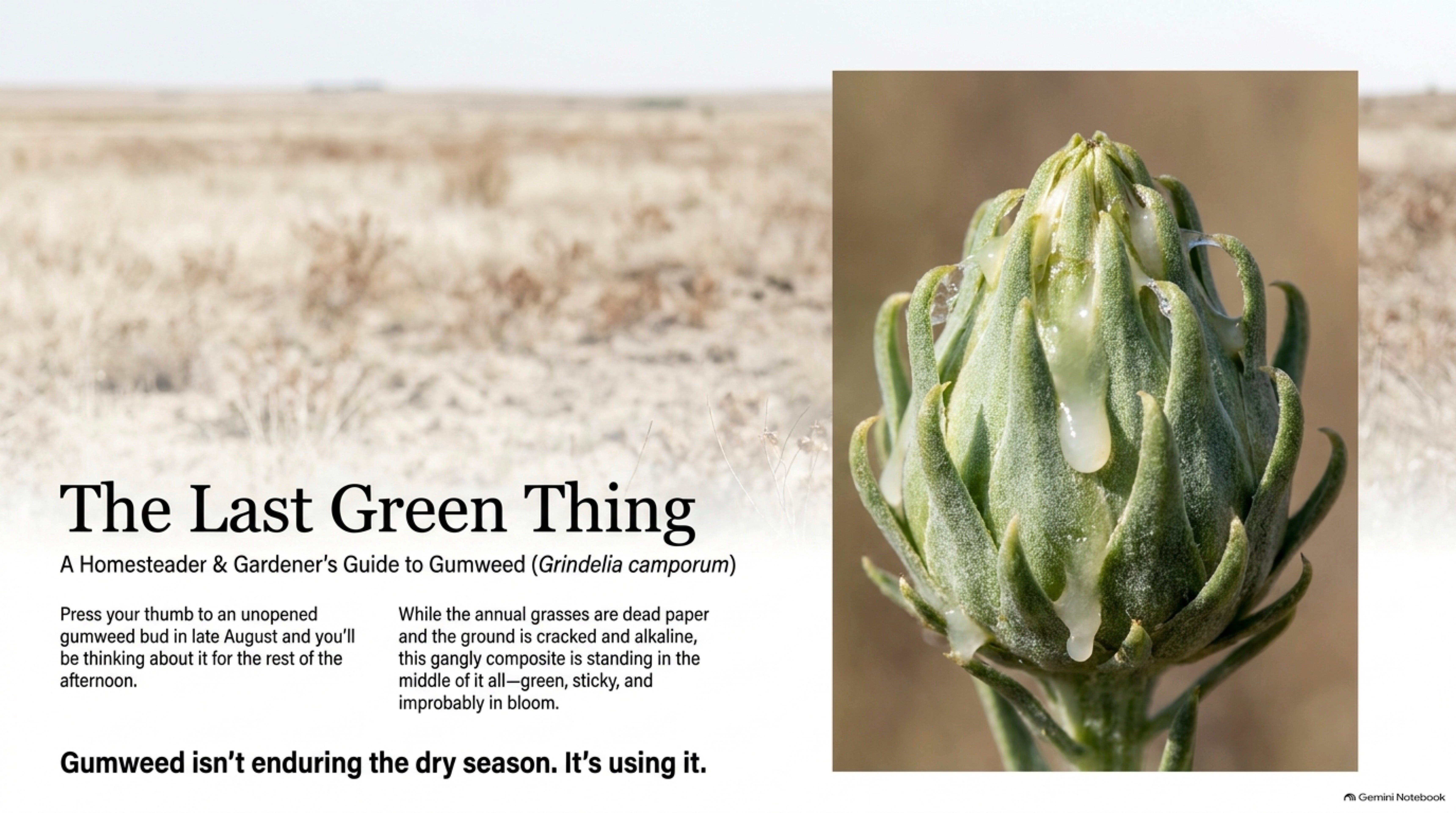
Press your thumb to an unopened gumweed bud in late August and you’ll be thinking about it for the rest of the afternoon. What comes away is white and milky and tacky, a varnish that smells of pine and turpentine and transfers itself faithfully to the next three things you touch. Meanwhile everything around the plant has quit. The annual grasses are dead paper, the ground is cracked and pale and alkaline, and this gangly, over-branched composite is standing in the middle of it green, sticky, and improbably in bloom, working the last bees of the year.
That’s the whole argument in one gesture. Gumweed isn’t enduring the dry season. It’s using it.
And it’s why the same weed turns up in five completely different conversations depending on who’s standing over it.
If you farm, you’re looking at a plant your stock will walk past. Cattle avoid it, deer avoid it, and almost every insect avoids it, and the resin is the reason. That refusal reads like a loss and isn’t, on certain ground it’s the only thing standing between an animal and a mineral gumweed is unusually good at concentrating.
If you garden, you’re looking at a hedgerow plant that flowers from May clear into November and peaks when your beds have gone over: nectar and pollen for native bees, honey bees, butterflies, and the hoverflies whose larvae eat your aphids, in the weeks when there is nothing else open. What almost nobody planting it knows is that gumweed cannot fertilize itself. Not prefers not to. Cannot. Which changes what you owe it.
If you forage, you’re looking at the rare plant with no food story at all, no staple, no famine use, no tradition worth the name, because the resin that armors it against everything else also takes it off the plate. What people take instead is the flowering top, and that’s medicine rather than dinner, so it comes with rules. But the rule that matters most here isn’t about dose, and it isn’t about a poisonous twin. There is no poisonous twin.
If you teach, you’re looking at a plant whose every name is a confession: gumweed, gumplant, resinweed, rosinweed, tarweed, stickyheads, the Spanish botón de oro, golden button, and the genus itself, Grindelia, named for a Latvian-German pharmaceutical chemist. Two unrelated settler languages reached independently for glue and for gold. Meanwhile the plant’s actual scientific name is, right now, an unresolved argument between two peer-reviewed authorities, and the name the drug trade sold it under for a century belongs to a plant that can’t be placed at all.
And if you’re just curious, you’re looking at the ground telling on itself. Gumweed picks its spots, alkali flats, salted bottomland, scraped roadside, disturbed alluvial dirt below about 4,600 feet, and it thrives precisely where the competition can’t stand up. A big stand is a soil report. What that report says, including the one line in it that should make you set your basket down, is the part nobody mentions.
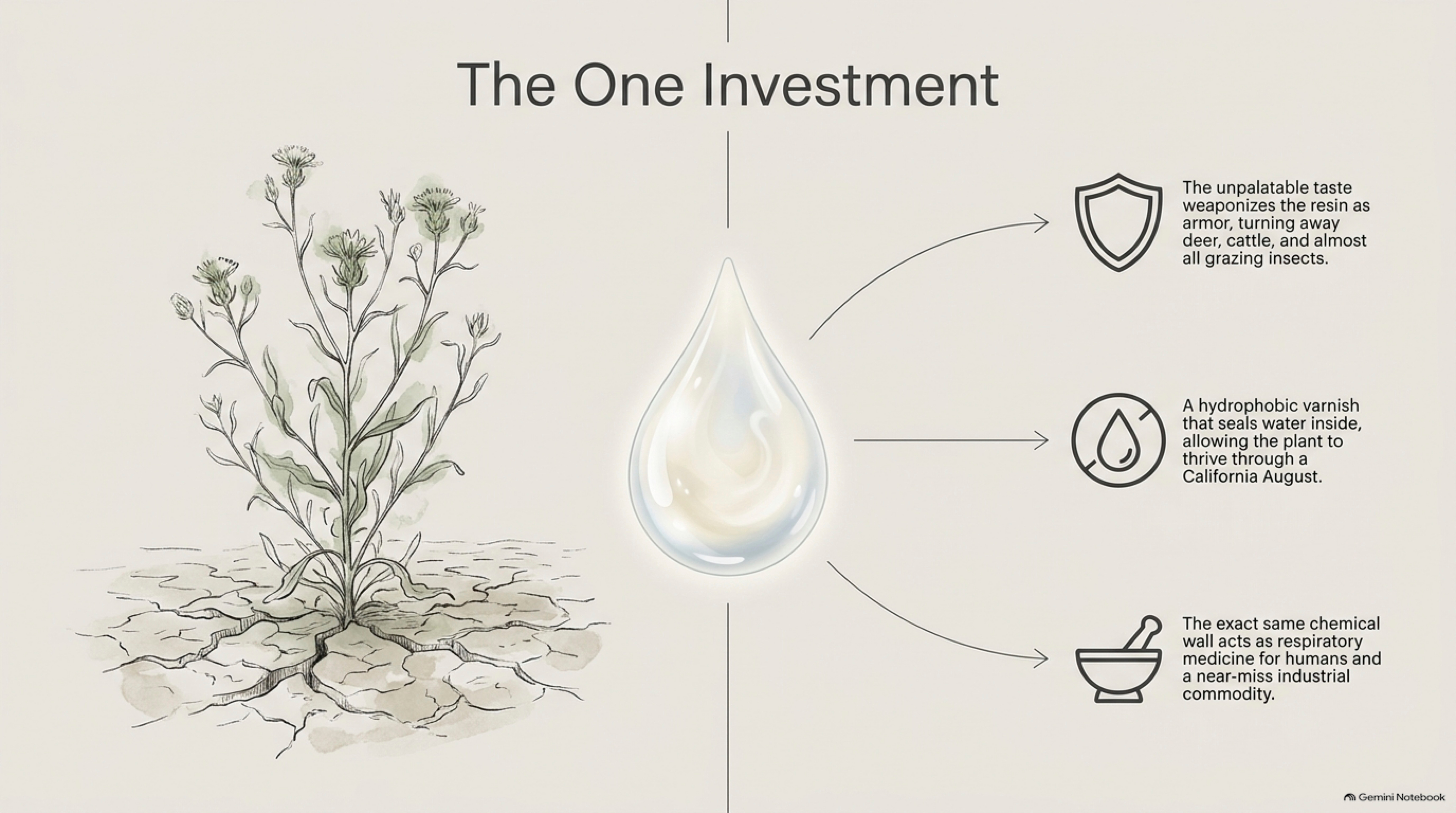
Five readings, one plant, and they braid into a single thread. Everything gumweed is, armor, medicine, bee bar, commodity, hazard, routes through one secretion. The resin is not a feature of this plant. It is the plant, and every use anyone has ever found for it is that same drop, held up to a different light.
So start with meeting it, which gumweed makes easy, because it identifies itself by touch before your eyes have finished the job.
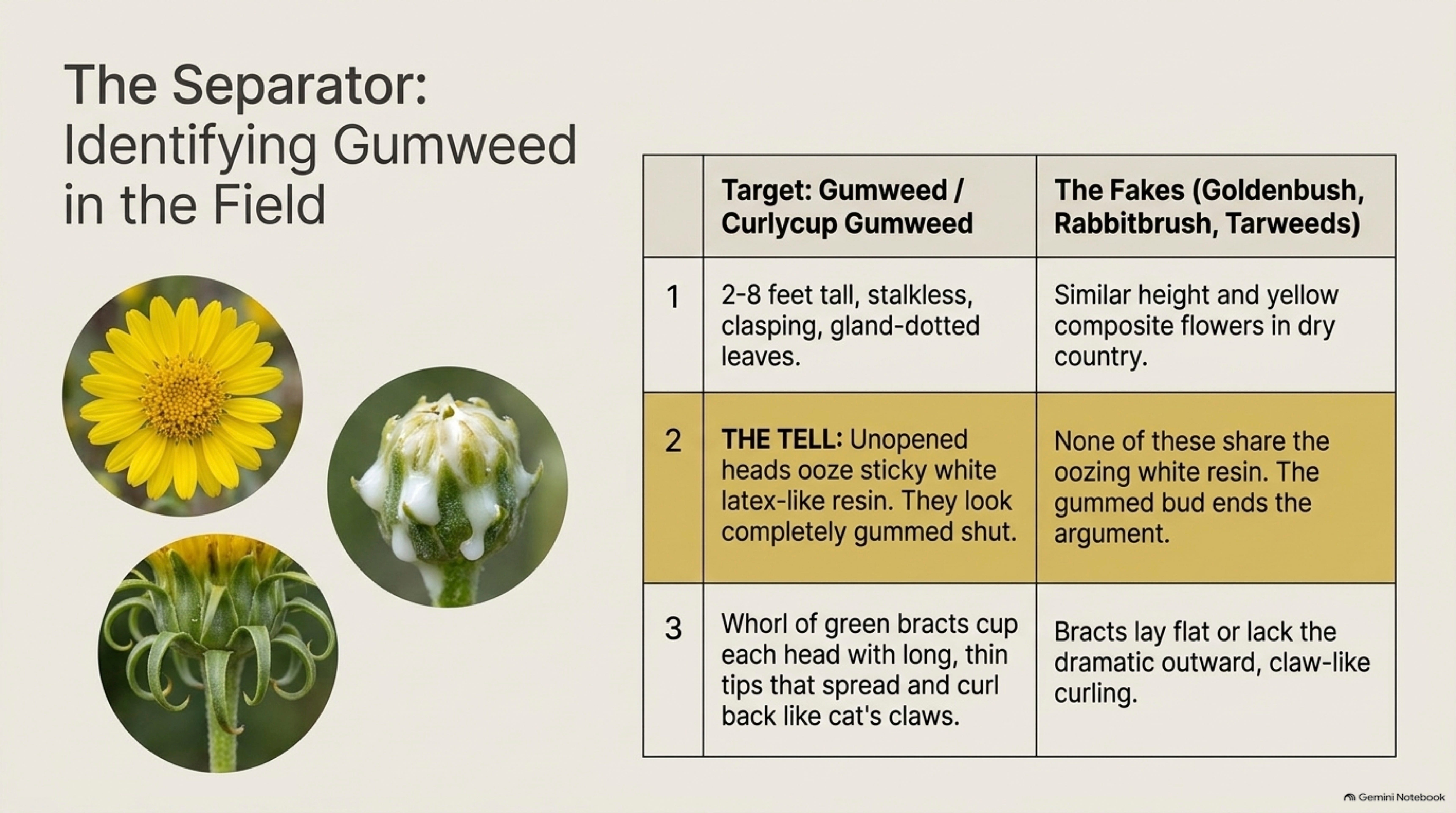
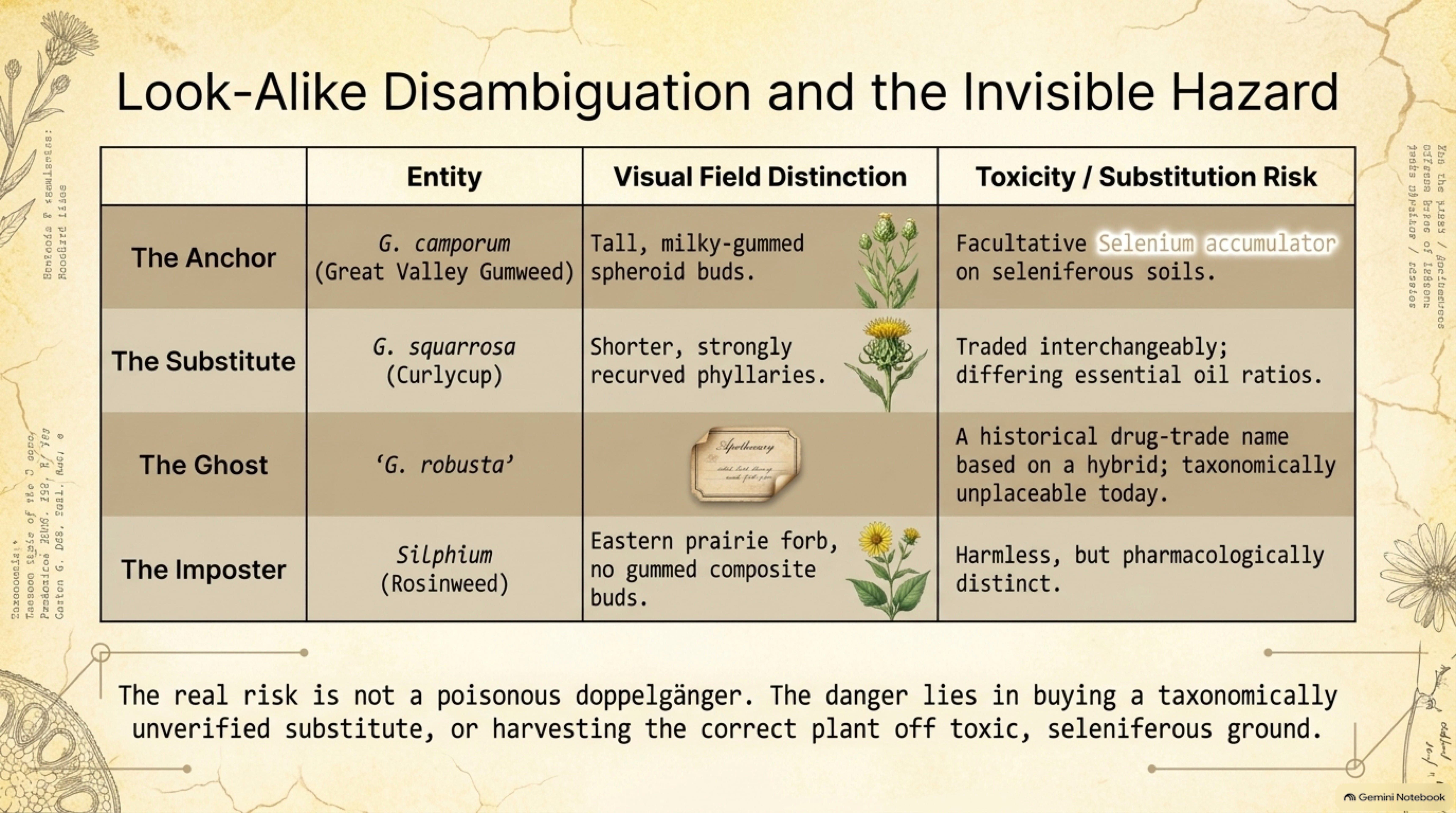
Look for a rangy perennial two to eight feet tall, branched and leafy, stems often looking white-varnished, leaves stalkless and clasping and gland-dotted and sticky, heads like fat daisies an inch or two across with twenty-five to thirty-nine yellow rays around a yellow disk. That’s a lot of yellow composites in a dry country. Here’s the tell that ends the argument: the unopened heads are little spheres oozing a sticky white latex-like resin, so they look gummed shut, and the whorl of green bracts cupping each head has long thin tips that spread and curl back like a cat’s claws. Goldenbush doesn’t do that. Rabbitbrush doesn’t. Neither do the tarweeds, and neither does the eastern rosinweed that shares half of gumweed’s common names. The gummed bud is the separator, and it is not subtle.
The confusions that remain are family arguments. Gumweed’s real lookalikes are its own siblings, curlycup gumweed with its phyllary tips curled back hard, coastal gumweed lying down on the dunes, and a whole intergrading complex that trained botanists separate with difficulty and everyone else mostly doesn’t. That sounds like a technicality. It becomes a safety issue about two hundred words from now, when we get to what’s on a bottle.
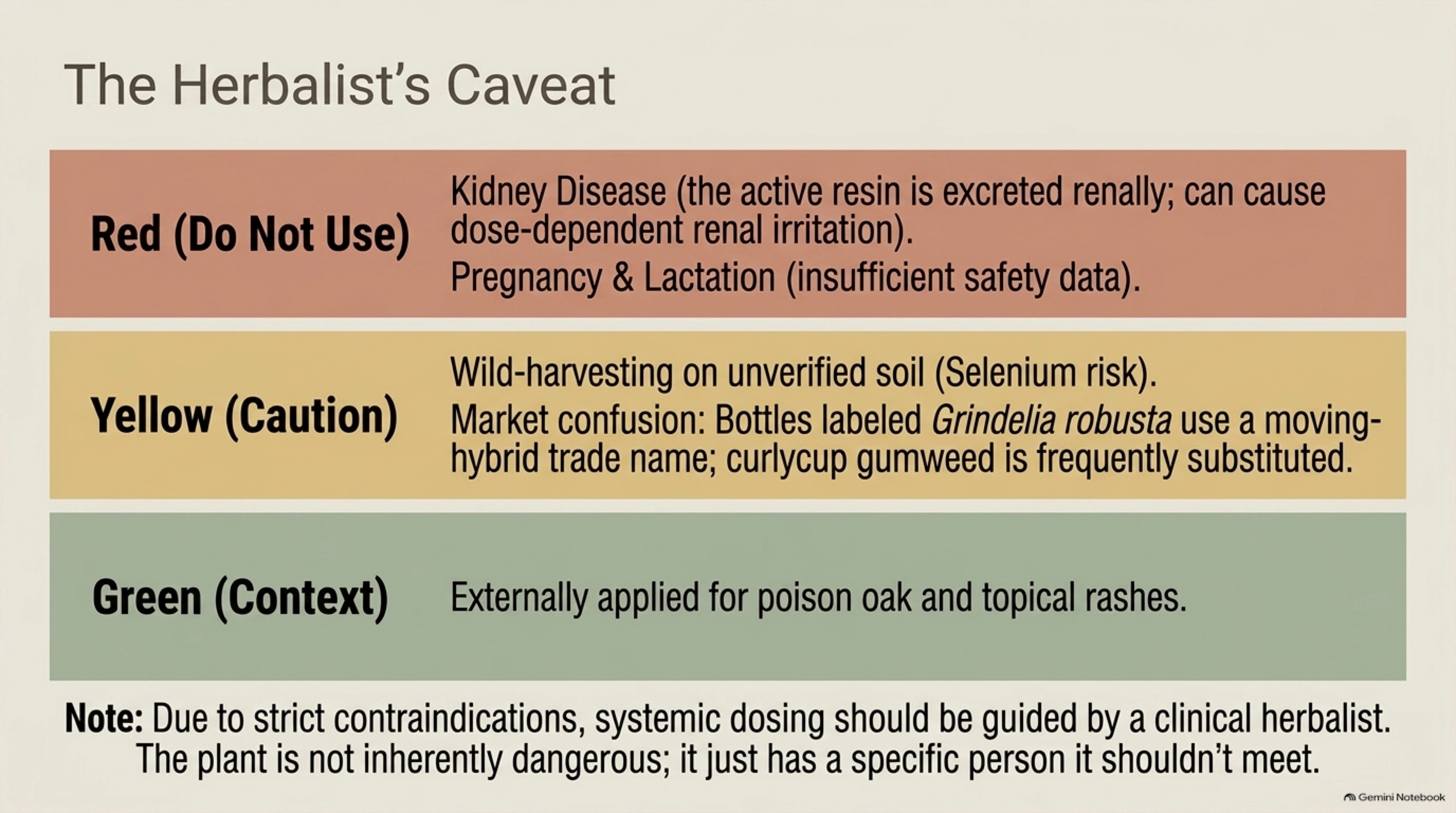
Because here is the caution that earns its place in the free portion, and it’s an odd one. There is no dangerously toxic doppelgänger for gumweed. The gummed-bud gestalt is distinctive enough that misidentification is a low risk. The genuine hazard is a correctly identified plant, harvested off the wrong dirt: gumweed is a facultative selenium absorber, meaning it takes selenium up out of seleniferous soils and concentrates it, to levels documented as hazardous. And selenium doesn’t show. It doesn’t change the smell, the tack, the color of the rays, or the curl of the bracts. You can key the plant perfectly, harvest it at exactly the right stage, and be wrong about it, because the thing that was wrong was never in the plant. So the harvesting rule for gumweed is a rule about geography and paperwork rather than about botany: know the ground, and know the species on the label. Both of those are worth more than a field guide here, and only one of them is a thing a field guide can help with.
Which is a strange enough situation that I’d rather hand you a use with no such asterisk on it.
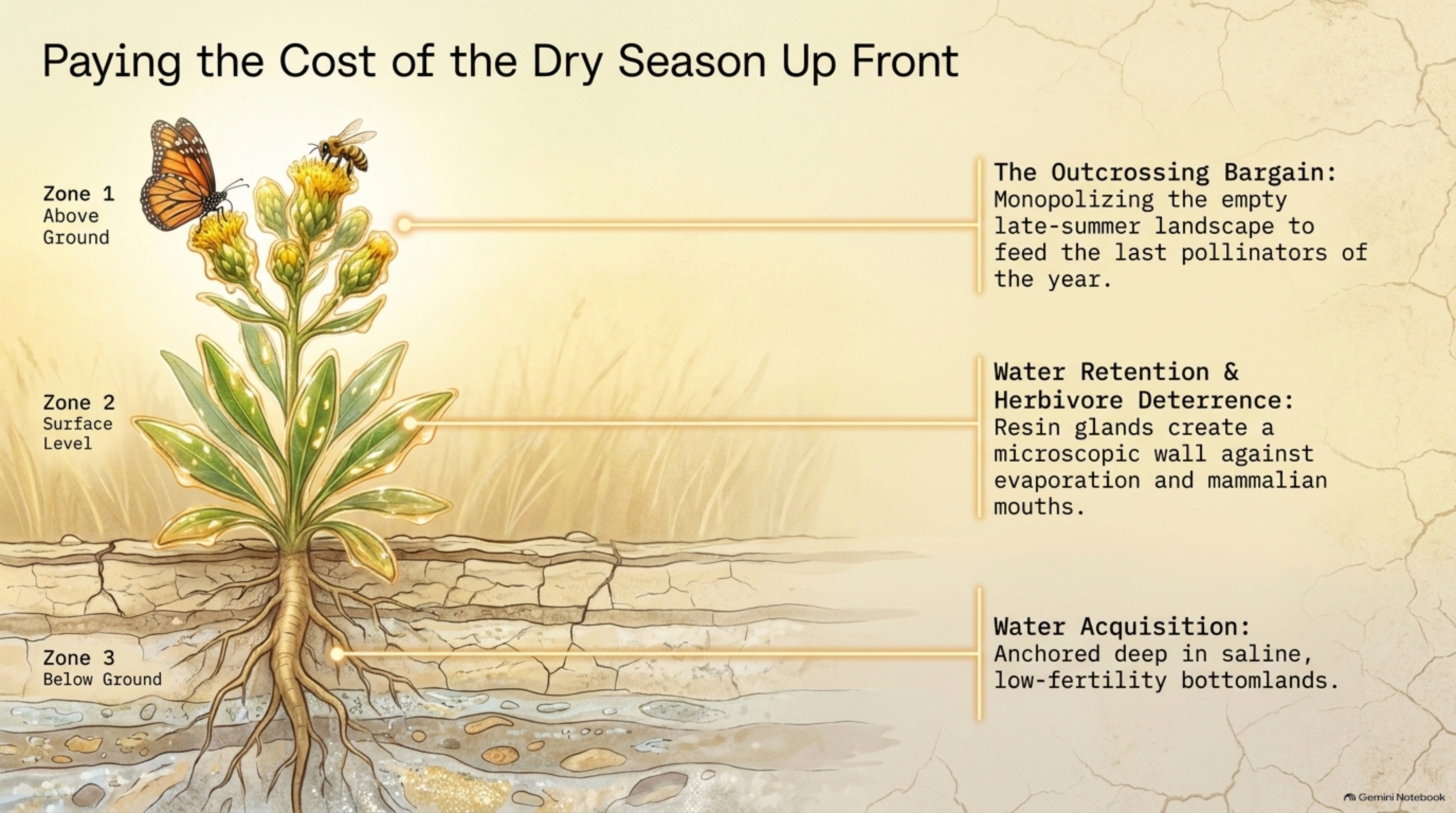
Leave it standing, and if you have a hard margin, plant more of it. That’s the whole instruction, and it is genuinely the best thing most people can do with this plant. Gumweed’s flagship value is that it holds the floral calendar open into the dry months, a late-summer and autumn nectar and pollen bank in a landscape that has otherwise shut for the season, which is exactly why it goes into pollinator meadows, hedgerows, and insectary strips on purpose. It asks for nothing in return: poor soil, sandy soil, high alkalinity, high salinity, minimal water, and a deep taproot that carries it through. On saline bottomland and beat-up roadside ground where the usual regenerative species sulk, it establishes and it holds. It’s a poor forage and a poor compost input, the resinous tissue is slow to break down and nothing wants to eat it, so don’t ask it for those. Ask it for the thing it is uniquely positioned to give, which is a table set in September.
And if you do harvest, the ethic follows straight from the plant’s own biology: leave plenty flowering and seeding. Gumweed is an obligate outcrosser. It is entirely dependent on the insects it feeds, which is a mutual dependence rather than a convenience, and a stand you strip is a stand that doesn’t set seed.
So we’re left with a plant that says no to nearly everything alive, and three unresolved things sitting on top of it.
The first is the refusal itself. Deer, cattle, and most insects have all agreed to leave gumweed alone, and the few that learned to read past the no did something genuinely odd, there’s a butterfly on record that drinks the resin, the very substance that turns everything else away, and it does so with a documented difference between the sexes. Nobody has asked why.
The second is the ground. That golden stand in the brown field is reading the soil out loud, its salinity, its history of disturbance, its place in the successional queue, and, on suspect land, its selenium. But the mechanism that lets gumweed do that reading is the same mechanism behind the harvest rule above, and once you see the join, a roadside weed stops looking like a weed and starts looking like an instrument.
The third is the theft. The asthma medicine that entered the United States Pharmacopeia in 1882 and stayed on the official list for forty-four years, and in the National Formulary until 1960, did not begin with the physicians who published the case series. It was learned from named Native nations, taken up with the thanks largely omitted, and the written record has been carrying that omission ever since.
There’s a fourth thing, and it’s the one I keep coming back to. Twice, once in the 1980s, once again in the biofuel years, serious agronomists ran the numbers on farming this plant for its resin, which is chemically close kin to pine rosin, the stuff behind adhesives, varnishes, inks, paper sizing, and rubber. Pine rosin without a pine forest, grown on salt flats, on marginal ground, on almost no irrigation. They got yields. They published. And both times it was shelved over a gap of about four percentage points.
That’s the other side.