

Burdock (Arctium lappa & Arctium tomentosum) – Living Plant Wisdom Profile
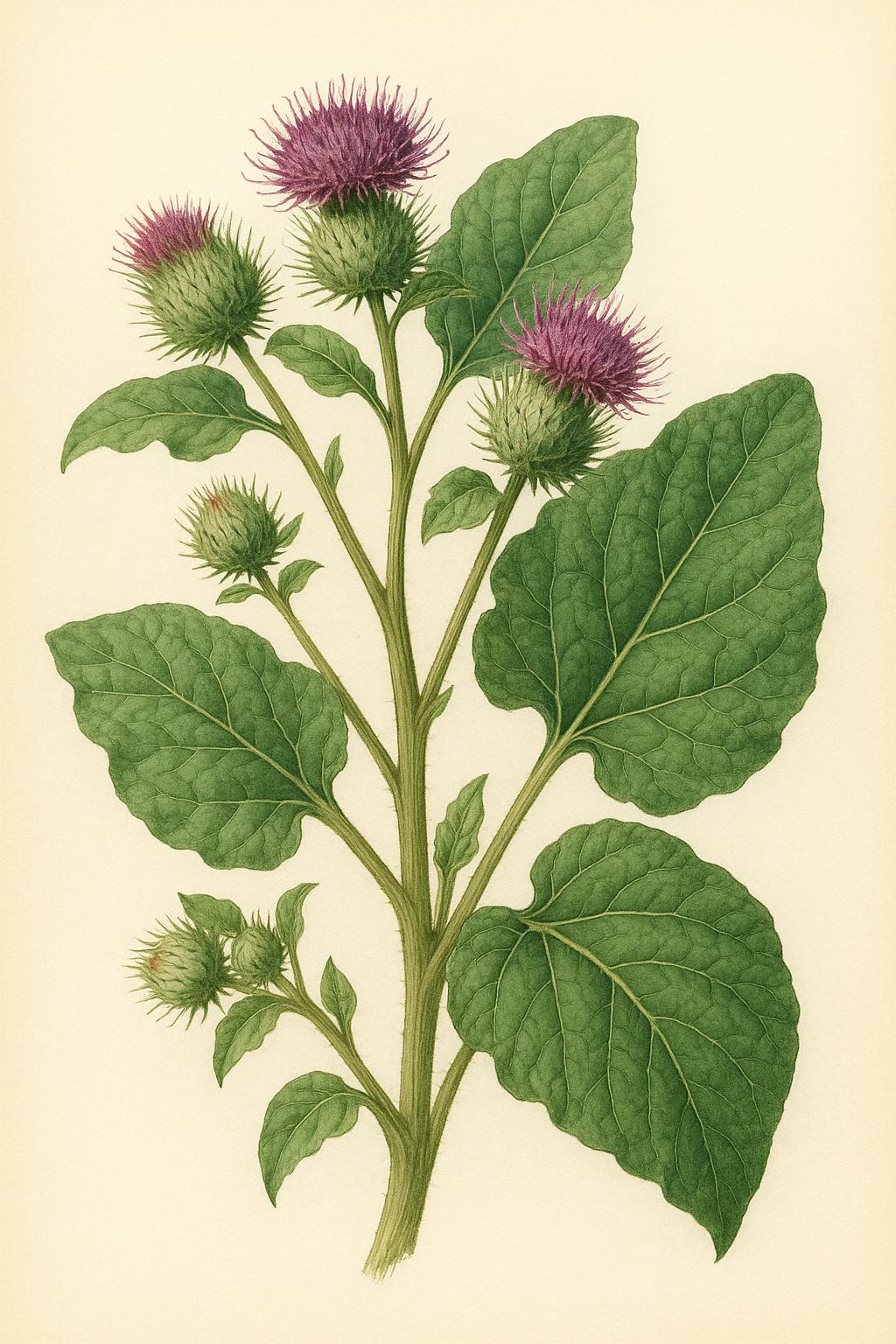
Burdock’s purple thistle-like flower heads bloom in the second year, attracting pollinators and embodying the plant’s tenacious spirit.
Introduction
I’ve always been fascinated by the way science can illuminate the hidden workings of plants—their chemistry, their ecological intelligence, the measurable patterns they follow. At the same time, I’ve never lost my respect for the traditions that carried plant knowledge long before laboratories existed. Somewhere between these two ways of knowing, I’ve come to believe, lies the richest understanding.
This Living Plant Wisdom Profile for burdock (Arctium lappa and A. tomentosum) is my attempt to weave those threads together. It isn’t meant to prescribe a single way of seeing, but to offer a range of lenses—scientific, traditional, ecological, and spiritual—that you can pick up and try for yourself. Some will fit comfortably, others might surprise you, and a few may not resonate at all. That’s the point. The work of relationship with plants begins in curiosity, not certainty.
For those of us who farm, garden, or steward the land, it can be easy to label burdock as a nuisance. Yet when we look again—with open eyes and multiple perspectives—we start to notice how much this so-called weed has to teach us about resilience, soil health, and the patience required to build strong foundations. My hope is that this profile helps you see burdock not just as a plant to manage, but as an ally worth listening to.
Executive Summary
This profile spans fifteen sections that together create a holistic picture of burdock—a plant that has nourished, healed, and quietly shaped landscapes for centuries. I’ve written it as both a practical resource and an invitation: take what serves your land and your people, adapt what needs adapting, and let the rest simply be a spark of curiosity.
Botanical and Ecological Foundation
Burdock is a biennial pioneer species whose life cycle mirrors lessons of patience and timing: a first year of rooting deep into the soil, followed by a second year of flowering and seeding with dramatic abundance. Farmers may see this as a model for soil repair, while homesteaders may notice its role in feeding pollinators and enriching disturbed ground.
Cultural and Traditional Wisdom
Across traditions—Chinese, Ayurvedic, European folk, Indigenous North American—burdock has been recognized as a purifier and tonic. These independent voices, separated by time and geography, converge on a shared intuition: burdock strengthens and cleanses. Whether we call it blood purification, metabolic balance, or simply “feeling lighter,” the pattern is worth noting.
Scientific Validation
Modern research supports much of this old wisdom. Burdock’s inulin nourishes the gut microbiome, its arctigenin shows promise in anti-inflammatory and cancer studies, and its tissues hold minerals that return fertility to soil and nutrition to food. For me, this is where science and tradition shake hands.
Regenerative Applications
Burdock’s gifts extend into the field. Deep taproots loosen compaction, leaves return nitrogen and minerals when chopped and dropped, and the plant offers fodder, pollinator forage, and even potential in soil bioremediation. What once looked like a weed becomes a regenerative partner—if we’re willing to work with it.
Practical Integration
The profile includes seasonal notes, harvesting guidance, and preparation methods—from kitchen recipes to fermented plant extracts for soil health. These are not strict formulas but invitations to experiment. Try them, adapt them, and notice how your land responds.
Future Vision
As climates shift and communities search for resilient local resources, burdock’s hardiness and generosity will only grow in importance. Its potential in food security, community health, and soil regeneration suggests a future where this humble plant plays a central role.
Ethical Framework
Underlying all of this is a commitment to reciprocity—acknowledging the traditions that have carried burdock’s wisdom, respecting cultural sovereignty, and encouraging us to engage with the plant world not as extractors, but as partners.
In the end, burdock offers no single prescription. It offers presence, persistence, and a reminder that abundance often hides in the margins. My wish is that this profile helps you, as a farmer, gardener, or homesteader, find your own way of listening to this plant—and through it, deepen your relationship with the land you care for.
From Burr to Blessing: Discovering the Hidden Wisdom of Burdock
What if the most annoying plant in your pasture holds keys to healing both land and body?
This remarkable 40,000 + word journey transforms how you see burdock—from despised weed clinging to your clothes to revered ally offering profound gifts. Written as both practical guide and spiritual teaching, this Living Plant Wisdom Profile reveals why this humble "beggar's button" has quietly shaped human culture for millennia.
Why This Matters Now
In our climate-changing world, we need plants that are resilient, healing, and abundantly available. Burdock checks every box—thriving in disturbed soils, offering powerful medicine, and teaching us about reciprocity with nature. Whether you're a regenerative farmer, herbalist, permaculture designer, or simply someone seeking deeper connection with the natural world, burdock has something profound to offer.
What You'll Discover
Ancient Wisdom Meets Modern Science: Explore how Traditional Chinese Medicine, Ayurveda, Indigenous knowledge, and cutting-edge research all point to burdock's remarkable healing properties—from blood purification to cancer research.
Regenerative Agriculture Gold: Learn how this "weed" can become your farm's secret weapon, providing livestock fodder, soil improvement, pollinator support, and natural fertilizer through Korean Natural Farming techniques.
Cultural Bridge-Builder: Discover burdock's role in everything from the invention of Velcro to sacred Scottish ceremonies, and how it became medicine for colonization's wounds in Indigenous communities.
Practical Magic: From gobo stir-fries to healing salves, burdock beer to biochar—dozens of recipes and applications that transform this common plant into uncommon solutions.
Ecological Intelligence: Understand burdock's sophisticated relationships with soil microbes, pollinators, and plant communities, and how to work with rather than against its pioneering spirit.
A New Kind of Plant Guide
This isn't your typical botanical manual. Weaving together soil science and spiritual insight, ethnobotany and economics, this profile treats burdock as a complete being worthy of relationship. Each of 15 comprehensive sections—from "Biochemical Architecture" to "Sacred Economics"—offers both practical knowledge and deeper wisdom.
The writing itself mirrors burdock's teaching: rooted in earth science yet reaching toward mystery, accessible to beginners yet profound enough for experts. You'll find yourself not just learning about burdock, but learning from it.
Your Invitation to Partnership
Whether you're pulling burdock from your garden in frustration or seeking sustainable solutions for land and health, this profile offers a radical proposition: What if this tenacious plant is exactly what our world needs? What if the answer to some of our biggest challenges has been growing at our feet all along?
Prepare to see weeds—and the world—with new eyes.
"In a time when we need healing more than ever, burdock whispers: 'I've been here all along, waiting for you to remember that the medicine you seek often wears the disguise of what you wish would go away.'"
Dive deep. The roots run deeper than you imagine.
Foundation: Plant Identity & Geographic Wisdom
Botanical Profile: Burdock is a biennial herb in the Asteraceae (daisy) family, tribe Cardueae (thistles). Great burdock (Arctium lappa L.) and Woolly burdock (A. tomentosum Mill.) are closely related Eurasian species now naturalized in temperate regions worldwide[1][2]. In the first year, burdock forms a basal rosette of huge cordate (heart-shaped) leaves up to 50–70 cm long, with dull green, coarse upper surfaces and whitish downy undersides[3][4]. The thick taproot can grow over 2–3 feet deep, storing energy as inulin (a starchy fiber) for the overwintering plant[5][6]. In its second year, a tall branching flower stalk (1–3 m high) bolts upward, bearing spherical purple flower heads with spiny hooked bracts that form the infamous burs[5]. These burs latch onto fur and clothing, an effective seed dispersal mechanism that inspired the invention of Velcro™[7][8]. Arctium lappa (Great burdock) generally has larger flower heads in spreading clusters with longer stalks, whereas A. tomentosum (Woolly burdock) is named for its woolly-haired leaf stalks and flower stems; its flower heads are similar in size to the smaller A. minus (Common burdock) but distinguishable by dense fuzz on the bracts[9]. Both A. lappa and A. tomentosum have been used interchangeably in herbal practice, though A. lappa is more commonly referenced.
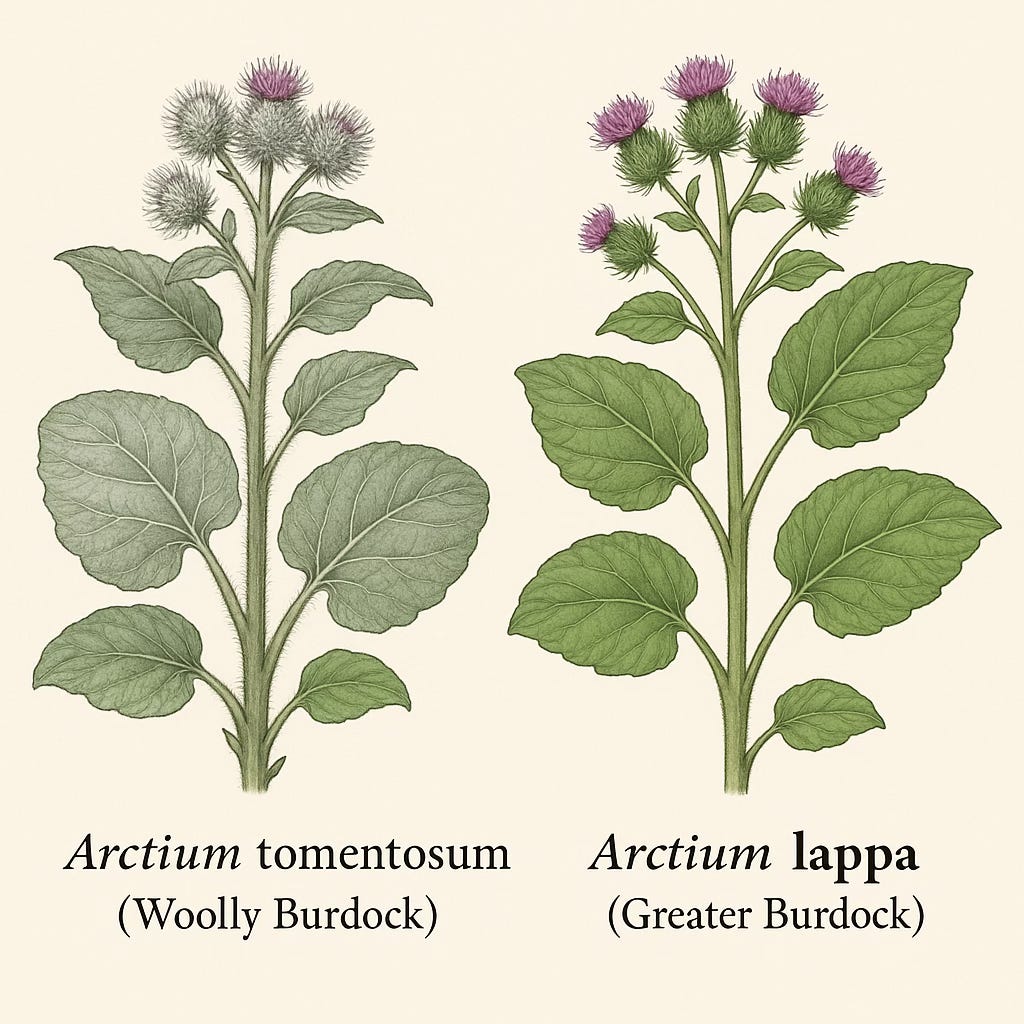
Phenology & Lifespan: Burdock’s life cycle spans two growing seasons.
Year 1 (vegetative): Seeds germinate in spring, and by summer the plant forms a low-profile rosette. The taproot grows rapidly, reaching its peak size by late summer to autumn of the first year[10]. Leaves persist into late fall, then die back. The taproot overwinters deep in the soil.
Year 2 (reproductive): In spring, stored energy in the root fuels a vigorous shoot that can reach full height by early to mid summer[11]. Purple florets emerge from green burrs in mid-late summer, offering a sweet fragrance to those who come close[12]. Pollination (primarily by insects) leads to burrs maturing and drying by early fall. By autumn of the second year the burrs detach, spreading seeds, and the plant dies after first frost, completing its biennial journey. In some cases, if conditions are poor, a rosette may persist two or more years before flowering, leading to a longer lifecycle[13]. The seasonal rhythms of burdock make it a reliable marker: rosettes in spring, flowering stalks in summer, and clinging burrs in fall. We can honor these phases by observing how the plant directs its energy – from downward (rooting) in year one to upward (flowering and seeding) in year two – an elegant lesson in patience and timing.
Native Range & Distribution: Burdock is native to temperate Europe and Northern Asia, where it has a long history of use. It likely originated in moist, disturbed soils at woodland edges and grasslands across Eurasia. Through human migration and trade, burdock spread globally; it was recorded in China by the 10th century and introduced to Japan around 940 CE as a vegetable crop[14][15]. Burdock arrived in North America with European colonists (perhaps as a medicinal root or an accidental stowaway in hay or wool) and was noted growing wild by the 17th century[16]. Today A. lappa and A. tomentosum are naturalized throughout temperate North America, found in USDA zones ~3-10 in all but the hottest or far north regions[17]. They thrive in disturbed ground: roadsides, field edges, barnyards, floodplains, and waste areas[18]. In these “edge” habitats, burdock acts as a pioneer species, quickly colonizing bare or overgrazed soil. It is considered invasive in the Western Hemisphere, often displacing native plants in disturbed sites[19][20]. Because of its aggressive spread and persistent seed bank, some jurisdictions list burdock as a noxious weed (for example, Colorado designates it as such[16]). There are no major conservation concerns for burdock globally – if anything, its challenge is over-abundance rather than scarcity. However, its vigorous presence can be reframed as an opportunity: burdock’s very success in human-disturbed landscapes hints at its ecological role as a healer of damaged soils and a companion to human habitation.
Habitat Preferences: Burdock prefers full sun or partial sun and moist, rich soils. It favors neutral to slightly alkaline pH in many areas but is also found on mildly acidic soils – interestingly, excessive burdock growth in pastures has been linked to high soil iron and low calcium, conditions often improved by liming[21]. It is a nutrient-loving plant, thriving in soil rich in nitrogen and organic matter[10]. Where soil is compacted or heavy, burdock’s robust taproot breaks up hardpan and mines subsoil minerals, making it a natural soil aerator. It tolerates clay if drainage is adequate, and also grows on loams and silty soils; extremely wet or waterlogged ground is unsuitable, as burdock roots will rot in poor drainage. Moisture: Burdock enjoys moderate moisture – in a well-drained spot with consistent rain or watering it grows enormous. It has some drought tolerance once the root is established (the deep root can tap moisture reserves), but prolonged drought will cause wilting and stunting of those big leaves. Conversely, it can withstand brief flooding (some species even occur in floodplain thickets) but not long-term saturation. The plant’s presence can indicate fertile, disturbed ground that retains moisture – a signpost of where animals frequented or where humans dumped rich waste. In tending land, noticing burdock patches can guide us to observe underlying soil conditions (high fertility, compaction, or pH imbalance) and consider what the land is asking for.
Key Parts Used & Harvest Timing: Nearly the whole plant has traditional uses. The root is most famous medicinally and as food – harvested in fall of the first year or early spring of the second year before the stalk shoots (older roots become woody)[22][23]. The seeds (enclosed in the burs) are used in Chinese and Western herbal medicine; they are collected in late summer to fall when the burrs turn brown and dry[24]. Leaves have folk uses as well – primarily topical or as a bitter tonic – usually gathered in spring or summer of the first year when they are tender (young, less bitter leaves can be cooked as a pot-herb, whereas older leaves are very bitter and fibrous)[25]. The leaf petioles and flowering stalks are actually edible when peeled and cooked, best harvested in late spring of the second year when the flower stalk is still young and not yet tough[26]. The burrs themselves (dried flower heads) generally are not used internally (due to spines and hairs), but in craft and lore they have minor uses (such as burr “rattles” or as natural Velcro in toys). In summary: roots for medicine/food (autumn Year 1), leaves for topical poultice or minor food use (spring Year 1), petioles/stalks for food (late spring Year 2), seeds for medicine (fall Year 2). Each part carries a unique aspect of burdock’s character – the root: nourishment and grounding; the seed: dispersing and detoxifying; the leaf: protective and cooling; the burr: tenacious attachment.
Safety Tier: Burdock is generally considered very safe (Tier A) – it is a common food item (especially the roots, known as “gobo”) and has a long history in herbal medicine with few adverse effects reported[27][28]. All parts are non-toxic when properly identified; however, caution is needed to avoid confusion with poisonous lookalikes. One famous case in the 1970s involved atropine poisoning from a commercial “burdock root tea” that was later found to be contaminated with deadly nightshade (atropa) material[29][30] – burdock itself contains no atropine, but this taught an important lesson on correct identification and sourcing. Assuming the correct plant, normal culinary or herbal use has an excellent safety record. Allergies: Being in the Aster family, rare individuals with severe sensitivity to Asteraceae (ragweed, etc.) could potentially react to burdock. Topical use of fresh leaves or burs might cause contact dermatitis in sensitive skin (the burrs have tiny bristles that can irritate skin or eyes)[31]. Pregnancy and lactation: Burdock root as food is generally deemed safe in moderation, but high-dose herbal use (especially of the seed) is traditionally avoided in pregnancy due to its strong detoxifying and slight uterine-stimulant nature in TCM theory. Some sources also caution that the seed’s bitter, draining properties could be too cooling during pregnancy. Known Contraindications: In TCM, burdock seed is contraindicated for patients with Qi deficiency and loose stools (because it is cold and slippery, it could aggravate diarrhea). In Western herbals, because burdock can lower blood sugar, diabetics on medication should monitor glucose if using large amounts. Also, its diuretic effect suggests caution if one is on diuretic drugs or has electrolyte-sensitive conditions. Pharmacokinetics: Data on human pharmacokinetics is limited, but we do know some compounds’ paths. For instance, arctiin, a major lignan glycoside in burdock seed, is converted by gut microflora into arctigenin, the active aglycone, which then gets absorbed and distributed – studies show arctigenin reaches various tissues and exerts anti-inflammatory and anticancer effects[32][33]. The high inulin content in burdock root is a prebiotic fiber fermented by gut bacteria into short-chain fatty acids, benefiting gut health. The metabolism of burdock’s polyphenols and bitter constituents likely involves liver phase II conjugation (as with many flavonoids); burdock’s detox reputation may in part relate to inducing certain liver enzymes (hypothesis level). Overall, no specific toxic metabolites are known – burdock’s constituents are handled by the body in the gentle manner of foods. It’s worth noting burdock can bind heavy metals in the soil, and similarly in the body it may chelate certain toxins. This “binding and elimination” property is part of its traditional use as a blood cleanser.
At its foundation, burdock teaches grounded resilience. It spends a year quietly rooting itself, drawing nourishment from deep in the Earth. By truly knowing the land – its moisture, its minerals, its seasons – burdock anchors firmly. This root wisdom invites us to ask: how can we deeply root ourselves before reaching upward? Burdock also shows how a humble “weed” can travel the world and adapt, following humanity’s footsteps to heal our disturbed grounds. In respecting its identity – not as a pest to be eradicated, but as a teacher and ally – we begin a relationship of reciprocity with the land. As we learn its names and growth cycle, we step into a more intimate conversation with nature’s timing and intentions.
Burdock reminds us that to heal any landscape or body, we must first establish strong roots of understanding.
Names as Portals of Understanding
Etymology: The genus name Arctium comes from Greek arktos, “bear,” an allusion to the plant’s “hairy” burrs (perhaps likened to a bear’s shaggy coat)[34]. The species name lappa is from Latin lappare, “to seize or hang onto,” referring to the burs that cling tenaciously[34]. Thus, the scientific name itself paints a picture: a “bear-like” plant that “seizes” onto passersby – a perfect description of burdock’s bristly, grabbing seed balls. Arctium tomentosum uses the Latin tomentum meaning “covered in matted hairs” (as in “tomentose”), highlighting that species’ woolly fuzz on leaves and stems.
Common Names (Cross-Cultural): Burdock has accumulated a rich assortment of folk names, each revealing a bit of cultural attitude or use[35]. In English, “Burdock” itself comes from bur (the prickly seedcase) + dock (an old word for a large-leaved plant)[36]. Many languages emphasize the clinging burs: in French bourre (tangle of wool) plus dock gave “bardane”, and similarly “beggar’s buttons”, “stick-tight”, “cocklebur” (though true cocklebur is a different plant) allude to burs sticking to clothes or fur[35]. Some call it “Velcro plant” in modern jest. Other names highlight its size: “Great burdock”, “Greater burdock” (distinguishing it from lesser burdock, A. minus). “Gobo” is its Japanese name, now used in English for the root as a food. “Snake’s Rhubarb” suggests large leaves (and perhaps a use for snakebite? folk etymology unclear)[37]. We also find “Fox’s clote” (clote being an old word for burdock, appearing in Shakespeare’s writings) and “Happy Major” (an intriguing English folk name possibly of obscure origin)[38]. In Chinese it’s “niúbàng” (牛蒡) for the root and “niúbàngzǐ” (牛蒡子) for the seed, meaning “ox pestle,” likely referring to the large root shaped like a pestle or an ox-tongue – the seeds’ name reflects the plant (zǐ means seed). Across Europe, names like “bardana” (Italian, Spanish) or “lappo” (Italian dialect) derive from the Latin lappa. By cataloging these names, we see burdock viewed variously as nuisance (stickwort, burr), food (gobo), or medicine (in Russian it’s “lopukh”, and in Ayurveda circles sometimes just called Burdock as it wasn’t native to Sanskrit tradition). Each name is a story: a piece of cultural memory encoding how people related to this plant – whether as pesky burrs on a traveler’s cloak, or a beloved vegetable in a soup pot.
Sacred and Mythic Names: Burdock doesn’t feature strongly in classical mythologies, but it does have a presence in folklore. In some Druidic and pagan herbal traditions of Europe, burdock was associated with protection and healing. One old name “Thor’s Thorn” hints at a Norse attribution, perhaps because of its robust, thistle-like appearance (though true thistles were more sacred to Thor). In the British Isles, there is folklore about the “Burry Man” – a costumed figure in an annual Scottish festival who is covered head-to-toe in burdock burrs as a form of ritual protection and community blessing[39]. This tradition (South Queensferry’s Burry Man) uses the clinging burs as a symbol of capturing negativity or ill luck – an earthy costume of burdock burrs worn as armor to absorb misfortunes. Such ceremonial usage elevates burdock from weed to a tool of sympathetic magic. Native American traditions (for tribes that adopted burdock post-colonization) may have folded it into ritual healing for new illnesses; however, since it’s not an original native plant, sacred names are few. We do know the Lakota termed it “wíčazo sáŋ” (meaning “stickseed” roughly) and used it in certain healing rites for throat ailments – a functional naming. Overall, burdock’s spiritual naming is subtle: it is a “commoner’s plant” often not deified but respected in folk rites. It carries a humble sacredness – a protector of the weary (catching negative influences) and a giver of vitality (as a tonic).
Trade and Historical Names: In old apothecary commerce, burdock root was often labeled “Radix Bardanae” (from the genus once being Lappa bardana). In the Eclectic herbal medicine era (19th-century America), it was called “Lappa” or “Burdock root” in literature and was a staple ingredient in “blood purifier” syrups and beers. The Iroquois in the 19th century, after learning its use, traded burdock roots and seeds occasionally with settlers or incorporated it into their materia medica under names like “medicine for rash” (descriptive rather than a single name)[40]. In Traditional Chinese Medicine commodity markets, burdock seed is Niu Bang Zi and has been an item of trade for centuries, often exported from China or Korea – even appearing in the West in TCM shops. Interestingly, during WWII in the UK when Asian imports were scarce, “burdock” in “Dandelion & Burdock” soda was sometimes replaced with native burdock root – though originally this famous British soft drink was indeed flavored by fermented dandelion and burdock roots since medieval times[41]. Thus, “Dandelion and Burdock” became both a product name and a cultural icon for a classic herbal beverage. In summary, burdock’s journey through languages and markets shows it to be a plant of many guises – weed and resource, villain and ally – depending on the story we choose to tell.
Each name of burdock is like a doorway into relationship. When we call it beggar’s buttons, we acknowledge the hitchhiker seeds that demand our attention. When we call it gobo, we honor the nourishment it offers. In learning its names in other tongues – niúbàng, bardana, fox’s clote – we see how many peoples have walked with this plant. Burdock invites us to shed the notion of “one true name” and embrace plurality. Just as its burs hitch rides to new places, its names carry bits of culture across time. By speaking its many names, we participate in an age-old dialogue: human and plant, meeting again and again in different lands, finding new ways to help each other. In honoring burdock’s names, we practice the respect of calling a being rightly, which is the first step in friendship.
1. Global Traditional Medicine Systems
Burdock bridges East and West, old world and new. Its virtues have been recognized in multiple healing systems, often independently, showing a remarkable consistency: burdock is a blood purifier, a detoxifier, and a nutritive tonic across cultures. Below we explore how various traditions understand and use this plant, noting which parts are favored and how they are prepared. We will distinguish between well-documented uses (confirmed in classical literature or modern pharmacology), traditional/folk uses (passed through oral or herbal literature), and emerging or hypothetical uses.
Traditional Chinese Medicine (TCM)
In TCM, burdock is known primarily for its seeds, called Niú Bàng Zǐ (牛蒡子). Burdock seed is categorized as an acrid, bitter, and cold herb that “Releases the Exterior” – meaning it helps dispel early-stage illnesses, especially those of a Wind-Heat nature[42]. Key actions: disperses Wind-Heat, benefits the throat, resolves toxicity, vents rashes, and moistens the intestines[43]. This translates to practical uses: the seed is used for fevers, coughs, and sore throats (especially with red, swollen throat or tonsillitis), for skin eruptions like measles or rashes that need to be brought to the surface, and for toxic swellings like boils, carbuncles, or mumps[43]. It is also mildly laxative (the idea of “moistening intestines” points to helping with constipation, particularly when heat is causing dryness). A classic TCM formula featuring burdock seed is Yin Qiao San, a remedy for early-stage febrile colds with sore throat – Niubangzi is combined with honeysuckle flowers and other cool, acrid herbs to relieve heat toxins in the throat. Another is Niu Bang Zi Tang (Burdock Decoction) historically used for measles and rashes that don’t surface well.
In terms of TCM energetics, Niubangzi enters the Lung and Stomach meridians[44]. By venting the Lung, it aids in coughing phlegm-heat out and relieving throat pain. By clearing Stomach heat, it can help with gum swelling or toothache (heat in Yangming channel) and also contribute to skin health (as Stomach heat can manifest in skin issues). TCM also recognizes burdock root as a food/herb, though it’s not as commonly listed in classical materia medica for strong medicinal actions. The root (called “niu bang gen”) is considered a gentle tonic and detoxifier used in dietary therapy – for example, as part of soups to clear heat and nourish yin fluids. In modern TCM practice, some herbalists do use the root (often under Western influence) to “clear damp-heat” or support liver function, but officially it’s the seed that holds the spotlight. Typical dosage & preparations: 6–12 grams of the dried seeds in decoction[45][46]. The seeds are often dry-fried (chao) lightly to enhance their extraction and moderate their coldness; this processed form (炒牛蒡子) is especially used if the patient has a more sensitive digestion. The root, when used, might be on the order of 10–30 grams in decoction as it’s more of a food-like herb. Modern TCM developments: In Chinese research, burdock seeds (and root) have been studied for their anticancer and blood sugar-lowering properties, and a modern Chinese patent remedy called “Niu Bang Jie Du Pian” combines burdock with other herbs as an internal detox for skin conditions.
From a TCM perspective, the synergy of burdock with other herbs is important: for example, Niu Bang Zi + Lian Qiao (forsythia fruit) for toxic heat, or Niu Bang Zi + Jing Jie to vent rashes. It’s seldom used alone in decoction, as its cold nature is balanced with other herbs. TCM does caution that because Niubangzi is acrid and dispersing, it should be avoided in cases of qi deficiency with diarrhea, or in those with open sores due to qi deficiency – essentially if a person is very weak and cold, this cooling dispersing herb could be too draining[45]. In summary, TCM crowns burdock seed as a “heat-clearing, toxin-relieving” agent, aligning perfectly with the Western concept of a blood cleanser. Interestingly, TCM’s use of the seeds for acute conditions complements Western herbalism’s focus on the roots for chronic conditions, giving a full spectrum of burdock’s healing potential.
Ayurveda (Indian traditional medicine)
Burdock is not native to India, so it doesn’t appear in the classic Ayurvedic texts by Sanskrit name. However, modern Ayurvedic practitioners, especially those in North America and Europe, have integrated burdock as a “Western herb” within Ayurvedic frameworks. Ayurvedically, burdock root is considered a cooling, bitter herb with sweet post-digestive effect (due to inulin content) – making it something of a Pitta-pacifying and Kapha-reducing tonic, while being generally neutral to Vata if used appropriately[47]. Doshas: Burdock’s bitter and astringent qualities reduce Pitta (cooling down heat, inflammation, skin conditions) and help Kapha (by its diuretic, draining action and ability to clear excess dampness/toxins), but unlike many bitters it also has a nutritive “sweet” earthiness (inulin) that can actually nourish Vata rather than aggravate it[47]. In fact, some Ayurvedic sources call it a rasayana (rejuvenative) for the blood and liver – essentially a blood tonic that both cleans and builds.
Ayurvedic Actions: Burdock root is often described as a “blood cleanser and nutritive tonic” (similar to the concept of Raktashodhak and Rasayana). It is dipana & pachana – gently increasing the digestive fire and helping digestion (especially of fats, due to its effect on bile secretion), yet it’s not a hot stimulant so it can clear sluggish digestion without exacerbating heat. It is bhedana (mild laxative) and mutrala (diuretic), which corresponds to how it flushes toxins via stool and urine. It’s also termed “krimighna” by some modern Ayurvedists, meaning it can help destroy parasites or “ama” in the gut. The net effect is that burdock detoxifies the liver, cools the blood, and strengthens the skin – aligning with uses in skin diseases like acne, eczema, psoriasis (cooling Pitta in the blood), as well as in arthritis or gout (clearing accumulated toxins and heat). Ayurvedic practitioners like Dr. David Frawley have noted burdock’s ability to “clear heat and toxins from the liver and blood while nourishing the body’s restorative essence,” a combination that is somewhat unique[47][48]. This makes it an adaptogenic tonic in the Ayurvedic view: one that gently builds Ojas (vital essence) by virtue of its nutritive properties, while also reducing excess Doshas that can damage tissues.
Forms & Preparations: A typical Ayurvedic way to use burdock is as a decoction of the root (known as Kwath or Kadha). For example, 1–2 teaspoons (~5–10g) of dried root simmered in 2 cups water down to 1 cup, taken twice daily, often combined with other herbs. It might be paired with say dandelion (similarly bitter and cooling) or turmeric (to support liver and add a bit of warmth if needed for Vata). It’s also made into a powder (Churna) and taken in doses of ~3–6 grams, sometimes with a carminative like ginger or cinnamon to enhance digestibility (especially if Vata might be concerned by the cold nature). The fresh root can be used in juices or chutneys; for instance, some Ayurvedic diet recommendations include burdock in vegetable juices for skin issues. There is even an Ayurvedic hair oil preparation using burdock root (along with bhringraj and amla) infused in sesame oil to promote hair growth and cool the scalp, reflecting a traditional understanding of its benefits for skin/hair and heat conditions.
Ayurvedic Summary: Rasa (taste): Tikta (bitter), Kashaya (astringent), with a hint of Madhura (sweet) especially after digestion. Virya (energy): Sheeta (cooling). Vipaka: Madhura (sweet post-digestive effect, meaning it ultimately nourishes). Guna (qualities): Laghu (light, easy to digest), Snigdha (slightly unctuous due to oily constituents in seeds, though root is more rough). It cleanses Rakta (blood) and enhances Rasa & Meda dhatus (nutritive plasma and fat metabolism) without aggravating Vata, which is somewhat rare for a bitter herb[47]. Ayurveda would also note burdock’s effect on Liver and Skin (Mamsa and Tvacha) as a systemic cooler that alleviates inflammation.
We should acknowledge these are modern attributions – classical Ayurvedic texts do not mention burdock, but by mapping its qualities we create a cross-cultural understanding. Interestingly, the pattern fits: Ayurveda often uses native “blood cleansers” like manjistha or neem for similar purposes, but burdock provides a local alternative in temperate climates that can be considered “Ayurveda’s friend from afar.” This is a beautiful example of how traditional systems can evolve and incorporate new plants by understanding their energetics and actions.
Unani & Middle Eastern Traditions
Unani Tibb (Greco-Arabic medicine) likely encountered Arctium by the Middle Ages through trade with Europe. In Unani, burdock would be seen as Cold and Dry in the second degree (approximation), aligning with its cooling, drying (diuretic, blood-purifying) effects. Unani practitioners used burdock root for renal calculi (kidney stones) and urinary problems, as it was known to “open obstruction” in kidneys and liver. It was also used for chronic skin diseases – in the Canon of Avicenna, an equivalent plant described as Jadaroq or Burdak is recommended for itch and dermatitis (this is likely burdock or a similar bur-bearing plant). The concept of Tanqiya-e-khoon (blood purification) in Unani matches the “blood cleansing” use. Dose forms included syrups and ma’jun (electuaries) containing burdock for skin and joint ailments, often mixed with honey or other herbs like khubbazi (mallow) or neem.
In Persian traditional medicine, burdock (known as “Panbashe” in some texts) was used to strengthen the body after illness – likely reflecting its nutritive value – and to reduce “hot” swellings. Traditional Middle Eastern herbals mention using the crushed seeds topically as a poultice on bites or stings (the idea being to draw out poison, which correlates with “resolves toxicity” in TCM). The leaves, due to their cooling nature, were sometimes applied to the soles of the feet to reduce fever (a folk practice in parts of Turkey). Overall, Unani and related systems mirror the European uses (since Unani often drew from Dioscorides and Galenic knowledge, which did cover burdock).
Indigenous and Native American Uses
Though burdock is an introduced plant in the Americas, many Native American communities recognized its value and integrated it into their medicinal repertoire post-contact. By the 18th and 19th centuries, it was being used by various tribes who had access to it via colonial settlements or it naturalizing on their lands. For example, the Cherokee, Iroquois, and Chippewa (Ojibwe) are documented using burdock especially for skin diseases and blood conditions[40]. The Cherokee and Iroquois used a decoction of the root for treating conditions like eczema, acne, and rheumatism – essentially aligning with the “blood purifier” concept. The Ojibwe included burdock root in formulas for general strengthening after illness and for supporting women in childbirth (one source notes Ojibwe healers gave a tea of burdock root and other herbs to women in labor to alleviate pain and prevent infections[49]). The Chippewa (Ojibwe) specifically used the plant as a cough medicine – combining burdock with other herbs to treat whooping cough and persistent coughs[50]. They also applied burdock in herbal steam baths for rheumatism.
One fascinating use: technology – the Ojibwe and other tribes in the Northeast sewed large burdock leaves together to make a makeshift sun hat for working in fields[51]. These “leaf hats” protected from sun and perhaps mosquitoes, demonstrating an ingenious practical use of the plant’s ample foliage. Also, some Plains tribes are said to have used burdock in ceremonial purification rites, possibly as a physical and symbolic cleanser. Ethnographer reports mention that the Ponca and other Plains people sometimes placed burdock leaves in sweat lodges or used an infusion to wash skin as part of healing ceremonies for fever.
We ethically acknowledge that this knowledge is the intellectual property of those Indigenous communities. Sharing these uses here is done with respect and gratitude. For instance, the story of Essiac tea is well-known: a Canadian nurse, Rene Caisse, in the 1920s learned of a healing tea from an Ojibwe elder which included burdock root as a main ingredient[52][53]. This formula (burdock root, sheep sorrel, slippery elm, rhubarb) became famous as “Essiac” cancer tea. It’s important to note that the Ojibwe’s herbal wisdom was at the heart of that remedy, even though it was later appropriated and commercialized. In sharing this, we honor the Ojibwe TEK (Traditional Ecological Knowledge) and recognize that burdock, although not originally from Turtle Island, became part of their healing repertoire and was used within a framework of reciprocity and prayer.
Because burdock was an introduced plant, many Native names simply translated to “burrs” or “sticky weed.” For example, the Choctaw called it “Kapota iskitini” (literally “little thistle”). Yet, even as a newcomer, burdock was not shunned – it was adopted, showing Indigenous adaptability. In some cases, it was even cultivated near villages. Alakananda Ma (an Ayurvedic practitioner in Colorado) notes that some tribes “cultivated and utilized” burdock along with yellow dock, especially to treat introduced diseases like measles and smallpox when they came in – using burdock to cool fevers and support the blood[54]. The ability of burdock to treat ailments brought by Europeans (like measles) is a poignant example of how Indigenous healers resourcefully turned an introduced weed into a medicine for introduced illnesses.
In any mention of Indigenous uses, we include ethical acknowledgments: this knowledge is shared in published ethnobotanical sources and we give credit to those communities (e.g., Chippewa cough remedy[50], Cherokee skin remedies, Ojibwe Essiac story). We encourage readers to seek out works by Indigenous herbalists and Elders for deeper learning, and to approach such knowledge with humility and respect.
European Folk Medicine and Western Herbalism
In Europe, burdock has been used medicinally for at least a millennium. Medieval herbal texts praised it for treating “bad humours” of the blood. It was a key ingredient in many classic “spring blood-cleaning tonics.” In the Physicians of Myddfai (13th c. Wales), a burdock root decoction was given for kidney stones and as a diuretic. By the 17th century, Nicholas Culpeper (1616-1654) wrote of burdock: “The leaves are cooling and moderately drying… the juice of the leaves or roots, given with wine, relieves the biting of serpents”. Culpeper, aligning with astrological medicine, assigned burdock to Venus (hence “a feminine plant”) and saw it as a soft healer, good for dampening fiery conditions and easing cramps (the “shrinking of sinews or arteries” likely referring to palsy or cramping). European tradition widely used burdock root as an alterative (gradual blood purifier) for conditions like skin eruptions, boils, eczema, psoriasis, gout, rheumatism, and syphilitic disorders. The leaves were used as poultices on wounds, ulcers, and inflammatory swellings (there’s an old practice of applying burdock leaves to the soles for fevers, similar to the Turkish practice mentioned). The seeds (often called “burdock burrs” in old texts) were used as a diuretic and for feverish colds; an eclectic formula called Trifolium Compound (a 19th-century blood purifier) included burdock seed along with red clover and stillingia for treating cancerous or syphilitic skin lesions.
By the 19th century in North America, Eclectic physicians (who were essentially professional herbalists) lauded burdock. Dr. John Scudder wrote, “Burdock is a neglected remedy which acts powerfully upon the blood, and through it upon the skin, kidneys, and mucous membranes.” They used it for chronic skin conditions and as a gentle tonic for weak patients, often combined with yellow dock, sarsaparilla, or echinacea. Ellingwood’s Therapeutist (1919) recommended burdock for “chronic engorgement of the lymphatics and recurrent boils.” The notion of “blood purifier” in Western herbal terms often implied it helps the body eliminate metabolic wastes and cool down inflammatory processes. This matches modern pharmacology, which finds burdock supports liver detox enzymes and has anti-inflammatory effects[56].
Folk uses in Europe also included biting of serpents as Culpeper said – likely a carryover of the idea that burdock leaves or root could treat snakebite or venomous bites when taken in wine or applied externally (perhaps due to its “anti-toxin” reputation; however, this use was more folkloric and not strongly substantiated). Another interesting use: hair and scalp – burdock root oil maceration (popularly called “burdock oil” or Oleum Bardanae) has been used in Russia and Europe as a scalp tonic to promote hair growth and reduce dandruff[57]. This use persists today in cosmetic products (burdock is found in some natural shampoos and skin creams, reflecting its anti-inflammatory and anti-fungal properties helpful for scalp conditions).
Western herbalists also consider burdock a mild bitter digestive tonic. It’s not as bitter as gentian or wormwood, but a decoction of burdock root before meals can stimulate appetite and digestion gently – indeed it has been used for anorexia and weak digestion[58][59]. The inulin content feeds gut flora, so herbalists say it “tones the gut”. Modern Western herbal integration: Burdock remains a staple in herbal clinics for acne, eczema, psoriasis, arthritis, gout, viral infections like Epstein-Barr, and as a general tonic for toxic overload. It’s often paired with dandelion root (the classic duo: dandelion and burdock), as both support liver and kidneys – dandelion more diuretic to flush, burdock more nutritive and skin-focused. It’s also part of famous formulas like the Hoxsey formula (another controversial cancer herbal remedy from the 20th century) and the aforementioned Essiac. Master herbalists like Michael Moore and David Hoffmann have written that “burdock may be the best known herbal treatment for chronic skin conditions – it works by promoting bile flow and thus detoxification, and by increasing circulation to the skin”[60]. This holistic view – that burdock cleans the blood by way of the liver and kidneys, and then the skin symptoms abate – is a through-line from folk wisdom to modern science (since we now know burdock has liver-protective flavonoids and diuretic action to help kidney clearance[56]).
Dosages & Prep (Western): Typical dose of dried root decoction: 2–6 grams (~1 teaspoon to 1 tablespoon of root) per cup, simmered 10–15 minutes, up to 3 times a day[61]. For a tincture (1:5 in 40% alcohol, for example), dose might be 2–4 mL, 3x/day. Fresh root tincture is also used by some for a stronger effect. Seeds can be tinctured or decocted; one might do 1–2 grams of seeds crushed in decoction. But because seeds are a bit harder to extract, tincture (alcohol extract) is often preferred: e.g. 40–60 drops of a 1:5 tincture. Topical: Fresh burdock leaves can be wilted and used as a poultice on burns, bruises or mastitis – they cool inflammation and reputedly draw out infection. One folk remedy for poison ivy rash is applying a wash of burdock leaf tea to ease itching (burdock and jewelweed often grow near each other, making a convenient antidote pair).
In European folk magical traditions, burdock was also seen as protective – people would carry a burdock burr in their pocket or place it above a doorway to ward off evil spirits (perhaps because it “grabs” onto anything negative). While not “medicine” per se, it highlights that people felt a benevolent power in this plant beyond its physical effects.
Other Traditions (Briefly)
Traditional Japanese Kampo: Burdock root (called Gobo) is eaten as a healthful food and also used in Kampo herbal blends derived from TCM. A formula Juzen-taiho-to (Shi-Quan-Da-Bu-Tang in Chinese) sometimes substitutes burdock for astragalus in modern practice for building blood post-illness. Generally, Japan embraces burdock more as food-as-medicine (macrobiotic diets laud burdock for its grounding energy).
Siddha and Ayurveda (Tamil traditions): Some Siddha texts refer to an herb that seems to match burdock (possibly introduced via colonial botanists) used for skin diseases and to “cool the blood”.
African Traditional Medicine: Burdock isn’t native to Africa except maybe small pockets in North Africa. Where introduced in highlands (e.g., East African highlands by Europeans), it hasn’t become a staple in traditional use to my knowledge, but African herbalists in diaspora might use it similar to how Western herbalists do.
Homeopathy: There is a lesser-known homeopathic remedy Arctium lappa made from the tincture of the root. It’s been used for acne, eczema, and cystitis in homeopathic literature, typically at potencies like 6C or 30C. However, it’s not a very central remedy in homeopathy.
Naturopathy and Eclectic medicine: As mentioned, naturopaths incorporated burdock early on. The famous “Hoxsey” anti-cancer formula (originating in the 1920s U.S.) included burdock root as a primary ingredient, along with red clover, stillingia, etc. Naturopathic doctors today often include burdock in “detox” protocols or gentle liver cleanses, bridging tradition and modern detox concepts.
In sum, across all these healing systems, a unifying theme arises: Burdock helps the body cleanse and restore balance, especially through the skin, liver, kidneys, and lymph. It’s cooling without being harsh, detoxifying while also nourishing. Whether framed as releasing Wind-Heat, balancing doshas, or cleaning the blood, the core understanding is remarkably aligned. This convergence of global wisdom speaks to the truth of burdock’s medicine – when so many independent traditions see a plant similarly, there is likely a deep validity to those uses. And now, modern science provides growing confirmation (anti-inflammatory, liver-protective, etc.[56]), bridging ancient and modern.
The global embrace of burdock illustrates the unity in diversity of healing traditions. Each culture has poured its own language and belief into the plant – yet all recognize a gracious healer in burdock. As we walk from an herbal clinic in Beijing to an Ayurveda ashram in India, to a Cherokee healer’s kitchen, to a European cottage garden – we find burdock quietly working in all places, wearing different hats but performing the same service of cleansing and strengthening. This reminds us that nature’s gifts cross human borders. Burdock asks us to be humble students: to see how one plant can wear many cultural coats, and still remain itself. In acknowledging all these traditions, we cultivate respect. We see that our modern use of burdock stands on the shoulders of countless ancestors – Chinese scholars, village herbalists, medicine women and men – who all observed carefully and handed down their knowledge. By honoring all voices, we let burdock’s full chorus of wisdom be heard. The plant becomes a bridge – connecting East and West, North and South, teaching us that healing is a common language.
2. Cultural & Spiritual Dimensions
Burdock’s gifts are not limited to the physical plane; this plant also carries cultural stories, symbolism, and subtle energies that have been acknowledged in various traditions. Here we explore the mythology, folklore, traditional ecological knowledge, and energetic/vibrational aspects of burdock. These dimensions show how burdock has been a teacher and symbol to humanity, not just a pharmacopoeial entry.
Mythology, Folklore & Cosmology
Burdock does not star in any famous mythological tales with gods or heroes, yet it appears in the everyday folklore of common people – and sometimes in festivals that have almost mythic character. One example is the “Burry Man” of Scotland, an annual ritual in South Queensferry where a man is completely covered in burrs (traditionally primarily burdock burs) and paraded through town[39]. The Burry Man’s burdensome costume of clinging burrs is thought to ward off evil spirits and absorb misfortune for the community, symbolically capturing negativity with the hooks of the burs. He is given whiskey through a straw at each doorstep (as he cannot move his arms easily), stumbling along as a living effigy of the hardships of the past year. At day’s end, the burs are removed (a painful cleansing process!) – signifying the community’s purification. This ritual has an almost cosmological significance to locals, marking the turn of the season (it occurs in August) and ensuring protection. It illustrates how burdock, though humble, can be central in a ceremonial context, embodying resilience and purification.
In broader European folklore, burdock was often associated with protection and healing charms. Carrying a burdock burr in your pocket was thought to protect against bad influences – akin to how the burs cling to you, they would “catch” bad luck or ill will thrown your way. In some regions, people believed that if burdock grew by your gate, the household would be protected from disease – perhaps because its presence indicated healthy, rich soil, or because it catches any negativity trying to enter. There’s a touch of cosmic irony in how an “invasive weed” like burdock might be seen as a guardian. But consider that cosmos often works through what’s available: if burdock pops up everywhere, maybe Spirit says “this too can be a helper.”
Astrologically, as noted with Culpeper, burdock was aligned with Venus and Air (some say Saturn as well, because of its ability to root in dark places and its persistence). Venus association emphasizes its gentle, cooling, moistening side – a plant of love and relationship (it “relates” to you by clinging!). Some folk practitioners would dig burdock root only on a Friday (Venus’s day) or when Venus was in earth signs, to maximize its healing power especially for skin and venereal issues (Venus rules skin and kidneys in astro-herbalism).
Burdock’s life cycle itself has cosmological metaphor: the descent of the root in the first year (into the underworld of soil) and the ascent of the flowering stalk in the second year (reaching for the sky) mirrors the death-rebirth theme common in myth. One could liken it to the myth of Inanna or Persephone: one year in the underworld, then rising. This is my own mythopoetic musing, but in observing burdock one feels that rhythm. It offers a teaching of patience – things hidden (like its medicinal qualities) are developing underground before they become visible.
Traditional Ecological Knowledge (TEK) & Indigenous Stories
As covered earlier, for Indigenous peoples who interacted with burdock, new stories and wisdom emerged. In many cases these were practical ecological observations: for example, Anishinaabe (Ojibwe) elders noted that burdock proliferated near settler habitations and disturbed grounds, and they would say that “the Creator sent even the weeds to help us” – an understanding that burdock came as part of the colonizers’ footprint, but also as part of the medicine needed to deal with colonization (like smallpox, etc.). This is a profound TEK perspective: that the land responds to trauma by growing the medicine for that trauma. In this light, burdock can be seen as a compassionate responder to the scars of colonization on the land and people, offering both physical and spiritual healing.
Indigenous management of burdock included activities like tending patches near villages (some Plateau tribes transplanted burdock closer to their living areas for ready access to its food/medicine), and phenological indicators like: “when the burdock burrs stick to the deer’s coat, we know the elk are in rut” – in other words, using the seasonal stage of burdock as a calendar cue for animal behavior or other plants’ phases. This kind of TEK interweaving shows up in subtle ways: e.g., in some areas, salmon runs coincide with burdock seed drop (late summer/early fall), so some coastal peoples would note that as burrs cling to clothing, it’s time to prepare fish smoking racks.
Reciprocal relationships and protocols in Indigenous contexts often involve giving an offering when harvesting any plant, even an “invasive” one. An elder might teach: when you dig burdock root, leave an offering of tobacco or a prayer, and maybe replant the crown if possible so it can regrow. Also, never take all the burdock in one area – ensuring some remains for the land (and for the animals who might need it) and for seed for the future. Some Pacific Northwest tribes, though not having burdock historically, have added burdock to their wild harvest calendar with the same respect as native plants – an example of the ethical inclusion of a newcomer into a stewardship system.
Stories encoding ecological wisdom: While we lack ancient myths, new stories have formed. One contemporary Cherokee herbalist I learned from personified burdock as “Grandmother Burdock” – a wise old woman with a big apron (the big leaves) and long gray hair (the fibrous root), who helps sweep out the bad stuff from your home (body). In her story, Grandmother Burdock came across the ocean to help the people here when new sicknesses came. This story, while modern, encodes the idea of burdock as an elder healer that arrived when needed, and it teaches respect for an introduced plant through a narrative, not just a lecture.
Another tidbit: Plains Indigenous folklore around bison and burdock. It’s said that burdock burs in the mane of a bison bull were a sign that he had wandered near settlers (since burdock grew around forts and trail stops). Hunters would supposedly track bison and if they found burs on them, know that buffalo had been in dangerous territory. The burs thus symbolized a connection (and a warning) about the changing landscape and presence of foreigners. While not exactly a spiritual tale, it shows how closely people observed and wove meaning – the burdock became a communicator or indicator in their relationship with the animal and human world.
In TEK, even a plant that is not originally native can be integrated respectfully, if done with reciprocity. Indigenous-led land stewardship today sometimes uses burdock in restoration in a counter-intuitive way: letting it grow initially in a damaged site to break up soil and shade out certain invasives, then later removing it once other natives can take hold. This pragmatic use echoes nature’s own successional role for burdock.
Energetic & Vibrational Medicine
Beyond physical constituents, many healers consider the energy or spirit of burdock. One modality here is Flower Essence Therapy. There are flower essences made from burdock (typically from the second-year flower). Burdock flower essence is said to help when one feels “stuck to the past” or burdened by old attachments – quite fitting given the sticky burrs. It assists in gently releasing negative attachments and cleansing toxic energy from one’s aura, encouraging a sense of grounding and self-nourishment rather than clinging to external sources. Emotionally, it’s sometimes recommended for feelings of loathing or uncleanliness about oneself – helping one purify and accept oneself (just as burdock cleanses the physical blood, its essence cleanses emotional “blood” or family baggage perhaps). It can also aid those who feel scattered, helping them root their energy and establish healthy boundaries (again, think of how burs set boundaries by literally attaching and saying “I’m here, pay attention”). One producer describes burdock essence as fostering “self-cleansing and release of accumulated emotional toxins, promoting freedom from grudges and past resentments.” This is a more esoteric aspect, but deeply in line with the doctrine of signatures if we think how burs latch on (attachments) and how the plant as medicine cleanses.
In homeopathy, Arctium lappa as mentioned is used for skin, but also interestingly for “repressed emotions manifesting as chronic skin conditions.” A proving of Arctium (homeopathic trial) noted themes of irritation under the surface and the need to eliminate something. This suggests an energetic signature: burdock’s spirit pushes things out – whether a rash or an emotion – to be released rather than suppressed.
Color signature: Burdock’s flowers are a rich reddish-purple. Purple often corresponds to the crown chakra in many systems, indicating connection to higher consciousness, while red-purple can denote strong life force and blood (think porphyry, the purple associated with royalty and blood). One might say burdock’s color shows it works from the crown (consciousness) down through the blood – connecting spirit and body. Perhaps why it’s considered a harmonizer of body and soul by some herbal intuitives. Some crystal healers pair burdock with amethyst (another purple) to clear negative influences from one’s energy field.
Sound and frequency: While burdock doesn’t have a known use in sound therapy, we might imagine the rattle of dried burs in a gourd could make a rustic rattle for shamanic work. In fact, dried burdock burs inside a container do make a soft rattling sound and could be used in a pinch for a cleansing rattle (since rattle ceremonies often are about shaking loose negative energy, how apt to use burs that literally shake loose!). This is more of a creative application than documented, but plausible. Also, hearing the rustle of large burdock leaves in the wind has a certain texture – a coarse, raspy sound as the dry leaves in late fall rustle. I’ve experienced being in a quiet field in autumn and hearing a subtle rattle – it was a stand of burdock with dry burs and leaves clattering in the breeze. The sound felt grounding and a bit haunting, like ancestral whisperings. If one were to meditate with the plant, that sound could be part of its song.
Elemental correspondence: Many herbalists sense burdock as an Earth and Water plant – Earth in its rooty, nourishing, physicality; Water in its cooling, moistening, cleansing action. But interestingly, it also has Air aspects (its seeds fly by attaching to animals moving through air; its leaves are broad and catch wind) and Fire aspects (it deals with excess heat in the body). Thus it has a balanced elemental presence. This might be why it is gentle and restoring – it carries all elements and can teach balance.
Sacred Festivals & Ritual Uses
We touched on the Burry Man festival. Another minor ritual: in parts of England on St. John’s Eve, kids historically played a game throwing burrs at each other, calling them “devil’s heads,” in an act that possibly was a remnant of a purification game – throwing off the devil (burrs) before midsummer day. Not exactly a formal sacred ritual, but interesting in context of folk play. In Japan, burdock doesn’t have a known spiritual festival role, but the appreciation of gobo in the New Year’s cuisine (like kimpira gobo, a sautéed burdock dish) is part of setting a healthy tone for the year, almost a secular sacred practice of nourishment.
Dreams & Spirit Communication
Some herbalists report that burdock appears in dreams or meditations to offer teachings. These are personal experiential realms, but one common thread: burdock’s spirit often comes through as a wise old grandmother or grandfather figure, teaching about simplicity and getting back to basics. People have dreamt of trudging through mud and a big leaf covering them from rain – interpreted as burdock teaching about being grounded and protected even in life’s muck. Another dream anecdote: someone dreamt of pulling an enormous root from the ground that turned into a person who then helped carry a burden for them. The symbolism of pulling burdens out by the root is clear.
We can see that in subtle ways, burdock engages our psyche. Once you’ve had to laboriously pick burs out of a dog’s fur or your sweater, you won’t forget it – it impresses a lesson of persistence (for you and the burr!). It’s a plant that makes itself known. Perhaps that’s a spiritual lesson: do not be afraid to claim your space and cling to what matters. But also, know when to let go (the burr eventually detaches from you and falls to grow a new life – so attachments can lead to new growth if they drop in fertile ground, another philosophical nugget).
Culturally and spiritually, burdock invites us to view healing beyond the biochemical. It shows how a plant interweaves with human ritual and meaning. The burr that annoys the hiker also protects the village in the Burryman, also becomes the inspiration for an invention (Velcro) that has global use. This speaks to burdock’s role as a connector – it connects itself to animals and people physically, and in doing so, it connects people to ideas and to each other. Spiritually, one might say burdock encourages connection with purpose: if it sticks to you, maybe you were meant to carry it somewhere (literally for seed dispersal, figuratively perhaps carrying its message). And then you remove it, completing the task. It’s a mutual exchange. In mythic terms, it’s a little trickster too – humbling the mighty (even kings can get burrs on their robes) and elevating the lowly (a beggar’s button can be a royal seal in disguise). Burdock teaches humility and tenacity. It grounds the spiritual into the physical – reminding us that sometimes enlightenment might look like a coat full of burrs and the patience to pick them off one by one, learning as we go. In respecting its cultural and energetic aspects, we honor burdock as not only a medicinal herb, but a being with whom we have a relationship – teacher, healer, and yes, sometimes prankster, but always there with a purpose.
3. Biochemical & Nutritional Architecture
Moving from the mystical to the molecular, burdock offers an impressive array of phytochemicals and nutrients that underpin its medicinal and nutritional benefits. It truly straddles the line between food and medicine, being both a nourishing root vegetable and a source of potent bioactive compounds. Here we delve into its known primary metabolites (the nutritive building blocks) and secondary metabolites (the specialized compounds), noting how preparations can influence these, and highlighting the modern research frontiers. We’ll also touch on the nutritional value, supporting its role as a regenerative food.
Primary Metabolites (Nutrition):
- Carbohydrates: Burdock root is rich in inulin, a soluble prebiotic fiber that can constitute up to 50% of the root’s dry weight[62]. Inulin is a fructooligosaccharide that is indigestible by human enzymes but feeds beneficial gut bacteria (like bifidobacteria), contributing to improved gut health and mild laxative effect. As the root is stored over winter, some inulin breaks down into fructose, which is why a spring-harvested burdock root tastes slightly sweeter than a fall-harvested one. Besides inulin, burdock contains some simple sugars and starches – indeed it provides a slow-release carbohydrate, making it suitable for diabetics in moderation (it doesn’t spike blood sugar; in fact, it may help regulate it).
- Protein and Amino Acids: While not high in protein, burdock root does contain a small amount (~1–2% by fresh weight). It’s not a complete protein source, but it has some amino acids, notably arginine and asparagine (common in roots). These amino acids may play a role in its healing effects; e.g., arginine is involved in wound healing and immune function.
- Fats: Burdock seeds contain fatty oils; the root has negligible fat. The seeds’ oil (burdock seed oil, sometimes used for skin/hair) is composed of beneficial fatty acids like linoleic acid. The root’s little fat includes some long-chain fatty acids but minimal amounts. Burdock doesn’t provide fatty nourishment like nuts, but the presence of oils in seeds contributes to that moistening laxative effect (think of flaxseed-like concept).
- Vitamins and Minerals: Burdock is a mineral accumulator. The root, as well as leaves and seeds, concentrate various minerals from the soil[63]. Burdock root is a good source of potassium (important for heart and muscle function) and contains significant calcium and magnesium. It also provides iron and zinc in notable amounts[64]. One analysis found burdock root (fresh) contained per 100g: ~ Minerals: Potassium ~300 mg, Calcium ~40 mg, Magnesium ~38 mg, Phosphorus ~60 mg, Iron ~0.8 mg, Zinc ~0.3 mg, also trace chromium, silicon, and copper[63]. Especially interesting is chromium, an element involved in blood sugar regulation; burdock’s chromium content (and possibly inulin’s effect) might synergistically aid insulin sensitivity. The presence of silicon and zinc may contribute to its reputation for skin/hair health (these minerals support connective tissue and skin repair). Vitamins: Burdock root has modest amounts of vitamin C (fresh root maybe ~3-4 mg/100g) and some B-vitamins like B1 (thiamine) and B2 (riboflavin)[64] – interestingly, the seeds are noted to contain vitamin A and C as well[63]. The leaves, if eaten (though very bitter), would have some vitamin A (beta-carotene) as do most green leaves. Overall, burdock is not a major vitamin source, but as a wild food, it contributes to a diverse diet.
- Fiber: In addition to inulin (soluble fiber), burdock root has substantial insoluble fiber (cellulose, lignin in older roots). This fiber aids in digestion regularity. The combination of soluble and insoluble fiber in burdock root can help lower cholesterol (soluble fiber binds bile acids) and promote satiety.
Secondary Metabolites (Bioactives):
Burdock’s secondary metabolite profile is broad, which explains its multi-faceted medicinal effects[65]. Key classes include:
- Lignans: Burdock seeds and roots contain lignans, especially arctiin and its aglycone arctigenin[62]. Arctiin is a plant lignan that, once ingested, gut bacteria convert to arctigenin – a compound shown to have anti-tumor, anti-inflammatory, and anti-viral properties. For instance, arctigenin has demonstrated ability to induce cancer cell apoptosis and inhibit tumor growth in research, as well as antiviral activity against influenza and others[66]. It also has anti-inflammatory actions by downregulating NF-kB pathways (a cellular switch for inflammation)[32]. This gives scientific backing to burdock’s traditional use in cancer adjunct therapy and inflammatory conditions.
- Polyphenols & Phenolic Acids: Burdock is rich in phenolic compounds. Notably, it contains caffeoylquinic acid derivatives (like those also found in dandelion). One such is chlorogenic acid and caffeic acid, which contribute to its antioxidant effects. Researchers have found burdock root extracts have strong free-radical scavenging ability due to these phenolics[56]. The leaves contain quercetin and other flavonoids as well. Burdock’s antioxidant capacity helps explain its traditional “anti-aging” or rejuvenative reputation (protecting cells from oxidative stress).
- Polyacetylenes: Like many plants in the daisy family, burdock roots (especially fresh) have some polyacetylene compounds (e.g., diynes and isopentenyldihydrofurans). These compounds (such as falcarinol or similar) have shown antibacterial and antifungal properties. In burdock, polyacetylenes likely contribute to its historically noted antibiotic effects (e.g., helping clear throat infections or skin infections). They can also give a bit of a pungent taste when root is fresh.
- Tannins: The root and particularly the seed hulls have some tannins (hence astringent taste in tea). These contribute to the astringent action that helps tone mucous membranes and skin. Tannins can be antimicrobial and anti-diarrheal. In burdock, the tannin content is not extremely high, but enough to notice a slight astringency.
- Phytosterols: Burdock contains phytosterols such as sitosterol and stigmasterol[56]. These plant sterols can have a cholesterol-lowering effect and are also precursors to certain hormones. They may partly explain burdock’s traditional use in balancing hormones or as a folk aphrodisiac (some sources mention burdock root “tones sexual function,” which could be via improving overall vitality and perhaps the phytosterols supporting hormone synthesis).
- Terpenoids: There are some sesquiterpene lactones reported in burdock, although they are more characteristic of other Asteraceae (like arctiopicrin is a bitter in burdock root). These contribute to the bitter taste and might aid digestion. Some terpenoids in the volatile fraction of burdock have also been identified (trace essential oil components like guaiazulene, giving a bit of anti-inflammatory effect – similar compounds in chamomile).
- Mucilage: Not a secondary metabolite class per se, but worth noting: burdock root has a slimy texture when fresh due to mucilage content (polysaccharides). This is soothing to mucous membranes – one reason it’s gentle on the gut and was used for inflammatory bowel conditions.
- Novel Compounds: Ongoing research keeps finding interesting constituents. For instance, burdock fructo-oligosaccharides beyond inulin, which may have immunomodulating effects. Also a compound called “Bardoxolone” was reportedly isolated (actually bardoxolone is another name for an artificial derivative of oleanolic acid, but burdock does have oleanolic and ursolic acid in small amounts, common plant triterpenoids known for anti-inflammatory activity). Japanese research has isolated compounds called “gobo ethers” with potential antimicrobial effects. Burdock seed’s volatile oil has components like acetophenone derivatives. All to say, the chemical tapestry is broad, and likely there are synergies at play.
Bioactivities and Confirmations: The secondary metabolites give burdock its known effects:
- Anti-inflammatory: Arctigenin, phenolic acids, and sesquiterpene lactones modulate inflammatory pathways[67]. This aligns with burdock relieving arthritis pain and skin inflammation.
- Antioxidant & organ-protective: The polyphenols and inulin’s fructans scavenge free radicals[56]. Animal studies show burdock root extract can protect the liver from toxic damage (hepatoprotective) and reduce cholesterol deposition, supporting its use for liver health and atherosclerosis.
- Antibacterial/antifungal: Polyacetylenes and arctigenin exhibit antibacterial effects, e.g. one study showed arctigenin from burdock inhibiting Pseudomonas aeruginosa by disrupting its cell membrane[68]. Traditional use on skin infections and internally for infection is thus substantiated. Burdock also has shown activity against H. pylori in vitro (possibly why it helps chronic gastritis).
- Anti-diabetic: Studies find burdock root can lower blood glucose in diabetic rats – likely due to inulin’s effect plus arctigenin improving insulin sensitivity. A human small trial of burdock root tea showed improved post-prandial blood sugar.
- Estrogenic modulation: Lignans like arctiin are phytoestrogenic (as they can be metabolized into enterolactone by gut flora, similar to flax lignans). This could explain mild hormone-balancing effects attributed to burdock (some herbalists use it in formulas for skin issues exacerbated by hormonal imbalance or for perimenopausal symptoms).
- Detoxification: Burdock root increased the activity of phase II detox enzymes (like glutathione-S-transferase) in animal studies, which scientifically grounds its “blood purifying” role (helping liver neutralize toxins). It also promotes diuresis – helping flush the kidneys.
- Anti-cancer: We mentioned arctigenin’s direct cytotoxic effect on cancer cells. Additionally, burdock root extract (like in Essiac) showed inhibition of tumor growth in some preclinical models. While not a standalone cancer cure, it is being examined as an adjunct (e.g., arctigenin aiding chemo by sensitizing cancer cells).
Preparation-Dependent Chemistry: How we prepare burdock greatly influences what constituents we extract or alter:
- Raw vs Cooked: Raw burdock root (e.g. grated fresh in a salad or juice) will have more polyacetylenes (which are somewhat heat-sensitive) and vitamin C, but also a very strong bitter bite. Cooked burdock (common in food) retains inulin (unless extremely prolonged cooking which might break some down to fructose), and makes mucilage more available. Cooking can reduce some bitterness and may inactivate certain enzymes or microbes that could cause spoilage, making it easier on digestion. Interestingly, traditional Japanese cuisine often soaks cut burdock in water and vinegar briefly to prevent browning (due to phenolics) and to remove some astringency, then cooks it – a practice that might reduce some phenolics but improve palatability. Fermentation (like burdock pickles) can break down inulin into simpler sugars, making it sweeter and more digestible, and possibly even creating new compounds (like organic acids that are good for health).
- Decoction vs Infusion: A decoction (boiling) of root will extract inulin, mucilage, minerals (highly), and most of the lignans (though lignans might also come out in tincture better) as well as polyphenols. A simple infusion (steeping) of root may not extract as much inulin or minerals, but could get some lighter phenolics. Seeds – a decoction can work if seeds are crushed, but some constituents (like arctigenin) are better extracted in alcohol; thus often seeds are tinctured or ground and taken as powder. Leaves – an infusion of leaf will extract bitters and some polyphenols (e.g. quercetin), whereas a brief blanch might remove some bitterness if using as food.
- Synergy with other foods/herbs: Historically, burdock is rarely used in isolation in meals – e.g., Dandelion & Burdock beer where fermentation likely created a probiotic beverage with enhanced bioavailability of nutrients[41]. In herbal formulas, burdock often pairs with other alteratives (yellow dock, cleavers, red clover), possibly because their different phytochemicals complement each other (one providing more flavonoids, another anthraquinones, etc.). A hypothesis: burdock’s inulin might even help feed gut bacteria that activate compounds from other herbs taken simultaneously. For example, combining burdock (with inulin) and turmeric (curcumin) – the improved gut flora might increase curcumin’s bioavailability. These are emerging considerations in herbal compounding.
- Enhancing Bioavailability: Consuming burdock with a bit of fat can help absorption of fat-soluble components (like certain polyphenols or vitamin E if present in trace). So sautéing burdock in oil (as done in stir-fries) could make some compounds more available. Also, fermenting or pickling burdock (as in Japanese takuan-style pickles or in vinegar tinctures) can break down cell walls, making minerals and polyphenols more absorbable. Traditional miso soups with burdock or vinegar pickles might have been unknowingly enhancing nutrient uptake. There is also a traditional tea in Russia called “Burdock kvass” – a lacto-fermented beverage of burdock root which likely boosts B-vitamins via fermentation.
Culinary Uses & Preparation Wisdom: Burdock root is a beloved vegetable in East Asia. In Japan, gobo is used in dishes like kinpira gobo (julienned burdock and carrot sautéed with soy sauce and sugar), gobo tempura, and pickled burdock (often colored orange with chile as pickled “sushi burdock”). These preparations leverage burdock’s earthy flavor, which is often described as a mix between carrot and artichoke or parsnip but less sweet. Texture: When cooked properly, burdock root is tender-crisp (if sliced thin or young roots) or starchy like a potato if larger chunks; it’s fibrous but satisfying. The slight sweetness from inulin (especially in slow-cooked or roasted burdock) pairs well with soy sauce, vinegar, or sesame. The leaf stalks and flower stalks can be peeled and eaten – European folk recipes talk of eating burdock stalks like asparagus. Indeed, once stripped of the bitter rind, the pith of second-year flowering stems can be boiled or steamed; they have a mild flavor. Samuel Thayer, a foraging expert, praises burdock stalks “when steamed a long time they become as soft as new potatoes… mild, slightly sweet flavor, superb”[69]. Traditional prep involves removing the skin (which is very bitter) and often boiling in two changes of water to remove bitterness[25] – a wise approach given how bitter those parts can be. However, the bitterness in leaves/petioles is due to constituents that are medicinal (but too bitter to relish). One old recipe calls them “Poor man’s artichoke” hearts: peel, parboil, then bake with butter and breadcrumbs. Notably, the leaves themselves are generally not eaten – as one forager quipped, “horrific greens” even after multiple boils[25]. So focus on root and stalk if consuming.
Fermented Food Preparations: There are traditions of fermented burdock: In parts of Eastern Europe, burdock beer or burdock ale was made by fermenting roots with dandelion and hops, yielding a healthful mild alcoholic brew used as a spring tonic. This persists in the British “Dandelion & Burdock” beverage, now usually a soda but originally a fermented drink from the Middle Ages[41]. In Korea, burdock root is sometimes included in kimchi or jangajji pickles. These probiotic preparations likely enhanced the medicinal qualities (introducing lactic acid, creating new compounds like peptides that could have health benefits).
Modern Products and Extracts: Scientists have developed concentrated extracts of burdock for research and supplements. For example, “Burdock seed oil” enriched in arctigenin is being explored for skin-lightening and anti-aging in cosmetics[70], as arctigenin can inhibit melanin and improve skin tone. Another product is burdock root extract powder as a supplement for blood sugar control or liver support. While these give potent doses of certain compounds, herbalists often still prefer the whole form or a broad-spectrum extract, believing the combination of compounds (like bitter + mucilage + mineral) gives balanced effects and reduces side effect risk.
In the context of regenerative agriculture and nutrition, burdock could be considered a functional food crop: hardy, soil-improving, and nutrient dense. It could be integrated into food forests or gardens as a root crop that also provides pollinator benefits. Some small farms now sell fresh burdock root at farmers markets to health-conscious consumers (especially those into macrobiotic or herbal cooking). It’s a food that provides fiber, prebiotics, and a suite of micronutrients – aligning well with modern nutritional goals. With the rise of interest in gut health, burdock’s high inulin might make it a next “trendy superfood” alongside Jerusalem artichoke or chicory. But unlike those, burdock also brings a unique flavor and a history of medicinal respect.
Zooming into burdock’s chemistry, we witness the intelligence of nature at the microscopic level. This plant packs into its roots and seeds a banquet of healing molecules – sugars that feed allies (our microbiome), lignans that fight enemies (pathogens or rogue cells), minerals that rebuild our bodies, and antioxidants that protect us. It’s fascinating that a “weed” contains such sophisticated chemistry that modern science is still uncovering. There’s a humility one gains: far from being “simple” or “primitive,” this plant is a master chemist. It evolved these compounds for its own survival – to deter predators, to heal damage, to interact with its environment – and by grace, those same compounds help us heal. Burdock teaches interdependence: our bodies resonate with these plant chemicals, using them as if they were made for us. Perhaps in the grand design, they were – or rather, we co-evolved to make use of them. When we break bread (or rather, roots) with burdock, we partake in an ancient biochemical communion. It reminds us that food and medicine are not separate; that the nutrients and the “cures” come from the same source. As we appreciate burdock’s nutritional and biochemical gifts, we also recognize a call to stewardship: the healthier the soil burdock grows in, the richer its mineral content; the more diverse the ecosystem, the more complex and balanced its chemistry. Thus, caring for the Earth in turn produces better plant medicine for us. It’s a virtuous cycle of reciprocity – one that burdock, through both its roots and its burs, keeps trying to hook us back into.
4. Ecological Intelligence & Soil Relations
One of burdock’s most profound roles is played out in the ecosystem and soil. Often maligned as a pasture weed, burdock in fact has ecological talents that can be harnessed in regenerative agriculture and understood in successional ecology. In this section, we examine how burdock interacts with plant communities, soil microbes, and fauna, and how it can be an ally in soil building and bioremediation. We’ll cover its guild relationships, allelopathy or lack thereof, pioneer behavior, root exudates, nutrient cycling, and relationships with wildlife (pollinators, seed dispersers, etc.).
Plant Community Dynamics & Guilds:
Burdock is typically found in disturbed habitats and edge ecosystems. It is a classic ruderal (pioneer) species, among the first to colonize bare soil or neglected ground[20]. In ecological succession, burdock fits in the early to mid stages: it can establish on open ground but really thrives where there is already plenty of nitrogen (often following human or animal activity). It’s not shade-tolerant, so as woody plants grow up, burdock populations decline – meaning it likely yields to later-succession species unless the ground is continually disturbed. Thus, one might call it a “repair plant”: it rushes in where soil has been compacted or enriched with animal waste, and it helps stabilize and improve the area for a time. Burdock’s broad leaves shade the soil, keeping it moist and preventing erosion or excessive sun-baking. Its deep taproot drills into hard soil, breaking up compaction layers and creating channels for water and future roots of other plants. When the root dies, it leaves behind an organic matter deposit deep down, feeding subsoil biota and improving structure (akin to a natural “tillage radish”). This is valuable in pasture recovery or in any degraded plot.
In a permaculture guild context, burdock can serve as a “dynamic accumulator” and mulch plant. It accumulates minerals like calcium, iron, magnesium, and silicon in its tissues[63]. If its biomass is chopped and dropped, those nutrients return to the topsoil in more available form (especially after decomposition). For example, a guild under a fruit tree might include burdock as a nutrient-pump: its roots mine nutrients from deeper soil and its decaying leaves feed surface soil – benefiting the shallow-rooted neighbors. Burdock pairs particularly well with shallow-rooted nitrogen fixers or groundcovers: it occupies the vertical niche (deep soil) and they cover horizontal ground. A possible guild: burdock with clover around it – clover fixes N for burdock, burdock’s leaves mulch clover and soil. However, one must manage burdock so it doesn’t shade out the lower plants too much; planting in a scattered way or cutting some leaves can allow light through.
Allelopathy: There isn’t strong evidence that burdock is allelopathic (producing chemicals that suppress other plants). Most of its competitive ability comes from sheer size and resource uptake. Unlike, say, black walnut or garlic mustard which exude inhibitors, burdock seems to coexist reasonably if space allows. Gardeners sometimes note that not much grows under a big burdock – but that’s likely due to shading and the thick leaf litter layer, not a chemical warfare. In fact, that leaf litter can be beneficial: it’s a green manure when the plant dies back. That said, some studies on burdock root exudates have looked at phenolic compounds – any mild allelopathic effects would need more research. Preliminary info suggests burdock might inhibit some grass seed germination where its leaf litter is thick (mechanical barrier or maybe some tannin effect), which could be nature’s way of shifting a plant community from grass-dominated to forb-dominated in a disturbed site, potentially a step in succession.
Nurse Plant Functions: Burdock’s large leaves create a microclimate underneath – cooler and moister. In an open field, a young tree seedling might actually find a friend in a first-year burdock nearby, which shades its base and preserves moisture. However, come year two, burdock might overshadow it. So as a nurse plant, burdock is a bit of a mixed bag; it may help other seedlings in year one, but in year two it competes for light. Perhaps it’s more a nurse in death – when the biennial dies, it leaves an open spot of enriched soil where other plants can take hold. This is often observed: you’ll see a ring of lush grass or nettle where last year a burdock stood, benefiting from the nutrients released by the decayed root and mulched leaves. In that way, burdock is a nurse in the succession process, preparing the way for next seral stage species.
Successional Role: Indeed, burdock is a “cover the ground and improve it” species early on, then yields. It can dominate an abandoned pasture for a few years (forming burdock thickets), but usually as shrubs or brambles take over, burdock diminishes. If an area stays at a moderate disturbance regime (say, along a fence where animals graze edges but not interior), burdock can persist indefinitely on the edges. In a stable climax community like a mature forest, burdock is absent (it cannot survive in deep shade and with thick competition). However, if you cut a swath in that forest and disturb the soil, burdock seeds from a century ago may germinate (the seed bank viability can be quite long; burdock seeds can remain viable for years, possibly decades). Thus, it’s one of those “memory of the land” plants that pops up to respond to a disturbance and cover exposed soil quickly with large leaves. It’s an “emergency responder” in successional ecology – doing first aid to the soil by shading, mining, and providing insect forage, but it can become a “weed” if the disturbance is constant (like overgrazed pasture, where it has no competition and just keeps filling in, reducing grazing quality and causing burr problems for livestock).
Soil-Plant-Microbiome Interface: Burdock’s interactions underground are notable. It is known to associate with arbuscular mycorrhizal fungi (AMF), like many non-brassica forbs. By drawing sugars deep into the soil for its root, it likely feeds networks of fungi and bacteria. Some research indicates burdock might have specific microbial partners that help it tolerate heavy metals or produce certain metabolites. For instance, a study on burdock under copper stress found that under high copper, burdock roots ramped up phenolic production and had changes in primary metabolism[71]. This suggests a stress response likely mediated by root-microbe signals (some soil microbes can help plants survive heavy metals by binding metals or triggering plant defenses). Burdock is also cited in some phytoremediation research: it can hyperaccumulate certain heavy metals like lead and arsenic to a degree[72]. This might be due to root exudates (like organic acids) that make metals soluble and uptake them, or symbiosis with metal-tolerant microbes. If one wanted to clean a soil with moderate contamination, planting a round of burdock and then removing and disposing of the roots could reduce toxin levels – though hyperaccumulators like sunflowers or mustard are more commonly used, burdock’s large biomass and deep reach make it interesting for extracting deeper contaminants (plus it’s hardy in climates where some hyperaccumulators aren’t).
Root Exudates: Burdock root likely releases carbohydrates (from inulin breakdown), feeding soil biota. It may also exude phenolic acids that can chelate minerals (helping it uptake iron, etc., which suits its love of iron-rich soil). If the earlier note that burdock thrives in high iron/low calcium soils[21] is considered, one could surmise burdock exudates help mobilize iron. People have noticed that soils where burdock grows tend to be rich – often ironically improved by years of burdock dropping organic matter. So is it the soil that makes the burdock, or the burdock that makes the soil? Likely both: it’s drawn to good soil, then it further enhances soil structure and fertility. When burdock stands die after year 2, they leave behind thick stems and leaves that decompose relatively quickly (not as woody as a shrub). This adds a flush of carbon and nutrients. The C:N ratio of burdock green material is relatively low (leaves are like any leafy green, maybe C:N ~15:1 or 20:1, meaning they decompose fast and can release nitrogen) – so chopping and dropping burdock leaves could be like adding compost that doesn’t tie up nitrogen[73]. However, older leaves may accumulate nitrates (which could leach or volatilize if not careful), so timing of chop-and-drop matters (best before they flower, when nitrates might concentrate)[74][73].
Heavy Metal Remediation: As mentioned, burdock has shown ability to handle and accumulate heavy metals. One study found burdock in industrial areas took up lead and cadmium in roots and leaves, suggesting a possible use in cleaning brownfields – though one must then treat those burdock plants as hazardous waste afterwards. The plus side is its deep roots can reach metals that shallow phytoextractors might miss. The downside is burdock is biennial (so need to wait two seasons for full root mass) and can spread seeds (one wouldn’t want it spreading beyond the area). But as a one-off cycle, it could be part of a strategy. Traditional wisdom already said “don’t harvest burdock for food from contaminated sites because it can accumulate toxins”[75] – that implies by the same token, it’s pulling those toxins out of the ground into itself. In a regenerative lens, maybe burdock volunteers in waste areas partly to do that cleanup job. It’s humbling to think the plant might knowingly or unknowingly be vacuuming up our messes.
Carbon Sequestration: Burdock’s robust biomass (especially root mass) means it captures a fair bit of carbon in one season. The taproot, though it dies after year 2, deposits carbon deep in soil as it decays – potentially more stable (as humus) than surface litter. In a climate adaptation context, any deep-rooted herbaceous plant that adds carbon to subsoil is valuable. It won’t rival perennial trees in long-term sequestration, but it does contribute to building soil organic carbon. If used as part of a cover crop or ley, burdock could help raise organic matter over time. However, because it is not a true perennial beyond 2 years, one might integrate it in rotations rather than expecting it to hold carbon for many years itself.
Wildlife & Pollinator Relations: (although a separate section comes below, it’s integrally ecological so let’s include here for completeness) - Pollinators: Burdock’s purple flowers, which bloom in mid-late summer, are highly attractive to a variety of insects. They primarily accommodate long-tongued bees (like bumblebees, leafcutter bees, mason bees, and honeybees) which sip nectar from the tubular florets[76]. Butterflies and skippers also visit for nectar, as do some bee-mimicking flies (Syrphidae)[76]. It’s noted that burdock can yield a good nectar flow for bees – some beekeepers even appreciate it, except when burrs stick to their suits! Recognized by pollination ecologists, burdock is often seen buzzing with native bees when in bloom[77]. This indicates it’s a valuable late-season nectar source, especially in weedy areas where not many other flowers might be available in August. Thus, in an ecological design, leaving some burdock to bloom can support pollinator health. - Insect Herbivores: A number of insects use burdock as a host. The painted lady butterfly (Vanessa cardui) – famous for its migrations – its caterpillars can feed on burdock leaves[78]. Also, the larvae of certain moths bore into the burdock stems (e.g., the burdock borer moth). These insects see burdock as part of their habitat; if burdock were eradicated in an area, it could impact those insect populations. - Wildlife Food: Birds – While burdock’s burs are notorious for tangling in bird feathers, some birds actually eat the seeds. Pheasants and possibly wild turkeys nibble on burdock seeds in winter when other foods are scarce[79]. It’s not a major food source, but when the burs are dried and break apart, birds can access the nutlets. There’s a balancing act: some small birds or bats can get stuck to burs (there are sad reports of small birds dying entangled in dense burs on stems[7]), so there is a minor hazard there. On the flip side, burdock is also providing winter seeds. Perhaps removing some burs (or burning burs as recommended to control spread[21]) can mitigate the hazard while still leaving some for food. Mammals: Livestock aside (which we’ll cover in ag section), wild deer or rabbits usually avoid eating burdock due to its bitterness[80]. In fact, it’s said the foliage may be toxic to rabbits (or at least indigestible)[80], so rabbits steer clear. Deer will only munch burdock if extremely hungry (they prefer other forbs). This is ecological – burdock’s role is not to feed big herbivores but to deter them and stick seeds to them for transport. Small rodents might nibble on young shoots or seeds on ground, but again not a primary food. - Habitat creation: When burdock forms a patch, its big leaves and shaded ground can offer shelter for small creatures like frogs or insects that need a moist hiding spot. I have often found toads taking refuge under burdock canopies in field edges – safe from hawks, kept cool and damp. So in that microhabitat sense, burdock contributes to biodiversity. After burdock dies, the hollow stems can even be nesting sites for some cavity-nesting bees or other insects (the bigger stems become hollow as they dry). The burrs attached to animals clearly indicate seed dispersal partnership: burdock heavily relies on hitchhiking. Any passing furry mammal – a dog, a coyote, a cow – can spread burs over great distances. From the plant’s perspective, offering a little annoyance to ensure propagation is a fair trade in the ecological game.
Nutrient Cycling & Soil Preferences Recap: Burdock thrives on nitrogen and phosphorus; it’s often found near old manure piles or where animals urinate. It can accumulate nitrates in its older leaves as mentioned[74], which indicates it’s soaking up N (preventing some leaching). If a soil is acidic and low-calcium, adding lime can push burdock out by making conditions less favorable (and giving advantage to grasses)[21]. That is one management tip, but also a hint: burdock may indicate the need for more calcium or balanced pH in soil. Its presence can be diagnostic: many weeds are “messengers” of soil conditions, and burdock often says “this soil is rich but perhaps compacted or a bit sour.” In improving soil, burdock ironically might sow the seeds of its own disappearance, because as soil gets better structured and perennials take hold, burdock’s window closes.
For regenerative farmers, integrating burdock intentionally could mean: planting it along swales or in corners as a nutrient trap (it will uptake surplus fertilizer and later be chopped as nutrient-rich mulch), using it to break compaction in rotation (perhaps sowing burdock in a degraded patch, letting it grow one season, then chopping before seed – akin to using daikon radish cover crop), or simply allowing volunteer burdocks on field edges to serve pollinators and then mowing them after bloom to prevent spreading. There is also genetic potential: burdock is basically a wild plant, but imagine breeding a variety with softer burs or sterile seeds for easier management as a “cover crop root vegetable.” It hasn’t been done widely (except the Japanese cultivated gobo mainly for root shape, not for being non-invasive). But a sterile burdock could be an interesting ally in soil restoration without weed risk.
Mycorrhizae and Soil Life: A quick note: If burdock indeed forms mycorrhizal relationships (likely AMF), it could contribute to the mycorrhizal network, sharing some of the nutrients it draws. For instance, a burdock plant might help funnel deep phosphorus via mycorrhizae to nearby shallow-rooted plants (since AMF can connect different plant species). Also, burdock’s decaying matter is relatively palatable to soil organisms – earthworms have been observed pulling burdock leaf stems into their burrows to consume. So it feeds the detritivores. Another observation: because burdock stands create a humid microclimate under them, you often find rich fungal growth in the litter (I’ve kicked aside burdock leaf litter and seen mycelial webs). Perhaps certain decomposer fungi particularly like burdock’s chemistry. If that can be identified, one might leverage it (e.g., burdock compost could foster beneficial fungi for soil).
In summary, Burdock in ecology is like a first responder and a soil physician – it comes when called by bare, compacted, or nutrient-loaded soils, and it works to cover, penetrate, and rebalance them, often making way for other life. But like a gruff doctor, its bedside manner (sticking burs) can irritate its “patients” like farmers or animals. Yet if we see through that, we recognize an ally. As part of a designed system, burdock can contribute to soil health, biodiversity (pollinators, insects), and nutrient recycling. The key is management – knowing when to let it do its work and when to rein it in (for example, cutting before seed to control spread, or managing soil nutrients to naturally reduce its dominance when its job is done).
Burdock’s ecological role teaches us about acceptance and cooperation with natural succession. Too often we fight plants like burdock, calling them invaders. But when we step back, we see that burdock is just answering the land’s call. The land says, “I’m hurt here, I need cover and deep healing,” and burdock shows up. Perhaps rather than cursing it, we can ask, “What is this plant doing here? What can I learn about this soil and this ecosystem from burdock’s presence?” Inevitably, the answers come: the soil is compacted or rich in waste, the area is in need of pollinator forage, etc. Burdock reminds us that every weed is a teacher. By observing its growth – the way its leaves angle to catch sun and funnel rain to its root, the way its burs ensure a next generation far afield – we gain insight into design. It’s like having a wise permaculture consultant free of charge, demonstrating how to cycle nutrients (by mining and dropping leaves), how to infiltrate water (taproot channels), how to engage animals in seed distribution. If we emulate these patterns, we work with nature, not against. In a sense, burdock cultivates us as much as we cultivate it: cultivating our humility, our observation skills, and our willingness to participate in the healing of landscapes. When we honor burdock’s ecological intelligence, we stop seeing a weed and start seeing a co-creator of fertile ground. The land and the plant are in dialogue; when we join that conversation, we become part of the healing guild.
5. Water Wisdom & Hydrology
Though burdock is not an aquatic plant, its relationship with water – how it uses, survives, and even sources it – offers lessons in hydrology and perhaps subtle water medicine. In regenerative contexts, we can also explore water-based preparations from burdock (hydrosols, etc.).
Water Relations & Drought Tolerance: Burdock enjoys moist soils, but it also has some drought resilience thanks to its taproot. In times of scarce surface water, the root accesses deeper moisture to keep the plant alive. Gardeners note that first-year rosettes can look wilted in midday heat but often perk up by evening, indicating they have enough reservoir to pull through. That said, burdock’s huge leaves do transpire a lot – in extended drought, those leaves will shrivel or the plant will remain stunted. It’s not a desert plant by any means. It lacks specific succulent strategies or drought dormancy beyond perhaps dropping some leaves to reduce area. So in climates with frequent summer drought, burdock will be confined to near waterways or irrigation areas. In a temperate climate with periodic dry spells, burdock stands persist by tapping subsoil moisture. It might be interesting to use burdock as a bio-indicator of groundwater: if you see robust burdock in late summer where everything else is parched, perhaps there’s groundwater not far down or a seep. In folklore, deep-rooted plants like burdock (and Russian thistle, etc.) have been thought to mark spots for wells – a bit of a stretch, but they do hint at moisture access.
Flood Adaptation: Burdock can handle short-term waterlogging (like spring floods) better than many plants – partly because it’s often in rich floodplain soils naturally. It has an aerobic root that can probably survive a few days submerged, but continuous waterlogging will cause root rot. It has no aerenchyma (air tissue) adaptation as wetland plants do. However, after floods, burdock can rapidly colonize freshly deposited silt due to its heavy seed and nutrient need. So sometimes after a flood recedes, you’ll see burdock and thistles as first colonizers on new sediment.
Dew and Fog Harvesting: The large leaves of burdock likely collect dew on their tiny hairs and surface. Early morning, one can often find beads of dew on burdock leaves. While not specifically known as a fog harvester like some desert plants, in a cool temperate sense, the dew on its leaves can drip to the base, effectively watering itself a bit. The leaf’s shape (broad and somewhat funnel-like with a channelled petiole) actually sends water toward the root zone. This is a micro water-harvesting strategy: rain or dew lands on leaf, runs along the petiole to the center of the rosette, and sinks near the root crown. Many plants do this, but with burdock’s size, it’s quite pronounced. One could observe during rain that each burdock acts like a little catchment, focusing water to its base where it can infiltrate down the root channel. In design, this means burdock doesn’t heavily share water with neighbors – it tries to keep what falls on it. But after it dies, those channels and petioles can help funnel water deeper where its decaying root was, maybe benefiting future plants. It’s a small piece of water wisdom: concentrate what you receive to where it’s needed most (the root).
Stream Bank Stabilization: While not typically planted for this, burdock’s root can help hold soil on banks in the short term. Biennial though, so not as good as perennials, but a thick patch of burdock can prevent some erosion on a disturbed stream bank for a couple of years until willows or sedges take over. Think of it as a temporary carpet pins – its deep root anchors a chunk of soil. If flows undercut it, the plant might topple, but until then it offers cover. Considering it often grows along streams naturally, it’s probably playing that role spontaneously.
Hydrosols & Water-Based Medicines: Burdock isn’t commonly distilled for essential oil (it has very low volatile oil content). But one could make a burdock hydrosol by steam distillation of fresh root or seed. Such a hydrosol would contain tiny amounts of whatever volatiles are present (maybe some earthy smelling compounds) and dissolved constituents. It could be used as a gentle skin toner or a soothing wash for acne/inflammation, given burdock’s anti-inflammatory and antimicrobial nature. This is not traditional, but in modern herbal practice, people do create a burdock root hydrosol as part of acne treatment regimens – applying it topically.
Herbal Waters & Teas: Traditional water extractions include decoctions (the most common way to extract burdock for internal use). Also cold infusions of burdock root are sometimes done to extract more mucilage (overnight in cold water yields a slimy tea that’s soothing for ulcers or sore throats). Baths: A strong burdock decoction added to bathwater has been used for eczema or rheumatism – essentially a water therapy carrying burdock’s goodies to the skin. In Indigenous practice, as mentioned, a sweat lodge might include burdock infusion thrown on hot rocks to create a medicinal steam for people to inhale and absorb through skin, aligning with the idea of “sweating out toxins” aided by burdock’s detox qualities.
Ceremonial Water Preparations: Some cultures value morning dew collected from medicinal plants as particularly potent. One could imagine a practice of collecting dew from burdock leaves at sunrise and using that water as a kind of homeopathic remedy for cleansing (dew has traditionally been considered very pure and energetically charged). While I don’t have a specific reference of that being done with burdock, it’s within the realm of possibility in folk magic contexts (there are records of dew off hawthorn or oak used, so why not the protective burr-dock?).
Flower Essences & “Water Memory”: We already discussed burdock flower essence in energetic section. That is essentially a water infusion of the flower in sun (the Bach-like method), where water is the carrier of the vibrational imprint. So water plays a key role in capturing burdock’s subtle qualities too. Also, homeopathic mother tinctures are often alcohol-water extracts; for burdock, a mother tincture would be made by macerating root in alcohol-water and then diluted. These are water-based medicine philosophies that highlight water’s ability to hold information from the plant.
Given the mention of water, we also consider how burdock might indicate or affect groundwater. Historically, deep-rooted plants have been used as clues for where to dig wells. Burdock’s root can go a meter deep; if it’s lush, one might guess water is within reach. That’s speculative, but local farmers sometimes hold such folk knowledge (“where burdock grows big, water is near”).
In the physical landscape, when heavy rain comes, burdock’s broad leaves intercept raindrops, reducing soil compaction from impact. They slow run-off by acting like little umbrellas. Then the water is directed to roots or slowly drips, allowing infiltration. This micro-scale water management in aggregate across a patch means burdock could reduce flash runoff in disturbed sites – a humble erosion control agent. If you have a bare slope and burdock colonizes it, it might actually reduce how much topsoil washes away compared to if it were just bare or thin weeds, at least until it dies back in winter (then one might want grasses or something to take over for winter hold).
Burdock in Wet Preparations: There’s a rather unique medicinal preparation called burdock stem juice documented in some Eastern European folk medicine – peasants would cut the juicy flower stems, peel them and squeeze out juice (or mash leaves) and use that fresh sap topically for skin issues or even internally in small amounts as a spring tonic. That’s a water-based (fresh plant sap) remedy. It highlights the hydro-solubility of many burdock constituents, as that raw juice presumably contained inulin, vitamins, some polyphenols. It was likely a short-lived but potent “green juice” type remedy.
Fire & Water Interplay: If we consider fire ecology briefly, burdock being biennial and mostly herbaceous, it doesn’t thrive in frequent fire regimes. Fire likely kills it (especially first year rosettes have no protection). But its seed bank could survive moderate fires (buried seeds might be okay). After a fire, if soil is nutrient-flushed (ash adds K, P) and open, burdock might be one of the first to germinate if seeds are present. So in that sense, water (rain) after fire plus seed gives a new flush. This is tangential but part of its adaptiveness.
Summary of Water Wisdom: Burdock shows how a plant can be both a water-seeker and water-storer (in tissue and in soil), how it gently modulates micro-hydrology by shading and channeling, and how water can capture its essence for our use. In regenerative design, thinking of burdock’s water function might inspire things like designing leaves or roof structures that mimic its funnel shape to harvest water, or using short-lived deep-root plants to puncture soil for infiltration like it does.
Water is life, and burdock’s relationship with water is one of quiet stewardship. It doesn’t command attention like a lotus on a pond, but in its own way, burdock tends to water’s needs in the soil. It reminds us that even in being a “dry land” plant, one must honor water: the dew, the rain, the underground flow. When we see how a burdock leaf carefully directs each raindrop to its root, we learn about mindful use of water – not wasting a drop that falls on us. And when we brew a cup of burdock root tea, watching the water turn golden-brown with the root’s essence, we partake in an ancient ritual: water meeting plant to create medicine. Water extracts burdock’s healing gifts and delivers them to our cells. Symbolically, this is the merging of two fundamental elements – Earth (root) and Water – to give life. Burdock, the Earthy root, cannot work within us until Water carries it in. There’s a humility in that: even the strongest root depends on water to move its medicine. In a spiritual sense, we might say burdock teaches fluidity: “Hold deep like a root, but flow like water.” It’s the balance of stability and flexibility. So as we honor burdock’s water wisdom, we also attune to water itself – the way it moves through landscapes and bodies, connecting all living things. Burdock, rooted in one place, still influences far away when an animal carries its burr across a river. Water, too, connects far-flung places. In that, there is unity.
6. Climate Resilience & Adaptation
As climate patterns shift, it’s valuable to consider how plants like burdock can adapt and even assist in resilience. Burdock’s wide native range (temperate Eurasia) and successful naturalization suggest it has a broad tolerance, but also some limits. Here we explore burdock’s tolerance to heat, cold, storms, etc., and its roles related to climate, such as carbon sequestration (touched on earlier), microclimate effects, erosion control, and how it might migrate under climate change scenarios.
Heat and Cold Tolerance: Burdock thrives in temperate climates. Optimal growing temperatures are probably moderate (15–25°C / 60–77°F during growing season). It can handle summer heat into the 30s°C (90s°F) if it has sufficient water – those big leaves will wilt midday in extreme heat but can recover in evening as long as roots can draw moisture. Prolonged extreme heat and drought (as in zone 9-10 summers with no rain) will stunt it or kill first-year rosettes. However, interestingly, burdock has naturalized in some subtropical highlands (like in parts of Brazil’s south or Kenya’s highlands). So it appears temperature is less a limit than moisture and photoperiod (it seems to need shortening daylength in fall to cue root energy storage for a proper cycle). Cold: As a biennial, burdock easily survives winter in vegetative state. First-year rosettes can withstand substantial frost – likely hardy to at least USDA zone 3 or even 2 for some ecotypes[17]. The roots overwinter under snow and resprout in spring. In extremely cold, snowless winters, some roots might freeze out if shallow, but usually they are deep enough to avoid lethal freeze. Seeds can also survive freezing winters. So burdock is cold-hardy – no problem in boreal climates short of permafrost zones. Where it might struggle is extremely short growing seasons; but it’s found in Alaska and high latitudes (e.g., naturalized in Scandinavia up to ~65°N). It may simply take an extra year if needed (sometimes acting almost perennial if flowering is delayed due to short season).
Storm and Wind: Burdock’s morphology makes it relatively resilient to storms. In its low rosette stage, wind or heavy rain doesn’t damage it – leaves hug ground. In second year, a 6-foot plant with hollow stems can be toppled by very strong winds or if soil is saturated. I’ve seen burdock stalks broken after a hurricane-level wind. But that doesn’t much matter for its reproduction if seeds were already set by that time. The large leaves can shred in hail storms (they’re soft), which could slightly weaken root development but likely it rebounds with new leaves. In essence, burdock is not bothered by normal storms; it might even profit from them if competitor plants are knocked down and it stands back up.
Fire Ecology: We touched briefly – burdock is not fire-adapted. Fire will kill the above ground growth and likely the root if it gets hot enough (no special insulating bark or below-ground buds except the root crown which could resprout if fire was light). Post-fire, as a pioneer, it can colonize burned areas if seeds are present or windblown/bird-carried. With increasing wildfires in some regions, burdock might appear more in post-burn landscapes, but it wouldn’t persist once shrubs and trees re-establish unless there’s chronic disturbance.
Flooding and Rainfall Extremes: Burdock likes moisture but not waterlogging. In climate change, we expect heavier downpours alternating with drought. In heavy downpours, burdock’s broad canopy can intercept heavy rain as mentioned, protecting soil from erosion (so it can mitigate some effect of intense rain). In drought spells, established burdock will hold on longer than shallow annuals, though eventually it too succumbs if drought is severe. In a mixed plant community, burdock could serve as a sort of “green reserve,” staying green longer into drought thus providing some ecosystem function (shade, insect fodder) when others have dried up, and being one of the first to rebound after rain.
Migration Potential & Climate Change: As climates warm, burdock could expand poleward or to higher elevations, following the temperate climate zone. Already found far north, it might move even into subarctic if summers get milder and soils disturbed by thaw. It might contract in areas that become too arid or tropical. In tropical climates, burdock doesn’t naturalize well because it likely requires vernalization (cold period) to trigger flowering, and the photo-period cues of temperate zones. However, in some tropical highland areas that mimic temperate conditions (cool year-round), burdock could become perennial or just stuck in vegetative state. If climates in some mid-latitudes shift to have milder winters (less vernalization), burdock’s biennial cycle might be altered – perhaps it won’t flower at the usual time or gets induced by other stress. But since it’s broad in adaptation, likely it will cope by adjusting phenology (maybe flowering earlier if warmer, etc.).
Carbon & Climate Services: Burdock, as discussed, sequesters carbon relatively quickly into biomass and into soil through root deposition[56]. It’s not woody, so that carbon doesn’t lock up for decades, but enters the soil cycle. However, converting atmospheric CO2 into root biomass even for a season helps build soil organic matter which can have longer-term carbon storage if not all decomposed. If one had a degraded land and grew dense stands of burdock, then tilled them under as green manure, one could build soil carbon significantly in a few years – that’s a climate mitigation (farming carbon into ground). On a landscape scale, weeds like burdock and thistle often are Nature’s way of pumping carbon into poor soils as a prelude to recovery. Recognizing that, we might cultivate them intentionally for carbon farming in certain phases.
Albedo and Microclimate: A field of burdock has a certain microclimate effect – the dark green leaves absorb sunlight (so not high albedo) but they also cover soil (preventing soil from heating as much, reducing evaporation). On a small scale, a patch of burdock can cool the ground beneath by shading (cooler microclimate for critters). On larger scale, not so relevant, but if replacing bare soil (high heat, high albedo dust) with leafy weed cover, you actually reduce local temperatures and dust – a positive effect.
Windbreak Efficacy: At 6 feet tall max, burdock is like a very short windbreak. It can reduce wind at ground level for smaller plants sheltered behind a rosette or cluster, but obviously not a substitute for shrubs/trees. Still, around garden beds, a ring of tall burdocks could cut wind speed a bit, protecting delicate plants inside. And because it’s not rigid like a fence, it filters wind gently.
Erosion Control: On slopes, burdock’s root and coverage definitely help hold soil. Especially in climates with heavy rain events predicted by climate models, having pioneering vegetation like burdock on any disturbed slope is beneficial to reduce topsoil loss. It’s essentially Nature’s sandbag – albeit short-lived.
Cultural Climate Resilience: A different angle – as climate change threatens food security, burdock root is a climate-resilient food that could be foraged or cultivated. It’s hardy to weather swings, and not picky about soil as long as some nutrients. In a crisis, it could be a reliable calorie (inulin) and nutrient source where other crops fail. Already after disasters, weeds are often first growth one can eat. Burdock can be that emergency food (though one must cook it etc.). So in designing resilient food systems, including “edible weeds” like burdock adds redundancy. Also, as health issues may increase with climate stress, having medicinal plants around like burdock (for skin, infections, etc.) is part of resilient healthcare. So encouraging it in a region can be seen as building natural pharmacy for tough times.
High Altitude/Latitude Considerations: In high altitudes with cooler summers, burdock might grow slower, maybe as a short-lived perennial if it doesn’t meet flowering requirements quickly. It’s not documented as an alpine plant, usually below ~8000 ft except maybe in certain Himalaya or Andes? If introduced, it might adapt in sheltered valley microclimates. But likely, extreme high altitudes are too harsh (thin soil, high UV – though burdock’s big leaves might sunburn at very high UV since they evolved in moderate UV zones). In such climates, related wild thistles might fill similar niche.
Permaculture & Future: Permaculture designers often talk about “the problem is the solution.” We already cast burdock in that light for weeds. But also for climate adaptation: fast-growing weeds can help buffer climate extremes on a site (keeping soil covered and moist, creating humidity islands). We can embrace that function – rather than bare soil that bakes or floods, a weed cover like burdock regulates moisture and temperature swings at the surface. So maybe we allow more weed groundcovers as living climate adaptors.
In some urban heat island contexts, even weeds in a vacant lot (like burdock) are providing cooling by transpiration and shading, compared to bare concrete or mown dead grass. Thus, letting burdock and others flourish in unused corners can slightly mitigate urban heat and stormwater runoff.
Breeding and Selection: If climate gets wetter in some places, maybe selecting burdock lines resistant to root rot (for cultivation) could be useful. If drier, maybe crossing with a more xeric relative? There is talk of developing perennial vegetables for climate resilience – while burdock is biennial, you could attempt to treat it as a perennial by not forcing it to seed (if you cut the stalk each year pre-bloom, maybe root survives an extra year or two, but eventually it wants to reproduce or exhausts). Or sequential planting to always have first-year ones for food since first-year roots are best. In scenarios of needing hardy food, breeders in Japan already made improved varieties of gobo (longer, straighter roots for ease of harvest). One could imagine improved “climate-smart” burdock with, say, more disease resistance or less sensitivity to daylength, to grow in subtropics. It’s not mainstream but could become interesting if global interest in alternative crops grows.
Burdock’s message for climate resilience might be “endure and prepare.” The plant endures harsh winters and bounces back; it prepares the ground for the future by depositing fertility. In facing climate change, we too must endure extremes and prepare the ground (literally and figuratively) for what’s next. Burdock teaches adaptability: it finds cracks in the status quo and makes a home there. As ecosystems are disrupted, burdock will likely be one of those green pioneers that cover scars – it might not be the final solution, but it’s the first wave of healing. Embracing that can help us design regenerative responses to climate impacts. Also, burdock’s unassuming presence in waste places reminds us that life persists. Even if landscapes change and some species perish, hardy generalists like burdock will carry on, carrying with them a library of ecological memory (like how to accumulate nutrients, how to attract pollinators). In a way, they are nature’s insurance policy. If we value them, we can learn to build our own resilience. In gratitude, we acknowledge burdock as a quiet ally in the uncertain road ahead – a plant that says: “I’ve got your soil covered, I’ll feed those who come by; do your part and I’ll do mine.”
This Substack is reader-supported. To receive new posts and support my work, consider becoming a free or paid subscriber. "The knowledge that turns every walk into a treasure hunt—yours for less than a movie ticket."