

The Hook That Catches What Tries to Leave
The thorn that was never Himalayan, the fruit worth the scratches, and the honest question under a plant we pay millions to kill.
Run a thumb down a blackberry cane in June and, before your eye finds them, your skin finds the ridges, five faint angles under the pad of your finger, and then the prickle catches. Not the slow grip of a rose thorn. A quick hook, curved back toward the root the way a fish hook curves, engineered to retain. The plant catches what tries to leave. Hold onto that gesture. It’s the whole plant, the thorn on the cane, the medicine in the leaf, the streambank it won’t let go of, the wound in the land it arrived to close. It’s also the reason the name on every management plan in the Pacific Northwest is wrong three times over.
Depending on who you are, you’re looking at a different thing.
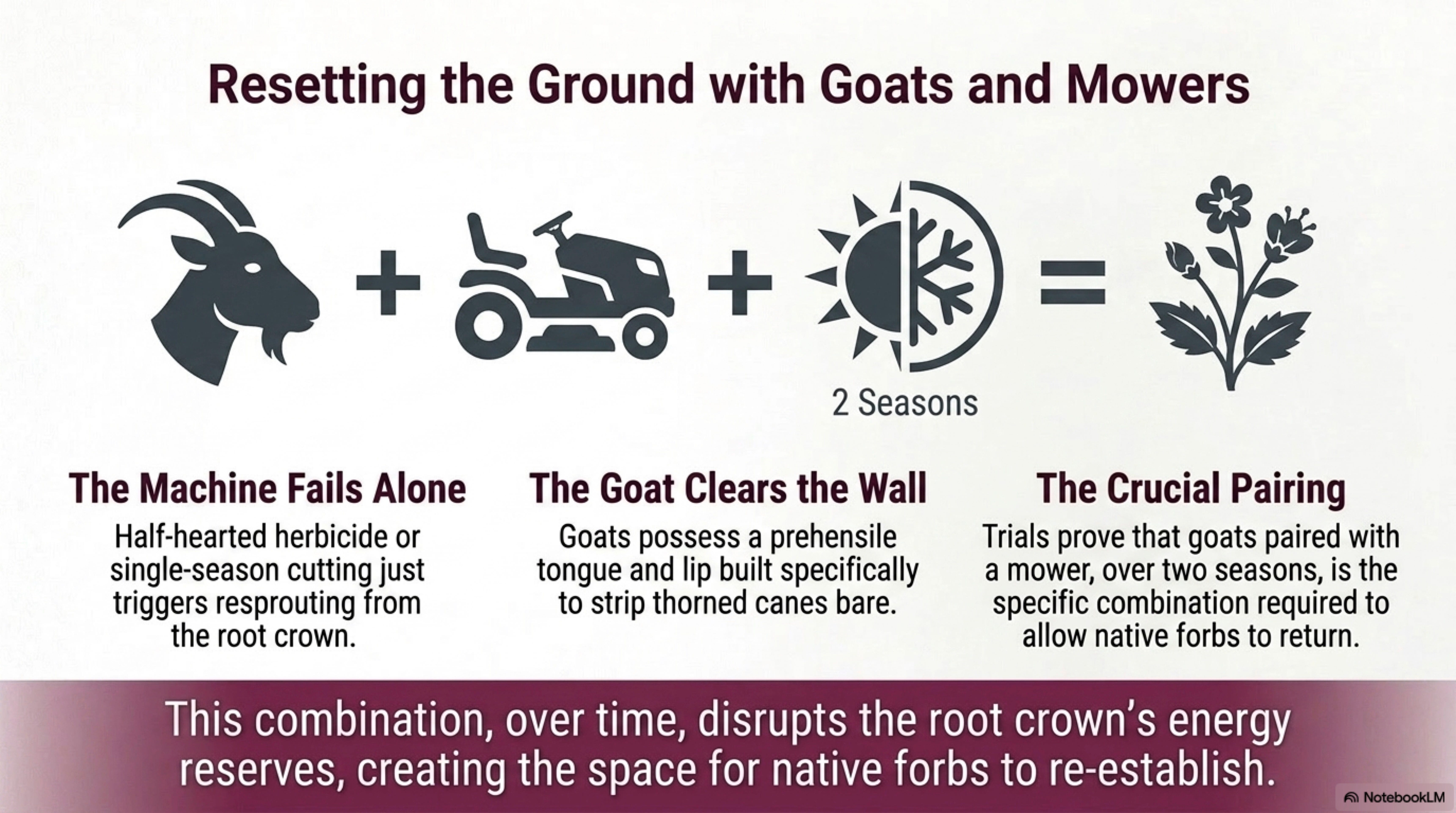
If you farm, you’re looking at a soil-reader and a wall of forage. It is almost never in deep forest, it lives at the edge, the road shoulder, the riparian terrace, the clearcut margin, the vacant lot, so where it flushes thick, the ground was opened, enriched, or grazed bare. And the same thorned canes you can’t clear without bleeding, a goat strips clean with a prehensile tongue and lip built for exactly this.
If you garden, you’re looking at one of the three great summer honey flows of the maritime Northwest, alongside bigleaf maple. Six to eight weeks of reliable nectar at the height of the mid-summer dearth, and a dense thicket that shelters ground-nesting sparrows and towhees, worth leaving on a margin, as long as you don’t let it swallow the beds.
If you forage, you’re looking at the most productive single-species fruit source in the post-industrial Northwest. A mature thicket throws ten to thirty pounds of fruit in a peak season, free food on public ground that most people pay a weed-whacker to destroy, and a genuine food-sovereignty resource in urban Cascadia.
If you teach, you’re looking at a plant whose every common name encodes a mistake. Himalayan, from a shipping route through India in the 1880s. The plant is Caucasian, native to Armenia and northern Iran, where it is paradoxically rare. And in June 2025 it was formally recorded in the Kashmir Himalaya for the first time, arriving, 140 years late, at the geography its name had always pointed to. The misnomer caught up with the plant.
And if you’re just curious, you’re looking at a double truth. This is a quarantined noxious weed in Oregon, a Cal-IPC “High” invader, a plant public agencies spend an unaudited fortune to control, and simultaneously the most generous fruit-and-nectar plant in the ruined places we’ve made. Cursed by statute, blessed at the table, both true in the same hand.
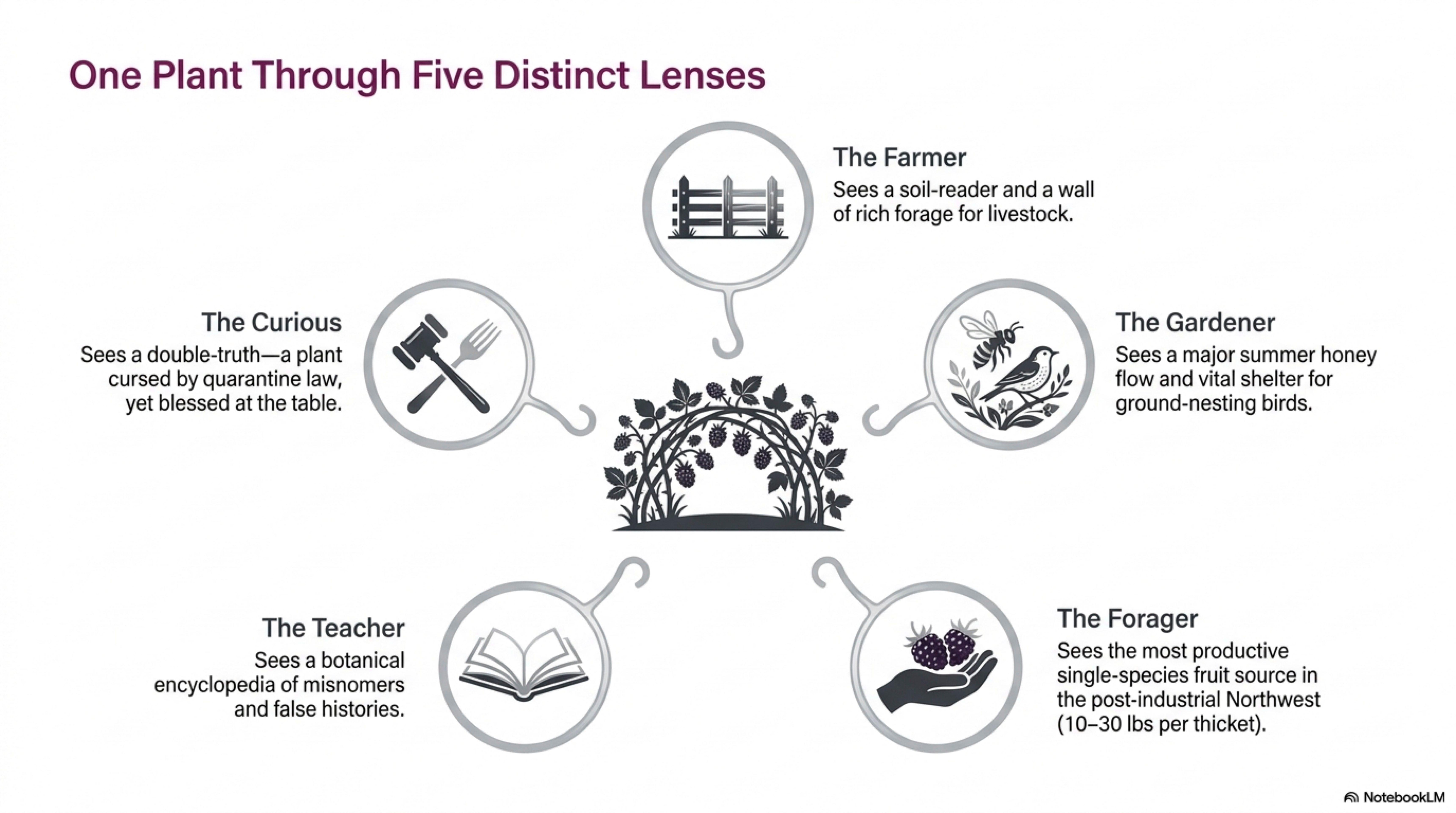
All five are right. Start with what you’ve actually got.
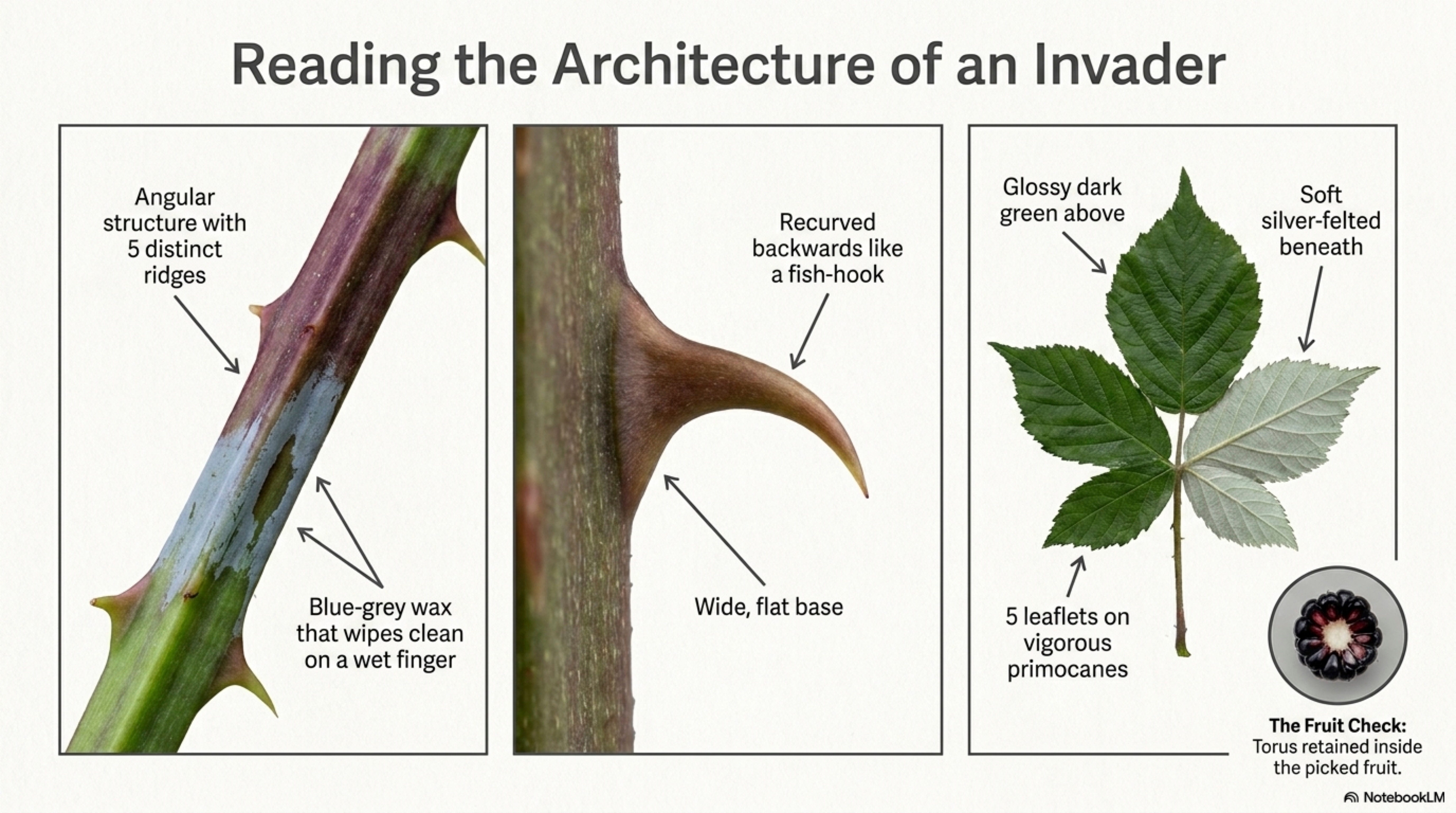
It’s a scrambling shrub with a two-year cane on a decade-old root crown. First-year canes are angular, five ridges you can feel, green to maroon, dusted with a blue-grey wax that wipes off on a wet finger, and set with broad-based prickles hooked back toward the base. The leaves are the old giveaway: dark and glossy above, silver-felted beneath, soft as a moth’s wing, discolor, two-faced. Five leaflets on a vigorous cane, three on a fruiting one. Flat-topped sprays of white-to-pink flowers in May and June; glossy black fruit July through September that pulls free keeping its little core, the torus, which is how you know it’s a blackberry and not a raspberry. Two things will tell you it’s this plant before you check the leaves: the cane is angular, not round, and the prickle base is wide and flat.
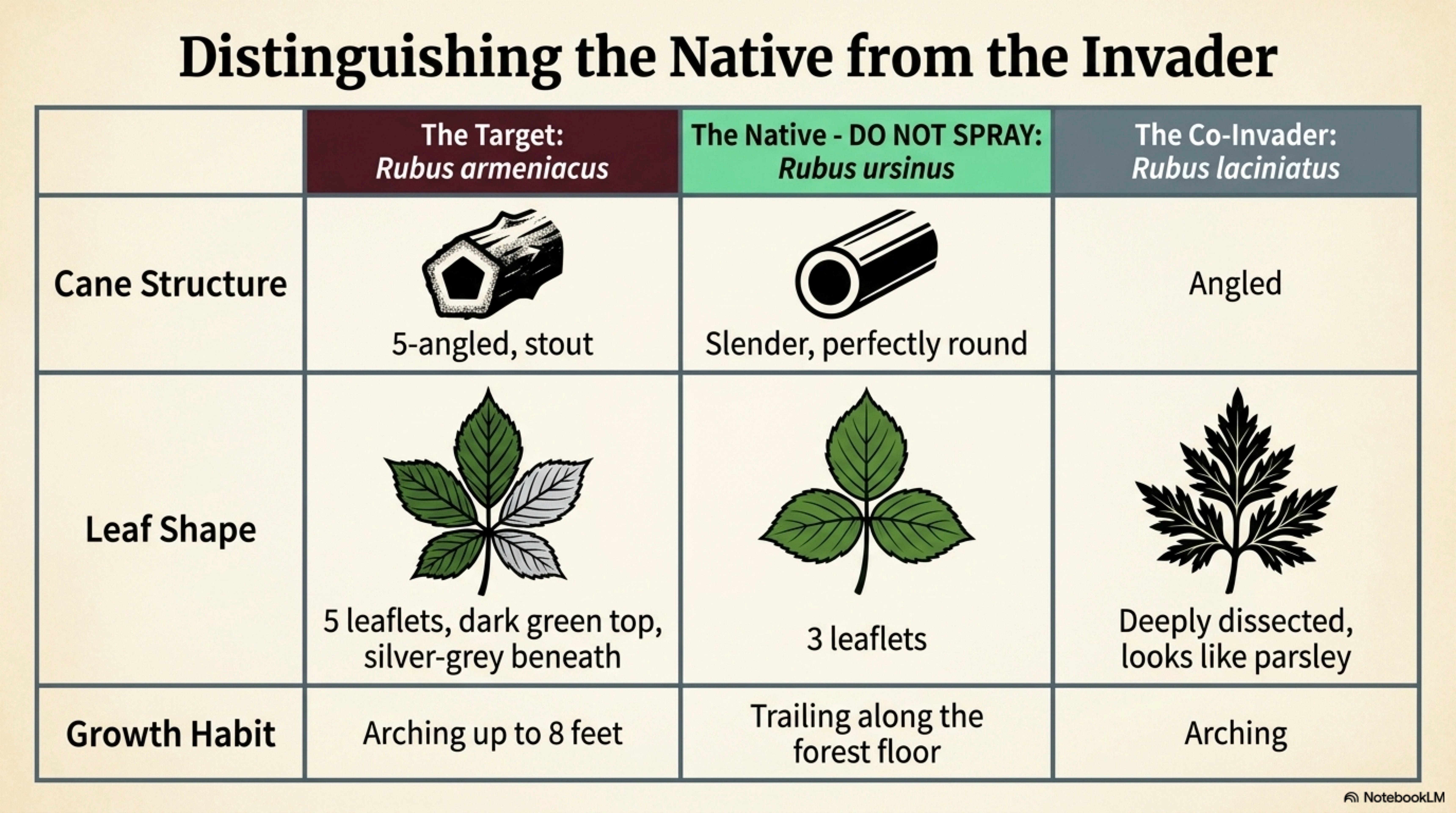
One flag to carry, and it cuts the consequential way. The danger here isn’t to you, every blackberry in these woods is edible. The danger is to the native. Our own trailing blackberry, Rubus ursinus, bleeds no confusion but shares the name: slender round canes, not ridged; three leaflets, not five; trailing along the forest floor instead of arching; and it belongs here, held its niche for millennia, fed and clothed Coast Salish peoples long before Burbank’s plant stepped off the boat. Every “blackberry blitz” that sprays or yanks a round, trailing, trifoliate cane is killing the wrong plant. Where the cane is slender and round and the leaves come in threes, leave it alone.
Now read the ground it stands on, because that’s the deeper skill. This plant is a sentence written by disturbance. Its seed wants light, which reaches it only when something opens the soil. It reads elevated nitrogen and crowds in to spend it. It holds leaf turgor straight through the summer drought that closes the native Rubus stomata, deeper roots, a leaf slower to panic, which is exactly why it wins on the dry, broken, sunlit terraces we keep making. It resprouts from the root crown after fire, mowing, cutting, and half-hearted herbicide, and it holds a torn streambank while it does. A thicket isn’t telling you the blackberry won. It’s telling you the land was opened, bulldozer, ditch, burn scar, abandoned lot, and left a door. The plant is the wound’s answer. We made the wound; it came to hold the opening.
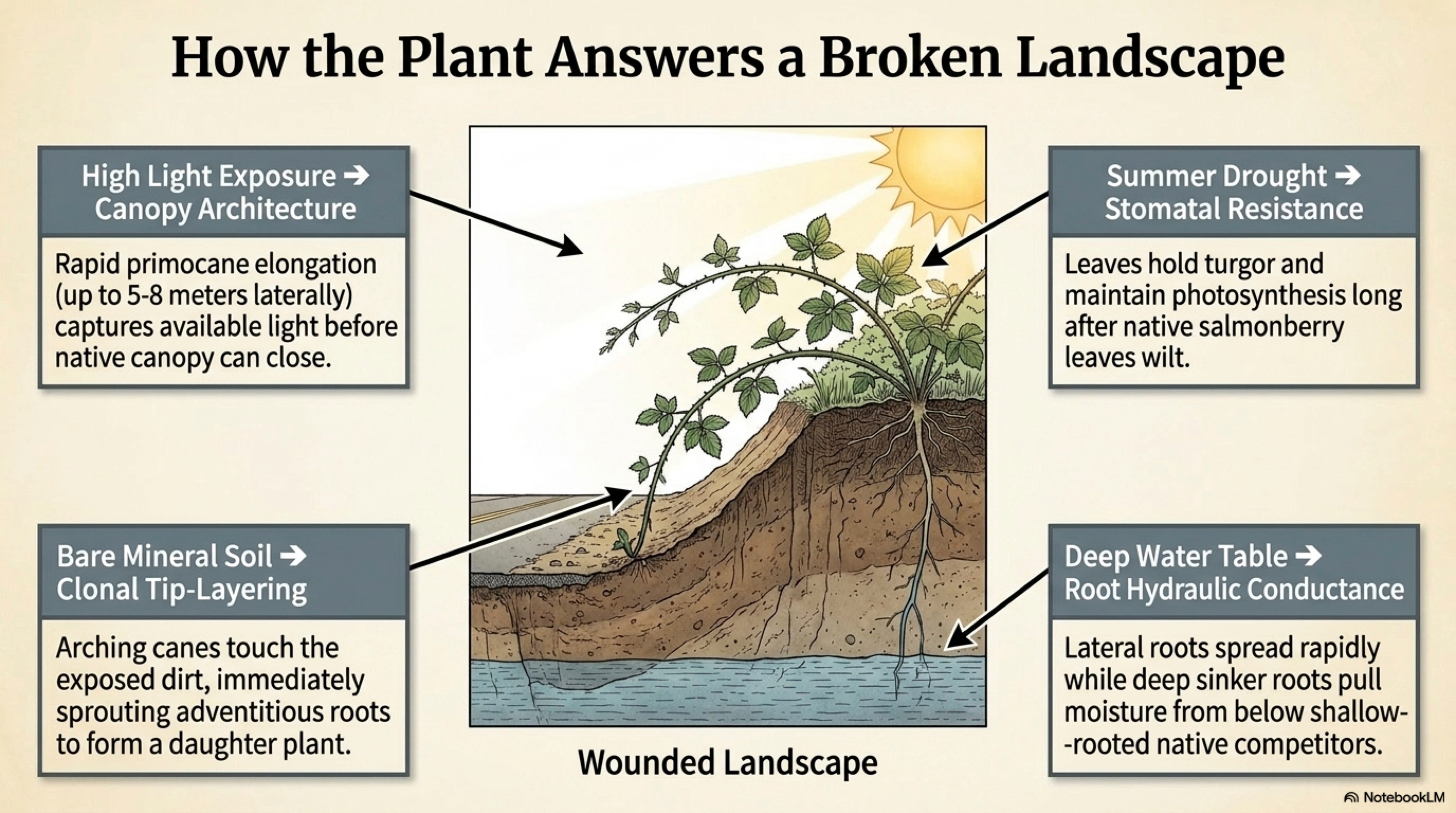
So the safe, useful things to do with it ask you to trust no health claim at all. Eat the fruit, glossy black, dropping into your hand at the lightest pull with the torus attached, when the warm air around the thicket carries the smell. Leave a stand on the margin for the bees through the dearth, or for the sparrows to nest in. Take the young primocane leaves in May and June for a mild, grassy tea. If you’re clearing it, put goats on it two seasons running rather than a machine, and pair them with a mow, because the trials show it’s the pairing, not the goat alone, that lets the forbs come back. Two disciplines only: harvest from clean ground, a plant this good at scavenging pulls cadmium and lead from roadside and railroad soil, and know that in Oregon the fruit is yours to pick but moving a cane, root, or seed is against the quarantine.
Here’s what I can’t walk past, though. The plant every crew here is paid to kill is, in the mountains it actually came from, the Talysh, the Caucasus, Persia, a domestic medicine older than the countries that hold it. A grandmother in Iranian Talysh boils the leaves for a child’s diarrhea; the astringent puckers the mouth, and by evening the runs slow. The recipe is older than the border. And she is not alone in it, not by a long way.
So which plant is the real one: the invader on the management map, or the medicine and hedge and village food that a dozen cultures reached for on purpose? And did the people who met it at home know something the eradication plans forgot?
That’s the question on the other side.