

It’s December 23rd. You’re probably thinking about family, food, maybe a few days off from whatever patch of earth you’ve been tending this year.
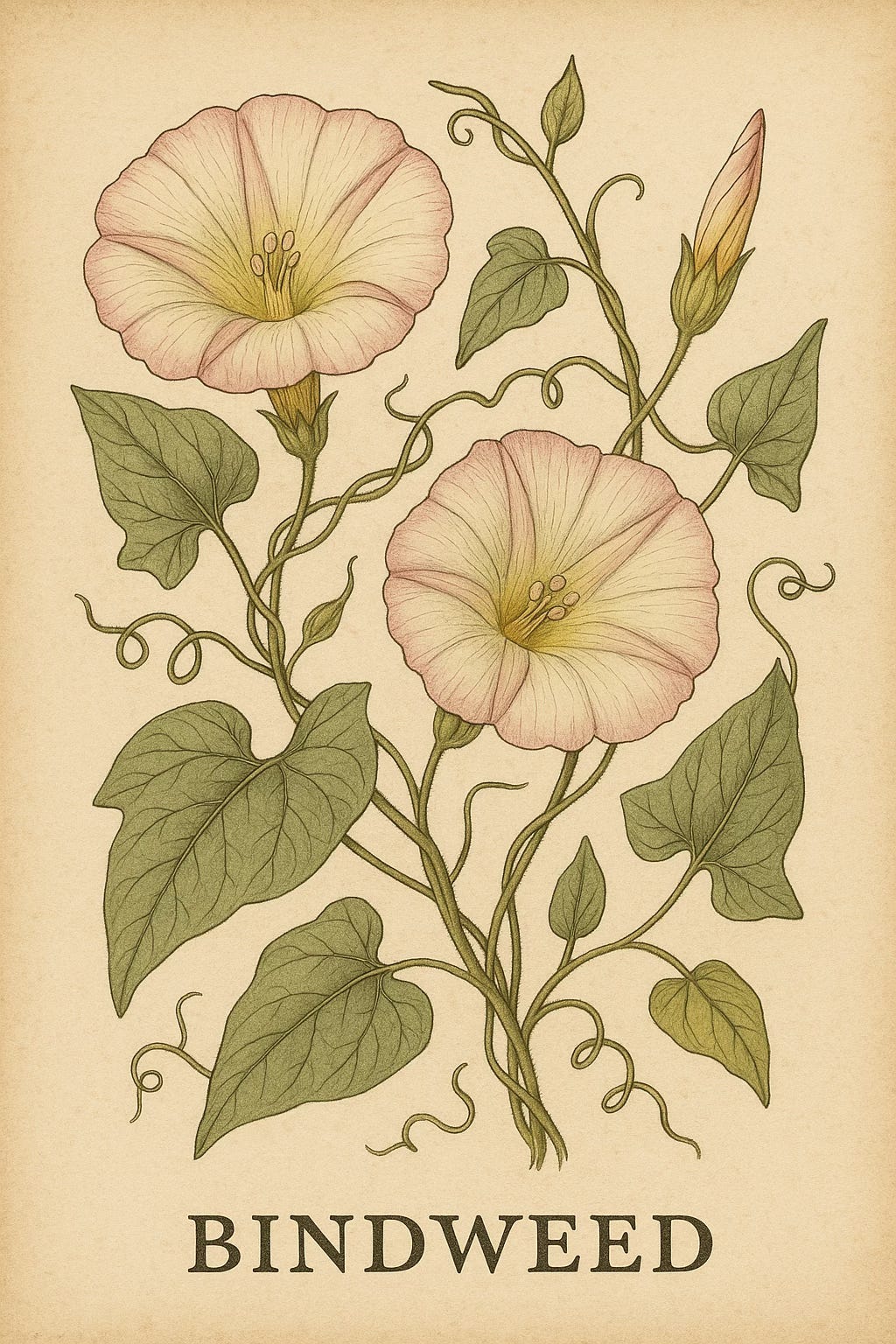
But before we close out 2025, I want to talk about bindweed one more time.
Not because I think you want more bindweed in your life (you definitely don’t), but because this month’s journey—from “how do I kill this thing?” to “what is this plant trying to teach me?”—represents something bigger than one persistent vine.
It’s about learning to read the land.
Four weeks ago, I released a video asking you to see bindweed differently. Not as a personal attack on your garden, but as ecological feedback—a messenger pointing to disturbance, fertility, and imbalance with botanical precision.
The response was... unexpected. Hundreds of you wrote back. Some relieved. Some still angry at the vine currently strangling your raspberries. A few admitted you’d been secretly impressed by bindweed’s sheer tenacity for years but felt guilty saying it out loud.
Then came the deep dive. Over 40,000 words exploring what lives six meters beneath your topsoil, why those innocent flowers fuel your pollinator economy for 100+ days, how bindweed wages chemical warfare in your rhizosphere, and what traditional cultures from China to the Great Plains understood about this plant that we’ve forgotten.
Week three brought the Stewarding Guide—the condensed, printable, take-it-to-the-field protocols. Occultation timing. Mulch specifications. Grazing rotations. Fermented plant juice ratios (1:1 bindweed to brown sugar, 7-day ferment, 1:500 dilution). The practical stuff you’ll reference when you’re standing there with a tarp and a decision to make.
And now, today, the podcast drops. Forty minutes synthesizing the science, the strategy, and the deeper lesson bindweed keeps trying to teach us about resilience: persistence isn’t about winning the surface fight—it’s about the depth of your reserves.
The podcast covers everything: the unstoppable underground architect archetype, the naming history across cultures (from “granny’s nightcap” to “devil’s guts”), the quantum biology speculation about helical growth and structured water, and why this plant—maddening as it is—deserves our respect.
Because here’s what I learned while researching this series:
Bindweed isn’t the problem. It’s the diagnostic.
When it shows up, it’s pointing to recent disturbance, fertile nitrogen-rich soil, and full sun exposure. It’s telling you your land’s story. And if you can learn to read that story—not just in bindweed but in every persistent plant that arrives—you move from exhausting warfare to intelligent partnership.
You stop fighting. You start designing.
Why this matters now, December 23rd, 2025:
I’ve spent fifteen years in vineyards and on working land. I know what it’s like to battle plants that won’t quit, to feel like the land is working against you instead of with you. These deep dives—bindweed, nettle, mullein, dandelion, all twelve we’re planning for 2026—are my attempt to change that relationship. Not just for me, but for anyone willing to see weeds as teachers instead of enemies.
The work takes time. 60-80 hours per profile. Research synthesis, cross-referencing peer-reviewed science with traditional wisdom, translating biochemistry into plain language, testing protocols in actual dirt. I’m currently at $5/month for full access to everything—all past deep dives, monthly profiles, and the practical regenerative intelligence that comes from years in the field and countless hours at the desk.
That price is changing to $15/month on January 1st. Not because I want to gatekeep knowledge, but because sustaining this level of research requires support. Current subscribers get grandfathered at $5 forever.
If you’ve been reading along this month—if the bindweed series changed how you see that vine, or any persistent plant on your land—then consider subscribing before year’s end. Not because you need another newsletter. Because this one might actually help you read the ground beneath your feet.
What you get:
Monthly Living Plant Wisdom Profiles (12 strategically selected plants in 2026)
Full deep dives bridging science, traditional knowledge, and regenerative practice
Quick Release Stewarding Guides for field application
Podcasts synthesizing complex ecology into conversation
Access to the entire archive (20+ comprehensive profiles)
The kind of education that changes decisions, not just opinions
This isn’t about collecting information. It’s about transforming how you steward land—whether that’s a backyard garden, a small farm, or a commercial operation. It’s about making educated decisions based on understanding rather than fighting based on frustration.
The plants are speaking. Bindweed’s been shouting for months, maybe years, and most of us have been too busy pulling to listen. This series was about learning the language. The subscription is about continuing the conversation—across twelve months, twelve plants, and whatever else the land teaches us in 2026.
Listen to today’s podcast. Let the Unstoppable Underground Architect tell you its story one more time. Then decide if you want to keep learning together.
Merry Christmas. Happy New Year. May your land teach you something beautiful in 2026, even if it arrives wrapped in vines you didn’t ask for.
The roots go deeper than we think. Always.
—Jay
P.S. — If you’re already a paid subscriber: thank you. You’re the reason this work continues. The podcast is live, the archive is growing, and 2026’s plant list is locked. Chickweed in January. Shepherd’s purse in February. Dock, cleavers, wild lettuce, and nine others selected for seasonal relevance and conversion potential. See you there.


