

Hold them together in late August and they don’t look like they belong in the same hand. A glossy black cluster still warm from the road shoulder. A dusty blue not-grape, cool from the fir shade. A dark, mealy berry wearing the fog. A purple-black pome with a faint almond finish, prairie-warm. Four colors. Four textures your tongue would never confuse.
They don’t taste like they belong together. But they’ve been saying the same thing all summer, and it was never about the fruit.
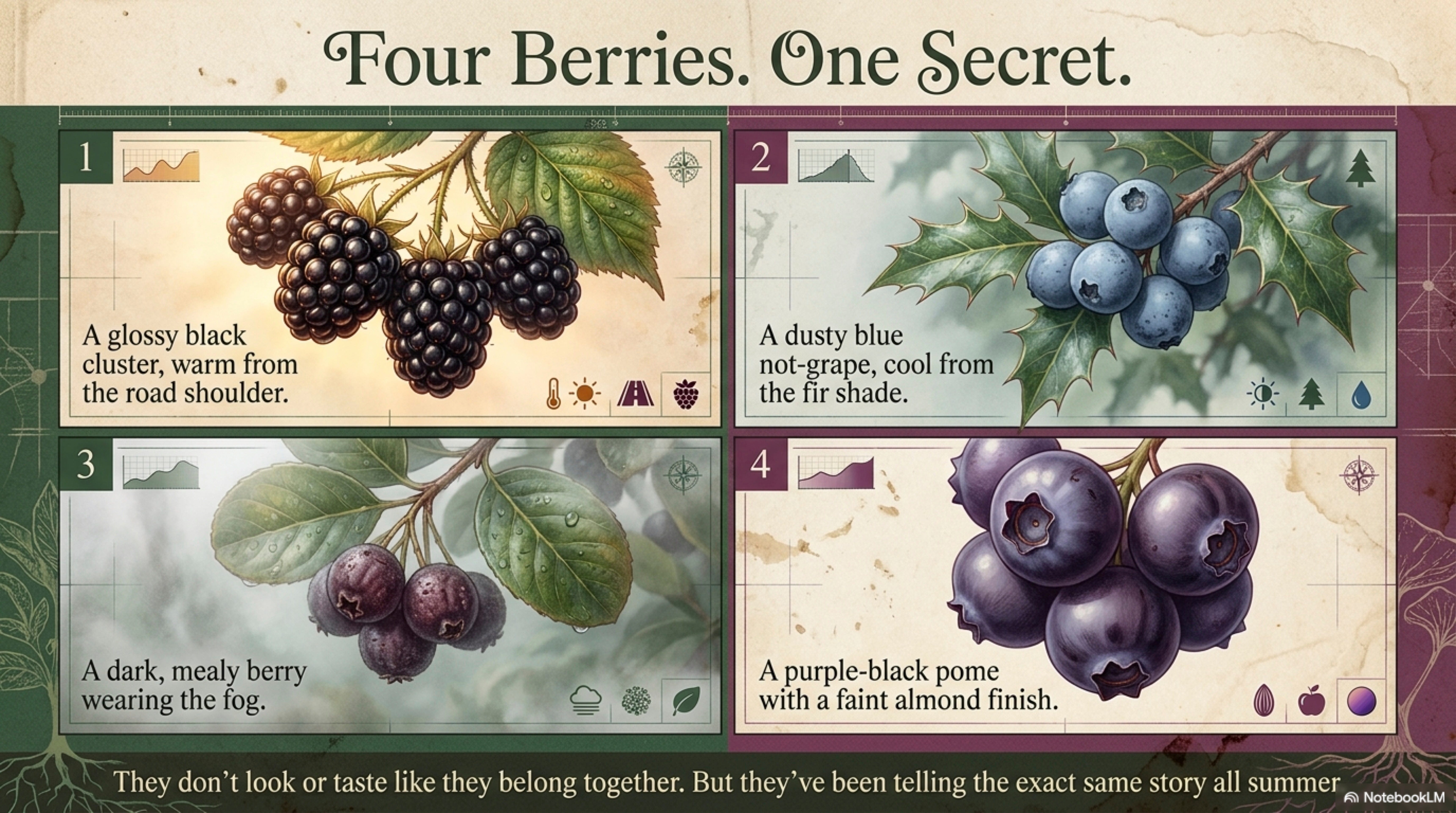
Each of these plants spent a week in your feed as a portrait. Taken one at a time, each is a useful plant with a good story. Taken together, they’re a diagnostic kit. Four berries, four chapters of the ground’s own history, readable on any walk you take this month. A link to each berry summary is connected to each image below.

Himalayan blackberry reads the wound. Find it thick on a road cut, a ditch, a cleared margin, and the ground is telling you it was recently opened, edged, drained, fed with nitrogen, left in the sun. The plant didn’t cause the wound. It answered it. The thorn that hooks backward, the cane that roots wherever it touches soil, the fruit that sets without pollination, all one trait. A biology built to close what we keep opening.

Oregon grape reads the chemistry you can’t see from the trail. A thriving stand of tall Oregon grape means well-drained, slightly acidic, coarse ground with its fungal networks still intact. Its absence in country that ought to suit it can flag compaction or waterlogged soil. The plant is quiet, knee-high, prickly as holly, and it hides a shocking yellow inside its roots that turns out to be everything humans have ever wanted from it, dye, medicine, bitterness, defense, in a single molecule.

Salal reads the tenure. Dense salal on the forest floor means acid, nitrogen-poor, coastal ground, ground the plant has been quietly claiming through a fungal partnership that locks nitrogen into a form only salal’s roots can reach. What looks like understory deference is a slow, patient landlord. The foresters call it a problem. The ecologist Prescott called it something closer to the truth: the plant doesn’t cause the poor site. It exploits one. Then it rewrites the lease.

Saskatoon reads the opening. Where it abounds, something broke the ground open, fire, grazing release, a cut, thirty to fifty years back. It’s a middle-of-the-story plant, first to flower, first to fruit, first green shoot back from the rhizome after a burn. Its abundance doesn’t mean the shrub won. It means the ground was opened and hasn’t yet closed.
A wound, a chemistry, a tenure, an opening. Between the four of them, they cover disturbance history, drainage, pH, fertility, fungal health, and successional stage. That isn’t a chapter of plant profiles. It’s a field diagnostic you can carry in your pocket and run with your eyes and your hand.
Here’s the part I keep circling back to.
Four plants. Four traditional medicines carried independently by cultures that mostly never spoke to one another. Caucasian grandmothers boiled the blackberry leaf for a sick child’s gut. Northwest peoples traded Oregon grape root across mountains for the yellow locked inside it. Three Pacific nations converged on salal leaf as an astringent for wounds and weeping tissue. Four nations, Blackfoot, Plains Cree, Woods Cree, Nlaka’pamux, independently used Saskatoon bark in the same narrow moment: after birth, to stop the bleeding.
Each time the chemistry has been checked, it agrees with the tradition. Blackberry’s tannins bind a leaking gut lining the way six cultures said they would. Oregon grape’s berberine is a genuine antimicrobial, and the controlled trials on psoriasis confirmed what the healers already knew about the skin. Salal’s condensed tannins predict the astringent convergence precisely. Saskatoon’s tannin profile makes the postpartum bleeding-control half plausible on paper.
And in every case, at least one critical test has never been run.
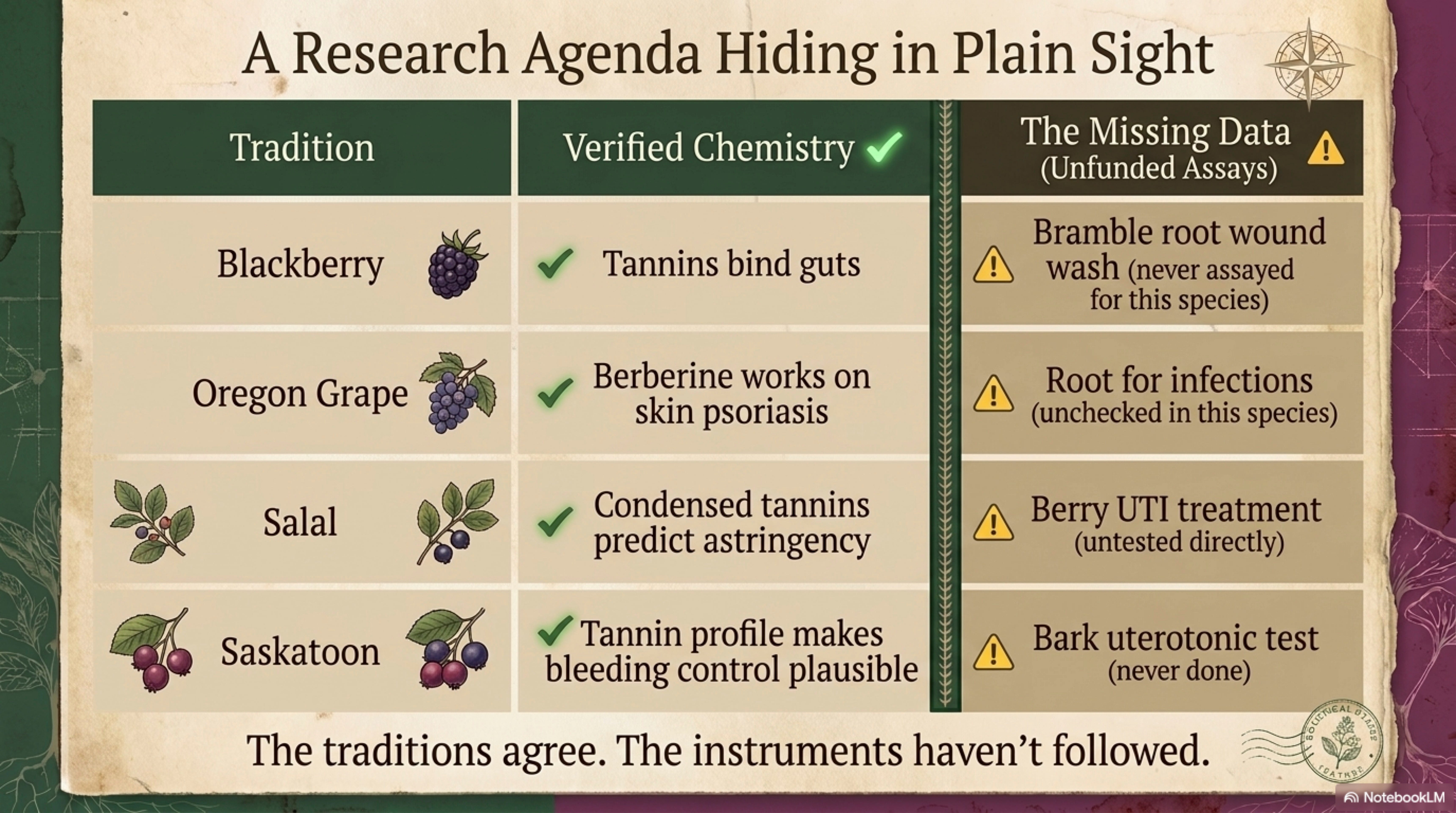
The bramble root that six cultures used as a wound wash, never assayed for this species. The Saskatoon bark that four nations used postpartum, the uterotonic test has never been done. The salal berry that carries the same unusual molecule behind cranberry’s urinary-tract reputation, never tested directly. The Oregon grape root that Mediterranean tradition trusted for infections, confirmed in a sister species, unchecked in this one.
The traditions agree. The instruments haven’t followed. That isn’t folklore drifting on the wind. It’s a research agenda hiding in plain sight, funded by no one, pointed at by everyone who was paying attention before the lab existed.
This is what I think the berries were teaching, underneath all four profiles, underneath the soil reads and the safety frames and the medicine that lives behind each post’s wall.
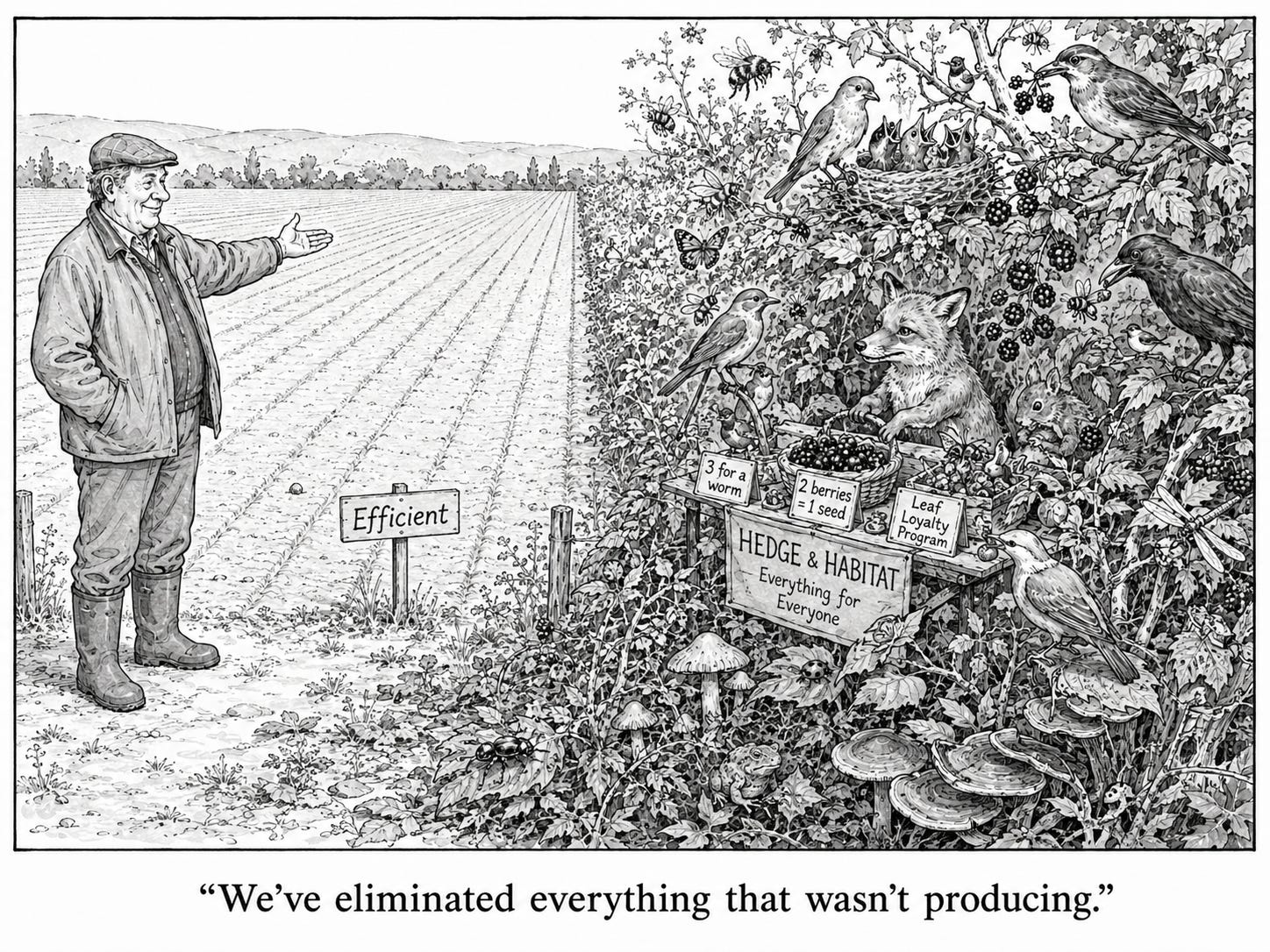
The berry is never about the berry. It’s about the edge.
An edge is where systems meet, forest and clearing, sun and shade, wet and drained, the managed and the wild. Agriculture often removes edges because they’re untidy. They complicate the mowing, the spraying, the straight line. But the edge is where the most relationships are running, the most species are feeding, the most work is getting done. The berry evolved to live there. It evolved to be the edge’s currency, sugar wrapped around seed, a contract between plant and animal, the deal that keeps the margin functioning.
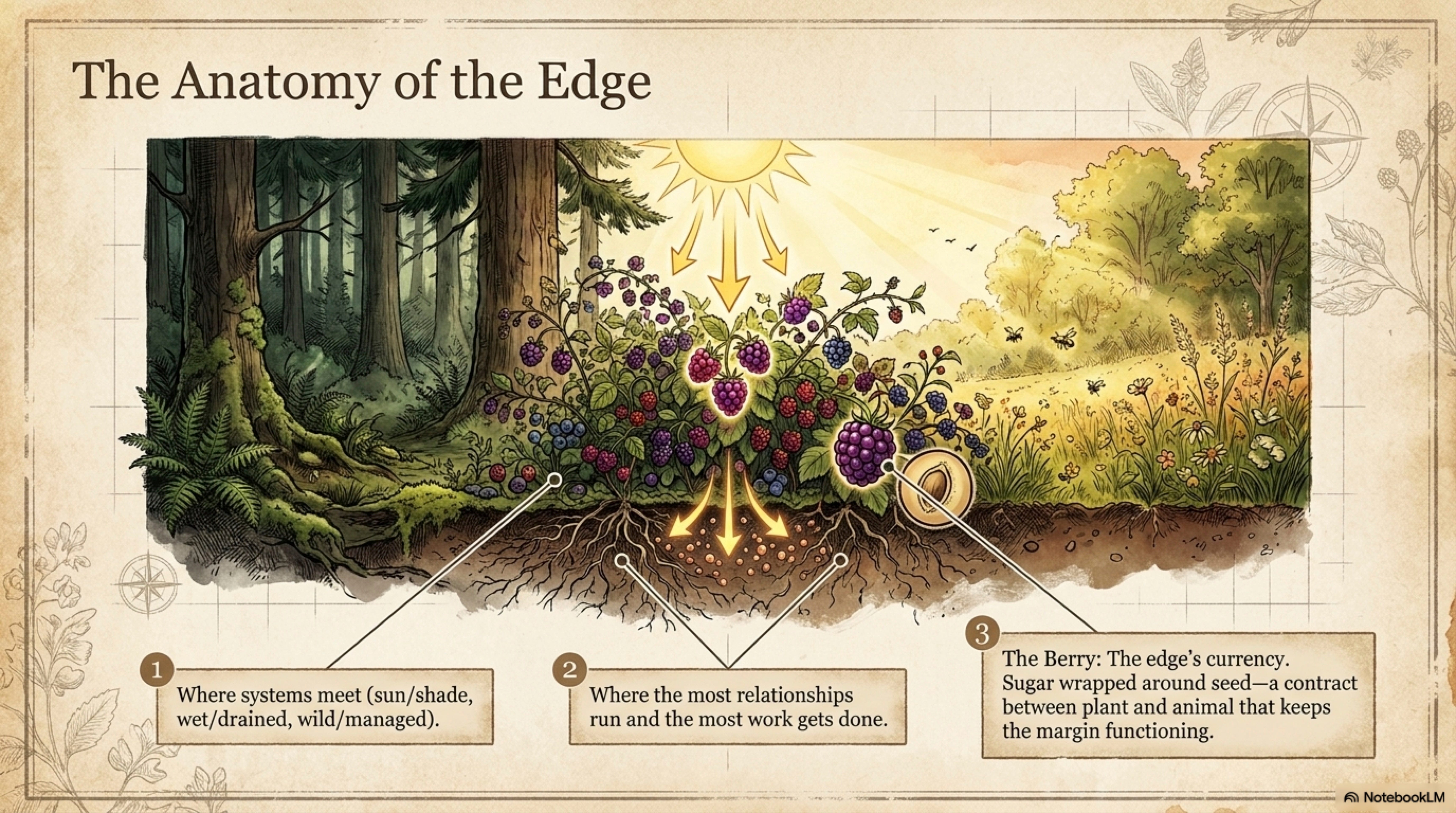
Every time you pick a blackberry off a road cut, or kneel beside an Oregon grape on a slope, or reach into a salal thicket at the forest margin, or stand at a burned coulee with the Saskatoons coming ripe, you’re standing at an edge. And the plant is already telling you what kind of edge it is, wounded or intact, acid or neutral, young or old, open or closing. The fruit is just the introduction. The conversation is about the ground.
That’s what this whole publication has been practicing, post by post, plant by plant, learning to read the ground before we reach for the intervention. A berry at a time, until the landscape starts talking back.
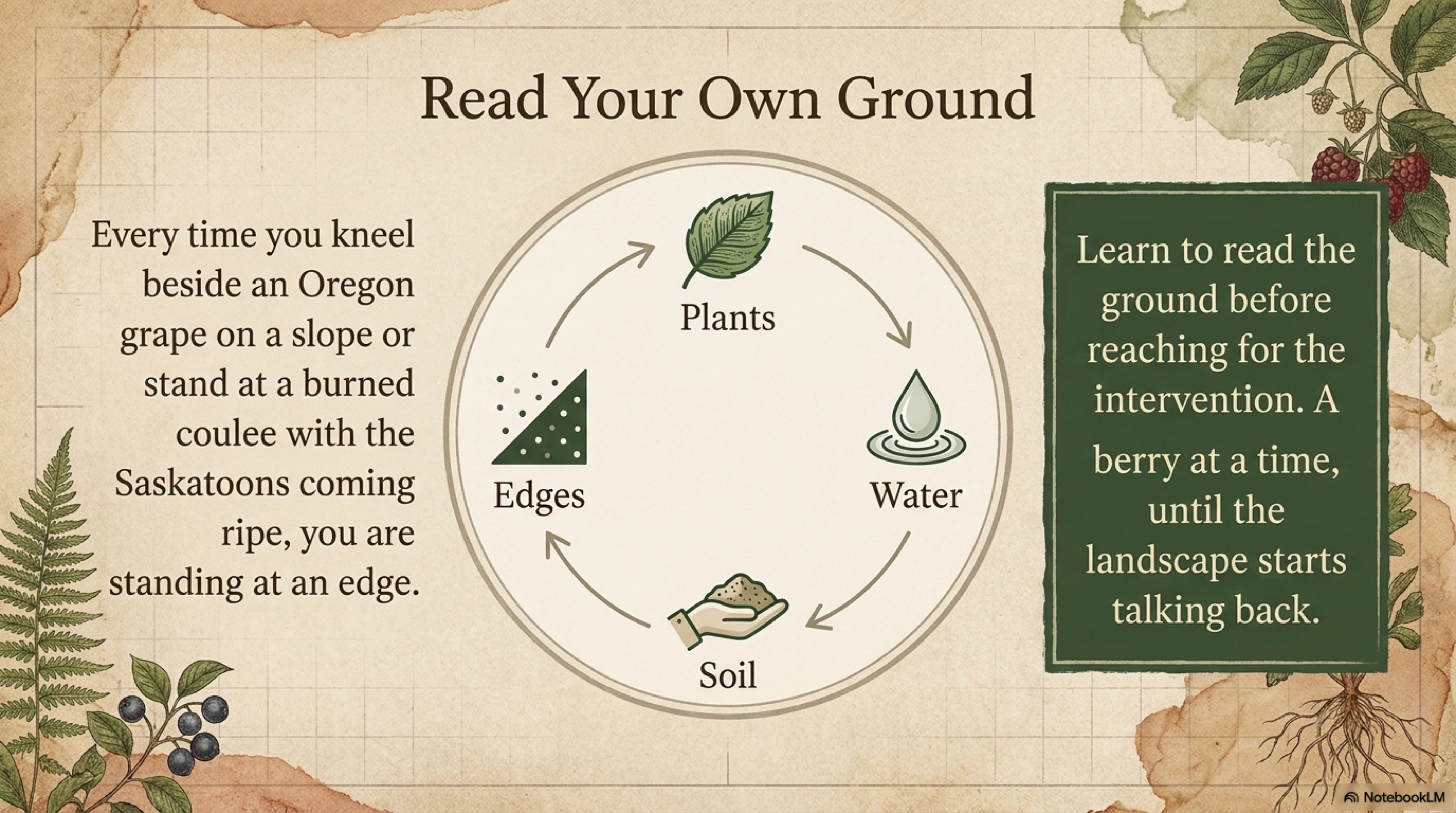
If you want the method underneath these posts, the whole framework for reading a property through its plants, its water, its soil, its edges, that’s what Reading the Land was written for. It’s the book these profiles keep demonstrating one chapter at a time.
And if you’d rather walk your own ground with someone who reads it this way, that’s what the Ground-Truth Session is for.
Next week, the plants get bitter. That’s not a warning. It’s where the pharmacy starts.
I enjoy reading your work; well researched and I always learn something new; thanks very much
Thank you SO MUCH for making this available as audio!! Sometimes I need to listen in the background as I cook or do chores 😊