

The Soil Can’t Heal If It’s Always Being Paid in Printed Money
Why monoculture creates ecological inflation, and how regeneration restores the real economy of the land.
A strange thing happens when you watch a degraded field long enough.
You stop seeing “problems.”
You start seeing responses.
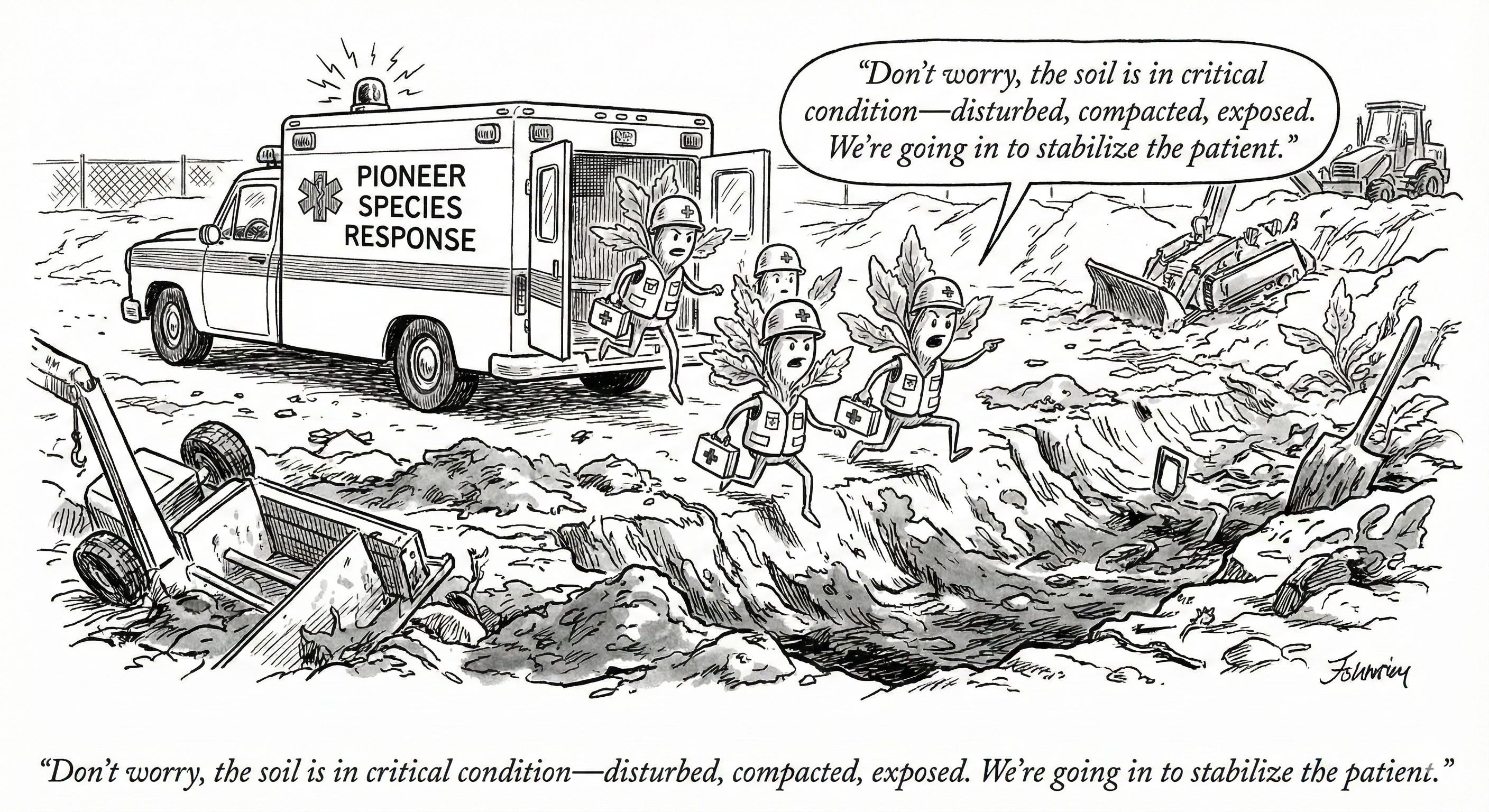
Weeds appear like paramedics. Pathogens arrive like auditors. Insects show up like opportunists at a poorly managed buffet. The land isn’t “misbehaving.” It’s negotiating, and when you ignore the whisper, you get the megaphone.
And the megaphone usually appears after we’ve done the same thing for decades:
Simplify the ecosystem into one crop.
Break the feedback loops that used to regulate it.
Replace regulation with external correction.
Repeat until the entire system becomes dependent.
That’s the part that should make us uneasy: dependency isn’t an accident in modern agriculture. It’s the business model’s native habitat.
Monoculture is a monologue in a world built for dialogue
Nature doesn’t run on single voices. It runs on conversation: roots trading carbon for minerals, fungi extending reach, predators keeping populations honest, plants using chemistry to negotiate with microbes and insects.
Monoculture is what happens when we mute the orchestra and demand a solo.
The soil responds the way any living system responds to forced simplification: it tries to restore complexity. It introduces pioneers. It recruits tough species. It reorganizes. We call those recruits “weeds” and “pests,” then we escalate.
That escalation; more herbicide, more fungicide, more soluble fertility, doesn’t end the conversation.
It just teaches the land to shout louder, and us to keep buying earplugs.
The gut–soil parallel isn’t metaphor. It’s pattern recognition.
We understand this with bodies now: your gut isn’t just a pipe. It’s an ecosystem. Diversity matters. Rhythm matters. Over-sterilization and ultra-processed inputs don’t just “feed you”, they reshape the ecology inside you.
Soil is the same pattern wearing different clothes.
A living soil isn’t dirt plus nutrients. It’s a negotiated network. When it works, it’s self-regulating: it cycles fertility, resists disease, buffers stress. When it’s broken, it demands constant intervention, like a gut that can’t tolerate normal food without medication.
So here’s the heresy:
The core problem of conventional agriculture may not be missing inputs.
It may be missing a regenerative state.
Because healing doesn’t happen when a system is constantly forced to perform.
Fasting, ketosis, and the regenerative state
In the human body, fasting isn’t magic. It’s not moral. It’s not even primarily about weight.
It’s about a switch:
When external input pauses, the body shifts from constant intake to internal recycling. The system stops performing and starts repairing.
It clears damaged parts, recalibrates signals, and makes room for repair.
Not because it’s “deprived,” but because it finally has permission.
So ask the uncomfortable soil question:
When does soil get permission to recycle itself?
Most modern fields never do.
They are pushed every season. Extracted. Disturbed. Stimulated. Corrected. They aren’t allowed to downshift into repair, they’re kept in perpetual production mode.
And that’s where the economy metaphor becomes more than metaphor.
Soil economy: what the land trades in (and what happens when we counterfeit it)
In a functioning soil, fertility isn’t “delivered.” It’s earned through relationship.
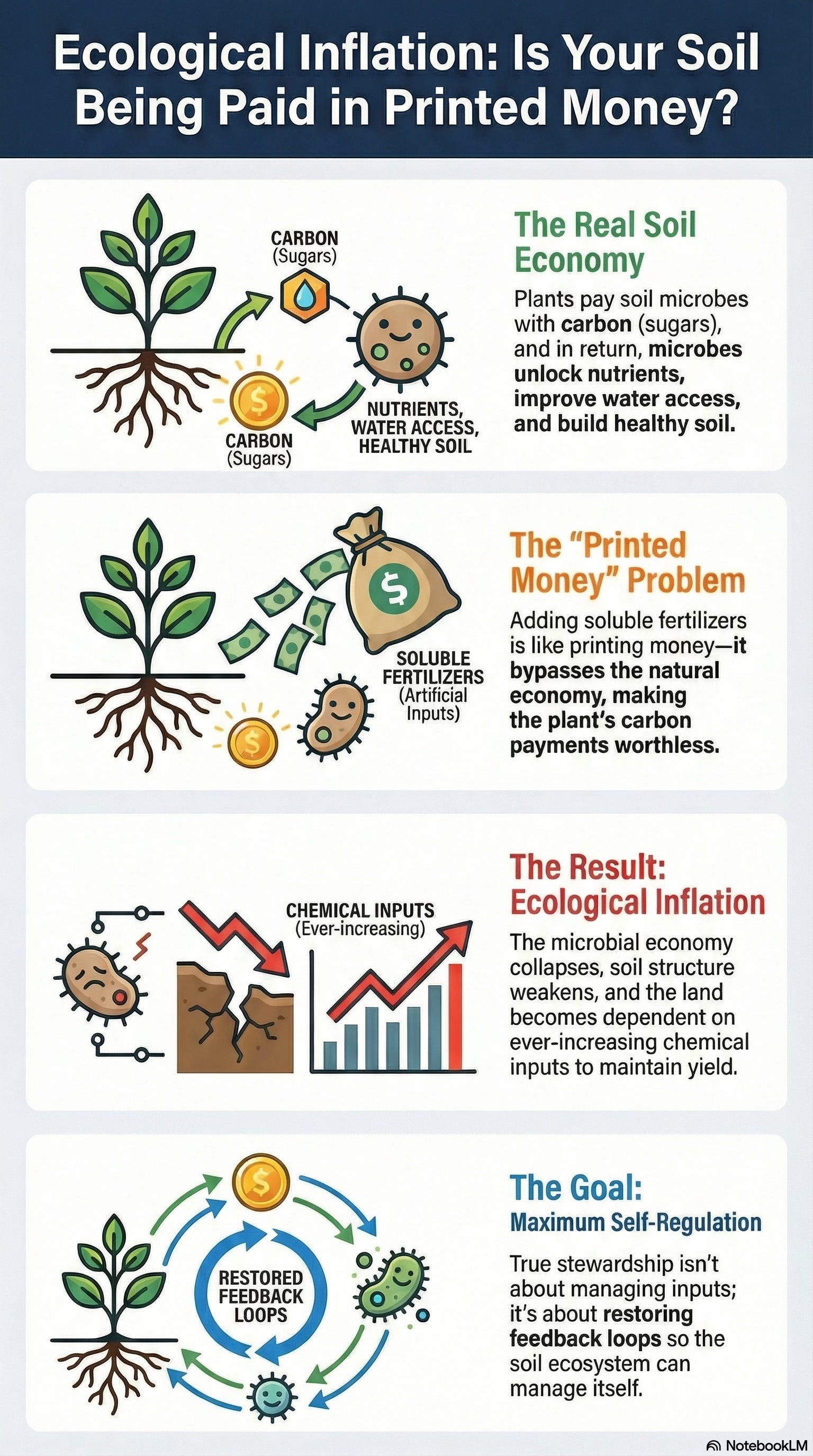
Plants manufacture sugars through photosynthesis and send a significant portion below ground as root exudates, carbon payments. Microbes and fungi respond by:
freeing mineral nutrients,
improving water access,
building soil structure,
and providing immune support against pathogens.
That’s an economy: value exchanged for value.
Soluble fertilizers can short-circuit this trade. They’re not “food” in the ecological sense, they’re a bypass.
They’re the land equivalent of printing money.
When you print money, you don’t create wealth, you distort signals
In a healthy financial economy, prices carry information. They tell you what’s scarce, what’s valuable, what people truly need, what production is worth.
When governments (or central banks) over-print money, they don’t just increase “liquidity.” They can also weaken price signals, reward leverage over productivity, and create a landscape where everything looks profitable, until it isn’t.
You get inflation. Speculation. Asset bubbles. Fragility.
Now translate that to soil:
When we “print fertility” in the form of constant soluble nitrogen and chemical correction, we distort ecological signals.
The plant no longer needs to “pay” microbes properly.
The microbial economy becomes impoverished.
Fungal networks decline.
Soil structure weakens.
Water buffering collapses.
Disease pressure rises.
Then the only way to maintain yield is… more printed fertility.
That isn’t abundance. That’s ecological inflation.
You can force growth, just like you can prop up markets with liquidity. But you’re not building resilience. You’re building dependency.
Weeds as inflation indicators (and sometimes debt collectors)
When a financial system is distorted, opportunists appear. When a soil system is distorted, opportunists appear too.
Weeds and pests often thrive in simplified landscapes because they are adapted to volatility, fast growth, rapid reproduction, quick exploitation of open niches.
They’re not “punishment.” They’re what shows up when the system’s internal checks and balances have been removed.
Calling them villains is like blaming inflation on the people who notice it first.
The missing practice: regenerative rest without abandonment
Conventional “fallow” often means bare soil. That’s not rest, it’s starvation.
A true regenerative rest phase looks like this:
Photosynthesis continues (energy still enters the system).
Extraction drops (the land isn’t being forced to cash out every season).
Diversity returns (multiple species, multiple functions).
Disturbance decreases (networks can rebuild).
This is the soil’s version of fasting: not empty, not dead, just not being overruled.
Call it “soil ketosis” if you like: carbon becomes the dominant currency again, fungal pathways expand, and internal cycling restarts.
And here’s the part conventional models quietly can’t handle: Once feedback loops return, the need for external correction falls. That is exactly what the input economy cannot tolerate.
A self-regulating farm is bad for the business of correction.
Stewardship is feedback engineering
If you want a single sentence that changes how you farm, teach, or design systems, try this:
A steward isn’t an input manager. A steward is a feedback engineer.
The questions shift from “What can I add?” to:
Where is energy leaking? (water, carbon, shade, erosion, bare soil)
Where is information being silenced? (microbial diversity, fungal networks, predator chains)
What loops are broken, and which can I close with the least force?
Regeneration isn’t control. It’s restoring the conditions where the system can control itself.
A closing test that should make everyone a little uncomfortable
If a farm requires constant external inputs to remain stable, it is not a stable ecosystem.
It may be profitable. It may be productive.
But it is fragile, like an economy propped up by printing, leverage, and emergency measures.
A healthy system can be pushed and still return toward coherence.
That’s the whole game:
Not maximum yield.
Maximum self-regulation.
The land isn’t lazy. It’s exhausted.
And it cannot heal while it’s always being paid in printed money.
I don't farm and I don't have a science background, but I live in a rural area where 35,000 acres grows mostly three crops. I get to drive around these fields every day in my normal travel. I put a few weeks in last summer at one of the processing plants where we were able to generate a 30-lb box of individually frozen bits of food every three seconds. It was less than 15 minutes from truck to box, and less than an hour from the crop in the field. American agriculture IS the best there is, and requires no less engineering than a Boeing 747. As long as we like grabbing those bags of frozen fruits or veggies from Costco or the food co-op then these 1-crop farms are in our food chain.
I think your analogy of soil health to gut health needs more attention. Some of these 1-crop farms have been growing just these 3 crops for 50 years, not forever. Some of those crops have been in for only a decade, as the processing plants and the markets have been able to support those 1-crop farms. I think we're in trouble, and I don't hear anyone sounding an alarm.
One of the strands of this soil health problem is growth management laws that force people into tight spaces and make it impossible to build in rural areas, even where there is plenty of room outside of the land already zoned for agriculture. A family on a parcel no smaller than 1/3 of an acre should be a gold standard. A tiny bit of understanding about regenerative farming will keep those soils healthy enough for that family to feed itself and its neighbors. Hedgerows between properties cultivate wildlife. People are NOT a scourge upon the earth! Enough of these properties will help balance these 1-crop farms, until we have a better understanding of how to manage them. There will always be people who want to grab that bag of frozen fruits or veggies from Costco!
I completely agree. The soil economy extends to the market economy, and we need to pay more attention. There could soon be an agriculture bubble bursting as bad as the 2007 housing bust.