
Rooted Possibilities - regenerative consulting by Jay Drysdale
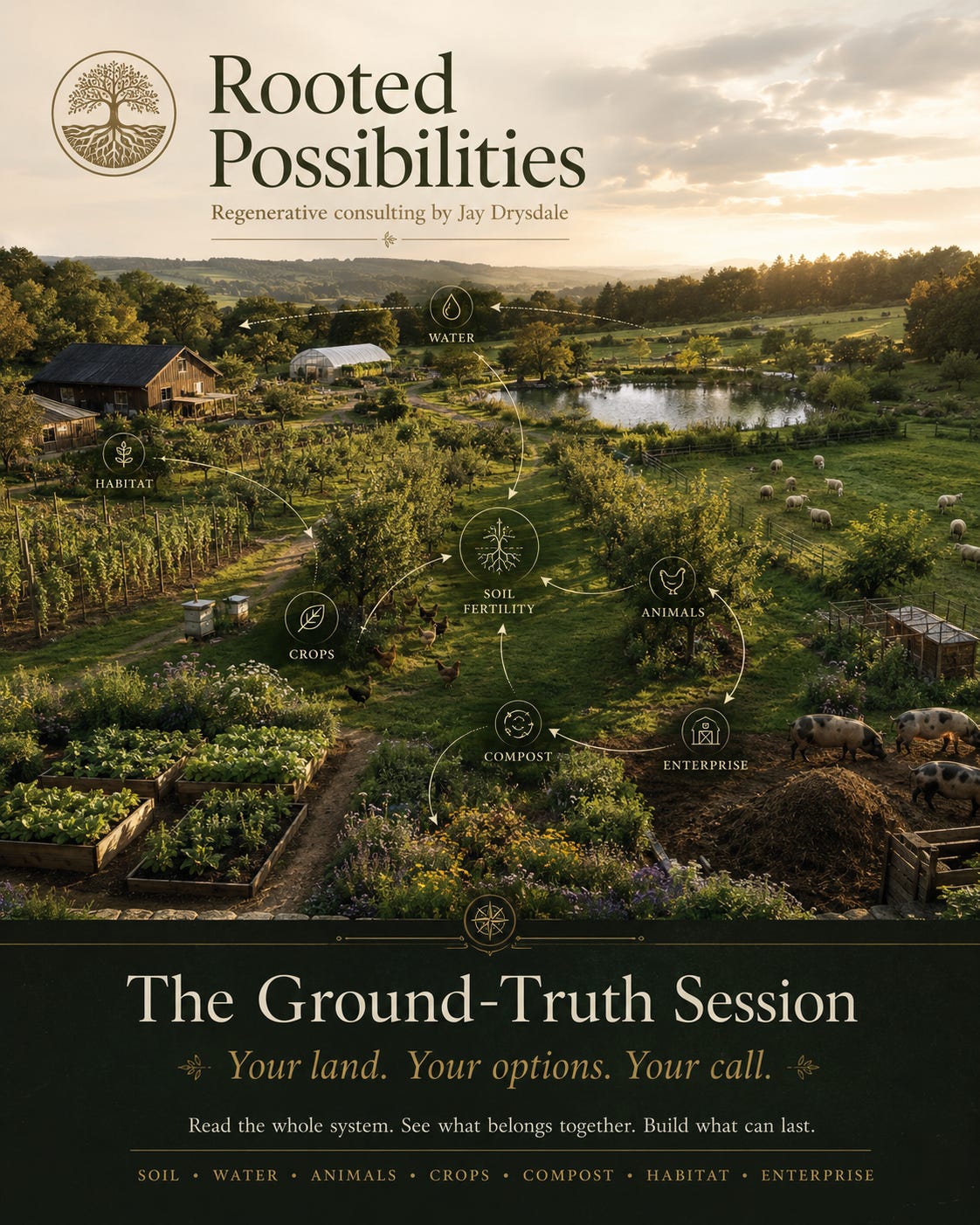
Rooted Possibilities
Regenerative consulting by Jay Drysdale
Your land. Your options. Your call.
You already know your land could become more than it is today.
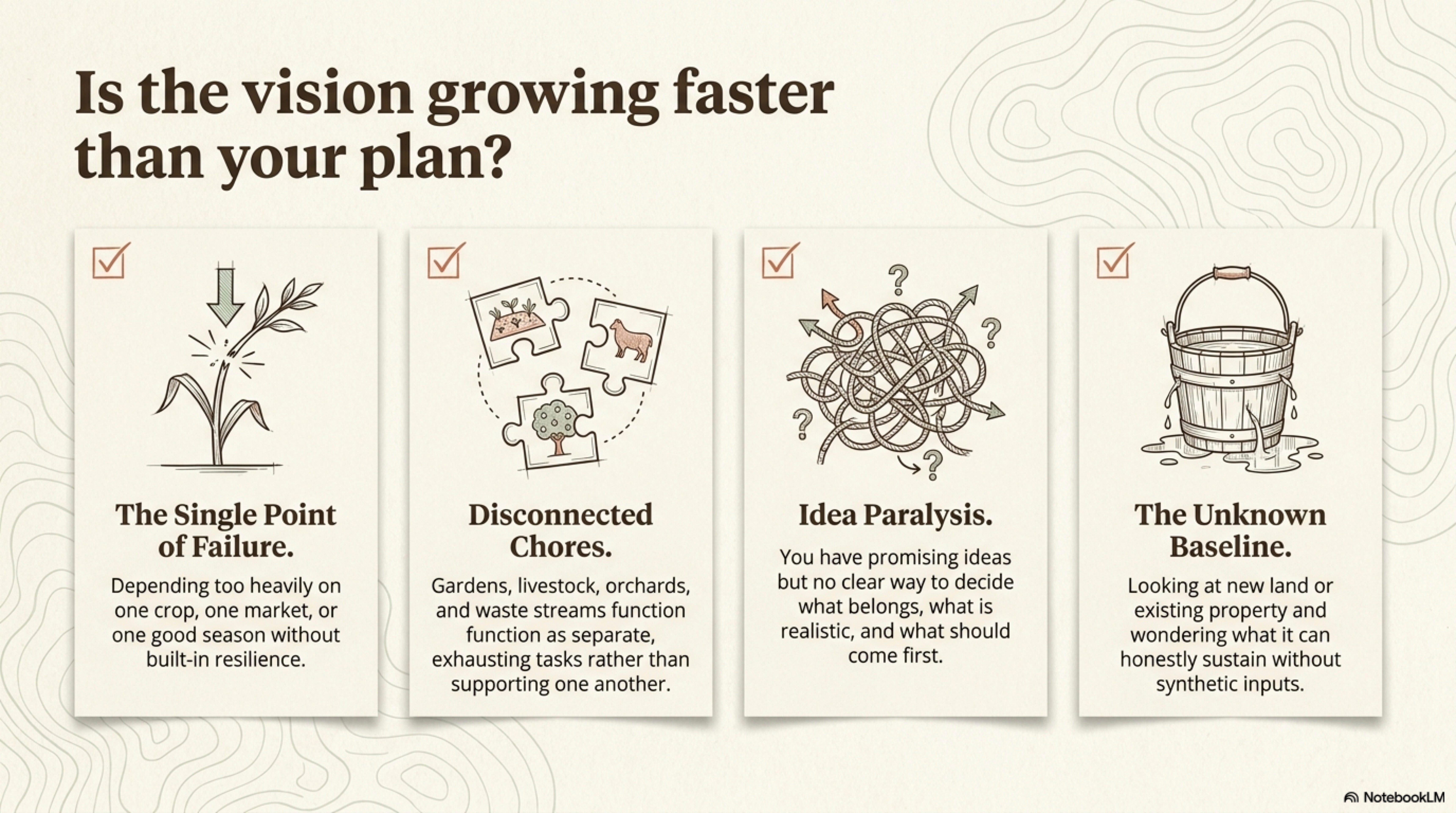
Perhaps your farm depends too heavily on one crop, one market, or one good season, and you want to build another source of resilience before circumstances force the issue.
Perhaps the garden, livestock, orchard, water, buildings and waste streams on your smallholding all function as separate chores, even though you sense they could be supporting one another. You may be looking at new land and wondering what it can honestly sustain, or trying to make an existing property produce more food, require fewer outside inputs, and return more than it consumes.
Or perhaps the vision has simply grown faster than the plan, leaving you with many promising ideas but no clear way to decide what belongs, what is realistic, and what should come first.
The difficulty is rarely a shortage of ideas.
It is knowing which ideas belong together, what the land can carry, what your time and finances can sustain, and what should happen first.
That is what the Ground-Truth Session is for.
What it is
You bring three things:
What you want the land to become.
What you actually have to work with — soil, water, buildings, plants, animals, capital and the honest number of hours available in your day.
And the reality: what works, what doesn’t, and what may be difficult to see from inside the operation.
What I bring is the ability to read a whole system, and put its pieces to work feeding one another.
For fifteen years I’ve farmed without synthetic inputs, and the vineyard was only where it started. Farm without the crutch of synthetic applications and you have no choice but to build fertility from what the land already makes — cover crops feeding the soil biology, fermented plant and microbial inputs carrying that life into the places it runs thin, compost closing what the animals open.
Because animals are an engine of soil health. I’ve raised and handled many kinds of poultry, hogs and lamb, and I know them the whole way — from brooder to butcher block, nothing wasted. A flock works through an orchard clearing pests and dropping fertility as it goes. Hogs turn windfall fruit and grape pomace into rooted, manured ground. Lamb grazes the cover the crops don’t need. Their manure feeds the compost; the compost feeds the soil; the soil feeds the crop; the crop feeds them, and round it comes again. That is a closed loop — not a slide in a deck, but a real chain where each enterprise’s waste is the next one’s feed, and every year a little less gets trucked in or hauled away.
Read a property this way long enough and you stop seeing separate problems — a pest here, a bare patch there, a feed bill, a pile of waste — and start seeing one system that is either feeding its own balance or quietly leaking it. That literacy transfers to any ground: a backyard, a pasture, a mixed farm. The players change; the relationships don’t.
I’ve put years of this into three books and volumes of notes — the research and the expensive mistakes in equal measure — and I’ve farmed through the hard middle of the transition myself, so I’m not calling out directions from the far bank. What you’re hiring is that outside eye: someone who can walk your land, trace the flows you’re standing too close to see, name what’s leaking, and show you where the whole thing wants to come back into balance.
I look at the whole system:
soil, water and fertility;
gardens, crops, orchards and pasture;
animals, habitat and biodiversity;
buildings, equipment and access;
compost, waste and nutrient flows;
family, labour and quality of life;
enterprise diversification and income;
the sequence required to make change possible.
Then I identify two or three realistic pathways forward, including what each one may require, where the difficult stretches are likely to appear and what should be tackled first.
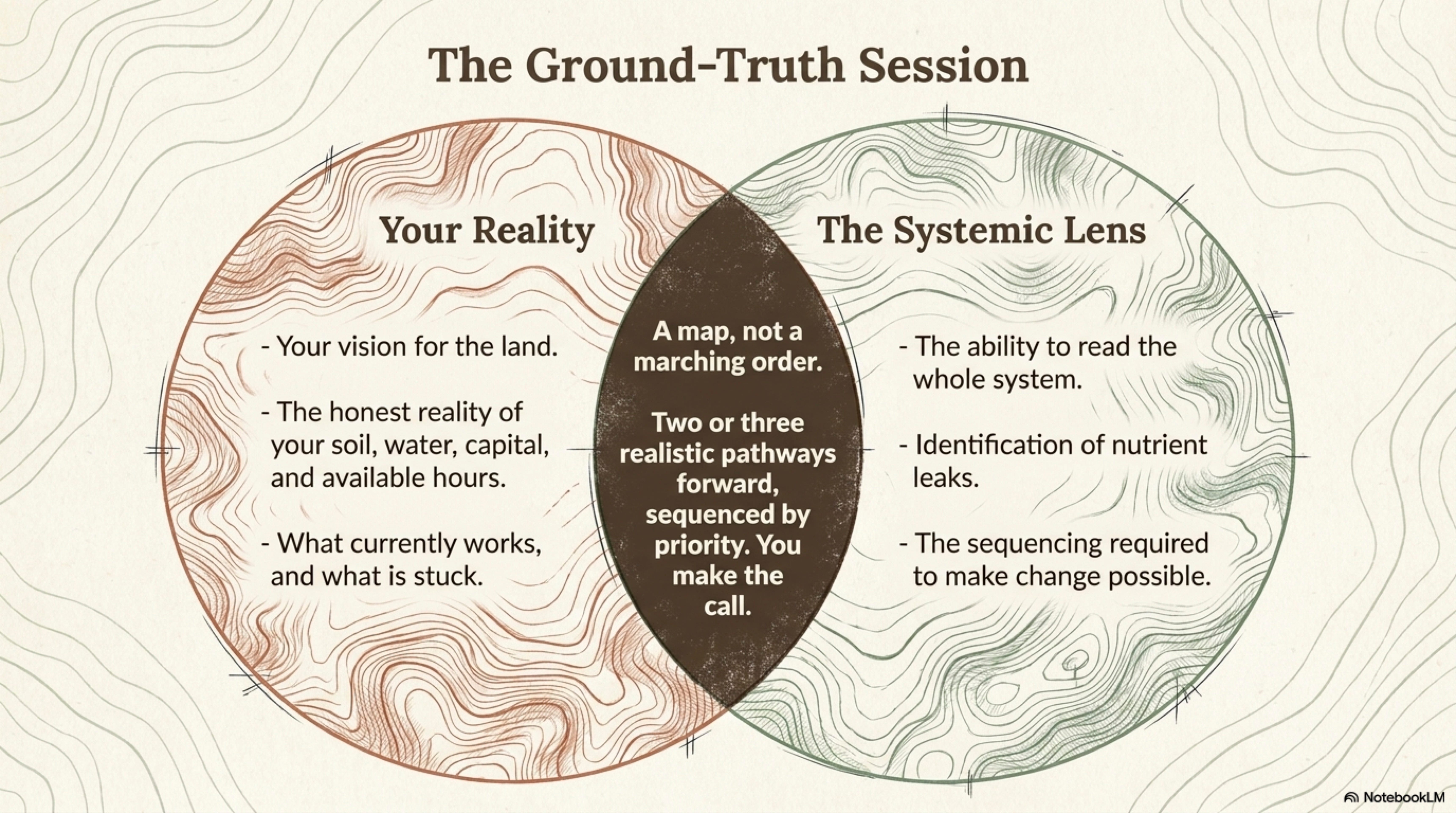
You decide which path to follow.
This is a map, not a marching order.
Ground-Truth Session — On the ground
On-site consultations across British Columbia and Washington.
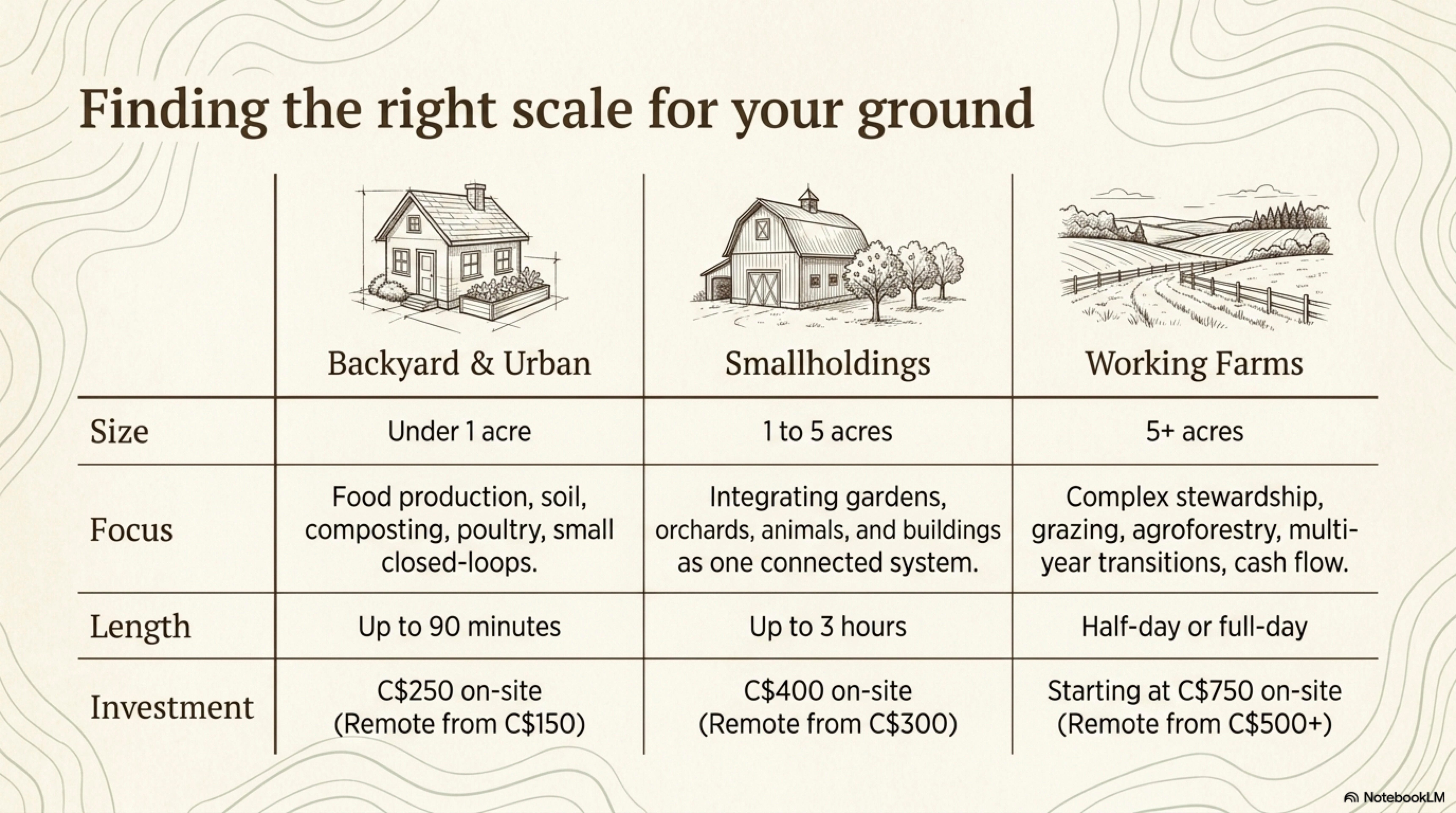
Backyard and Urban Properties
Under one acre — C$250
For gardens, homesteads and household-scale properties.
We may explore food production, perennial planting, soil improvement, composting, water, poultry, habitat, natural sprays, season extension and small closed-loop systems.
Includes a pre-session questionnaire, up to 90 minutes together and a concise written summary of priorities.
Smallholdings
One to five acres — C$400
For properties where gardens, orchards, animals, buildings and possible enterprises need to work as one connected system.
We may explore land use, water, soil, fertility, livestock integration, infrastructure, labour, diversification and how the pieces can support one another rather than compete for attention.
Includes preliminary property review, up to three hours together and a written priority summary.
Working Farms and Larger Properties
More than five acres — starting at C$750
For farms, rural properties and more complex stewardship projects.
We may explore existing and potential enterprises, cropping, grazing, agroforestry, water systems, ecological restoration, infrastructure, labour, cash flow, markets and the multi-year transition already underway, whether it has been named or not.
Complex farms, commercial operations and larger properties may require an expanded half-day or full-day assessment.
Ground-Truth Sessions — Remote
Many Ground-Truth Sessions can be completed remotely using maps, photographs, and a detailed conversation and questionnaire.
Remote pricing begins at:
C$150 for properties under one acre;
C$300 for properties from one to five acres;
C$500+ for farms and larger properties.
What you receive
You leave the session holding more than notes. You leave with:
A reading of your land you cannot get from inside it — what your ground is genuinely capable of carrying, and what is quietly working against it.
Your priorities in order — the two or three moves that deserve attention first, and the reasons they come before the rest.
Permission to stop — the good-looking ideas that do not belong on your land, named plainly, so you quit spending money, labour and hope on them. It is often the most useful thing said all day.
A written summary to keep and work from — the opportunities and constraints, the pathways we discussed, the next steps, the risks worth watching, and what can safely wait.
A clear sense of what comes next — whether you have enough to carry on alone, or whether deeper work would serve you. No push either way.
What happens next
For some stewards, the Ground-Truth Session provides enough clarity to move forward independently.
Others may benefit from a more detailed Possibility Map, Regenerative Roadmap or ongoing Stewardship Partnership.
That deeper work can include:
whole-property planning;
enterprise diversification;
closed-loop system design;
phased implementation;
preliminary financial and labour considerations;
seasonal decision support;
specialist and community connections.
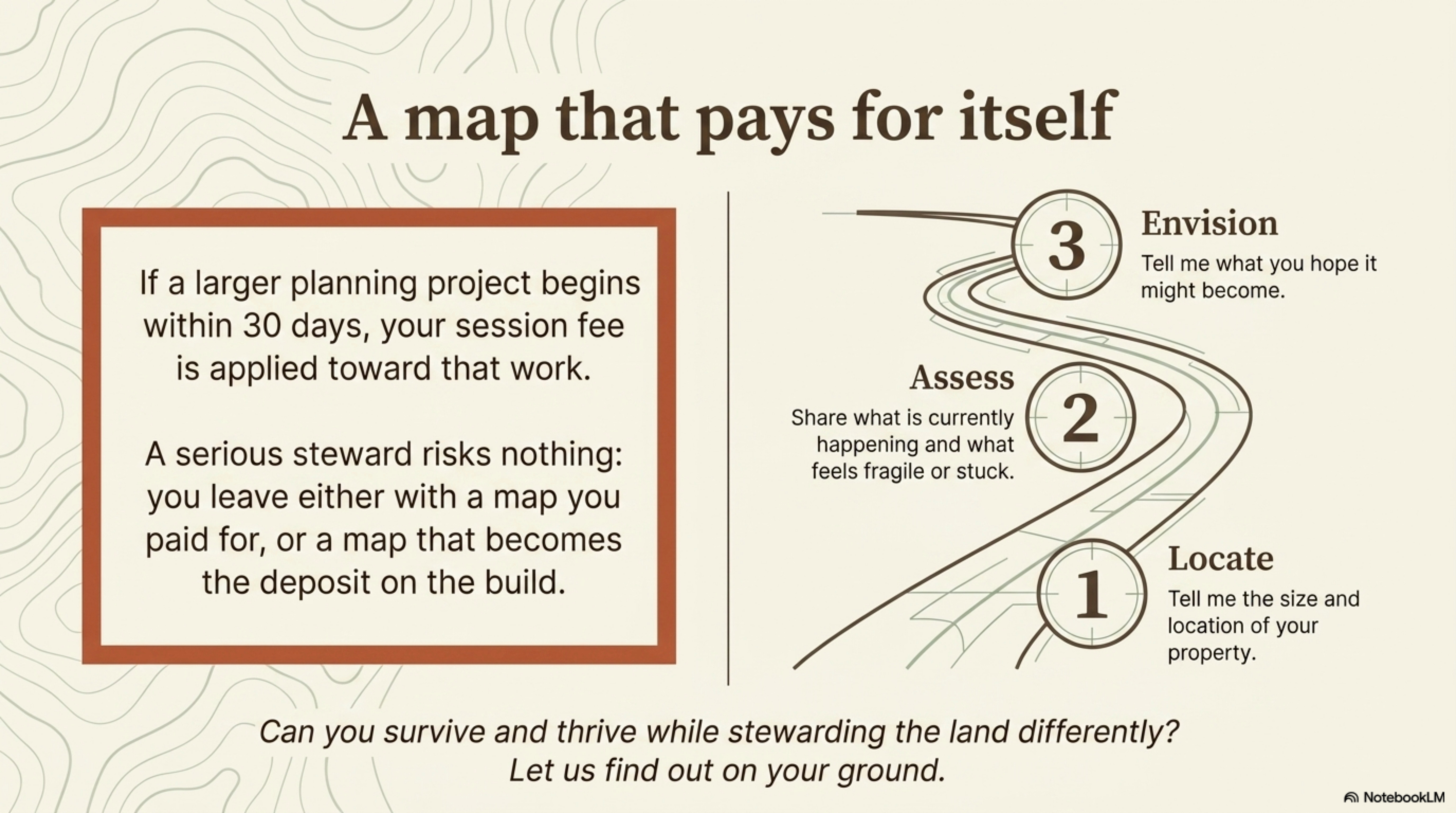
When a larger planning project begins within 30 days, your Ground-Truth Session becomes its first phase, and the session fee is applied toward that work. A serious steward risks nothing: you leave either with a map you paid for, or a map that becomes the deposit on the build.
What I will not do
I will not arrive with a formula and force your land into it.
I will not sell you a one-season cure. There is rarely one worth buying.
And I will not pretend that meaningful transition is always comfortable.
There can be a difficult stretch between reducing dependence on an old system and seeing the new biology, enterprises and relationships begin to carry their weight. That is often where good transitions are abandoned.
Helping you cross that gap — with your nerve, production and cash flow intact — is much of what you are hiring me for.
This may be for you if…
You have more ideas than you have seasons to test them, and no clear way to choose between them.
You want to diversify — but not by bolting on another full-time job you don’t have the hours for.
You are trying to make the pieces pull in the same direction — soil, water, animals, income, family — instead of competing for your attention.
You are starting something — homestead, farm, retreat, teaching project, land-based business — and want it shaped by your ground, not copied from someone else’s.
You can feel the land is capable of more, and you are ready to hear, honestly, what that future will ask of you.
And probably not yet — if you are still deciding whether to steward the land differently at all. That is a fair question, just a different one. Come back when you’ve chosen, and we’ll get to work.
How to begin
Tell me:
the approximate size and location of your property;
what is currently happening there;
what you hope it might become;
what feels stuck, fragile or unclear.
I will send a set of questions so we both arrive at the session knowing what we are looking for.
Can you survive and thrive while stewarding the land differently?
I believe so — when the transition is designed honestly from the beginning.
Let us find out on your ground.
— Jay
