

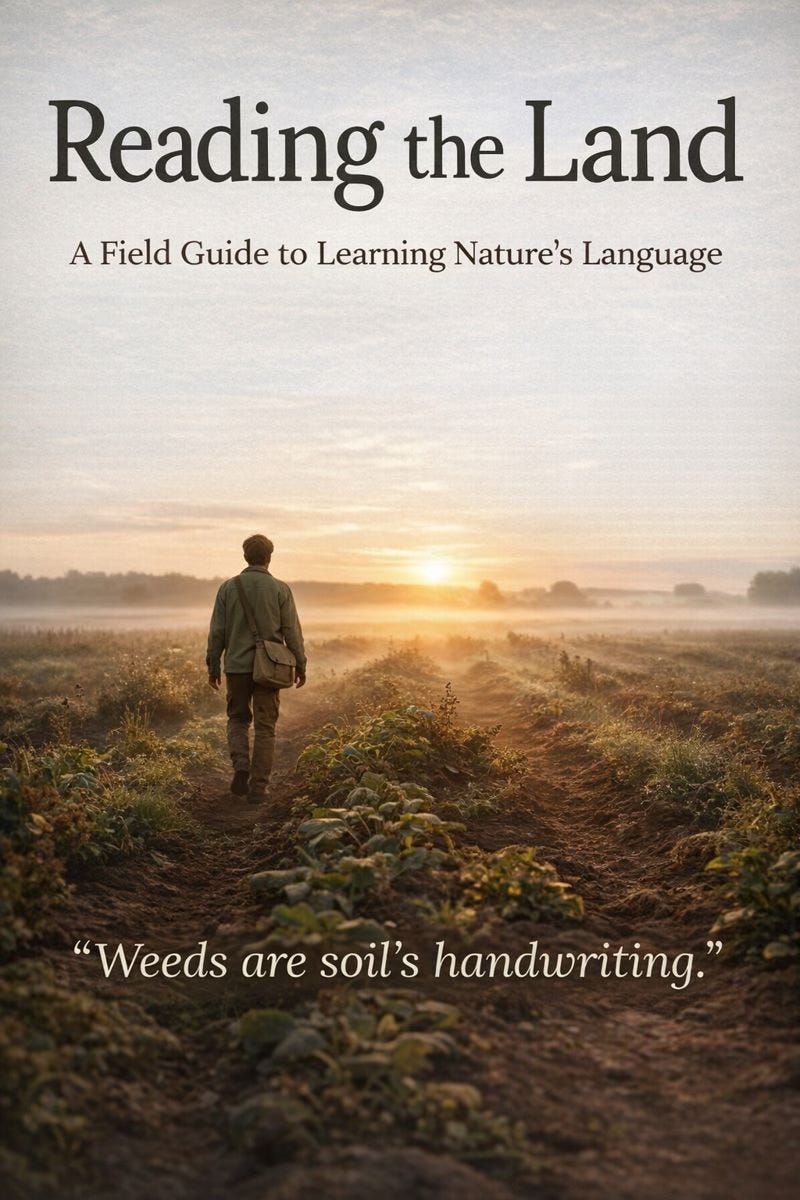
A year ago, Holistic Farming was a newsletter with thirty subscribers and a desire to understand the land I steward by bridging silos of science and story. Today, more than ten thousand of you walk this path with me, reading, responding, sharing what resonates with neighbours and fellow growers who are asking the same questions we’re all asking: How do we work with the land instead of against it?
This guide is my thank you.
Reading the Land represents months of distillation, everything I’ve learned in years of viticulture, countless conversations with stewards wiser than me, and the ongoing experiment of listening to and interpreting what the soil, plants, and insects are actually saying.
I’m not here to tell anyone how to steward their land.
My goal is to provide enough research for you to interpret and connect the dots for your yourself, consider your region, your weather, your variables. If I can provide low cost methods and ideas that balance your landscape rather than dominate or control something that will never play by synthetic rules. It’s the guide I wish someone had handed me when I first knelt down, on land I chose to steward, and realized what the weeds were trying to tell me.
For paid subscribers, this guide is my gift, as part of our ongoing exchange. You’ve already invested in this work, and if you stay interested, I will keep delivering new material and hopefully understanding.
For everyone else, the guide is available on Gumroad for $14. That’s less than a single meal, and it feeds the part of you that hungers for meaning. Also available on amazon in paperback for $18.
One more thing: on January 1st, the paid subscription price rises from $5 to $8 monthly. If you’ve been considering joining this curious circle, the deep dives, the full plant profiles, and guides like this one, now is the time. Everyone who subscribes before the new year keeps the $5 rate for as long as they stay. Consider it a grandfather clause for the early believers.
Thank you for being here. Thank you for reading. And thank you for caring enough about the land beneath your feet to learn its language.
Let’s keep listening together.
—Jay
Table of Contents
Introduction: Why I Wrote This Guide
Learning Nature’s Language
Part 1: Observing the Soil — Foundations of Life
The City Beneath Your Feet
The Soil Food Web: Who Lives Here
Reading With Your Senses
The Spade Test: A Diagnostic Ritual
The Jar Test: Know Your Texture
The Water Story: Infiltration and Drainage
The Language of Soil Structure
Learning Through Contrast
Reading Across Time
What the Soil Is Asking For
Beginning the Conversation
Part 2: Observing the Plants — Weeds and Crops as Messengers
The Land’s Written Language
A Framework for Reading Plants
Learning to See: The Plant Walk
A Field Guide to Common Indicators
Reading Your Cultivated Plants
What the Plants Are Asking For
Connecting Above and Below
Becoming Fluent
Part 3: Observing the Insects — Nature’s Tiny Signals
Reading the Pulse
A Framework for Reading Insects
Learning to See: The Bug Walk
A Field Guide to Common Indicators
What the Insects Are Asking For
Connecting the Three Stories
Signs of Balance
Becoming Attuned
Part 4: Integrating the Insights — The Land’s Whole Story
Reading in Full Sentences
The Whole Land Reading
Diagnostic Stories
When the Stories Conflict
When to Act, When to Wait
Tracking Change Over Time
The Apprentice’s Path
Your Ongoing Conversation