

A single leaf unfurling in morning light can alter the course of a life. This week, a reader's comment stirred some thoughts on how we perceive farming, how we define our relationship with the earth, and how we might have forgotten the sacred simplicity at the heart of growing. It reminded me that intention stands at the threshold of every meaningful connection we make with plants and soil. This week, I hope to inspire you to connect—I hope to help you find the doorway back to an ancient belonging.
How to Reconnect with the Earth—No Matter Where You Live
Somewhere along the way, many of us were taught that "farming" belongs only to those with land. Big tractors carving furrows across wide fields, weathered fences marking boundaries, barns standing sentinel against seasons.
But that's not the whole story. It never was.
Because farming isn't about acres. It's about intention.
It's not about the name—farming, gardening, or simply playing in the soil—it's about showing up with your whole being and connecting. It's about choosing to enter into relationship with the living world—whether you're tending a vast orchard under open sky or a single tomato plant breathing against your kitchen window. It begins not with tools or knowledge, but with care. With the simple, revolutionary act of checking in on something green and alive, day after day, until its rhythms become part of yours.
Farming, at its essence, is the act of tending to life with the intention to nourish. That miracle can happen anywhere—on a city windowsill bathed in morning light, a balcony overlooking concrete canyons, a school desk where a child's wonder takes root, or a kitchen counter where dinner and dreams grow side by side.
And it can start with just one plant.
My Journey From One Basil to Thirty
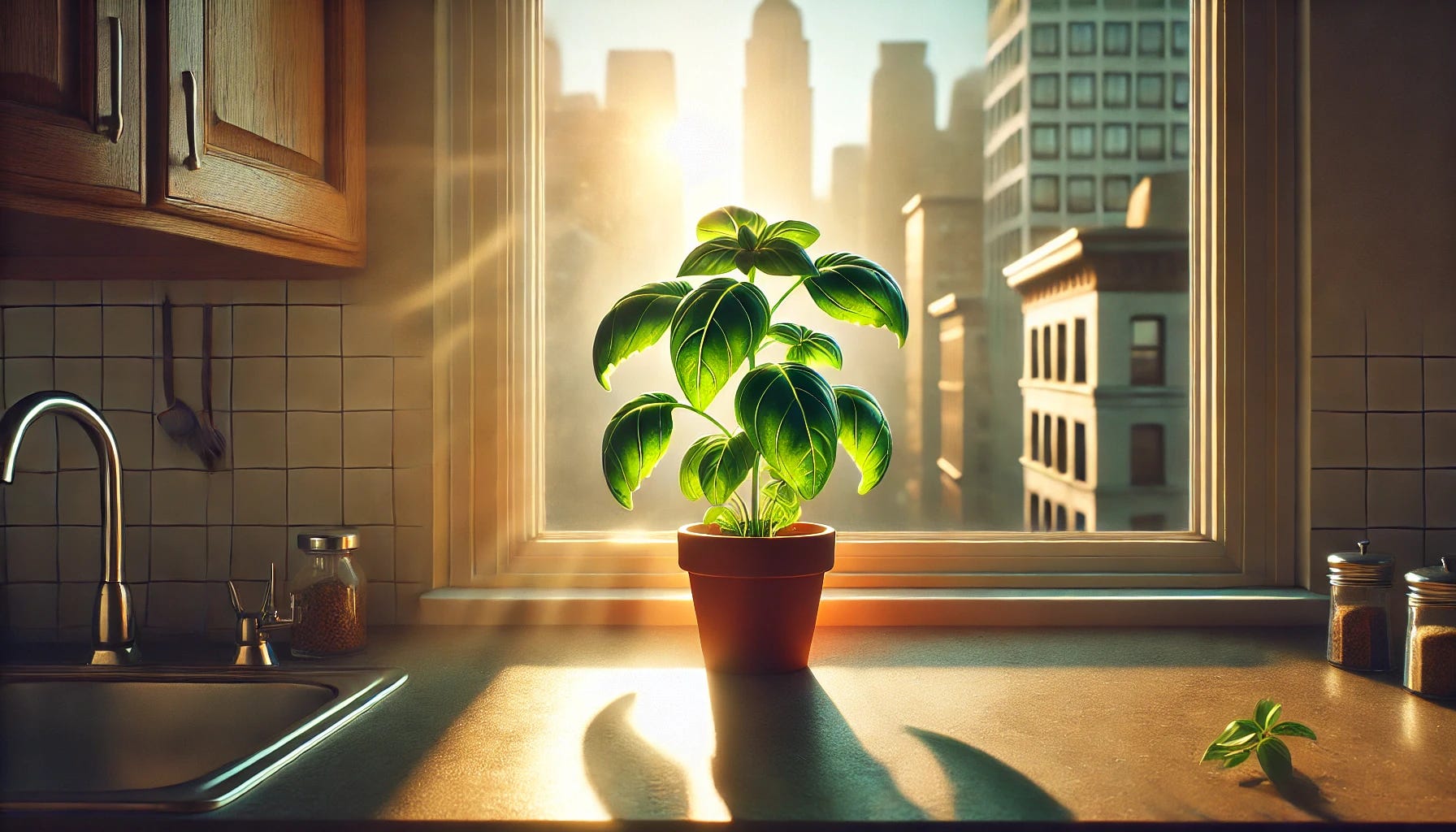
Ten years ago, I bought some basil seeds to grow Genovese basil for homemade pesto. Nothing extraordinary—just a $3 impulse purchase while wandering the aisles of a hardware store. I placed it on my kitchen windowsill, not knowing this single green being would completely transform my relationship with the living world.
That first basil plant became my daily anchor. I'd greet it in the morning while making coffee, marvel at how it turned toward the sun like a prayer, feel the distinctive texture of its leaves beneath my fingertips. When I pinched off leaves for cooking, I'd thank it—feeling slightly foolish at first, until gratitude became the most natural language between us.
One plant became two when I discovered Thai basil with its purple stems and whispers of anise. Then came cinnamon basil with its spicy warmth, lemon basil bright as sunrise, holy basil carrying centuries of reverence. Each variety revealed its own temperament, its own needs, its own particular gifts. Today, my seed collection includes over 30 types of basil from around the world—some common as rain, some so rare I spent months tracking them down like lost poems.
What started as curiosity about one plant bloomed into a passion for all herbs, especially unusual varieties that connect me to different culinary traditions and healing practices across continents and generations. I found myself eagerly awaiting seed catalogues like love letters, joining online forums to learn more, and trading with other growers whose hands I've never shaken but whose hearts I know through what they tend. The joy of discovering something like Persian basil or a nearly forgotten Italian heirloom variety feels like reuniting with a long-lost ancestor who remembers what my bones have forgotten.
And it all started with one plant.
The One Plant Movement
You don't need to grow everything. Just grow something that grows you back.
The idea pulses with simplicity: What if everyone chose just one plant to begin a relationship with?
Not because they should. Not because it's "practical." But because they're curious. Excited. Drawn in by something they cannot name but recognize.
When you connect with a plant that resonates with your particular spirit, it becomes so much more than a chore. You begin to notice. To care. To listen. The quiet conversation between your breath and its leaves slowly rewires your relationship with the natural world. You remember what your ancestors knew but never had to say—that you belong to the earth as surely as the earth belongs to you.
Finding Your Place to Grow
Before choosing your plant, take a moment to observe your space with fresh eyes. Where does light linger in your home? Is there a windowsill that catches morning sun like amber? A corner where afternoon light filters through dust motes? Even a bathroom with a skylight could become the perfect sanctuary for certain green companions.
Don't worry if you don't have "ideal" conditions. Plants, like people, are remarkably adaptable. The most important factor isn't perfect light or fancy soil—it's your attention. Your presence. The quiet moments when you pause to really see.
So... What's Your Plant?
Here's a gentle guide to help you find the plant that might be calling you right now:
The Nurturer: Drawn to comfort, warmth, and the medicine of care? Try calendula with its sun-bright healing flowers, chamomile whose blossoms hold the essence of calm, or thyme that has protected hearth and health for centuries. These plants soothe and restore—and they thrive when tended with gentle hands.
The Bold One: Want colour, life, and something you can see stretching toward possibility? Try a sunflower turning its face to follow light across the sky, zucchini with its abundant generosity, or tomato whose fruit holds summer's entire story. These plants grow with flair and presence, unafraid to take up space.
The Dreamer: Looking to deepen your connection to dreams or intuition? Try lavender whose scent bridges worlds, mugwort that has accompanied dreamers for millennia, or sage—plants long used for memory, clarity, and marking sacred boundaries between what is and what could be.
The Practical One: Need something useful and forgiving of human imperfection? Try mint that returns even after winter's deepest sleep, green onions that regrow from their own ends in a water glass, or basil that gives and gives again after every harvest—plants that grow fast and return generosity for even minimal care.
The Wild Heart: Love things a little untamed? Try dandelion whose roots break through concrete to reach soil, nettles whose sting reminds us that protection and nourishment often come together, or yarrow that heals wounds on battlefields and in gardens alike. These plants are resilient, fierce, and deeply rooted in traditional healing—they teach by example.
The Sensitive Soul: Want to care for something that mirrors your own tender nature? Try lemon balm whose bruised leaves release comfort, violets that bloom in spring's first vulnerable moments, or nasturtiums whose flowers float like bright boats on green seas.
For Those Afraid of "Plant Murder"
If you've ever whispered "I kill everything I touch" when it comes to plants, I want you to know something essential: Plants are resilient beyond our understanding. They want to live. And the occasional failure isn't a reflection of your worth as a caretaker—it's simply part of learning the language of another species.
In fact, returning plants that didn't make it to the soil through composting is part of the sacred cycle too. Every "failed" plant teaches you something if you're willing to listen with humility. The question isn't "Can I keep this alive forever?" but rather "Can I be fully present with this living being for as long as our paths cross?"
Plant It With Intention
Once you find your plant, take a moment. Don't just pot it—connect with it.
Touch the soil with bare fingers, feeling its texture, its temperature, its potential.
Say something aloud, even just a greeting or your name, letting your voice be the first human sound it knows in your care.
Promise to check in each day, not out of obligation but out of genuine curiosity about what might unfold between you.
That's how relationship begins. Not with perfection, but with presence.
You don't have to know everything. You just have to show up, again and again, with open hands and watchful eyes.
The Bigger Picture
This isn't about gardening. This is about belonging. When you care for one plant, your senses slowly reawaken. You start noticing rain not as an inconvenience but as a gift. Sunlight becomes something to track across walls. Seasons reveal themselves in subtle shifts of color and growth. The smell of soil after rain becomes a perfume no bottle could capture. You notice pollinators pausing on flowers like messengers between worlds.
You begin to remember, in your body rather than just your mind, that you are nature—not separate from it. Never were. Never could be.
Your First Step
1. Choose your one plant this week. Whether from a grocery store shelf, a seed packet, or a friend's cutting passed hand to hand like a blessing.
2. Create a simple welcome ritual when you bring it home. This could be as quiet as holding the pot between your palms for a moment of silence or as elaborate as finding the perfect spot with ceremony. Say aloud: "I look forward to getting to know you. We'll learn together."
3. Start a plant journal—even if it's just photos on your phone with dates, or quick voice notes about what you notice. Documenting small changes creates connection and trains your eye to see what might otherwise remain invisible.
4. Share your one plant with our community using #OnePlantMovement—let your journey inspire others to begin their own green relationships. In a world of headlines shouting crisis, your single pot of life speaks volumes about hope.
Join the Movement
If you've never grown anything, start with one. Just one. If you already grow many things, pause and ask yourself: Which one do I feel most deeply connected to? Which one teaches me the most about being alive?
Let's shift the story—away from farming as something "other people do somewhere else," and back into something intimate, intuitive, and possible for everyone with access to a seed and a handful of soil.
Let's spark a million tiny farms in unlikely places. Let's remember that revolutions begin with the smallest acts of tending what matters. Let's find the plant that has been waiting to find us.
#OnePlantFarming #GrowWithIntention #MyFirstPlant
What was your first plant relationship that changed something in you? Or what plant are you planning to start with? Share your story in the comments below—let's grow this community one plant, one person at a time.
🪴♥️♥️🥰🥰🥰🥰 I love it. I am starting tiny gardens in childcare centers, all along hurricane and wildfire stricken land. I believe it restores trust in the world again. I love this idea of presence and belonging. I’m going to share this with the teachers in hopes to inspire them.
You've sold me, thank you! I'd also like to suggest to those that will connect outdoors that they consider a Bee Hotel which could help w the pollination process.
Here's a link to a DIY plan to build a Bee Hotel of your own:
https://content.ces.ncsu.edu/how-to-manage-a-successful-bee-hotel/appendix-4-building-plans-for-a-simple-bee-hotel-shelter