

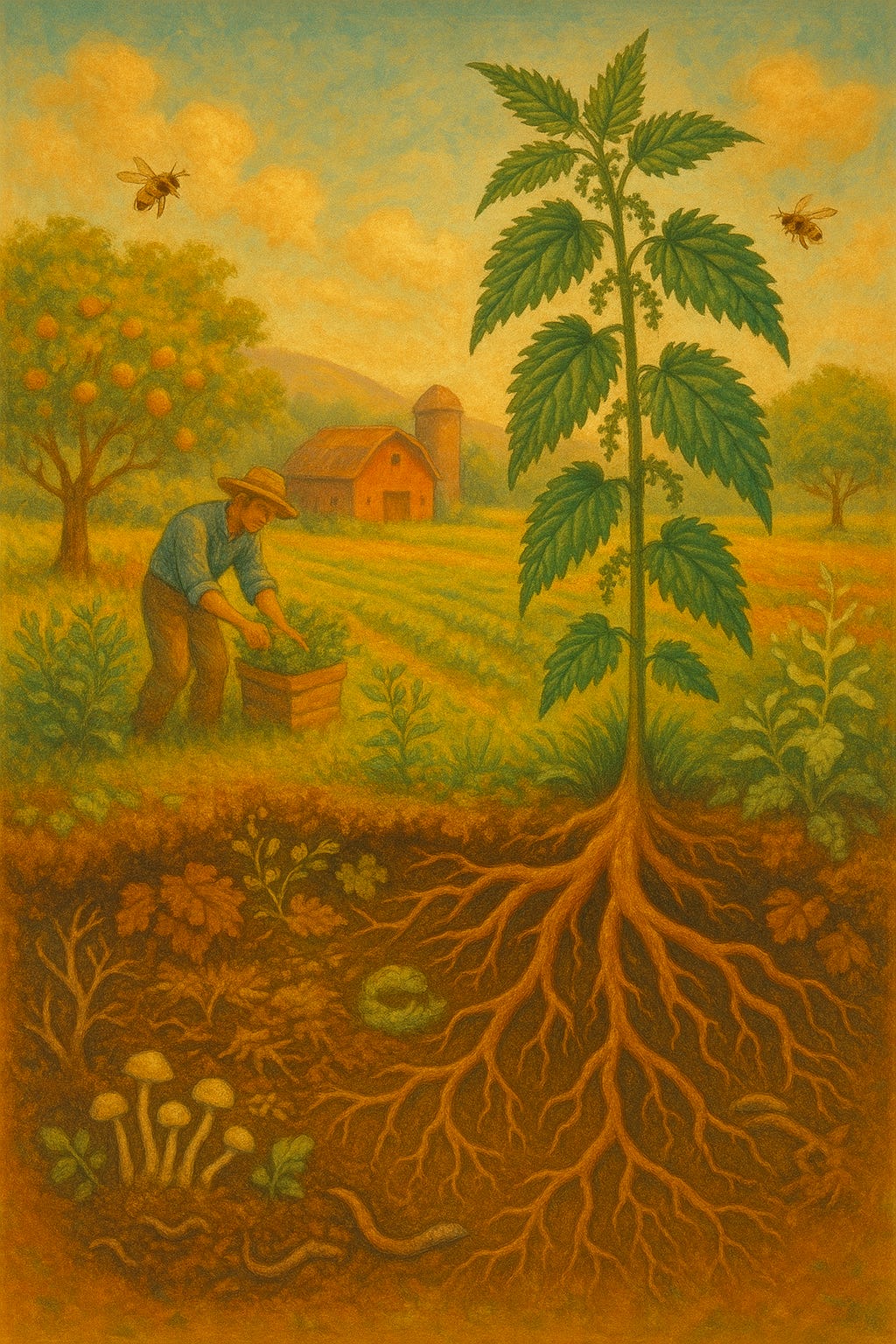
Nettle Amendment Guide — For Gardens, Orchards, and Vineyards.
TABLE OF CONTENTS
About Stinging Nettle
Benefits in Regenerative Agriculture
How to Use This Guide
Fresh-Cut Mulch
Nettle Tea
Fermented Plant Juice (FPJ)
Dried Leaf Meal
Compost Accelerator
Silica Tonic
Vegetable Family Compatibility Guide
Fresh-Cut Ring Mulch
48-Hour Nettle Tea
FPJ Foliar Applications
Silica-Rich Stem Decoction
Compost Pile Accelerator
Pest Management Hacks
Complementary Herb Guilds
Standard Programme
Enhanced Programme
24-Hour Green Tea Soil Drench
FPJ Foliar Program
Silica Stem Decoction
Compost & Bio-N Inoculation
In-Vineyard Biodiversity Strip
Effects on Wine Quality
Garden Calendar
Orchard Calendar
Vineyard Calendar
1. INTRODUCTION
1.1 About Stinging Nettle (Urtica dioica)
Stinging nettle is a perennial herbaceous plant that has existed relatively unchanged for millions of years. This botanical survivor belongs to the Urticaceae family and reaches heights of 1-2 meters at maturity. Its hallmark feature—the stinging trichomes (hair-like structures) covering its stems and leaves—contains a combination of histamine, formic acid, and other compounds that create the characteristic sting.
Far from being merely a defensive weed, nettle is a botanical powerhouse of nutrients, containing:
Nutrient Content in Dry Matter Primary Benefit
Nitrogen 3-5% Promotes leaf and stem growth
Calcium 3% Cell wall strength, disease resistance
Potassium 2.5-3% Flower formation, drought tolerance
Iron 0.1-0.2% Chlorophyll formation, energy production
Silica 1-2%. Cell wall reinforcement, pest resistance
Magnesium 0.6% Chlorophyll development, enzyme activity
Stinging nettle is a free-growing "dynamic accumulator." Its tissues contain readily available nitrogen, calcium, magnesium, iron, silica, vitamins, growth hormones, and a broad suite of micronutrients plus plant-defense elicitors. Turning that biomass back into your beds gives vegetables the same spring tonic nettle once gave people.
1.2 Benefits in Regenerative Agriculture
Nettle functions as nature's own regenerative system, offering multiple ecological benefits:
As a Soil Builder:
Dynamic Accumulation: Nettle's deep roots draw nutrients from subsoil layers, making them available in topsoil when the plant decomposes
Soil Biology Enhancement: Attracts and supports earthworms, mycorrhizal fungi, and beneficial bacteria
Humus Formation: Contributes to stable soil carbon through its balanced C:N ratio when decomposed
As a Plant Health Promoter:
Natural Growth Stimulation: Contains auxins and other plant growth regulators
Disease Resistance Activator: Silica content and bioactive compounds trigger plants' natural defense mechanisms
Nutrient Delivery System: Provides nutrients in forms readily available to crops
As an Ecosystem Supporter:
Beneficial Insect Habitat: Hosts predatory insects that control common agricultural pests
Pollinator Attractor: Provides food for butterflies and other pollinators
Biodiversity Hub: Creates microhabitats for various organisms
Beyond these ecological functions, nettle has historically served as human food, medicine, fiber for textiles, and dye material—a true multifunctional plant ally.
1.3 How to Use This Guide
This guide is structured to serve farmers and gardeners at all scales—from backyard gardens to commercial vineyards. Each section provides specific protocols tailored to different agricultural contexts:
Garden Edition: Focused on vegetable and small-scale production with simple, accessible techniques.
Orchard Edition: Tailored for fruit trees with emphasis on disease resistance and balanced growth.
Vineyard Edition: Specialized applications for viticulture with attention to wine quality parameters.
For beginners: Start with one simple preparation (the 24-hour tea is most accessible) and observe results before expanding. The guide includes "Start small" suggestions at the end of each section.
For experienced practitioners: Advanced formulations, timing considerations, and integration strategies with other biodynamic practices are included throughout.