

Salal owns the Pacific forest floor, names a month in a living language, and rides into your bouquet under a trade name that erased both, and the secret that ties it together is underground
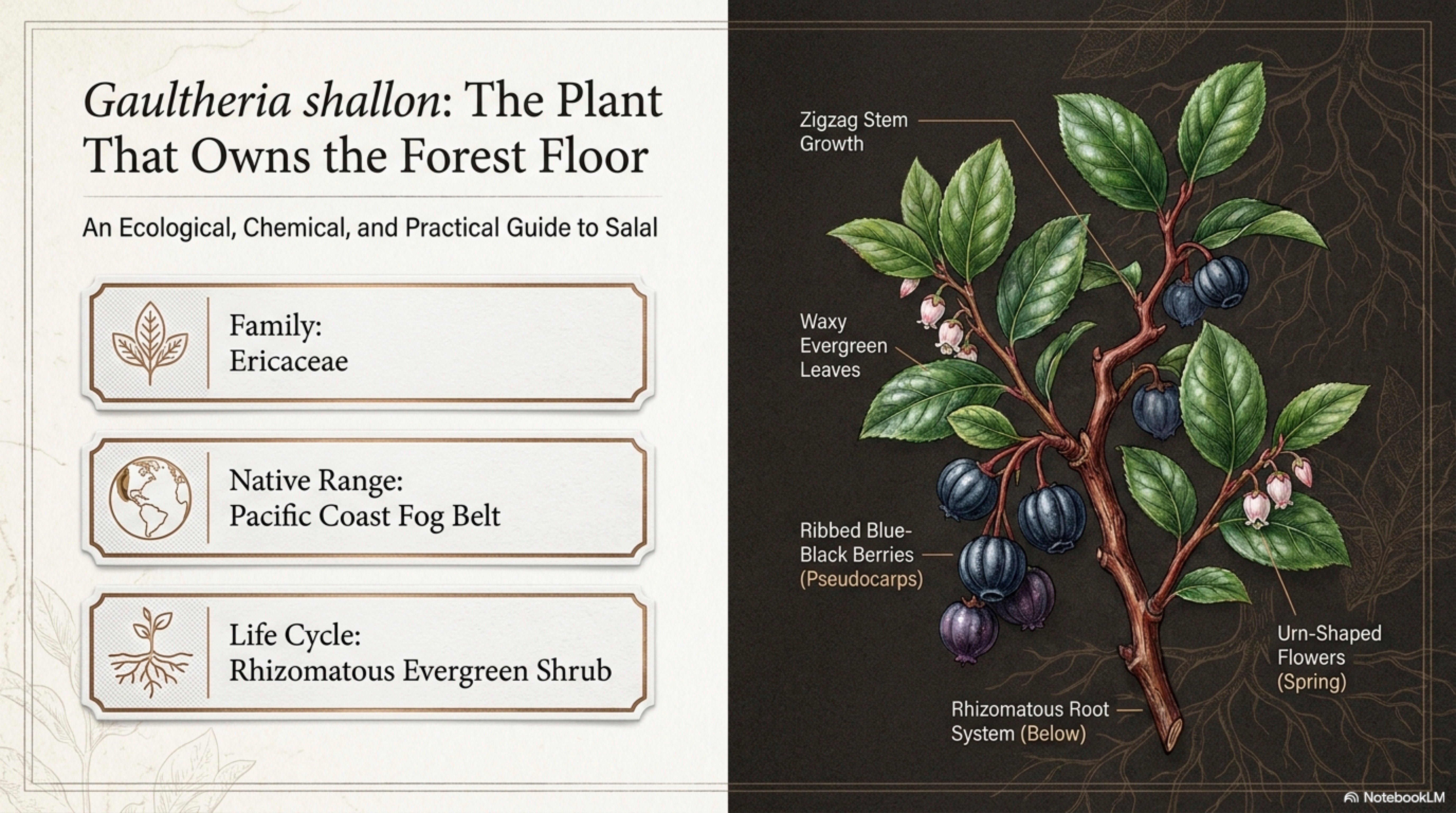
The first thing you register walking into an old-growth stand west of the Cascades is not the silence or the size of the firs. It’s the floor. A low, continuous tide of dark, leathery leaves, waist-high in places, covering everything the canopy shadow hasn’t already thinned. The stems zigzag as if undecided. The leaves hang like stiff little flags and refuse to move. This is salal, and the plain fact of the place is that it owns the ground it stands on. Reach down and pull on it, snap a leaf, thumb a berry, and depending on who you are, something different comes loose in your hand.
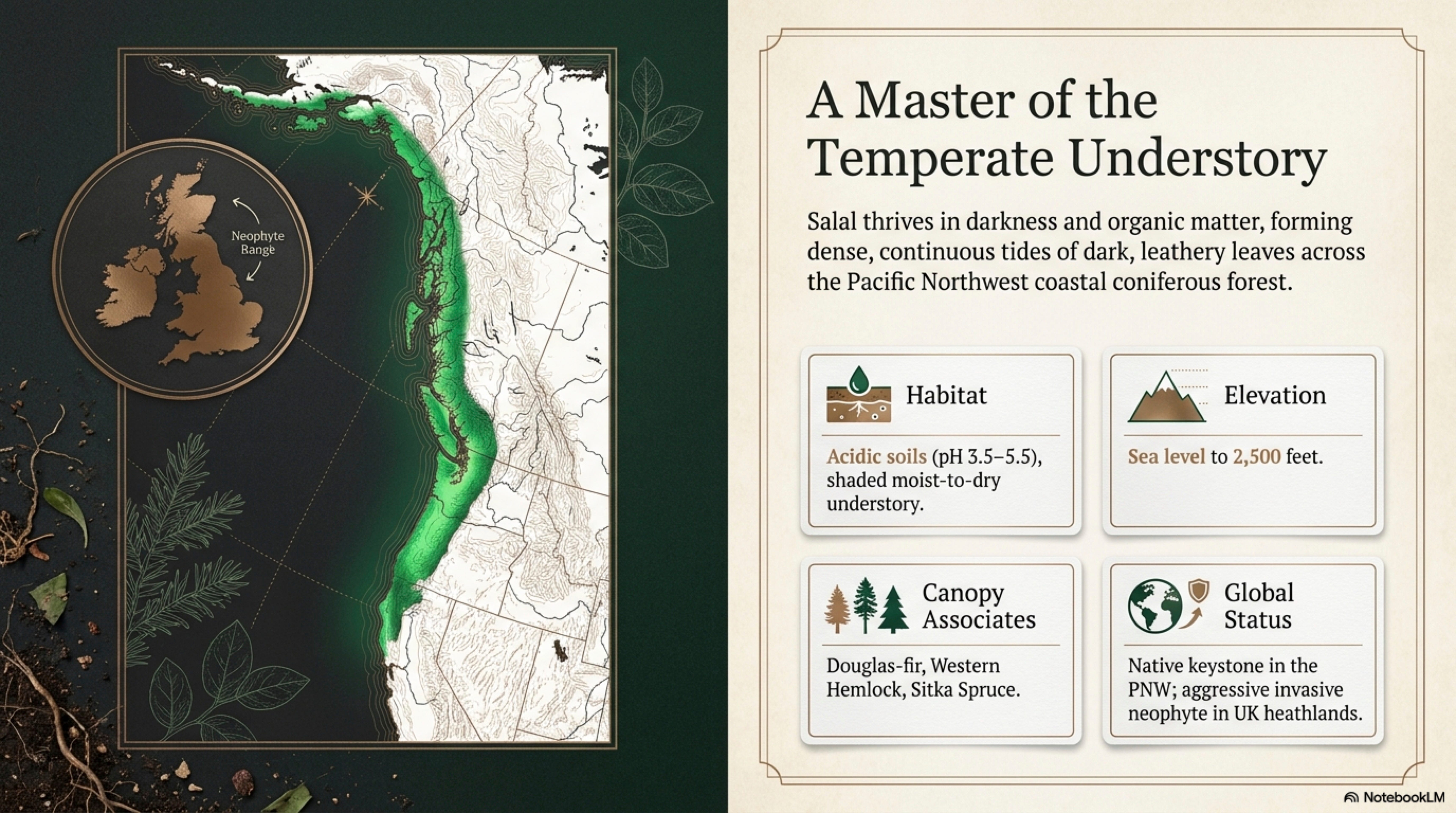
If you farm shaded, acidic Pacific Northwest ground, you’re holding erosion control that no straw wattle can match, a permanent weed-suppressing understory, and, if you have mature fir or hemlock overhead, an unleveraged crop: salal foliage anchors a $150-million international floral trade, harvested by lease straight off the forest floor.
If you garden, it’s the native evergreen backbone of a west-side food forest, groundcover, spring bumblebee forage, late-summer berries, that you will have to fence in, because it does not stop.
If you forage, it’s a dark blue-black berry, ripe August through October, mild and mealy and sweet, that Pacific Northwest peoples dried into pressed cakes the weight of a bread loaf and stored through winter.
If you teach, it’s the plant Lewis and Clark first misidentified and then marveled at, whose Latin name shallon is a Chinook word smuggled into botany, and whose leaf now ships to European florists as “Lemon Leaf”, a name with no lemon in it and no memory of any of the above.
And if you’re just curious, it’s a diagnosis: where salal runs dense, the soil is acid, nitrogen-starved, coastal-fog-fed, and recently opened up. The plant is reading the ground for you before you’ve reached for a test kit.
All five are true. And here’s the splinter worth following: for a plant everyone files under “understory”, the subordinate, the filler, the thing that grows beneath the forest that matters, salal behaves nothing like a passenger. It behaves like a landlord.
Learn it by three features and you’ll never miss it. The leaf is stiff, waxy, and finely serrate, run it backlit and you’ll see the small forward-pointing teeth along the margin. The flower is a pink-white urn, slightly sticky, hanging in a one-sided row like a string of paper lanterns. And the berry sits in a visibly ribbed, lobed cup where the swollen calyx wraps its base, a plum in a saucer. That ribbed base is the single most reliable mark the plant carries; no huckleberry has it.
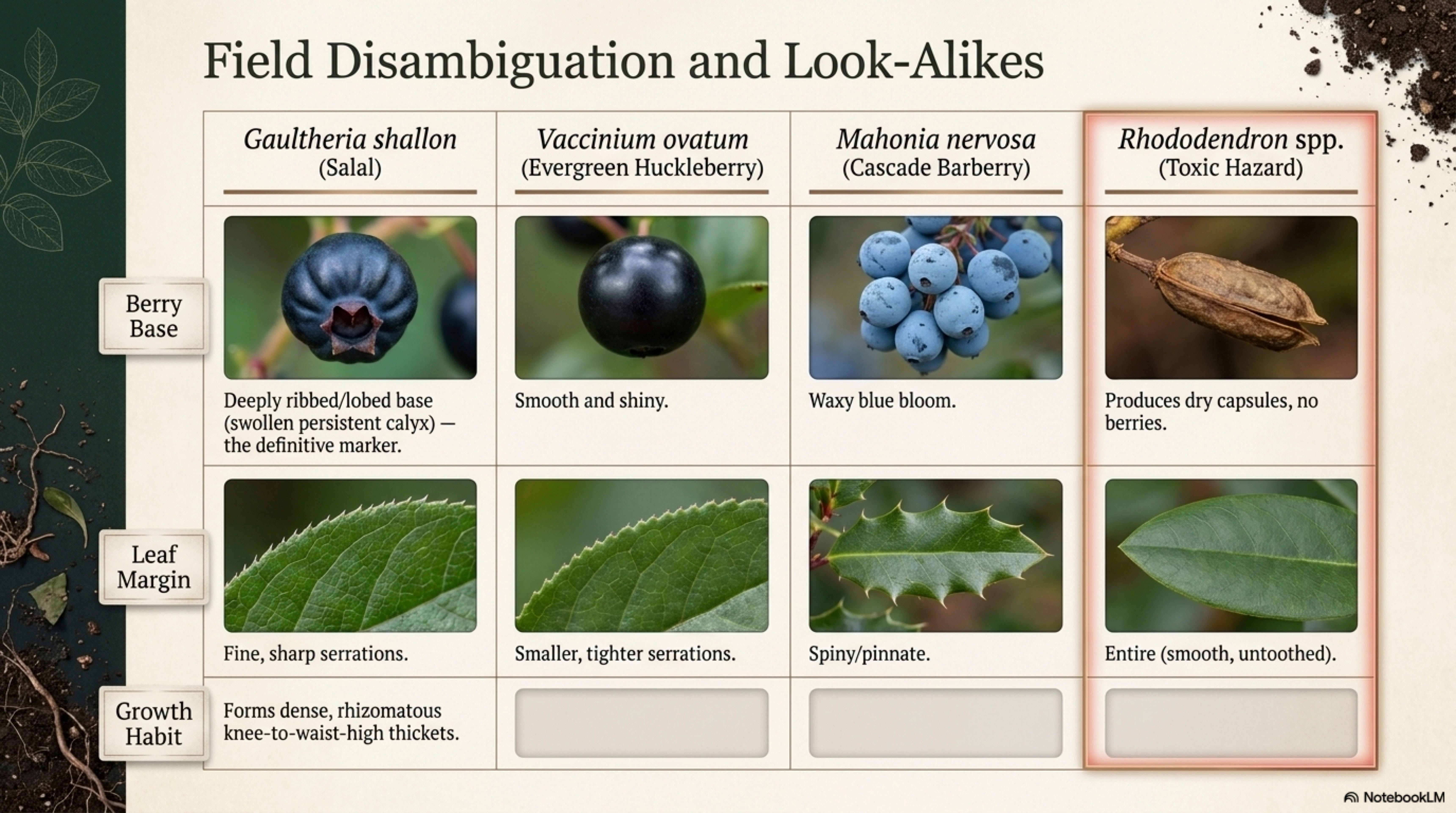
Here’s where the one real caution lives, and it isn’t in the salal. It’s in the leathery evergreen cousins that share its family and its forest. Rhododendron, azalea, and bog laurel all carry grayanotoxins, and all can read as “leathery Pacific Northwest shrub” to a hurried eye. The tells are clean: those toxic relatives have smooth (untoothed) leaf margins, open showy face-flowers instead of little urns, and dry seed capsules instead of dark berries. Serrate leaf, urn flower, ribbed-based berry, check all three and you are holding salal, not something that will hurt you. The plant’s danger, in other words, is a danger of resemblance, not of itself.
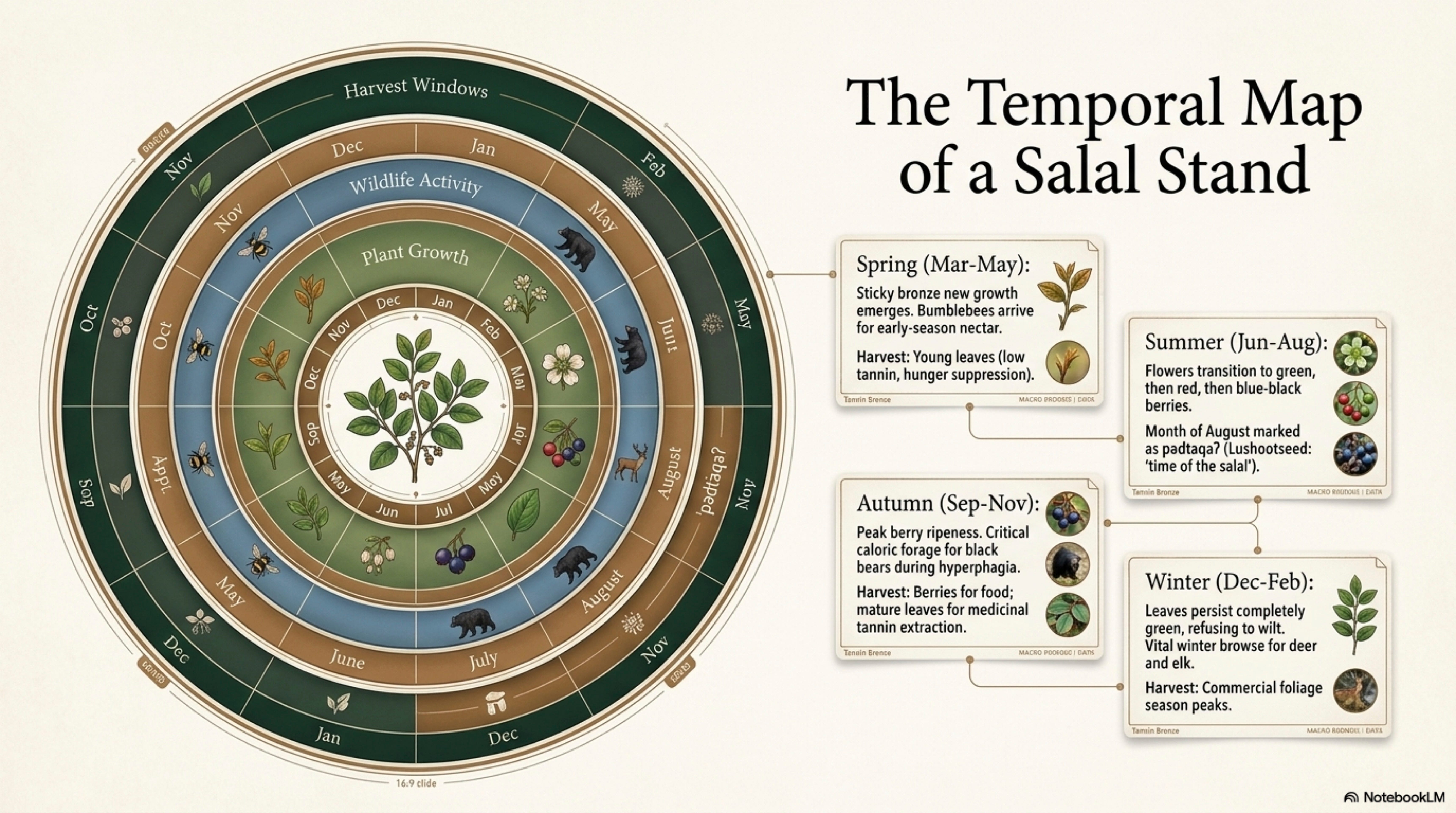
The safe, useful thing to do with salal asks for no health claim at all: eat the ripe berries. Fully blue-black, faint dusty bloom, releasing with a light downward tug, sweet, a touch mealy, with a gentle back-of-mouth pucker that tells you the tannins are at their lowest. Eat them fresh, or cook them into jam that sets almost without added pectin. And leave a share of each cluster standing, because the bears and the band-tailed pigeons are working the same fruit at the same season, and they’re the ones who carry the seed. That’s the free, honest gift of the plant. The leaf medicine, the astringent one, the one three separate nations reached for independently, travels with cautions and belongs on the other side of this.
Because the meadow’s surface keeps two things back. The first: how does a plant everyone calls understory come to own an acre of forest floor so completely that the great conifers overhead can’t seed into it, and do it not by growing tall or fast, but by some slower trick played on the dirt itself? The second: that dark, unremarkable, faintly mealy berry turns out to carry the highest tannin load ever measured in a temperate edible fruit, more antioxidant punch than blueberry, lingonberry, or cranberry, and one molecule that puts it in strange company with the cranberry-and-urinary-tract story. A plant this good at hiding in plain sight is hiding something. Both answers are real. Neither is on this side of the page.
That’s the other side.