

I couldn’t find the book I needed. So I wrote it.
What fifteen years of listening to a vineyard finally produced.
There’s a weed growing in your fence line you’ve probably sprayed, mowed over, or cursed at a hundred times. I used to do the same. Then I started asking a different question, not how do I get rid of it, but why is it here, and what does it know that I don’t?
That curiosity changed everything. And it turns out it applies just as much to a vine as it does to a weed.
I spent over a decade learning to steward a vineyard in the Okanagan in British Columbia, vinifera on a slope toward the lake, in a climate getting more extreme every season. I wanted to test a specific idea: could we farm a monoculture without synthetics? Could natural systems carry the load that chemistry had been doing?
The short answer is yes. The longer answer is what became this book.
What I found, slowly and through a lot of expensive mistakes, is that the vine is not the crop. The ecosystem is. The soil biology, the vineyard floor, the insects, the water, the canopy architecture, these aren’t separate management problems. They’re one continuous, interdependent reality, and the vine experiences them that way even when we don’t. Every intervention ripples outward. Get the floor right and the canopy becomes easier to manage. Neglect water timing and no foliar program can compensate. Treat a symptom without understanding the system producing it and the symptom comes back, reliably, season after season.
Most of the growers I’ve watched burn out weren’t failing at farming. They were chasing symptoms in a degraded system, a spray for this pest, a fertilizer for that deficiency, never getting off the treadmill because nobody helped them see that the treadmill itself was the problem.
That’s what I kept wanting a book to say. Clearly. Practically. In plain language that would actually help someone make a decision in the field on a Tuesday morning when the weather turns and the spray window just closed.
I looked for that book for years. I borrowed pieces of it from soil microbiology texts, canopy management guides, plant-based preparation manuals, ethnobotany libraries, biodynamic almanacs. Each was excellent in its own lane. None of them talked to each other. And the vineyard, of course, doesn’t care about our disciplinary boundaries. It just keeps growing, or failing, as a whole.
Here’s where the personal part comes in.
We sold the winery. The farm is still waiting to sell, longer than expected in this chaos of an economy. Which left me in a particular kind of limbo: a farmer with decreasing ties to land to farm, a lot of accumulated knowledge, and for the first time in years, actual time to think.
Don’t die with your music still in you. — Wayne Dyer
I’ve always held onto that line. And after spending a good portion of my life in that vineyard, much of it alone, walking rows, watching, correlating, slowly understanding, I realized I had accumulated something that needed to go somewhere. A way of seeing. A long catalogue of thoughts, hypotheses, hard-won hunches, and a deep desire to finally articulate what makes a vine genuinely healthy and a farm truly resilient.
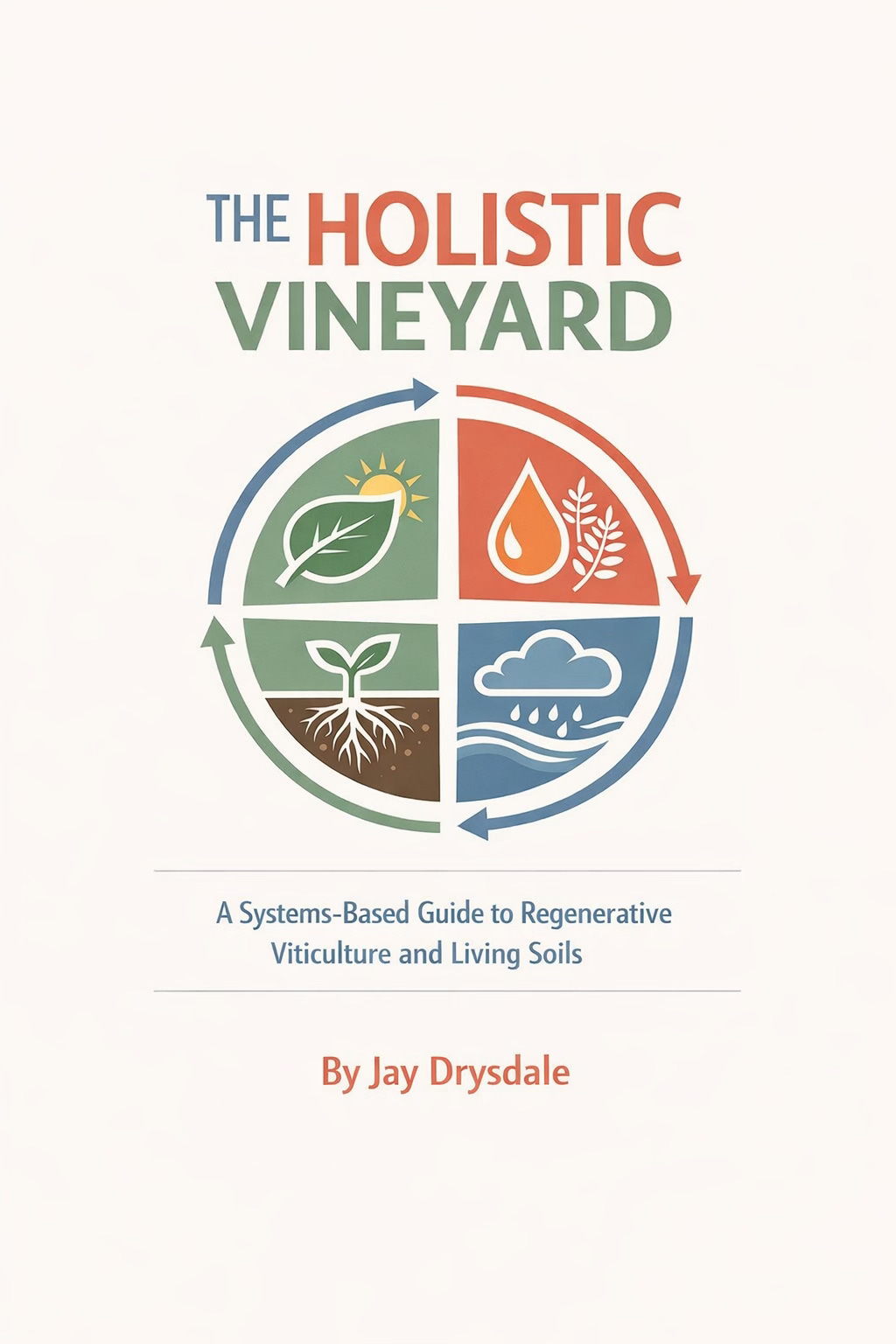
What emerged is The Holistic Vineyard.
The Holistic Vineyard
A Systems-Based Guide to Regenerative Viticulture and Living Soils
A field manual for farming vinifera without synthetics, in closer harmony with nature. Not a rulebook. Not a dogma. A starting point, and deliberately so, because no two pieces of land are the same, and the most honest thing anyone can offer a farmer is options, not prescriptions.
This book is meant to be a starting point, not a rule, and definitely not a dogma.
Options for growers who don’t want to go down a synthetic route. Options for farming in closer harmony with Mother Nature. Frameworks for thinking, not schedules to follow blindly.
I wrote it for the farmer tired of chasing symptoms — a spray for this pest, a fertilizer for that deficiency — who never gets off the treadmill because the underlying system is degraded and nobody has helped them see it. I wrote it for the grower curious about regenerative practice who can’t afford to use their livelihood as the experiment. I wrote it for the person standing in their rows at sunrise, knowing something is off, but not yet having the language for it.
And I wrote it because regenerative agriculture is at an inflection point. Before the concept gets greenwashed into corporate playbooks, I wanted to plant a flag for the real thing. Systems thinking. Soil biology first. The long game.
The vineyard is a patient teacher. It doesn’t hurry its lessons and it doesn’t soften them. What follows in this book is what many years of that teaching produced. Your land will teach you something different. But maybe this shortens the learning curve.
I hope it finds the people who need it.
WHAT’S INSIDE
PART I Foundational Principles of a Holistic Vineyard
Before any spray schedule or pruning decision, you need a different way of reading your vineyard. Four frameworks that change what you look for and why, not philosophy, but diagnostic thinking that reshapes daily decisions from the ground up.
PART II The Four Pillars of Holistic Vineyard Care
This is the actual work. The four pillars aren’t separate programs, they interact. Get the vineyard floor right and canopy management becomes easier. Neglect water timing and no foliar program can compensate. One integrated system, managed that way.
PART III Seasonal Cycle of Care
The four pillars applied through the real growing season. Eight phenological stages, each with specific timing for cover crop management, canopy work, spray applications, and irrigation. This is where principle becomes practice, week by week, from the first pruning cut to the last day of dormancy.
PART IV Monitoring & Feedback as a Decision System
Observation without a system is just anxiety with a clipboard. What to measure, which tools actually earn their place, and how to turn field observations into clear, confident decisions, without drowning in data or second-guessing yourself through the weeks when everything is happening at once.
PART V Livestock Integration & Ecosystem Enhancements
Beyond the vine rows. Done right, livestock and habitat structure reduce your workload, closing nutrient loops, suppressing pests biologically, building the kind of ecological complexity that lets a farm regulate itself. Done carelessly, they create problems as costly as the ones they were meant to solve. This section shows you the difference, clearly.
PART VI Synthesis — The Living System
Putting it all together, and being honest about what transition actually costs and how long it takes. Real timelines, the problems the earlier chapters can’t prevent, and the pragmatic toolkit for navigating them without losing your nerve or your crop.
APPENDICES Quick Reference Resources
The working documents you’ll return to season after season: complete recipes, application variants for real conditions, and the research trail behind every recommendation so you can go deeper wherever your curiosity leads.
GET THE BOOK
Available now in paperback.
→ Order on Amazon (paperback)
→ Digital download (Gumroad)
WORK WITH ME
The book is where the knowledge lives. But sometimes what you really need is someone to walk your rows with you.
If you’re curious about integrating livestock, or want to think through what a more closed-loop system might look like on your land, or simply want a fresh set of eyes to see whether farming greener is even realistic for your situation, I’m available to consult. No agenda, no sales pitch. Just honest assessment from someone who has made most of the mistakes already so you don’t have to.
Nice