

Follow the Root
You have been fighting the wrong half of this plant
Happy Canada Day. It seemed only right to give the day to the one plant that carries the country’s name on every noxious-weed list in North America, and was never, not for a single generation, actually Canadian.
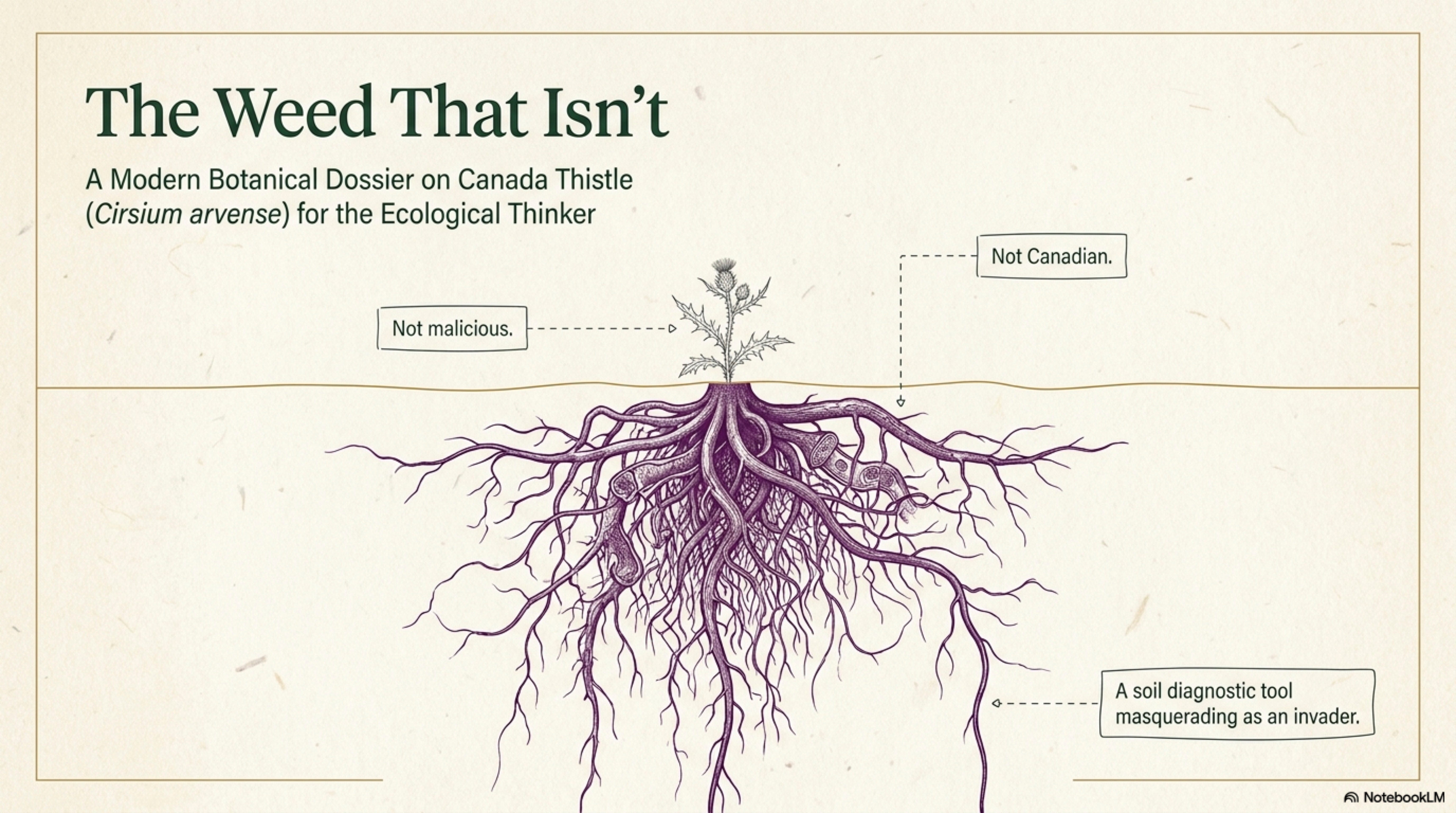
You meet this one through the glove that wasn’t thick enough. That’s how most people are introduced, a purple-headed colony in the tired corner of a field, a careless grab, a row of small stings up the wrist. And then you do the obvious thing. You cut it, or pull it, or run the tiller through it. And next season there are ten where there was one, and you decide the plant is malicious.
It isn’t. It’s just that the spines are the loud thing, and the loud thing is never the diagnostic one. The thing that actually runs this plant is underground, and it is the single fact every other fact about Canada thistle hangs from, because it changes what every one of you is looking at.
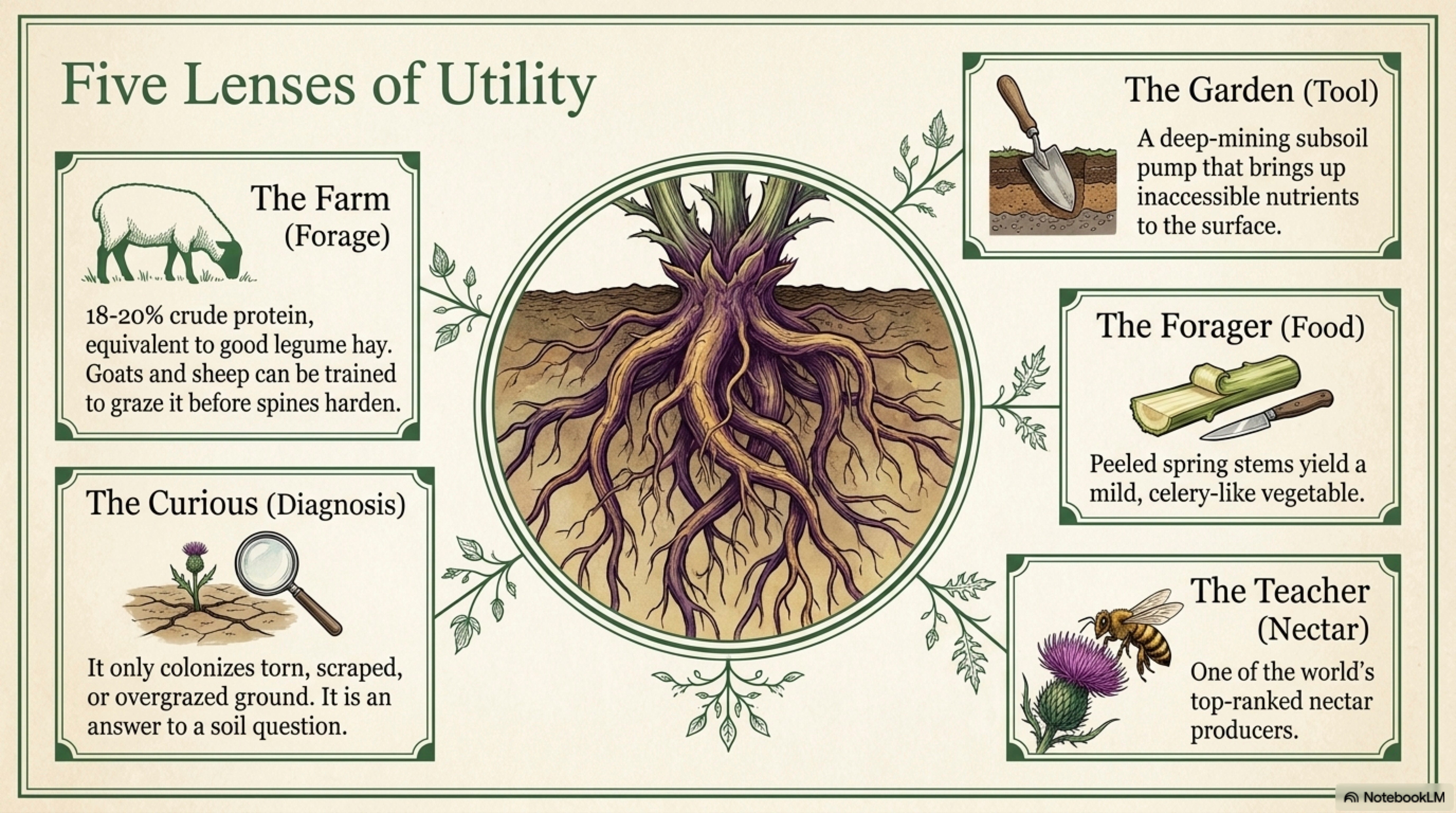
If you farm it, you’re looking at forage you’ve been treating as an enemy. At the young rosette stage, before the spines harden, Cirsium arvense runs around eighteen to twenty percent crude protein and eighty-odd percent total digestible nutrients, comparable to good legume hay, and cattle, sheep, and especially goats can be trained to graze it. The barrier was never nutrition. It was the spines, and the timing.
If you garden it, you’re looking at a tool you didn’t buy. The root drives several meters down through compacted subsoil, mining water and minerals no shallow crop can reach; cut the tops before they bud and drop them, and you hand that deep-mined fertility back to the surface. But cut it at the wrong moment and you get the ten-where-there-was-one trick, this gift comes with a clock attached.
If you forage it, you’re looking at a quiet vegetable. Peel the spiny rind off a young pre-flower stem and the core is mild, green, faintly sweet, celery-ish. It’s respectable enough company that a Scottish distillery folds it into gin as one of its botanicals. Modest, but real.
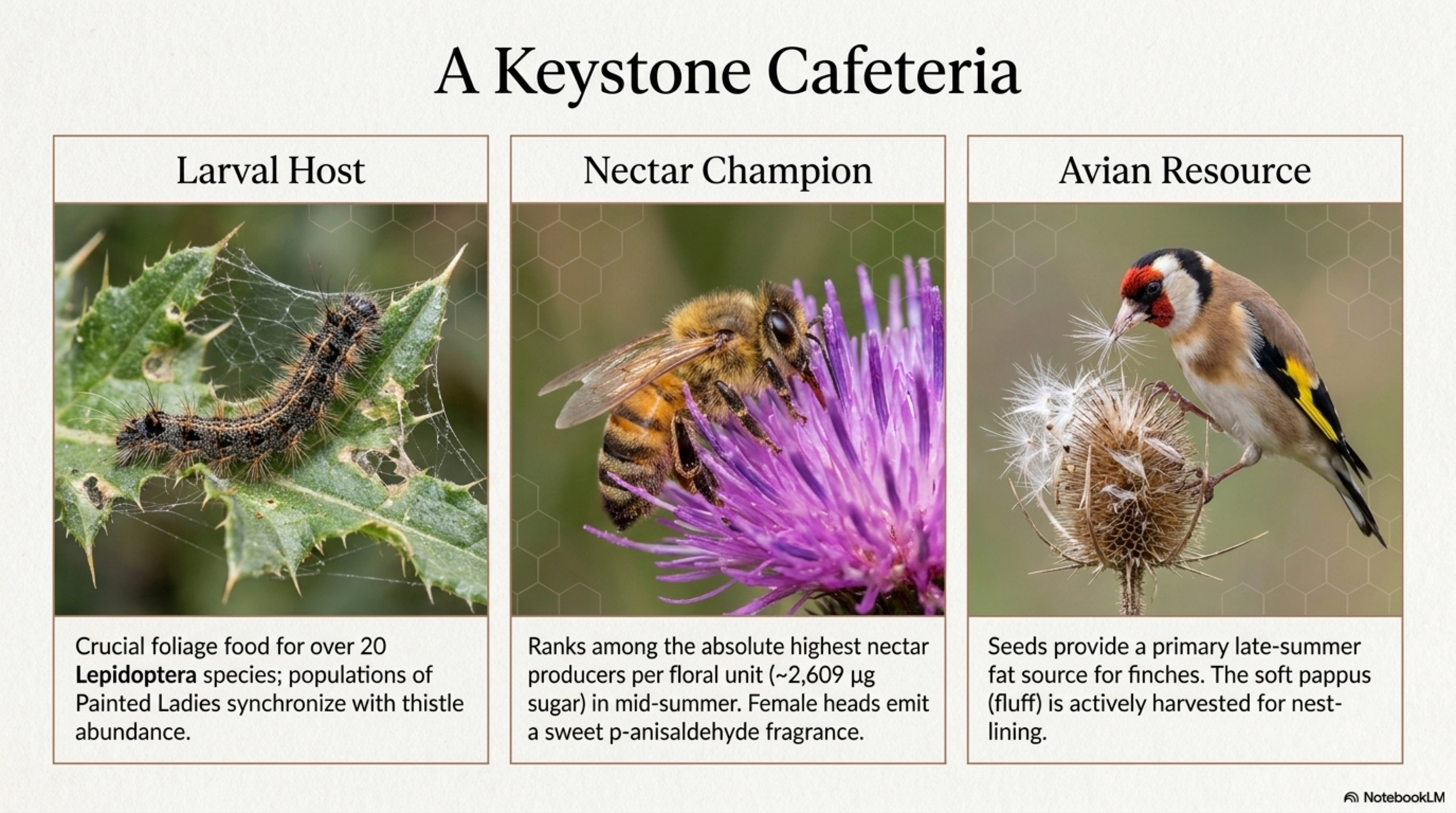
If you teach with it, you’re looking at a contradiction standing in a field. This is one of the most legislated agricultural weeds on earth, and simultaneously one of the top-ranked nectar producers ever measured, a mid-summer fountain that feeds honeybees, native bees, hoverflies, and butterflies, whose seed-down lines goldfinch nests. The same plant, cursed and thanked in the same breath, both judgments true.
And if you’re just curious, you’re looking at a diagnosis. Canada thistle does not colonize healthy ground. It shows up where the land has been torn open, plowed, scraped, burned, overgrazed, and a dense patch is less a verdict on the plant than a question about the soil. What the patch is answering is the thing worth the whole walk. But that answer’s on the other side.
All five are true at once. And here’s the splinter worth following: every one of them, the forage, the tool, the food, the nectar, the curse, comes from the same buried organism, and the prickly thing you’ve been fighting above ground isn’t it.
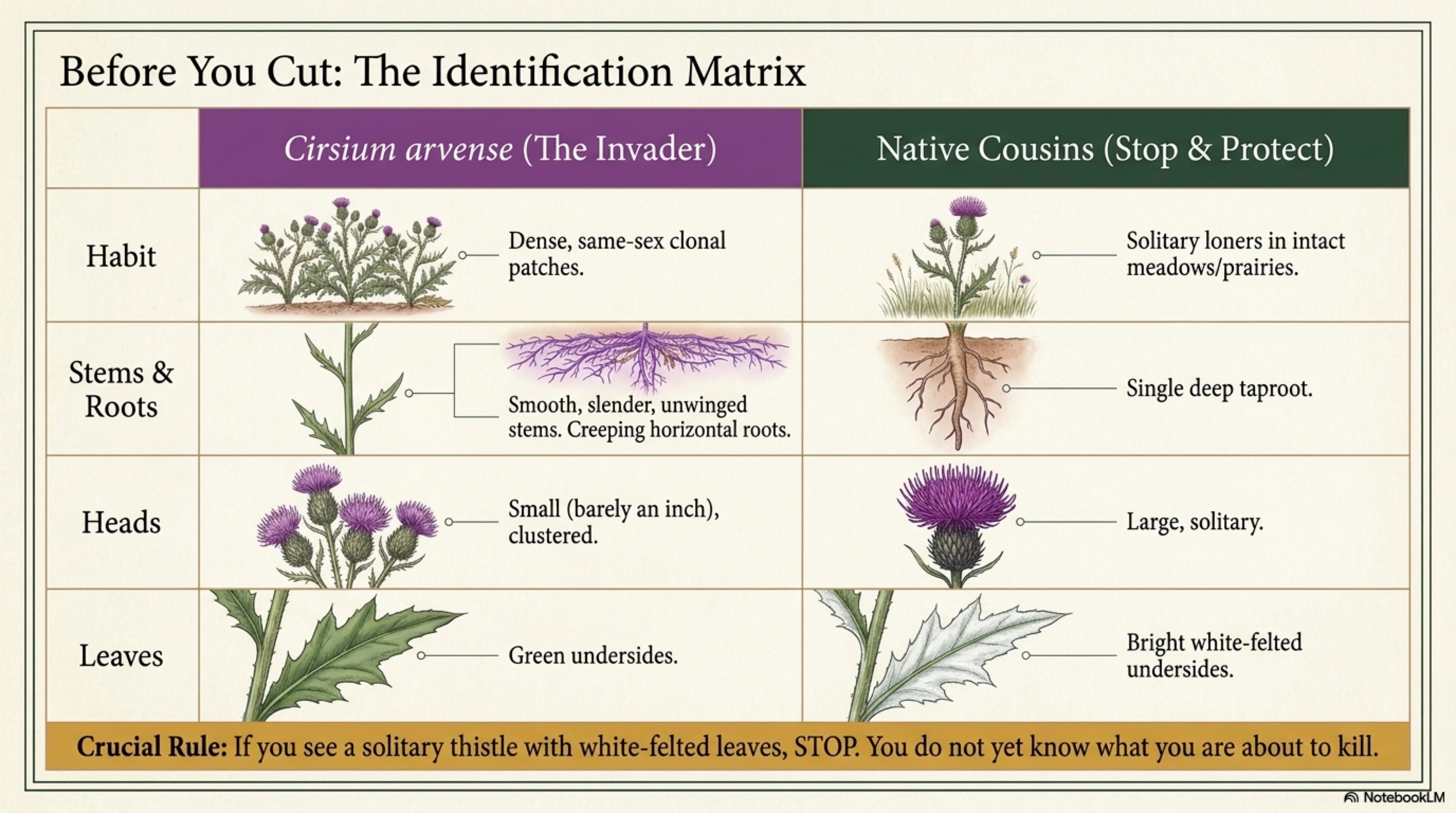
So learn the body first. It’s a creeping perennial, knee- to chest-high, with deeply lobed, wavy, spine-edged leaves and, unlike most of its cousins, slender stems that skip the spiny wings and branch near the top into clusters of small flower heads, each barely an inch across. The heads are all tubular florets, no petals, wrapped in spineless bracts, pink-purple, and on a warm day a stand throws a sweet, almost vanilla scent. The oddity worth knowing: it’s dioecious, male and female flowers grow on separate plants, so only the females carry the famous silver down. And it rarely travels as a lone spike. It runs in dense clonal patches, one plant doing a convincing impression of a crowd.
Something I noticed, and it points the opposite way from where you’d expect. The danger with this plant isn’t that something toxic looks like it. It’s that it looks like its harmless relatives, and several native thistles, some of them regionally rare or federally protected, get sprayed and yanked every year by people certain they’re killing the invader. Canada thistle gives itself away by habit: smooth unwinged stems, small heads in clusters, dense same-sex patches, creeping roots, and leaf undersides that are green rather than felted bright white. Its native cousins tend to be loners with white-felted leaf backs and a single deep taproot. If two or more of those tells don’t match, a solitary thistle in intact meadow, prairie, or dune, you stop. You don’t yet know what you’re about to kill.
Now put its body to work, claim-free. The simplest honest use is the one the curious door already started: let it read your soil, then cut it before it seeds and drop the tops as mulch, or ferment them into a plant feed, either way you catch the minerals it pulled from deep and return them to the topsoil, and the deep root that dies behind it leaves a channel for water and the next plant’s roots to follow. The peeled spring stem is food, with three conditions: wear gloves, take it before it flowers while it still snaps crisp, and never harvest from sprayed roadsides or runoff ground, a plant this good at hoarding nitrate is only ever as clean as where it stands.
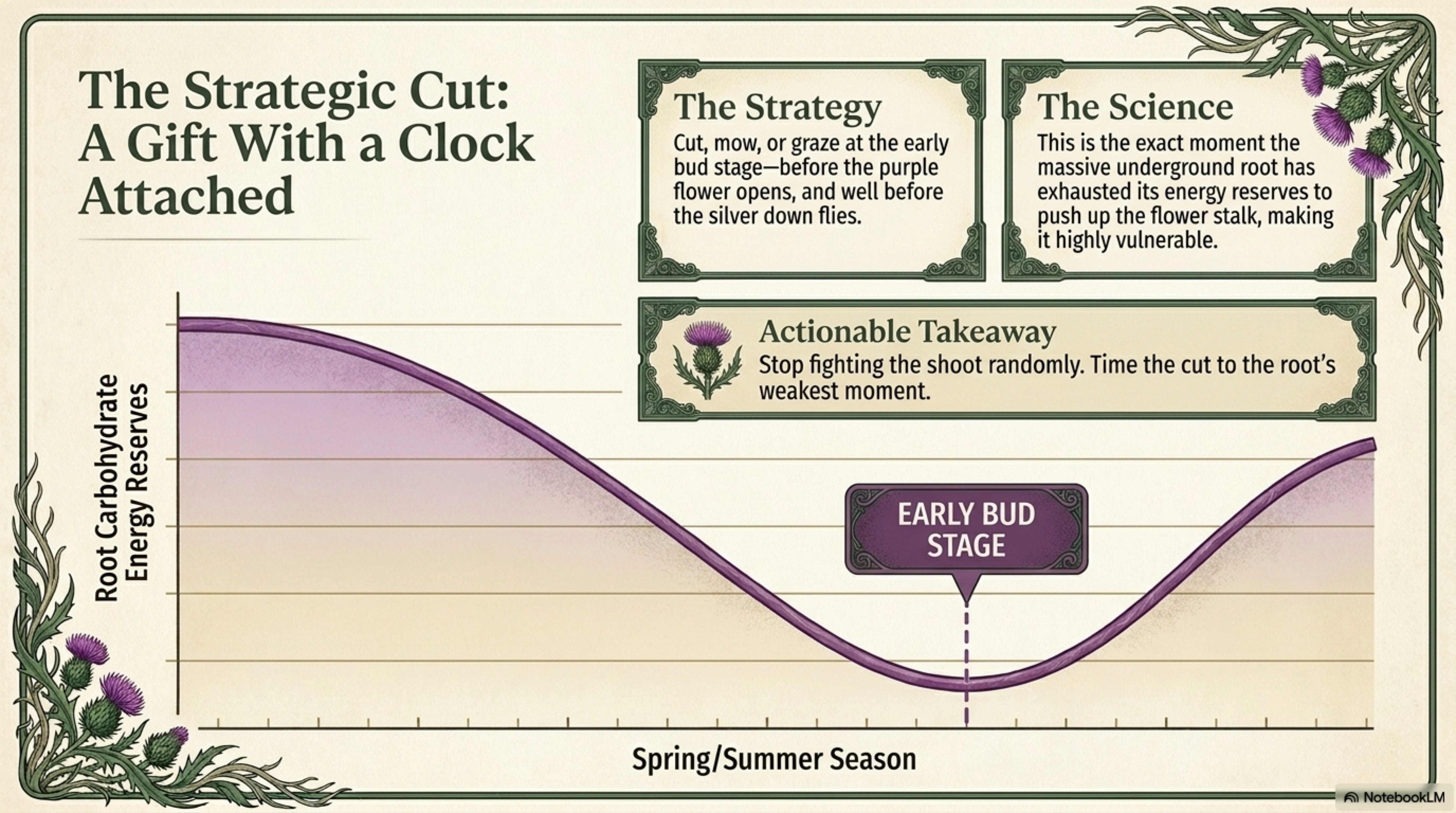
And if you do one timed thing: cut, mow, or graze at early bud, before the purple opens, well before the down flies. A single female can throw thousands of seeds, and buried deep they can wait two decades or more for their opening. Skip the rototiller, though: chopped root fragments resprout, a piece the size of a grain of rice is enough, so tillage without follow-through doesn’t kill the plant, it sows it. Know when to leave it standing, too: holding a raw slope after a burn, or feeding bees and finches through high summer, it’s earning its keep. Then cut before seed.
This is the best part, this is a foreign weed, cursed in statute since Vermont passed one of North America’s first weed laws against it in 1795, an accident that arrived in contaminated grain and got blamed on Canada though it came from Europe.
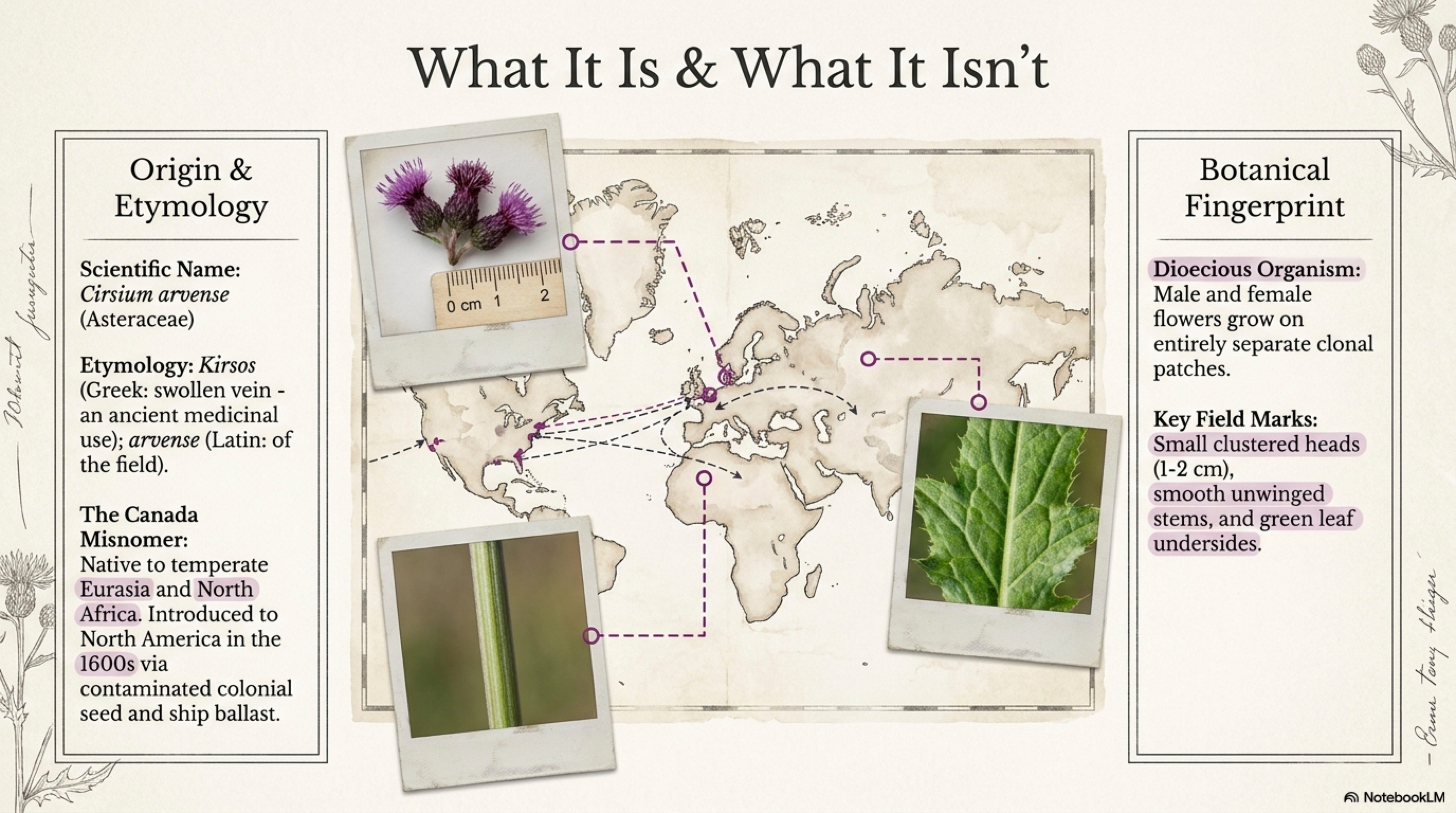
And yet the people who met it kept reaching for it, independently, for the same thing. A first-century Greek physician named its whole genus after a swollen vein and used thistles for varicose blood. Chinese medicine, on the far side of Eurasia, built a close relative into a front-line remedy to “cool the blood and stop bleeding.” European and Himalayan folk healers reached for it as an astringent, a styptic, a stauncher of flow. Three traditions that never compared notes, circling one use: bleeding.
The same plant that reads the wounds in your soil, three separate civilizations decided could read the wounds in a body, and stop them. That’s either a very long coincidence or a signal the chemistry should be able to confirm. So which is it? Did they all catch something real, and does the lab back them? Or did each of them just grab the nearest prickly green and call it medicine? There’s a clean answer to that, and an honest catch hiding inside it.
That’s the other side.