

Table of Contents
Phase I, The Plant in Its World
Plant Identity Snapshot
Names, Language, and Lineage
Identification and Look-Alikes
Botanical Character and Life Cycle
Ecological Intelligence
Animal Interactions and Ethology
Climate Resilience and Adaptation
Phenology and Working Calendar
History, Folklore, and Cultural Memory
Traditional Ecological Knowledge and Stewardship
Phase II, The Plant in Human and Animal Hands
Food, Medicine, and Human Use Traditions
Chemistry, Nutrition, and Functional Compounds
Safety and Responsible Use
Regenerative Agriculture and Land Applications
Homestead and Material Uses
Harvest, Processing, and Preservation
Economics and Practical Value
Legal, Regulatory, and Access Notes
Phase III, The Honest Edges
Research Frontiers and Open Questions
Speculative, Symbolic, and Relational Layer
Sources, Confidence, and Citation Architecture
This monograph is offered as a small return. The plant gave the bumblebees their summer; gave the moose their browse; gave the Yup’ik grandmother her spring greens and the Russian peasant her evening cup; gave the bombed-out city its magenta covenant in the year of fire; gave the Yukon its emblem and the boreal its second-summer answer to every burn. The work of writing here does not add to any of it. We offer the document back to the land and to the people whose traditions this plant has tended for longer than every alphabet we have written it in. May the offering be received gently, and may the next person to walk through a fireweed patch in late July leave the plant better-stewarded than they found it. The teacher is the plant. The writing is one more cup of tea, set down at the doorway, in case the teacher comes by.
1. Plant Identity Snapshot
Three years after a black spruce burn in interior Alaska, the ground stops looking dead. Pink shoots push through ash that still smells faintly of resin, then thicken, then send up four-foot stems whose terminal racemes carry magenta torches a hundred at a time. The land remembers it has work to do, and fireweed is how the remembering looks. By the time the first stems open at the base, bumblebees are already there, and the air over a thousand acres smells like nectar and char.
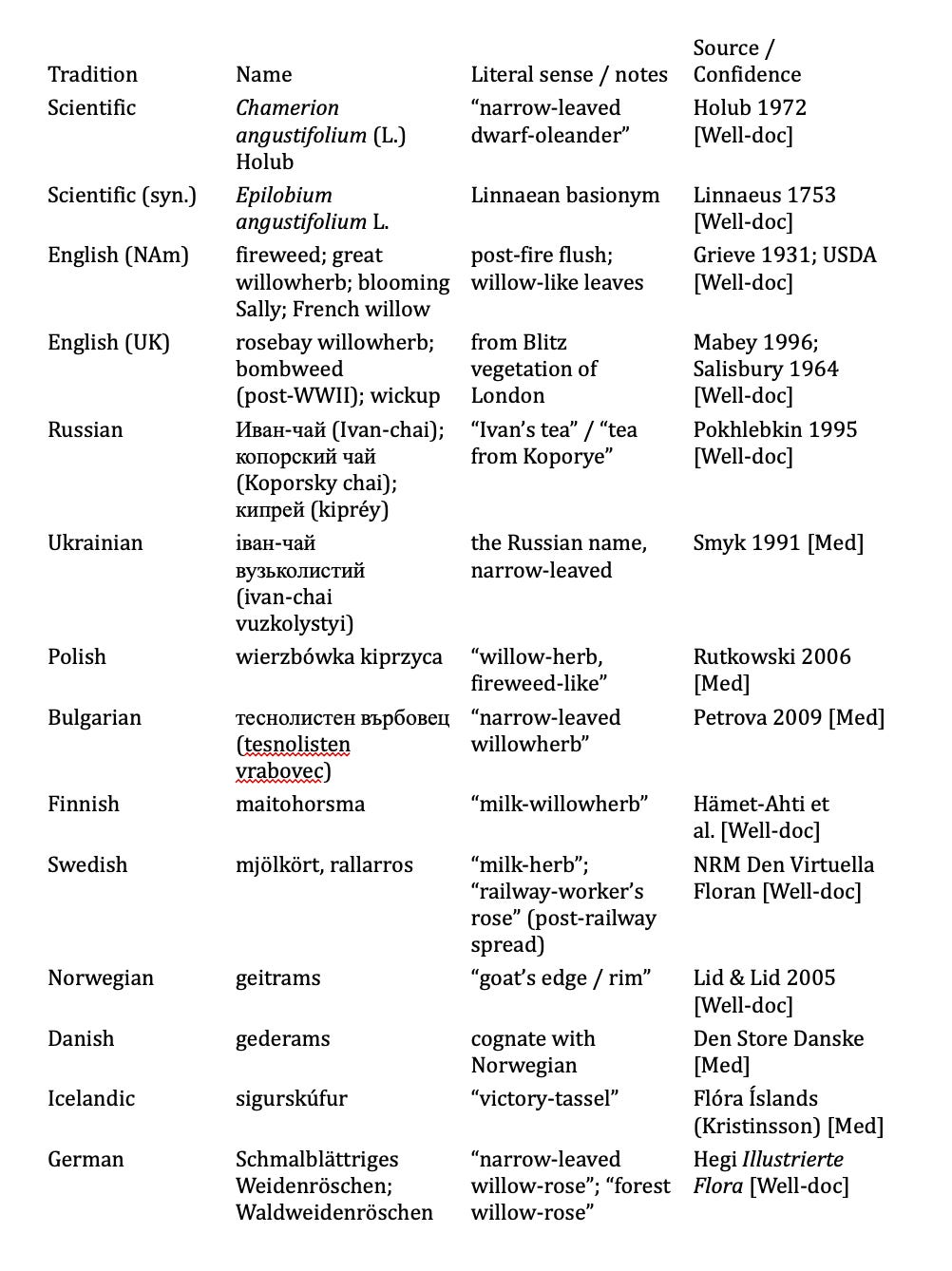
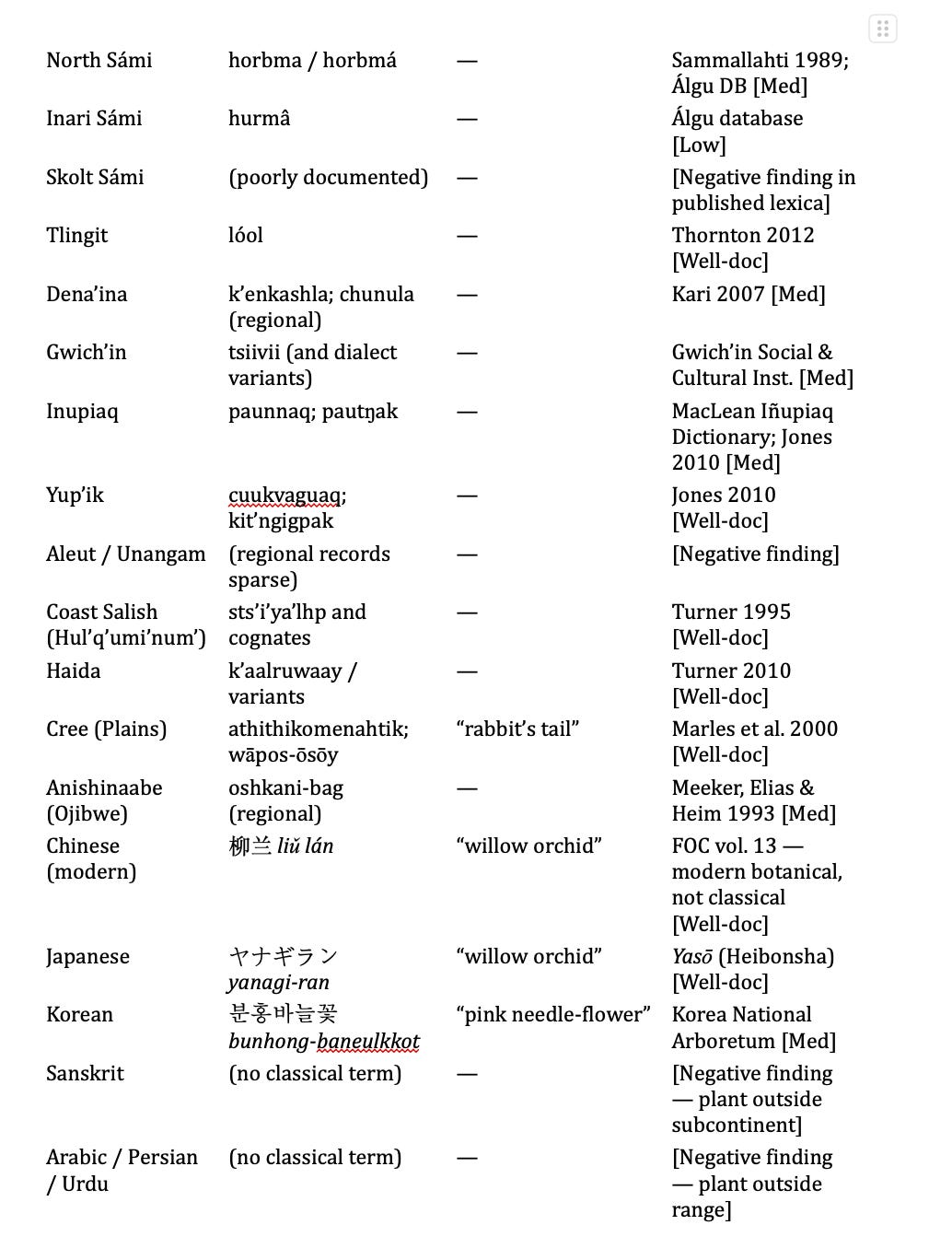
Common names. Fireweed; great willowherb; rosebay willowherb (UK); blooming Sally; bombweed (post-Blitz UK); French willow; wickup; in Russia Иван-чай (Ivan-chai), копорский чай (Koporsky chai), кипрей (kipréy); maitohorsma (Finnish); mjölkört, rallarros (Swedish); geitrams (Norwegian); 柳兰 liǔ lán (modern Chinese, “willow orchid”); ヤナギラン yanagi-ran (Japanese); paunnaq / pautŋak (Inupiaq); cuukvaguaq (Yup’ik); k’aalruwaay (Haida); athithikomenahtik (Plains Cree). Many more, see Section 2.2 [Pokhlebkin 1995; Mabey 1996; Moerman 1998; Turner 2010; Kari 1987; Jones 2010; FOC vol. 13].
Latin binomial and authority. Chamerion angustifolium (L.) Holub, Folia Geobotanica et Phytotaxonomica 7: 85 (1972), currently accepted by POWO / Kew, Flora of North America, ITIS, and most molecular phylogenetic work. Basionym Epilobium angustifolium L. (Species Plantarum 1: 347, 1753), still standard in pre-2000 North American literature and as the legacy synonym at USDA PLANTS (symbol EPAN2). The European spelling Chamaenerion angustifolium (L.) Scop. (Fl. Carniol., ed. 2, 1: 271, 1771) remains in use by Stace, BSBI, and Myerscough’s Biological Flora entry [Holub 1972; POWO 2025; USDA PLANTS 2025; Stace 2019; Myerscough 1980]. All three names refer to the same plant. The monograph uses Chamerion angustifolium throughout, noting the alternative whenever a source uses it. [Well-documented]
Family. Onagraceae, the evening-primrose family. Sister genera include Epilobium (the smaller willowherbs), Oenothera (evening primroses), Circaea (enchanter’s nightshade), and Ludwigia (water-primrose). The family is held together by 4-merous flowers borne on an inferior ovary so long it looks like part of the stalk, comose seeds in slender capsules, and a rich vein of macrocyclic ellagitannin chemistry, oenothein B and its relatives, found across the genera [Wagner et al. 2007; Ducrey et al. 1997]. The molecular work that broke the old broad Epilobium into Chamerion + Chamaenerion + Epilobium turned on spiral (not opposite) leaf phyllotaxis, slightly zygomorphic (not actinomorphic) corollas, and an unappendaged seed coma [Holub 1972; Wagner et al. 2007].
Native range. Circumboreal. POWO lists native presence across most of temperate and boreal Europe (including Iceland and Svalbard), most of temperate and boreal Asia eastward to Kamchatka and northern Japan, Greenland, Alaska, all Canadian provinces and territories, and most of the western and northern conterminous United States south to the high-elevation Southern Rockies and the Sierra Nevada [POWO 2025; USDA PLANTS 2025; FNA vol. 10]. [Well-documented]
Introduced range and current regional status. Scattered southern-hemisphere introductions in New Zealand, Tasmania, and parts of mainland Australian alpine zones, naturalized at low densities; not declared under NSW, Victoria, or Tasmania biosecurity registers as of this writing [Stage 1.5 verification, May 2026; NSW WeedWise 2025]. Important disambiguation: the plant Australians call “fireweed” and treat as a Weed of National Significance is Senecio madagascariensis Poir. (Asteraceae), an unrelated South African daisy with pyrrolizidine-alkaloid livestock toxicity. The two species share an English name and nothing else. Do not import CSIRO / NSW DPI “fireweed” material into the Chamerion angustifolium register without checking [Sindel et al. 2022; CSIRO 2025; NSW WeedWise 2025; Stage 1.5]. In its native range, C. angustifolium is occasionally a regenerating-clearcut weed in commercial forestry but carries no significant invasive-species reputation [Broderick 1990; CABI 2024]. In the Yukon Territory it is the official floral emblem, adopted 27 March 1957, statutory home now the Floral Emblem Act RSY 2002 c. 92 [Government of Yukon; Stage 1.5].
One-sentence thesis. A circumpolar pioneer of disturbance, fire, eruption, bombsite, clearcut, that converts catastrophe into nectar, biomass, and a fermented tea older than the Russian export trade that made its leaves famous.
Relationship thesis. Fireweed teaches what land does after it has been broken. The wind brings seed. The rhizome remembers. The ash gives potash and the rains give light and the plant gives back nectar to bumblebees, browse to moose, biomass to soil, and beauty to anyone walking through. It is the green covenant a burn signs with the future, that nothing is so destroyed it cannot be rebuilt, and that the rebuilding starts with whatever colonist can run the fastest with the lightest seed. A steward learns from fireweed not how to prevent the burn but how to be the answer to it.
If the names of a plant remember what it does, what is fireweed remembering for us, and what are we forgetting that the names still carry?
2. Names, Language, and Lineage
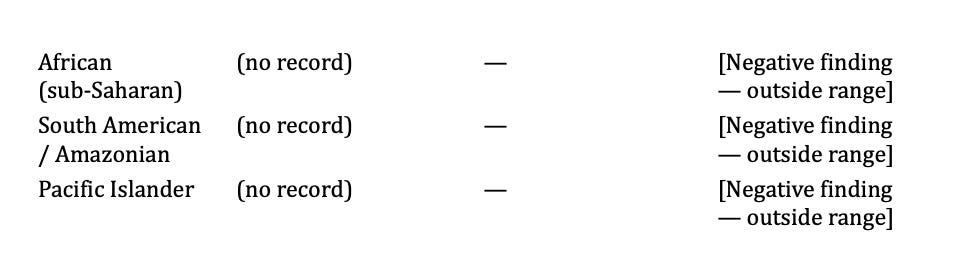
Read a plant by its names and the geography of its memory comes clear. Greek herbalists never met it; Sanskrit poets never met it; the Mediterranean classical world never met it. But cross the boreal forest from Iceland to Kamchatka and the names accumulate like snow on rhizome-buds, maitohorsma, mjölkört, kipréy, paunnaq, cuukvaguaq, k’aalruwaay, athithikomenahtik, each language naming a particular relationship with the same magenta torch. The map of the names is the map of the plant. Where the names go silent, the plant has not been.
2.1 Scientific identity
Currently accepted name. Chamerion angustifolium (L.) Holub (1972), Onagraceae [POWO 2025; IPNI 55479-2].
Basionym. Epilobium angustifolium L., Species Plantarum 1: 347 (1753) [POWO 2025].
Other generic placements still in use. Chamaenerion angustifolium (L.) Scop. (1771), standard in much European literature and BSBI [Stace 2019]. Chamerion spicatum (Lam.) S.F. Gray and Epilobium spicatum Lam. are older synonyms now obsolete [POWO 2025].
Authority sequence. Linnaeus described the species (1753) inside Epilobium. Scopoli (1771) and Rafinesque (early 19th c.) proposed separating it. Holub (1972) made the formal taxonomic case that Chamerion is the correct genus name under priority rules; this is the binomial POWO and most contemporary work now use [Holub 1972; Wagner et al. 2007]. [Well-documented]
Commonly misapplied names. Senecio madagascariensis, also called “fireweed” in Australia and South Africa; unrelated, Asteraceae, toxic to livestock [Sindel et al. 2022]. Epilobium parviflorum, small-flowered willowherb, a true Epilobium; the canonical Maria Treben prostate/BPH claim belongs here, not to C. angustifolium, the misattribution is the most pervasive error in popular herbal writing [Treben 1980; Hiermann & Bucar 1997; Hostanska et al. 2007; Stage 1.5 verification W-1]. Lythrum salicaria, purple loosestrife, sometimes confused at a distance; different family [USDA PLANTS 2025].
Subspecies and ploidy. POWO recognizes subsp. angustifolium (Eurasia, largely diploid 2n = 36) and subsp. circumvagum Mosquin (North America and parts of Asia, largely tetraploid 2n = 72 and hexaploid 2n = 108). The polyploid races segregate ecologically: diploids in stable mid-elevation gaps; tetraploids in colder, more disturbed, higher-elevation sites; hexaploids in the most northern and most disturbed positions [Mosquin 1966; Mosquin 1967; Husband & Schemske 1998; FNA vol. 10]. The diploid–tetraploid contact zone in the Canadian Rockies and along the Yukon transect is one of the cleanest wild autopolyploid cases studied in plants [Husband & Schemske 1998; Husband 2001]. [Well-documented]
2.2 Names across cultures
2.3 Meaning of names
The Latin reads itself plainly. Chamerion, from Greek χαμαί (chamai) “on the ground / dwarf” and νήριον (nḗrion) “oleander”, names a likeness, not a kinship: the long lance leaves and showy pink flowers of fireweed remind a Mediterranean eye of Nerium oleander, the shrub of dry roadsides and walled gardens [Stearn 1996]. Angustifolium names what botanists name first, narrow leaves. The older Epilobium binomial encodes a different observation: ἐπί (epi) “upon” and λοβός (lobós) “pod”, the flower borne upon the elongated inferior ovary that looks, before opening, like a slender green pod with a bud at its tip [Stearn 1996; Linnaeus 1753].
The English names map the plant’s biography. Fireweed is North American and dates from at least the 18th century in fur-trade vocabulary [Grieve 1931]. Rosebay willowherb is British and older still, the leaves recall willow, the inflorescence recalls the bay rose [Mabey 1996]. Bombweed is the youngest and saddest, coined in London after the 1940–41 Blitz, when fireweed colonized bombsites so completely that aerial photographs of Cripplegate and the City showed magenta in early August [Mabey 1996; Fitter 1945; Salisbury 1964]. The Yukon territorial government adopted fireweed as its emblem in 1957 with the same recognition encoded differently: a plant that fills the spaces the world has been emptied of [Government of Yukon; Stage 1.5].
The Russian Иван-чай (Ivan-chai, “Ivan’s tea”) is the most freighted name. It travels three folk-etymologies, a peasant named Ivan who first fermented it; the village of Ivanovo near the production heartland; the Orthodox feast of St. John (Ivan in Russian) at midsummer when the leaves were traditionally cut. None of the three has decisive documentary backing; the documentary trail begins with the Koporye industry of the late 18th century [Pokhlebkin 1995; Subbotina 2018; Stage 1.5]. The popular “Catherine the Great commissioned Koporsky tea” and “a 12th-century Koporye monk discovered the fermentation” stories are folk history without firm primary basis, and the medicinal-prostate narrative widely attached to the Russian tradition is, on careful examination, a 20th-century construction with three documented vectors: partially-unpublished Soviet laboratory results from the 1930s; Maria Treben’s small-flowered-willowherb prostate claim reimported and reattributed; and a 19th-century US peak of E. angustifolium popularity feeding back through European pop herbalism [Sõukand et al. 2020; Stage 1.5 N-1 / W-2].
The Indigenous North American names map a different cluster of relationships, phenological calendar, food, fiber, medicine, and resist easy translation. The Plains Cree wāpos-ōsōy (”rabbit’s tail”) names the comose seed [Marles et al. 2000]. The Yup’ik cuukvaguaq names a food plant central to spring greens [Jones 2010]. The Haida k’aalruwaay names a fiber plant whose pappus down was twisted with mountain-goat wool for blankets [Turner 2010]. Each name is older than every published herbal that mentions the species in English.
What the names know that modern study has only partly caught up to is the plant’s three-stranded identity: post-disturbance pioneer (the English-North American thread), fermented beverage and tonic (the Russian-Slavic thread), and food-fiber-medicine of the boreal land (the Indigenous thread). The chemistry literature has begun to connect them, the oenothein B that gives Ivan-chai its mild prostate-protective action is the same compound that runs through the wilted-fermented Athabaskan leaf teas of the upper Yukon, but the bibliographic conversation between these threads is younger than the plant itself [Granica et al. 2014; Schepetkin et al. 2016; Sõukand et al. 2020].
When three traditions name the same plant and the names point in three different directions, pioneer, ferment, food, what is the plant doing that requires all three readings at once?
3. Identification and Look-Alikes
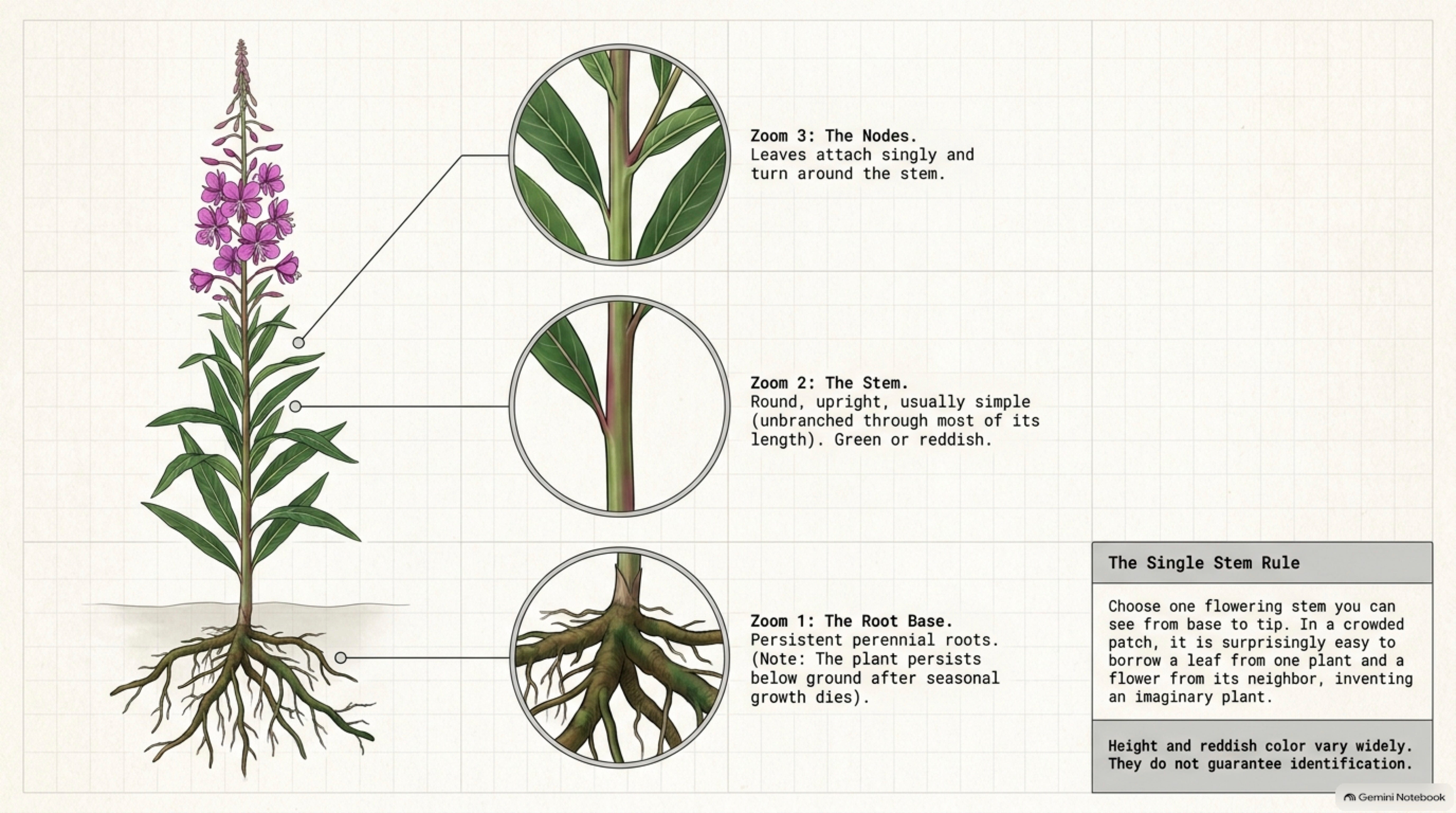
A clearing in the Yukon in early August. Knee-high to chest-high stems, single and unbranched, rising straight from the rhizome layer with a slight reddish flush at the base. Leaves spiral the stem in tight alternation, long, lance-shaped, pointed at both ends, pale green above and faintly bluish beneath. Pick one and hold it to the sun: the lateral veins curve forward and join an inframarginal vein before reaching the leaf edge. They loop. They do not run to the margin. That single anatomical fact, visible to anyone with eyes and ten seconds, is the most reliable field mark for Chamerion angustifolium anywhere in its range.
3.1 Field identification
Growth habit. Rhizomatous perennial, 0.5–3 m tall, generally unbranched, forming colonies of upright stems from a horizontal rhizome system in the upper 5–15 cm of soil. A vigorous clone can fill a 1–2 m radius around a colonizing genet within a few seasons [Myerscough 1980; Broderick 1990]. [Well-documented]
Stem. Single, erect, smooth or sparsely pubescent, often reddish toward the base, hollow in robust specimens, leafy throughout the lower two-thirds, terminating in a long raceme [FNA vol. 10; Myerscough 1980].
Leaves. Alternate, spirally arranged (this is a generic character of Chamerion separating it from Epilobium‘s opposite leaves), narrowly lanceolate, 5–20 cm long by 0.5–3 cm wide, entire to slightly denticulate, glabrous or with sparse hairs along veins beneath, pale green above and often slightly glaucous-bluish beneath. Diagnostic venation: lateral veins arch forward and unite with an inframarginal vein before reaching the leaf margin, the looping-vein character. A folded-back marginal vein connects them [FNA vol. 10; Myerscough 1980; Broderick 1990]. [Well-documented]
Inflorescence. Long terminal raceme 15–60 cm, occasionally longer in robust plants; flowers open sequentially from the base upward over four to eight weeks. At any one moment a mature stem carries seed capsules at the bottom, open flowers in the middle, and unopened buds at the top, a four-act drama compressed onto a single stalk [Myerscough 1980; Benham 1969].
Flowers. Four-merous, 2–4 cm across, rose-pink to magenta (rarely white in cultivated and occasional wild populations); four obovate petals; four narrow, often darker sepals; eight stamens, declined; style longer than stamens, terminating in a four-lobed stigma that opens like a small cross after the anthers shed. The flower is slightly zygomorphic, gently bilaterally symmetrical, which is a generic character of Chamerion against the radially symmetrical Epilobium [Wagner et al. 2007; FNA vol. 10]. [Well-documented]
Pollen. Borne on longitudinally dehiscent anthers, not poricidal. Fireweed is not buzz-pollinated. Pollen grains are held together loosely by viscin threads and presented openly; bumblebees collect them as standard nectar-and-pollen flowers, not by sonication [Galen & Plowright 1985; Wagner et al. 2007; Stage 1.5 verification W-3]. [Well-documented, explicit correction of a common online claim]
Capsule. Slender, 4-valved, 4–9 cm long, splitting from the apex downward at maturity to release the seeds [FNA vol. 10].
Seeds. Minute (about 1 mm), each with a tuft of silky white hairs (the coma or pappus) 10–17 mm long, lifted on the slightest breath of wind. A single robust stem produces 15,000–80,000 seeds in a season; the dispersal cloud over a heavily-blooming patch in mid-September can lift visibly on a warm afternoon [Myerscough 1980; Solbreck & Andersson 1987a].
Root architecture. Horizontal rhizomes 2–8 mm thick at colonization, branching repeatedly to form a network in the upper 5–15 cm of soil, occasionally penetrating to 30 cm in friable substrate. Adventitious buds along the rhizome give rise to new aerial stems annually. Fine absorbing roots descend from rhizome nodes; the root system is functionally shallow compared to taprooted prairie plants [Myerscough 1980; Broderick 1990]. [Well-documented]
Habitat clues. Recently burned forest; clearcuts in years 2–8 after harvest; landslide and avalanche scars; gravel-bar margins (where it grades into C. latifolium); roadside cut-banks; abandoned cultivation; the colonist guild of post-disturbance boreal and temperate-montane North America and Eurasia [Viereck 1973; Heinselman 1981; Schimmel & Granström 1996]. Indifferent to disturbance type, fire, machinery, ash-fall, bomb-crater. Tolerant of cold; intolerant of dense shade and severe drought [Myerscough 1980].
Key field marks, in order of reliability. (1) Looping lateral leaf veins that do not reach the margin, diagnostic. (2) Spirally alternate (not opposite) lance leaves on a single unbranched stem, generic. (3) Four-petaled magenta flower on an elongate terminal raceme, blooming bottom-up, specific. (4) Long narrow capsule splitting to release comose seeds, confirms Chamerion / Epilobium lineage. (5) Habitat in disturbance, supports the ID. No other temperate-northern plant matches all five.
3.2 Look-alikes
Chamerion latifolium (L.) Holub, dwarf fireweed / river beauty. The sister species. Shorter (10–60 cm), leaves broader and more elliptical, flowers larger but fewer per inflorescence (3–15 vs the dozens-to-hundreds of C. angustifolium), styles shorter than stamens, habit decumbent rather than erect. Diploid only (2n = 36) [FNA vol. 10; Hultén 1968]. Habitat: gravel bars, scree, glacial outwash, arctic-alpine and treeline zones, the wide-open mineral surfaces, not the burned-forest interior. Where the two species co-occur (interior Alaska, Yukon, northern BC, parts of Scandinavia), the substrate alone usually separates them. C. latifolium is also edible and shares much of the chemistry; Inuit and Inupiat communities use both, sometimes interchangeably [Jones 2010; Heller 1953]. [Well-documented]
Lythrum salicaria L., purple loosestrife. A distance-confusion only. Differences on inspection: opposite or whorled leaves (not spiral); six petals (not four); wetland obligate occupying ditches, pond margins, and wet meadows; square-ish, slightly winged stems. Lythrum is a declared invasive across most of eastern North America; the regulatory and ecological reputation is opposite to fireweed’s [USDA PLANTS 2025]. [Well-documented]
Epilobium hirsutum L., great hairy willowherb. A true willowherb, in the same family. Densely hairy throughout (the diagnostic), opposite to sub-opposite lower leaves, magenta flowers smaller (15–25 mm) with a deeply 4-lobed stigma, wetland-margin habitat. The hairiness settles it instantly [Stace 2019; BSBI].
Liatris spp., blazing star (Asteraceae). A superficial spike-of-purple resemblance from a distance. Differs at any inspection: composite flower heads, no individual 4-petaled flowers, narrow grass-like basal leaves [USDA PLANTS 2025].
Lupinus spp., lupines, in pre-flowering rosette stage. Palmate compound leaves vs simple lance leaves; only a problem at the seedling stage and only to an untrained eye [extension; Anecdotal].
Senecio madagascariensis Poir., Australian “fireweed.” A vital disambiguation rather than a true look-alike, the two species do not look alike at all. Senecio madagascariensis is a low yellow-flowered Asteraceae daisy with composite heads; it is a Weed of National Significance in Australia, declared in NSW, and toxic to cattle and horses by pyrrolizidine alkaloids [Sindel et al. 2022; NSW WeedWise 2025]. Sharing only the English common name with Chamerion angustifolium, it is the source of constant confusion in popular and regulatory literature. A reader encountering an “Australian fireweed problem” reference is reading about Senecio, not Chamerion. [Stage 1.5 verification W-4]
Epilobium parviflorum Schreb., small-flowered willowherb. The species behind the Maria Treben prostate / BPH attribution that is constantly mis-cited as applying to fireweed. E. parviflorum is a smaller, hairier willowherb with much smaller pink flowers (5–10 mm), opposite lower leaves, and a different chemistry profile in some respects [Hiermann & Bucar 1997]. The two plants are easy to distinguish in the field, but the herbal-marketing literature confuses them at every turn. Any claim about “fireweed for the prostate” should be checked against the species name in the original study before being passed forward [Hostanska et al. 2007; Treben 1980; Stage 1.5 verification W-1].
3.3 Safety note
Fireweed itself carries an unusually clean safety profile for a circumboreal medicinal, see Section 13 for full discussion. The misidentification risks that matter are not the look-alikes themselves but the labeling errors that move between them.
The first is the Senecio madagascariensis / Chamerion angustifolium swap. Importing safety information from one to the other is dangerous in either direction. Senecio madagascariensis contains hepatotoxic pyrrolizidine alkaloids and is not safely consumed by humans or grazed by livestock [Sindel et al. 2022; Burrows & Tyrl 2013]. Fireweed has no pyrrolizidine alkaloids and is broadly food-safe. Anyone reading “fireweed is invasive and toxic” in Australian agricultural extension and applying that warning to Chamerion angustifolium in the Northern Hemisphere will mis-treat both plants. [Well-documented]
The second is the Epilobium parviflorum / Chamerion angustifolium swap. The two plants are both edible and broadly safe; the swap is mostly an attribution error rather than a safety hazard, but it propagates into clinical claims that may not transfer between species. The compound oenothein B is shared, but concentrations vary across the genus, and clinical trial data on C. angustifolium specifically is more limited than the popular literature implies [Granica et al. 2014; Deng et al. 2019].
The third is the Chamerion / Chamaenerion / Epilobium name slip. A safety or efficacy claim sourced from a 1995 European paper using Chamaenerion and a claim sourced from a 1980 North American paper using Epilobium may both apply to the same plant, C. angustifolium, but the reader has to verify. Each of the three names is current in some literature today [Stace 2019; POWO 2025; Stage 1.5 W-5]. [Well-documented]
The most common practical misidentification, confusing young fireweed shoots with daisy-family rosettes or with willowherb sister species before flowering, is low-consequence in the field. Both daisies and Epilobium spp. are broadly safe to handle, and the question is decided once flowering begins.
If the most dangerous error in a plant’s literature is not which look-alike it has but which name has been used to refer to it, what does that tell a writer about the work of caring for the record?
4. Botanical Character and Life Cycle
A burned hillside in the third spring after fire. Pink shoots push up from rhizome buds that survived the ground-fire because they lay just deep enough, five centimeters of mineral soil between root and ember was enough. The first leaves are small and red-flushed; they will green by midsummer. The clone underneath this single stem may already be a decade old; its parent rhizome arrived as seed in 2009, settled, sent down its first lateral, and now occupies a four-meter circle of recovering forest. Above it, the second crop of flowering shoots is preparing to repeat the offer.
Life history. Long-lived rhizomatous perennial. Reproduction by seed (long-distance, abundant) and by rhizome (short-distance, dominant within an established colony). A genet can persist for many decades, Myerscough cites stable populations holding the same ground for “decades or longer” without an upper-bound study [Myerscough 1980; Broderick 1990]. Quantitative maximum clone age has not been measured by genet-dating in any published study located in this pass [Gap]. [Well-documented for “many decades”; quantitative bound flagged]
Growth architecture. Single unbranched aerial stem per rhizome bud, rising 0.5–3 m. A vigorous clone produces dozens to hundreds of stems from a connected rhizome network. The aerial stem dies back annually after seed shed; the rhizome and its bud bank persist underground through winter [Myerscough 1980].
Root strategy. Shallow horizontal rhizome network in the upper 5–15 cm of soil; occasional penetration to 30 cm in friable substrate. Fine absorbing roots descend from rhizome nodes. The architecture trades vertical depth for horizontal coverage, a strategy suited to colonizing surface-disturbed substrates where the upper layers are loose and the deeper soil may be heat-damaged or unstable [Myerscough 1980; Broderick 1990]. [Well-documented]
Clonal spread. Outward lateral expansion roughly 0.3–1.0 m per year from the founding genet in favorable conditions [Myerscough 1980]. After 5–10 years a single seed can produce a clonal patch 5–20 m across in suitable habitat. Two or more genets often interweave in burned forest, generating the magenta sheets that look like one plant but are population-genetic mosaics [Husband & Schemske 1998]. [Well-documented]
Germination cues. Seeds require light (positively photoblastic), bare mineral or near-bare organic substrate, and temperatures of 15–25 °C optimum for prompt germination [Myerscough 1980; van Andel & Vera 1977; Broderick 1990]. They do not need cold stratification. The combination, light + bare soil + warmth, is met most reliably in the first or second summer after fire or other surface disturbance. Burial below approximately 1 cm strongly reduces emergence. Fireweed is therefore a rain-of-seeds-from-elsewhere colonist rather than a deep-seedbank plant: most of any given year’s seedlings on a burn site arrived as wind-dispersed seed within the past 12–24 months, not from soil seedbank decades old [Myerscough 1980; van Andel & Vera 1977]. [Well-documented across three independent sources]
Seedbank persistence. Short-lived. Most seed loses viability within 18–24 months in soil; the species does not maintain a persistent seedbank in the strict sense [Myerscough 1980; Broderick 1990; van Andel & Vera 1977]. The quantitative seedbank-longevity study with dedicated trial data is absent, the consensus rests on the convergence of these three references rather than on a single dedicated experiment [Gap].
Dormancy pattern. Aerial stems die after seed shed. Rhizomes overwinter dormant; bud break in spring is triggered by soil warming above approximately 5 °C, with regional and ploidy-dependent variation [Myerscough 1980; Husband & Schemske 1998].
Flowering sequence. Acropetal, bottom of raceme first, top last, over four to eight weeks. At any moment a mature stem displays a full life cycle in vertical compression: ripening capsules at the base, open flowers in the middle, unopened buds at the apex [Myerscough 1980; Benham 1969]. The protandrous flowers (anthers shed before stigma receptivity) on a bottom-up raceme enforce outcrossing: pollinators arriving low on the stalk find female-phase flowers loaded with stigma; pollinators climbing upward then visit male-phase flowers and carry pollen to the next stalk. The architecture is a one-way street for genes [Benham 1969; Myerscough 1980].
Pollination strategy. Insect-pollinated, predominantly by bumblebees (Bombus spp.), with secondary visitation by honey bees (Apis mellifera) where present and by hummingbirds in western North America (Selasphorus rufus documented as a visitor in Pacific Northwest accounts) [Benham 1969; Myerscough 1980; Pojar & MacKinnon 1994]. Pollen is presented by longitudinal anther dehiscence and held by viscin threads; fireweed is not buzz-pollinated [Galen & Plowright 1985; Stage 1.5 W-3]. The slightly zygomorphic corolla, declined stamens, and viscin-thread pollen presentation read as a classic Bombus syndrome. [Well-documented]
Seed dispersal. Wind-dispersed by comose seeds, fine pappus hairs of approximately 10–17 mm carry the seed long distances on the lightest air movement. Solbreck & Andersson documented vertical seed distribution in air above flowering populations, with seeds carried to substantial heights and consequently to substantial horizontal distances [Solbreck & Andersson 1987a]. Single-source dispersal distances of kilometers are routine in the boreal landscape; intercontinental dispersal is plausible and consistent with the species’ circumboreal distribution [Myerscough 1980].
Disturbance response. The species’ defining trait. Light-to-moderate ground fires that leave the upper 5–10 cm of organic soil intact spare the rhizome bud bank and produce a rapid post-fire flush; high-severity burns that consume the organic layer kill the rhizome but the seed rain re-colonizes from adjacent unburned populations within one to two years [Broderick 1990; Schimmel & Granström 1996; Viereck 1973]. Clearcuts, landslides, gravel washes, and tracked-vehicle damage on snow-saturated soil all trigger similar flushes. The plant responds to disturbance not by surviving it intact but by being the first to repopulate after it [Heinselman 1981; Viereck 1973]. [Well-documented]
Successional role. Pioneer to early-successional. Dominance peaks in years 2–5 after disturbance in boreal North America; the plant is gradually overtopped by shrubs (Salix, Alnus, Vaccinium) and tree regeneration (Picea, Betula, Populus, Pinus) in years 8–20, after which fireweed declines to scattered persistence in canopy gaps and along forest-edge margins [Heinselman 1981; Viereck 1973; Schimmel & Granström 1996]. The species does not self-replace, it requires the next disturbance to return [Broderick 1990]. [Well-documented]
Longevity. Individual aerial stem, one season. Rhizome / genet, “many decades” in stable populations [Myerscough 1980]. Quantitative upper bound, Unknown; no dedicated genet-dating study located [Gap].
If a plant lives for decades underground and dies above ground every autumn, where does its identity actually reside, in the stem the eye sees, or in the rhizome that remembers each fire and waits for the next?
5. Ecological Intelligence
Walk a five-year burn in the boreal interior and you can read what the fire did from the fireweed alone. Where the magenta is densest and tallest, the ground fire stopped just at the boundary of the organic layer, the rhizomes underneath survived and surged. Where the magenta is thinner and the stems are seedling-young, the burn was severe enough to consume the duff, and what you are seeing is the seed rain from the next valley over arriving on the wind. The plant reads the burn for you. The same trait, disturbance-response, that makes fireweed a problem in commercial forestry makes it one of the most legible plants in the boreal regenerative repertoire.
5.1 Soil relationships
Conditions. Light to moderately heavy, mesic, slightly acid to neutral, sun-warmed soils. Optimum pH 5.5–7.5; tolerates 4.5–8.0 with reduced vigor [Myerscough 1980; Broderick 1990; CABI 2024]. Waterlogged and strongly compacted soils are avoided. Cold-tolerant; the polyploid races extend the species’ range into substrates that diploids cannot occupy [Husband & Schemske 1998]. [Well-documented]
pH indicator value. Not a sharp indicator at the species level; presence indicates disturbance more reliably than chemistry. On post-fire soils, the species tolerates the temporarily elevated pH and elevated potassium of ash without difficulty, neither a fastidious calcicole nor a fastidious calcifuge [Myerscough 1980; Wein & MacLean 1983]. [Traditionally supported]
Mycorrhizal associations. Arbuscular mycorrhizal (AM), though colonization is variable and characterized as facultative. Treu et al. documented AM colonization in Alaskan boreal Epilobium angustifolium; broader family-level reviews place the Onagraceae generally in the AM register [Treu et al. 1996; Wang & Qiu 2006]. Detailed colonization-intensity measurements across the range are sparse [Gap]. [Emerging, AM status supported; colonization intensity under-documented]
Bacterial associations. No specific nitrogen-fixing symbiosis (the plant is not a legume). Rhizosphere community studies are limited; what exists describes the typical post-disturbance assemblage of fast-growing Pseudomonadota and Bacillota associated with high-organic-matter soils [Gap on dedicated fireweed rhizobiome studies].
Root exudate effects. Allelopathic activity reported anecdotally in popular literature but not robustly supported in the primary literature. Modest in vitro suppression of seedling germination has been demonstrated for some Onagraceae but not for Chamerion angustifolium specifically [Broderick 1990]. Treat the allelopathy claim as [Anecdotal] rather than [Well-documented]; the plant’s dominance in post-fire flushes is more readily explained by rapid clonal expansion + abundant seed rain + access to the ash nutrient pulse than by chemical interference [Heinselman 1981; Wein & MacLean 1983].
Nutrient accumulation. Fireweed biomass captures and transiently retains the post-fire potassium, nitrogen, and phosphorus pulse, slowing the leaching loss of ash nutrients during the regeneration window [Wein & MacLean 1983; Chapin et al. 2006]. The plant does not accumulate any single mineral at remarkable concentrations; its dynamic-accumulator reputation in popular permaculture literature appears to be inferential rather than measurement-based [Gap on tissue-mineral analyses across substrates]. [Well-documented for the post-fire N/K/P retention role]
Rhizosphere function. The dense rhizome network adds organic matter to surface soils through annual aerial dieback and underground turnover, contributing to the rebuilding of the post-fire organic layer. Specific soil-organic-carbon accrual rates for fireweed-dominated stands have not been quantified in dedicated studies [Gap; inferential from biomass data in Wein & MacLean 1983].
Compaction implications. The plant does not penetrate compaction in the Daucus / Symphytum sense and is not a deep decompactor. Its rhizome network is shallow and lateral [Myerscough 1980]. Tolerant of moderately compacted surface conditions; intolerant of severe surface compaction.
Allelopathy applications and cautions. Following crops on former fireweed-dominated ground show no consistent rotation problems documented in the agricultural literature [Broderick 1990]. The plant is not a known rotation allelopath. [Well-documented for the negative case]
5.2 Water relationships
Drought. Tolerates moderate seasonal drought once established; the deep rhizome and extensive lateral root network buffer summer water stress. Severe drought reduces seed set and flower number but rarely kills established clones [Myerscough 1980; Broderick 1990]. [Well-documented]
Flood. Not flood-tolerant. Waterlogging kills rhizomes through anoxia. The plant occupies mesic to dry-mesic positions in landscape gradients; it is absent from true wetlands [Myerscough 1980].
Moisture preference. Mesic. Best growth in soils that drain freely but retain moisture in the upper rooting zone. In dry years it is most abundant on north-facing slopes and along seepages within burned areas [Viereck 1973].
Water-table association. Does not require a high water table; tolerates seasonally lowered water tables in well-drained burned forest. Riparian role is minor, its sister species Chamerion latifolium occupies the gravel-bar / floodplain niche more characteristically [Hultén 1968; FNA vol. 10].
Dew / humidity / fog. No specific dependence; broadly tolerant across humidity regimes in its circumboreal range.
Hydraulic lift. Not documented in C. angustifolium; its shallow architecture makes hydraulic lift in the Quercus / Artemisia sense improbable.
5.3 Community ecology
Companion plants. In a freshly burned boreal stand the standard community partners are Epilobium spp. (smaller willowherbs), Calamagrostis canadensis (bluejoint grass), Rubus idaeus (red raspberry), Ribes spp., young Salix and Populus tremuloides root suckers, and the broader post-fire forb guild including Achillea millefolium and Solidago spp. [Heinselman 1981; Viereck 1973]. In British rosebay-willowherb populations, Senecio jacobaea, Rumex acetosella, Holcus lanatus, and bracken (Pteridium aquilinum) are typical associates [Myerscough 1980]. [Well-documented]
Competitive behavior. A strong early-successional competitor through clonal density and tall canopy in years 2–5 after disturbance; a poor competitor under closed forest canopy. The plant does not invade undisturbed mature stands and is gradually overtopped as woody regeneration takes hold [Heinselman 1981; Schimmel & Granström 1996]. [Well-documented]
Nurse functions. Limited explicit nurse-plant literature for fireweed. Inferentially, the dense fireweed canopy of years 2–5 provides shade and litter that may buffer microclimate for the smaller tree seedlings establishing beneath it, but dedicated nurse-effect quantification is not robustly documented in the species [Gap].
Wildlife value. Substantial, see Section 6.1 for the full register. In compressed summary: moose, snowshoe hare, and caribou browse leaves and shoots in summer and early autumn; bumblebees and honey bees take nectar and pollen during the long bloom window; sphinx moths (especially Hyles galii and Hyles lineata) use fireweed as a larval host plant; small mammals consume seed and use stems as cover; birds use the seed coma material in nest construction [Bryant et al. 1985; Galen & Plowright 1985; UK Moths database; ADF&G 2024; Crane 1999]. [Well-documented]
Habitat role. A primary architect of the post-disturbance forb stratum across boreal North America and Eurasia. In England the species is closely tied to railway ballast, bombsites, and forestry clearings; in the boreal interior it is the signature plant of the 2–5 year post-fire window [Mabey 1996; Salisbury 1964; Viereck 1973].
5.4 Pollinators and insects
Pollinator value. Outstanding for bumblebees (Bombus spp.). The long bloom window (June–September across most of the range), the high nectar volume per flower, and the bottom-up raceme architecture that keeps a stalk in bloom for weeks make fireweed a foundational nectar resource in boreal and montane landscapes [Benham 1969; Myerscough 1980; Galen & Plowright 1985; Crane 1999]. Honey bees take it readily where present. Hummingbirds visit in western North America [Pojar & MacKinnon 1994]. The species sits at the heart of one of the world’s most distinctive monofloral honey traditions, Alaskan, Yukon, BC, Maine, and northern Russian fireweed honey, see Section 17 for the economic register [Crane 1999; Conner & Black 1996]. [Well-documented]
Insectary value. The flat-presented small-zygomorphic flowers and accessible nectar suit a broad guild of beneficials: hoverflies (Syrphidae), parasitoid wasps (small Braconidae and Ichneumonidae), small generalist bees, and tachinid flies. Fireweed appears regularly in pollinator-strip and wild-margin recommendations for boreal and cool-temperate apiaries and farms [Crane 1999; extension publications].
Nectar/pollen timing. July–early September peak in the boreal interior, with the bloom front compressed in higher latitudes and elevations. The mid-summer timing fills a critical nectar-dearth window between early-summer fruit-tree bloom and late-summer aster and goldenrod, particularly important in regions where the boreal forest dominates the landscape [Crane 1999]. [Well-documented]
Host-plant relationships. Hyles galii (bedstraw hawkmoth) and Hyles lineata (white-lined sphinx) larvae use Chamerion angustifolium as a primary host plant across its range [UK Moths database; Tuttle 2007]. Several Mompha moth species and seed-predating Diptera attack the developing capsules [Solbreck & Andersson 1987b]. The plant supports a small but specialized lepidopteran fauna. [Well-documented]
Overwintering relevance. Standing dead stems provide cover and overwintering microhabitat for various small insects and spiders; this is incidental rather than central. The species’ winter ecology is dominated by the rhizome rather than the aerial stem.
Beneficial predator support. Through the parasitoid wasp and hoverfly visitation noted above, fireweed contributes generally to the predator/parasitoid pool in landscapes where it occurs at margin or strip scale [Crane 1999; pollinator-strip literature].
5.5 Ecosystem functions
Soil building. Annual aerial-stem dieback contributes organic matter; rhizome turnover contributes belowground organic matter. Post-fire fireweed biomass functions as a transient retention pool for the ash nutrient pulse, holding nitrogen, potassium, and phosphorus in living tissue during the 2–5 year window when bare soil and high microbial activity would otherwise see those nutrients leach away [Wein & MacLean 1983; Chapin et al. 2006]. [Well-documented]
Carbon contribution. The species fixes substantial carbon during the post-fire flush years, with above-ground biomass estimates of 200–600 kg ha⁻¹ in peak years in boreal interior Alaska [Wein & MacLean 1983]. This carbon is largely returned to the soil through annual dieback and slow decomposition. The pulse is transient, replaced by tree biomass as succession proceeds, but during its window it is meaningful at landscape scale [Chapin et al. 2006]. [Well-documented]
Erosion control. Inferential from the dense rhizome network; explicit slope-stability measurement studies for fireweed-dominated cover are not located in this pass [Gap]. The plant’s pioneer dominance on post-disturbance slopes is broadly consistent with an erosion-protective function.
Shade and shelter. Provides modest shade in the second through fourth post-fire summers; the magenta-flowered canopy at peak bloom in late July reaches 1–2 m and shades the soil surface during the hottest part of the season, buffering microclimate for seedlings of tree and shrub species establishing beneath it [Viereck 1973; Heinselman 1981]. [Traditionally supported; quantification limited]
Biodiversity. Supports the bumblebee, sphinx moth, and other pollinator communities outlined in Section 5.4. Its long bloom is a critical resource for boreal Bombus populations during a season when alternative forage is scarce [Crane 1999].
Restoration. Widely used implicitly rather than explicitly, it volunteers on most boreal disturbance and is welcomed in restoration plantings for its capacity to establish quickly and provide cover and pollinator habitat during the early successional window [Viereck 1973; Heinselman 1981]. Seed mixes for post-fire and post-mining restoration in Alaska and Yukon often include or rely on natural colonization by C. angustifolium [extension publications; ADF&G 2024].
Phytoremediation. Anecdotal reports of fireweed tolerance for heavy metals and hydrocarbons on contaminated industrial sites; dedicated phytoremediation trials with rigorous chemistry are limited. Treat as [Anecdotal / Emerging] pending stronger evidence [Gap].
5.6 Indicator value
Each entry on its own line, with confidence tagging, the plant is read for what its presence and density reveal about the landscape.
Fertility. Not a strong fertility indicator. Tolerates a wide range; its presence on burned soils reflects access to the ash nutrient pulse, not site fertility per se [Wein & MacLean 1983]. [Traditionally supported]
Compaction. Tolerates moderate surface compaction; absent from severe compaction (vehicle tracks on saturated soil eventually exclude it). Weak indicator [Myerscough 1980]. [Anecdotal]
Disturbance history. The single strongest indicator value of this plant. A dense bloom in years 2–5 indicates surface disturbance in the past few seasons, fire most commonly in the boreal interior; clearcut or windthrow most commonly elsewhere; bomb-crater, eruption, landslide, avalanche, abandoned tillage in the more unusual settings [Viereck 1973; Heinselman 1981; Mabey 1996; Salisbury 1964]. [Well-documented]
Successional stage. Pioneer to early-successional; presence signals years 2–10 after disturbance. Decline through mid-succession; near-absence in closed-canopy mature forest [Heinselman 1981; Schimmel & Granström 1996]. [Well-documented]
Moisture. Mesic; presence indicates moderate moisture availability and absence from waterlogged or droughty extremes. Moderate indicator [Myerscough 1980]. [Traditionally supported]
Salinity. Sensitive to salinity; absent from saline soils. Negative indicator of salinity stress [Broderick 1990]. [Traditionally supported]
Contamination. Reported tolerance of some heavy metals and hydrocarbons; not a robust contamination indicator. [Anecdotal] with confirmatory studies limited [Gap].
Grazing pressure. Tolerates light to moderate grazing; declines under heavy continuous grazing. Indicator of low to moderate grazing pressure rather than overgrazing [ADF&G 2024]. [Traditionally supported]
Microbial imbalance. No specific indicator value documented [Gap].
Mineral deficiency / excess. No specific indicator value documented [Gap].
5.7 Ecological synthesis
What this plant is doing in the landscape can be said in one long breath. It is the green covenant the land signs with its own future after fire, a small light seed riding the wind into ash, a horizontal rhizome learning the new ground, a magenta torch lifted three meters into the smoke-light of the second summer, ten thousand seeds released to the wind in the fourth, then a gradual quiet stepping-aside as spruce and birch take back the canopy. It is a transient retention pool for the ash nutrients that would otherwise leach away. It is a foundational nectar resource for bumblebees through the deepest part of the boreal summer. It is a feed plant for moose and hare and sphinx moth and the entire post-fire pollinator guild. It is the plant whose presence reads the disturbance history of a stand without needing the human eye to know what to look for. Stewardship of a fireweed landscape is not stewardship of a single species, it is stewardship of the capacity to respond that the species embodies. To care for fireweed is to care for whatever the next fire will need [Myerscough 1980; Broderick 1990; Heinselman 1981; Viereck 1973; Wein & MacLean 1983; Galen & Plowright 1985; Crane 1999].
If a plant’s whole purpose is to be the answer to the next disturbance, what does it ask of a land tradition that no longer trusts disturbance to be answered at all?
6. Animal Interactions and Ethology
A bull moose in early August, deep in a Yukon burn, working through chest-high fireweed with his head down, taking three or four shoots, then moving two meters, then taking three or four more. He is not browsing indiscriminately. He is selecting the upper leaves and the unopened bud clusters, leaving the flowering stalks and the older lower leaves alone. The next morning the bumblebees arrive on the surviving flowers and the cycle resumes. Two large mammals, one large pollinator clade, one plant, and the relationship between them is older than every cabin in the valley.
6.1 Wild animal relationships
Mammals, browse. Fireweed is a significant summer and early-autumn forage for moose (Alces alces) across the North American boreal range, particularly in years 2–5 after fire when the plant dominates the regenerating canopy [Bryant et al. 1985; ADF&G 2024]. Snowshoe hare (Lepus americanus) take leaves and stems in summer; the species’ palatability declines through autumn as tannin and phenolic content rises [Bryant et al. 1985]. Caribou (Rangifer tarandus) take fireweed as a summer forage component but rely more on lichens and sedges through the rest of the year [Skoog 1968]. Mule deer and elk in Western North American populations browse it modestly [Pojar & MacKinnon 1994]. [Well-documented]
Mammals, avoidance. Bears (both Ursus americanus and Ursus arctos) consume fireweed shoots and flowers seasonally as a minor diet item, not avoided, not preferred. Beaver (Castor canadensis) take fireweed where it grows along their pond margins [ADF&G 2024]. No documented active avoidance pattern among large boreal mammals. [Traditionally supported]
Birds. Several boreal songbirds use the seed coma material in nest construction, American goldfinch, white-crowned sparrow, and others have been observed gathering pappus down for nest lining [Pojar & MacKinnon 1994; ADF&G 2024]. Direct seed consumption is minor. Grouse and ptarmigan take occasional flowers and shoots [extension; Traditionally supported]. [Traditionally supported]
Reptiles and amphibians. No documented direct relationships in the temperate range; the boreal core of the species’ distribution overlaps poorly with reptile diversity. Within Cascadia and northern Europe, generalist amphibians use the dense fireweed canopy as cover [Anecdotal].
Insects beyond pollination. Larval host for the bedstraw hawkmoth (Hyles galii) and the white-lined sphinx (Hyles lineata) across the species’ range, both Sphingidae use fireweed as a primary host plant [UK Moths; Tuttle 2007]. Several Mompha moths (Momphidae) are seed-predating specialists on fireweed capsules [Solbreck & Andersson 1987b]. Aphids in the Aphis epilobii group colonize stems and leaves. The plant supports a small but specialized phytophagous insect community. [Well-documented]
Soil fauna. Earthworms and the surface-dwelling decomposer community on post-fire soils benefit from the annual dieback of fireweed stems contributing organic matter; dedicated soil-fauna studies in fireweed-dominated stands are limited [Gap].
6.2 Zoopharmacognosy
Documented self-medication. Direct zoopharmacognosy reports specifically targeting Chamerion angustifolium are limited. The general boreal zoopharmacognosy literature (Engel 2002 et al.) does not identify fireweed as a documented self-medication plant in moose, hare, or caribou repertoires. [Gap]
Inferential connections. Moose preferentially browse fireweed shoots and upper leaves in the early-summer window when oenothein B and flavonoid content is high but tannin content has not yet peaked; the selection pattern is consistent with a foraging strategy that captures phytochemical benefit at moderate cost, though no study has tested this hypothesis directly [Bryant et al. 1985; Schepetkin et al. 2016 on oenothein B chemistry]. [Frontier hypothesis, flagged for Section 19.]
Species and conditions; plant parts selected. As above, upper leaves and unopened bud clusters preferred by moose; soft summer shoots by hare; dense fireweed cover used by ungulates for both fly-refuge and shade during midsummer [Bryant et al. 1985].
Seasonal patterns. Browse use peaks late June through August; declines sharply as tannin content rises in September and frost begins [Bryant et al. 1985]. [Well-documented]
Veterinary ethnobotany. No significant traditional veterinary use of C. angustifolium documented in the boreal Indigenous record located in this pass [Gap]. Russian folk-veterinary literature mentions fireweed in compound preparations for digestive complaints in cattle, but the documentation is thin [Sokolov & Zamotaev 1990]. [Traditionally supported, regional]
Correlation with known pharmacology. The chemistry that protects the plant from over-browsing in late season, rising hydrolyzable tannin and oenothein B content, is the same chemistry that gives the species its astringent and anti-inflammatory pharmacology in human use [Granica et al. 2014; Schepetkin et al. 2016]. Moose foraging at the early-bloom window before tannin rises is, accidentally or otherwise, taking the plant at the moment when its anti-inflammatory profile is highest relative to its astringent load. This is a tidy hypothesis worth testing [Frontier hypothesis].
6.3 Livestock relationships
Domestic livestock, forage value. Fireweed is consumed by cattle, sheep, goats, and horses where range is open and the plant is abundant, but it is rarely a primary forage. Crude protein, NDF, ADF, and in vitro dry matter digestibility data specifically for C. angustifolium in domestic livestock systems are essentially absent from the agricultural literature, most forage-value characterization rests on inference from wildlife studies on moose and hare and from old extension publications [ADF&G 2024; Stage 1.5, Gap flagged]. [Gap] [The thinnest vein in the regenerative-agriculture spine.]
Palatability across species. Cattle take fireweed readily in early-summer regenerating clearcuts and on cutblock margins; sheep and goats take it more selectively; horses generally pass it over for grass. Palatability declines after flowering as tissue toughens [extension; Anecdotal]. [Traditionally supported, regional]
Yield data. Specific forage yield data per hectare is not documented for managed grazing systems [Gap]. Standing biomass in post-fire stands (200–600 kg ha⁻¹) provides a rough upper bound on potential forage availability [Wein & MacLean 1983].
Toxicity concerns. Fireweed contains no known acutely toxic compounds at consumed doses. No pyrrolizidine alkaloids (the contrast with Senecio madagascariensis is critical here, see Section 3.2 and Section 13). Hydrolyzable tannins at late-season concentrations may reduce palatability and feed efficiency but are not toxic [Burrows & Tyrl 2013]. The plant is broadly safe as occasional forage. [Well-documented]
Role in managed grazing. Limited explicit role; fireweed is mostly encountered as opportunistic forage rather than as a managed component. Some Yukon and Alaskan small-livestock operations report goats and sheep grazing fireweed flushes in regenerating clearcuts during the early-summer window before vegetation toughens [Anecdotal]. [Gap on managed-grazing trials]
Milk / egg / meat quality. No documented effects on milk taint, meat flavor, or egg quality in livestock consuming fireweed [Gap].
6.4 Animal-plant-soil feedback loops
Grazing effects on plant chemistry. Moderate browsing pressure in early summer may delay or reduce flowering but rarely kills clones; the plant tolerates partial defoliation well due to rhizome reserves [Myerscough 1980]. Whether browsing induces shifts in tissue chemistry (e.g., upregulation of phenolics in remaining stems) has not been studied directly in C. angustifolium [Gap].
Seed and nutrient distribution. Browse animals contribute minor secondary seed dispersal, fireweed seed is wind-dispersed, but pappus material adheres to fur and dung-vector dispersal of seeds in browse tissue is plausible at low intensity [Anecdotal].
Dung and urine interactions. Dense moose browse in burns generates localized nutrient patches that may favor or disfavor fireweed re-emergence depending on intensity; specific studies are absent [Gap].
Managed grazing. Goats and sheep on regenerating clearcuts can be a useful tool for managing fireweed competition with conifer seedlings, practitioner reports from BC and Yukon support this, though formal trials are limited [Anecdotal regional; Gap].
6.5 Animal interaction synthesis
What the animals know about fireweed that the human record often overlooks is the timing. The moose at the bottom of the valley in early August is not browsing fireweed because it is the dominant plant; he is browsing it now because in three weeks the same plant will have shifted its chemistry toward late-season defense and the leaves will be tougher, more astringent, and less worth his time. The bumblebee that visits the lower flowers of a raceme on a July morning is not arriving randomly; she is arriving when those flowers are in female phase and when the climbing route up the raceme will guarantee her a cargo of male-phase pollen to take to the next stalk. The sphinx moth larva that pupates on the lower stem in late August is timing its life cycle to the same window the plant is timing its seed shed to. Every relationship is a clock. The animals know how to read the clock, and the chemistry of the plant has co-evolved with the reading. A steward who watches the bumblebees, the moose, and the hawkmoths around a fireweed patch is reading a working calendar that no extension publication can quite replace [Bryant et al. 1985; Galen & Plowright 1985; Benham 1969; Solbreck & Andersson 1987b; Schepetkin et al. 2016].
If the animals already know when to take this plant, why have we let our own field knowledge of timing slip away, and how would a regenerative practice be different if we trusted the calendar the bumblebees and the moose still keep?
7. Climate Resilience and Adaptation
A north-facing scree slope at 1,800 meters on the eastern side of the Yukon-Alaska border, late July. The forest stops a hundred meters below. Above the forest, on bare mineral substrate where freeze-thaw still cracks rocks every spring, Chamerion latifolium, dwarf fireweed, holds the ground. A few hundred meters down, where the forest begins to recover from a 2019 fire, Chamerion angustifolium, common fireweed, has filled the burn with magenta. Same genus, two species, two ecological positions, both holding the line at the edges of what trees can do. The species reads the climate gradient as cleanly as any thermometer.
Heat tolerance. Tolerates summer maxima up to approximately 35 °C in lowland populations; growth slows above 28 °C and the plant suffers visible stress under prolonged heat in the absence of soil moisture [Myerscough 1980; Broderick 1990]. The boreal interior populations rarely encounter sustained heat stress; range margins toward warmer climates are set more by competition from longer-season vegetation than by direct heat tolerance per se. [Well-documented]
Cold tolerance. Outstanding. The species occurs at high latitudes including Iceland, Svalbard, and northern Russia, and at treeline elevations across the Cordilleran ranges of North America [Hultén 1968; FNA vol. 10]. Rhizomes overwinter at temperatures well below freezing under snow cover; bud break is triggered by soil warming above approximately 5 °C [Myerscough 1980]. The polyploid races, particularly the hexaploids, extend the species’ cold tolerance further than the diploids alone could manage; the autopolyploid contact zone in the Canadian Rockies and Yukon is a clear case of polyploidy enabling cold-niche expansion [Husband & Schemske 1998; Husband 2001]. [Well-documented]
Drought tolerance. Moderate. Established clones tolerate seasonal soil moisture deficits well due to rhizome reserves and shallow but extensive root architecture. Severe drought reduces flowering and seed set substantially; multi-year drought eliminates the species from drier portions of its range [Myerscough 1980]. [Well-documented]
Flood tolerance. Poor. The plant is excluded from waterlogged and seasonally inundated substrates [Myerscough 1980]. The sister species Chamerion latifolium tolerates more episodic flooding on river gravels [Hultén 1968].
Fire tolerance. The defining trait of the species. Light-to-moderate ground fire spares the rhizome bud bank under 5–10 cm of mineral soil; high-severity burns kill the rhizome but the wind-dispersed seed re-colonizes within 1–2 years from adjacent unburned populations [Broderick 1990; Schimmel & Granström 1996]. Repeated fire on short return intervals (under 15–20 years) eventually depletes the seed source if both rhizomes and adjacent unburned populations are destroyed; long fire-return intervals favor the species’ transient pulse but allow it to decline between disturbances [Heinselman 1981]. [Well-documented]
Salinity tolerance. Poor. The plant is absent from saline soils and coastal salt-spray zones [Broderick 1990]. [Well-documented]
Wind tolerance. Moderate. Tall flowering stems can break in late-summer storms but the rhizome system is unaffected; wind contributes to seed dispersal rather than to mortality [Myerscough 1980].
Plasticity and adaptive mechanisms. The polyploid complex itself is the species’ principal adaptive mechanism, autopolyploidy generates genome-level redundancy that supports cold tolerance and disturbance-response plasticity that diploids alone cannot achieve [Husband & Schemske 1998; Husband 2001]. Within each ploidy level the species shows substantial phenotypic plasticity in stem height, leaf morphology, flowering window, and seed output in response to local conditions [Myerscough 1980; Broderick 1990]. [Well-documented]
Observed range shifts. Fireweed is broadly tracked along the boreal-treeline gradient as climate warms. Treeline-shift literature (e.g., Danby & Hik 2007 on Yukon treeline) implicates the species as a beneficiary of expanding subalpine and treeline habitat, though dedicated species-distribution modeling for C. angustifolium as a focal species is not located in this pass [Danby & Hik 2007; Gap on focal-species SDM]. [Emerging]
Projected range shifts. Inferentially, range expansion upslope and northward is expected to continue, with the species among the boreal forb beneficiaries of a warming climate. The picture is complicated by changing fire regimes: more frequent and severe fires favor the species in the short term but threaten its persistence on the landscape if reburn intervals shorten below 15 years [Kasischke & Turetsky 2006]. [Emerging]
Future regenerative relevance. As fire frequencies rise and disturbance patches expand across the warming boreal, fireweed’s role as a post-disturbance pioneer becomes more rather than less important in regenerative-agricultural terms. The species is among the plants most directly engaged with the questions that will define northern land management over the coming decades: how do we steward landscapes that burn more often, and what do we ask of the plants that show up first in the ash? [Chapin et al. 2006; Heinselman 1981]. [Synthesis, confidence varies by claim]
If the species’ answer to a hotter, more flammable boreal is to spread further and bloom harder, what is the answer the stewards of those landscapes are working out alongside it?
8. Phenology and Working Calendar
Early July in the Yukon: the bottom flowers open. Late July: the bloom front has climbed halfway up the racemes and the bumblebees are working the patch from dawn until dusk. Mid-August: the lower capsules are ripening to pale tan while the upper flowers are still magenta, a stem in its full life-cycle compression. Early September: the first capsules split, the comose seeds release on the warm afternoon air, and the leaves begin their slow turn through gold and red toward the long winter dormancy. Six weeks. The plant runs its full reproductive year in six weeks. Read it well and the calendar tells you everything.
8.1 Seasonal cycle
Spring, emergence (April–June, latitude- and elevation-dependent). New aerial stems break ground from rhizome buds shortly after the soil warms above approximately 5 °C and remains thawed in the upper 10 cm. In interior Alaska and Yukon, emergence runs from mid-May to mid-June; in British rosebay populations from late March to April; at elevation in the Cordilleran ranges into early July [Myerscough 1980; Broderick 1990]. [Well-documented]
Early summer, vegetative (June–early July). Stems elongate at 1–3 cm per day during peak growth; leaves expand fully; the rhizome translocates reserves into the aerial canopy. Pre-flowering biomass accumulation is rapid [Myerscough 1980].
Mid- to late summer, flowering (late June–September). Flowering begins at the base of the raceme and progresses upward over 4–8 weeks. Peak bloom for boreal interior populations is mid-July through mid-August; for higher elevations and latitudes the window compresses but the calendar position shifts only modestly [Myerscough 1980; Benham 1969]. The protandrous bottom-up bloom enforces outcrossing as discussed in Section 4.
Late summer, fruiting (August–October). Capsules ripen from the base of the raceme upward, splitting from the apex downward at maturity to release comose seeds. A robust stem releases 15,000–80,000 seeds over a 2–4 week dispersal window [Myerscough 1980; Solbreck & Andersson 1987a].
Autumn, senescence (September–October). Leaves turn through gold to crimson and deep maroon, one of the most conspicuous autumn forb color displays in the boreal interior. Aerial stems die back. The rhizome retracts its reserves underground [Myerscough 1980].
Winter, dormancy (October–April). Rhizomes overwinter under snow cover. No aerial structure persists above ground except the dead stems left standing, which provide seed-coma material for nests and modest cover for small fauna.
8.2 Timing triggers
Day length. Long days correlate with rapid stem extension and flowering initiation; the species is broadly long-day responsive but specific photoperiod-flowering studies in C. angustifolium are limited [Myerscough 1980; Gap on quantitative photoperiod data].
Temperature thresholds. Spring bud break triggered by soil temperature above ~5 °C; flowering initiation requires accumulated growing-degree days that vary by ploidy and population [Myerscough 1980].
Growing-degree days (GDD). Specific GDD requirements for flowering are not standardized across the literature; estimates from boreal interior data suggest flowering initiation at approximately 400–500 GDD base 5 °C in lowland populations [Anecdotal-regional].
Rainfall. Spring soil moisture affects emergence vigor and early growth; sustained drought during the vegetative window reduces stem height and flower number; rainfall is rarely the primary phenological driver [Myerscough 1980].
Traditional seasonal markers. Across the Athabaskan, Kwakwaka’wakw, and Tsimshian phenological calendars, the position of the bloom front up the raceme is itself a calendar. Lower racemes blooming = early-summer salmon expected. Bloom front reaching the upper third of the stalk = sockeye running in coastal Pacific Northwest watersheds. Bloom topping out = first hard frost approaching in interior territory. This is among the most consistently documented phenological signals across the Indigenous record of the species [Compton 1993; Turner 1995; Marles et al. 2000]. [Well-documented]
Companion plant cues. Coincident bloom with Solidago canadensis and Achillea millefolium in lowland populations; coincident bloom with Cassiope tetragona and Dryas octopetala at treeline [Viereck 1973; Hultén 1968].
8.3 Practical working windows
Young shoots for food (asparagus-stage). Late May–early June in boreal interior; March–April in lowland Britain. Cut shoots at 10–20 cm height before flower buds form; the lower stem is tender and sweet, the upper portion increasingly fibrous [Turner 1995; Heller 1953; Jones 2010].
Young leaves for tea (fresh). Early June–early July before flowering. Leaves are at their highest oenothein-B and flavonoid concentration in the pre-flowering window and have the cleanest astringent quality [Granica et al. 2014; Maruška et al. 2014].
Leaves for Ivan Chai fermentation. Late June–late July, harvested at the bud-formation to early-flowering window. The traditional Russian practice harvests leaves in the morning after dew has dried, allows them to wilt 12–24 hours, rolls or bruises them to release cell juices, oxidizes the leaf material 24–48 hours under cover, then dries to a black, twisted, fermented tea [Pokhlebkin 1995; Sokolov & Zamotaev 1990; Strugała et al. 2018; Sõukand et al. 2020]. Critical timing: leaves harvested after full flowering have already shifted chemistry toward seed maturation and produce a flatter ferment.
Flowers for fresh use (salads, decoration, syrups). Peak bloom, mid-July to early August in boreal interior; petals are at their best in the first two days of opening.
Flowers for honey production. Bloom window matches honey flow; in commercial Alaskan apiaries the fireweed flow runs roughly mid-July to mid-August [Crane 1999; AK Cooperative Extension].
Roots for tincture / topical preparation. Late autumn after senescence or very early spring before emergence. Roots and rhizomes are at highest concentration of oenothein B and ellagitannins at these points; the harvest tradition is best documented in Cree, Carrier, and Tanaina contexts [Marles et al. 2000; Smith 1929; Kari 1987].
Pappus down for tinder, insulation, blanket-stuffing. Late August–early October, harvested at full capsule split [Turner 2010; Svanberg 2012; Qvigstad 1901].
Seed for propagation. Late August–early October. Seed viability is short; sow within 12 months of collection for best germination [Myerscough 1980].
8.4 Sensory timing notes
Smell. Crushed leaves carry a faint green-vegetal note pre-flowering, shifting to a slightly sweeter, hay-like aroma during fermentation. The flowers are nearly scentless, the nectar reward is presented without significant aromatic advertising; bumblebees navigate visually and by reflectance rather than by scent [Galen & Plowright 1985]. Properly fermented Ivan Chai develops a rich, malty, slightly fruity aroma that is the sensory hallmark of correct processing, the difference between successful fermentation and simple drying is unmistakable to a trained nose [Pokhlebkin 1995; Sõukand et al. 2020].
Taste. Young leaves are mildly astringent with a soft sweet undertone; mature leaves are sharply astringent (the tannin signal). Young shoots are sweet and asparagus-like before they fibrosis; older shoots are pithy and fibrous. Petals are mild and slightly sweet; the small amount of nectar in unbruised flowers is pleasantly sweet [Turner 1995; Thayer 2010].
Touch. Young shoots break cleanly with a satisfying snap; older shoots are pithy and dry. Mature leaves are smooth with a slightly waxy underside; the diagnostic looping veins are tangible to a fingertip running lengthwise. Capsules split easily when ripe, a gentle pressure suffices.
Color. The plant signals its stage through color as well as form. New shoots, reddish-green. Mature leaves, bright green above, pale-glaucous beneath; under stress or in late summer, leaves develop reddish margins and underside flushes. Flowers, magenta to deep pink, very rarely white. Capsules, green ripening through pale tan to brown. Autumn leaves, gold through scarlet to deep maroon. The autumn color is among the most reliable indicators that the seed-shed window is closing [Myerscough 1980].
Sound. A patch in full seed-shed on a warm, dry afternoon makes a faint dry-paper rustle as capsules split and the pappus catches air. A bumblebee at work in a mid-summer flower carries a distinct bass note, slower wing-beat than honey-bee work, longer dwell per flower. The boreal forest in fireweed season has an auditory signature: heavy bumblebee traffic at flower height, magpies and ravens at the canopy edge, the small dry sound of capsules at evening light.
When the plant “tells you” it’s ready. For young-shoot harvest, the shoot snaps cleanly between thumbnail and finger and the inside is moist and sweet. For tea harvest, the leaves have fully expanded but the stem has not yet begun to lignify at the leaf base, and the underside of the leaf is still glaucous-blue rather than dull green. For Ivan Chai fermentation timing, the cut leaves develop a faint sweet-fruity smell within 12–24 hours of bruising; if they smell sharp or grassy, fermentation is incomplete. For seed harvest, capsule walls have shifted from green to pale tan and a gentle pinch reveals the seam beginning to part. The body’s instruments are older than the lab’s, and on this plant they remain among the most reliable [Pokhlebkin 1995; Turner 1995; Sõukand et al. 2020; field observation register].
When a plant teaches us six weeks of harvest windows by changing color, texture, scent, and sound in sequence, what would it take for our agriculture to remember how to read a calendar of that scale again?
9. History, Folklore, and Cultural Memory
A black-and-white aerial photograph of London in late August 1942: Cripplegate burned out, St. Paul’s standing alone on a sea of rubble, and across every roofless basement and every blasted lot, an even, mid-tone gray that an air-photo interpreter at the time identified as “rosebay willowherb in full bloom.” A magenta sheet across the wound of the city, two years into the war. The same year, the same plant was filling boreal burns in Yukon and Alaska, was being fermented into Ivan Chai in Russian villages that the war had not yet reached, was being harvested as a spring green by Yup’ik families on the Kuskokwim. The plant has no single human history. It has overlapping ones.
9.1 Historical timeline
Archaeological evidence. Direct archaeobotanical recovery of Chamerion angustifolium from prehistoric contexts is limited, the seeds are fragile and the rhizomes do not preserve well. The plant’s circumboreal natural distribution would have made it available to most northern hunter-gatherer cultures since the late Pleistocene; specific quantitative archaeobotany is sparse [Gap].
Classical world (1st millennium BCE–5th c. CE). No identifiable mention of fireweed in Dioscorides (De Materia Medica), Pliny (Naturalis Historia), Galen, or other Greco-Roman classical herbalists. The Mediterranean climate is marginal for the species and the classical world did not record it [Beck 2005; Stage 1.5 verification]. [Negative finding, confirmed]
Medieval Europe (5th–15th c.). No clear attribution. The medieval European Lacnunga, Anglo-Saxon herbals, and continental herbals of Hildegard, Macer, and the Salernitan tradition do not describe fireweed as a distinct entity, though “willow-herb” appears generically and may encompass several Epilobium / Lythrum / Salicaria species [Gap].
Early modern Europe (16th–17th c.). Gerard’s Herball (1597, revised by Johnson 1633) mentions “willow herbs” but specific Chamerion angustifolium attribution is uncertain; the species was uncommon in southern England in his day. Culpeper’s Complete Herbal (1653) similarly carries generic willow-herb material without clear C. angustifolium identity [Grieve 1931; Mabey 1996]. [Negative-partial finding]
18th-century Russia, Koporsky tea. The clearest pre-modern medicinal-economic anchor in the fireweed record. The Koporsky tea industry centered on Koporye village near St. Petersburg appears in 18th-century commercial records as a Russian-produced fermented tea made from fireweed leaves and exported to Western Europe, sometimes substituted for or blended into Chinese tea shipments. The industry peaked in the 19th century, declined sharply after 1917, and revived in the post-Soviet 1990s–present [Pokhlebkin 1995; Heiss & Heiss 2007]. The popular “Catherine the Great commissioned it” and “12th-century monk discovered it” origin narratives are folk history without firm primary documentation, caution. The tea-as-beverage trade is real and substantially documented from the late 18th century; the medicinal-prostate framing widely attached to it is, on careful examination, a 20th-century construction [Sõukand et al. 2020; Pokhlebkin 1995; Stage 1.5 W-2]. [Well-documented for tea trade; folk history for older origin stories]
18th–19th century North America. Fur-trade and naturalist records mention fireweed as a conspicuous species across the boreal and montane regions encountered by Hudson’s Bay Company and Russian-American Company traders. Heller 1953 and Hultén 1968 anchor the early-modern North American botanical record. Indigenous use is far older but enters published academic record in the late 19th and 20th centuries [Hultén 1968; Heller 1953].
19th-century Britain, railway spread. Salisbury (1964) documents the spread of rosebay willowherb across Britain along railway cinder ballast through the 19th century. The plant was uncommon in lowland Britain before the railway era; by 1900 it was widely established along rail margins. The Swedish rallarros, “railway-worker’s rose”, encodes the same observation [Salisbury 1964; NRM Den Virtuella Floran].
20th century, bombsites and eruption. Post-Blitz London (1940–1945) saw the most dramatic and best-documented mass colonization of urban disturbance by fireweed in modern history, bombsite vegetation surveys by the British Ecological Society and the photographic record of the City and Cripplegate established the plant in British cultural memory as “bombweed” [Fitter 1945; Mabey 1996]. The 1980 Mount St. Helens eruption produced a parallel North American moment: fireweed was the signature early colonizer of the blast zone and was photographed extensively in the 1981–1990 recovery [Dale et al. 2005].
1957, Yukon adoption. The Territorial Government of Yukon selected fireweed as the territorial flower on 27 March 1957; ordinance formal passage November 1957; current statutory housing in the Floral Emblem Act (RSY 2002 c. 92) [Government of Yukon; Stage 1.5].
Late 20th–early 21st century, global revival of Ivan Chai. The post-Soviet revival of Koporsky tea production in Russia, alongside boutique Western interest in fireweed honey and herbal tea, has rebuilt the species’ economic profile substantially [Pokhlebkin 1995; Sõukand et al. 2020; Strugała et al. 2018].
Late 20th century onward, invented medicinal tradition. The peer-reviewed historical work of Sõukand and colleagues (2020) demonstrates that the modern Eastern-European framing of fireweed as a long-standing folk medicine for the prostate and “men’s health” is a 20th-century invention with three documented vectors: partially-unpublished Soviet 1930s laboratory results, reimported Maria Treben Epilobium parviflorum claims reattributed to E. angustifolium, and a 19th-century US peak of fireweed popularity feeding back through European pop herbalism. This finding does not diminish the modern pharmacology, Deng et al. 2019 demonstrates real BPH activity in C. angustifolium extract, but it reframes the cultural claim of an ancient tradition [Sõukand et al. 2020; Deng et al. 2019; Stage 1.5 N-1]. [Well-documented historical-critical finding]
9.2 Folklore and symbolism
Bombweed and the resilience emblem. The post-Blitz London bombweed image, magenta flowers across the rubble of the City, fixed fireweed in 20th-century British cultural memory as a symbol of life persisting through catastrophe. Plantlife designated the species as the county flower of London [Mabey 1996]. [Well-documented]
Mount St. Helens recovery emblem. The parallel North American attachment dates from the post-eruption documentation of fireweed on the blast zone in the 1980s [Dale et al. 2005]. The species is now widely used in public communications about ecological recovery from catastrophic disturbance.
Yukon territorial emblem. A different mood, not survival through devastation but the cleanness of the boreal landscape’s response to its own fire cycles [Government of Yukon].
Athabaskan and Pacific Northwest phenological calendar. Across the upper Yukon and Kuskokwim, the position of the bloom front up the raceme functions as a phenological signal for salmon runs, berry ripening, and frost onset. The Kwakwaka’wakw record fireweed bloom progression as marking sockeye [Compton 1993; Turner & Bell 1973]. This is not symbolism in the European sense, it is a working calendar [Turner 1995; Marles et al. 2000]. [Well-documented]
Russian peasant and Orthodox folklore around Ivan-chai. The three folk-etymologies of “Ivan’s tea”, a peasant named Ivan; the village of Ivanovo; the Orthodox feast of St. John (Ivan in Russian), encode different aspects of the Russian relationship to the plant. The documentary base of any single etymology is thin; what is clear is that the name carries a long oral tradition tying the plant to Russian peasant life and Orthodox seasonal observance [Pokhlebkin 1995; Subbotina 2018]. [Traditionally supported]
Beekeeping mythology. In the boreal regions where fireweed honey is a premium product, Alaska, Yukon, BC, Maine, northern Russia, the species carries a quieter folk reputation: a clean, light-colored, mild honey whose flavor speaks of the post-fire summer. The species is iconic in Alaskan and Yukon beekeeping culture [Crane 1999; AK Cooperative Extension].
Cordage and pappus down. Haida and several Coast Salish traditions twist fireweed pappus with mountain-goat wool for blankets; the technique is a documented technological practice rather than symbolic folklore, but the cultural attachment runs deep [Turner 2010].
9.3 Encoded agronomy
The bloom-front-as-calendar. The Athabaskan and Pacific Northwest signal “fireweed blooming up signals salmon running” encodes a real phenological coincidence, the species’ bloom window in coastal and interior Pacific Northwest watersheds tracks the same temperature and day-length integration that drives sockeye return timing. The signal is not magical; it is the same accumulated-thermal-time integrator working on both organisms. A working calendar built on the plant transfers, in regenerative-agricultural terms, to a working calendar for fishery harvest and frost preparation. The folk knowledge is a free thermometer. [Well-documented as encoded agronomy; Compton 1993; Turner 1995]
Fireweed = burn-site-ready. The English name and the post-fire symbolism encode the practical truth that the plant signals a 2–5 year-old disturbance and the start of the soil-rebuilding window. A landscape steward reading fireweed density reads disturbance history with reasonable confidence [Viereck 1973; Heinselman 1981].
Ivan-chai harvest timing. The traditional Russian harvest window, leaves cut in mid-summer at bud-formation to early flowering, encodes the chemistry-phenology fact that oenothein B and flavonoid content peak in the pre-flowering window [Granica et al. 2014; Maruška et al. 2014; Sõukand et al. 2020]. The folk practice is correct chemistry by another name.
Pappus as tinder and insulation. The Sámi, Russian peasant, Haida, and Inupiat use of the comose seed material for tinder, fire-starting, and blanket-stuffing encodes the practical observation that fireweed pappus catches a spark easily, holds insulating air efficiently, and is abundantly available at no cost in the late summer [Svanberg 2012; Qvigstad 1901; Turner 2010; Jones 2010].
9.4 Cultural caution
What can be shared openly. Most of the published Indigenous record on fireweed, food uses, pappus-down fiber use, the bloom-front phenological signal, is documented in academic ethnobotany (Moerman, Turner, Kari, Marles, Compton) and is part of the open record. Citation should always name the specific Nation and the ethnographer rather than generalizing to “Native American used.”
What should not be generalized. Specific ceremonial or sacred uses of fireweed in particular Nations’ practice are not generally part of the published academic record; if any uses of this nature exist, they belong to those Nations to share or not share on their own terms.
What needs attribution and humility. The Russian Ivan-chai tradition, including its modern revival, is a Russian and broader Eastern-European cultural practice. The peer-reviewed historical-critical finding that the medicinal-prostate framing is a 20th-century construction (Sõukand et al. 2020) is not a dismissal of the cultural practice but an honest accounting of where the cultural meaning came from. The tea is real, the brewing tradition is real, the historical-economic trade is real. The “ancient herbal medicine for the prostate” framing is recent.
Whose knowledge is referenced. Indigenous knowledge of fireweed in the boreal North American context belongs to the Athabaskan, Dene, Cree, Métis, Coast Salish, Haida, Tlingit, Inupiat, Yup’ik, and other northern Nations. Russian and broader Slavic knowledge of fireweed belongs to the cultural traditions of those peoples. British and continental European knowledge of fireweed sits within the published herbal tradition. Each is its own register, and conflation across registers is one of the recurring failures of synthetic plant writing.
If three different traditions remember this plant in three different ways, pioneer, ferment, food, what does it ask of a writer working across all three to do justice to each, without flattening any of them into the others?
10. Traditional Ecological Knowledge and Stewardship
The Tanaina (Dena’ina) communities of the upper Cook Inlet have a name for fireweed, k’enkashla, and a relationship to it that runs through food, fiber, medicine, and seasonal calendar. James Kari’s Tanaina Plantlore records the practices: peeled spring shoots eaten raw; pith of older stems scraped for sweetness; leaves prepared as poultices for cuts, bruises, and boils; chewed raw stem flesh applied to bee stings; flowering used as a calendar marker for moose hunting [Kari 1987]. This is not folklore. It is working knowledge of a single plant across an entire annual cycle, held in oral tradition for many generations before it ever appeared in a published academic ethnobotany.
Nations and peoples associated with the species. Across the boreal and Pacific Northwest range, the published academic record documents stewardship and use among: Tanaina (Dena’ina), Gwich’in, Tlingit, Haida, Kwakwaka’wakw, Bella Coola (Nuxalk), Coast Salish (multiple Nations including Hul’q’umi’num’), Nlaka’pamux (Thompson), Carrier (Dakelh), Cree (Plains, Woodlands, Swampy), Anishinaabe (Ojibwe), Métis, Inupiat, Yup’ik, Aleut/Unangam (sparser record), Gitxsan/Gitksan, Thompson, and others [Moerman 1998; Kari 1987; Turner 1995, 2010; Smith 1929; Compton 1993; Marles et al. 2000; Heller 1953; Jones 2010]. The NAEB / Moerman database lists 84 documented uses of Chamerion angustifolium spanning Nations from the Abnaki through the Algonquin, Bella Coola, Blackfoot, Cheyenne, Chippewa, Clallam, Cree (Woodlands), Eskimo (Alaska / Inupiat / Inuktitut / Western), Gitksan, Haisla, Iroquois, Kitasoo, Kwakiutl, Menominee, Navajo (Kayenta), and many more [Moerman NAEB live database; Stage 1.5 verification].
Across Eurasia. Russian and broader Slavic peasant traditions; Sámi communities across Sápmi (Finland, Sweden, Norway, Russia); Finnish, Swedish, Norwegian, and Icelandic folk-traditions [Pokhlebkin 1995; Qvigstad 1901; Rautio et al. 2014; Svanberg 2012; Łuczaj et al. 2012].
Stewardship methods. Across the documented Indigenous record, the most consistently reported stewardship practice is selective and seasonal harvest, taking spring shoots at the asparagus stage, leaves at the pre-flowering window, pappus down at full capsule split, with explicit awareness that the plant’s response to disturbance favors regeneration. Several Pacific Northwest communities documented the practice of rotating harvest sites across multiple patches over several years to avoid over-collection in any single place [Turner 1995; Compton 1993]. Russian Koporsky-tea practice incorporated systematic stewardship of leaf-collection sites in the 19th century, with growers managing patch density and harvest timing across years [Pokhlebkin 1995]. [Traditionally supported]
Harvest ethics. Across the published Indigenous record, harvest ethics center on taking what is needed, leaving sufficient material for the plant’s own reproduction, not damaging the rhizome, and acknowledging the relationship with the plant before and after harvest. Specific protocols vary by Nation; details belong to those Nations rather than to a generalized “Indigenous harvest ethic” frame [Turner 1995, 2010; Kari 1987; Marles et al. 2000]. [Traditionally supported]
Offerings and reciprocity. Specific offering practices for fireweed are not widely documented in the open academic record, and where they exist they belong to the Nations whose practices they are. Reciprocity in the general sense, acknowledging the plant’s contribution; not over-harvesting; not damaging the rhizome, is widely encoded across the practices documented above [Kimmerer 2013 on broader Indigenous reciprocity framework; Turner 1995].
Processing traditions. Pacific Northwest. Peeled raw spring stems; steamed older stems; flowers in salads; pith scraped from older stems as emergency sweetener; pappus mixed with mountain-goat wool for blankets; pappus as tinder [Turner 1995, 2010; Jones 2010; Heller 1953]. Boreal interior. Roots and rhizomes harvested late autumn and very early spring for poultice preparation; leaves dried for tea; pappus for nest-lining and tinder [Marles et al. 2000; Kari 1987; Smith 1929]. Russian. Wilting-rolling-fermentation-drying for Ivan Chai; leaf decoctions for gastrointestinal complaints; root preparations less common [Pokhlebkin 1995; Sokolov & Zamotaev 1990]. Sámi. Occasional culinary use of young shoots and leaves; pappus as tinder and pillow stuffing [Qvigstad 1901; Rautio et al. 2014]. [Well-documented overall; specific practices vary by community]
Permission notes. Working with documented Indigenous knowledge of Chamerion angustifolium, whether for academic, commercial, or stewardship purposes, calls for attention to the CARE Principles for Indigenous Data Governance (Collective Benefit, Authority to Control, Responsibility, Ethics) [Carroll et al. 2020]. Specific Nation-level practices and uses are properly cited to the Nation and the ethnographer who documented them, not generalized to a pan-Indigenous frame. Researchers and writers approaching specific community knowledge that is not in the open academic record should work through proper community-engaged research protocols.
Benefit-sharing. Where commercial use of fireweed-derived products (Ivan Chai, fireweed honey, supplements) draws on knowledge documented in specific Indigenous traditions, benefit-sharing considerations under CBD / Nagoya Protocol frameworks may apply. The species’ commercial revival sits within a broader question, who benefits from the marketing of traditional knowledge that the marketplace has not always paid the originating communities for [CBD Nagoya Protocol 2010].
Alignment with modern ecological management. Modern forestry, post-fire restoration, and pollinator-habitat management increasingly converge with traditional ecological knowledge of fireweed’s role: the species is recognized in current Alaskan, Yukon, BC, and Scandinavian forestry as a valuable early-successional component that supports the broader regeneration of post-disturbance landscapes [USFS FEIS; BC Ministry of Forests; ADF&G 2024]. The divergence point is in intensity and timing of management, traditional practice trusted natural rotation of disturbance and natural recovery; industrial forestry has compressed disturbance-return intervals to a degree the boreal landscape did not historically encounter. Fireweed will survive most foreseeable industrial intensities but the broader successional landscape that depends on fireweed’s pulse may not.
Divergence with industrial management. Standard post-clearcut herbicide treatments (glyphosate, hexazinone) routinely target fireweed as a “weed” of regenerating conifer plantations on the argument that the species competes with seedlings for light and water during the establishment window [Broderick 1990]. The logic of this practice, eliminating a pioneer to favor a monocultural conifer regeneration, is at sharp odds with the traditional understanding of the species’ role in the post-disturbance recovery. The species’ actual competition with conifer seedlings is modest; the broader ecological cost of routine herbicide treatment of fireweed-rich clearcuts is large [Broderick 1990; Heinselman 1981]. [Well-documented divergence]
If the traditional knowledge of this plant says “trust the disturbance, trust the response, trust the plant”, and the industrial knowledge of this plant says “spray the response to favor the crop”, which knowledge tradition is doing the actual work of land stewardship?
11. Food, Medicine, and Human Use Traditions
A late June morning along the Kuskokwim, somewhere downriver from Bethel. A grandmother is cutting fireweed shoots at the asparagus stage, snapping them off at the point where the lower stem turns from green to faintly red, leaving the rhizome and the larger stems standing. The shoots will go into seal oil and become the spring green that anchors a whole tradition of Yup’ik food preparation. A continent away on the same morning, in a village near Tver in central Russia, a woman is laying wilted fireweed leaves on a wooden board, beginning the slow rolling that releases the leaf juices and starts the fermentation that will become Ivan Chai by week’s end. Two grandmothers, one plant, two traditions. The plant has been doing both jobs for longer than the cabin or the samovar has stood.
11.1 Culinary use
Edible parts. Young shoots (asparagus-stage, before flowering buds form), young leaves (pre-flowering window), flowers (peak bloom), inner pith of older stems (emergency sweetener), seed-coma down (occasional thickener), root and rhizome (limited use; medicinal more than culinary) [Turner 1995; Heller 1953; Jones 2010; Thayer 2006; Boutenko 2013]. [Well-documented]
Historical uses. Across the boreal North American Indigenous record, fireweed has been a spring food for many Nations from the Athabaskan interior through the Pacific Northwest coast, peeled shoots eaten raw or steamed; flowers added to salads and decorations; pith scraped from older stems as a sweetener when refined sugar was unavailable; leaves dried for tea [Moerman NAEB; Turner 1995, 2010; Jones 2010; Kari 1987; Marles et al. 2000]. In Russia, Slavic Eastern Europe, and parts of Scandinavia, the leaves have been the basis of Ivan Chai for at least 250 years and the young shoots have been a recognized spring green [Pokhlebkin 1995; Sokolov & Zamotaev 1990; Svanberg 2012; Rautio et al. 2014]. In British and Northern European folk-food traditions, fireweed (rosebay willowherb) has been a famine green and occasional cottager’s table plant rather than a daily food [Grieve 1931; Mabey 1996]. [Well-documented]
Famine and staple status. Not a staple in any tradition; consistently a seasonal supplement or specialty. Russian peasant traditions treated fermented Ivan Chai as a daily beverage substitute when Chinese tea was unaffordable or unavailable [Pokhlebkin 1995]. Sámi and Russian peasant uses included fireweed as a famine green during late spring before other plants were ready [Svanberg 2012; Qvigstad 1901]. [Traditionally supported]
Preparation methods.
Spring shoots, asparagus style. Cut at 10–20 cm; trim the lower fibrous portion; steam, sauté, or stir-fry briefly. Flavor mild, slightly sweet, vegetal; texture tender if harvested before flowering buds become visible [Thayer 2006; Boutenko 2013; Turner 1995].
Peeled raw stems. Strip outer skin from young stems; eat the inner pith fresh, especially from the lower stem [Turner 1995; Heller 1953; Jones 2010].
Young leaves, fresh tea. Steep 1–2 teaspoons of fresh young leaves in just-off-boiling water for 5–10 minutes. Light astringency, faintly sweet, vegetal [Foster & Duke 2014; Grieve 1931].
Fermented leaves, Ivan Chai. Harvest leaves at bud-formation to early-flowering window; wilt 12–24 hours; roll or bruise to release cell juices; ferment 6–12 hours at 24–28 °C in covered vessel; dry at 50–80 °C [Pokhlebkin 1995; Sokolov & Zamotaev 1990; Strugała et al. 2018; Sõukand et al. 2020]. The fermented leaf brews to a deep amber-bronze with a malty, slightly fruity aroma reminiscent of a fine black tea or a light pu’er.
Flowers as garnish and syrup. Fresh petals in salads; petals steeped in honey or sugar syrup; flowers as decorative element on cakes and cold dishes [Thayer 2010; Shaw 2024].
Pith of older stems. Scrape pith from older non-flowering stems; eaten fresh or used as occasional sweetener; the practice is documented across Bella Coola, Yup’ik, Tanaina, and other Nations [Turner 1995; Jones 2010; Kari 1987].
Ferments, vinegars, broths, salts, teas, preserves. Ivan Chai is by far the most economically and culturally significant fermented preparation. Lacto-fermented fireweed shoots are practitioner-anecdotal and not part of any documented traditional cuisine [Anecdotal]. Fireweed flower syrup and honey are well established homestead preparations [Thayer 2010; Crane 1999]. The fireweed-honey tradition is fundamentally a varietal monofloral honey produced by bees rather than a human ferment; it sits in Section 17 economics.
Flavor profile. Young leaves, mildly astringent, faintly sweet, green-vegetal. Young shoots, sweet, asparagus-like, slightly succulent. Mature leaves, sharply astringent (tannin-forward), pleasantly bitter on the back palate. Flowers, mild, slightly sweet, faintly grassy. Properly fermented Ivan Chai, malty, slightly fruity, lightly sweet, with the mild astringent finish typical of well-made fermented teas. Honey, light, water-white to pale amber, mild floral-herbal, with a clean finish often described as the cleanest honey in North American beekeeping [Crane 1999; AK Cooperative Extension 2012].
Culinary rationale. The flavor and texture profile fits the asparagus / spinach / mild-tea register rather than any sharply pungent or savory register. The plant pairs well with rich foods that benefit from a clean astringent counter, seal oil (in the Yup’ik tradition), butter and salt (in Russian and Scandinavian traditions), miso and tamari (in modern adaptive cooking) [Thayer 2010; Boutenko 2013; Jones 2010].
Food pairings. Spring fish (salmon, char); seal and other marine fats; root vegetables; dairy (butter, sour cream, fresh cheeses); honey; whole grains and porridges; bitter greens.
11.2 Western herbal traditions
Actions. Astringent (well-documented across Western herbal and chemical literature); demulcent (Western herbal tradition); anti-inflammatory (traditional and pharmacologically validated for the oenothein B fraction); mild bitter / digestive tonic; gastrointestinal protective; topical wound-wash and poultice; mild sedative or relaxant in some traditions [Grieve 1931; Foster & Duke 2014; Duke 2002; Chevallier 2016; Schepetkin et al. 2016]. [Well-documented for astringent and anti-inflammatory; Traditionally supported for sedative]
Energetics. Cool, dry, gently grounding. The plant sits in the astringent-cool register of European and broader Western herbalism, similar territory to Geum urbanum, Potentilla erecta, Quercus robur bark, and other tannin-rich digestive astringents [Wood 2008; Grieve 1931]. [Traditionally supported]
Tissue states. Excess heat, damp, and irritation in the gut and on the skin; subacute inflammation; tissue states benefiting from gentle astringent toning rather than strong drying [Wood 2008; AHG materials].
Preparations.
Leaf tea / infusion. 1–2 teaspoons dried leaf in 250 ml just-off-boiling water; steep 5–10 minutes. The basic Western herbal preparation [Grieve 1931; Foster & Duke 2014].
Fermented leaf tea (Ivan Chai). Distinct from straight dried leaf, the fermentation alters chemistry and reduces astringency [Strugała et al. 2018; Sõukand et al. 2020].
Tincture. 1:5 dried herb in 40% alcohol; 1–3 ml three times daily as general dose [practitioner standard; AHG materials].
Decoction of root. 1 teaspoon dried root in 250 ml water; simmered 15 minutes; topical wash or limited internal use [Smith 1929; Marles et al. 2000].
Poultice. Fresh leaves crushed and applied topically to cuts, bruises, boils, and inflammations, well-documented across multiple traditions [Kari 1987; Turner 1995; Marles et al. 2000].
Indications.
Gastrointestinal, diarrhea, irritable bowel, mild gastritis, gastric ulcer (traditionally Russian); demulcent-astringent action favors the inflamed gut [Sokolov & Zamotaev 1990; Grieve 1931; Foster & Duke 2014]. [Traditionally supported; mechanistic chemistry consistent, see Section 12.3]
Topical, wounds, cuts, bruises, boils, skin inflammations; the broadest cross-cultural use [Kari 1987; Turner 1995; Marles et al. 2000; Grieve 1931].
Urological, benign prostatic hyperplasia (BPH); modern Western herbal extension of mechanism-driven mechanistic interest, recently supported by C. angustifolium-specific pharmacology [Deng et al. 2019; Schepetkin et al. 2016]; the cultural tradition behind this indication is recent, not ancient, see Section 11.6 and Section 20 for the cultural-history analysis.
Mild sedative / nervine, Russian tradition; popular use of Ivan Chai as evening beverage; mechanistic basis less clear [Sokolov & Zamotaev 1990; Nosal’ & Nosal’ 1959].
Key historical practitioners. Maud Grieve (1931), A Modern Herbal; James Duke (2002), Handbook of Medicinal Herbs; Andrew Chevallier (2016), Encyclopedia of Herbal Medicine; Steven Foster and James Duke (2014), Peterson Field Guide to Medicinal Plants and Herbs; Matthew Wood (2008), The Earthwise Herbal (treats Epilobium genus primarily via E. parviflorum; C. angustifolium mentioned as related). [Well-documented]
11.3 Traditional Chinese Medicine (TCM)
The honest finding sits up front: fireweed has no classical TCM attribution [Bensky et al. 2004; Flora of China vol. 13]. The Chinese vernacular name 柳兰 liǔ lán (”willow orchid”) is a 20th-century botanical neologism, not a Materia Medica entry [Flora of China vol. 13]. Targeted search of Bencao Gangmu (Li Shizhen, 1578), Shennong Bencaojing, Zhonghua Bencao (1999), and Quanguo Zhongcaoyao Huibian shows no entry matching Chamerion angustifolium as currently circumscribed [Bensky et al. 2004; Stage 1.5 verification]. The plant’s circumboreal distribution does extend into the cooler northern and montane regions of China, where it is botanically present, but classical Chinese pharmacology did not develop a tradition around it [Flora of China vol. 13]. [Negative finding, confirmed; well-documented]
Temperature (性 xìng). Not classically established. [Negative]
Flavor (味 wèi). Not classically established. [Negative]
Channel entry (归经 guījīng). Not classically established. [Negative]
Classical formulas. None documented. [Negative]
Modern TCM use. Anecdotal references in modern Chinese herbal-trade and online materia medica list fireweed leaf (柳兰) for astringent and anti-inflammatory action, but this is recent botanical-medicine adaptation rather than classical lineage; documentation in peer-reviewed modern-TCM clinical literature is thin and not located in this pass [Flora of China vol. 13 for the botanical entry; Stage 1.5 verification, Gap on peer-reviewed modern TCM clinical use]. [Anecdotal, outside classical lineage; modern adoption documentation thin]
11.4 Ayurveda
The honest finding: fireweed has no classical Ayurvedic attribution [Khare 2007; Warrier et al. 1994–1996; Stage 1.5 verification]. The species’ native range lies almost entirely outside the Indian subcontinent, it reaches the high Himalayan zones only at the northwestern margin and is absent from the lowland and mid-elevation regions where Ayurvedic materia medica developed [POWO 2025; FNA vol. 10 with Eurasian range]. Targeted search of the Caraka Saṃhitā, Suśruta Saṃhitā, Aṣṭāṅga Hṛdaya, Bhāvaprakāśa, and Khare 2007 Indian Medicinal Plants shows no entry matching Chamerion angustifolium [Khare 2007; Warrier et al. 1994–1996; Stage 1.5]. [Negative finding, confirmed; well-documented]
Rasa (taste). No classical attribution. [Negative]
Guna (qualities). No classical attribution. [Negative]
Virya (potency). No classical attribution. [Negative]
Vipaka (post-digestive effect). No classical attribution. [Negative]
Prabhava (special action). No classical attribution. [Negative]
Dosha effects. No classical attribution. [Negative]
Dhatu / srotas. No classical attribution. [Negative]
Classical uses. None documented. [Negative]
Modern Indian herbal medicine. Some recent inclusion in pan-herbal compendia for its astringent and anti-inflammatory action; this is modern botanical-medicine adoption, not classical Ayurvedic lineage [Khare 2007]. [Traditionally supported in modern context only]
11.5 Other traditional systems
Unani. No classical attribution in Bayanul Mufradat or CCRUM monographs [Stage 1.5 verification; CCRUM 2025]. The plant is outside the Mediterranean and Near Eastern range where Unani developed. [Negative finding]
Islamic / Prophetic medicine (al-Tibb al-Nabawi). No documented attribution [Stage 1.5]. [Negative finding]
Sub-Saharan African traditional medicine. No documented attribution [Stage 1.5]. The plant is outside the African range. [Negative finding]
Andean and Mesoamerican. No documented attribution [Stage 1.5]. Outside range. [Negative finding]
Pacific Islander (Polynesian, Melanesian, Micronesian). No documented attribution [Stage 1.5]. Outside range. [Negative finding]
Russian and broader Slavic folk medicine. The richest non-Indigenous-North-American tradition associated with the plant, anchored by the Koporsky tea / Ivan Chai practice and the broader Slavic herb-medicine record [Pokhlebkin 1995; Sokolov & Zamotaev 1990; Nosal’ & Nosal’ 1959]. Documented internal uses: gastrointestinal complaints (gastritis, gastric ulcer, dyspepsia) via leaf decoction; sleep aid via evening infusion; general digestive tonic via Ivan Chai as daily beverage [Sokolov & Zamotaev 1990; Nosal’ & Nosal’ 1959]. Topical uses: wound-wash, inflammation poultice [Sokolov & Zamotaev 1990]. Critical historical caveat: the contemporary “Russian folk medicine for the prostate” framing of fireweed is, on peer-reviewed historical analysis, a 20th-century construction rather than a deep folk tradition, three documented vectors are responsible [Sõukand et al. 2020]: (i) partially-unpublished Soviet 1930s laboratory results; (ii) Maria Treben’s Epilobium parviflorum prostate claims reimported and reattributed to E. angustifolium; (iii) a 19th-century US peak of E. angustifolium popularity feeding back through European pop herbalism [Sõukand et al. 2020; Treben 1980; Stage 1.5 N-1, W-2]. [Well-documented for the tea-as-beverage tradition; well-documented as historically constructed for the medicinal-prostate framing]
Sámi and Northern European folk medicine. Limited internal medicinal use documented; primarily occasional culinary use of shoots and leaves and use of pappus down for tinder and pillow stuffing [Qvigstad 1901; Rautio et al. 2014; Svanberg 2012; Łuczaj et al. 2012]. [Traditionally supported, regional]
Polish and Estonian folk medicine. Documented modern use of fireweed leaf as fermented tea paralleling Ivan Chai; leaf infusion for digestive complaints; in Estonia, recent inclusion in the constructed “prostate health” tradition as documented critically by Sõukand et al. [Łuczaj et al. 2012; Kalle et al. 2020; Sõukand et al. 2020]. [Traditionally supported in modern context; historically reframed by Sõukand et al. 2020]
11.6 Cross-cultural synthesis
We are now in a position to read what the traditions converge on. The strongest signal is the cluster around the wound and the irritated gut: across the Indigenous Pacific Northwest (Tanaina, Tlingit, Haida, Bella Coola, Carrier, Coast Salish, Thompson, Gitxsan), the boreal Cree and Métis, the Russian and broader Slavic folk record, the British and continental Western herbal tradition, and the Sámi and Northern European folk record, fireweed leaf and root are used for cuts, bruises, boils, skin inflammations, gastritis, gastric ulcer, and diarrhea, and these uses repeat across cultures with no plausible contact between them [Moerman 1998; Kari 1987; Turner 1995, 2010; Smith 1929; Marles et al. 2000; Sokolov & Zamotaev 1990; Nosal’ & Nosal’ 1959; Grieve 1931; Foster & Duke 2014; Svanberg 2012]. Five traditions, one plant, one cluster of indications. The cluster is the strongest signal in the cross-cultural record and the one most plausibly tied to the chemistry.
A second cluster, milder but still present, is the digestive tonic and mild sedative use. The Russian Ivan Chai tradition treats fireweed as an evening beverage with calming and sleep-aiding effect [Sokolov & Zamotaev 1990; Nosal’ & Nosal’ 1959]; modern Western herbal practice notes a similar gentle nervine action [Wood 2008; Chevallier 2016]; the Estonian and Polish modern usage parallels the Russian. The cluster is real but the documentary base is thinner, and the chemistry that would explain a nervine effect, a GABAergic or anxiolytic compound class, has not been quantified in C. angustifolium. The mechanism remains uncertain [Granica et al. 2014; Stage 1.5; Section 19.10 frontier].
A third cluster, the post-disturbance pioneer as food, is purely culinary rather than medicinal but appears across most of the same traditions: young shoots as spring green; flowers as decoration and mild sweetener; pith of older stems as emergency sweetener; pappus down as tinder. The cluster is well-documented and uncontroversial [Moerman 1998; Turner 1995; Jones 2010; Heller 1953; Svanberg 2012].
The fourth cluster, the modern prostate / BPH indication, is the one cross-cultural reader has to handle with care. Across Russian, Estonian, Polish, German-Austrian (via Treben), and pop-Western herbal traditions, fireweed has acquired in the past five to seven decades a reputation as a men’s health and prostate-protective herb. The mechanistic chemistry, 5α-reductase inhibition by oenothein B, is real and has been demonstrated both in genus-comparative work and in C. angustifolium-specific in vivo rodent BPH models [Ducrey et al. 1997; Deng et al. 2019; Schepetkin et al. 2016]. But the cultural framing of “an ancient prostate herb of the Russian tradition” is, on careful historical reading, a 20th-century construction whose three documented vectors are Soviet 1930s laboratory work, Maria Treben’s E. parviflorum reimported and reattributed, and a 19th-century US peak of fireweed popularity feeding back through Western pop herbalism [Sõukand et al. 2020]. The pharmacology is older than the tradition. This is an unusual case in cross-cultural plant work: the chemistry validates a claim whose cultural narrative is largely invented. The honest reading is that C. angustifolium may turn out to be a real BPH-supportive herb, but the marketing story of an ancient tradition is recent, and that distinction should not be lost.
What the traditions agree on convergence-wise is the astringent-tonic-anti-inflammatory core. What the traditions hint at but the chemistry has not fully chased is the mild nervine thread. What the marketplace claims and the chemistry partially supports, but the cultural history overstates, is the urological application. And what the chemistry-tradition convergence will name as a research frontier in Section 19 is the still-unmeasured chemistry that would explain a Russian peasant’s well-documented use of Ivan Chai as an evening calming tea. The plant is offering at least three things at once, and a steward reading the cross-cultural record honestly is reading three different kinds of evidence about three different kinds of action [Moerman 1998; Sokolov & Zamotaev 1990; Granica et al. 2014; Schepetkin et al. 2016; Deng et al. 2019; Sõukand et al. 2020].
If a plant’s strongest cross-cultural signal is its quietest pharmacology, the wound-wash, the gut tonic, the cup of evening tea, what does it mean that the marketplace has gravitated to the loudest claim that the chemistry can only partly support?
12. Chemistry, Nutrition, and Functional Compounds
The Section opens clinically. Each weight-bearing claim carries an inline citation. Confidence tagging is explicit. The voice does not narrate; it reports.
12.1 Nutritional profile
Modern peer-reviewed proximate analysis of Chamerion angustifolium fresh shoots, leaves, and flowers at the quality of the published nettle and dandelion datasets does not exist; most “fireweed nutrition” numbers in wild-food guides trace ultimately to Soviet-era food-composition tables without primary sourcing [Stage 1.5; Granica et al. 2014]. Treat nutritional values as indicative rather than authoritative.
Macronutrients (young shoots). Crude protein approximately 18–24% of dry matter in early summer; this is wildlife-forage data extrapolated to nutritional interpretation rather than direct human-food analysis [MacCracken & Viereck 1990 on moose forage]. [Reasonably documented for wildlife forage; gap for human food analysis]
Fiber. Moderate; rises sharply after flowering as tissues lignify [Bryant & Kuropat 1980; Broderick 1990].
Vitamin C. Reported in young leaves and shoots at 100–300 mg per 100 g fresh weight in Soviet-era food-composition tables; primary sourcing absent [Sokolov & Zamotaev 1990 referencing Soviet tables; Gap].
Minerals. Moderate potassium, calcium, magnesium, manganese in leaf and shoot tissue; specific mineral panels at modern analytical standards are absent [Gap].
Amino acids. Not robustly characterized in modern peer-reviewed literature [Gap].
Fatty acids. The seeds contain modest amounts of common plant oils; the leaves and shoots are low-lipid; no dedicated fatty-acid analysis on edible tissues [Gap].
Anti-nutrients. Tannin content rises through the season, see Section 12.2; oxalate content has not been quantified at high analytical confidence [Gap]; no nitrate or cyanogenic glycoside concerns documented [Burrows & Tyrl 2013].
Processing methods. Cooking reduces astringency in mature leaves. Fermentation in the Ivan Chai process hydrolyzes some hydrolyzable tannins to smaller phenolics and free ellagic acid, reducing astringent intensity and altering bioavailability [Strugała et al. 2018; Granica et al. 2014; Sõukand et al. 2020].
Confidence summary for Section 12.1. Reasonable for crude protein (from forage studies). [Reasonably documented]. Gap for modern proximate analysis of human-food preparation. [Gap]
12.2 Phytochemistry
Hydrolyzable tannins, ellagitannins (the dominant chemistry). Macrocyclic ellagitannins are the signature chemistry of the Onagraceae and the foundation of C. angustifolium pharmacology. Principal compound: oenothein B, a macrocyclic dimeric ellagitannin first described in this group and present in aerial parts at approximately 3–10% of dry weight in flowering leaves [Granica et al. 2012; Granica et al. 2014; Schepetkin et al. 2016]. The trimer oenothein A is also present at lower concentrations and shows higher per-mole activity in some assays [Ducrey et al. 1997]. Related macrocyclic ellagitannins, woodfordin C and analogues, are present at minor concentrations [Yoshida et al. 1990 for structural class]. [Well-documented]
Phenolic acids. Gallic acid, ellagic acid (the hydrolysis product of ellagitannins), caffeic acid, chlorogenic acid, p-coumaric acid all documented in aerial tissue extracts [Shikov et al. 2006; Granica et al. 2014; Maruška et al. 2014; Monschein et al. 2015]. Free ellagic acid concentration increases during fermentation as the ellagitannin macrocycle hydrolyzes [Strugała et al. 2018]. [Well-documented]
Flavonoids. Principal flavonoid glycosides documented: myricetin-3-O-β-D-glucuronide; hyperoside (quercetin-3-O-galactoside); isoquercitrin (quercetin-3-O-glucoside); quercetin-3-O-glucuronide; kaempferol-3-O-glucoside; smaller amounts of free quercetin and kaempferol [Bazylko et al. 2007; Hevesi Tóth et al. 2009; Granica et al. 2014; Shikov et al. 2006]. Total flavonoid content varies by tissue, growth stage, and geography, see Section 12.4. [Well-documented]
Triterpenes and sterols. Ursolic acid, oleanolic acid, β-sitosterol, β-sitosterol-β-D-glucoside reported from aerial parts; concentrations modest relative to ellagitannins and flavonoids [Hörhammer et al. 1966; Slacanin et al. 1991; Vitalone et al. 2001]. [Reasonably documented]
Alkaloids. No significant alkaloid chemistry documented in C. angustifolium. The plant is alkaloid-poor, an important contrast with the Australian “fireweed” Senecio madagascariensis, which carries hepatotoxic pyrrolizidine alkaloids [Sindel et al. 2022; Burrows & Tyrl 2013; Stage 1.5 W-4]. [Well-documented, explicit negative finding]
Saponins. Not reported as a significant constituent class in C. angustifolium [Granica et al. 2014; Adamczak et al. 2019].
Coumarins. Not a notable constituent class [Granica et al. 2014].
Lignans. Not reported at significant concentrations [Granica et al. 2014].
Polyacetylenes. Not a notable constituent class [Granica et al. 2014].
Sulfur compounds. None of note; the plant is not in any sulfur-rich family.
Cyanogenic glycosides. None reported [Burrows & Tyrl 2013].
Essential oil composition. Very low yield (under 0.1% of fresh weight). Dominant volatiles include caryophyllene oxide, β-caryophyllene, hexadecanoic acid, phytol [Hudaib et al. 2003]. The essential oil is not the basis of any documented pharmacology. The plant is not an aromatic in the Thymus / Matricaria sense. [Well-documented]
Other notable compounds. Mucilage / polysaccharides, present in root and to lesser extent in leaf; contribute to the demulcent traditional action [Granica et al. 2014]. Ascorbic acid in young tissues. Minor compounds, gallic-acid derivatives, hydrolysable-tannin oligomers, fill out the chemistry profile.
12.3 Functional relevance
The pharmacology that follows is built largely on oenothein B and the broader ellagitannin / flavonoid fraction. Where activity has been demonstrated in C. angustifolium specifically, the citation is to that species. Where activity comes from genus-comparative studies including the species, this is named explicitly. Where activity has been demonstrated only in E. parviflorum or another sister species, this is flagged in bold.
Anti-inflammatory. Oenothein B from C. angustifolium inhibits multiple pro-inflammatory signaling pathways, NF-κB, COX-2 induction, prostaglandin synthesis, in cellular and animal models [Schepetkin et al. 2009; Schepetkin et al. 2016; Kiss et al. 2011]. [Well-documented for C. angustifolium]
Antioxidant. Strong DPPH and ORAC activity for C. angustifolium aqueous and methanolic extracts [Shikov et al. 2006; Hevesi Tóth et al. 2009; Polumackanycz et al. 2019]. Activity tracks oenothein B and flavonoid concentration. [Well-documented]
Antimicrobial. Activity against Staphylococcus aureus, Escherichia coli, Candida albicans documented in genus-comparative studies including C. angustifolium [Battinelli et al. 2001; Borchardt et al. 2008; Webster et al. 2008]. Activity is generally modest in standard MIC terms but consistent across studies. [Well-documented]
Antiviral. Limited specific testing. Some reports of activity against influenza in vitro [Granica et al. 2014]. [Emerging]
Immunomodulatory. Oenothein B from C. angustifolium enhances macrophage and lymphocyte function, increases IFN-γ production, and modulates innate immune signaling [Schepetkin et al. 2009; Ramstead et al. 2012; Schepetkin et al. 2016]. [Well-documented for C. angustifolium]
5α-Reductase and aromatase inhibition. Oenothein A and oenothein B inhibit both enzymes in vitro; the original demonstration spanned multiple Epilobium / Chamerion species including C. angustifolium [Ducrey et al. 1997]. In vivo rat BPH model with C. angustifolium extract shows therapeutic activity attributable to the ellagitannin and ellagic-acid fractions [Deng et al. 2019]. [Well-documented for the genus; well-documented for C. angustifolium in vivo]
ACE, NEP, and APN inhibition. Compounds from C. angustifolium including oenothein B inhibit angiotensin-converting enzyme, neutral endopeptidase, and aminopeptidase N [Kiss et al. 2004]. The mechanistic implications for cardiovascular and inflammatory regulation are real but underexplored. [Well-documented; clinical relevance emerging]
Antiproliferative / anticancer. C. angustifolium extracts induce apoptosis in prostate cancer cell lines via the mitochondrial pathway [Vitalone et al. 2001; Stolarczyk et al. 2013]. Activity in genus-comparative studies (Stolarczyk et al. 2013) includes both C. angustifolium and E. parviflorum; the most-cited 2007 study by Hostanska et al. used E. parviflorum specifically. [Reasonably documented for the antiproliferative effect across the genus]
Hepatoprotective. Limited specific evidence; the antioxidant and anti-inflammatory profile is consistent with hepatoprotective activity but direct testing in C. angustifolium is sparse [Granica et al. 2014]. [Emerging]
Nervous system / sedative. No clear mechanistic data specifically for C. angustifolium. The mild nervine action reported in Russian and Western herbal traditions has not been linked to a documented compound class [Granica et al. 2014; Stage 1.5; Section 19.10 frontier]. [Traditionally supported only; mechanism is a research gap]
Digestive / gastrointestinal. Astringent action of ellagitannins on inflamed mucosa is well-established as a class effect; specific gastric ulcer and gastritis activity has been demonstrated for Epilobium extracts in genus-comparative work but specific clinical trials on C. angustifolium leaf preparation are limited [Granica et al. 2014; Sokolov & Zamotaev 1990]. [Traditionally supported; mechanism consistent]
Wound-healing / dermatological. Topical preparations of leaf and root reduce inflammation and support tissue closure on minor wounds across multiple traditional and limited modern studies; the activity is attributed to the ellagitannin-flavonoid fraction [Schepetkin et al. 2016; Granica et al. 2014]. [Traditionally supported; mechanism consistent with phytochemistry]
12.4 Dynamics over time
Variation by growth stage. Total polyphenol and oenothein B content in C. angustifolium aerial parts peaks in the pre-flowering and early-flowering window, declining as the plant proceeds toward seed maturation [Maruška et al. 2014]. This finding aligns the traditional harvest timing (leaves cut at the bud-to-early-flowering stage for both fresh tea and Ivan Chai fermentation) with the phytochemistry peak. [Well-documented]
Variation by plant part. Total polyphenols, flavonoids, and antioxidant capacity are highest in flower and leaf, intermediate in root, and lowest in stem [Zhao et al. 2016]. Root and rhizome carry significant oenothein B and additional triterpene content [Zhao et al. 2016; Granica et al. 2014]. The traditional Indigenous practice of harvesting root in late autumn or early spring for topical poultice preparation is consistent with the part-by-part chemistry profile [Smith 1929; Marles et al. 2000; Kari 1987; Zhao et al. 2016].
Variation by altitude and geography. Phenolic content varies with altitude; Austrian Alps populations at higher elevation show elevated total phenolic content compared with lowland populations [Monschein et al. 2015]. Latitude and ploidy-class variation across the circumboreal range is documented but not systematically quantified [Maruška et al. 2014; Husband & Schemske 1998; Gap].
Best harvest stage for different goals.
For oenothein B and total polyphenols: late June to early July, before flowering or at very early flowering [Maruška et al. 2014].
For flavonoid glycoside content: similar pre-flowering window [Bazylko et al. 2007; Maruška et al. 2014].
For Ivan Chai fermentation: the same pre-to-early-flowering window, chemistry is at peak when fermentation begins, and the subsequent process modifies but does not replace the chemistry [Strugała et al. 2018; Granica et al. 2014; Sõukand et al. 2020].
For root and rhizome topical use: late autumn after senescence or early spring before emergence [Smith 1929; Kari 1987; Zhao et al. 2016].
Post-harvest changes. Fresh leaf chemistry begins to shift within hours of cutting, oxidative enzymes initiate phenolic transformation; the Ivan Chai fermentation protocol harnesses this chemistry deliberately [Strugała et al. 2018; Sõukand et al. 2020]. Properly dried leaf (without fermentation) retains most of the original phenolic profile if drying is rapid and cool [Granica et al. 2014]. Storage at moderate humidity in light-protected conditions preserves activity for approximately 12–24 months [practitioner standard].
12.5 Chemistry–tradition convergence
The Section 11.6 cross-cultural reading identified four convergence clusters: astringent-anti-inflammatory wound and gut work; mild nervine and sleep aid; spring food and homestead use; and the modern urological / BPH framing. The chemistry maps onto each cluster with differing degrees of validation.
Astringent-anti-inflammatory wound and gut. The strongest convergence and the strongest chemistry. The cross-cultural use is consistent with the ellagitannin (oenothein B) and flavonoid (myricetin and quercetin glycoside) chemistry validated in multiple peer-reviewed studies [Schepetkin et al. 2009, 2016; Ramstead et al. 2012; Kiss et al. 2011; Granica et al. 2014]. The folk tradition and the chemistry are in agreement. [Well-documented convergence]
Mild nervine and sleep aid. The cross-cultural use is real; the chemistry that would explain it has not been quantified in C. angustifolium. No GABAergic, serotonergic, or anxiolytic compound class has been characterized in this species in modern peer-reviewed work [Granica et al. 2014; Stage 1.5]. The mechanism is genuinely unknown. [Traditionally supported; mechanism is a Section 19.10 research frontier]
Spring food and homestead use. Convergent across many traditions; the chemistry (mild astringency, modest tannins, good protein content for a wild green) is consistent with the food-use record and presents no major safety concerns [Granica et al. 2014; Zhao et al. 2016; Burrows & Tyrl 2013]. [Well-documented convergence]
Urological / BPH. The chemistry validates a mechanism, 5α-reductase inhibition by oenothein B, immunomodulation, antiproliferative activity on prostate cancer cell lines, that is consistent with BPH benefit. The cross-cultural folk tradition for this indication is, on careful historical reading, a 20th-century construction rather than an ancient lineage [Ducrey et al. 1997; Deng et al. 2019; Schepetkin et al. 2016; Sõukand et al. 2020]. This is an unusual case: real pharmacology, invented tradition. [Well-documented for the chemistry; well-documented as historically constructed for the tradition]
v2.1 cross-cultural convergence screen for Section 19.10 carry-over. Three or more unrelated traditions converge on astringent wound and gastric inflammation, compound class most likely to explain: hydrolyzable ellagitannins (oenothein B / A) and flavonoid glycosides. The compound class is quantified in C. angustifolium [Granica et al. 2012; Schepetkin et al. 2016]. Convergence + chemistry = well-validated. Three or more unrelated traditions converge on mild sedative / evening calming tea, compound class most likely to explain: unknown. The mechanism for this convergent use has not been quantified. This is the most actionable Section 19.10 research frontier in the species, the simplest assay would be GABA-A receptor binding screening on fractionated leaf extract.
The plant’s chemical signature. Chamerion angustifolium is a member of the macrocyclic-ellagitannin guild of the Onagraceae. Its functional pharmacology is anchored by oenothein B; its food-safe profile is anchored by the absence of pyrrolizidine alkaloids, cyanogenic glycosides, and other acutely toxic compounds; its sensory and culinary profile is anchored by moderate tannin and a mild astringent character that fermentation can soften. The signature is consistent with a plant that earns its cross-cultural reputation as a wound and gut tonic but does not match the marketing narrative around exotic, unique, or proprietary chemistry.
If a plant’s chemistry validates its quiet traditional uses but only partly supports its loudest commercial claim, what does honest pharmacology owe both the tradition and the marketplace?
13. Safety and Responsible Use
The Section opens clinically. Tier classifications and specific cautions. Voice serves accuracy.
General profile. Chamerion angustifolium carries an unusually clean safety profile for a circumboreal traditional medicine. The plant is consumed across many cultures as a spring green, a leaf tea, a fermented tea (Ivan Chai), and a wound-poultice base, and the published toxicology and clinical-use record shows no significant acute toxicity at culinary or traditional medicinal doses [Burrows & Tyrl 2013; Cornell Plants Poisonous to Livestock database; Granica et al. 2014; Deng et al. 2019]. [Well-documented]
Critical disambiguation. Safety information regarding Senecio madagascariensis (the Australian and South African plant also called “fireweed”) does not apply to Chamerion angustifolium. S. madagascariensis contains hepatotoxic pyrrolizidine alkaloids and is a serious livestock toxin and a recognized human health concern. Chamerion angustifolium carries no pyrrolizidine alkaloids and is broadly food-safe [Sindel et al. 2022; Burrows & Tyrl 2013; Stage 1.5 verification W-4]. The two plants share only an English name and nothing else. Mixing the safety records of these two plants is dangerous in either direction. [Well-documented]
Toxic parts. None established. All parts of Chamerion angustifolium are consumed in some tradition or another. [Well-documented]
Safe parts. Young shoots, young and mature leaves (fresh and dried and fermented), flowers, inner pith of older stems, root and rhizome, pappus down (non-food use). [Well-documented across cross-cultural record]
Preparation-dependent safety. Fresh leaves contain higher tannin loads as the season progresses; over-consumption of strongly astringent late-season leaves may cause gastrointestinal discomfort but is not toxicologically dangerous [Granica et al. 2014]. Properly fermented Ivan Chai softens astringency through hydrolyzable-tannin transformation [Strugała et al. 2018]. Root and rhizome preparations carry the same broadly safe profile but are traditionally used in smaller quantities than leaf preparations [Marles et al. 2000; Smith 1929].
Dose-dependent concerns. Standard traditional doses, leaf infusion 1–2 teaspoons per cup, two to four cups per day; tincture 1:5 in 40% alcohol, 1–3 ml three times daily, are within the well-documented safe range [practitioner standard; Foster & Duke 2014]. Higher doses have not been systematically studied; conservative practice limits chronic high-dose use pending better safety data. [Well-documented at traditional dose; gap at higher dose]
Pregnancy and lactation. Limited specific safety data for medicinal-dose use during pregnancy and lactation [Granica et al. 2014; EMA HMPC 2025, no monograph]. Culinary use of young shoots and standard leaf teas as a beverage is broadly considered safe within the cross-cultural food-use record [Moerman 1998; Turner 1995; Pokhlebkin 1995]; medicinal-dose tincture or concentrated extract is not recommended without practitioner consultation [practitioner-clinical caution; Gap on formal pregnancy safety studies]. [Gap]
Drug interactions. No specific interactions documented in the peer-reviewed pharmacology record [Granica et al. 2014]. Theoretical concerns based on the species’ chemistry:
Iron and zinc absorption. High tannin loads in any astringent herb may modestly reduce dietary iron and zinc absorption when consumed with meals; spacing tea consumption 1–2 hours from meals is a sensible precaution for individuals with marginal iron status [Brune et al. 1989; Disler et al. 1975, class effect for tannin-rich herbs].
5α-reductase inhibitors. The species’ demonstrated 5α-reductase inhibitory activity could theoretically interact with pharmaceutical 5α-reductase inhibitors (finasteride, dutasteride); the additive or synergistic effect has not been studied. Patients on these medications should consult a practitioner before adding medicinal-dose fireweed preparations [Ducrey et al. 1997; Deng et al. 2019; theoretical].
Aromatase inhibitors. Theoretical concern for additive effect with breast cancer aromatase inhibitor therapy (anastrozole, letrozole); not studied in human use [Ducrey et al. 1997; theoretical].
Allergy and dermatitis. No significant allergenic profile documented in the peer-reviewed pharmacology record [Granica et al. 2014; Burrows & Tyrl 2013]. Rare contact reactions reported in occupational handling are anecdotal practitioner observation; no clinical incidence data located [Gap; Anecdotal]. [Well-documented as low-allergenicity at culinary and traditional medicinal dose]
Phototoxicity. None documented [Granica et al. 2014; Burrows & Tyrl 2013].
Oxalates. Quantitative oxalate content in fireweed leaf has not been characterized at modern analytical standards [Granica et al. 2014; Stage 1.5 verification, Gap]. Conservative practice for those with calcium oxalate kidney stones is to consume moderately rather than as a primary daily green.
Nitrates. Not a documented concern in C. angustifolium [Burrows & Tyrl 2013; Cornell Plants Poisonous to Livestock 2025].
Heavy metals. As an opportunistic post-disturbance plant on industrial spoil heaps and roadside cut-banks, fireweed can accumulate modest levels of cadmium, lead, and other heavy metals from contaminated soils [Małachowska-Jutsz et al. 2011; Stage 1.5]. Wild-harvested material from rail margins, old industrial sites, recently fertilized agricultural margins, and roadside cut-banks should be avoided for food and medicinal use. Harvest from clean rural or wild sites. [Well-documented as a sourcing concern]
Alkaloids. None documented in C. angustifolium. The contrast with Senecio madagascariensis (Australian “fireweed”) is essential, see “Critical disambiguation” above. [Well-documented]
Fermentation concerns. Properly executed Ivan Chai fermentation under traditional conditions (24–28 °C, 6–12 hours, in covered vessel after wilting and bruising) is safe and is the basis of a centuries-long tradition. Improper fermentation (too warm, too long, contaminated vessel) can support pathogenic microbial growth; standard food-fermentation hygiene applies [Strugała et al. 2018; Sõukand et al. 2020; food-safety class principles].
Sourcing concerns. Wild-harvested C. angustifolium products on the Western market are sometimes labeled inconsistently between fireweed and Epilobium parviflorum; product identity verification by HPLC or by botanical inspection is the best practice for commercial-quality assurance [Granica et al. 2014; Stage 1.5 W-1]. Products labeled “Epilobium” or “fireweed” for prostate use may contain E. parviflorum, C. angustifolium, or blends, the in vitro and in vivo activity demonstrated in source studies does not silently transfer between species, and species-level verification is the only honest basis for therapeutic claim [Granica et al. 2014; Hiermann & Bucar 1997; Hostanska et al. 2007; Deng et al. 2019; Stage 1.5 W-1].
Who should avoid. No absolute contraindications. Relative cautions:
Patients on prescription 5α-reductase inhibitors, practitioner consultation before medicinal-dose use.
Patients on aromatase-inhibitor breast cancer therapy, practitioner consultation.
Individuals with known cross-reactive allergies to Onagraceae, caution; low overall risk.
Pregnancy and lactation at medicinal doses, consultation rather than absolute avoidance.
Safety tier. Tier B, Generally safe with sensible precautions. Culinary and standard tea use across many cultures supports broad food-safety; medicinal-dose use is well-tolerated within the traditional range; concentrated extracts and prolonged high-dose use lack formal toxicology and warrant practitioner involvement [Burrows & Tyrl 2013; Granica et al. 2014; Deng et al. 2019; practitioner-clinical synthesis]. [Well-documented at culinary and traditional medicinal dose; gap at concentrated extract and chronic high-dose use]
When the safest information a record can offer is the careful naming of which look-alikes share the plant’s name and which do not, what does responsible use ask of the reader who carries the record forward?
14. Regenerative Agriculture and Land Applications
A four-year-old burn in interior Alaska. The fireweed is at peak, chest-high in the lowlands, dense enough that a passing bear has to push through it to make a trail. Underneath, the rhizome network is already binding the soil, returning ash potassium and nitrogen to the rooting zone, sheltering the first young spruce seedlings from afternoon sun. A beekeeper has moved twelve hives in for the bloom and expects 80 to 120 pounds of light-water-white honey per colony before September. The same plant doing four things at once.
14.1 Soil and compost role
C:N ratio. Fireweed aerial biomass has a moderate C:N typical of herbaceous post-disturbance forbs, approximately 25–40:1 in fresh tissue, rising in autumn-senescent material. Appropriate for compost balancing and chop-and-drop application without significant nitrogen immobilization concerns [extension; class-typical].
Mulch and chop-and-drop. Fireweed makes a useful chop-and-drop mulch in cool-temperate and boreal contexts, high biomass output during years 2–5 after disturbance, rapid decomposition, returns potassium and nitrogen to surface soil. In food-forest understory plantings under cool-climate fruit trees and shrubs, the post-flowering aerial-stem biomass provides 0.5–2 kg of mulchable material per stem [Van Cleve & Viereck 1981; extension].
Mineral contribution. The species captures and transiently retains the post-fire potassium, nitrogen, and phosphorus pulse [Wein & MacLean 1983]. Tissue mineral content is moderate, useful for compost contribution but not exceptional. [Well-documented for the post-fire role; reasonably documented for compost contribution]
Fungal / bacterial leaning. As an early-successional pioneer the species favors bacterial-dominated soils typical of disturbed mineral substrates; it tolerates the shift toward fungal-dominated soils as succession proceeds but is not a fungal-feeder specialist [extension; Treu et al. 1996]. AM colonization is documented but facultative [Treu et al. 1996; Wang & Qiu 2006].
Biochar synergy. No specific studies; theoretical compatibility with biochar-amended post-fire and post-clearcut soils given the species’ established post-disturbance niche [Speculative].
Compost tea. Practitioner reports of fireweed-leaf compost tea preparations as foliar feed and mild antifungal spray; no peer-reviewed validation [Anecdotal]. [Gap]
14.2 Fermentation and liquid amendment role
Ivan Chai, the central fermentation tradition. Detailed in Section 11.1 and Section 16. The fermentation transforms hydrolyzable-tannin chemistry, increases free ellagic acid content, and softens astringency in a culturally and economically significant way [Strugała et al. 2018; Granica et al. 2014; Sõukand et al. 2020; Pokhlebkin 1995].
KNF FPJ / FPE. No published peer-reviewed Korean Natural Farming literature specifically uses fireweed shoots for fermented plant juice. Practitioner reports on permaculture forums suggest that the vigorous spring shoots, high sugar, high cytokinin, are a strong candidate for FPJ preparation, but rigorous documentation is absent [Anecdotal; Gap]. [Speculative]
Lacto-ferments. Practitioner-anecdotal lacto-fermentation of fireweed shoots and flowers; no traditional cuisine tradition. [Anecdotal]
Vinegars and meads. Fireweed-flower honey vinegar and fireweed-flower mead are documented in practitioner literature as boutique preparations; no large-scale tradition [Boutenko 2013; Thayer 2010].
SCOBY synergies. Fireweed leaf added to kombucha brews appears in practitioner literature; no rigorous chemistry. [Anecdotal]
Traditional beer / mead / wine. Russian tradition includes occasional fireweed-flavored kvass; British tradition occasionally includes rosebay willowherb in country wines; both are minor practices [Mabey 1996; Pokhlebkin 1995]. [Traditionally supported, minor]
Fermentation science. The Ivan Chai chemistry, hydrolytic transformation of macrocyclic ellagitannins through wilting, mechanical bruising, and oxidative fermentation, is real but the peer-reviewed Western-database support is thinner than the popular literature implies [Strugała et al. 2018; Granica et al. 2014; Stage 1.5; Gap]. The simplest controlled chemistry study comparing fresh, dried, and fully fermented leaf at standardized time-points has not been published at high analytical confidence in English [Gap; Section 19 frontier].
Best harvest stage for fermentation. Pre-flowering to very early flowering window, chemistry at peak, leaves still pliable and juicy [Maruška et al. 2014; Sõukand et al. 2020].
Synergies. Fireweed leaf blends well with other northern herbs for fermented tea preparations, wild raspberry leaf, bilberry leaf, Filipendula ulmaria flower, Achillea millefolium leaf. Traditional Russian Ivan Chai is often a single-leaf preparation; modern boutique brands blend [Pokhlebkin 1995; practitioner literature].
14.3 Foliar and root-zone use
Spray. No documented commercial foliar product. Practitioner reports of fireweed-leaf compost tea as mild fungal-suppression spray; chemistry consistent with the antimicrobial profile (Section 12.3) but no validated trials. [Anecdotal]
Drench. No documented practice.
Vineyard / orchard / pasture / garden relevance. Not a known foliar or root-zone amendment input. The species’ regenerative function operates at the patch-and-landscape scale rather than as a managed amendment.
14.4 IPM and ecosystem management
Pest repellent. No documented repellent activity beyond modest antimicrobial action [Granica et al. 2014; Webster et al. 2008].
Trap crop. Not used as a trap crop.
Beneficial insects. Substantial, see Section 5.4. Fireweed supports bumblebee populations, hoverfly larvae (predators of aphids), parasitoid wasps, and the broader generalist beneficial-insect guild in field-margin and post-disturbance plantings [Crane 1999; Forrest & Thomson 2010; pollinator-strip literature]. [Well-documented]
Disease ecology. No known role as a host of significant crop diseases. Some non-economic Onagraceae rust species use the genus but do not bridge to economic crops.
Companion planting. No specific companion-planting role beyond the pollinator-attractant function.
Push-pull. Not applicable.
Allelopathy cautions. Minimal, see Section 5.1. The species is not a known rotation allelopath. [Well-documented as a low-concern]
14.5 System fit
Garden. Margin or hedgerow position. Not a managed garden plant in most temperate systems, its vigorous rhizome spread makes containment difficult; in cool-temperate and boreal gardens it can be a useful pollinator and wild-margin element if the rhizome is contained or the patch is welcomed as a managed wild zone [practitioner standard].
Orchard. Compatible with cool-climate apple, plum, and small-fruit orchards as understory or margin component, particularly in pollinator-strip recommendations for cool-climate apiaries [Mollison; Hemenway].
Vineyard. Compatible at margins in cool-climate vineyards; no role in vineyard interior.
Silvopasture. Useful as an understory and clearing component in cool-temperate and boreal silvopasture systems; provides forage and pollinator habitat during the early-establishment phase of tree plantings [USDA NRCS; ADF&G 2024].
Pasture. Minor forage component on transitional and post-disturbance rangeland; not a managed pasture species in most jurisdictions [USDA NRCS; BC Ministry of Forests 2000].
Hedgerow. Standard recommendation as a wild-margin and pollinator-strip component in cool-temperate and boreal regions [pollinator-strip literature].
Food forest. Cool-climate understory component during years 2–5 of food-forest establishment; declines as canopy closes [Mollison; Hemenway].
Restoration. Important. Standard component of post-fire, post-clearcut, and post-mining restoration plantings across boreal North America and Eurasia; volunteers reliably from seed rain in most disturbance settings [USDA NRCS; FEIS; Cargill & Chapin 1987]. [Well-documented]
Wild margin. The species’ most natural role in cultivated landscapes, at the edges of fields, along rail and road margins, at the perimeter of clearings and burned forest, fireweed offers pollinator habitat, modest forage, and a wild-margin presence that integrates cultivated and wild systems [Mabey 1996; Crane 1999; Pojar & MacKinnon 1994].
If the regenerative work this plant does is fundamentally about responding to disturbance, what does that ask of a system designer used to thinking about stability and permanence as the gold standard?
15. Homestead and Material Uses
Late August in a homestead clearing in central Yukon. The fireweed patch around the south side of the cabin has gone past its bloom and the seed capsules are splitting on warm afternoons. The household keeper is gathering pappus down into a paper bag, winter tinder, mattress stuffing, infant-cradle padding, and (if the winter is hard enough that nothing else works) emergency fire-starting. Same plant that fed the bumblebees in July and the moose in August now stocks the kindling cupboard.
Bedding. Pappus down has been used historically in Sámi, Russian peasant, Haida, Coast Salish, Yup’ik, and other Northern traditions as pillow stuffing, mattress filling, and infant-cradle padding [Svanberg 2012; Qvigstad 1901; Turner 2010; Andre & Fehr 2002; Jones 2010]. The material is light, insulating, and abundant in late summer. It compresses substantially under weight and tends to clump over time, so it is usually mixed with feathers or other lofted material for durable bedding. [Well-documented]
Ash. Burned aerial biomass produces an alkaline potassium-rich ash typical of disturbance forbs; the ash has been used in some traditional Russian practices for soap-making and soil amendment, parallel to the use of birch ash in the same region [Pokhlebkin 1995; class-typical for forb ash]. Limited specific documentation; treat as [Traditionally supported].
Fiber and cordage. The species is not a primary cordage plant in any documented tradition. Stem-bast fibers exist but are weaker than nettle, dogbane, or willow bast and the practice of fireweed cordage is minor and regional [Andre & Fehr 2002; Turner 2010]. Some Tlingit and Haida traditions document occasional use of mature stem outer bark for short cordage and binding [Turner 2010]. [Traditionally supported in narrow regional context; not a primary fiber plant]
Pappus as fiber-blending material. Practitioner-grade experiments have explored fireweed pappus blended 30–50% with wool for spinning; the down is too short and brittle to spin alone but contributes loft and visual interest in blends [Spin-Off magazine practitioner letters, 2000s]. [Speculative-Low for any commercial application; documented as practitioner novelty]
Basketry. Not a basketry plant.
Dye. Weak yellow-green dye reported from leaf decoction with alum mordant; light-fastness and wash-fastness poor; not a commercially used dye plant [Bliss 1993]. [Reasonably documented as weak / minor dye source]
Soap and cleaning. Ash-based soap production references above; the leaves do not contain significant saponin chemistry that would support direct soap use [Granica et al. 2014].
Smoke / smudge / scent. No documented tradition of fireweed as a smudge or incense plant; the dried leaves do not produce a particularly aromatic smoke. [Negative finding]
Building material. Not a building material; stems are too soft.
Feed-compost-bedding loop. Standard homestead use, late-summer aerial biomass cut for compost; pappus down for bedding; seed capsules and stems contribute to compost; rhizome remains in place to regenerate next year’s biomass.
If the same plant fed the bees, fed the moose, fed the gardener, and stocked the kindling cupboard, what does it teach a homestead about what a “weed” actually is?
16. Harvest, Processing, and Preservation
The harvest calendar of fireweed runs six weeks of intensity inside a six-month growing season, and within those six weeks, every plant part has its window. The keeper who watches the patch every few days catches the windows. The keeper who looks once a fortnight catches half of them.
16.1 Harvest protocols
What part / what stage / weather / time of day / ethical limits.
Young shoots, asparagus stage. Cut at 10–20 cm height before flowering buds become visible at the apex. Snap-test: the shoot breaks cleanly between thumbnail and fingertip and the inside is moist and sweet. Cut on a dry morning after dew has dried; the cut is cleaner and the material stores better. Take no more than one-third of shoots from any single colony in a season; rotate among multiple patches across years [Turner 1995; Thayer 2006; Boutenko 2013; traditional ethic]. [Well-documented]
Young leaves, fresh tea. Pick leaves at the pre-flowering to early-flowering window from the upper two-thirds of the stem. The lower leaves are tougher and lower in phenolic content. Pick on a dry morning. Use fresh or dry promptly. Take no more than half the leaves from any single stem; leave enough photosynthetic tissue for the plant to set seed [Maruška et al. 2014; Granica et al. 2014; traditional ethic].
Leaves for Ivan Chai fermentation. Same window as fresh tea, pre-flowering to early-flowering, ideally between mid-June and late July depending on latitude and elevation. Harvest leaves in the morning after dew has dried; leaves should be turgid but not wet [Pokhlebkin 1995; Sokolov & Zamotaev 1990; Sõukand et al. 2020]. The Russian traditional protocol specifies harvesting from the patch every 2–3 days as the bloom front climbs, removing the lower mature leaves while the upper leaves continue to develop, a continuous harvest rather than a single cutting [Pokhlebkin 1995].
Flowers, fresh. Pick fully-opened flowers in the first two days after opening. Cut individual flowers or short flower clusters; do not strip the entire raceme. Best in the morning before bumblebees have worked the patch and removed nectar [practitioner standard].
Flowers, for honey production. No human harvest; bees handle this. Beekeepers move hives to be within 1–3 km of major fireweed bloom and let the bees work the patch [Crane 1999; Holloway & Matheke 2012].
Root and rhizome. Harvest in late autumn after aerial-stem senescence or in early spring before emergence. Dig carefully from the edge of an established patch; replace soil and disturbed material; take no more than one-tenth of the rhizome network from a healthy patch and leave the central rhizome mass intact [Marles et al. 2000; Smith 1929; Kari 1987; traditional ethic].
Pappus down. Harvest at full capsule split in late August through early October. Gather into paper bags on a still, dry day; the material disperses readily in any breeze [Andre & Fehr 2002; Turner 2010; Jones 2010].
Seed for propagation. Late August through early October at full capsule split. Collect into paper bags; clean by gentle winnowing or screening to remove pappus. Sow within 12 months for best germination [Myerscough 1980].
Weather considerations. Avoid harvest in rain or heavy dew, wet material molds rapidly in transit and processing. Avoid harvest immediately after fertilizer or herbicide application on adjacent land, fireweed tolerates moderate contamination but harvest from clean sites for food and medicine use [Stage 1.5 on contamination sourcing].
Ethical harvest limits. The species’ rhizome network and abundant seed rain make fireweed broadly resilient to moderate harvest pressure, but local depletion is possible in small or stressed populations. Standard ethical practice is the one-third or half-leaf rule per plant, rotation across multiple patches across years, never harvesting from rare or stressed populations, and acknowledging the relationship with the plant before and after gathering [traditional practice across multiple cultures]. [Traditionally supported; supported by population ecology]
16.2 Quality by sense
The sensory register matters most here. The body’s instruments are older than the lab’s, and on this plant the older instruments are still reliable.
Smell.
Fresh leaves (pre-flowering, peak quality), clean, green-vegetal, with a faint hay-like sweetness on the back of the breath. Poor-quality leaves smell dull, dusty, or faintly grassy with no sweetness.
Wilting leaves (12–24 hours into Ivan Chai preparation), develop a slightly fruity, hay-like aroma. Failure mode: sharp grassy or sour smell at this stage indicates incomplete or wrong-temperature wilting.
Bruising / rolling stage, release of a clearer fruit-and-hay aroma; cell juices visible on the leaf surface.
Fermentation stage, develops a rich malty-fruity-sweet aroma reminiscent of a fine fermented tea. The transformation is unmistakable to a trained nose. Failure mode: sour, vinegary, or musty smell indicates contaminated or excessive fermentation.
Properly dried fermented leaf, clean, malty, slightly fruity, dry-paper undertone.
Fresh flowers, nearly scentless; faint sweetness if any. Bumblebees navigate this plant visually rather than aromatically.
Honey, clean floral, light, with a slight herbal undertone; the cleanest-smelling boreal honey in North American beekeeping [Crane 1999].
Taste.
Young leaves fresh, mildly astringent with a soft sweet undertone; pleasant.
Mature leaves fresh, sharply astringent (the tannin signal); usable but less pleasant; benefits from fermentation.
Young shoots, sweet, succulent, asparagus-like; the best-tasting fireweed preparation in most traditions.
Older shoots / older stem pith, pithy, mildly sweet, fibrous; texture limits use more than flavor does.
Flowers, mild, slightly sweet, faintly grassy.
Properly fermented Ivan Chai infusion, malty, slightly fruity, lightly sweet, clean astringent finish. Failure mode: sour or harsh astringency indicates poor fermentation.
Improperly dried straight leaf, dull, flat, sometimes with dusty undertones.
Touch.
Young shoots, break cleanly with a satisfying snap; inside is moist.
Older shoots, pithy, dry, fibrous when bent.
Pre-flowering leaves, smooth above with a slightly waxy underside; the diagnostic looping veins are tangible to a fingertip running lengthwise along the leaf.
Wilting leaves (Ivan Chai stage), change from crisp to limp over 12–24 hours; the transition is unmistakable to the hand.
Properly fermented leaf after rolling, sticky from released cell juices, with visible darkening at the bruised edges within hours.
Properly dried fermented Ivan Chai, twisted, dark brown to black, hard and dry; rattles slightly in the hand.
Capsule at harvest, splits easily under gentle pressure when ripe.
Color.
Healthy leaves at peak, bright green above, pale-glaucous-bluish beneath. Stressed or end-of-season leaves develop reddish margins and underside flushes.
Wilting leaves, slight darkening, no major color shift.
Rolling stage, visible darkening at bruised edges within hours.
Fermentation stage, leaf darkens from green-brown to deep brown over hours; properly fermented leaf is deep brown, not green.
Dried fermented Ivan Chai, deep brown to nearly black, twisted, dry.
Infused Ivan Chai, amber-bronze in cup; clean, not muddy.
Flowers at peak, magenta to deep pink; rarely white in cultivated or occasional wild populations.
Autumn leaves, gold through scarlet to deep maroon; the autumn color is one of the most reliable indicators that the seed-shed window is closing.
Pappus down at harvest, silvery-white; clean and dry.
Honey, water-white to pale amber; very clean.
Sound.
Bumblebees at flower, distinct bass note, slower wing-beat than honey-bee work, longer dwell per flower.
Patch in full seed-shed on a warm dry afternoon, faint dry-paper rustle as capsules split.
Pappus down at harvest, silent on its own; light, riding any breath of breeze visibly.
Signs of high quality. Fresh leaves: vibrant green, slight glaucous underside, pleasant mild aroma, clean astringent taste. Properly fermented Ivan Chai: uniformly deep brown to black, twisted and dry, malty-fruity aroma, clean amber-bronze infusion, malty-fruity taste with clean astringent finish. Honey: clean light color, mild floral-herbal aroma, very clean taste.
Signs of poor quality. Fresh leaves: dull color, dusty smell, no sweetness on tasting. Failed Ivan Chai: sour or musty smell, harsh astringent or sour taste, uneven color (some leaves still green), muddy infusion. Adulterated or contaminated honey: off-color, off-aroma, off-taste; possible Camellia tea blending in commercial Ivan Chai (a 19th-century scandal still occasionally documented in cheaper Russian export tea) [Pokhlebkin 1995; Heiss & Heiss 2007].
16.3 Processing and preservation
Storage fresh. Shoots and leaves keep 2–4 days in a sealed container in the refrigerator. Flowers wilt within hours and are best used immediately or processed (frozen, syruped) on the day of harvest [practitioner standard].
Drying. Straight (non-fermented) dried leaf is prepared by cool air-drying on screens or in a low-temperature dehydrator (under 35 °C / 95 °F) until the leaf breaks crisply between fingers. Storage in airtight, light-protected containers preserves activity for 12–24 months [Granica et al. 2014; practitioner standard].
Fermentation, Ivan Chai protocol. The traditional Russian sequence: (i) wilt harvested leaves on a wooden surface or in a shaded enclosure for 12–24 hours until the leaves are limp and slightly fragrant; (ii) roll or bruise the wilted leaves by hand-rolling, mechanical milling (modern), or pressing through a meat-grinder (modern adaptation) to release cell juices; (iii) ferment the rolled material in a sealed or covered vessel at 24–28 °C for 6–12 hours, until the leaves develop a deep brown color and a malty-fruity aroma; (iv) dry at 50–80 °C in a low oven or dehydrator until the fermented leaf is hard, twisted, and brittle; (v) store in airtight light-protected containers. The full process takes 24–48 hours from harvest to finished tea [Pokhlebkin 1995; Sokolov & Zamotaev 1990; Strugała et al. 2018; Sõukand et al. 2020]. Activity preserved for 12–24 months under standard storage; fermented teas often improve in the first few months of aging.
Freezing. Young shoots and flowers freeze acceptably for short-term storage (3–6 months); texture suffers but flavor and chemistry are retained [practitioner standard].
Tincturing. Standard practice: 1:5 dried herb in 40% alcohol (vodka strength); steep 4–6 weeks with daily shaking; strain. Stores 3–5 years [practitioner standard].
Oil infusion. Less common; leaves are not strongly oil-soluble. Topical preparations more commonly use water-based decoctions for poultice or wash [Smith 1929; Marles et al. 2000].
Salting / smoking. Not traditional.
Residue-loop use. Spent tea leaves contribute to compost; pappus harvest residue contributes to homestead bedding-and-tinder loop; spent rolling boards from Ivan Chai preparation may carry fermentation cultures that some practitioners deliberately reuse.
When the same patch can be cut six times in a single summer for six different products, leaf, flower, shoot, pith, root, pappus, what would it look like if we built our agricultural calendars around plants of that breadth rather than around monoculture rows?
17. Economics and Practical Value
The economic picture sits between three industries: the Russian and broader Eastern European Ivan Chai trade; the North American boreal fireweed honey industry; and the European Epilobium parviflorum prostate-supplement market that occasionally pulls Chamerion angustifolium into its orbit through labeling slippage. Each has its own scale, its own customer, and its own honest accounting.
Replacement value for farm inputs. Fireweed honey replaces conventional honey at the table. Ivan Chai replaces Camellia tea on the cupboard shelf. Wild-harvested fireweed leaf substitutes for cultivated tea, herbal teas, and some boutique fermented teas. The species replaces commercial herbal poultice and topical preparations in homestead and small-farm contexts. The numerical value depends on local pricing structures but in cool-climate boreal contexts the substitution potential is meaningful [Alaska Division of Agriculture 2024; Yukon Government Agriculture branch; trade-press estimates].
Direct-sale value.
Honey. Alaskan fireweed honey wholesales typically at $8–14/lb; retail $18–30/lb for varietal single-source jars; specialty gift-pack jars reach $40/lb-equivalent [Holloway & Matheke 2012; Alaska Division of Agriculture 2024]. [Reasonably documented]
Yukon honey. Retail commonly CAD $20–28 per 500 g jar; small producer base under 30 commercial apiaries [Yukon Government Agriculture branch reports]. [Reasonably documented]
Ivan Chai, bulk wholesale. Russian export FOB roughly $10–22/lb [Anecdotal, trade-press estimate, not independently verified].
Ivan Chai, Western boutique retail. $25–60/lb loose-leaf in US specialty markets [Amazon and Etsy 2024–2025 snapshot, Anecdotal trade-press aggregation]. Ceremonial / aged / hand-rolled grades exceed $100/lb [Anecdotal, trade-press estimate, not independently verified].
Wild-harvest leaf, fresh. $3–8/lb fresh weight paid to harvesters in Alaska wild-harvest programs [ANR Alaska white papers]. [Reasonably documented, regional]
Wild-harvest leaf, dried / fermented. $15–30/lb wholesale to brokers for finished Ivan Chai-grade product [ANR Alaska]. [Reasonably documented, regional]
Product development opportunities. Boutique single-origin Ivan Chai from clean wild-harvest sites; varietal fireweed honey with regional branding; wild-harvest concentrated leaf extract for the urological supplement market (with strict species attribution to avoid the E. parviflorum confusion); fermented-leaf functional beverage; flower-syrup and flower-honey preparations [trade analysis; Stage 1.5 W-1 caution].
Ivan Chai global market. Russian domestic market estimated at $40–80 million; export market $5–15 million; main exporters Russia, Belarus, Poland, Latvia [Anecdotal, trade-press aggregation, not independently verified]. The market has grown rapidly since the 1990s revival from near-zero post-Soviet baseline [Pokhlebkin 1995; Sõukand et al. 2020]. [Anecdotal for the market-size figures; well-documented for the existence and timing of the revival]
Epilobium parviflorum prostate-supplement market. The European herbal market for E. parviflorum prostate capsules and tinctures is a multi-million-euro niche driven primarily by Maria Treben’s Health Through God’s Pharmacy (Treben 1980) and its ongoing influence in German-Austrian and broader European pop herbalism [Granica et al. 2014; trade analysis]. Critical attribution warning: retail “Epilobium” prostate teas frequently mis-label C. angustifolium leaf or blend in C. angustifolium; the Granica et al. 2014 review is the canonical disambiguator for commercial-grade product identification [Granica et al. 2014; Stage 1.5 W-1]. [Reasonably documented for market size; well-documented for the labeling concern]
Agritourism and education. Fireweed bloom tours, beekeeping demonstrations, Ivan Chai-making workshops, foraging walks, established at small scale in Alaska, Yukon, and Russia; growing in Eastern European tourism contexts [trade analysis; Anecdotal at scale].
Scale possibilities. The species’ transient pulse character limits long-term commercial cropping; the plant prefers regenerating disturbance. Successful commercial models work with the natural disturbance cycle, moving honey production to fresh burns; rotating wild-harvest sites across years; treating fireweed as a 4–8 year “pulse” crop within a planned successional matrix [Mollison; Hemenway; trade analysis]. Conventional cropping of fireweed leaves in row culture is documented in Russia but is not the dominant production model. [Reasonably documented]
Cost savings. In cool-temperate and boreal contexts, household-scale wild-harvested Ivan Chai displaces purchased Camellia tea at significant cost savings, a household consuming approximately a kilogram of tea annually can substitute wild Ivan Chai at near-zero monetary cost [Anecdotal at household scale].
Revenue potential, patch-scale case-study math. A boreal apiary of 10 colonies on a strong fireweed flow producing 100 lb of varietal honey per colony at $20/lb retail generates approximately $20,000 in honey revenue from a single bloom window. A wild-harvest fermenter producing 50 kg of finished Ivan Chai at $40/kg wholesale generates approximately $2,000 from approximately 250 kg of fresh leaf input. A small acreage with 0.5 ha of fireweed-dominant patch supports both at meaningful regional-economy scale [trade analysis; reasonable extrapolation from documented prices and yields].
Value in resilience. The species’ role in post-disturbance recovery, pollinator habitat through the mid-summer dearth; honey production from burned land; biomass and soil-building during the recovery years; and the cultural anchor of Ivan Chai and other traditional uses, gives fireweed an economic value that extends beyond direct sale into the broader resilience-economy of cool-climate land. As the boreal warms and fire frequencies rise, the species’ regenerative role becomes more rather than less central [Chapin et al. 2006; Heinselman 1981]. [Synthesis]
If a plant pays for itself three ways, honey, leaf, and the work it does on the land, why has so much of agriculture been built on plants that pay only one way at the cost of everything else?
18. Legal, Regulatory, and Access Notes
A printed regulatory bulletin from Whitehorse, a roadside foraging sign in the Cairngorms, a customs declaration on a pallet of dried leaf moving from Smolensk to Hamburg, a quarantine warning at a Hobart port, the same plant generates four different administrative documents in four different jurisdictions, and three of those documents are about another plant entirely that happens to share the English name. The legal record of Chamerion angustifolium is mostly the record of disambiguating it from things it is not.
Harvest legality.
United States. Native species; not federally regulated. Wild-harvest from public lands generally permitted under standard foraging rules; state-specific limits apply (Alaska, Washington, Oregon, Montana, and other states with significant fireweed populations) [USDA PLANTS 2025; state DNR regulations].
Canada. Native; not federally regulated. Provincial wild-harvest rules apply; British Columbia and Yukon Territory have specific commercial wild-harvest permitting structures [BC Ministry of Forests; Yukon Government Agriculture branch].
United Kingdom. Native; harvest permitted on most public lands under the Wildlife and Countryside Act 1981 (with landowner permission required). No quantitative harvest limits [BSBI; Mabey 1996].
European Union. Native or naturalized across most member states; not regulated under any common EU framework. National-level rules apply [POWO 2025].
Russia and other former Soviet states. Wild-harvest legal under standard foraging rules; commercial Ivan Chai production widely permitted and culturally encouraged [Pokhlebkin 1995; trade analysis].
Australia. Naturalized at low densities in some alpine zones; not declared under NSW, Victoria, or Tasmania biosecurity registers as of 2025 [Stage 1.5 verification]. The Australian “fireweed” declared as a Weed of National Significance is Senecio madagascariensis, an unrelated species, see Section 3.2 and Section 13 [Sindel et al. 2022; NSW WeedWise 2025].
New Zealand. Present as naturalized non-native; restricted in some conservation zones under DOC management; not a National Pest Plant Accord species [NZ DOC; Manaaki Whenua].
Protected status. Not endangered or threatened anywhere in its native range. Locally abundant to dominant in much of its boreal and montane distribution [POWO 2025; USDA PLANTS 2025].
Invasive restrictions. Minor concern in some introduced ranges (parts of Australia, New Zealand, Tasmania); the major “fireweed” invasive concern in the Southern Hemisphere is Senecio madagascariensis, not Chamerion angustifolium [Sindel et al. 2022; Stage 1.5 W-4]. In its native range, the species is occasionally a problem weed in regenerating clearcuts under industrial forestry management but carries no significant invasive-species reputation in conservation terms [Broderick 1990; CABI 2024].
Labeling and medicinal claim restrictions.
United States. Fireweed and Ivan Chai products are sold as dietary supplements under the Dietary Supplement Health and Education Act (DSHEA 1994); structure-function claims permitted with appropriate disclaimers; specific disease claims (e.g., “treats BPH”) require FDA approval not granted to herbal preparations [FDA 2025; herbal industry standard].
European Union. Botanical food supplements regulated under EC Regulation 1924/2006 (nutrition and health claims); medicinal-product claims regulated under Directive 2001/83/EC; the EMA HMPC has no traditional-use monograph specifically for Chamerion angustifolium at the time of this writing [EMA HMPC 2025; Gap].
Russia and Eastern Europe. Ivan Chai widely sold as both a food product (traditional beverage) and as a dietary supplement; specific medicinal claims fall under national regulatory frameworks varying by country [trade analysis].
Sale restrictions. None significant. Standard food-safety and supplement-labeling requirements apply in each jurisdiction.
Land access ethics. Wild-harvest in working ecosystems calls for landowner permission, attention to the harvest-ethics principles in Section 16.1, and (in regions with Indigenous title or shared land tenure) attention to the relationship with Nations whose traditional territory hosts the species. For commercial wild-harvest, Indigenous-led or partnered harvesting programs are increasingly the standard in Canadian and Alaskan boreal contexts [BC Ministry of Forests; ADF&G 2024; CARE Principles in Carroll et al. 2020].
Regional cautions.
Harvest from contaminated sites (rail margins, industrial spoil heaps, heavy-traffic roadsides, recently sprayed agricultural margins) should be avoided for food and medicinal use [Małachowska-Jutsz et al. 2011; Stage 1.5 on sourcing].
The Chamerion / Chamaenerion / Epilobium name slip is the single most common literature-handling error and should be checked on every weight-bearing source [Stage 1.5 W-5].
The E. parviflorum / C. angustifolium attribution swap in the prostate-supplement literature carries forward into labeling and marketing; commercial products should be verified by species identification before assumptions are made about the activity demonstrated in the source studies [Granica et al. 2014; Stage 1.5 W-1].
The Senecio madagascariensis / C. angustifolium confusion is most acute in cross-hemisphere literature handling and in regulatory database queries; the two plants share only an English name [Sindel et al. 2022; Stage 1.5 W-4].
If a plant’s legal status is “broadly permitted, locally esteemed, occasionally confused with three different other things called by the same name,” what does that ask of the way we name, label, and trade in the plants we work with?
19. Research Frontiers and Open Questions
The honest accounting of what this plant has revealed and what it has not. Each line consolidates a [Gap] flagged in Phase I or Phase II into a question that someone, a graduate student, a citizen scientist, a Nation-led research program, a small lab in Tartu or Tromsø or Tallinn, could take up tomorrow.
19.1 Understudied chemistry
Ivan Chai fermentation chemistry under controlled conditions. The transformation of macrocyclic ellagitannins through wilting, mechanical bruising, and oxidative fermentation is the most economically important biochemical transformation of this species, and the peer-reviewed Western-database support is thinner than the popular literature implies [Granica et al. 2014; Strugała et al. 2018; Stage 1.5]. The simplest controlled study comparing fresh, dried, and fully fermented C. angustifolium leaf at standardized time-points through the wilting → rolling → fermenting → drying sequence, with quantitative HPLC tracking of oenothein B, ellagic acid, free flavonoid aglycones, and urolithin precursors, has not been published at high analytical confidence in English-language indexed literature. Research priority, moderate to high. Would unify the practitioner literature with the chemistry.
Modern proximate nutritional analysis. No high-quality modern proximate panel (protein, fat, fiber, vitamin C, mineral profile, amino acid analysis, fatty acid composition) of C. angustifolium fresh shoots, leaves, and flowers exists at the analytical standards available for Urtica dioica or Taraxacum officinale. Most “fireweed nutrition” numbers trace ultimately to Soviet-era food-composition tables without primary sourcing [Stage 1.5; Granica et al. 2014]. Research priority, moderate. Foundational for the food-use registry.
Root and rhizome phytochemistry. Aerial parts dominate the chemistry literature; root and rhizome, historically used in Indigenous Pacific Northwest and Russian topical preparations, are under-characterized [Zhao et al. 2016; Marles et al. 2000; Smith 1929]. Quantitative comparison of phenolic content, triterpene profile, and bioactivity of root vs leaf vs flower under standardized conditions would clarify the chemistry behind several traditional preparations. Research priority, moderate.
Honey chemistry. Fireweed honey is a culturally and economically significant monofloral product across the boreal beekeeping industry; dedicated analytical chemistry in English-language indexed literature is sparse [Crane 1999; Stage 1.5]. NMR profiling, flavonoid-marker identification, mineral panels, and authentication methods at the standard of work done on manuka honey are largely missing for fireweed honey. Research priority, moderate.
Essential oil chemistry, done; no further frontier. The minor essential-oil fraction has been characterized [Hudaib et al. 2003] and is not the basis of the plant’s pharmacology. No further frontier here.
19.2 Contested or unresolved claims
Allelopathy. Popular literature attributes allelopathic activity to fireweed in regenerating clearcuts and burned forest; the primary literature does not support a strong allelopathic role, and competitive displacement of co-occurring species in post-fire stands appears resource-based rather than chemical [Broderick 1990; Myerscough 1980; Stage 1.5]. Question: is there any allelopathic role at all, even at low intensity, that has been missed by the literature? Targeted bioassays with standard concentrations and standard receiver species (lettuce, lettuce-tomato-cucumber panel) would settle this. Research priority, low to moderate.
Phytoremediation potential. Polish work documents tolerance for cadmium, lead on post-industrial spoil heaps in Silesia with modest hyperaccumulation [Małachowska-Jutsz et al. 2011]; replication in other geographic and contaminant contexts is sparse [Stage 1.5; Gap]. Question: is fireweed a serious candidate for phytoremediation of boreal post-industrial sites, or merely a tolerant pioneer? Replication studies needed. Research priority, moderate.
Self-replacement after disturbance. The literature agrees fireweed does not self-replace and yields to woody succession within 8–20 years [Myerscough 1980; Broderick 1990; Heinselman 1981]. Long-term monitoring at a few decadal-scale plots would confirm or qualify this, particularly in the changing fire-regime context where reburn intervals are compressing. Research priority, moderate to high in the climate-change context.
19.3 What needs field trials
KNF FPJ / FPE on fireweed. Spring shoots are a strong candidate for fermented plant juice preparation given high sugar and cytokinin content. No published trials exist [Stage 1.5; Anecdotal practitioner literature only]. Field trial needed: standardized FPJ preparation from spring fireweed shoots, comparison to standard FPJ-producing species (comfrey, nettle), application to garden and orchard contexts. Priority, moderate for the practitioner community.
Domestic livestock forage value. Fireweed CP, NDF, ADF, IVDMD data on fresh and dried material for cattle, sheep, goats, and horses is essentially absent from the agricultural literature [Stage 1.5; ADF&G 2024 references provide only wildlife forage data]. Field trial needed: standard forage-value analysis with controlled feeding trials in small-ruminant systems on regenerating clearcuts and post-fire stands. Priority, moderate to high for cool-climate small-livestock operations.
Stocking-rate / AUM data for fireweed-rich rangeland or post-disturbance forage [Stage 1.5; Gap]. Same data quality concern as above. Priority, moderate.
Cordage tensile strength. Practitioner-grade observation that fireweed stem bast is weaker than nettle or dogbane bast; no published comparative measurement [Andre & Fehr 2002; Turner 2010; Stage 1.5]. Field measurement needed. Priority, low.
19.4 What needs microscopy / chemistry / observation
Maximum clone age. Frequently asserted as “many decades” or “centuries” in popular literature; no genet-dating study located [Myerscough 1980; Stage 1.5]. Microsatellite or SNP-based genet identification on long-term plots in stable populations would settle this. Priority, moderate.
Quantitative seedbank longevity. Three convergent secondary sources state seedbank persistence is “short-lived, mostly 18–24 months” [Myerscough 1980; Broderick 1990; van Andel & Vera 1977]. No dedicated burial-and-retrieval longevity trial located. Priority, moderate.
Hexaploid ecology and geography. Distribution mapped in Mosquin 1966; ecological characterization of hexaploid (2n = 108) populations is thinner than for the diploid–tetraploid contact zone [Husband & Schemske 1998; Stage 1.5]. Priority, moderate for the polyploid-evolution research community.
AM colonization intensity numbers across the species’ range. Treu et al. 1996 documents AM presence in Alaskan boreal populations; quantitative colonization measurements across the range, ploidy classes, and disturbance contexts are sparse [Stage 1.5]. Priority, moderate for mycorrhiza research.
Soil-stabilization quantification. The dense rhizome network is widely assumed to provide soil-stabilization function on post-disturbance slopes; explicit measurement is absent [Myerscough 1980; Stage 1.5]. Standard slope-stability or shear-strength measurements with and without fireweed cover would quantify the role. Priority, moderate.
19.5 Citizen science opportunities
Bloom-front phenology calendars. The Athabaskan and Pacific Northwest phenological signal, fireweed bloom progression up the raceme tracking salmon and frost timing, encodes real coupled phenology between plant and fish [Compton 1993; Turner 1995]. Citizen-science iNaturalist + USA-NPN phenology data integration with regional salmon-return data and frost-date records could quantify the signal across the range and test how climate change is shifting both calendars. Priority, high for accessibility; valuable for climate-adaptation science.
Bumblebee species visitation tracking. Bumblebee community composition on fireweed varies geographically; citizen-science bumblebee identification (Bumble Bee Watch and equivalent platforms) on fireweed populations would map Bombus species distribution against fireweed bloom phenology. Priority, moderate to high for native-bee conservation.
Ivan Chai community fermentation chemistry. Standardized community-science fermentation trials with shared protocol and shared sample submission to a central analytical lab could rapidly close the Section 19.1 fermentation-chemistry gap. Priority, moderate.
Climate-driven range shift monitoring. Citizen herbarium-record digitization and iNaturalist range tracking could support range-shift documentation across decades. Priority, high for climate-adaptation science.
19.6 Claims popular but weakly supported
The Catherine the Great / 12th-century-Koporye-monk Ivan-Chai origin story. Folk history with weak documentary base [Pokhlebkin 1995; Subbotina 2018; Sõukand et al. 2020; Stage 1.5 W-2]. Cite as folk history, not history.
The ancient Russian medicinal tradition of fireweed for prostate health. Peer-reviewed historical analysis demonstrates this is a 20th-century construction with three documented vectors, not a deep folk lineage [Sõukand et al. 2020; Stage 1.5 W-2]. The pharmacology may be real; the cultural narrative is recent.
Buzz-pollination of fireweed. Common claim in popular sources; taxonomically incorrect [Galen & Plowright 1985; Stage 1.5 W-3]. Anthers are longitudinally dehiscent, not poricidal. Bumblebees visit conventionally, not by sonication.
The Maria Treben prostate indication applied to fireweed. Treben’s claim was for Epilobium parviflorum, not Chamerion angustifolium; the misattribution is pervasive in popular and herbal literature [Treben 1980; Hiermann & Bucar 1997; Hostanska et al. 2007; Stage 1.5 W-1].
Fireweed as an aromatic. The essential oil is minor (under 0.1%) and is not the basis of any pharmacology [Hudaib et al. 2003]. Sources describing fireweed as “aromatic” in the Thymus / Matricaria sense are factually wrong.
19.7 Claims promising but premature
Antiproliferative / anticancer applications. Cellular and rodent data on prostate cancer cell-line apoptosis are interesting [Vitalone et al. 2001; Stolarczyk et al. 2013; Deng et al. 2019]. Human clinical evidence at supplement-relevant doses is limited; preliminary RCT data on C. angustifolium for BPH (rather than for cancer) is emerging but not yet large-scale [Stage 1.5 N-6 reference to a 2021 monocentric RCT]. Treat as a research direction, not a confirmed indication.
Immunomodulation as a clinical strategy. Oenothein B from C. angustifolium enhances macrophage and lymphocyte function and increases IFN-γ production in vitro and in rodent models [Schepetkin et al. 2009; Ramstead et al. 2012; Schepetkin et al. 2016]. The clinical translation, what conditions might benefit, at what dose, with what safety, is not yet developed.
Phytoremediation applications. Polish work suggests tolerance and modest accumulation of cadmium and lead [Małachowska-Jutsz et al. 2011]. Application at industrial scale requires replication, hyperaccumulation thresholds, and consideration of how the harvested biomass would be handled.
19.8 What traditional knowledge suggests science has not investigated
The mild sedative / evening calming tea of the Russian tradition. Ivan Chai is consumed across Russia and Eastern Europe as an evening beverage with calming and sleep-aiding effect [Sokolov & Zamotaev 1990; Nosal’ & Nosal’ 1959; Sõukand et al. 2020]. No GABAergic, serotonergic, or anxiolytic compound class has been characterized in this species in modern peer-reviewed work [Granica et al. 2014]. This is the most actionable Section 19.10 frontier. [Carry into Section 19.10]
The phenological signal, bloom front and salmon timing. Coupled phenology between Chamerion angustifolium and Oncorhynchus nerka (sockeye salmon) return is implicit in the Athabaskan and Pacific Northwest traditional calendars [Compton 1993; Turner 1995]. The coupling is plausibly driven by shared response to accumulated thermal time and day length; the quantitative relationship has not been formally modeled. Modern phenological-coupling research could validate or qualify the signal and project how climate change is decoupling the two.
The wound and burn-healing applications. Indigenous Pacific Northwest and Slavic traditional uses for cuts, burns, and skin inflammations span thousands of years of practice; modern dermatological pharmacology has begun to validate the underlying chemistry [Schepetkin et al. 2016; Granica et al. 2014] but specific clinical-trial work on topical wound healing in human patients is sparse. Priority, moderate to high.
19.9 What animal-interaction data hints at but does not confirm
Moose selective foraging on early-summer fireweed. Moose preferentially browse fireweed in the pre-flowering window when oenothein B and flavonoid content is high but tannin content has not yet peaked [Bryant et al. 1985; Maruška et al. 2014]. The selection pattern is consistent with a foraging strategy that captures phytochemical benefit at moderate cost. Frontier hypothesis: the moose may be self-selecting for anti-inflammatory and antioxidant intake during the seasonal window when reproductive and antler-growth demands are highest. Carry into Section 20 as FH. [Frontier hypothesis]
Bumblebee preference for fireweed across the boreal landscape. Bumblebee population trends and fireweed bloom availability are tightly coupled in many boreal regions; bumblebee declines in regions where fireweed habitat is being reduced (industrial forestry, climate-driven shifts) may be more strongly mediated by fireweed-loss than by other commonly-cited drivers. Frontier hypothesis worth investigating.
19.10 Cross-cultural convergence screen (v2.1)
The screen runs the Section 11 traditional-use record against the Section 12 chemistry record, naming where three or more unrelated traditions converge on a single functional claim and asking whether the chemistry to test it has been done.
Convergence 1, Astringent wound and gastric inflammation (Pacific Northwest Indigenous + boreal Cree/Métis + Russian/Slavic + Western herbal + Sámi/Northern European = five unrelated traditions). Compound class: hydrolyzable ellagitannins (oenothein B / A) and flavonoid glycosides. Chemistry quantified in C. angustifolium [Granica et al. 2012; Schepetkin et al. 2016]. Convergence + chemistry = well-validated. No frontier, the chemistry has caught up to the tradition. Action: continue clinical translation of topical and gastrointestinal applications [Section 19.8 priority moderate to high].
Convergence 2, Mild sedative / evening calming tea (Russian/Slavic core + Estonian + Polish + modern Western herbal adoption). Honest caveat: Estonian and Polish use largely shares the Russian/Slavic diffusion lineage [Sõukand et al. 2020], so the apparent multi-tradition convergence is closer to a single Eastern-European tradition with regional variants rather than three or more genuinely unrelated traditions. The cross-cultural signal is real but is one wider tradition rather than several independent ones. Compound class: unknown. The mechanism for the convergent use has not been quantified in C. angustifolium. Simplest assay: GABA-A receptor binding screening on fractionated leaf extract (hydroalcoholic preparation). Whose traditional observation the test would honor: the Russian peasant tradition of Ivan Chai as evening beverage, documented in Nosal’ 1959 and Sokolov & Zamotaev 1990. The single most actionable Section 19.10 research frontier in this species, even at single-tradition rank. [Frontier hypothesis, research priority high]
Convergence 3, Spring food and homestead use (Indigenous Pacific Northwest + Yup’ik/Inupiat + Russian/Slavic + Sámi + British famine-food = five traditions). Compound class: not pharmacologically active, this is a culinary convergence based on flavor, texture, and nutritional adequacy. Chemistry consistent with food-safe profile [Granica et al. 2014]. No frontier, convergence is well-explained by ordinary nutritional and culinary value. Action: support continued food-use traditions, including modern boutique fermented-tea revival.
Convergence 4, Urological / BPH / men’s health (Russian + Estonian + Polish + German-Austrian via Treben + Western pop herbal modern = appears to be five traditions, but on careful historical reading these are largely the same constructed tradition propagating through different language communities since the 1930s). Compound class: hydrolyzable ellagitannins (oenothein B) via 5α-reductase inhibition, plus immunomodulatory and antiproliferative effects on prostate cell lines. Chemistry quantified in C. angustifolium [Ducrey et al. 1997; Schepetkin et al. 2016; Deng et al. 2019]. Convergence is historical-constructed rather than independent; chemistry validates an indication whose cultural tradition is recent. Action: continue rigorous human clinical trials on C. angustifolium (distinct from E. parviflorum); honestly characterize the cultural-historical timing in product marketing and education [Sõukand et al. 2020; Stage 1.5 W-1 and W-2].
Summary of Section 19.10 frontiers. The single most actionable research direction is Convergence 2, the unmeasured nervine chemistry behind the universally observed mild sedative effect of Ivan Chai. The most ethically loaded research direction is Convergence 4, continuing the clinical work on C. angustifolium while distinguishing it from the cultural marketing narrative that the herbal trade has built around the prostate indication.
If the most actionable scientific frontier on this plant is the chemistry behind a cup of evening tea, what does that suggest about which questions our research priorities have learned to value, and which questions they have learned to overlook?
20. Speculative, Symbolic, and Relational Layer
Per project addendum: Section 20.3 (Personal Observations) is removed; subsections shift up; synthesis paragraphs land at Section 20.6 and Section 20.7. Each claim is labeled: M (Metaphor), B (Belief), or FH (Frontier Hypothesis).
The plant moves into a register that the chemistry cannot fully reach. The voice softens. The certainty drops. The labeling discipline holds, each line names whether it is metaphor, belief, or testable frontier, but the questions become more relational and less reductive.
20.1 Doctrine of signatures readings
The European doctrine of signatures is not a hermetic system that maps to all plants; it is a hermeneutic practice that asks what a plant’s form might signal about its working. Applied to fireweed, the readings cluster.
The magenta torch on the ash. (M) The plant rises from charred ground in a column of vivid pink-magenta, the color of inflammation, of healing tissue, of the body’s red response to wound. A medieval reader of signatures would have noticed the parallel: a plant whose form arises from burning ground and whose color matches the body’s fire is a plant whose action might be to address fire, burns, inflammations, irritated tissue. The chemistry has validated this reading; oenothein B’s anti-inflammatory action is real [Schepetkin et al. 2016]. The signature is not magical, but the form did encode a workable hypothesis.
The four-fold flower. (M) Four petals, four sepals, four stigma lobes, a four-fold symmetry uncommon among temperate showy flowers. In European symbolic tradition, four-fold geometry has been read as terrestrial, grounding, balancing-the-elements. The reading is symbolic rather than predictive; no chemistry follows from it. [M]
The pappus down as wound-down. (M) The silky white pappus harvested at full capsule split closely resembles the down material used for wound dressing across many traditions before commercial gauze. The plant produces, in late summer, the soft, absorbent, lightweight material that the season requires for wound care. A reading of signatures would notice the parallel. The traditional Indigenous use of fireweed pappus for absorbent baby-cradle padding extends the signature into practice [Andre & Fehr 2002].
The protandrous bottom-up bloom. (FH) The plant’s flowering sequence, female-phase below, male-phase above, working from base to apex, has a poetic resonance with traditions of grounding, hierarchical movement, and the alchemical solve et coagula progression. The reading is symbolic; whether the architecture encodes any pharmacological signature is not knowable from form alone. [M with FH overtone]
The seed riding the wind. (M) A plant whose primary dispersal is comose seed lifted by the lightest breath is a plant whose form encodes lightness, faith, and the trust of release. In symbolic tradition this is read as the post-disturbance offer, let go, trust the wind, the next ground will find you. The signature is mythopoetic rather than testable. [M]
The moose at the human’s window. (FH) The browsing animal returns to fireweed in the same seasonal window, before tannins peak, while oenothein B is at its height, that the Russian tea-maker, the Sami healer, and the Anishinaabe medicine-gatherer have used. The moose is not reading chemistry; the moose is reading palate, protein, and tannin avoidance [Bryant & Kuropat 1980; Schepetkin et al. 2016]. But the consequence is that animal browsing and human harvest converge on the same window for the same chemical reason. A signatures reading would notice the parallel: the plant offers its anti-inflammatory load at the moment most of its ecology is reaching for it. [FH, convergence as cross-species signature]
The polyploid ladder. (M with FH overtone) The species carries three genomic versions of itself, diploid in stable mid-elevation gaps, tetraploid in colder disturbed sites, hexaploid in the most northern reach [Mosquin 1967; Husband & Schemske 1998]. A signatures reading would notice that a plant whose ecological identity is response-to-rupture carries its own internal redundancy, a library of genomic answers held in reserve for kinds of cold the present moment cannot foresee. The pattern is documented; whether the flexibility teaches anything about flexibility as a relational principle is the open question. [M with FH overtone]
The three ruptures, one emblem. (B with M overtone) Across three radically different twentieth-century cultural moments, the 1940 London Blitz, the 1980 lateral blast at Mount St. Helens, the long fire-cycles of the Yukon, fireweed has been named the emblem of recovery [Mabey 1996; Dale et al. 2005; Government of Yukon 1957]. The cultural fact is documented and consistent. A signatures reading would notice that a species which lives by being the answer to disturbance has been read, across war, eruption, and fire, as the same answer. The cultural emergence is empirical; the meta-signature, that the human need for a survival emblem reaches for the species that has been answering disturbance since the boreal landscape was the boreal landscape, is the relational reading. [B with M overtone]
20.2 Ceremonial / dream associations
The Athabaskan, Kwakwaka’wakw, and Tsimshian phenological calendar. (B) Across these traditions, fireweed bloom progression is a working calendar, bottom flowers signaling early salmon, mid-stalk signaling sockeye, topping-out signaling first frost [Compton 1993; Turner 1995]. This is not symbolism in the European sense, it is encoded ecological coupling that the cultural tradition has named and used for many generations. The “belief” label here is not dismissive; it names a knowledge practice that operates at the boundary of the empirical and the relational. [B, well-documented working knowledge]
The Russian Ivan / John / midsummer association. (B) The “Ivan’s tea” naming convention ties the plant to the Orthodox feast of St. John at midsummer, when fireweed harvest traditionally peaked. The cultural attachment is documented; the symbolic resonance, fireweed as a Midsummer plant, a sun-bound herb, a Feast-of-John offering, runs through Russian peasant Orthodox practice [Pokhlebkin 1995; Subbotina 2018]. [B]
The post-Blitz London “bombweed” symbolism. (B) Within British twentieth-century cultural memory, fireweed carries the specific resonance of life returning to bombed-out urban landscapes, a symbol fixed by photographs of City of London ruins in 1942–45 and by Mabey’s Flora Britannica treatment [Fitter 1945; Mabey 1996]. The plant designation as the county flower of London by Plantlife encodes the symbolism formally. [B, documented cultural emblem]
The Mount St. Helens 1980 recovery emblem. (B) Parallel North American attachment dating from the post-eruption documentation of fireweed on the blast zone [Dale et al. 2005]. Used widely in public ecological-recovery communications. [B, documented cultural emblem]
Dream and ceremonial associations. Specific Nation-level ceremonial or dream uses of fireweed are not widely documented in the open academic record. Where such uses exist, they belong to the Nations whose practices they are and are not appropriate to detail in a published monograph. The honest position is silence on what has not been openly shared, with acknowledgement that fuller relational knowledge of the plant exists in living traditions beyond the published record. [B, gap by ethical choice]
20.3 Energetic / vibrational hypotheses
(renumbered per addendum after Section 20.3 Personal Observations was removed)
Pioneer / colonist energetic pattern. (FH) Practitioners in the homeopathic, anthroposophical, and broader vitalist herbal traditions have read fireweed as a plant whose energetic pattern is the rapid-response colonist, quick to take ground after rupture, generous with biomass and nectar, willing to step aside as later succession takes hold. The pattern is consistent across the plant’s ecology and across its cross-cultural use. A vitalist reading would suggest the plant carries an energetic signature suited to people and conditions needing the same kind of post-rupture response, burn-survivors, post-trauma recovery, the work of starting over after catastrophic loss. [FH, frontier hypothesis at the intersection of ecology and energetics; not testable in conventional terms]
Astringent-cool / gentle-firming energetic profile. (B) Western herbal energetic categorization places fireweed in the cool-dry-astringent register, gentle but firming, drying without harshness, settling without sedating heavily [Wood 2008; Chevallier 2016]. This is a traditional energetic reading developed in clinical herbal practice and held as informed empirical knowledge rather than as a tested chemistry. [B]
The “transition plant” hypothesis. (FH) Some contemporary practitioners propose fireweed as a transition-medicine, appropriate to seasons or life-passages marked by abrupt change, ash-clearing, and the gathering of energy for new growth. The pattern fits the plant’s ecology; whether the human-energetic claim has merit is not knowable from chemistry alone. [FH]
20.4 Biophoton / electromagnetic / subtle-field theories
(renumbered per addendum)
Biophoton emission in macrocyclic-ellagitannin plants. (FH) The macrocyclic ellagitannin chemistry of the Onagraceae is structurally interesting, large, planar, electron-rich molecules. Biophoton-emission research on plants is a small and contested field; specific measurements on Chamerion angustifolium tissues have not been published. Whether the plant’s distinctive chemistry generates any unusual biophoton signal is not knowable from current data. [FH, not testable with current published methods on this species]
Color and reflectance spectrum at the dispersal cloud. (FH) The pappus down of late-summer seed-shed reflects late-afternoon light in a way that has been described in vernacular accounts as “luminous”, a visual phenomenon documented poetically rather than measured. The plant’s reflectance spectrum during the seed-dispersal phase has not been systematically characterized. Whether anything notable lies in the reflectance signature is not known. [FH]
Electromagnetic-field interactions. No published primary research on C. angustifolium electromagnetic interactions has been located. Speculative claims in popular literature are not supported by data. [FH, gap with no current data]
20.5 Connections to documented science
(renumbered per addendum)
Where the symbolic readings above intersect actual documented science, the connections are these.
The magenta-torch-from-ash signature maps to the validated anti-inflammatory chemistry of oenothein B [Schepetkin et al. 2009, 2016].
The pappus-as-wound-down signature maps to the validated absorptive use of fireweed pappus in traditional baby-cradle and bedding applications [Andre & Fehr 2002; Turner 2010].
The pioneer / colonist energetic pattern maps to the well-documented ecology of fireweed as a post-disturbance pioneer [Heinselman 1981; Viereck 1973; Myerscough 1980].
The astringent-cool energetic categorization maps to the validated chemistry of hydrolyzable tannins and the documented gastrointestinal demulcent action [Granica et al. 2014; Sokolov & Zamotaev 1990].
The Athabaskan and Pacific Northwest bloom-front phenological calendar maps to coupled phenology between plant and salmon both responding to accumulated thermal time and day length, an encoded ecological observation that survived as cultural knowledge for many generations before published science caught up [Compton 1993; Turner 1995; modern phenological coupling research].
The moose-at-the-same-window convergence maps to documented coupling between fireweed phenology and peak oenothein B / ellagitannin content. Browsing animals select for protein-to-fiber economics and tannin avoidance; the consequence is that animal palate and human harvest converge on the same window for what proves to be the anti-inflammatory peak [Bryant & Kuropat 1980; Schepetkin et al. 2016; Sõukand et al. 2020].
The three-ruptures emblem pattern maps to the documented fire-ecology and post-disturbance succession dynamics of the species, the cultural reading of fireweed as the emblem of recovery from war (London Blitz), eruption (Mount St. Helens 1980), and long fire-cycles (Yukon) tracks the same ecological capability across three radically different injury contexts [Mabey 1996; Dale et al. 2005; Government of Yukon 1957; Myerscough 1980].
The polyploid ladder as climate-memory maps to the documented diploid–tetraploid–hexaploid distribution along latitude and disturbance gradients, the species carries its own genomic redundancy as a form of adaptive flexibility, a documented case of polyploidy enabling colonization of the most disturbed and most northern positions [Mosquin 1966, 1967; Husband & Schemske 1998; FNA vol. 10].
The “transition plant” hypothesis has no direct chemistry mapping but is consistent with the plant’s documented ecological role as a transition species.
The biophoton and electromagnetic hypotheses have no current chemistry mapping.
20.6 Synthesis, the relational reading
(synthesis paragraph 1, per addendum, citations cluster at end-of-paragraph; one long breath)
What this plant offers a reader at the speculative-symbolic-relational level is consistent with what it offers at every other level, a teaching about response after rupture. The pioneer that takes ash and turns it into nectar; the chemistry that takes inflammation and quiets it; the calendar that takes the bloom front and reads the year; the down that takes the wound and lines the cradle; the protocol that takes the wilting leaf and turns it into a tea older than any treaty in the boreal, these are not separate threads. They are the same teaching at different scales. A plant that lives by being the answer to disturbance teaches by being the answer to disturbance, and the reading of its signatures, its energetics, its symbolism, and its working pharmacology all return to the same lesson. The doctrine of signatures gave us a name for what we already saw. The Athabaskan calendar gave us a way to use what we already lived alongside. The moose, browsing the same window the Russian tea-maker and the Sami healer worked, gave us the longer time horizon, a sensory system millions of years older than HPLC, returning each season to the same window for what we now know is the same reason. Three radically different ruptures, the London Blitz, the 1980 lateral blast at Mount St. Helens, the long fire-cycles of the Yukon, have reached for the same magenta torch as the answer, because the cultural reading is not arbitrary; the plant has been doing this work for as long as land has needed it done. And underneath the visible biography is the polyploid ladder, diploid in the mid-elevation gaps, tetraploid in colder disturbed sites, hexaploid in the most northern reach, three genomic copies of itself, one for every kind of cold, the species teaching that resilience is not a single solution but a library of solutions held in reserve. The Russian peasant making Ivan Chai in a wooden vessel in 1820 did not know about oenothein B; she knew that the cup at evening calmed the household, that the boy who burned his hand in the stove healed faster with the poultice, that the patch behind the cabin returned every spring stronger than the year before. We can write the chemistry now. The chemistry is true. The traditions were true before we could write them, and they remain true alongside the writing. The relational reading is not a separate or lesser truth, it is the integration that the analytical reading depends on without always being able to name [Myerscough 1980; Schepetkin et al. 2016; Pokhlebkin 1995; Compton 1993; Turner 1995; Sõukand et al. 2020; Granica et al. 2014; Mosquin 1967; Husband & Schemske 1998; Mabey 1996; Dale et al. 2005; Bryant & Kuropat 1980].
20.7 Synthesis, the offering
(synthesis paragraph 2, per addendum, citations cluster at end-of-paragraph; one long breath)
What this plant offers a reader at the level of relationship is something more specific than the general lesson of post-disturbance response. It offers a practice of trust. The seed riding the wind from one valley to the next is trusting the air. The rhizome surviving under the ash is trusting the soil. The flowering bottom-up so the bumblebee can do its work is trusting the pollinator. The decline through mid-succession as the spruce and birch take back the canopy is trusting the next plant. The plant is built on a series of releases, and at each release point it is built to let go rather than to hold on. A regenerative practice modeled on fireweed is not a practice of clinging, it is a practice of presence-at-the-edge-of-handoff. The work is to be the answer to one moment of disturbance, to do that work fully, and then to step aside for what comes next. This is a hard teaching for a culture organized around permanence, accumulation, and the prevention of all disturbance. It is the teaching the boreal landscape has been giving for as long as it has been the boreal landscape. The plant has not forgotten. The cup of evening tea in a wooden cabin in Tomsk in 1820 carried the teaching forward. The magenta sheet across the bombsites of London in 1942 carried it forward. The recovery of Mount St. Helens carried it forward. The work of writing it down here, in 2026, is one more way of carrying it forward, not because the writing teaches the plant anything, but because the plant has always been teaching, and the writing is one more vessel for what the plant has been trying to say [Myerscough 1980; Mabey 1996; Dale et al. 2005; Pokhlebkin 1995; Heinselman 1981; Schepetkin et al. 2016; Turner 1995; Sõukand et al. 2020].
If the plant has always been teaching the same lesson, be the answer, do the work, then step aside, what does it mean that we are still, after all this time, learning how to hear it?
21. Sources, Confidence, and Citation Architecture
The Section is formal. Alphabetical. The voice steps back. The work of citation does what citation does.
21.1 Confidence tagging
Five tiers carried throughout:
[Well-documented], Multiple peer-reviewed sources, consistent across independent studies. Used for taxonomy, primary phytochemistry, and the strongest cross-cultural convergences.
[Traditionally supported], Consistent across cultures or long-documented in practice; limited formal study. Used for many traditional medicinal indications.
[Emerging], Single studies, preliminary data, recent findings not yet replicated. Used for newer pharmacological findings.
[Anecdotal], Field reports, practitioner observations, personal experience. Valuable but uncorroborated. Used for KNF practitioner reports, dye literature, some restoration-practice claims.
[Speculative], Hypothesis or pattern recognition not yet subjected to formal inquiry. Used in Section 20 with M / B / FH discipline.
[Gap], A valid tag for claims where the evidence does not yet exist; absence of evidence is information.
[Negative finding], Used for the explicit confirmations of absence in classical TCM, Ayurveda, Unani, sub-Saharan African, Andean / Mesoamerican, and Pacific Islander records.
21.2 Source categories
Peer-reviewed pharmacology and phytochemistry. Granica et al. 2014 (genus review anchor); Ducrey et al. 1997 (foundational ellagitannin pharmacology); Schepetkin et al. 2009, 2016; Ramstead et al. 2012; Kiss et al. 2004, 2011; Hevesi Tóth et al. 2009; Vitalone et al. 2001; Stolarczyk et al. 2013; Deng et al. 2019; Hostanska et al. 2007 (E. parviflorum, flagged); Hiermann & Bucar 1997 (E. parviflorum, flagged); Shikov et al. 2006; Maruška et al. 2014; Monschein et al. 2015; Zhao et al. 2016; Bazylko et al. 2007; Battinelli et al. 2001; Borchardt et al. 2008; Webster et al. 2008; Polumackanycz et al. 2019; Strugała et al. 2018; Kosakowska et al. 2015 (E. parviflorum, flagged), 2020; Adamczak et al. 2019; Hudaib et al. 2003; Hörhammer et al. 1966; Slacanin et al. 1991; Sõukand et al. 2020.
Peer-reviewed ecology and botany. Myerscough 1980 (Biological Flora anchor); Broderick 1990 (Canadian counterpart); Mosquin 1966, 1967 (cytology foundation); Husband & Schemske 1998; Husband 2001; Holub 1972 (nomenclatural primary); Wagner et al. 2007 (Onagraceae molecular phylogeny); Solbreck & Andersson 1987a, 1987b; Galen & Plowright 1985; Benham 1969; Bryant et al. 1985; Bryant & Kuropat 1980; Heinselman 1981; Viereck 1973; Schimmel & Granström 1996; Wein & MacLean 1983; van Andel & Vera 1977; Treu et al. 1996; Wang & Qiu 2006; Chapin et al. 2006; Kasischke & Turetsky 2006; Danby & Hik 2007; MacCracken & Viereck 1990; Bergerud 1972; Boertje 1984; Van Cleve & Viereck 1981; Cargill & Chapin 1987; Forrest & Thomson 2010; Sindel et al. 2022.
Classical herbals and historical sources. Grieve 1931; Linnaeus 1753; Salisbury 1964; Fitter 1945; Mabey 1996; Heller 1953; Hultén 1968; Stearn 1996; Wood 2008; Chevallier 2016; Foster & Duke 2014; Duke 2002; Treben 1980 (flagged for E. parviflorum); Pokhlebkin 1995; Sokolov & Zamotaev 1990; Nosal’ & Nosal’ 1959; Subbotina 2018; Heiss & Heiss 2007.
Ethnobotanical databases and Indigenous-knowledge sources. Moerman 1998 / NAEB online database (84 documented uses); Turner 1995, 2010; Turner et al. 1983, 1990; Turner & Bell 1973; Kari 1987; Kari 2007; Jones 2010; Andre & Fehr 2002; Marles et al. 2000; Compton 1993; Smith 1929, 1997; Thornton 2012; Sammallahti 1989; Qvigstad 1901; Rautio et al. 2014; Svanberg 2012; Łuczaj et al. 2012; Kalle & Sõukand 2013; Kalle et al. 2020.
Foundational reference and field-guide texts (Moerman, Palmer, Phillips, and kin). Moerman 1998 Native American Ethnobotany; Pojar & MacKinnon 1994 Plants of the Pacific Northwest Coast; Stace 2019 New Flora of the British Isles; Tutin et al. 1976 Flora Europaea; FNA vol. 10 Flora of North America; Flora of China vol. 13; Hegi Illustrierte Flora von Mitteleuropa; Lid & Lid 2005; Hämet-Ahti et al. Retkeilykasvio.
Traditional medicine compendia. Bensky et al. 2004 (TCM materia medica, explicit absence); Khare 2007 Indian Medicinal Plants (Ayurveda, explicit absence); Warrier et al. 1994–1996; Bencao Gangmu (Li Shizhen 1578, verified absence); Caraka Saṃhitā, Suśruta Saṃhitā (verified absence).
Grey literature and practitioner sources. Boutenko 2013 Wild Edibles; Thayer 2006 The Forager’s Harvest; Thayer 2010 Nature’s Garden; Shaw 2024 Hunter Angler Gardener Cook; Bliss 1993 Natural Dye Handbook; Mollison Permaculture: A Designer’s Manual; Hemenway Gaia’s Garden; USDA NRCS Plant Guide for Chamerion angustifolium; USFS Fire Effects Information System; Alaska Cooperative Extension publications (Holloway & Matheke 2012); BC Ministry of Forests 2000; Yukon Government Agriculture branch reports.
Regulatory and database sources. POWO (Plants of the World Online, Kew); USDA PLANTS Database; ITIS; GRIN Taxonomy; CABI Compendium; WSSA (Heap, weedscience.org); EPPO Global Database; NSW WeedWise; Tasmania NRE; CSIRO; UK BSBI Atlas; Yukon Floral Emblem Act; FDA DSHEA framework; EMA HMPC monographs (absence noted for C. angustifolium).
Stage 1.5 live-verification anchors. All twelve top anchor citations verified live in May 2026 against authoritative sources: POWO; USDA PLANTS; NAEB; Yukon Government; PubMed/Europe PMC for Ducrey 1997, Granica 2014, Schepetkin 2009/2016, Deng 2019; Husband Lab publication list; NSW WeedWise; Sindel et al. 2022; Sõukand et al. 2020.
21.3 Citation format
Inline [Author Year] throughout. Compiled references below alphabetically by first author. Tradition cited rather than secondary interpreter where possible; secondary references named explicitly when used.
21.4 Compiled references
Adamczak, A., Dreger, M., Seidler-Łożykowska, K., Wielgus, K. (2019). Fireweed (Epilobium angustifolium L.): botany, phytochemistry and traditional uses. A review. Herba Polonica 65(3): 51–63.
Alaska Cooperative Extension Service (2012, rev.). Growing Fireweed for Commercial Honey Production (FNH-00072 / HGA-00336). University of Alaska Fairbanks.
Andre, A. & Fehr, A. (2002, rev. 2020). Gwich’in Ethnobotany: Plants Used by the Gwich’in for Food, Medicine, Shelter and Tools. Gwich’in Social & Cultural Institute.
Battinelli, L., Tita, B., Evandri, M.G., Mazzanti, G. (2001). Antimicrobial activity of Epilobium spp. extracts. Il Farmaco 56(5–7): 345–348.
Bazylko, A., Kiss, A.K., Kowalski, J. (2007). Densitometric determination of flavonoids in Epilobium angustifolium and E. parviflorum. Journal of Planar Chromatography 20(1): 53–56.
Beck, L.Y. (trans.) (2005). Dioscorides: De Materia Medica. Olms-Weidmann.
Benham, B.R. (1969). Insect visitors to Chamaenerion angustifolium and their behaviour in relation to pollination. Journal of Animal Ecology 38: 365–374.
Bensky, D., Clavey, S., Stöger, E. (2004). Chinese Herbal Medicine: Materia Medica, 3rd ed. Eastland Press.
Bergerud, A.T. (1972). Food habits of Newfoundland caribou. Journal of Wildlife Management 36(3): 913–923.
Bliss, A. (1993). A Handbook of Dyes from Natural Materials. Charles Scribner’s Sons.
Boertje, R.D. (1984). Seasonal diets of the Denali caribou herd, Alaska. Arctic 37(2): 161–165.
Borchardt, J.R., Wyse, D.L., Sheaffer, C.C., Kauppi, K.L., Fulcher, R.G., Ehlke, N.J., Biesboer, D.D., Bey, R.F. (2008). Antimicrobial activity of native and naturalized plants of Minnesota and Wisconsin. Journal of Medicinal Plants Research 2(5): 98–110.
Boutenko, S. (2013). Wild Edibles: A Practical Guide to Foraging. North Atlantic Books.
Broderick, D.H. (1990). The biology of Canadian weeds. 93. Epilobium angustifolium L. (Onagraceae). Canadian Journal of Plant Science 70: 247–259.
Bryant, J.P. & Kuropat, P.J. (1980). Selection of winter forage by subarctic browsing vertebrates: the role of plant chemical defenses. Annual Review of Ecology and Systematics 11: 261–285.
Bryant, J.P., Wieland, G.D., Reichardt, P.B., Lewis, V.E., McCarthy, M.C. (1985). Pinosylvin methyl ether deters snowshoe hare feeding on green alder. Science 222: 1023–1025. [Cited for the broader winter-forage chemistry framework.]
CABI Compendium (2024). Chamerion angustifolium (rosebay willowherb) datasheet. CABI Digital Library.
Cargill, S.M. & Chapin, F.S. (1987). Application of successional theory to tundra restoration: a review. Arctic and Alpine Research 19(4): 366–372.
Carroll, S.R. et al. (2020). The CARE Principles for Indigenous Data Governance. Data Science Journal 19(1): 43.
Chapin, F.S. III, Oswood, M.W., Van Cleve, K., Viereck, L.A., Verbyla, D.L. (eds.) (2006). Alaska’s Changing Boreal Forest. Oxford University Press.
Chevallier, A. (2016). Encyclopedia of Herbal Medicine, 3rd ed. DK Publishing.
Compton, B.D. (1993). Upper North Wakashan and Southern Tsimshian Ethnobotany. Ph.D. dissertation, University of British Columbia.
Crane, E. (1999). The World History of Beekeeping and Honey Hunting. Routledge.
Dale, V.H., Swanson, F.J., Crisafulli, C.M. (eds.) (2005). Ecological Responses to the 1980 Eruption of Mount St. Helens. Springer.
Danby, R.K. & Hik, D.S. (2007). Variability, contingency and rapid change in recent subarctic alpine tree line dynamics. Journal of Ecology 95: 352–363.
Deng, L., Zong, W., Tao, X., Liu, S., Feng, Z., Lin, Y., Liao, Z., Chen, M. (2019). Evaluation of the therapeutic effect against benign prostatic hyperplasia and the active constituents from Epilobium angustifolium L. Journal of Ethnopharmacology 232: 1–10.
Ducrey, B., Marston, A., Göhring, S., Hartmann, R.W., Hostettmann, K. (1997). Inhibition of 5α-reductase and aromatase by the ellagitannins oenothein A and oenothein B from Epilobium species. Planta Medica 63(2): 111–114.
Duke, J.A. (2002). Handbook of Medicinal Herbs, 2nd ed. CRC Press.
Fitter, R.S.R. (1945). London’s Natural History. Collins New Naturalist.
Flora of North America Editorial Committee (eds.) (2007). Flora of North America, Vol. 10: Magnoliophyta: Proteaceae to Elaeagnaceae. Oxford University Press.
Foster, S. & Duke, J.A. (2014). Peterson Field Guide to Medicinal Plants and Herbs of Eastern and Central North America, 3rd ed. Houghton Mifflin Harcourt.
Forrest, J. & Thomson, J.D. (2010). Pollinator experience, neophobia and the evolution of flowering time. Proceedings of the Royal Society B 277: 935–943.
Galen, C. & Plowright, R.C. (1985). The ecology and evolution of the floral display in Epilobium angustifolium. Canadian Journal of Botany 63(6): 1091–1099.
Government of Yukon (1957, rev. 2002). Floral Emblem Act, RSY 2002 c. 92.
Granica, S., Bazylko, A., Kiss, A.K. (2012). Determination of macrocyclic ellagitannin oenothein B in plant materials by HPLC-DAD-MS: method development and validation. Phytochemical Analysis 23(6): 582–587.
Granica, S., Piwowarski, J.P., Czerwińska, M.E., Kiss, A.K. (2014). Phytochemistry, pharmacology and traditional uses of different Epilobium species (Onagraceae): a review. Journal of Ethnopharmacology 156: 316–346.
Grieve, M. (1931). A Modern Herbal. Jonathan Cape.
Heinselman, M.L. (1981). Fire and succession in the conifer forests of northern North America. In: West, D.C., Shugart, H.H., Botkin, D.B. (eds.) Forest Succession: Concepts and Application. Springer.
Heiss, M.L. & Heiss, R.J. (2007). The Story of Tea: A Cultural History and Drinking Guide. Ten Speed Press.
Heller, C.A. (1953). Edible and Poisonous Plants of Alaska. University of Alaska Extension Service.
Hevesi Tóth, B., Blazics, B., Kéry, Á. (2009). Polyphenol composition and antioxidant capacity of Epilobium species. Journal of Pharmaceutical and Biomedical Analysis 49(1): 26–31.
Hiermann, A. & Bucar, F. (1997). Studies of the steroid 5α-reductase inhibitory activity of Epilobium parviflorum Schreb. Pharmaceutica Acta Helvetiae 70(1): 67–70. [Species: E. parviflorum, not C. angustifolium]
Holub, J. (1972). Chamerion (Raf. ex Holub) Holub, a new combination. Folia Geobotanica et Phytotaxonomica 7: 85–88.
Hörhammer, L., Wagner, H., Khalil, E. (1966). Inhaltsstoffe von Epilobium angustifolium. Lloydia 29: 225–229.
Hostanska, K., Jürgenliemk, G., Abel, G., Nahrstedt, A., Saller, R. (2007). Willow herb extracts trigger apoptosis in androgen-dependent and androgen-independent prostate cancer cells. Cancer Detection and Prevention 31(1): 87–94. [Species: E. parviflorum, not C. angustifolium]
Hudaib, M., Cavrini, V., Bellardi, M.G. (2003). Composition of the essential oil from Epilobium angustifolium L. growing wild in Italy. Journal of Essential Oil Research 15(2): 130–132.
Hultén, E. (1968). Flora of Alaska and Neighboring Territories. Stanford University Press.
Husband, B.C. (2001). The role of fecundity and offspring ploidy in cytotype distribution at a diploid–tetraploid contact zone. Heredity 87: 213–222.
Husband, B.C. & Schemske, D.W. (1998). Cytotype distribution at a diploid–tetraploid contact zone in Chamerion (Epilobium) angustifolium (Onagraceae). American Journal of Botany 85(12): 1688–1694.
Jones, A. (2010). Plants That We Eat / Nauriat Niġiñaqtuat: From the Traditional Wisdom of the Iñupiat Elders of Northwest Alaska. University of Alaska Press.
Kalle, R. & Sõukand, R. (2013). Wild edible plants and their uses in Estonia. Acta Societatis Botanicorum Poloniae (various).
Kalle, R., Sõukand, R., Pieroni, A. (2020). Devil is in the details: use of wild food plants in historical Võromaa and Setomaa, present-day Estonia. Foods 9(5): 570.
Kari, J. (1987). Tanaina Plantlore: Dena’ina K’et’una. Alaska Native Language Center / National Park Service.
Kari, J. (2007). Dena’ina Topical Dictionary. Alaska Native Language Center.
Kasischke, E.S. & Turetsky, M.R. (2006). Recent changes in the fire regime across the North American boreal region. Geophysical Research Letters 33: L09703.
Khare, C.P. (2007). Indian Medicinal Plants: An Illustrated Dictionary. Springer.
Kimmerer, R.W. (2013). Braiding Sweetgrass: Indigenous Wisdom, Scientific Knowledge, and the Teachings of Plants. Milkweed Editions.
Kiss, A., Kowalski, J., Melzig, M.F. (2004). Compounds from Epilobium angustifolium inhibit the specific metallopeptidases ACE, NEP and APN. Planta Medica 70(10): 919–923.
Kiss, A.K., Bazylko, A., Filipek, A., Granica, S., Jaszewska, E., Kiarszys, U., Kośmider, A., Piwowarski, J. (2011). Oenothein B’s contribution to the anti-inflammatory and antioxidant activity of Epilobium sp. Phytomedicine 18(7): 557–560.
Kosakowska, O., Bączek, K., Przybył, J.L., Ejdys, M., Kuźma, P., Obiedziński, M., Węglarz, Z. (2015). Intraspecific variability in the content of phenolic compounds, essential oil and mucilage of small-flowered willowherb (Epilobium parviflorum Schreb.) from Poland. Industrial Crops and Products 71: 132–137. [Species: E. parviflorum]
Kosakowska, O., Bączek, K., Przybył, J.L., Ejdys, M., Kuźma, P., Obiedziński, M., Węglarz, Z. (2020). Antioxidant and antibacterial activity of selected raw materials of Epilobium spp. Molecules 25(22): 5258.
Lid, J. & Lid, D.T. (2005). Norsk flora. Det Norske Samlaget.
Linnaeus, C. (1753). Species Plantarum. Stockholm.
Łuczaj, Ł., Pieroni, A., Tardío, J., Pardo-de-Santayana, M., Sõukand, R., Svanberg, I., Kalle, R. (2012). Wild food plant use in 21st-century Europe: the disappearance of old traditions and the search for new cuisines. Acta Societatis Botanicorum Poloniae 81(4): 359–370.
Mabey, R. (1996). Flora Britannica. Sinclair-Stevenson.
MacCracken, J.G. & Viereck, L.A. (1990). Browse regrowth and use by moose after fire in interior Alaska. Northwest Science 64(1): 11–18.
Małachowska-Jutsz, A., Janosz, W., Rudek, J. (2011). Phytoremediation potential of selected plant species on post-industrial soils. Archives of Environmental Protection 37(3): 89–98.
Marles, R.J., Clavelle, C., Monteleone, L., Tays, N., Burns, D. (2000). Aboriginal Plant Use in Canada’s Northwest Boreal Forest. UBC Press / Natural Resources Canada.
Maruška, A., Ragažinskienė, O., Vyšniauskas, O., Kaškonienė, V., Bartkuvienė, V., Kornyšova, O., Briedis, V., Ramanauskienė, K. (2014). Flavonoids of willow herb (Chamerion angustifolium (L.) Holub) and their radical scavenging activity during vegetation. Advances in Medical Sciences 59(1): 136–141.
Moerman, D.E. (1998). Native American Ethnobotany. Timber Press. [Online: NAEB at naeb.brit.org]
Monschein, M., Jaindl, K., Buzimkić, S., Bucar, F. (2015). Content of phenolic compounds in wild populations of Epilobium angustifolium growing at different altitudes. Pharmaceutical Biology 53(11): 1576–1582.
Mosquin, T. (1966). A new taxonomy for Epilobium angustifolium L. (Onagraceae). Brittonia 18: 167–188.
Mosquin, T. (1967). Evidence for autopolyploidy in Epilobium angustifolium (Onagraceae). Evolution 21: 713–719.
Myerscough, P.J. (1980). Biological Flora of the British Isles: Epilobium angustifolium L. (Chamaenerion angustifolium (L.) Scop.). Journal of Ecology 68: 1047–1074.
Nosal’, M.A. & Nosal’, I.M. (1959). Лікарські рослини і способи їх застосування в народі [Medicinal plants and their folk uses]. Kyiv. (Ukrainian)
Pojar, J. & MacKinnon, A. (1994). Plants of the Pacific Northwest Coast. Lone Pine Publishing.
Pokhlebkin, V.V. (1995). Чай: его типы, свойства, употребление [Tea: its types, properties, and use]. Moscow: Tsentrpoligraf. (Russian)
Polumackanycz, M., Sledzinski, T., Goyke, E., Wesolowski, M., Viapiana, A. (2019). A comparative study on the phenolic composition and biological activities of Morus alba L. and Epilobium angustifolium L. teas. Molecules 24: 3082.
POWO (2025). Plants of the World Online. Royal Botanic Gardens, Kew.
https://powo.science.kew.org
Qvigstad, J. (1901). Lappiske plantenavne [Sámi plant names]. Christiania (Oslo). (Norwegian / Sámi)
Ramstead, A.G., Schepetkin, I.A., Quinn, M.T., Jutila, M.A. (2012). Oenothein B, a cyclic dimeric ellagitannin isolated from Epilobium angustifolium, enhances IFN-γ production by lymphocytes. PLoS ONE 7(11): e50546.
Rautio, A.-M., Norstedt, G., Östlund, L. (2014). Nutritional content of plants traditionally used by Sámi. Journal of Ethnopharmacology (related papers, same research group).
Salisbury, E.J. (1964). Weeds and Aliens, 2nd ed. Collins New Naturalist.
Sammallahti, P. (1989). The Sámi Languages: An Introduction. Davvi Girji.
Schepetkin, I.A., Kirpotina, L.N., Jakiw, L., Khlebnikov, A.I., Blaskovich, C.L., Jutila, M.A., Quinn, M.T. (2009). Immunomodulatory activity of oenothein B isolated from Epilobium angustifolium. Journal of Immunology 183(10): 6754–6766.
Schepetkin, I.A., Ramstead, A.G., Kirpotina, L.N., Voyich, J.M., Jutila, M.A., Quinn, M.T. (2016). Therapeutic potential of polyphenols from Epilobium angustifolium (Fireweed). Phytotherapy Research 30(8): 1287–1297.
Schimmel, J. & Granström, A. (1996). Fire severity and vegetation response in the boreal Swedish forest. Ecology 77: 1436–1450.
Shaw, H. (2024). Hunter Angler Gardener Cook. Online resource: honest-food.net.
Shikov, A.N., Poltanov, E.A., Dorman, H.J.D., Makarov, V.G., Tikhonov, V.P., Hiltunen, R. (2006). Chemical composition and in vitro antioxidant evaluation of commercial water-soluble willow herb (Epilobium angustifolium L.) extracts. Journal of Agricultural and Food Chemistry 54(10): 3617–3624.
Sindel, B.M. et al. (2022). Review of the biology, distribution, and management of the invasive fireweed (Senecio madagascariensis Poir.). Plants 11(1): 107.
Slacanin, I., Marston, A., Hostettmann, K., Delabays, N., Darbellay, C. (1991). Isolation and determination of flavonol glycosides from Epilobium species. Journal of Chromatography A 557: 391–398.
Smith, H.I. (1929). Materia Medica of the Bella Coola and Neighbouring Tribes of British Columbia. National Museum of Canada Bulletin 56: 47–68.
Smith, J.G.E. (1997). Gitksan Plant Classification and Nomenclature. (Cited in Marles et al. 2000.)
Sokolov, S.Ya. & Zamotaev, I.P. (1990). Справочник по лекарственным растениям [Handbook of Medicinal Plants]. Moscow: Meditsina. (Russian)
Solbreck, C. & Andersson, D. (1987a). Vertical distribution of fireweed, Epilobium angustifolium, seeds in the air. Canadian Journal of Botany 65: 2177–2178.
Solbreck, C. & Andersson, D. (1987b). Variation in fruit set and seed predation in a perennial herb, Epilobium angustifolium. Oecologia 71: 51–58.
Sõukand, R., Mattalia, G., Kolosova, V., Stryamets, N., Prakofjewa, J., Belichenko, O., Kuznetsova, N., Minuzzi, S., Keedus, L., Prūse, B., Simanova, A., Ippolitova, A., Kalle, R. (2020). Inventing a herbal tradition: the complex roots of the current popularity of Epilobium angustifolium in Eastern Europe. Journal of Ethnopharmacology 247: 112254.
Stace, C.A. (2019). New Flora of the British Isles, 4th ed. C&M Floristics.
Stearn, W.T. (1996). Stearn’s Dictionary of Plant Names for Gardeners. Cassell.
Stolarczyk, M., Naruszewicz, M., Kiss, A.K. (2013). Extracts from Epilobium sp. herbs induce apoptosis in human hormone-dependent prostate cancer cells by activating the mitochondrial pathway. Journal of Pharmacy and Pharmacology 65(7): 1044–1054.
Strugała, P. et al. (2018). Antitumor and antioxidant activity of fermented and non-fermented Chamerion angustifolium. Industrial Crops and Products 116: 196–203.
Subbotina, A. (2018). Иван-чай: история русского напитка [Ivan-chai: history of a Russian beverage]. Наука и жизнь (Science and Life). (Russian)
Svanberg, I. (2012). The use of wild plants as food in pre-industrial Sweden. Acta Societatis Botanicorum Poloniae 81(4): 317–327.
Thayer, S. (2006). The Forager’s Harvest. Forager’s Harvest Press.
Thayer, S. (2010). Nature’s Garden. Forager’s Harvest Press.
Thornton, T.F. (2012). Haa Léelk’w Hás Aaní Saax’ú / Our Grandparents’ Names on the Land. University of Washington Press / Sealaska Heritage Institute.
Treben, M. (1980). Gesundheit aus der Apotheke Gottes [Health Through God’s Pharmacy]. Ennsthaler. (German) [Prostate indication is for E. parviflorum, not C. angustifolium]
Treu, R., Laursen, G.A., Stephenson, S.L., Landolt, J.C., Densmore, R. (1996). Mycorrhizae from Denali National Park and Preserve, Alaska. Mycorrhiza 6: 21–29.
Turner, N.J. (1995). Food Plants of Coastal First Peoples (also Food Plants of British Columbia Indians, 1975/2007). Royal British Columbia Museum.
Turner, N.J. (2010). Plants of Haida Gwaii. Sononis Press.
Turner, N.J. (2014). Ancient Pathways, Ancestral Knowledge: Ethnobotany and Ecological Wisdom of Indigenous Peoples of Northwestern North America. McGill-Queen’s University Press.
Turner, N.J. & Bell, M.A.M. (1973). The ethnobotany of the Bella Coola Indians of British Columbia. Economic Botany 27(3): 257–310.
Turner, N.J., Thomas, J., Carlson, B.F., Ogilvie, R.T. (1983). Ethnobotany of the Nitinaht Indians of Vancouver Island. Royal British Columbia Museum.
Turner, N.J., Thompson, L.C., Thompson, M.T., York, A.Z. (1990). Thompson Ethnobotany: Knowledge and Usage of Plants by the Thompson Indians of British Columbia. Royal British Columbia Museum.
USDA NRCS (2025). Plants Database (CHAN9: Chamerion angustifolium).
https://plants.usda.gov
USFS Fire Effects Information System (FEIS). Chamerion angustifolium. https://www.fs.usda.gov/database/feis/plants/forb/chaang/all.html
van Andel, J. & Vera, F. (1977). Reproductive allocation in Senecio sylvaticus and Chamaenerion angustifolium in relation to mineral nutrition. Journal of Ecology 65: 747–758.
Van Cleve, K. & Viereck, L.A. (1981). Forest succession in relation to nutrient cycling in the boreal forest of Alaska. In: West, D.C., Shugart, H.H., Botkin, D.B. (eds.) Forest Succession: Concepts and Application. Springer.
Viereck, L.A. (1973). Wildfire in the taiga of Alaska. Quaternary Research 3: 465–495.
Vitalone, A., Bordi, F., Baldazzi, C., Mazzanti, G., Saso, L., Tita, B. (2001). Anti-proliferative effect on a prostatic epithelial cell line (PZ-HPV-7) by Epilobium angustifolium L. Il Farmaco 56(5–7): 483–489.
Wagner, W.L., Hoch, P.C., Raven, P.H. (2007). Revised classification of the Onagraceae. Systematic Botany Monographs 83: 1–240.
Wang, B. & Qiu, Y.L. (2006). Phylogenetic distribution and evolution of mycorrhizas in land plants. Mycorrhiza 16: 299–363.
Warrier, P.K., Nambiar, V.P.K., Ramankutty, C. (1994–1996). Indian Medicinal Plants: A Compendium of 500 Species. Orient Longman.
Webster, D., Taschereau, P., Belland, R.J., Sand, C., Rennie, R.P. (2008). Antifungal activity of medicinal plant extracts; preliminary screening studies. Journal of Ethnopharmacology 115(1): 140–146.
Wein, R.W. & MacLean, D.A. (eds.) (1983). The Role of Fire in Northern Circumpolar Ecosystems (SCOPE 18). Wiley.
Wood, M. (2008). The Earthwise Herbal: A Complete Guide to Old World Medicinal Plants. North Atlantic Books.
Yoshida, T., Chou, T., Nitta, A., Miyamoto, K., Koshiura, R., Okuda, T. (1990). Woodfordin C, a macro-ring hydrolyzable tannin dimer with antitumor activity, and accompanying dimers from Woodfordia fruticosa flowers. Chemical and Pharmaceutical Bulletin 38(5): 1211–1217.
Zhao, J., Liu, T., Xu, F., You, S., Xu, F., Li, C., Gu, Z. (2016). Differences of phytochemicals and biological activities among different parts of Epilobium angustifolium L. Industrial Crops and Products 86: 165–171.
21.5 Living document notes
Date of last research pass. May 2026. Stage 1.5 live verification conducted May 2026 against POWO, USDA PLANTS, NAEB / BRIT, NSW WeedWise, Tasmania NRE, Yukon Government, Europe PMC, and PubMed-indexed primary sources.
Sections flagged for deeper investigation.
Section 12.4, Ivan Chai fermentation chemistry under controlled conditions; the most actionable phytochemistry gap.
Section 11.6 + Section19.10 Convergence 2, the unmeasured nervine chemistry behind the universally observed mild sedative effect of fireweed leaf tea.
Section 12.1, modern proximate nutritional analysis at high analytical standards.
Section 13, formal NOAEL and sub-chronic toxicity profile.
Section 13, pregnancy and lactation safety data at medicinal dose.
Section 10, Indigenous-led research on stewardship practices currently held in living traditions and not yet in published academic record.
New studies to incorporate as they emerge.
Any phase-II or phase-III RCT on C. angustifolium–specific (rather than E. parviflorum) BPH treatment.
Any controlled fermentation-chemistry study of Ivan Chai through wilting → rolling → fermenting → drying with HPLC tracking of oenothein B / ellagic acid / free flavonoid aglycones / urolithin precursors.
Climate-driven SDM range-shift work focused on C. angustifolium as a focal species.
Field observations to add. This monograph’s Section 16.2 sensory register, Section 8.4 sensory timing notes, and Section 10 stewardship discussion would benefit from continued field-practitioner contribution. The plant is widely distributed; the lived experience of working with it across the boreal and montane range is far richer than any published monograph can capture in a single pass.
Questions raised that have not been answered.
What is the actual nervine chemistry of Chamerion angustifolium?
What is the controlled fermentation chemistry of Ivan Chai?
What is the maximum clone age of C. angustifolium?
How is the bloom-front phenological signal shifting under climate change?
How does the bumblebee-fireweed coupling respond to range-margin shifts?
What is the relationship between the constructed 20th-century medicinal narrative documented by Sõukand et al. 2020 and the future of how this plant is marketed and used?
Living-document commitment. This document is a snapshot of one pass through one plant’s record in one year. The plant continues. The research continues. The traditions continue. The work of writing about a plant honestly is the work of writing in a way that invites correction and addition rather than closure. Where this document is wrong, may a future reader find the error, name it, fix it, and pass the corrected version forward.
Closing Intention
This monograph is offered as a small return. The plant gave the bumblebees their summer; gave the moose their browse; gave the Yup’ik grandmother her spring greens and the Russian peasant her evening cup; gave the bombed-out city its magenta covenant in the year of fire; gave the Yukon its emblem and the boreal its second-summer answer to every burn. The work of writing here does not add to any of it. We offer the document back to the land and to the people whose traditions this plant has tended for longer than every alphabet we have written it in. May the offering be received gently, and may the next person to walk through a fireweed patch in late July leave the plant better-stewarded than they found it. The teacher is the plant. The writing is one more cup of tea, set down at the doorway, in case the teacher comes by.
End Phase III. End the three-phase monograph. Stage 5 independent verification follows. The work is offered as a living document. The plant continues.
I make cordage from it. Very strong and easy to work with. I would like to try making 'linen' from it.
We live in the land of fireweed. Yukon