

This week’s summary is unlocked in full, so you’ll see where the paywall normally falls. The complete Working with Fireweed Guide arrives Sunday.
If you would like to see the monograph for which this summary came from, click the image below and you can dive into 80+ pages of research on Fireweed.

By October a fireweed stem is mostly framework. The leaves have coloured and dropped, and the long capsules that were easy to miss in July have split along their seams into narrow, curling strips. The last of the silk catches on whatever is nearby. From the road it looks finished.
It isn’t. Much of fireweed’s year now carries on where you can’t see it.
It doesn’t need the fire
The name carries a landscape: pink rising out of black ground. Britain knows the same plant as rosebay willowherb, and remembers it as bombweed, for the way it took the Second World War bombsites. Ivan-chai follows the leaves into a Russian teapot. Closer to home, the Regional District of Central Okanagan’s dual-language guide, made with Syilx artist and Knowledge Keeper Krystal Withakay (spaxwawlm), gives it as sɬqmiɬp in nsyilxcən, with an audio link so you can hear it said properly. The Champagne and Aishihik First Nations’ Dàkwänjè Dictionary records Nàkhela in Southern Tutchone. Every name is a different kind of attention.
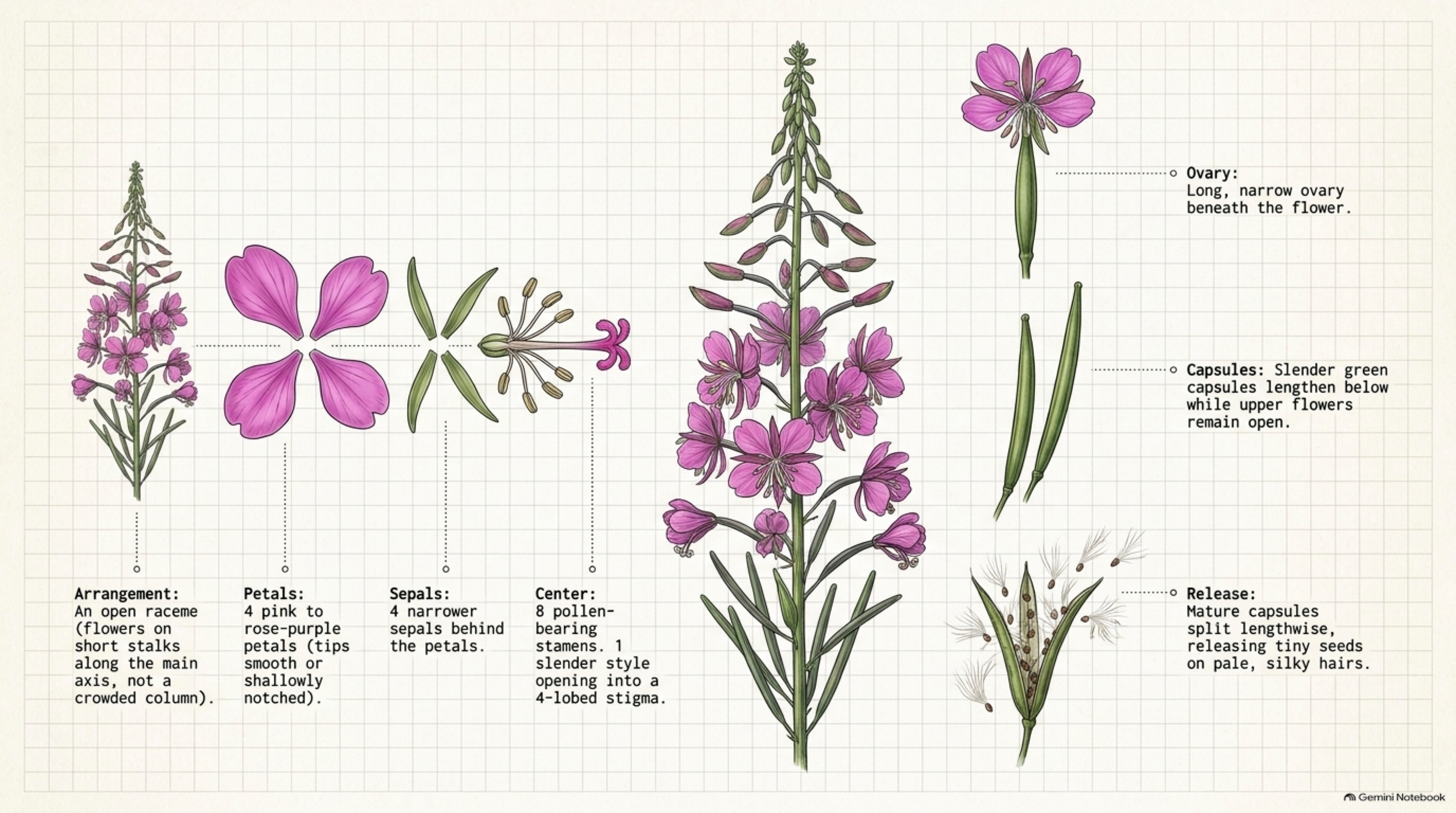
The English one carries a mistake. It’s natural to assume fire wakes the seed. It doesn’t. Fireweed seed germinates without burning; nurseries grow it with no flame anywhere near it, and nobody needs to scorch a garden bed to start a patch. Nor is the seed lying in the soil waiting for the next fire. When Anders Granström placed seeds in the forest-floor organic layer of a northern Swedish conifer stand and recovered them over time, the fireweed seed reserve was gone within the first year, partly because it had already germinated. Fireweed seed is generally nondormant, and natural seed banks in the soil are often short-lived.
So where does a patch come from? Two places, and that’s the plant’s real gift.
The first route rides the wind. Find a seed still held in an opening capsule and look closely. The seed body is about a millimetre long. The tuft of silk it rides, the coma, runs 10 to 17 millimetres: roughly ten to seventeen times the length. It slows the seed’s fall so moving air can take it. Arrival is only the first event, though. The seed still has to land on moist, exposed ground, germinate, and survive as a seedling. Silk caught on a dry stalk marks an arrival, not a plant.
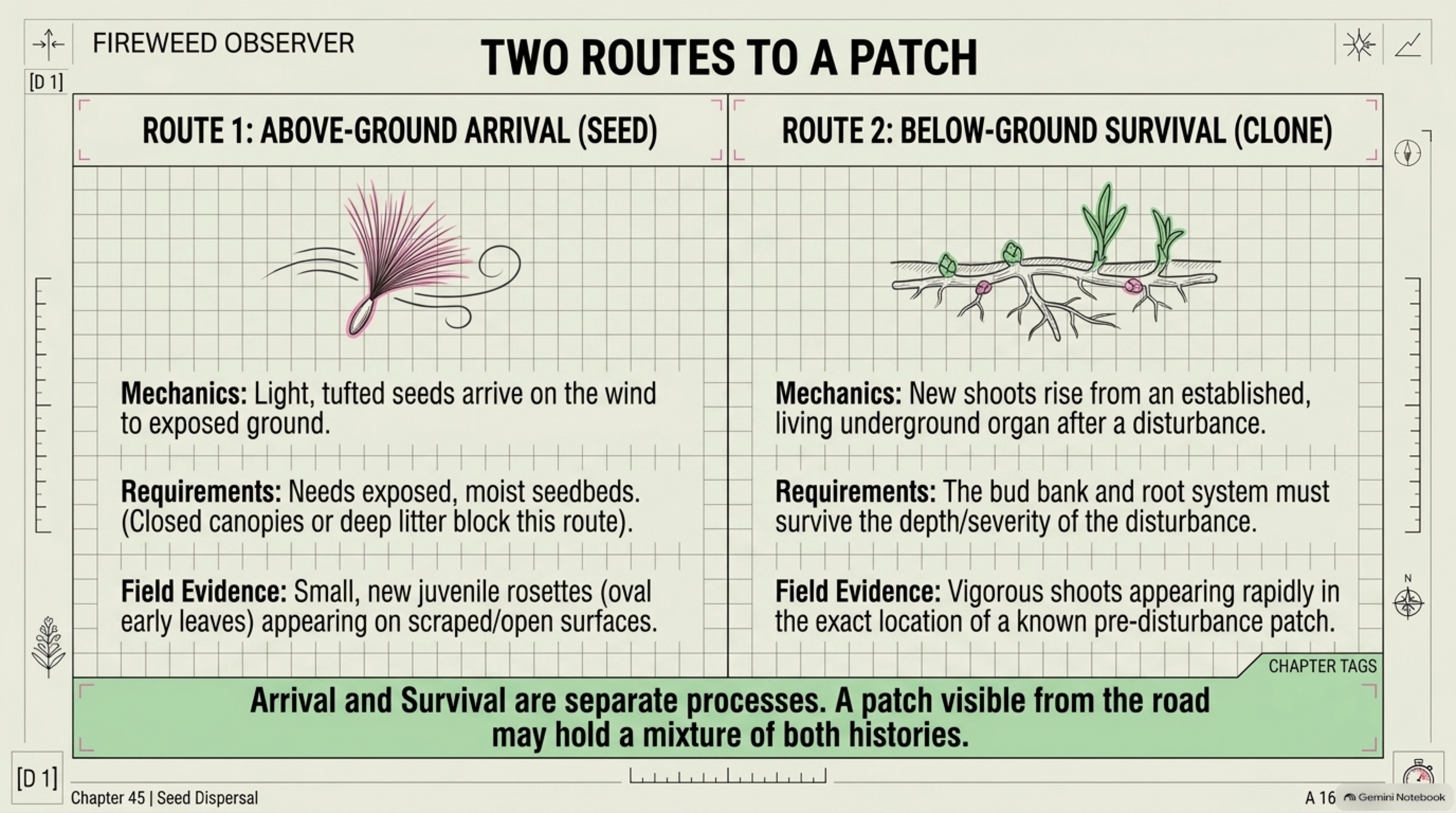
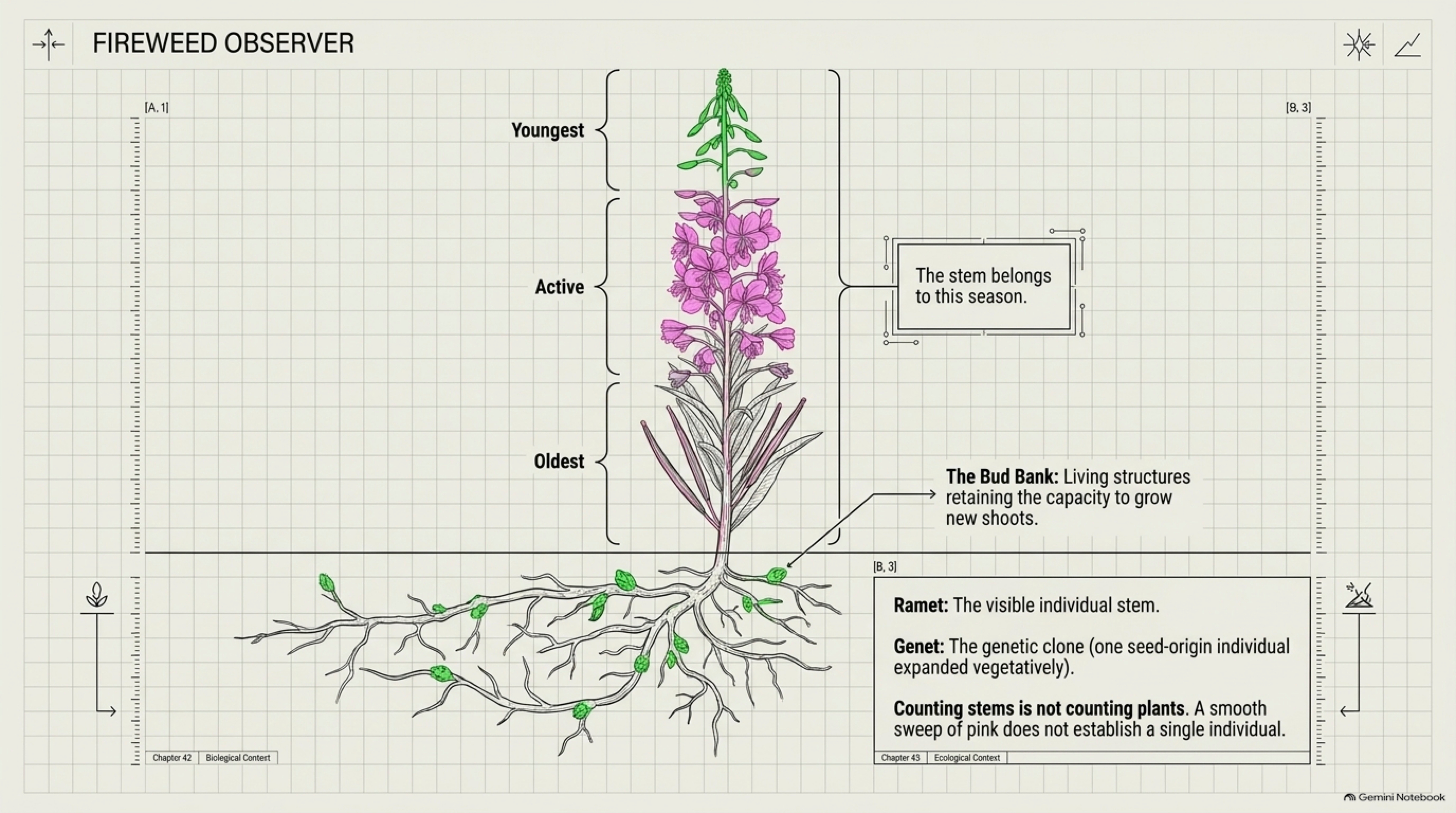
The second route never left. Fireweed is a perennial. Below a stem, roots extend through the soil carrying living buds (botanists call them a bud bank), and the plant stores reserves through the growing season. A boreal study by Simon Landhäusser and Victor Lieffers measured it doing exactly that. When fire or a blade kills the stem, those organs can survive and send up new shoots, sometimes beyond the edge of the patch you thought you knew. Many stems can belong to one plant: a single seedling’s underground system can become a clone.
Put the two routes together and a flowering stand stops being one thing. It can hold fresh arrivals from the next valley, old survivors coming up from below, and several generations of both, under one unbroken sheet of pink. The flowers alone can’t tell you which is which.
And it can’t grade the burn
Here’s the second half of the reversal, and it’s the one I most want you to carry out to the field. It’s tempting to believe fireweed reads a fire for you: thick, tall magenta where the burn was gentle, thin stems where it ran hot. It’s a lovely idea. The evidence doesn’t carry it.
Height and density can’t, by themselves, tell you how severely ground burned. Seed supply, which underground plants survived, moisture, shade, the neighbouring vegetation and whatever management came afterward all shape the stand. Similar-looking patches can have different histories, and one burn can grow back very differently from one end to the other. Experimental burns in Swedish forest by Schimmel and Granström showed that survival depends partly on how deep the living structures sit relative to how deep the fire burned. That’s a real relationship, but it doesn’t hand anyone a scale for reading severity off fireweed in British Columbia.
Nor does fireweed keep a timetable. As shrubs and trees close in, it may thin to the bright edges. But a peak recorded in one study can’t promise when a patch elsewhere will fade, and an opening that keeps getting disturbed may go on favouring it. A road edge mowed for visibility has a different future from a clearing left to grow up under trees.
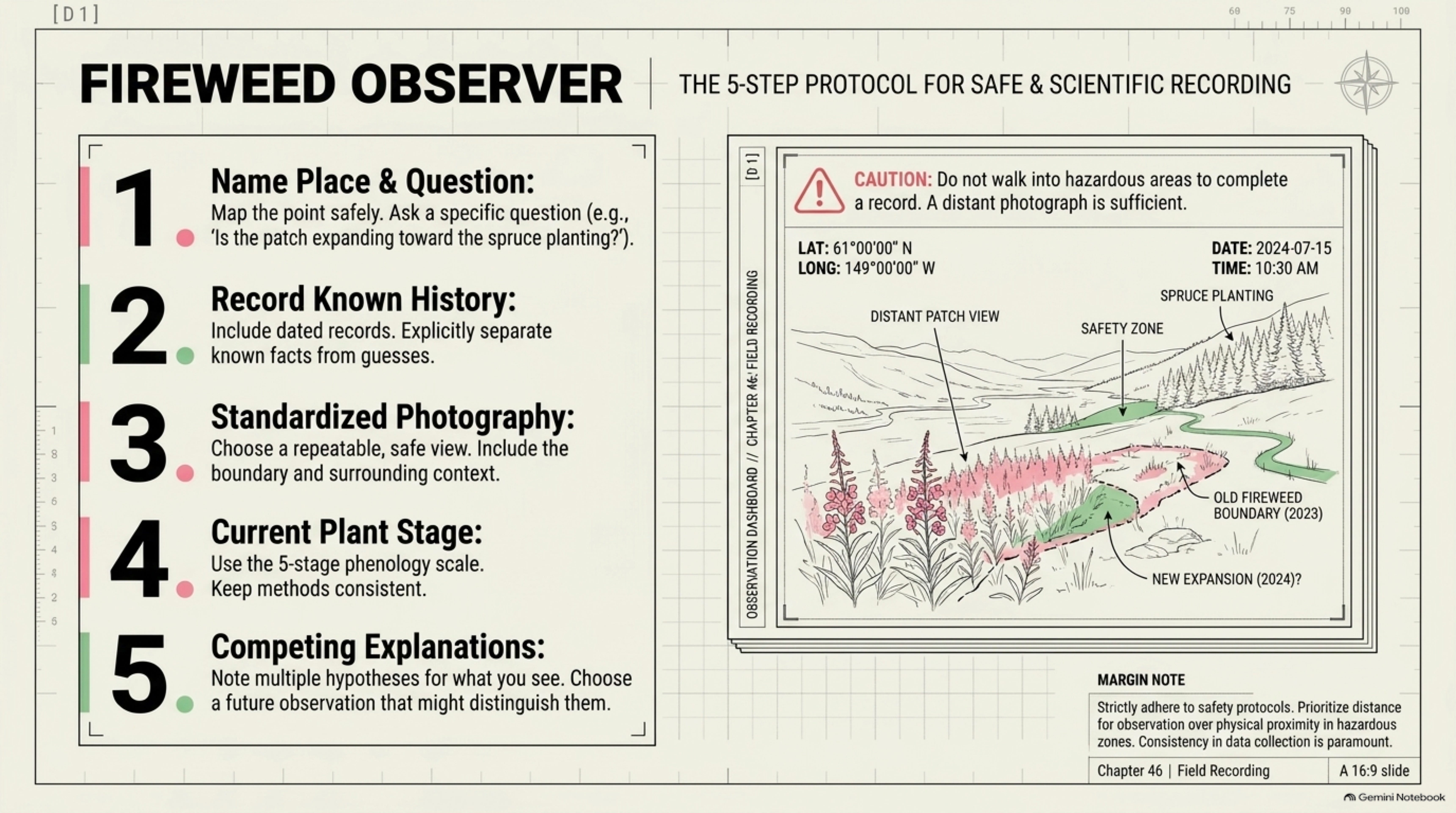
What fireweed can do is draw your eye to a place worth reading. Follow the boundary instead of stopping at the flowers. Does it thin under a shrub, stop at a track, end where the slope turns dry? Each edge is a question. The answer has to come from the place’s history, not the plant’s height.
A flower built like a staircase
Get level with an open flower. Eight stamens carry pollen. In the centre, the style holds the stigma, the surface that receives pollen. In a young flower the anthers are shedding while the stigma’s four lobes stay shut and the style bends away. Later the style swings forward and the lobes spread open. Each flower is male first, female second. Botanists call it protandry.
Now step back and look up the stem. Lower flowers open first. So at any moment the older, receptive flowers sit below the younger, pollen-shedding ones. A bumblebee that lands low and climbs, which is what they tend to do, touches receptive stigmas first, delivering pollen it brought from elsewhere, then loads up on fresh pollen higher up before flying off. The flowers are arranged like a staircase, and the bee climbs it in the right order.
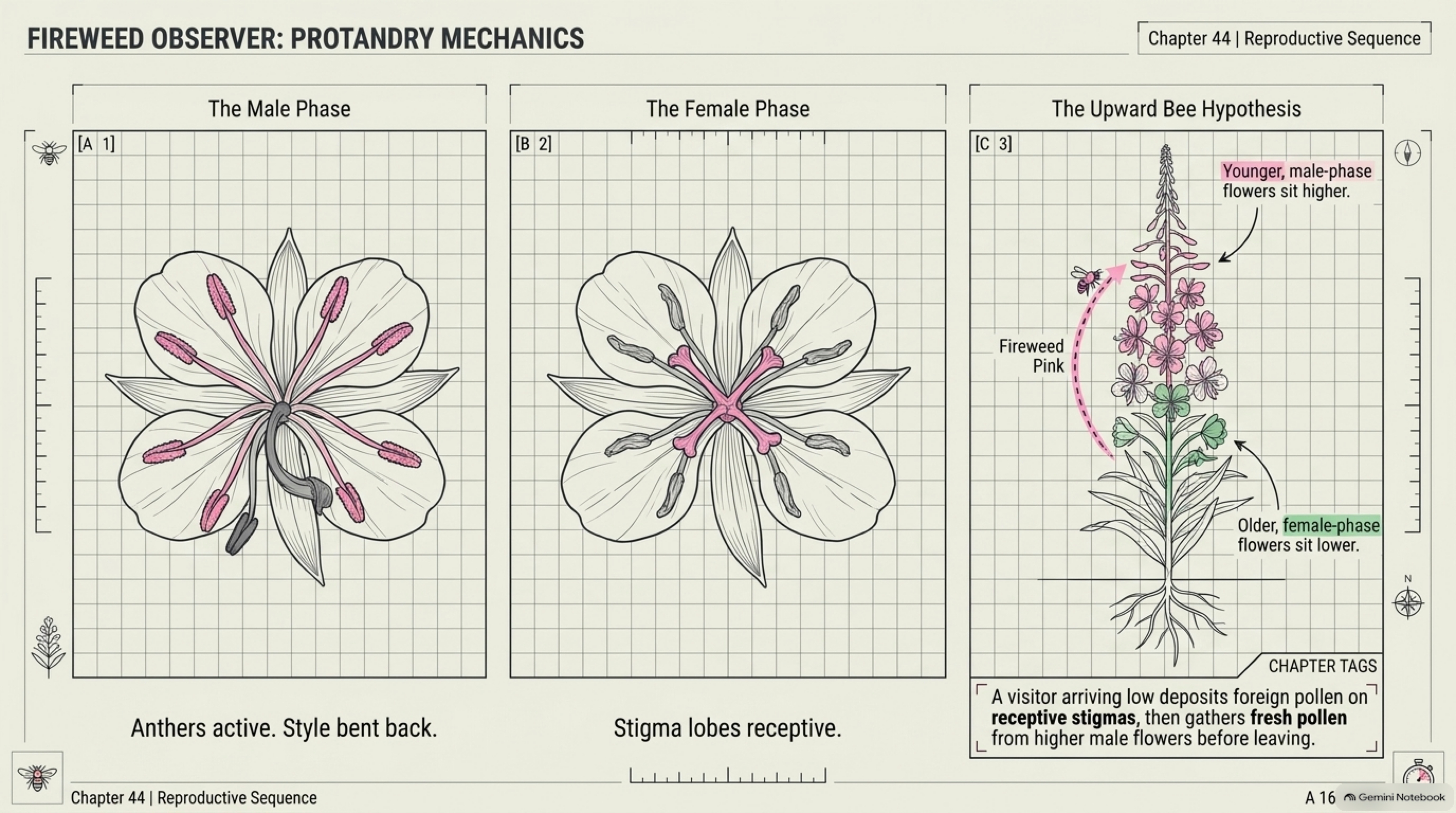
The bees complicate it nicely. Candace Galen and R. C. Plowright watched Bombus terricola on fireweed and found that nectar-collecting workers usually started low, while pollen collectors tended to arrive around the middle. Both moved upward. What the bee was shopping for changed where it entered the building.
And the staircase isn’t a lock. Fireweed can fertilise itself, and a bee carrying pollen between two stems of one clone is still moving it within a single genetic individual: a short flight that only looks like a cross. In experiments by Matthew Routley and Brian Husband, plants with the male-first sequence sired more offspring on other plants, so the arrangement pays. But it favours crossing rather than guaranteeing it, and Husband and Douglas Schemske found self-fertilised offspring performing worse in one diploid population. The design leans toward outcrossing. The bee still decides the route.
Ten seconds with a leaf held to the light
Hold a mature leaf up where the light comes through it. Fine side veins leave the midrib, curve outward, and join a line running just inside the edge. They meet before they reach the rim. Botanists call it the submarginal vein. Once you’ve seen it you’ll look for it on every walk.
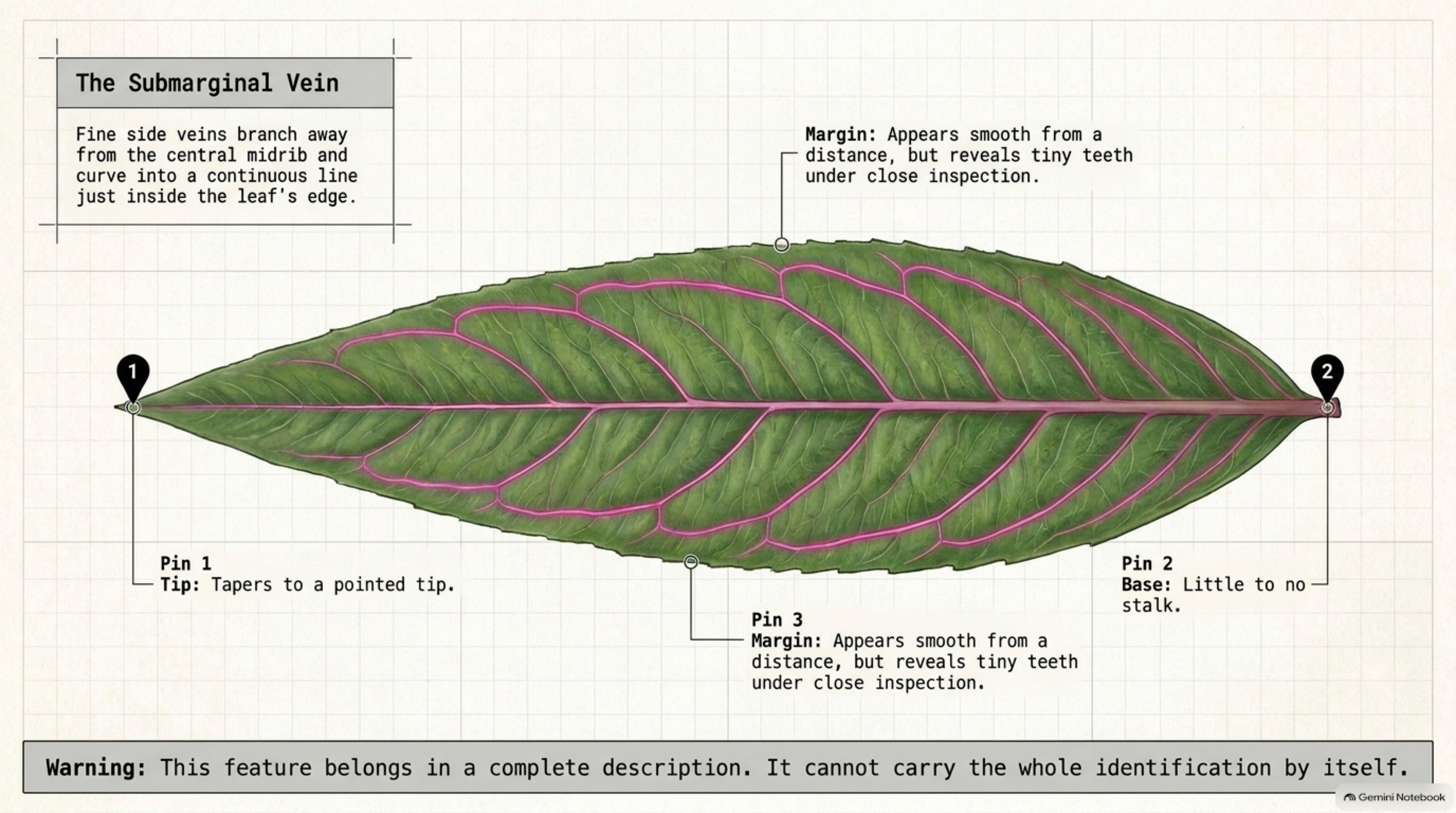
It’s one clue, not a verdict. Add the rest: leaves narrow and pointed, attached singly and turning around a round stem, with little or no leaf stalk; four-petalled flowers, each on its own short stalk, spaced along a long central stem (a raceme, not a dense spike); long, slender capsules lengthening below while flowers are still open above.
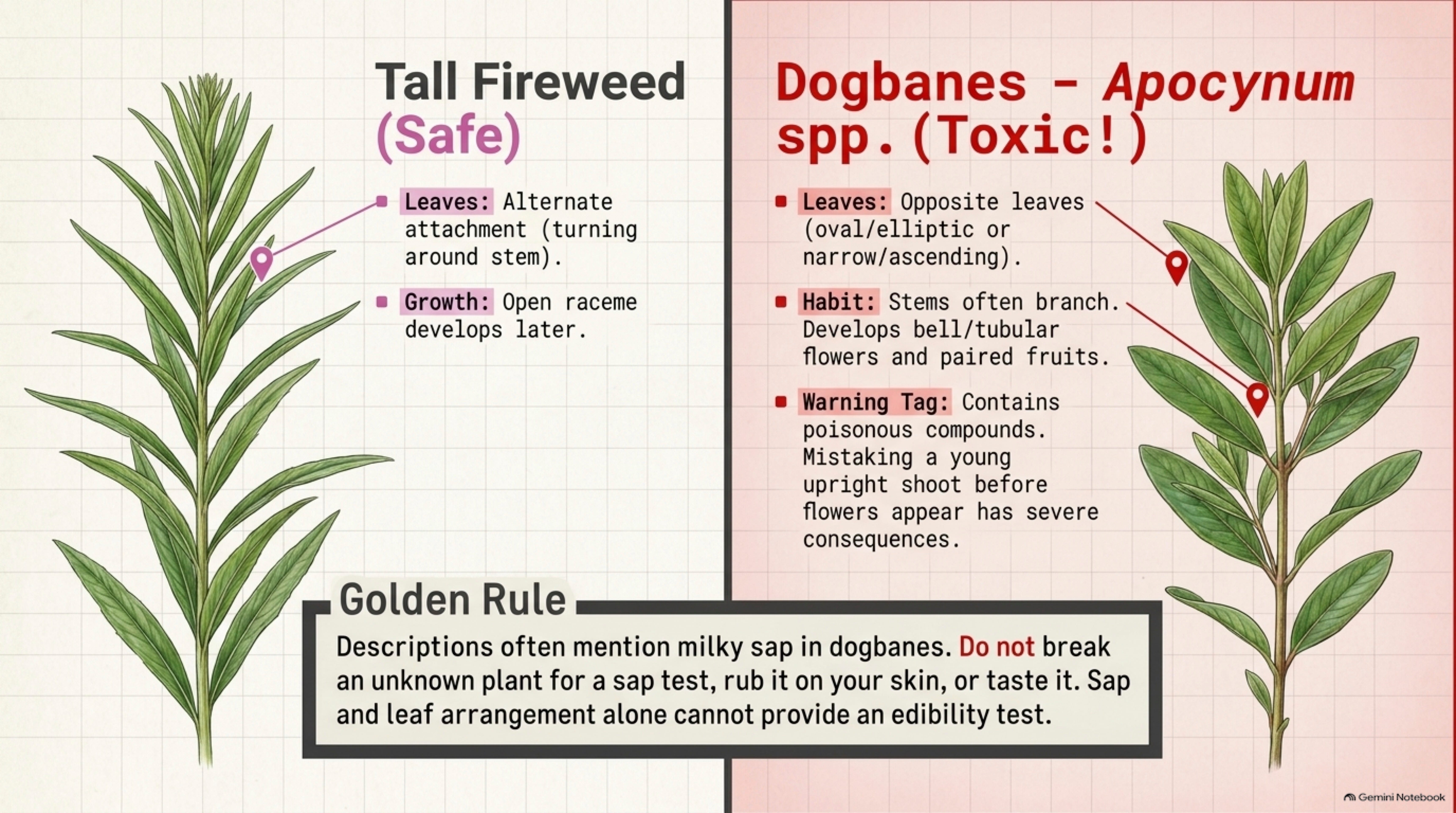
The lookalike that can hurt you is a spring one. Dogbanes (spreading dogbane and hemp dogbane) are poisonous, and their young shoots may lack the flowers that make the difference obvious. Spreading dogbane has opposite, oval-to-elliptic leaves on short stalks and branching stems; its small flowers are bell-shaped and white to pink. A young stem may not have branched yet, which is exactly why spring is the risky season. Observe an unfamiliar shoot where it stands. Don’t break it for a sap test, and never taste anything to identify it.
a\
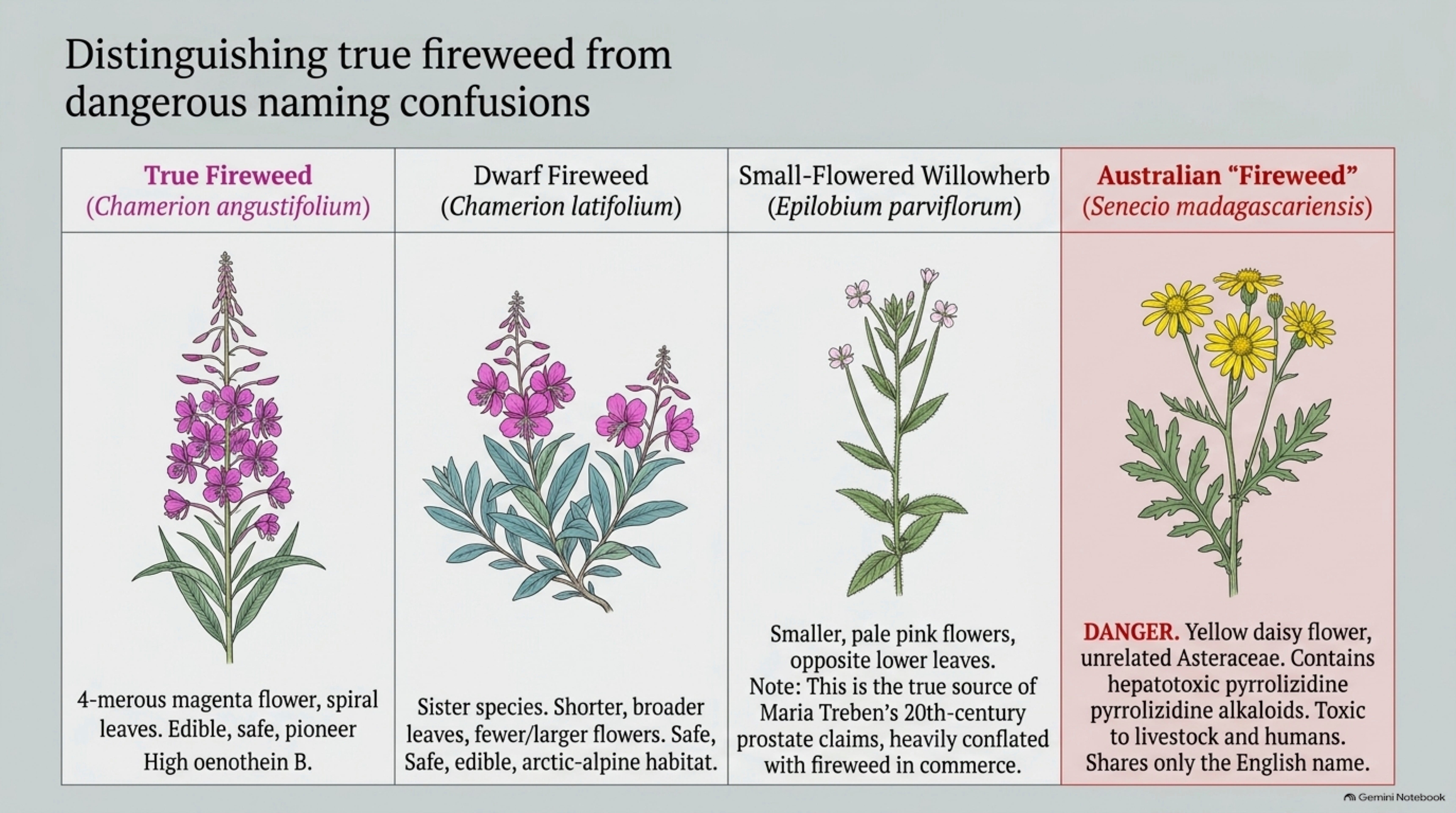
The others are comparisons, not hazards. Purple loosestrife can look like fireweed from across a ditch, but up close its flowers sit in dense clusters, often with six petals, on an angled stem, with leaves opposite or in threes lower down and small capsules. River beauty, or dwarf fireweed, is a close relative: lower, broader-leaved, big flowers, and it lacks the submarginal vein. Its recorded uses belong to it, not to tall fireweed, and the reverse holds too. Other willowherbs share the family pattern; a regional flora or a botanist settles them.
And check the name before you trust a warning. Search “fireweed toxic” and you may land on a yellow daisy in an Australian pasture. Senecio madagascariensis is unrelated to anything in this post, but it shares the English name, and Australian agricultural guidance documents its toxicity to livestock, including through contaminated fodder. Before you carry a warning into your notes, check the scientific name and the region. Ours is Chamaenerion angustifolium, the name Canada’s VASCAN database and Flora of North America use. You’ll also meet it as Chamerion angustifolium, and Kew accepts Epilobium angustifolium. Same plant, three filing cabinets.
Put the six-week saying on trial
Here’s the useful thing, and October is a fine time to start it.
There’s a northern saying, recorded on a National Park Service photo caption at Dyea, Alaska: once the top of the fireweed has finished flowering, winter is six weeks away. The caption records it without any data behind it. That makes it yours to test.
Some fireweed calendars are older and far more particular than a caption. In “When the Wild Roses Bloom,” Nancy Turner and Andrea Reid credit Bernadette Antoine, Nlaka’pamux, with an account connecting full fireweed bloom to the time to hunt mule deer, after the fawns are born. That’s a calendar tied to one people’s country in the southern Interior, a plant’s development read against an animal’s life. It’s a different kind of knowledge from a one-line saying on a caption, and worth keeping in its place with her name beside it.
To give the saying a fair trial on your own patch, decide your terms before you look at a single date:
What counts as “finished flowering”? One chosen stem, most of the patch, or the last open flower within your boundary?
What counts as “winter”? First frost, or snow that stays? They rarely arrive together.
Where exactly? Pick a patch you have permission to revisit and a viewpoint you can find again: a fence post, a rock.
Then keep five stages through the year: emergence, first flower seen, advancing bloom, first open capsule, dieback.Photograph from the same spot each visit. Write “first seen,” not “first opened”: if flowers appeared between visits, record the last visit without them alongside the first visit with them. Mark missed visits as missed. After a season, you’ll have an interval. After several, you’ll know whether the saying works where you live. A neighbouring valley still needs its own record.
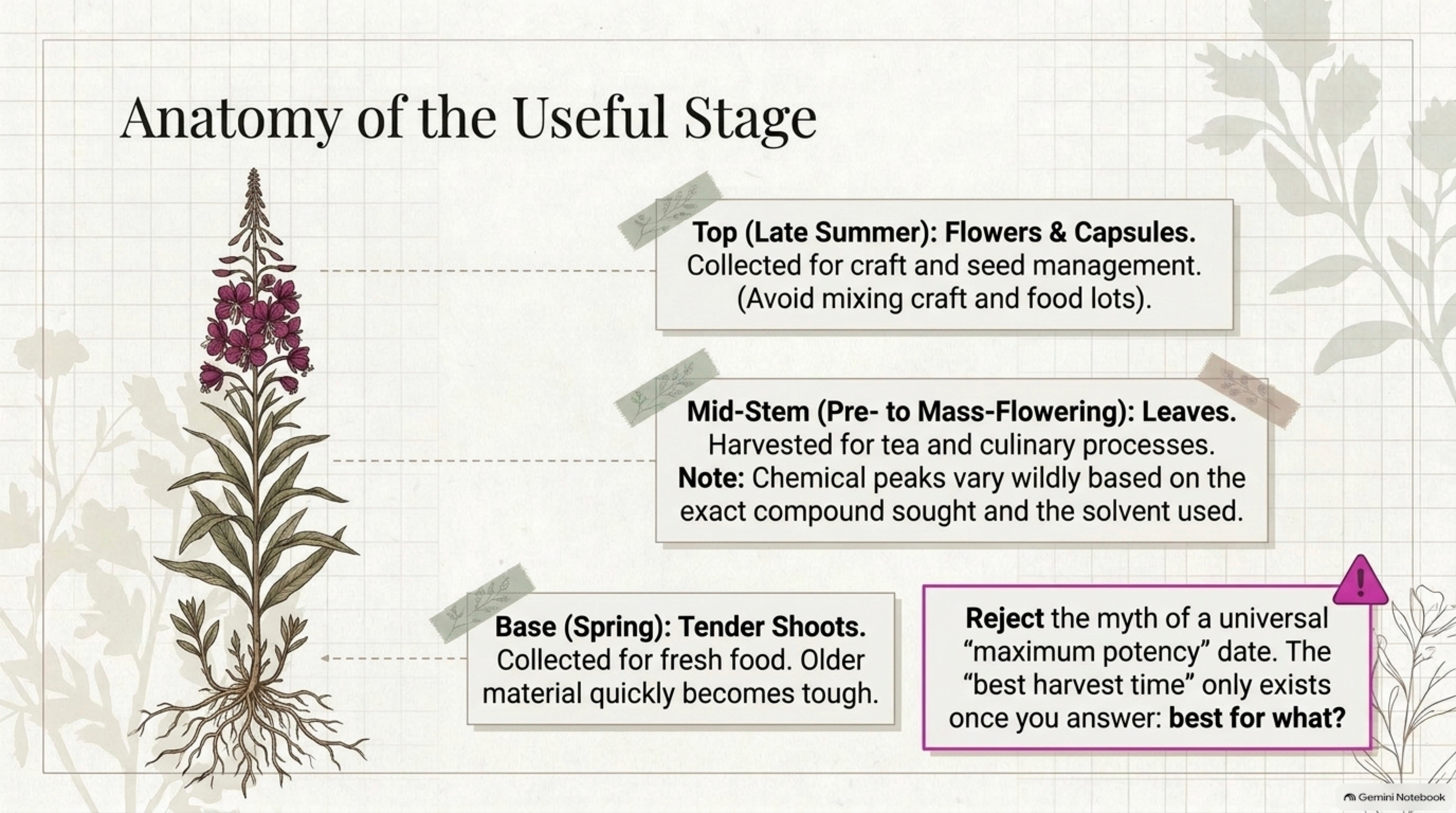
You can begin now. An opening capsule or a dry stalk is a perfectly good first entry, and Sunday’s guide includes a ready-made page for it (Tool 1, the seasonal strip). Send me your patch’s dates when you have a year of them. I’d like to know too.
If you’re thinking of eating it come spring: young shoots and leaves have documented food uses. University of Alaska Fairbanks Extension describes them as culinary material; the Gwich’in Social & Cultural Institute records tall-fireweed shoots eaten in spring (crediting Alestine Andre and Alan Fehr’s Gwich’in Ethnobotany); the Alutiiq Museum in Kodiak records leaves and shoots as vegetables. Before any of it reaches a pan, five things must all be true: the plant is confirmed tall fireweed at its current stage; the place allows collection and has a history you can establish as suitable (spraying, roads, rail lines, runoff and industrial ground all count against it); the part suits the preparation; the handling is clean and cold; and the method is one you trust. After a wildfire, leave anything near burned buildings, vehicles, stored chemicals or their ash out of food entirely until the site has been assessed. Washing can’t clear it, and green growth can’t establish that it’s safe. And if someone eats a plant nobody could identify: in Canada, call a poison centre at 1-844-764-7669(Quebec: 1-800-463-5060; Nunavut: your local health centre); in the US, 1-800-222-1222. Call 911 for collapse, seizure, trouble breathing, or someone who can’t be woken. Don’t wait for symptoms.
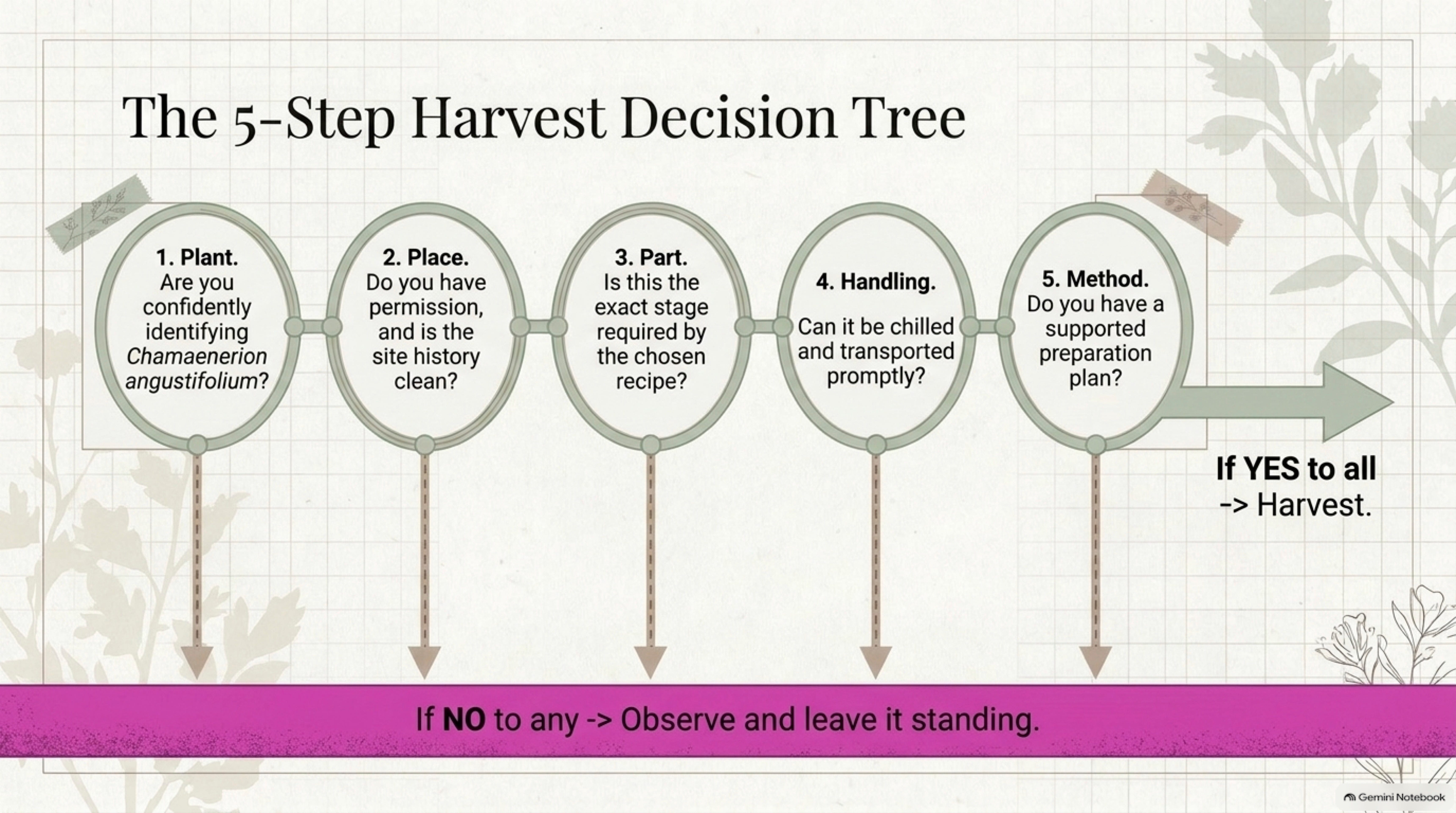
Everything above is the plant on its own terms: how it arrives, how its flowers work, how to know it, how to read it against your own season. Below is what happens when you put fireweed in a cup, on a label, in a forestry budget or in a jar for sale. That’s where the stakes change, and where most of what’s repeated about this plant comes apart. Five bigger questions:
Does fireweed actually help the prostate, and what can a herbalist honestly tell a client?
Is Ivan chai the ancient remedy the packet says it is?
When should leaves be cut for tea, and does “fermenting” make it stronger?
If fireweed is crowding a planting, which clearing actually pays off over fifteen years?
Before you sell fireweed honey, syrup, jelly or tea, what has to be true?
Normally, the paywall falls here. This week it’s open, so read on and decide for yourself whether this side is worth it.
The capsule and the cup are different medicines
For herbalists, and anyone a friend asks about their prostate.
Start with the best human evidence there is, and read it closely. In 2021, Esposito and colleagues ran a six-month, double-blind trial at one Italian centre: 128 men with benign prostatic hyperplasia (BPH), randomly assigned to a standardized Epilobium angustifolium extract in gastric-resistant capsules (70 men) or placebo (58).
Here’s the worked example, using the trial’s own figures. On the International Prostate Symptom Score, where lower is better:

The gap between the two groups’ changes is about 2.5 points in the extract’s favour. Night-time urination on the night before study visits also favoured the extract. No treatment-related adverse effects were reported.
Now the part the packet leaves out. Those were secondary outcomes. The primary outcomes were prostate volume, which showed no significant treatment effect, and urine left in the bladder after voiding, where the extract group’s average barely moved, although the spread of values changed. One centre, limited follow-up, men on certain medicines excluded, industry involvement. And nobody drank tea. So this is one trial of one capsule product, suggesting some symptom relief and no shrinkage. That’s worth taking seriously and worth replicating independently. It is not evidence for a cup of fireweed tea.
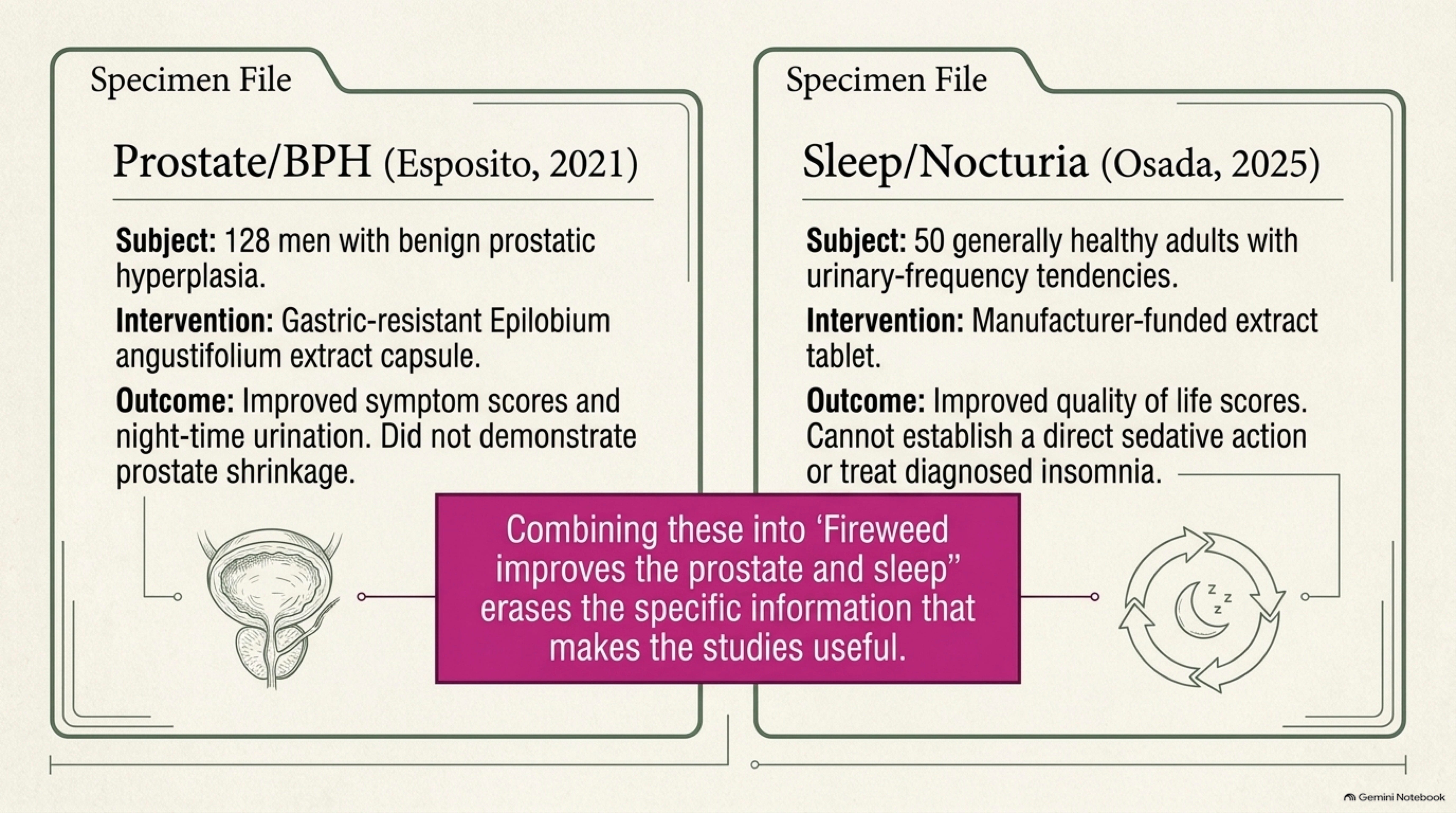
The sleep story is thinner. Osada and colleagues (2025) randomised 50 generally healthy Japanese adults with urinary-frequency tendencies and sleep complaints to extract tablets or placebo for eight weeks, with 47 analysed. A quality-of-life questionnaire about night-time urination favoured the extract overall and in its Sleep/Energy domain; other domains didn’t move significantly. The manufacturer funded it, most authors were company-affiliated, and nobody measured how often people got up in the night or how long they lay awake. That doesn’t establish fireweed as a sedative or a treatment for insomnia. A warm cup in an evening routine can be lovely without being a drug.
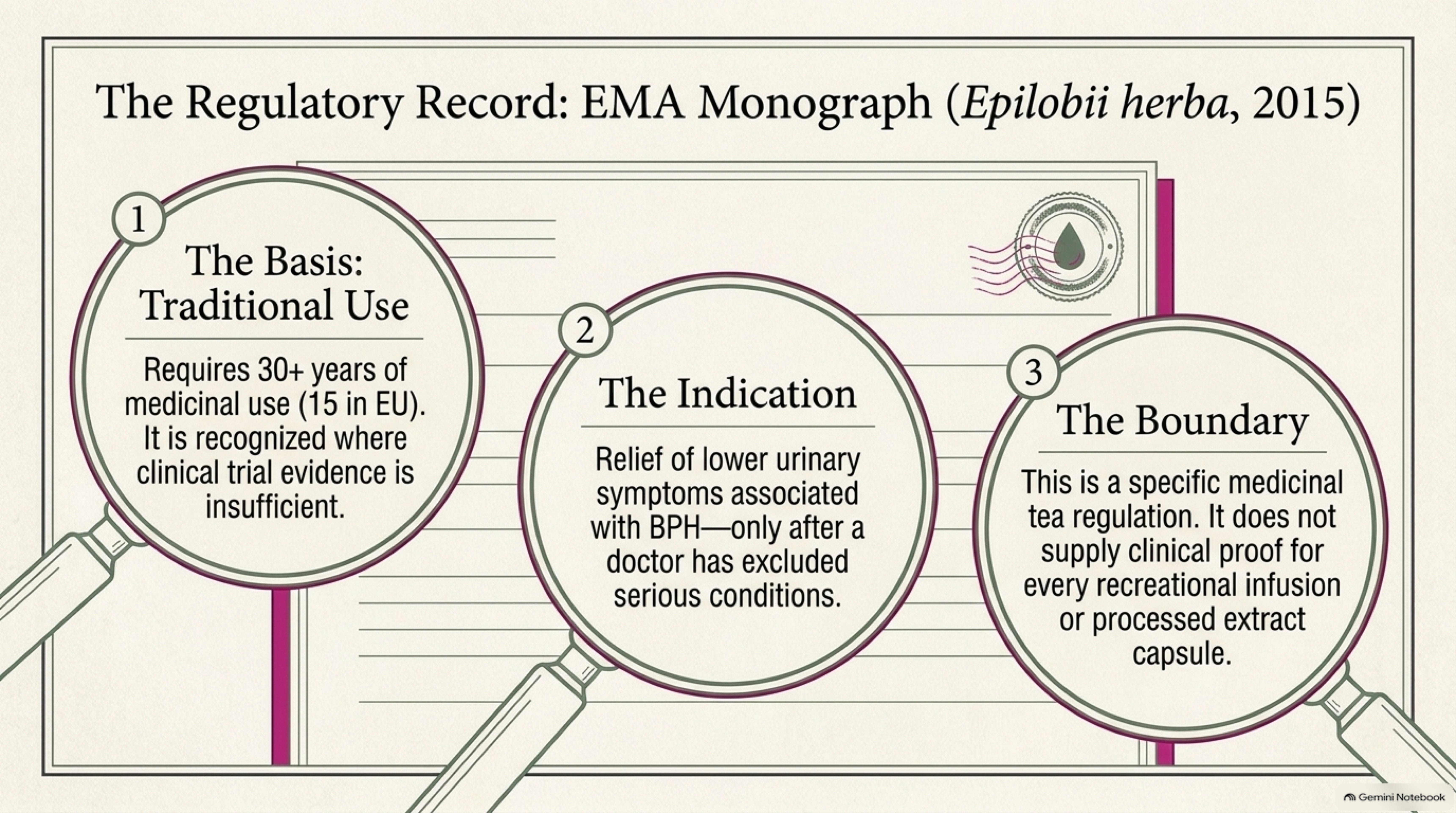
Then the regulator. The European Medicines Agency’s monograph on Epilobii herba (adopted 2015, published 2016) covers the cut-up above-ground herb of E. angustifolium and/or E. parviflorum as a medicinal tea, for relief of lower urinary symptoms associated with BPH, after a doctor has excluded serious conditions. Its basis is traditional use: at least thirty years of medicinal use, fifteen of them in the EU, plus plausible effectiveness. It is not proof from trials. When the EMA reviewed it again in 2022 it considered the Esposito trial and kept the traditional-use basis, finding the trial’s extract insufficiently described. That recognition covers a defined medicinal preparation. It doesn’t mean every branded tea or kitchen infusion has been tested.
On interactions, a correction worth making. In Ducrey’s 1997 lab work, isolated compounds from Epilobium species (oenotheins) inhibited enzymes involved in hormone metabolism. It’s tempting to turn that into a list of medicines to avoid. Resist it: it’s a mechanism worth investigating. It is not a documented interaction between a cup and any named medicine, and the EMA monograph records no reported interactions. The honest advice is general, not a scary list: anyone on regular medicines, or considering a concentrated extract, takes the exact product to a pharmacist or clinician. Nobody stops a prescribed treatment to try fireweed.
The frame that travels with it, every time:
Avoid it if allergic, and stop at any suspected reaction. Trouble breathing or swelling of the mouth or throat is an emergency.
Pregnancy, breastfeeding and children: therapeutic safety isn’t established. Get individual advice; never scale down an adult amount.
Persistent or worsening urinary symptoms need assessment, not a stronger brew.
Get immediate medical care for any of these: you can’t urinate; there’s blood in the urine; there’s severe lower-abdominal or urinary pain; or urination is painful, frequent or urgent together with fever and chills. Don’t wait to see whether fireweed helps.
No dose here, on purpose. If someone is considering a medicinal product, the label, the leaflet and a professional decide the amount.
What you can honestly tell a client, in three sentences: One industry-involved trial of a specific standardised extract found an improvement in urinary symptom scores, without shrinking the prostate. The EU recognises fireweed medicinal tea on the strength of long traditional use, for men whose doctor has already ruled out anything serious. The tea in your kitchen and the capsule in that trial aren’t the same product, so let’s look at what you’re actually taking.
“Ancient” is the most expensive word on the packet
For tea makers, sellers, and anyone buying for a dispensary.
The packet story goes: Ivan chai, an ancient Russian folk remedy for men’s health, rediscovered. Two 2020 studies took it apart, gently and thoroughly.
Julia Prakofjewa and colleagues’ “Re-written narrative” followed Ivan-chaj practice and the stories told about it across Eastern Europe. The drink’s reputation moved from tea substitute and imitation to promoted national heritage, with media and commercial storytelling playing their part. In interviews conducted in 2018, one participant in Karelia recalled learning the processed tea in 1989. Others who gave a starting date had begun one to four years before the interview. The origin legends you’ll find repeated aren’t established by the evidence.
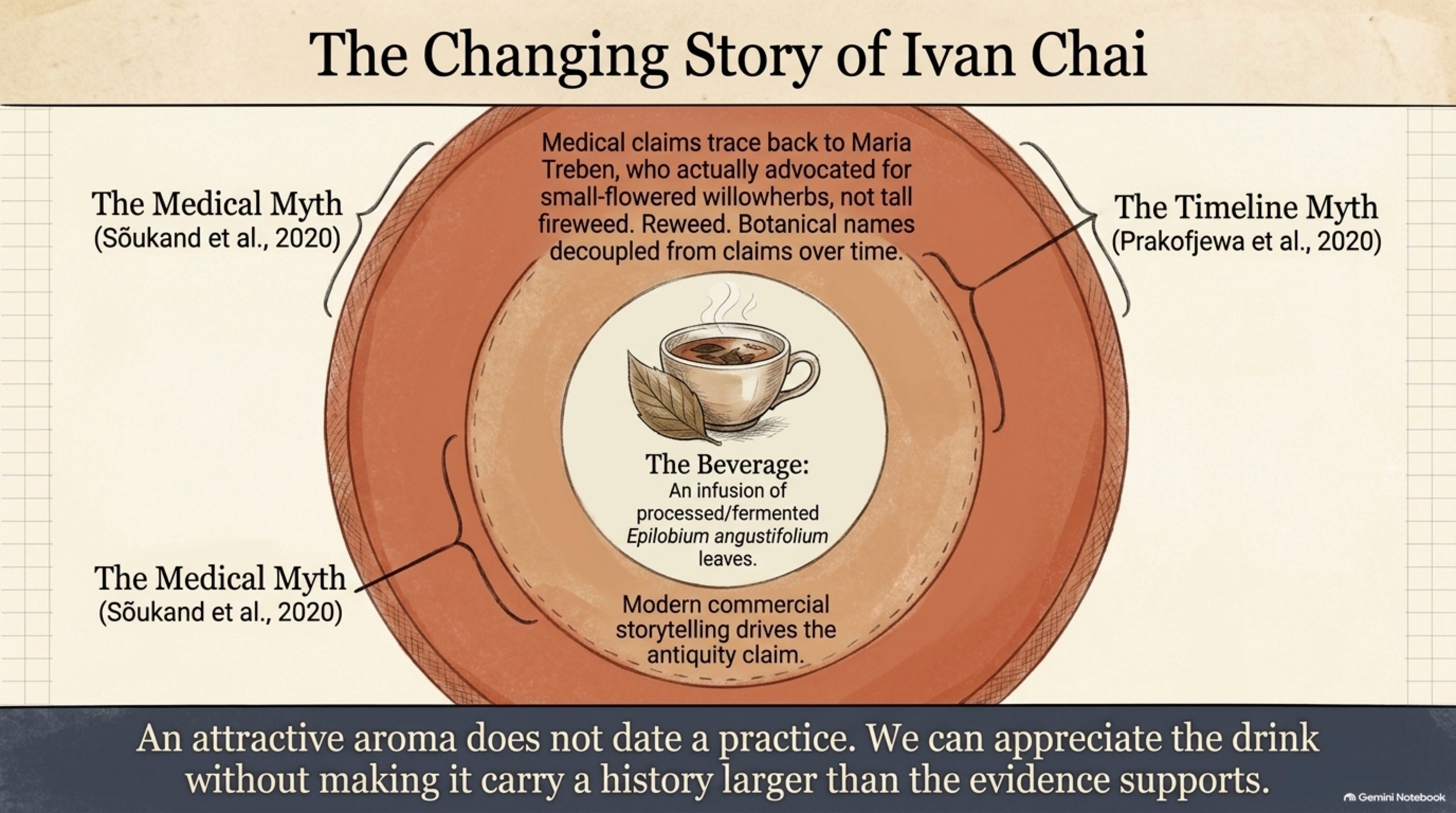
Renata Sõukand and colleagues’ “Inventing a herbal tradition” combined 599 interviews across seven countries with historical analysis of how the medicinal claims spread. One finding deserves a place on every label: Maria Treben’s advocacy, much repeated in later accounts, centred on small-flowered willowherbs, not tall fireweed. As the claims travelled through print, the botanical names and quotations came loose, and a reference to one willowherb started holding up a claim about a different species.
None of that makes a cup made today less worth drinking. A household can acquire a meaningful habit within a generation, and a maker can work skilfully while repeating an origin story that needs correcting. But if you sell, every sentence on the packet is a claim someone can ask you to support. In Canada, Health Canada’s guidance on classifying products at the line between food and natural health product weighs composition, how the product is represented, its format, public perception and history of use. Calling it “tea” doesn’t settle the question. A health claim needs supporting evidence and has to meet the applicable rules, and some claims need authorisation before they can be made at all. “Ancient” costs nothing to print. Supporting it is another matter.
And if you’re buying, two 2026 studies say check the jar itself. Chudinov and colleagues ran several analytical methods on seven retail herbal beverages from Russia and confirmed undeclared purple loosestrife (Lythrum) in two. That’s a small sample, not a market estimate, but it proves the problem exists and that checking identity takes more than one method. Mykhailenko and colleagues measured sixteen commercial Epilobium teas and found constituents varying substantially, including among products carrying the same species name. (They used laboratory extracts of the dry tea, not brewed cups, and relied on the labels for species.) Identity and chemical consistency are separate checks, and you need both.
Run any label through the guide’s five questions (Tool 6). Try it on this invented one: “Fireweed leaf tea. Rich in oenothein B. Clinically proven for restful nights and prostate health.” The first sentence needs identity evidence. “Rich” needs a measurement and something to compare it against. The last sentence needs a clinical study of this leaf tea, in people like the buyer, measuring both promises. A capsule trial can’t lend its result to a tea through a shared molecule. Where the link is missing, judge the drink on its flavour.
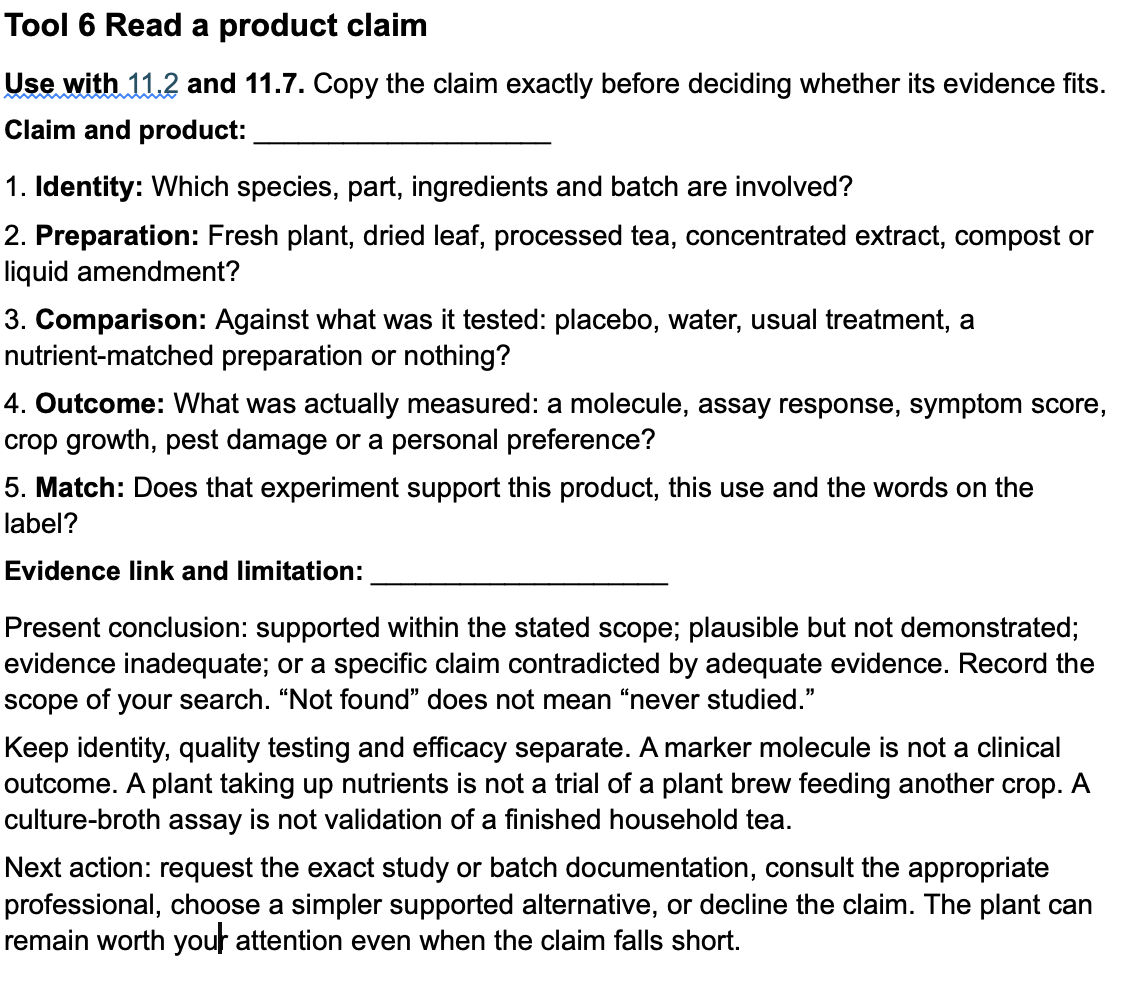
The money line: ask suppliers for botanical authentication, a batch number, and what exactly was tested, when and in which lot. “Laboratory tested” means something only when someone can tell you what the laboratory tested.
The craft and the chromatograph want different leaves
For anyone harvesting leaf for tea, to drink or to sell.
One rule says to cut leaves just before flowering, when the chemistry peaks. The two studies the guide examines don’t support it. Maruška and colleagues found the highest total of the flavonoids they measured at mass flowering. Ivanauskas and colleagues, working with Ukrainian material through early, mass and late flowering, found many leaf polyphenols highest late in flowering, with other compound groups following different patterns. Their study didn’t sample before flowering, so it can’t speak for the early season either way. Together they don’t support any single best harvest moment, and certainly not a pre-flowering peak.
The way out is to ask what the harvest is for. A leaf that rolls without shattering, a cup that tastes good, and the highest concentration of a particular compound are three different targets. Pick your stage for your purpose, and say which purpose it is.
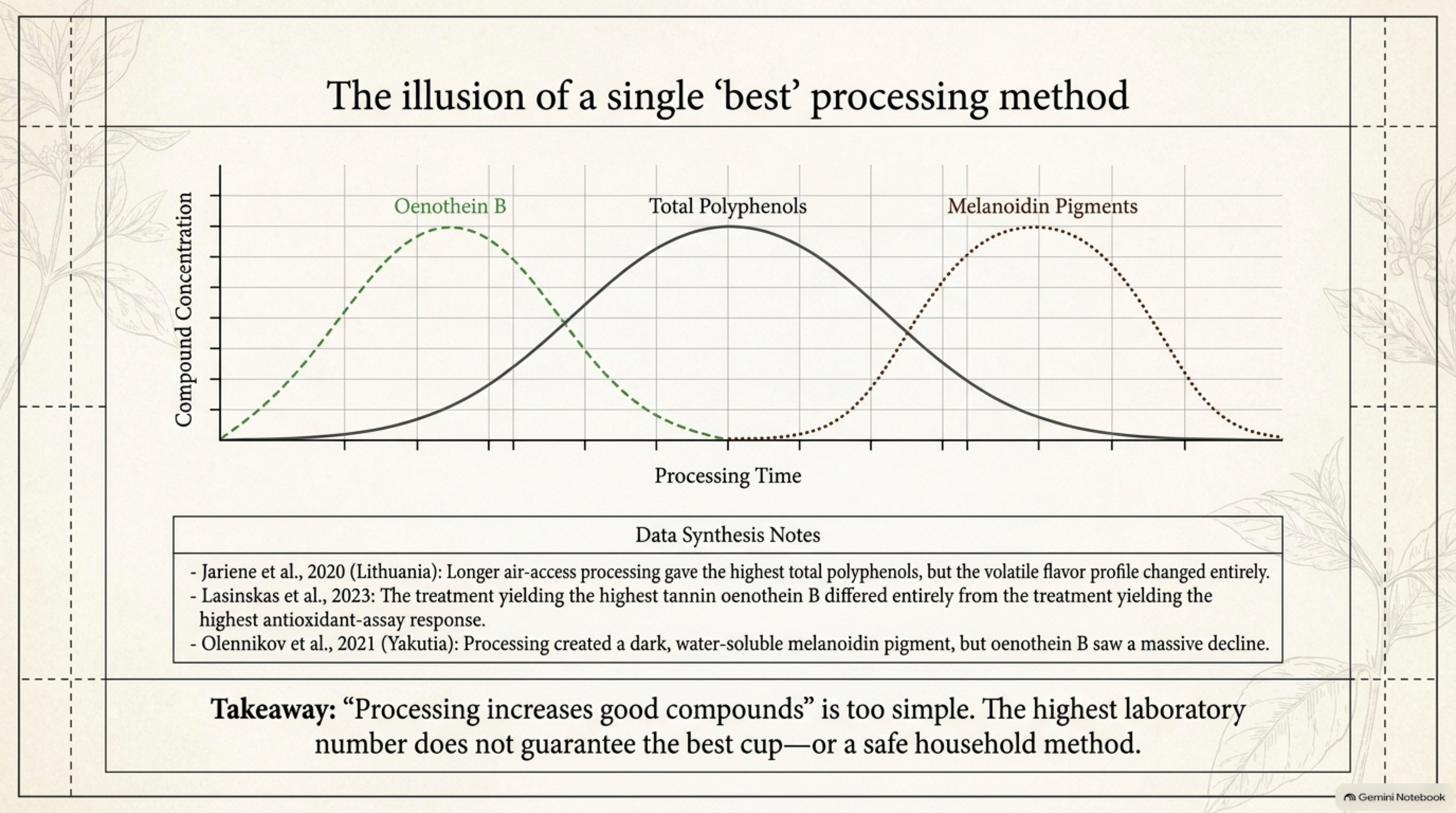
Processing raises the same trap. “Fermented” fireweed tea sounds stronger. The experiments say it depends on what you measure:
Jariene and colleagues (2020, Lithuania): the longer air-access treatment gave the highest total-polyphenol result and changed the volatile profile.
Lasinskas and colleagues (2023): the treatment yielding the most oenothein B, the tannin most often used as fireweed’s chemical marker, wasn’t the one with the strongest antioxidant-assay response, and some leading results weren’t significantly different from each other.
Olennikov and colleagues (2021, Yakutia): after a different chamber process, oenothein B dropped substantially, while overall antioxidant capacity of the dried leaf didn’t differ significantly, and the researchers isolated a new dark, water-soluble pigment with antioxidant activity of its own.
So a darker leaf can hold less of a given compound than it started with, and colour can’t tell you which way it went. And “fermentation” means two different things: enzyme-driven oxidation in bruised leaf, as in black tea, or changes caused by microbes. Both meanings turn up in fireweed writing, sometimes in one paper. Where microbes are deliberately involved, as in Efimenko’s controlled work with an identified fungal strain, the safety testing belongs to that lab system, not to a jar on your counter. Fermentation doesn’t make a tea probiotic either; that claim needs identified live organisms, an adequate amount, and a demonstrated benefit.
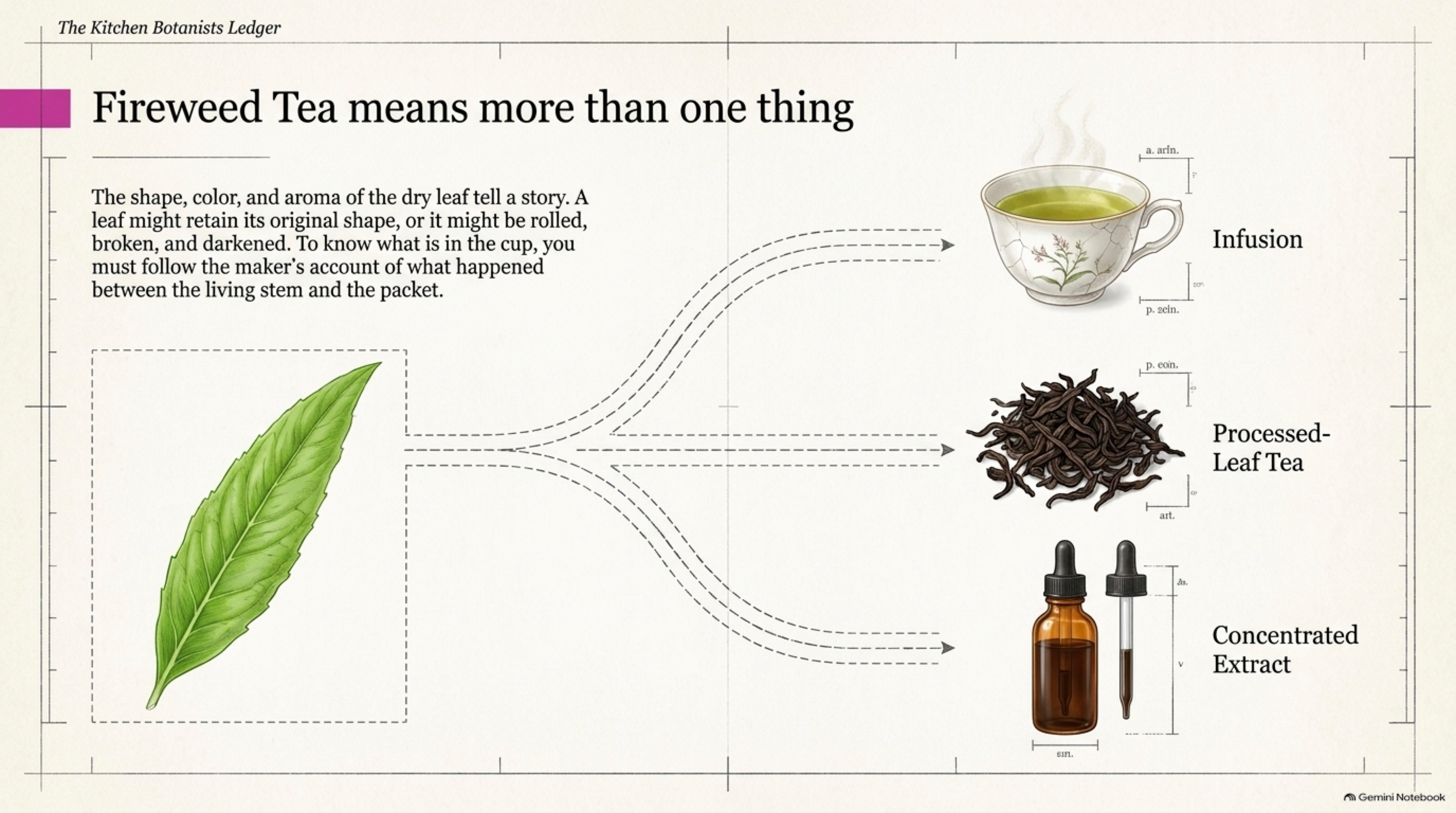
The judgment: if you make tea for flavour, choose the stage that rolls and tastes the way you want and stop chasing laboratory numbers. (Note that the guide doesn’t yet supply a complete home-drying schedule either.) If you want to sell on a compound, a paper won’t do; you’d need measurements of your own product. And be clear-eyed about one more gap: the guide does not supply a validated home method for moist-leaf processing, and says so. Before teaching a process or scaling one for sale, a food-safety specialist needs to review the exact steps, from holding conditions through drying endpoint to storage. If you want a processed cup now, buy a finished product with a clear identity, batch and brewing instructions. (UAF also notes the tea can be mildly laxative for some people.)
The cleanest clearing isn’t the best investment
For land managers, foresters and ranchers deciding whether fireweed is a problem worth paying to solve.
In 1992 a British Columbia experiment began comparing single and repeated manual cutting, a glyphosate treatment, and untreated plots in a mixed shrub-and-herb community around planted Engelmann spruce. Fireweed was one member of that community. What makes the experiment so useful is that it was measured twice, ten years apart, and the two readings disagree.
At year five (Comeau, Biring and Harper, 2000), repeated cutting and glyphosate had both thickened the spruce near the base compared with untreated plots, and repeated summer cutting had increased height. Survival didn’t differ. Total vegetation cover no longer differed, though vegetation stayed shorter in several treatments.
At year fifteen (Comeau and Harper, 2009), the differences in average spruce height and diameter were no longer statistically significant. But survival was now higher in every vegetation-control treatment than in the untreated plots, and repeated cutting gave benefits comparable to glyphosate.
Read those together and the purchase changes. The size advantage seen at five years didn’t remain statistically clear. What emerged instead was a survival benefit, and the hand-cutting option delivered it as well as the chemical one did. The official project record also names the repeated visits as a substantial cost of manual treatment, so count labour across the whole sequence, including assessment and follow-up, not just treatment day. And this was an Interior Cedar–Hemlock site with a mixed community, so it isn’t a prescription for a pure fireweed stand, a dry valley or a garden.
There’s a second ledger. Lisa Wood and colleagues (2025) studied fireweed after sublethal glyphosate exposure. In growth chambers, treated plants were shorter with reduced photosynthetic efficiency. In operational BC forests, pollen viability was lower one year after treatment (the two-year comparison didn’t differ significantly from controls), and herbicide residues turned up in the flowers at both intervals. The study didn’t measure bee-colony effects or a safe food-harvest interval. But if your land feeds bees or anyone forages it, residues in the flowers belong in the decision.
The judgment: write the outcome down before you choose the tool. Is it survival of planted trees? Growth by a given year? Clear access? Set the threshold that would justify acting. Then put every option through the same questions: what happens to the plants you want to keep, how much bare soil is exposed, which flowers are lost and when, what regrows, who and what is exposed, and how many visits the full course takes. The plot that looks cleanest on treatment day may not be the one that pays at year fifteen. Any herbicide use needs current label, registration and site advice from a qualified professional; a rate in a 1992 experiment is not an instruction.
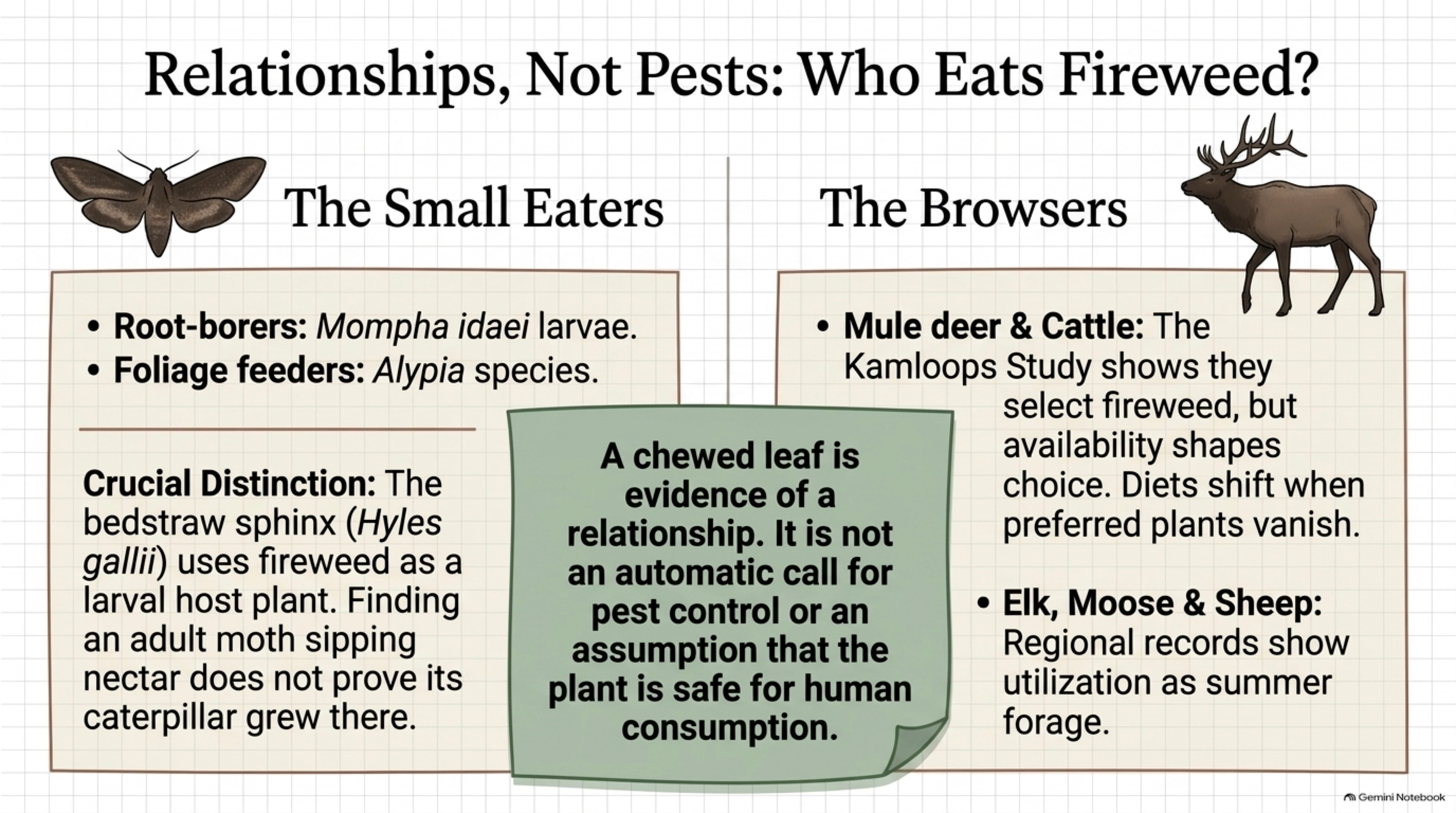
For ranchers: near Kamloops, Walter Willms and colleagues found both mule deer and cattle selected fireweed on summer range in logged openings when it was available, with cattle shifting to grasses and deer to shrubs as preferred plants ran short. Much of the work used a few animals in fenced fields. It’s a diet-choice study, not a stocking rate, and it doesn’t prove grazing can contain a patch. Before you use fireweed as feed or grazing as control, take your site to a range adviser, livestock nutritionist or vet.
Before you sell a jar
For homesteaders, market vendors and beekeepers.
Honey or syrup? In Canada, honey has a legal identity: the federal food compositional standard defines it as produced by honey bees from nectar or specified plant-associated secretions. Flowers steeped in water with sugar make fireweed-flower syrup, however old the recipe that calls it “honey.” If you’re selling, the name on the jar has to match the process. And with real honey, “fireweed” is itself a claim about floral origin. A hive beside a flowering patch doesn’t establish where every nectar load came from. That takes the beekeeper’s knowledge plus appropriate product evidence.
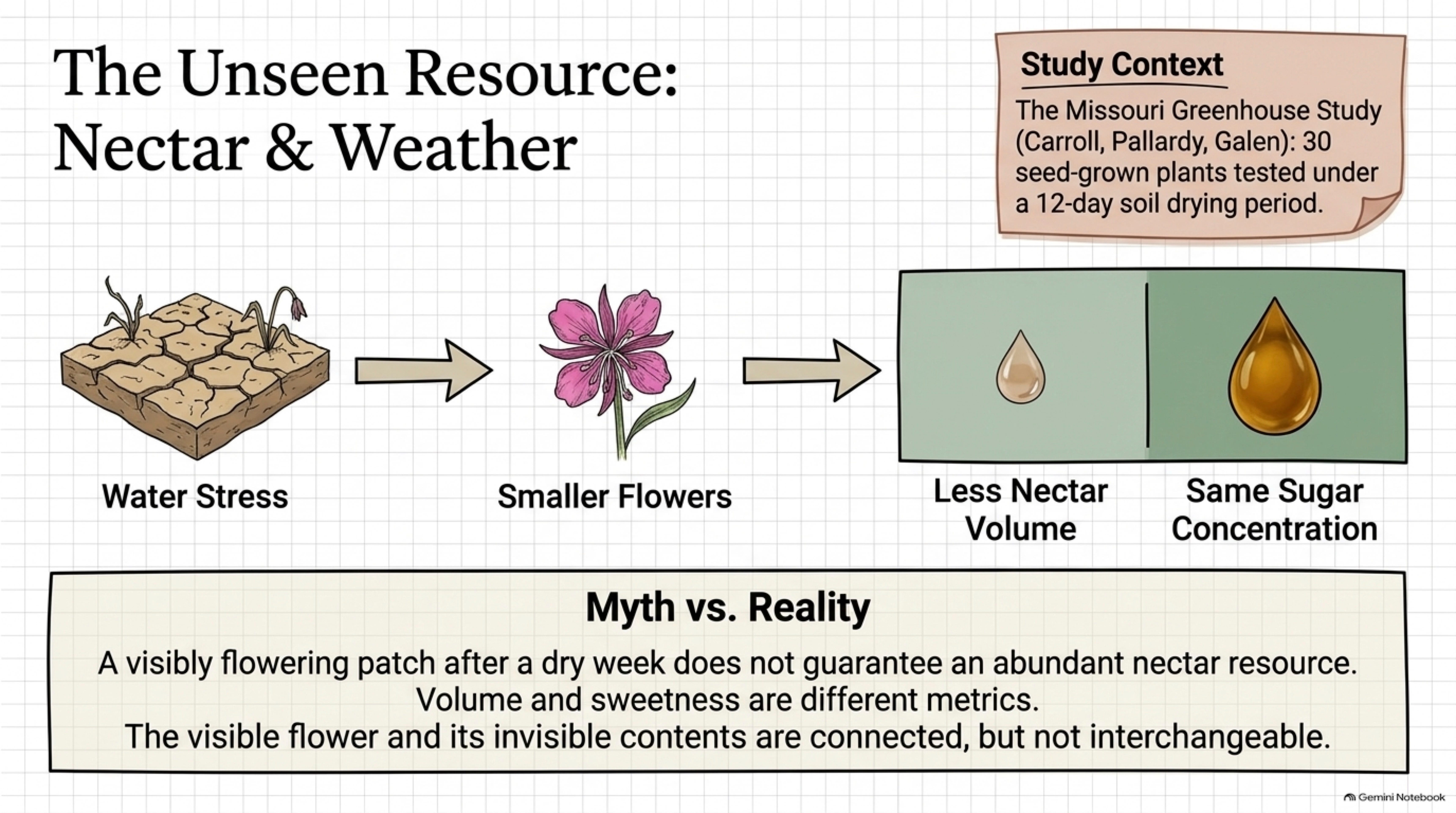
Don’t forecast a flow from the bloom. Amy Carroll, Stephen Pallardy and Candace Galen dried down half of thirty paired greenhouse fireweed plants for twelve days. The stressed plants made less nectar per flower and smaller flowers, while nectar sugar concentration didn’t differ significantly. A patch can look just as generous after a dry week while offering less food in every flower. (They didn’t measure bee visits or honey yield, so this is about the flower, not your supers.)
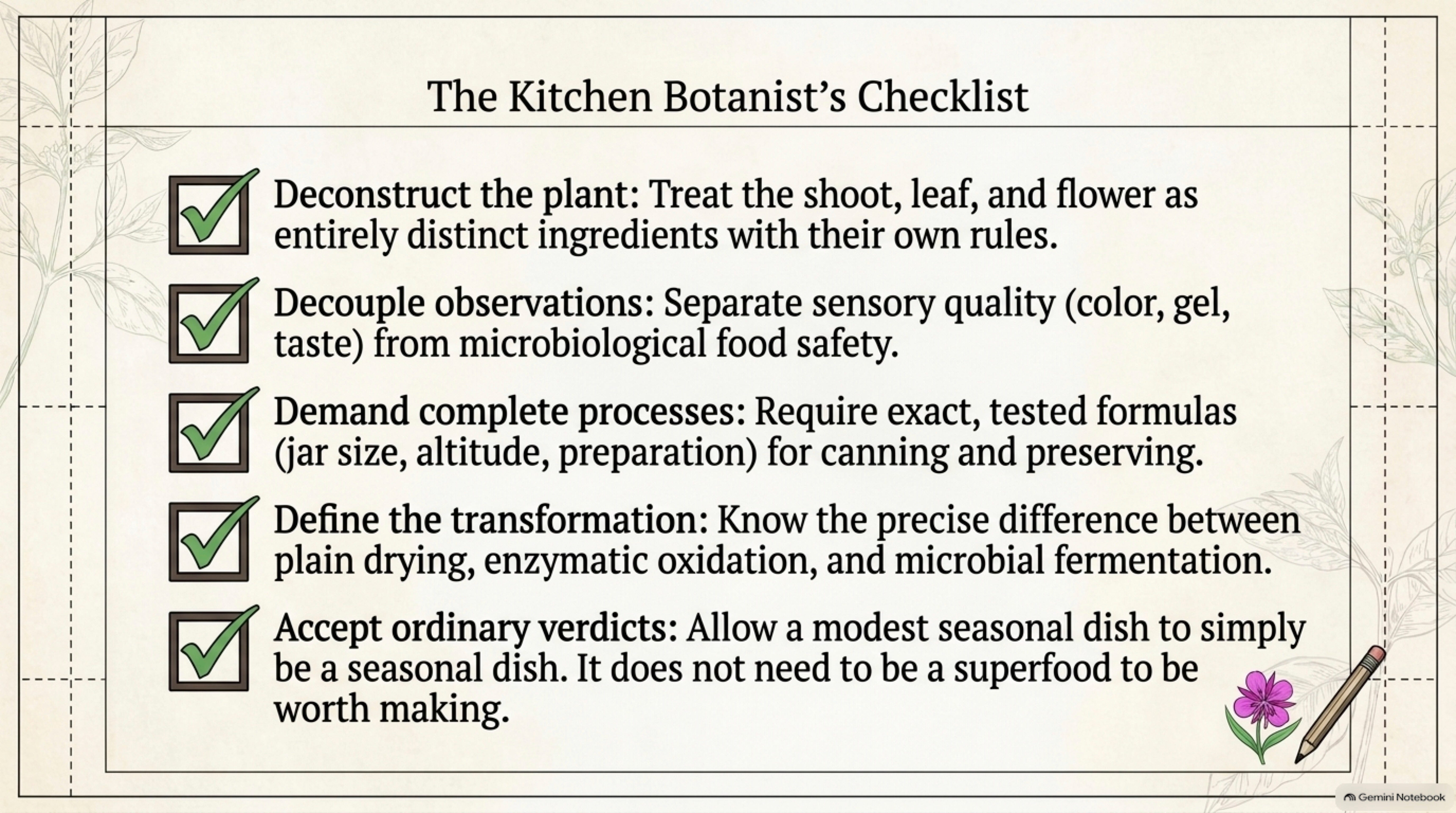
Jelly: a recipe isn’t a process. The University of Alaska Fairbanks publishes a fireweed jelly formula, and an Extension specialist stated in 2024 that it was tested in 1998 and is still considered safe for home use. But its instructions call for boiling empty jars for five minutes, while the National Center for Home Food Preservation specifies ten minutes below 1,000 feet, with more time at elevation, and UAF’s own newer jams and jellies guide also calls for ten. The fireweed sheet also leaves jar size, headspace and altitude adjustments unstated. The guide withholds shelf-stable instructions until a qualified home-preservation adviser reconciles those into one coherent process. If you plan to sell jelly, do that first, with your actual jars and elevation.
Then the route to the buyer. In BC’s Interior Health region, lower-risk pre-packaged foods at an organised temporary market typically don’t need Environmental Health Officer authorisation; higher-risk foods require health approval. The exact formula and process decide which side a fireweed product falls on. Online sales generally require an approved kitchen, and a temporary-market confirmation doesn’t cover online or retail. Federally, the Canadian Food Inspection Agency bases licensing on the activities you undertake, and labelling, traceability and preventive controls can apply even without a licence. Elsewhere, start with your local health authority.
The money line: before you buy jars or labels, fill in the guide’s enterprise record (section 12.5) for one product and one sales route. Count the work that never makes the photograph: finding an authorised source, travel, sorting, rejects, cleaning, packing, enquiries, unsold stock. Seasonal abundance doesn’t guarantee a supply, and permission to collect for your kitchen may not cover commercial quantities. If an essential answer is missing, find it before you spend.
Go back out to the patch before the snow. The stalks are dry now; most of the silk has gone wherever the wind took it. Some of it landed on ground too dry or too shaded to keep it. A little may have found the right bare, damp seam of soil, and next summer will show you which. Under your boots, the roots are holding buds and the reserves they stored all season, carrying the plant through the cold toward another start.
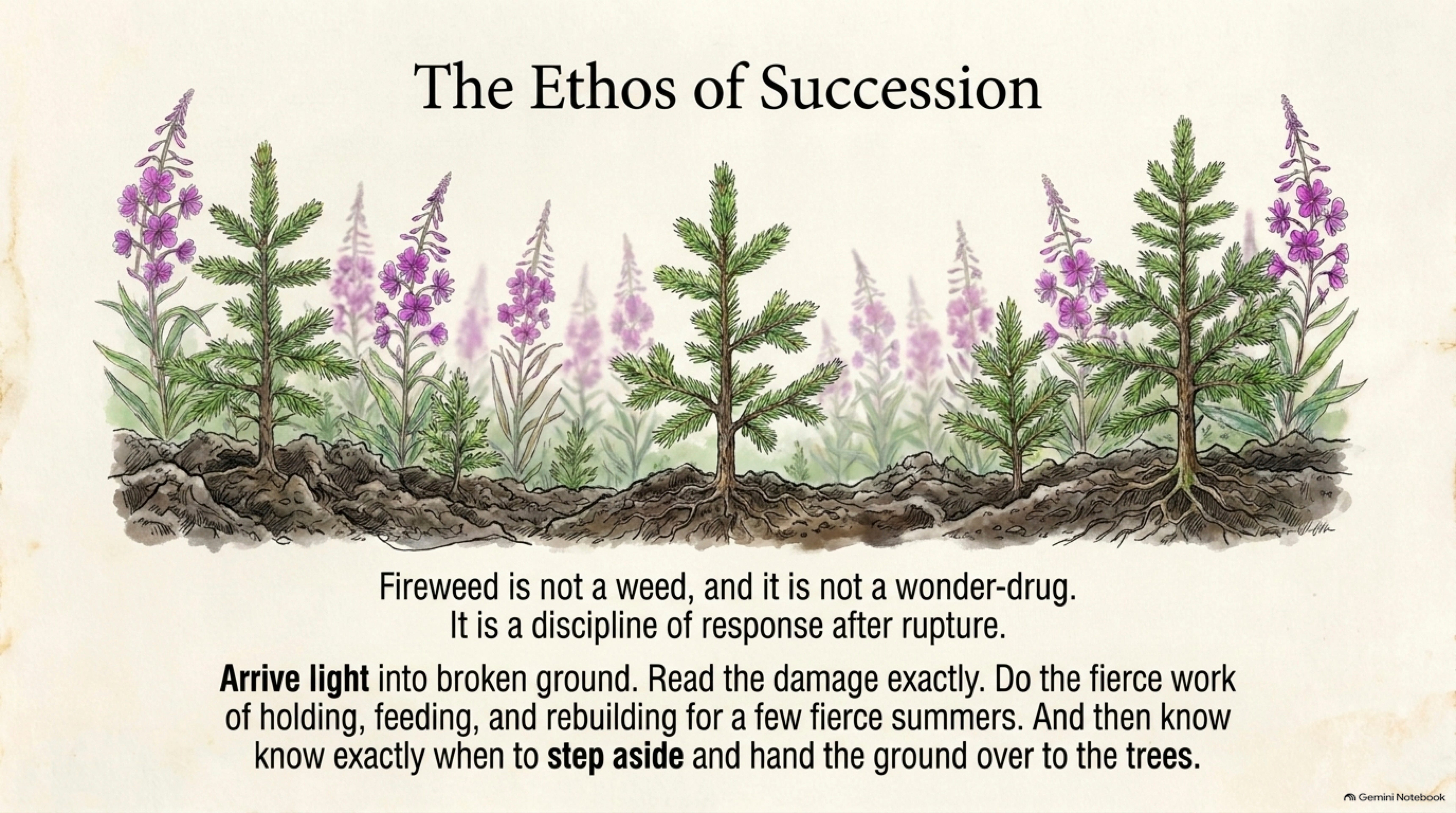
It won’t grade the burn for you or keep a timetable. It doesn’t need the fire, or the stories we’ve hung on it. It arrives on the wind, holds on underground, and comes up readily where ground is opened. What that means for your own patch, the record will tell you.
Find one dry stem this week. Follow it down to where it enters the ground, and make it the first line in your record.
Sunday: Working with Fireweed, the full guide: identification, the plant’s year above and below ground, burned ground, harvest, the kitchen, the cup, craft, what the health evidence actually says, and six tools for your own patch. [The fireweed monograph] for the full research trail.
Sources and further reading
Every source here is public. Names and accounts stay with the people and publications that shared them; citation doesn’t imply anyone endorses this post.
Names: Regional District of Central Okanagan, Syilx / Okanagan partnerships (guide credited to Krystal Withakay, spaxwawlm) · Champagne and Aishihik First Nations, Dàkwänjè Dictionary · VASCAN · Kew POWO · RHS on rosebay willowherb
Seed, roots and fire: Granström 1987 · Flora of North America · Landhäusser & Lieffers 1997 · Klimešová et al. 2009 · Schimmel & Granström 1996 · US Forest Service FEIS review · USDA NRCS Plant Guide
Flowers and bees: Galen & Plowright 1985 · Routley & Husband 2003 · Husband & Schemske 1995 · Carroll, Pallardy & Galen 2001
Lookalikes: Flora of North America on purple loosestrife · SDSU on spreading dogbane · NSW WeedWise on Senecio madagascariensis
Calendar and food: NPS caption, Dyea · Turner & Reid 2022, “When the Wild Roses Bloom” · UAF Extension, Fireweed · Gwich’in Social & Cultural Institute · Alutiiq Museum · BC wildfire contaminant guidance · Canadian poison centres · Poison Control (US)
Health evidence: Esposito et al. 2021 · Osada et al. 2025 · EMA monograph · EMA 2022 review · Ducrey et al. 1997 · NIDDK on BPH
The tea’s story and the jar: Prakofjewa et al. 2020 · Sõukand et al. 2020 · Chudinov et al. 2026 · Mykhailenko et al. 2026 · Health Canada, food/NHP classification
Harvest timing and processing: Maruška et al. 2014 · Ivanauskas et al. 2024 · Jariene et al. 2020 · Lasinskas et al. 2023 · Olennikov et al. 2021 · Efimenko et al. 2021
Clearing and grazing: Comeau, Biring & Harper 2000 · Comeau & Harper 2009 · BC project record EP 1135.01 · Wood et al. 2025 · Willms et al. 1980
Selling: CFIA honey labelling · Ask Extension on fireweed jelly · NCHFP on sterilising jars · UAF Jams and Jellies · Interior Health food premises · CFIA food licensing
Est-ce que great willowherb est un autre nom de la même plante?