

I came to mallow with a stubborn curiosity: if the land keeps sending the same messenger, what is it trying to say? In our fields, mallow often rises where the ground is tight and the biology is thin. It isn’t vandalism; it’s triage. This summary is the handrail, the why behind the what, so you can act quickly and speak clearly about your choices.
I’m doing this to practice a better kind of attention. Conventional agriculture trains the eye to chase yield; weeds train the eye to read pattern. Mallow points to compaction, splash erosion, bare soil, and frayed fungal ties. When we read those signals, stewardship shifts from control to conversation.
I’m doing this to braid ways of knowing that rarely sit together. Under the lens, mallow is mucilage and minerals, polysaccharides that calm irritated tissues. In the field, it’s a low canopy that slows rain, feeds insects, and cushions scuffed ground. In kitchens and stories, it’s comfort medicine. In the energetic sense—a working hypothesis, not a doctrine, it carries the signature of softness that cools heat and loosens what’s seized. Here, I separate tested from untested and label both.
I’m doing this for smallholders and micro-farmers who need tools that don’t cost a fortune or their sovereignty. If a weed can become a gentle tea for stressed leaves, a ferment that wakes the soil food web, a living mulch for bare places, or a story that restores memory, then we already have more capacity than we think, under our boots and in our kitchens.
I’m doing this to de-escalate the war on weeds. Mallow isn’t the problem; mallow is the memo. Read it well and you’ll know where to loosen, where to mulch, where to rest, and where to invite more diversity. No miracle claims, just repeatable experiments, humble wins, fewer blind spots.
Mostly, I’m doing this because healing runs in cycles, disturbance, repair, renewal, and so do we. This page is the short walk: core signals, quick practices to try, simple measures to track. If it resonates, the deep dive takes you the rest of the way down the row.
What Everyone Should Know
Part I: Meeting the Plant
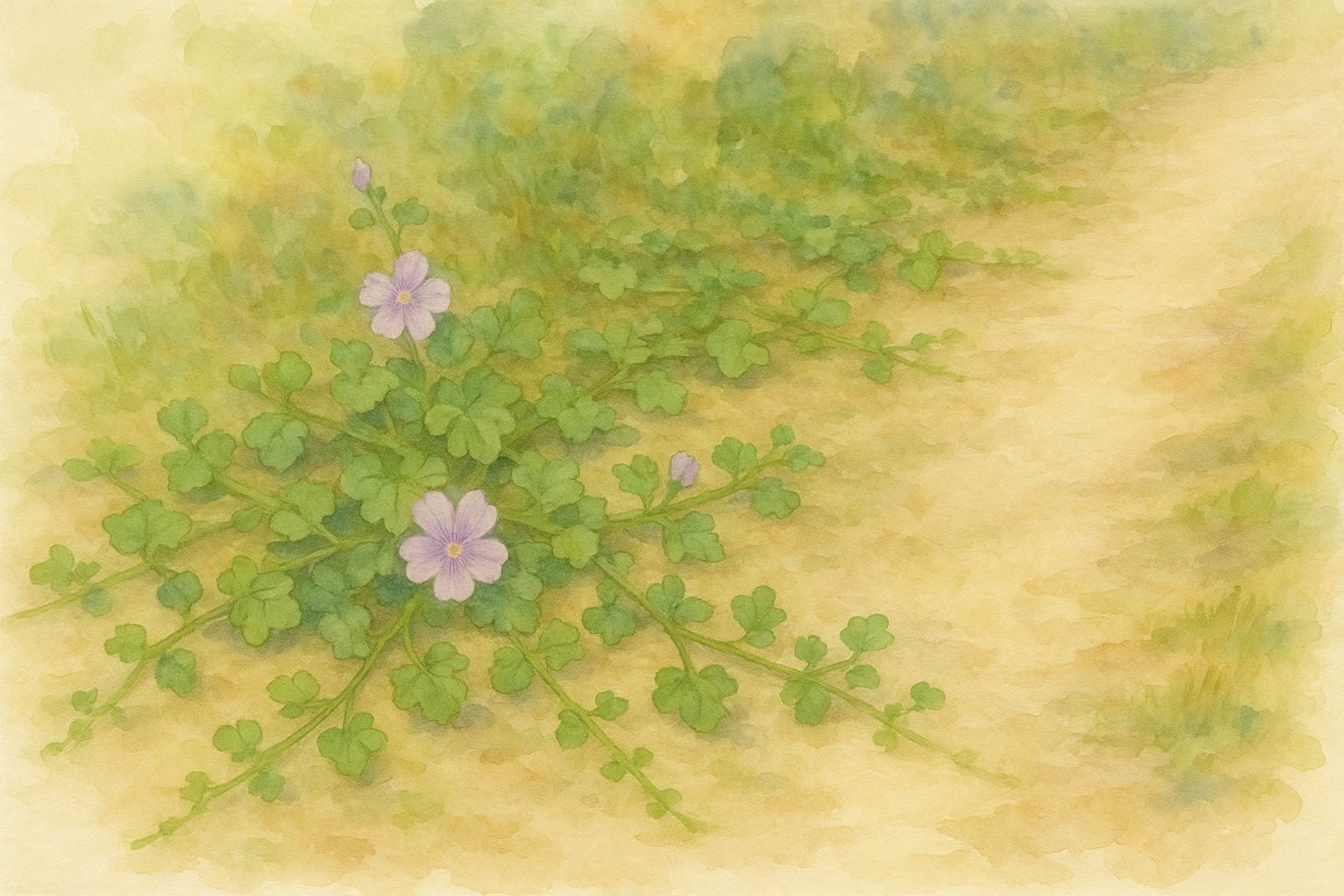
Picture this: You’re walking along a gravel path at dawn, and there’s this green rosette sprawled out like it owns the place. Soft, fuzzy leaves catching dewdrops like tiny parasols. Little mauve-pink flowers hiding in the leaf joints, treating bees like regulars at a neighborhood café. That’s mallow (Malva neglecta or M. sylvestris) – and it’s been quietly thriving in the most beat-up, compacted, neglected soil while your fancy garden plants are throwing tantrums.
This plant is a gentle, resilient first responder for tired soil. It shows up where the ground’s been roughed up—gravel edges, barnyards, sidewalk cracks, construction sites—and stays cheerful in dry, compacted spots by sending a taproot down to where the water hides.
The name game is actually cool: The genus Malva comes from the Greek word for “soft” (malakos), which is perfect because this plant is literally about softness – soft leaves, soothing medicine, gentle healing. The English “mallow” shares that same root. In Arabic it’s khubbayza (meaning “little loaf” after the cheese-wheel shape of its seeds). In French it’s mauve – yes, the color is named after this plant!
Here’s where it gets fun: There are look-alikes, but mallow’s pretty distinctive once you know what to look for:
Round, shallow-lobed leaves on long stems (5-9 lobes)
Alternate arrangement (not opposite like mint-family weeds)
Those characteristic “cheese wheel” seed pods that split into wedges
Slippery feel when you crush the leaves (that’s the medicinal mucilage)
Small pink/purple flowers with darker veins
The wild geraniums might confuse you at first, but their leaves are more deeply cut and opposite. Ground ivy smells minty and has square stems. Mallow? Round stems, no real smell, and that telltale sliminess.
And here’s the relief: It’s in a non-toxic family. No dangerous look-alikes that’ll poison you. This is a safe friend.
Part II: The Living Intelligence (AKA “This Weed is Actually a Soil Doctor”)
Okay, this is where mallow blew my mind. This “weed” is actually a nurse plant – it’s not just loitering, it’s doing a job your soil needed.
What it’s doing underground:
Sending a deep taproot down to break up compacted soil like a biological jackhammer
Mining calcium, potassium, magnesium, and iron from deep down and bringing them up
Creating channels for water and air (and eventually other plant roots)
Partnering with mycorrhizal fungi (though the science is still catching up)
Feeding soil microbes with its mucilage, building the underground community
Why it shows up where it does: Mallow is basically telling you a story about your soil. Lots of mallow means:
Compacted, disturbed ground (construction sites, overgrazed pastures, abandoned lots)
High potassium and nitrogen but possibly low calcium
Poor drainage or waterlogged conditions that alternate with dry spells
Recent disturbance (it’s a pioneer species – nature’s emergency responder)
Maybe alkaline pH (6.5-8)
It’s like nature’s way of saying “this soil needs help” and then providing that help. It’s not a problem – it’s the solution showing up.
The ecological genius:
Feeds bees and butterflies (painted lady larvae love it!)
Provides early spring nectar when not much else is blooming – a bridging food source
Its leaves break down fast, returning nutrients to the soil as quick, mineral-rich mulch
Creates shade and moisture for other seedlings trying to establish
Tolerates trampling, mowing, and drought like a champ
Seeds can sit dormant in soil for 5-10 years, waiting for the right moment
Blooms from late spring through fall – months of pollinator support
Oh, and here’s a detail I love: It accumulates so much calcium and potassium that traditional permaculturists call it a “dynamic accumulator.” When you chop it and drop it, you’re basically making free fertilizer. That slippery mucilage? It speeds up composting too – the microbes have a party.
This isn’t just surviving – this is quietly healing damaged ground while feeding whoever shows up hungry.
Part III: The Stories It Carries
This part hit me in the feels.
Ancient Greek physicians called mallow omnimorbion – “remedy for all diseases.” Pythagoras reportedly ate mallow leaves before long fasts. The Romans loved it so much that Pliny the Elder claimed “daily use of mallows prevents any type of illness.” Medieval apothecaries called it Omnimorbium – the cure-all.
But here’s the real story: Throughout history, mallow has been famine food – and that’s not an insult, that’s its superpower.
In the 1948 Siege of Jerusalem, people survived on wild mallow when nothing else was available
It’s mentioned in the Book of Job as what desperate people ate
During tough times across Europe, the Middle East, and North Africa, mallow soup kept people alive
In Palestinian culture, khubeiza (mallow stew) isn’t just food – it’s a symbol of resilience, of making do, of refusing to give up. After 1948, it became part of Israeli national memory too: the plant that sustained a people through their darkest hours.
There’s a saying in Arabic: “Khubbayza fi al-bayt, dawa bila taqyeed” – “Mallow in the house, medicine without constraint.” Free healing, for everyone, always available.
The folklore is beautiful across cultures:
An Italian rhyme: “Malva sta dov’è il male va” (Mallow grows where pain goes away)
French country saying: “There’s mallow in her milk” (said of nursing mothers with abundant milk supply)
It was associated with Venus in Renaissance alchemy for its gentle, feminine nature
In Turkish folk belief, it connects to women’s health and fertility
And yes, traditional uses span the globe:
Cherokee made poultices for swellings
Moroccan Berber women cook it with olive oil and spices as both food and medicine
Turkish herbalists use it for everything from coughs to digestive issues
Chinese herbalism has used related species (Malva verticillata) for centuries, especially the seeds
Mediterranean villagers gathered it at dawn, shaking dew from the leaves into jars for eye rinses
What strikes me is the consistency: wherever this plant grows, humans figured out it could help them. That’s not coincidence – that’s reliable medicine.
WHERE THE MAGIC HAPPENS (The Paid Sections)
This is where you go from “oh cool, a weed” to “I can actually work with this.” Here’s what’s waiting behind the paywall:
Part V: Working Together
Biochemistry & Nutrition – Holy crap, this “weed” is basically a wild superfood:
Leaves are 15-20% protein when dried (more than many vegetables!)
83.5 mg of vitamin C per 100g (like an orange!)
Loaded with calcium, iron, magnesium, potassium – it’s a mineral powerhouse
The mucilage is 15-20% of the plant – that gel is your soothing medicine
Packed with antioxidant flavonoids including malvin (the purple pigment)
Plus phenolic acids, tannins, coumarins, and trace essential oils
Seeds are tiny but protein and fat-dense (great for chickens, and yes, people ate them historically)
The science explains what grandmothers knew: this plant nourishes and heals at the same time.
Safety Profile – And here’s the relief: It’s incredibly safe.
Tier A safety rating (safest category of herbs)
Used for babies to elders for thousands of years across cultures
Main caution: harvest from clean areas (it can accumulate nitrates from over-fertilized soil or heavy metals from roadsides)
Pregnancy: fine as food, just avoid mega-doses of concentrated extracts in first trimester
Breastfeeding: safe and may even help milk supply
The only “overdose” risk is eating so much you get soft stool (it’s high fiber – which is usually a benefit)
Space medications and thick mallow teas by about an hour (that gel can briefly slow pill absorption, but it’s minor)
Real risks are environmental (spray drift, roadside pollution), not the plant itself. This is as close to foolproof as herbal medicine gets.
Agricultural Applications – This section is gold if you’re a gardener or farmer:
How to use it as green manure (chop-and-drop before it seeds heavily)
Why it makes a great living mulch in orchards and vineyards
Its role as forage (rabbits, goats, poultry love it)
Companion planting strategies that work with its presence
How to manage it when it becomes too weedy (timing is everything)
Economics: some farmers are actually selling it as a specialty crop now!
Using it as a soil indicator to diagnose and fix underlying problems
One permaculturist’s trick: ferment mallow into liquid fertilizer (high in potassium!) and use as foliar feed. Its mucilage apparently accelerates compost decomposition too – throw mallow in your pile and watch it heat up faster.
You’ll learn when mallow is actually helping (more often than you think) and when it’s a sign you need to address compaction, drainage, or mineral imbalances.
Part VI: The Relationship Deepens
Processing & Preparation – This is where theory becomes practice:
When and how to harvest (best times, moon phases if you’re into that, sustainable wildcrafting ethics)
Drying and storage methods that preserve potency
The difference between cold infusion (maximum mucilage – best for sore throats and digestive issues) vs hot tea (more antioxidants, less slime)
Complete recipes with ratios! Including:
Authentic Palestinian khubeiza stew (the real deal)
Honey-based cough syrup that actually works
Eye soother for irritation and conjunctivitis
That wild “meringue” trick using root mucilage (it’s how marshmallow candy started!)
Mallow fritters, stuffed leaves, and pickled seed “capers”
How to make poultices, salves, and compresses for skin issues
Culinary uses from salad to soup thickener
Why you’d want a “mallow bath” for sunburn, eczema, or just dry skin
The cold infusion method alone is worth the price: leave dried leaves in room-temp water overnight, and you get this incredibly soothing, slippery tea that coats and heals everything from sore throats to inflamed digestive systems. It’s like medicine you can feel working.
Climate Change & Resilience – This part is honestly kind of prophetic:
Why mallow will likely expand its range as the planet warms
How it handles both drought (deep taproot reaching hidden moisture) and flooding (tolerates waterlogging that kills other plants)
Its role as potential “catastrophe insurance” – the food that’s there when carefully tended crops fail
Carbon sequestration through rapid biomass growth on otherwise bare ground
What it teaches us about adaptation: be gentle, be persistent, root deep, bloom where you are
There’s a line in here that stuck with me: “In a warming world where diseases might shift and supply chains break, mallow can support basic health. The plant doesn’t care about power outages or shipping delays.”
It’s the crack-in-the-sidewalk ally we’ll need as things get more chaotic.
Legal & Compliance – Because even weeds have rules:
Wildcrafting laws (where you can and can’t harvest)
Safety around herbicide-sprayed areas
If you want to sell it (it’s generally legal, but there are labeling requirements)
Ethical protocols for sharing traditional and Indigenous knowledge
Why you should avoid roadside and industrial sites
Short version: harvest smart, harvest clean, respect the knowledge sources, and you’re good.
Part VII: Research Frontiers
This is where you see what science is discovering right now:
Recent studies on wound healing and tissue regeneration (mallow speeds it up significantly)
Anti-inflammatory pathways being mapped (reduces TNF-α, IL-6 – the inflammatory markers)
Intriguing research on endometriosis (promising results in animal studies)
Potential effects on gut microbiome (those polysaccharides may be prebiotic)
Agricultural research on its role in soil microbiology succession
Clinical trials in the pipeline for sore throat, eczema, and oral mucositis in cancer patients
Speculation about phytoremediation (cleaning contaminated soils)
Even biodegradable packaging from its mucilage!
The research is circling back to validate what traditional medicine knew, while discovering new applications we hadn’t imagined.
Consciousness & Spiritual Dimension – Okay, this part surprised me, but it’s actually beautiful:
Plant spirit medicine and the “doctrine of signatures” (form reflects function)
Why some herbalists call it a “grandmotherly spirit” – nurturing, not flashy
Using mallow in forgiveness rituals or emotional healing work
Its teaching about being “gentle yet strong” – it doesn’t fight, it just persists
The symbolism of thriving in neglected places (what does that mirror in our own lives?)
Flower essence work with vulnerability, softness, and healthy boundaries
Simple rituals: gratitude stews, healing baths, Earth-healing meditations
The metaphor is powerful: Mallow doesn’t fight, it just keeps being itself – gently persistent. In chaotic times, when we’re exhausted from constant battling, that’s profound wisdom. Sometimes presence and gentleness transform more than aggression ever could.
Part VIII: Vision & Gratitude
The final section paints a picture of where this could go:
Future urban landscapes where vacant lots become mallow gardens – cooling cities, feeding pollinators, offering free food and medicine
Community clinics using locally harvested mallow preparations
Children learning to identify and use common mallow as readily as they know oak trees
Farms that collaborate with their spontaneous helpers instead of fighting them
Ecological restoration using mallow as a first-wave healer, preparing soil for natives
Mallow stew on restaurant menus as celebrated heritage food, not poverty food
A shift in values: recognizing the common over chasing the exotic
And it ends with genuine gratitude to the plant itself – which, honestly, is the kind of relationship shift we need with the living world. Not domination, but partnership. Not extraction, but reciprocity.
Why This Matters (My Take)
Look, I get it – paying for information about a weed feels weird. But here’s the thing: this isn’t just about one plant.
This profile is teaching you:
How to read what plants are telling you about your soil (every weed is a diagnosis)
How to see value in what society has labeled worthless
How to connect traditional wisdom with cutting-edge science
How to build resilience – yours, your garden’s, your community’s
How to work with nature instead of exhausting yourself fighting it
Plus, let’s be real: when have you ever had someone hand you a complete manual for a free food and medicine that’s probably growing in your neighborhood right now?
The free sections give you enough to start noticing and appreciating mallow – to see it differently, to understand its role. The paid sections give you the skills to actually work with it:
To heal yourself and your family
To improve your soil without buying amendments
To have food security when times get tough
To make medicines that actually work
To become more capable and self-reliant
$5/month or $50/year. That’s less than a fancy coffee drink. Less than a bag of organic salad greens that you’ll eat once. Less than any herbal remedy you’d buy at a store – and those remedies are probably less potent than what you can make yourself from this abundant weed.
You get the kind of knowledge that used to be passed down through generations – except now it’s backed by modern research, organized clearly, written by someone who genuinely loves both the science and the spirit of these plants, and delivered in a format you can actually use.
The Bottom Line
Common mallow is everywhere, free, edible, medicinal, and an ecological genius. It’s been keeping humans alive and healthy for thousands of years, and it’s still out there doing its quiet work – healing broken ground, feeding pollinators, waiting patiently to help us if we’d just pay attention.
The question is: Do you want to keep walking past it, or do you want to really know it?
The first three sections are yours to keep – meeting the plant, understanding its ecological intelligence, hearing its stories. That alone might change how you see your backyard, your neighborhood, the world.
But if you want the full toolkit – the recipes with ratios, the medicine-making protocols, the agricultural strategies, the research findings, the harvest calendar, the troubleshooting guide, the soul work – that’s what the paid content delivers.
It’s practical alchemy. It’s the difference between “huh, interesting” and “I can actually do this.”
Either way, next time you see that low green rosette with the round leaves and tiny purple flowers sprawled beside a path, you’ll know: that’s mallow, the soft-hearted survivor, the healer of broken ground, the nurse weed that shows up when soil – or people – need gentling.
And maybe, just maybe, that’s exactly the kind of friend we all need right now.
P.S. – If you’re thinking “I’ll just Google this stuff,” sure, you could. But you’ll spend hours piecing together fragments from questionable sources, most of them contradictory, none of them organized or connected like this. This profile did that work for you – years of research, traditional knowledge, modern science, practical testing, all woven together. Your choice is whether your time is worth $5. Mine absolutely is. 😊
We definitely need to relearn how to farm like we did.