

There’s a quiet rebellion happening in your garden right now.
While you’re inside reading this, a mat of delicate green is spreading across any bare soil that dared show itself this winter. Five-petaled white flowers, each one a tiny star, are opening toward whatever thin light the season offers. Finches are pecking at the seeds. Your grandmother, if she grew up on a farm, probably called it by name and tossed handfuls over the fence to the chickens without a second thought.
Chickweed. Stellaria media. The plant so common it became invisible.
What follows is an attempt to make it visible again.
What You’ll Find in These Pages
This profile began as a question I couldn’t shake: What does a plant actually know? Not in some mystical hand-waving sense, but in the literal, measurable, ecological sense. How does chickweed communicate with soil microbes? Why does it show up where it does? What is it telling us about our land?
The answers led me far deeper than I expected, through Dioscorides’ prescriptions in first-century Greece, into the pharmacopeias of Ming Dynasty physicians, across Ojibwe gathering grounds, and back to the barnyard where this “weed” earned its name. What emerged is something between a botanical monograph and a conversation with an old friend who happens to know more than they let on.
Here’s what you’ll discover:
Part I: The First Meeting opens with chickweed in its habitat, dew-speckled, low to the ground, doing its work. You’ll learn its names across cultures (from the Chinese “goose intestines” to the Celtic “starwort”), how to distinguish it from its toxic lookalike scarlet pimpernel, and why misidentification matters more than you might think.
Part II: Getting to Know Them goes underground. This is where we examine chickweed’s ecological intelligence, its root exudates, its curious decision to skip mycorrhizal partnerships entirely, its role as a bacterial-soil indicator. We map its community relationships: what it competes with, what it facilitates, how it handles drought (spoiler: it doesn’t, it just times its life around it). A full 52-week phenological calendar tracks its behavior through a Pacific Northwest year, week by week.
Part III: Stories & Lineage crosses the threshold into human history. We trace chickweed from Dioscorides through Hildegard von Bingen, Li Shizhen’s Compendium of Materia Medica, and into the “eat your weeds” revival of the 1970s. The folklore section unearths weather proverbs, Welsh wedding charms, and the Japanese Nanakusa festival where chickweed earns its place among the seven sacred spring herbs. We examine Traditional Chinese Medicine and Ayurvedic frameworks in depth, not to appropriate, but to understand how different traditions approached the same humble plant.
Part IV: The Threshold marks where free knowledge ends and partnership begins. Everything before it is yours to share. Everything after is for those who want to go deeper.
Part V: Working Together opens the biochemical architecture. Here we catalog chickweed’s unusual nutrient density, its gamma-linolenic acid content (rare in leafy greens), its 25-30% protein by dry weight, its vitamin C levels that once prevented scurvy. We examine the saponins, flavonoids, and triterpenoids that underpin its traditional uses, and we’re honest about what science has confirmed versus what remains speculative. Safety gets its own thorough section: pregnancy considerations, drug interactions, nitrate accumulation risks, and why that high oxalate content matters.
Part VI: Regenerative Agriculture Applications is where theory becomes practice. Korean Natural Farming protocols for chickweed FPJ (fermented plant juice), including optimal harvest timing down to moon phase and hour of day. Biodynamic applications and planetary associations. Cover crop functions with actual C:N ratios. Livestock integration: forage quality by season, medicinal dosing for poultry and ruminants, parasite management possibilities. And the economics—because a weed that saves you money on feed, fertilizer, and labor is a weed worth knowing.
Part VII: Processing, Preservation & Products closes the loop. Harvest optimization protocols. Drying curves that preserve compounds versus those that destroy them. Fermentation parameters for everything from sauerkraut-style preservation to KNF inputs. Quality control systems, sensory scoring, microscopy for adulterant detection, even TLC fingerprinting for those who want to verify what they’re selling. And residue cycling, because on a regenerative farm, there is no waste.
A Note on Evidence
Throughout this profile, you’ll see terms like Established, Probable, Plausible, and Speculative. This isn’t hedging, it’s honesty. Traditional knowledge and peer-reviewed science don’t always speak the same language, and where they diverge, I’ve tried to be clear about who’s saying what and how much weight it deserves.
When five traditions across three continents agree that chickweed soothes inflamed skin, and modern pharmacology identifies anti-inflammatory flavonoids in the tissue, that’s Established. When Culpeper claimed it “dissolves internal fat” in 1653 and a 2012 mouse study showed mixed results on weight markers, that’s Speculative, interesting enough to note, not reliable enough to recommend.
This is the methodology. Seek truth, not trends. Let Mother Nature and empirical data teach in tandem.
Who This Is For
If you’re a forager who wants to know what you’re eating at the molecular level—this is for you.
If you’re a farmer wondering whether that winter groundcover is friend or foe—this is for you.
If you’re an herbalist who wants the full traditional context behind your chickweed salve, from TCM channel theory to Ayurvedic dosha effects—this is for you.
If you’re simply curious how a plant that most people spray with herbicide ended up in Japanese emperor rituals and medieval monastery infirmaries—this is for you.
And if you’ve ever looked at the green mat spreading beneath your fruit trees and wondered what is this thing actually doing?—well. You’re about to find out.
Chickweed doesn’t demand attention. It doesn’t have showy flowers or a famous reputation. It just shows up, covers the wounds in your soil, feeds your birds, offers you a salad in the hungry gap of late winter, and then quietly exits before the heat arrives.
The least we can do is learn its name.
See you next week.
Jay
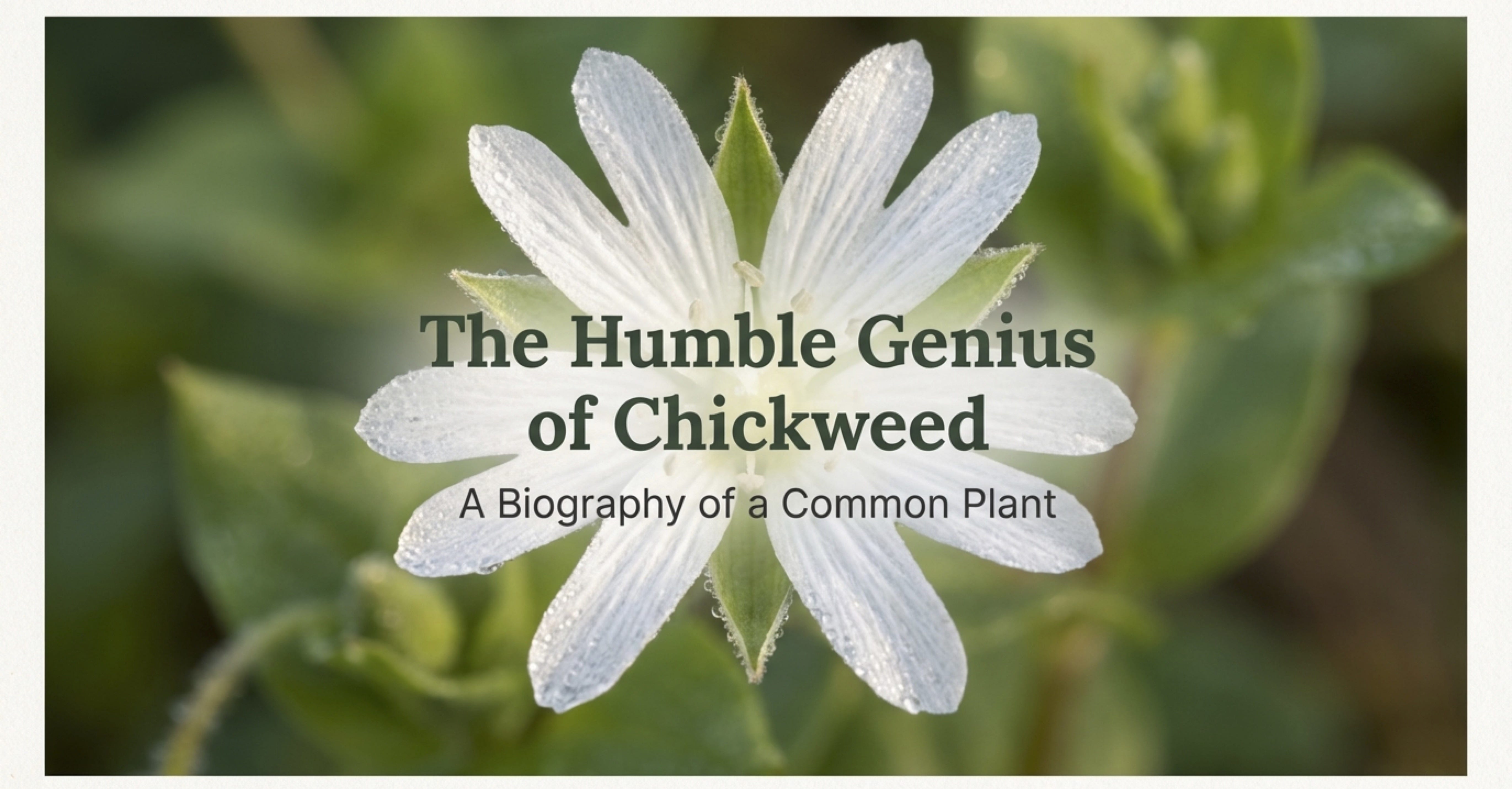
Part I: The First Meeting
1) Opening Field Vignette: A mat of common chickweed sprawls across cool spring soil, its dew-speckled leaves and tiny starry blooms catching the morning light. Amid the last melt of winter frost, a green carpet of chickweed unfurls between dormant garden rows. Finches hop among the delicate tangles, pecking at seeds and tender greens, while a hen eagerly devours clumps of the “chickenweed” tossed over the coop fence. The air is crisp and sweet as the five-pointed white flowers open under a pale sun. In folklore these “starwort” blossoms forecast fair weather by remaining open in sunshine and closing before rain, nature’s barometer whispering to the farmer. A tired gardener kneels to pinch off a handful of succulent stems, a free spring salad at her feet, recalling that chickweed earned its name as cherished feed for poultry and for its tenacity as a weed. Nearby, an herbalist gathers trailing vines to brew a soothing tea and a cooling salve for itchy skin. What one person calls a weed, another recognizes as nourishment and medicine, quietly knitting health into soil and body alike. Why this plant matters now: Chickweed’s resilience through cold seasons, generous nutrition, and gentle healing properties offer clues for sustainable food security and soil care in a changing climate, a humble weed inviting us to rethink scarcity as it blankets bare ground with living green.
2) Plant Identity & Names
2.1 Common & Indigenous Names: Common chickweed is known by many names across cultures. The English “chickweed” reflects its value as chicken fodder, while “starweed” and “starwort” refer to its tiny star-shaped flowers. Other English names include winterweed and chickenwort. The Latin genus Stellaria means “star-like,” from stella (star), describing the blossoms. In Chinese it is called 繁缕 (fánlǚ, “profuse threads”), also nicknamed “鹅儿肠/鸡肠菜” (“goose intestines”/“chicken vegetable”) for its tangling habit and use as a potherb. Chickweed has fewer recorded Indigenous names in the Americas, since it’s an Old World native introduced with European contact. Some First Nations adopted it: the Ojibwe (Chippewa) knew it as wi’nibõdjibigonų (recorded phonetically) and used it as a minor medicine, while the Iroquois fed it to poultry and noted its medicinal value. In Europe, it was called Stitchwort (for easing “stitches” – sharp pains) and Alsine in older herbals (from Greek alsinos). Proto-Indo-European roots: The term “wort” in starwort comes from Old English wyrt (plant/herb). Sanskrit: (No known direct name in classical texts; chickweed was introduced later.) Traditional Chinese: 繁缕 (fánlǚ), also written 蘩露 in some texts – classified as a cooling “people’s herb.” Arabic/Unani: (Known as a cooling salad herb, not prominent enough for a fixed classical name). Trade Names: Chickweed likely spread along European trade routes as a contaminant in soil/seed, rather than a traded herb; by the Age of Exploration it had naturalized on most continents, though never a major commercial commodity. Cryptic Names: In colonial America it was sometimes dubbed “poverty weed” or “snow weed”, hinting at its emergence in lean winters and early spring.
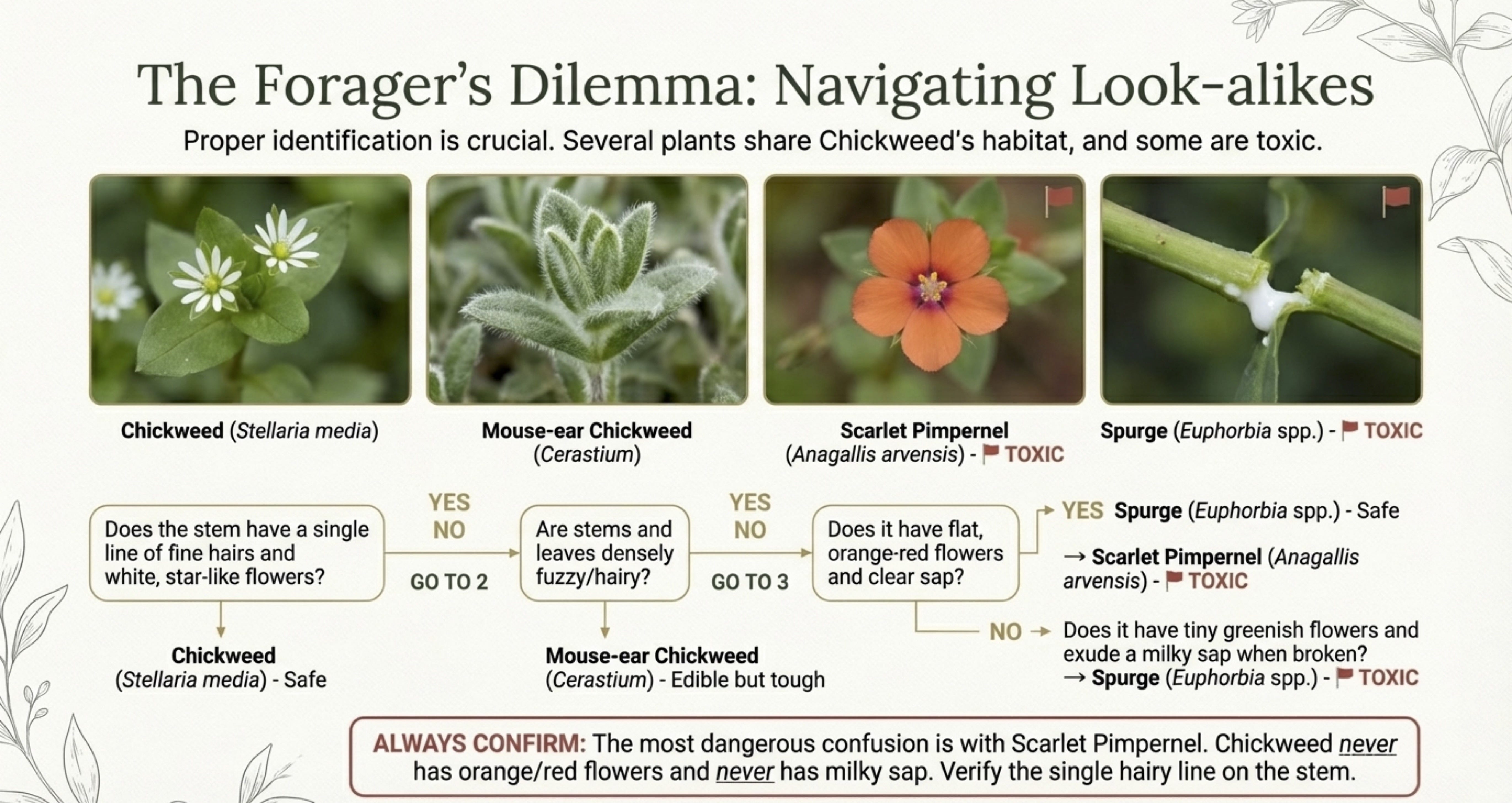
2.2 Look-alikes & Misidentification Hazards: Several low, creeping plants share chickweed’s habitat and can be mistaken for it, so proper identification is important – especially if foraging.
Key Differentiators: Chickweed is a delicate, trailing annual with prostrate mats (stems 5–40 cm). The stems are slender, green, and have a single line of fine hairs on one side that switches sides at each node – a unique hallmark. The leaves are opposite, smooth-edged and hairless, ovate with pointed tips (0.5–2.5 cm long), often with a tiny translucent fluid gland at the tip. Nodes: The stem often roots at nodes that touch soil, forming a shallow fibrous network. Aroma: When crushed, chickweed has little scent – just a mild “green” smell (no strong herb or carrot-like odor). Flowers: about 5–8 mm across, each with five deeply bifid (cleft) white petals that look like ten slender rays; they are nestled by five green sepals with hairs. Season: Chickweed germinates in cool damp seasons (autumn and late winter) and can flower nearly year-round in mild climates, but peak visible flowering is in late winter through spring.
Confusable Taxa:
Mouse-ear chickweed (Cerastium fontanum) — A close relative with similar low habit and opposite leaves, but distinguished by dense fuzz: its leaves and stems are covered in thick hairs (common chickweed’s are smooth). Edible but much hairier and tougher in texture.
Scarlet pimpernel (Anagallis arvensis) — Grows in the same lawns and beds, also with opposite leaves and sprawling form, but has orange-red flat flowers (not white and starry). Toxic if ingested. Chickweed’s flowers are always white and deeply notched, never flat and red.
Spurge (Euphorbia spp.) — Prostrate weeds with opposite leaves that can co-occur. Spurges exude a milky sap when broken (chickweed does not) and have tiny greenish flowers. Spurges are poisonous and lack chickweed’s distinct star flowers.
Simple Dichotomous Key:
1a. Stem with a single line of fine hairs, petals white and deeply cleft forming star-like appearance → Chickweed(Stellaria media)
1b. Stem uniformly hairy or hairless, or sap milky → 2
2a. Leaves and stems densely hairy, flowers white but petals not deeply cleft → Mouse-ear chickweed (Cerastium)
2b. Leaves hairless, often with milky sap → 3
3a. Flowers orange or red, flat, ~5 mm, no white starry petals → Scarlet pimpernel (Anagallis) [🚩 toxic]
3b. Flowers very small greenish, sap milky, prostrate mat → Spurge (Euphorbia) [🚩 toxic]Photo/Diagram: (Refer to field guides for images of chickweed vs. mouse-ear chickweed and scarlet pimpernel.)The one-sided line of hairs on chickweed’s stem is often visible with a hand lens and is a reliable ID clue.
🚩 SAFETY FLAG: The most worrisome confusion is with scarlet pimpernel, its foliage looks somewhat like chickweed’s, but the orange/red flowers are a giveaway. Pimpernel contains toxic glycosides; ingesting it can cause nausea and heart issues. Always confirm chickweed by its small white starry flowers (never orange) and lack of milky sap before eating. Also verify the single hairy line on the stem. Chickweed itself is very safe and non-toxic (Established), but avoid harvesting from areas sprayed with chemicals or where toxic look-alikes grow intermixed.
2.3 Taxonomy & Status: Chickweed’s scientific name is Stellaria media (Linnaeus) Villars. Linnaeus originally named it Alsine media, and later it was placed in genus Stellaria (family Caryophyllaceae, the Pink or Carnation family). Synonyms in older literature include Alsine media and colloquial names like Star Chickweed.
Native/Introduced: Native to temperate Europe, Western Asia, and North Africa, chickweed has become cosmopolitan across the world. It was introduced to North America likely in the 17th–18th centuries and is now naturalized in all 50 U.S. states and Canadian provinces. In the Pacific Northwest it’s ubiquitous in gardens and disturbed sites.
Weed/Invasive Status: Chickweed is considered a common weed in gardens, farms, and lawns. It thrives in cool, moist, fertile soil and can form a living groundcover from late fall through spring (outcompeting or indicating high soil nitrogen). It is not usually legally listed as a noxious invasive (because it’s relatively easy to control by cultivation and dies back in heat), but it is extremely persistent. A single plant can produce thousands of seeds over multiple generations per year. Seeds germinate whenever conditions are favorable – often year-round with peaks in spring and autumn – making chickweed a prolific self-seeder.
Conservation Status: Not of conservation concern – chickweed is globally secure (it even grows in Antarctica in sheltered sites). In fact, it is sometimes an indicator of soil health (or at least fertility), rather than a species at risk. Its proliferation can, however, indicate an imbalance in cultivated systems (e.g. high nitrogen or frequent disturbance). Gardeners often find that where soil is rich and loose, chickweed abounds.