

A plant can be troublesome and still deserve attention. It can be useful without being useful for everything. Russian thistle asks for this kind of reading because its effects change with the season, the site and what we ask it to do.
Begin with the living plant. Learn its stage. Look at the ground around it. If you remove it, know where the material will go and what you hope will grow in its place. If you study it, carry the name, preparation and limits of the evidence with the result.
This is what I could find; if you have further or more current research I would like to hear about it. The next useful correction may come from a laboratory, an old text or someone returning to the same patch long enough to notice what changed.
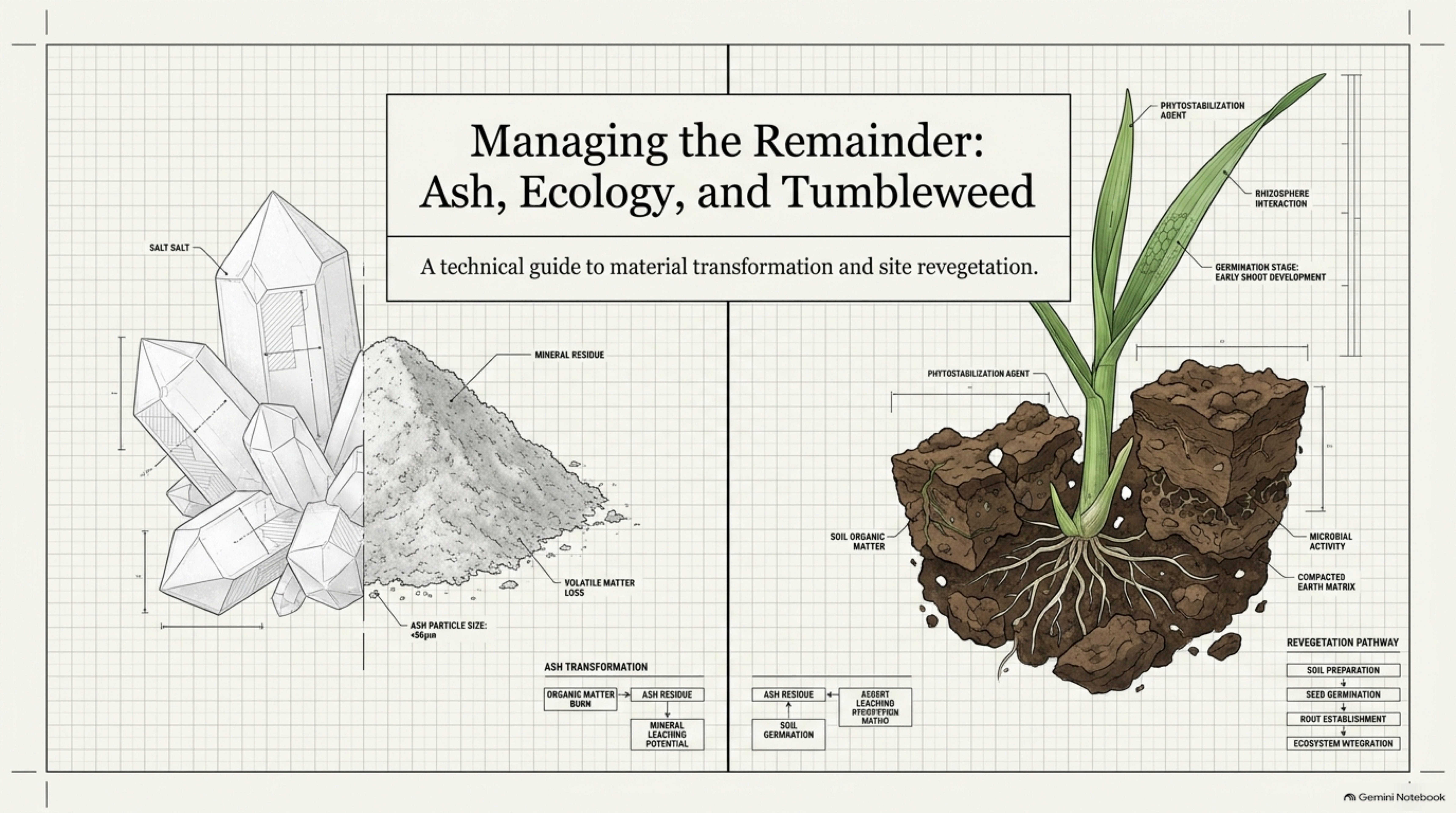
Russian thistle is often noticed after most of its life is over. A dry globe crosses a road, catches in a fence or gathers against a building. By then, the green plant that made it has nearly disappeared from the story.
This monograph begins while the plant is still rooted. It follows its identity, growth, relationships, uses and consequences through twenty-one sections. The purpose is to help farmers, gardeners, land stewards and curious readers understand what this plant can do, what people have asked of it, and which decisions the evidence can support.
A useful reading holds several things together. Russian thistle can provide living cover and forage, use substantial soil water, host insects, disperse seed and become a difficult residue to manage. Its chemistry offers research questions. Its history contains practical adaptation. None of these capacities cancels the others. Their significance depends on the plant, the place, the stage and the intended use.
The botanical focus is Salsola tragus L., also encountered as Kali tragus. Older literature uses names including Salsola kali and Salsola iberica. Some of that literature concerns Russian thistle in a broad historical sense; some concerns different plants. Those names stay attached to the records where their meaning matters. A shared common name does not make every source interchangeable.
How to use this monograph
Phase I follows the plant in its world. Begin here for identification, seasonal observation, ecological relationships and historical context. Phase II follows the plant into human and animal use, with practical decisions about forage, food traditions, amendments, materials, harvesting, economics and regulation. Phase III examines what remains uncertain and how better questions could be asked.
Readers making an immediate land-management decision should read Sections 3, 8, 13, 14 and 16 together. Identification, stage, destination and follow-up belong to the same decision. Readers interested in food or medicine should keep Sections 11–13 together; a recorded use or an active laboratory extract is not a preparation-specific safety assessment.
Evidence terms describe particular claims rather than the reputation of the whole plant. Established means the claim has strong support within its stated scope. Probable indicates a well-supported interpretation with meaningful remaining uncertainty. Plausible identifies a reasonable possibility that still needs direct testing. Speculative identifies an untested proposal. Unknown means the available evidence does not resolve the question. Historical reports and personal observations are identified as those forms of evidence, rather than being placed on a ladder toward clinical proof. Section 21 explains this approach in more detail.
This edition incorporates selected botanical, ecological, chemical, forage and regulatory research available by 15 October 2026. It is a living synthesis, not an exhaustive systematic review or a guarantee that every local rule has been checked. Links lead to the sources supporting the relevant discussion. Where a publication uses a broader species name, an experimental extract or a particular setting, that boundary remains part of the finding.
What the evidence makes useful
Recognize the plant before deciding what to do with it. Russian thistle changes markedly through the season. Tender seedling leaves, mature spine-tipped bracts and winged fruiting structures offer different information. Closely related plants and hybrid lineages complicate identification. Two convenient traits or a photograph of a dry ball are insufficient for high-consequence uses. See Sections 1–4.
Read an open patch as a question. Recruitment often follows exposed ground and favourable moisture. Traffic, cultivation, crop failure, weather and incoming seed can all contribute. The plant is a useful reason to investigate those conditions; its presence does not diagnose a single soil deficiency or prove poor stewardship. See Sections 5, 7 and 14.
Work before seed production where possible. Early action usually reduces the volume and difficulty of material handling. Plants can flower at different sizes, survive incomplete cutting and recruit in later flushes. Dry skeletons can retain viable seed for months. Stage and follow-up matter more than a universal date or a loose crown. See Sections 4, 8 and 16.
Respect both forage value and batch variability. Russian thistle has a documented forage history and a small recent feeding trial. Nitrate and oxalate concentrations vary, and young green growth is not a reliable certificate of safety. Species, ration, water, adaptation and measured feed composition matter. See Sections 6 and 11–13.
Keep ordinary residue management proportionate. Known-source plants removed before flowering can enter ordinary residue or compost decisions. Reproductive material needs seed containment. Material from contaminated ground needs a separate assessment. These are different situations, with different handling choices. See Sections 14–16.
Treat promising chemistry at the level actually tested. An enriched alkaloid fraction, an ethanol extract, whole forage, ash and an infusion are different materials. Laboratory enzyme inhibition, metal uptake and fuel tests offer worthwhile research leads. They do not establish a medicine, a field cleanup service or a profitable business. See Sections 12, 15, 17 and 19.
Leave room for attention. The most useful record may be a fixed photograph, a flowering date, a note about what returned after cutting, and a comparison with an undisturbed patch nearby. A careful observation can improve the next decision without pretending to answer every question about the plant.
Contents
Phase I The plant in its world
1 Plant Identity Snapshot 5
2 Names Language and Lineage 7
3 Identification and Look-Alikes 9
4 Botanical Character and Life Cycle 11
5 Ecological Intelligence 13
6 Animal Interactions and Ethology 17
7 Climate Resilience and Adaptation 20
8 Phenology and Working Calendar 21
9 History Folklore and Cultural Memory 23
10 Traditional Ecological Knowledge and Stewardship 25
Phase II The plant in human and animal hands
11 Food Medicine and Human Use Traditions 28
12 Chemistry Nutrition and Functional Compounds 33
13 Safety and Responsible Use 37
14 Regenerative Agriculture and Land Applications 40
15 Homestead and Material Uses 44
16 Harvest Processing and Preservation 48
17 Economics and Practical Value 51
18 Legal Regulatory and Access Notes 53
Phase III The honest edges
19 Research frontiers and open questions 57
20 Speculative symbolic and relational perspectives 64
21 Sources confidence and citation architecture 67
Sections and source links are clickable in the digital editions.
Phase I The plant in its world
Identity, life history, ecological relationships, animal use, seasonality and cultural memory.
This account follows Salsola tragus as accepted by Kew’s Plants of the World Online. Older publications often used a broader Russian-thistle concept. Where that uncertainty affects a result, the name used in the original study remains visible.
The confidence words describe the particular claim: Established, Probable, Plausible, Speculative or Unknown. They do not rank cultures or substitute for identifying the evidence. A historical account can establish that a practice was recorded while leaving its effectiveness unknown. A successful experiment can establish a response under its conditions while leaving its field importance uncertain.