

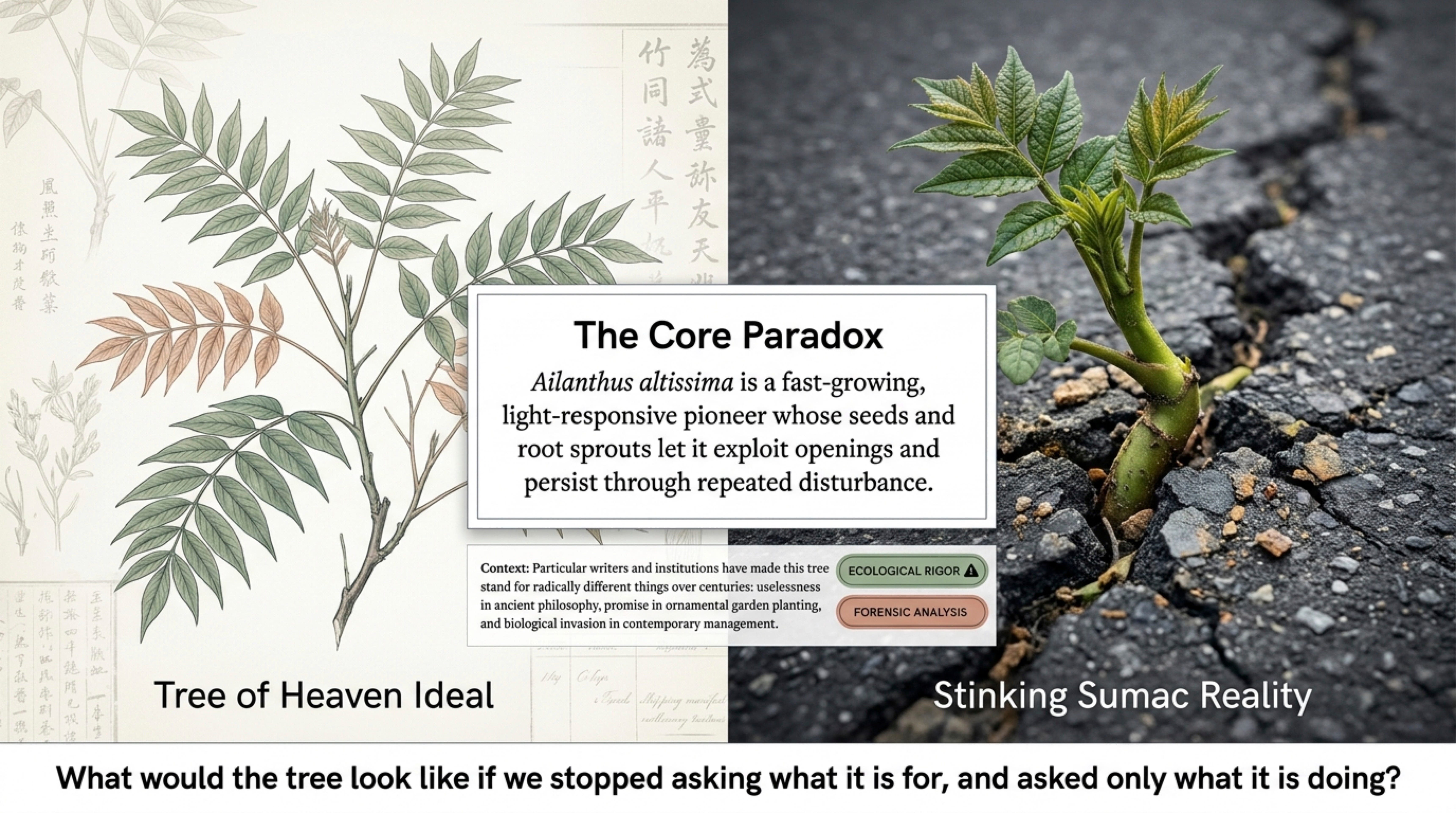
It’s late October, and the tree of heaven at the edge of the gravel turnout looks almost tropical in the wrong season: leaves nearly as long as your arm, yellowing leaflet by leaflet, and above them the seed clusters going from red-gold to tan, each seed set in the middle of a twisted paper wing. Some of those clusters may still be hanging after the first snow.
Down in the mown strip, a small stem has come up. It might be a seedling. It might be a shoot from a root running back under the gravel to the tree you’re looking at. Standing there, you can’t tell, and that’s the whole difficulty: before you decide anything about this tree, you have to find out how much of it is there.
If you farm: cut one down and see what you bought. Two years after a tree-of-heaven harvest in Pennsylvania, one stand held about 17,860 two-year-old sprouts per acre (the figure comes from the USDA Fire Effects Information System’s review of the literature). The stump did not mourn.
If you garden: the roots run long and flat and unbranched under pavement until they find better ground, and then a shoot comes up where the root surfaces. That seedling in your bed may not be one. The same review reports sprouts 15 to 27 metres from the parent tree, though that figure rests on a secondhand source.
If you forage: this isn’t the tree you’re thinking of. The spring vegetable people mean by “Chinese toon” is a different tree, in a different family, that shares one syllable of its Chinese name with this one. The record of anyone eating the leaf of this tree is thin: one line in a 1596 materia medica about lean years, a note on parboiling out the smell, and, in the same entry, a grade of slightly toxic.
If you teach: by the year 659, a Chinese materia medica was already telling this tree from its fragrant namesake by the grain of the wood, open in one and dense in the other. In 1596 Li Shizhen was still sorting the pair, by nose. Somewhere in between, the names changed hands.
If you’re only curious: an insect that feeds on this tree can carry the tree’s chemistry into a bird’s beak. In feeding experiments, birds avoided lanternflies that had fed on it.
Five doors, one room, and the room is a root system with a canopy on top.
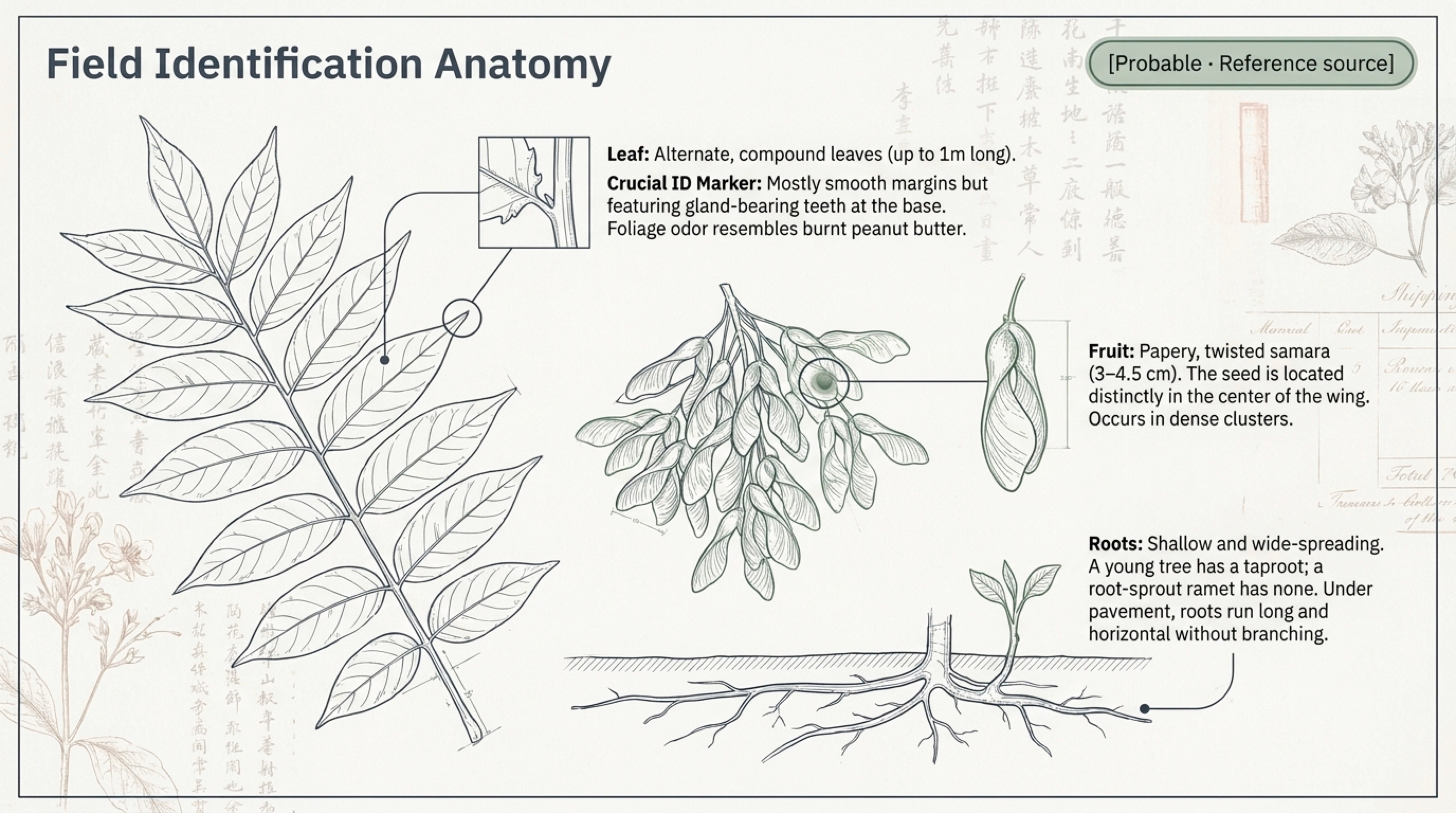
Here’s the one thing to look at. Turn a leaf over and find the base of a leaflet. Most of the edge is smooth, no teeth at all, except one or two near the base, and each of those carries a small gland on its underside. The glands are nectaries; insects visit them. Skip the folk test of crushing a leaf and sniffing (burnt peanut butter, says one extension guide). Smell is too subjective to carry an ID, and there’s sap on those stems.
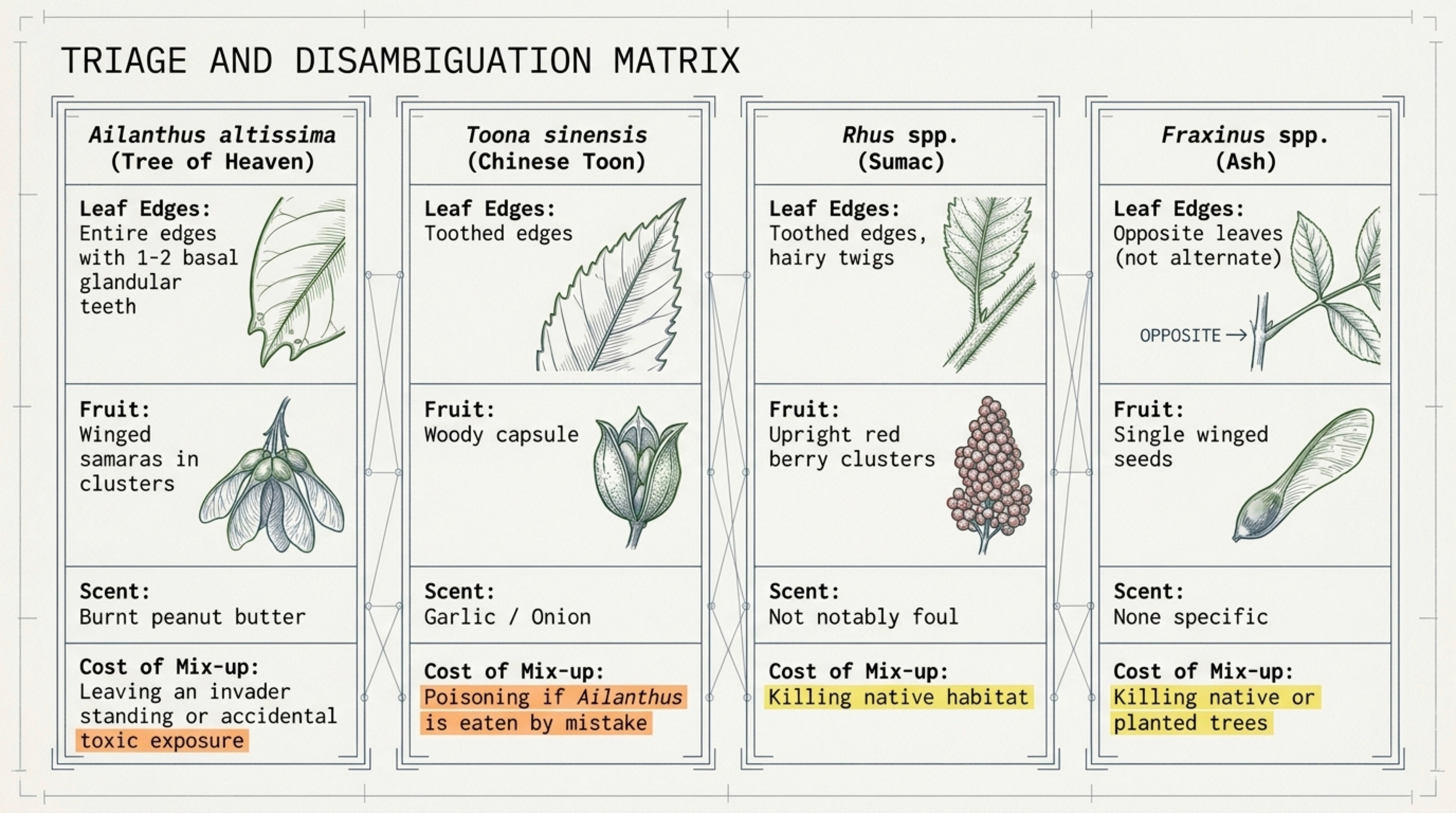
The look-alike worth your attention is the one you might eat. As the monograph’s sources describe Chinese toon (Toona sinensis), its leaf usually ends without a terminal leaflet, its leaflets lack those gland-tipped basal teeth, a crushed young leaf smells of onion rather than peanut butter, and its fruit is a woody capsule that splits into valves, not a papery samara. That description comes secondhand, from relays of the Flora of China, so check it against a flora before anything goes in your mouth. In the other direction, ash has opposite leaves and staghorn sumac has toothed leaflets and hairy twigs; mistaking either costs you a native tree.
Now the part that tells you something. A tree of heaven is a record of an opening. In Hungarian oak–hornbeam and beech forests, gap cuttings let it in where seed-bearing trees stood nearby (Erdélyi and colleagues, 2025). Across a 3,885-hectare oak landscape in Ohio, time since timber harvest predicted where it grew and how thickly better than fire history did (Rebbeck and colleagues, 2017). Under closed canopy the story splits by age: in a West Virginia forest, seedlings failed while shoots from established roots hung on for years, barely growing (Kowarik, 1995), and in a New York old-growth stand, saplings responded strongly when a gap opened (Knapp and Canham, 2000). Reference works still disagree on how much shade it can take. Light is the gate; the life stage decides who gets through.
What it won’t tell you is what your soil is like. It grows on acid ground recorded at pH 4.1, on poor calcareous soil in China, and in alkaline soil short of phosphorus; its roots will use compacted or sealed ground; and in trials on contaminated sites it takes up metals, so a tree of heaven on a mine, a sludge pit or a road verge is consistent with contamination and shows nothing either way. Read it for the one thing it does point to, that the ground was opened and light got in, and even that is a pattern, not a diagnosis. Seed pressure, moisture and past control shape it too.
The one thing to do with it this week is the safest thing there is: draw a map. Once the leaves are down and the females are still holding their clusters, walk the line. Number every stem. Mark the ones holding seed and write “fruit observed” or “no fruit observed,” never “male”: a tree without fruit might be a male, or a female too young to have set seed, and you can’t tell which by looking. Note stems that stand in a line and may share a root, without writing down that they do. Keep the map; next year’s version is your evidence. It’s a proposed method, not a field-tested one.
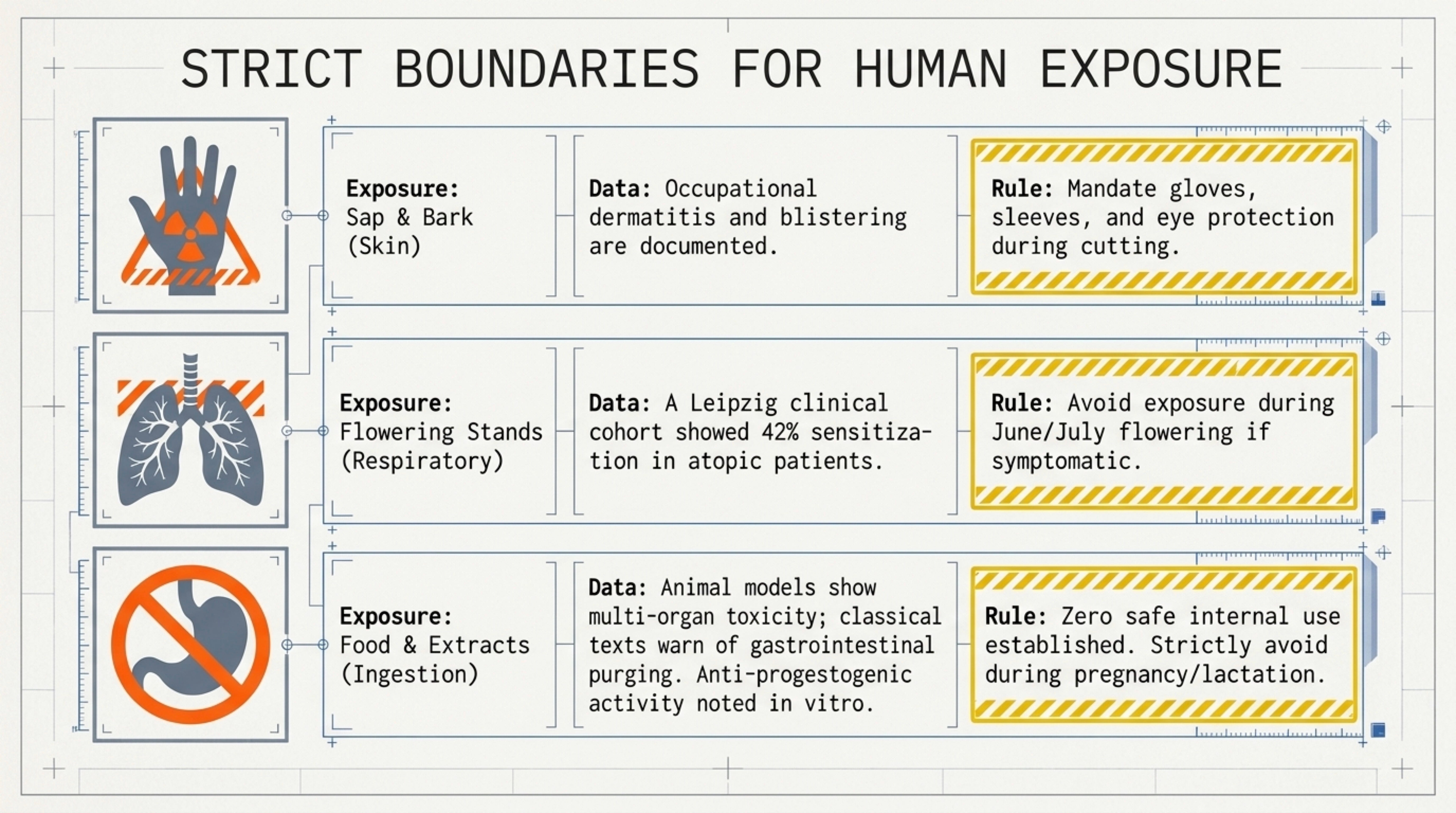
Wear gloves, sleeves and eye protection around cut stems: case reports describe tree workers with blistering contact dermatitis from the sap, and nobody has worked out how common it is or what in the sap does it. And I’m not going to hand you a way to eat it or brew it. The monograph found no established safe dose and no validated food preparation, and a lack of trials is not reassurance.
When to act, then, and when to wait. Act first on the females, because they are the seed. Don’t cut and walk away: in an Ontario provincial park, and in a comparison of hand cutting against eight herbicide treatments, cutting alone made things worse (Meloche and Murphy, 2006; Burch and Zedaker, 2003). One visit isn’t a plan, either. A river-corridor study in Arkansas followed treatment for five to eight years, and in any stretch longer than a year without a visit the tree was more likely to grow than shrink (Young and colleagues, 2020). Wait until you’re sure it isn’t an ash, a sumac or a toon. Wait until you know whose rules apply: the Regional District of Central Okanagan lists the tree, the province’s weed schedules don’t, and Naramata sits in a different district. And wait until you’ve planned for the seed before the saw comes out, because a female you’ve treated may still drop viable seed. Which method actually held up, and which one took the neighbour’s trees along with its own, is where the trials disagree, and it’s the part that costs real money to get wrong.
That’s the trouble with how we usually count this tree: we count the canopy, and the canopy is the part that grows back.
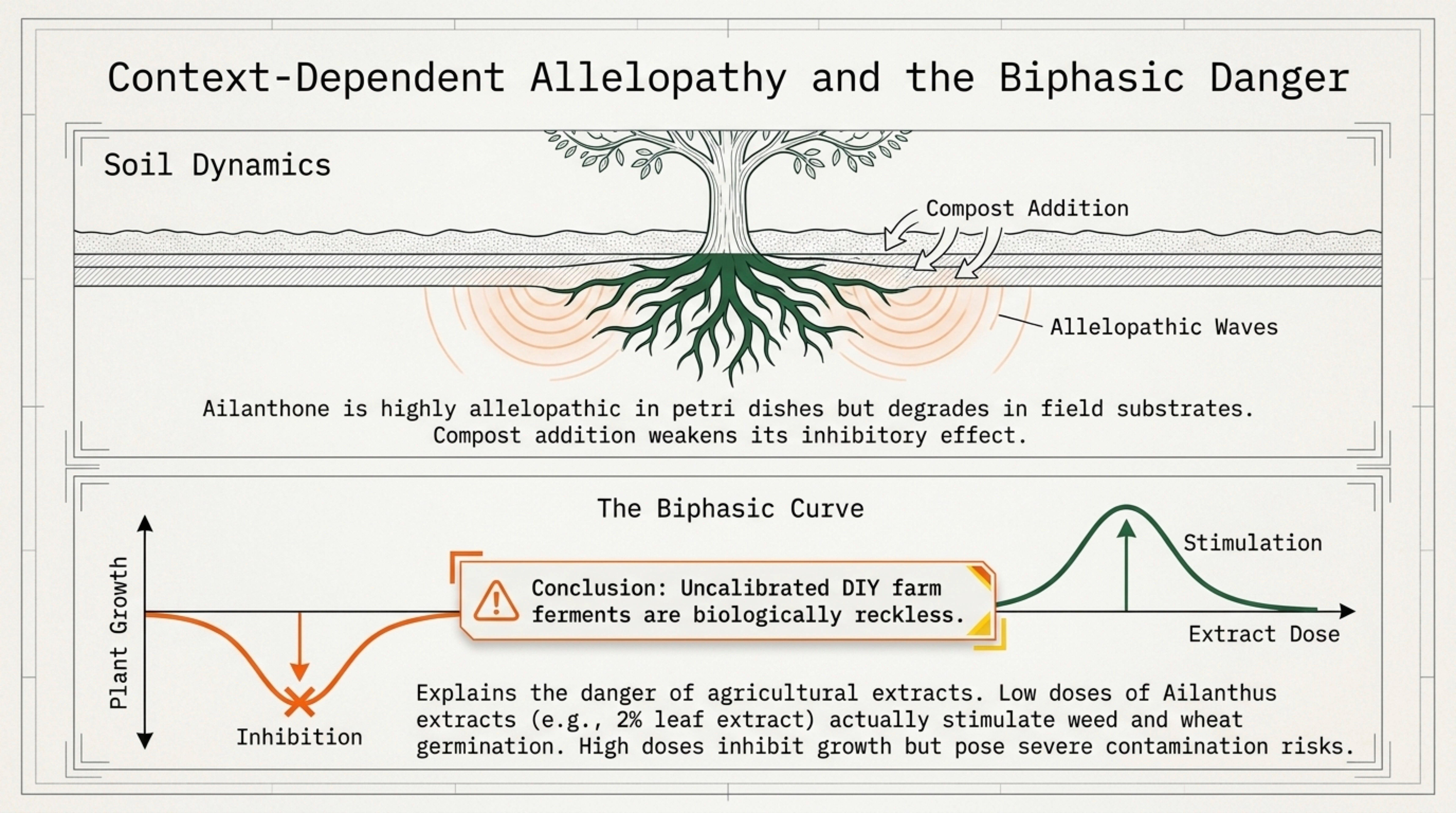
Which brings us to the question people argue about loudest, and the one the evidence is most awkward about: is the tree poisoning the ground? A compound from it will stunt seedlings in a dish. What happens in a forest, with shade and roots and leaf litter all in the mix, is much harder to say.
Behind the line: what the field evidence does and doesn’t say about your soil; which tree a thousand years of Chinese physicians were actually prescribing; what a lanternfly is doing wearing this tree’s chemistry; and what the removal trials say about ending it, and what it costs.