

Rethinking Regeneration: A Holistic Approach to Soil, Farming, and the Future
Modern agriculture has spent too much time trying to control nature—chasing yield, efficiency, and short-term gains. But in doing so, we’ve lost sight of the bigger picture. Soil degradation, synthetic dependencies, and the disconnection between human and ecological health all stem from treating nature like a machine instead of a living, evolving system.
What if, instead of imposing solutions, we learned from nature? What if the key to regenerative agriculture wasn’t about swapping inputs but about understanding the relationships that actually sustain life? What if we stopped seeing ourselves as managers of the land and instead became stewards, listeners, and participants in nature’s own regenerative processes?
That’s the approach I’m exploring—a way of farming that looks beyond conventional wisdom, weaving together indigenous knowledge, microbial intelligence, fermentation science, and holistic knowledge from various modalities to restore soil and heal our relationship with the land.
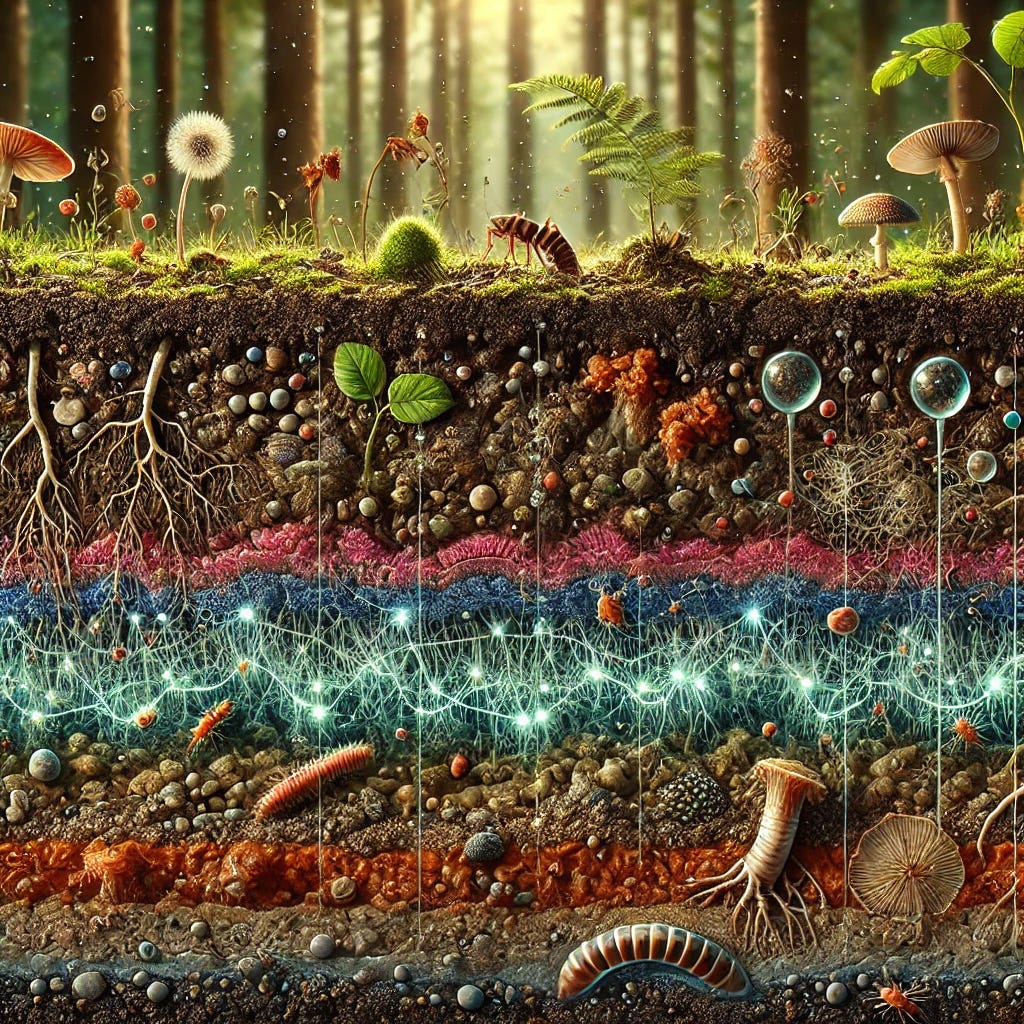
Farming as a Living System
Most organic and regenerative efforts focus on swapping out synthetic inputs for "natural" ones. But nature doesn’t work in replacements—it works in relationships. That’s why my approach isn’t about quick fixes or one-size-fits-all solutions. It’s about understanding the interconnections that build soil health, plant resilience, and even human well-being.
The real power of regeneration is in symbiosis, microbial intelligence, and the unseen forces that drive growth and decay. Nature has already designed perfect feedback loops—we just need to stop disrupting them and start working within them. That means focusing on fungal networks, microbial diversity, and dynamic ecosystems that can self-correct over time.
Some key questions I want to explore:
What role do native plants play in building long-term resilience in farming systems?
Can fermentation techniques enhance soil life the way they preserve food and boost human gut health?
What happens when we stop trying to accelerate nature and instead sync with its natural timelines?
How do we build farming systems that regenerate land and sustain production in a changing climate?
How do fungal networks and soil microbes mirror the human gut microbiome, and what does this teach us about soil and human health?
Bridging Science, Tradition, and Unexplored Frontiers
This work isn’t about blindly following tradition or chasing every new scientific breakthrough. It’s about finding where traditional knowledge and modern science align, where regenerative practices overlap with microbiology, and where nature’s rhythms reveal solutions that industrial agriculture has ignored.
More importantly, it’s about testing, refining, and applying these ideas on the ground. Theory only gets you so far. My goal is to build systems that actually work, not just in a lab or on paper, but in the field.
That means:
Making DIY regenerative amendments with fermentation, native plant extracts, and microbial inoculants.
Mapping soil microbiology to better understand its connection to plant health and ecosystem stability.
Testing natural aerated ferments to see how they support fungal-rich soils and microbial diversity.
Rethinking how vineyards and orchards are designed so they can thrive without synthetic inputs.
Creating a step-by-step roadmap for farmers looking to transition from conventional to regenerative systems.
Exploring the bioenergetics of plants—the unseen influence of soil health beyond just chemistry.
Closing the food waste loop using black soldier flies, worms, fungi, and microbial decomposition to cycle nutrients back into the land.
Where This is Headed
This journey isn’t about promoting a single ideology or pretending to have all the answers. It’s about testing, refining, and sharing an approach to regeneration that’s grounded in both science and tradition. It’s about uncovering forgotten knowledge, proving what works through real-world application, and making it accessible so others can do the same.
Through SubStack, videos, field trials, and hands-on workshops, I’ll be sharing what I learn—not to dictate solutions, but to provide a framework that others can adapt to their own land and needs.
Because ultimately, regeneration isn’t a formula. It’s a conversation—one that we need to have if we’re serious about building a future where both land and people thrive.
If this resonates with you, follow along. Let’s reimagine what’s possible.
Nice! Doing similar work over here, too. I’ve been really enjoying finding similar patterns between human health and soil health. The more I learn about each system, the more parallels I’m finding between the two (the land I steward gets healthier, and I seem to get healthier along with it!).
Looking forward to what you discover around the fermentation piece! Also hoping to improve my composting systems and bring in some BSF as part of that. 🙌 🪰
You look at the title image and ask yourself:
“Why is it so difficult to understand that Earth’s skin is as much of an organ as our own?”
Earth’s skin needs healing. Tender, love and care.